




Abstract
Museums are multimodal environments where semiotic resources including objects, space, sound, light, movement, language and the body converge. Our case study of a Taiwanese ceramics exhibition draws on the concept of ‘affective affordances’, meaning the socially and contextually informed ways that semiotic resources invite felt and embodied responses. We use this concept to investigate the ways in which texts and space co-construct affective meanings. We discuss texts and space as physical entities within the affective exhibition, each possessing intrinsic properties which can potentially stimulate certain embodied responses from visitors. Specifically, the case study addresses two questions: (1) how written texts within an exhibition interact with space to afford affective meaning potential; and (2) how museum visitors as active participants respond to space and text as affective stimuli. The study adopts a novel composite theoretical framework that combines spatial discourse analysis using the Binding framework, linguistic analysis using the Appraisal framework, and walking interviews. Our analysis provides rich empirical evidence of how space and written texts interact to create a felt sense of place for visitors.
Setting the scene: Affective affordances in the museum
Museums are immersive multimodal environments, where semiotic resources such as objects, space, sound, light, movement, language and the body converge. In such multimodal environments, museum visitors are exposed to and interact with a wide range of such resources, which all play a constitutive role in creating the “unique temporal-spatial dramaturgy” (Liao, 2016) of the museum experience and environment. And the museum experience is inherently an affective one: it has been widely recognised in recent years that museums and heritage sites are “places where visitors go to feel” (Smith, 2014: 125).
Within Museum Studies, researchers have analysed the ways in which museums prompt affective responses from visitors (e.g., Boyd and Hughes 2020; Waterton and Dittmer 2014), and there has been particular focus on the role of space in shaping visitors’ felt responses (McMurtrie 2017; Stenglin 2008). Research has also shed light on the interaction between visitors and verbiage in the museum (e.g., Blunden 2020; Ravelli 2006). However, there has been little investigation into whether or how written museum texts, such as labels, contribute to visitors’ affective responses. The current paper draws together these strands of research to explore the role played by written texts within a case study exhibition in creating an affective experience for the visitor. Specifically, our paper addresses two questions: (1) how written texts within an exhibition interact with space to afford affective meaning potential, and (2) how museum visitors as active participants respond to space and text as affective stimuli.
By ‘text’, here we mean written verbiage, and in this case study we focus on interpretive labels. As Ravelli writes, it is important to distinguish between research that approaches the museum as an integrated, multimodal text and research that focuses on “the language produced by the institution, in written and spoken form, for the consumption of visitors”, which she calls “texts in museums” (2006: 1, emphasis added). Our study takes the latter approach to investigate the specific role played by verbiage, alongside space, in the wider ‘affective assemblage’ (Waterton and Dittmer 2014) of the museum. Both text and space have their own specific affective affordances, and as we demonstrate in this paper, visitors may experience the exhibition differently depending on how they interact with those specific affordances.
The term ‘affordance’ refers to what an environment offers to the human or non-human animals who exist in it, and how that environment facilitates certain behaviours and constrains others (Gibson 1979). This concept has also been taken up in social semiotics, where Kress (2010) emphasises that affordances are not fixed, universal or static but dynamic and socio-culturally contingent. Museum environments afford a range of behaviours: quiet contemplation in an art gallery, for example, or excited engagement with interactive displays in a science museum. Individual visitors may take up the invitations offered by the environment to a greater or lesser extent, or may resist them: children running and shouting in a quiet exhibition are still subject to the same affordances as others, but respond differently.
Drawing on the concept of affordance, Westberg (2021) proposes ‘affective affordances’ as a description of how semiotic resources prompt affective responses. He approaches affect as a situated, contextual and relational practice, where the feeling body of the reader (or visitor) responds to stimuli. Framing affect as practice enables recognition of its social nature: individual responses occur within socio-cultural frameworks that establish affective patterns, although resistance to, innovation within or subversion of these patterns is always possible (Reckwitz, 2017; Wetherell, 2012). Cognition and discourse are not seen as separate from affect but as integral components of feeling. This stands in contrast to nonrepresentational theories of affect (e.g., Massumi, 1995), which position the feeling body as buffeted by pre-cognitive, pre-discursive intensities. 1
Affective affordances, then, are the socially and contextually informed ways that semiotic resources invite felt and embodied responses. This approach to understanding affective engagement with an object, text or environment is ideally suited to the study of museums: it is flexible and open-ended, and facilitates inclusion of the wide range of meaningful elements present in the museum.
To explore the question of how visitors engage with the museum as an affective environment, a case study was carried out at 新北市鶯歌陶瓷博物館New Taipei City Yingge Ceramics Museum, abbreviated to 陶博 TaoBo. The town of Yingge was a key site of ceramics production in Taiwan for much of the 20th century, and the TaoBo was established there in 2000 as a museum of both local culture and ceramic art (Muyard, 2009). Within the museum, we chose to focus on the permanent exhibition titled 硘仔鎮, ‘Pottery Town’ because of its unusual spatial layout and vivid, detailed written labels, which we considered likely to evoke affective responses in visitors.
Analytical framework
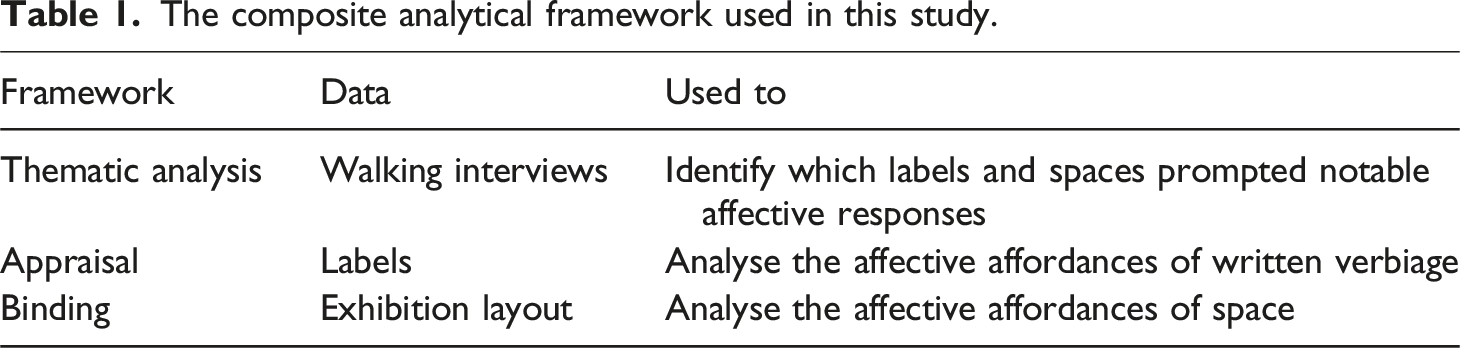
This section details the combination of ethnographic and multimodal social semiotic methods that we employed to investigate the affective affordances of space and text at the TaoBo. These methods comprised a thematic analysis of semi-structured walking interviews (Braun and Clarke, 2022), a linguistic analysis of the exhibition labels using the Appraisal framework (Martin and White, 2005) and a spatial discourse analysis of exhibition layout and design using the Binding framework (McMurtrie, 2012; Stenglin, 2008). Appraisal theory is situated within Systemic Functional Linguistics (SFL; Halliday and Matthiessen, 2004), and Binding adapts the core concepts of Appraisal to expand the framework from the linguistic to the spatial mode of communication. Their shared social semiotic orientation allows these frameworks to effectively complement one another, enabling a cohesive analysis of how both verbiage and space may pose an “invitation to share feelings” (Martin, 2004: 329).
Museum wayfaring: Walking interviews
Walking interviews constitute an emplaced ethnographic method, aimed at capturing a participant’s perception of the environment. Some walking interviews, known as ‘go-alongs’, involve a researcher accompanying the interviewee on ‘natural’ outings to places they would visit anyway (Kusenbach, 2003); others take place at a time and place set by the researcher (Hitchings and Jones, 2004; Madsen, 2017). Both styles establish a relationship between the participant, researcher and place. Evans and Jones (2011) found that the walking interviewees spoke drastically more about their relation to the surrounding place, with less prompting from the interviewer than those interviewed while sitting down.
With this in mind, our study carried out in June 2022 employed walking interviews to investigate visitors’ perception of the Yingge exhibition as a “spatial storytelling place” (Kim, 2020: 555), that is, how the room layout, the route and the sequence of the display evoke continuous affective encounters. Walking interviews allowed us to examine the ways visitors’ embodied responses were elicited by specific semiotic resources situated at particular locations in the exhibition room. The interviewees were native speakers of Taiwanese Mandarin, six female and two male, aged between 22 and 27; they were all students recruited through a university in Taipei. All names are pseudonyms.
Participants first visited the exhibition without the researcher, then they guided the researcher around the exhibition and discussed whichever objects, spaces, or labels they chose to focus on. The conversation was recorded, and the researcher photographed the objects, labels or spaces that they mentioned. Interviews were transcribed, then the data underwent a process of thematic analysis (Braun and Clarke, 2022). Among the themes generated during this analysis, space and verbiage stood out as key affective stimuli. We used these results to identify particular spaces and labels which appeared to prompt affective responses. We then focused our Appraisal and Binding analyses on those spaces and labels.
Interpersonal language: Appraisal
The written texts were analysed using the Appraisal framework developed by Martin and White (2005), which deals with linguistic evaluation. The framework involves three systems: Engagement, Attitude and Graduation. 2
Engagement is based on Bakhtin’s concept of dialogism (Bakhtin and Holquist, 1981), which holds that all verbal communication is in dialogue with past instances of language as well as with a reader or listener (cf Martin and White, 2005: 92). The Engagement system assesses whether an instance of language acknowledges these other voices (heteroglossia) or makes a bare assertion (monoglossia).
Expressions of opinion, or Attitude, fall into three categories according to the target of the evaluation: Affect, Judgement and Graduation. Affect evaluates an emotional state (e.g., ‘in/security’, ‘un/happiness’ and ‘dis/satisfaction’), while Judgement evaluates behaviour (e.g., ‘normality’, ‘capacity’ and ‘tenacity’) and Appreciation evaluates objects or phenomena (2005: 71). Attitude can be either inscribed (explicit) or invoked (implicit).
Graduation (Martin and White, 2005: 137–154) addresses the ways in which evaluation can be intensified or moderated. Evaluation can be upscaled or downscaled in terms of its Focus, which describes its prototypicality (e.g., ‘a true musician’) or its Force, which covers both quantity and intensity. Quantification can be further divided into Number (‘heaps of books’), Mass (‘a gigantic orange’), and Extent, which can be considered in terms of temporal or spatial Proximity (‘ancient history’) or temporal or spatial Distribution (‘widespread excitement’). Intensification resources up- or downscale the vigour of a Process (‘amble’ compared to ‘stride’) or the degree of a Quality (‘pretty’ compared to ‘stunning’). Finally, repetition can also function as graduation, either of Force (‘hot hot weather’) or of Focus (‘he’s not a doctor-doctor’).
Interpersonal space: Binding
The Binding framework (Stenglin, 2004, 2008; 2009a; 2009b) is a social semiotic model which adapts the basic premises of the Appraisal framework to analyse how interpersonal meanings are made by three-dimensional space. Drawing on Martin and White’s Affect category, Binding proposes that affective meaning-making potential in space is linked to feelings of security evoked by openness or restriction (Stenglin, 2009b: 42–43). Both more-open (Unbound) and more-closed-in (Bound) spaces can evoke feelings of security, while a space that is either Too Bound or Too Unbound can create insecurity. For example, an expansive, high-ceilinged gallery room might be Too Unbound, creating feelings of vulnerability, while a narrow, enclosed space such as a lift might be Too Bound, creating a sense of restriction. Colour also plays a role in Binding: warm colours such as red “appear to advance” towards the viewer, increasing the perceived boundedness of the space, while cool colours such as white tend to construct relatively Unbound spaces (Stenglin, 2004: 375).
Individual and cultural factors also influence how the meaning potential established by space is realised within the feeling body of each visitor to that space (Stenglin, 2008: 426–28) Figure 1. Binding scale, adapted from Stenglin (2008).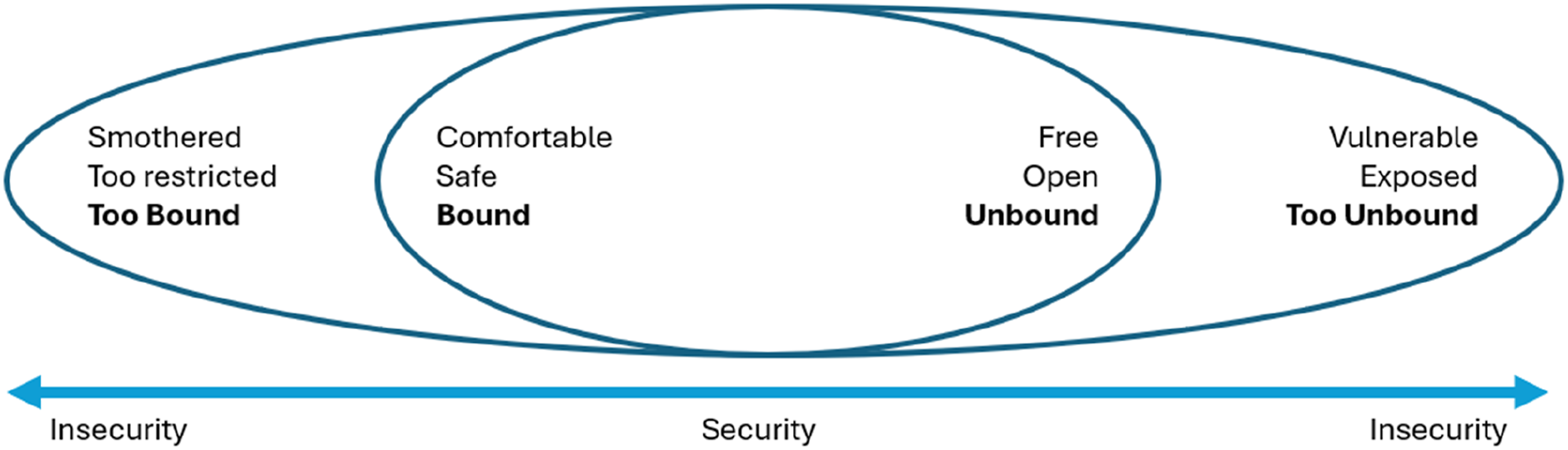
In terms of dimension, Binding occurs on vertical and horizontal planes. In the built environment, walls usually form the vertical plane, and the floor and ceiling form the horizontal plane. Insecurity can be created on both planes through openness or restriction, and it can also be created on the horizontal plane by factors such as unevenness underfoot (Stenglin, 2004: 139). Stenglin notes that perception of Binding can also relate to the change experienced when moving, for example, from a narrow, strongly Bound entranceway into an Unbound atrium (Stenglin, 2008: 440). Gradual shifts can ease visitors into a sense of comfort in a space that would otherwise have been experienced as Too Bound or Too Unbound, while sudden changes in Binding may create added insecurity (McMurtrie, 2012).
Affective affordances in the exhibition: A unified analytical framework
The composite analytical framework used in this study.
Binding: The affective affordances of space
This section describes the layout of the Pottery Town exhibition and the two routes which visitors could take when walking through it. Then, a Binding analysis is presented, which details the affective affordances of the exhibition layout, and identifies the different affordances experienced by visitors on the two different paths.
The Pottery Town exhibition is located on the first floor of the TaoBo. There are two entrances leading from the corridor into the exhibition. Most interviewees entered through the model kiln, following the route shown on the map in Figure 2. However, there is also an open entrance which circumvents the kiln. Exhibition map, with usual visitor route indicated (not to scale). Map by the authors.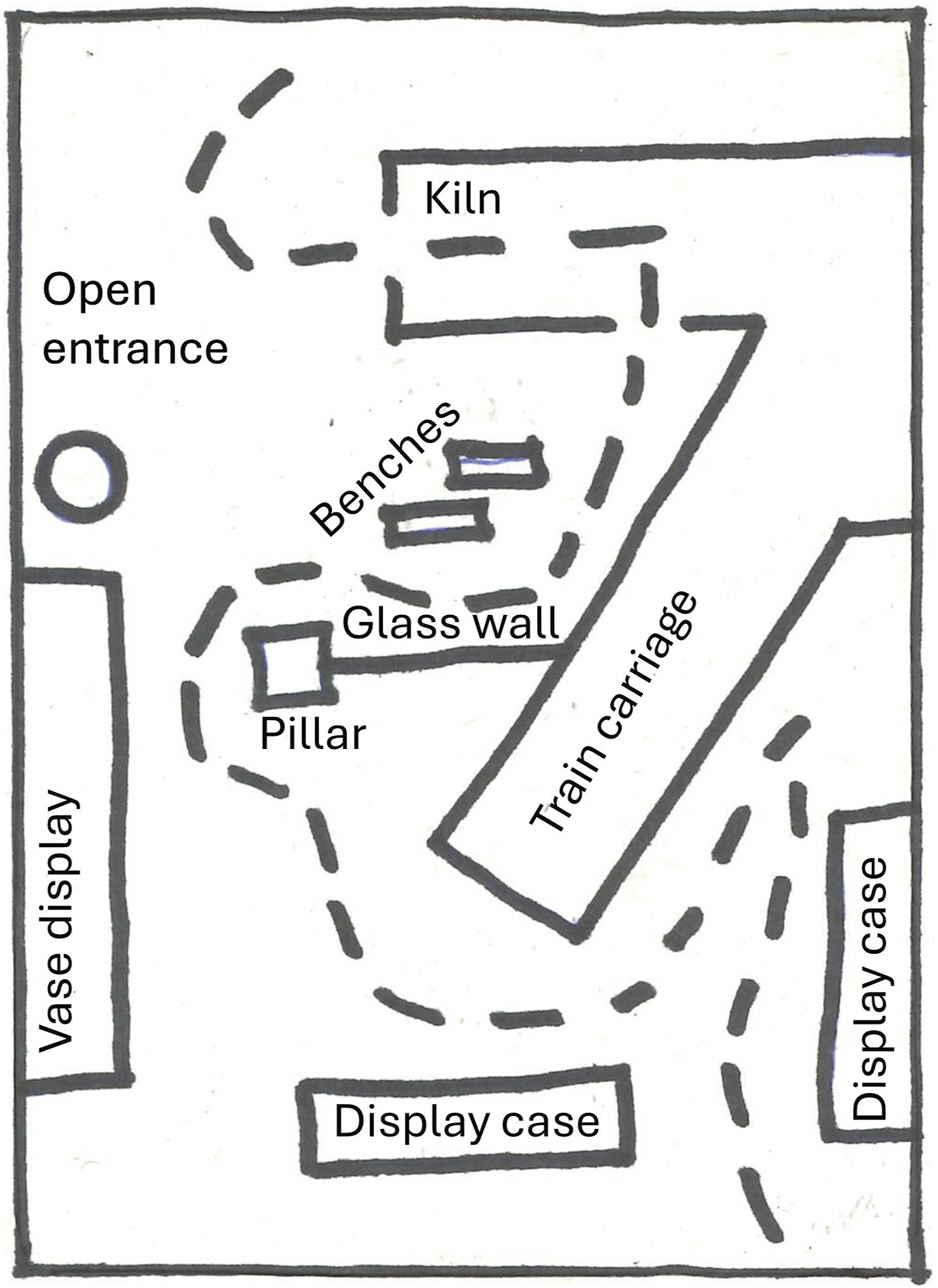
Moving through the kiln involves going from the relatively open, Unbound corridor into the strongly Bound space of the kiln. The kiln is narrow, with a low, arched ceiling. It is dark, and glowing, reddish lights simulate the fire of a real kiln. At the far end is a cart stacked with pottery tiles. Visitors walk towards the cart and exit through an archway on the right-hand side. This exit is L-shaped and prevents any light from entering the kiln through the archway, which means that when visitors enter the kiln it may not be immediately obvious where the exit is (see Figure 3, left-hand photograph). This apparent dead end increases the sense of confinement. The interior of the kiln (left) and the exit (right). Photos by the authors.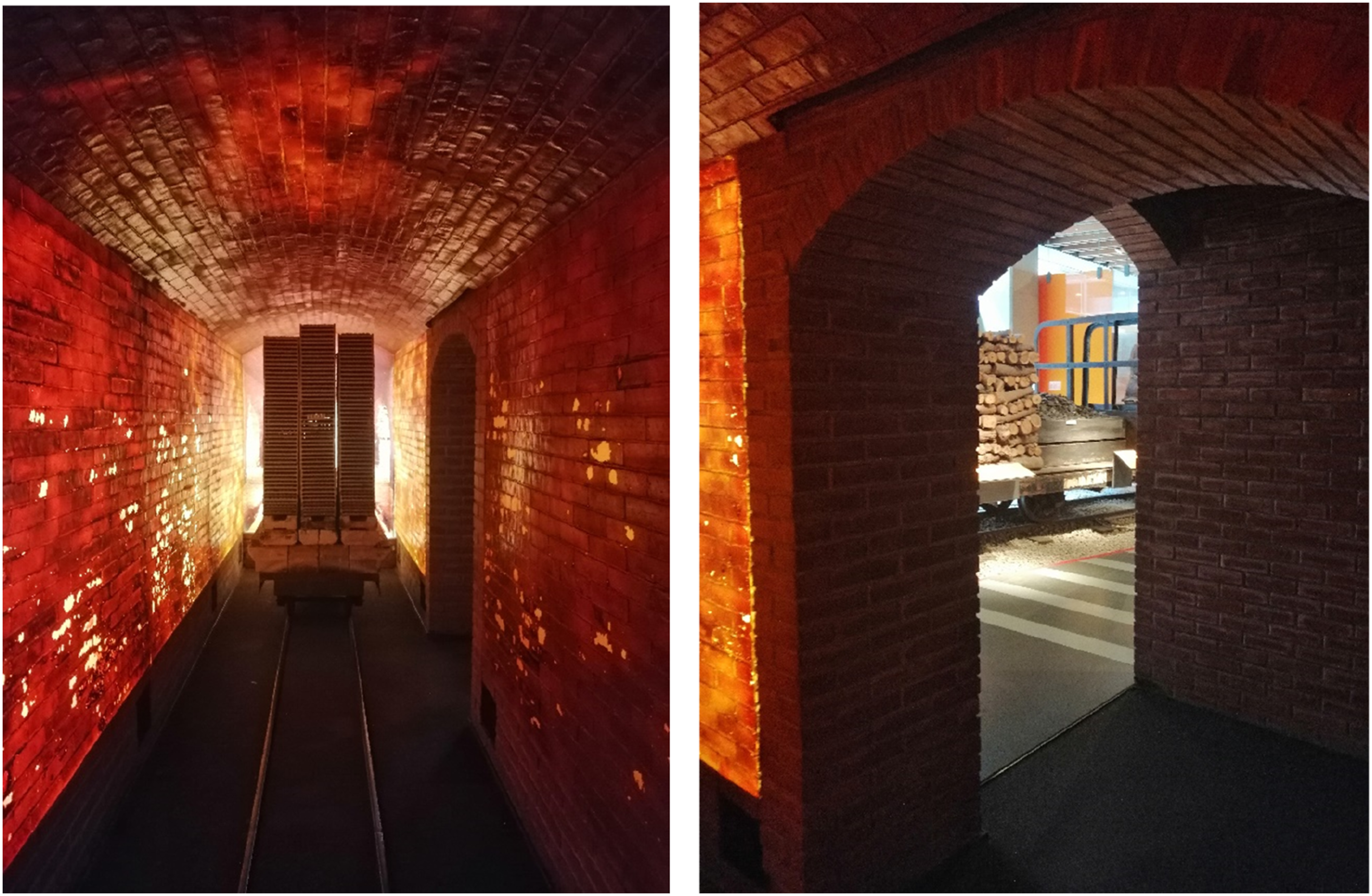
The narrow space and low ceiling create a strongly Bound space. This is emphasised by the predominance of red. Dark, warm colours such as red increase boundedness by appearing to advance towards the viewer. Finally, there is also some insecurity underfoot: the cart rails are set into the floor, and visitors must take care not to stumble. Stenglin (2008) emphasises that “the base plane is extremely important to the sense of security a person experiences in a space, as it represents their most concrete and physical point of contact with the earth below” (p. 430).
The uneven base plane and strongly Bound space create a sense of insecurity. Interviewees宜蓁Yi-chen and 承恩 Cheng-en both described the kiln as 恐怖[frightening], and 詠晴 Yung-ching qualified her initial startled response: 然後從這邊走進來是有嚇到因爲它旁邊- - 我說的嚇到不是驚嚇, 只是, 哇, 就是它用的好像是真的, 然後這個是第一個我很喜歡的地方。 Then walking in from here there’s a shock because this bit is - - when I say shock I don’t mean like being scared, it’s just, um, just it seems like it’s using real things, so this is the first place that I like.
Here it seems that the affective impact of the Bound kiln space contributes to an embodied sense of experiencing something real. 柏翰 Pai-han initially struggled to put this into words, but then arrived at an explanation: 它就是比較, 進去會比較, 那個, 該怎麽說, 嗯, 就是感覺自身在那個真實的窯裏面, 當然我們在實際情況不可能進去, 會被燒死。[笑] […] 我們來到了一個我們平常不會來到的地方, 這叫做- - 然後有一個全新, 不同的感受, 是, 這個有一個專有名詞叫那個異質地志感。然後就有這種感受, 然後我們可能就會受這樣的感受去吸引, 繼續觀看接下來的東西。 It’s just quite, going in is quite, like, how can I put this, um, like you feel like you’re really inside an actual kiln, of course we could never go into one in real life, we’d be burned to death (laughs) […] we come into a place we usually can’t come into, this is called - - and there’s a whole new, a different feeling, it’s, there’s a technical term for this, it’s the feeling of a heterotopia. Then there’s kind this kind of feeling, and we can have this feeling and it attracts us to continue looking at the things that come next.
柏翰 Pai-han used the concept of a heterotopia, an ‘other space’ which represents, distorts and contests the real spaces outside it (Foucault, 1986), to explain his experience of insecurity inside the kiln. Pai-han’s sense of displacement is key for his interaction with the exhibition, as it sparks an interest in exploring further.
Insecurity resulting from high, or quickly varying, levels of Binding can create an uninviting space (McMurtrie, 2012), but that does not seem to be the case here: the interviewees are impacted by the strong Boundness, but they experience the Bound stimulation as excitement rather than as distress. 承恩 Cheng-en specifically described this shift in Binding as part of what drew him into the exhibition: 我覺得它在進去剛開始覺得恐怖, 然後後來發現它只是一個窯而已, 然後這個也是, 我覺得它視覺上就是一個很憧憬, 然後就會記得, 哦, 鶯歌可能以前會長這樣子。[…] 然後, 可能它[展覽空間]比較特別大, [笑] 跟前面那個比, 然後就會覺得誒, 很有想像空間, 想像以前的生活[…] I think when you first start going in you think it’s frightening, then you realise it’s just a kiln, that’s all, and this is also, I think visually it’s very attractive, so you just remember, um, Yingge might have been like this back in the day. […] Then, maybe it’s [the main exhibition space] just especially big in comparison (laugh) compared to before, then you just think, eh, you really imagine the space, imagine what life was like before […]
Once 承恩 Cheng-en leaves the kiln and moves into the “especially big” space of the main exhibition, he is able to vividly imagine Yingge’s history. Like 柏翰 Pai-han, the Binding relations draw him into the exhibition. There is a striking contrast between these interviews and the experiences narrated by 鈺婷Yu-ting, the only interviewee who went into the exhibition through the open entrance rather than through the kiln. Her route, shown in Figure 4, took her along the far wall of the room. Map showing 鈺婷Yu-ting’s route (not to scale). Map by the authors.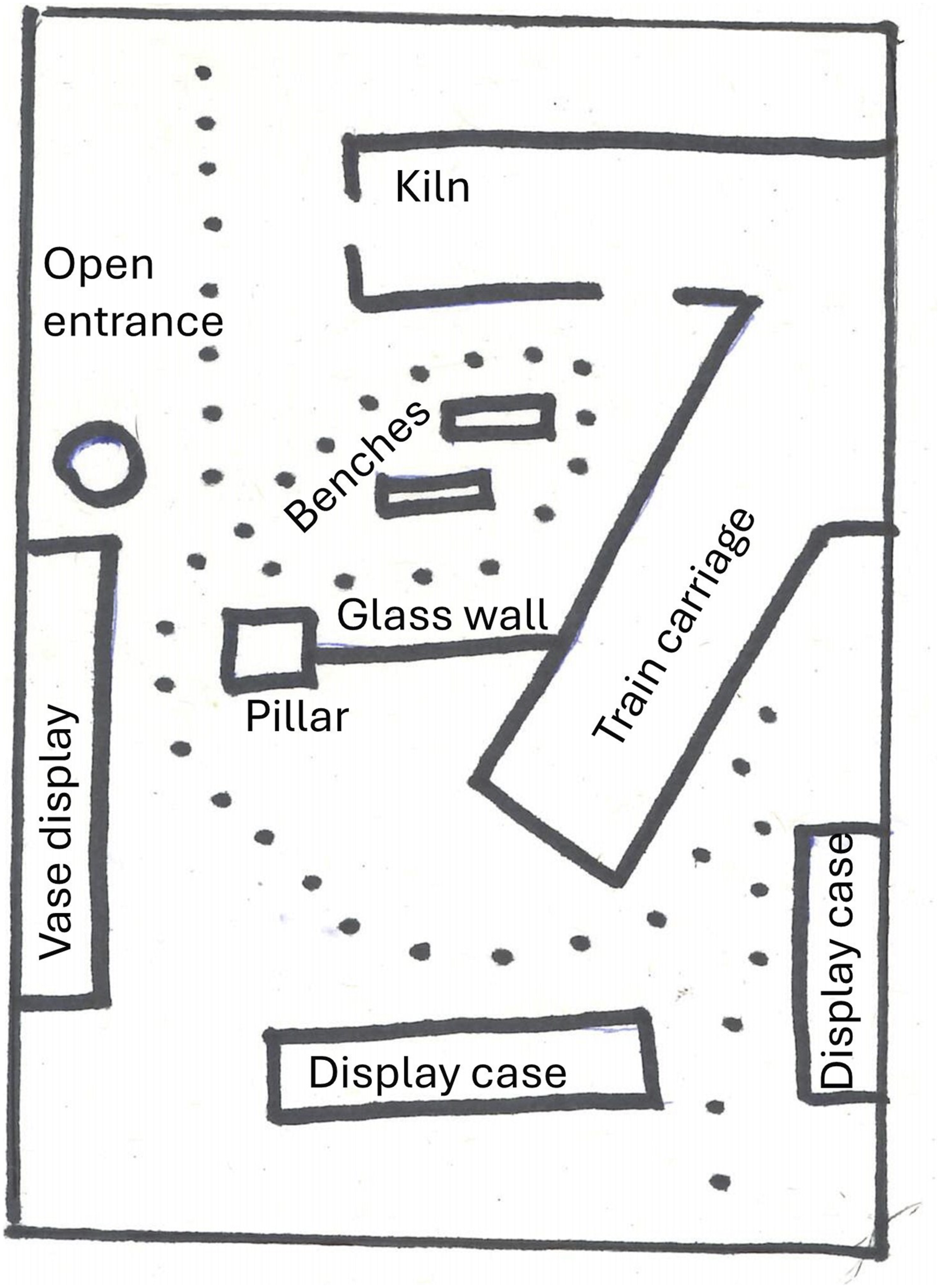
鈺婷Yu-ting noticed a label on the wall with details about four historical figures, but she did not read it as she did not recognise them and did not feel interested. Instead, she moved towards the vase display, which she found visually attractive though not particularly emotive.
鈺婷Yu-ting’s route did not take her through the same drastic shifts in Binding as the route through the kiln. She was not immediately drawn into an affective connection with the exhibition in the way that 柏翰 Pai-han and 承恩 Cheng-en were.
However, she then arrived at the central pillar (see Figure 5). On the opposite sides of this pillar are two poems. One describes a travelling peddler selling ceramics in the street pre-industrialisation, and the other describes families and friends working together in a post-industrialisation ceramics factory. 鈺婷Yu-ting finds these texts 感動 [moving]. She describes her interaction with the labels as follows: 在看到這兩段文字之前, 我只是覺得這些東西很漂亮。但我好像還沒有進到鶯歌的感覺。對。然後所以我就是看完了這個文字之後, 我才去看那邊的東西。對。所以我看完了這個文字 - - 因爲它在說這個, 賣陶瓷的人, 他的一些心裡的歷程, 然後就覺得哦, 好, 那我想來看一下。 Before I read these two texts, I just thought that these things were very pretty. But I didn’t seem to have that feeling yet, of going into Yingge. Yeah. And so then it was only after I’d read the texts that I went to look at the things over there. Yeah. So after I’d read the texts - - because they talk about the, the person selling pottery, some of what’s going on in his mind, and so I just thought oh, okay, well then I’d like to have a look. The spatially evocative route (left) and the textually evocative route (right); stars indicate the position where the visitor initially felt a sense of place (not to scale). Maps by the authors.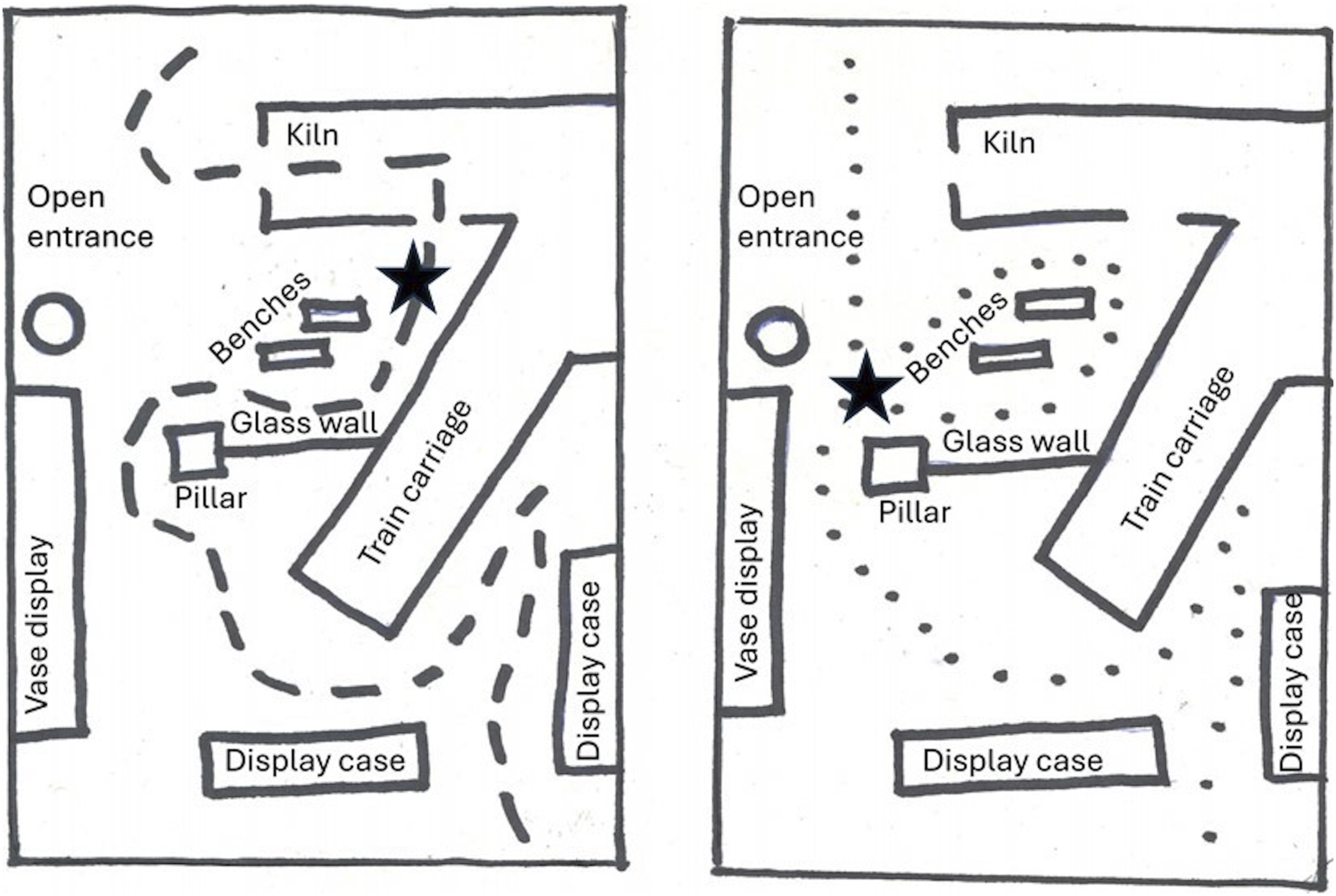
For participants who entered through the affective space of the kiln, the shift from an enclosed, Bound space to the open, Unbound exhibition room allowed them to feel transported into Yingge’s past. However, for 鈺婷Yu-ting, the written label performed the same transportive function, allowing her to feel a connection to Yingge’s history.
Appraisal: The affective affordances of text
In this study, Appraisal analysis has been used to analyse all labels which appeared to prompt affective responses, based on the interview data. Here we present the analysis of the poem 鈺婷Yu-ting spoke about in most detail. This poem functions as an affective portal, allowing 鈺婷Yu-ting a path into a felt connection with Yingge’s past. This positioning is made possible by the affective affordances of the text.
The Mandarin label reads as follows (accompanied by an English translation provided by the authors): 一鄉鎮、一鄉鎮, A village, a [nother] village, 沿街叫賣, Crying wares along the streets, 時而急行, 時而徐行。 Now hurriedly walking, now gently walking. 一根扁擔, 兩個簍子, One carrying pole, two baskets, 一邊是兩老的叮嚀, One side is two elders’ worried exhortations, 一邊是妻小的渴盼。 One side is wife and little ones’ eager hopes. 挨家挨戶, 販售的是我燒築一窯的夢。 House after house, what is sold is my fired kiln of dreams. 坐船也好, 搭火車也罷, Whether travelling by boat or taking the train, 擔不離肩、肩不離擔, Pole does not leave shoulder, shoulder does not leave pole, 慢慢長路是我遂行理想的唯一伴侶。 Slow-slow long road is, as [I] pursue [my] aspirations, my only companion. (古早歲月沿街叫賣) (crying wares along the streets in the olden days)
There is very little inscribed Attitude here. The description of the family’s feelings provides the only explicit evaluation in the poem: 叮嚀 [worried exhortations] and 渴盼 [eager hopes] are tokens of Affect:Dissatisfaction. The narrator’s own Affect is not inscribed, though it is invoked through the metaphorical description of 我燒築一窯的夢 [my fired kiln of dreams]. The ‘dreams’ here invoke Affect:Happiness by showing that the peddler aspires to a better future.
Rather, resources of Graduation play a major role, primarily through repetition and parallelism. Repetition is a common strategy for the up- or downscaling of Force in Mandarin, particularly in literary texts (Meng, 2022: 112). This can consist of the repetition of identical tokens or ‘the assembling of a series of actions’ (2022: 112).
Most of these Graduation resources fall into the Force:Quantification category of Extent:Distribution:Space. For instance, the repetitive structure of 一鄉鎮、一鄉鎮 [A village, a[nother] village], and 坐船也好, 搭火車也罷 [Whether travelling by boat or taking the train] both fall under the category of Force:Quantification. These upscalings of Space emphasise how far the peddler has to travel in the course of his work, using any methods of transport available. The peddler is portrayed as stoic, hardworking and resolute, an image which invokes Attitude:Judgement:Tenacity. This invocation is not produced by any single phrase, but radiates (Hood, 2006) across the poem as a result of the Graduation resources employed throughout. This positive evaluation enables empathy: the reader is positioned to ‘feel with’ the peddler as he struggles onwards (Macken-Horarik, 2003: 308).
In terms of engagement, the Mandarin poem is narrated monoglossically by the peddler, who addresses the reader directly. The internal focalisation of the Mandarin poem was part of what 鈺婷Yu-ting found powerful about it: 因爲它在說這個, 賣陶瓷的人, 他的一些心裡的歷程 because they talk about the, the person selling pottery, some of what’s going on in his mind
The monoglossic narration and use of invoked Judgement: Tenacity establish a clear reading position, inviting the reader to empathise with the hardworking, patient peddler.
Discussion: Bringing text and space together
As seen in the examples analysed here, the affective affordances of text and space interact to create a holistic experience for the visitor. Our interviews indicated that a central feature of this experience was a vivid sense of Yingge as a place. Sense of place, as described in geography, “sits somehow between the objectively shared properties of environments and subjectively idiosyncratic experiences of them” (Relph, 2001: 211). Constructing a sense of place in a heritage setting is an embodied and imaginative process of engaging with the physical environment (Ashworth and Graham, 2018) and its affordances, including space and written text.
Our analysis suggests that space and written texts in the Pottery Town exhibition interact to create a felt sense of place in two potential ways: by establishing a relationship of either affective resonance or affective compensation, depending on the route taken by the visitor.
For 承恩 Cheng-en, who entered the exhibition through the strongly Bound kiln and felt transported to Yingge by the affective affordances of that space, the labels reinforce his sense of place. 然後就會覺得誒, 很有想像空間, 想像以前的生活然後再搭配文字。就 […] 我覺得它這邊會讓我對鶯歌的印象會加深。 then you just think, eh, you really imagine the space, imagine what life was like before, and the text accompanies it too. So, […] I think this section really added depth to my impression of Yingge.
This suggests that for visitors following the kiln route, space and text establish a relationship of affective resonance: the affective affordances of the label echo and amplify the initial sense of place created by the spatial resources (cf Mühlhoff, 2019).
For 鈺婷Yu-ting, who entered the exhibition through the open entrance, reading the label was the pivotal point where she felt a sense of affective connection to Yingge. 在看到這兩段文字之前, 我只是覺得這些東西很漂亮。但我好像還沒有進到鶯歌的感覺。 Before I read these two texts, I just thought that these things were very pretty. But I didn’t seem to have that feeling yet, of going into Yingge.
This demonstrates that for visitors who do not enter the exhibition through the kiln, space and text operate in a relationship of affective compensation: these visitors may not feel the initial force of connection afforded by the powerfully affective space of the kiln, but the label allows an alternative way to access a sense of place. Visitors on both paths were able to connect to an affective sense of Yingge, but the moment of connection happened at different points, as shown in Figure 5. Along both routes, the affective affordances of space and text provide the visitor with an invitation to feel.
Conclusion: Text, space and feeling
The TaoBo case study explored how written texts and space interact to afford potential affective meanings, and how visitors as active participants take up that meaning potential. The study demonstrated that at least for some visitors, space can be affective, transporting them into a sense of place; and for some visitors, written texts can provide similar affective affordances.
The use of walking interviews alongside semiotic and linguistic analysis provided access to the “collective sensory experiences” (Gandy, 2017: 365) of the visitors while they meandered through the exhibition. Interviewees were able to express the varied emotions they felt while moving through the kiln, and indicate the empathy they felt towards the peddler described in the label. The complementary analytical frameworks of Appraisal and Binding allowed this study to situate the affective affordances of text and space within the embodied practice of museum visiting.
In so doing, this study has contributed towards our understanding of how affective responses can be evoked by textual and spatial resources in the museum, and has demonstrated that the Appraisal and Binding frameworks can be usefully combined to tease out the complex interactions between these resources. Future work might consider involving a larger sample of participants and different types of museums, which are likely to afford different affective potentials; it could also explore the multimodal aspects of the written texts themselves, such as font, size and colour, or could look into applying social semiotic analysis (e.g., Appraisal analysis) to the interview data.
Footnotes
Declaration of conflicting interests
The author(s) declared no potential conflicts of interest with respect to the research, authorship, and/or publication of this article.
Funding
The author(s) disclosed receipt of the following financial support for the research, authorship, and/or publication of this article: Fieldwork for this article was funded by a Taiwan Ministry of Education Short Term Research Award.