



Abstract
Using two-wave panel survey data collected 12 months apart from a random sample of 447 Hong Kong respondents, this study builds upon the stress–strain–outcome model to examine the relationships among future uncertainty stress, social media addiction, emotional exhaustion, and psychological distress. The cross-lagged panel analysis revealed significant associations between future uncertainty stress, social media addiction, and psychological distress. Furthermore, social media addiction and emotional exhaustion were significant mediators between future uncertainty stress and psychological distress. These findings could enrich the understanding of how uncertainty stress contributes to psychological distress in an era characterized by pervasive digital connectivity.
Keywords
Introduction
The current era of rapid social and technical change has witnessed a significant rise of uncertainty stress, which refers to stress encountered when dealing with ambiguous situations and challenging environments (Peng et al., 2020; Wu et al., 2021). Uncertainty stress has been recognized as an increasingly prevalent and critical factor affecting public health (Peng et al., 2020; Yang & Huang, 2003). Concerns such as the potential for job loss or anxiety over uncertain aspects of personal life and society can impose a substantial burden on individuals’ mental health, functioning as a nonnegligible stressor and leading to negative reactions (Peng et al., 2020). According to the uncertainty reduction theory, information-seeking strategies serve as the primary means for reducing uncertainty among vulnerable people (Knobloch, 2008; Kramer, 1999; Wu et al., 2021), which positions social media addiction as a critical factor in exploring the psychological effects of uncertainty stress.
In today’s digital age, the internet and ICTs have become indispensable, fostering constant connectivity through social media platforms, fostering constant connectivity through various social media apps (Nguyen, 2021). While social media enables stronger connections, collective actions, and emotional support, it also presents challenges such as addiction and disruption of daily life, creating a paradox in its impact on well-being (Bekalu et al., 2023; Cao et al., 2020). Such duality underscores concerns about “digital well-being,” particularly as individuals navigate the challenges of “ubiquitous connectivity” (Vanden Abeele, 2021, p. 933). Social media addiction, characterized by a state of reliance on these platforms that disrupts daily life (Cao et al., 2020), has been extensively linked to adverse mental health outcomes. Numerous studies have consistently documented a positive association between social media addiction and psychological distress or other mental health problems (Marino et al., 2018; Wong et al., 2020). However, systematic reviews and meta-analyses highlight the need for further research to clarify causal relationships and identify diverse influencing factors (Huang, 2022; Shannon et al., 2022).
Despite substantial progress in understanding the impacts of social media addiction, several gaps remain. First, uncertainty stress as an antecedent of social media addiction has received limited examination. Previous research has highlighted the need to examine uncertainty stress as a stressor using longitudinal data (Yang et al., 2017). Second, existing studies often rely on cross-sectional data, limiting the ability to establish causal mechanisms between antecedents and outcomes (Marino et al., 2018). Third, much of the research has focused on specific groups, such as students and youth, rather than broader populations.
To answer the scholarly call for more research, this study aims to advance both theoretical and methodological understanding to fill the above-mentioned research gaps. Conceptually, it applies the Stress–Strain–Outcome (SSO) model to investigate the relationships among future uncertainty stress, social media addiction, emotional exhaustion, and psychological distress. Specifically, the study seeks to (1) investigate the rarely studied antecedent of future uncertainty stress as a stressor and (2) explore the antecedents of psychological distress arising from stressors and strains in an era characterized by high uncertainty, excessive reliance on social media, and emotional overstretch. Methodologically, the study employs a longitudinal design, collecting data over two waves 12 months apart, with a random sample of 447 Hong Kong residents. The use of a general public sample enhances the generalizability of the findings. Moreover, Hong Kong, having experienced significant challenges such as the pandemic and political unrest, provides an ideal context to examine the effects of future uncertainty stress on social media addiction and psychological distress. By doing so, this research has the potential to offer new insights into managing digital well-being in an increasingly uncertain world.
Research context
Hong Kong provides a unique context to examine the inter-relationships between future uncertainty stress, social media addiction, emotional exhaustion, and psychological distress. In the past few years, Hong Kong had witnessed successive waves of political and social changes including the political crisis in the anti-extradition bill movement and the enactment of national security law (Chen et al., 2020; F. L. F. Lee et al., 2019). In 2020, similar to many other societies worldwide, Hong Kong was hit by the COVID-19 pandemic, resulting in a sudden halt to many economic and social activities. Beyond the domestic issues, as an international city and a global financial hub, Hong Kong also been caught in the geopolitical challenges between China and America (Lui et al., 2022). These uncertainties have raised concerns among Hong Kong people about the future developments of the city and their own lives. This study aims to investigate whether such uncertainty over the future will trigger social media addiction and lead to psychological distress.
In recent years, there is a growing body of research focusing on problematic social media use and its impacts on mental health in Hong Kong. For instance, Wong et al. (2020) found internet gaming disorder and problematic social media use have adverse impacts on mental health among university students. Yu and Luo (2020) identified students who are addicted to social media exhibited more sleeping disturbance, lower levels of life satisfaction, and higher levels of depression. Similarly, T. Wang et al. (2021) also found university students’ addiction to social networking services is negatively related to their mental health status. Another study concerning secondary school students indicated their addiction to social media had negative associations with their emotional competence, behavioral competence, beliefs in the future, and spirituality (Yu & Shek, 2021).
All in all, most existing studies in Hong Kong exhibit several common limitations (see also Kwok et al., 2021; C. W. Wang et al., 2015; Yam et al., 2019): (1) the adoption of cross-sectional design which precludes the examination of causal relationship; (2) the use of student samples instead of community-wide samples which limits the generalizability of research findings; and (3) the lack of examination of moderating and/or mediating factors that could explain the mechanisms of the impacts of problematic social media use. These limitations are in line with the general problems in extant overall literature. Therefore, this study aims to address these gaps by adopting a two-wave panel study, building a community-wide sample, and examining the mediating variables based on the SSO model.
Literature review
Social media addiction and the stress–strain–outcome model
Social media encompasses a broad range of internet-based applications that are built on the technological foundations of Web 2.0, which allowed the creation and exchange of user-generated content (Kaplan & Haenlein, 2010). Boyd (2014) identified four affordances of social media, namely persistence, visibility, spreadability, and searchability. These affordances have contributed to the prevalence of social media in today’s networked society. In addition, the availability, convenience, and interactivity of social media have also made them more convenient and gratifying to use compared to traditional media. However, these user-friendly features have also drawn people to social media use and given rise to the problem of social media addiction.
Social media addiction describes individuals’ mental dependence on social media manifests itself in excessive seeking and use of these platforms, which disrupts and hinders individuals’ regular activities (Cao et al., 2020). Scholars have different opinions on the conceptualization of media addiction. While some scholars view it as an “impulse control disorder” based on the Diagnostic and Statistical Manual of Mental Disorders (DSM), others see it as a subtype of behavioral addiction involving “excessive human-machine interactions” driven by “reinforcing features of the medium and activity” (M. D. Griffiths, 1995; Leung & Chen, 2021, p. 650; Young, 1998, p. 238). “Compulsivity and impairment” are two central components that have been frequently included in the definition of media addiction (Leung & Chen, 2021, p. 650). Previous literature also indicated that digital addictions frequently arise from habitual behaviors aimed at escaping from the reality (Van Deursen et al., 2015).
M. Griffiths (2000, 2005) identified six components of addiction: salience, mood modification, tolerance, withdrawal, conflict, and relapse. Specifically, salience refers to the situation when an activity dominates people’s thinking, feelings, and behaviors; mood modification refers substances and actions as a method to generate mood change; tolerance refers to the increase of the amount of an activity to achieve the previous effects; withdrawal refers to the state of unpleasant feelings and/or physical effects when an activity is discontinued or suddenly reduced; conflict suggests that the engagement in an activity would adversely affect personal relationships, working or educational lives, and other social and recreational activities; and relapse refers to the tendency to return to earlier patterns of an activity after a prolonged period of abstinence or control (M. Griffiths, 2000, 2005).
Most previous studies have focused an array of antecedents associated with social media addiction, which ranged from loneliness, fear of missing out, time spent on social media to perceived academic competence (e.g. Alzougool & Wishah, 2019; Baltaci, 2019; Caplan, 2007; Hamutoglu et al., 2020; Tunc-Aksan & Akbay, 2019; Yesilyurt & Turhan, 2020). Yet, the role of uncertainty stress about one’s own life and the society has largely been overlooked.
The Stress–Strain–Outcome (SSO) model (Koeske & Koeske, 1993) provides a framework to foreground and examine the salience of stress in people’s daily lives. The model comprises three components of stress, strain, and outcome, which postulates that stressors would exert direct influences on strain, which in turn would affect the outcomes (Koeske & Koeske, 1993). In other words, the SSO model treats stress as the independent variable and outcome as the dependent variable, with strain acting as the mediator.
Originally developed and used as a tool to test the work stress and emotional exhaustion of employees at work (e.g. Koeske & Koeske, 1993; Tetrick et al., 2000), the SSO model has later been widely adopted to examine the impacts of problematic social media use on mental health. For instance, Maier et al. (2012) have investigated how the stressor social overload has led to the outcome of satisfaction and intention to discontinue social media usage through the mediator of emotional exhaustion as the strain. Apart from focusing on mental health as the outcome, a substantial body of studies has examined the impacts of excessive and compulsive social media use on other attitudinal and behavioral consequences, such as the academic performance of students (Cao et al., 2018; Dhir et al., 2019; Masood et al., 2022; Shi et al., 2020) and the cognitive engagements of entrepreneurs (Shahzad et al., 2021).
The SSO model provides an appropriate framework for this study as it offers a comprehensive method to examine the psychological distress resulting from stressors and strains in an era marked by high uncertainty, over-reliance on social media, and omnipresent digital connectivity. Specifically, this study aims to explore how people’s future uncertainty stress (as the stressor) would affect their psychological distress (as the outcome) through the mediation of social media addiction and emotional exhaustion (both serving as strains). Future uncertainty stress is identified as a prominent stressor due to its prevalence in an era characterized by rapid social and technological changes. Social media addiction and emotional exhaustion are included as mediating strains, illustrating how the state of losing control in social media usage and the subsequent emotional overstretch intensify into psychological distress.
Future uncertainty stress as antecedent of social media addiction and psychological distress
Psychological distress is a construct that has been used since World War II to document the distribution of broadly defined mental health problems, screen for mental illness, and assess the severity and effectiveness of clinical treatments (Kessler et al., 2002). While constructs such as well-being tend to focus on positive affect and functioning such as happiness and social involvement, psychological distress is a measure of mental health problems encompassing anxiety, sadness, irritability, and emotional vulnerability, which is strongly associated with illness, physical morbidity, and rates of mortality (Winefield et al., 2012). Unlike related constructs, such as stress, there are clinically recognized measures of psychological distress, including the point beyond which an individual is likely to experience serious social, emotional, and physical problems and to receive a diagnosis of depression or another mood or anxiety disorder based on the Diagnostic and Statistical Manual (DSM) (Pratt et al., 2007).
Empirical studies and anecdotal evidence have shown that stress is a leading cause of psychological distress (Cohen & Wills, 1985; Watson & Pennebaker, 1989). Stressful life events are conceptualized as undesirable events “whose advent is either indicative of, or requires a significant change in, the ongoing life pattern of the individual” (Holmes & Masuda, 1974, p. 36). When the change in the environment and the change within the individual are asynchronous, the latter is likely to experience a stressful life event (Chiriboga, 1982).
People become vulnerable to addiction when they respond to stress (Hawkins et al., 1992; Rhodes & Jason, 1990). The findings of previous research showed that stressors caused by interpersonal and school-related problems and symptoms of anxiety were significantly associated with internet addiction (Jie et al., 2014). Moreover, Leung (2007) found that when they were confronted by excessive life stress, young people were inclined to increase their internet use to manage their moods, compensate for the lack of social interaction, and escape reality. Therefore, researchers have argued that some individuals may use digital media (e.g. the internet and mobile phones) primarily to cope with life stress (Anderson & Collin, 1996).
While stress comprises different aspects, recent years have witnessed the growing severity of stress over the uncertainty of the future. Uncertainty is defined as the lack of complete information or knowledge about situations, potential developments, and possible outcomes, which has been considered as a significant stressor (Peng et al., 2020; Scholz, 1983). As a prominent dimension of stress, uncertainty stress refers to the stress experienced in facing ambiguous circumstances and challenging environments (Peng et al., 2020; Wu et al., 2021; Yang et al., 2017). Future uncertainty stress can arise from various conditions when individuals are unsure about their future, involving both external and internal factors such as social change uncertainty and future employment uncertainty (Chao & Sung, 2023; Yang et al., 2017).
Uncertainty stress undermines mental well-being by impairing one’s ability to predict and plan effectively, thereby hindering conscious action (Yang et al., 2017). Previous literature has documented the negative impact of uncertainty stress on individual’s mental health (Wu et al., 2021). The COVID-19 pandemic, economic downturn, geopolitical crises, and climate change are all daunting challenges, which have made people uneasy at their future life. People who feel stressful about their future are also more likely to experience the emotional state of anxiety and sadness, which are the symptoms of psychological distress.
Furthermore, uncertainty stress may lead to social media addiction because when people need to confront serious life challenges, they are likely to consume social media heavily to either seek crucial information or escape from the harsh reality (Y. Wu et al., 2023). For instance, Chiu’s (2014) research indicated that life stress positively predicts smartphone addiction among university students. People who are experiencing future uncertainty stress are likely to consume more social media to cope with their negative mood and escape from reality. This situation may aggravate the chance of being addicted to social media. In addition, during the COVID-19 pandemic, it is found that COVID-19 stress has led to addictive social media use among colleague students in China (Zhao & Zhou, 2021). During times of uncertainty, people’s heightened need for information seeking on social media has brought new threats to their digital well-being. Therefore, we propose the following hypothesis:
H1. People who experience a higher intensity of future uncertainty stress exhibit (a) a higher level of social media addiction and (b) a higher level of psychological distress.
Social media addiction and emotional exhaustion: risk factors for mental health
Apart from stressful life events, another potential antecedent of mental health is emotional exhaustion. Emotional exhaustion refers to feelings of being “overextended and depleted,” leading to a state of “psychologically and emotionally drained” (Sheng et al., 2023, p. 2). In the context of this research, emotional exhaustion is the feeling of being emotionally overextended by the usage of ICTs or social media, such as Facebook (Sriwilai & Charoensukmongkol, 2016).
In recent years, in an increasing amount of literature, a consistently positive relationship is demonstrated between social media use and emotional exhaustion in various settings and societies. Some studies have found that excessive use of social media will lead to emotional exhaustion and undermine the job performance of employees at work (Tang et al., 2020; Yu et al., 2023). In South Korea, a study found that social media-related stress would increase users’ emotional exhaustion (Lim & Choi, 2017). In Finland, a 6-year longitudinal survey has found an association between active social media use and emotional exhaustion in both middle and late adolescence (Maksniemi et al., 2022). In China, a survey study also identified that information overload would significantly influence emotional exhaustion (Sheng et al., 2023).
For people to suffer from social media addiction, it means that they are encountering difficulties in controlling themselves from continuous social media use. This kind of excessive and compulsive use of social media will possibly overwhelm the users, leading to their emotional exhaustion. Accordingly, we propose the following hypothesis:
H2. Social media addiction is positively related to emotional exhaustion.
As a core component of burnout, emotional exhaustion has been identified as a threat to individual’s mental health (Rehman et al., 2020; Sriwilai & Charoensukmongkol, 2016). Emotional exhaustion, characterized by a sense of psychological overextension and depletion of mental resources, plays an important role in shaping individual’s psychological well-being (J. Lee et al., 2022). Indeed, previous studies have demonstrated that emotional exhaustion is a significant factor in the development of psychological distress (Akhtar et al., 2017; J. Lee et al., 2022).
In the context of social media, emotional exhaustion manifests as the feeling of draining and irritability after continuous use of social media. Nowadays, people are constantly expected to quickly reply to messages, which fosters overuse of internet and social media, impairing one’s well-being (Büchi et al., 2019). When people experience burnout from their continuous use of social media and believe they are wasting their time, such feeling of emotional exhaustion can lead to psychological distress symptoms such as anxiety and depression. Therefore, we propose the below hypothesis:
H3. Emotional exhaustion is positively related to psychological distress.
The Stress–Strain–Outcome (SSO) model offers a comprehensive framework for understanding individuals’ reactions to stress and its subsequent effects. This model encompasses three key dimensions: (1) stressor, defined as emotional and behavioral stimuli that can adversely affect individuals; (2) strain, characterized as negative states or emotions associated with stress; and (3) outcome, which refers to the negative behavioral and psychological consequences resulting from stress and strain (Dhir et al., 2019; Koeske & Koeske, 1993; Y. Wang & Teo, 2023). In this study, future uncertainty stress is conceptualized as the stressor, arising from emotionally charged stimuli encountered in ambiguous and challenging situations. Social media addiction and emotional exhaustion are both considered as strains. Social media addiction is viewed as a problematic state characterized by strong impulsivity, restlessness, and excessive rumination (Kessler et al., 2002), which, stemming from stress, can lead to emotional exhaustion (J. Lee et al., 2022; Y. Wu et al., 2023). The role of emotional exhaustion as a strain has been extensively examined in existing studies (Gamble et al., 2024), highlighting it as a disruptive, emotionally drained status that significantly contributes to psychological distress (Akhtar et al., 2017; J. Lee et al., 2022).
Research on the role of psychological distress within the SSO framework shows variability in its conceptualization—from being a direct strain resulting immediately from stressors such as the threat of COVID-19 (Khan, 2021) or perceived work-related stress (Cheung & Tang, 2010), to an outcome variable that develops through mediating strains such as social media fatigue, stemming from stressors like the fear of missing out (Dhir et al., 2018). Recent studies applying the SSO model have explored the impact of psychological need thwarting at work (stressor) on psychological distress (outcome) through the mediation of emotional exhaustion (strain) (Gamble et al., 2024). Given that psychological distress can fundamentally affect daily functioning, this research treats it as the outcome variable, aiming to capture how future uncertainty stress influences psychological distress through the state of social media addiction and subsequent emotional exhaustion.
To delineate the antecedents and mechanisms predicting psychological distress, this study hypothesizes that the relationship between future uncertainty stress (the stressor) and psychological distress (the outcome) will be mediated by social media addiction (the first-level strain) and emotional exhaustion (the second-level strain). Therefore, the final hypothesis posited is:
H4. The relationship between future uncertainty stress and psychological distress is mediated by social media addiction and emotional exhaustion.
Taken together, Figure 1 illustrates the research framework of this study, which allows us to examine the antecedents, mediating variables, and consequences of problematic social media use.
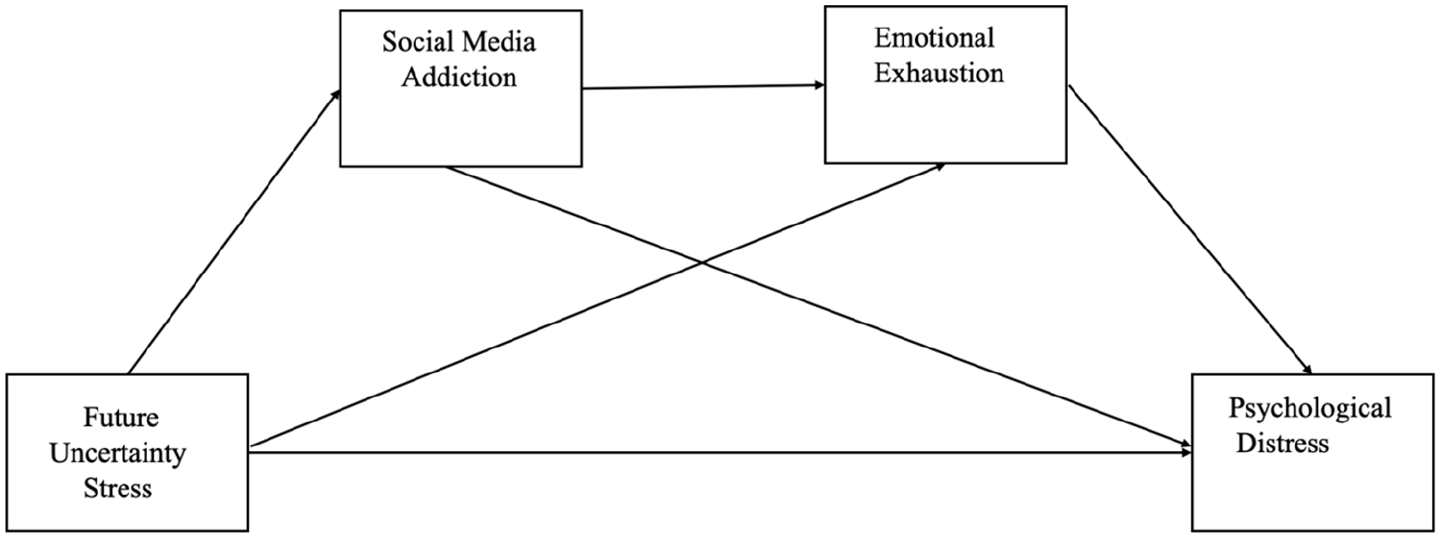
Research framework.
Method
Data collection
Utilizing a longitudinal panel approach to gather data from a random sample of social media users, the data was collected through a two-wave panel study executed in Hong Kong by a university-affiliated survey center, spaced a year apart. The research was approved by the Human Research Ethics Committee of the author’s institution. The respondents are social media users aged 17 to 54, who are perceived as the most active users of these platforms (Leung, 2014). Adopted a random sampling strategy using the CATI system, the first wave of data collection was conducted in May 2021, with a total of 700 completed cases. The second wave was conducted in June to August 2022, 447 original respondents completed the survey, yielding a retention rate of 63.9%. The retention rate falls within the acceptable range for data validity and representation integrity and is at a similar level to previous studies (Chen, 2018, 2021; Gil de Zúñiga et al., 2015; Watson & Wooden, 2006). The adoption of two-wave panel survey allows us to better ascertain the casual relationship between the variables. Among the respondents who completed both waves of the survey, 45.0% were male and 55.0% were female. In terms of age distribution, 12.9% of respondents were below 20, 27.6% were aged 20 to 29, 38.0% were between 30 and 39, 19.0% were between 40 and 49, and 2.5% were 50 and above.
Measurements
Future uncertainty stress
Adapted from previous (Ross et al., 1999), three items were used to measure the respondents’ future uncertainty stress. Respondents were asked to indicate to what extent do they feel stressed due to (1) major social change; (2) concern about your future; and (3) concern about job future. The response categories ranged from “1” (never) to “6” (very severe). The three items were averaged to form an index of future uncertainty stress (T1 M = 3.39, SD = 1.23, α = .72; T2 M = 3.15, SD = 1.29, α = .75). The Cronbach’s α is similar to that reported in previous literature (e.g. Yang et al., 2017).
Social media addiction
To measure respondent’s social media addiction, this study adapted the Bergen Facebook Addiction Scale (BFAS) that has been widely used in previous literature. Although the full scale consists of 18 items, scholars have validated the use of six items to represent the six corresponding aspects of social media addiction (Andreassen et al., 2012). In our measurement, respondents were asked how often they have experienced the following six addictive situations in the use of social media: “(1) try to cut down the amount of time spend on social media and fail” (relapse); (2) “use social media in order to forget about personal problems” (mood modification); (3) “feel an urge to use social media more and more” (tolerance); (4) “become restless or troubled if you have been prohibited from using social media” (withdrawal); (5) “use social media so much that it has had a negative impact on your job/studies” (conflict); and (6) “spend a lot of time thinking about social media or planned use of social media” (salience). Measured on a 5-point Likert scale with 1 being “very rare” and 5 being “very often,” the six items were averaged to create a composite measure (T1 M = 1.84, SD = .74, α = .77; T2 M = 1.96, SD = .75, α = .80). The higher the score, the greater the level of addiction. The Cronbach’s α is similar to that reported in previous literature (e.g. Andreassen et al., 2012).
Emotional exhaustion
Adopted from previous literature (Maier et al., 2012), respondents were asked to indicate on a 5-point scale from 1 (strongly disagree) to 5 (strongly agree) to what extent do they agree with the following statement: (1) I feel irritable after using social media for hours; (2) I feel emotionally drained from using social media; (3) using smartphone puts too much stress on me. The scores were averaged to create a composite measure (T1 M = 2.28, SD = 0.84, α = .75; T2 M = 2.23, SD = 0.83, α = .70). The Cronbach’s α is similar to that reported in previous literature (e.g. Akhtar et al., 2017).
Psychological distress
Respondents were asked to indicate during the past week, to what extent they have experienced the following nine statements adapted from the Depression, Anxiety, and Stress Scale (DASS-21) that has been widely used in previous literature (Gurin et al., 1960; Kessler et al., 2002). Items include (1) “I couldn’t seem to experience any positive feeling at all”; (2) “I felt that I had nothing to look forward to”; (3)“I felt that life was meaningless”; (4) “I experienced breathing difficulty”; (5) “I experienced trembling”; (6) “ I was aware of the action of my heart in the absence of physical exertion”; (7) “I found it difficult to relax”; (8) “I was intolerant of anything that kept me from getting on with what I was doing” and (9) “I felt that I was rather touchy.” With 1 being “Did not apply to me at all-never” and 4 being “Applied to me very much, or most of the time-almost always.” The nine items were averaged to form an index of psychological distress (T1 M = 1.58, SD = 0.51, α = .80; T2 M = 1.66, SD = 1.55, α = .81). The Cronbach’s α is similar to that reported in previous literature (e.g. Sampasa-Kanyinga et al., 2018).
Control variables
The psychological distress at the outset of the study in Time 1 and demographic variables in Time 1 including gender, age, education, and income were included as control variables.
Results
To test the hypotheses, this research conducted mediation analysis using the PROCESS macro for SPSS (Hayes, 2013) and cross-lagged hierarchical regressions. First, to examine the direct effects (H1, H2, H3), cross-lagged hierarchical regressions was conducted by having measures in Time 2 regressed on measures in Time 1 (Gil de Zúñiga et al., 2015). Second, to test the indirect effects (H4) among the research variables, Model 6 from Hayes’ (2013) PROCESS macro with 10,000 bias-corrected bootstrap samples and 95% confidence intervals (CIs) was employed (Chen, 2018). Statistical significance is achieved when the confidence interval does not include zero, marked by the lower bound (LL) and upper bound (UL). As shown in Table 2, the analysis included (1) independent variable and mediators (i.e. future uncertainty stress, social media addiction and emotional exhaustion) measured in Time 1 and dependent variable (i.e. psychological distress) measured at Time 2; and (2) exogenous variable (i.e. future uncertainty stress) measured in Time 1 and endogenous variables (i.e. social media addiction, emotional exhaustion, and psychological distress) measured in Time 2. Besides, the autoregressive term of the key dependent variable was also included in the analysis as a control and exogenous variable (Gil de Zúñiga et al., 2015).
Hypothesis 1a and Hypothesis 1b predicted respondents suffering from a higher level of future uncertainty stress are likely to exhibit (a) higher level of social media addiction and (b) higher level of psychological distress. Results of hierarchical regressions are shown in Table 1, after controlling demographic variables and social media addiction measured in time 1, future uncertainty stress (time 1) was positively related to social media addiction (time 2) (β = .12, p < .05). H1a was supported. With demographic variables, social media addiction, emotional exhaustion and psychological distress measured in time 1 being controlled, future uncertainty stress (time 1) positively predicted psychological distress (time 2) (β = .16, p < .05). H1b also received support.
Cross-Lagged Regression Models Predicting Social Media Addiction, Emotional Exhaustion and Psychological Distress.

Note. Beta weights are final-entry OLS standardized Beta (β) coefficients.
p < .001; ** p < .01; * p < .05. N = 447.
Hypothesis 2 proposed social media addiction is positively associated with emotional exhaustion. As shown in Table 1, with demographic variables and emotional exhaustion measured in time 1 being controlled, social media addiction (time 1) was a significant predictor of emotional exhaustion (time 2) (β = .20, p < .001). H2 was supported.
Hypothesis 3 examined whether emotional exhaustion has a positive relationship with psychological distress. After controlling demographic variables, future uncertainty stress, social media addiction, and psychological distress measured in time 1, results indicated that emotional exhaustion (time 1) positively predicted psychological distress (time 2) (see Table 1) (β = .11, p < .05). H3 also received support.
Table 2 shows the result of mediation analysis with demographic variables and the autoregressive term of psychological distress as covariates. Future uncertainty stress (time 1) is positively related to social media addiction (time 1) (B = .093, standard error [SE] = 0.034, CI = [0.025, 0.161]) and psychological distress (time 2) (B = .067, SE = 0.022, CI = [0.024, 0.110]). Social media addiction (time 1) and emotional exhaustion (time 1) were also positively correlated (B = .212, SE = 0.067, CI = [0.081, 0.343]). Emotional exhaustion (time 1) positively correlated with psychological distress (time 2) (B = .067, SE = 0.029, CI = [0.010, 0.124]). These findings provide additional support for H1a, H1b, H2, and H3.
Direct and Indirect Effects of the Relationship Among Future Uncertainty Stress, Social Media Addiction, Emotional Exhaustion, and Psychological Distress.

Note. CI = confidence interval; LL = lower bound; UL = upper bound. Entries are unstandardized regression coefficients. Bootstrap resample = 5000. Estimates were calculated using the PROCESS macro (Model 6). Demographic variables and autoregressive term of the key variable were controlled.
The findings from the mediation analysis further revealed the indirect influence of future uncertainty stress on psychological distress, mediated by social media addiction and subsequently by emotional exhaustion, as proposed in Hypothesis 4. As shown in Table 2, the indirect effects of future uncertainty stress (time 1) on psychological distress (time 2) through social media addiction (M1 time 1) and subsequently through emotional exhaustion (M2 time 1) were significant (B = .001, SE = 0.001, CI = [0.0001, 0.004]). In addition, the indirect effects of future uncertainty stress (time 1) on psychological distress (time 2) through social media addiction (M1 time 2) and subsequently through emotional exhaustion (M2 time 2) were also significant (B = .002, SE = 0.001, CI = [0.0002, 0.006]). H4 was supported.
Discussion and conclusion
In an era characterized by proliferating uncertainty and digital ubiquity (Ganesh & Stohl, 2013), this study adopted the SSO model to illustrate the causal relationship between future uncertainty stress and psychological distress, as well as between future uncertainty stress and social media addiction. Furthermore, the study also examined the significant role of social media addiction and emotional exhaustion as mediators between future uncertainty stress and psychological distress.
This study makes several important contributions to the literature. First, it responds to calls from previous research to examine the impact of uncertainty stress using longitudinal data (Yang et al., 2017). The findings reveal that uncertainty stress at Time 1 is a significant predictor of psychological distress at Time 2, aligning with previous research that highlights uncertainty stress as a growing public health concern (Peng et al., 2020). These results underscore the long-term psychological effects of uncertainty stress and emphasize the need for proactive interventions to address its consequences.
Second, it also extends the existing literature by identifying future uncertainty stress as a significant antecedent of social media addiction. These findings align with prior research, which suggests that individuals experiencing stress often resort to unhealthy coping mechanisms, such as over-reliance on social media (M. D. Griffiths & Kuss, 2017; Leung, 2007), a state that has been positively correlated with depression (Iqbal et al., 2022). This highlights the double-edged nature of social media, offering temporary relief but potentially worsening distress over time.
Furthermore, by employing a longitudinal panel design, this study unveiled the sequential indirect effects of future uncertainty stress on psychological distress through social media addiction and emotional exhaustion. These findings contribute to the growing body of research applying the SSO model (Maier et al., 2012; Shahzad et al., 2021; Whelan et al., 2020), by examining uncertainty stress as a key stressor and expanding the model’s application to contemporary digital challenges.
From a practical perspective, in recent years, Hong Kong society has faced immense political, economic, and social uncertainty due to social movements and the COVID-19 pandemic, similar to other parts of the world. When individuals encounter high levels of future uncertainty stress, they tend to over-rely on social media as an inappropriate coping mechanism to escape reality, which will further reinforce the negative psychological impact. This social phenomenon warrants the attention of social workers and educators, particularly in the context of future public crises, and may have implications beyond the Hong Kong setting.
For mental health professionals, the mental health of individuals experiencing failures of self-control in social media use deserves attention. Recognizing the potential mental health risk of social media addiction can help guide the development of tailored therapeutic strategies and prevention programs that specifically address the link between uncertainty stress and social media addiction. For educators, schools and universities could incorporate modules on digital well-being, emotional regulation, and self-regulation strategies to empower young people with tools to manage their stress effectively without over-reliance on social media. For policymakers, the public heath sectors can leverage these insights to develop public awareness campaigns that advocate for healthy coping strategies for stress and responsible social media use, especially during times of uncertainty and crisis. Digital disconnection strategies encouraging people to proactively take breaks from social media (Nguyen, 2021) should be promoted to reduce the risk of psychological distress. The current study also responds to recent research (Vanden Abeele, 2021), calling for society and policy makers to pay attention to people’s struggles in an age of constant connectivity and the use of digital mental health interventions to cultivate healthier mobile and social media habits.
Our research is not exempt from limitations. First, while our study design benefited from the longitudinal panel method, however, we primarily depended on self-reported measures to evaluate social media addiction, emotional exhaustion, and psychological distress. Although such measures are frequently used and validated, they may be subject to individual bias. To address this issue, future research could consider incorporating objectively recorded data, such as the actual time an individual spends on social media. Second, we gathered our data in the context of Hong Kong. Future studies could benefit from conducting comparative analyses explore the cultural variations in the relationship between uncertainty stress and social media addiction across different regions. Cultural values, personal traits and social support resources may influence how individuals perceive and respond to uncertainty, leading to different reactions and mental health outcomes. Third, this study’s use of two-wave panel data limits our ability to fully capture the dynamic processes underlying the hypothesized mediation effects. Future research should ideally employ four waves of data to more effectively track the dynamics in the relationship between future uncertainty stress and psychological distress, as well as the mediating roles of social media addiction and emotional exhaustion.
Despite the identified limitations, this study offers a significant contribution to our understanding of the interplay between future uncertainty stress, social media addiction, emotional exhaustion, and psychological distress. Theoretically, our research findings demonstrated a sequential pathway from future uncertainty stress to psychological distress, enriching the SSO literature by examine future uncertainty stress as a key stressor. Methodologically, departing from previous studies which mainly relied on experiment and cross-sectional survey, this study utilized a longitudinal survey approach to affirm the impact of stressful life events on social media use and psychological distress. Practically, the study provides clinical and policy insights for mental health interventions and underscores the importance of raising public awareness about self-control in social media use amid challenging times.
Footnotes

Funding
The author(s) disclosed receipt of the following financial support for the research, authorship, and/or publication of this article: This research was fully supported by the Research Grants Council (RGC) of Hong Kong SAR under the Faculty Development Scheme (Project No. UGC/FDS15/H13/20).
Declaration of conflicting interests
The author(s) declared no potential conflicts of interest with respect to the research, authorship, and/or publication of this article.