




Abstract
TikTok is a top-rated social media app used by U.S. college students, so understanding what users like and dislike about the platform is an important endeavour for contemporary media and communication scholars. To investigate such perceptions, 468 college students completed an online survey about their likes and dislikes associated with TikTok. In total, 13 unique themes emerged for likes and dislikes, respectively. The like themes included humorous content, variety/diversity of content, being entertained, community educational content, algorithm/personalisation, user interface, TikTok culture/references, short video content, creative outlet, emotion/stress management, relatable content and trending content. The dislike themes were addictive nature, negative interactions, uninteresting content, influencers/attention-seeking, cancel culture/platform drama, privacy concerns/fake news, negative emotions/mental state, revealing content (nudity), political content, TikTok platform guidelines, app functionality, advertisements and trending content. Results revealed college students’ perceptions of TikTok’s most likeable and unlikeable characteristics and users’ satisfaction with TikTok compared to other social media platforms. Implications for these findings are discussed.
Introduction
TikTok, an app designed to serve as a platform for the creation and distribution of short videos on any topic imaginable, has taken the world by storm; described as a ‘free-for-all […and] greatest hits compilation’ (Herrman, 2019, para.10); the app serves over a billion users across the globe (Iqbal, 2022). This study examines college students’ perceptions of what they like and dislike about TikTok by analyzing the platform’s most likeable and unlikeable characteristics—both in terms of content as well as affordability and functions—highlighted by college students’ insights; the authors also address whether college students are more satisfied with TikTok as a platform as opposed to other popular social media sites.
Importantly, like any other social media platform, anything from TikTok’s popularity to the perceived benefits of use could lead to addiction or dependency among users (e.g., Facebook addiction; Ryan et al., 2014). Social media addiction, which is characterised by a ‘compulsion to use social media’ (Hou et al., 2019, p. 2), may result in an individual being unable to discontinue the use of the app, spending time on the app instead of prioritising important tasks, loss of sleep and other negative side-effects. Because TikTok is relatively new and, consequently, understudied concerning individual effects, this study aims to fill a gap in the literature on addiction to or dependence on TikTok and targeted platform satisfaction. The results of this study provide valuable insights into TikTok’s impact on college students, a population in which the overwhelming majority is present on the app (Auxier & Anderson, 2021). This study may also extend the applications of extant literature concerning social media addiction and dependency by providing context for addictive platform qualities (i.e., short-form video) as perceived by college students who use TikTok.
Literature Review
TikTok as Compared to Other Social Media Platforms
College students report high levels of media use and, consequently, have made and continue to make up a large portion of users on social networking sites (Auxier & Anderson, 2021; Sponcil & Gitimu, 2013). For example, 90% of young adults between 18 and 29 years of age use social media applications, and TikTok, Facebook, Instagram and Snapchat are among the most used applications (Auxier & Anderson, 2021) and have several notable features that distinguish them from one another. Instagram focuses on sharing still photos and videos and is highly influenced by filter manipulation (Hu et al., 2014). Snapchat is similar to Instagram in its focus on sharing photos and videos. However, it differentiates itself by having a sender-and-receiver messenger set up and capitalising on the disappearance of content after viewing it (Vaterlaus et al., 2016). Facebook users create written or multimedia statuses or posts to share with their network or Facebook groups (Hampton et al., 2011). Finally, TikTok centres around creating and sharing short video content that utilises filters and background music to retain viewers’ attention (Omar & Dequan, 2020). TikTok is unique from other social media platforms because there are universal time constraints on the length of each video; another critical difference is the lower degree of autonomy that users have in choosing which videos they see as compared to other social media sites because of how the algorithm functions (Southwick et al., 2021).
Characteristics of TikTok Content
TikTok feeds users content through algorithmic recommendations, shaping their experiences by personalising their video feeds (Klug et al., 2021). When users log in to TikTok, they can immediately interact with trending videos by using social features such as friend requests, ‘liking’ content, commenting and private messaging, giving users tools to connect to others in the TikTok community (Kaye et al., 2020a). Users can create, produce and act in their videos while consuming other creators’ content (Yang, 2022). TikTok’s algorithm filters content on the ‘For You’ page where personalised content appears, which creates opportunities for users to build connections with others who have similar interests and experiences due to algorithmic overlap (Barta & Andalibi, 2021; Kaye et al., 2020b). TikTok users can express themselves creatively (Du et al., 2020), use the platform as a place to self-disclose (i.e., uses and gratifications, Brammer et al., 2023), or benefit from taking in others’ content, which may elicit an emotional response and subsequently facilitate the establishment of interpersonal relationships (Chen et al., 2021). Users’ creativity and memetic engagement are replicated by others, which compounds the shared experience and creates a platform culture (Zulli & Zulli, 2020). Finally, the previous literature indicates that social media can be a fun way to escape from reality and relax for its users (Phua et al., 2017), which is likely true for TikTok users.
Characteristics of and Potential (Dis)Satisfaction with TikTok
TikTok users can access various content that can influence their experiences on the platform. For example, TikTok offers diverse comedic content through parodies, jokes and sketches of popular culture (Schellewald, 2021). TikTok can also be used as a learning medium because it hosts educational content and has a wide user base that includes people from all backgrounds (Pratiwi et al., 2021). TikTokers may also find some content relatable because videos can be shot without professional equipment or training; this amateur recording is more natural and relatable to its users (Su et al., 2020). TikTok content does have its potential pitfalls when it comes to satisfaction. For example, previous research indicates that social media posts that have a higher amount of engagement (e.g., many likes or comments) are typically seen as ‘more attention-worthy by the platform’ and may lead to boosting or monetisation of the post (Drenten et al., 2020, p. 54). Thus, even when an algorithm is in place, users may still encounter boosted content and advertisements that they find annoying, uninteresting or, more seriously, problematic (Rohrer & Boyd, 2004).
Further, ‘cancel culture’ is a popular term for the trend in which someone who performs a troubling action or causes irreparable social damage—by mistake or on purpose—is kicked out of mainstream media as punishment for their wrongdoings (Clark, 2020). For TikTok users who encounter content that they find problematic, the answer may be to make sure users not only evacuate their feeds but are forced off of the platform entirely—or at least out of the spotlight. Adverse reactions to content or app use may also lead to negative interactions on the platform or abandonment of the platform altogether (O’Reilly et al., 2018); similarly, problems with other people in the TikTok system, including a dislike of other users and/or concerns about the platform’s corporate leadership (e.g., Brown, 2020), could also lead to a dislike of the platform or a negative impact on users’ emotional states (O’Reilly et al., 2018). As TikTok users have become increasingly aware of the pitfalls of the platform algorithm and discussing precarious topics, the use of methods such as algospeak (i.e., the substitution of special characters for traditional characters to avoid bans, ‘s’ becomes ‘$’; Klug et al., 2023) has also increased. Such behaviours may become demanding and result in frustrations with the platform. This study aims to identify other reasons users may like or dislike TikTok and/or the content it hosts.
Potential for Addiction to TikTok in Young People: Media Dependency
The previous literature on social media addiction has focused on everything from life satisfaction (e.g., Shahnaz & Karim, 2014) to the fear of missing out (e.g., Rozgonjuk et al., 2020). Still, one finding remains consistent: addiction is a condition that negatively impacts those who suffer from it. Addiction is characterised by heavy and often compulsive use of a platform coupled with a disregard for the negative consequences of that use (Hou et al., 2019). The authors contend that TikTok users, just like Facebook, Instagram or Snapchat users, are susceptible to addiction to the platform or dependence on TikTok. Following Ball-Rokeach and DeFleur’s (1976) theory of media dependency, where media dependency is defined as being dependent upon the multitude of social and psychological benefits of media use in an unstable sociocultural environment, we aim to advance an understanding of TikTok dependence or addiction as unique.
Signs of addiction to TikTok may include an inability to focus on everyday life, the inability to go a short amount of time without using the application, and/or extended periods engaging on the platform (see Schellewald, 2023). The United Nations characterises people aged 15 to 24 years old as ‘youth’, or young people (‘Youth’, United Nations, n.d.). This group significantly overlaps with nearly half of TikTok users aged 18 to 29 (Auxier & Anderson, 2021). Youth who develop an addiction to social networking sites may experience a decline in sleep quality and mental health (Alonzo et al., 2021), diminishing academic performance (Al-Menayes, 2015), loss of control (Seo & Ray, 2019) and an increased likelihood of enacting dangerous offline habits such as hazardous consumption of alcohol (Savolainen et al., 2020) among other negative impacts. Consequences such as these can harm a young person’s life and future regarding social media addiction. We must learn more about the nature of addiction to TikTok to develop a deeper understanding. We can start by looking into how users perceive TikTok as a platform and whether the platform has the potential to exhibit addictive qualities.
Based on the synthesis of literature above, there are several precise demands for research regarding TikTok as it compares to other popular social media platforms, what specific features or characteristics of the platform that users like and dislike, and—in an attempt to replicate findings of scholars such as Schellewald (2021, 2023)—whether TikTok may have addictive qualities that impact young people’s use habits and lead to media dependence on the platform. To meet these demands and fill the corresponding gaps in the communication literature, the authors propose the following research questions to guide the analysis conducted herein:
RQ1: Are users more satisfied with TikTok than other social media platforms? RQ2: What do TikTok users like and dislike about the platform? RQ3: Do users perceive TikTok as a platform with addictive qualities?
Methodology
Participants and Procedure
A pool of 800 participants at a large southwestern university in the United States completed the survey. Because college students comprise a large portion of TikTok users (Auxier & Anderson, 2021), and over 200 participants were needed to reach the appropriate statistical power and confidence level of 95%, this sample is suitable for investigating user sentiments. After several validity checks for attention and accuracy, only 468 responses were used for analysis. Participants (N = 468) ranged in age from approximately 18–34 years old, with the average participant being approximately 21.78 years old. The sample was predominantly female (n = 309, 66%), with 32.8% male (n = 153) participants and six participants who declined to answer. Participants self-reported 75.4% (n = 353) as White, 5.1% (n = 24) as Black/African American, 2.7% (n = 12) as Asian, .4% (n = 2) as Native Hawaiian/Pacific Islander, 1.2% (n = 5) as American Indian/Alaskan Native and 14% (n = 72) reported as ‘Other’. Parts of the data collected were used for a different study. Participants were asked to complete a series of Likert-type measures about how much time they spend on TikTok per day, their perceptions of TikTok as a platform and their level of satisfaction with TikTok compared to other social media outlets. In addition, participants were asked open-ended questions about their likes and dislikes regarding TikTok.
Results
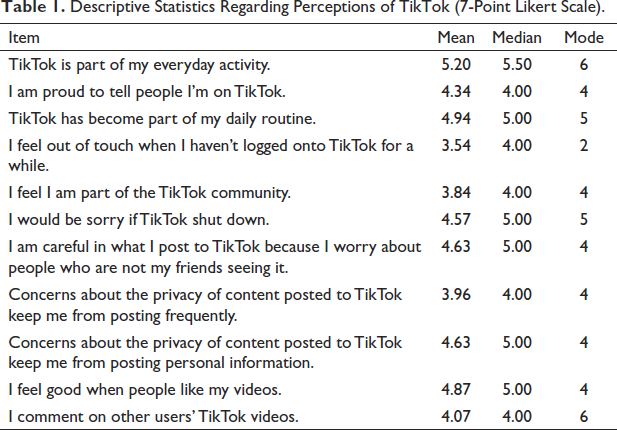
Participants reported spending an average of 125 minutes daily on TikTok (SD = 1.34). In terms of the number of TikTok followers, 30.4% (n = 135) reported having between 11 and 50 followers, 21.4% (n = 100) reported having less than 10, 13.9% (n = 65) had between 51 and 100, and 7.3% (n = 34) have 101–150, 4.3% (n = 20) have between 151 and 200, 1.7% (n = 8) have 201–250, 1.5% (n = 7) have 251–300, 2.4% (n = 11) reported having 201–400, 13.7% (n = 64) have more than 400 followers. Using a Likert scale of 1 = light to 7 = heavy user, most participants reported being moderate users of TikTok (M = 4.42, SD = 1.65). Descriptive statistics regarding general perceptions about TikTok are presented in Table 1.
Descriptive Statistics Regarding Perceptions of TikTok (7-Point Likert Scale).
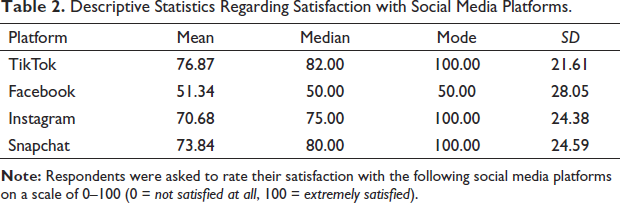
When asked about their satisfaction with TikTok on a scale from 0 = unsatisfied to 100 = very satisfied, participants reported a mean of 76.87 (SD = 21.61). Frequencies are displayed in Table 2. Regarding satisfaction with other social media platforms (e.g., Facebook, Snapchat and Instagram), participants rated their satisfaction with TikTok the highest.
Descriptive Statistics Regarding Satisfaction with Social Media Platforms.
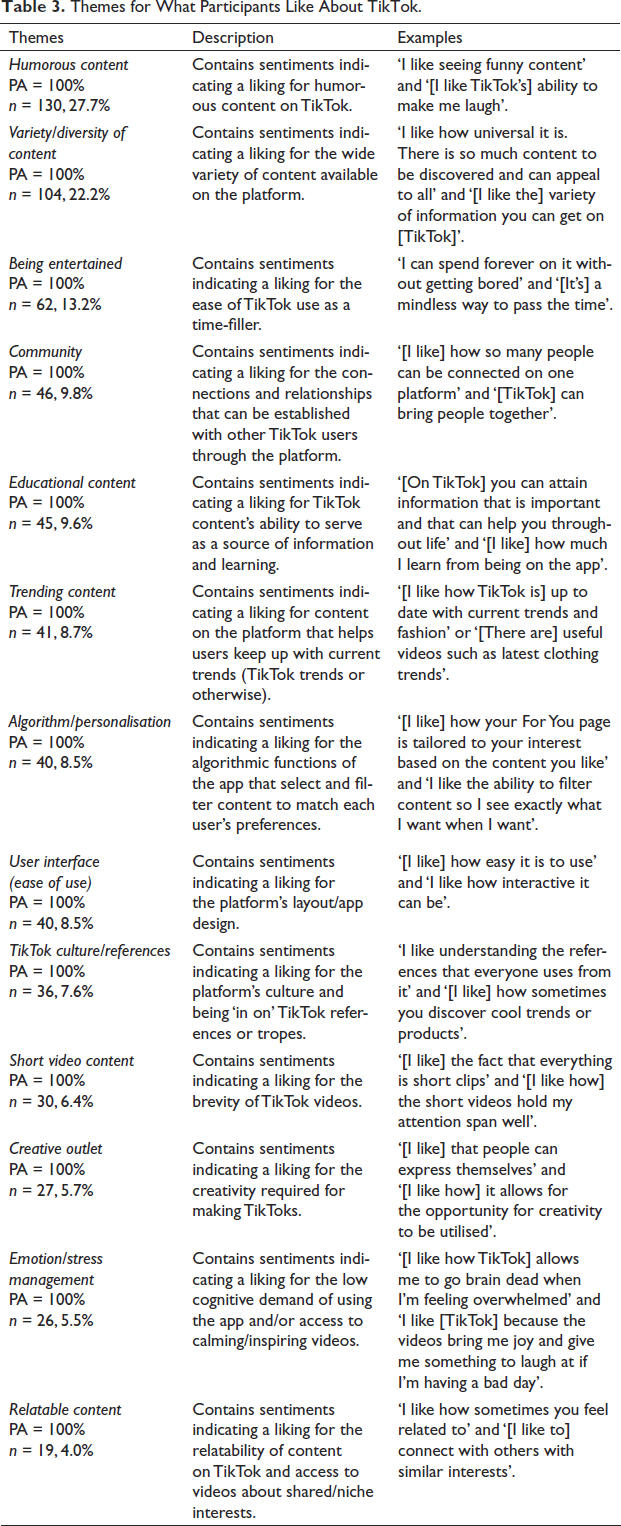
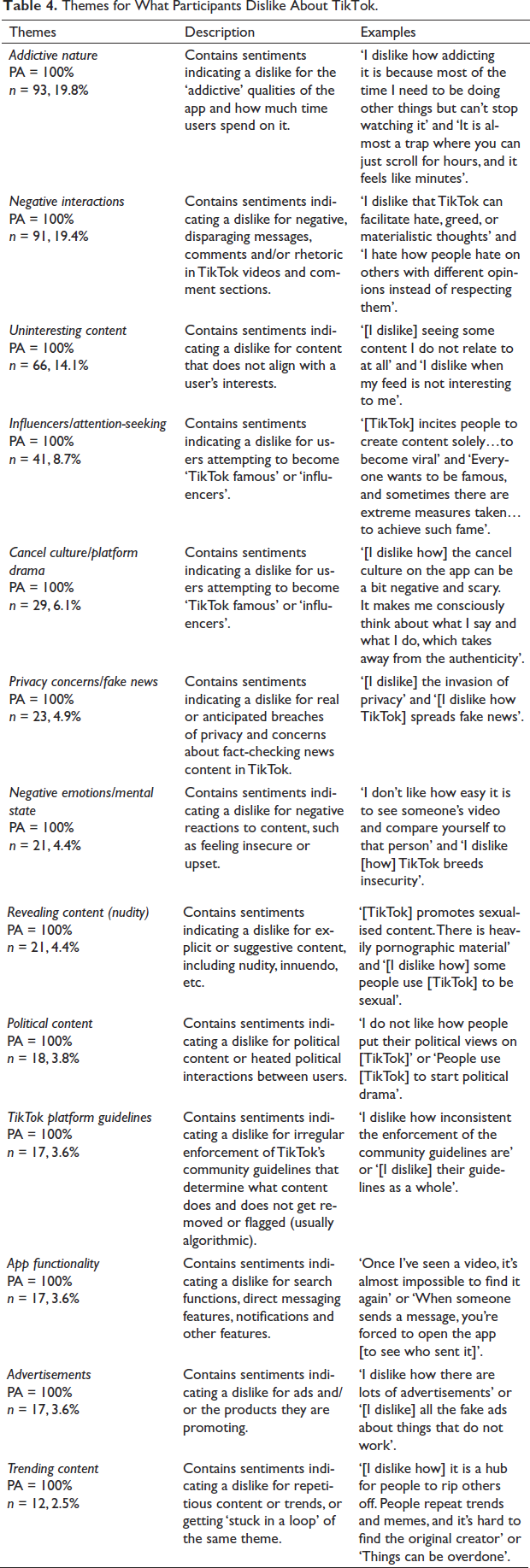
Using Bulmer’s (1979) coding methods as a guide, three coders read all the responses independently and made categories based on the responses. Then, the same three coders met to determine the themes. All statements were categorised into distinct groups until no new themes were created. The researchers unanimously agreed on the final themes with a high level of intercoder reliability (Cohen’s κ = 0.99, level of agreement; κ = 1). Themes are presented in Table 3 about what participants liked about TikTok. Table 4 showcases the 13 themes that emerged when participants were asked what they disliked about TikTok.
Themes for What Participants Like About TikTok.
Themes for What Participants Dislike About TikTok.
There were 13 themes reflecting what participants liked about TikTok, which were then grouped into 4 categories. The first of the four categories is ‘The Nature of the Content’, which contains the following eight themes: being entertained, emotion/stress management, humorous content, variety/diversity of content, educational content, short video content, relatable content and trending content. The second category, ‘TikTok Culture and Community’, contains the following two themes: community and culture/references. The third category is platform, which contains the following two themes: algorithm/personalisation and user interface. The final theme, creative outlet, was not grouped into a category and is discussed independently (see Table 3).
In addition, there were 13 different themes for what participants did not like.
TikTok that were grouped into three categories. ‘Problems with Content’ includes the themes of uninteresting content, revealing content (nudity), political content, advertisements, negative emotions/mental state and trending content. ‘Problems with Users’ include negative interactions, influencers/attention-seeking and cancel culture/platform drama. Finally, ‘Problems with the Platform’ includes addictive nature, privacy concerns/fake news, TikTok platform guidelines and app functionality (see Table 4).
Discussion
This study investigates U.S. college students’ perceptions of the most likeable and unlikable characteristics of TikTok and user satisfaction with TikTok compared to other social media platforms. The results of RQ1 revealed that participants rated their satisfaction with TikTok the highest compared to Facebook, Snapchat and Instagram. Researchers have found that satisfaction is the most crucial factor in why people continue to use TikTok and that usefulness, entertainment value and social value directly affect how satisfaction is accrued (Ma et al., 2019). In addition, the results in Table 1 reflect daily TikTok use among participants, who must be satisfied enough to continue regular use of the app.
RQ2 investigates what users like and dislike about TikTok’s platform. The results from Table 3 display what the participants liked about TikTok, and the results from Table 4 show what participants disliked about TikTok. Both tables depict various themes that have become common among the participants. Many of the participants’ responses to the question ‘What do you like about TikTok?’ fall into The Nature of the Content category, in which responses indicate that users like the different types of content TikTok offers and enjoy being entertained by various creators. The previous literature states that users who experience a variety of user-generated content and feel entertained may be more susceptible to increasing their social media usage with that platform (Kim & Kim, 2019). Communication scholars must continue to investigate the role that perceptions of content have on media consumption because it is essential to understand why some content is more effective at eliciting excitement and joy than others, which may yield disinterest.
Participants’ answers also reflected a liking for TikTok Culture and Community. They like how TikTokers connect and establish relationships with each other and the culture that arises from these connections. Research has shown that a social media platform’s success depends on its users providing content others will like, showing social support and sharing information or personal experiences (Oh & Syn, 2015). Future research should investigate how platform culture, such as TikTok’s trends and challenges, feeds into shaping a community online.
The third category representing participants’ likes is a platform because many users appreciate the application’s algorithmic functions, layout and design. This is in line with research that suggests that the success of a user interface relies on many aspects, such as consistency, accessibility and ease of navigation (Abdo & Alali, 2016). In addition, algorithms are present on many social networking sites. However, TikTok’s algorithm is unique from other platforms. Other social media platforms allow users to engage outside of the algorithm, but for TikTok, users predominantly engage with the algorithm and know how it shapes their interactions (Bhandari & Bimo, 2022). Therefore, communication scholars must examine algorithms’ impact on future platforms. Participants also liked the Creative Outlet aspect of TikTok, such as creating content and using their creative talents and skills. Content creators focus on making short videos that do not require prolonged attention from their viewers, requiring them to express themselves more directly, which may leave a substantial impact on the viewer (Ling et al., 2021). Future communication research should investigate how content creators adapt to different platforms’ limitations to communicate with their audiences effectively.
Participants’ answers to the open-ended question ‘What do you dislike about TikTok?’ were analyzed. Results were sorted into categories reflecting problems with the platform, TikTok content and other users. Problems with content often centred around interest or lack thereof, with some respondents identifying specific types of content as uninteresting or inappropriate (e.g., nudity). Other content users did not want to see included political content, which is consistent with patterns of political content avoidance found in previous social media research (Bode et al., 2017). Annoyance with advertisements also came up several times, which is aligned with the literature (Rohrer & Boyd, 2004). However, two dislike themes associated with content were surprising: (a) negative emotions/mental states and (b) trending content. Though scholars have determined that there are connections between social media use and adverse mental health outcomes for some individuals (O’Reilly et al., 2018), it is interesting that some would find TikTok content particularly distressing; future research should investigate whether there are topics covered in TikTok content that have not made it on to other platforms, or if users who exclusively use TikTok have not had the opportunity to encounter the distressing content in other places/formats. A dislike of trending content implies that creators must jump on trends before people get tired of them; for example, if a sound is popular on TikTok and a company wants to use it in a TikTok ad for their product, it cannot be seen as overplayed or overused for the ad to be most effective (Saluja, 2020).
Problems with users themselves surface as themes, too, with some mentions of negative interactions via comments or direct messages. Cyberbullying and hurtful online experiences are common and only escalated nationally during the COVID-19 pandemic (Barlett et al., 2021), during which TikTok gained popularity in the United States. Results suggest that TikTok’s corporate personnel and those whose algorithmic designs are meant to catch and penalise derogatory remarks must keep working on creating a safe and civil environment on the platform. As for less distressing user-oriented themes, such as annoyance with influencers/attention-seeking and cancel culture/platform drama, only so much can be done on the algorithmic end. Recent studies have shown that coping with ‘cancel culture’ can, for example, complicate the divide between facilitating online social justice movements that condemn injustices like racism and driving people away from being ‘reconnected to having faith in liberal democracies’ (Bouvier & Machin, 2021, p. 324). Because TikTok is populated mainly by young people and much of the ‘cancel culture’ surrounds celebrities and influencers who come in and out of the spotlight anyway, the drama on the platform is probably less severe than ‘cancelling’ an elected official or figures outside of pop culture.
The last category of dislikes was problems that users reported having with the platform. Anxieties about privacy concerns/fake news have persisted since earlier talks about a ban. Recently released information about the high amount of data collected by the app—an amount higher than any other social media site collects—has stirred up some familiar conversations about potentially banning the app (Huddleston, 2022). Despite these conversations always accompanying TikTok due to its foreign ties to China and the typical scrutiny that newly popular apps face at their advent, the platform continues to boast millions of users with new app downloads each day (Statista, 2022). The same resilience has also overcome complaints about TikTok platform guidelines and app functionality, where reporting and censoring features do not work equitably between majority and minority communities (Ohlheiser, 2021) and some features force users to do things like open the app to see who a direct message is from instead of including that information in the notification banner.
The results of RQ3 have been indicated by the responses from what participants reported, which has produced the theme of an addictive nature. The number one dislike reported may not involve voluntarily remaining on the app: 19.8% of participants were worried about having an addiction to TikTok. Addiction to TikTok could negatively impact college students’ lives. The previous literature has stated that social media addiction can become present when more time is spent online and less time is allocated to studying (Hou et al., 2019). In addition, researchers have found that academic performance can be affected when students spend more time online (Hasnain et al., 2015) and that addiction can also be a predictor of low self-esteem (Andreassen et al., 2017) and depression (Kircaburun, 2016). It is important to note that media dependency is when an individual depends upon the social and psychological benefits of media use (Ball-Rokeach & DeFleur, 1976). Media dependency can lead to addiction to TikTok for some users. Dependency can be formed by prolonged excessive use, which can be problematic for an individual (Carillo et al., 2017; Han et al., 2019). The past literature has shown that users who spend excessive time online are more prone to developing an addiction to social media (Primack et al., 2017). Therefore, users need to be aware of and monitor their use of TikTok by managing time and priorities effectively or asking for help if necessary.
There were a few limitations to this study. The sample was primarily white, so more diversity would be welcome. College students are also more affluent than other groups who may frequently use TikTok. Further, asking college students to self-report what they (dis)like about app experiences requires that they articulate what they like; if, for example, they do not have the words to describe their feelings, those themes may not come through in the data. In addition, more addiction measures should be employed to quantify addiction to TikTok. New theoretical perspectives should be used to investigate how users communicate with each other on TikTok compared to other platforms.
Conclusion
In this detailed study, an in-depth analysis explores college students’ perceptions of what they like and dislike about TikTok. It provides context for user satisfaction with and dependency on the platform. The findings bring definition to college students’ perceptions of TikTok—a platform they frequent—and what they suggest the highlights (e.g., variety of content) and pitfalls (e.g., addiction) of the platform are. The findings from this study provide valuable insight into the role that TikTok plays in the lives of college students. However, they may also assist communication researchers in making sense of social media satisfaction or addiction to short-form video applications more broadly.
Moreover, this study can widen the uses of existing research on addiction and dependency regarding social media use by offering a framework to understand the addictive nature of TikTok from the perspective of college students. Future research should focus on how users may or may not feel a sense of belonging to the TikTok community, significantly as a host for individualistic content where someone’s face and personality are exacerbated in ways that they may not be on text-based platforms. More studies exploring the nuances of TikTok are a necessity due to the influence and reach of the platform, as are studies that track users’ perceived dependency on the app over time. In light of the concerns surrounding the security of TikTok among users and government officials (McClain, 2023), time is of the essence for such work.
Footnotes
Declaration of Conflicting Interests
The authors declared no potential conflicts of interest with respect to the research, authorship and/or publication of this article.
Funding
The authors received no financial support for the research, authorship and/or publication of this article.
