



Abstract
Black American women are among the largest consumer groups of social media in the United States. In recent years, Black American women have curated spaces on social media platforms to authentically converse about Black womanhood and resist structural gendered racism. Still, there is a dearth of research on the subjective importance of Black American women’s social media use and risks for social media addiction. This study tested the association between social media use integration and social media addiction, and whether connectedness to Black women moderated this relationship. Data from 354 Black American women (Mage = 24.34 years) were collected using an online survey. We found that social media use integration was positively associated with social media addiction. Connectedness to Black women moderated this relation, such that the positive association between social media use integration and social media addiction was magnified at a higher level of connectedness to Black women. Our findings inform practice implications for a non-pathologizing approach to addressing social media addiction among Black American women with consideration to structural gendered racist contexts.
Keywords
People who are young adults, Black, and female are among the largest consumers of social media in the United States (Pew Research Center [PRC], 2017, 2021). Approximately 84% of young adults in the United States use at least one social media platform (PRC, 2021). Relative to White Americans, Black Americans report greater use of social media platforms, such as Facebook (74% vs 67%) and Instagram (49% vs 35%; PRC, 2021), with women reporting greater use than men (PRC, 2021). Women are shown to use social media for social interaction, information access, and entertainment (PRC, 2021). Scholars suggest that Black American women may have other uses for social media, such as access to social resources to navigate structural oppression (Gray & Stein, 2021; Peterson-Salahuddin, 2022). Thus, with its vast utility, social media can hold emotional significance for and become deeply integrated into a person’s life (Jenkins-Guarnieri et al., 2012).
Still, the use of social media is not without risks (Andreassen et al., 2012). For instance, the excessive use of social media can lead to social media addiction or the uncontrollable use of social media despite impairments in multiple life domains (Griffiths, 2005). Social media addiction has been associated with adverse psychosocial and physical health consequences among dominantly White samples (Kuss & Griffiths, 2011; Marino et al., 2017, 2018). Despite their high rates of social media use (PRC, 2017), Black American women continue to be overlooked in social media addiction literature. Thus, this study investigated Black American women’s social media use integration in relation to social media addiction. Given Black American women’s co-opting of social media platforms as spaces for empowerment (Peterson-Salahuddin, 2022), we examined the potential moderating role of connectedness to Black women in the social media use integration–social media addiction link.
Black American Women’s Social Media Use Integration
Most studies investigating social media use in relation to psychosocial outcomes have measured social media use by self-reports of social media use frequency, duration, or the number of social media platforms visited (Allahverdi, 2022; Helm et al., 2022). While such approaches to measuring social media use have been widely used, they do not move beyond analyzing how much social media is used to investigate what subjective importance social media use holds for people (Shensa et al., 2017). Accordingly, social media use integration has been conceptualized as an emotional investment in social media use and the incorporation of social media use into daily activities (Jenkins-Guarnieri et al., 2012). While the former relates to an emotional investment in social media use, the latter relates to habitual behaviors of checking social media and engaging with others via social media (Jenkins-Guarnieri et al., 2012).
Few studies have examined social media use integration in relation to mental health (Bekalu et al., 2019; Berryman et al., 2018; Woods & Scott, 2016). In a sample of United States-based college students (71.1% female; 10.1% Black), social media use integration (measured as a composite of both an emotional investment in social media use and the incorporation of social media use into daily activities) was not significantly associated with social anxiety (Berryman et al., 2018). Comparatively, in a sample of Scottish adolescents, an emotional connection to social media use was associated with higher levels of depression and anxiety (Woods & Scott, 2016). Specific to positive mental health, in a sample of American adults (51.5% female; 11.8% Black), the integration of social media use into daily routines was associated with more positive mental health while an emotional connection to social media use was linked with less positive mental health (Bekalu et al., 2019). The study also found that the negative association between an emotional connection to social media use and positive mental health was greater for racially minoritized adults compared to White adults, which the authors speculated (but did not further explore) might relate to their varied motivations for social media use (Bekalu et al., 2019).
Taken together, prior research has provided an inconclusive understanding of how an emotional and behavioral investment in social media use, together, relates to psychological and behavioral outcomes, including social media addiction. Black American women’s experiences with social media use integration have been particularly overlooked within prior studies that have used majority White samples (Bekalu et al., 2019; Berryman et al., 2018; Woods & Scott, 2016). Indeed, there is a paucity of research examining Black American women’s social media use in relation to psychosocial outcomes (Olayinka et al., 2021; Stanton et al., 2017). For instance, a study reported that the frequency of using the microblogging platform, Tumblr, was associated with greater depressive symptoms among Black American women (Stanton et al., 2017). Research is needed to better understand how culturally specific aspects of social media use among Black American women may influence their psychological and behavioral outcomes (Shensa et al., 2017). Thus, this study investigated Black American women’s social media use integration in relation to social media addiction within the broader context of structural gendered racism (i.e., the simultaneous experience of sexism and racism; Lewis et al., 2013).
Social Media Use Integration within Structural Gendered Racist Contexts
Black American women contend daily with structural gendered racism involving policies and discourses at the intersections of racism and sexism that seek to oppress women of color (Lewis et al., 2013). Black American women have endured structural gendered racism for centuries—dating back to their dehumanization and commodification during the slavery era (Owens & Fett, 2019). Most recently, the pernicious influences of structural gendered racism have been evident in the disparities in COVID-19 infection–related mortality rates among Black American women (Laster Pirtle & Wright, 2021). These disparities have been attributed to Black American women’s pre-existing health disparities and lack of access to affordable health care (Chinn et al., 2021; Laster Pirtle & Wright, 2021). Recent years have also witnessed what scholars have characterized as state-sanctioned violence against Black American women, such as with the deaths of Breonna Taylor, Sandra Bland, and Rekia Boyd, among others, by the (in)actions of police officers or while in police custody (Tynes, 2021).
In the face of structural gendered racism and anti-Black gendered violence, Black American women have leveraged social media platforms as public arenas to engage in community-building, activism, and counter discourses for Black American women’s empowerment (Gray & Stein, 2021; Peterson-Salahuddin, 2022). For instance, Black American women use social media platforms, such as Twitter and Vine, to engage in digital storytelling that recounts Black history, celebrates Black culture, and dialogues about the injustices facing Black Americans (Lu & Steele, 2019). Scholars have begun to discuss Black American women’s engagement with Black-centered (e.g., Black Twitter; #BlackLivesMatter) and Black women-centered (e.g., #YouOKSis; #SayHerName) social media campaigns (Brown et al., 2017; Conley, 2017; Peterson-Salahuddin, 2022). To our knowledge, only one empirical study has examined Black American women’s use of social media for culturally specific purposes (e.g., activism, support, empowerment) in relation to psychosocial outcomes (Olayinka et al., 2021). In this study, social interaction with #BlackGirlMagic was associated with greater self-esteem among Black American women (Olayinka et al., 2021). Further studies are needed to elucidate Black American women’s social media use in relation to psychological and behavioral health outcomes.
Potential Moderator: Connectedness to Black Women
Exposure to structural racism has been correlated with increased connectedness to one’s racial/ethnic community among people from historically marginalized racial groups (Liao et al., 2016; Thelamour et al., 2021). For Black American women, connectedness might involve an emotional or relational affiliation with other Black women that manifests in social support and other social interactions (Davis, 2019; Davis & High, 2019). Connectedness with Black women is suggested to provide Black American women with a sense of belonging and validation that strengthens their capacities to navigate gendered racist stressors (Jones et al., 2021; Malcome et al., 2019). Indeed, Black American women report needing, expecting, and receiving greater support from Black women than from White women (Davis & High, 2019). In this study, we consider connectedness to Black women as a proxy for social support and other forms of identity engagement that result from a greater proximity to Black women (Davis & High, 2019).
Black American women are shown to seek connectedness with one another in both online and offline spaces (Conley, 2017; Davis, 2019). Scholars have discussed Black American women as curating spaces on social media that center Black women’s experiences, counter stereotypes about Black women, and provide opportunities for mutual support (Brown et al., 2017; Conley, 2017; Peterson-Salahuddin, 2022). Despite such benefits, the use of social media for giving and receiving social support may engender behavioral risks. Previous research with international samples of young adults has indicated that giving and receiving online social support may contribute to social media addiction (Brailovskaia et al., 2021; Liu & Ma, 2020). For example, after publicly experiencing gendered racist sexual harassment, a Black American woman may compulsively follow threads from posts with #YouOKSis—a campaign intended to illuminate the experiences of women of color with street harassment—to gain a sense of resolution following the incident (Conley, 2017). In sum, Black American women’s risks for social media addiction may be influenced by the interaction between their needs for intragroup connectivity and their emotional and behavioral investment in social media use.
Control Variables: Perceived Social Isolation and Self-Esteem
This study controls for two variables that have been associated with social media addiction: perceived social isolation and self-esteem (Meshi et al., 2020; Tateno et al., 2019). Social media provides opportunities for social interaction which can serve to reduce actual or perceived social isolation (Meshi et al., 2020; Primack et al., 2017). Research has indicated a positive association between young adults’ perceived social isolation and social media use (Primack et al., 2017) and Internet addiction (Tateno et al., 2019). In a sample of older adults, perceived social isolation contributed to social media addiction (Meshi et al., 2020). The social isolation–social media addiction link has yet to be examined among Black American women.
Prior meta-analyses have reported a negative correlation between self-esteem and Facebook addiction (Marino et al., 2018) and social media addiction (Huang, 2022). Scholars have speculated that low self-esteem may shape people’s preferences for online social interaction which allows for greater perceived control over one’s self-presentation (Lee & Cheung, 2014). In turn, preferences for online social interaction have been linked with greater risks for Internet addiction (Kim & Davis, 2009). While one study demonstrated a negative association between self-esteem and social media use among Black American women (Stanton et al., 2017), research has yet to examine self-esteem in relation to Black American women’s social media addiction. Despite these gaps in research with Black American women, we account for literature demonstrating the relations between perceived social isolation and self-esteem with social media addiction by controlling for these variables within our analyses.
The Current Study
Black American women are suggested to have a particularly high level of social media use, 2021). There remains, however, an incomplete understanding of Black American women’s social media use with research having yet to examine their experiences with social media use integration and social media addiction. This study investigated the association between social media use integration and social media addiction in a sample of Black American women, controlling for perceived social isolation and self-esteem. Given studies illuminating Black American women’s culturally specific social media use to celebrate Black womanhood and resist systemic oppression (Brown et al., 2017; Conley, 2017), we additionally examined if the intensity of the relation between social media use integration and social media addiction varied by levels of connectedness to Black women. We hypothesized the following:
Hypothesis 1: Social media use integration will be positively associated with social media addiction.
Hypothesis 2: Connectedness with Black women will strengthen the positive association between social media use integration and social media addiction.
Methods
Participants and Procedure
Our sample included 354 Black American women with a mean age of 24 years (SD = 3.70). Only one participant (0.3%) identified as a transgender woman, with all others identifying as cisgender women. The majority identified as heterosexual (75.1%; n = 266), followed by bisexual (17.5%; n = 62), gay/lesbian (4.8%; n = 17), and queer (0.8%; n = 3). Seven participants (1.7%) chose to self-describe their sexual orientation, including one participant who identified as “pansexual” and five participants choosing to not use a label. The majority identified their ethnicity as African American (72.6%; n = 257), followed by 10.2% as biracial or multiracial (n = 36), 9.0% as African (n = 32), 5.4% as Afro-Latina (n = 19), and 2.8% as West Indian/Caribbean (n = 10). Our sample was well-educated, with 37.9% (n = 134) having graduated from high school, 25.9% having obtained an undergraduate college degree (n = 92), and 6.0% (n = 21) having completed a graduate school program. The majority of participants reported working full-time (37.3%; n = 132) or part-time (20.6%; n = 73). Slightly over one-third of our study participants were unemployed, identifying as full-time students (17.8%; n = 63), non-students (17.5%; n = 62), or as stay-at-home parents (6.8%; n = 24). Participants reported moderate self-esteem (M = 2.71, SD = 0.59) and social isolation (M = 3.16, SD = 1.13).
This study was part of a cross-sectional data collection in March 2022 to investigate the links between Black American women’s digital media use, connectivity, and mental health. Qualtrics Panels recruited a geographically diverse sample of Black American women between the ages of 18 and 30 to take an anonymous online survey. Participants provided informed consent prior to taking the approximately 25-min Qualtrics-hosted survey. Upon survey completion, participants were debriefed and reminded about confidentiality. Qualtrics Panels compensates participants directly, providing them with the option to receive various types of compensation. As such, we did not have access to compensation details (Boas et al., 2020). Institutional review board approval was received at a large Southeastern university.
Measures
Social Media Addiction
To measure social media addiction, we used an adapted version of the unidimensional 18-item Bergen Facebook Addiction Scale (Andreassen et al., 2012). We adapted the measure by changing the word “Facebook” to “social media” in each item. Sample items included “Become irritable if you have been prohibited from using social media,” “Used social media in order to forget about personal problems,” and “Tried to cut down on the use of social media without success.” Participants indicated how often in the past year they had engaged in the listed behaviors, responding on a 6-point Likert-type scale (1 = never to 6 = very often). Higher total scores indicated greater social media addiction. The scale has demonstrated convergent and discriminant validity (Andreassen et al., 2012). Ratings on the Bergen Facebook Addiction Scale were positively correlated with measures of neuroticism and extraversion and negatively correlated with a measure of conscientiousness (Andreassen et al., 2012). The scale had a Cronbach’s α of .83 in a study with Norwegian college-aged students (53.7% female; Mage = 22.0; Andreassen et al., 2012). In this study, the scale had excellent reliability (α = .96).
Social Media Use Integration
We used the 10-item Social Media Use Integration Scale (Jenkins-Guarnieri et al., 2012) to measure the integration of social media use for emotional connection and the integration of social media use into social routines. The Social Media Use Integration Scale includes two subscales: Social Integration and Emotional Connection (Items 1–6) and Integration into Social Routines (Items 7–10). As this study is intended to provide a foundational examination of Black American women’s social media use integration, we follow recommendations to use a consolidated measure of the emotional and behavioral investment in social media use (Bekalu et al., 2019). Participants indicated their level of agreement with statements on a 5-point Likert-type scale (1 = strongly disagree to 5 = strongly agree). Sample items included “I feel disconnected from friends when I have not logged into social media,” “Social media plays an important role in my social relationships,” and “Using social media is a part of my everyday routine.” Higher total average scores indicated greater social media use integration. The scale’s convergent validity was established based on significant positive correlations between scores on the Social Media Use Integration Scale and the Facebook Intensity Scale (Ellison et al., 2007). Discriminant validity was demonstrated based on nonsignificant correlations between scores on the Social Media Use Integration Scale and subscales of the Big Five Inventory (John et al., 2008). The scale has had excellent reliability (α = .90–.91) in studies with college students (71.1%–71.7% female; Mage = 18.4–19.6; 4.5%–10.1% Black; Berryman et al., 2018; Jenkins-Guarnieri et al., 2012). In this study, the scale had good reliability (α = .84).
Connectedness to Black Women
To measure connectedness to Black women, we used an adapted version of the unidimensional 6-item Connectedness to Others Scale (Pavey et al., 2011). We adapted the measure by changing the word “others” to “Black women.” Participants indicated their agreement with statements on a 5-point Likert-type scale (1 = strongly disagree to 5 = strongly agree). Sample items included “I feel a bond with other Black women,” “I care for other Black women,” and “I feel protective towards other Black women.” Higher total average scores indicated greater connectedness to Black women. In a prior study with college students (77.9% female; Mage = 24.3; undisclosed racial characteristics; Pavey et al., 2011), the scale had acceptable reliability (α = .72). In this study, the adapted scale had good reliability (α = .89).
Control Variables
Perceived Social Isolation
We used the unidimensional 4-item Patient-Reported Outcomes Measurement Information System Perceived Social Isolation Short Form (Cella et al., 2010) to measure perceived social isolation. Participants indicated how often they related to the statements in the past week on a 5-point Likert-type scale (1 = never to 5 = always). Sample items included “I feel left out,” “I feel that people barely know me,” “I feel isolated from others,” and “I feel that people are around me, but not with me.” Higher total average scores indicated greater perceived social isolation. The scale has been correlated with other social isolation measures. In a prior study (50.3% female; 13.0% Black; Primack et al., 2017), the scale had excellent reliability (α = .92). In this study, the scale had good reliability (α = .89).
Self-esteem
We used the unidimensional 10-item Rosenberg Self-esteem Scale (Rosenberg, 1965) to measure self-esteem. Sample items included “I feel I have a number of good qualities” and “I take a positive attitude towards myself.” Participants indicated how true statements were on a 4-point Likert-type scale (1 = strongly disagree to 5 = strongly agree). Five negative items were reverse-scored. Higher total scores indicated greater self-esteem. Construct validity was established based on significant positive correlations with other measures of self-esteem. In a prior study with Black women (Mage = 27.9; Thomas et al., 2004), the scale had good reliability (α = .81). In this study, the scale had good reliability (α = .82).
Analytical Approach
Descriptive statistics and bivariate correlations among the study variables were calculated using the Statistical Package for Social Sciences (SPSS 28.0). We used Pearson correlation tests to examine the correlations between perceived social isolation, self-esteem, social media integration, connectedness to Black women, and social media addiction. Hierarchical multiple regression models were constructed to examine whether social media use integration, connectedness to Black women, and their interaction, were associated with social media addiction, controlling for perceived social isolation and self-esteem. In Step 1, we entered the control variables (perceived social isolation and self-esteem). In Step 2, we added social media use integration and connectedness to Black women. In Step 3, we added the interaction term between social media use integration and connectedness to Black women. The variables used to compute the interaction term were mean centered (Aiken & West, 1991). Using recommended procedures (Dawson, 2014), we conducted simple slopes analysis by plotting the interactions at two levels (±1.00 SD) of social media use integration and connectedness to Black women.
Results
Preliminary Analyses
A priori power analysis using G*Power 3.1 revealed that a sample size of N = 160 was needed for a medium effect size (f2 = .15) at an α level of .05 with power at .95. To test the data for normality, we screened for missing data and examined box plots for outliers. There were no missing data or outliers. Skewness values ranging from −.36 to .13 and kurtosis values ranging from −.90 and .40 were within acceptable range (Byrne, 2010). We did not find evidence of multicollinearity, with variance inflation factors <10 and tolerance values >.20 (Shrestha, 2020). Table 1 presents the descriptive statistics and bivariate correlations of the study variables.
Descriptive Statistics and Correlations for the Main Study Variables.

Note. N = 354. Social isolation = perceived social isolation. SMUI = social media use integration; CBW = connectedness to Black women; SMA = social media addiction.
p < .05. **p < .01. ***p < .001.
Hypothesis Testing
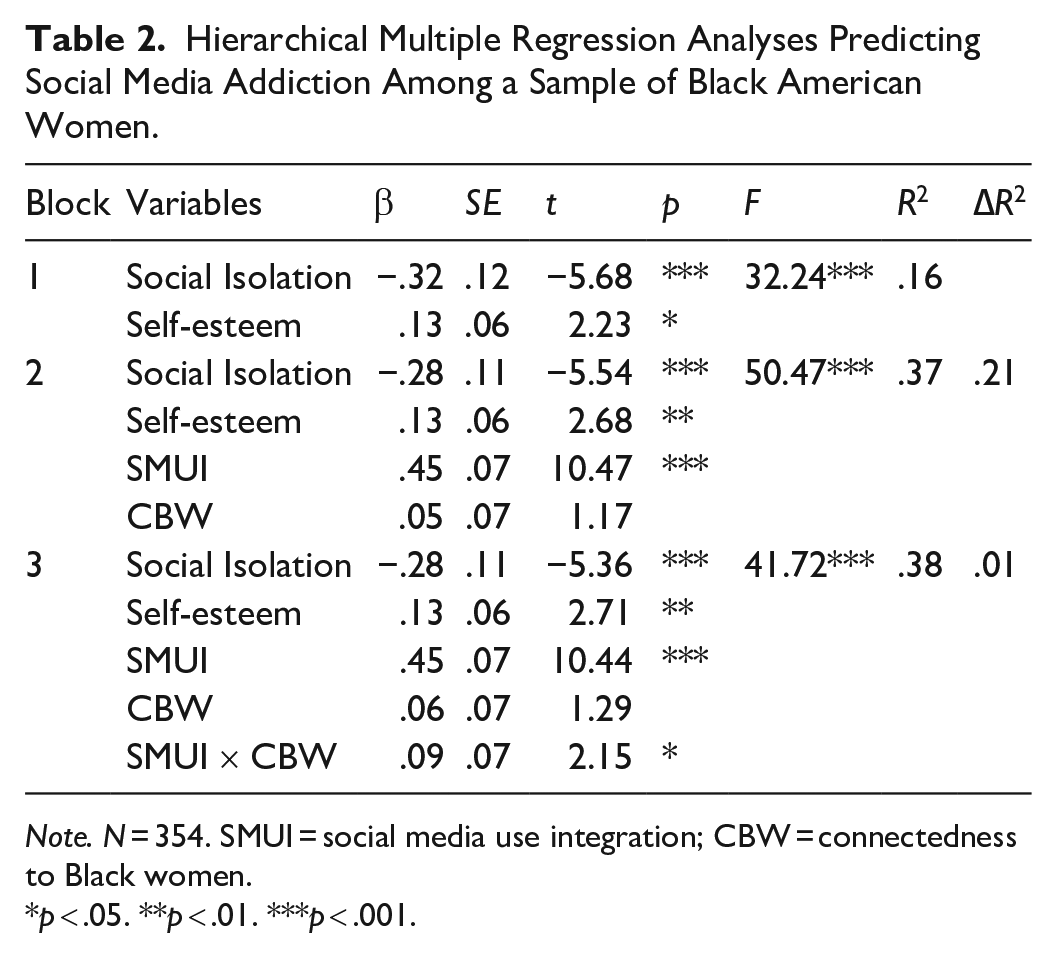
The final model accounted for 36.7% of the adjusted variance of social media addiction, F(5, 348) = 41.72, p < .001. The inclusion of the control variables in Step 1 predicted 15.0% of the adjusted variance in social media addiction, F(2, 351) = 32.24, p < .001. The inclusion of social media use integration and connectedness to Black women in Step 2 contributed significantly to the model, F(4, 349) = 50.47, p < .001, predicting an additional 20.9% of the adjusted variance in social media addiction. In Step 3, the interaction between social media use integration and connectedness to Black women contributed significantly to the model, F(5, 348) = 41.72, adding another 0.7% to the adjusted variance.
Hypothesis 1
Hypothesis 1 tested whether social media use integration would be positively associated with social media addiction. As presented in Table 2, there was a significant positive main effect of social media use integration on social media addiction (β = .45, t = 10.44, p < .001). Thus, Hypothesis 1 was supported.
Hierarchical Multiple Regression Analyses Predicting Social Media Addiction Among a Sample of Black American Women.
Note. N = 354. SMUI = social media use integration; CBW = connectedness to Black women.
p < .05. **p < .01. ***p < .001.
Hypothesis 2
Hypothesis 2 tested whether connectedness to Black women would strengthen the positive association between social media use integration and social media addiction. As presented in Table 2, there was a significant interaction between social media use integration and connectedness to Black women, β = .09, t = 2.15, p < .05. Further probing using simple slopes analysis (see Figure 1) showed that at a low level of connectedness to Black women (i.e., 1 SD below the mean), the social media use integration was significantly positively associated with social media addiction, t(5, 348) = 6.15, β = .57, p < .001. At a high level of connectedness to Black women (i.e., 1 SD above the mean), social media use integration was significantly positively associated with greater levels of social media addiction, t(5, 348) = 9.30, β = .83, p < .001. In other words, the positive association between social media use integration and social media addiction was magnified or exacerbated at higher levels of connectedness to Black women. Thus, Hypothesis 2 was supported.

Simple slopes analysis of social media use integration and social media addiction at two levels of connectedness to Black women.
Discussion
This study examined Black American women’s social media use integration in relation to social media addiction, and the potential moderating role of connectedness to Black women. We found that social media use integration was positively associated with social media addiction—a relationship that was strongest at a high level of connectedness to Black women. To our knowledge, this study is the first to examine social media use integration in relation to social media addiction. Furthermore, this study is the first to examine social media addiction among Black American women—a segment with notably high rates of social media use (PRC, 2017), but who remain under-researched in the social media literature. In doing so, we introduce a non-pathologizing perspective of Black American women’s social media addiction as influenced by the subjective importance of social media use within broader structural contexts.
Our study expanded on prior studies using predominantly White samples by investigating social media use integration among Black American women. Our data suggest that social media use integration was higher in our sample than in a nationally representative sample of American adults, including the White sub-sample and Black sub-sample (Bekalu et al., 2019). It is possible that socio-cultural factors may have influenced the greater social media use integration in our sample from data collected in 2022, compared to the samples from 2018. Notably, data for this study were collected in March and April 2022—almost exactly 2 years since Breonna Taylor, a Black American woman, was murdered by police officers in her apartment in Louisville, Kentucky, and as the United States continued to have widespread COVID-19 infections which disproportionately burdened Black Americans (Laster Pirtle & Wright, 2021). It is conceivable that these contextual factors shaped social media use integration in our sample.
We confirmed our first hypothesis that social media use integration would be positively associated with social media addiction. This finding corroborates prior research that has demonstrated the deleterious impacts of social media use integration on health and mental health outcomes, such as anxiety, depression, reduced psychosocial well-being, and lower self-rated health (Bekalu et al., 2019; Berryman et al., 2018; Woods & Scott, 2016). Moreover, our findings demonstrate a significant association between social media use integration and social media addiction. This cumulative body of research elucidates the importance of moving beyond solely investigating the frequency of social media use to additionally examine how emotional and behavioral investments in social media use may contribute to adverse psychological and behavioral health outcomes. In addition, our results point to the importance of examining how social media use integration may be shaped by culturally specific factors among Black American women and other socially disadvantaged groups, increasing their risks for social media addiction.
We confirmed our second hypothesis that connectedness to Black women would moderate the association between social media use integration and social media addiction. Our results showed an interaction between social media use integration and connectedness to Black American women in relation to social media addiction. Specifically, the positive association between social media use integration and social media addiction was significant at low and high levels of connectedness to Black women. This association was strongest at a high level of connectedness to Black women. It is conceivable that Black American women’s social media use may center on seeking connections with Black women to obtain social support, engage in socio-political activism, among other needs (Conley, 2017; Peterson-Salahuddin, 2022). There is a need for research exploring what unique benefits Black American women may obtain from connecting with Black women through social media use, and how this influences social media addiction. Furthermore, given research illuminating Black American women’s experiences with online victimization (Gray & Stein, 2021; Matsuzaka et al., 2022), there is a crucial need to examine both the benefits and risks of Black American women’s social media use in relation to their psychological and behavioral health.
Finally, in this study, we controlled for extraneous variables (i.e., perceived social isolation, self-esteem) that could have potentially impacted the associations between social media use integration, connectedness to Black American women, and social media addiction. Our results indicated that perceived social isolation was significantly positively associated with social media addiction, while self-esteem was significantly negatively associated with social media addiction. These results extend previous research demonstrating the links between social media addiction and perceived social isolation (Tateno et al., 2019) and lower self-esteem (Huang, 2022). Still, as the data were cross-sectional, we were not able to further explicate the causal direction between perceived social isolation, self-esteem, and social media addiction.
Limitations and Future Directions
This study has limitations that should be considered when interpreting the results. First, the cross-sectional study design limits our ability to infer causal relationships. Future research with longitudinal data is needed to establish a temporal relationship between social media use integration, social media addiction, and mental health outcomes (Marino et al., 2017, 2018). Second, given that our data drew from the use of self-report measures, they were susceptible to social desirability bias and recall bias. Third, our study findings cannot be generalized beyond our sample recruited through Qualtrics Panels. For instance, although we recruited for transgender women, this sample comprised 99.7% cisgender women. Due to cissexism, it is possible that Black women-centered social media may be occupied by users espousing trans-exclusionary ideologies (Boe et al., 2021). Thus, future studies should explore the experiences of Black American transgender women within Black women–centered social media.
Fourth, our study used the Social Media Use Integration Scale without disaggregating social media use integration findings by its subscales, namely, integration of social media use into social routines and social media use for emotional connection. This decision was based on the desire to measure social media use integration, holistically, considering both its emotional and behavioral components. In light of the findings of a prior study specific to the subscales’ contrasting associations with positive mental health outcomes (Bekalu et al., 2019), future research is warranted to explore the associations between integration of social media use into daily social routines, social media use for emotional connection, and social media addiction among Black American women. Fifth, our measure for connectedness to Black women did not permit us to explicitly measure whether connectedness to Black women was experienced offline or online. Given the potential simultaneity of connectedness in both offline and online formats (e.g., engaging with a Black women–centered blog while spending in-person time with a Black female friend), we chose to include a broad measure of connectedness to Black women that accounts for all formats of connectivity. Still, we recognize this as impeding our ability to describe our sample’s connectivity with other Black women within exclusively online spaces. Furthermore, in this study, we considered connectedness to Black women as a proxy for social interaction, social support, and discursive engagement among other experiences that might be facilitated by a greater proximity to Black women (Conley, 2017; Peterson-Salahuddin, 2022). We did not, however, measure for these relationships nor their associations with social media use integration and social media addiction. Thus, future studies are recommended to examine the mechanisms by which connectedness to Black women within online spaces directly, indirectly, or interactively influences social media addiction among Black American women.
Practice Implications
Our findings point to the need for mental and behavioral health practitioners to build knowledge and skills to engage in culturally relevant assessment and intervention with Black American women with risks for social media addiction. This is particularly important considering research linking social media addiction with mental health concerns commonly seen in practice settings, such as depressive and anxiety symptoms (Huang, 2022). Thus, social media addiction should be assessed as a potential contributor to depressive and anxiety symptoms, particularly among segments known to be substantial consumers of social media, such as young adults, women, and Black Americans (PRC, 2017, 2021). Our results illuminate the importance of assessing not only the frequency of social media use but also the integration of social media use in patients’ lives. Among Black American women, there is a need to additionally assess what subjective importance social media has for their connectivity with Black women and efforts to navigate structural gendered racism (Conley, 2017). For instance, practitioners are recommended to engage Black American female patients in an exploration of how and why they may use social media to such an extent that it risks becoming hazardous to their functioning. We recommend that these discussions be framed within broader sociocultural and structural contexts (e.g., structural gendered racism). Situating individual behaviors and psychosocial conditions within structural contexts supports a non-pathologizing perspective on their presenting problems (Shim, 2021). In other words, Black American women’s social media addiction might be discussed as a consequence of an excessive reliance on social media as a survival strategy amid structural stressors (Peterson-Salahuddin, 2022). In turn, practitioners can validate Black American women’s unique motives for social media use, while supporting the identification of alternative pathways to meet their psychosocial needs through more adaptive mechanisms.
Footnotes
Declaration of Conflicting Interests
The author(s) declared no potential conflicts of interest with respect to the research, authorship, and/or publication of this article.
Funding
The author(s) received no financial support for the research, authorship, and/or publication of this article.
