



Abstract
The rise of social network sites (SNSs) provided users with new ways to initiate and maintain personal relationships. Numerous functions (e.g., messaging, sharing, and reacting on content) allow for social interaction customized to distinct relationship needs and behaviors. This study investigated the associations of attachment style with distinct SNS usage patterns. Furthermore, the relationships of SNS (1) motives, (2) activities, and (3) outcomes were examined. In line with previous research, attachment anxiety was strongly related to SNS use. It predicted all relational SNS motives and activities. In contrast, high avoidance predicted a higher motive to use SNS to maintain autonomy, less monitoring activity, and higher scores on social media addiction. SNS motives (i.e., intimacy) partially mediated the relationship of attachment style on SNS activities. Furthermore, certain SNS motives, activities, and combinations of both aspects fully mediated the associations between attachment dimensions and social media addiction. The findings indicate that neglecting the mediating role of SNS motives and activities might partly account for inconsistencies in previous findings.
Keywords
Social network sites (SNSs) have become an obligatory tool for today’s social interaction (Boyd, 2017). SNSs can blur the boundaries between real-life and virtual relationships. Especially the younger generations would find it hard to completely give up on SNSs (Pew Research Center, 2018). Today, relationships both romantic and platonic are initiated and maintained using the various functions of online social networks (Boyd, 2017). The options to interact are numerous (e.g., direct messaging, sharing different kinds of content, liking, or commenting on others’ posts). Consequently, they offer users additional ways to connect with others depending on their own needs, preferences, and expectations regarding interpersonal relationships. A relatively stable disposition associated with distinct relationship needs and behaviors is the attachment style (Bartholomew & Horowitz, 1991; Hazan & Shaver, 1987). Numerous studies have investigated associations of attachment style with different SNS motives, activities, and outcomes (Stöven & Herzberg, 2021). To our best knowledge, to date, no study has systematically examined the differences regarding the interrelations between relationship-orientated facets of SNS use, that is, SNS motives, activities, and outcomes, associated with attachment style. Since interpersonal relationships are the core of SNS, this study aims to fill this gap.
SNS and Relationships
Until the early 2000s, initiating and maintaining personal relationships was vastly limited to offline social interaction (Boyd & Ellison, 2007). With the rise of web 2.0, social networking sites quickly gained high popularity and provided users with new possibilities to engage with others (Clement, 2020). The reciprocal nature of SNSs allows online experiences, which share important features of real-life social interaction (e.g., self-presentation, building up a network, and initiating and maintaining social bonds) (Boyd, 2017; Kaplan & Haenlein, 2010). Typical features such as instant messaging, “like”-buttons, and sharing and commenting on personal content (e.g., posting information, pictures, and videos) offer users a variety of ways to connect with others, depending on their preferences and needs regarding personal relationships.
The Uses and Gratifications Approach (UGA) emphasizes the active role of the user and provides a useful theoretical framework for researching usage patterns of new media (Katz & Foulkes, 1962). According to uses and gratifications theory, individuals use media to gratify their needs. The approach focuses on the relations of four aspects of media use: (1) the social and psychological origins (i.e., attachment style) of needs that generate (2) expectations about mass media. These needs lead to (3) differential usage patterns which result in (4) gratifications and other (unintended) consequences of media use (outcomes) (Katz & Foulkes, 1962; Rubin, 2009).
Attachment Theory
Regarding the first component of the UGA, that is, psychological origins of needs individuals seek to satisfy via media, individual differences in relationship expectations, emotions, and behaviors are guided by attachment style (Bowlby, 1969; Hazan & Shaver, 1987). Attachment style is considered a relatively stable disposition deriving from experiences with early caregivers, which result in mental representations of the self (model of self) in relation to others (model of others) (Bowlby, 1969). These inner working models guide future relationship expectations and behaviors. Attachment style is based on two dimensions—anxiety and avoidance (Brennan et al., 1998). Due to a negative model of self, attachment anxiety is associated with depending on others for self-worth resulting in high relationship-involvement and the fear of abandonment. High avoidance is related to discomfort with closeness and self-reliance because of a negative model of others. Security is defined as low levels on both dimensions and is characterized by being comfortable with both intimacy and autonomy in relationships. Furthermore, high levels on both dimensions are characterized by strong ambivalence in relationships (“push and pull”) and emotions, that is, craving closeness but also avoiding intimacy due to the fear of rejection, emotional unavailability, or feeling emotionally flooded when experiencing distress. Attachment style–related needs determine behaviors in relationship with important others (Feeney & Noller, 1992). As SNSs have become an integral part of modern social interaction, it is reasonable to expect that differences will emerge in needs and behaviors according to attachment style.
Attachment and SNS Engagement: Previous Findings
Due to the rapidly growing role of SNSs in everyday life, numerous studies have investigated the associations of attachment style with SNS over the past two decades. Stöven and Herzberg (2021) synthesized the results of 17 studies in a systematic literature review. Overall, high levels of attachment anxiety showed strong relations with general SNS engagement such as more time spent on SNSs (Blackwell et al., 2017; Hart et al., 2015; Oldmeadow et al., 2013). For avoidance, the results indicated no association or less engagement with SNSs (Chen et al., 2019). However, the majority of the studies found that higher scores on the avoidance dimension predicted less SNS engagement compared to attachment anxiety.
High attachment anxiety is related to a negative model of the self and depending on others to feel worthy. This is reflected by the motives to use SNSs associated with high levels of anxiety, such as the need to belong (relatedness), as well as the need to be well-liked and seek feedback in online networks (Chang, 2019; Chen et al., 2019; Hart et al., 2015). In line with theory, the opposite was true for users scoring high on avoidance, who are characterized by being self-reliant and trying to keep distance in social interaction. Therefore, high avoidance was associated with using SNS to preserve one’s autonomy (Baek et al., 2014). Regarding SNS activities, similar patterns emerged. Individuals high on the anxiety dimension engaged in numerous relational SNS activities such as reciprocal social interaction, self-presentation, and surveilling partner’s or ex-partner’s profiles (Baek et al., 2014; Flynn et al., 2018; Marshall et al., 2013). No preference for social activities was found for avoidant users, while the results for self-presentation were inconsistent (Chen et al., 2019; Emery et al., 2014; Flynn et al., 2018). While avoidant users generally avoid self-disclosure, they try to preserve their positive self-view in times of threat (Mikulincer & Nachshon, 1991). Furthermore, avoidant users showed less monitoring behaviors than anxious users, but a preference for unilateral parasocial activity compared to the other attachment types (i.e., following famous bloggers and other VIPs), which allows them to feel connected without facing the threat of closeness (Baek et al., 2014; Marshall et al., 2013). Thus, anxious users engaged in reciprocal social activities while avoidant users preferred unilateral interactions.
Regarding outcomes of SNS use, attachment anxiety showed relations to negative SNS outcomes, that is, social media addiction (SMA) (Blackwell et al., 2017; Chen, 2019; Worsley et al., 2018). The findings regarding the risk of negative outcomes, especially SMA, associated with avoidance were inconsistent with one study finding a positive association (Blackwell et al., 2017) and others reporting no association (Baek et al., 2014; Chen, 2019). The same was true for the interaction of high avoidance and high anxiety. While Demircioğlu and Göncü Köse (2018) found that fearful attachment was associated with a higher risk for SMA, Vaillancourt-Morel et al. (2020) found that attachment anxiety and avoidance were only related to problematic Facebook use, when the other dimension was low. A systematic review on attachment style and SMA found that only attachment anxiety was systematically associated with a higher risk for SMA and problematic behaviors (D’Arienzo et al., 2019).
In the current research, little attention was paid to the interaction of the two attachment dimensions, that is, secure (low scores on both dimensions) and fearful (high scores on both dimensions) attachment. Instead, they were widely treated as independent dimensions. Therefore, hardly any information is available on the potential associations with SNS use, especially SNS motives and activities (Stöven & Herzberg, 2021).
The Mediating Role of Motives
Previous research mostly examined specific aspects of SNS use, but largely without looking at the interrelationship of the different facets according to the UGA. However, there is some evidence that inconsistencies in previous research might be partially due to neglecting the relationships between SNS motives, SNS activities, and SNS outcomes (Stöven & Herzberg, 2021). According to the UGA, media use is goal-oriented and serves to satisfy individual needs. The resulting motives determine the type of use and the outcomes and make SNS use a very individual experience. Thus, the same activity can lead to different outcomes depending on users’ (attachment) needs and expectations (Chen, 2019; Papacharissi, 2008).
Baek et al. (2014) employed a more integrative approach and investigated the role of motives, activities, and outcomes of SNS use. While, in line with most research, the authors found no general association between attachment avoidance and SMA, parasocial SNS use fully mediated the effect of attachment avoidance on SMA. Furthermore, as high avoidant users are generally more introverted, they are typically less present on SNSs (D’Arienzo et al., 2019). However, psychological distress and low self-esteem mediated a positive effect on feedback-seeking (Flynn et al., 2018), because avoidant individuals seek to validate their positive self-view in times of threat and also feel the desire to be accepted (Carvallo & Gabriel, 2006; Mikulincer et al., 1998). For individuals high on the anxiety dimension, psychological distress, low self-esteem, and seeking relatedness mediate the positive effect on SMA (Chen, 2019; Flynn et al., 2018).
Baek et al. (2014) applied global motives of Internet use, that is, informational and entertainment. Given that SNSs’ main purpose is to connect and interact with others and to create or maintain interpersonal relationships (Bargh & McKenna, 2004), it seems plausible that the authors did not find any differences concerning the mediating effects of global motives of Internet use regarding the association of attachment style and SNSs activities and outcomes. Therefore, it seems important to focus on relationship-specific motives and activities, especially when looking at the association with attachment style.
Investigating the Relationships Between SNS Motives, Activities, and Outcomes
Summing up, two main problems can be identified from previous research that need to be addressed to comprehensively understand how attachment style is associated with SNS use: first, it is crucial to systematically consider the relationships between SNS motives, SNS use, and SNS outcomes, and second, to apply relationship-relevant categories of SNS use. This study aims to close this gap by examining the relationships between relational SNS motives, activities, and outcomes. The uses and gratifications approach serves as a framework.
Therefore, in the first step, motives, activities, and outcomes were defined based on previous findings and attachment theory. As mentioned above, previous research has established associations between attachment styles with various SNS motives which, according to Stöven and Herzberg (2021), can be attributed to four generic motives—the need to belong, feedback-seeking, autonomy, and jealousy. Except for jealousy, these SNS motives reflect different relationship needs related to the internal working models of the self and others associated with the attachment dimensions. Avoidance determines the need for self-reliance and independence in relationships as reflected by the (1) autonomy motive, which is characterized by the need to maintain one’s independence by controlling closeness in online interactions. Due to a negative model of the self, anxiety is related to intensive reassurance-seeking to feel worthy. The need to seek feedback and reassurance for a positive self-view through appreciation by others is captured by the (2) feedback-seeking motive. Jealousy is not considered a motive, but an emotion that can result in various motives to reduce the unpleasant feeling (e.g., feedback-seeking). Therefore, jealousy is not included as a motive in the model. Instead of the jealousy motive, we defined the seeking (3) intimacy motive which is characterized by the need to deepen relationships and attain more intimacy. It is a core aspect of adult attachment theory and a broader, less situation-specific motive. Seeking intimacy depends on both a positive model of self and others, characteristic of secure attachment. Avoidant individuals are uncomfortable with closeness while the negative model of self in anxious individuals makes seeking intimacy a potential threat through rejection. Yet, the distant nature of SNSs can make rejections seem less threatening compared to face-to-face, which provides new opportunities for anxious users to seek closeness. Finally, the need to belong is a fundamental human need (Baumeister & Leary, 1995). For example, even though avoidant individuals are uncomfortable with closeness, they still feel the need to belong (Carvallo & Gabriel, 2006). Therefore, the (4) belonging motive captures the need to belong and to feel connected through SNSs.
Relationship-related SNS activities comprise the second component of the model (Figure 1). Previous research has investigated associations with numerous different aspects of SNS use, such as quantitative aspects (e.g., time spent, number of friends, number of log-ins), different SNS platforms (mostly Facebook, Twitter, and Instagram), or qualitative aspects both platform-specific (e.g., status updates, tweets) and general (e.g., self-presentation, parasocial use). The focus of this study lies on qualitative aspects of SNS use as they provide more insights into differential usage patterns than quantitative aspects. Moreover, as the SNS landscape is constantly changing, instead of specific platforms or specific activities, respectively, the use of generic categories of activities that can be applied across the most popular SNS platforms was investigated. A comparison between active and passive use of the currently most frequently used SNSs (i.e., Facebook, Instagram, Twitter, and TikTok) showed no direct effect for either platform on satisfaction with life (SWL; Masciantonio et al., 2021). Furthermore, active use of all platforms was associated with social support which mediated a positive effect on SWL. Only TikTok did not reveal this association. Despite obvious differences between the platforms, they seem to be sufficiently similar with regard to overriding SNS motives, activities, and outcomes relevant to interpersonal relationships.

Revised model after Baek et al. (2014) of the relationships between attachment style and relationship-relevant facets of SNS use.
Based on the findings of the review (Stöven & Herzberg, 2021), four SNS activities were determined. (1) Social activity comprises reciprocal interaction with (online) friends and followers. (2) Parasocial activities, such as viewing (and reacting to) the content of famous bloggers, movie stars, singers, athletes, or politicians. (3) Self-presentation includes activities such as sharing personal content (i.e., pictures, videos), opinions, and information, while (4) monitoring activity comprises viewing the SNS profiles and content of partners or ex-partners. For avoidant persons preserving one’s independence and detachment in relationships is of high importance (Hazan & Shaver, 1987). Therefore, according to Mikulincer and Nachshon (1991), they neither like to make intimate self-disclosures, respond to or retort self-disclosure, nor even be exposed to others’ intimate disclosure. Thus, as suggested by previous findings, parasocial activity seems the only SNS activity likely to be preferred by avoidant users. Furthermore, monitoring one’s partner’s content has shown to be negatively predicted by avoidance, as monitoring might reactivate the attachment system which avoidant persons try to suppress to avoid pain (Shaver & Mikulincer, 2009). Because anxious individuals’ self-worth is dependent on others, self-presentation on SNSs as well as social use and monitoring of an (Ex)Partners profile provide should be of higher interest.
Stöven et al. identified three main outcome categories, that is, SMA, SWL, and problematic SNS use. Problematic SNS use and SMA are often used interchangeably (Sun & Zhang, 2021). Furthermore, problematic SNS use is part of SMA when measured with the well-established Bergen Social Media Addiction Scale (BSMAS; Andreassen et al., 2012). Thus, it is not considered a separate outcome in the model. Especially attachment anxiety shows strong relations to SMA, while for avoidance the results are less consistent (D’Arienzo et al., 2019; Stöven & Herzberg, 2021). A person’s motive to engage with SNSs plays an important role in the development of SNS dependency (Papacharissi, 2008). In line with the UGA (Rubin, 2009), social compensation theory claims that individuals who struggle to fulfill social needs offline use online interaction as a compensation strategy resulting in a higher risk for dependency (Zywica & Danowski, 2008). While SNSs offer anxious users an effortless opportunity to compensate for deficiencies in real-life relationships by seeking reassurance and closeness online (D’Arienzo et al., 2019), for avoidant people SNS use provides only a small amount of attractive features to gratify their relationship needs of independence and distance. Finally, SWL is a valid indicator of general well-being and is further associated with outcomes of mental health. Although SNS use has the potential to (temporarily) satisfy anxious users’ needs, a withdrawal into the digital world could lead to a negative reinforcement effect (D’Arienzo et al., 2019) decreasing the SWL. Since avoidant users do not seem to gain much from using SNSs, an impact on their SWL was not observed (Baek et al., 2014). SMA and SWL were included in the model as outcome categories each representing one SNS specific and one unspecific outcome of SNS use.
Research Question and Hypotheses
RQ1. How are attachment dimensions associated with relational SNS motives (1), activities (2), and outcomes (3)?
RQ2. How do SNS motives and activities mediate the effects of attachment style on SNS use and negative outcomes of SNS use?
To address RQ2, it was initially planned to conduct comprehensive exploratory analyses regarding the potential mediating effects of SNS motives, activities, and their interaction on SNS outcomes. Due to the complexity of the model, the focus was put on testing specific hypotheses on these associations. An exploratory approach to the remaining associations was applied in a second step.
The associations of attachment style with SNS motives, activities, and outcomes:
H1a. Attachment Anxiety is positively associated with the motive to use SNS for intimacy, the motive to seek feedback, and the need to belong, but not the motive to seek autonomy.
H1b. Attachment Avoidance is positively associated with the motive to use SNS for autonomy.
H2a. Attachment anxiety is positively associated with monitoring and social activity.
H2b. Attachment avoidance is negatively associated with monitoring and self-presentation.
H2c. Attachment avoidance is positively associated with parasocial activity.
H3a. Attachment Anxiety, but not avoidance is positively associated with SMA.
H3b. Both attachment Anxiety and avoidance are negatively associated with SWL.
The mediating role of SNS motives and activities:
H4a. The motive to seek intimacy mediates the positive effects of attachment anxiety on social activity and monitoring.
H4b. The motive to belong mediates the positive effect of attachment anxiety on social activity.
H4c. The feedback-seeking motive mediates the positive effect of attachment anxiety on self-presentation and monitoring.
H4d. The motive to belong mediates the positive effect of attachment avoidance on parasocial activity.
H4e. The feedback-seeking motive mediates the positive effect of attachment avoidance on self-presentation.
H5. Engaging in certain activities does not mediate the relationship between attachment style and SNS outcomes.
H6a. The motives to seek intimacy, to seek feedback, and belonging mediate the positive effect of attachment anxiety on SMA.
H6b. The motives to seek intimacy, to seek feedback, and belonging mediate the negative effect of attachment anxiety on SWL.
H6c. A high autonomy motive mediates a negative effect between attachment avoidance with SMA.
Method
Participants and Procedure
Participants for the online survey were recruited by e-mail and social media platforms in the university and personal environment. Students of the Helmut-Schmidt-University in Hamburg could gain achievement points for participating. A total of 276 completed the survey after signing the informed consent. Five cases had to be excluded due to missing data resulting in a final sample size of 271. Among those were 56.5% female and 43.5% male. The age ranged from 20 to 70 years (M = 33.12; SD = 12.30). The research data is archived and can be accessed under the Open Science Framework link https://osf.io/qtrbn/?view_only=859335080f7d45eeaa319a2abf99c516.
Measures
SNS Motives and Activities
To measure SNS motives for each of the four motives (e.g., autonomy, intimacy, feedback-seeking), three to five items were assigned to the corresponding scales based on expert consensus with two additional researchers. The statements are rated on a 6-point scale from 1 = always to 6 = never. To measure SNS activities for each of the four activities (social, parasocial, self-presentation, monitoring), four to six items were assigned to the respective scale based on expert consensus. Each of the items was rated on a 5-point scale ranging from 1 (not true at all) to 5 (completely true). For social and parasocial activity, a German translation of the items developed by Baek et al. (2014) was applied.
In the second step, a pilot sample (N = 8) completed the preliminary version of the SNS motives and activities scales and gave feedback on comprehension issues. Only a few adjustments were necessary to improve comprehensiveness which was approved by expert consensus. Internal consistency was assessed with Cronbach’s alpha (Table 1). Exploratory factor analyses revealed a three-factor solution for the SNS motives with the items of the belonging motive and the feedback-seeking motive representing a common factor. Nevertheless, confirmatory factor analyses revealed a better fit for the hypothesized four-factor structure compared to the three-factor solution (χ2/df = 3.164 vs 3.966; comparative fit index [CFI] = .925 vs .893; Akaike information criterion [AIC] = 367.784 vs 441.027). Therefore, the four-factor solution was applied. Exploratory factor analyses for SNS activities resulted in the hypothesized four-factor solution. The model fit was slightly below what is considered as acceptable (χ2/df = 3.795; CFI = .863). For the SNS activity scales, Cronbach’s alpha ranged from .77 (parasocial activity) to .92 (monitoring) and for SNS motives from .76 (autonomy) to .91 (feedback-seeking), indicating good internal consistency of the scales. The complete questionnaire is provided in supplement S2.
Gender Differences and Descriptive Analyses of SNS Motives and Activities.
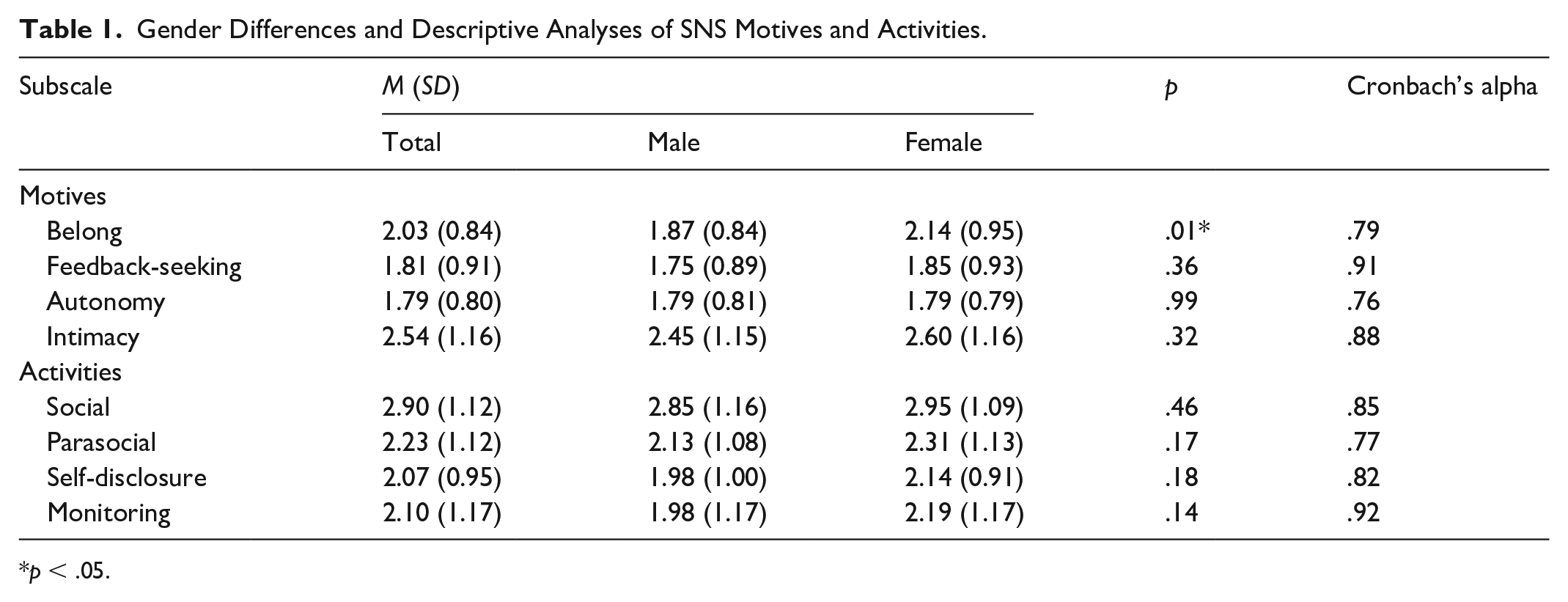
*p < .05.
Satisfaction With Life
The German version of the Satisfaction With Life Scale (SWLS; Diener et al., 1985) by Janke and Glöckner-Rist (2012) allows for measuring the extent to which individuals are satisfied with their current life “all in all.” Five statements (e.g., “I am satisfied with my life,” “My living standards are excellent”) are rated on a 7-point rating scale from 1 (does not apply at all) to 7 (entirely true).
Social Media Addiction
Andreassen et al. (2012) developed the BSMAS, an established tool to capture the extent of SMA. The scale consists of six items (e.g., “You spend a lot of time thinking about social media or planning how to use it”) measured on a 5-point rating scale from 1 (very rarely) to 5 (very often). Since no German translation of the scale is available to date, the items were translated into German by a native speaker.
Trait Adult Attachment
To assess adult attachment, we used the German translation of the Experiences in Close Relationships (ECR) Scale (Brennan et al., 1998) by Neumann et al. (2012). The questionnaire consists of 36 items with 18 items assessing attachment anxiety (e.g., “I’m afraid that I will lose my partner’s love”) and 18 items assessing attachment avoidance (e.g., “I prefer not to be too close to romantic partners”) on a 7-point rating scale, ranging from 1 (strongly disagree) to 7 (strongly agree).
Design
This study employed a cross-sectional design using an online survey. To test the hypothesized associations between attachment dimensions and SNS motives, activities, and outcomes, full structural equation modeling was applied using maximum likelihood estimation. The latent model comprised of 2 latent exogenous (attachment anxiety and avoidance) and 10 latent endogenous variables, that is, the 4 SNS motives, 4 SNS activities, and 2 outcomes of SNS use (Figure 1). Variables were measured by four items each, except for self-disclosure and SWL which were measured by five items, and monitoring and SMA which were measured by six items each. Error terms in the model were uncorrelated. Correlations between factors were freely estimated. The assumption of multivariate normality was violated (Mardia’s normalized estimate of multivariate kurtosis = 31.70). To address this issue and to test the significance and confidence intervals of the mediator paths (i.e., specific indirect effects), Bootstrap with 1,000 samples was applied. Structural equation modeling using AMOS 27 (Arbuckle, 2006) was applied.
Results
Model Test
In the first step, the goodness of fit of the proposed model was tested. Chi-square was significant (χ2 = 5,913.07, df = 3,093, p < .001), indicating an unacceptable fit of the model. Due to the sensitivity to sample size and the assumption of the underlying central chi-square distribution that the model fits the population perfectly, this fit index is known to be somewhat problematic in estimating the goodness of fit (Byrne, 2016). Therefore, the absolute value of the chi-square test is better interpreted as χ2/df, with values <5 deemed acceptable (Bollen, 1989). The χ2/df ratio is 1,912, which is good. The CFI = .756 indicated a poor fit of the model, while the root mean square error of approximation (RMSEA = .058 with 95% confidence interval [CI] = [.056, .060]) was satisfactory.
Descriptive Analyses
Table 1 provides an overview of the descriptive analyses of the SNS motives and activities as well as gender differences. The ECR subscales anxiety and avoidance were correlated (r = .22, p = .007). All motive subscales were significantly correlated with the highest correlation between the motive to seek belonging and feedback-seeking (r = .78, p < .001). Across the activity subscales, self-presentation was significantly positively correlated with social (r = .46, p = .001) and parasocial activity (r = .23, p = .02). For full information on scale correlations, see Table 1 in supplement S1.
Gender differences only emerged for the belonging motive (Table 1). Women (M = 2.14, SD = 0.95) scored significantly higher on this motive than men (M = 1.87, SD = 0.84, p = .01). A younger age is significantly associated with higher scores on parasocial activity (p < .001) and monitoring (p < .001) as well as on the belonging (p = .02), intimacy (p < .001), and the feedback-seeking motive (p < .001).
Relations of Attachment Style Dimensions With SNS Usage Patterns
Direct Effects of Attachment Style Dimensions on SNS Motives, Activities, and Outcomes
Preliminary regression analyses were conducted to estimate the association of attachment and aspects of SNS use when the other variables were not considered (Table 2). Anxiety is positively associated with the intimacy, feedback-seeking, and belonging motive, while avoidance is only related to the autonomy motive. Furthermore, anxiety was positively related to the autonomy motive. Other than expected, anxiety is positively associated with monitoring and parasocial SNS use, while avoidance does not show significant associations with any SNS activity. Anxiety but not avoidance is positively associated with SMA and negatively with SWL.
Standardized Regression Coefficients of Attachment Dimensions With SNS Motives, Activities, and Outcomes.

SNS: social networks sites; SWL: satisfaction with life; SMA: social media addiction.
p < .05.
p < .01.
To test the relationships between attachment style and different facets of SNS use, direct and indirect effects of the model were tested for significance by applying bootstrap resampling method with 1,000 samples (Table 3). As hypothesized (H1a), anxiety was positively associated with the feedback-seeking motive (β = .35, p = .001), the belonging motive (β = .32, p < .001), and marginally the intimacy motive (β = .16, p = .054). Other than expected, anxiety was also associated with the autonomy motive (β = .28, p = .001). In line with H1b, attachment avoidance was positively associated only with the autonomy motive (β = .21, p = .009). Looking at SNS activities, anxiety was associated with higher levels of monitoring (β = .23, p < .001) but not social activity (β = −.11, p < .126) only partially confirming H2a, while high avoidance was negatively associated with monitoring (β = −.18, p = .006) and self-presentation (β = −.18, p = .001) according to H2b. Contrary to previous findings, high attachment avoidance was not associated with greater parasocial use (β = −.09, p = .308). Thus, H2c could not be confirmed. According to H3b, both attachment anxiety and avoidance were associated with lower scores on SWL (β = −.47, p = .001; β = −.24, p = .004). Other than expected (H3b), avoidance (β = .24, p = .001) but not anxiety (β = .04, p = .562) had a positive direct effect on SMA.
Direct Effects of Attachment Style on SNS Motives, Activities, and Ouctomes.
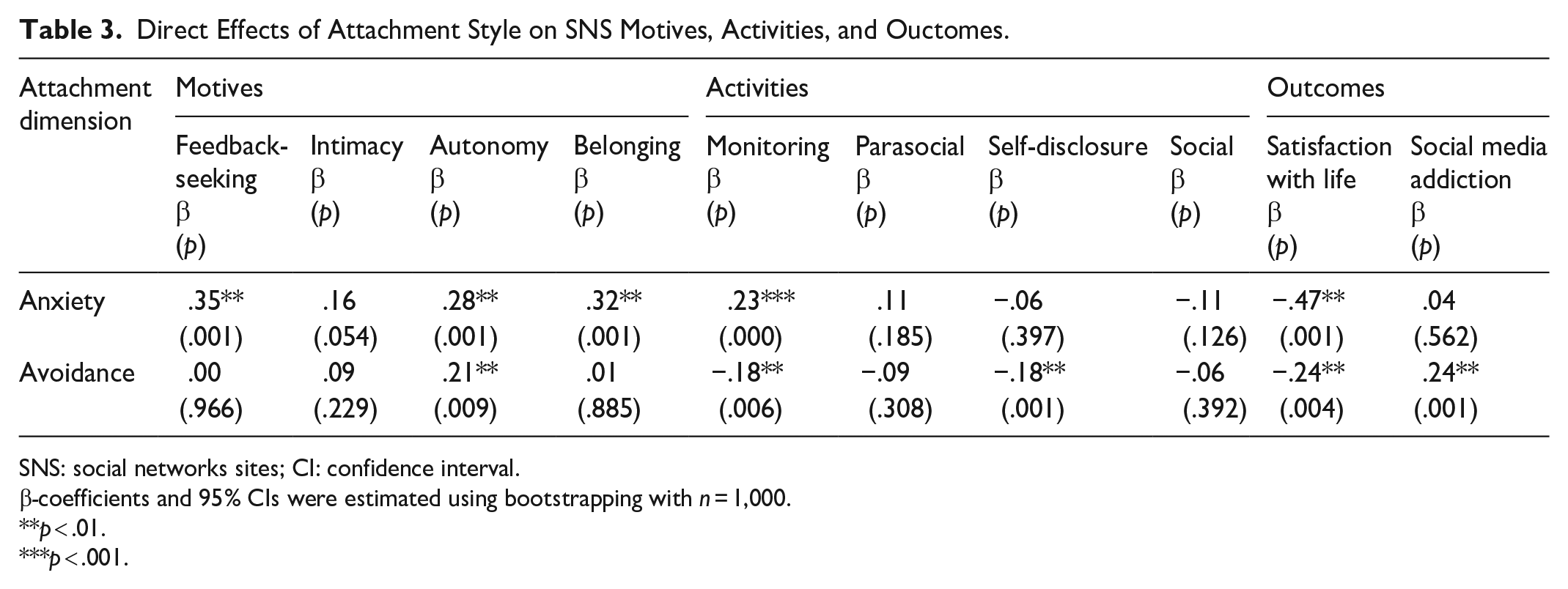
SNS: social networks sites; CI: confidence interval.
β-coefficients and 95% CIs were estimated using bootstrapping with n = 1,000.
p < .01.
p < .001.
The Mediating Effect of Motives and Activities
Results show that the intimacy motive fully mediated the effect of anxiety on social activity (β ind = .03, CI = [.00, .10], p = .031) and monitoring (β ind = .03, CI = [.00, .11], p = .038) according to H4a, but—other than expected—also on self-presentation (β ind = .02, CI = [.00, .07], p = .037) and parasocial use (β ind = .03, CI = [.00, .11], p = .036). According to H2b, the motive to belong mediated the positive effect of anxiety on social activity (β ind = .09, CI = [.03, .26], p = .014). According to H4c, the feedback-seeking motive fully mediated the effect of anxiety on self-presentation activity (β ind = .11, CI = [.05, .21], p = .001) and partially the positive effect on monitoring (β ind = .11, CI = [.02, .25], p = .013). Other than expected, no mediating effects of SNS motives on the relationship between avoidance and SNS activities were found (H4d + e).
Regarding the mediating effects of activities on outcomes of SNS use, monitoring fully mediated a positive effect of anxiety on SMA (β ind = .03, CI = [.01, .08], p = .002) and a negative effect of avoidance on SMA (β ind = −.03, CI = [−.09, −.01], p = .006). Thus, H5 could not be confirmed. No mediation effect was found for the hypothesized motives for the association between attachment anxiety and SMA (H6a) or SWL (H6b). Only the autonomy motive fully mediated the negative effect of anxiety on SMA (β ind = −.03, CI = [−.08, .00], p = .032). Table 4 provides an overview of the results for all hypotheses.
Overview of the Results on the Hypotheses.
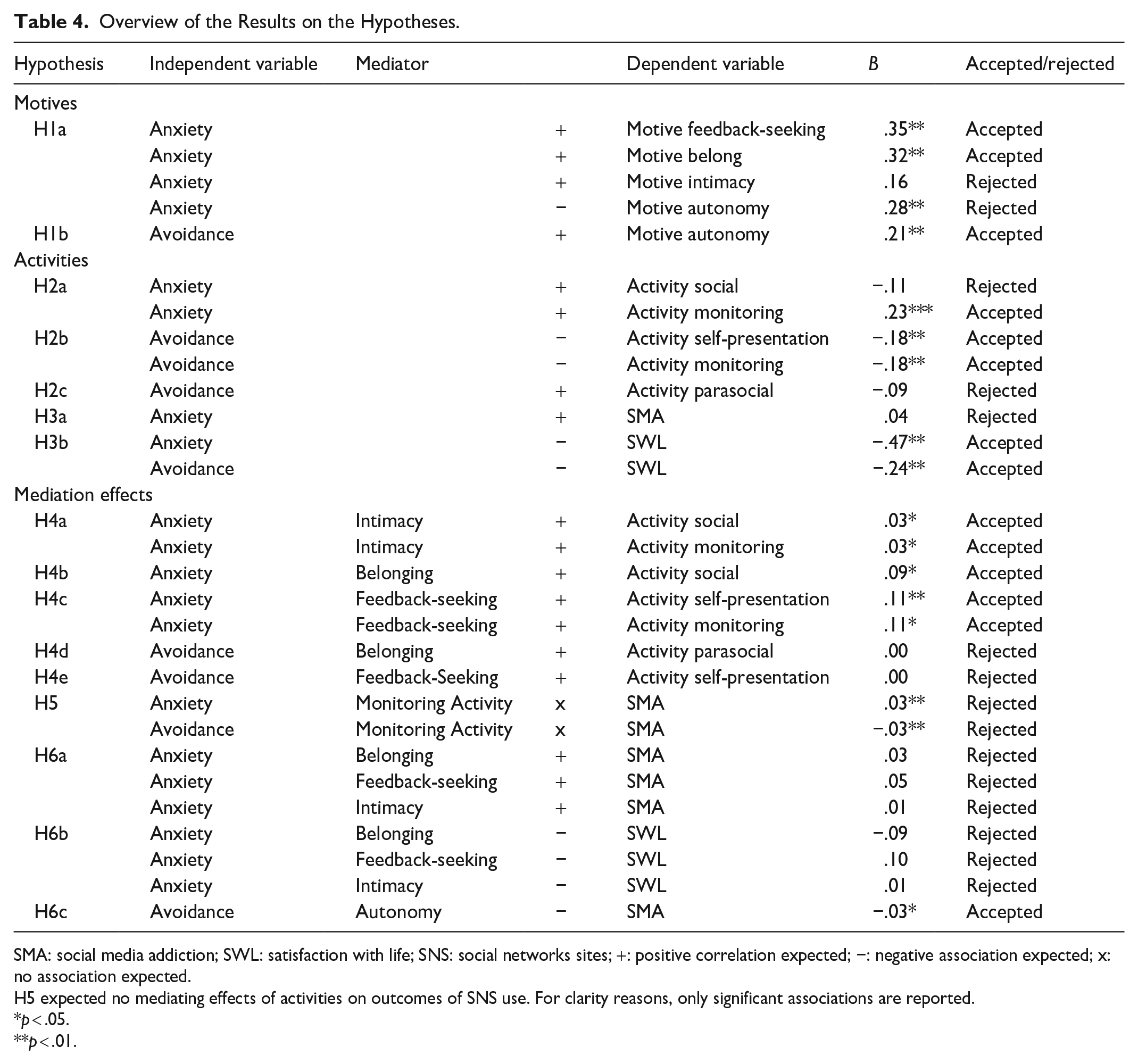
SMA: social media addiction; SWL: satisfaction with life; SNS: social networks sites; +: positive correlation expected; −: negative association expected; x: no association expected.
H5 expected no mediating effects of activities on outcomes of SNS use. For clarity reasons, only significant associations are reported.
p < .05.
p < .01.
Exploratory Analyses
After testing hypotheses on the relationships between attachment style and SNS use, motives, activities, and outcomes exploratory analyses were conducted to examine further mediation effects between the components in the model. Results showed that the autonomy motive partially mediated a negative effect of avoidance on SMA (β ind = −.03, CI = [−.07, .00], p = .037). Regarding multiple mediation of motives and activities on outcomes, the positive effect of anxiety on SMA was fully mediated by the combination of the intimacy motive with monitoring (β ind = .01, CI = [.00, .03], p = .027), the feedback-seeking motive and monitoring (β ind = .02, CI = [.00, .07], p = .042), as well as by using parasocial activities for intimacy (β ind = .01, CI = [.00, .03], p = .037). No mediation effects on SWL scores were found. For further information on mediation effects, see Table 3 in supplement S1.
Discussion
Social networks offer a multitude of new ways to get in touch with each other and form relationships. According to the UGA, individual needs determine how and why a medium is used as well as (unintended) outcomes of usage (Katz & Foulkes, 1962). Regarding close relationships, attachment style has shown to be a reliable predictor of individual relationship needs and behaviors (Hazan & Shaver, 1987). Over the last two decades, a large number of studies have examined the relationships between attachment style and various aspects of SNS use—with partly inconsistent results (Stöven & Herzberg, 2021). However, the interrelationships of SNS motives, activities, and outcomes have received little attention. This study aimed to close this gap by investigating the underlying dynamics of attachment style with SNS motives, activities, and outcomes in the scope of personal relationships.
Attachment and Relational SNS Use—An Integrative Approach
Associations of Attachment With SNS Motives and Activities
High anxiety showed strong relations to all motives of SNS usage. While findings from previous research investigating the relationship with general SNS motives indicated no differences across attachment types (Baek et al., 2014), differences emerged when considering relationship-relevant motives. Attachment anxiety was associated with all relational motives of SNS use (belonging, intimacy, feedback-seeking, and autonomy). This supports the assumption that individuals high on anxiety are the “heavy users” of SNSs to satisfy numerous relationship needs, for example, to feel closer and to seek positive feedback (Shaver et al., 2005). Surprisingly, anxiety was also associated with SNS use to keep one’s autonomy. As anxiety is related to poor conflict resolution (Sierau & Herzberg, 2012), keeping control about how close others become in SNS interactions might allow high anxious users to easily evade the threat of conflict, for example, by simply closing the app or ignoring other users. Furthermore, as attachment anxiety is associated with social anxiety (Manning et al., 2017), feeling to be in control of social interaction and the chance to keep certain (potentially threatening) people at an arm’s distance might explain the positive relation to the autonomy motive.
In line with theory, individuals high in avoidance use SNS to maintain autonomy (i.e., distance) in social interactions (Bowlby, 1969; Hazan & Shaver, 1987). Furthermore, higher scores on avoidance were associated with less monitoring, as avoidant individuals seek to remain detached from others and do neither like high self-disclosing others nor reciprocate self-disclosure of others (Mikulincer & Nachshon, 1991). The pressure to share personal information might rather lead to reluctant behavior in avoidant individuals, as this poses a potential threat of merging with others. In line with previous findings, attachment anxiety was positively related to monitoring. Other than expected, there was no direct effect of attachment anxiety on self-presentation behaviors. But both the motive to enhance intimacy and to seek feedback fully mediated a positive effect of anxiety on self-presentation. This supports previous findings which found that high anxious users’ self-presentation was mediated by feedback sensitivity, low self-esteem, and psychological distress (Flynn et al., 2018; Hart et al., 2015) as attachment anxiety is associated with low self-esteem and depending on others’ affection. Furthermore, a positive effect on engaging in social activities was fully mediated by the motives to belong and to enhance intimacy, while intimacy and the feedback-seeking motive partially mediated the effect on monitoring. These findings indicate that inconsistencies regarding attachment-related differences in SNS activities might be partially due to neglecting the role of SNS motives.
The Mediating Role of Motives and Activities for Effects on SMA
Results of simple linear regression confirmed previous findings regarding associations of attachment style with outcomes of SNS use. Anxiety but not avoidance was associated with higher SMA and lower SWL scores. However, once motives and activities were included in the comprehensive model, these effects changed. While direct associations with motives barely changed, the direct effects on activities became weaker. The associations with outcomes changed even more significantly. While anxiety no longer showed a general association with SMA, a positive association with avoidance emerged. These findings support the assumption that relational SNS motives and activities affect SNS outcomes. Although no direct effect emerged for attachment anxiety on SMA, surveilling a partner’s or ex-partner’s profile mediated the positive effect of anxiety on SMA. Furthermore, using SNS to monitor an (ex-)partner with the motive to enhance intimacy or to feel better about oneself (feedback-seeking) was associated with higher SMA scores for individuals high in anxiety. Looking at pictures of a romantic partner can evoke feelings of love and positive affect and activates the reward system of the brain (Xu et al., 2011). As anxious individuals struggle with emotion regulation (Karreman & Vingerhoets, 2012; Shaver et al., 2008), surveilling an (ex-)partner’s page—especially when seeking to feel intimate—might provide them with a useful tool that is available 24/7. Moreover, the reward system of the brain plays an important role in the development of addictive behaviors (Schultz, 2002). Also, seeking intimacy in parasocial relationships contributed to the risk of SMA in anxious users. Parasocial relationships can evoke the feeling of being connected (Horton & Wohl, 1956). The findings above support the assumption of a self-reinforcement effect. SNSs appeal with easy access to intimate relationships without the challenges of face-to-face interactions, such as the threat to be rejected in person. This is especially true for so-called passive (i.e., unilateral) activities such as surveilling and parasocial use (Horton & Wohl, 1956). Due to the one-way nature of monitoring and parasocial interaction, these might fail to sustainably fulfill the need for intimacy (i.e., feeling close) as it lacks important features of real-life interaction (Twenge & Spitzberg, 2020). Nevertheless, short-term gratifications might contribute to more passive use. Furthermore, the autonomy motive mediated the negative effect of anxiety on SMA.
The motive to maintain distance from others is conflicting with the pattern of seeking closeness and affirmation. Therefore, SNS use guided by the autonomy motive is likely to fail the fulfillment of relationship needs of anxious users. This lack of gratification might function as a protector from developing SMA. Moreover, anxious users who also need autonomy may consequently derive less benefit from SNSs than users who have a high need for closeness and affirmation. Different patterns emerged for avoidant users. A direct effect on SMA indicates a generally higher risk for avoidant users to display addictive symptoms. While no particular motive or activity mediated this positive association, the autonomy motive fully mediated a negative effect on SMA. Avoidant individuals have a generally higher need for independence and avoiding closeness, which makes social interaction also via SNS less attractive. Therefore, problematic SNS use might only emerge for avoidant individuals who have a relatively low need for autonomy. This could be the case for users who score high on both attachment dimensions. Fearful attachment, according to the typology by Hazan and Shaver (1987), is characterized by both a fear of and a desire for relationships and is related to negative outcomes of SNS use (Demircioğlu & Göncü Köse, 2018). This contradicts previous assumptions by Vaillancourt-Morel et al. (2020) that preserving one’s autonomy via SNS interactions is the mechanism that leads to problematic Facebook use among high avoidant and low anxious users. Nevertheless, these results are consistent with findings that problematic SNS use is only associated with high levels on one dimension when the other is low, since the association between avoidance and SMA is enhanced by a low autonomy motive (characteristic for anxiety) and the risk for SMA among anxious users is reduced by a high autonomy motive (characteristic for avoidance). Thus, further research needs to be conducted in order to fully understand how the interaction of attachment dimensions is associated with attachment motives, activities, and outcomes.
Implications
In line with previous findings, SNSs seem to provide a useful tool especially for anxious individuals, as online social interaction allows for both easy access to relationships and easy exit, when “it is complicated.” A self-reinforcement effect might lead to SMA. Both attachment anxiety and SMA are associated with negative outcomes of mental health (e.g., depression) (Roberts et al., 1996; Twenge et al., 2018). Therefore, it is crucial to understand these dynamics, for example, for the development of interventions such as teaching media competence in clinical and non-clinical settings. Since SNSs are an integral part of interpersonal interaction, in the field of (attachment-based) psychotherapy individuals can learn (how) to have positive relationship experiences via SNSs. Since even repeated imagined positive relationship experiences can change the attachment style toward secure attachment (Gillath & Karantzas, 2019), virtual relationship experiences should also be able to be used for this purpose. For this purpose, problematic patterns of use (i.e., combinations of motives and activities that promote SMA by not satisfying needs in a sustainable way) can be identified and replaced by helpful patterns. Even though avoidant users show rather unspecific usage patterns, they showed a higher risk for SMA. The underlying mechanisms remain unclear. Further research is needed to understand the black box of what drives.
Limitations
The first limitation to mention of the study is the fit of the model. High correlations between the motive to belong and to seek feedback as well as between social activity and self-presentation indicate that these might not be treated as independent factors. Moreover, the scale development had somewhat limited scope as it was based on findings of previous research. Therefore, there might be further relationship-specific SNS motives and activities which were not considered in the current model. Furthermore, the monitoring activity focused on passively viewing the profiles of (ex-) romantic partners. Recent findings suggest that passively viewing profiles of friends results in different effects on psychological outcomes (e.g., SWL) than actively interacting with others (Masciantonio et al., 2021). Therefore, passive social use (i.e., viewing friends’ profiles) should be considered in addition to viewing partners’ (monitoring) and VIPs’ profiles (parasocial use).
SNSs are a very dynamic research topic, as they rapidly change and evolve. Thus, there are no actual basic models or theories which serve as a common framework for research in this field. Nevertheless, a tremendous amount of studies are examining associations with all kinds of aspects of SNSs. This makes it hard to find a common theoretical base to build strong hypotheses. Therefore, in this study, the uses and gratifications approach served as a framework for exploratory investigations. Due to the complexity of the topic, this limits the significance of the findings, as opposed to a hypotheses-guided approach with a strong theoretical base. The vast number of estimated paths in the model yields the risk of random findings. Therefore, the results should be interpreted with caution. Rather, they serve as a reference for future research.
Furthermore, the interaction of the attachment dimension was not considered. As there was no theoretical base to build on, it was impossible to derive hypothesis and consider the moderation effect of attachment dimensions in the model. An exploratory approach on these associations was not possible due to the sample size and the already complex model.
Furthermore, the platform used (e.g., Facebook, Instagram, Snapchat, Twitter) was not considered. Although the different functions inherent to each of the SNSs might affect the user experience and outcomes, with respect to SWL, no difference between the active and passive use of different platforms was found (Masciantonio et al., 2021). A higher SWL through active use was mediated by social support for the three most frequently used platforms. Furthermore, interacting with others (social activity) on image-based platforms (e.g., Instagram) decreases feelings of loneliness, but not on text-based platforms (e.g., Twitter) (Pittman & Reich, 2016). Nevertheless, the most used platforms of the main age group in the sample (20–29) are Instagram (82%), Facebook (68%), and TikTok (57%), which are all image-based and similar in their functions (mainly sharing of pictures and videos, as well as comment and like functions) while Twitter is used by only half of this age group (Faktenkontor, 2021). Nevertheless, since there are considerable differences between the platforms and their respective functions, it would be appropriate in the future to investigate how different platforms are used for specific motives and how this affects the outcomes. Age was significantly associated with several SNS motives and activities. However, it was not included as a variable in the model. Furthermore, the cross-sectional nature limits the investigation of causal relationships between the variables. Finally, a rather small convenience sample was used. Although gender, which has shown strong associations with SNS use, was equally distributed, the sample was relatively heterogeneous regarding occupation (mostly university students) and age. As age has shown to play an important role in SNS use (Pew Research Center, 2018), a more diverse sample regarding this dimension would be of interest. However, the age group who uses SNSs most frequently (39 years and younger) was well represented in the sample (Faktenkontor, 2021).
Conclusion
Putting it together, this study revealed some new insights regarding the interplay of attachment style, and relational SNS motives, activities, and outcomes. SNS motives and activities can function as mediators between attachment style and certain outcomes. Previous research shows an increased risk for anxious users. This study offers insights into risk factors for SMA in the context of SNS usage patterns, that is, the interplay of certain motives and activities that have the potential to develop negative self-enhancing dynamics as interpersonal needs might not be sustainably met through certain patterns of use. Thus, when examining SMA or problematic SNS use in future research, these dynamics should be considered, as they can account for inconsistencies in previous research. Furthermore, when examining the relationship between attachment style and SNS use, the focus should lie on those aspects, which are relevant to attachment style–associated differences, that is, related to personal relationships and social interaction. A well-evaluated theoretical framework for SNS use is still lacking but yet of high importance concerning the quality and (practical) significance of findings. This study sought to give an impulse toward the development of such a model.
Supplemental Material
sj-docx-1-sms-10.1177_20563051231157291 – Supplemental material for User-Defined Relationships: Exploring the Dynamics of Attachment Style and Motives, Activities, and Outcomes of Social Network Sites
Supplemental material, sj-docx-1-sms-10.1177_20563051231157291 for User-Defined Relationships: Exploring the Dynamics of Attachment Style and Motives, Activities, and Outcomes of Social Network Sites by Lynne Marie Stöven and Philipp Yorck Herzberg in Social Media + Society
Supplemental Material
sj-docx-2-sms-10.1177_20563051231157291 – Supplemental material for User-Defined Relationships: Exploring the Dynamics of Attachment Style and Motives, Activities, and Outcomes of Social Network Sites
Supplemental material, sj-docx-2-sms-10.1177_20563051231157291 for User-Defined Relationships: Exploring the Dynamics of Attachment Style and Motives, Activities, and Outcomes of Social Network Sites by Lynne Marie Stöven and Philipp Yorck Herzberg in Social Media + Society
Footnotes
Declaration of Conflicting Interests
The author(s) declared no potential conflicts of interest with respect to the research, authorship, and/or publication of this article.
Funding
The author(s) received no financial support for the research, authorship, and/or publication of this article.

Supplemental Material
Supplemental material for this article is available online.
Author Biographies
References
Supplementary Material
Please find the following supplemental material available below.
For Open Access articles published under a Creative Commons License, all supplemental material carries the same license as the article it is associated with.
For non-Open Access articles published, all supplemental material carries a non-exclusive license, and permission requests for re-use of supplemental material or any part of supplemental material shall be sent directly to the copyright owner as specified in the copyright notice associated with the article.
