



Abstract
Self-presentation on social network sites (SNS) such as Instagram is often assumed to be inauthentic or even fake. While authenticity on SNS has been linked to increased well-being, most research has investigated it either monolithically (e.g., via screen time measures) or with regard to stable self-presentations (e.g., in Facebook profiles). In contrast, this study compares subjective authenticity perceptions within users and between self-presentations via two SNS features—Stories vs Posts. Drawing on the affordances approach, we theorize and test whether and how Stories produce greater state authenticity than Posts. Results from a preregistered within-subjects study comparing self-reports on N = 489 Posts and N = 546 Stories from N = 202 Instagram users show that by allowing more spontaneous self-presentation, Stories indeed produced (slightly) higher authenticity perceptions than Posts. However, subjective authenticity was high in both features, indicating that they similarly offer a space for authentic online self-presentation.
Introduction
Are people authentic when presenting themselves on social network sites (SNS)? While this question has received considerable attention regarding users’ profiles (e.g., Back et al., 2010) or their SNS use overall (e.g., Reinecke & Trepte, 2014), it has rarely been investigated by comparing across key social media features and their affordances. This may have overlooked crucial differences in authenticity, resulting from the unique characteristics of technological features via which SNS users present themselves to audiences. Moreover, while research has studied authenticity mostly as the observed consistency between actual and presented self (for an overview, see Toma, 2017), it mostly remains unclear how authentic users perceive themselves when presenting on SNS. Yet, such subjective authenticity may be a crucial driver of users’ overall well-being (Luo & Hancock, 2020), platform and feature choice, and audience perceptions. In the present research, we thus aim to close this gap by applying an affordance approach testing how authentic Instagram users feel when self-presenting via two key SNS features, Stories versus Posts. As both features are established and frequently used on Instagram, this SNS offers a unique environment to compare them. The affordance approach, in turn, allows us to gain insights into these key features, which are popular beyond Instagram.
Despite extensive use and increasing popularity (Instagram Business, 2021), Stories have received surprisingly little scholarly attention. Just like Posts on the Instagram Feed, Stories are tools for masspersonal communication (O’Sullivan & Carr, 2018). Yet, Stories and Posts are distinct features that highlight different affordances—which in turn may lead to different authenticity outcomes (Choi & Sung, 2018; Evans et al., 2017). While Instagram generally has a reputation to contain highly polished and curated content, Stories allow users to share short-lived captures of life as it happens (McRoberts et al., 2017). Hence, one might expect Stories to facilitate more authentic self-presentation on SNS.
Authenticity on SNS is often understood as a social construct, wherein a person is externally judged to be authentic or not (Luebke, 2021; Salisbury & Pooley, 2017). However, as Salisbury and Pooley (2017) have noted, “by repeatedly calling out the constructedness of users’ authenticity claims, researchers may inadvertently downplay those claims’ power and resonance” (p. 3). To take SNS users’ own authenticity perceptions more seriously, we explore the varying levels of subjective authenticity that users experience when self-presenting via Stories versus Posts on Instagram.
Grounded in the affordances framework, we analyze Stories and Posts, briefly review authenticity in SNS self-presentations, and, by drawing on both, identify three key psychological mechanisms that link Story and Post affordances to authenticity (Sundar et al., 2015): (1) expectations of response, (2) privacy control, and (3) spontaneity. The hypotheses derived from this rationale were tested in a preregistered, within-person online survey that collected self-reports on N = 489 Posts and N = 546 Stories from N = 202 Instagram users. We conclude by highlighting the implications of our findings for SNS users as well as future research comparing the effects of key SNS features.
Authentic Self-Presentation on Social Network Sites
In general, masspersonal communication on SNS is characterized by a positivity bias (Reinecke & Trepte, 2014; Toma, 2017), raising the question of how authentic users can possibly be and feel in this environment (Luo & Hancock, 2020). Still, SNS also offer new possibilities for authentically expressing oneself, for instance, when spontaneously and informally sharing one’s daily activities and thoughts (Manning et al., 2017). This complexity makes SNS highly relevant for authenticity self-perceptions—and thus for users’ psychological well-being (Reinecke & Trepte, 2014).
Authenticity consists of two dimensions: authentic self-awareness and authentic self-expression (Knoll et al., 2015). The former refers to exploring and knowing one’s identity. The latter is particularly relevant for SNS use and the present study, since it means presenting oneself in a way that is consistent with how one knows the self (Knoll et al., 2015). Such authentic self-expression is achieved by acting in accordance with one’s values, preferences, and needs (Kernis & Goldman, 2006). This requires a person to be “true to oneself in most situations” (Wood et al., 2008, p. 386), insofar as the person is aware of their inner states and able to express them in behavior and emotion accordingly. Being authentic has been empirically linked to better mental health and well-being (Kernis & Goldman, 2006; Smallenbroek et al., 2017; Wood et al., 2008).
In the present research, we focus on state authenticity, which refers to subjectively feeling in alignment with oneself in the moment (Lenton et al., 2013; Sedikides et al., 2017). As humans need to act in accordance with multiple selves and different social roles, whose salience changes across contexts and situations in daily life (Trepte & Reinecke, 2011), we argue that state authenticity is uniquely suited to study subjectively authentic self-presentations via Stories and Posts. Importantly, as we translate subjective authenticity to the technological context of social media, we propose that self-presentation as an overt behavior serves as a necessary (though not sufficient) condition for the experience of subjective authenticity. Put differently, subjective authenticity occurs through and is experienced in relation to one’s own self-presentation. Hence, we focus on self-effects of social media, that is, how social media messages impact not recipients but senders themselves (Valkenburg, 2017). As Valkenburg (2017) argues, masspersonal communication in SNS such as Instagram may accelerate self-effects by inviting internalization and self-related feedback. Self-presenting in Stories and Posts may have a strong impact on senders’ authenticity self-perceptions, which in turn may be crucial for senders’ mental health. Considering the ongoing debate on potentially harmful effects of social media (Meier & Reinecke, 2021) and authenticity’s importance for mental health (Wood et al., 2008), investigating self-effects of SNS features on state authenticity is an important next step to unravel this relationship.
State authenticity is evoked by universal triggers (Sedikides et al., 2017), such as acting more extraverted, agreeable, conscientious, expressing emotional stability and intellect in a situation (Fleeson & Wilt, 2010), or experiencing positive emotions (e.g., Lenton et al., 2013). Hence, in contrast to concerns about declining authenticity due to social media (Syvertsen & Enli, 2020), SNS may in fact increase authenticity self-perceptions. The positivity bias in SNS communication—nudging users to share mostly emotionally positive aspects of their lives, which are particularly potent triggers of authenticity self-perceptions—may facilitate rather than exacerbate subjective authenticity.
Indeed, positive self-presentation on SNS has been found to be beneficial for well-being (Kim & Lee, 2011). Users seem to be aware that their presented self on SNS is a highly positive one, but evaluate this presentation as still grounded in reality (Toma, 2017). This is in line with research showing that users extend their actual personalities to SNS rather than idealize themselves (e.g., Back et al., 2010) and act according to their offline personality in SNS environments (e.g., Gosling et al., 2011). Toma (2017) further argues that even though SNS self-presentation is highly selective, it can still show elements of the authentic self. In fact, in a longitudinal study, Reinecke and Trepte (2014) found that levels of self-reported authenticity were high on SNS overall, providing evidence for the assumption that SNS enable authenticity self-perceptions. They also found a reciprocal relationship between hedonic well-being and SNS authenticity, indicating that users who experience more positive emotions also perceive themselves as more authentic on SNS over time.
Overall, prior research on state authenticity and authentic self-presentation on SNS indicates that (1) expressing oneself authentically is positively linked to well-being both offline and online; (2) masspersonal SNS self-presentation seems to be generally characterized by a positivity bias; but (3), despite this bias, users may experience their SNS self-presentations as rather authentic. Whether this is truly the case and whether authenticity self-perception varies as a function of SNS features with different affordances are mostly untested assumptions, however. We therefore investigate whether users of Instagram Stories versus Posts feel authentic—even if their self-presentation may be selective and positively biased. Crucially, this subjective experience that one’s self-presentation is authentic—rather than the authenticity of a self-presentation as “observed” from the outside (e.g., Back et al., 2010)—is what is beneficial to users’ well-being (e.g., Smallenbroek et al., 2017).
Affordances of Instagram Stories and Posts
SNS features allow for a variety of communication practices and may thus be used to fulfill different communicative goals and needs (Smock et al., 2011). These can be captured through the analytical lens of affordances (Evans et al., 2017; Treem & Leonardi, 2013). The affordances approach allows researchers to systematically carve out how differences between key features of SNS—such as Stories and Posts—might influence users’ interactions, and thus their authenticity.
Gibson’s (1979) concept of affordances refers to relationships between an object in the environment and its observer. Based on this Gibsonian understanding of the term, computer-mediated communication (CMC) affordances “emerge in the mutuality between those using technologies, the material features of those technologies, and the situated nature of use” (Evans et al., 2017, p. 36). In short, affordances are perceived action possibilities. According to Sundar et al. (2015), affordances derive from specific technological features and functionalities within the design and interface, and impact users through their psychological correlates. Specifically, we compare Stories and Posts along the four SNS affordances identified by Treem and Leonardi (2013)—persistence, visibility, association, and editability. We expect that these affordances will elicit systematic usage differences between Stories and Posts, which will translate into differential processing via three psychological mechanisms (i.e., spontaneity, privacy control, and expectations of response).
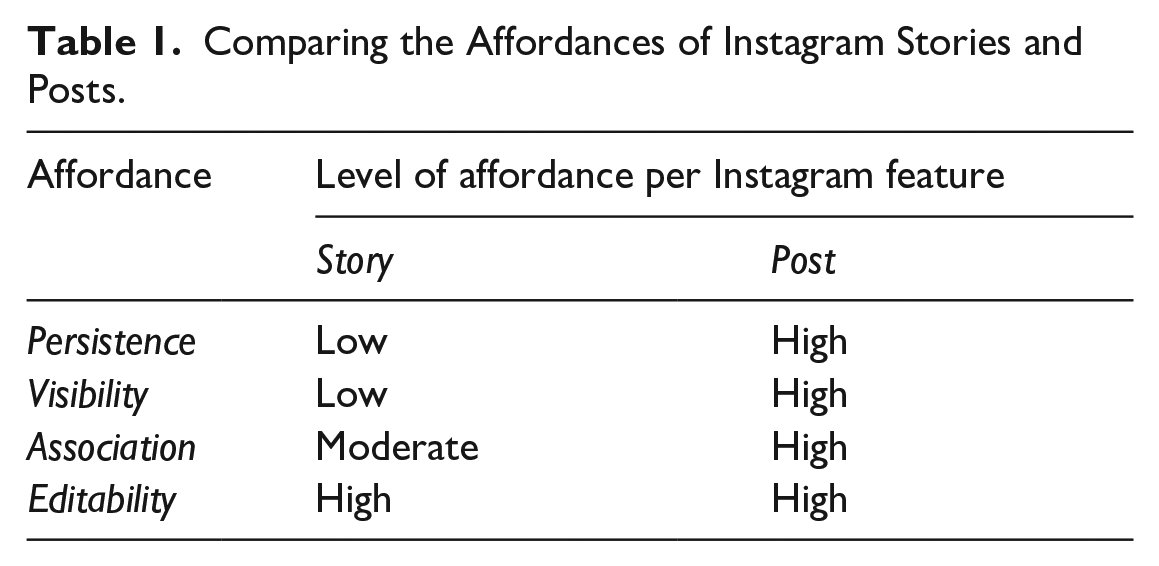
Persistence means that a message does not disappear or expire (Treem & Leonardi, 2013, p. 155). The opposite is ephemerality, which was first popularized as the unique affordance of Snapchat (Bayer et al., 2016; Salisbury & Pooley, 2017). The level of message persistence is a key difference between Stories and Posts. Stories afford ephemeral self-presentation, while Posts are highly persistent, as they typically remain permanently visible on a user’s profile, unless they are deleted or archived. Ephemeral communication channels are associated with a focus on what is happening in that moment (Bayer et al., 2016). Hence, we argue that the main psychological correlate from ephemerality versus persistence is the spontaneity of self-presentation.
Visibility in SNS enables users “to make their behaviors, knowledge, preferences, and communication network connections . . . visible to others” (Treem & Leonardi, 2013, p. 150). Visibility is higher in Posts than in Stories as a result of technological differences that concern (1) visibility of content to other users and (2) visibility of interactions of others with one’s own content. Regarding the first point, for Stories, the visibility of content to others is more adjustable, as they offer more options for privacy management, including permanently hiding Stories from certain followers or sharing Stories only with a pre-set group of “close friends.” In Posts, either all followers or virtually anyone may see shared content, depending on whether one’s profile is private or public. Regarding the second point, the visibility of responses is higher in Posts. Other users can publicly like and comment on Posts. Stories can only be replied to via private messages and one-to-one quick reactions. Accordingly, connections between people in the network and others’ feedback to one’s self-presentation are less visible in Stories. Stories, however, offer greater visibility when it comes to being aware of one’s audience, as audiences are displayed to the person self-presenting in a list of views for each Story slide. In terms of making one’s network visible, though, Posts offer greater visibility than Stories. Building on Sundar et al. (2015), we argue that the technological features driving this difference in visibility impact perceptions of privacy control as their psychological correlate.
Association has a twofold meaning. On one hand, associations are connections between individuals, which can be displayed via friend lists on SNS. On the other hand, associations are connections between an individual and content, for instance, via comments and likes (Treem & Leonardi, 2013). Posts are likely to afford greater person-to-person association than Stories because of their display of responses. Person-to-content associations may also be higher in Posts due to higher permanence (T. R. Choi & Sung, 2018; O’Sullivan & Carr, 2018), as likes and comments remain displayed unless reversed or deleted. Hence, considering this difference, we propose users’ expectations of response as a final psychological correlate that contrasts both features.
Editability describes whether a message can be altered as the communicator desires before sending it (Treem & Leonardi, 2013, p. 159; Walther, 1996). Both Stories and Posts allow applying filters or adjusting individual aspects of an image (Hu et al., 2014), hence affording similarly high levels of editability.
With one exception, no research has compared authenticity self-perceptions of masspersonal communication for different SNS features based on their affordances. Grounded in the affordances approach, T. R. Choi and Sung (2018) found that expressing one’s true self was more common on Snapchat than on Instagram. They attribute this finding to the affordances of each SNS overall, such as lower persistence on Snapchat, which benefits authentic self-presentation. Yet, as demonstrated above for the example of Instagram, even within one SNS the affordances of individual features may differ. Hence, when analyzed through the lens of affordances, Instagram may offer varying and even high authenticity levels, depending on whether users self-present via Stories or Posts. For a summary of the different affordances of Stories and Posts, see Table 1.
Comparing the Affordances of Instagram Stories and Posts.
Overall, due to their affordances, Instagram Stories appear to be a tool facilitating more authentic self-presentation than Posts. Their ephemerality may make people comfortable in sharing mundane content (McRoberts et al., 2017). Without having to present highlights of their life, users may perceive that Stories are more reflective of their lives as a whole and thus present themselves more authentically. Stories’ lowered visibility may prevent users from self-censoring and fearing others’ judgment through negative feedback. Building on the affordances analysis of Stories versus Posts presented above, we propose the following:
H1. Usage of Instagram Stories will be related to higher levels of state subjective authenticity than usage of Instagram Feed Posts.
Drivers of Subjective Authenticity in Stories and Posts
While there are strong arguments for a main effect of Stories (vs Posts) on authenticity as described in H1, we argue that any difference in subjective authenticity across these two features is largely explained by three distinct mechanisms: expectations of response, privacy control, and spontaneity. These mechanisms serve as the psychological correlates of Story versus Post affordances (Sundar et al., 2015).
Expectations of Response
A key difference between Stories and Posts may be found in the expectation of audience responses. Through the absence of publicly displayed feedback, visibility and association are considerably lower in Stories. These differences may lead to varying expectations for audience response across Stories and Posts. Senders expecting some response to their public messages is a crucial component of masspersonal one-to-many communication (French & Bazarova, 2017), compared to classic mass communication. Two key arguments suggest that response expectations should be lower when presenting via Stories compared to Posts. First, response expectations have been found to vary by technical feature and SNS. Compared to other SNS, users on Instagram expect to receive more likes than comments (French & Bazarova, 2017). In Stories, as likes are technically not available, expected responses are low, as neither sharer nor viewers would consider it necessary to respond to such low-effort posting (Triệu & Baym, 2020). Second, Story audiences are “self-selecting” (McRoberts et al., 2017, p. 6905)—meaning that audience members have to actively decide whether to watch a certain Story—whereas Posts are more often consumed serendipitously by just scrolling through the Feed. Thus, the expected (imagined) audience size for Stories should be smaller than for Posts (Litt, 2012), which in turn should yield lower response expectations. Accordingly, we hypothesize the following:
H2. Usage of Instagram Stories will be related to lower levels of expected response than usage of Instagram Feed Posts.
The act of “liking” content goes beyond the overt behavior of a click or a double-tap. Rather, users can infer meaning from these kinds of mediated responses and may perceive them as a form of social support, especially when they are received from close ties (Carr et al., 2016). The number of likes can also serve as a form of feedback to evaluate one’s relative standing among peers (Chua & Chang, 2016). The presence or absence of responses therefore likely has an impact on SNS users. Positive feedback can be beneficial to self-esteem and well-being (Valkenburg et al., 2006). However, a lack of feedback may elicit the feeling of being disapproved by one’s peers, which in turn can lead to deleting content out of embarrassment or frustration over not receiving (enough) likes (Chua & Chang, 2016). Hence, publicly displayed responses to one’s masspersonal SNS communication may carry a component of social judgment and feelings of being “in the public eye.” When only private responses are available, however, pressure and concerns around one’s self-presentation may decrease (Triệu & Baym, 2020).
Publicly visible responses to SNS communication should thus negatively affect subjective authenticity. For instance, in one study, when talking about experiences in which they felt the least like themselves (i.e., inauthentic), participants mentioned being evaluated by others, pressure of others’ expectations, or not meeting others’ standards most prominently (Lenton et al., 2013). Therefore, expecting little to no publicly displayed feedback in the form of likes and comments should give users the space to present themselves more authentically—without fearing intrusion or public judgment by others. Thus, we expect the following:
H3. Lower levels of expected response will be related to higher levels of state subjective authenticity.
Privacy Control
Privacy means the “selective control of access to the self or to one’s group” (Altman, 1975, p. 18). Trepte and Reinecke (2011) argue that SNS can fulfill both social and psychological privacy needs, even if informational privacy may be threatened. Psychological privacy refers to protecting internal states from intrusions (Burgoon et al., 1989). SNS, compared to face-to-face settings, give users high control over which thoughts and emotions they disclose to others (Trepte & Reinecke, 2011). For social privacy, which is concerned with the experience of having control over one’s social encounters and relationships (Burgoon et al., 1989), SNS users can control their interaction partners by using mechanisms such as friend lists (Trepte & Reinecke, 2011), blocking accounts, disclosing only to a target audience (Vitak & Kim, 2014), or privacy settings (boyd, 2011). In social media, practices of control are a key boundary condition for privacy and first manifest as a perception of available control mechanisms before being executed (Trepte, 2021). Affordances—as another boundary condition—determine present privacy mechanisms with, for example, persistence and association complicating control as a privacy mechanism (Trepte, 2021).
As discussed previously, Stories also offer lower visibility than Posts due to more privacy management tools, especially those that enable users to segment their audiences. Hence, feelings of “context collapse” (boyd, 2011), wherein a lack of boundaries between separate social groups leads to those groups being “flattened” into a single audience—which hampers self-disclosure (Vitak & Kim, 2014)—may be circumvented through targeted audience selection via Stories. Moreover, in Stories, the “imagined audience” (Litt, 2012) becomes much more concrete as users are informed about their actual audience through their Story views. Accordingly, we propose the following:
H4. Usage of Instagram Stories will be related to higher levels of perceived privacy than usage of Instagram Feed Posts.
Trepte and Reinecke (2011) argue that privacy control is crucial for authenticity on SNS. They consider control over audiences, interaction partners, and content to be key pathways through which SNS offer spaces where one can safely and thus authentically express the self (Trepte & Reinecke, 2011). In Instagram Stories, the ability to finely segment social groups should allow users to present themselves more authentically concerning their differing social roles. Close others, in particular, have been associated with experiences characterized as “most me” (Lenton et al., 2013, p. 281), hence contributing uniquely to state authenticity. Self-censorship, in turn, is often employed to maintain self-presentation while navigating audience tensions (Marwick & boyd, 2011; Vitak & Kim, 2014). Overall, the perception of having privacy control over one’s audience should reduce self-censoring behaviors and therefore provide the possibility to present oneself more freely and authentically. We therefore propose the following:
H5. Higher levels of perceived privacy will be related to higher levels of state subjective authenticity.
Spontaneity
The most notable and original difference between Stories and Posts is their persistence (vs ephemerality). Stories, designed after Snapchat’s core features, are rather ephemeral and encourage sharing moments that are “not particularly exciting or memorable” (Bayer et al., 2016, p. 971). For Instagram Posts, it is common that taking pictures is thoroughly planned and curated (Chua & Chang, 2016). Stories can be crafted as an event unfolds, without the need for careful planning (McRoberts et al., 2017). Higher ephemerality in message composition may also suggest a more synchronous nature of the communication to the sender, even if the message reception is mostly asynchronous (Bayer et al., 2016). Stories live off being “an improvisational performance constructed of life’s moments” (McRoberts et al., 2017, pp. 6906–6907). In contrast, higher visibility and persistence of content can make users “think twice” about what to share (Vitak & Kim, 2014). Through less planning and an emphasis on in-the-moment usage, Stories might be used more spontaneously than Posts. We therefore hypothesize:
H6: Usage of Instagram Stories will be related to higher levels of perceived spontaneity than usage of Instagram Feed Posts.
Although spontaneity is not prominently reflected in psychological conceptualizations of authenticity, it is a key factor in constructivist perspectives, such as “mediated authenticity” (Enli, 2015) or political authenticity (Luebke, 2021). Hence, it appears plausible that being spontaneous and acting in an immediate manner may foster subjective authenticity in the social media context, as well. Vorderer et al. (2015) further argue that due to the now widely established “permanently online, permanently connected” lifestyle, authenticity in daily life may be replaced by constant performance. Accordingly, the authors suggest that spontaneity is sacrificed for staged self-presentation, underlining an inherent link between (lack of) spontaneity and (in)authenticity. Salisbury and Pooley (2017) note that Snapchat’s claims of authenticity stem from “spontaneous authenticity” (p. 8). Given this proposed but untested link between spontaneity and authenticity of self-presentation on SNS, we assume the following:
H7. Higher levels of perceived spontaneity will be related to higher levels of state subjective authenticity.
Taking these relationships together, the Instagram Stories feature is hypothesized to allow for self-presentation that users subjectively experience as more authentic. Compared to Instagram Posts, Stories should yield significantly lowered expectations of response, higher feelings of privacy control, and more spontaneous self-presentation. These characteristics are, in turn, expected to contribute to the feeling that one has presented oneself authentically (i.e., state authenticity). These three characteristics are assumed to operate as mediators, explaining the effect of feature use (Story vs Post) on authenticity. The overall research model is presented in Figure 1 and summarized by the following mediation hypothesis 1 :
H8. Usage of Instagram Stories versus Instagram Posts will be related to higher levels of state subjective authenticity through (a) lower expectations of response, (b) higher perceived privacy control, (c) higher perceived spontaneity.
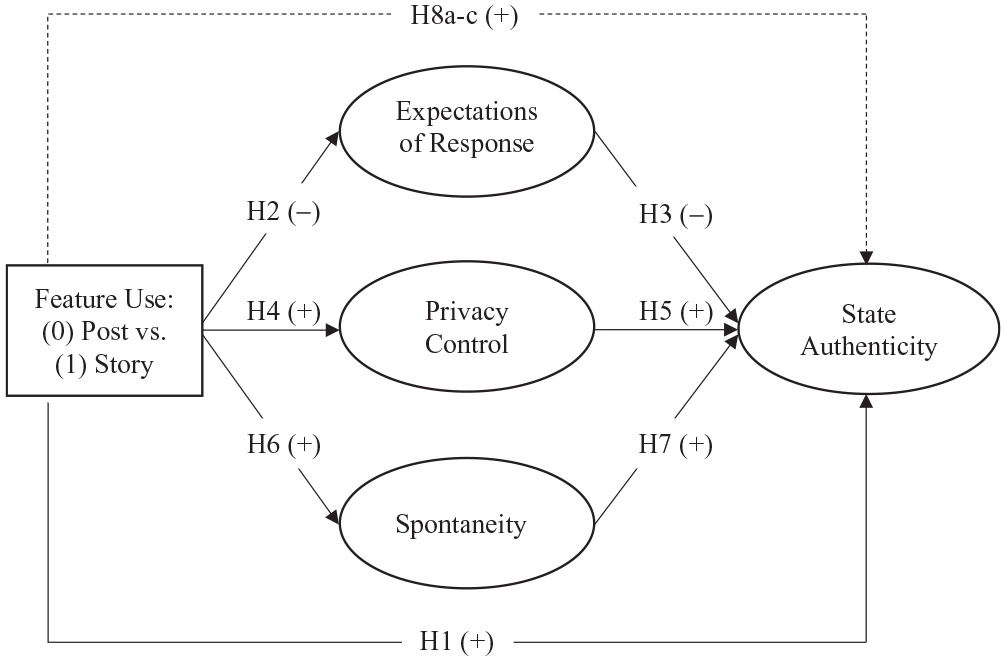
Research model.
Method
Design and Preregistration
An online survey among German-speaking Instagram users was conducted. The survey employed a within-subject repeated measurement design, wherein participants answered the same questions about their most recent Instagram Stories versus Feed Posts for up to three Stories/Posts each. Hypotheses, variables, a priori power analysis, and procedure were preregistered on the Open Science Framework (OSF), see https://osf.io/8nqxw.
Sample and Procedure
We conducted a priori power analysis (see OSF preregistration for details), which determined that N = 199 participants were required to detect a small main effect (H1). Participants were recruited by posting the survey link on Instagram and Facebook via private profiles as well as to SurveyCircle (www.surveycircle.com). Altogether, 202 participants completed the study. Participants were predominantly women (82%), with a mean age of 25 years (SD = 4.67). The sample was highly educated with 62% holding a university degree. Instagram was used daily (76%) by most participants and most had private accounts (70%).
Participants indicated basic information about their Instagram settings and usage at the beginning and end of the survey. They were initially asked how often they had shared content using either the Stories or Post feature during the last 6 months, a timeframe that was expected to be long enough to ensure that enough messages in both features had been shared but short enough for participants to recall their perceptions of shared events. Only participants who had shared at least one Story or Post during this time remained in the study. Afterward, participants were asked about their general well-being. 2 The questionnaire continued with the measures of state authenticity, spontaneity, privacy, and expectations of response concerning their last (up to) three Stories and Posts. By studying multiple self-presentations, we cover the possibility that people would present multiple selves online. Participants were asked to look at their Instagram Story archive and profile, to facilitate accurate responses concerning their Stories and Posts.
For Stories, participants were given a definition of what was to be understood as “one” coherent Story in this context, as Instagram Stories are difficult to assess as a unit via self-report. Stories might cover completely different events and experiences, but always add up to a 24-hr Story reel. Since the context and self-presentation likely differ for the multiple events that users post in their Stories, using the full 24-hr reel as a unit of analysis is imprecise for the assessment of state authenticity. At the same time, users may post several Story slides for one specific event, making individual Story slides an insufficient measure to assess distinct occasions. Hence, one Story unit was defined as all Story slides that were posted for one specific event. This way, up to three distinct Story events were studied. Finally, participants indicated demographics, were debriefed, and thanked.
Measures
If not indicated differently, items were measured on a 5-point Likert-type scale ranging from 1 “does not apply at all” to 5 “fully applies.” The complete questionnaire is provided on the OSF, see https://osf.io/tyxrc/.
Instagram Feature Use
The independent variable was whether participants had used the Story or the Post feature to self-present on Instagram. This was a within-subject variable with up to six measurements (i.e., max. three Stories and max. three Posts). Participants then responded to a set of items for each Story and Post individually.
Authenticity
As there is no standard scale to measure state authenticity, items were adapted from prior studies (Fleeson & Wilt, 2010; Kim & Lee, 2011). Two items measured subjective authenticity perceptions of one’s self-presentations on Instagram: “In this Story (Post), I felt authentic in the way I presented myself” and “I feel like this Story (Post) shows what my life is really like.” Correlations between the two items were in the range of .47 ⩾ r ⩽ .65 across the six Stories/Posts, indicating sufficiently high internal consistency.
Expectations of Response
Expectations of response were measured using two items adapted from French and Bazarova (2017), which stated whether participants had expected many people to (1) like or (2) comment their Post, or, respectively, (1) reply or (2) react with an emoji to their Story. Correlations between the two items were in the range of .44 ⩾ r ⩽ .82 across the six Stories/Posts, indicating sufficiently high internal consistency.
Privacy Control
Privacy control as the perceived availability of control mechanisms (Trepte, 2021) was measured using two items adapted from Metzger and Suh (2017). The items referred to (1) the feeling of having control over the audience one shared content with and (2) the feeling that Instagram’s privacy settings allowed the participant to control what information was shared. Correlations between the two items were in the range of .55 ⩾ r ⩽ .79 across the six Stories/Posts, indicating sufficiently high internal consistency.
Spontaneity
The level of spontaneity that participants had perceived in their last Stories and Posts was assessed with two self-developed items: “I spent a lot of time editing this Story/Post” (reverse coded) and “This Story/Post was created very spontaneously in that moment.” Correlations between the two spontaneity items were low, mostly r ⩽ .30. Since this assessment of spontaneity was preregistered, we proceeded by creating a two-item index of this measure. However, we explored the robustness of findings by additionally analyzing the two spontaneity items separately.
Analytical Strategy
The measurements concerning Stories and Posts (e.g., authenticity) are nested within participants (i.e., repeated measurements). Therefore, we analyzed the data with multilevel modeling (Level 1: measurements, Level 2: participants) using R package lme4 (version 1.1.23; Bates et al., 2015). H1–H7 were tested with a series of multilevel regressions. In all models, Level 1 predictors were centered around their respective person means and the person means were reintroduced as sample-mean-centered Level 2 variables, to compare within-person and between-person effects of predictors on outcomes (Bell et al., 2019). H8 was tested with three separate multilevel 1-1-1 mediations, in which predictor, mediator, and outcome were all assessed at Level 1 (Zhang et al., 2009). Mediation analysis was conducted with the mediation package (version 4.5.0; Tingley et al., 2014), and p values were estimated with quasi-Bayesian confidence intervals computed from 2,000 Monte Carlo simulations.
Results
The data, R-Markdown, descriptive statistics, means, and effect sizes (Tables S1 and S2, see Supplement) can be found on the OSF, https://osf.io/tyxrc/. Results of the multilevel regressions testing H1–H7 are reported in Table 2. In H1, we assumed that Stories would allow for greater authenticity than Posts. The estimated marginal means and a multilevel regression including Story (vs Post) as dummy variable indicate that Stories were indeed associated with slightly higher (b = .08, p < .05) authenticity (M = 3.95) than Posts (M = 3.86). The effect was very small (d = 0.14), but different from zero (see Table S2 for all mean comparisons), thus supporting H1.
Series of Multilevel Regressions Testing H1–H7.

Note. Based on NL2 = 202 participants and NL1 = 1,020 evaluations of Stories and Posts; Story was dummy-coded as 1 = Story, 0 = Post; Model 0: null model with random intercept; Model 1: model with random intercept and fixed slopes for all predictors; predictors on Level 2 (L2) are person means, centered on the sample means; predictors on Level 1 (L1) are centered on their respective person means (except for the Story dummy variable); method of estimation: maximum likelihood; depicted are unstandardized regression coefficients (b) with SEs in parentheses. AIC = Akaike information criterion. ICC = intraclass correlation coefficient.
p < .001, **p < .01, *p < .05.
We further assumed that Stories would produce lower expectations of response (H2), higher privacy control (H4), and higher spontaneity (H6) than Posts. A series of multilevel regressions including Story (vs Post) as dummy predictor confirm these hypotheses: Stories resulted in lower response expectations (b = −0.67, p < .001), higher privacy control (b = 0.06, p < .05), and higher spontaneity (b = 0.69, p < .001). A robustness check showed that when the two spontaneity items were analyzed separately (due to low correlations, see “Method” section), H6 was still supported (see R-Markdown on the OSF for details). While the effects were moderate to strong for response expectations (d = −0.85) and spontaneity (d = 0.84), they were very small for privacy control (d = 0.15).
We assumed that while expectations of response should be negatively related to state authenticity (H3), privacy control (H5), and spontaneity (H7) should be positively related to state authenticity. We tested these hypotheses by assessing both the between-person (i.e., Level 2) and within-person (i.e., Level 1) associations of these three predictors. Results (see Table 2) initially indicated that participants who reported higher than sample-average levels on all three predictors also reported higher authenticity, thus lending support for H5 (b = 0.19, p < .01) and H7 (b = 0.23, p < .001), but provided evidence directly contradicting H3 (b = 0.12, p < .05). Initial results further showed that if participants reported a Story or Post to be more spontaneous than is typical for them personally (i.e., above their spontaneity person mean), this was associated with higher authenticity (b = 0.17, p < .001), lending support for H7. No such within-person associations were observed for H3 (expectations of response) and H5 (privacy control). However, a robustness check showed that when the two spontaneity items were analyzed separately, H7 was supported for the item measuring content creation “spontaneously in the moment” (both between and within persons), but not for the item measuring the “time spent editing Posts/Stories” (see data analysis on the OSF for details). Moreover, the positive between-person effect of response expectations on authenticity (H3) turned nonsignificant and the within-person effect of privacy control (H5) turned significant. These final results for H3, H5, and H7 are visualized in Figure 2.

Final Results for H3, H5, and H7 from a multilevel model predicting state authenticity.
Finally, we tested whether expectations of response (H8a), privacy control (H8b), and spontaneity (H8c) statistically mediated any effects of Stories (vs Posts) on authenticity. The three mediation analyses showed that while no evidence for mediation was observed for expectations of response (indirect effect = −0.021, p = .24) or privacy control (indirect effect = 0.006, p = .068), spontaneity significantly mediated the effect of Stories (vs Posts) on authenticity (indirect effect = 0.120, p < .001; direct effect = −0.02, p = .63; total effect = .098, p < .05). While we reject H8a and H8b, we thus find evidence for H8c. The robustness checks again indicated that this finding was robust for the “in the moment” item but not the “editing” item of the spontaneity measure.
In conjunction, these findings indicate that while Stories (vs Posts) had a small main effect on authenticity (see H1), this effect was particularly explained by higher spontaneity when creating Stories, but not by less time spent on editing Stories (vs Posts), nor by differences in privacy control or response expectations.
Discussion
The present research contributes both theoretically and empirically to the literature on social media, authenticity, and well-being. First, our study demonstrates the utility of using an affordances approach to distinguish SNS features and their implications for users. Departing from the most recent work on the supposedly monolithic effects of social media “screen time” on well-being, we analyze the effects of social media channels at the feature-level rather than the device- or application-level (Meier & Reinecke, 2021). Our findings indicate that Stories and Posts are indeed used with different expectations and cognitions, resulting in different outcomes. While differences for spontaneity and response expectations were moderate to strong, differences in authenticity and privacy control were small. This indicates that some affordances rooted in technological features may be more salient to users than others, which may in turn be related to the communicative goal with which each feature is used. Thus, our findings clearly underline how comparing two highly popular SNS features (Stories vs Posts) based on their affordances (1) allows us to more precisely identify the causes of social media effects and (2) investigates social media in a way that is more resilient to technological change (Bayer et al., 2020; Smock et al., 2011).
Second, we contribute to the emerging literature on self-effects (Valkenburg, 2017), which asks not how messages affect other recipients, but the senders themselves. With the present study, we demonstrate that when reflecting on their past (up to) three Stories or Posts, users evaluate themselves as differently authentic. These self-perceptions may in turn have implications for social media users’ mental health, given both authenticity’s crucial role for hedonic and eudaimonic well-being and the ubiquity of social media use. Such self-effects may be particularly pronounced for adolescents and emerging adults, who are still developing their authentic selves, and typically use social media avidly (Valkenburg, 2017). While our findings suggest only a small positive association of individual Stories (vs Posts) with authenticity, such effects may accumulate. In the light of recent evidence showing that ephemeral social media did cue internalization of presented personality traits while permanent social media did not (S. Choi et al., 2020), and that authentic self-presentation positively affects mood (Bailey et al., 2020), even such slight effects may be meaningful to users. Still, whether short-term self-perception effects as observed in our study develop into long-term changes of authenticity is a crucial question for future studies.
Third, extending prior research (e.g., Reinecke & Trepte, 2014) by integrating an affordance perspective, our study provides further evidence that users, on average, experience their self-presentations on SNS as rather authentic. Overall state authenticity levels were high across the over 1,000 Stories/Posts participants reported on (M = 3.92 on a five-point scale, see Table S1). Thus, contrary to concerns (Syvertsen & Enli, 2020; Vorderer et al., 2015), SNS may in fact provide a venue for users to be and feel rather authentic in daily life, at least when measured through their self-perceptions. Our study specifically extends prior work by revealing that while this may be slightly more accurate for Instagram Stories (M = 3.95), it may be similarly true for Instagram Posts (M = 3.86). Importantly, though, these high authenticity scores may also indicate a “feeling good effect” that derives from the positivity bias (Reinecke & Trepte, 2014) and not from actual authentic self-presentation. As our data structure is correlational (see Limitations), we cannot completely dismiss this possibility. Our focus on subjective authenticity still opens up new possibilities for researching online authenticity, that is, by combining analyses of “objective” (i.e., externally observed) authentic self-presentation with subjective authenticity perceptions as a general well-being outcome.
Fourth, authenticity varied to relevant degrees both between participants (SDbetween = 0.71) and between each Story and Post (SDwithin = 0.56, see Table S1). Our study thus extends prior research by showing that authenticity on SNS can vary from message to message (i.e., within users). Prior research has so far understood SNS authenticity mainly as something that varies between persons, and mostly investigated regarding features that typically yield rather stable self-presentations (e.g., in Facebook profiles). Our study, in contrast, suggests that future theory and research on SNS authenticity will have to account for considerable situational variation of subjective authenticity in users’ self-presentations.
Finally, a major contribution of our work lies in identifying the crucial role of spontaneity, a concept so far understudied in the SNS and well-being literature. Spontaneity, in contrast to expectations of response and privacy control, emerged as the main driver of increased authenticity in Stories. This follows directly from Stories’ unique affordances, particularly their higher ephemerality. While we also observed Stories to elicit lower expectations of response and slightly higher privacy control, only the increased spontaneity associated with Stories explained the small positive effect of Stories (vs Posts) on authenticity. Though privacy control contributed independently to authenticity on a within- and between-person level—supporting theoretical considerations on the relationship between privacy and authenticity (Trepte & Reinecke, 2011)—feature differences might have been too small to detect a mediation effect. This could be explained by the fact that most participants had private accounts and did not make use of the privacy measures offered in the Story feature, hence leveling Story/Post differences. Interestingly, the amount of editing that went into Stories/Posts was not associated with authenticity perceptions, indicating that people adhere to platform standards such as the positivity bias without compromising subjective authenticity.
Limitations
The contributions of our study are limited in several ways. First, our findings are not representative of Instagram users in general, as we relied on a convenience sample of Western, highly educated, young, and predominantly female participants with private Instagram accounts. The relatively small person-level sample size does not allow us to find effect sizes below 0.1. Hence, replications with more diverse and larger samples are needed.
Second, we used a within-subject repeated measurement design and asked participants to look at their Instagram Story archive and profile while responding to measures, which likely facilitated valid responses and better captured the heterogeneity of Stories/Posts. Nonetheless, our survey data are nonexperimental and should be treated as observational. Our findings for the effect of expectations of response on authenticity underline the limitations of our correlational design and the use of self-reports, as they were opposite to what we predicted in H3. Expecting more responses to Stories/Posts was associated with higher authenticity self-perceptions. However, the reverse causation is equally plausible: Stories/Posts that users experience as more authentic may result in higher response expectations, for instance, because users expect their authentic selves to be liked by their friend network. This reverse effect may be particularly likely due to the positivity bias in SNS. That is, users typically show the authentically positive sides of their lives, but not the authentically negative ones (Reinecke & Trepte, 2014). Positive authentic self-presentations should then also be accompanied by higher response expectations. Thus, the finding concerning H3—as well as all other correlational evidence from this study—should be treated with caution and requires replication using designs that allow causal inference.
Third, our study focused on Instagram, which is still understudied in the literature compared to Facebook (Meier & Reinecke, 2021). Drawing on the affordances approach allowed us to contrast the psychological correlates of two popular masspersonal features, Stories and Posts, which generalize across different SNS, although the specific technical features show slight variation between branded applications. Still, sampling users of just this one SNS limits our findings. Future research would do well to test authenticity differences by comparing them across other SNS that also include these features, particularly the Story feature (e.g., Snapchat, Facebook, WhatsApp, and Twitter) to achieve a more granular understanding of technical functionalities and their affordances. They may be technically similar but their sociocultural usage practices may differ across SNS (for an extended discussion of such generalizability issues, see Bayer et al., 2020; Meier & Reinecke, 2021).
Conclusion
Our preregistered investigation of over 1,000 self-reports of participants’ recent Instagram Stories/Posts provides quantitative evidence for a positive, though small, effect of Stories (vs Posts) on users’ state authenticity. Specifically, users felt more authentic via Stories particularly when they experienced their self-presentations as more spontaneous, happening in the moment. Just like spontaneity, privacy control positively influenced authenticity across features. Our findings thus further support the notion that Instagram users may, on average, feel rather authentic when presenting themselves to their audiences online. In conclusion, our study highlights a potential for improving SNS users’ well-being by (re-)designing SNS to emphasize more ephemeral forms of communication.
Footnotes
Declaration of Conflicting Interests
The author(s) declared no potential conflicts of interest with respect to the research, authorship, and/or publication of this article.
Funding
The author(s) received no financial support for the research, authorship, and/or publication of this article.
