




Abstract
Self-presentation, the process by which people disclose information about themselves to others, is fundamental to online interaction and research on communication technology. Technology often mediates the self-presentation process by obscuring who is in the audience via constrained cues and opaque feed algorithms that govern the visibility of social media content. This can make it risky to disclose sensitive or potentially stigmatizing information about oneself, because it could fall into the wrong hands or be seen by an unsupportive audience. Still, there are times when it is socially beneficial to disclose sensitive information, such as LGBTQ+ (lesbian, gay, bisexual, transgender, queer, and others) people expressing their identities or disclosing HIV status. Decisions about sensitive disclosure, moreover, can be even more complicated in today’s social media landscape with many platforms and audiences in play, particularly for younger users who often use many platforms. We lack a good understanding, however, of how people make these decisions. This article addresses questions about sensitive disclosure on social media through a survey study of adolescent men who have sex with men and their willingness to disclose on social media the use of pre-exposure prophylaxis (PrEP), an HIV prevention medication. Results suggest that perceived platform audience composition and platform features such as ephemerality play into disclosure decisions, as well as the perceived normativity of PrEP use among peers.
Introduction
Self-presentation, the process by which people disclose information about themselves to others, is fundamental both to interaction on social media platforms and research on communication technology (e.g., DeVito et al., 2017). Sharing information online often means that one’s audience is uncertain or imagined (Litt & Hargittai, 2016), as complex algorithms and privacy schemas obscure who can or will see content (Eslami et al., 2015). Furthermore, different social media platforms offer varied affordances for persistence or ephemerality of both identities and content, and different platforms are often used to reach specific audiences (DeVito et al., 2018; Ellison & Vitak, 2015; Zhao et al., 2013).
All of this means that online disclosure of sensitive or potentially stigmatizing elements of one’s identity can be fraught (Andalibi et al., 2016; Gray, 2009a). Research on Grindr, a predominantly gay dating/hookup app, for example, has shown that many users fear recognition by nearby peers (Blackwell et al., 2015; Corriero & Tong, 2016). This could lead to inadvertent outing or being negatively judged for being on an app that is known for hookups (Birnholtz et al., 2014). Even in an era in which homophobia has declined, there is substantial evidence that LGBTQ+ (lesbian, gay, bisexual, transgender, queer, and others) people are cautious in disclosing their identity online (DeVito et al., 2018; Duguay, 2016).
Others have examined the disclosure of HIV-positive status on dating sites, finding that allowing people to leave their status ambiguous in their profile can allow for strategic and deliberate disclosure (Warner et al., 2019) but also means people may not disclose at all (Handel & Shklovski, 2012). HIV status is one of many cases where disclosure can carry stigma or social consequences, and also has broader implications for potential partners of the discloser as well as for making disclosure more normatively acceptable.
An important current example of sensitive online disclosure is daily pre-exposure prophylaxis (PrEP), an oral medication that is over 90% effective in preventing the spread of HIV (Centers for Disease Control and Prevention, 2019a), as we describe in more detail below. On one hand, there is evidence that those who disclose PrEP use face stigma and shame from peers who believe those on PrEP are promiscuous and/or incapable of conventional safe sex practices such as condom use (Golub, 2018; Spieldenner, 2016). On the other hand, there is emerging evidence that lack of awareness of both PrEP and of others who use PrEP can impede its uptake, particularly among younger people (Macapagal et al., 2020). That is, if young people were willing to disclose PrEP use to friends on social media, for example, it could improve uptake of this valuable treatment (e.g., Young et al., 2018).
In this article, we examine the disclosure of potentially sensitive or stigmatizing information on social media by focusing on PrEP usage and disclosure among adolescents. Understanding how young people make decisions about such disclosures across multiple social media platforms in today’s complex social media environment (Alhabash & Ma, 2017) can help us both update our understanding of self-presentation and potentially impact an immediate health problem. We report on a survey of adolescents assigned male at birth who have sex with other males (AMSM; 1 that is, gay and bisexual males) examining their awareness of PrEP, social media activity, and willingness to disclose PrEP use on different social media platforms.
Background
Self-presentation is the social process by which people disclose information about themselves to others, with the goal of fostering particular impressions (Goffman, 1959; Leary & Kowalski, 1990). Goffman’s theoretical framework has been expanded to better account for unique attributes of today’s online social contexts (e.g., Hogan, 2010; Walther et al., 2008). Indeed, self-presentation today is fundamentally socio-technical in nature, as disclosure and visibility depend on both the technical features and affordances of platforms (Bayer et al., 2016; DeVito et al., 2017; Gray, 2009b) and social factors such as audience (Litt & Hargittai, 2016) and contextual variability of normative behavior (Marwick & boyd, 2014).
Self-presentation can be particularly challenging for those with potentially stigmatized or non-normative identities or characteristics (Goffman, 1963), such as LGBTQ+ identities. Green (2007) discusses the intersection of Goffman’s sociological self-presentation framework in the symbolic interactionist tradition with queer and feminist theory, which also takes a performative view of identity, self-presentation, and disclosure (e.g., Butler, 1990; Muñoz, 1999). In the latter approach, disclosure can be seen as a radical act of performing a queer or non-normative identity, in which the language of disclosure itself becomes a marker of that identity (Butler, 1990). Muñoz (1999) refers to this as disidentifying, or performing in a way that sets oneself apart from others’ expectations. Additional work on online queer activist spaces explores how these spaces and the identities performed within them coevolve (e.g., Dasgupta, 2017).
Online, there is evidence of cautious disclosure of LGBTQ+ (Gray, 2009a) and other stigmatized identities. Andalibi et al. (2016), for example, found that sexual abuse survivors seeking online support on Reddit would use anonymous “throwaway” accounts to avoid drawing stigma to their more permanent Reddit identity. Quasi-anonymity, of course, is not viable in the long term when the goal is to meet somebody in person, as with a dating app, or to connect with extant social ties, so additional strategies are required. Fernandez and Birnholtz (2019) found that transgender users of dating apps tended to disclose their trans status very early, often in the profile itself, to avoid surprises later, whereas Warner et al. (2019) found that HIV-positive users of apps like Grindr tended to disclose their HIV status later and/or more subtly.
These difficulties may be enhanced for AMSM disclosing PrEP use, because both their sexual minority identity (Duguay, 2016) and PrEP use (Golub, 2018; Spieldenner, 2016) may be stigmatized. Indeed, disclosing PrEP use could potentially be even more fraught for some AMSM than disclosing their sexual orientation in that PrEP disclosure can be a marker of sexual activity and perhaps promiscuity (Dubov et al., 2018), which may itself be stigmatized for younger people (McDavitt & Mutchler, 2014; Savin-Williams, 2016). For the latter of these, PrEP is arguably similar to the human papillomavirus (HPV) vaccine (Hildebrandt et al., 2019), which indicates likely sexual activity but is also a proactive step to prevent a serious medical condition. In some ways, this is also similar to concerns observed in studies of adults using Grindr and other hookup apps, where participants were concerned about being recognized by others on the site and thought to be overly promiscuous (Blackwell et al., 2015; Corriero & Tong, 2016; Hardman Taylor, Hutson, & Alicea, 2017). Moreover, for AMSM PrEP, sexual activity and coming out as LGBTQ+ can be contentious topic for parents and adolescents generally (Mustanski et al., 2018; Ryan et al., 2010). In this light, disclosing PrEP use may itself become a politically performative, disidentifying act for young people, that may be seen by some as taking an activist stance.
We focused in our study on several categories of attributes that stand to affect disclosing this information on different social platforms, rooted in a socio-technical approach to self-presentation.
Audience
Audience, as a core component of Goffman’s (1959) framework, has long been a focus of online self-presentation research. Consistent with Litt (Litt, 2012; Litt & Hargittai, 2016), we use the term to connote the people who can see behavior or content on social platforms. This is akin to what Marwick and boyd (2014) refer to as members of networked publics. As Marwick and boyd further argue, moreover, social media audiences or networked publics can conflate contacts from multiple social realms, a well-documented phenomenon known as context collapse.
This possibility motivates caution among social platform users in sharing content that may be seen by unintended audiences. Litt and Hargittai (2016) discuss the notion of the “imagined audience” and factors that influence whom people believe will see the content they post. With regard to the sensitive disclosure of transgender status, Fritz and Gonzales (2018) show amplified concerns about privacy among people using crowdfunding to finance gender transition surgery. Hayes et al. (2016), moreover, are among a few studies that examine perceived audience and social support across social media platforms, finding that people have different expectations for support from their audiences on different platforms.
Consistent with feminist and queer theory cited above, audience is likely a substantial concern for AMSM because, despite recent declines in homophobia, LGBTQ+ identities remain stigmatized in many communities. Disclosing an LGBTQ+ identity online can therefore be a fraught process (Baiocco et al., 2015; Duguay, 2016; Gray, 2009a). Here too pseudonymous platforms such as Tumblr have been shown to be a valuable arena for identity experimentation and exploration (Wargo, 2017). These sites are often young people’s first exposure to others with LGBTQ+ identities and a valuable source of support (Fox & Ralston, 2016). As young people come out, they also often express their sexual identity to friends and contacts on more mainstream social platforms (Duguay, 2016). There is an important tension between online spaces satisfying an important need for identity experimentation (Wargo, 2017), information, and community support (Harper et al., 2016).
Despite these benefits, there is evidence that people are careful about how and to whom they reveal this aspect of their identity (McConnell et al., 2018). Duguay (2016) shows how LGBTQ+ adolescents often take steps to strategically avoid context collapse around their sexual orientation. DeVito et al. (2018) build on this by showing how some LGBTQ+ people manage their identity using multiple social platforms to target the right content and identity information at the right audience, as part of what they refer to as an individual’s social media ecosystem. They note the importance of knowing whether, for example, one’s family, friends, or other LGBTQ+ people will see content, and posting based on those assumptions.
Moreover, even once people are out about their sexual orientation on social platforms, AMSM may still be concerned about being perceived negatively by some audiences through their behavior. It can, for example, be problematic to be seen as too effeminate (or “gay”; Savin-Williams, 2016), too overt about a gay or bisexual identity relative to other traits (Cassidy, 2015), or too interested in sexual attention from other men (Birnholtz, 2018).
As Marwick and boyd (2014) imply, different social platforms constitute different publics, with different norms, expectations, and audiences. Some platforms are focused on connecting people for primarily online or social interaction, while others, such as dating apps, aim to connect people in person for social and/or sexual encounters (Mowlabocus, 2012). These distinct goals have different connotations for both audience and self-presentation (Ellison et al., 2012). Disclosure of HIV-positive status has a functionally different meaning on a dating app, for example, where one might be meeting sexual partners (Warner et al., 2018), than it might on a traditional social network or support group, where one might be seeking social support (e.g., Mo & Coulson, 2008).
Thus, there is reason to believe AMSM will be cautious with regard to their audience when considering disclosure of PrEP use, but we do not have a good sense of how this would play out. We asked the following research question:
Platform Features/Affordances
In considering the socio-technical nature of self-presentation, others have drawn on the concept of affordances (e.g., DeVito et al., 2017; Ellison & Vitak, 2015; Evans et al., 2017). Affordances refer to the relationships between a platform’s features and users’ capabilities in using those features. For online self-presentation and disclosure, affordances that are particularly salient regard the persistence of a user’s identity on a platform and the permanence versus ephemerality of content (DeVito et al., 2017). Our primary focus here was on ephemeral versus permanent content.
As DeVito et al. (2017) note, identity permanence can allow for exploration of identity without fear of recognition or identification. This can be helpful in cases where one is revealing possibly stigmatizing information (e.g., Andalibi et al., 2016) or experimenting with novel aspects of one’s identity (e.g., Wargo, 2017). This work is rooted, moreover, in early work on online identities where quasi-anonymity was more common and one could easily experiment with identities very different from one’s own (Turkle, 1995) and meet quasi-anonymous strangers, as occurred for LGBTQ+ people in gay-themed chat rooms, for example (Shaw, 1997).
DeVito et al. (2017) go on to describe content permanence as the degree to which content remains a permanent part of one’s profile versus disappearing. More permanent content raises additional self-presentation concerns as it stands to affect impressions over a longer period of time and becomes part of a curated collection of content (Hogan, 2010; Zhao et al., 2013). Ephemeral content, such as messaging on Snapchat or the popular “stories” feature on Snapchat and Instagram, disappears either immediately after viewing or after a pre-specified period (often 24 hr). As Bayer et al. (2016) and Xu et al. (2016) note, this allows for sharing lightweight, informal moments with friends with fewer concerns about self-presentation or the content being viewed by an unanticipated future audience.
For PrEP disclosure or other sensitive behaviors, this could prove an important distinction. There is a substantial difference between a permanent post or a statement in one’s profile that they are on PrEP and an ephemeral post in the moment such as “going to get PrEP.” The former would become part of the curated record and be seen along with other permanent posts as something the profile owner thinks is significant (Hogan, 2010; Xu et al., 2016). The latter could be seen as one of many small moments the profile owner is sharing and would be visible only briefly. From a self-presentation standpoint, the audience for the ephemeral post is limited to current contacts, as opposed to unanticipated future audiences. Either type of post, however, could foster awareness of PrEP use and thus have impact. We therefore wondered about likelihood of disclosure in permanent versus ephemeral posts. We asked the following research question:
Social Perceptions
In addition to concerns about audience and the permanence of content, a third set of concerns around PrEP disclosure on social media is perceptions of others’ behavior and risk. Goffman’s (1959) work suggests that people engaged in self-presentation often aim to play roles in a manner consistent with others’ expectations for those roles. On social network sites, we know that people often engage in selective self-presentation to share content likely to generate desirable impressions (Fox & Vaendemia, 2016; Walther & Parks, 2002).
Expectations and conforming with them, of course, depend on some individual sense of normative behaviors. Norms of this nature influence perceptions of what is acceptable (and not) to post on social media platforms. Bazarova (2012), for example, observed that negatively valenced content was perceived to be less appropriate for more public posts, rather than private messages, on Facebook. Hardman Taylor, Hinck, and Lim (2017) saw that people who frequently post selfies were judged more negatively than those who do not.
Given that sexual minority men are at elevated risk of HIV (Centers for Disease Control and Prevention, 2017), and that HIV is often a stigmatized health condition (Warner et al., 2018), AMSM may want to signal they are (1) HIV negative and (2) taking steps to reduce their HIV risk which may make them more attractive to other partners. In addition, AMSM may want this information from others as well.
For AMSM PrEP disclosure, there are three important variables we would expect to play a role. The first of these are perceptions of the normativity and peer perceptions of PrEP use. If participants believe their peers use PrEP and/or if they believe their peers positively perceive those who use PrEP, they should be more willing to disclose. In addition, perception of the risk of contracting HIV might also affect PrEP disclosure in that people who think HIV is a significant risk may wish to signal and see others signal that they are taking steps to address this risk. We asked the following research question:
Research Context
This study is part of a larger program of research on HIV prevention among AMSM in the United States and presents a unique opportunity to better theoretically understand sensitive disclosure while addressing a substantive public health problem. AMSM in the United States are disproportionately affected by HIV, accounting for only about 5% of all adolescent males (Centers for Disease Control and Prevention, 2017) but nearly two-thirds (63.4%) of new HIV infections among all adolescents under 18 from 2010 to 2014 (Centers for Disease Control and Prevention, 2014).
Despite these alarming rates of HIV, there is a relative absence of behavioral and biomedical prevention interventions for AMSM (Mustanski & Fisher, 2016). Current evidence-based HIV prevention programs focus primarily on adults and heterosexual youth (Centers for Disease Control and Prevention, 2019b). However, as the issues affecting sexual health decisions among AMSM are unique, interventions should be designed with their needs in mind to ensure the content resonates with them (DuBois et al., 2015). Moreover, only 6.7% of US students in a 2017 survey reported receiving LGBTQ-inclusive sex education (GLSEN, 2017). Thus, research on effective HIV prevention methods for this group is urgently needed.
Daily oral PrEP is a biomedical HIV prevention method approved for adults in 2012 that is more than 90% effective at reducing sexual transmission of HIV among adults (Centers for Disease Control and Prevention, 2019a). PrEP has been recently approved by the US Food and Drug Administration for use by adolescents weighing over 77 pounds (Centers for Disease Control and Prevention, 2019c). AMSM uptake is likely to increase with this recent approval, but we have limited knowledge, however, of adolescent attitudes toward PrEP usage, disclosure, and accompanying stigma.
These are not idle concerns given social obstacles that blocked early PrEP uptake among adults. In particular, there was a prevalent stereotype that the effectiveness of PrEP encouraged promiscuous behavior (i.e., “risk compensation”; see Milam et al., 2019). Usage of PrEP was associated with being perceived as hypersexual (Calabrese & Underhill, 2015), resulting in a disincentive to disclose use. More concerning, stereotyping of PrEP users as promiscuous also was associated with reductions in uptake among MSM (men who have sex with men) in general (Eaton et al., 2017). For adolescents, this would be on top of AMSM often already managing what is often a stigmatized identity as gay or bisexual (Fox & Ralston, 2016; Gray, 2009b; Savin-Williams, 2016).
Moreover, there is evidence that young people often first learn about PrEP through social media and dating apps, and not through parents, doctors, or sex education (Macapagal et al., 2020). This and related work suggests that AMSM awareness of others’ use of PrEP, particularly among vulnerable Latinx and Black populations, could be fostered through social media disclosure and awareness (e.g., Khanna et al., 2016). Thus, understanding factors that motivate and constrain online disclosure of sensitive information could inform these efforts.
Method
Participants
Participants included 215 adolescents, aged 15 to 18, in the United States who identify as gay or bisexual males (see Table 1 for descriptive statistics). There were 68 eighteen-year-olds, 66 seventeen-year-olds, 46 sixteen-year-olds, and 35 fifteen-year-olds. When reporting their race, 155 identified as White, 28 as Black, 36 as Asian, 12 as Native Hawaiian, 7 as American Indian, and 7 as Other (participants could choose multiple-race categories). Most participants (139) were exclusively attracted to other males, while 76 indicated at least some attraction to females as well. We removed participants with missing values in the analyses described below, so N is reported separately for each analysis and often lower than 215.
Sample Demographics (N = 215).

There were two methods of recruitment. Most participants were recruited via paid advertisements on Facebook and Instagram in July 2019. The advertisement led them to a screener survey to verify that they met our eligibility criteria (15–18 years old, assigned male at birth, sexually attracted to male partners, able to read English at an eighth-grade level, HIV negative, or unknown status). Eligible participants were emailed a link to complete the online questionnaire. The remaining participants had responded to past ads for studies by members of the research team but were deemed ineligible (e.g., because they were too young or lacked sexual experience) for those studies. These individuals were sent an email describing this study and a link to the screener survey, at which point the procedure was the same.
Procedure
To determine participant eligibility and deter fraudulent entries, potential participants first completed a brief screener questionnaire. This asked for demographic information such as their age, gender, and gender of attraction, followed by three simple photo identification tasks that could be best answered by an English-speaking human. Once eligibility was determined through evaluation of screener responses by the research team, each prospective participant was emailed a customized link to the questionnaire. After completing it, participants were emailed a US$25 Amazon gift card.
Given the minimal risk of our questionnaire and work suggesting that sexual and gender minority minors may be unable or unwilling to ask their parents for permission to participate in research (Macapagal et al., 2017), we sought and received a waiver of our Institutional Review Board’s (IRB) parental consent requirement for participants who were minors. All participants consented (18 years old) or assented (15–17 years old) to participate on the first page of the questionnaire.
Measures
The questionnaire was developed by the research team and included a combination of validated scales from prior work and items developed specifically for this study. Wording and descriptive statistics for all items are reported in Table 2, and a correlation matrix for continuous measures is in Table 3. Some items from the questionnaire, which covered additional topics as well, are not reported on here.
Descriptive Summary of Measures (n = 195).
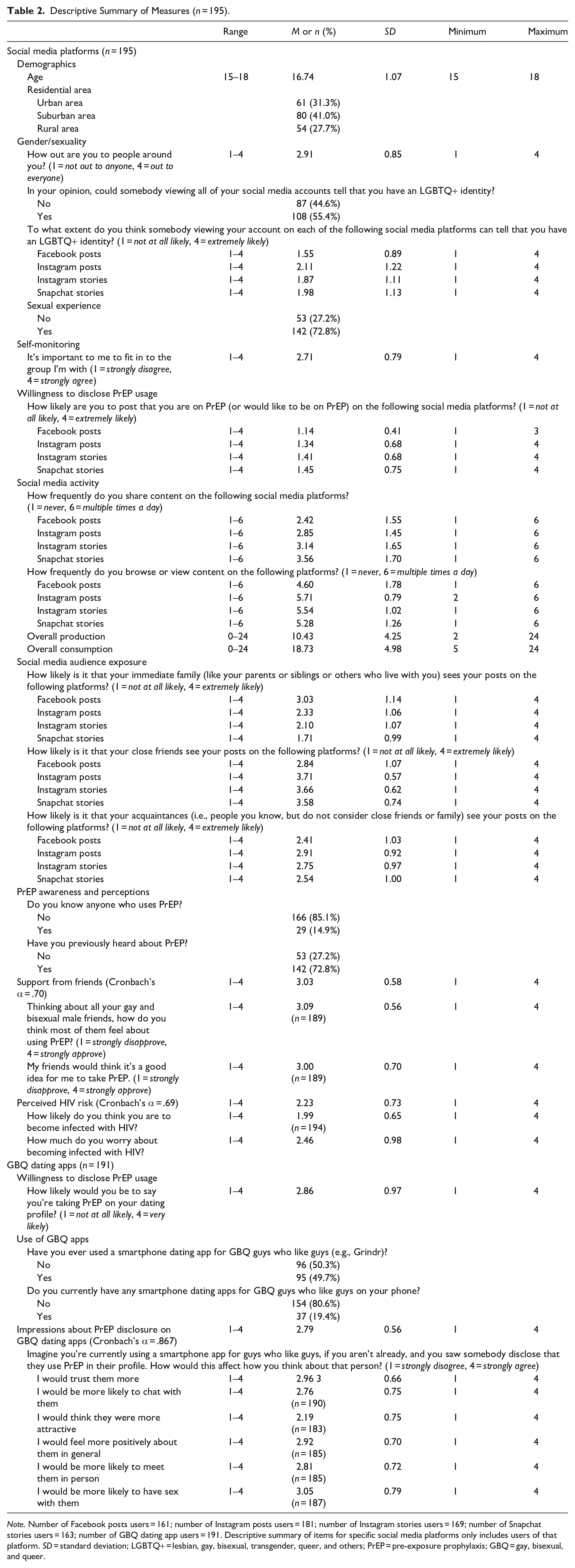
Note. Number of Facebook posts users = 161; number of Instagram posts users = 181; number of Instagram stories users = 169; number of Snapchat stories users = 163; number of GBQ dating app users = 191. Descriptive summary of items for specific social media platforms only includes users of that platform. SD = standard deviation; LGBTQ+ = lesbian, gay, bisexual, transgender, queer, and others; PrEP = pre-exposure prophylaxis; GBQ = gay, bisexual, and queer.
Correlation Matrix (n = 195 Participants; 673 With Repeated Measures).

p < .05. **p < .01. ***p < .001.
Covariates and Controls
Demographics
Participants completed items that asked them to report their age and whether they lived in what they considered a primarily urban, suburban, or rural area. Given that rural and urban contexts may differ in available support, peer groups, and experiences (e.g., Gray, 2009b), we believed this might impact disclosure of PrEP usage.
Gender/Sexuality
Gender, gender of attraction, and “outness” as an LGBTQ+ person were measured using items adapted from Toomey et al. (2016). Gender of attraction was collected by asking if participants were attracted exclusively, mostly, or equally (relative to females) attracted to other males. Outness was measured by asking how out participants were to the people around them on a 4-point scale (1 = not out to anyone, 4 = out to everyone). To control for how out participants felt they were on social media overall, we asked as a binary item if participants thought someone who viewed the posts on all their social media accounts could identify their LGBTQ+ identity (out on social media). For each social media platform, we then asked the perceived likelihood that somebody viewing the participant’s account on that platform could discern their LGBTQ+ identity (identity disclosure per platform; 1 = not at all likely, 4 = extremely likely).
Investigator-created items asked their lifetime number of consensual sex partners by partner gender. Given that sexual experience was limited in the sample, we collapsed this to a binary measure, indicating whether or not they had ever had consensual sex with another person.
Self-Monitoring
Self-monitoring is a psychological trait that has been shown to affect online sharing and self-presentation (Litt et al., 2014). To control for this, we measured self-monitoring using several items from Lennox and Wolfe (1984). Reliability for these items was low, so we used only a single item that we believe had face validity (see Table 2).
Dependent Variables
Likelihood to Disclose PrEP Usage
Investigator-created items asked participants how likely they would be to disclose PrEP usage on each social media platform they reported using (see below) as well as about PrEP disclosure in their profile on gay, bisexual, and queer (GBQ) dating apps. For each platform, this was measured on a 4-point scale (1 = very unlikely, 4 = very likely).
Independent Factors
Social Media Activity
Using a series of items adapted from DeVito et al.’s (2017) survey, we measured frequency of producing and consuming content on six major social media platforms (Facebook, Instagram, Snapchat, Twitter, Tumblr, and TikTok), using a 6-point scale (1 = never, 6 = multiple times per day). For platforms that offer both persistent and ephemeral posting options (e.g., Facebook and Instagram offer ephemeral “stories” and persistent “posts”), we asked about these features separately. Use of Facebook stories, Twitter, Tumblr, and TikTok were low, so we focus on Facebook posts, Instagram posts and stories, and Snapchat stories.
To account for some people being more likely to consume or produce content on all platforms, we created two measures of overall social media activity. Overall production (M = 10.43, standard deviation [SD] = 4.25, range = 0–24) was computed by summing the self-reported frequencies of content production on the four platforms. Overall consumption (M = 18.73, SD = 4.98, range = 0–24) was computed in the same manner.
Social Media Audience
Perceived social media audience was measured with items adapted from DeVito et al. (2017). These asked how likely participants thought it was that contacts in three relationship categories (family, friends, acquaintances) would see what participants posted on each platform.
PrEP Awareness and Perceptions
As many adolescents are unaware of PrEP (Macapagal et al., 2020), items directly related to PrEP use were preceded by a short explanation of what PrEP is and what it does.
Awareness of PrEP Use
This was measured using two binary items from Bauermeister et al. (2013) that asked if participants know or have known anyone on PrEP (No: 85.1%, Yes: 14.9%) and if they have ever heard about PrEP (No: 27.2%, Yes: 72.8%).
Support from Friends
To assess perceived peer support, we asked if participants believed their friends would think it was a good idea for them to take PrEP, with two investigator-created items with acceptable reliability (Cronbach’s α = .70) using 4-point scales (see Table 2). Where one item was missing for a participant, the other one was used as the measure (this occurred in 16 cases). The mean of the two items was otherwise used for the aggregated measure.
Perceived HIV Risk
Perceived risk of contracting HIV consisted of two items with acceptable reliability (Cronbach’s α = .69) from Napper et al. (2012) asking how likely participants think it is that they will be infected with HIV (1 = very unlikely, 4 = very likely) and how often they worry about this (1 = never, 4 = all the time). In the single case where one item was missing for a participant, the other one was used as the measure. The mean of the two items was otherwise used for the aggregated measure.
Apps for GBQ People and PrEP Disclosure
We also asked participants about their usage of GBQ apps for sexual minority men using items adapted from Macapagal et al. (2018). This consisted of two binary items asking if they had ever used these apps and if they currently had one installed on their phone. To understand participants’ perceptions of others who disclose PrEP use on these apps, we asked a series of six investigator-created scale items (see Table 2). Reliability for these items was good (Cronbach’s α = .87), and the mean was used.
Analysis
To address our research questions, we ran two sets of statistical models. Analyses to predict PrEP usage disclosure on mainstream platforms (Table 4) used a mixed-model regression with per-platform measures of activity, audience, and LGBTQ outness as within-participant factors, all other measures (see above) repeated for each participant across all platforms, and participant as a random effect. After excluding participants with missing values, there were 673 observations from 195 participants in these models. Models were fit using R statistical software with the lme4 2 package, and individual fixed-effects variables and nested models were tested by F tests with Kenward–Roger approximation with the R package pbkrtest 3 (Luke, 2017). Confidence intervals of coefficients were computed through the bootstrap method using the lme4 package. Using linear mixed models (LMMs) has several advantages over analysis of variance (ANOVA; which is a special case of LMM with only fixed effects), in that it accounts for both fixed and random effects and adjusts the standard error (SE) to better accommodate for repeated measures (Gelman & Hill, 2007).
Linear Mixed-Effects Models for Likelihood of PrEP Usage Disclosure on Social Media Platforms (n = 195 Participants; 673 With Repeated Measures).

Note. Model 0 (M 0) only has intercept and the term for random effects. PrEP = pre-exposure prophylaxis; SE = standard error; CI = confidence interval; Ref. = reference group.
*p < .05. **p < .01. ***p < .001.
The model predicting PrEP usage disclosure on GBQ apps (Table 5) was a least squares linear regression model with covariates and controls, and variables about social perception, dating app use, social media activeness, and participants’ impression of those who disclose PrEP use on dating app profiles. There were 191 valid cases after excluding those with missing values.
OLS Model for Likelihood of PrEP Usage Disclosure on GBQ Dating App Profile (n = 191).
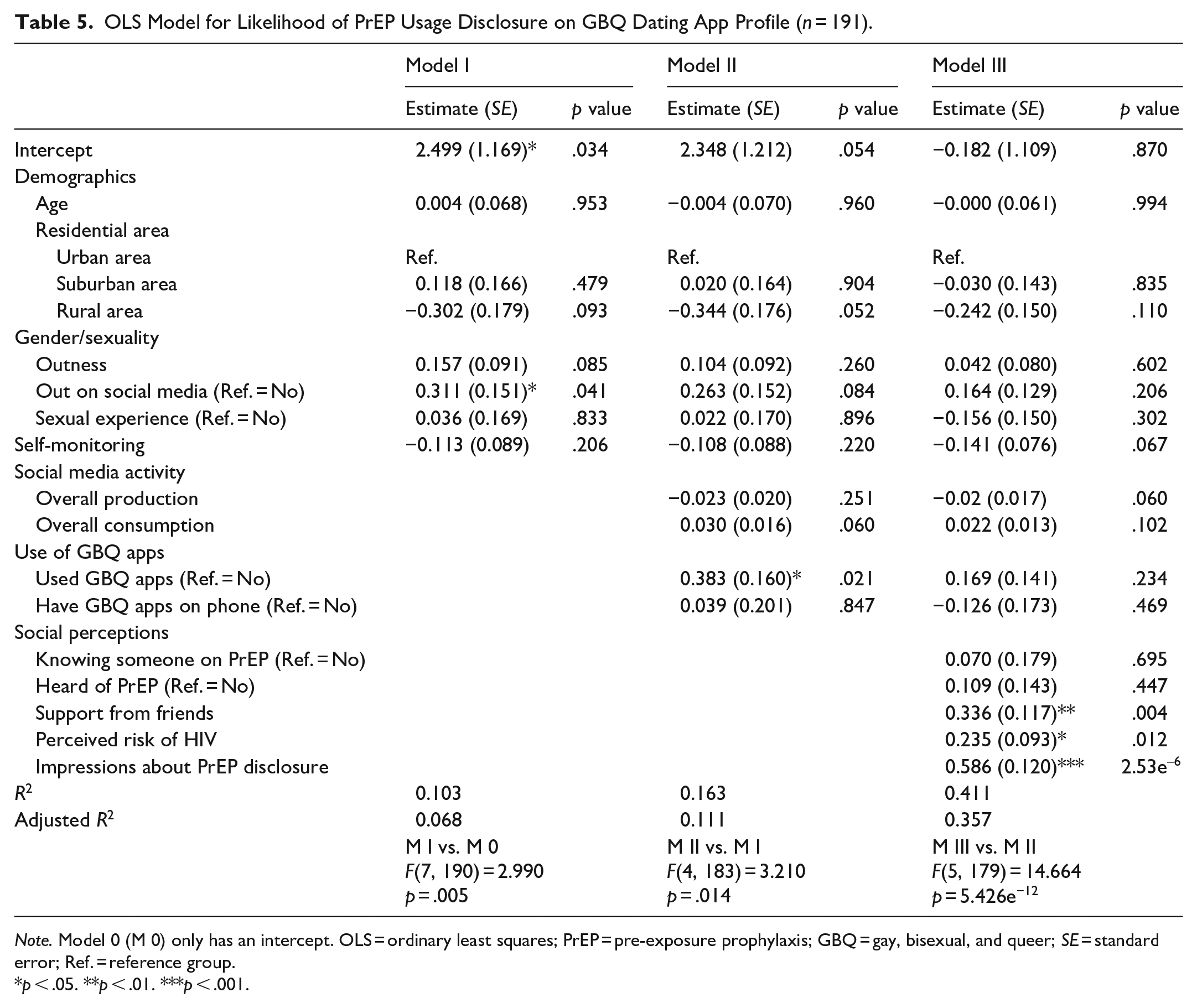
Note. Model 0 (M 0) only has an intercept. OLS = ordinary least squares; PrEP = pre-exposure prophylaxis; GBQ = gay, bisexual, and queer; SE = standard error; Ref. = reference group.
p < .05. **p < .01. ***p < .001.
Results
We structure our results according to our three research questions, after discussing covariate and control variables.
Covariates and Controls
Model I includes only covariate and control variables (see Table 4). Two of these were statistically significant. Not surprisingly given what is known about the experiences of urban and rural LGBTQ+ youth, participants in a Rural area were less likely to be willing to disclose PrEP usage on social media compared to the reference category, which is Urban area. The coefficient for this variable is significant at the 5% level and negative in all five models. The extent to which a participant believed others can tell by looking at their profile on a platform that they have an LGBTQ identity (Identity disclosure) was positively related to likelihood of disclosure, across all models. Age, overall outness, and sexual experience were not statistically significant predictors. Outness, however, is moderately correlated with Identity disclosure (see Table 3), which could help explain this.
We therefore looked at the relationship between Outness and Identity disclosure on different platforms. We only look at this relationship on the subsample of participants who use all four platforms (n = 124). As we expected, participants who are publicly out believe it is significantly more likely that others will be able to discern their sexual orientation on all four platforms (Facebook posts: t = 3.15, degrees of freedom [df] = 87.71, p = .0022; Instagram posts: t = 4.53, df = 88.78, p < .0001; Instagram stories: t = 4.46, df = 93.69, p ⩽ .0001; Snapchat stories: t = 4.64, df = 94.34, p < .0001). 4
We then examined how Identity disclosure varies by platform (Figure 1). We found that participants believe that others will be most likely to discern their sexual orientation via Instagram posts, followed by Snapchat stories and Instagram stories (not significantly different from each other), and then Facebook posts (significant). We compared Identity Disclosure between platforms sequentially by t tests and used the Benjamini–Hochberg procedure (BH procedure) to control the False Discovery Rate at 0.05 (Instagram posts vs. Snapchat stories: t = 1.79, p = .074; Snapchat stories vs. Instagram stories: t = .99, p = .32; Instagram stories vs. Facebook posts: t = 3.54, p = .0025).
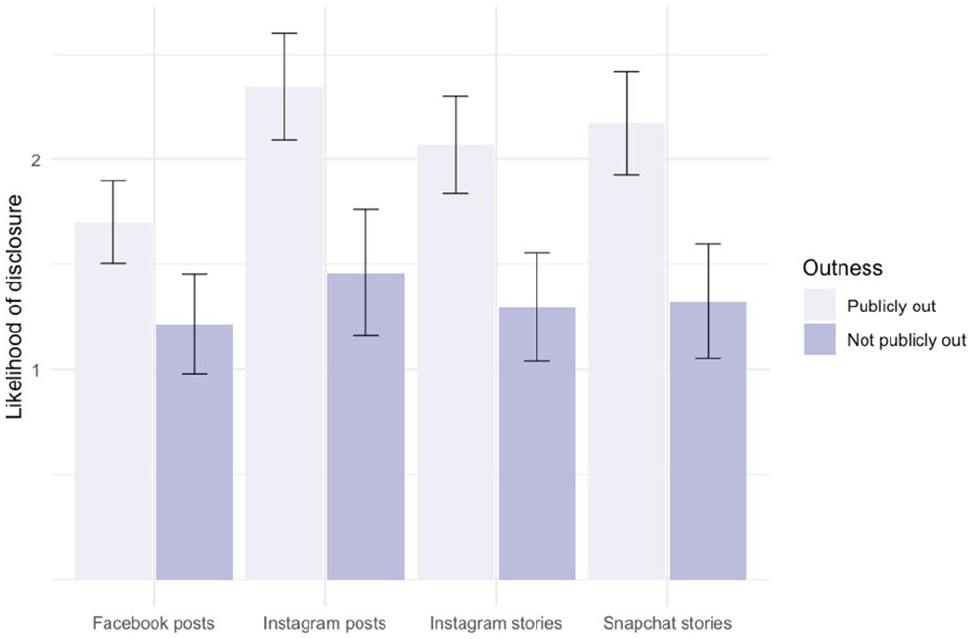
Likelihoods of LGBTQ+ identity disclosure.
To better understand how Outness relates to PrEP disclosure (Figure 2), we examined the relationship between these variables. We found that participants who are publicly out (Outness = not out to anyone or only out to a select few people) are more likely to disclose this information on Snapchat than those who are not publicly out (Outness = out to most people or out to everyone), but this pattern did not hold on the other three platforms (Facebook posts: t = –0.99, df = 45.53, p = .33; Instagram posts: t = 1.03, df = 75.49, p = .31; Instagram stories: t = 0.36, df = 65.60, p = .74; Snapchat stories: t = 2.31, df = 96.28, p = .023). We then ran t tests with p values corrected by the BH procedure, finding that participants are more likely to disclose PrEP usage on Instagram and Snapchat than on Facebook posts, and we did not see significant differences between the other three platforms (Snapchat stories vs. Instagram stories: t = 0.49, p = .62; Instagram stories vs. Instagram posts: t = 1.69, p = .094; Instagram posts vs. Facebook posts: t = 3.59, p < .0001).

Likelihoods of PrEP use disclosure.
Social Media Activity and Audience Concerns
Our first research question concerned audience considerations in participants’ likelihood of disclosing PrEP usage on social media platforms. In Model II (see Table 4), we add these variables to the model, and the F test suggests the additional variables explain more variance, F(7, 540.029) 5 = 11.329, p < .0000.
Looking first at social media activity, we see that those who produce more frequently on a platform are more likely to disclose PrEP usage on that platform, β = .086, F(1, 492.746) = 31.867, p < .0000. Those who consume content more often on the platform and those who are overall more active producers or consumers across all platforms they use are neither more nor less likely to disclose PrEP usage.
Our results also suggest that audience concerns are a significant predictor of likelihood of PrEP disclosure. Looking at the specific audience categories, there are two important results. First, the perceived likelihood of a family member seeing posts on a platform (Family exposure) is negatively related to willingness to disclose PrEP usage on that platform, as evidenced by the significant, negative coefficient of the variable Family, β = –.041, F(1, 632.942) = 4.683, p = .031.
Second, participants who perceived that a close friend would be more likely to see their posts on the platform (Friends exposure) were more willing to disclose their PrEP use, β = .065, F(1, 613.189) = 5.118, p = .024. There is thus a positive relationship between the perceived likelihood of a friend seeing posts on a platform and a participant’s likelihood of disclosing PrEP usage on that platform.
We also examined whether believing that acquaintances were likely to be in the audience (Acquaintances’ exposure) for a platform affected disclosure. However, we did not find evidence that this was the case, β = .009, F(1, 655.744) = 0.162, p = .688.
Platform Properties
Our second research question concerned the properties of the social media platforms, focusing in particular on the relative persistence or ephemerality of posts on each one. At first, platform did not seem to make a difference in the models. In Model III (see Table 4), we add the Social media platform variable, with Facebook as the reference category. The additional variables did not increase the variance explained by a statistically significant margin, F(3, 511.151) = 1.000, p = .457.
We wondered, however, if this variable was conflated with audience, given that we know from work cited above that adolescents tend to use different platforms for different audiences and contexts. It appears that this was the case, as—when the Social media audience variables are removed in Model IV—we see that participants are more likely to disclose PrEP usage on ephemeral platforms: Instagram stories, β = .142, F(1, 506.106) = 8.234, p = .004, and Snapchat stories, β = .124, F(1, 499.048) = 6.113, p = .014, compared with Facebook posts, which is the reference category. Controlling for other variables, Instagram stories will increase participants’ willingness to disclose PrEP use by 0.14 units on the scale and Snapchat stories will increase it by 0.12 units. Model IV also, when compared to Model I, explains significantly more variance, F(7, 543.920) = 11.023, p < .0000.
Reflecting on this, it appears that ephemeral posts and audience are likely causing this conflation, which we explore in the next section. That is, participants believe that ephemeral posts are more likely to be seen by friends, so they are more likely to disclose using these posts. It is also interesting that, given that adolescents often use Instagram with their friends (Pew Research Center, 2018), Instagram posts were not also significant. Here, we believe that ephemerality further serves to reduce audience exposure and the sense that PrEP usage might be part of one’s more persistent online identity. We return to this in the discussion.
Exploring Audience and Ephemerality
To further explore this conflation and better understand the relationship between audience and platform properties, we looked deeper into our data set. First, we compared production and consumption behavior for the subset of participants who use all four platforms (n = 124). There are clear differences in production and consumption on these platforms that likely affect our earlier results (Figure 3) and that become more interesting when we consider our analysis of audience below.

Frequencies of social media production and consumption.
As Figure 3 shows, we see that participants consume content frequently on all of the platforms, with the greatest frequency for Instagram posts, followed by Instagram stories, Snapchat stories, and Facebook posts (Instagram posts vs. Instagram stories: t = 2.75, p = .0068; Instagram stories vs. Snapchat stories: t = 2.23, p = .028; Snapchat stories vs. Facebook posts: t = 4.33, p < .0001). They produce less frequently than they consume on all platforms, and produce ephemeral content more often, especially on Snapchat. With more permanent content, they post on Instagram more often (Snapchat stories vs. Instagram stories: t = 3.02, p = .0030; Instagram stories vs. Instagram posts: t = 4.81, p < .0000; Instagram posts vs. Facebook posts: t = 2.42, p = .017).
To then understand the relationship between platform and audience, we compared perceived audience by platform for the family and friends categories, since these were most salient in our models (Figure 4). We see in Figure 4 that participants believe family and friends are about equally likely to see posts on Facebook, whereas friends are far more likely to see content on Instagram and Snapchat (Facebook posts: t = 1.55, p = .124; Instagram posts: t = –13.72, p < .0000; Instagram stories: t = –15.60, p < .0000; Snapchat stories: t = –17.09, p < .0000). As we suspected, this suggests that audience is conflated with platform, though the similarity of audience for Instagram posts and stories complicates the story around ephemerality. Without a widely used ephemeral platform likely to be viewed by family, however, it is not possible to untangle this conflation in our data. (Note that Facebook does offer stories, but very few participants use them.)
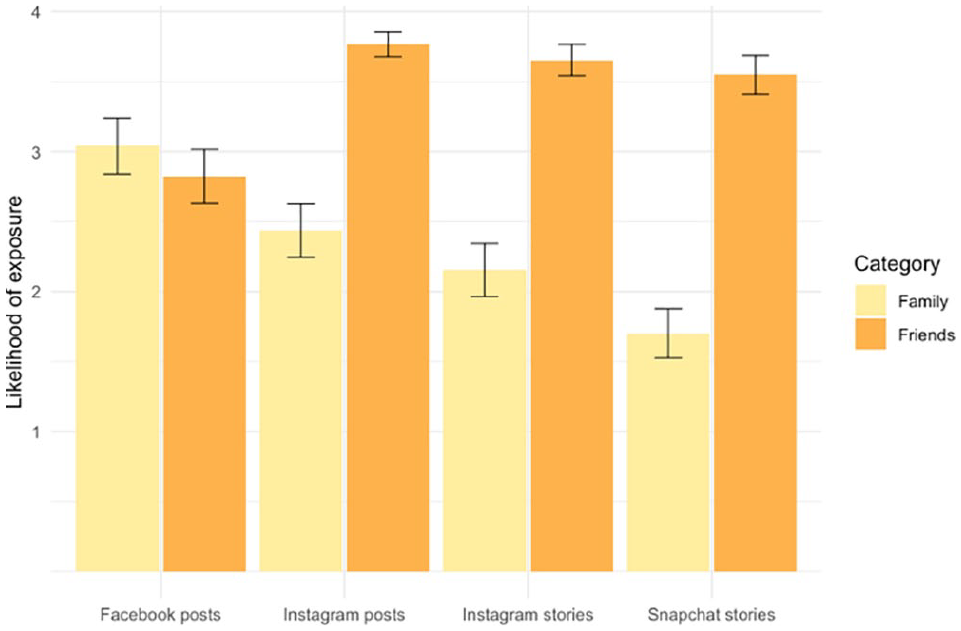
Likelihoods of audience exposure.
Social Perceptions of PrEP Use/HIV Risk
Our third research question concerned several factors related to social perceptions of PrEP usage and HIV risk, and the results suggest that these are significant predictors of PrEP usage disclosure.
Looking first at mainstream social media platforms, in Model V (see Table 4), we add the Social perceptions variable block which explains additional variance by a statistically significant margin, F(4, 184.886) = 6.302, p < .0001. First, we see that Knowing someone on PrEP is positively related to likelihood of disclosure, β = .248, F(1, 176.176) = 5.612, p = .019, when compared to not knowing somebody on PrEP, which is the reference category. Perceived Support from friends for PrEP usage is also positively related to likelihood of disclosure, β = .158, F(1, 187.558) = 5.809, p = .017. The same was also true for Perceived HIV risk, β = .122, F(1, 188.641) = 5.102, p = .025. Interestingly, having heard of PrEP was not a significant predictor, β = .000, F(1, 186.398) = 0.001, p = .994.
Turning to disclosure on GBQ apps, we ran separate ordinary least squares (OLS) models (see description above and Table 5) which did not include the per-platform measures we used for the mainstream platforms. Model I in Table 5 includes covariates and controls. In this model, participants who are Out on social media at all are more likely to disclose PrEP use than those who are not out, which is the reference category (β = .311, p = .041). This item is not significant in the other models, however.
In Model II, we add social media activity and GBQ app usage, and the additions explain more variance by a statistically significant margin, F(4, 183) = 3.210, p = .014. In this block, we see that those who have Used GBQ apps would be more likely to disclose PrEP usage in their profile on these apps than those who have not used them (β = .383, p = .021). Overall, social media activity and having a GBQ app currently installed were not significant predictors.
In Model III, we add the Social perceptions variables, which increase the R2 for the model from .163 to .411, F(5, 179) = 14.664, p < .0000. Here, we see that perceived Support from friends for PrEP usage is positively related to disclosure (β = .336, p = .004) along with Perceived risk of HIV (β = .235, p = .012), as with mainstream platform disclosure above. Curiously, Knowing someone on PrEP was not a significant predictor in this model (β = .070, p = .695), unlike the mainstream platforms. This could be because one’s audience on GBQ apps consists of more strangers than friends, so one is less worried about what one’s friends might think.
Results from Model III also suggest that participants’ Impressions about PrEP disclosure in profiles on GBQ apps was positively related to likelihood of participants disclosing on GBQ apps (β = .586, p < .0000). That is, those who felt more positively about others who disclosed were more likely to disclose themselves.
Discussion
We structure our discussion according to our core research questions.
Audiences and Ephemerality
Our first question concerned the role of participants’ perceived social platform audience in their willingness to disclose PrEP usage. We found that participants were more likely to be willing to disclose on platforms where they thought their friends were most likely to see their posts, and less likely to disclose on platforms where they thought family were most likely to see their posts. Acquaintances in their audience did not have a significant effect in our models.
Considered in light of literature on sensitive disclosure in online spaces, this finding is an important contribution in several respects. First, much literature on sensitive disclosure on social media focuses on a single social media platform, so does not capture participants’ perceptions of variation in their audience across platforms. For example, Duguay (2016) examines LGBTQ+ youth on Facebook, Wargo (2017) focuses on Tumblr, Corriero and Tong (2016) focus on Grindr, and Andalibi et al. (2016) focus on Reddit. While all of this work provides rich insights into the nature of decisions people make around sensitive disclosure, they do not capture variations in a single participant’s attitudes toward different audiences on different platforms. Alhabash and Ma (2017) do capture attitudes toward multiple platforms; however, they focus on general usage and motivations, and not on disclosure.
As DeVito et al. (2018) point out in introducing their notion of a personal social media ecosystem, however, participants in that study articulated very clear differences in their attitudes toward different platforms, but these were not always consistent across participants. Building on that exploratory qualitative study, our results suggest that anticipated audience is a salient factor in the willingness to disclose potentially sensitive information such as PrEP usage, when a participant is confronted with multiple platform choices for the disclosure in today’s complex landscape of multiple platforms, audiences, and features.
Moreover, while the apparent conflation of audience and platform in our results somewhat limits the nature of our claims, it also sheds some light on the social media landscape in ways that a more controlled design could not. Our results suggest that participants think of their friends as seeing more ephemeral content, and also suggest that content intended for one’s close friends may be more appropriate as ephemeral (e.g., Bayer et al., 2016; Xu et al., 2016). For a sensitive disclosure like PrEP usage, ephemerality may be serving not just to limit the persistence of and visibility of the content but also the extent or duration of its association with the participant. Ephemeral disclosure also adds an additional consideration to feminist and queer theory perspectives on disclosure (e.g., Butler, 1990; Muñoz, 1999), and how the persistence or ephemerality of identity markers and language can affect perceptions or impact of disclosure. More controlled study, perhaps using scenarios, could help shed light on these questions, and this would have implications for discussions of affordances in self-presentation processes (DeVito et al., 2017; Evans et al., 2017).
Our results should not be interpreted to mean that all sensitive disclosures would follow this same pattern. In this case, AMSM are more likely generally to discuss their sexuality and sexual behavior with friends than with family (Feinstein et al., 2018) due to the reduced likelihood of stigma or shaming, so this audience choice makes intuitive sense. At the same time, we also know from the initial experience with PrEP among adult men that some might hesitate to disclose PrEP usage at all even to friends due to concerns about stigma (Golub, 2018). It is also possible that low willingness to disclose PrEP use among AMSM follows from relatively low prevalence of HIV in this age group relative to older groups. As prevalence is low, the perceived signaling value of PrEP as an indicator of good health may increase with age. This combination likely explains the relatively low levels of willingness to disclose that we saw overall. Still, some participants were willing to disclose, and this was influenced by the audience for the post.
Other types of sensitive disclosures might follow different patterns. Given the nature of our study, moreover, we did not provide an option for a purely anonymous disclosure as may occur in online-only settings such as Reddit (e.g., Andalibi et al., 2016). Our contribution here is not that people will disclose sensitive things to their friends but not their families, but rather to provide evidence that audience and ephemerality play a role in these decisions.
From a practical standpoint, our results could inform efforts to increase uptake of medications like PrEP and influence the trajectory of HIV in the AMSM population (Macapagal et al., 2020; Young et al., 2018). In particular, our results suggest first that AMSM may be more willing to disclose on platforms their family is unlikely to see, where their friends are most likely to be part of the audience, and where the disclosure is less likely to be part of their persistent presence on the platform.
Social Context and Perceptions of Normativity
From Goffman’s (1959) discussion of region behavior in self-presentation, Litt’s (2012) work on imagined audience, and work on different social contexts of online self-presentation (Marwick & boyd, 2014), we know that different contexts or networked publics have different social norms and practices. There have been relatively few studies, however, that quantitatively examine factors that influence sensitive online disclosures as part of the self-presentation process.
We were interested in the social context of disclosure and participants’ perceptions of the normativity or acceptability of PrEP usage. In this case, we saw that participants who felt that they knew people who used PrEP or were likely to be supportive of participants’ PrEP usage were more likely to be willing to disclose their own PrEP usage. Relatedly, those who use GBQ apps were more likely to disclose if they looked positively on others who disclosed in their profiles. This can likely be explained in part by perceived risk in disclosure. If disclosure of PrEP use is seen as an act of disidentification (Muñoz, 1999) or performing non-normative sexual identity or behavior (Green, 2007), familiarity with and positive impressions of other PrEP users likely indicate that the participant knows others who have engaged in a similar performance. This may predict positive outcomes and also give the participant a model for what the disclosure might look like, as with coming out stories described by Gray (2009a).
In combination with the audience results above, this presents an interesting set of implications and questions for future work. That is, participants wanted to disclose to their friends as opposed to their families, but particularly if their friends were likely to be supportive and/or PrEP users themselves. From a theoretical standpoint for the study of online self-presentation, this further supports the importance of audience and the need for audience to be supportive when one is presenting the self in a sensitive way.
In looking at disclosure on GBQ apps, moreover, we see that perceptions of others who disclose were also a strong predictor of disclosure. This suggests further that building awareness of disclosure and its value might help encourage further disclosure and uptake of PrEP.
For those interested in promoting self-disclosure for public health or awareness, however, all of this presents a bit of a paradox in that somebody needs to be the first to disclose. One might think that lower self-monitors might be more willing to disclose first and let others follow, but this factor did not emerge as significant in our models. Another possibility would be to allow groups of PrEP users (or others with a similar property) to first disclose to each other and then the broader population. This could occur, for example, in Facebook groups or via secondary Instagram, Twitter, or Reddit accounts (e.g., “throwaway” accounts or “finstas”).
Limitations and Future Work
As with any study of this nature, this work has limitations that urge caution in interpreting our results. First, this is a survey study of AMSM in the United States who were willing to participate in research about their AMSM status. While we took steps to make this easy by waiving parental consent requirements, there are still likely potential participants whose experience we did not capture that were unwilling to participate for fear of being discovered or upsetting their family. We also had very few actual PrEP users in our sample as it is still very uncommon for adolescents; however, experience with PrEP may change attitudes reported here.
We deliberately focus here on a population that often has heightened self-presentation concerns (DeVito et al., 2018; Duguay, 2016) and on an issue that is particularly salient in this regard (Eaton et al., 2017; Golub, 2018; Macapagal et al., 2020). While these factors likely foreground important decisions and factors that play into all self-presentation decisions, it is possible that they are exaggerated as they play out in our results with this specific population. We urge further study of these factors in the broader population, including other marginalized populations with different concerns as well as more mainstream users of social media.
We focused on AMSM in our study because this group of adolescents may be more vulnerable to HIV in part because they are more likely to engage in sex that poses higher HIV transmission risk (i.e., condomless anal sex with partners also assigned male at birth). Indeed, male-to-male sexual transmission accounted for 94% of new infections among 13- to 17-year-olds in 2016 (Centers for Disease Control and Prevention, 2018). Recent research, however, suggests HIV prevalence in trans men and other gender minorities assigned female at birth who have sex with MSM, including adolescents (Clark et al., 2017). Thus, the exclusion of sexual minority adolescents who could benefit from PrEP is a limitation of this work, and we urge future research to include this population.
As we noted above, we were also limited by the combination of our design and today’s social media landscape in that there does not appear to be a platform that is used widely with family members that also supports ephemeral sharing. While Facebook does provide a stories feature that is ephemeral, very few of our participants reported regularly using this feature. As such, it was difficult to tease apart these factors, though we believe the ecological validity our design provides is a worthy trade-off. We urge additional work that uses more controlled designs to tease apart affordances for ephemerality and audience, perhaps through laboratory experiments or scenario studies to see how people might behave differently if the social media platform/audience landscape were changed. This would help us better understand the fundamentally socio-technical nature of self-presentation.
Conclusion
Self-presentation on social media platforms is a fundamentally socio-technical process that involves considerations of audience, platform affordances, and the social context of disclosing information about the self. In this article, we have explored attitude disclosure of one type of sensitive information—PrEP usage—on multiple social media platforms. We reported on a survey study of AMSM’s willingness to disclose PrEP usage on different platforms as it related to their perceived audience on each platform, affordances for ephemeral and persistent posting, and their perceptions of their friends’ attitudes toward and support for PrEP use. This was among a very few studies that directly compare participants’ attitude toward disclosure of the same piece of information across many of the platforms in today’s complex social media landscape. Results suggest that audience considerations and platform affordances are important, but possibly conflated. They further point to the importance of peer behavior and support, as well as perceptions of others who disclose PrEP usage.
Footnotes
Acknowledgements
The authors wish to thank Leishla Perez-Cordona for assistance with this research.
Declaration of Conflicting Interests
The author(s) declared the following potential conflicts of interest with respect to the research, authorship, and/or publication of this article: The first author has received research funding from and worked as a paid academic collaborator with Facebook on work unrelated to the present study.
Funding
The author(s) received no financial support for the research, authorship, and/or publication of this article.
