




Abstract
The COVID-19 pandemic led to over one million American deaths, disproportionately suffered by those who resisted vaccination by championing individual autonomy over the collective good. The article takes as its point of departure that vaccine resistance is a recurring phenomenon in U.S. history with multiple origins. Among these are the absence of a consistent approach to public health policy—the combined result of the absence of federal police power—and tensions between the public good and libertarian values. The latest instance of populist resistance was assisted by changes in the information system. Relying on several lines of research, we specify a model of group identification that highlights social media’s role in this latest eruption of opposition. A key element is an attentive public that selectively shares information based on reputational concerns. We test our model by applying frame analysis on a body of data drawn from U.S.-based news content and audience reactions on Facebook.
The COVID-19 pandemic resulted in over one million American deaths, leaving the United States with the highest per capita fatality rate among advanced democracies. Although the demographic and health profiles of Americans contributed to the high number, the comparatively low full vaccination rate among Organisation for Economic Co-operation and Development (OECD) countries—68%—also explains the excess mortality. Given the contribution of the United States to the swift development of effective vaccines, free for the taking, this is a puzzling anomaly, as is the resistance to the vaccines that grew over time. A review of the voluminous research on this topic shows the influence of demographics, socioeconomic status, political identity, and media diet on resistance (Chadwick et al., 2021; Jiang et al., 2021; Kristensen et al., 2023; Troiano & Nardi, 2021). Less explored are the influences of populism, mistrust of authority often associated with anti-intellectualism, Manichaeism, and belief in conspiracy theories (Berman, 2021; Mitra et al., 2021).
In this article, we argue that this cluster of related phenomena represents a recurring impulse in American history, most recently assisted by an information system that enhances the salience of public opinion distrustful of medical authority and state power. To that end, we propose and test a model of group identification via a frame analysis of U.S.-based news content and audience reactions on Facebook (FB). We base our model on a review of several bodies of research that help explain the politicization of the public’s response to vaccination, an unlikely candidate for controversy given the nearly year-long lockdown that preceded the development of a medical solution. A review of the history of vaccine resistance reveals that the dissent was not unique.
The Body and the Body Politic: Moral Foundations of U.S. Vaccine Politics
We begin with the observation of experts that public health is a collective good that requires the intervention of the state (Oliver, 2006). Its production is inherently political because, as Gostin (2000) puts it, “Public health can be achieved only through collective action, not through individual endeavor” (p. 7). One obstacle to successful implementation lies in the resonances of U.S. political culture and their influence on perceptions of illness and morally-inflected notions of responsibility.
American political culture embodies a moral dimension that reflects the nation’s founding under conditions of internal and external threat. Absent ties provided by soil or blood, U.S. immigrant-driven society depends on values that combine an uneasy marriage of Enlightenment ideals and Protestant religion. Anti-statism reflects the influence of John Locke on the founding documents of American democracy, while Manichaeism—an inclination to find external sources of evil—is assisted by religious beliefs that seek the reform of nonbelievers and their perceived corrupt practices (Morone, 2004). Tellingly, these themes are also prominent in conspiracy theories that have arisen throughout the nation’s history (Goldberg, 2001).
Consistent with Sontag’s (1978) thesis about illness as a metaphor, scholars argue that culturally inflected understanding rather than dispassionate scientific analysis often influences public health debates. These function as “societal stress tests” (Forbes, 2021) that offer an “occasion for retrospective moral judgment” (Rosenberg, 1989, p. 9). Conditioned by historically rooted tensions that arise from the jurisdictional ambiguities regarding enforcement of health policy, as well as conflicting values that underpin the U.S. approach to disease management, these tests symbolically pit the health of individual bodies against that of the body politic (Musolff, 2010).
Historical Foundations of Vaccine Resistance
While most Americans support childhood vaccination (Funk et al., 2023), public support has historically relied on a path susceptible to resistance under conditions of political polarization and institutional distrust (Conis, 2015; Jedwab et al., 2021; Kaufman, 1967). Contributing to the instability are legal ambiguities regarding the use of police power to enforce health policy at the national level, as well as the varied use of sanitation and containment approaches to epidemic management at the local level (Witt, 2020) that accentuate the cultural tensions. When confronted with federal disease control measures deemed too coercive by the public—especially during periods of populist-inspired suspicion—the containment approach and its rhetoric risk fanning the flames of conflict because of their tension with the values of individualism and liberty (Colgrove, 2006). Two examples illustrate the dynamic.
In the early 19th century, following widespread acceptance of Edward Jenner’s vaccines, smallpox was nearly eradicated. By the 1870s, however, both vaccination and immunity had declined, and the disease began to spread just as an anti-vaccination movement took root. Fueled by suspicion of medical authority and fears of the growing power of the state, organized political opposition arose that included numerous acts of resistance and a wave of litigation based on the due process clause (Willrich, 2008). The anti-vaccination movement lasted well into the 1930s—including resistance to flu vaccination after World War I—before ebbing due to improvements in medical practice and acceptance of the role of government in public health (Kaufman, 1967). The latter is illustrated by the success of the campaign in the 1950s to vaccinate children against polio in what has been called the “golden age of vaccination” (Poland & Jacobson, 2011).
Consensus began to erode again in the late 1990s following the publication of a Lancet article that linked Measles, Mumps, and Rubella (MMR) vaccines to autism (Wakefield et al., 1998). Despite revelations that the conclusions of the retracted article were based on fraudulent data, an anti-vaccination movement arose that gained momentum through public support offered by celebrities and political figures that included future President Trump. The movement presaged a much more potent form of resistance to COVID-19 vaccination. In both cases, social media amplified the voices of citizens over those of experts (Smith & Graham, 2019).
Social Media, News Consumption, and Group Consciousness
Social media have altered the dynamics of political identity formation. The Pew Research Center reports that about half of the U.S. population gets its news “often or sometimes” from social media (Walker & Matsa, 2021). The most popular source is FB, with 31% of Americans regularly getting their news from the site. Because friendship networks compose the infrastructure of social media, reputation and moral standing are potent drivers of news frames that displace interest-based goals in favor of commitment to group identity (Hodson et al., 2022; Kahan et al., 2017; Williams & Delli Carpini, 2011).
COVID-19 represented a stress test of public support insofar as the unpredictable nature of the disease—coupled with the polarized state of U.S. politics and its information system—made group identity salient in shaping evaluations of the threat and the necessity of government intervention (Kristensen et al., 2023). Research shows that populist-driven suspicion of elite opinion (Merkley, 2020; Stecula & Pickup, 2021)—correlated with partisan media sources (Motta & Stecula, 2023)—drove anti-vaccine attitudes. Thus, a Yale Public Health study of citizens linked to their voting records (Wallace et al., 2022) found that in the pre-vaccine period, the excess death rate among Democrats and Republicans was similar. After vaccines became widely available in summer 2021, however, the Republican excess death rate nearly doubled that of Democrats, and the gap widened that winter. Adherence to the values of freedom and autonomy superseded those supporting the collective good, thereby exposing individuals to the fate of a virus indifferent to political affiliation.
Despite its rhetoric heralding the swift arrival of the vaccine via “Operation Warp Speed,” the Trump administration was crippled by what Parker and Stern (2022) described as “fierce infighting between multiple power centers, blame-shifting, ambiguity regarding who was in charge, and a delayed, disorganized response to the pandemic” (p. 626). The absence of leadership from the top devolved power to governors with conflicting political agendas and a polarized public that drew upon favored sources of information and recirculated prevailing issue frames through social media to their friendship networks. There, the news frames became entwined with self-perception and group identity.
The group influence phenomenon echoes the pioneering work of Asch (1956) on conformity, as well as the research that conceptualizes partisanship in a dual fashion, contrasting expressive affiliation with instrumental gain (Huddy et al., 2015). Grounded in social identity theory, expressive affiliation elicits reasoning that draws on party identification as a defense against challenging information. In contrast to detached ideological commitment and short-term interest that support instrumental partisanship, emotional attachment to social bonds and moral conviction fuel expressive partisanship and moral condemnation of rivals (Huddy et al., 2018).
Moral Conviction, Outrage, and Risk Perception
Derived from an unflagging belief in attitudes believed to be supported by universally applicable and irrefutable values and beliefs, moral conviction strengthens attitudes “perhaps more powerfully than any other attitude characteristic” (Ryan, 2014, p. 381). Policies based on such attitudes are seen as self-evident judgments of rightness and wrongness that lead to distancing from and intolerance of those who think differently (Skitka et al., 2005), as well as anger that motivates political action (Haidt, 2001; Huddy et al., 2005; Valentino et al., 2011).
With respect to risk, anger also bolsters optimistic estimates and thereby a risk-seeking behavior (Lerner & Keltner, 2001). Insofar as perceptions of risk are mediated by values and beliefs, they are inherently political (Douglas & Wildavsky, 1982; Slovic et al., 1980). With respect to the transmission of moral news frames—a signal feature of social media discourse—news stories containing such a frame are more likely to be shared (Valenzuela et al., 2017), a function of the network peer group dynamics that encourage moral grandstanding (Tosi & Warmke, 2016). Driven by selective information sharing and impression management, moral judgment intensifies group loyalty and hardens opinion.
We integrate these findings in a model based on expressive identity that helps explain how the dynamics of news sharing on FB may have contributed to the polarized response of Americans to vaccines developed to stop the spread of the COVID-19 pandemic.
Modeling Expressive Identity Formation
Figure 1 illustrates the main components of the Expressive Group Identity (EGI) model that begins with news stories observed and shared by attentive citizens to less attentive members of their social media networks. News outlets observe which content garners the most engagement—for example, shares and likes—and publish similar content to try to reproduce their success, inducing a repeated cycle through the attentive public.

Expressive Group Identity (EGI) model.
Represented by multiple terms like gate-watchers, secondary gatekeepers, and curators (Bruns, 2005; Singer, 2014; Thorson & Wells, 2015), attentive citizens see themselves as opinion leaders (Kalogeropoulos et al., 2017; Kümpel et al., 2015). Aside from a wish to spread specific content, status seeking is one of the strongest predictors of news sharing (Bright, 2016; Jordan & Rand, 2020; Lee et al., 2011). Reluctant to put reputation at risk by sharing what is perceived as low-quality information (Hodson et al., 2022; Thompson et al., 2019), such an act amounts to a personal commitment akin to taking a moral position (Brady et al., 2020; see Flores-Yeffal & Sparger, 2022). In a process termed “moral contagion,” citizens share stories that signal political identity, boosted by the perception that others are sharing them as well (Brady et al., 2020; see also Kristensen et al., 2023).
The EGI model bears similarities to the two-step flow model (Katz, 1957; Katz & Lazarsfeld, 1955), originally developed in a centralized media environment in which traditional media (e.g., newspapers and television) held highly concentrated power and influence. Social media have disrupted centralized media hierarchies by providing citizens with access to large online social networks that increase their ability to shape opinion on politics and social issues (Choi, 2015; Riedl et al., 2023; Wu et al., 2011). Studies of FB show that news recommendations increased trust in the shared media outlet (Turcotte et al., 2015) and the salience of the issues covered in the stories (Feezell, 2018). Furthermore, FB endorsements (sharing, liking, and commenting) influenced users’ choices about which news content to read, even counter-attitudinal news content if their FB friends had endorsed it (Anspach, 2017).
In the two-step flow era, the specifics of these patterns were unknown, leading to the concept of an imagined audience for journalists. Social media platforms such as FB include measures for registering audience engagement that have displaced intuitive estimates with precise metrics. Ready availability of audience analytics combined with a shrinking market create incentives to match journalistic content to what the audience wants and expects (Ferrer-Conill & Tandoc, 2018; Gentzkow & Shapiro, 2010; Ksiazek et al., 2016). Given the polarized state of the information system, such audiences are likely to be distinguished by their partisan leanings.
From the viewpoint of news editors, stories observed to stimulate audience engagement encourage propagation of similarly framed stories to build audience loyalty, the genesis of a feedback loop that develops between media frames and citizen engagement: Shared news frames encourage production of similar content, although the influence of audience analytics depends on organizational factors such as platforms of distribution and perceptions of individual journalists (Bunce, 2019; Hanusch, 2017; Hanusch & Tandoc, 2019). Repeated encounters with familiar content shared by users seeking attention and moral approval make group identity salient, drawing distinctions with members of political out-groups. In sum, social media widen the distribution of news frames and augment their capacity for influencing public opinion by imbuing it with a moral dimension borne of group identity.
With respect to COVID-19 vaccine acceptance, research shows that those who received information that others were reluctant to take the vaccine were more likely to report that they themselves would not take it (Palm et al., 2021). In the context of social media, strength of partisan affiliation and the scope of online social networks contributed to COVID-19 vaccine attitudes. Conservatives with average network sizes were more likely to express unfavorable vaccine attitudes and discuss vaccine side effects, distrust of medical professionals, and conspiracy theories (Jiang et al., 2021).
Our model shares features with the Ideological Health Spirals (IHS) model (Young & Bleakley, 2020) in that both are iterative; assume a politicized, polarized media environment; and are based on perceptions of relevant norms. While the IHS model predicts a behavioral intention based on individual differences, our model originates in group-level processes that explain differences in mortality based on partisan affiliation. Here, we note survey research that found vaccine-resistant citizens got their COVID-19 information from social media, especially FB (Chadwick et al., 2021; Green et al., 2023). An examination of the group dynamics on that platform offers clues as to the reasons for that resistance.
The recursive nature of our model assumes that news organizations track measures of audience engagement and respond with similar content that drives the social dynamics we described. Based on these components and our review of the research literature, we pose the following hypotheses:
The EGI model also includes the potential of news frames to influence audience perceptions of the safety of a new vaccine. With respect to risk, we pose the following question:
Method and Data
We analyze news posts from the most widely viewed news sites on FB as measured by Statista.com for each month in 2021, the year vaccinations were first made available. We divide the sites by their partisan leanings (Ad Fontes Media, n.d.; AllSides, n.d.; Sanders, 2022) to acknowledge the widening polarization in the use and trust of media sources (Jurkowitz et al., 2020) but also note their ideological asymmetry. On the left, the most viewed were BuzzFeed News (4.2M followers), CNN (39.3M), HuffPost (12M), NBC News (10.9M), The New York Times (18.8M), and The Washington Post (7.1M). On the right, Breitbart (5M), Daily Wire (3.6M), Fox News (23.4M), Newsmax (4.4M), One America News Network (1.6M), and The Washington Times (726 K). While users on the left favor four legacy sources, those on the right favor only two. This imbalance echoes the findings of Benkler et al. (2018) on the partisan asymmetry of the information system where media producers and social media audiences on the right “read, share, and quote almost only right-oriented media,” with the most far-right content drawing the most attention (p. 56).
Using a variety of keywords, we used FB’s data-retrieval tool—CrowdTangle—to search for all posts with references to COVID-19 vaccines. The yield was 5,274 posts, of which we selected those that had 1,000 or more shares (N = 432) in the 12-month period beginning in January 2021. Shared content appears on a user’s timeline as well as the news feeds of their friendship network, increasing the visibility of a given news frame. A post’s number of shares thus provides an operational measure of a news frame’s resonance and serves as a tangible metric of audience engagement with a story for the media outlet that produced it, thereby providing an incentive for reproducing it.
We selected the 1,000-shares threshold because it represents an inflection point ahead of a plateau of a near-perfect log-normal distribution. The relatively small number—8% of total posts—nevertheless represented about two thirds of the total number of shares, an indication of the posts’ specific resonances with their audiences. Sources on the left yielded 289 posts: 253 links to news articles, 19 videos, and 17 photos. On the right, 141 posts: 105 links, 19 videos, and 17 photos. The imbalance in coverage reflects the smaller audience base of right-leaning sources but also their meager attention to the controversy during the first half of the year, a finding we discuss below.
Our analysis is based on two streams of data, FB posts and user comments. We use frame analysis as our primary text analysis tool for coding news posts, an analytical technique that probes the underlying structure of messages that guides the understanding of public issues (Entman, 1993). For our study, we use the model by Chong and Druckman (2007) that conceptualizes an attitude as the sum of a salient set of beliefs about a given public issue (frame in thought). The beliefs tap several independent dimensions underlying an issue, one or more of which may be emphasized in a text.
Using an inductive approach supplemented by an analysis of post content, we arrived at four major frame dimensions used to support or oppose vaccination: morality, politics, science, and risk(bolded in Table 1). Each of these were accompanied by subframes, defined in the Supplemental Appendix. These varied from the scientific evidence supporting the efficacy of vaccines, the right of individuals to choose rather than being required to take them, conspiratorial beliefs about who may be gaining political advantage from them, the risks of taking a new medical treatment, and so on. We were especially interested in the moral dimension of the controversy—appeals to the principle supporting a frame or negative judgment of those perceived to have violated one—because it is a primary driver of news sharing as well as the dynamics of group identity formation.
Frame Presence (Percent of Posts), 2021.
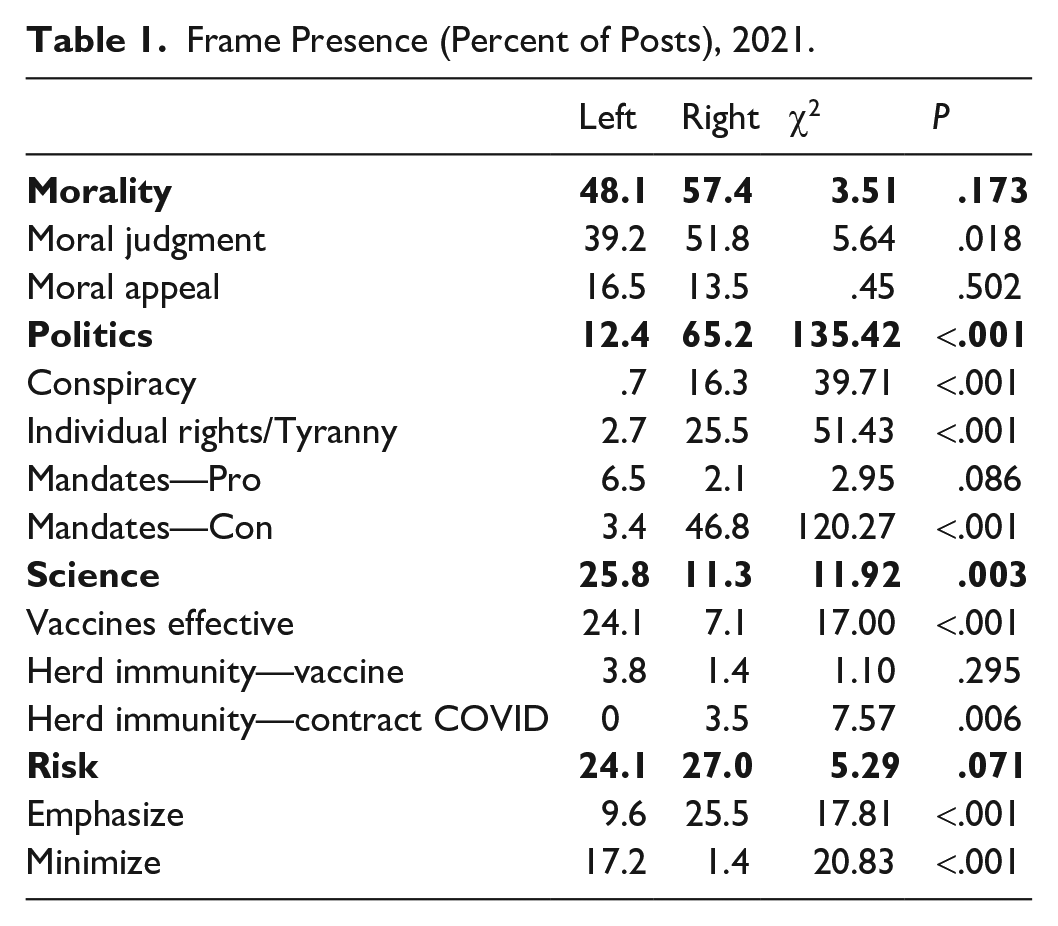
We coded an issue frame as present if it appeared in a post, including the caption, the text of a news article link (usually corresponding to the news article’s headline), text appearing in an embedded photo, or the title of an embedded video. As a check on the validity of our coding, we also coded the longer news articles to which the posts were linked. We found statistically significant but variable correlations between the two, a consistent function of favored news frames on both sides. For example, opposition to mandates was much more highly correlated on the right (.77) than on the left (.47), as were the risks of vaccination (.78 vs. .55). On the left, content correlation for mandate support was .52 as compared to .35 on the right.
We also assessed each post on its overall position on vaccination: pro, neutral (or mixed), or con. Intercoder reliability was determined on double-coding 15% randomly selected posts from the full sample. Krippendorff’s alpha was .82 for overall agreement. 1 Of these frames, the moral pair proved to be more ambiguous than the other categories, a phenomenon noted in other studies (Weber et al., 2018). We also surmise that because journalistic norms discourage the explicit use of moral language, instances of morality news frames are often implicit, making it challenging to achieve high levels of agreement among coders. Given the exploratory nature of our study, we follow guidelines provided by the author of the reliability scale who recommends relaxing the .8 standard to .67 “where tentative conclusions are still acceptable” (Krippendorff, 2004). A detailed coding protocol appears in the Supplemental Appendix.
For our analysis of FB users’ comments on the posts, we examine two components: the presence of language expressing moral outrage and a sense of group identity. For our operational measure of the moral dimension of audience comments, we used the Digital Outrage Classifier (DOC) developed by Brady et al. (2021). The DOC assigns each comment a probability—ranging from 0 to 1—that it includes an expression of moral outrage, one characterized by anger and blaming in response to a perceived moral violation. Here, we emphasize the negative valence of moral language on the assumption that it played a dominant role in distinguishing in- and out-groups in the hyper-polarized state of U.S. politics during the COVID-19 vaccine controversy. We used the recommendation by Brady et al. of using .7 threshold for determining the presence of moral outrage by the presence of terms that included both qualities. For example, the DOC indicated that the following FB user comment on a Breitbart post expressed moral outrage: “One man should not be able to initiate a tyrannical rule. Senate did the right thing but the incompetent House won’t even let the representatives vote. So Pelosi is simply a second tyrant.”
We selected comments that received at least 5% of the maximum number of likes received by a single comment for each post and calculated a score for each. For example, if the most-liked comment on a post received 1,000 likes, we selected all comments on that post that received at least 50 likes and applied the DOC to that set. We then calculated a score based on the ratio of likes received by those comments containing outrage to those received by all liked comments. For example, if the set of comments for a given post received a total of 5,000 likes, and comments within that set that expressed moral outrage received a total of 2,000 likes, the ratio would be 2,000 / 5,000 = .4.
For our operational measure of group consciousness, we used Linguistic Inquiry and Word Count (LIWC), a software program that uses validated dictionaries to analyze words and phrases to infer a variety of psychological attributes (Pennebaker et al., 2015). For each post, we selected all comments that received at least 5% of the maximum number of likes received by a single comment on that post, combined them in a single document, 2 and applied LIWC to measure group consciousness. Defined as a combined function of high group affiliation and low cognitive processing, high group identification combines with low levels of critical thinking to yield unquestioning commitment to group goals (Ashokkumar & Pennebaker, 2022).
Findings
A preview of findings shows stark partisan differences in overall vaccine framing: a balance among science, politics, and risk on the left; largely political on the right. Analysis of trends reveals increased use of moral frames over time by left and right sources, leading to its dominant presence on both sides of the controversy. With respect to user comments, we see a similar pattern: increased use of moral language and the growth of group consciousness.
Table 1 summarizes the frequency of media frames for the entirety of the coverage. It reveals the prominence of moral frames grounded in divergent principles that led to an incommensurable exchange of opinions, a finding that echoes the long-standing tensions we cite in our introduction. Thus, science plays a role on the left—1 in 4 posts—but falls to 1 in 10 on the right. There, political frames dominate, appearing in two thirds of the posts.
Accordingly, we find predictably high support on the left for the vaccine (92% of posts) but ambivalence on the right: 26% opposed, 41% neutral (balanced in favor and against), and 21% in favor (12% could not be assessed one way or the other). One clue to the politically inflected nature of the ambivalence can be found by analyzing the presence of a scientific frame asserting effectiveness of the vaccines. Here, we found a near-perfect correlation between the presence of a vaccine effectiveness frame and overall support for vaccination, on both sides. The difference is in the frequency of occurrence; on the left, roughly 1 in 4 posts, but less than 1 in 10 on the right.
Although science played a role in the debate, even on the left, it was only one of several players on a stage that depicted what amounts to a morality play. As the EGI model predicts, a dominant frame category among both sets of sources is morality—about half of the posts on the left and nearly 6 in 10 on the right. Morality frames included positive appeals to a moral principle and/or moral judgment for violating one. Figure 2 shows characteristic examples.
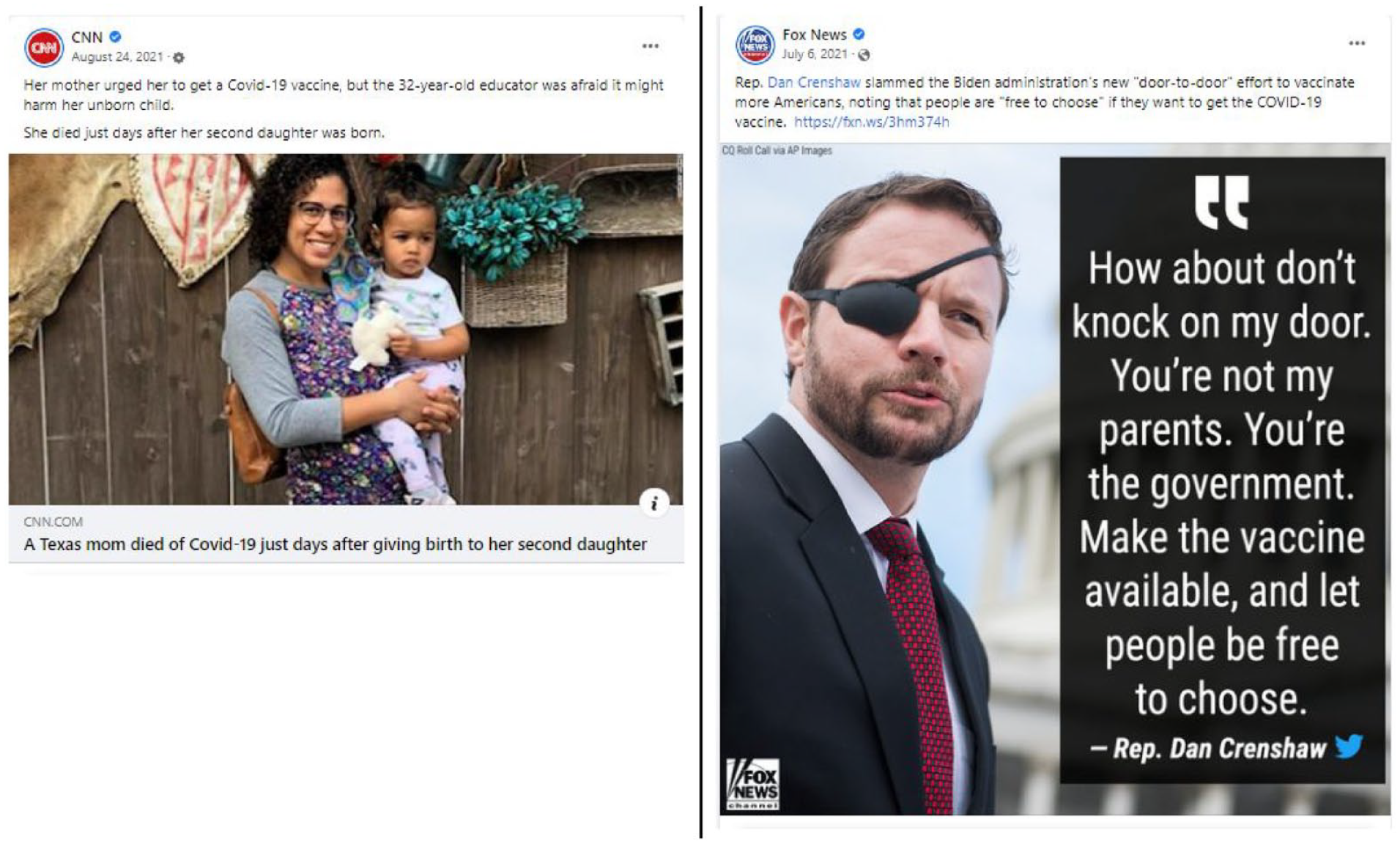
Morality frame examples, co-occurring with science and risk (on the left) and politics (on the right).
Posts on the left had a simple story to tell—the vaccines offered effective protection and posed minimal risk. On the right, manifold resistance—largely political—dominated: opposition to mandates (nearly half of the posts), threats to individual freedom and state tyranny they represented (one in four), and health risks posed by the vaccines themselves (one in four). In addition, one in six posts included conspiratorial frames that included the federal government lying to the public and plots hatched by the Biden administration and the Chinese government to further their respective political goals.
Co-occurrence of Frames
Figure 3 shows a heatmap of co-occurrences of pairs of frames in posts from left- and right-leaning sources. Darker shades indicate more frequent pairing, and the number in each cell is the raw number of posts in which that pair of frames occurred together. The patterns of co-occurrences reveal two familiar stories: one about politics and the health of a nation (i.e., the body politic), the other about science and the health of its citizens (i.e., the physical body). On the left, the most frequently occurring substantive frame was vaccine effectiveness, and its most frequent co-occurring partner, the minimal risk of vaccination. Examples of the latter included regulatory news and announcements from the FDA regarding clinical trials and vaccine approvals, as well as stories that debunked misinformation or allayed fears about anecdotal evidence of vaccine side effects. On the right, frames opposing mandates as well as those invoking individual rights and the tyranny of state institutions appeared most frequently. The heatmap in Figure 3 reveals the pattern: robust resistance to vaccination policy reinforced by moral judgment. This manifests in the tripartite links between frames of resistance and vaccine mandates, state tyranny, and moral condemnation on the one hand, and the pairing of frames of the risks of vaccination with moral judgment on the other. By contrast, moral judgment plays a diffuse role in the discourse on the left, mainly but weakly associated with vaccine effectiveness and risk.

Frame co-occurrences by source, 2021.
To summarize, both sets of sources addressed each other’s position, but the right expressed greater moral commitment to its objection to mandates than the left to its support of vaccination. The partisan asymmetry we observe here echoes research on the structural advantage of tighter network interconnection and message discipline enjoyed by the right (Benkler et al., 2018; Brady et al., 2019; Entman & Usher, 2018). Our findings also align with research on differences between liberals and conservatives on their attitudes toward the vaccines, (dis)trust of medical professionals and medical science, and discussion of conspiracy theories (Jiang et al., 2021).
With respect to vaccine effectiveness, we noted the sparse appearance of that frame among right-leaning sources. Nevertheless, tabulating these with support for vaccination once again reveals the tension between science and politics that initially thrusts the right into a dilemma. Although right-leaning sources adhered to a partisan frame, they needed to maintain a semblance of journalistic objectivity by avoiding an untenable wholesale denial of medical science and of the Trump administration’s success. After all, three of the available vaccines had been developed by U.S. pharmaceutical companies during President Trump’s term in office. The dilemma temporarily ceded the advantage to the left, which benefited by using the prestige of scientific evidence to its political advantage.
The dilemma for the right would be resolved by a shift in emphasis to the more politically potent frame of mandates. When we tabulate the stance on vaccination by the presence of a frame opposing mandates, ambivalence drops substantially: The percentage opposing vaccination rises from 0 to 24 and neutral from 10 to 62. As the mandate issue shifted from scientific to political grounds, it reconfigured the debate to one with incommensurable standards of success, each reinforced with increased moral conviction.
The patterns we observe also help explain the stark asymmetry in issue attention between left and right media sources. On the left, coverage was about evenly distributed between the first and second halves of the year (57% and 43%). By contrast, it was markedly skewed on the right (23% and 76%).
Increasing Moral Judgment on the Left and Right
With President Biden’s stated goal of “100 million vaccinations in 100 days” (announced on 8 December 2020), news frames on the left highlighted appeals to get vaccinated and to protect oneself, family, and neighbors, coupled with moral judgment of those who resisted. On the right, the issue did not emerge as morally inflected until mandates became an issue in late summer (71% of morality frames occurred between August and November). Then reports appeared of vaccine requirements for federal workers, employer mandates, and vaccine passport programs in cities such as New York City. We thus find a lag between the moral fever pitch of left news sources, which peaked in July as deaths rose among the unvaccinated with the emergence of the Delta variant, and the countervailing moral judgment of right media sources, which peaked in November, targeted on resistance to mandates and claims of government overreach (Figure 4). 3 On the left, we find two peaks, the early one associated with the rollout of the vaccine, and the second with mandates.

Moral framing by source, 2021.
Executive orders and legal action at the state level that challenged federal rules regarding employer mandates accompanied highly shared news stories from right sources and shifted attention from scientific discussion of the health risks/benefits associated with vaccine hesitancy on moral grounds. In both cases, the frequency of moral frames increased over time, lending support for our first hypothesis.
Framing and Sharing
Left sources dominated shared posts from January to August, while right sources dominated from September to December, mirroring the shift to mandate frames in the latter half of 2021 (Figure 5).

Shares by source, 2021.
We formulated the second hypothesis on our model’s prediction that moral judgment frames would account for the most shared news stories. Our analysis turned up some unexpected results. Using a linear regression model that included news frames and FB emotion reactions, 4 we found that stories with moral judgment frames had a small but significant negative impact on sharing on the left and none on the right. For the left, “wow” (an expression of shock) as well as “love” were the best predictors (R2 = .16). This was also the case on the right, but with anger added as the third best predictor. The major difference between the two was the strength of share predictors on the right (R2 = .65) compared to the left.
Although we could not find a direct link between sharing and explicit moral judgment frames, the wow reaction attached to stories on both sides highlighted violations of normative behavior. On the left, these included health care worker negligence, people declining vaccination, attempted theft of vaccine doses, as well as vaccine risks. On the right, stories focused on the unfairness of mandates and the turmoil they created, as well as the risks posed by an unproven medical technology. A correlational analysis of post shares and wow reactions echoes findings depicted in Figures 3 and 4: more frequent sharing of left content in the first half of the year, with robust correlations with wow reactions (February: r = .4; April: .67; May: .63), followed by a shift to the right after the rise of the mandate controversy in the latter half (August: r = .4; September: .45; November: .62).
Because moralizing frames did not play a direct role in predicting shared content, we consider potential mediating factors. Sharing by itself is a low-effort activity that relies on a single click. More effortful and arguably a more accurate reflector of engagement is a willingness to type a comment that registers a measure of public moral commitment. A multiple regression on predictors of comments reveals a pattern that clarifies the role of moral positioning. Here, we find that “haha” and anger were leading emotional predictors for the left (R2 = .54) as well as the right (R2 = .46). A close read of the posts on both sides shows that derisive reactions respond to stories that mocked opponents of favored vaccine policy. 5 As in the case of a “wow” reaction, we regard these as indexing moral judgment because insofar as mockery treats its targets with contempt, it denies their moral worth (Mason, 2003). The patterns here thus offer partial support for our second hypothesis.
Moral Outrage and Group Solidarity
Our third and fourth hypotheses predicted an increase in moral outrage and group consciousness and solidarity over time. Here, our analysis yielded mixed results. Figure 6 shows moral outrage scores of comments for both sides. Although there are dips, the overall trends show increases. A Mann-Kendall test of significance on the outrage of comments on the left shows an upward trend (p < .05) but not so on the right, likely due to the paucity of coverage during the first half of the year that makes the first five observations unreliable. Beginning with the June data, the upward trend achieves statistical significance (p = .003). The data thus provide partial support for our third hypothesis.

Moral outrage in user comments, 2021.
On the issue of group consciousness, however, Figure 7 shows no support for a linear trend line of a steady increase. We find instead two different patterns.

Group consciousness by source, 2021.
Group consciousness on the left begins at its high point in January, then falls until June when, coinciding with the onset of the mandate issue, it rises again. We find a similar but much more pronounced pattern on the right: a spike in February—likely in response to the entering Biden administration’s challenge—followed by a steep drop until late spring, when group affiliation rose sharply in harmony with the onset of the mandate issue. In summary, the curves show the greater sensitivity of conservatives to solidarity-building political frames—those that threaten individual freedom—than liberals to the dispassionate appeals of scientific authority. With respect to the growth of group consciousness, our findings show that it depends on the sustained presence of a common issue frame.
Risk
With respect to our research question, Figure 8 shows that the risk of taking a new vaccine was a recurring feature of news coverage, although it was nearly three times more frequent on the right than on the left. While news frames emphasized the risks of contracting the virus, those on the right counterbalanced with the risks of injecting a new vaccine.

Risk emphasis frames by source, 2021.
Our finding supports research that noted an anomalous absence of concern among conservatives of the threat posed by the virus (Calvillo et al., 2020). Conservatism was associated with decreased perceptions of vulnerability to the virus and its severity, as well as endorsement of beliefs that the media had exaggerated the virus’s impact and that its spread was a conspiratorial plot. Our results provide robust empirical support for the authors’ speculation that the relationship between political ideology and threat perception depended on issue framing by political leadership and media, bolstered by the growth of group identity that came in the case of audiences on the right at the cost of their lives.
Conclusion
The COVID-19 pandemic provided a test to the state of U.S. public health policy, as well as the health of the body politic. The individual, voluntary nature of the former combined with the ailing state of the latter led to the preventable deaths of tens of thousands of Americans. Their identification with like-minded others contributed to an unwarranted confidence in their decisions to forego protection against a potentially lethal illness. The goal of our research was to test a model that helps explain how the distribution of news frames through social networks may have contributed to partisan vaccine resistance. Our empirical focus on FB permitted attention to expressive group identity in the EGI model given the platform’s popularity among U.S. news audiences and the role of impression management in health information sharing (e.g., Hodson et al., 2022). In line with the predictions of the model, we found an increased presence of morally-inflected news frames over time, correlated with increases in expressions of moral outrage and the growth of group identity in audience response. Within the FB media environment, such reactions mirrored the polarization and intergroup animosity that undermined efforts to foster the solidarity required to respond effectively to a public health crisis.
The EGI model also posited a recursive increase in news media issue frames in response to perceived audience demand. The nature of our data—posts most shared—made it impossible to test this component of the model directly because any such test would, by definition, reveal a close correspondence between issue frames and audience shares. We nevertheless argue that such correspondence provides prima facie evidence for this component of the model on the argument that audience response to news content that varied systematically between the two categories of sources defined conflicting partisan-based positions. This was evident in the summary of frame distributions and the co-occurrences of news frames. The patterns we found in our analysis provide clues for explaining the partisan differences in U.S. COVID-19 mortality statistics mentioned in the introduction of our article.
Our findings foreground how the most shared news frames substituted emotional commitment to social bonds and moral conviction for rationally based self-protection (and protection of others). The surface irony is that this impulse originated in an ideological commitment to autonomy and individual rights. The deeper origins of the paradox derive from the tensions between political values that animate liberal democracy and the advances of science that support expert authority. Colgrove (2005) captures the essence of this conflict in the example of an emotionally driven debate on childhood vaccination that arose in the 1920s: Elite knowledge formed the basis on which experts could claim to be better qualified than parents to judge the well-being of children, and it was the medical control of children that fueled the most heated reactions from antivaccinationists. . . . To proponents of such programs, state medicine was a rational and economically efficient way of dealing with the vagaries of illness in society; to opponents, it represented an insidious attempt to transform the country into a socialistic state. Legally mandated vaccination, provided at public expense by city-employed doctors, was a paradigmatic example of the evils of state medicine. (pp. 172, 173)
Elected using populist appeals, the Trump administration navigated a narrow political channel: championing the development of a life-saving vaccine while downplaying the necessity of accepting its use. The contradiction enabled the development of the dynamic captured by our model: the empowerment of an opinion whose confidence grew with reinforcing issue frames and a growing sense of group identity and moral certitude.
One indication of the growing hostility was that the presence of frames friendly to the opposition—individual rights/tyranny, opposition to mandates in left media content, support for mandates, vaccine effectiveness in right—elicited mockery in user comments. An example of rhetorical bear-baiting, the presence of oppositional frames summoned contempt for partisan rivals. The pattern supports research that shows engagement in social media is driven in part by out-group animosity (Rathje et al., 2021) and that sharing COVID-19–related content increases partisan homophily (Kristensen et al., 2023). Significantly, the evident familiarity of both sides in the controversy with each other’s perspective reinforces findings that selective partisan exposure may not be a significant contributor to polarization (Nelson & Webster, 2017; Shin, 2020). Our results point to the opposite conclusion that familiarity is an essential component of partisan contempt.
Taken together, our results underline the strengths and risks of cultural and political values that have historically underpinned vaccine compliance in the United States and the role social media can play in amplifying these elements. Against a backdrop of political polarization and low trust in government, public health campaigns face significant challenges as uncertainty, political ideology, and morality are readily yoked and amplified in an environment where everyone has—and can share—their personal experience with disease, vaccines, and death. It follows that the variety of local approaches would be affected by the multiple forces present during the COVID-19 pandemic: the growth and influence of anecdotal evidence engendered by social media, a polarized information ecosystem, and a political culture that reveres autonomy over the collective good. The latter would champion individual rights in defiance of the mortal risks posed by a novel disease.
Limitations and Future Directions
We point to several study limitations as opportunities for further research to test the EGI model. First, as our study is based on a frame analysis of news content and user comments, we cannot draw causal conclusions regarding individual or public attitudes toward vaccination or behavior. Future experimental studies could explore this question explicitly. Second, as these results reflect analysis of a limited sample of news articles and comments centered on one social media platform (e.g., FB) and the U.S. context, the EGI model would benefit from additional empirical tests of the hypothesized increase in moral outrage in citizen reactions and concomitant increase in the salience of group identity and solidarity. Future studies should test the model on other social media platforms and in other national contexts from a comparative perspective to strengthen generalizability, considering other advanced democracies with degrees of political polarization and resurgent populism. Furthermore, we note that regime type and demographic factors may also matter; for example, the study by Seckin et al. (2024) of the Turkish Twittersphere did not find partisanship in COVID-19 vaccine stances despite high levels of polarization in that country. Finally, we acknowledge that some of the distortions that we observe and analyze in our study may be partly a function of the isolation experienced by citizens that likely exacerbated existing political divisions.
Supplemental Material
sj-docx-1-sms-10.1177_20563051241277293 – Supplemental material for Live Free and Die: How Social Media Amplify Populist Vaccine Resistance
Supplemental material, sj-docx-1-sms-10.1177_20563051241277293 for Live Free and Die: How Social Media Amplify Populist Vaccine Resistance by Andrew Rojecki, Viki Askounis Conner and Peter Royal in Social Media + Society
Footnotes
Declaration of Conflicting Interests
The author(s) declared no potential conflicts of interest with respect to the research, authorship, and/or publication of this article.
Funding
The author(s) disclosed receipt of the following financial support for the research, authorship, and/or publication of this article: This project was funded in part by the Defense Advanced Research Projects Agency (DARPA) under contract HR001121C0168.

Supplemental Material
Supplemental material for this article is available online.
Notes
Author Biographies
References
Supplementary Material
Please find the following supplemental material available below.
For Open Access articles published under a Creative Commons License, all supplemental material carries the same license as the article it is associated with.
For non-Open Access articles published, all supplemental material carries a non-exclusive license, and permission requests for re-use of supplemental material or any part of supplemental material shall be sent directly to the copyright owner as specified in the copyright notice associated with the article.
