




Abstract
Research on political partisans suggests that social media offer ideal playing fields for the group game of politics. This study considers how political and social identities interact to influence political communication on social media. Using an original two-wave survey of Americans fielded during the 2020 election period, we analyzed how social media users’ levels of social sorting—the alignment between racial, religious, ideological, and political identities—related to perceptions of and engagement in politics on social media. Results suggest that those with higher (vs. lower) levels of social sorting were more likely to perceive their social media environments as dominated by political content and conflict, and populated with politically interested and like-minded people. Auto-regressive panel models suggested that social sorting and political use of social media may be reciprocally related. Findings indicate social sorting may be a key concept for unearthing the group roots of politics on social media.
Politics is a group sport. This ancient reality has gained new recognition as political conflict increasingly unfolds along the fault lines of identity (Achen & Bartels, 2017). Social media have played a central role in this modern story, both as contexts where political identity-conflict is highly visible and as technologies that can fuel group-based political communication. Research finds that psychological attachment to political groups can shape news consumption, political expression, misinformation sharing, and polarization on social media (Bail et al., 2018; Hasell & Weeks, 2016; Pereira et al., 2023). In other words, social media offer ideal playing fields for the group game of politics (Carr, 2017; Kreiss et al., 2020).
Yet, research in the United States context has largely focused on how social media interact with partisan identity—allegiance to the “blue” or “red” team (e.g., Brady & Van Bavel, 2021; Pereira et al., 2023; Shin & Thorson, 2017). Some scholars have argued that this focus may miss the significant and mutually reinforcing influences of other social identities such as race, religion, or class in American politics (Kreiss et al., 2020). Indeed, there is compelling evidence that political communication on social media should be shaped by both the political and social identities people hold. Mason (2018) advanced the concept of social sorting to capture the alignment between social and political identities in the United States. As Americans come to identify with social groups that are objectively aligned with their partisan identity (e.g., strongly identifying as white, Christian, and Republican), they start to behave like super fans for their political team. Those who are highly socially sorted display more ingroup attachment and outgroup prejudice, and are further driven to engage in politics (Harteveld, 2021; Mason, 2016, 2018).
In this paper, we argue that social sorting offers a useful theoretical lens for studying social media as arenas for group politics in the United States. Using an original two-wave survey of American adults fielded during the 2020 election period, we analyzed how social media users’ levels of social sorting relate to their perceptions of and engagement in politics on social media. We found that highly socially sorted users exist in distinct political environments and that social sorting and political use of social media are related over time and may reciprocally influence each other. Our findings indicate that social sorting may be a crucial concept for understanding how social media function as environments for group-based politics.
Social Media as a Group Sport
Existing scholarship has often focused on how individual characteristics, such as political sophistication and ideological preference influence normatively important phenomena including misinformation consumption, ideological polarization, and echo-chambers (e.g., Fletcher et al., 2021; J. K. Lee et al., 2014). Yet, people’s experiences of social media are also filled with cues to group identity and seemingly endless intergroup conflict (Carr, 2017; Duggan & Smith, 2016). This suggests that social media can also be conceptualized as spaces for “group politics,” in which political attitudes and behaviors are primarily shaped by how individuals affiliate themselves with interest and social groups (Achen & Bartels, 2017). Research from this perspective takes some of the same normative fears (e.g., misinformation and polarization) and considers whether social identities and group dynamics are driving forces (Bor & Petersen, 2021; Shin & Thorson, 2017; Yarchi et al., 2021). For example, instead of viewing political expression on social media as motivated merely by interest in politics, a group politics approach emphasizes how such expression might stem from a desire to see one’s group achieve greater respect or influence (Lane et al., 2021).
Much of the research on group-based social media politics has relied on Social Identity Theory (SIT), which offers a comprehensive theoretical framework for understanding how people think and behave as group members. Fundamentally, SIT argues that when people feel deeply attached to their group they are motivated to think in “us versus them” terms and behave in ways that make their group appear positively distinct from other groups (Hornsey, 2008). In contexts where groups are in a zero-sum contest for status and resources, as is often the case in politics, highly identifying group members are likely to (a) demonstrate prejudice against outgroups, (b) feel strong emotions when they encounter threats to their group, and (c) take action to counter such threats (Mackie et al., 2000; Mason, 2018).
Drawing on these basic principles of SIT, research in the American context has largely focused on how partisan identity (i.e., identifying as a Democrat or Republican) shapes political use of social media platforms. Evidence suggests that social media help individuals form ties with people who share their partisan identity, thereby fostering stronger ingroup networks (Mosleh et al., 2021). Further, users with strong partisan identities evaluate and share information, and express themselves in ways that bolster their ingroup (Bor & Petersen, 2021; Brady & Van Bavel, 2021; Hasell & Weeks, 2016; Pereira et al., 2023). Other research suggests that social media drive affective polarization, or positive feelings toward political ingroups and negative feelings toward political outgroups (Kubin & von Sikorski, 2021; Suhay et al., 2018; Yarchi et al., 2021), thereby further exacerbating social cleavages between parties.
While such research clearly illustrates the utility of SIT for studying social media politics, it does not address the multiple politically consequential identities that are present on such platforms. As Carr (2017) pointed out, one of the things that make social media such rich contexts for intergroup communication is that multiple and nested groups can be present in the same communicative contexts. For a highly identifying Democrat who is also Hispanic, and an atheist, each of these identities is likely to be salient on social media. Our central argument in this paper is that what makes social media unique contexts for group politics is their ability to make multiple forms of identity salient, visible, and politically consequential. Understanding how political use of social media is shaped by group identity requires theorizing interactions between political and social identities. Accordingly, we use the concept of social sorting as a means of more clearly theorizing the group roots of political social media use.
Social Sorting
Like many nations, America has a political system foundationally shaped by the interaction between different social groups (Achen & Bartels, 2017). Mason (2018) argued that since the 1960s the American electorate has been undergoing a process of sorting, resulting in two political parties that are increasingly homogenous in terms of race, religion, geography, and class. Democrats are the political team for liberals, Black and Hispanic people, atheists, and those living in urban areas, while Republicans are the team for conservatives, white people, Christians, and those living in rural areas (Mason, 2018). This shift toward more socially homogenous parties has been accompanied by an increase in psychological attachment to Democrat or Republican “mega-identities” (i.e., an increase in social sorting). 1
Building on Social Identity Theory, Mason (2018) argued that the process of social sorting amplifies group-based tendencies beyond the influence of partisan identity (i.e., being a Democrat or Republican) alone. Identification with multiple identities that are all objectively part of the same political group raises the stakes for individuals because it attaches their positive self-concept to a single mega-identity. At the same time, people who are socially sorted lack cross-cutting (unaligned) identities that can calm their group impulses (Mason, 2016). For example, within the United States, a Black liberal Democrat is motivated to behave like a super fan for the Democratic party because most others from their racial and ideological groups are part of the larger Democratic coalition. A white conservative Democrat might behave in less extreme group-consistent ways because they hold racial and ideological identities that are in alignment with the other party (i.e., cross-cutting). This type of “cross-pressure” is theorized to inhibit the group-impulses of individuals in politics (Mason, 2018). Research has found that people who are highly sorted express more group-based emotions (particularly anger and animosity toward outgroups) and that these emotions fuel political activism (Harteveld, 2021; Mason, 2016, 2018).
Mason (2018) outlined a range of historical and sociological forces that contribute to increased levels of social sorting in America, including the post-civil rights era racial realignment of the parties, loosening of traditional social bonds, and increased influence of political elites who actively harness group identities for political power. Mason also briefly noted the role of media in offering Americans ready-made sources for identity-aligned information. Yet, little work to date has examined the relationship between media use and social sorting on either the macro or individual level. As we will argue, there is good reason to suspect that social media play a unique role in this broader story of social sorting and that, in turn, social sorting offers an ideal concept for understanding contemporary political communication on social media. While social sorting was developed in the specific context of the U.S., our theorizing is relevant to any political system where political parties must compete for the support of social groups.
The Present Study
This study uses the concept of social sorting and basic principles of Social Identity Theory (SIT), to outline a framework for studying group-based politics on social media. Our framework assumes that people engage in politics on social media as group members, per SIT. However, we argue that it is not only partisan identity driving political experiences on social media, but a wider array of psychologically connected social identities. Our framework first recognizes the unique characteristics and affordances of social media that make them particularly responsive to social sorting. Next, we argue that this responsiveness leads those with higher levels of social sorting to develop distinct, ingroup-dominated political social media environments. Within such environments, political behavior and social sorting are mutually reinforcing; highly sorted users engage in more political behavior and, in turn, greater political use of social media leads to further social sorting.
Empirically, our goal is to establish basic evidence for each of the components of this framework. This is a necessary step toward building more sophisticated causal accounts of how social media and group identities influence each other. 2 Our hypotheses examine relationships across social media in general and on Facebook in particular. We focus on Facebook because it plays an outsized role in American politics (Bakshy et al., 2015) and is the most commonly used platform in the dataset we examine.
Social Sorting and the Political Social Media Environment
The first assumption of our framework is that levels of social sorting are related to the social media environments in which users encounter politics. Research on prominent phenomenon such as “echo-chambers” and “filter-bubbles” assumes that some people exist in specific types of insular and contentious social media environments, that can have negative consequences for democratic politics (e.g., Fletcher et al., 2021). While evidence for wide-spread partisan echo-chambers is mixed (Terren & Borge-Bravo, 2021), we argue social sorting might offer a more precise means of identifying users who inhabit such environments. This is an important goal, because these insular social media environments may facilitate problematic forms of political engagement (e.g., misinformation sharing, outgroup hostility; Bor & Petersen, 2021; Mason, 2018).
On a basic theoretical level, SIT suggests that strongly identifying group members are both attentive to identity cues in their environment and motivated to build networks of similarly dedicated ingroup members (Brewer, 1999). Research on partisan social media use often demonstrates this social bias toward ingroup members. For example, Mosleh et al. (2021) found causal evidence that people are more likely to follow users on Twitter when they share a partisan identity. As we have argued, social sorting should magnify such effects by turning some users into “super-fans” of their political team. Because the highly sorted are more cognitively and emotionally engaged in politics (Mason, 2018), they may be likely to seek out such experiences online. Further, social media environments should be particularly responsive to socially sorted identities in several key respects.
First, social media afford multiple means of producing and consuming group identity cues, both in terms of more stable user profiles and dynamic communication (e.g., comments and multimedia content; Carr, 2017; Papacharissi, 2010). Depending on the affordances provided by different platforms, identity cue can be either explicit (e.g., “I’m a proud conservative!”) or implicit (e.g., profile picture of an American flag). Because socially sorted users have multiple social identities that are psychologically linked to their political identity, the sheer number of such cues that are relevant to them on social media should be greater. In addition, social media algorithms may interpret socially-sorted users as highly interested and invested group members and, in turn, expose them to higher levels of political content (Thorson et al., 2019). The highly socially sorted should be particularly attentive to group cues in this content and likely to use them to form impressions of others (Hornsey, 2008; Spears & Postmes, 2015). Accordingly, sorted users should have a much stronger sense of the identities people in their networks hold and a higher sensitivity to identity threats and intergroup conflict (Hornsey, 2008; Mason, 2018).
Second, because social media help sorted users effectively recognize each other’s multiple identities, they can build networks of people who share those identities (i.e., religious, racial, political; Di Tommaso et al., 2020). Accordingly, social media are likely to provide socially sorted individuals with networks that are similar to them across multiple politically-aligned identities, further homogenizing their political experiences and reducing opportunities for cross-cutting influences (Heatherly et al., 2017; Mason, 2016; Mosleh et al., 2021). At the same time, recent evidence suggests that few people exist in completely homogenous political social media environments (i.e., “echo chambers” Fletcher et al., 2021). Therefore, socially sorted individuals are likely to be primarily surrounded by their political teammates on social media, while still having ample opportunity to come into contact (or conflict) with the other team (Bor & Petersen, 2021; Brady et al., 2017).
Putting these arguments together, we predict that as users’ levels of social sorting increase, they are more likely to find themselves in social media environments filled with politically engaged users and content. These environments should contain a higher proportion of fellow ingroup members. At the same time, socially sorted users should be more sensitive to identity threats and intergroup dynamics in political interactions (Hornsey, 2008). They therefore may perceive the contact they do have with political outgroup members on social media as containing higher levels of conflict. Crucially, in making these predictions, we argue that social sorting offers more theoretical utility in explaining how social media respond to group identities than partisan identity alone. We hypothesize:
From Social Sorting to Social Media Political Behavior
Next, our framework predicts that the social media environments that socially sorted users inhabit should offer them particularly rich contexts for political engagement. This should result in higher levels of political behavior among those who are more socially sorted. SIT suggests that highly identifying group members are more attentive to group-related cues in their environment and more likely to take action in ways that bolster their group’s positive distinctiveness (Hornsey, 2008). This should particularly be the case in the U.S., because (a) socially sorted individuals are uniquely primed to take action to help their groups, and (b) social media offer abundant opportunities for identity-defensive action (Carr, 2017; Velasquez & Montgomery, 2020).
Because social sorting “super-charges” people’s political identities, it creates greater opportunities for identity threats and enhances the impact of those threats when they occur (Mason, 2018). Mason (2016) found that Americans who are highly socially sorted are more emotionally reactive in ways that drive political engagement (anger in particular; Mackie et al., 2000; Valentino et al., 2011). Crucially, this relationship seems to be driven by what highly socially sorted individuals lack: the calming influence of cross-cutting identities (Mason, 2016). On social media, socially sorted users who exist in politics-heavy, homogeneous networks have fewer checks on their emotions and little incentive to refrain from posting an angry comment or forwarding a negative news article about a rival group.
Indeed, social media make it exceedingly easy for socially sorted individuals to both monitor for identity threats and to express group-based emotions through action (Bor & Petersen, 2021; Carr, 2017). Research finds that social media are extremely efficient at amplifying emotion and moral outrage (Brady et al., 2017; Crockett, 2017). In turn, several studies confirm that political behavior on social media is driven by the strong negative emotions that socially sorted individuals are likely to possess (Brady et al., 2017; Hasell & Weeks, 2016; Heiss, 2021). Accordingly, we predict that increased levels of social sorting will be associated with aggregate-level increases in political behavior on social media. We examine this possibility both for information reception (i.e., monitoring of identity threats) and for more active social media behaviors such as political expression and engagement (i.e., potentially identity-protective action). We offer hypotheses related to two types of variables in our data set: (a) political use of social media generally, and (b) political use of Facebook, the most used-platform in our sample.
From Social Media Political Behavior to Social Sorting
Finally, our framework suggests that engagement in politics on social media can lead to increased social sorting. While identification with social and political groups is typically quite stable (Huddy, 2001), there is evidence that attachment to social groups can shift to align with political identities (Egan, 2020) and that big political events such as elections can serve to activate and strengthen existing collections of identities (Singh & Thornton, 2019). Given the added salience of social identities during election periods, the opportunity for changes in social sorting are theoretically even greater (Mason, 2018). Although Mason (2018) suggested that media likely play a role in the ongoing process of social sorting, there is little direct empirical evidence concerning this possibility. In general, mass media are significant forces for political identity development and reinforcement (Lau et al., 2017). Social media, in particular, have been theorized to reinforce existing political self-concepts and identities (Lane et al., 2019). Consistent with a reinforcing spirals approach to media selection and effects, individuals who use social media to communicate their political identities may find those identities reinforced (Moeller et al., 2018; Slater, 2015; see Beam et al., 2018 for contrary evidence). This may be particularly likely for highly social sorted users because of: (a) the prevalence of identity-challenging information on social media, and (b) opportunities for identity reinforcing feedback.
First, although we predict highly socially sorted users will exist in primarily homogenous social media spaces, evidence suggests that they are still likely to encounter identity-challenging content (Bakshy et al., 2015; Beam et al., 2018). In particular, during election periods, social media is likely to be filled with political communication (Jungherr, 2016), which can contain identity threats to which highly identifying group members are sensitive. Affective polarization research has often used similar theoretical reasoning to explain how social media use can lead to polarized political identities (Kubin & von Sikorski, 2021; Suhay et al., 2018; Yarchi et al., 2021). Suhay et al. (2018) argued that people can encounter criticisms of their political group online and that such identity threats can drive them closer to their ingroup and further away from their outgroup. Socially sorted users should not only be monitoring for such threats, but should respond by moving closer to their group psychologically (Hornsey, 2008).
Second, because social media networks are primarily populated by political ingroup members (Bakshy et al., 2015), they provide prime environments for responding to and coping with identity threats. If someone insults your political team on social media, you can seek out fellow political group members for identity-reinforcing feedback (Knobloch-Westerwick & Meng, 2011), or you can engage in expression that reinforces your existing identities (Cho et al., 2016; Lane et al., 2019; Velasquez & Montgomery, 2020).
With the solidarity of ingroup networks, social media provide an outlet for navigating outgroup threats with minimal effort (e.g., posting, tweeting, sharing), which should facilitate identity reinforcement. We argue that these conditions are particularly ripe for changes in social sorting because the strengthening of any single aligned social identity contributes to the strength of a political mega-identity (Mason, 2018). We hypothesize the following:
Method
Data and Sample
To examine the relationship between social sorting and political use of social media, we fielded a two-wave national survey during the 2020 U.S. general election period. Participant recruitment and data collection were conducted by YouGov, a research firm that maintains an online panel of approximately 1.2 million active U.S. respondents. YouGov uses a matching methodology to recruit and produce representative population samples. The sampling frame used for matching was constructed by stratified sampling across gender, age, race, and education characteristics from the full 2017 American Community Survey (ACS). 3 Between September 9th and 14th, YouGov sent invitations to participate to 3,293 individuals in their pool, 1,574 of whom responded to the invitation (cooperation rate = 47.79%). These responses were then matched down to the contracted sample of 1,350 to produce the final Wave 1 (W1) dataset. In Wave 2 (W2), participants from W1 were re-contacted from October 27th to November 3rd and 1,112 provided valid W2 responses (retention rate = 82.37%). Given the focus of this study, we selected respondents who identified as a Democrat or Republican and had valid social sorting scores in Wave 1 (n = 857). The sample was further limited to those who used social media (W1 N = 754; W2 N = 613). This final sample has a W1 mean age of 50.9 years, median education of “some college,” and a median income of $30,000 - $69,999. The gender composition of the sample was 59.4% female, 40.2% male, and 0.4% another gender category. The racial/ethnic composition was 74.4% white, 9.6% Black/African American, 8.6% Hispanic, 2.6% Asian/Pacific Islander, and 4.8% other racial/ethnic groups. 40.5% identified as Republicans and 59.6% identified as Democrats (see Table A1 in Supplemental Appendix). Data and analysis code for this study can be accessed at: https://osf.io/6fzre/?view_only=a58538d3ff92416582ef142f352bdbe1
Measures
Descriptive statistics for all variables reported in Table A2 in Supplemental Appendix.
Social Sorting
Our measure of social sorting was adapted from Mason and Wronski (2018) and assessed the degree to which respondents identify with (i.e., feel close to) political and social groups based on each group’s objective alignment with the respondent’s partisan group. Mason and Wronski consider groups to be objectively aligned with a party when they make up a comparatively larger share of the people who identify with that party in American National Election Study data. For example, in 2016, a greater proportion of Democrats (vs. Republicans) identified as Black, and therefore Black identity was considered objectively aligned with Democrats. Following Mason and Wronski, this study considered Black, Hispanic, Atheist, and Liberal identities as aligned with Democrats, while white, Christian, and Conservative identities aligned with Republicans (see Mason & Wronski, 2018 for more detail).
To construct our social sorting measure, in both waves we asked respondents, “how close do you feel to” the groups noted above on a scale ranging from 1 (not very close) to 5 (extremely close). See Tables A3 and A11 in the Supplemental Appendix for descriptive statistics and bi-variate correlations. For Democrat respondents, we averaged reported closeness to objectively aligned identities (Democrat, Black, Hispanic, Atheist, and Liberal) and reported distance from unaligned identities (Republican, white, Christian, and Conservative; i.e., closeness measures were reverse-coded). For Republican respondents, we averaged reported closeness to objectively aligned identities (Republican, white, Christian, and Conservative) and reported distance from unaligned identities (Democrat, Black, Hispanic, Atheist, and Liberal; reverse-coded). These averaged responses assessed social sorting in W1 (M = 0.52, SD = 18) and W2 (M = 0.54, SD = 18). We used this established measure because ours is one of the first studies to examine the relationship between social sorting and media use (see discussion section for further reflection).
Perceptions of Political Social Media Environments
In W1, respondents selected a social media platform they used the most. Response options included: Facebook, Twitter, Instagram, YouTube, Snapchat, WhatsApp, TikTok, or “another platform (please describe).” Then, they reported their perceptions of their most-used platform. First, they were asked, “On average, how interested in politics are the people you come into contact with on [most used platform]?” 4 Responses were measured on a scale from “Not at all” to “Extremely” with an option for I’m not sure and coded into SM Network Politically Interested (W1). Next, they were asked, “How many of the people you come into contact with on [most used platform] share your political views?” Responses were measured on the same scale as the previous item; SM Network Politically Similar (W1). Next, respondents were asked, “How much of the content that you’ve seen on [most used platform] has been related to politics in the past 30 days?” Responses were measured on a scale from “Almost none” to “Almost all”: SM Proportion Content Political (W1). Finally, respondents were asked, “On social media how much conflict do you see between people with different political views?” Responses were measured from “No conflict at all” to “An extreme amount”: SM Political Conflict (W1; see Table A2 in the Supplemental Appendix for full descriptives).
Political Social Media Use
For each social media platform they used, respondents were asked in both waves how often they received political information on that platform in the last 30 days. Responses were measured on a scale from 1 (never) to 7 (multiple times a day). Because scale points 3 (once per week) and 4 (1–2 days per week) had inadvertently overlapping labels, we combined these values resulting in a 6-point scale. We then averaged across values for all platforms used by each participant to create an index of SM Political Information Reception (W1: M = 3.91; SD = 1.51; α = .85; W2: M = 4.08; SD = 1.46; α = .84 5 ). We also asked respondents how frequently they expressed their “views about politics on ANY social media site in the past 30 days?” We further clarified that this includes “things like writing posts, posting photos/videos, or responding to other users’ political content.” Responses were measured on the same 6-point frequency scale as the previous measure and labeled SM Political Expression (W1: M = 2.96; SD = 1.81; W2: M = 2.92; SD = 1.81).
Political Facebook Use
For Facebook users, we took the Facebook-specific political information reception item described above and labeled it FB Political Information Reception (W1: M = 4.51; SD = 1.73; W2: M = 4.69; SD = 1.46). We also asked about how frequently respondents engaged in 10 behaviors on Facebook in both waves using the same 6-point scale; (1) clicked a link to read a political article, (2) clicked “like” on political content, (3) shared political content, (4) commented on a political post, (5) written their own political post, (6) posted a news/political article, (7) posted a political photo or meme they created, (8) participated in a political Facebook group, (9) got information about a protest, and (10) changed their Facebook profile picture in response to a social or political event. Items were averaged; Facebook Political Engagement (W1: M = 2.27; SD = 1.16; α = .92; W2: M = 2.26; SD = 1.15; α = .91).
Political News Use
To contextualize associations between social sorting and social media use, we asked how many days in the past week respondents used the following sources to receive news about politics or elections in W1; (1) television, cable, or video streaming services (M = 5.51; SD = 2.80), (2) printed newspapers or magazines (M = 2.31; SD = 2.25), (3) radio or podcasts (M = 3.12; SD = 2.52), and (4) online news websites (M = 5.35; SD = 2.81).
General Social Media Use
In some analyses, we controlled for overall social media use. For each social media platform that respondents reported using, we asked how frequently they used a given platform for any purpose during W1. Responses were measured on the same 6-point frequency scale and averaged to create an index of general social media use (W1; M = 4.80; SD = 1.07, α = .76). General Facebook use (W1) was also used as a control (W1; M = 5.13; SD = 1.25)
Analysis Plan
Our analysis proceeded in three stages. First, we conducted a brief exploratory analysis of the relationship between objective social sorting and various types of media use at W1. Second, we analyzed cross-sectional relationships between levels of social sorting and participants’ perceptions of their political social media environments at W1. We used multinomial logistic regression models 6 to plot the probability of respondents selecting various response options across levels of social sorting, while controlling for demographic and identity variables. Third, we examined relationships between social sorting and political behavior on social media. Using the R package Lavaan (Oberski, 2014), we conducted a set of autoregressive models (i.e., cross-lagged panel models), which predicted W2 levels of these focal variables, while controlling for the corresponding W1 level of each predictor. This technique allowed us to examine how variables predicted aggerate-level change in other variables between waves (S. Lee et al., 2021). Demographics used in previous analyses were included as exogenous control variables. Non-social media forms of media use were also controlled for when predicting social sorting to isolate the variance explained by political social media use. Models were conducted separately for aggregate political social media use and for Facebook-specific measures. While autoregressive models have significant limitations—and cannot be interpreted in strict causal terms—they offer one means of assessing possible reciprocal influence using our data (S. Lee et al., 2021). 7
Results
Describing Social Sorting
First, we noted substantial variance in levels of social sorting (range: 0–1) among our sample of partisan social media users (M = 0.52, −2SD = 0.17, +2SD = 0.87). Referring to our full sample of partisan respondents (n = 857), we found no significant difference in levels of social sorting (W1) between partisans who used social media and those who did not (t(127.5) = 1.32, p = .19). Supplemental Table A4 reports zero-order correlations between variables used in our analyses (see Supplemental Appendix). Among social media users, social sorting (W1) was positively correlated with all online and social media use variables at W1 (rs = .08 to .13, ps < .05). In contrast, correlations between social sorting (W1) and TV, audio, and print news use (W1) were non-significant (p > .5). These cross-sectional findings suggest that social sorting is uniquely, yet modestly related to digital media use, particularly social media use (see Supplemental Table A4).
Social Sorting & Political Social Media Environment
Tables 1 to 4 report multinomial logistic regressions predicting the relationship between social sorting and respondents’ perceptions of their most used social media environment as (a) politically interested, (b) politically similar, (c) containing a high proportion of political content, and (d) containing high levels of political conflict (H1 and H2). Across these models, levels of social sorting consistently and significantly predicted changes in the log-odds of being in different response categories (at ps < .05). To make these results more easily interpretable, we used social sorting coefficients from each model (second row in Tables 1–4) to generate predicted probabilities of respondents selecting various response options across levels of social sorting. Figure 1 plots these probabilities, collapsing across categories that exhibited similar patterns (for ease of interpretation). Looking at the purple “dash-dot” line in each panel of the figure, we observed that as levels of social sorting increase, so does the probability that respondents perceive their most used social media network as (a) “very” to “extremely” politically interested, (b) that “three quarters” to “all” share their political views, and (c) that “three quarters” to “all” of the content on that site is political. 8 Notably, the probability of being “not sure” about the political views of one’s social networks decreased as respondents became more socially sorted (pink “long-dash” line in Figure 1; Panel 2). As levels of social sorting increased, respondents had a higher probability of perceiving “a great deal” to an “extreme amount” of conflict on social media. Collectively, these findings indicate that users high (vs. low) in social sorting exist in distinct social media environments, more likely to be populated by more politically interested and likeminded contacts and higher levels of political content and conflict (H1 and H2 supported).
Multinomial Logistic Regression Predicting SM Network Politically Interested.
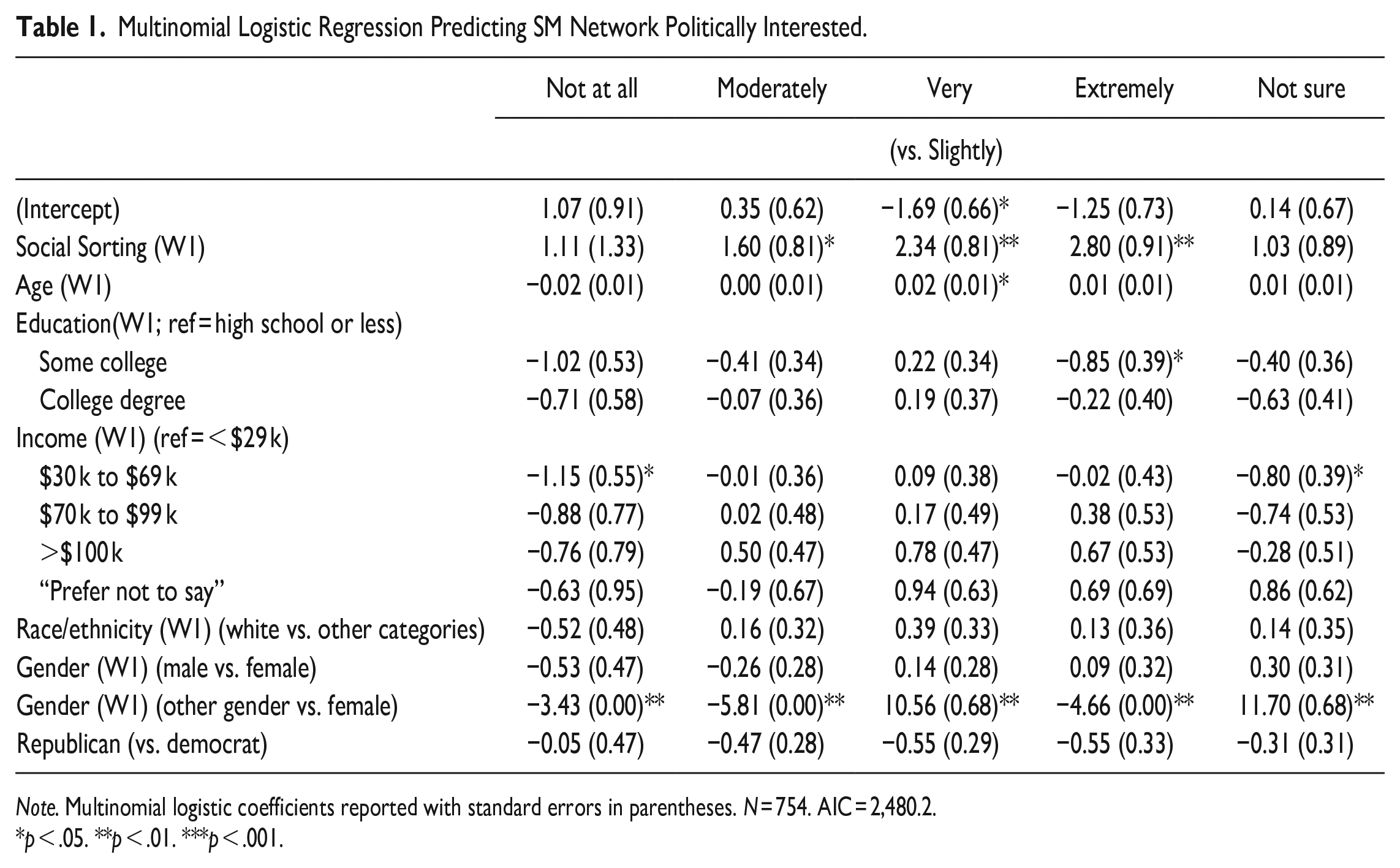
Note. Multinomial logistic coefficients reported with standard errors in parentheses. N = 754. AIC = 2,480.2.
p < .05. **p < .01. ***p < .001.
Multinomial Logistic Regression Predicting SM Network Politically Similar.
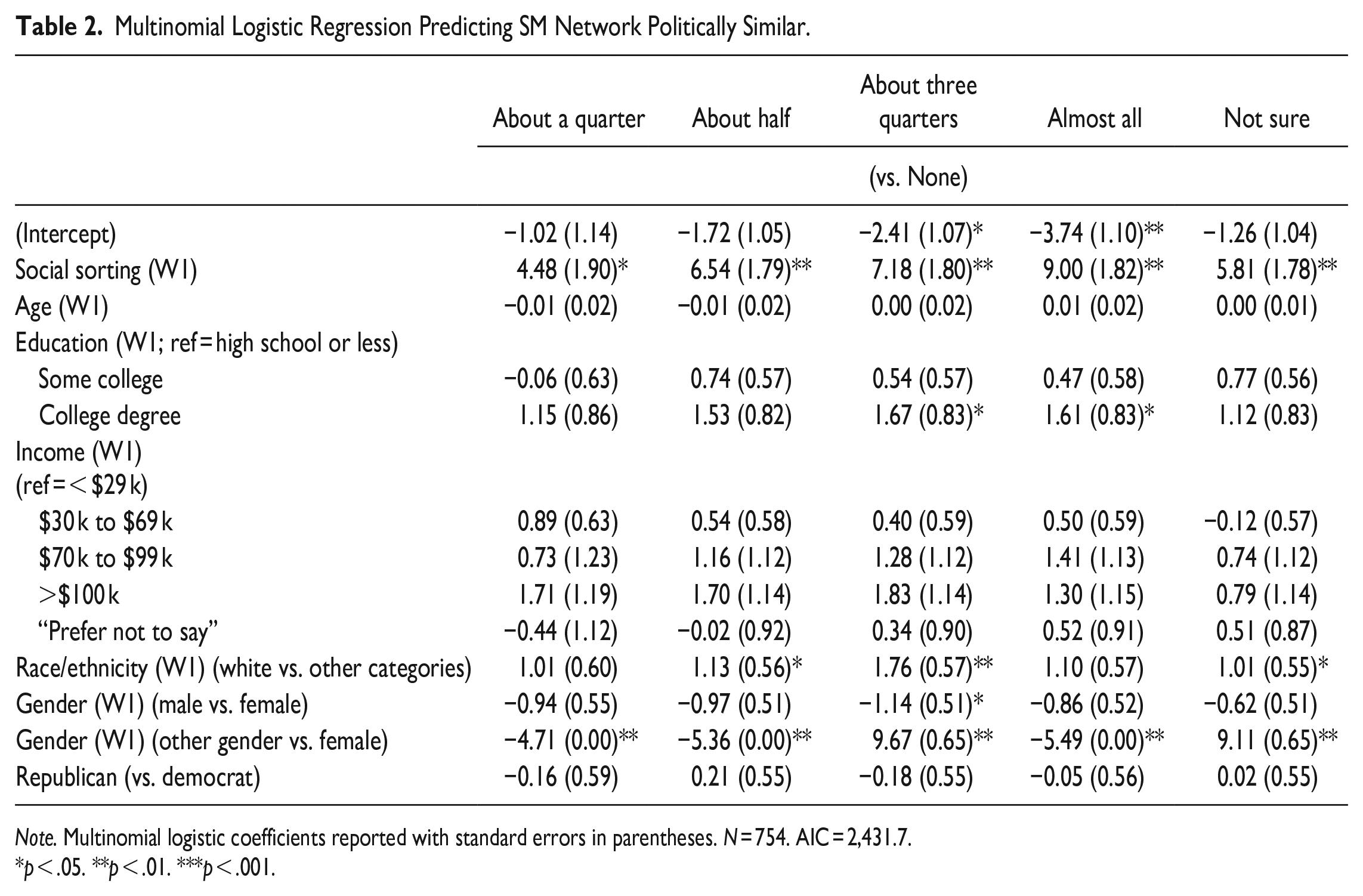
Note. Multinomial logistic coefficients reported with standard errors in parentheses. N = 754. AIC = 2,431.7.
p < .05. **p < .01. ***p < .001.
Multinomial Logistic Regression Predicting SM Proportion Content Political.
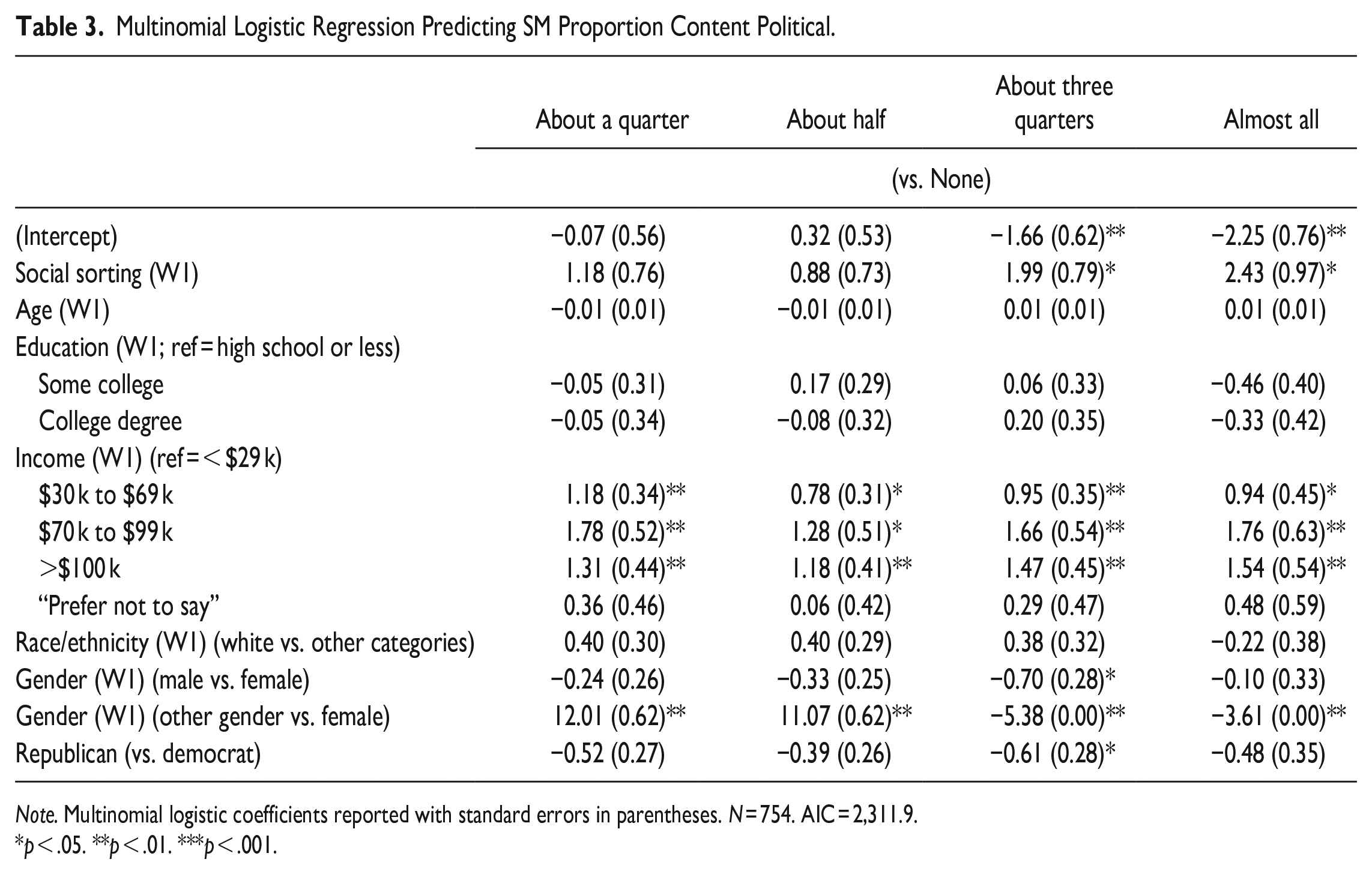
Note. Multinomial logistic coefficients reported with standard errors in parentheses. N = 754. AIC = 2,311.9.
p < .05. **p < .01. ***p < .001.
Multinomial Logistic Regression Predicting SM Political Conflict.
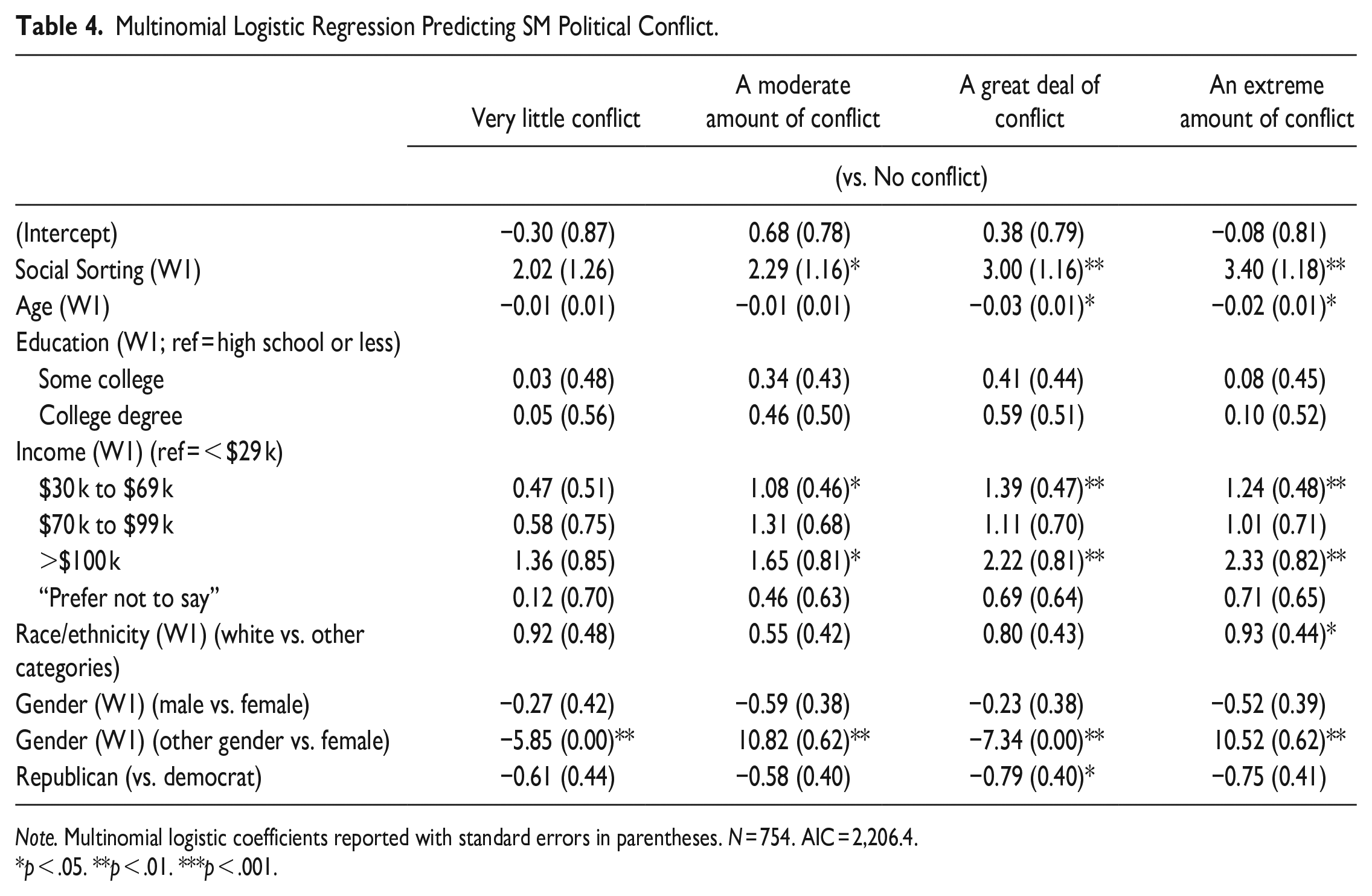
Note. Multinomial logistic coefficients reported with standard errors in parentheses. N = 754. AIC = 2,206.4.
p < .05. **p < .01. ***p < .001.
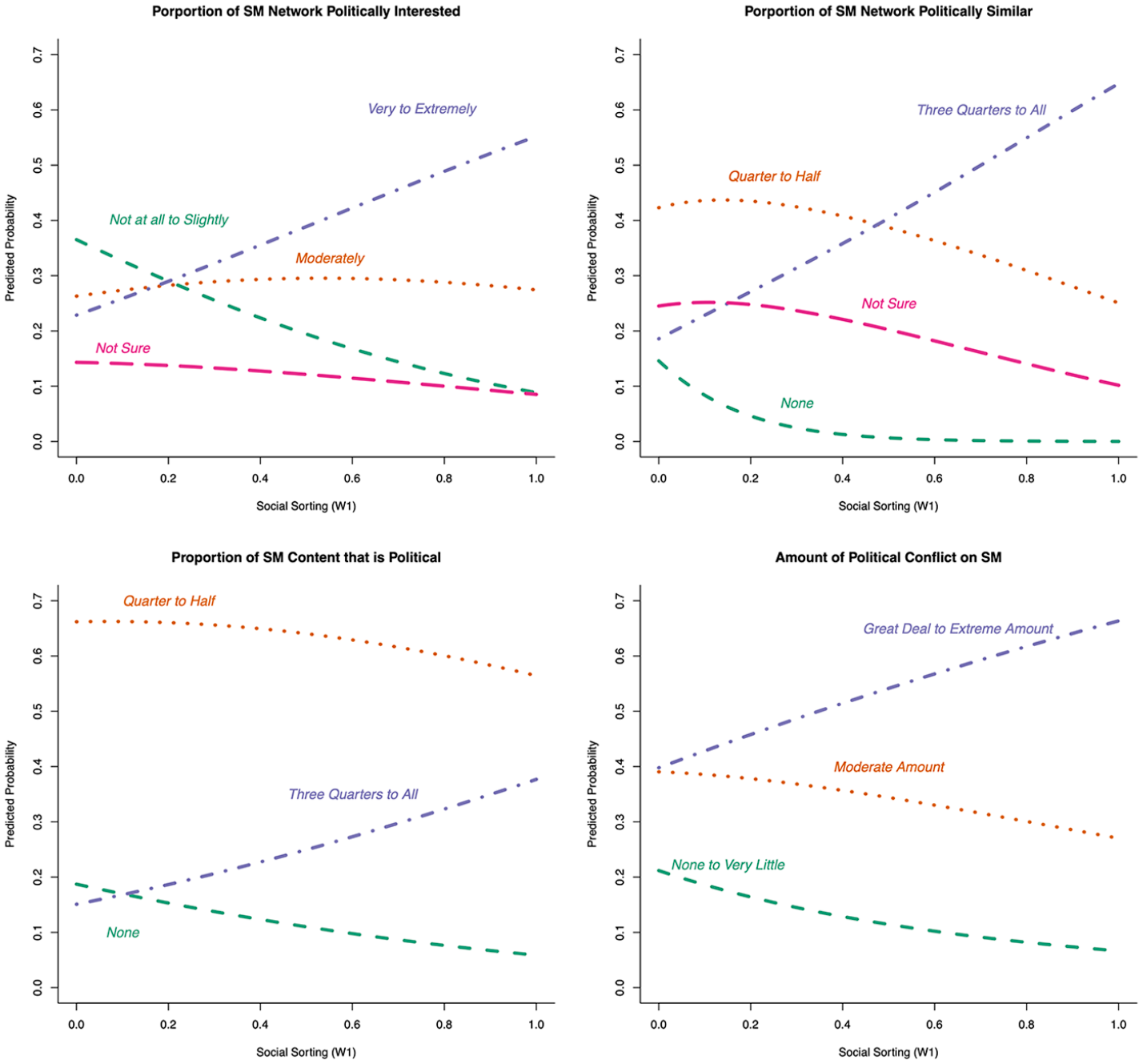
Predicted probabilities for perceptions of political social media environment across levels of social sorting.
Social Sorting and Political Social Media Use
Auto-regressive analyses examining relationships between social sorting and political social media use across waves (H3–H6) are reported in Tables 5 and 6. Path diagrams with standardized estimates from these models are displayed in Figures 2 and 3. In the first auto-regressive model (Table 5), social sorting (W1), SM political information reception (W2), and SM political expression (W2) were specified as outcome variables. Fit statistics indicated that the model satisfactorily fit the data (Comparative Fit Index (CFI) = 0.98, Tucker-Lewis Index (TLI) = 0.88, Root Mean Squared Error (RMSE) = 0.07, Scaled χ2 (10, n = 565) = 40.53, p < .001).
Auto-regressive Models for All Social Media.
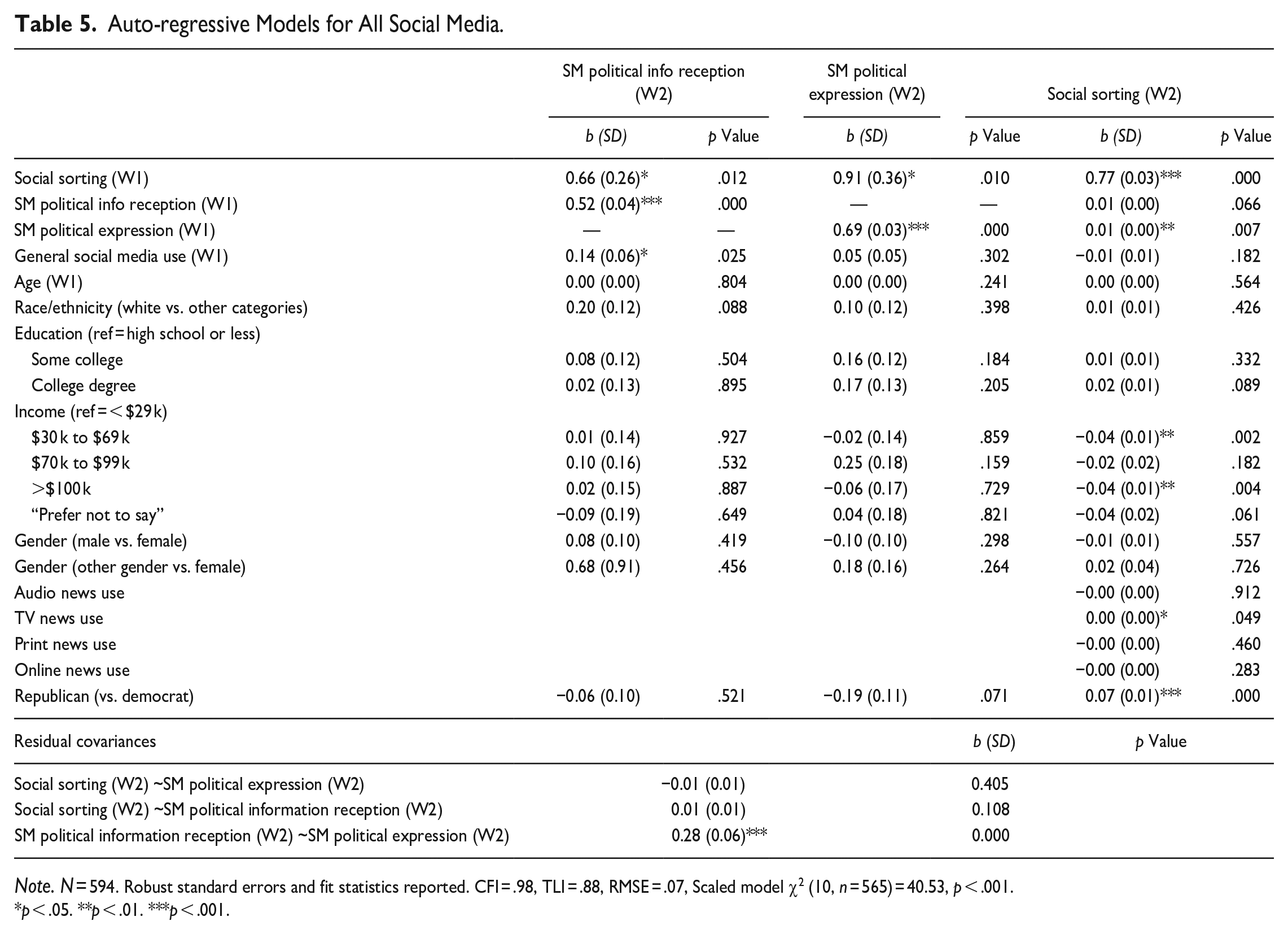
Note. N = 594. Robust standard errors and fit statistics reported. CFI = .98, TLI = .88, RMSE = .07, Scaled model χ2 (10, n = 565) = 40.53, p < .001.
p < .05. **p < .01. ***p < .001.
Auto-regressive Models for Facebook.
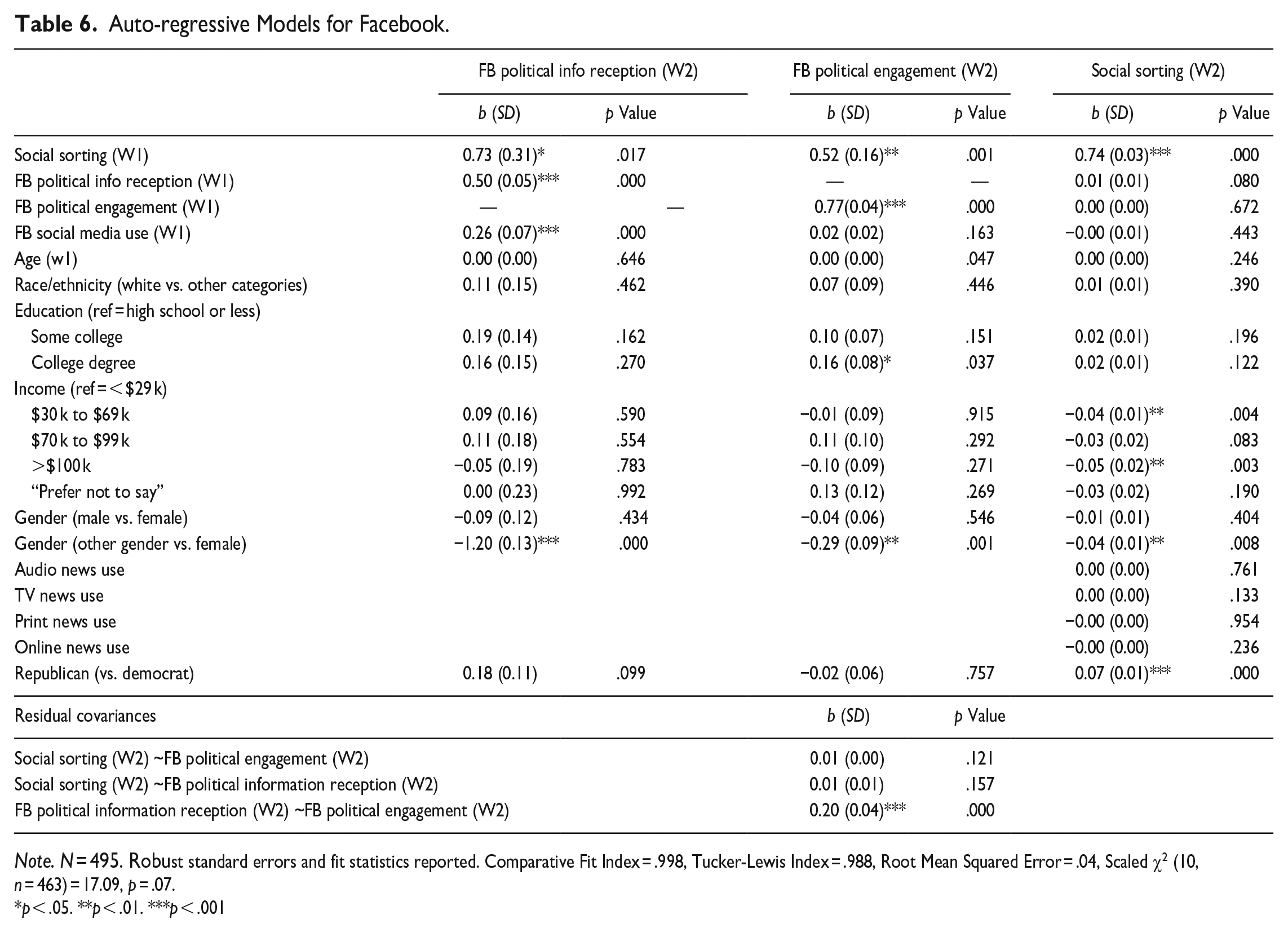
Note. N = 495. Robust standard errors and fit statistics reported. Comparative Fit Index = .998, Tucker-Lewis Index = .988, Root Mean Squared Error = .04, Scaled χ2 (10, n = 463) = 17.09, p = .07.
p < .05. **p < .01. ***p < .001
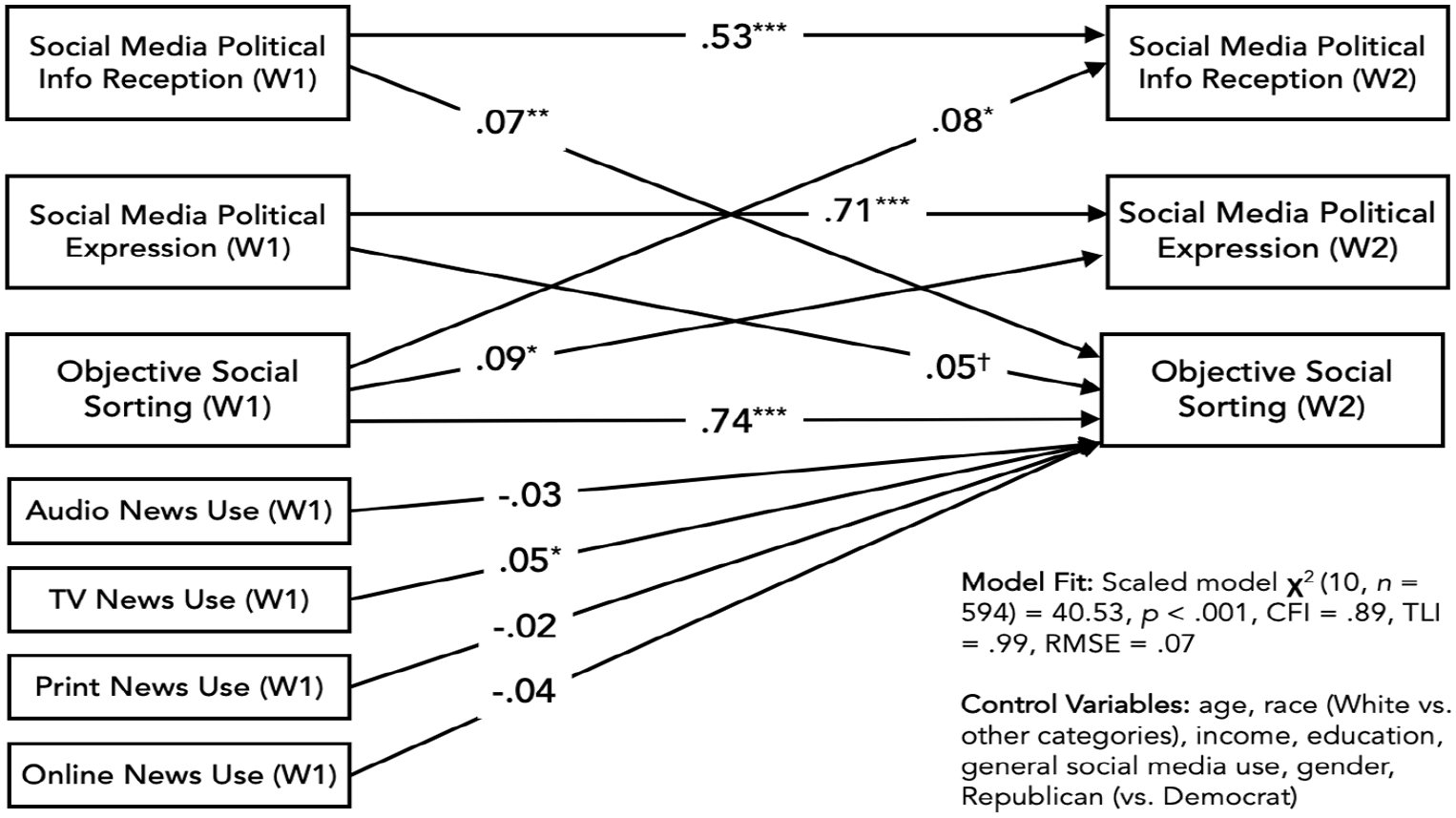
Path diagram for all social media auto-regressive model.
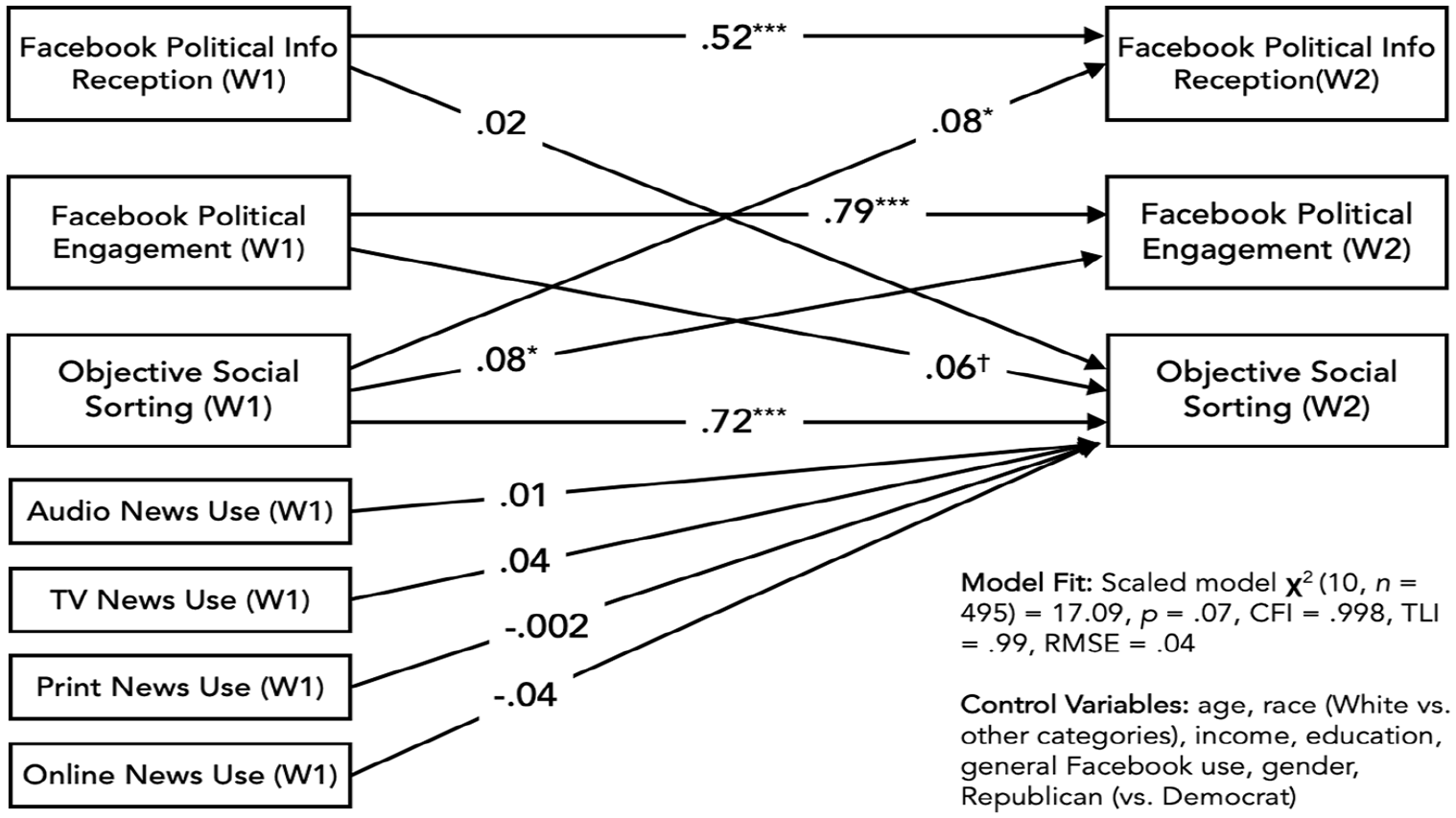
Path diagram for facebook auto-regressive model.
Social sorting (W1) was positively associated with aggregate-level increases in both SM political information reception (W2; b = 0.66, SE = 0.26, β = .08, p = .01) and SM political expression (b = 0.91, SE = 0.36, β = .09, p = .01) between waves (H3 supported). In turn, aggregate-level increases in social sorting between waves were positively associated with SM political information reception (W1; b = 0.01, SE = 0.003, β = .07, p = .007) and SM political expression (W1), although this second relationship did not reach the level of statistical significance (b = 0.005, SE = 0.003, β = .05, p = .07; H5 partially supported). Television news use was also a significant predictor of social sorting (W2; b = 0.003, SE = 0.002, β = .05, p = .049), however neither general social media use nor other forms of W1 news reception (print, audio, and online) were significant predictors (ps > .1).
The second auto-regressive model looked specifically at political engagement on Facebook among Facebook users and specified social sorting (W1), Facebook political information reception (W2), and Facebook political engagement (W2) as outcome variables (Table 6). Fit statistics indicated that the model satisfactorily fit the data (CFI = 0.998, TLI = 0.988, RMSE = 0.04, Scaled χ2 (10, n = 564) = 17.09, p = .07). Social sorting (W1) was positively associated with aggregate-level increases in both Facebook political information reception (b = 0.74, SE = 0.31, β = .08, p = .02) and Facebook political engagement (b = 0.52, SE = 0.16, β = .08, p = .001) between waves (H4 supported). Aggregate-level increases in social sorting between waves was positively associated with Facebook political engagement (W1), but not at a level that reached statistical significance (b = 0.009, SE = 0.005, β = .06, p = .08). Facebook political information reception (W1; b = 0.002, SE = 0.004, β = .01, p = .672) was not a significant predictor of social sorting (W2; H6 not supported). Overall, these auto-regressive models offered evidence that social sorting and political social media use predicted each other across waves, although the effects were relatively small.
Robustness Analyses
A key assumption underlying the predictions tested above is that social sorting can explain variance in social media-related variables above and beyond that explained by strength of partisan identity alone. To examine this, we re-conducted all analyses with alternative model specifications. Strength of partisan identity was excluded from the social sorting index and instead entered as its own term in each model. We then re-examined relationships between strength of partisan identity and outcomes of interest, with the revised social sorting index as a control. Results reported in Supplemental Tables A5 to A9 and Supplemental Figure A1 largely confirm that strength of partisan identity alone does not exhibit the same relationships with social media-related variables as those observed with social sorting in the main analyses. Most coefficients for strength of partisan identity in social media environment models (H1 and H2) were non-significant (ps > .05). Supplemental Figure A1 demonstrates far more muted differences in political social media environments across levels of strength of partisan identity (compared to Figure 1). There were no significant relationships between strength of partisan identity and political social media use in the alternative specifications of auto-regressive models (ps > .05; H3–H6). This suggests that the original measure of social sorting offers greater predictive power than strength of partisan identity alone.
Discussion
This study examined social media as contexts for the group game of politics through the theoretical lens of social sorting. In discussing our findings, we highlight how the relationship between social sorting and political social media use generates a host of new theoretical questions and challenges. Consistent with prior research, respondents who came to social media with strong attachments to their political and social groups (i.e., the socially sorted) were likely to be embedded in networks of highly politically interested ingroup members (Bakshy et al., 2015). These users were also more likely to be exposed to large amounts of political content and conflict. Crucially, partisan identification alone did not predict such differences in political experiences on social media. This suggests that social sorting may have unique utility in explaining how group membership shapes political social media environments.
Highly socially sorted respondents existed in social media spaces that are likely to encourage them to behave like “super fans” for their political team, trying to “beat the other team” rather than participate more civic-mindedly (Mason, 2018). As scholars diagnose and study problems of normative concern (e.g., misinformation, affective polarization, and online hostility), social sorting offers a more precise means of identifying users whose social media environments may facilitate anti-normative behavior (e.g., hostility; Bor & Petersen, 2021) than partisan identity alone.
Relatedly, we found that social sorting consistently predicted the frequency at which people received political information and engaged in politics on social media (and on Facebook specifically) over time. The small size of these relationships serves as a reminder that group identity is likely one of the many factors driving political engagement on social media. Yet, our analysis does identify the utility of social sorting for examining group dynamics within social media. Mason (2018) suggested that higher engagement among the social sorted may occur because they exhibit higher levels of affective polarization and political interest. As we have argued, the socially sorted may also have been sensitive to identity threats in their social media environments and more likely to use the affordances of these platforms to respond in group-protective ways. While we can only speculate about the mechanisms underlying these relationships, our findings highlight that the group-based factors motivating political use of social media may go undetected if partisan identity alone is considered.
Finally, we found some evidence that social media might serve to further drive the process of social sorting. These relationships were small and only significant in some models. This reflects the fact that other macro-level forces are likely to shape our attachments to identity groups during election periods (Mason, 2018). This point is reinforced by our finding that users and non-users of social media have comparable levels of social sorting. Yet, in our analysis, certain forms of political social media use stood out as significant predictors of aggregate-level increases in social sorting. With the exception of television in one of our models, no other form of news media use was predictive of increased sorting, nor was general use of social media. Our results suggest that political social media use may play a substantive role in the story of increased social sorting in America, without, by any means, being a primary driver. Analyses did indicate that any effects are likely to depend on the context of particular platforms and user groups. For example, in our data, political use of Facebook was not associated with increased social sorting. While Facebook is often considered a site where political identities are reinforced, Beam et al. (2018) found that news use on Facebook was associated with decreases in affective polarization. These nuances indicate the need for future studies examining how the features and affordances of social media contribute to the ongoing process of social sorting.
Overall, our study suggests three broader takeaways. First, the field of political communication needs to more deeply integrate group theories into research on the big problems facing digital politics (Lane et al., 2021). This requires not only considering how individuals interact with technologies based on their own individual political resources, but also how their loyalty to political teams plays a role (Kreiss et al., 2020). The deep literature on partisan identity can serve as a springboard for such studies, but to understand the group roots of prominent social media phenomena it is vital to consider the role of multiple and intersecting identities. For example, a social sorting perspective on “echo-chambers” (high levels of political homophily on social media) might retheorize homophily as occurring across partisan and aligned social identities. Further, if the small number of users who do exist in echo-chambers are highly socially sorted, this homophily has increased consequences for group-based and anger-driven political behavior on such platforms (Fletcher et al., 2021; Mason, 2018). In this way, our findings demonstrate the promise of social sorting to help us better theorize social media as contexts for group politics, beyond a focus on partisan identity.
Second, our findings suggest the possibility of a reinforcing spiral between social sorting and political social media use. While the relationships we find are small—and inconsistent for pathways predicting social sorting—they do hint that social media could serve as contexts where political media selection and use reciprocally influence each other (Moeller et al., 2018; Slater, 2015). Because the design of our study precludes causal conclusions, further work needs to be done to examine these relationships with more robust methods, over longer time periods, and in different political and national contexts. While Mason (2018) explicitly focuses on the United States, scholars have already begun to apply the underlying theoretical reasoning of social sorting to non-American contexts (Harteveld, 2021). Similarly, applying social sorting to global political communication could prove fruitful in developing a more generalized theory of how identity alignment is related to political media use. Our study offers a starting point for further empirical study of the potentially reciprocal relationship between social sorting and digital media across national and technological contexts. It also suggests that future research might conceptualize social sorting as a psychological characteristic that moderates various communicative processes of scholarly interest such as selective exposure or online hostility.
Finally, while we interpret our findings as generally supportive of the potential for group theories to help explain political social media use, they also sound a note of caution. Social media have often been implicated as primary drivers of political group polarization. Both the effect sizes we observe and the variance left unexplained in our models suggest that social media are most likely part of a constellation of influences driving Americans closer to their team and further away from the opposition. Similar to a recent study that failed to find a relationship between partisan news exposure and polarization (Wojcieszak et al., 2021), our study suggests that social media may be taking a larger share of the blame for group-based political competition and conflict than is supported by the evidence. Future research needs to further clarify the magnitude of the role played by social media in the process of social sorting, while more frankly acknowledging other factors like racial conflict and illiberal politicians (Mason, 2018).
Limitations and Future Directions
This study has important limitations that suggest key areas for future research. Our findings should be understood in the context of recent concerns about the validity of self-reported political social media use (e.g., Haenschen, 2020). While the goal of our analysis is not to generate estimates of population-level social media behavior, our findings could be greatly strengthened through use of digital trace data. In this respect, we view our findings as initial signals of the role of social sorting, which need further replication and exploration. To remain consistent with foundational studies on social sorting, we used existing measurement strategies, including the list of partisan-aligned racial, religious, and partisan identities used by Mason (2016). However, this measure can undoubtedly be improved by the inclusion of other aligned identities (e.g., geographic identities) and through closer inspection of psychometric properties. Finally, our hypotheses should be examined with methods that afford stronger causal inference. This could include survey data with more waves of data or experimentally manipulating social sorting. Larger sample sizes can also facilitate proper tests of whether these relationships vary across partisan and social groups and are dependent on specific social media affordances. These will be a thorny, but worthwhile methodological challenges.
Conclusion
For better or worse, social media are figural in the story of modern politics. As the group-nature of political life is pushed to the surface by struggles for racial, ethnic, and religious dominance across western Democracies, social media scholars need better ways of theorizing the role played by social identity. As we have demonstrated, social sorting is a promising theoretical framework for this task. Our findings offer caution to those who would blame social media as the primary cause of political identity conflict in America, while identifying more nuanced ways that political social media use and sorted sociopolitical identities might reinforce each other. Ultimately, social sorting can help unearth the group roots of social media politics while at the same time revealing social media as important forces in modern identity politics.
Supplemental Material
sj-docx-1-crx-10.1177_00936502231161400 – Supplemental material for The Group Roots of Social Media Politics: Social Sorting Predicts Perceptions of and Engagement in Politics on Social Media
Supplemental material, sj-docx-1-crx-10.1177_00936502231161400 for The Group Roots of Social Media Politics: Social Sorting Predicts Perceptions of and Engagement in Politics on Social Media by Daniel S. Lane, Cassandra M. Moxley and Cynthia McLeod in Communication Research
Footnotes
Acknowledgements
We would like to express our gratitude to the editor and anonymous reviewers whose feedback greatly shaped this manuscript. We would also like to thank undergraduate research assistant Saj Sudwal for his important contributions to this project.
Declaration of Conflicting Interests
The authors declared no potential conflicts of interest with respect to the research, authorship, and/or publication of this article.
Funding
The authors received no financial support for the research, authorship, and/or publication of this article.

Supplemental Material
Supplemental material for this article is available online.
Notes
Author Biographies
References
Supplementary Material
Please find the following supplemental material available below.
For Open Access articles published under a Creative Commons License, all supplemental material carries the same license as the article it is associated with.
For non-Open Access articles published, all supplemental material carries a non-exclusive license, and permission requests for re-use of supplemental material or any part of supplemental material shall be sent directly to the copyright owner as specified in the copyright notice associated with the article.
