



Abstract
This article challenges prevailing assumptions that fringe social media platforms predominantly serve as unmoderated hate-filled spaces for far-right communication by examining the userbase’s emotional connection to these environments. Focusing on Gab Social, a popular alternative technology website with affordances akin to Twitter, Facebook, and Reddit, and its subgroup, “Introduce Yourself,” the research investigates how participants discuss their attachment and sense of membership within a far-right online community. Employing a constructivist grounded theory approach and a thick data mixed-methods technique encompassing netnography and sentiment analysis, I uncover the complex and impassioned narratives underlying users’ sense of emotional belonging on the platform. The resulting findings demonstrate how counter-mainstream media act as a unifying force by catering to the social needs of participants seeking an in-group of like-minded individuals. Moreover, I argue that fringe social media platforms offer participants far more than mainstream platforms, providing a positive interactive environment and a new virtual home for those feeling rejected and antagonized by other communities, institutions, and organizations, both online and offline. Therefore, the work offers valuable empirical insights into the emotional emphasis participants place on fringe social media and its implications for fostering attachment, community formation, and identity construction within far-right online counterpublics.
The growing worldwide prevalence of the far right is inherently linked to their widespread online presence. Subsequently, as populace demand, appeal, and participation continues to grow for these digital realms, the far right is expanding the scope of its virtual ecosystem (Baele et al., 2023). What is self-defined as alternative technology (Alt-Tech) or “fringe” social media represents a burgeoning succession of communication-based platforms that mimic the design and affordances of mainstream social media websites with little to no moderation policies (Kor-Sins, 2023). In a battle against “Big Tech”—Facebook, YouTube, Instagram, Reddit—prominent far-right figures and financially influential sympathizers foresee the ability to capitalize on growing online animosities (Peucker & Fisher, 2023), promoting the construction of like-minded communities with similar worldviews as a virtual escape from different opinions, ostracization, and rejection (J. Collins, 2024; Jasser et al., 2023). This powerful draw for in-group belonging and escapism means the Alt-Tech movement is not restricted to the fringes of the internet and society. Instead, recent analytics suggest that millions of worldwide users are participating across these far-right mediums—Gab Social, TruthSocial, MeWe, Gettr, and Bitchute—monthly (Similarweb, 2024).
The increased participation within these alternative platforms is generating significant attention from scholars interested in the community’s communication patterns and dynamics. Perhaps unsurprising for a technocultural movement seeking or at least allowing uncensored (hate) speech, a plethora of research highlights the discourse dominating fringe social media discussions (J. Collins, 2023; Eddington, 2018; Jasser et al., 2023; Munn, 2021; Peucker & Fisher, 2023; Zeng & Schäfer, 2021). These studies range from the manipulatory use of mainstream media headlines in cementing far-right conspiracies and ideologies (Peucker & Fisher, 2023) to how toxic communications help formulate a collective identity (J. Collins, 2023), the amplification and proliferation of COVID-19 conspiracy theories (Zeng & Schäfer, 2021), and the offline and online mobilization of participants during the Capitol Hill insurrection (Munn, 2021). However, can we confine and simplify the conceptualization of these spaces as straightforward vessels for spreading outward racism, hate speech, violence, and conspiracies? Or do more nuances exist below the surface-level hatred, captivating the audience and creating an alternative means of community? And if hate speech, conspiracies, and manipulatory toxicity are not the only processes for far-right virtual belonging, then what else is?
While extremist and hate-filled discourse dominates the Alt-Tech research landscape, this article delves deeper into the intricate emotions driving the sustained popularity of these communities. Herein, a more holistic approach is necessary to illustrate the positive communal instruments for the Alt-Tech movement and its participants, extending beyond a simplistic framing of negativity. Building on the latest work in the field (Amarasingam, 2023; J. Collins, 2024; Törnberg & Törnberg, 2024), I highlight the essentiality of sentiments within these spaces. What this establishes is a novel framework for exploring far-right fringe social environments. Within this new paradigm, I examine the platform Gab Social, posing two interconnected questions: (1) How do emotion-based processes of belonging, attraction, and attachment manifest in the far-right online space Gab Social? And (2) how do these processes shape the platform’s user engagement and virtual community dynamics? Consequently, the study aims to showcase the emotion-based community themes within the far-right Alt-Tech space and to unpack the functions of these processes in facilitating and promoting participant engagement and communication dynamics.
I employ a critical grounded theory approach within a mixed-methods framework, integrating netnography and sentiment analysis to formulate the community’s sentiment-based communication structures and processes. Central to this research design is both immersivity and reflexivity (Bryant & Charmaz, 2019; Mattheis, 2023), wherein qualitative and quantitative data collectively contribute to unraveling the narrative of emotion-based belonging, attraction, and attachment within the Gab Social subgroup. The inductive approach unfolds in two stages: (1) in close-reading findings extracted from the netnographic fieldnotes and manually collected data, which were thematically coded and organized, and (2) across a dual-lexical sentiment analysis. These mixed-methods allow for the research question’s empirical mapping, shedding light on the emergence of a new home on Gab, with offline and online rejection and Alt-Tech reattachment serving as its foundational elements. Furthermore, by adopting this thick data procedure, the study delves empirically deeper, outlining six fundamental discursive themes that shape user engagement and the community dynamics within this newfound virtual home. Through these findings, the article brings attention to the positive processes that help underpin the success of the far-right fringe social media movement.
Literature Review
Social movement theory (SMT) and its emphasis on collectives, communities, and group dynamics offer an excellent starting point for examining the importance of positivity on Gab Social. Herein, SMT’s central rationale toward participants’ experiences and motivations for collective identity include the shared systems of meanings (rituals, practices, and cultural artifacts), intragroup and intergroup interactions and dynamics, and emotional investments (Melucci, 1996). Consequently, if emotions play a crucial role in collectivity, it is then logical to ask what types of emotions are present and in what capacity they function. For instance, R. Collins (2001) highlights both the actionable and consequential dimensions of emotions in SMT, ranging from physical manifestations and collective assemblages to feelings of solidarity, groupness, and moral superiority. Micro-level investigations within SMT showcase more specific functions for the individual, like the delineation and connections between self and other or the personal and social (Ahmed, 2004). Others take the argument one step further, framing sentiments at the core of social movements, as they provide the sense of belonging and shared grievances inspiring collective action (Stekelenburg & Klandermans, 2009). Regardless of the specific viewpoint or application, SMT underscores the importance of emotions in constructing communities and driving social movements.
Therefore, the foundation for developing an empirical framework around Gab Social’s far-right community is the intertwined relationship between emotions and belonging. While formulating a consensus definition of belonging continues to be contentious (Chin, 2019), the article utilizes the concept’s focus on the innate human need to establish positive social bonds and interpersonal relations (see Pardede & Kovač, 2023). In this context, belonging becomes a relational and sentimental construction of self and other, reflecting individuals’ “emotional investments and desires for attachment” (Yuval-Davis, 2006). Recognizing that everyone possesses the need and aspiration to belong, and sentiment is a critical driver of belongingness (Leary, 2021), emotion plays a pivotal role in shaping one’s sociality, positionality, and identity. The article intermixes the term emotional belonging (see Yuval-Davis, 2006)—the psychosocial relationship between individual sentiments and the sense of community connection—to encapsulate the affective ties and subjective experiences individuals invest in their social groupings. Operationalizing this concept helps highlight the intricacies of (online or offline) community dynamics as it delves into the emotional attachments that shape the continuous home-like construction of groupness (Antonsich, 2010). By applying these interconnected concepts, we can shed light on the emotional motivations, affiliations, and interpersonal bonds that maintain and promote Alt-Tech social spaces.
The contemporary research intermixing the themes of emotions and belonging in far-right online spaces is limited to a handful of studies (Askanius, 2021; J. Collins, 2023; De Koster & Houtman, 2008; Jasser et al., 2023; Marcks & Pawelz, 2022; Törnberg & Törnberg, 2023, 2024) which predominantly fixate on the hate-filled threats these two devices generate. For instance, J. Collins (2023) documents the purposeful use of societal insecurities in the far right’s mobilization strategy, illustrating a collective anxiety model that continuously fluctuates between anxiety need and creation. Marcks and Pawelz (2022) and Jasser et al. (2023) offer similar (negative) depictions. The former showcases the relationship between the broadcasted hyper-emotional disparagement and the perceived collapse of the Judeo-Christian culture and society. Herein, the German far right utilizes these discourses to formulate a collective self-defense identity and promote extremist violence against labeled perpetrators (Marcks & Pawelz, 2022). The latter details Gab Social’s baseline for techno-social belongingness built off the perceived persecution and subsequent fear of “Big Tech” social media control—mimicking similar “white victimhood” sentiments (Jasser et al., 2023).
When positive emotions are mentioned, they are often referenced in their malicious use in formulating belonging (Åkerlund, 2022; Askanius, 2021; Tuters & Hagen, 2020), dog whistling, and/or cloaking the hate-filled message existing below the surface. These findings are especially prevalent when examining popular far-right virtual communication strategies. For example, the use of ambiguous humor, irony, and dark satire via memetic imagery is a strategy to slowly convert unsuspecting participants on mainstream platforms to the neo-Nazi and Alt-right fringes of the internet while simultaneously normalizing extremist messages within the public sphere (Askanius, 2021). The gradual affinity to far-right–disguised humor and recognition of intended hate-filled messages creates another facet of belonging, one of in-grouping (Greene, 2019). An insider community is established through these discourses, where understanding the often-nefarious intended meaning generates a technocultural superiority and inferiority between those in the know and those not (J. Collins, 2024). Consequently, contemporary research makes clear the ever-presence of hatred—no matter its surface-level presentation—that dominates the far-right online ecosystem.
However, there is a fascinating connection between the study of these hate-filled far-right virtual spaces and how research on emotions and belonging describes the importance of positive social connections. Herein, can the far right’s emotional belonging be solely governed and maintained by negative sentiment? The answer is no. Sociality and affective relations, irrespective to social grouping, also or even mainly rely on positive self-projections and the natural seeking of in-groupness (Pardede & Kovač, 2023; Valcke et al., 2020). These connections have started to emerge within research on the far-right and other extremist online spheres (Amarasingam, 2023; J. Collins, 2024; Törnberg & Törnberg, 2024). For instance, Törnberg and Törnberg (2024) emphasize the significance of reciprocal emotions, wherein community members forge positive collective bonds through the social support and protectiveness offered by Stormfront. Similarly, Amarasingam (2023) discusses the roles of sentiment-based online community bonding revolving around social openness, collective investments in the group, and the relative ease of spiritual and emotional connection-making.
Building on these novel perspectives of far-right virtual community and positivity, the study provides an exciting look at the emotional processes of belonging within Gab Social. Herein, the findings centered around a new home demonstrate the importance of utilizing a different perspective for analyzing the far right’s Alt-Tech ecosystem beyond the well-documented surface-level negativity (J. Collins, 2024). By examining the sense of emotional belonging within Gab’s “Introduce Yourself” community, I highlight the essential processes that create, maintain, and promote these environments of far-right connectivity. The immersive discoveries also emphasize the importance of recognizing the userbase’s individual- and meso-experiences (both online and offline), attributing to this alternative collective and its internal dynamics.
Method
I utilize the constructivist grounded theory (CGT) approach to capture the deeper-seated layers and narrational themes forming the userbase’s sense of emotional belonging to Gab. While maintaining the fundamental elements of any grounded theory technique (Kenny & Fourie, 2015), CGT emphasizes the researcher’s responsibility and role to capture the participant’s experiences and emotional expressions (Bryant & Charmaz, 2019). Herein, the observer plays an active part in the analytical process by intermixing their recorded experiences with the collected data vis-à-vis a journaling process, where the researcher works iteratively with the two-sided data to code and establish the studied phenomenon’s recurring themes. Moreover, this epistemological and interpretive storytelling model, where the investigator’s thoughts and feelings are valuable, pairs well with netnography’s immersive and experiential fieldnotes guiding the thematic findings (Kozinets, 2019). For CGT in general and this study in particular, the narratives can also move beyond the qualitative realm, oftentimes complemented by quantitative depictions highlighting different aspects of the same phenomenon (Bryant & Charmaz, 2019). What is created then is a mix-and-match methodological pairing technique with CGT as the foundational building block, helping connect interpretation with an analytical technique in a coherent story on the Gab community’s multilayered attachment. Where many sole quantitative, qualitative, or even mixed-methods investigations in the field struggle to tell a cohesive narrative, CGT provides a solution to unite or fill in the missing and necessary pieces to complex social phenomena.
Dual lexicon-based sentiment analysis provides the study’s quantitative empirical baseline. A pre-defined word dictionary per the chosen lexis reflects the semantic orientation of the examined words or sentences, computing the collected content’s individual polarity or emotional values (Wijngaards et al., 2019). I employ a two-pronged lexical approach with Sentimentr (Rinker, 2022) and EmoLex (Mohammad & Turney, 2013), which captures both polarity scores and emotional values to encapsulate the sentimental variations perpetuated by Gab’s “Introduce Yourself” (Czarnek & Stillwell, 2022). The former calculates sentence polarity, scoring each word via a 10739-unigram dictionary, with final sentence values falling between −2.0 (negative) and +2.0 (positive). 1 This computer-aided practice allows for the accurate production of visualizable data, closely mimicking human-controlled benchmarks (Wijngaards et al., 2019). EmoLex’s 14182-lexicon associates words with a particular sentiment (negative emotions—disgust, anger, fear, sadness versus positive emotions—surprise, joy, anticipation, trust) adapted from Plutchik’s (1982) seminal eight basic emotions work. The dual-lexical approach is suggested by Czarnek and Stillwell (2022) to highlight not only the negative or positive affiliation with the experienced themes but also the emotional spectrum and complexities within the community’s attachment and attraction. Therefore, employing this cross-technique better captures the differentiated use of the far right’s sentimental values on Gab Social.
The reflexive qualitative technique, netnography, “seeks to understand the cultural experiences that encompass and are reflected within the traces, practices, and systems” of online communication sites (Kozinets, 2019). The method is best recognized as a reconstituted ethnography—using different disciplinary elements from anthropology, computer science, communication, media, and cultural studies—for investigating virtual collectives, connecting the online traces of social interactions to help tell an experiential and immersive story of the observed community. Moreover, netnography’s application in the article centers around its outlined emotional participation strategy with the researcher directly engaging with the “feeling of those whose worlds and words are being investigated” (Kozinets, 2019). The approach is not to empathize or sympathize with far-right participants but to ground the research within the community’s conceptualization of the world, where understanding the nuances of far-right emotions requires an analytical and normative shift to their values, ideas, and ideologies. Using this technique, I showcase the importance of cultural immersion for examining extremist communities and the qualitative variations these findings bring. Therefore, the method—portraying the overarching technoculture of the examined (sub)community—can help transcend the surface-level depictions in contemporary research of far-right online content. Finally, the cumulative results center around a thick data approach (Davis et al., 2019), with netnography and sentiment analysis helping to form the overarching narrative and empirical depth to far-right platform attachment.
Case Selection, Data Collection, and Analytical Technique
While existing work emphasizes the significance of the Alt-Tech movement within the far right as an expanding microcosm of techno-sociality (Jasser et al., 2023; Munn, 2021), our current conceptual framework surrounding these individual platforms and their user engagement remains limited. This study focuses on Gab Social and its subgroup, g/introduceyourself, to investigate how this online community fosters a sense of attraction and attachment through the emotional dimensions within their posting. Notably, Gab is considered the most prominent and publicly available alternative social media platform in the Western world, with recent research suggesting approximately 20 million users on the site (Acampa et al., 2023). Herein, Gab Social stands out from other Alt-Tech and fringe platforms in avoiding the trap of techno-elitism (see Gehl, 2016), where the website is purposefully open to all right-wing conservative participants regardless of one’s background. And although not all members purport to extremist ideologies or narratives, many users occupy the virtual space as a far-right enclave (Jasser et al., 2023; Kor-Sins, 2023).
Therefore, with the platform’s millions of users and subsequent diverse range of content, the article examines the subgroup g/introduceyourself as a constructed medium for far-right users to connect and demonstrate their emotional connection to Gab. The group serves as a welcoming community, where users can post greetings and signify their political, social, and ideological positionality—making their case for in-group status. Using members’ self-reflections on why they came to the platform and why they belong, I aim to unpack the emotion-based processes of Alt-Tech belonging, attachment, and attraction cultivating the far right’s presence and success on Gab.
The data collected from g/introduceyourself were taken in two separate but continuous phases. Phase 1 involved scraping the group for individual posts from November 2022 to April 2023, utilizing the open-source Python code /garc (Stevens, 2020). This initial coding phase presented an effective means to systematically gather a large subset of data while ensuring the retrieval of diverse information, such as user-generated content, timestamps, and interactions. The second phase involved a follow-up 2-month synchronous period between the manual collection of each post on g/introduceyourself and a reflexive immersion journal (Kozinets, 2019). While the collected content remained consistent, matching the details scraped in phase 1, I used May and June 2023 as an exhaustive timespan to better understand the virtual subgroup’s technocultural traces. During this immersion stage, the netnographic fieldnotes involved documenting participant experiences and writing reflections on the predominant themes and emotional connections dictating user engagement. These reflections are essential to thematically bridge the gap between the scraped and manual data. Over the 8 months, the combinatory collection resulted in 6,225 posts—5,706 scraped and 519 manual—and the researcher’s immersive discoveries.
Coding and analyzing the data flow from the open-format CGT technique (Bryant & Charmaz, 2019). In this procedure, the prescribed reflexivity and memo writings conducted on MAXQDA pair with netnographic immersion journal fieldnotes. This epistemological coupling works as both a thematic reinforcement and supplement, with the findings from each helping to refocus the codes into a more consolidated narrative (Kenny & Fourie, 2015). After performing the inductive interpretation of the manually collected data and constructing the predominant themes (Friends and Family, Free Speech, Like-Minded, Identity, Religiosity, and Out-grouping), 10 keywords based on frequency and thematic relevance were identified from each (see Table 1). These keywords were then applied to the scraped data, sorting every post, with the matching keyword, into their respective theme(s). Any duplicate posts sorted into the respective themes were removed. Finally, the fully coded and sorted dataset is analyzed with the dual-lexical sentiment methods (Sentimentr and EmoLex) on RStudio. This technique provides a complimentary angle and quantitative baseline to the empirical conceptualization. Mixing these methodologies helps contribute to the overarching story of belonging, attachment, and attraction on the platform Gab Social, offering a potential explanation of far-right user experiences and emotional connections within and to the Alt-Tech website.
Outline of the Inductive Themes and Keywords Found on Gab Social’s g/introduceyourself.

Finally, necessary ethical considerations must be addressed. Netnography provides a blueprint for ethically analyzing social media platforms based on ethnographic principles of participative-cultural research (Kozinets, 2019). For this study, the main concerns revolve around protecting the userbase and their data and the public availability of content. The personal data scraped (usernames), timestamps, and links to the content were immediately removed from the dataset after the initial collection, with the study focusing solely on the textual media. Moreover, there is no possible reverse search affordance within Gab (or on the subgroup g/introduceyourself), with the selected excerpts in the article protected against discovery. All data are thus anonymized, safeguarding the users and their opinions. It is also essential to note that content on g/introduceyourself is public and does not rely on an account to view the posts.
Analysis
The results are grounded in the construction and maintenance of Gab’s key offering to its userbase, a new home. Utilizing CGT with the thick data technique, sentiment, and netnographic analysis, I highlight the emotional and discursive processes that stimulate g/introduceyourself on Gab, with community positivity at the forefront of the group’s interaction. However, that does not mean far-right extremist rhetoric is non-existent. Instead, these narratives play an effective part in group attachment, challenging the way we perceive hate-filled communications and our normative conceptualization of positive and negative emotions. Through a comprehensive investigation of the collected 6,225 posts, subject to both computerized and immersive close-reading practices, a complex formulation of emotional belonging highlights the deep-seated attachment layers governing the site’s continued success. Notably, excerpts from selected content are used as illustrative examples and talking points to supplement the findings. The following mixed-methods analysis starts with a centralized focus on a new home and its construction within the Gab community and then branches into the predominant themes that actively maintain, promote, and create this virtual environment.
A New Home: The Platform’s Emotional Connections
The findings demonstrate a complex emotional package (disgust = 6.0%, anger = 6.1%, surprise = 7.1%, sadness = 7.2%, fear = 8.5%, anticipation = 18.3%, joy = 21.0%, trust = 25.7%) of belonging on Gab (see Figure 1), dominated by positive attribution (positive = 78.5% vs. negative = 21.5%) to the platform and its community. These strong emotive reactions assume various forms, ranging from religious texts and inspirational quotes to affiliation with a like-minded community, Gab’s self-proclaimed status as a bastion for free speech, a loose-based identity, and a place to escape online and offline prejudices. For instance, the following posts all cement an upbeat yet eclectic community atmosphere:
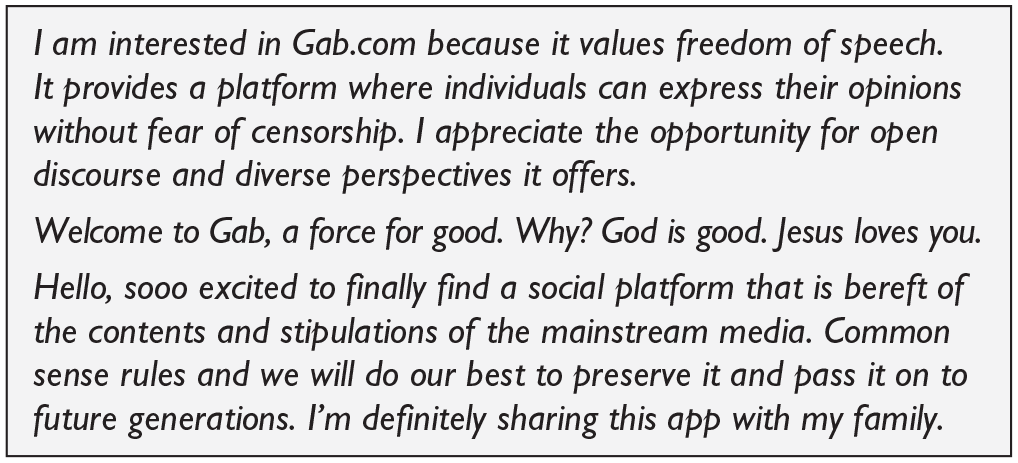
What makes these positive attributes effective processes for the community’s emotional belonging are the multifaceted or multilayered attachments users place on the Alt-Tech media space, where Gab is designed as a catch-all platform for the different facets of the far right (Zannettou et al., 2018). Therefore, while one user emphasizes their neo-Nazi beliefs, “globalism will be crushed, support your race and support your country 1488,” another poster is “ready to have friends and to learn from daily content.” While these participants may not share common ideological perspectives—or instead choose to accentuate a particular aspect of themselves in forming social relationships—they coexist, communicate, and connect via their shared sentimental connection to Gab. The subgroup thus offers a primarily positive interactive space for its community members regardless of the user’s nuanced far-right affinities.

Participant’s discursive emotions on Gab Social’s g/introduceyourself.
I deconstruct the emotional attachment levels shown in Figure 1 to illustrate the distinct communicative devices in which these sentiments play into virtual belonging. At the heart of the group and the Gab community’s allure reside the foundational tenets of trust, happiness, and hope, which participants count on for their social interactions. Where do these emotive ties come from, which seldom exist on mainstream platforms or, conversely, where social media has been found to create emotional harm (Alsunni & Latif, 2021; Kross et al., 2013)? To achieve these sentiments, the platform depends on an in-group superiority belief system that places Gab’s users and content on a self-righteous pedestal (J. Collins, 2024):

By creating this superiority-minded environment, the alt-media space supersedes dispositional distrust against social media content while simultaneously creating an echo-chambered milieu where Gab’s content and posters are “the best.” Subsequently, these conceptualizations directly translate into the numerous posts linked with anticipation, joy, and trust. For example, one user is “happy to be in a place where I can be free to be me!” while others feel open to “sharing real truths”—countering conventional narratives, histories, and facts. Therefore, the group offers an open-space environment for far-right users to freely communicate: (false) information and conspiracies (Dehghan & Nagappa, 2022), what makes them happy, their interests and thoughts, and ideological aspirations, providing an environment for counter-societal socialization, relationships, and sub-communities to form (Munn, 2023).
These findings contribute to the overarching discourse surrounding the sense of emotional belonging prevalent among the subgroup’s userbase. While existing research portrays Gab as a technocultural refuge from experiences of social exclusion, mockery, and content moderation (Jasser et al., 2023; Nouri et al., 2021), this analysis reveals that the emotional bonds forged on g/introduceyourself hold a more significant importance for its users. Consequently, the userbase’s conceptualization of the space may transcend the status of a mere social media platform, placing the virtual community as a new home:

From these posts, users emanate a euphoric sense of discovery in which Gab serves as an emotional sanctuary to lost internet souls. This content portray not only hope but also a struggle to belong (Munn, 2023), in which online and offline ostracization have made the community desperate for any type of positive social relations.
The home characterization reveals two interrelated facets: (1) rejection and (2) reattachment. The former depicts common grievances among the site’s participants, one of “political homelessness,” “censored by leftists,” and attacked by the “woke mob,” and the other of the destruction of the “middle class,” “Whites,” and Western civilization:

The final reply encapsulates the transformative power of far-right media, transitioning from feelings of rejection to reattachment within the Gab community—a parallel online society or ecosystem of disenfranchised users (Dehghan & Nagappa, 2022). What is crucial to this transmutational drive is that the userbase actively turns negative sentiment into positive. Thus, the latter, reattachment, offers users a novel chance at socializing post-societal rejection, with participants referring to their joining of the network as “starting over,” a “second chance,” a “new beginning,” and a “new life starting.” Herein, the group fills its community’s social needs and desires by existing as a positive and welcoming like-minded environment for aggrieved far-right individuals. Andrew Torba, Gab’s CEO, further cements these ideals in his battle-like conceptualizations, contrasting the platform’s positive and foundational aspects of free speech, open dialogue, and lack of censorship with the numerous outsiders attempting to destroy the community. Within this fight, Gab Social and its userbase are a “bastion” (new home) for those who feel rejected or attacked and seek an alternative belonging (Torba, 2023).
Constructing a virtual home centered around these two principles offers interesting insights into Gab’s success as an alternative social media platform. However, some may still question what processes make it a home-like space for its users? Figure 2 provides the quantitative baseline Sentimentr scores for each inductive theme, further expanded upon below. These segments are constructed in combination with the observed new home group function and include how the community sees the benefits of Gab Social; how the userbase connects; how extremist ideologies, conspiracies, and hatred fit into this welcoming space; and the use of out-groups to promote commonality, comradery, and communal challenges. Understanding these themes in relation to home as the Gab group’s primary ingredient to their sense of emotional belonging can help transform how we think about far-right communicative landscapes.

Sentimentr scores for emotional belonging themes in creating a new home on Gab Social.
Friends and Family, Free Speech, and Like-Minded: The Benefits of Gab Social
First, it is essential to delineate the themes that attract users to the platform and subgroup. Given the abundance of far-right alternative social media sites, such as Parler, Truth Social, Gettr, and MeWe, what makes the userbase specifically interested in Gab? The article outlines three separate principles of narrational attachment between friends and family, (far-right) free speech, and a like-minded community, all helping to strengthen a positive sense of emotional belonging. Importantly, participants are captivated by the technological affordances and lax moderation policies the platform offers and by the community itself. These elements are mutually reinforcing, helping to solidify the platform’s attractive technoculture (Kozinets & Gambetti, 2020).
A new home necessitates a deeper connection between far-right users on Gab, one of friendship, familial bonds, and community (J. Collins, 2024; Jasser et al., 2023). These friends and family (Sentimentr score = .265) facets regularly materialize in posts on g/introduceyourself and provide a positive interaction starting point. Utilizing the close-reading keywords (Happy, Hear, Community, New, Friend, Join, Family, Hope, Interest, Connect) associated with the coded theme, the related contents highlight the introductory relationships and emotions between virtual strangers:

There is an immediacy behind joining the platform, where boundaries for initial membership are non-existent, and being part of the “Gab family” is automatic. Importantly, little effort is required to “feel at home” or to “fit in.” Simply registering and posting a welcoming message generates positive replies from the community, with participants actively looking to connect.
Why are these users so quick to form or look for friendly and familial bonds? Because the userbase feels they have each experienced similar scenarios of online and offline societal rejection (Renström et al., 2020) and are now like-minded (Sentimentr score = .125) in their social needs, wants, and interactions (Jasser et al., 2023). Consequently, the community often cites their platform experiences in reference to the Gab family as “us,” “we,” “together,” or “our,” as a method to denote homeliness and in-group (Brewer & Gardner, 1996). This reformulation in placing the group over self is an effective means for building a collective voice while countering past and present communal transgressions:
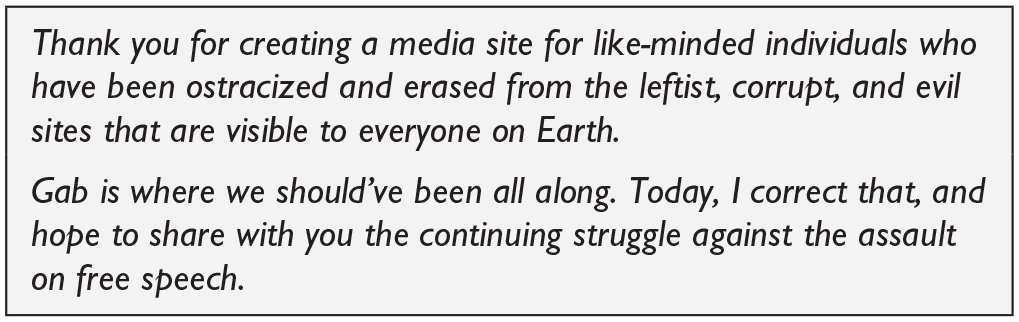
These varying tribulations—an explanatory factor for the relatively lower Sentimentr score—offer themselves as a bonding exercise for the group’s participants, inherently linking their struggles toward a common cause. It also showcases that experiences of rejection do not have to be individualized, but rather users believe “we,” as a far-right community, are all suffering the same virtual fate, although experiences of ostracization and moderation may differ.
At the same time, Gab’s marketing and terms of service stratagem as a (far-right) free speech (Sentimentr score = .317) haven provides the façade that individuals can “finally” post whatever is on their mind “without censorship” or “Big Tech control.” The associated free speech keywords (Free, Share, Speech, Discussion, Platform, Truth, Know, Freedom, Learn, Diverse) reiterate these findings. What is essential to this emotional belonging is the newly found freedom to communicate anything the user wants:

Moreover, the community’s infosphere as “truth seekers” who research and highlight “hidden realities” (Munn, 2022) provides an empowering environment where the group’s far-right ontologies are continuously reaffirmed:

Gab is thus an information space of comfort for pseudo-societal thinkers. Participants can feel at home in a virtual place that appeals to an alternative (far-right) perspective of the world and appreciates those willing to speak their minds on taboo or counter-mainstream topics.
Identity and Religiosity: How the Community Connects
Understanding and identifying the community which calls Gab home is vital to comprehending their intimate relationship with the platform and subgroup. However, no overarching identity unifies the group. Instead, loose guidelines are established by the content and replies, which regularly repeat in the data. In their search for emotional belonging, users attempt to fall within the spectrum of acceptable content captured in the close-reading findings. Moreover, while the previous attributes related to home evoke positive sentiments among participants, identity among the community is oftentimes contentious, volatile, and under existential threat (J. Collins, 2023). These values create an atmosphere of insecurity and subsequent venting on how the group should best overcome it.
Finding a coherent identity among far-right individuals is difficult, demonstrated in the umbrella conceptualization of the movement (Pirro, 2023). Outlining one on Gab—an international online space with content variety from puppies to neo-Nazis—is even more challenging. However, that does not mean specific communal identities and cultures do not exist on “Introduce Yourself.” Instead, what is clear from the identified terms (Interest, Conservative, White, Child, Belief, Country, Sick, Race, Family, Patriot) is that the community’s identity (Sentimentr score = .156) presents an ongoing struggle for the userbase’s survival versus their collective strength. The relationship is best understood in pairings with the destruction of these outlined essential self-facets:
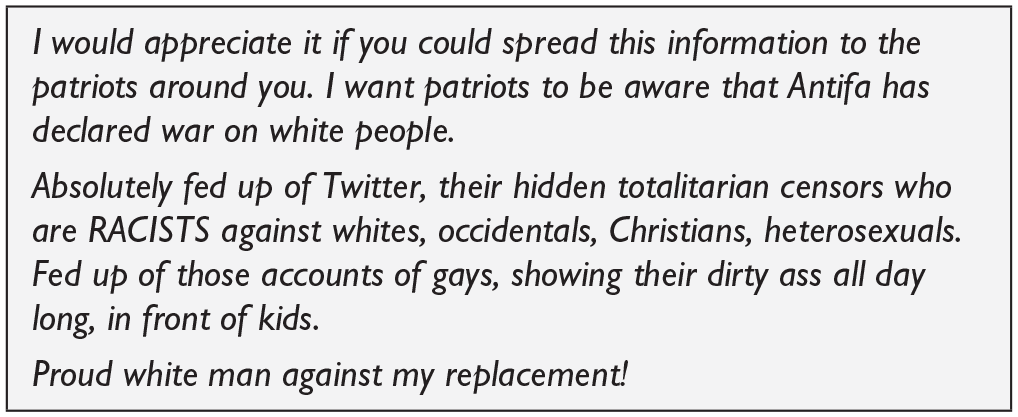
The userbase is thus quick to double down on their attachment to Gab, where these identifying features offer hypermasculine nationalism (Hogg, 2020) or a sense of control (Webber et al., 2018) against existential threats. These sentiments place the community as true patriots “fighting for our freedom.” In this context, one’s whiteness, country, family values, and patriotism are traditional symbols of a far-right ultra-conservative nostalgia (Reyna et al., 2022)—an attempt to recapture the community’s past prestige. Therefore, fitting into this power “struggle” offers users an easy in to develop connections and feel welcome into the group while maintaining the Gab community as a powerful communal force fighting to protect one another.
Religiosity (Sentimentr score = .173) offers itself as another central instrument and answer to this identity insecurity and as a predominant catch-all belonging for the subgroup’s users. In this context, the group’s collective faith can challenge the “evils of the world.” Religious doctrine intermixes with the abovementioned protectionism to showcase the strength the community holds both in spiritual affinity and collectivity (Armaly et al., 2022):

Christianity, likewise, presents a positive “guiding light” for the userbase’s sense of rejection, often taking this form in inspirational biblical quotes and support networks on the platform:

This discourse becomes a powerful tool to foster connections among the diverse userbase and a higher power. The findings showcase that believing in Jesus relieves and comforts the community’s growing ontological insecurities (Kinnvall, 2004). Moreover, in cases where the group’s hypermasculine strength or racial nostalgia fails to establish a strong sense of control or to challenge the “great evil in the world,” Christianity becomes a fallback mechanism to uphold the community’s perception of “winning.” As a result, user identity on the group is multilayered, utilizing the far right’s transnational diversity to fluctuate in their conceptualization of home on the platform. What then becomes essential is that specific identity-based characteristics on “Introduce Yourself” intentionally remain loosely defined. Instead, a sense of emotional belonging within the userbase revolves around power, as participants ebb and flow across different identities or in-group features that project their collective strength and maintain the subcommunity as a positive environment for far-right socialization.
A Look at Total Sentimentr Score and Far-Right Extremism’s Place on g/introduceyourself
Where does the far-right extremist rhetoric fit within a Gab Social group whose emotional belonging is built on predominantly positive sentiments (Sentimentr score = .153) and perceptions of home? The answer is that conventional understandings of right and wrong or good and bad do not match the ways the far-right constructs positive processes of attraction and attachment on g/introduceyourself. Consequently, positive perceptions of home come in all shapes and sizes marked by intermixing extremist and conspiratorial principles featuring in concealed replies, post-commandeering, and dog whistling or via outright xenophobic, racist, and anti-Semitic content. The content and discursive intergroup struggle of moral ambiguity paint a complex picture of what the virtual home looks like according to its participants. This complexity is exemplified by instances where emotions such as anger, fear, and disgust are constructed and experienced as positive in-group themes.
In the context of the new home on Gab, characterized by its emphasis on rejection and re-attachment, the userbase’s perception of the world has undergone a transformative shift, aligning them with the distinctive yet disjointed ontology of the far right (see Busbridge et al., 2020; Luger, 2022). At the core of this transformation sits the regular use of conspiracy theories. These narratives are diverse—with no one defining storyline—and encapsulate the believed topsy-turvy nature of society, “the world has turned upside down. Wrong is now right and right is now wrong.” Herein, negative emotion (Gerts et al., 2021) plays a fundamental role in conspiratorial manipulations, with users drawing on different conceptualizations of loss, suffering, and destruction in constructing their repurposed world:

While the content selected appears unattached, for the Gab sub-community, perceptions of “truth” are oftentimes interchangeable with anger and fear (Marcks & Pawelz, 2022). These processes are self-fulfilling and mutually reinforcing, with the creation of alternative worldviews being a precursor to hate-filled language, and conversely, the propagation of hate reinforces these alternate perspectives (J. Collins, 2023). Combining this relationship with the group’s emphasis on home on the fringe media site as the ultimate “free-speaking online space” generates a recipe for users to post anything they desire as various forms of pseudo-truths. Toxic communications and conspiracies thus serve a larger purpose. Shifting ontologies around world crises provide a starting point for extremist opinions to flourish (J. Collins, 2023; Fitzgerald, 2022; Kaunert et al., 2022), even if the users present these narratives through a positive depiction of “love.”
What is essential for the userbase is that conspiracies, how they are discussed, and the hatred the messages evoke are not one-dimensional. Rather, extremist ideologies and opinions are reinforced and manipulated via different content types and dissemination strategies. For instance, dog whistling and radically suggestive media appeals to specific participants who understand the intended message of the original poster (Åkerlund, 2022):

For discussions on “real truth,” the dominating replies fixate on Jewish conspiracies and ethnic discrimination, where users are quick to swarm the comment section with hate-filled messages toward the out-group. Other virtual members, often self-described neo-Nazis, feel more comfortable sharing their far-right opinions—anti-Semitism the most common—without the need to conceal their feelings or narrative in the replies:
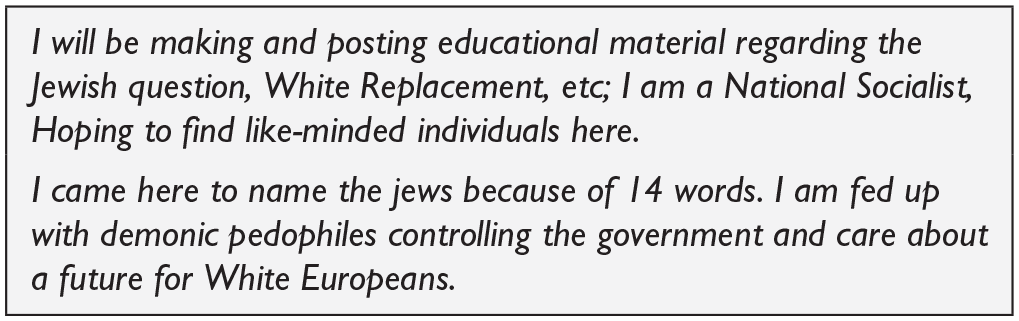
Why do some users then post ambiguous far-right extremist messages if this content is regularly posted without a filter? It is not about hiding the narratives from potential censorship—the community’s moderators do not remove (far-right) radical rhetoric. Nor is it about maintaining a front-page façade of positivity. Rather, these narratives are an activity or entertainment for participants (Zuckerman, 2019). Extremist users bond over the shared explicit and implicit messages against out-groups (Hardy, 2023), where ambiguity allows for toxic reinterpretations of commonly cited enemies and functions as a vessel to attract more eyes among unsuspecting viewers. In this instance, hate-filled media and conspiracies act as a mechanism for comradery construction and re-attachment, reinforcing the like-minded emotional belonging and sense of shared groupness previously highlighted. Toxicity is “fun” for the platform’s community, presented as an ongoing game to figure out the missing (conspiratorial or extremist) connections to their new home’s far-right ontologies.
Out-Grouping: Intergroup Dynamics, Competition, and Community (Self-)Moderation
The final foundation to far-right online narratives and discussions is the intergroup competition (Bliuc et al., 2019; Reyna et al., 2022) promoted and highlighted on Gab. In this context, framing rejection and reattachment vis-à-vis in-group vs. out-group (Sentimentr score = −.026) dynamics connects all members to a common experience (Hogg, 2018). The discursive process of accentuating an “us” and “them” serves two purposes: (1) creating a virtual boundary for membership with clear self-moderation guidelines and (2) presenting an overarching communal threat, where one’s home needs to be protected.
In the choose-your-own-community style of Gab’s new home formulation, the boundaries of who belongs and does not depend on the adapting hate-filled discourse toward established far-right out-groups, with the predominant keywords Left, Woke, Jews, LGBTQ, Gay, Evil, Enemy, Censor, Antifa, War. For an alternative fringe media space built on countering “Big Tech” censorship (Jasser et al., 2023), animosity toward mainstream media, the left, and Jews as epicenters of “control” and “evilness” dominates intergroup discussions:

The in-group vs out-group competition presents itself as a battle between right and wrong, where the Gab community sits as the moral good, upholding free speech rights online. This dichotomized demarcation toward wrongness and rightness opens the floodgates to the numerous outlined far-right narratives with the ability to produce and circulate radical content seen as righteous and an essential positive facet of their emotional belonging. At the same time, deep-seated anxiety that this newly established home and virtual freedom could be destroyed is frequently portrayed. These existential threats and fears translate into aggressive behavior against any “outsider” content:

Out-grouping thus offers the userbase a paramount tool for radical unity (Hogg & Adelman, 2013), promoting togetherness in a fragmented social environment where the community’s identity, ideology, and narratives are often conflictual and diverse. Protecting their new home against existential threats surpasses any faceted far-right affiliation, value system, or preference for specific media. The focus instead concentrates on “our” space, our home. This practice connects the diverse userbase, now united in the shared sense of home on Gab and against any out-groups that threaten the core of this virtual belonging. By communally harassing defined outsiders, users showcase and reaffirm their deep-seated emotional attachments to the platform and collective desire to maintain this exclusive far-right online space.
Conclusion
Through the interconnected themes of online and offline rejection and the reattachment to the far right’s Alt-Tech ecosystem, participants on Gab Social’s g/introduceyourself highlight the positive emotion-based communicative processes leading to their sense of belonging, attraction, and attachment on the platform—a new home. These themes include (1) the immediate formulation of friendship and familial bonds; (2) a like-minded (radical) positionality and worldview; (3) an “anti-Big Tech” motivation and the common quest for free speech; (4) a powerful in-group construction of collective identity through whiteness, masculinity, and patriotism; (5) Christianity as a common unifier and a method for a “winning” in-groupness; and (6) out-grouping as a tool to promote togetherness and solidarity. These thick data-immersive and computerized findings underscore that contemporary research often paints a one-sided and consequently flawed picture of far-right fringe social media, focusing on their hyper-negative and hate-filled environments. However, this study emphasizes the importance of considering the positive drivers contributing to these platforms’ success, maintenance, and growth. Moreover, it argues that the conventional dichotomy of positive and negative sentiments may not accurately reflect how the far-right perceives their emotion-based communications. By assessing the scale and manifestation of participant emotions, the article offers a novel approach seldom applied in the field. Consequently, academics should re-evaluate Alt-Tech spaces through a different, multi-dimensional conceptual lens that captures the nuanced dynamics and emotion-based elements that establish and sustain these online communities. Recognizing this necessity will open the field to new directions and better understandings for these platform’s successes.
Furthermore, the study’s framework and findings serve as an initial exploration and empirical testing of the intricate emotional dynamics within the far-right Alt-Tech ecosystem. From these results, I suggest the far right is carving out alluring online spaces for social interaction, fostering environments rife with pseudo-realities, conspiracies, hatred, and extremist ideologies that fuel a positive sense of in-groupness. Still, much more work on these topics is needed. While there is little doubt that Alt-Tech social media platforms, exploiting societal fragmentation and ostracization, are pivotal in radicalizing, recruiting, and mobilizing individuals to their cause (Dehghan & Nagappa, 2022), user motivations for joining these platforms go beyond the stereotypical focus on those seeking toxic communications, free hate speech, or subscribing to far-right ideologies. Instead, many individuals are inspired by the positive sentiments and strong sense of emotional belonging within these spaces. We must recognize these positive psychosocial processes as an effective online strategy and as promoters of alternative (radical) “homes.” Therefore, future research should investigate—across different disciplinary techniques and datasets—the intricate dimensions of techno-sociality, positionality, and culture entrenched within these virtual spaces. For instance, methodologies such as interviewing, as exemplified in the work by De Koster and Houtman (2008) on Stormfront, could offer a more profound understanding of the motivations and experiences of these online participants. While the existing literature appropriately emphasizes the discursive dangers of these platforms, such studies merely scratch the surface. Immersive research is essential to reveal how the far-right strategically leverages these spaces for recruitment, mobilization, and advocacy. By adopting a nuanced and multifaceted perspective, future investigations can significantly contribute to our comprehension of far-right online dynamics and inform effective strategies for addressing the challenges posed by these digital spaces.
Footnotes
Acknowledgements
I would like to thank the Center for Research on Extremism (C-REX) and my supervisors for their support in formulating this article.
Declaration of Conflicting Interests
The author(s) declared no potential conflicts of interest with respect to the research, authorship, and/or publication of this article.
Ethical Approval
The study received institutional review board approval from the Committee for Ethics in Research, Faculty of Social Sciences, Charles University in Prague.
Funding
The author(s) disclosed receipt of the following financial support for the research, authorship, and/or publication of this article: This work was supported by the Cooperation Program, research area POLS.
