



Abstract
A new wave of websites, referred to as alternative technology (alt-tech) social media, are proliferating across the internet, characterised by far-right-centric content and the imitation of mainstream platform affordances. This study employs Netnography to examine the recruitment practices of four prominent alt-tech platforms: Gab, Parler, Truth Social, and Gettr, providing an in-depth comparative analysis of their homepages. To better understand these communicative dynamics, the article highlights the similarities and differences between the homepage content of these alt-tech platforms. The findings reveal the hate-filled paradigm collectively captivating their userbases while highlighting the distinct technocultures developed and promoted within each platform. By focusing on the technocultural interplay between the selected platforms and their communities, the study offers a compelling exploration of alt-tech social media environments, the particular needs and niches fulfilled by each space, and their place within the broader far-right ecosystem.
Introduction
Far-right online communications span a vast network of websites and platforms, each contributing to the propagation of hate-filled narratives, ontologies, and behaviours across the movement. These networks range from mainstream social media (Crosset et al., 2019; Hutchinson and Droogan, 2024) to fringe (Collins, 2024; Dowling, 2024; Jasser et al., 2023) and more obscure platforms (Baele et al., 2021; Tuters and Hagen, 2020), creating an extensive and ever-evolving content milieu that remains challenging for scholars to capture. Among these spaces, alternative technology (alt-tech) social media websites have emerged as a crucial yet underexamined subset. Designed to mimic mainstream affordances while rejecting content moderation, alt-tech platforms provide a purposefully unrestricted environment where far-right discourse flourishes (Collins, 2025; Munn, 2022). Moreover, the highly permissive nature of these platforms fosters extreme ontological framings and narratives, making them pivotal in constructing and reinforcing far-right digital cultures (Collins, 2024; Dowling, 2024). Despite their growing influence online, research on alt-tech remains fragmented, often focusing on individual platforms or specific community dynamics, underscoring the need for a comparative perspective on how these virtual spaces shape user engagement, sustain participation, and cultivate distinctive technocultures.
Herein lies an often-overlooked aspect of alt-tech: its differentiation. Why do multiple platforms exist to offer the same or at least similar unmoderated communication space? And if they provide distinct user media experiences, how do these virtual milieus distinguish themselves while maintaining a shared and familiar far-right digital culture? In addressing these questions, the study both advances our understanding of alt-tech platforms and provides a framework for future studies of far-right digital cultures via three important ways: (1) it offers a first-of-its-kind experiential analysis to investigate how four prominent alt-tech social media sites – Gab, Truth Social, Gettr, and Parler – construct their homepage content to shape user engagement and sustain membership; (2) through a comparative Netnographic approach, I showcase the potentials for immersive research in analysing far-right platforms, their differences, and the communities that occupy them; and, (3) outlining and adopting a technocultural perspective to examine alt-tech social media helps showcase the concept’s use for studying broader far-right online communications, emotions, ontologies, and technological structures.
To address the outlined questions and situate the contributions within their empirical context, I examine the technoculture of alt-tech homepage content, focusing on the affective and ideological mechanisms these platforms use to recruit, engage, and retain users. The Netnographic findings reveal that, while each platform curates a distinct set of hate-based narratives, they extend beyond the current counter-public model (see Jasser, 2021). Rather than, as previously suggested, functioning solely as refuges from mainstream content moderation (Collins, 2024; Jasser et al., 2023), these platforms serve as active sites of ideological recruitment, reinforcement, and mobilisation, shaping far-right participation through collective framings of grievance, out-grouping, and belonging. Moreover, alt-tech spaces cultivate and curate unique technocultures that structure user engagement through targeted discursive strategies. By situating these findings within a comparative framework, this study moves beyond the current foci of isolated platform research to examine the broader ecosystem in which alt-tech platforms operate. Simultaneously, the results offer new insights into the critical role of alt-tech in sustaining and evolving the far-right digital movement.
Literature review
Before diving into the article’s aim, it is first necessary to define the far-right and its relation to alt-tech spaces. While a consensus definition remains elusive around labelling the far-right (Pirro, 2023), the study employs a flexible conceptualisation that best captures the heterogeneity of communities that gather on alt-tech platforms. Cas Mudde’s ‘family resemblance’ approach, which identifies extremism, radicalism, and populism as overlapping strands (Mudde, 2019), alongside Carter’s (2018) concise definition of the far-right as ‘an ideology that encompasses authoritarianism, anti-democracy, and exclusionary and/or holistic nationalism’, provides the foundation for this study. Herein, these authors highlight how the far-right’s umbrella-like nature permits ‘mixing and matching’ of ideological elements, producing both variety and ambiguity (Mudde, 2019), and that this capacity for cherry-picking is integral to its persistence (Pirro, 2023). Such nuances reflect across the selected alt-tech social media platforms, which span content and groupings from lifestyle and hobby discussions to Neo-Nazi subcommunities. Alt-tech platforms function as all-inclusive hosts for (broadly defined) far-right attitudes, discourses, and identities, necessitating this flexible conceptualisation to account for the range of participants and the subsequent technocultural milieu therein.
From this baseline, alt-tech creates a separate ecosystem for the far-right, consisting of self-sustaining platforms designed specifically for their userbase (see Baele et al., 2023). Often described as an ‘alliance for free speech’, these platforms have attracted significant financial backing and support from influential figures, who have prioritised recreating mainstream functionalities on new sites aligned with their narratives (Hermansson et al., 2020). While the far-right community may find it challenging to gain traction in mainstream media (Rogers, 2020), the alt-tech environment offers a safe space – free from the threat of censorship – that is crucial for fostering in-group cohesion, a sense of belonging, and attracting new members. In a global online landscape where these users feel targeted and marginalised (Munn, 2022), these platforms serve as a venue for communication, information sharing, and entertainment, providing a virtual community insulated from outside judgement (Collins, 2024). However, the range of content needs within the far-right ecosystem is varied. Some users seek basic communication channels, while others look for platforms that facilitate the dissemination of extremist content. This diversification of websites (supply) and participant wants (demand) has been described as an ‘alt-everything’ (Hermansson et al., 2020). Consequently, alt-tech offers a variety of virtual spaces to cater to these differing requirements.
The diverse media orientations for fringe sites encapsulate the broadness of both needs and niches for far-right online users. Alt-tech platforms include Stormfront and other forum-based networks of communiqué (Åkerlund, 2021; De Koster and Houtman, 2008), local alternative news websites run by radical political parties (Rone, 2022), dating sites for white and or ‘European-heritage’ individuals (Hermansson et al., 2020), the encrypted messaging app Telegram (Rogers, 2020), dark web networks of extremist violence content sharing and communications (Baele et al., 2021; Tuters and Hagen, 2020), and the object of study alternative social media sites. Importantly, fringe social media presents an interesting view into the communication dynamics of a multi-million far-right userbase and movement (Similarweb, 2025).
Through this initial framing it comes as no surprise that the field’s interpretations and diagnostics of alt-tech social media captured the technology-based initiative as a counter to mainstream website hegemony and their restrictive moderation policies (Jasser et al., 2023). After all, this is how these platforms present(ed) themselves to their (potential far-right) audience – as a fight against ‘big tech’ companies. Therefore, the field’s empirical baseline fixated on the notion of counter-public and their structural qualities, with several articles depicting how exactly this paradigm manifests (see Ebner, 2019; Jasser, 2021). And while these depictions helped capture the initial trajectory of alt-tech platforms, I argue that the field should not remain static in our explorations and understandings. Rather, we must consider how these platforms have transitioned from counter-publics to vital hubs for far-right ideologies and narratives to materialise and thrive.
What is particularly intriguing is the field’s recent reconceptualisation of these alt-tech platforms from technological conduits to the social behaviours within (Collins, 2024; Weigel and Gitomer, 2024). For instance, some scholars ask how do participants conceptualise their involvement on these platforms? Their findings range from the construction of community and identity (Collins, 2025; Jasser et al., 2023), the emotional attachment placed on these websites (Collins, 2024), and the power of ‘hate-sharing’ for developing communal solidarity and engagement (Weigel and Gitomer, 2024). And although these findings provide a solid initial framework, we should take this one step further.
What is needed is a theoretical and empirical bridge to better connect these elements, asking how participants’ conceptualisations of these spaces compare and contrast across alt-tech environments, and how each platform fulfils the particular niches and needs of its userbase. Works on technoculture could provide this necessary impetus. For example, Liinason and Norocel’s (2024) special issue on Technocultural Worlding helps explain the increasingly fragmented understandings of online participants’ political realms and the construction of the (imaginary) communities they inhabit. By blending material and virtual worlds, the authors illustrate how retrogressive spaces form, grow, and are maintained. Evidently, technocultural approaches emphasise not only technological implementation but also user engagement and experiences, offering deeper insights into the co-evolution of alt-tech platforms and their far-right participants.
Theory
If we are to further develop our understanding of the alt-tech social media environment, then the field needs effective conceptual frameworks that place greater emphasis on its virtual participants. Importantly, this alternative paradigm does not need to undermine the technological bases previously established. After all, how can we comprehend and map these communication structures without first understanding the affordances – the characteristics of social media constructed upon the relation between social, contextual, and technical that restricts and enables certain uses of the website (Ronzhyn et al., 2023) – and systems they are constructed upon? Instead, what is needed is a framework which bridges technology (structure) with community and its communications (agents). Technoculture offers the essential intermixing of these components (Kozinets and Gambetti, 2020). Defined as the ‘various identities, practices, values, rituals, hierarchies, and other sources and structures of meanings that are influenced, created by, or expressed through technology consumption’, technoculture offers a fruitful baseline to unpack how and in what ways media is consumed – dictating the inescapable and intimate relationship between platform and user (Kozinets, 2019a). Moreover, the concept remains purposefully broad, allowing for researchers to pick-and-choose the critical elements of virtual culture most pertinent to their case (Kozinets and Gambetti, 2020).
What then are the key components which can be studied under the technoculture framework? While potential applications across media and communication studies could be described as ‘infinite’ combinations, permutations, and possibilities (Kozinets and Gambetti, 2020), this article pinpoints four predominant technocultural landscapes of discovery (Collins, 2024; Kozinets, 2019a, 2019b; Kozinets and Gambetti, 2020): (1) (2) (3) (4)
Importantly, this theoretical recentring provides a much-needed impetus for analysing alt-tech platforms which currently fall conceptually short as counter-publics (Jasser, 2021). This viewpoint sets a dichotomous and rather simplified paradigm, a perceived battle between ‘us’ and ‘them’ (Collins, 2025). Although the framing provides an established context for research, I argue that it largely undersells and trivialises the many cultural nuances that exist within and across these websites. We need novel theoretical approaches that can be operationalised to provide the missing empirical pieces to the complex puzzle of far-right platforms. Technoculture offers this broad and adaptive toolset for researchers (Kozinets, 2019a; 2019b), allowing for a much-needed reconceptualisation of alt-tech systems, communications, and behaviours that extends beyond intergroup relations or competition (Collins, 2025). By adapting this novel theoretical framework, this study can explore the many technocultural outlets presented by and to users.
This article integrates two technocultural elements – ontological and emotional – with Netnography’s interactive phase (Kozinets, 2019a). Focusing on the selected platform’s homepage content, these two paradigms unpack (1) the contrasting narrational and ideological qualities between communities, and (2) the patterns and mechanisms of affective engagement driving platform attractiveness. Notably, the article does not analyse the more computational or technical aspects of each website as their affordances and presented structures largely mimic one another. Nor does it unpack the visual qualities or aesthetics of each post. By immersing myself in these environments via Netnography, I examine how these platforms and their communities specifically curate their userbase’s content milieu to co-produce and present distinct technocultural spaces of far-right belonging. Through this approach, technoculture is not only a conceptual tool but a methodological lens, allowing for a comparative exploration of how these platforms recruit, sustain, and maintain participation.
Method
Netnography is a structured and immersive methodological toolkit to better understand the online cultural elements (traces) that connect users to one another (Kozinets, 2019a). Born out of the marketing field in the late 1990s, the technique aims to capture – implementing key tenets and practices from anthropology, media, communication, and computer sciences – what makes a virtual community, a community (Kozinets and Gretzel, 2024). As such, adopting the technoculture concept, Netnographers either directly or indirectly engage with the demarcated online space, deciphering the intellectual (mapping structures and communal ideas), cultural (rituals, symbols, terminology, practices), historical (myths, traditions, narratives), emotional (critical empathy of users’ feelings), and/or social (engaging with the community) elements of interest (Kozinets, 2019b). Importantly, researchers may focus on one or a combination of these interactive subsets.
Netnography differs from other online immersive techniques in its methodological guidelines or blueprint. While some scholars denote online or virtual ethnography as a ‘flat methodology’, with researchers able to intuitively pick and choose what practices they want to adopt for their study (e.g. Postill, 2024), Netnography provides a structured but adaptive framework to follow. This article adheres to Kozinet’s (2019) six iterative and reflexive steps; initiation, defining and delineating research topics and formulating guiding questions; investigation
Essential to note is that these replicable and transparent instructions are not isolated procedures; they are complementary, with each step building on the previous one in a cumulative manner. This process can be described as hermeneutic (see Gillo, 2021; Kozinets and Gambetti, 2020), creating a unified narrative that strengthens the researcher’s engagement with each stage of the study’s pipeline. It also ensures minimal disconnect between data collection, immersive fieldnote findings, the iterative coding procedure, and the analysis of technocultures.
Following the establishment of the initial comparative research design and subsequent questions, the study delineated the boundaries and logic behind this choice. The platform selection is driven by popularity and the availability of public data, with Gab (3.51 million monthly visits), Truth Social (15.37 million), Gettr (1.03 million), and Parler (185k) standing out as the most frequented free-access far-right fringe social media platforms (Similarweb, 2025). Each platform’s far-right ‘fame’ stems from different circumstances. Truth Social (founded in 2022) is a Donald Trump–owned enterprise and functions as his sole communication platform after being banned from Twitter and Facebook. Gab Social (2016), and Parler (2018) were both extensively used during the January 6th Capitol Hill riots, after which Parler was briefly removed from the internet. Gab continues to serve as a hub for a wide range of far-right influencers across the Anglosphere. Gettr, meanwhile, positions itself as a ‘truth-based’ social media site that provides the infrastructure for a supposed ‘marketplace of ideas’ online. Notably, the homepage affordances and presented content directly mirror one another across these platforms, creating a like-for-like comparative framework where I could focus on the content itself rather than other technocultural features. This design also generates a sense of familiarity across domains, allowing users to seamlessly move between them without the need for learning or adjustment periods. Therefore, these websites offer a rich non-homogenised look into the far-right’s ideological and narrational mixing (Baines et al., 2021; Collins, 2024; Peucker and Fisher, 2023; Zhang et al., 2025, while still maintaining their core projected values as alt-tech social media spaces. The selection criteria also ensured that the publicly available homepages were straightforward to access for data collection.
Moreover, analytics suggests that many of these platforms’ participants should be defined as curious, rather than active community members. According to the average bounce rates (40–55%), page visits (2–5), and visit durations (3–8 minutes), the typical user examines the website’s homepage, a few other dedicated spaces, and then leaves without extensive interactions or a continual presence (Similarweb, 2025). These statistics set the precedent for evaluating the alt-tech social media homepages, with the content vital for transitioning participant’s curiosity to active membership. Therefore, if alt-tech social media sites want to continue to attract new members, the frontpage serves as an essential selling point in a hypercompetitive environment.
The same logic flows from defining the study’s boundaries to establishing the parameters for data collection and the subsequent immersion period. Observing the first ten posts every day from each platform’s web-based homepages, I sought to replicate or mimic the way many users participate on these websites. If potential members are curious and the chosen platforms want to engage these individuals for longer or more extended periods, the initial content presented is essential. Moreover, I wanted an extensive collection period to establish any (in)consistencies and patterns for each presented content milieu. The initial scope was for 2 months, between May and June 2024, but was shortened to 50 days following the perceived exhaustion of data – where patterns and themes only repeated with no introduction of new elements (Kozinets, 2019b).
Owing to the Netnographic process, two data sets were created synchronously during this period – the content itself and the immersive fieldnotes. For the latter, I detailed every relevant technocultural note found within each post, focusing on the intellectual and cultural interactive elements that could help illustrate what similar and dissimilar characteristics make these spaces communities of shared meanings, narratives, and recruitment. Moreover, these findings set the inductive thematic baseline for coding the collected content, ensuring the hermeneutic process of deep connection-making and the researcher’s unified understanding of the data throughout the collection phase. The accumulated media (2000 individual total posts) is thus reflexively coded in the integration period, combining the main themes discovered via the researcher’s community immersion with any additional characteristics added during this coding process.
Main themes from Netnographic findings and their definitions.
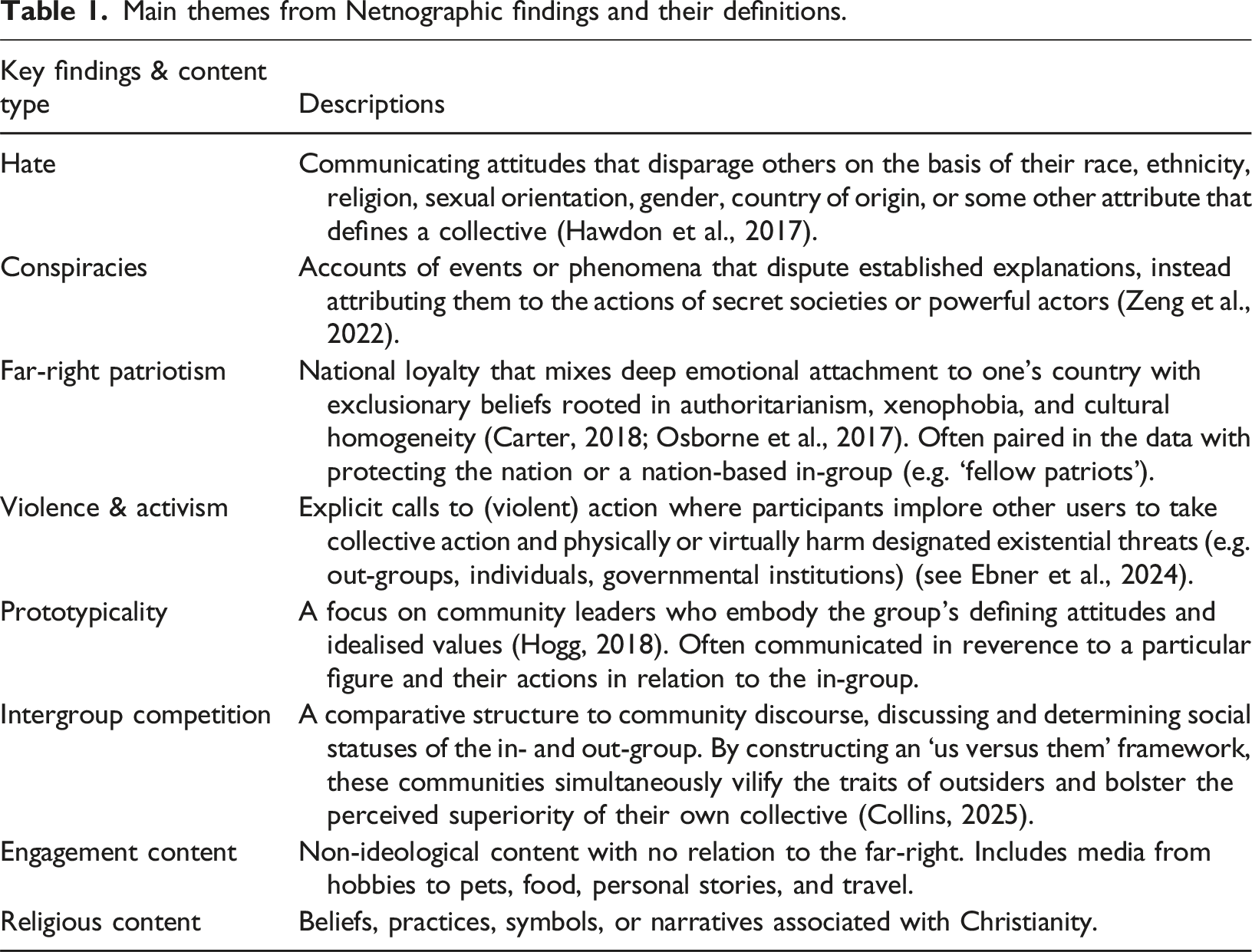
Finally, ethical considerations are paramount, especially when dealing with far-right content and userbases. Guided by the principles of Netnography, which prioritises participatory and culturally sensitive research (Kozinets, 2019a), I took several measures to protect users’ privacy. For instance, personal data such as usernames, timestamps, and content links were excluded from the dataset after the initial collection. Moreover, all data is anonymised to safeguard the identities and opinions of platform users, including paraphrasing the selected illustrative texts to avoid reverse searching. While Gab and Gettr allow their homepages to be viewed without accounts, Parler and Truth Social do not – a potential sticking point for the public-private debate. However, following the logic and guidelines proposed by Demant and Moretti (2024), I avoid this dispute through a ‘neutral’ account that did not require further administrative approval to view their homepage content. These proposed conditions received ethical approval from the author’s institution.
Analysis
The article offers a comparative investigation into the technocultural homepage media presented by and to the far-right alt-tech movement on platforms Parler, Gettr, Truth Social, and Gab. I highlight the primary similarities and differences sustaining the far-right social media ecosystem by combining culture-based experiential journaling, implemented via Netnography, with a subsequent inductive thematic coding of the manually collected 2000 front-page posts. Specific excerpts from the collected content are selected to illustrate the findings. Through my continuous investigative immersion within these communities, the findings reflect both the cultural patterns I observed and the ways I came to understand the featured content and its purpose for the userbase. The following analysis first traces the interconnected baseline of hatred across these platforms and then examines the distinct technocultures each platform evokes through this shared sentiment.
Inductive themes (see Figure 1) centre around the use of Hate (59%) across the four homepages (Gettr – 83%, Truth Social – 55%, Gab – 54%, Parler – 42%). With antagonism acting as the baseline technoculture, the other recorded processes naturally flow from this environment. For instance, Conspiracies (43%) among the far-right exploit extreme prejudices against out-groups, who purport to act secretly to achieve nefarious goals (Baele, 2019). Positive portrayals of designated community leaders, referred to as Prototypicality (22%), offer a collective blueprint and evidence of how best to confront the perceived ‘evils’ of the world (Hogg, 2018). The themes Intergroup Competition (19%), Patriotism (11%), and Violence & Activism (10%) provide actionable and comparative frameworks for achieving the technological movement’s objectives, from ‘fighting back’ against society’s ‘intentional destruction’ to ‘doing whatever is necessary to protect my home, my family, and our freedom’. Notably, the thematic outliers, Engagement Content (17%) and Religion (6%), are explored in their respective media contexts. Together, these themes weave a compelling narrative behind the alt-tech social media movement and the distinct spaces that constitute this hate-filled virtual ecosystem. Sankey diagram on the alt-tech social media homepage’s inductive themes.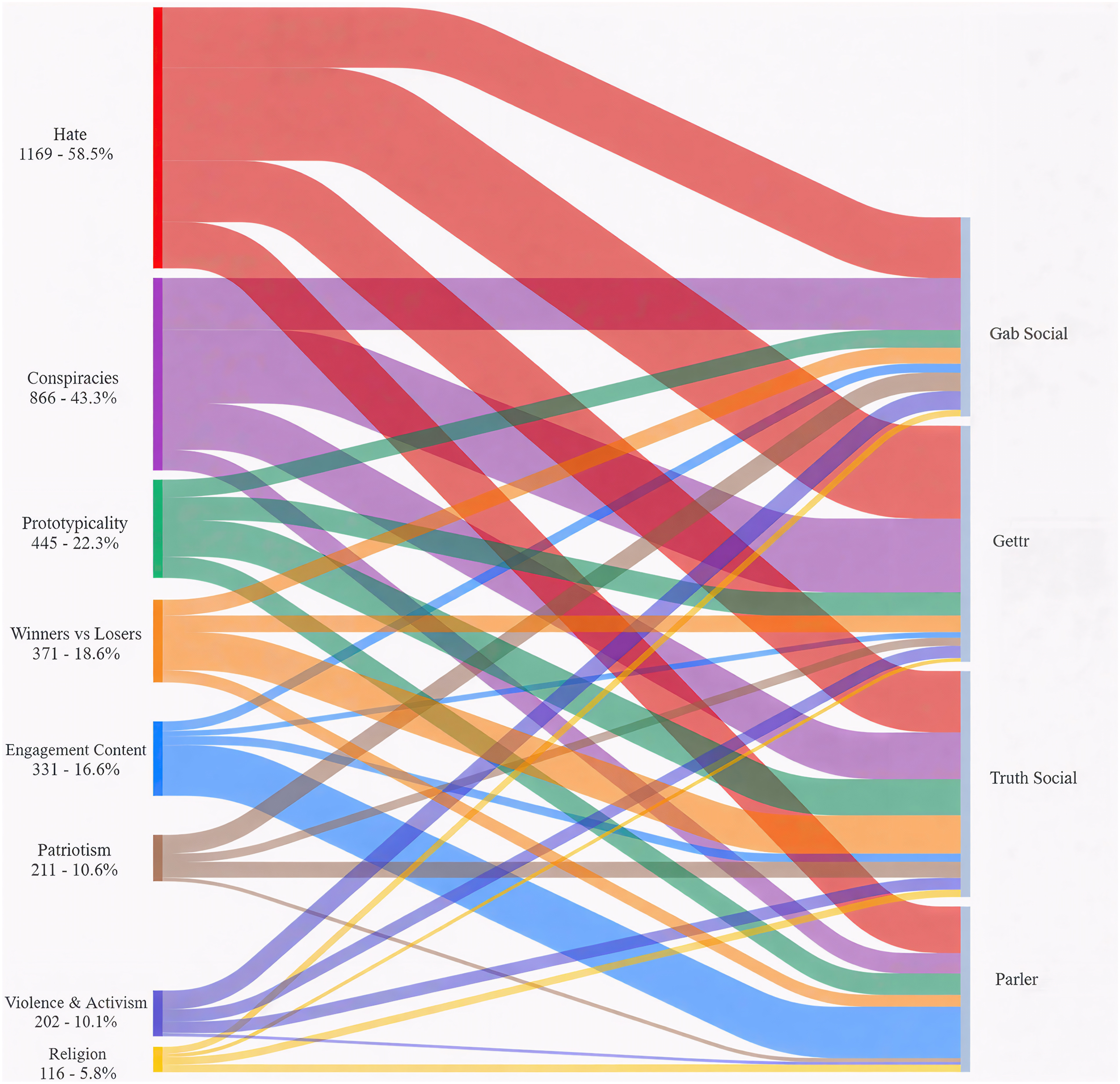
Why is hate such a widespread occurrence on these websites’ homepages? Throughout my immersion process, hate appeared as a fundamental and easily accessible tool for the userbase, reflecting a familiar byproduct of social movements. Where recruitment strategies in Social Movement Theory often rely on intergroup competition to achieve their aims (see Cunningham, 2012), I frequently observed these dynamics manifest on far-right alt-tech homepages through hate-filled content targeting assorted out-groups or collective issues. Who (or what) precisely the community chooses to hate is dependent on the technocultural utility that this emotion provides. For example, Gettr manipulates communal out-grouping and insecurities to peddle various conspiracy theories and formulate alternative realities. The ‘illegal’ and ‘immoral’ persecution of Donald Trump creates a dichotomous battle between the good (Truth Social community) and the bad (all those against them). Finally, Gab’s front-page content frequently identifies various ‘enemies’ in collective calls for (violent) action. As a result, hate serves as an effective social movement process, operating as a thematic baseline for the majority (59%) of the content examined.
What this evocative communication strategy promotes across the selected platforms is what I denote as a ‘retributive technoculture’, where participants occupy these spaces to seek revenge against perceived grievances and injustices. Hate, in this context, becomes both a collective outlet and a potent recruitment strategy for individuals who feel wronged in the current socio-political and economic climate. Herein, simply joining and becoming members of an alt-tech community promises a form of (retributive) change – though the nature of that retribution varies across platforms. On Truth Social, it manifests as (re)becoming the winners in society, with Trump as the heroic figure to catalyse and consolidate change. For Gettr, revenge revolves around vindication for conspiracies proven ‘true’ and halting an imagined white genocide. Taking the form of violent retribution against various out-groups, Gab Social users are fuelled by dissatisfaction with the current governmental system. Finally, on the softer side, Parler frames itself as the best space on the internet for free expression, offering a ‘third chance’ for participants seeking social media untainted by perceived censorship or corruption. Further unpacking these collective feelings and projections in combination with the other inductive findings across the selected platforms serves as the cornerstone for all subsequent analyses within the study.
Gab Social and its community of hate
Gab Social’s homepage themes and hate-filled content.
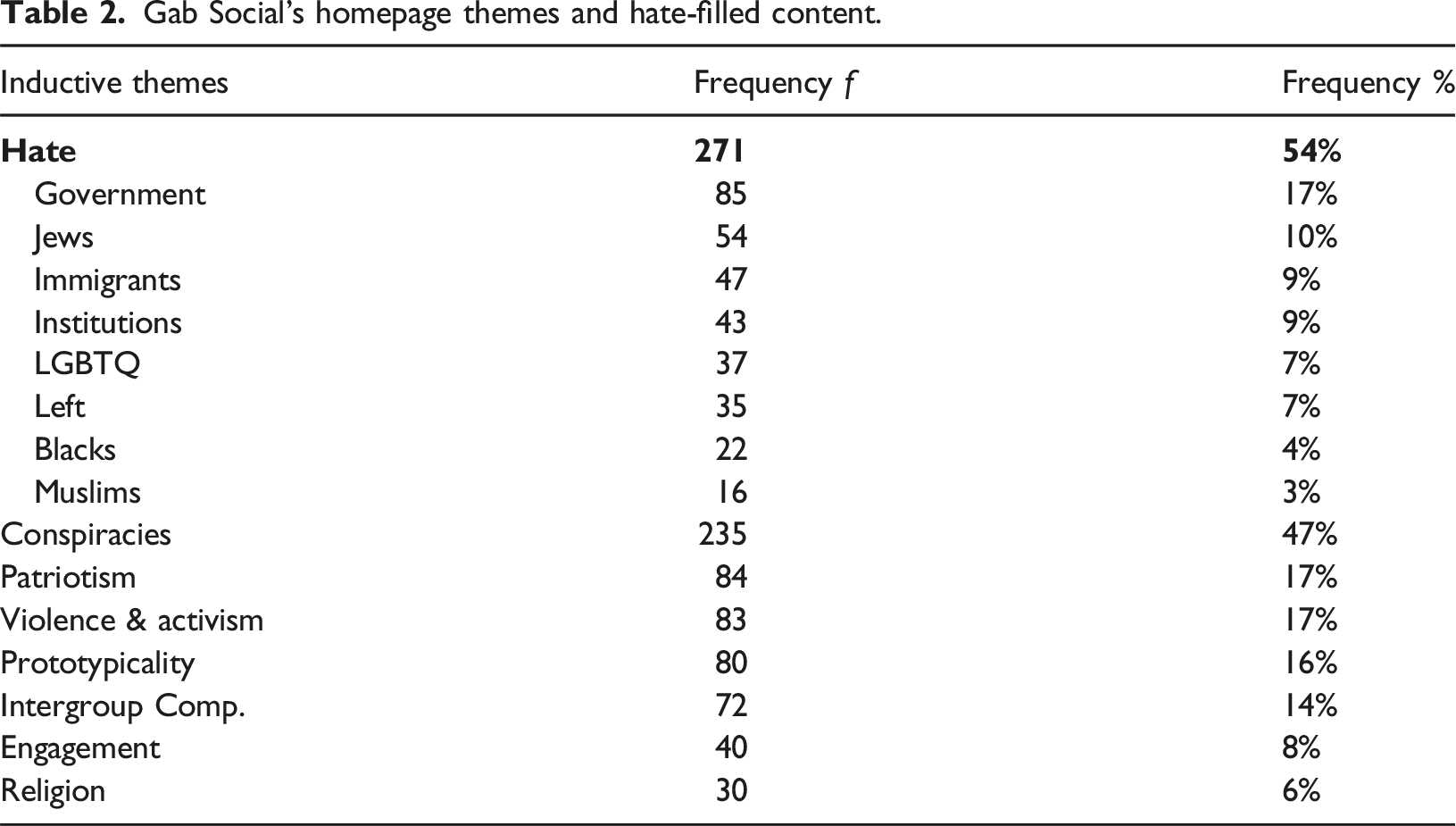
From the immersion journal, hate-filled content on Gab can be separated into two categories, ‘minority’ and ‘systematic’ enemies. The former are the believed manifestations or products of a system left unchecked, who are used as destructive agents to the wellbeing, belief, and values to participants of the far-right site (Van Prooijen, 2024). These include Jews, Immigrants, LGBTQ, Blacks, and Muslims who are abhorred in various fashions dependent on the far-right ecosystem’s media milieu and mainstream news cycles: The sooner the western world wakes up to the fact that they are putting gays, illegals, and other depraved people in powerful positions throughout government because they can be blackmailed and controlled, the better.
The latter represents the deep-rooted and structural mechanisms in place that give the underlying purpose to the online movement. Where minority threats are tangible representations of community problems, a more ambiguous structural enemy exists below the surface: ‘They're not trying to divide us—they did that two centuries ago with the introduction of two-party politics. What’s happening now is replacement. White nations are being intentionally populated with non-White individuals, making the Great Replacement a racial issue, not just a political one’.
The two threat categories oftentimes work in tandem as part-and-parcel of the same issues. Moreover, the community depends on both material and immaterial anxieties to mobilise support (Collins, 2023), with Gab’s technoculture built around an elaborate milieu of hate-based content. I denoted this as a ‘hate everything’ mechanism, a ‘smorgasbord of detestation’ that functioned as a collectivised group process. The more intertwined these threats become, the easier it is for the community to connect with each vitriol post (Marcks and Pawelz, 2022). However, airing grievances is not enough for some participants who desire change, leading to violent calls for action and activism.
Who is violent rhetoric directed towards? What I found intriguing on Gab is that minorities are considered the ‘secondary aftereffects’ created by the system. The community thus believes that destroying the structures (and individuals) behind contemporary society is the central solution. Within this framework, it is the userbase’s duty to enact and justify violent measures against the government, the broadly defined left, and their institutions: Well of course they’ll do it again dear, cause you didn't hang anybody last time White Western nations—and the people within them—are losing their freedoms and being undermined due to compliance. Neither tolerance nor obedience to unjust laws are core Christian virtues.
Herein, I documented an ‘inevitability’ about these calls for violence, with the userbase believing that other options are no longer effective. This environment sets a dangerous precedent for action. Violent content on Gab’s homepage both legitimises these behaviours to the entire platform and provides a vague framework for retaliation. Potential targets can thus be anything or anyone loosely connected to the system, fitting within the outlined ‘hate everything’ paradigm. Moreover, by framing violence as not only justified but necessary, these narratives foster a sense of urgency and moral obligation amongst community members (Wahlström et al., 2021). Combining these processes creates a cycle where hate-filled content and violent rhetoric are continually reinforced, escalating the potential for real-world harm.
Truth Social and the Savior Trump
Truth Social’s homepage paired co-occurrences and thematic frequencies.
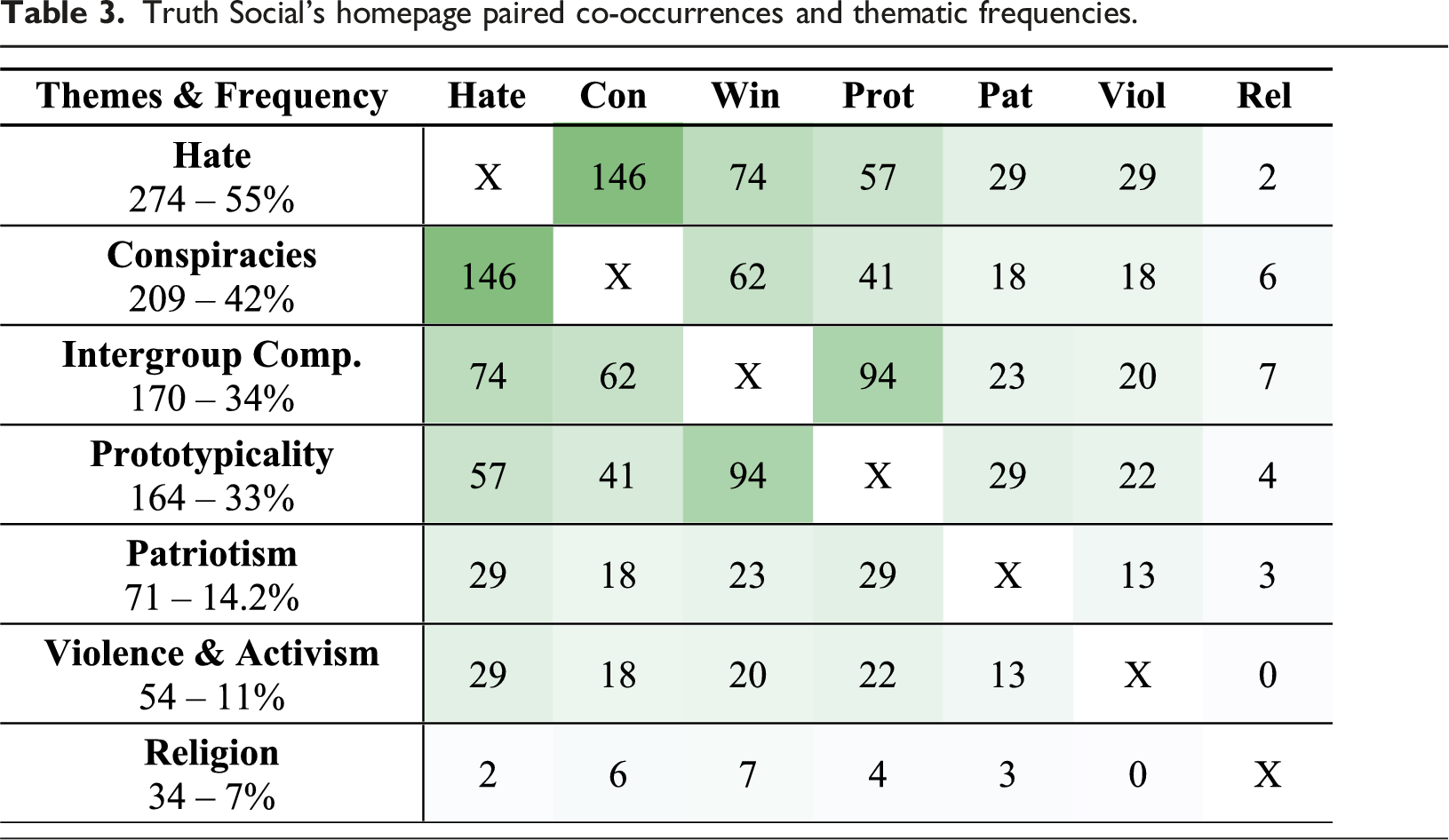
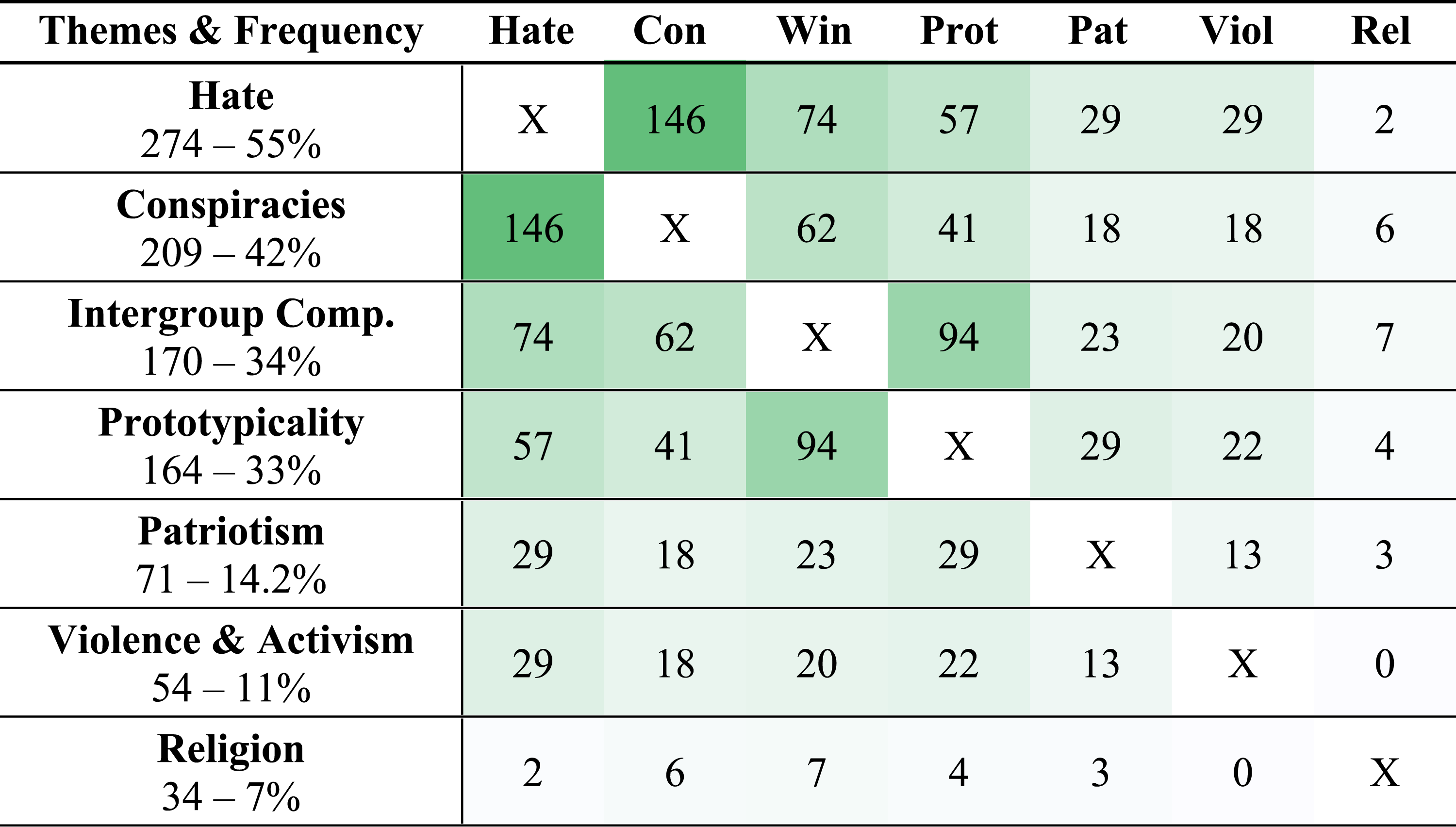
The first combination for constructing the platform’s technoculture is intermixing hate, conspiracies, and intergroup competitivity. Self-defined ‘MAGA’ Republicans utilise the three-way pairing to redefine previous election results, battle the ongoing corrupt system, and pre-emptively hedge narratives for future losses. The fieldnotes focused on the userbase’s ‘complete reliance on an alternative ontology’ that portrays Trump and his constituents as the victims of an underlying corrupt elitist scheme: I support President Trump against this blatant disregard for the rule of law and what stands as the most blatant case of election interference in American history. MY CIVIL RIGHTS HAVE BEEN TOTALLY VIOLATED WITH THIS HIGHLY POLITICAL, UNCONSTITUTIONAL, AND ELECTION INTERFERING WITCH HUNT. OUR FAILING NATION IS BEING LAUGHED AT ALL OVER THE WORLD!
Constructing an ‘everybody against us’ victimhood narrative unifies the community with past and present electoral grievances (Capelos et al., 2025). As seen in the final all-capitalised post, Trump is inclined to perpetuate these narratives as a strategy to mobilise the platform’s participants around this anger. This stratagem is exemplified by the ‘Swamp the Vote USA’ platform campaign, which suggests that by mobilising many online supporters, the election results will be ‘too big to rig’. Platform users believe, from my observations, that the only way they can lose (and have lost) is by ‘cheating’ or by ‘playing in an unfair game’. In the context of conspiratorial intergroup competition, the community effectively absolves itself of accountability for electoral failures, thereby maintaining a continuous sense of ‘winningness’ (Collins, 2025; Van Prooijen, 2024). Trump further capitalises on these sentiments by crafting conspiratorial narratives around perceived ‘witch hunts’ as proof of his ongoing success, which the userbase is disposed to accept as part-and-parcel of the alternative ontology created on the platform.
Through a conspiracy-based technoculture that posits a rigged system against Trump, I documented how users cast the president as the ‘prototypical hero’ who, upon re-election, will restore the country to a ‘perceived former glory’ (Olson, 2020). This portrayal leverages the concept of prototypicalism alongside intergroup competition (Hogg, 2018), leading participants to define their in-group identity based on Donald Trump’s success and the qualities he embodies. My experiences suggest that the Truth Social community’s entire technoculture is predicated on Trump’s influence, with the userbase ‘depending on him for its survival’. From this environment, Trump is elevated to a near-divine status, regarded as infallible by the platform’s users: If Trump is imprisoned, he will transcend being just a man. He has already become a symbol for the people, an idea. His public struggle has become a powerful catalyst, awakening millions who might have otherwise remained unaware. Damn fucking right we want to eliminate the democracy you know. It’s why you are all shitting yourselves over being ousted. Trump is going to BLOW UP Washington starting his first day.
Participants remark that regardless of the decision in his 2024 hush money trial, the president’s image and popularity will only increase. Others noted their ‘proudness’ in supporting a convict as a symbol against the corrupt system. Building upon this prototypical status Trump receives in the platform’s postings, various participants outline the observed ‘messianic-like patriotism’ he fulfils for the country: I just want to give President Trump the biggest hug! He is truly fighting for America, for all of us, and for future generations. God bless you, sir! President @realDonaldTrump is taking the fight so that the American people don’t have to. This trial was rigged, but he stands firm for us and our country. November 5th—A day of reckoning—the most crucial moment to make our voices heard!
The resulting findings, which mix prototypicality, patriotism, and intergroup competition, highlight the overarching reliance on Donald Trump as the American saviour who will elevate in-group status. I noted this as a ‘dramatic framing of the stakes’, where Republican victory is existential and casts the presidential election (2024) as a battle between good and evil, with the country’s (and platform’s) survival at stake. The homepage content creates and reinforces this dichotomy, presenting a scenario in which either Trump triumphs in the next election or the entire nation suffers. Consequently, it becomes ‘the collective duty’ of the platform’s participants to vote for their prescribed messiah and uphold the winning-based technoculture of the group.
Gettr and a conspiratorial alternative ontology
Gettr’s homepage themes and conspiratorial content.
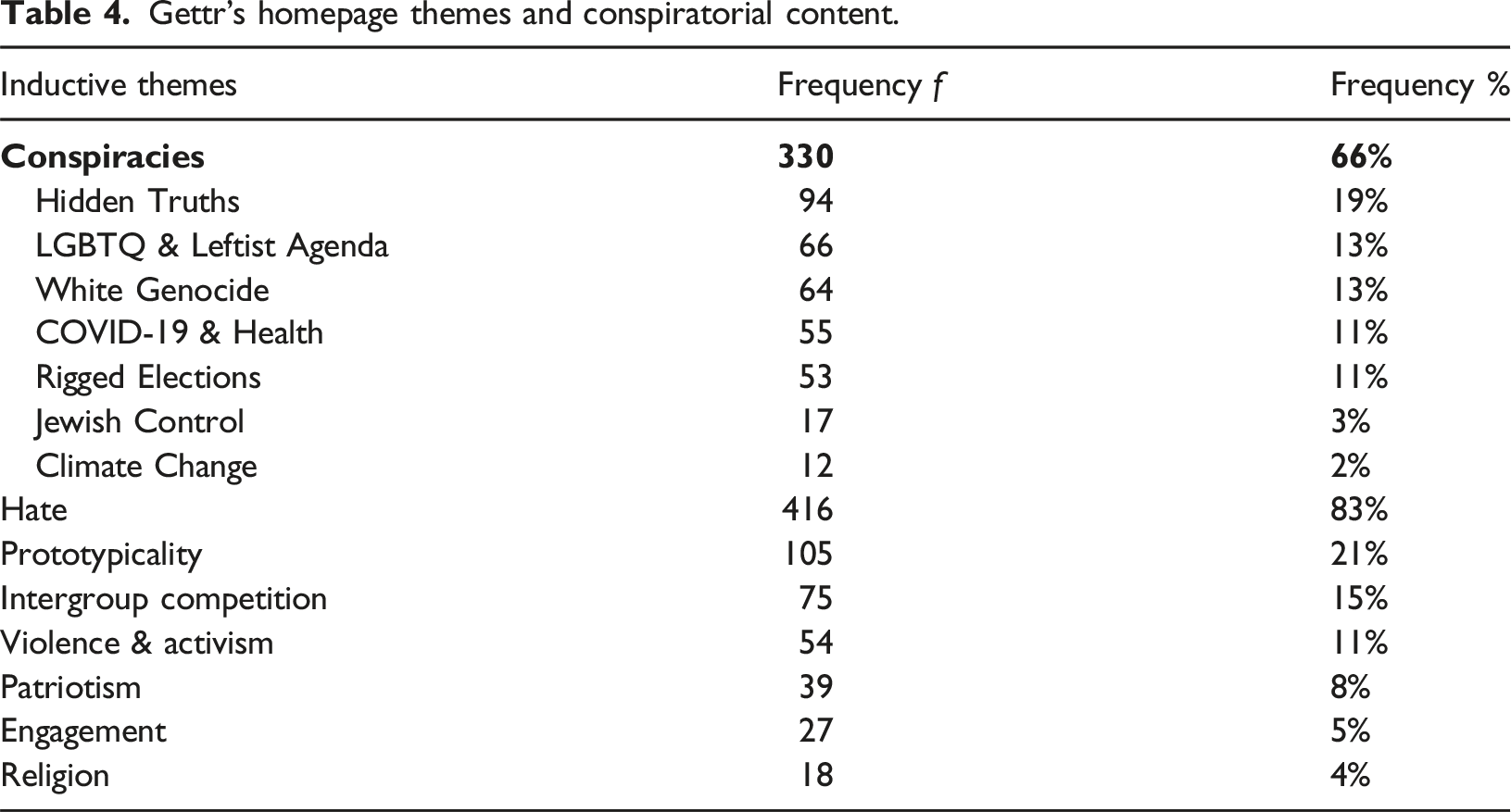
Therefore, there are two primary technocultural processes to unpack on Gettr: (1) the purposeful overload of (false) information and (2) the resulting content milieu and its effects on participants’ media consumption. What type of conspiracies are used to blur ontological lines? For instance, Hidden Truths encapsulates a mixture of different topics. The fieldnotes documented these subjects to include everything from the ‘Masonic’ symbolism in Taylor Swift concerts to indoctrinate her young fanbase, to Ukrainian lies about the ongoing war and president Zelenskyy’s corruption, and how astronauts have never walked on the moon. At times, I found myself challenging the ‘ridiculousness’ of these statements. However, their purpose is not random. Rather, overloading ontological certainty with conspiracies provides the seamless gateway or segue into more extreme narratives (Baele, 2019). If the community is more accepting to alternative information, then it becomes easier to peddle far-right content from across the radical milieu and virtual ecosystem. Therefore, this dynamic creates a continuous conspiratorial mixing on Gettr’s homepage, denoted as ‘light’ to ‘dark’ discursive material.
Through the ontological unlocking and conspiratorial priming on Gettr’s homepage, far-right extremist narratives thrive. What was apparent from the Netnographic process is that the userbase firmly believes that society is undergoing a ‘deliberate process of white genocide’, where Judaeo-Christian values, traditions, and cultures are being purposefully destroyed and/or replaced (Ekman, 2022). Other members take it a step further, suggesting an active plot to annihilate the worldwide Caucasian population (Greene, 2019). These radical conspiratorial interpretations manifest into paranoia that the whole of modern society is against these far-right participants and the virtual ecosystem, covering a range of societal institutions – government, education, medicine, science, mass media, and law. Within this genocidal-belief framework, the fieldnotes and accompanying posts make clear how each conspiracy theory fits together into the larger technocultural puzzle. For instance, attacks against the LGBTQ population frame the issue as one of education and protecting children: Schools Will Never Be Worth Anything Until The Progressive Liberal Woke Demented Teachers Are FIRED ! All The Perverted Principles Are Thrown Out Of The Schools ! All The Gay Woke Flags And Other Crap Are Cleared Out Of Every Classroom !
Conspiracies against governmental institutions and immigration policies present an orchestrated invasion of the country as preparation for an impending race war: This goes beyond just votes—a hidden force is being placed within our country: millions of military-aged men from adversarial nations. Do you really believe that figures like Obama and other powerful actors wouldn’t arm them for a potential conflict on American soil? Think again!
And finally, COVID-19 and the vaccination program is presented as a means to eliminate the white race, with the current truth being covered up: A more pressing question is: How many people have suffered harm or lost their lives due to these experimental injections? And why aren’t those responsible for the pandemic facing charges for crimes against humanity?
Piecing together pseudoscientific facts with anecdotal evidence from ‘experts’ and other community members, Gettr’s homepage establishes a fear-based technoculture where societal institutions plot to destroy them. These sentiments promote a documented ‘resilient collectiveness’, as the in-group unifies against the common threat and develops new knowledge on potential solutions (Ren et al., 2022). Within this environment, to survive, the community increasingly must place their trust internally in other members who also create, promote, and believe in the ‘white genocide’ ontology (Davis, 2025).
Parler and a rebuilding community
Parler’s homepage themes and community engagement.
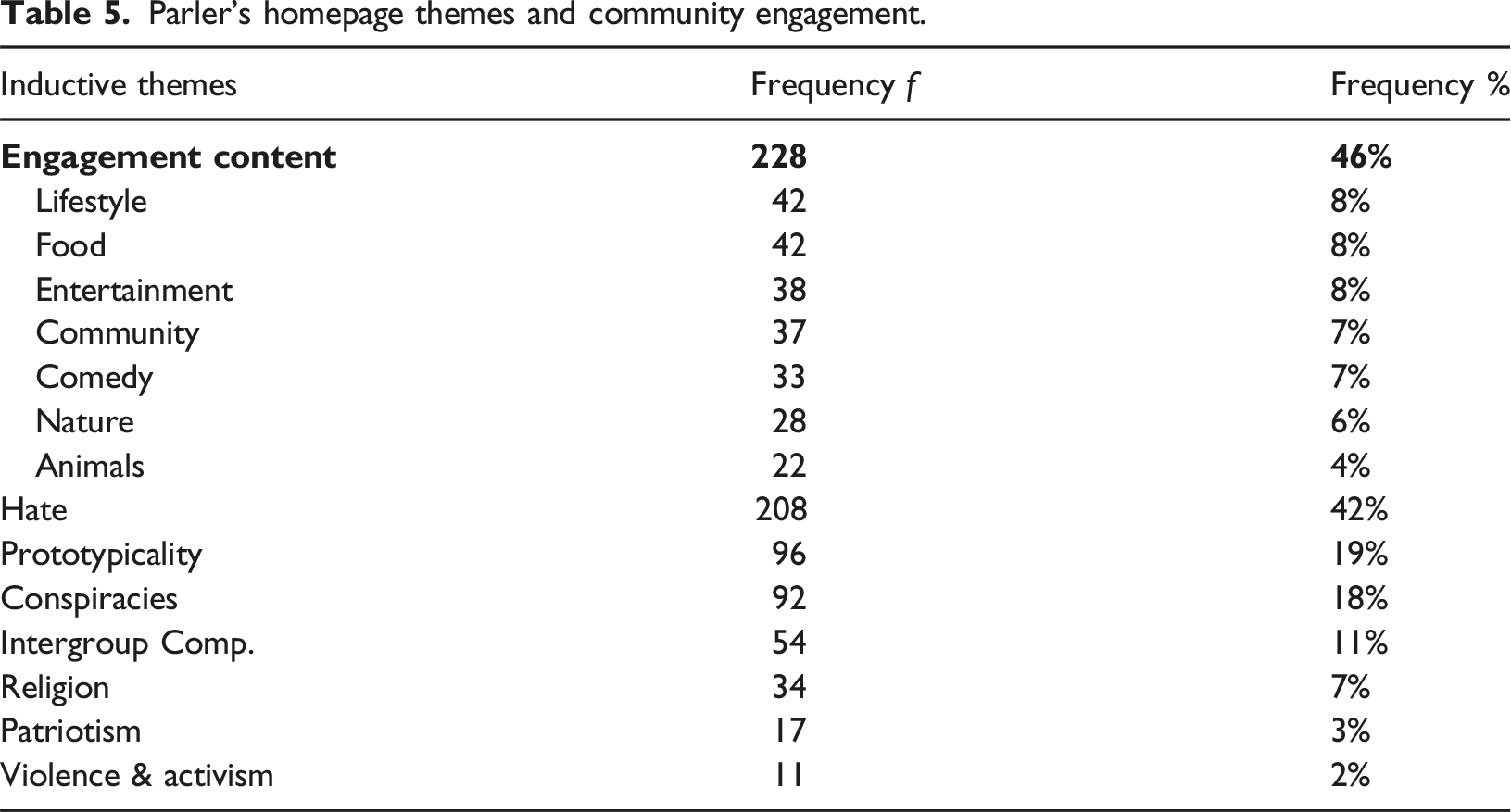
Due to the platform shutdown and the subsequent significant loss of its userbase (Similarweb, 2025), Parler needs to reconstruct its community and re-establish a viewership. The userbase thus relies on different community-building technocultural processes self-described as being ‘light-hearted’, ‘personable’, and ‘relatable’ to achieve this (Y. Ren et al., 2012). Subsequently, these environments must first establish a positive sense of belonging and attraction (Pardede and Kovač, 2023). The article demonstrates that the base for all social media platforms, alt-tech included, necessitates forming and maintaining a connected community and userbase before it can start amplifying extremist material.
(Re)constructing a community requires positive affiliations with the environment and its participants (Antonsich, 2010). If the userbase and social movement are to convince those curious about the website to join, then they need to be able to present themselves (the in-group) in an attractive fashion (Collins, 2024; Kim et al., 2023). I observed how the content on Parler’s homepage ‘accentuates the positive qualities’ of its community in both direct and indirect ways. A straightforward strategy is simply self-advocating for the platform: Worried about the impact of social media on your children? Parler is pioneering a new path by creating a cleaner, safer space for kids online! Let’s go! Parler is dedicated to building a secure, innovative platform where everyone can have a positive experience on social media. Thank you, Parler!
This tactic provides an easy means for potential future members to see exactly how the in-group conceptualises their virtual social space. Subsequently, explicitly presenting the environment as ‘safe’ and a place for positivity is an effective recruitment tool for those interested in joining the social movement (Kim et al., 2023; Törnberg and Törnberg, 2024). Simultaneously, the journaling process detailed that it is not just about how users conceptualise this space, but the other ‘indirect means’ of positive affirmations developed through their postings: Feeling grateful every day to live in a place with sunsets like this! Happy Monday! Wishing everyone an amazing week ahead. Keep your face towards the sunshine, and the shadows will fall behind you. Hello World! #NewUser My name is Siera. I enjoy spending time with others and can be outgoing. I love the outdoors, animals, and nature!
By individuals sharing their everyday lives, experiences, and upbeat values on Parler’s front page, these elements place a communal emphasis on positivity and openness that helps foster a sense of belonging among users (Collins, 2024). Moreover, the site uses hashtags to group those interested in similar topics to further situate this belongingness, including #parlereats, #parlerpets, #parlersports, and #parlermemes. The subsequent findings and immersive experience illustrate the technocultural development of these alt-tech social media spaces and how they construct environments to later introduce (or ‘squeeze in’) extremist rhetoric. Positivity thus offers itself as a potential precursor or foundation for future hate.
Conclusion
This study examined how alt-tech social media platforms strategically construct homepage content to shape user engagement and recruitment. Through a comparative analysis of Gab, Truth Social, Gettr, and Parler, the findings reveal that these platforms do not merely function as counter-publics but actively cultivate and present distinct technocultural environments that reinforce different aspects of the far-right’s hate-filled ontology and ideology. While Gab amplifies hostile out-group scapegoating, Truth Social fosters political loyalty and recruitment through Trump-centric narratives, Gettr sustains engagement through conspiratorial reinterpretations of reality, and Parler prioritises community rebuilding as a foundation for future participation, all four platforms rely on affective and ontological technocultural framings to sustain user engagement. By centring their predominantly hate-filled narratives around grievance, out-groupings, and belonging, these environments work together, playing an active role in (re)shaping far-right digital participation. The findings also showcase that recruitment within alt-tech social media aims to fulfil diverse technocultural niches, which satisfy its participant’s different needs for hate-filled discourses.
What do these comparative homepage findings mean concerning the nexus of alt-tech and mainstream social media platforms, and why should we care about the types of media users are originally presented when visiting these spaces? Within the hypercompetitive attention economy (see Maly, 2024), hate offers a unified and simplistic discursive tool to connect userbases and websites. As such, disseminating highly emotive hate-filled content offers participants seamless bridges across platforms. This linking creates a continuity of ideological and narrational messages while providing easy markers and expectations for community belonging. These mechanisms are further compounded by mainstream social media’s recent shift toward alt-tech moderation policies or lack thereof (Otero and Scharlach, 2025). For instance, both X and Facebook have loosened enforcement around harmful speech by defunding their Terms & Service teams (Moran et al., 2025) and promote divisive material to maximise engagement (Milli et al., 2025).
Moreover, as exemplified by the homepage findings, the many forms and variations that online hate attractivity can take make the movement difficult to disrupt. Within the outlined ‘retributive hate’ framework, users are not forced to choose between platforms, since hate remains attractive in multiple guises and circulates across social media spaces. The growing interconnection of milieus and content sharing across platforms (see Baele et al., 2023) ensures that when a topic loses resonance, others are quickly adopted, sustaining a continuous cycle of emotive attraction (Collins, 2023, 2024). At the same time, virtual far-right communities (within the alt-tech and mainstream) collaborate to reinforce discourses and compete to establish platform attractiveness (Ahmed and Pisoiu, 2021; Sengul, 2025). These push-and-pull competitive dynamics underscore how difficult it is to counter such narratives, as hate is continuously (re)produced in different mediums to attract more eyes. As moderation mechanisms weaken and their milieus expand, hate is amplified rather than contained, drawing more users into far-right ecosystems. In short, hate sticks.
More research should still be done to establish alt-tech’s interconnected nature. Whereas identifying the individualised and common technocultural elements serves as a fascinating steppingstone for bettering the field’s understanding of the alt-tech social media platforms, it does little to centralise these spaces under a common umbrella. Herein, the article suggests a novel baseline argumentation that simply maintaining the conceptualisation of alt-tech as a counter-public technological adaptation no longer captures the utility of these spaces for its users. Rather, these social environments now serve as communal spaces of (hate-filled) retribution, with the selected platform homepages advertising numerous pathways in which the far-right community can seek revenge for perceived grievances. While these retributive avenues differ across platform technocultures, the communities present themselves as a cohesive movement mobilised against passed transgressions and out-groups.
Moreover, future research should explore how alt-tech platforms evolve within the broader far-right ecosystem and how these spaces affect far-right radicalisation. At the macro level, combining Netnographic insights with social network, metric, or computational approaches would allow scholars to map the complete ecosystem better, tracing how structural interconnections and media flows sustain and promote one another. At the micro level, more direct interactive techniques (i.e. interviews, focus groups) would provide a deeper understanding of user experiences. Scholars could examine why participants occupy these spaces, how they interpret their involvement, and in which ways alt-tech content and interactions shape their radicalisation. Such research would also help situate alt-tech more firmly within the broader far-right ecosystem and align it with other contemporary foci in extremism studies. For instance, scholars could study how narratives originating in alt-tech spaces migrate to mainstream platforms, other alternative media sites, and offline contexts. This novel agenda would help establish how (and in which ways) alt-tech platforms are not isolated counter-publics but integral components of a wider digital ecosystem sustaining the far-right.
Footnotes

Ethical Considerations
The study received IRB approval from the Committee for Ethics in Research, Faculty of Social Sciences, Charles University in Prague.
Funding
The authors disclosed receipt of the following financial support for the research, authorship, and/or publication of this article: This work was supported by the European Regional Development Fund project 'Beyond Security: Role of Conflict in Resilience-Building' (reg. no.: CZ.02.01.01/00/22_008/0004595).
Declaration of conflicting interests
The authors declared no potential conflicts of interest with respect to the research, authorship, and/or publication of this article.
Data Availability Statement
Due to the sensitive nature of the collected content, the data is available upon reasonable request.