




Abstract
This study employs a neural network approach to investigate the dissemination and content of populist ideas within the Israeli political Twittersphere. By analyzing a data set of Twitter activity by Israeli lawmakers from 2013 to 2022, the study reveals a consistent increase in the frequency and concentration of populist ideas, particularly among legislators from religious-nationalist parties. The analysis of the topical content of populist ideas spread on Twitter highlights the significant impact of legal proceedings against the Prime Minister on political discussions. It delineates the development of a Manichean discourse among the center-left and a complete populist cosmology among the right, reaching its peak in 2022. The study demonstrates the utility of such approaches in understanding the evolution and dissemination of populist ideas, as well as the challenges faced by the backsliding Israeli democracy.
Introduction
The idea of populism—mainly, but not exclusively in its radical-right form, is having its day, with many parties from the so-called mainstream “accommodating” by adopting populist ideas (Wagner & Meyer, 2017). These trends call for a comprehensive characterization of the types of populist ideas in political systems, and how they evolve. Because populism is an idea that can attach itself to various political ideologies (Mudde, 2004), research has moved beyond the “usual suspects” approach and has begun to examine comprehensive corpora of leaders’ speeches or party manifestos. This has led to important methodological developments and a deeper understanding of populism at the party level (Di Cocco & Monechi, 2022; Jenne et al., 2021). However, such research has thus far provided snapshots—rather than a dynamic, contextual view—of populist ideas. Furthermore, it has ignored the flow and penetration of populist ideas among parties’ rank and file members. Consequentially, we lack an understanding of the actors likely to distribute them, the timing of their distribution, their concentration within parties, and the dynamic structure and development of such ideas.
Because the adoption of social media among politicians in established democracies is very high (Haman & Školník, 2021), it can be analyzed to attain such a dynamic, detailed perspective on populist ideas. However, most studies use data clustered around events such as elections or crises (Hameleers et al., 2020; Lacatus, 2019; Schmuck & Hameleers, 2020), and neglect to inspect intra-party dynamics. Our research takes a different approach: following studies using large-scale social media data to inspect the political and societal impact of such platforms (Barberá, 2015; Castanho Silva & Proksch, 2022; Theocharis et al., 2020), we analyze the evolution of the topical content and the distribution of populist ideas among Israeli parliamentarians (Members of Knesset, MKs) in the 2013–2022 period and their level of penetration into parties’ communications.
We investigate the Israeli political Twittersphere because Israel is an important, yet understudied, case for the examination of populist ideas. For decades, scholars have been pointing to radicalization of Israel’s nationalist and clerical right-wing parties (Pedahzur, 2001; Perliger & Pedahzur, 2018) as well as the transformation of Likud—Israel’s largest party—toward populism (Ben Porat & Filc, 2022; Filc & Pardo, 2021). However, the recent surge of authoritarian populism underscores the critical need for a thorough, systematic examination of the dynamics of this radicalization. 1 Early cross-platform research questioned the utility of Twitter for studying populism (Engesser et al., 2017; Schmuck & Hameleers, 2020). However, recent research, both comparative and Israel-focused, has analyzed data collected after Twitter’s switch to a longer tweet format in November 2017, and has demonstrated its effectiveness for studying populism (Jacobs et al., 2020; Lavie-Dinur et al., 2022). Especially given Trump’s effective style on Twitter (Bucy et al., 2020), we view it as an invaluable platform for the study of such ideas.
We employ a supervised learning approach that combines hand-coding with a neural network to detect populist ideas—communicated via subframes that express closeness to or admiration of the people, antagonism toward the elite, and exclusion of outgroups—in a comprehensive data set of tweets posted by Israeli legislators. 2 Using this framework, we identify a notable increase in the prevalence of populist ideas within the political Twittersphere, particularly, but not exclusively, among legislators from right-wing and religious-nationalist parties. Furthermore, we report that, within parties, populism is no longer limited to specific factions or legislators. The analysis reveals that legal proceedings against the Prime Minister played a pivotal role in the development and crystallization of populist ideas among political parties. Overall, the communicational processes unraveled here are comparable with phenomena transforming politics in Europe, as exclusionary and anti-elite views move from the fringe to the mainstream, formerly center-right mainstream parties radicalize and embrace populism, and aggressive anti-elitist ideas penetrate centrist parties. When these trends occur simultaneously in one polity, they present challenging conditions for the resilience of democratic, and in particular, counter majoritarian institutions and norms. Indeed, as the ideational changes analyzed here preceded the rise of an extreme right-wing government in Israel that has attempted to curb the power of the judiciary, this research highlights the utility of social media data for mapping political ideas which might eventually threaten liberal democracy.
Theoretical Approaches and the Israeli Case
Our research relies on two approaches for the study of populism. The first is ideational (Hawkins & Kaltwasser, 2017; Mudde, 2017): it argues that populists view politics as a Manichean battle between the pure people and the corrupt elite who oppose their interests. This antagonistic view is often extended toward the “establishment/system.” Furthermore, populism can be inclusionary or exclusionary (Mudde & Kaltwasser, 2013). Inclusionary populism calls for the incorporation of marginalized communities into the political community, while exclusionary populism—characteristic of radical-right populist parties in Europe—creates the “people” by differentiating it from a threatening enemy within, an “outgroup.” Exclusionary ideas are commonly ethnic/nativist (Art, 2011), but internal enemies can be ideological, cultural or economic (Mudde, 2007, p. 65–69).
In the second approach we use, populism is conceived as a communication style and is manifested by the presence of specific discursive elements (Aalberg et al., 2017). Social media communications has provided a rich data source for communication style scholars: it has been argued that such communications enable political outsiders—backbenchers, opposition members, and extremists—to bypass other means of communication (Castanho Silva & Proksch, 2022; Hong et al., 2019). Populist actors, who invariably portray themselves as outsiders, prefer social media over other communication channels (Ernst et al., 2019). Gerbaudo (2014) suggested that populism has an “elective affinity” with social media, possibly because it enables an informal “vote” on ideas, echoing the populist notion of people-sovereignty, and creating non-hierarchical online communities (Hameleers et al., 2020). Influential communication style studies have characterized the distribution of populist messages across political actors: in their cross-national analysis of parties’ posts on Twitter and Facebook, Ernst and Engesser (2017) and Ernst et al. (2017) have found that populist communication is more prevalent at the ideological extremes, echoing previous results from Belgium (Jagers & Walgrave, 2007). Another strand showed that all actors, but more so extreme parties, increase populist communication during elections (Schmuck & Hameleers, 2020), and that these messages lead to additional user engagement (Bobba et al., 2018).
Work on Israeli populism has mainly engaged with variants of the ideational approach. Thus, for example, Filc (2010) pointed to Likud party’s historical use of inclusionary ideas to mobilize Mizrachi Jews by calling for their symbolic, economic, and political incorporation. He also argued that 20 years later, the Ultra-Orthodox Sephardic Torah Guardians party combined inclusive populism, anti-establishment rhetoric with ethnocentric, exclusionary ideas. Further research has focused on the transformation of Likud under Benjamin Netanyahu from an inclusive populist movement, to a radical right exclusionary one (Filc, 2018), and recent work points to Likud’s embrace of anti-elitist, conspiratorial ideas (Navot & Goldshmidt, 2022). In the same vein, a recent expert survey—which relies on an ideational framework—rates Likud as maximally populist (Norris, 2019). Levi and Agmon (2020) use the ideational approach to highlight anti-elitist inclinations by the religious-nationalist Jewish Home, which has targeted civil society organizations as well as judicial and legal oversight systems. Perhaps the only study using the communication style approach in the Israeli context was done by Weiss Yaniv and Tenenboim-Weinblatt (2016). While echoing findings by ideational scholars, their work also points to centrist populism. Specifically, they argue that the There is a Future centrist party use of anti-corruption, and anti-elitist ideas resembles communications used by centrist/valence populist parties in Central and Eastern Europe (Zulianello & Larsen, 2021). Finally, research on the use of social media by Israeli politicians had found that it provides challengers and outsiders an effective way to engage with voters (Samuel-Azran et al., 2015) and that they use it to communicate with journalists in order to impact the overall issue agenda (Lavie-Dinur et al., 2022).
Coding Populism, Data, and Validation
Our conceptualization and measurement of populist ideas in posts follows directly from the ideational and communication style approaches. Specifically, we combine the actor-oriented ideational approach with the view that populism can be measured by examining its communication style across all political actors (Vreese et al., 2018). The ideational approach offers a clear and concise conceptual framework for identifying populism’s core ideas, and work within the communication style approach (e.g., Jagers & Walgrave, 2007) provides a practical way to measure it in political discourse. Specifically, we build on the insight that populism can be measured along three dimensions/subframes: reference to the people (people-centrism), a rejection of the elite/establishment (anti-elitism), and a demarcation between the people and an enemy within (outgroup exclusion). Therefore, our classification of tweets relies on identifying these subframes, as outlined below. 3
People-Centrism and People-Sovereignty
A necessary component of any populist communication is “the people.” We follow the communication-style approach in coding messages that explicitly feature a monolithic, virtuous political community, and to which the communicator shows closeness as people-centric (Ernst & Engesser, 2017). The community can be based on national, religious, ethnic, political, or class-based criteria. References to it can be, for example, “(the) people,” “(the) public,” “(the) citizen(s),” and “(the) voters.” Furthermore, much like Bracciale and Martella (2017), we view references to people sovereignty, which embody a majoritarian, non-compromising vision in which the will of the sovereign should be adhered to (Urbinati, 2019), as people-enteric.
Below are excerpts of tweets that include a people-centric subframe:
(1) The people decide, they are the sovereign . . . while maintaining their unique Jewish state, the Jewish majority, Jewish Zionism, and the decisions of the majority.
(2) Praying together with all the great people of Israel for a long period of peace and security! Shabbat Shalom and only good news.
Anti-Elite/Establishment
Populism’s core idea is a Manichean struggle between the people and the elite (Hawkins & Kaltwasser, 2017). Elites are viewed as having disproportionate power, illegitimately thwarting the implementation of the will of the people (Mudde, 2004). Populism is also a profoundly anti-establishment idea. Therefore, there are attacks on political institutions and the establishment for being corrupt and/or defective. Elites in this subframe can be specific or more diffuse political-institutional actors; they can be cultural, judicial, bureaucratic, ideological, or economic. We identify anti-elite/establishment tweets as those that portray elites/institutions/establishment as the antithesis of the people, as an enemy, where they are described as corrupt, exploitative, immoral, unaccountable or treacherous.
Below are examples of tweets that include anti-elitist subframes:
(1) This morning, the court in Egypt decided to outlaw the Hamas movement. Meanwhile, representatives of Hamas still sit in the Knesset.
(2) You may not be able to hear me, but I am screaming!!! When will the courts’ rule of shadows stop?!
Outgroup Exclusion
For outgroup exclusion, we build on the conceptualization of the people as separated not only vertically—from elites—but horizontally as well, from an internal, dangerous, socio-political group (Hameleers et al., 2017). Much like in anti-elitism, this subframe contrasts the homogeneous “people” with an enemy that is responsible for the injustice it has been facing. As opposed to the elite, the outgroup is the enemy within, a fifth column.
Below are examples of tweets coded as including an outgroup exclusion subframe:
(1) Israeli Arabs turn the funeral of terrorists into a demonstration of support for terror against their own country.
(2) You also learned to spread lies like your leftist friends . . . Druze are loyal and love the country. Not like your friends.
The three subframes of populism enable us to create a simple classification schema for populist tweets, which builds upon the distinction between the people and their rivals. As mentioned, a necessary condition for any populist message is a reference to “the people.” This demotic subframe is a starting point; in Jagers and Walgrave’s (2007), a reference of a people is considered as a preselector for fully developed, thicker, populist ideas. Thus, for a post to be coded as populist, it is should be more than demotic (March, 2017); we require that it reflects the populist ontology by referring also to the people’s rivals: the elite, or the outgroup. Thus, tweets are coded as populist if and only if an enemy from above (elites/institutions) or from within (an outgroup) is also mentioned. In other words, a tweet will be classified as populist in cases where it includes
A people-centrist and/or people-sovereignty subframe, and
Either an anti-elite or an outgroup subframe (or both).
Classification
Our data set consists of all tweets posted by members of the Knesset, from the period of January 1, 2013 to July 14, 2022. To construct it, we compiled a list of Israeli politicians who have served as MKs, identifying each of their official Twitter accounts. We used the Twitter Academic API to download the timelines of these accounts. Since the initial scraping in April of 2021, we have been downloading new tweets for each account on a daily basis. The resultant data set is 831,429 tweets, from 221 distinct Twitter accounts.
In order to label these posts for populist rhetoric we employed a supervised learning approach, leveraging a human-labeled sample to train a multi-layer convolutional neural network. From our data set of tweets, we extracted a sample of 5,586 tweets. 4 To ensure a sufficient number of tweets would include populist ideas, and because the frequency of such ideas in political communications tends to be relatively low (Hawkins, 2009), we selected half of our training tweets at random, and half based on concise lists of search-words:
People-centric/people-sovereignty: The people of Israel, sovereign, the public, rule of the people, will of the people, Jew, Mizrahi, Ashkenazi.
Anti-elite/establishment: Supreme Court, corrupt, detached, traitor, media, NGO, Attorney general, hegemony, rule, academia.
Outgroup exclusion: Arab, Islamist, terror, immigrants, asylum-seekers, Bedouin, enemy, Left, radical.
The lists use terms that map directly onto the broad underlying concepts. However, because populism is invariably context specific (Gründl, 2020), we have added some Israeli-specific terms. For people-centrism, we added the stem Jew*, because of the centrality and politization of the Jewish religion in Israel (Talshir, 2022). Second, in the outgroup exclusion group we have included groups that are targeted by radical-right populists in Europe, such as immigrants and asylum seekers, as well as terms specific to the Israeli case given the delegitimation of Arab Israelis’ (Perliger & Pedahzur, 2018). Relatedly, we included the stem left. This is because work on Israeli populism has pointed to a “chain-of-equivalences,” whereby ISIS is like Iran, Iran is like Hezbollah, Hezbollah is like Hamas, Hamas is like . . . the Palestinians, the Palestinians . . . are like the Israeli Arabs, and they are like the Israeli left, their loyalty of to the state and nation suspected. (Ben Porat & Filc, 2022, p. 74)
The process of hand coding—performed by two research assistants who were advanced Israeli political science students 5 —entailed reading the sampled posts and labeling them as matching any or all of these elements of populism. The coding was done with the supervision of one of the authors, who also served as an arbitrator in cases of disagreement. Table 1 summarizes the proportion of posts that received each label, as well as their inter-coder reliability.
Populism Categories in Training Data.

After the human coding stage was complete, from the set of labeled tweets, we randomly selected 80% for training a neural net, 10% for testing it internally, and 10% for out-of-sample evaluation of the neural net’s performance. We then constructed a multi-layer convolutional neural network. The first layer was the HeBERT pre-trained Hebrew language model based on Google’s BERT (bidirectional encoder representations from transformers) architecture (Chriqui & Yahav, 2022; Devlin et al., 2019). This neural network model was trained initially on a pair of large corpora of the Hebrew language: the OSCAR (Abadji et al., 2021) text corpus of 21 million Hebrew sentences, and the complete Hebrew language content of Wikipedia (3.8 million sentences). This layer is intended to train the neural network on what the structure of Hebrew in terms of the interrelation of words. The second layer was our set of hand-labeled tweets. The two layers function together to iteratively derive patterns in how both the labeled tweets vary from each other categorically, and how they vary from the Hebrew language in general.
Four neural networks were trained using this framework, one for each of the categories labeled. We did so by breaking the tweets into 10 equally sized, but randomly assigned bins. We trained each neural net 10 times: one using each of the bins as an out of sample test, with the balance of the other 90% of tweets used as the training data. This allowed us to perform k-fold cross validation to ensure that our evaluations of the model were not conditioned on an idiosyncratic draw. We present averaged truth tables for each model across all folds in Table 2.
Truth Tables for Training Stage.

All four populism models performed with over 80% accuracy. Because this metric can be misleading with rare events, we also report precision and recall. Importantly, for our purposes, precision rather than recall is the most important metric. This is because we would rather have a conservative estimate of populist ideas, which would not inflate and systemically bias our classification on populist tweets. Second, non-systematic false negatives do not affect our point estimates of populism while false positives could do so. That is, since we are measuring the aggregate populism in each legislator’s tweets, capturing every populist tweet is less important than ensuring that the model-identified populist tweets are accurate or at least not systematically biased.
All models perform with nearly two-thirds or better precision. Examining random samples of the false positives in each category showed no discernible systematic patterns in the misses for each of the first three categories. Outgroup exclusion shows some patterns in picking up on terms and phrases that are associated with populism in certain contexts but not others. However, the false positives do not follow systematic patterns correlated with other factors. Random samples of the false negatives in each category also revealed no systematic patterns. In addition, the magnitude of the false negatives is such that there is still sufficient quantity of expected true positives when aggregated to the MK level. Content that the models are adequately performing, we then trained a final set of models using all of the labeled tweets so as not to waste the out-of-sample tweets that were labeled. We then applied these models to the full set of tweets, so that each tweet was labeled as to whether it represented an instance of each of the categories of populism. To create the final data set, we have dropped posts where politicians were not re-elected to parliament, resulting in a final data set of 410,837 tweets capturing MKs’ tweets in 2013–2022.
Validation
A baseline expectation regarding our classification validity is that it would show that populist ideas exist across the ideological spectrum (Ernst & Engesser, 2017), 6 but that it would differentiate between parties described as populist in the literature to those who are not. In Figure 1, we present the proportions of populist tweets by party during the full period (Panel a). Given the change in tweet length and its potential impact we also inspect proportions from 2018 onward (Panel b). In line with recent research on extremism (Lazar & Cohen, 2022; Zur & Bakker, 2023), Panel a shows that the algorithm places three Israeli religious-nationalist parties at the top. Next are parties identified as populist in previous research, the Sephardic Torah Guardians and Israel Our Home (Ben Porat & Filc, 2022; Filc, 2018). The centrist There is a Future party comes sixth, followed by Likud. The findings for There is a Future echo Weiss Yaniv and Tenenboim-Weinblatt (2016). Given Likud’s shift to populism, its ranking might seem surprising. However, inspection of Panel b shows that since 2018, Likud MKs have increased their use of populist ideas, suggesting a process of dynamic radicalization toward populism.

Proportions of populist tweets and 95% error bands by party, (a) 2013–2022, (b) 2018–2022.
We now move to examine the correspondence between parties and the types of populist ideas their MKs spread. To do that, we estimate a 10-topic structural topic model (Roberts et al., 2013), using parties as predictors of topic prevalence. 7 Based on our review of the Israeli case and literature analyzing the European populist radical right (Mudde, 2007; Vachudova, 2021), we expect right-wing populist ideas to revolve around identity and judicial/oversight institutions, and the left to emphasize more social inclusion. We also expect parties opposing Netanyhau’s rule to emphasize government corruption. Results are presented in Table 3. 8
Three Most Used Topics and Topic Proportions in Populist Tweets by Selected Parties.
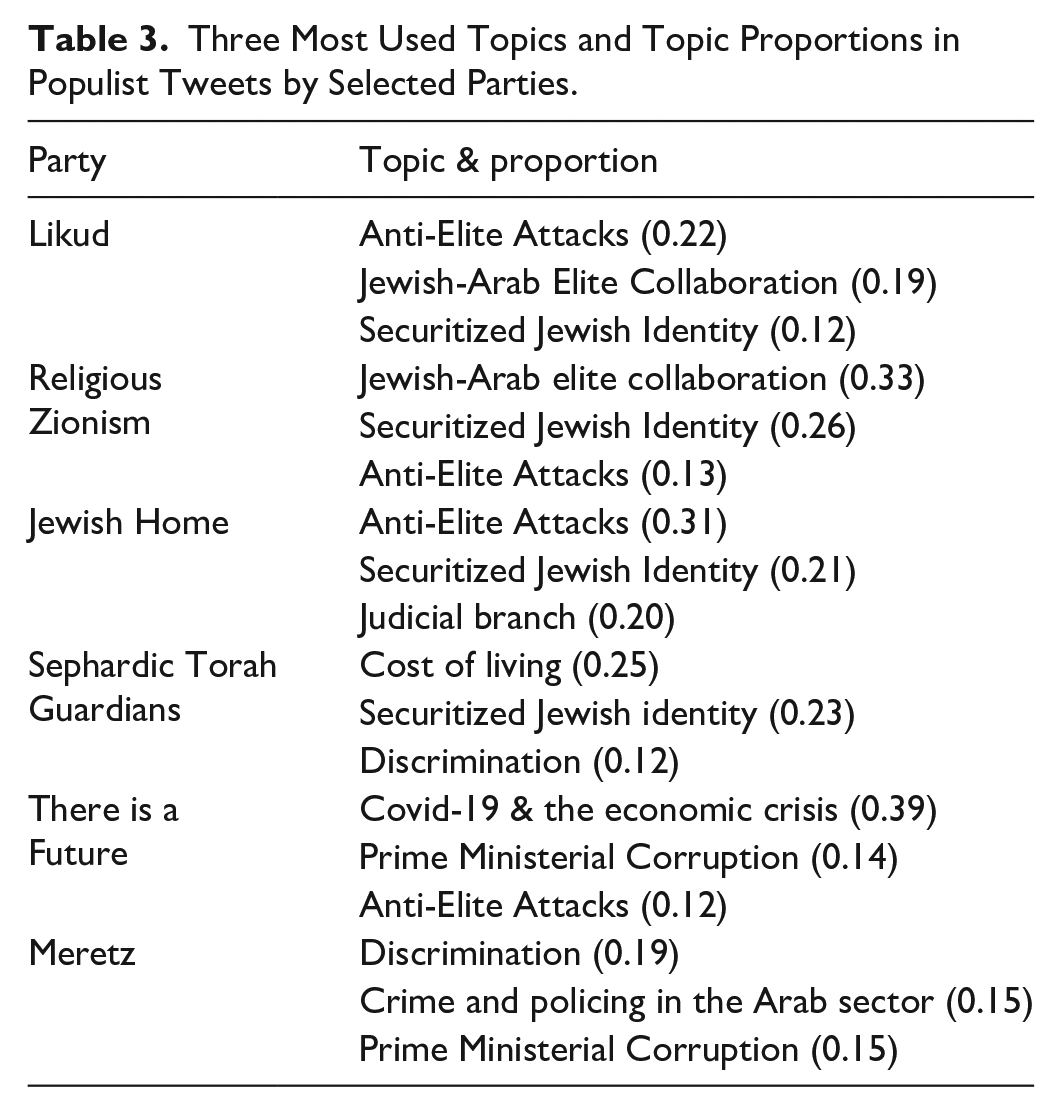
Beginning with right-wing MKs, we observe a high degree of topical overlap within the bloc. Consider Likud and Religious Zionism: more than 400 tweets Religious Zionism MKs and 600 by Likud focus on the a topic we have identified as Jewish-Arab Elite Collaboration, revolving around delegitimizing Arab political elites and cooperation with them. Furthermore, a salient right-wing theme is Anti-elite Attacks, in which various actors including oversight and law enforcement agencies, media, and others are targeted. Third among right-wing typical topics is what we termed Securitized Jewish Identity, in which terror or threats against Jews are politicized. Finally, an issue we call Judicial branch—comprising a fifth of Jewish Home’s populist tweets—captures the party’s well-known animosity toward the judiciary. 9 For the Ultra-Orthodox Sephardic Torah Guardians’ legislators, we find, reassuringly—given the party’s inclusive populism—that 25% of their populist tweets revolve around the issue of Cost of Living, as well as an issue we term Discrimination, which include a variety of calls for equal treatment and inclusion of minority groups.
Moving to the center, for There is a Future party the issue we call Economic crisis & Covid-19 is dominant, comprising of nearly 40% of its populist tweets (more than 500 posts), and captures the party’s aggressive line of anti-government attacks during the pandemic. Two additional topics identified by the model include tweets that also capture the party’s line of opposition to Netanyahu’s regime, pointing to systemic corruption stemming from his rule. Finally, we examine left-wing Meretz: 20% of its MKs’ tweets fall under the issue we have dubbed Discrimination, characterized by calls for inclusion of Arab citizens, also captured in its second most-frequent topic. Last, Meretz MKs, a vocal anti-Netanyahu party, have produced approximately 70 tweets falling under the Prime Ministerial Corruption category.
Overall, these tests indicate that our algorithm has preformed adequately: first, it has identified an ideologically broad spectrum of populist ideas. Second, it discriminated well among parties, identifying, for example, a higher tendency for populist ideas among the religious right and Likud, as well as other parties which are known to have displayed early signs of populism. Third, it has identified different varieties of populism, distinguishing between exclusionary and inclusionary ideas, as well as a number of anti-elite and identity-based ideas, all matching our expectations regarding the actor spreading such ideas. With these reassuring results, we move to examining in detail, the dynamics and penetration of such ideas.
Quantitative and Qualitative Findings
To examine the systemic dynamics of populist ideas’ distribution, we generate a variable capturing the monthly proportions of tweets including populist ideas. Figure 2 shows relative stability—around 1%—in populist tweet proportion during the 2013 to late 2017 period. This stable proportion doubles in late 2017. While further research is required, we believe this change is, most likely, attributable to the change in Twitter’s length policy, presumably increasing MKs ability to express more complex (including populist) ideas in a tweet. A steady incline follows in the next two and a half years, with proportions rising to 3%–4%. By the end of the time-series, proportions fluctuate above 5%.

Monthly proportions of populist tweets from full data set.
To understand party-level dynamics, we have disaggregated monthly proportions into constitutive parties. We present statistics for select parties in Figure 3, with center-left parties on left Panels, and center-right parties on the right. Beginning with There is a Future party in Panel a, we observe that the level of populism communicated by its MKs follows other parties until rising in March 2020. During this period, corresponding to the Covid-19 emergency, the opening of the PM’s trial, and to anti-government protests, proportions reach a mean of 7%, with populist post production at a mean of 3.3, reflecting a monthly populist tweet production of 40 for the entire cohort of MKs on Twitter. Populist rhetoric precipitously declines after the party joins a government coalition in 2021. These dynamics do not reflect all centrist MKs: they stand in contrast with the centrist Blue and White party (Panel c), where populist tweet production have been consistently lower than systemic levels. We finish our analysis of the center-left with Meretz: for MKs from this small party, tweet production generally followed systemic levels, with similar qualitative—but significantly lower populist tweet production—to that of There is a Future, including a swift decline in the production of populist posts once the party enters a coalition in 2021.
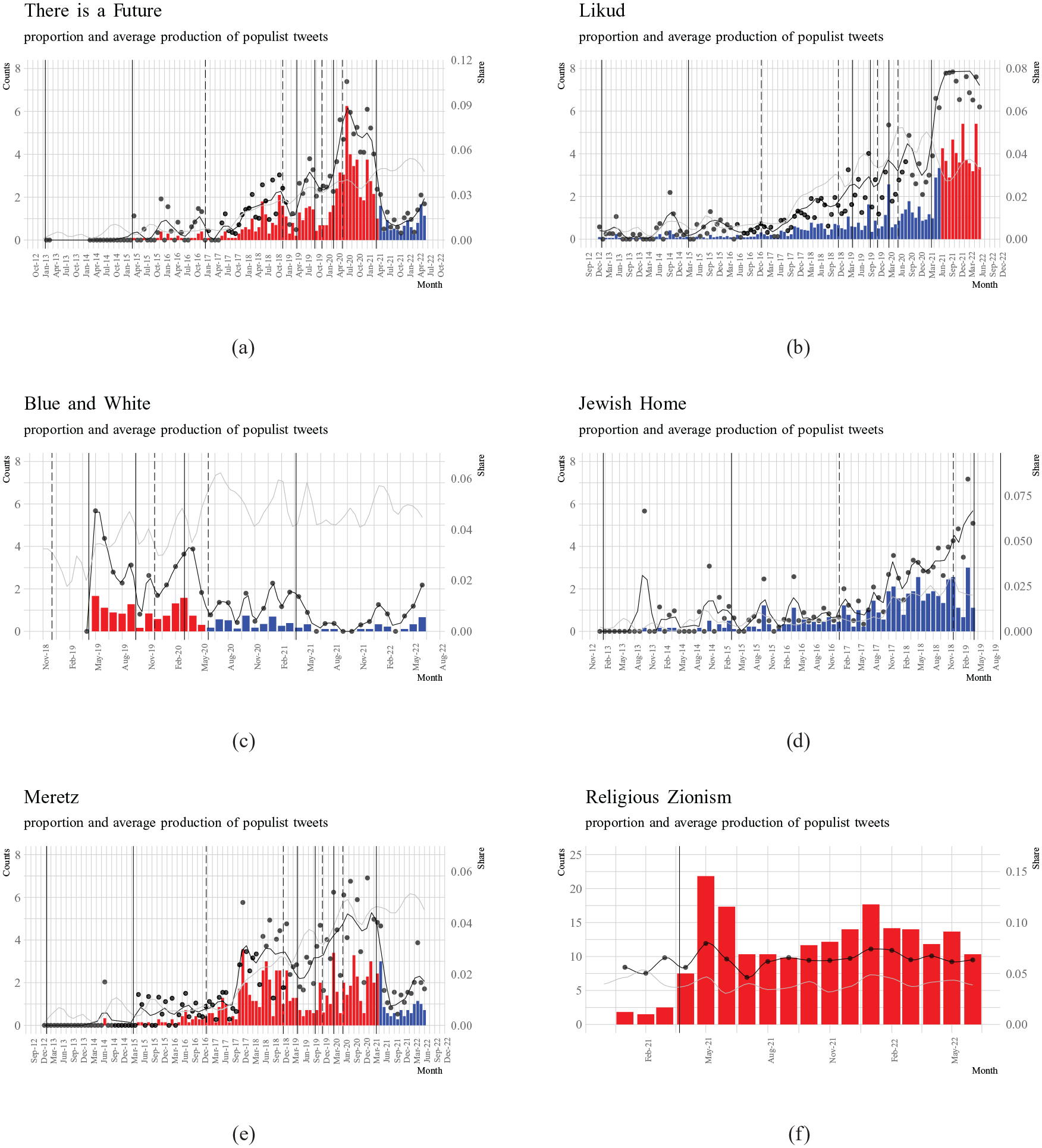
Points are party monthly proportions, along with a local regression line.
Turning to right-wing parties, Panel b displays proportions for Likud legislators. The party generally did not exceed the systemic mean level of populist tweets until 2021. After the loss of power in May 2021 this changes; Likud MK’s proportion exceed other parties’ by a factor of two/three. Considering Likud’s size of 30+ MKs, this means that during mid 2020-mid 2021 period—even prior to losing power—its MKs generated on aggregate 35 to 70 populist posts per month. After their move to the ranks of the opposition, this increased to 90 to 150 monthly populist posts. Panel d capture trends for Jewish Home party, demonstrating an early tendency toward populist ideas prior to the tweet-length policy change, and that overall, MKs that were more likely to post populist ideas relative to the systemic level. Finally, Panel f, presenting Religious Zionism MKs, is striking, with proportions exceeding other parties, at a period where systemic levels were already at their highest. Most strikingly, the figure demonstrates the amount of populist posts produced each month by its six MK: in all months following the 2021 elections, more than 60 tweets including populist ideas were posted, with more than 120 in May 2021.
Next, we examine within-parties concentration of populist ideas. To do that, we employ a similar approach to that used by Theocharis et al. (2020) in their study of online incivility; we generate a party-month level data set, in which every MK who tweeted a populist post during the month is coded one, and zero otherwise. We then calculate the Gini coefficient at the party month level; low scores reflect a party whereby populist ideas are more equally distributed among MPs rather than reserved for specific MKs or factions. We present results in Figure 4 for the same parties as above.
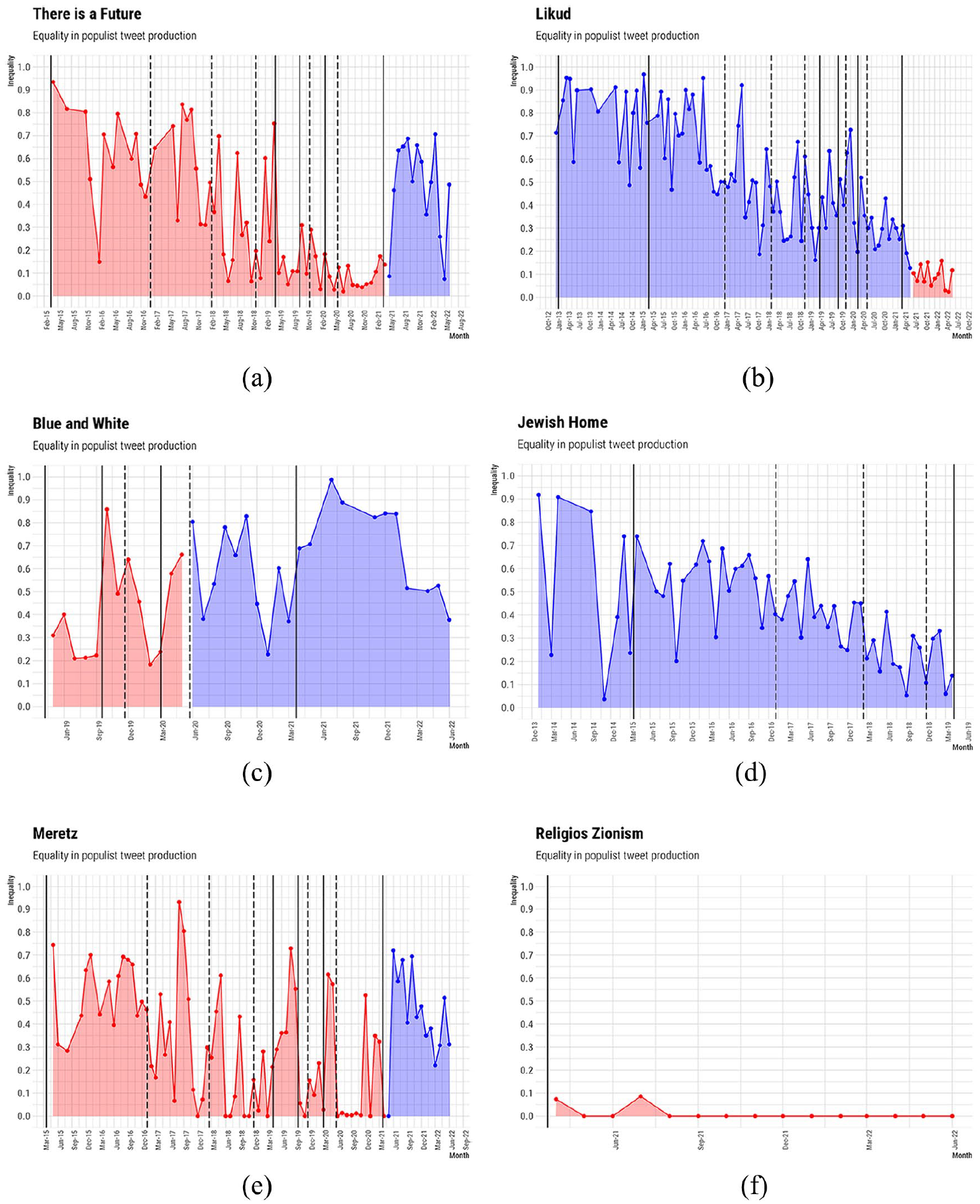
Gini scores for select parties.
For Meretz and There is a Future (Panels e and a), we observe high equality of populist tweet distribution among MKs during the period where their use of populist ideas became more prevalent (Figure 3). Inequality characterized their distributions once they join the coalition. Beyond those extremes, there is a high degree of variation. Examination of Blue and White Gini values reflects the fact that populist ideas have not taken hold among most of the party’s MKs. In contrast, when we examine the right-wing bloc, we see a clear downward trend for Likud and Jewish Home, reflecting an increased tendency toward equality, as all MKs begin to distribute populist ideas. Finally, the data for Religious Zionism are striking, again: throughout its entire period of existence, the party’s MKs are uniformly committed to distributing populist ideas.
The evidence thus far indicate that there has been a systemic increase in the tendency of posting populist ideas, that external events correspond to populist tweet production, and that there are considerable quantitative similarities within the right and left blocs, as the evolution of populist ideas followed similar dynamics for MKs within the camp. Here we describe the types of populist ideas that have evolved in the political Twittersphere, based on our reading of populist tweets. Among right-wing MKs, prevalent is the conception that the law and the judicial system should serve the people rather than being a liberal constraint on the power of the government. This idea is presented in many tweets, as early as 2017, for example: “The minority elite dictatorship of the Supreme Court try to abolish the law and go against the majority of the people of Israel and its elected officials,” or: “Our mission is to block . . . the Supreme Court and restore democracy and the values of the . . . People of Israel.” For Likud, it was the investigation, indictment and trial of the Prime Minister that pushed its communication patterns to rely on anti-establishment claims. Consider these typical tweets, posted in 2019, describing plotting against the PM: The scenes of joy in the news studios [after Netanyahu’s indictment] make clear . . . This is an attempt by the left with the assistance of the media and law enforcement to oust the Prime Minister and the Right . . . in recent years they have been working against us . . . Only the public will decide!
There was also a move towards Trump-like statements: “One of our first tasks after the election will be to close down the deep state which has become a monster and return our country to the people.” This line of arguments fits well with that of the religious right version of populism, with tweets such as, in May 2019, “The judicial branch has stolen democracy from the people.”
Right-wing anti-elite populism reaches its zenith after Likud loses power in May 2021. At that point we observe a new version of radical-right populism, in which right-wing opposition MKs focus on the illegitimacy of an elected government. Consider this tweet by a Religious Zionism MK: “This government is unlike any other . . . it is the only government in history formed by terror supporters and people who are uninterested in the state of Israel as the nation state of the Jewish people.” Anti-government attacks accused it of treason: Five more holy Jews were killed only because they were Jews .. thanks to the submissive and inept government that can’t even provide basic security to citizens. Terrorists understand that there is an extreme left-wing government! When the immunity system is weak the viruses attack!
Among the center and the center left, we identify a number of dominant, related, ideas. The overarching theme is Netanyahu’s legal troubles. The issue was so central that all government decisions were portrayed as part of widespread, ingrained corruption designed to extend the Prime Minister’s rule, mainly expressed by There is a Future MKs. This is captured in the following tweet: There is no citizen in Israel who doesn’t understand that . . . there isn’t a single decision not influenced by political considerations. People are dying because of this! The public in Israel has no trust in Netanyahu and his detached government.
This line of argument was also used, for example, in regard to the government’s difficulties in passing a budget: “By not passing the budget . . . for purely personal political reasons, Netanyahu committed a serious crime against our economy and against every Israeli citizen.” The government’s Covid-19 policies were also attacked, using the same rationale: There is no epidemiological logic in comparing the right of prayer with the right to earn a decent living . . . it is clear that no minister will take responsibility for the damage to the Israeli economy and citizens. Away with the government of darkness!
Discussion and Conclusion
We report an overall increase in the use of populist ideas, but does that capture other phenomena such as affective polarization or opposition status? With regards to affective polarization, we agree that the two are, and indeed, should be, correlated. However, our research deals with an elite-level behavior, not with public views, which might reflect myriad other processes. Furthermore, recent research on Israel’s affective polarization shows it has followed different trends to those we find in this research (Gidron, 2023). Further research is required to establish the causal relationship between opposition and increased populism in the Israeli case; while we do find that MKs in opposition are more likely to spread populism, the case of Blue and White party indicates that our classification is able to distinguish populism from merely opposing the government. A further point should be made regarding generalizability: while our method and analysis provide important insights for the study of populism, we acknowledge that our use of a context-laden vocabulary would require modification if one was to use similar approaches cross-country research setting.
Having said that, we have reached a number of important findings, both quantitative and qualitative in nature: quantitatively, that there has been a systemic, significant rise in the use of populist ideas in Israel’s political Twittersphere. This rise was remarkable among some actors in the center-left, but has been more pronounced, and almost linear, for right-wing MKs, culminating in unprecedented levels of populism by Likud and most significantly Religious Zionism MKs after March 2021. Relatedly, judged by Gini coefficients, by mid 2021, populist ideas have taken full hold of the right-wing camp.
Likud’s move from inclusionary to exclusionary populism, and the targeting of minorities and political opponents is well documented (Levi & Agmon, 2020). Furthermore, attacks by the religious right on the courts is typical to 21st-century populism (Blokker, 2019). But these two populist strands might have remained isolated in Israel. What seems to have brought them together are the legal proceedings against the Prime Minister; they have provided religious populists and Likud with a symbol and a common cause (Navot et al., 2022). A complete populist cosmology became available: the judiciary, media, and civil-society forces, working along with internal enemies such as left-wing voters and Arabs, in an attempt to topple the leader of the Zionist right, and thus thwart the “will of the people.” True to its complete populist shift, Likud’s 2021 electoral loss was portrayed as a mistake, and the government as illegitimate: along with Religious Zionism—the most radical party ever to sit in an Israeli parliament—the party adopted ethno-religious identity and security based arguments to portray the government as the enemy of the people. Netanyahu’s legal troubles have also galvanized populist ideas on the center, mainly by legislators from There is a Future party. Fueled by period characterized by a multitude of systemic crises, the party’s main message in opposition became an aggressive anti-elitist one, characterizing almost every major government policy as illegitimate and corrupt. Put in broader context, we believe our analysis of Israel’s Twittersphere indicates that it has encountered a combination of three populist currents: the first is captured by Likud’s transformation, which resembles processes of mainstream party radicalization in Poland and Hungary (Vachudova, 2021). The second resembles processes in Western Europe, in which the populist radical-right (Mudde, 2007), and in the Israeli case, the populist religious right, gains additional influence. The third, centrist-populism, again, resemble much of the anti-corruption, protest fed parties that have characterized post-communist systems (Pop-Eleches, 2010). As such, these three currents will prove it difficult for Israel to maintain a stable liberal democratic system in the face of current challenges and backsliding. More generally, insights from this case show how social media discourse can be used to identify early “symptoms” of ideational shifts toward authoritarian populism.
Supplemental Material
sj-pdf-1-sms-10.1177_20563051241265863 – Supplemental material for The Political Twittersphere as a Breeding Ground for Populist Ideas: The Case of Israel
Supplemental material, sj-pdf-1-sms-10.1177_20563051241265863 for The Political Twittersphere as a Breeding Ground for Populist Ideas: The Case of Israel by Eitan Tzelgov and Steven Lloyd Wilson in Social Media + Society
Footnotes
Declaration of Conflicting Interests
The author(s) declared no potential conflicts of interest with respect to the research, authorship, and/or publication of this article.
Funding
The author(s) disclosed receipt of the following financial support for the research, authorship, and/or publication of this article: This research was supported by the University of Anglia Faculty of Humanities Small Award.

Supplemental Material
Supplemental material for this article is available online.
Notes
Author Biographies
References
Supplementary Material
Please find the following supplemental material available below.
For Open Access articles published under a Creative Commons License, all supplemental material carries the same license as the article it is associated with.
For non-Open Access articles published, all supplemental material carries a non-exclusive license, and permission requests for re-use of supplemental material or any part of supplemental material shall be sent directly to the copyright owner as specified in the copyright notice associated with the article.
