



Abstract
We take two approaches to understanding democratically corrosive sentiment (DCS) in the US, which we operationalize in terms of populist attitudes, conspiracy beliefs, and expectation of fraud in the next election. Our first approach is media use, which is not well understood as a correlate of DCS beyond generalities about the harms of social media and partisan news. We distinguish between mainstream news and right-wing media, and between three categories of social media: those facilitating stronger ties among users, those facilitating weaker ties, and extremist Alt-Tech brands. Our second approach to explaining DCS is attitudinal. For this, we introduce a concept called Feelings of Being Devalued (FBD), which we offer as a complement to status threat and sense of material deprivation. Using a survey of our design (N = 2,000) fielded in the US in 2022, we show that: (1) mainstream news use and attention to right-wing media have opposite relationships with DCS; (2) not only Alt-Tech social media but also stronger-tie media such as Facebook are correlated with DCS, while use of weaker-tie social media such as X are uncorrelated in a model with a rich set of controls; and (3) FBD is strongly associated with DCS—more so than right-wing authoritarianism, social dominance orientation, and ideology.
Keywords
Democratically corrosive sentiments (DCSs) such as populist attitudes and conspiracy belief threaten the health of democracies. Research into the antecedents of such sentiments has emphasized two main predictors: materialist concerns associated with economic well-being, and considerations associated with identity and culture (Blum and Parker 2019). The role of media use alongside these as a factor in DCS has not yet come into adequate focus, although media clearly provide an important context for public opinion of all kinds.
Many observers identify some general connection between media use and DCS, especially for social media and mass media oriented toward propaganda. Yet empirical estimates of the associations between media diets and DCS have been mixed, especially for social media (Enders et al. 2021, 2022;; Min 2021; Piazza and Van Doren 2022; Uscinski et al. 2021). We find this an interesting puzzle, since opinion and exposure to media content are generally so deeply intertwined. In this study, we seek to advance understanding of media use as a correlate of DCS, in the case of the US. To do this, we distinguish two classes of mass media use and three classes of social media use, examining their different associations with populist attitudes and conspiracy beliefs.
In addition to studying the role of media, we are also interested in attitudinal correlates of DCS. In this study, we offer a new attitudinal measure that may work alongside material conditions and status threat associated with specific identities, and also alongside media use. We call this Feelings of Being Devalued (FBD). While the present study examines the US, we are interested in FBD as a concept that is not country-specific and that might serve for future comparative analyses. We test FBD together with our media measures as correlates of DCS using a cross-sectional survey of US adults (N = 2000) fielded in 2022. We find that attention to right-wing media and mainstream news have opposite relationships with DCS, as expected. We also find that in models with a broad set of controls, the use of weaker-tie social media apps such as Twitter is unrelated to DCS, while the use of stronger-tie social media apps such as Facebook, and Alt-Tech apps such as Gab, is positively associated. We also find that FBD is more strongly correlated with DCS than many commonly used predictors, such as right-wing authoritarianism and social dominance orientation.
Democratically Corrosive Sentiment: Populist Attitudes and Conspiracy Beliefs
Scholars have employed many approaches to measuring various attitudes that are corrosive of democratic norms (eg: Armaly and Enders 2022; Bartels 2020; Norris and Inglehart 2019; Kalmoe and Mason 2022; Kingzette et al. 2021; Malka and Costello 2023; Petersen et al. 2023; Piazza and Van Doren 2022; Simonovits et al. 2022). Uscinski et al. (2021) and Enders et al. (2022) demonstrate the value of distinguishing anti-establishment sentiment from extreme positions on the left–right ideological dimension, and we follow their approach. The anti-establishment dimension of opinion entails populist attitudes and political conspiracy belief, which share Manichean thinking and antagonism toward the political order. Populist attitudes are a central concern in democratic backsliding across democracies, including the US (Milner 2020; Weyland 2020). The thin-centered ideology approach to populism by Mudde (2004) has become widely used: Populism is belief in the opposition between some conception of “the people,” who are pure and good, and elites, who are corrupt and bad (Akkerman et al. 2014; Mudde 2004). A variety of measurement scales are available (Silva et al. 2020), and populist attitudes have many predictors in one or the other direction: political interest and knowledge, education, need for cognition, sense of political disempowerment, sense of loss of social or economic stability, right-wing authoritarianism, and social dominance orientation (Arzheimer 2009; Bornschier 2010; Marcos-Marne et al. 2022; Milner 2020; Pellegrini et al. 2022; Spruyt et al. 2016; Uscinski et al. 2021). In the US, support for Trump and populist-style antagonism toward democracy are predicted by racial prejudice and status threat operationalized as social dominance orientation (Abramowitz and McCoy 2019; Jardina and Mickey 2022; Mutz 2018; Piazza and Van Doren 2022).
Conspiracism is the companion to populist attitudes in the anti-establishment dimension (Milner 2020; Stecula and Pickup 2021; Uscinski et al. 2021). Both are associated with motivated reasoning, a nexus that van Prooijen et al. (2022) refer to as “populist gullibility.” The conviction that government elites work cohesively against the monolithic interests of the public overlaps with some specific conspiracy theories in the US, including Replacement Theory, QAnon beliefs, the Birther conspiracy, and various ideas about COVID-19 and vaccinations (Castanho Silva et al. 2017). Several predictors of conspiracism are shared with populist attitudes, including feelings of loss of control, discomfort with uncertainty, the Dunning–Kruger effect, perception of threat or marginalization, social dominance orientation, and anxiety (Douglas et al. 2017; van Prooijen and Acker 2015). Manichean thinking, right-wing authoritarianism, and education (inversely) also predict both (Oliver and Wood 2014; van Prooijen and Acker 2014). In the US, racial animus is associated with populist attitudes and belief in the Birther conspiracy about Barack Obama (Pasek et al. 2014). Other predictors are more specific to conspiracy belief, such as faith in intuition, pattern-seeking, jumping-to-conclusion bias, and other epistemic orientations, as well as Dark Triad personality traits (Douglas et al. 2017; Garrett and Weeks 2017; Imhoff et al. 2022). The fact that individuals who believe one conspiracy are likely to believe others illustrates the presence of a general orientation toward conspiracism (Oliver and Wood 2014; Sutton and Douglas 2020; Uscinski et al. 2016; Wood and Porter 2019).
Following Uscinski et al. (2021), we treat populism and conspiracy as the primary components of DCS in this study. We are especially attracted to the fact that this approach is not context-specific, making it applicable in future research for comparison across countries as well as for longitudinal analysis of backsliding as a multicountry trend. For the present study of the US, it is helpful to also have a measure of sentiment that is context-specific and that entails both populism and conspiracy, in situ. Our candidate for this is attitudes about the trustworthiness of contemporary elections. Trump’s “Big Lie” about the 2020 election combines populist mistrust of elites with conspiracy, and this is a robust motivator for his supporters. A loss by Trump in 2024 would likely precipitate more legal and political challenges to the election outcome as well as possibly violence in the manner of the Capitol Insurrection. In the Spring of 2024, Trump began predicting a “bloodbath” and the end of democracy if he again lost the election (Astor 2024). For these reasons, we treat the a priori expectation of election fraud in 2024 as an instance of DCS specific to the US in the present period. In other countries and at other times, other such specific measures would be relevant. We use this as a supplement to the primary concepts of conspiracism and populist attitudes.
Media Use and DCS
How is media use of various kinds tied to these sentiments? Social media and partisan news are well known for facilitating the spread of falsehoods, propaganda, and conspiracies (Allcott and Gentzkow 2017; Benkler et al. 2018; Garrett et al. 2016; Klein et al. 2019; Vosoughi et al. 2018). The breakdown of the traditional mass media-based public sphere has been described as having an “elective affinity” with populism (Gerbaudo 2018; Waisbord 2018) as well as with problems in the basic epistemic integrity of democracy (Benkler et al. 2018; Bimber and Gil de Zúñiga 2020).
Mass Media
Much of the discussion of mass media use and DCS has focused on right-wing media in the case of the US, where this type of media ecosystem is stronger than in most democracies, except for France (Labarre 2024; Hmielowski et al. 2020). US right-wing media, such as Fox News, Breitbart, and One America News, are not simply news businesses with a conservative editorial position, like the Wall Street Journal. They employ a business strategy of partisan advocacy and monetization of selective exposure by conservative audiences, and in pursuit of these goals they frequently spread propaganda and other falsehoods (Benkler et al. 2018; Bennett and Livingston 2018; Jamieson and Cappella 2010). These right-wing media are the US version of the larger class of “alternative media” in many countries that promote populist attitudes messages (Müller and Schulz 2021). The association between attention to right-wing mass media and both populist attitudes and conspiracism is well-established in the literature. The extent to which causation flows in each direction is not so clear, however, but in general, it is understood to work both ways: selective exposure affects media choice, and attention to media content affects attitudes (Levendusky 2013; Piazza and Van Doren 2022; Stecula and Pickup 2021; Strömbäck et al. 2023; Stier et al 2020).
The picture is more puzzling and less well-understood regarding traditional, mainstream news businesses, which pursue accuracy over advocacy. Attention to mainstream news could be inversely associated with DCS, positively associated, or uncorrelated entirely. In the positive direction, the flow of factual news from responsible Fourth-Estate journalism could provide fuel for conspiracy theories and populist hostility to elites. People high in DCS might attend to mainstream news as well as right-wing news for confirmation of their beliefs and reinforcement of their feelings of anger. Considerable overlap is known to exist between audiences for right-wing media in the US and mainstream news, despite the tendency of selective exposure to work the other way. A recent study of news audiences in the US by Pew shows less than 20% of Republicans obtained their news exclusively from right-wing media (Jurkowitz et al. 2020). There is also evidence that populists in the US and several European countries obtain news from mainstream sources as well as partisan ones (Stier et al. 2020). This exposure to mainstream news, including fact-checks, could via motivated reasoning lead to the strengthening of beliefs (Nyhan 2021; Walter and Murphy 2018; Walter et al. 2020). Even news coverage explicitly critical of conspiracy theories and populist claims may elevate awareness and prime anti-establishment priors (Nyhan and Reifler 2010; Tsfati et al. 2020; Udani et al. 2018). Exposure to mainstream news involving race or immigration may prime status threat and racial or ethnic resentment (Abramowitz and McCoy 2019; Jardina and Mickey 2022; Mutz 2018; Piazza and Van Doren 2022).
On the other hand, mainstream news could have the opposite relationship with DCS. When people holding DCS are exposed, mainstream news could work against simplistic populist narratives by providing realistic accounts of political developments. News content may reinforce democratic norms and the legitimacy of political disagreement as well as the presence of heterogeneous interests among both elites and publics. The existence of affective tipping points means that the potential exists for persistent exposure to counter-attitudinal news to lead some people to update wrong understandings despite motivated reasoning (Redlawsk et al. 2010). These considerations suggest that selective exposure resulting from corrosive sentiment as well as the effects of news content on corrosive sentiment should make mainstream news and DCS inversely associated. It may also be the case that no strong association exists either way because these effects are weak or because they counterbalance one another.
Empirical reports of associations between mainstream news and DCS have not adequately resolved this, with a mix of weak or null results and some solid associations (Gil de Zuñiga et al. 2023; Goidel et al. 2017; Hollander 2018; Strömbäck et al. 2023). For example, Min (2021) finds news media use inversely correlated with the Obama Birther conspiracy and belief that global warming is a hoax, but does not differentiate mainstream from partisan news, so it is unclear whether a difference exists between them. Strömbäck et al. (2023) find no relationship between TV news or tabloid newspapers to conspiracy belief in Sweden and a negative relationship with broadsheet news. Piazza and Van Doren (2022) find overall news use inversely associated with supportive views of the Capitol Insurrection and political violence. We expect that the relationships of mainstream news and right-wing media to DCS are opposite. Due to a combination of selective exposure away from mainstream news by the most extreme adherents to conspiracy beliefs and populism, as well as the tempering effects of responsible journalism in light of threshold effects for motivated reasoning, the two forms of media should have inverse relationships. This is our first hypothesis.
H1. Attention to mainstream news and attention to right-wing media have opposite associations with DCS.
Social Media
Few people doubt that social media facilitate the circulation of conspiracy theories and other falsehoods among citizens, as well as connecting populist leaders and elite conspiracists directly to mass audiences without the gatekeeping and analysis functions of mainstream news (Engesser et al. 2017; Ernst et al. 2017; Gerbaudo 2018; Hameleers and Schmuck 2017; Müller and Schulz 2021; Roberts 2020). It is unclear how much of this relationship is accounted for by people’s underlying orientations and how much might be associated with media use itself. Concerning the direction of causation, social media present a different situation than mass media. People do not select between Facebook, Twitter, Instagram, Snapchat, and other social media based on political viewpoint in a way analogous to what happens in the market for news brands. Selective exposure does not exert the same effect in social media as it does in inherently political news media. The exception is the set of Alt-Tech social media sites, such as Gab or Truth Social, which do attract users for reasons associated with political outlook. Truth Social is the exemplar because it is a social media brand designed specifically for followers of Donald Trump. This distinction between social media brands aimed at a political audience and the larger set of brands designed for social purposes presents an opportunity for a useful comparison: one class of social media should elicit selective exposure, while others do not.
Empirical reports about social media and DCS are suggestive but inconclusive. For example, Min (2021) finds that expression of conspiracy theories is positively related to a general measure of total time using Facebook, Twitter, Instagram, YouTube, Snapchat, and WhatsApp. Similarly, Schumann et al. (2022) show a relationship in a German sample between populist attitudes and a measure of use of “social media (e.g., Facebook, Snapchat, YouTube, Twitter, etc.).” Enders et al. (2023) study the frequency of use of Facebook, Twitter, Instagram, and YouTube and find this predictive of a QAnon thermometer, but not other measures of conspiracism including belief in election fraud. Uscinski et al. (2021) studied frequency of use of Facebook and Twitter, finding neither associated with populist attitudes or conspiracy belief. Enders et al. (2021) find that use of Facebook and Twitter are both modestly associated with belief in conspiracies, while Müller and Schulz (2021) find a relationship for both with populist attitudes. Piazza and Van Doren (2022) find positive attitudes toward the 2021 Capitol insurrection unrelated to a generic measure of social media use. Strömbäck et al. (2023) find a positive relationship between a general measure of use of social media for public affairs and conspiracy belief.
There are likely two reasons for inconclusiveness in the literature. The first involves both conceptualization and measurement. Many studies measure the overall frequency of social media use. However, social media are primarily tools of entertainment and social connection, unlike mass news media, so variation in overall frequency or time of use should be driven by non-political factors, making this a very noisy predictor. The preferable approach is to measure uses of social media specifically for public affairs or news. This is the form of social media use that should be most related to political attitudes and outcomes, and it is the approach we adopt.
The second reason for inconsistency is the heterogeneous nature of social media brands. Some apps facilitate public communication in broad, mainly anonymous, networks, some emphasize communication among familiar networks, some offer encryption and privacy, some emphasize video, and others text. Some attract people banned from other apps. We expect that some of this heterogeneity can be resolved by organizing social media into three categories.
Stronger-Tie and Weaker-Tie Social Media
Facebook and related social media apps, such as Snapchat and WhatsApp, emphasize interaction in social networks of family or friends. In contrast, Twitter/X, Threads, Instagram, and Tiktok emphasize the creation of online networks based chiefly on interests, where pre-existing social relationships do not necessarily exist and where mutual consent is not needed for a network tie (Hughes et al. 2012). This results in at least two broad kinds of social media networks: those with stronger and weaker social ties. This is important because political homophily should be greater in stronger-tie networks and exposure to disparate political information and views greater in weaker-tie networks built around non-political interests such as sports or music (Anspach 2017; Vaccari and Valeriani 2021). Incidental exposure to political content is in fact more common in Twitter (Fletcher and Nielsen 2018).
Conspiracy theories tend to circulate most effectively among like-minded groups, and mobilizing like-minded others is a motivation for sharing such beliefs (Min 2021; Petersen et al. 2023; Sunstein and Vermeule 2009). Stronger-tie networks can provide a socially safer, less oppositional means for sharing views that have stigma attached to them in the larger public sphere. Messages from political in-group members are also likely to be more influential than those from unaffiliated others. In line with this expectation, Ernst et al. (2017) compare the supply of populist content in Twitter and Facebook, finding more such content in Facebook. Ernst et al. (2017) show Facebook networks feature more populist content than Twitter networks, which we attribute to the underlying network structure. This is the basis of our second hypothesis.
H2. The use of stronger-tie social media such as Facebook has a larger relationship to DCS than the use of weaker-tie social media such as Twitter.
Alt-Tech Social Media
Another category of social media became important in the late 2010s: “Alt-Tech” or “free-speech” apps (Uscinski et al. 2021). These are typically a special case of weaker-tie networks, and before its collapse Parler was sometimes known as “Twitter for extremists.” Among the most common Alt-Tech sites are Gab and 4chan/8chan, as well as Truth Social. What distinguishes these from mainstream weaker-tie network is that their business models focus on facilitating political communication among those with extremist or democratically corrosive views. This should mean both that people with DCS select into use of Alt-Tech brands and that their use of these apps strengthens such sentiment. In line with this idea, Enders et al. (2021) show that belief in QAnon and other conspiracy beliefs is more strongly associated with the use of 4chan/8chan than the use of Facebook, Twitter, Instagram, or YouTube. Uscinski et al. (2021) find the use of 4chan/8chan associated with conspiracism and populist attitudes, whereas the use of Facebook and Twitter is not. Our own expectation is that a straightforward relationship exists.
H3. The use of Alt-Tech social media is associated with DCS.
Interaction Between Mass and Social Media
Mass media and social media function together as part of the aggregate media system. Social media use has disrupted some traditionally beneficial functions of the Fourth Estate, especially around gatekeeping on the truthfulness of claims (Bennett and Pfetsch 2018; Bennett and Livingston 2018; Bimber and Gil de Zúñiga 2020). As Benkler et al. (2018) show, right-wing mass media in the US, especially Fox News, are disinclined to correct or gatekeep falsehoods that are identity-confirming for conservatives, and may on the contrary disseminate them proactively. Translated to the individual level, this constitutes an expectation of interaction effects between mass media and social media use.
H4. There are positive interactions between the use of right-wing mass media and (a) stronger-tie social media and (b) Alt-Tech social media in predicting DCS.
H5. There is a negative interaction between the use of mainstream mass media and (a) stronger-tie social media, and (b) Alt-Tech social media in predicting DCS.
Feelings of Being Devalued
In addition to our interest in the role of media use in DCS, we are also interested in substantive attitudes and perceptions about public affairs. A great deal of work has been reported on this topic, especially from perspectives associated with status threat, since support for Donald Trump in the US, as well as populist parties in Europe, is predicted by status threats of various kinds. However, status threat is conceptualized and measured heterogeneously in practice, in part because threats can be perceived in any context where status distinctions exist among groups of people. Direct measures of status threat are often not available in extant surveys. Work in social psychology sometimes infers the existence of status threat from more measurable, assumed consequences (Scheepers et al. 2009). Blum and Parker (2019) take such an approach, measuring support for Trump as an indicator of status threat in a study of foreign policy attitudes. In her widely cited study of status threat, Mutz (2018) actually analyzed social dominance orientation as a proxy, absent a distinct measure of status threat. Some highly persuasive experimental studies have successfully measured status threat directly by examining subjects’ reactions to prompts about whites becoming a minority in the future (Craig and Richeson 2014; Major et al. 2018; Outten et al. 2012). But status threat can exist around other aspects of identity not limited to racial or demographic changes or white animus toward black people (Parker and Barreto 2013), especially in global context where broad “cultural backlash” motivates authoritarian politics in places with variable racial compositions (Norris and Inglehart 2019).
An ongoing concern in this literature is the role of economic and material motivations in relation to identity and status threat. Identity and status threat have been more important than economic motivations in the US over the last decade (Craig and Richeson 2014; Parker and Barreto 2013). But in other countries this is less the case, as economic predictors of support for populist parties are strong, including unemployment, exposure to automation, and fiscal austerity policies (Guriev and Papaioannou 2022). The interplay of identity and economics varies across time and context, and whether leaders blame out-groups for economic woes.
These considerations do not undermine the theoretical importance of status threat in the study of DCS, especially when accounting for a specific electoral outcome. But we see a need for a general concept that can capture the sense of historical decline in economic well-being as well as the varieties of status threat, since out-group aversion can be associated with many identities (Mason 2018). Such a concept could profitably include a sense of devaluation that may be more or less individualistic as opposed to group-based, that is distinct from social dominance orientation as well as from authoritarianism, and that is not a function of specific racial identities.
The theory of significance quest suggests such a concept should exist. This theory posits a universal need for a sense of significance that can be frustrated by a range of circumstances at either the group or individual level (Doosje et al. 2016; Kruglanski et al. 2014). Where it operates at the group level, significance quest may be felt by lower status groups experiencing or threatened by hostility or humiliation at the hands of higher-status groups. Significance loss is associated with radicalization and an orientation toward violent extremism, and is also associated with belief in conspiracy theories (Kruglanski et al. 2022; Vegetti and Littvay 2021). Other related concepts, such as perceived victimhood, are also not predicated exclusively on group status threat (Armaly and Enders 2022).
We define a concept that we call FBD, which is a general sense of losing out, of decline in status, or loss of well-being, in the trajectory of history. We intend this to capture material conditions, status threats, and general nostalgia over a lost sense of place or significance that may or may not be rooted in any specific group identity. We see several benefits from FBD as a complement to direct and proxy measures of status threat. It is not limited to perceptions of group threat, and it does not require making the customary theoretical adjudication between materialist, economic motivations on the one hand and identity-based motivations on the other, since these can work together and their mix is subject to local variation and interaction (Greve et al. 2021; Noury and Roland 2020; Rebechi and Rohde 2023). FBD also does not require making a theoretical distinction about which specific component of high-status identity is most salient to a population, such as demographic change, race, or religion. With growing interest in populism as a global movement, a concept capturing a sense of decline not specific to national context may be useful. While support for populism and other forms of DCS are linked to status threat across countries, the composition of intergroup relations and identities differs greatly, and more generally threats to individual significance maybe heterogeneous. In Europe, for instance, primarily Muslim immigrants from the Middle East are more salient to high-status whites than Latinx immigrants, and the status of black–white relations differs greatly from that in the US. Political identities associated with religion, nationalism, and separatism have variable relevance across countries. In Europe, regional differences between Northern and Southern countries as well as between Western and Eastern countries also exist, introducing different levels of relevance of materialist and cultural concerns.
We operationalize FBD in terms of three propositions: Today’s society often makes me feel worthless; society exploits people like me; and people like me are not valued the same way as before. The first and third items tap decline by referring to “today’s society” and “the same way as before.” This sense of decline is directed at three perceptions: worthlessness, which can evoke either self-worth or the judgment of others; exploitation, which involves the perception of antagonistic actions or attitudes of unspecified others; and devaluation, which assesses a sense of either neglect or active antagonism. Two of the items include a soft, generic prompt about identity: “people like me.” In the US, this prompt might prime thinking about race or ethnic group, religious identity, age, gender, type of employment, or socioeconomic status. Applied to other countries in future studies, it would likely prime different identities. We expect that FBD is distinct from social dominance orientation, as well as authoritarianism and ideology, and that it is predictive of DCS.
H6. Feelings of Being Devalued is associated with DCS.
Methods
Our data come from a survey administered for us by Lightspeed Kantar Group to an online panel from May 17 to June 9, 2022. The sample of 2000 respondents was constructed using quotas for age, gender, household income, education, and region based on US Census data.
Democratically Corrosive Sentiment
Populist Attitudes
We designed our own measure of populism based on Mudde’s (2004) “thin-centered” and non-ideological definition of the concept as belief in antagonism between the “pure” public and political elites. We employed a nine-item scale, asking for agreement with the following: Politicians should follow the will of the people; the people, and not politicians, should make our most important policy decisions; the political differences between the elite and the people are larger than the differences among the people; I would rather be represented by a citizen than by a specialized politician; politicians talk too much and do not act enough; in politics, talking about compromise means renouncing principles; the authorities have consciously exploited the situation with COVID-19 to weaken democracy; to have a job or career is OK, but what most women really want is a home and children; and men are oppressed in today’s United States. The first six items form a non-ideological subscale of generic populism (Cronbach’s alpha = 0.78). The last three items add a soft conservative component by tapping into traditional beliefs about gender and family, as well as claims distributed and exploited by Donald Trump and other Republicans that COVID public health policies represent exploitation of the public by elites. In the analysis, we used the complete scale with nine items (Cronbach’s alpha = 0.79), making this a measure of populism oriented toward the right.
Conspiracy Belief
Our measure of conspiracism is a six-item scale of general orientation toward belief in conspiracy (Cronbach’s alpha =0.92) that we designed, based on Bruder et al. (2013), Swami et al. (2011), and Enders and Smallpage (2018). The items used a seven-point scale for agreement with the following: Even though we live in a democracy, a few people will always run things anyway; the people who really “run” the country are not known to the voters; big events like wars, the recent recession, and the outcomes of elections are controlled by small groups of people who are working in secret against the rest of us; much of our lives are being controlled by plots hatched in secret places; important news is deliberately hidden from the public by leaders; and groups of scientists manipulate, fabricate, or hide evidence to deceive the public. For validation of our scale, we also asked about seven specific conspiracies related to QAnon, Replacement Theory, 9/11, climate change, genetically modified foods, and COVID. These items would also form a reliable scale (Cronbach’s alpha = 0.88), and each is correlated with our measure of orientation toward conspiracism, as shown in Figure 1. We employ the general orientation measure in the analysis.
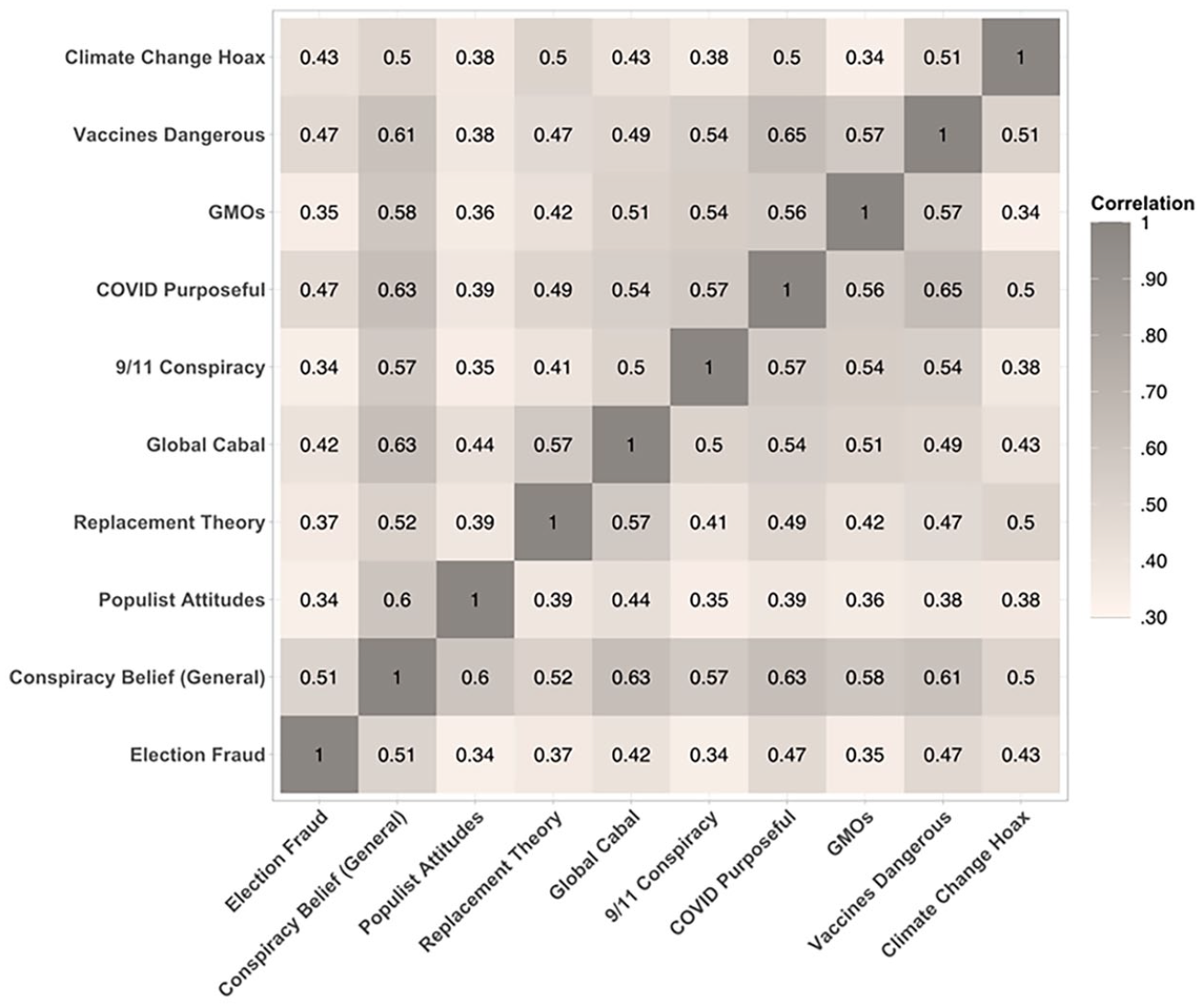
Pearson correlations among specific conspiracy beliefs, general conspiracy belief, expectation of election fraud, and populist attitudes.
Expectation of Election Fraud
For our US-specific measure combining populism and conspiracy, we measured expectation of election fraud in 2024 using a single item framed in a party-neutral way that could tap into expectations both by Trump voters and others who may expect that Republican officials might alter votes in their own candidate’s favor. We asked: “How likely do you think it is that there will be significant fraud or vote-stealing in the next presidential election?” We intentionally primed respondents with the term “steal” to evoke “Stop the Steal” but did not explicitly address partisanship or candidates.
Covariates of DCS
Mainstream News and Right-Wing Media
Our approach to measuring media use was first to ask respondents sequentially about their attention to individual media brands for news about public affairs and politics: Vox, NPR or PBS, New York Times, Washington Post, Huffington Post, NBC News, CBS News, ABC News, and CNN for mainstream news; and Fox News, Breitbart, and One America News for right-wing media. From the results, we constructed a measure of overall attention to mainstream news and right-wing media using respondents’ highest score for any outlet in the category.
Social Media
Our approach to social media involved several steps designed to give us nuanced measures. We started with a question about general frequency of use of each of ten social media apps: Facebook, Twitter, YouTube, Facebook Messenger, Instagram, Snapchat, TikTok, Reddit, Telegraph, WhatsApp—and an eleventh category we called “Free-speech oriented platforms (such as Gab, Rumble, Truth, or a similar app).” We then followed up for users of each app with questions about whether they used it “to engage in public affairs and politics.” We distinguished receiving (whether the respondent had received any information about public affairs and politics) from engaging (whether the responded had engaged with content by doing any of the following: “made my own posts,” “commented,” “shared posts,” “reacted (like/hate etc.).” We used a frequency measure for engaging, and then collapsed this into a dichotomous measure that indicates whether the respondent is actively engaged with social media for public affairs or politics. To check the robustness of the results to this approach, we also used the un-collapsed ordinal measure of engaging, and results are the same.
Feelings of Being Devalued
We measured FBD with three items (Cronbach’s alpha = 0.75) asking respondents’ level of agreement on a seven-point scale with the following: Today’s society often makes me feel worthless; society exploits people like me; and people like me are not valued the same way as before.
Controls
Our analytic strategy was to estimate a model with a robust set of controls, as follows.
Right-Wing Authoritarianism and Social Dominance Orientation
For right-wing authoritarianism, we used the six-item Very Short Authoritarianism scale of Bizumic and Duckitt (2018). For social dominance orientation, we used the SDO7(s) scale from Ho et al. (2015).
Education and Age
We asked respondents’ highest level of education with a five-point scale, from grade school or some high school to advanced degree, and captured age with a birth-year question.
Political Interest
We measured how interested respondents are in politics with a four-point scale: Not at all interested, not very interested, fairly interested, and very interested.
Ideology and Party identification
We measured ideology with self-placement on a left–right scale from 0 to 10, where 0 is farthest left and 10 is farthest right. For party identification, we asked which party the respondent is closest to: the Republican Party, the Democratic Party, another party, or none. In the analysis, we used a binary variable where Republican identifiers score 1 and all others score 0.
For ease in interpretation, we employ standardized versions of all variables, with means of 0 and standard deviations of 1, except for the dichotomous measures.
Results
We begin by examining the measures of DCS. As we describe above, our six-item measure of general orientation toward conspiracy belief is well correlated (r values from 0.51 to 0.63) with the individual conspiracy theories we asked about, as Figure 1 shows. These specific theories included some associated with the political right, including those promulgated by Donald Trump, and some that are not identity-confirming for conservatives, such as Genetically Modified Organism and 9/11 conspiracies.
We anticipated that our general measures of DCS—populist attitudes and conspiracy beliefs—would be associated with expectation of election fraud in the US, which is our measure of a context-specific combination of populism and conspiracy belief. These data show that this is the case. General conspiracy belief correlates with expectation of election fraud at r = 0.51, and populist attitudes correlates with it at r = 0.34. We also expected from the literature that general populist attitudes would correlate with conspiracy belief, and this is also the case at r = 0.60.
We estimated models for the three measures of DCS including controls for party identification, ideology, right-wing authoritarianism, social dominance orientation, political interest, education, and age. Our cross-sectional design does not permit making causal inferences, so we understand the models as indicating associations that are independent of the controls. As we note above, theory would suggest more reverse causation from media choice to attitudes for mass media than for social media, with the exception of the Alt-Tech category.
A plot of coefficients is shown in Figure 2, and full models are located in Table A1 in the Supplemental Information File. A few of the controls bear comment. Right-wing authoritarianism predicts populist attitudes and conspiracy belief, while social dominance orientation predicts expectation of fraud and conspiracy belief, and populist attitudes in the negative direction. The fact that social dominance orientation is inversely related to populist attitudes is consistent with the populist tenet that the public as a whole is pure, good, and homogeneous in its interests. Younger people are lower in conspiracy belief and expectation of election fraud, and older people are higher in populism.
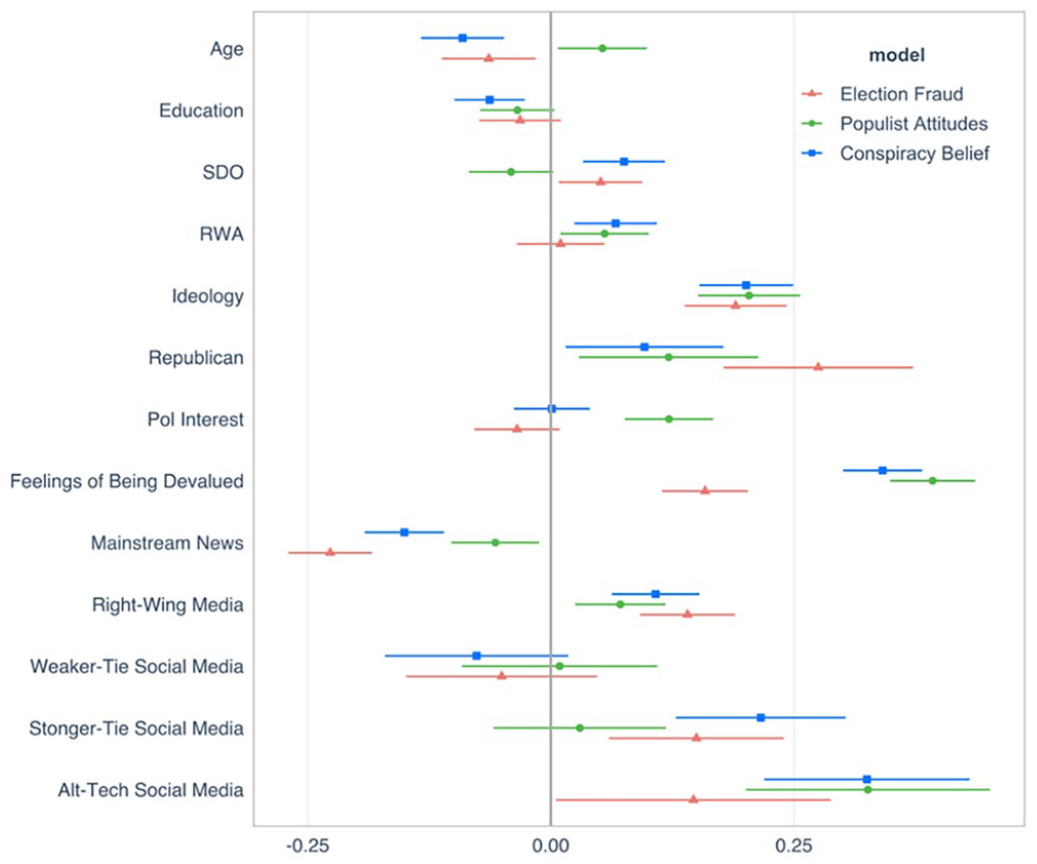
Predicting populist attitudes, conspiracy beliefs, and expectation of election fraud.
Our hypothesis (#6) about FBD is strongly supported. It is associated with all three measures of DCS. A generalized sense of being devalued by society is a powerful contributor to DCS in the US, absent priming in the survey questions about either particular identities and group threats or financial strain. For populist attitudes and conspiracy belief, it outperforms every other variable except Alt-Tech social media. As the marginal effects plots in Figure 3 show, an increase in FBD by a standard deviation is associated with increases in populist attitudes and conspiracy belief by just under a half standard deviation, and an increase of around a quarter standard deviation in expectation of election fraud. Marginal effects of identifying as Republican are shown for comparison, where the largest association with with expectation of election fraud.
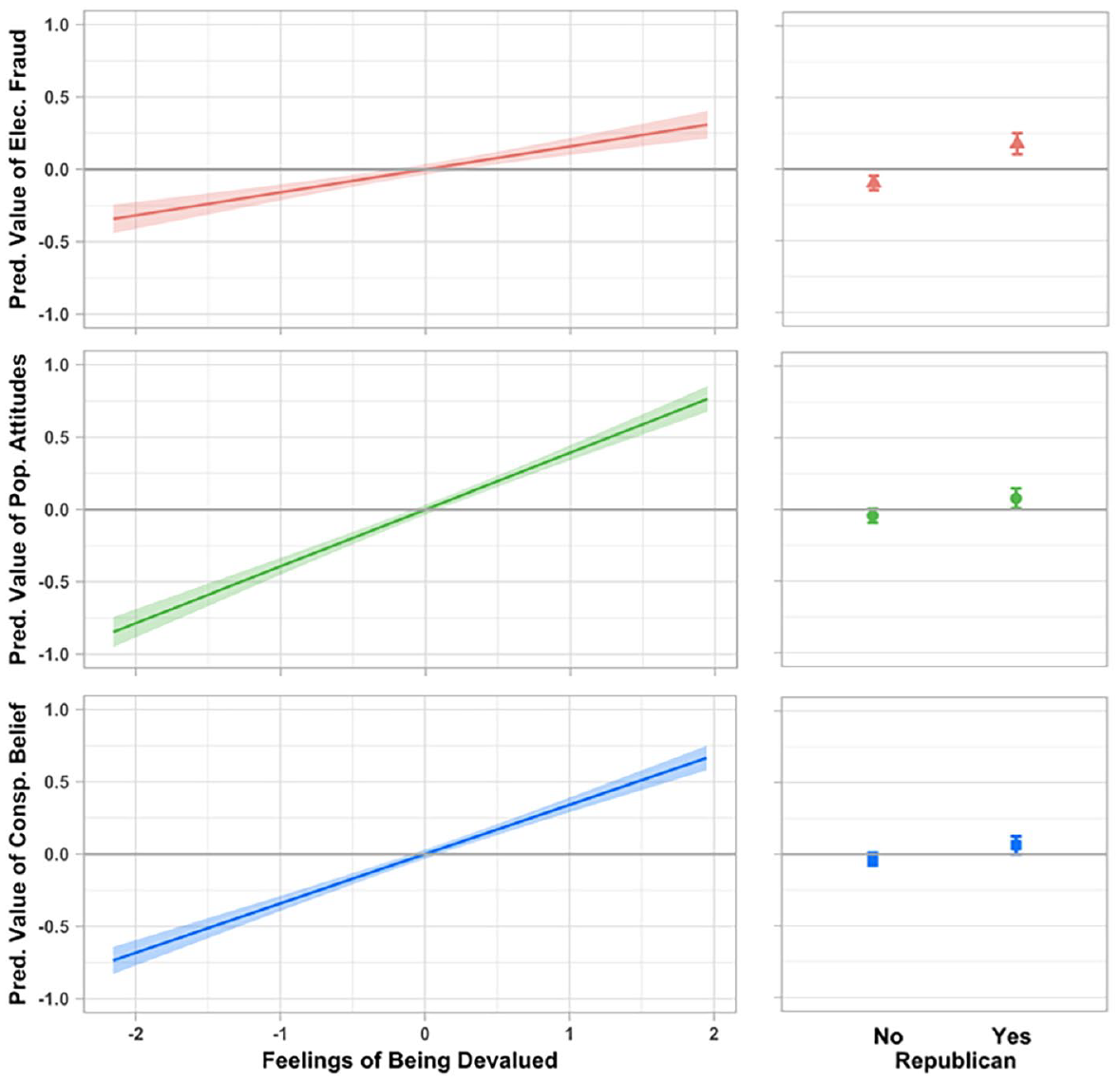
Marginal Effects of FBD Compared with Republican Identity.
Turning to media use, we find support for the hypothesis about mass media (#1). Right-wing news is positively associated with populist attitudes, conspiracy belief, and expectation of election fraud as expected, while attention to mainstream news is inversely associated with all three. Figure 4 compares the marginal effects of mainstream news and right-wing media. The slopes are inverse, and of comparable magnitude.
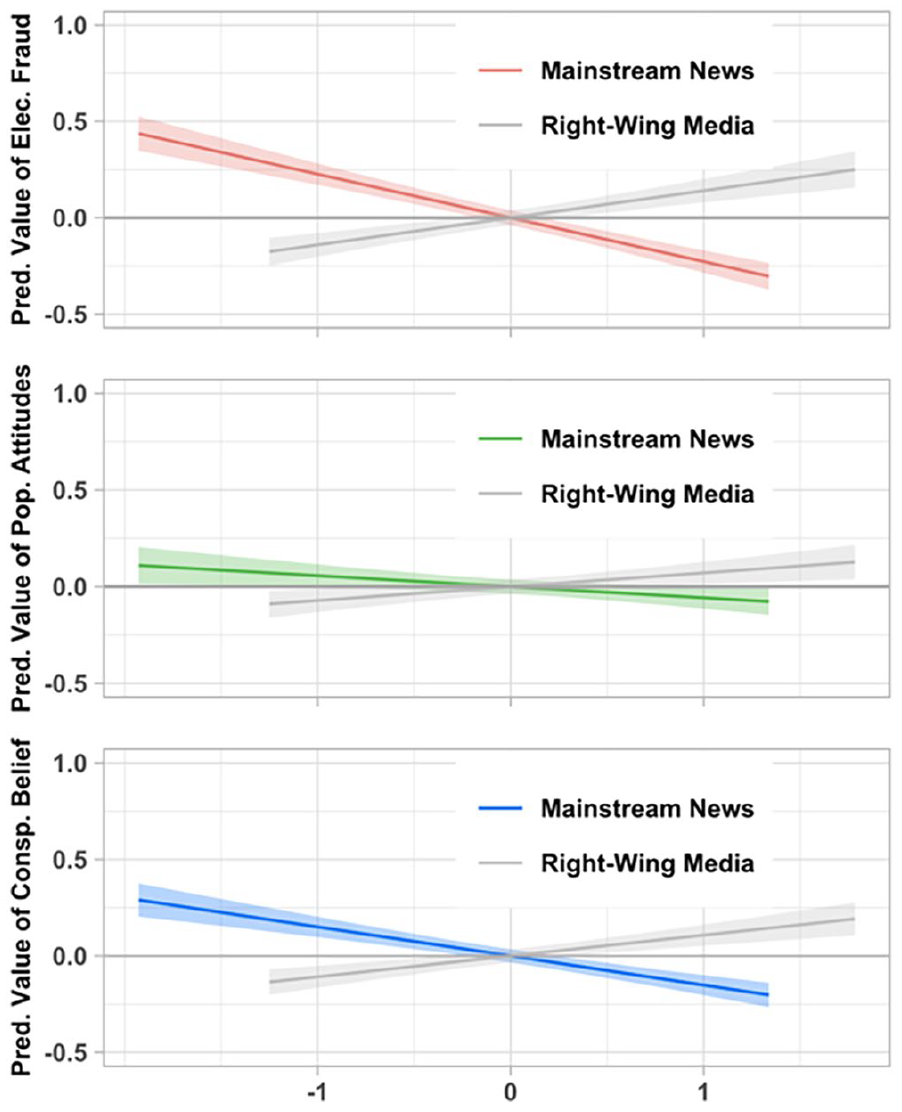
Marginal effects of mainstream news and right-wing media.
Our hypotheses about main effects of social media (#2 & #3) are also supported. We start with use of Alt-Tech apps, where the strength of the relationships is noteworthy. As Figure 5 shows, the marginal effect of a standard-deviation increase in engagement via Alt-Tech apps on populist attitudes and conspiracy belief is about a quarter standard deviation, while it is smaller for expectation of election fraud. Alt-Tech social media and FBD are together the strongest predictors of conspiracy belief and populist attitudes, surpassing Republican identity, right-wing authoritarianism, and social dominance orientation. Interestingly, throughout the results, the expectation of election fraud exhibits somewhat different relationships, with Republican identity being more strongly associated.
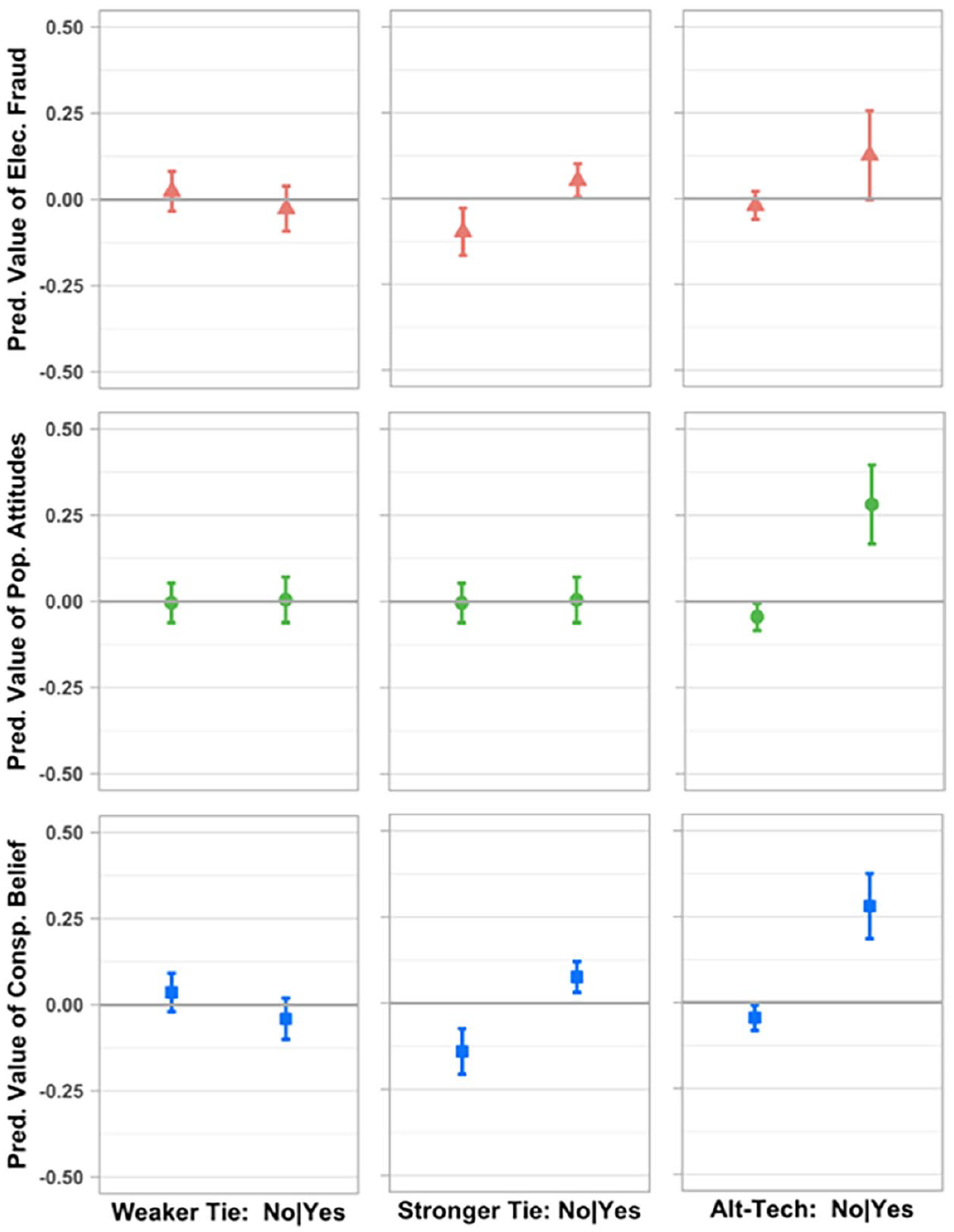
Marginal effects of social media use.
For mainstream social media, we expected a larger relationship for stronger-tie apps than for weaker-tie apps. The results show that the coefficients for weaker-tie apps are not different from zero; the expressions of populist attitudes, conspiracy belief, and election fraud that one can easily find by browsing in weaker-tie social media apps are accounted for by the other variables in our model. The situation is different for stronger-tie apps, which are associated with conspiracy belief and election fraud, but not populist attitudes, as shown in Figure 5. To check whether these results might be an artifact of how we classified the social media apps as either stronger-tie or weaker-tie, we re-ran the models using only Facebook and Twitter to represent the two categories. The results are substantively the same in overall model fit as well as coefficient size and significance. See Table A2 in the Supplemental Information File for details.
Our final hypotheses (#4 & #5) address positive and negative moderation for social media use and mass media use. To test these expectations, we re-ran our models employing the appropriate interaction terms for right-wing media with stronger-tie social media and Alt-Tech social media, and for mainstream news with both forms of social media. All of the coefficients were small and non-significant, leading us to reject these hypotheses. Surprisingly, people’s use of mass media does not moderate the relationship between their social media use and attitudes about democracy (see Figures A3 and A4 in the Supplemental Information File for interaction plots.)
Discussion
While the psychological and ideological correlates of DCS in the US are thoroughly documented, the role of media use has been less well settled. Our main findings support the well-known relationship between attention to right-wing media and DCS. We add to this the finding that attention to mainstream news has at least as strong a relationship in the negative direction. To the extent that right-wing media are a venue for populist attitudes, conspiracy belief, and expectation of election fraud, mainstream news works inversely.
As for social media use, the findings support our expectation that stronger-tie social media such as Facebook have greater relationships compared with weaker-tie social media apps such as Twitter. Populist attitudes, conspiracy beliefs, and expectations of election fraud appear to be most influential among networks of people who are more familiar with one another and who have a higher degree of political homophily. This does not exonerate weaker-tie corporations like X/Twitter from responsibility for failing to moderate content adequately. These platforms facilitate the circulation of anti-democratic sentiment, with the likely effect of regularly priming people’s sentiment and elevating its salience in daily life. But the platforms do not seem to be making individuals any more anti-democratic in their sentiments.
Not surprisingly, Alt-Tech social media such as Gab do appear to have that effect. Our data allow us to compare Alt-Tech to mainstream stronger-tie media. Our results suggest that mainstream stronger-tie apps like Facebook, WhatsApp, and Telegram could be just as instrumental as Alt-Tech in the long run, because of their greater reach. How our distinctions among social media networks play out in the future will be interesting to see as the social media industry changes rapidly.
Our expectation of interactions between use of mass media and social media were not supported. We do not doubt the importance of mass media at the system level to the health of the public sphere, but in our data social media and mass media have independent relationships to DCS.
Our concept of FBD, which we intend as a complement to specific measures of status threat, captures a broader sense of decline in circumstances that may be individualistic or group-based. It turns out to be a very strong predictor, comparable to use of Alt-Tech social media, and notably stronger than Right Wing Authoritarianism and Social Dominance Orientation. Our findings endorse the use of this concept in future work.
Our study employed two general measures of DCS that could apply to future research. Theoretically, the relationships we hypothesize should apply in other democracies. We also employed the US-specific measure of expectation of election fraud. In other countries, we envision different such measures complementing the general variables.
The most important limitation of our study is its cross-sectional design. As is the case with other such survey projects on DCS and media use, we are unable to make inferences about causation, so we have referred to our findings in terms of associations and covariates. A number of the associations we find have not been reported before, and they give clues for further research into causation. This is especially true of the distinction among social media types, and also of FBD, where our results potentially expand the scope of future analysis of mechanisms associated with DCS. A great deal of public discourse lumps “social media” into a single category, which we believe obscures causal mechanisms. We theorized that stronger-tie, weaker-tie, and Alt-Tech social media are different, and well-controlled correlations support this expectation.
We do not see a simple solution to problems of causal inference around media use. Bi-directionality is a timeless challenge for scholars studying media. Cross-sectional surveys cannot get beyond covariation in the presence of strong controls. Multiwave panel surveys can overcome this in principle as a design matter, but they can suffer from a problem of their own, namely over-stringency and elevated probability of false negatives. The marginal effect of media use over a period of a few months between survey waves should typically be small to zero when a respondent has been chronically using a media outlet or social media app. Even causally strong laboratory experiments face the problem that naturally occurring selective exposure is circumvented when subjects are randomly assigned to treatments, eroding external validity.
A perfect storm in the world of media and democracy is raging at present. First, DCS continues to threaten the functioning of elections and policy-making in the US. In other countries, it is fueling the rise of extremist parties such as the Alternative for Germany (AfD) party in Germany and the National Rally in France. Second, the social media industry has successfully forestalled serious regulatory efforts in the US Congress, though efforts by some legislators continue. Effects on the industry of US state-level and European regulation remain to be seen. Meanwhile, voluntary content standards for falsehoods and extremism are weakening at some firms, such as X/Twitter. And third, the explosion of generative Artificial Intelligence will have untold disruptive consequences, including new possibilities for industrial-scale spread of conspiracies and other falsehoods. Our study shows the continued importance of traditional Fourth Estate journalism in the face of this storm; while attention to news does not moderate the effects of exposure in some social media, it exerts a positive force in its own right. All these developments intersect with strongly felt perceptions by some that they have been so devalued by the historical course of events in recent years that political structures and democratic process itself are growing worthless.
Supplemental Material
sj-docx-1-hij-10.1177_19401612241253455 – Supplemental material for Media Use, Feelings of Being Devalued, and Democratically Corrosive Sentiment in the US
Supplemental material, sj-docx-1-hij-10.1177_19401612241253455 for Media Use, Feelings of Being Devalued, and Democratically Corrosive Sentiment in the US by Bruce Bimber, Julien Labarre, Daniel Gomez, Ilia Nikiforov and Karolina Koc-Michalska in The International Journal of Press/Politics
Footnotes
Declaration of Conflicting Interests
The author(s) declared no potential conflicts of interest with respect to the research, authorship, and/or publication of this article.
Funding
The authors disclosed receipt of the following financial support for the research, authorship, and/or publication of this article: This study was funded with a grant from the Audencia Foundation, France.

Supplemental Material
Supplemental material for this article is available online.
Author Biographies
References
Supplementary Material
Please find the following supplemental material available below.
For Open Access articles published under a Creative Commons License, all supplemental material carries the same license as the article it is associated with.
For non-Open Access articles published, all supplemental material carries a non-exclusive license, and permission requests for re-use of supplemental material or any part of supplemental material shall be sent directly to the copyright owner as specified in the copyright notice associated with the article.
