



Abstract
Several studies argue that journalism can facilitate and shape democratic backsliding when news organizations are captured by business and political elites. Under these conditions, journalists will likely fail to hold political actors to account and provide information essential for public deliberation. Gradually, news outlets devolve to provide unfair representations based on private interests instead of news coverage guided by public interest. However, research still lacks a systematic and detailed analysis of practices in news production that could be capable of damaging democracy. Not only is evidence very scarce, but it is also limited to the content analysis of news outputs and editorials. Using forty semistructured interviews and three case studies, this research investigates how journalists from the most influential outlets in Brazil covered key political events within a period of constant decline in the quality of democracy (2016–2021). Then, I build on the results to propose a new typology of de-democratizing journalistic practices: soft steering (recommendations pretending concern with standards, including partisan interpretations of balance), hard steering (direct orders, including internal censorship or entirely pre-defined stories), and anticipatory steering (reporters and editors act on their own based on perceptions and previous instructions). Moreover, this research offers evidence that de-democratizing journalistic practices can be internalized by news practitioners and, over time, replace democratic norms. Finally, it suggests a dynamic relationship between censorship and self-censorship in which control not only inhibits actions but also compels journalists to perform in specific ways.
Keywords
Introduction
Norms of pluralism, deliberation, equality, and freedom are far from coherent and synergistic. Mouffe (2002, 2007) articulates how modern democracies are perpetually caught in a tension between two different traditions: liberalism and equality. The liberal tradition is constituted by the rule of law, the defense of human rights, and the respect for individual liberty, often associated with liberal democracy. Equality relates to the tradition of ensuring that all citizens have an equal say and access to political processes. The challenge for democratic societies, the author argues, is to find a balance that does not fully sacrifice one principle for the sake of the other but instead fosters a political space where differences can coexist in a pluralistic framework. As such, democracy is always a work in progress, requiring constant negotiation and contestation among diverse groups and interests.
This condition requires a more comprehensive and nuanced approach to evaluating the democratic nature of states. Research on modern democracies must consider a range of relevant components, such as electoral democracy, political rights, civil liberties, the rule of law, and horizontal accountability. Merkel (2004) argues that “effective democracies” can become “defective” when one or more of these components is not “fully functional.” Consequently, there is not a clear, binary, or static split between democratic and autocratic states. Countries may move toward democracy in ways that are subject to interruptions and regressions (Levitsky and Way 2010). States classified as democratic may also slide “backward” toward authoritarianism (Levitsky and Ziblatt 2018). Therefore, this study understands de-democratization as a constant decline in the indicators for the relevant democratic components within a country.
Journalism is thought to foster these democratic components by a well-established literature (Randall 1998; Schedler 1998; Voltmer 2006; Voltmer and Rawnsley 2019). Still, a growing body of studies argues that journalism can facilitate and shape de-democratization processes when news organizations are captured by business and political elites (Dragomir 2018; Rao and Wasserman 2015; Schiffrin 2021). This scholarship suggests that journalism will likely fail to hold political actors to account and deliver information essential for public deliberation under these conditions. As a result, their news outputs are unable to prevent an illiberal turn or a “democratic backsliding,” as predicted by other studies (Norris 2006; Voltmer and Rawnsley 2019). In relatively recent cases of de-democratization, journalists and legacy news organizations 1 are thought to have actively originated or further accelerated this process by gradually devolving to provide unfair representations based on the private interests of media owners and high-level managers instead of news coverage guided by public interest (de Albuquerque 2019; Pimentel and Marques 2021; van Dijk 2017). On some occasions, the private interests of individual journalists trying to advance their careers can also contribute to these practices (Ferreira 2024).
However, the fields of political communication and journalism studies have yet to investigate in detail how journalism operates in relation to democratic backsliding (McDevitt 2022: 501). That is, to identify and analyze which kinds of journalistic practices fail to prevent or even actively enable de-democratization. The extant literature has given little attention to the role of the media in undermining democratic norms (McDevitt et al. 2022: 748). Research to date has not offered a comprehensive and systematic map of practices in news production that are damaging to democracy. Furthermore, empirical evidence of how media capture is operationalized in news production is scarce (Atal 2017; Finkel 2015; Mabweazara et al. 2020).
This article will address this gap by developing a taxonomy of journalistic practices capable of damaging democracy. To that end, I will use forty in-depth semistructured interviews and three case studies to investigate how journalists from the most influential news outlets in Brazil covered key political events within a period of constant decline in the country’s quality of democracy (2016–2021).
Literature Review
Previous studies in Central and Eastern Europe (Bogaards 2018; Dragomir 2018; Knott 2018), India (Rao and Mudgal 2015), and South Africa (Rao and Wasserman 2015) argue that news organizations and journalists have been falling or avoiding scrutinizing political actors as well as publishing political content essential to public deliberation when controlled by politicians and their allies in the industry. A bourgeoning strand of literature conceptualizes different forms of “media capture,” predominantly underpinned by political and financial pressures or preferences (Atal 2017; Schiffrin 2017, 2018; Stiglitz 2017). Media capture theory argues that intersecting political economies (e.g., patterns of media ownership) and everyday socioeconomic practices (e.g., editorial decisions) can lead to news organizations becoming dominated by networks of political elites and their business allies working in collusion (Schiffrin 2021). As a result, the editorial output of captured media serves and is controlled by powerful and private interests of these elites (Schiffrin 2017: 5). According to this model, news outlets become a tool for politicians (Knott 2018: 365) and/or shift toward providing profit-oriented (and less or nonpolitical) content (Rao and Wasserman 2015: 657) rather than pursuing normative journalistic goals such as being an accountability mechanism and foster public debate (McNair 2009; Schudson 1995, 2008). In both cases, news organizations’ autonomy becomes so seriously compromised that journalists’ outputs start to routinely favor the private interests of the ruling elites over the public ones.
Relations of clientelism also observed in African countries (Mabweazara et al. 2020) and regional media in Latina America (Bastian 2019) evolved to a larger-scale capture across the globe, particularly in private national news organizations. More than creating a dependency on public advertising, which results in support for specific political actors and public policies, commercial allies of the ruling party are buying critical voices in the media landscape to turn legacy news media into pro-government propaganda. Hungary is a largely discussed example (Bajomi-Lázár 2013), but previous studies also show evidence in Poland, Serbia, and Turkey (Finkel 2015; Kerpel 2017). This form of capture is more effective than censorship while keeping the facade of a democratic regime. Furthermore, Public Service Media that could provide independent information to counterbalance the captured private media has been targeted by more direct forms of government capture in both post-Soviet states (Kerpel 2017; Milosavljević and Poler 2018) and so-called “more stable democracies,” such as the United States (Wright et al. 2024) and the United Kingdom (Freedman 2019).
Little is known, however, on how this capture operates inside the newsroom. Studies on media and democratization tend to focus on the network of influences (e.g., political actors pressuring and ownership issues) or the perceived effects of editorial outputs (Schiffrin 2021; van Dijk 2017). As such, this scholarship tends to efface journalistic agency and sociological aspects crucial to news production (Ferreira 2024). News outputs are a result of both the institutional structure (i.e., regulatory framework, market characteristics, professional, and organizational guidelines, resources) and the agency/professional judgment (Cook 1998; Deuze 2008; Gitlin 2003), the latter of which is influenced by the unique assets each journalist brings to the job (i.e., sociodemographic background, political views, life conditions) (Deuze 2002: 41–43). On the other hand, journalism studies have a tradition of accounting for sociological aspects. Previous studies on journalistic practice suggest that “watchdog journalism” and even “opinionated news coverage” are frequent and normalized in countries with intense political struggle (Hanusch and Hanitzsch 2019; Mellado et al. 2017a, 2017b). Nonetheless, this research struggles to connect with political theories, including journalism’s potential to undermine democracy. For instance, few studies consider the changing interests that guide these watchdog traditions or the fairness of their application over time, which risks damaging democratic deliberation (de Albuquerque 2019).
The Case of Brazil
Following twenty-one years of military dictatorship, Brazil opted for a mixed model of democracy that combines the protection of individual rights and mechanisms to foster equality and participation. The 1988 Constitution was heavily influenced by the US model and liberal ideals (presidential, two chambers, federalism, extensive guarantees to individual rights) but also by concerns rooted in the traumas of this authoritarian past (fragmented multiparty system, mixed electoral system, mechanisms of participatory/direct democracy, social-democratic welfare state) (Silva 2019). Therefore, I used five democracy indexes from the Varieties of Democracy (V-Dem) that correspond to these core aspects established by the Brazilian Constitution as the country’s democratic values and norms. These are Electoral (measuring the principles of electoral or representative democracy, including election fairness and media independence), Liberal (the rule of law, checks and balances, and civil liberties), Deliberative (assessing decision-making in the public interest versus coercion or narrow interests), Egalitarian (evaluating equal access to resources, power, and freedoms across societal groups), and Participatory (measuring citizen engagement in government or policy-making through consultations and civil society organizations) (Coppedge et al. 2021: 43–44). Brazil has steadily declined in all these indexes since 2016 (Figure 1). V-Dem annually aggregates more than 450 indicators to generate a continuous spectrum (Coppedge et al. 2021) and is considered a reliable measure and used by many studies on democracy (Daoust and Nadeau 2023).
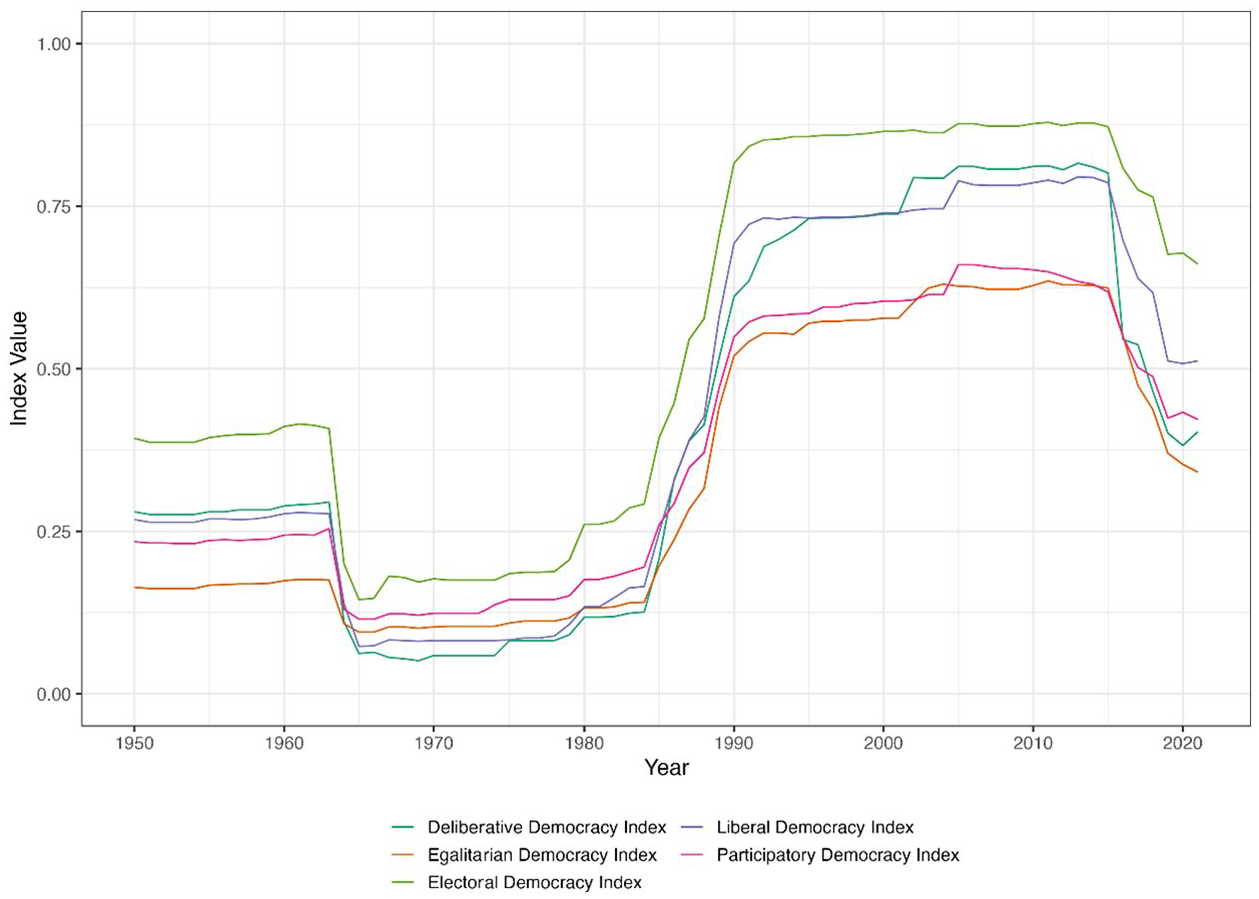
Brazil and quality of democracy over time.
Preliminary content analysis of news outputs suggests that Brazilian legacy news organizations provided unfair representations during this period (Araújo and Prior 2020; de Albuquerque 2019; van Dijk 2017). Specifically, they appear to have facilitated Brazil’s de-democratization by targeting specific political actors and favoring commercial interests. This different pattern of behavior is best reflected by the following three events, all of which have frequently been cited as turning points in Brazil’s political life (Pinheiro-Machado 2019; Souza 2016). These are the impeachment of the left-wing president Dilma Rousseff in 2016; the anticorruption taskforce Operação Lava Jato (Operation Car Wash), which led to the arrest of her predecessor and mentor, Luiz Inácio Lula da Silva, in 2018; and the election of the far-right populist Jair Bolsonaro late that year. For example, the main Brazilian legacy news media are thought to have strongly advocated for Rousseff’s impeachment, choosing to ignore blatant irregularities in the trial (de Albuquerque 2019; Guazina et al. 2019) while simultaneously promoting economic policies rejected in the election (Pimentel and Marques 2021). Moreover, these studies argue that outlets have overlooked significant misconduct in Operation Car Wash and manipulated news outputs in order to destabilize the then-incumbent government (Souza 2016; van Dijk 2017). Moreover, news coverage was perceived as overly supportive of Car Wash, which ensured former president Lula’s arrest in a controversial judicial process and his removal from the 2018 election. Immediately afterward, the main news outlets downplayed Bolsonaro’s authoritarian values throughout the electoral campaign (Araújo and Prior 2020). Nonetheless, there is a lack of evidence on how the unfair representations identified by these studies were operationalized, that is, a systematic analysis focusing on journalistic practice.
Selecting stories, sources, or even angles for the news items is part of journalistic work due to limitations of space and funds vis-à-vis a plethora of information available (Shoemaker et al. 2008). Moreover, legacy news outlets and journalists need to assign value to, select, and inevitably hierarchize the information in TV segments, online home pages, or printed newspapers with limited pages (O’Neill and Harcup 2008). Still, these are normative democratic journalistic practices only when guided by public interest and aiming to deliver fair representations of views and events in order to facilitate citizens’ deliberation (Bennett et al. 2006; Schudson 1995). These are the conditions underpinning a journalistic role capable of consolidating and protecting democracy (McNair 2009; Schudson 2005). However, the unfair representations suggested by previous studies in Brazil would entail organized practices with the aim of shaping news outputs for the benefit of the private interests of media owners or individual journalists. That is, reporting based on public interests would have to be replaced by specific narratives and framings designed to sway public deliberation.
The notion of unfair representations should not be conflated with the contested notion of impartiality (Márquez-Ramírez et al. 2020; Mellado 2019). Indeed, it has been argued that protecting democracy would require sometimes not being impartial. For example, the press would risk passivity with antidemocratic actors. Previous studies provide evidence that news reporting can improve the quality of democracy by scrutinizing political actors and deliberation processes (Norris 2006; Randall 1998; Schmitt-Beck and Voltmer 2007). Moreover, some cases show that journalism facilitated political transitions toward democracy precisely through more critical news coverage (Mughan and Gunther 2012; Ojo 2007; Randall 1993; Schedler 1998). The Western journalism model characterized by a “critical” but “independent and impartial” watchdog role was exported globally, often through colonialism and international institutions (Nerone 2013). However, this model only describes a small portion of the practices in the news environment, especially outside the West or the Global North (Nerone 2013; Zelizer 2013).
Like many Latin American countries, Brazil has a tradition of watchdog journalism, critical news coverage, and even opinionated outputs (Márquez-Ramírez et al. 2020; Mellado et al. 2017b; Waisbord 2000, 2009). This journalistic culture does not necessarily undermine democracy, which is supported by Brazil’s relatively high scores recorded by V-Dem in the 1990s and 2000s (see Figure 1 above). The de-democratizing potential I tackle in this article lies in how private political and commercial interests (of journalists or their news organizations more broadly) define when and how to be critical. In Brazil, de Albuquerque (2005, 2019) first suggested that journalists and news organizations distort the watchdog role to become a “political agent.” However, this role has become more pronounced or heavily dictated by private interests only in recent years, correlating with the democratic decline registered from 2016 onward. After almost two decades of scoring 1.94 out of 5 for media bias in V-Dem, Brazil dropped to 1.6 in 2013, 1 in 2016 and 0.8 in 2018—the lowest since the 1988 Constitution (Coppedge et al. 2024). Values closer to zero indicate that the news coverage is significantly skewed, which includes no coverage or only negative outputs of specific political parties and candidates. In other words, media bias in Brazil worsened a lot in just few years.
Therefore, these unfair representations based on private interests would constitute journalistic practices potentially damaging to democracy or, as I will label them, de-democratizing journalistic practices. In order to systematically analyze these practices, this article will answer the question:
What forms of de-democratizing journalistic practices, if any, were employed in Brazil’s legacy news media during the country’s democratic decline (2016–2021)?
Methodology
To answer this research question, I analyzed journalistic practices during the aforementioned key political events in Brazil’s de-democratization (i.e., case studies) through a series of longitudinal qualitative semistructured interviews with journalists covering these events. These are (1) the news coverage of Operation Car Wash (2014–2022), focusing on its relations with the impeachment of President Dilma Rousseff in 2016 and the arrest of former President Lula in 2018, (2) the 2018 election, which placed Jair Bolsonaro, a politician openly against liberal democracy, in the presidency, and (3) the first three years of Bolsonaro’s four-year term (2019–2021).
Qualitative interviews have been proven an effective method to uncover journalists’ perspectives, attitudes, and practices (Ferrucci 2017; Karlsen and Stavelin 2014; Plesner 2009). The semistructured form, in particular, is appropriate for exploring the journalists’ actions in detail since it employs a guide with open rather than leading questions but also permits improvised follow-up questions to clarify or expand answers when needed (Wengraf 2001). It provides both relative freedom for participants to talk about specific situations and the means to return to more rigorous questioning when the conversation slips to shared “common-sense” assumptions situations (Kvale 2014). Moreover, semistructured interviews aid comparability in a multicase study (Wengraf 2001).
It is, however, important to note some limitations. Ryfe (2020) alerts that self-reports cannot fully capture the “underlying cultural motivations” of journalists. Their rationale, the author argues, is constructed by several external inputs and internal reflections deeply allocated in their long-term memory. Although my participants provided valuable perceptions on factors shaping their decisions, they should not be understood as isolated and definitive causal factors. Still, the main focus of this article is to analyze the journalists’ procedures and actions (not their motivations), for which interviews are widely accepted as a valuable method of data collection. Indeed, this collection is dependent on the participant’s ability to remember events that occurred relatively far in the past (Anderson and Jack 2016). Interviewees can also be purposefully generic, evasive, and/or engage in post hoc rationalizations in order to portray “better versions” of themselves (Mason 2018: 254). These are particularly pronounced among journalists due to their shared values, practices, and organizational issues, as well as their knowledge of interview dynamics (Hanusch and Hanitzsch 2019: 299).
The political events of my case studies unfolded over months and generated several news outputs. The interview questions focused on the work of the participants in the production of these outputs. Specifically, I sought to identify the most recurrent practices, who made which kind of decision, and possible forms of negotiations among the professionals. This approach answers Raemy et al.’s (2023) call to further explore negotiation and practice as units of analysis since they are an integral part of the journalistic culture. Building on the techniques of previous studies on decision-chain in journalism (Reich and Barnoy 2016, 2020), I employed follow-up questions strategically to move away from abstract statements and rationalizations. I also used the news outputs from the period under study to challenge some of the participants’ answers. Moreover, securing a large number of participants from the same news outlets aided in flagging significant discrepancies in the accounts (Rubin and Rubin 2005: 136). The interview questions are in the supplementary material.
This study focused on the mainstream news organizations with the largest audiences, as determined by the Reuters Digital News Report. These are Globo, Record, and Folha/UOL, which are still central to public deliberation in Brazil (Newman et al. 2020). The interview sample contains a diverse range of professional positions to triangulate interviewee accounts and explore different perspectives. Journalists covering politics or managing newsrooms throughout the period of the case studies were identified and selected using the selected organizations’ archives. Subsequently, snowballing techniques were employed to contact more participants. Interviews were conducted between December 2021 and July 2022 until the saturation point (Charmaz 2014; Mason 2018). A total of forty participants were interviewed—ten in-person and thirty online. 2 At the time of the interviews, nineteen participants had between ten and twenty years of experience, eighteen were in the range of twenty and forty years of career, and three had more than forty years of journalism. The research was conducted with the ethical approval of the University of Edinburgh, which required obtaining informed consent and anonymizing the participants. Table 1 details the sample.
Map of Participants, Professional Positions, and News Organizations.
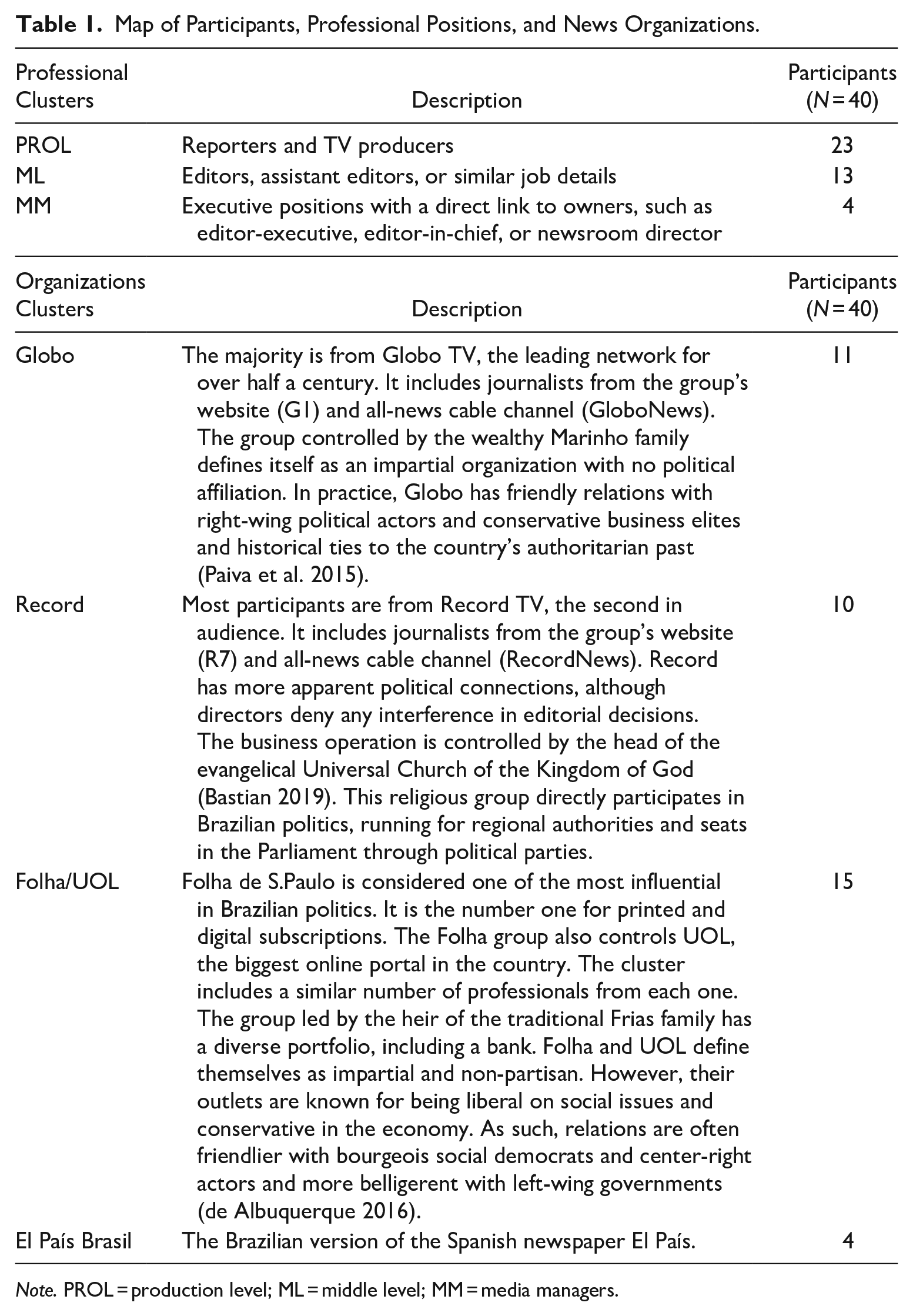
Note. PROL = production level; ML = middle level; MM = media managers.
Interview data were analyzed by open textual coding, and the answers were grouped by thematic axis to extract adequate inferences. This involved identifying key themes in each case study based on major trends or common patterns. To that end, this study used a “directed” coding process in which codes are constructed based on both existing theory and the data (Fletcher 2017: 186; Gilgun 2019: 108; Hsieh and Shannon 2005: 1281). First, an initial list of codes was developed, drawing from the literature review. Then, codes were adjusted, eliminated, or created during a series of pilot processes until the whole sample was coded.
Results and Discussion
The majority of participants’ accounts in this study indicated that journalistic normative procedures were systematically violated with intent during Brazil’s de-democratization. Specifically, they reported the organized employment of practices designed to provide unfair representations of key political actors and events, shaping news outcomes for the benefit of private interests—theirs individually or their media organization more broadly. Consequently, fair representations of public debates and truth-seeking reporting based on public interests were replaced by a focus on specific narratives and framings to sway public deliberation. This dynamic indicates a departure from the idea that a loss of autonomy prevents journalists and outlets from performing their pro-democratic functions or even the concept of unintentional and nonorganized mistakes. Furthermore, these accounts suggest a continuous increase in such practices after 2016 in a positive relationship with the decline in the quality of democracy identified in Brazil by V-Dem.
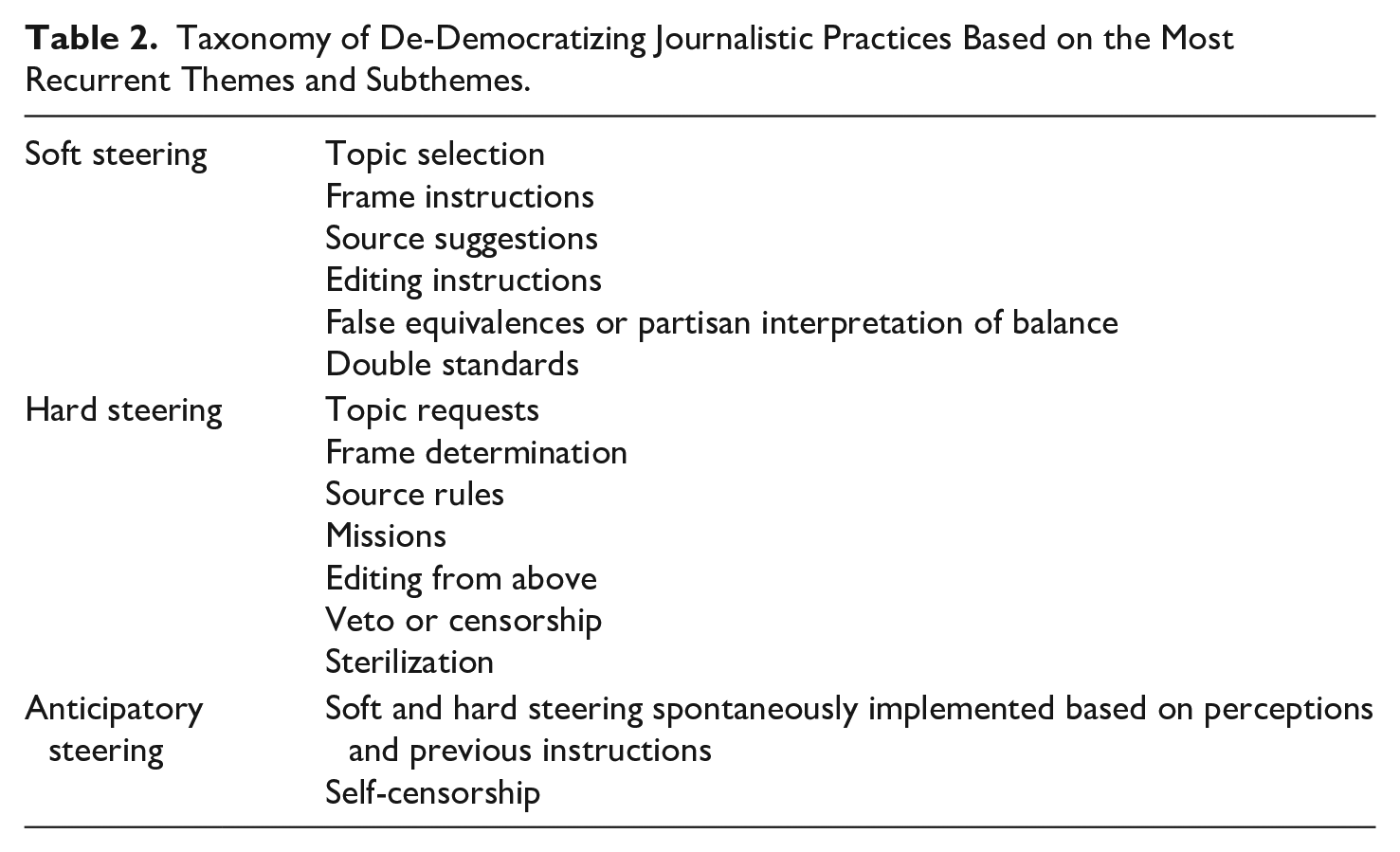
These de-democratizing journalistic practices emerged in several formats, involving a range of procedures and actors within different newsrooms. The most recurrent were clustered by similarities under three key broad themes (“soft steering,” “hard steering,” and “anticipatory steering”). Table 2 shows the general and specific (i.e., subthemes) kinds of practices.
Taxonomy of De-Democratizing Journalistic Practices Based on the Most Recurrent Themes and Subthemes.
Soft Steering
The “soft steering” includes practices regarding the topics that should be covered (“topic selection”), the preferred angles to be used in these news outputs (“frame instructions”), particular sources that should be included or excluded (“source suggestion”) and ways to edit an article or TV news item (“editing instructions”). Reported by the vast majority of participants multiple times, these were typically enabled by top-down instructions designed to generate unfair representations. That is, from media managers (MM) to professionals in the middle level (ML), such as senior and junior editors, and from them to the production level (PROL), which includes reporters and producers.
For example, some participants highlighted that while editors easily accepted stories about corruption allegations involving Lula’s Workers Party (PT, Partido dos Trabalhadores), more evidence and sources were always required to publish allegations involving other parties in Case 1 (Operation Car Wash). Moreover, the prosecution’s or the defense lawyers’ narrative was made more or less prominent depending on the actors involved (Journalist 25—PROL, Globo; Journalist 21—PROL, Folha/UOL). These practices created double standards in relation to critical questioning and the value of evidence, as well as built support for specific arguments or actors. In Case 2 (the 2018 election), news items were also steered in particular directions, as described by one participant: It is normal that your editor suggests sources or framing, but they always push your story in the same specific directions, which I imagine comes from above. I was writing about the economy and the decisions presidential candidates would face after the election. A few minutes later, I got recommendations to interview certain experts, all in favor of austerity measures. (Journalist 5—PROL, Folha/UOL)
However, the “soft steering” was characterized by an effort from media managers and middle-level professionals (e.g., senior editors) to convey these instructions discreetly and portray them to the production level professionals (e.g., reporters) as practices in line with journalistic standards. One interviewee reported that You get requests and instructions. An editor who calls you aside, a boss who calls you into the room and tells you that ‘you could highlight this,’ or ‘it is better to focus on this.’ In these cases, there is a care with the words to present the instructions as something to improve the quality of the report. (Journalist 12—PROL, Record)
According to participants, some middle-level professionals, such as senior editors and chiefs of reporting, play a crucial role in softly blocking or redirecting production level professionals. That is because they are able to enforce de-democratizing practices shaped by media managers’ and owners’ preferences without appearing to do so, as explained in detail by one midlevel editor: Whoever is in charge, in a position of leadership, in a company like the Folha group, is not going to tell reporters: “You can’t do it because the board of directors supports Bolsonaro.” But they will say: “Don’t do it that way, it’s better that way” or “Leave it to the columnists.” People are in this leadership position because they know how to play this game and be the foreman.
3
They won’t tell the reporter bluntly that they can’t do the story. (Journalist 22—ML, Folha/UOL)
“Soft steering” practices were usually employed in the production process in order to shape the news output before publication. Still, they were also applied after publication to set the directions for future outputs. As one veteran journalist explains: It’s like being called into the principal’s office. Your director doesn’t say directly: ‘You can’t be critical of an event or a politician.’ But they can question the terms you use or the intensity. It is curious, however, that they requested I tune it down only after critiques against Car Wash’s prosecutors or Bolsonaro. I did as many to the Workers Party for corruption cases and government failure. Never got a complaint. (Journalist 40—ML, Globo)
Therefore, the essence of “soft steering” is the implementation of de-democratizing practices under a façade of concern with democratic journalistic standards.
In addition to suggestions of particular sources, frames, and ways of editing, a significant one-third of participants reported “partisan interpretations of balance.” These views were used by MM and ML professionals to implement and justify de-democratizing practices at the PROL that deeply shaped news outputs, particularly on news items about corruption or the 2018 election (Cases 1 and 2). This comment demonstrates how a seasoned editor was pressured by managers during the election: It is a right-wing board of directors, an anti-PT
4
board. I received messages like: “The page is too petista,”
5
“The page is very petista,” or “It is very left-wing; you have to be careful; you have to have balance.” But I never got a message saying the page was too bolsonarista
6
when we had more news about him. (Journalist 22—ML, Folha/UOL)
The “partisan interpretations of balance” creates the unbalanced and unfair representations that it pretends to contain. The same participant explains how the situation escalated during the election: It has become an obligation. If you are going to publish a news item about PT, you have an obligation to make one about Bolsonaro. It’s mandatory. You must do it. You have a good news item that involves left-wing topics or actors. Then you will have to dig up some Bolsonaro shit to put it on the side. Then it forces you to publish some shit, you know? You are going to give weight to news about Bolsonaro, which would not have that weight. Campaign activities or the agenda are fine. You have to show all the candidates. But not news. News you don’t make up. But we had to make up. And that is when you end up highlighting things that shouldn’t be highlighted. . . reverberating populism and hate. (Journalist 22—ML, Folha/UOL)
Hard Steering
Over half of the participants also described cases of more explicit forms of steering in which the de-democratizing nature of the practices is less convoluted. The “hard steering” includes practices that are both unique and similar to those of “soft steering,” but they are all clearly imposed by MM or ML professionals to PROL professionals. According to the accounts, preferences regarding topics, sources, and angles were conveyed as an order and not a suggestion. Reports also indicated that managers and editors did not try to present “hard steering” instructions as practices in line with journalistic standards. The pretend concerns with the quality of reporting and balance seen in the “soft steering” was replaced by an expression of command (e.g., “I prefer that way”) or direct references to the news organizations’ interests (e.g., “the house wants that”). That way, the “hard steering” represents an escalation with a more prevalent influence of managers and senior editors at both the initial investigation of a news item at the PROL and the editing stage at the ML.
One recurrent “hard steering” practice is “frame determination,” in which managers and editors demand specific and unfair frames or angles for given topics or political actors. For example, participants across all outlets reported constant requests for positive frames on Car Wash’s judges and prosecutors while the PT and former president Lula should be portrayed in a “bad light” (e.g., Journalist 12—PROL, Record, Globo; Journalist 25—PROL, Globo). Another relevant example of “frame determination” is the participants’ reports about requests for downplaying the authoritarian values of Jair Bolsonaro and/or portraying his opponent as an equal risk of extremism from the other end of the ideological spectrum (e.g., Journalist 21—PROL, Folha/UOL). Bolsonaro was a far-right candidate who often praised the Brazilian past dictatorship, while Fernando Haddad and the PT could not be described as far-left. Moreover, the characterization of an equal risk seems unfair since the Workers Party never threatened democratic institutions and the transition of power, even after being ousted from the presidency in 2016 (Hunter and Power 2019; Souza 2016). Although Bolsonaro’s record of authoritarian statements was not entirely absent from the 2018 election news coverage (Case 2), interviewees described straightforward instructions to avoid “publishing too much” on the topic or even potentially negative terms. A significant example of this dynamic is the newspaper Folha de S.Paulo, in which media managers issued an internal memorandum banning the use of “far-right” to describe Bolsonaro. A key political editor from this organization said: I think the newspaper got it wrong. If it was in another country, it would have been called far-right. The newspaper calls other leaders similar to Bolsonaro. . . at least call them ultra-right. (Journalist 6—ML, Folha/UOL)
In some cases, the steering of “frame determination” can be “hard” to the point of defining what kind of questions the reporters should ask. As one interviewee explained, the instructions can be used even to circumvent electoral legislation
7
designed to maintain candidates’ fair exposure on TV channels: The kind of question you’re going to ask one, the kind you ask another. It’s one thing to have the same interview time for everyone. Another thing is the question, right? (. . .) For example, at one point, we were ordered not to question Bolsonaro about the corruption investigation against his son (Journalist 12—PROL, Record)
Another “hard steering” recurrently reported by participants is “source rules.” These were very authoritative instructions from media managers and middle-level professionals to give more or less coverage to particular actors, parties, and/or organizations, mostly to reporters at the production level. Around one-third of participants described that orders to minimize the space given to politician in the news coverage were common. For example, one interviewee said: The silent treatment. The case of Lula at Globo is emblematic. The whole news coverage, the investigation, depositions, and arrest, was a horrendous media spectacle. His defense only appeared in short statements from the attorney or preferably a note read by the broadcaster. Then, after the arrest, he was dead. We were instructed to avoid giving voice to Lula or his allies ahead of the 2018 election. For news items on the Parliament and the Temer government, reporters were instructed to interview someone from the PSOL, a small left-wing party, and not from the PT, which was the biggest opposition party. (Journalist 40—ML, Globo)
The “source rule” also includes the amplification of specific actors. Several participants from Record reported clear instructions to give more space to Bolsonaro during the 2018 election (Case 2) on their website and even in TV news cycles despite legislation restrictions. In an escalation of this dynamic, media managers decided to blatantly break the electoral law and air a two-hour interview with Bolsonaro two days before the voting. As one interviewee explained: There was a presidential debate scheduled on Globo, and Bolsonaro had declined to participate. Then, the media managers informed the newsroom out of the blue that he agreed to speak with Record TV. A special team was selected to record an interview, and an agreement was made to air it at the same time as the debate. Bolsonaro spent almost two hours talking about what he wanted. That is, he refused to debate with the candidates, and we offered a platform for him to say whatever he wanted without being questioned. He played the victim, raised conspiracies, and blamed his opponents for the attempt on his life. . . all on national TV two days before the election. The order was to give him space to talk. (Journalist 10—PROL, Record)
Media managers and middle-level professionals can also undermine fair representation by demanding the production of more stories on a particular topic. “Topic requests” is another significant practice within the “hard steering.” Several interviewees’ descriptions suggest that managers and editors employed these demands more prominently during Case 2 in the run-up to the 2018 election. These included increasing reports on a topic particularly difficult for a candidate and/or recovering old stories related to these topics. These practices allowed the news outlets to circumvent the electoral legislation and, to some extent, influence public deliberation: You start to do stories that are negative to particular candidates or hunt things about them. Not during the official election period because we have some rules to follow. But you warm up a few months before. For example, the editors ordered us to do a special series about corruption in 2018, including cases in which people were acquitted or even empty accusations dismissed by the courts. And this brought up again the whole issue of Car Wash, Lula, and everything else. There are ways for you to influence the public, and you don’t invent anything. It is the timing and the way you air that. . . (Journalist 12—PROL, Record)
The participants also reported that two or more “hard steering” practices were often employed together. Editors could demand more stories on a particular topic, as above, or more on this topic with a preferred frame. In some cases, reporters were presented with a very detailed request of what the story should be, including how to investigate, write, edit, and publish. A few interviewees described “missions” in which all aspects of news production are defined in advance as an order with no space for discussion. Stories fully defined before the fact-finding process reinforce biases and provide an inadequate picture of an issue, actor, or event to citizens relying on information to deliberate. As a seasoned reporter explained: There are sometimes requests. We call them missions. It’s a top-down thing. We have to do this story, and that is it. The “house” wants it. Point. So, they tell you the framing, the sources, the central argument, the tune. A director already talked with your editor, and your editor talks to you. (Journalist 13—PROL, Record)
Over half of the interviewees also reported “veto or censorship” of topics or particular stories. That is, media managers and middle-level professionals ordered production-level professionals not to pursue a given story or not publish it if it has already been written. According to the accounts, these practices were more recurrent at Record, albeit not exclusively to its news outlets. These vetoes were often employed in association with specific frames during Operation Car Wash (Case 1) and the 2018 election (Case 2). As one participant said: It was wide open. We don’t like Lula. We are not supposed to publish anything about Lula. Only if it’s negative (. . .). And I couldn’t give anything against Bolsonaro. I could only give something positive. (Journalist 32—PROL, Record)
A veto can sometimes become unsustainable. For example, when a political scandal gets a lot of exposure on other news outlets or social media. Then, media managers and senior editors lifted vetoes and enforced the “sterilization” practice. Around one-quarter of participants reported that when a prohibited news item becomes unavoidable, reporters and editors are ordered to write and publish it as dryly as possible. As said by this participant: You publish a sanitized text. Sterilized. Without any context or implications. No risk of any perceived value or criticism, but almost no information either. A dry headline. Weintraub resigns. Queiroz is arrested.8–10 (Journalist 32—PROL, Record)
Overall, interview data suggest an increase in “soft” and “hard steering” practices during the period under study. Consequently, these practices become part of the news production process over time, that is, structural. Moreover, their constant employment generates a journalistic culture that legitimizes de-democratizing practices, which I will discuss next.
Anticipatory Steering
The previous subsections demonstrate that “soft” and “hard steering” are enacted by top-down instructions. Journalists at the PROL and ML employ de-democratizing practices following suggestions or demands from MM and/or senior ML professionals. However, similar practices can be carried out autonomously at the lower levels of the newsroom (i.e., without any instructions), which I call “anticipatory steering.” Around one-third of the participants reported that PROL and ML journalists often decide on angles, topics, and sources in ways that undermine fair representation based on their perceptions of what “the house wants” or past instructions (i.e., the interests of line bosses or the news organizations more broadly). The interviewees’ accounts suggest the emergence of a culture that legitimizes and even normalizes de-democratizing journalistic practices. As such, “anticipatory steering” is the least visible but the most pervasive form because it makes such practices part of the journalists’ role.
The “anticipatory steering” suggests a more dynamic relationship between forms of censorship highly present in the “hard steering” and a more complex practice of self-censorship among news practitioners. Practices of “hard steering” lead to censorship. Not the classical form of censorship determined by a type of external power (e.g., an authoritarian government), but internal censorship in which high-level professionals ban certain topics or sources. However, a strong perception of these instructions leads journalists to avoid topics and sources on their own. Indeed, participants reported an increase in traditional bottom-up self-censorship. These interviewees described several instances in which they decided not to go forward with an investigation or include a particular source in their report. This comment about a newsroom’s dynamic in 2021 (Case 3) evidences the cumulative effects of frequent MM and ML instructions: “The newsroom was already calloused and no longer sold 11 things that weren’t going to pass.” (Journalist 27—PROL, Record).
These accounts are consistent with traditional forms of self-censorship. Self-censorship in journalism has been defined as a conscious decision to avoid topics, sources, terms, pieces of information, or particular lines of investigation (Hughes and Márquez-Ramírez 2017; Koo 2024; Lee 2019; Mortensen 2018). Several studies in the Global South analyzed self-censorship practices in newsrooms (Barrios and Miller 2021; Hughes and Márquez-Ramírez 2017; Tapsell 2012; Yesil 2014). Although causal factors and rationales vary, these studies also show that self-censorship is mostly marked by a conscious posture of inaction. A significant number of participants, however, also described occasions in which they did more than just avoid topics, sources, or offering a given story. These are PROL reporters and some ML editors who employed some or all of the “soft” and “hard steering” practices but on their own initiative. These include adopting specific angles, choosing sources, or pursuing certain stories aiming for unfair representation and private interests based only on their perceptions of what is expected from them and past instructions.
Studying the post-apartheid politicization of the public South African Broadcast Corporation, Arndt (2018, p. 158) identified an “anticipatory politicization” that becomes inscribed in the organizational culture every time top-down or bottom-up politicization succeeds. Then, politicization is internalized by journalists, resulting in an anticipation of what those in power desire without previous pressure from external political actors or even the intent required in traditional self-censorship (Arndt 2018, p. 157). Specifically, journalists avoid working on a story of potential political interest, to some extent, automatically. Building on Arndt’s concept, I argue that journalists in Brazil practice an “anticipatory steering” by internalizing previous instructions, aims, and a set of de-democratizing practices after continual top-down “hard steering” and bottom-up (conscious) self-censorship. However, the “anticipatory politicization” drives “automatic” inaction, while the “anticipatory steering” drives journalists to act. As one participant explains: There comes a certain point that everyone already understands. You don’t even need to say anything anymore. Everyone already knows, right? We already know what the position of the house is. We know what to include or not. And that is it. You do what you have to do. (Journalist 12—PROL, Record)
Therefore, my results indicate that “anticipatory steering” shapes news outputs based on perceptions of the private interests of media owners and line bosses, generating unfair representations without “hard steering.” Although these perceptions are not always accurate, a dynamic of censorship and self-censorship creates this culture in which these de-democratizing practices become internalized. As observed by Arndt (2018) in “anticipatory politicization,” “anticipatory steering” is often unconscious or, to some extent, “automatic.” Moreover, it is generated by de-democratizing practices and creates more of them, as well as an environment in which they become the norm. Questioned about the work during the Car Wash (Case 1), a participant reflects on the ideas “naturally absorbed” about the impeachment of Dilma Rousseff and the arrest of President Lula and suggests a culture that silently steered journalists in a certain direction: All of that was impregnated in such a way within the newsroom environment. It was a very difficult moment to be there because it was very complicated to be working in a place where you realized that there wasn’t a dissonant voice there. It wasn’t openly spoken about, but clearly, there was a line to be followed. (Journalist 25—PROL, Globo)
Conclusions
This article’s results suggest that journalists and legacy news organizations repeatedly violated their normative functions with the intent of providing unfair representations shaped by the private interests of media owners and high-level managers. The organized nature and increased frequency of such practices in the analyzed period support my conceptualization of de-democratizing journalistic practices, that is, the systematic employment of practices in news production with the potential to damage democracy. These findings call for revisiting previous studies that tend to conceptualize the role of journalism in de-democratization only in terms of its failure to perform pro-democratic functions (Dragomir 2018; Knott 2018; Rao and Wasserman 2015). Moreover, the taxonomy of such practices developed in this article makes a valuable contribution by answering the relative lack of compressive and systematic investigation on how journalism operates in relation to democratic backsliding.
A key contribution of my findings is indeed their relation and generalizability to other contexts. The de-democratizing journalistic practices and the taxonomy developed in this article do not seem specific to the Brazilian media system. Recent studies in non-Western countries also found evidence that journalists and news organizations can have a more active role in de-democratization by engaging in intraelite contestation (Selvik and Høigilt 2021, 2023; Voltmer et al. 2021). These studies argue that journalists can work for specific political actors and use news content to attack or deflect the attacks of opposing actors in ways that suggest practices similar to the ones found in Brazil. However, this scholarship does not focus on systematically analyzing these practices, indicating that this article’s taxonomy could benefit other research designs.
However, the categories in my taxonomy should not be considered exhaustive, and, most importantly, they don’t occur in isolation. There is overlap and interaction between them and with external factors. The results suggest that de-democratizing journalistic practices may be in flux as much as the news and its production. Further analysis is recommended to refine categories and identify the causal mechanisms of these practices, as well as to consider other factors shaping citizens’ exclusion in politics. For instance, my dataset also indicates a slight variation in the frequency of the different practices across the three analyzed media groups that warrant more exploration in a comparative perspective. Moreover, mainstream media is very influential in Brazil’s public debate, but future studies should consider including other news outlets. It is also important to note that participants reported forms of resistance to de-democratizing practices. Although an exploratory analysis of these accounts suggests a small occurrence and debatable effectiveness, these are counter-actions in very hierarchical newsrooms that must be properly analyzed in future studies.
Supplemental Material
sj-docx-1-hij-10.1177_19401612241266557 – Supplemental material for “It Forces You to Publish Some Shit”: Toward a Taxonomy of De-Democratizing Journalistic Practices
Supplemental material, sj-docx-1-hij-10.1177_19401612241266557 for “It Forces You to Publish Some Shit”: Toward a Taxonomy of De-Democratizing Journalistic Practices by Ricardo Ribeiro Ferreira in The International Journal of Press/Politics
Footnotes
Acknowledgements
I am extremely grateful to Kate Wright, Jean-François Daoust and Benjamin Martill. I also wish to thank the reviewers whose helpful comments have improved this work.
Declaration of Conflicting Interests
The author declared no potential conflicts of interest with respect to the research, authorship, and/or publication of this article.
Funding
The author received no financial support for the research, authorship, and/or publication of this article.
Supplemental Material
Supplemental material for this article is available online.
Ethical Considerations
The research was conducted with the ethical approval of the University of Edinburgh, which required obtaining informed consent from all participants (ethics review ID 283800, School of Social and Political Science).

Notes
Author Biography
References
Supplementary Material
Please find the following supplemental material available below.
For Open Access articles published under a Creative Commons License, all supplemental material carries the same license as the article it is associated with.
For non-Open Access articles published, all supplemental material carries a non-exclusive license, and permission requests for re-use of supplemental material or any part of supplemental material shall be sent directly to the copyright owner as specified in the copyright notice associated with the article.
