



Abstract
This study maps the Rohingya diaspora’s digital engagement on Facebook and explores how their participation has transformed over the years. Using the CrowdTangle analytics platform, this mixed-methods study presents the Rohingya community’s collective engagement on Facebook across six years, from January 2017 to December 2022. It comprises 47 Rohingya diaspora FB pages that published 34,905 posts and received nearly 8 million user interactions. Revealing their yearly transformation in interactions on Facebook, this study uncovers their contextual embodiment—within the increasingly complex and ever-changing regional and global socio-political landscape. Three key insights emerged from our findings. First, memories of loss, suffering, and longing for home intertwine in Rohingya transnational digital connectivity. In this remembrance process, Arakan (Rakhine) remains the place of reference and the center of gravity in their multi-layered identity formation and political mobilization. Second, as a gateway to seek global attention and articulate their political grievances, Rohingyas compose a coherent, unified, and human rights-based discourse on Facebook. Through such framing, they create an oppositional consciousness, drawing positive attention to their plight and the injustice they have endured for decades. Third, Islam, Muslim solidarity, and the narrative of Muslim victimhood emerge as indisputable markers in their identity (re)construction and manifesting political resistance. Anchoring on Islam, they build bridges between the scattered diaspora members and transcend their local struggle to the global audience, cementing the nexus between their Muslim identity and discrimination by the Buddhist-majority Myanmar government.
Keywords
Introduction
Social media has become the new-age memento for people in exile, uprooted from home and living an in-between life. Digital proximity bridges physical distances by compressing time and space and has also changed the contours in which displacement, nostalgia, memories of loss, and distance have long been imagined and experienced.
In the current migration paradigm, the “interlocked phenomena of human mobility and digital mediation” in the everyday lives of migrants have been drawing an interdisciplinary interest from scholars (Leurs & Smets, 2018, p. 2). By allowing expressions and performances from a distance, digital platforms and their versatility became a “quintessential outreach platform for a variety of non-state actors involved in diaspora politics” (Kumar, 2018, p. 1). Offering a “complex symbolic environment” (Bucy & Gregson, 2001, p. 369), the internet facilitates homeland imagination for displaced communities and instigates a significant shift in diaspora identity formation. Digital platforms constitute an alternative space to voice political dissent and perform small acts of everyday resistance by voicing dissent to totalitarian authorities (Clothey & Koku, 2017; NurMuhammad et al., 2016).
Besides, the “low barriers to entry and exit, and non-hierarchical and non-coercive” nature of the internet, offer a complete package of “benefits” to diaspora communities who wish to connect around a homogeneous socio-cultural identity and associate under identical political objectives (Brinkerhoff, 2009, pp. 47–48). However, amid such profound political and cultural transformation in virtual space, the gap remains as to what extent such digital togetherness, identity building, and political resistance evolve, transform, and sustain over the years. It is also pertinent to spotlight how migrants and refugee communities within the global South interact in this digital landscape—particularly in a volatile political environment and under persistent resource constraints. This study addresses this lacuna by examining the nuances of the Rohingya diaspora’s interactions with Facebook and its users over time.
Frequently characterized as “the world’s most persecuted minority,” the life stories of the Rohingyas are one of perpetual violations of human rights, ethnic cleansing, statelessness, and dispossession (Ansar, 2020, p. 1). The government of Myanmar, the country they call home, categorically denied their fundamental rights available to Burmese citizens by introducing punitive policies and practices of othering and marginalization. These include citizenship rights, freedom of movement, employment, health, education, marriage, and family (Ansar & Khaled, 2021; Cheesman, 2017; Holliday, 2014). While their plight solicited global attention following the mass exodus in 2017, the conflict has been brewing for decades, with periodic Rohingya exodus from the Rakhine state to neighboring Bangladesh (Khaled, 2021). In 1978, to clear out what the then Burmese military government referred to as illegal migrants, the Myanmar army commenced Operation Nagamin (Dragon King) against the Rohingya community in Rakhine province (Kyaw, 2017, p. 270). The conflict escalated following the controversial citizenship policy in 1982 under the concept of Taingyintha, or the “national races” (Cheesman, 2017, p. 461). Amid violence and periodic exodus, neighboring Bangladesh continues providing sanctuary to over a million displaced Rohingyas. Following this recurring displacement and onward migration from Bangladesh refugee camps, a sizable Rohingya diaspora community formed across Asia and in pockets of Australia, Europe, and North America.
In exile as well, Rohingyas’ everyday lives are characterized by (im)mobility regimes, dependencies, and lack of representation, stemming from their statelessness, ambiguous legal status, and inadequate protection policies in the host countries; the vast majority of them are not the signatories to the United Nations (UN) 1951 refugee convention (Ansar & Khaled, 2023). The hegemonic governmentality by the host countries and the inability to return to Myanmar put them in a situation of spatial, economic, and social immobility. A response to such offline constraints is the advent of digital connectivity among the exiled Rohingya diaspora.
In recent years, a handful of studies have made significant strides to map the growing digital footprint of the Rohingya community. On the one hand, they reveal how technological affordances have reinvigorated a collective Rohingya identity, created a sense of virtual togetherness, provided digitally mediated transnational care, and facilitated political mobilization to internationalize their plight (Ansar & Khaled, 2023; Aziz, 2022a, 2022b). On the other, they reveal the gendered dynamics of displacement (Ansar & Khaled, 2022) and the practices of civic resistance manifesting self-identification and political consensus building along ethnic and religious lines (Abraham & Jaehn, 2020). Unpacking the evolving facets of the Rohingya exile lives, shifting communication technologies, and their pursuit of justice in transnational spaces, these studies make a notable contribution. However, considering the limited resources and declining global interest in the Rohingya crisis, it begs the question of how such digital engagements are positioned and sustained within the global social, cultural, and political upheaval. Whether and how does their “social media activism at the margins” (McCosker, 2015, p. 1) continue to stay relevant and visible?
In this study, we take on the challenges of addressing this transformation phenomenon in Rohingyas’ digital everyday lives. We pursue this endeavor as exploratory research to produce a cartography of Rohingya diaspora engagement on Facebook using an extensive social media data set, an extended timeframe, and by reflecting on the online–offline choreography.
The findings come up with the following observations. First, there is a visible decline in the Rohingya diaspora’s collective digital activism on Facebook pertaining to the complex unfolding of global and regional challenges. Second, memories of loss, suffering, and longing for home are inextricably intertwined in the discussion on Facebook. Third, through transnational digital connectivity, Rohingya diaspora members primarily concentrated on manifesting their ethnic identities and building bridges between the scattered members here and there, thereby creating a sense of virtual togetherness and nurturing a collective self. Finally, by focusing on the creative constellation of political issues and transnational exchanges in virtual space, they confront the policy pretensions of Myanmar’s totalitarian military government rather than involvement in conflict per se.
The arguments unfold as follows: Following the introduction, the second section provides a literature review of Facebook’s role in the Rohingya conflict in Myanmar and the digital diaspora. The third section discusses the conceptual framework and the data collection methodology (including its limitations). It elaborates on the core concepts of identity building and oppositional consciousness used in this study. It also details the research design, the methods used for data collection, ethical challenges, and the exploratory data analysis process. The fourth section presents the empirical findings, elucidating the intricate dynamics between forced displacement, digitalization, and virtual community formation. It provides a nuanced understanding of how Facebook facilitates identity re-construction and political mobilization among displaced Rohingyas, as well as how such engagements evolved and transformed over time. Finally, the concluding section shows how the observations made in the article transcend the current understanding of everyday (digital) resistance and diasporic identity negotiation through online media practices in forced migration and conflict contexts.
Background and Literature Review
Rohingyas and Facebook: A Troubled Relation
During the brief quasi-democratic period between 2011 and the military coup in February 2021, profound digital transformation and connectivity with the rest of the world were witnessed in Myanmar—a country that had been isolated for decades. In 2011, with its aggressive campaign to capture new markets, Facebook launched in Myanmar. By 2018, internet access in Myanmar had increased to more than 30% from what was less than 1% of the total population in 2001, with Facebook becoming the prime source of news for around 40% of internet users (Whitten-Woodring et al., 2020, p. 1). Before 2011, Myanmar maintained firm control over its already limited media outlets; public political expression was sporadic and censored (Farrelly & Win, 2016; Lee, 2019). With the exponential increase in mobile phone penetration that proliferated to more than 50% by 2015, Facebook allowed “zero-rating” or “free basics” programs to chase the new market in Myanmar until 2017 (Whitten-Woodring et al., 2020, p. 4). This triggered a situation where “many Internet users in Myanmar do not see the Internet as existing beyond tools like Facebook” (Lee, 2019, p. 3209).
Despite the Myanmar army’s outsized influence, the semi-democratic government formed in 2011 brought in several policy changes that resulted in greater economic, political, and media freedoms for citizens (Lee, 2016, p. 2). The government expanded the scope of foreign direct investment, which was until then synonymous with Chinese investment. Several banned democratic parties, including the National League for Democracy headed by the 1991 Nobel Peace Prize laureate Aung Sun Suu Kyi, were allowed to re-register and contest in the local elections. Regarding media freedom, in 2012, the government ceased the draconian practice of pre-publication censorship introduced by the military dictatorship in the late 1960s (Whitten-Woodring et al., 2020, p. 3). Nevertheless, the indirect government control of domestic media remains. Such ambivalence around media freedom created a space for social media to expand and express political and social opinions that were otherwise censored in mainstream news platforms. This newly formed, liberal landscape provided new opportunities for several extremist religious and political groups to “enflame religious and ethnic tensions and promote discriminatory policies, often to the detriment of Myanmar’s Muslim population” (Lee, 2016, pp. 1–2). In this period of “transition to democracy and the resulting reshuffling of political and social power,” Facebook enjoyed uninterrupted popularity as “conditions in Myanmar were ripe for extreme online speech to occur and for disinformation to remain unchallenged” (Whitten-Woodring et al., 2020, pp. 4–6). Different nationalist Buddhist groups, including the anti-Muslim 969 Movement and the Association for the Protection of Race and Religion, known as the Ma Ba Tha, embarked on a hateful anti-ethnic minority and anti-Muslim political agenda that led to policy changes, clearly targeting the Muslim minorities (Van Klinken & Aung, 2017).
Described in a 2013 Time Magazine cover story as the “Face of Buddhist Terror,” the monk and prominent Ma Ba Tha leader Wirathu had gathered over half a million followers until Facebook permanently suspended his account (Beech, 2013, p. 14). He regularly posted inflammatory messages and videos to his followers, claiming Myanmar Buddhism was facing an existential threat from Islam that ought to be resisted (Ansar, 2020; Beech, 2013). Thus, violence against the Rohingyas was initially shaped and justified by religious groups, political actors, and armed forces inside Myanmar, with the proliferation of extreme speech and disinformation against the community on Facebook. This unprecedented display of hate speech on the virtual platforms is what Lee (2016, p. 4) described as “the dark side of liberalization,” explaining how the increased access to the internet and social media provided a “long-denied platform to incendiary political opinions that can inflame ethnic and religious tensions.”
Moreover, in a special report titled Hatebook: Inside Facebook’s Myanmar operation, Reuters unveiled more than 1,000 samples, including posts, comments, and images that incited racial hatred and state-sponsored violence in 2017 (Aziz, 2022b, p. 3). Similarly, in an investigative report on the nexus between Facebook and the persecution of the Rohingyas, Amnesty International (2022, p. 5) exposed how actors linked to the Myanmar military and radical Buddhist nationalist groups systematically flooded the Facebook platform with incitement targeting the Rohingya, sowing disinformation regarding an impending Muslim takeover of the country and seeking to portray the Rohingya as sub-human invaders.
A UN investigation on the 2017 violence revealed how Facebook accounts belonging to the military, extremist religious leaders, government offices, political cartoonists, and social influencers routinely spread hateful messages against the Rohingyas and justified violence against them, framing them as outsiders and dangers to the Burmese nation (United Nations, 2018).
Notably, Facebook’s negligence to control hate speech against the Rohingya was also highlighted by the former employee turned whistle-blower Frances Haugen. Her revelations accused the company of putting “astronomical profits before people,” a trade-off with the lives of Rohingyas for better market penetration (Milmo, 2021b, para. 3). The widespread use of hate speech on Facebook played an instrumental role in mainstreaming anti-Rohingya narratives, inciting violence and their subsequent forced exodus from Myanmar. Consequently, as of 2023, Meta—Facebook’s parent company—faces at least three legal cases in the United States and the United Kingdom seeking remediation for the Rohingya (Milmo, 2021a).
Identity Construction and Political Mobilization in Digital Platforms
Migration, displacement, and refugeehood are inherently entangled with “spatial and temporal repertoires of emotions and affects” (Griffiths, 2020; in Aziz, 2022a, p. 4073). Digital platforms transformed the idea of social space, allowing migrants to become crucial protagonists by disrupting the conventional order of connectivity and community (Candan & Hunger, 2008; Marino, 2015). The emerging digital technologies and their access to information and communication routinely transgress traditional boundaries and dislocate the everyday understandings of space, borders, and belongings (Latonero & Kift, 2018; Mainsah, 2014). Through multi-layered exchanges across a broader spectrum, digital space redefines the contours of cultural formations, interpersonal relationships, and a sense of belonging (Ansar & Khaled, 2023; Clothey & Koku, 2017).
With the advent of information and communication technology, “conflict-generated” diasporas mobilized primarily through constructing grievance narratives, influencing secessionist attempts, and pursuing the right to self-determination (Graziano, 2012; Kumar, 2018; Lindholm, 2021). Elias and Lemish’s (2009) study of teenage immigrants from the former Soviet Union to Israel showed how virtual connectivity shaped their evolving identity and helped them navigate the difficulties stemming from their resettlement. Aouragh (2011) showed how social media rekindled nostalgia and memories of homeland among the members of the Palestinian diaspora in exile. Similarly, discussing young Norwegian women of African descent, Mainsah (2014) illustrated how the intersection of online and offline spaces and local and global contexts reinvigorates cultural identities and develops a new geography of ways of belonging. Focusing on the Tamil diaspora, Kumar (2012, 2018) analyzed how the quest for a Tamil state in North-East Sri Lanka has relocated to virtual platforms following the brutal defeat of Tamil guerrillas in 2009 after 26 years of fighting against the Sri Lankan government. Referring to “digital riots,” Graziano (2012) discussed how the Tunisian diaspora in exile actively participated and built solidarity with fellow Tunisians back home and across Europe in their legitimate claims for democracy and human rights during the 2011 Arab Spring.
Focusing on Facebook, studies also brought attention to specific ethnic and diasporic groups’ online identity formation and political engagement. For instance, NurMuhammad et al. (2016) showed how Facebook provides the much-needed space for the persecuted Uyghur community from China to construct a transnational Uyghur identity through everyday communication. Oiarzabal (2012) investigated how Facebook influenced the Basque diaspora to reaffirm and maintain their cultural identity and transmit their political struggle for self-determination in Spain to the new generation of Basques. Exploring the in-betweenness of the Palestinian youth in Sweden, Lindholm (2021) discussed how transnational activism and social mobilization on Facebook were means of managing, meaning-making, and mediating a complicated positioning between places and identities.
In contrast to such growing political and social pertinence, an “interactional, positional, and affective polarization” also takes precedence on social media (Yarchi et al., 2021, p. 98). Governments instrumentalize these platforms to control and counter immigration through targeted social media campaigns and recruitment of paid agents to monitor migrants’ virtual activities (Andreassen, 2021; Brekke & Thorbjørnsrud, 2020). The direction of the relationship between the users and ideologies in these platforms is, therefore, complex, heterogeneous, and reciprocal (Nordbrandt, 2021). Agreeing with the fact that “cartographic imaginations of migration and displacement” have been highly Eurocentric, this article responds to the call for “de-centralize Europe in (Digital) Migration Studies” by showcasing an understudied diaspora from Asia (Leurs & Smets, 2018, pp. 11–12). With new empirical insights, the findings reflect on the specific features of the Rohingya diaspora as well as the parallels they draw with other diaspora communities. Offering a nuanced understanding of the cutting-edge developments from the Asian context, we see this article as a contribution to the emerging interdisciplinarity within the digital migration studies with a global South and peripheral perspective.
Theoretical Underpinnings: Identity Building and Oppositional Consciousness
For operational and interpretative reasons, the theoretical underpinnings of this study are centered on the concept of identity building and oppositional consciousness. Pertaining to its ability to pursue and perform an alternative socio-cultural and political representation, the internet has emerged as a crucial social realm for identity building in exile (Clothey & Koku, 2017, p. 351). Shared experiences and memories of violence, escape, loss, and suffering are imperative to construct such a collective identity, manifested in the bonding and togetherness among the community members.
In a discussion on diaspora identity politics, Story and Walker (2016, p. 138) suggested that identity may appear in two ways: either emphasizing the homogeneity or uniqueness of the group or referring to specific sets of characteristics. Through such expressions, they stress on their unique identity with features distinguishing themselves from others. Contesting the conventional notion of diaspora identity, Brubaker (2005, p. 12) advised against observing diaspora as a bounded identity, instead “as an idiom, a stance, a claim.” Interpreting diasporas as a result of particular processes and performances of identity building, Sökefeld (2006, p. 267) argued that “sentiments of belonging, attachment to a home and ideas of a place of origin [i.e., the key diaspora features] do not constitute the ‘substance’ from which diasporas—like other identity groups—are made.” Such understanding of diaspora identity necessitates rethinking diaspora as a fluid process that continuously revolves around time, space, resources, and political atmospheres under which it mobilizes.
Online identity building gradually translates into identity politics in this “strange new world of the postmodern quotidian” (Poster, 1998, p. 197). This process underlines the intrinsic urge of the isolated and marginalized community to resist social, cultural, and political erasure and desire “to exist in public space” (Diamandaki, 2003, p. 1). Mansbridge and Morris (2001) coined the term oppositional consciousness as “an empowering mental state that prepares members of an oppressed group to undermine, reform, or overthrow a dominant system” (p. 1). Oppositional consciousness is a process of self-realization in which vulnerable and discriminated people identify the injustice they endured and, in response, construct a positive self-image to ensure collective justice (Clothey & Koku, 2017, p. 355). It conveys hope and strengthens a marginalized community’s social and cultural empowerment, leading to a call for change and justice (Mansbridge, 2001, p. 5). Oppositional consciousness expands the notion of a culture of resistance by designating “a coherent set of values, beliefs, and practices which mitigates the effects of oppression and reaffirms that which is distinct from the majority culture” (Mitchell & Feagin, 1995, p. 68). It emerges at particular historical junctures when “certain political opportunities, certain mobilizing institutions and certain repertoires of action and self-understanding become available” (Mansbridge, 2001, p. 5). While oppositional culture “provides a foundation by offering ideas, rituals and long-standing patterns of interaction among members of a group,” oppositional consciousness, on the other hand, “explicitly recognize[s] injustice, transforms and builds on facts and ideas to create hope” (Clothey & Koku, 2017, p. 355).
Building upon these concepts, we explore how the Rohingya diaspora engages on Facebook, constructs their identity as a marginalized community, and facilitates the creation of oppositional consciousness.
Methodological Approach and Research Design
This study’s empirical approach can be characterized as a mixed-methods research design with an exploratory emphasis. On the one hand, it conducts a quantitative data analysis of publication and user engagement patterns of FB pages operated by members of the Rohingya diaspora. With FB pages as the unit of analysis, the study seeks to understand the “big picture” structure and development of the Rohingya digital diaspora on Facebook. On the other hand, the study seeks to make sense of the content published via the posts of these Rohingya diaspora FB pages qualitatively. It applies a qualitative, interpretive analysis of the meaning of selected FB posts. Accordingly, the qualitative part of the methodology uses FB posts as units of analysis. This mixed-methods research design, combining quantitative Facebook data analysis with qualitative, hermeneutic-oriented interpretive analysis of FB posts, allows us to gain deeper insights into the complexities of the Rohingya digital diaspora.
Data Collection and Sampling
The study quantitatively explores and maps Rohingya FB pages’ posting activities and the user interactions they receive—including likes, shares, and comments. These activities, which result from the deliberate choices of FB page administrators and users, respectively, create digital trace data. Freelon (2014) defined these as “evidence of human and human-like activity that is logged and stored digitally” (p. 59; see also: Howison et al., 2011). The study seeks to valorize digital trace data to understand the Rohingya diaspora FB pages’ key characteristics, content publishing behavior, and user engagement patterns across the 6-year analysis period (2017–2022).
The analyzed digital trace dataset was obtained through CrowdTangle, an analytics tool owned and operated by Meta, Facebook’s parent company (CrowdTangle team, 2023). CrowdTangle tracks data from public FB pages and their posts, including metrics such as the number of likes, shares, and comments—it can, therefore, be used to study what content is the most popular—in the sense of engaging users—on Facebook. Meta offers CrowdTangle data, which are secondary data, not collected directly by researchers. This is a limitation. However, these data are distinctive due to their extensive temporal and spatial coverage compared to alternative collection methods like interviews, data donations, or screen scraping. CrowdTangle data have been widely utilized in various studies, such as Angus et al. (2023), Ghasiya and Sasahara (2022), and Larsson (2020).
To create a sample of Rohingya diaspora FB pages, we used CrowdTangle’s web interface and Facebook’s internal search in February 2023. We searched both interfaces with carefully selected keywords in English (i.e., Rohingya refugees, Rohingya genocide, Rohingya women, Rohingya community, Rohingya youth, and Arakan Rohingya). The Rohingya language is a spoken dialect with no universally agreed written script. The military governments restricted Rohingyas from exercising their cultural and linguistic rights as part of their systematic exclusion from the idea and the Union of Myanmar. Therefore, English, notwithstanding the interesting cleavage, is prima facie the lingua franca in Rohingya diaspora Facebook communications. It is partly due to the purpose of political activism ingrained in the use and interactions on Facebook. Nonetheless, concentrating on only one language constitutes a potential study limitation.
To explore and place digital evidence within a larger context, we gathered a list of FB pages related to Rohingya from January 01, 2017 to December 31, 2022 (the mass exodus happened in August 2017). Analyzing a dataset that covers a considerable period helped us to explore the “historical digital traces collected over years of social media use” (Møller & Robards, 2019, p. 106). We filtered the initial list of more than 70 FB pages gathered through the keyword search to identify FB pages operated by members of the Rohingya diaspora community. We excluded FB pages operated by non-Rohingya diaspora actors, such as non-governmental oraganizations, news outlets, UN bodies, and humanitarian organizations. We also excluded inactive FB pages that did not publish any posts in our analysis period. Our final sample comprises 47 active FB pages operated by members of the Rohingya diaspora. We subsequently downloaded an extensive dataset of 34,905 FB posts that the sampled FB pages had published during the 6-year analysis period (see Table 1).
Overview of Sample Metrics in the Analysis Period (January 01, 2017–December 31, 2022).

For each FB post, we obtained data such as publication date, media type (e.g., link post, video post, photo post), and the number of likes, comments, and shares, among other metrics. We also obtained the Uniform Resource Locators to the actual FB posts that enabled us to view them as they appeared on Facebook.
We used the open-source software R to conduct the data analysis (version 4.3.0.; R Core Team, 2022), notably the tidyverse R packages dplyr (data wrangling) and ggplot2 (graphics) (Wickham, 2016).
Variable Construction
The exploratory data analysis focuses on the interrelation between the publishing behavior of Rohingya diaspora FB pages and the FB users who interact with those pages and, notably, the posts they publish. We are interested in the frequency and type of those interactions across time. Accordingly, the following metrics are of interest:
Total posts: The total number of FB posts published by the FB pages in the analysis period. Total posts are a measure of the FB pages’ publication frequency.
Total interactions: The total number of FB users’ interactions with FB pages and the FB posts these pages published in the analysis period. Total interactions are calculated as the sum of shares, comments, and reactions (including likes and the newer “emotional” reactions: sad, love, haha, angry, wow, and care). Total interactions are a measure of user engagement.
In addition to the scope of user engagement and its development across the analysis period, we are also interested in its sentimental valence. In other words, we are interested in whether positive or negative FB reactions guide user engagement with Rohingya FB pages and the FB posts they publish. Therefore, we also use the following metrics:
Positive reactions: These are the sum of love, haha, wow, and care reactions. Positive reactions are a subset of the user engagement metric of total interactions.
Negative reactions: These are the sum of sad and angry reactions. Negative reactions are also a subset of total interactions.
In addition to absolute figures, we also considered mean values per FB post for the analyzed metrics of total interactions, positive reactions, and negative reactions.
Categorization of Rohingya FB Pages
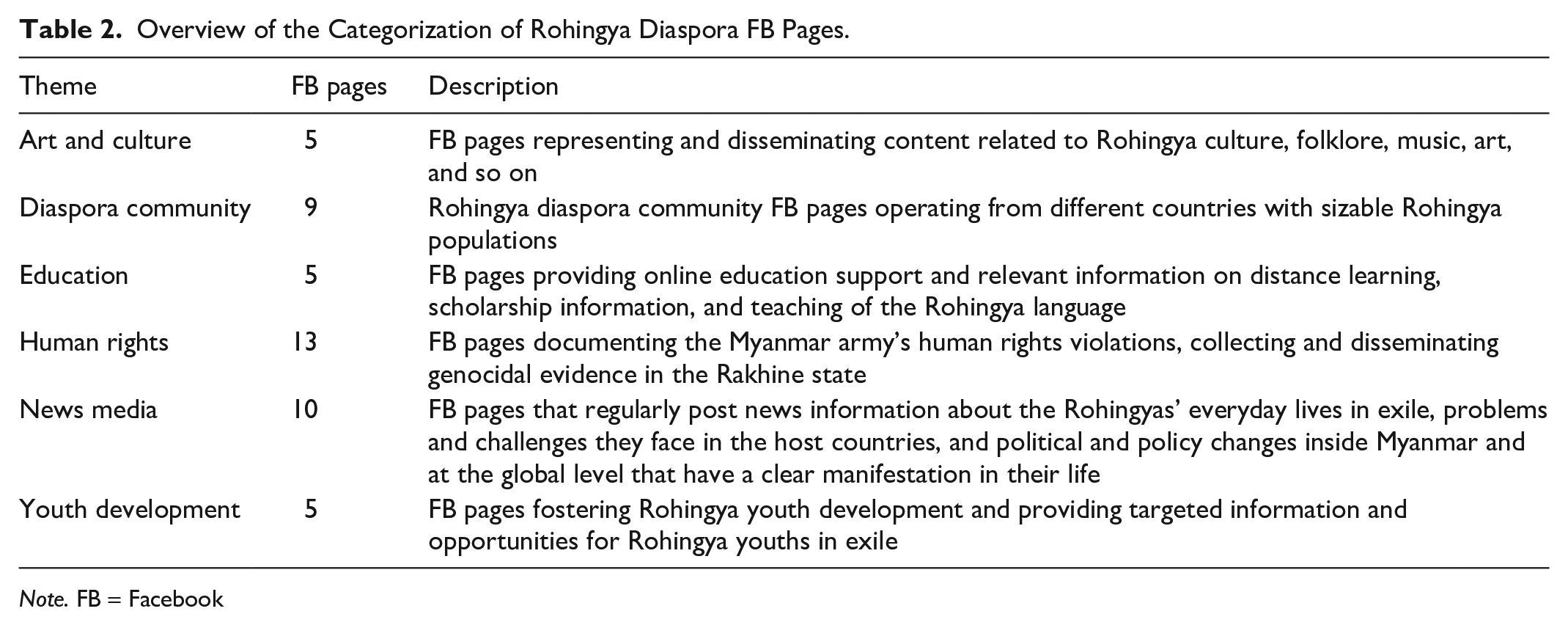
To complement our mapping of the Rohingya digital diaspora on Facebook using digital trace data, we manually categorized the Rohingya diaspora FB pages into page types. We consulted each FB page’s About section and pre-analyzed each page’s most engaging FB posts. Based on this qualitative critical pre-screening, we identified six emergent and recurring themes of diasporic activities and interests to categorize the 47 FB pages. Table 2 reports the different categories.
Overview of the Categorization of Rohingya Diaspora FB Pages.
Note. FB = Facebook
Interpretive Analysis of Selected Rohingya FB Posts
To complement the quantitative part of the analysis that focused on FB pages, we also conducted an interpretive analysis of selected FB posts from these pages. Inspired by the anthropological approach of context-dependent, interpretive thick description (Geertz, 2008), the qualitative interpretive analysis aims to add a contextual layer specific to the unique case of the Rohingya digital diaspora. Thompson (2001) characterized thick description as “a means to discover and reveal the depth of meaning that human actors inscribe in their language and actions” and viewed it as “particularly applicable to communications studies” (p. 66). Clark and Chevrette (2017) noted that thick description enabled researchers to “move between cultural context [and] the social actions and behaviors that constitute it” (p. 1).
The interpretive analysis was applied to 67 FB posts that were selected in two steps. First, 264 FB posts with a minimum of 1,000 user interactions were identified. Second, from these 1,000 FB posts, the posts that received at least 100 comments were selected, resulting in 67 FB posts (approximately 0.2% of the sample of 34,905 FB posts). We chose user comments as a selection criterion because commenting represents the most interactive type of user interaction on Facebook (Kim & Yang, 2017). The threshold of 100 comments ensured the selection of a manageable subsample of FB posts that each stirred significant levels of discussion among the FB users who engaged with the Rohingya diaspora FB pages.
Finally, individual comments and images shared in this article were blurred to uphold ethical standards and maintain confidentiality. With a protected security code, all collected data, including screenshots, were stored in online data storage. Information that discloses personal identity has been carefully revisited and avoided when referring to empirical evidence.
Results: Mapping the Rohingya Diaspora on Facebook
The following results report the findings from the exploratory data analysis of Rohingya diaspora FB pages, followed by the qualitative interpretive analysis of selected FB posts.
Exploratory Time Series Analysis
A first set of exploratory results emerges from the time series of key page and user engagement metrics. Figure 1 displays the development of the average monthly number of total interactions, likes, comments, and shares across the 6-year analysis period.

Time series of total interactions, likes, comments, and shares of Rohingya diaspora Facebook pages.
The blue lines in Figure 1 indicate linear trends for each metric (the gray areas around the trend lines indicate error margins at a 95% confidence interval). Slight negative trends appear for the curves of total interactions and shares, whereas likes and comments exhibit slight positive trends. Overall, there is a diminishing trend of total interactions, including declining shares. While likes and comments follow a positive trend, it also emerges that these two metrics—with their “mountainous” shape—also exhibit higher overall volatilities. It is also noteworthy to mention the extremely high values at the beginning of the total interactions and shares curves, which both originate from a single FB post (!). This post 1 depicts graphic human rights abuses in videos and photographs and went viral with exceptional levels of sharing on Facebook in February 2017.
A further time series result concerns the sentiment of user engagement across the analysis period. Figure 2 shows that positive reactions follow an upward trend, indicating an increase in the average level of positive sentiment toward Rohingya diaspora FB pages and posts. Conversely, negative reactions follow a downward trend after a peak of negativity around August 2017, when the Rohingya mass exodus occurred.

Time series of positive and negative reactions to Rohingya diaspora FB pages.
As we observe, the ascending diaspora engagement on Facebook in 2017, late 2019, and early 2020 stands out in posting and overall interactions. These online activities are inextricably intertwined with offline circumstances. For instance, 2017 was marked by the mass exodus of nearly a million Rohingya refugees from Myanmar into neighboring Bangladesh. Similarly, on November 11, 2019, Gambia applied to the International Court of Justice (ICJ) on behalf of the Rohingya community against Myanmar, accusing the country responsible for violating the genocide convention. Two days later, on November 13, a case was filed by a Rohingya diaspora organization in an Argentine domestic court based on what is termed “universal jurisdiction” against members of the Myanmar government, including the then de facto leader Aung Sang Suu Kyi. On November 14, the pre-trial chamber of the International Criminal Court issued a decision suggesting the prosecutor commence with a formal investigation on the Myanmar government for alleged genocide in the Rakhine state. These successive events were momentous for the community in their quest for justice and global recognition of their plight. 2
Following this tenacious global spotlight on the Rohingya issue for months, the pandemic engulfed the world, and in Myanmar, on February 01, 2021, the military took over power. Overnight, the international community’s focus on the plight of the Rohingyas was replaced by discussions on violent nationwide protests and civil resistance against the military coup. Subsequently, the Ukraine war started a year later, on February 24, 2022, changing the very contour of international politics and security dynamics and the global media focus.
Thus, the findings reiterate how offline momentum gives the impetus for online activism and the embeddedness of the digital realm in offline actions. It underscores the cyclical nature of Rohingya Facebook engagement within a complex interplay of international political order and collective community pursuit of their long struggle for justice. The inability of online engagement to generate tangible social and political changes means if it is “all click, no action” (Wilkins et al., 2019, p. 97), it would gradually fade away—ostensible in the case of progressively declining Rohingya diaspora’s collective action on Facebook.
Differences Across FB Page Categories
A second set of exploratory results materializes when comparing user engagement across the different types of Rohingya diaspora FB pages. Figure 3 shows how total posts, total interactions, and mean total interactions per post are distributed among the different FB page categories.

Total posts, total interactions, and total interactions per post across different types of Rohingya diaspora Facebook pages.
In absolute numbers, news media-oriented FB pages exhibited the highest post publishing frequency (total posts). They received the highest user engagement levels (total interactions) of all page categories. However, in relative numbers—when considering the mean total interactions per post—FB pages dedicated to fostering the Rohingya community and promoting education occupy the first two spots, followed by news media pages. It is also noteworthy to consider the figures for human rights-oriented FB pages. Although they publish posts relatively frequently, they receive relatively fewer interactions. This applies particularly to mean total interactions per post, where human rights-oriented Rohingya diaspora FB pages receive the least engagement compared to the other page categories.
Figure 4 illustrates further differences in user engagement patterns across the different types of Rohingya diaspora FB pages. When differentiating the user interaction types such as likes, shares, and comments, it is worthwhile to distinguish between absolute and relative per post values. While news media FB pages again dominate the rankings when considering the (absolute) sums of likes, shares, and comments, differences appear in the extent of that dominance across these different metrics. News media pages are particularly dominant in the number of likes and shares. However, the lead over the second-placed diaspora community FB pages is smaller regarding the sum of comments. The differences across FB page categories are even smaller at the relative (per post) level of user engagement.

Absolute and relative (per post) user engagement across different Rohingya Facebook page categories.
This means, for example, that although education-oriented Rohingya diaspora FB pages posted the fewest total number of posts in our sample (see Figure 3), these posts fared relatively well in relative terms. They ranked second in the average number of likes, shares, and comments per post. Similarly, posts from art and culture-oriented FB pages performed better than all other categories in the mean number of Comments per post.
These figures convey crucial insights into how different types of Rohingya FB pages also exhibit different user engagement patterns. Some FB page types, such as those related to education and art and culture, only publish a relatively small fraction of Rohingya diaspora FB posts. Nevertheless, their FB posts trigger relatively high user engagement, notably commenting.
On the other hand, overall user engagement, in absolute terms, is still dominated mainly by news media FB pages and content. Posts published by news media FB pages are particularly attuned to being liked and shared by users.
Making Sense of Rohingya Diaspora FB Content Qualitatively: Identity Construction and Political Mobilization
As a “digital diaspora in the making” (Ansar & Khaled, 2023, p. 3), the interactions of the Rohingya community on Facebook bring myriad features—a testament to the growing nexus between social media and forced migration. The interpretive analysis of the selected FB posts and interactions suggests that topics discussed on Facebook predominantly feature content related to Rohingya identity and their political mobilization. It provides an identity canvas accommodating a range of issues, including the assertion of unique Rohingya ethnicity and their presence in pre-modern Myanmar, memories of Arakan, display of Rohingya cultural and folklore heritage, and amateur music videos with Arakanese songs (Arakan Desor Jeerani) urging Rohingya youth (Arakanese Nowjoan) to step up and reclaim their past in Myanmar.
Images and videos of loss and suffering, shared grievance for the homeland, nostalgia, and quest for a return to the Rakhine state persistently shape the narrative and influence the construction of Rohingya identity. Ethnic identity formation is, therefore, articulated in terms of identity loss (NurMuhammad et al., 2016, p. 491). Another important marker of such identity tracing is referring to the Rakhine state as Arakan and Myanmar as Borma (Burma). To maintain a coherent Rohingya identity, to preserve and transmit it to the new generation, mainly those who were born and raised outside Myanmar, videos with visual and graphical representations of Rohingya history are regularly posted on Facebook, which contributes to facilitating a coherent identity narrative and connectedness (Aziz, 2022b; Bernal, 2010).
A conspicuous development in Rohingya Facebook activities is the prominence of Islam, refugeehood, and everyday lives in exile, also partly produced by the conflict. The emphasis on their Muslim belief as part of Rohingya identity and a reason to be discriminated against and differential treatment by the international community are overwhelmingly represented in their Facebook interactions. Referring to the situation in the Rakhine state as Aiyame Jaheliat (Quranic Age of Darkness), portraying the Rakhine state as the new open Muslim concentration camp, questioning the reluctance of the so-called “Muslim World” in declaring Jihad (resistance) against “Buddhist Evils,” the resurrection of Hashor Kiyamot (Quranic day of judgment) and seeking justice from Allah, are narratives that frequently appeared in the contents—both as key posts and reaction to it.
Such narratives of loss, nostalgia, Muslim suffering, displacement, and fear of erasure from history kindle generational togetherness and foster Rohingya identity and belonging in exile. A form of “communal digital grief” is perceptible in such virtual togetherness (Babis, 2021, p. 397). In this process, social media creates the opportunity to “mend ruptures in the social body” and to bridge the gap with their physical homeland (Bernal, 2010, p. 124). For a diaspora with “a cause to advocate” (Mavroudi, 2008, p. 60), digital engagement inevitably revolves around political mobilization, and the same goes with the Rohingya diaspora, where online users reinforce their Burmese origin and distinctiveness of their ethnic identity in the forefront of political positioning.
Similarly, Rohingya political mobilization on Facebook is crafted and disseminated in various ways, with contents dominated mainly by their shared struggle for citizenship, human rights violation, statelessness, Rohingya genocide recognition, and transnational solidarity. For the stateless Rohingyas, who are entangled in such asymmetrical global power structure and offline constraints, the digital platform provides an alternative mechanism to outreach. It offers alternatives to tap resources, build capacities, create links, and enhance connectivity among the scattered community members in an “unevenly interconnected world” (Ponzanesi, 2020, p. 978). Facebook posts contain information on online fundraising, mobilizing international solidarity and support, and reaching out to global political stakeholders, including the UN, European Council, and Organization of Islamic Cooperation (OIC). This coordinated web activism offers them a “connective opportunity structure” in agenda-framing and in pursuing a concerted effort to underpin their aims, concerns, and expectations to the global stakeholders (Kumar, 2018, pp. 11–12).
The “mediated visibility” in digital space also compensates for the long absence of offline resistance, where diaspora members regularly live-stream their protests and political processions on Facebook (Aziz, 2022b, p. 20). A political manifestation of Rohingya identity and cultural representation is also palpable in this virtual space. This is profoundly exhibited in content that posts Rohingya folklore, poems, and music, leading to a poetic expression of resistance, as illustrated in Figure 5.

Rohingya poetry of resistance on Facebook.
In compensation, the frequent use of hashtags such as #Rohingya, #RohingyaGenocide, #SolidaritywithRohingyas, #BurmeseRohingya, and #WhatshappeninginMyanamar; political memes; and caricatures (e.g., see Figure 6) take precedence in their political expression. Such symbolic manifestation of solidarity ignites political opinions through vibrant and provocative political participation. This process strongly influences collective identity formation and political consensus building among the young generation of the Rohingya diaspora (Gerbaudo & Treré, 2015). They leverage humor as a civic resistance and a gateway that persuades powerful emotion and ignites hope and optimism.

Political memes have a strong presence on Rohingya Facebook activism.
Contesting Burmese narratives and pernicious reports in international media, Rohingya users frequently present self-reflection and perspective on the political events and give a “voice to the voiceless” (Aziz, 2022b, p. 14). For example, declaring Rohingya persecution as genocide, organizing a digital campaign during the Gambia v. Myanmar case at the ICJ, the embeddedness of Rohingya history in the kingdom of Arakan—a territory forcibly merged within the Union of Myanmar—are issues that firmly dominate the Facebook forum, in an attempt to form “a common history and identity” (Candan & Hunger, 2008, p. 134). With this persistent political positioning, they cultivate a common political (and digital) historiography of the Rohingya community in Myanmar.
Similar to identity re-construction, Rohingya political mobilization is also shaped by their sense of Muslimhood (e.g., see Figure 7). As a recurring phenomenon, Islam acts as the connecting dot in Rohingya political engagement in virtual space. They call for a political agency through various discursive means. For example, narratives of how Rohingya people are being ignored by the powerful Western countries due to their faith, selective compassion by the UN and international community, failure of the OIC to rally global support, and the absence of a Muslim Country Representation at the UN Permanent Security Council are frequently surfaced in the discussion on Facebook.

Rohingya suffering as Muslims is widespread in their Facebook representation.
Another notable feature of the Rohingya diaspora’s Facebook engagement is the configuration of their participation. Only 10% of users actively engage (assertive users) by further commenting in detail and adding new information or dimension to the original posts. The rest are sort of timid users whose involvements are limited to making comments such as “Thank You,” “Sad,” “True,” “OK,” “God help us,” “Great,” and so on. While assertive users take their cause further, it is the timid users who help sustain such a collective journey. It is, therefore, imperative to apprehend the role of participation—a key driver “to the formation of a sense of transnational identity” (Marino, 2015, p. 3).
Discussion: Dwelling Between Fatigue and Responsibility
In this changing milieu of digital engagement and transformation over the years, the Rohingya diaspora appears to be caught “between fatigue and responsibility” (Lindholm, 2021). While the descending trends of their collective action on Facebook constitute fatigue and hopelessness, their persistent prioritization of identity building and political positioning through the human rights framework reaffirm their unwavering resilience. In this period of transformative changes in Myanmar and the international socio-political order, Facebook constituted a key terrain for “both the construction and the contestation” of Rohingya identity and collective resistance (Gerbaudo & Treré, 2015, p. 869). In this ambivalent process of homogeneous positioning on digital platforms, we identified three pertinent issues that influence and shape this dispersed community’s connectivity and togetherness.
First, Arakan (Rakhine state) remains the place of reference and the center of gravity in the Rohingya diaspora’s multi-layered identity formation and political activism. Arakan is what “connects generations in dispersal and a way to remember a common past” (Lindholm, 2021, p. 302). Arakan is their non-negotiable homeland and a resolute marker for positioning their social, cultural, and political journey. With this emotional commitment circling a particular geographic location, the Rohingya community members not only seize the narrative-making apparatus but also manifest “their collective sense of self, who they are and what they stand for” (Gerbaudo & Treré, 2015, p. 865). Notably, their resistance through persistent references to Arakanese folklore in the forms of poetry, music, metaphors, and imageries also unveils how the folklores and indigenous rural culture from Arakan shape their cultural identity, a phenomenon famously termed as Folklorismus by German sociologist Hans Moser (1962, p. 177).
Second, Rohingyas employ a cohesive, coherent, human rights-based discourse on Facebook to articulate their political grievances and proclaim their shared objectives. As a gateway into global attention, human rights-based narratives of suffering and loss help transcend their grievance narratives beyond diaspora members (Kumar, 2012). Acting as a “community-forming device,” Facebook also facilitates the culture of resistance and reaffirms Rohingya ethnic identity through a direct, relatively less hierarchical, and fluid channel of communication (Oiarzabal, 2012, p. 1469). Cultivating this concerted oppositional consciousness strengthens their sense of rights, justice, and belonging. It helps advance the discussion on their plight and draws global attention to the injustice they have endured for decades. They also engage through humor and caricature to convey political messages; nevertheless, the profundity of such practices to build collective consciousness is contested due to the aesthetic interpretation of humor (Korkut et al., 2022). The context specificity of humor is another important aspect that limits the scope of transcending the messages beyond the familiar circle.
Third, Islam, Muslim solidarity, and Muslim victimhood appear to be the indisputable markers in their identity (re)construction and expansion of political resistance. In an everyday setting, their sufferings as Muslims cannot be trivialized. However, to address the injustice, looking at it through the lens of Muslim victimhood has the risk of being deflected from the wider practice of marginalization and persecution, which Myanmar has long instrumentalized against ethnic minorities as a continuation of colonial divide and rule policy. Connecting deeply with Islam facilitates a sense of solidarity by positioning within global Muslim identity and struggle. Nevertheless, such manifestation may “engender a cathexis between a community of believers and a people joined by suffering” (Abraham & Jaehn, 2020, p. 1058). Such crisis framing through a religious lens may obscure the slender yet significant boundaries between religion and ethnicity in cementing the Rohingya identity and future ethnic and political reconciliation (Ansar & Khaled, 2023, p. 7).
Notwithstanding, amid such evolving interactions and issue-framing dynamics, a gender perspective on identity formation and political bargaining is muted in the Rohingya diaspora engagement on Facebook, leaving this as a topic in the periphery. Neither in the form of the content nor in the users’ discussion, women and gender issues received notable attention. Based on the above findings and positioning itself as an interdisciplinary endeavor combining disciplines of communications, forced migration, international politics, and digital media studies, the article contributes to the existing scholarship in five ways:
First, to our knowledge, it is the first comprehensive study on Rohingya Diaspora engagement on Facebook and their transformation over the years with a large-scale dataset. Second, putting the spotlight on the Rohingya community, a peripheral diaspora within the global diaspora discourse, the article offers a nuanced understanding of the “capacities for building and maintaining more peripheral dissident publics over longer time frames” (McCosker, 2015, p. 1). Third, it unpacks how offline socio-political dynamics influenced the scale and characteristics of their digital activism, thereby reiterating the “non-digital-media-centric-ness” of social media engagement and reciprocity between online and offline activism (Smets, 2018). Fourth, it illustrates how diaspora activism on Facebook effectively moves through and beyond “selective exposure” and has sustained, managed, and evolved over the years (Aruguete & Calvo, 2018). Finally, it argues that although online engagement inevitably helps amplify the offline circumstances, it is the offline momentum that helps consolidate the virtual resistance.
Conclusion
Despite its dubious role in making the Rohingya crisis and their forced exodus from Myanmar, Facebook continues to act “as nodes of socialization and interaction” for the exiled Rohingya diaspora in a non-linear way (Marino, 2015, p. 7). An emotional outpouring of identity construction and political resistance is conspicuous on this platform. It reveals their persistent engagement around ethnic identity preservation, cultural reproduction, and political resistance despite prolonged displacement and palpable material and social disadvantage. Expanding the emerging scholarship on displacement and digitalization, the article presents how dispersed Rohingya communities on Facebook reinforce diasporic ties, consolidate their ethnic identity, and advance their political objectives through oppositional consciousness building. Such engagement in digital space is reshaping the contour of interpersonal relationships, cultural representation, community formation, political narrative making, and building community cohesion. It promotes an identity that revolves around Arakan, their imagined homeland. It is shaped by the memories of loss, suffering, and responsibility to carry forward their pursuit of Myanmar citizenship and recognition of the Rohingya genocide. In parallel, they persistently transcend territorial boundaries by strategically situating their plight as a similar struggle of Muslims elsewhere. Crafting grievance narratives and using human rights-based language, Rohingya diaspora members connect with the global audience and convey their messages. By embracing this dual approach, they “invite comparatively expressive forms of political engagement” that are deeply local in their cause and digitally global in their arguments (Kumar, 2018, pp. 15–16). In this virtual domain, they embark on an ambivalent journey where the challenge remains to stay relevant and focused amid the ever-changing global social, cultural, and political order.
Footnotes
Declaration of Conflicting Interests
The author(s) declared no potential conflicts of interest with respect to the research, authorship, and/or publication of this article.
Funding
The author(s) received no financial support for the research, authorship, and/or publication of this article.
