



Abstract
Despite perennial hope in the democratic possibilities of the internet, the rise of digital authoritarianism threatens online and offline freedom across much of the world. Yet while critical data studies has expanded its geographic focus, limited work to date has examined digital mobilization in the agrarian communities that comprise much of the Global South. This article advances the concept of “organic online politics,” to demonstrate how digital mobilization grows from specific rural conditions, material concerns, and repertoires of resistance, within the constraints of authoritarian violence and internet control. To do so, we examine social media interaction in the wake of the 2021 military coup in Myanmar, an agrarian nation with recent, rapid digital connection that corresponded with a decade-long democratic turn. Analyzing an original archive of over 2000 Facebook posts collected from popular farming pages and groups, we find a massive drop-off in online activity after the military coup and analyze the shifting temporalities of digital mobilization. Crucially, we highlight the embeddedness of online interaction within the material concerns of farming communities, examining how social media become a key forum for negotiating political crisis in Myanmar's countryside. These findings call attention to rural digital subcultures as fertile sites of investigation and point toward the need for future scholarship on data practices that attends to rooted agrarian struggles.
From the Arab Spring to #Ferguson, social media is increasingly a site of revolution. Despite large rural populations resisting authoritarian rule in many countries, however, little is known about how agrarian constituencies mobilize across various platforms and from distinct places. With a few exceptions (Roberts et al., 2017; Su et al., 2021), rural contexts have received limited treatment in critical data studies. Classic studies indicate that rural resistance systematically differs from urban protest, for example when villagers practice evasion, foot-dragging and feigned ignorance rather than open rebellion (Scott, 1985). Given these insights, and building on recent scholarship that challenges data universalism (Datta, 2018), grounds digital politics in rural livelihoods (Young, 2019), and centers ongoing decolonial struggles over land and labor (Faxon and Kintzi, 2022), we ask: how do rural conditions and concerns shape digital mobilization in authoritarian regimes?
To answer this question, we turn to Myanmar, where a 2021 military coup ended a decade of democratic reforms and precipitated what came to be known as the Myanmar Spring Revolution. The internet became a key terrain of struggle, with social media serving as a prime platform both for military propaganda and pro-democracy mobilization (Jordt et al., 2021; Mi-Kun and Siegel, 2022; Nachemson and Frontier Myanmar, 2022). Myanmar's population—predominantly rural and historically reliant on farming—promoted dissent with Facebook posts like Figure 1. Published the day of the military coup in a public Facebook group devoted to new agricultural techniques with over 118,000 members, the post showcases the rural character of online defiance. By combining a common reference to the Myanmar military—the green color of soldiers’ uniforms—with the use of herbicide to kill weeds, the slogan harnessed the imagery of a common farming activity for a revolutionary end. The post comes from “agricultural staff,” a reference to government employees within the Ministry of Agriculture, and anticipates the Civil Disobedience Movement that would take off in the coming days with widespread strikes against the junta's takeover. Using an eye-catching background to accentuate the enlarged text, the author exploited Facebook's affordances to respond to democratic crisis in ways rooted in local cultural references, social structures, and farming practices.

A post from the day of Myanmar's military coup reads: “I’m agricultural staff. So, I have a habit of using herbicide when I see green. Be warned.”.
The post illustrates what we call organic online politics, or forms of digital mobilization that grow from specific rural conditions, material concerns, and repertoires of resistance. In advancing this concept, we argue that online politics are shaped not only by authoritarian repression and national political trajectories, but also by rural communities and their histories. In Myanmar, rural reactions to the coup were distinct from urban responses. By documenting rural resistance, such as tractor protests, and calling for particular forms of dissent, such as reneging on agricultural bank loans, Myanmar farmers’ Facebook groups reflected and directed anti-authoritarian mobilization through an agrarian vernacular. Our analysis provides a methodological approach, empirical findings, and conceptual framing that highlight the importance and deepen understanding of the rural dimensions of online activism, providing a new perspective on data politics that centers the agrarian Global South.
To advance our argument, we analyze an original dataset of popular content from 210 Myanmar Facebook pages and groups 1 related to agriculture, collected in the months before and after the 2021 military coup. Data collection and analysis were funded by a grant from Facebook Research on digital literacy, demographics and misinformation, given upfront to our partner, a Myanmar civil society organization, 2 as an unrestricted grant with no reporting requirements. While we are grateful for financial support, particularly to Myanmar research assistants and activists in the wake of the military coup, we also acknowledge that the grant likely served a public relations purpose for Facebook, particularly in light of international scrutiny on the platform's role in the Rohingya genocide. Scholars, activists, and human rights groups have called particular attention to Facebook's role in fomenting violence (Rio, 2020) and complicity with acts of ethnic cleansing committed by the Myanmar military against Rohingya minorities (Amnesty International, 2022). Facebook had no oversight or control over our research process and has not reviewed our analysis. We undertook this project as critical scholars interested in rural internet use, assessing a full range of relevant content with interpretation informed by over 60 hours of discussion among a diverse research team with substantial local knowledge and experience. Our authorial team is comprised of five interdisciplinary social scientists, including two born in Myanmar, with a combined 25 years of research experience on democracy, agriculture and human rights in Myanmar. Throughout our collaboration, we sought to foster engaged and reflexive dialogue in navigating the ethical implications of conducting research on an increasingly dangerous internet as a research team funded with an independent grant from the platform that we sought to study. We are grateful to additional research assistants in Myanmar, who not only collected and coded Facebook posts, but also provided insights from the ground in discussions immediately following the coup. This collective positionality, briefly sketched here, points to the power of rooting analysis of digital mobilization in longer research with local communities.
Below, we bring together literature on digital and rural mobilization to conceptualize organic online politics. We then provide essential background before outlining our methodology, highlighting the opportunities afforded by a mixed-methods approach with an ethnographic sensibility. Next, we detail our findings. We first demonstrate the massive drop-off in overall online activity and spike in political content after the coup, trends that correspond to the nationwide internet restrictions and the shifting temporalities of mobilization across Myanmar. Second, we demonstrate the rural character of data practices by interpreting agrarian forms of digital dissent. Together, these findings illuminate the key dimensions of organic online politics, which are constrained by authoritarian control and enmeshed in the conditions, concerns and resistance repertoires of rural communities.
Situating organic online politics
Much has been made of the potential for social media to foment democracy (Tufekci and Wilson, 2012). While social media platforms were initially lauded as drivers of liberatory mobilization that could topple autocratic regimes (della Porta and Mattoni, 2014; Valenzuela et al., 2012), studies conducted in the wake of so-called “Twitter Revolutions” show that networked sites do not inherently promote democratization in authoritarian contexts (Kermani and Adham, 2021). Rather, recent scholarship highlights social media's insidious role in abetting misinformation and disinformation campaigns (Freelon and Wells, 2020), promoting xenophobia and ethnoracism (Freelon et al., 2020; McIlwain, 2017), and enabling censorship and surveillance (Byler, 2022; Qin et al., 2017) while regulating national political discourse (Hintz, 2016). Today, a global resurgence in authoritarianism lends urgency to investigations into how democratic digital mobilization intersects with heightened polarization and authoritarian practices (Keremoğlu and Weidmann, 2020; Sinpeng, 2020).
Understanding these dynamics requires attention to the broader social relations that shape the digital (Alvarez Leon, 2022; Lee et al., 2021; Leszczynski and Elwood, 2022). Here, we draw upon frameworks for approaching networked publics as both digital spaces of interaction and practices of imagining oneself within a larger collective body (Boyd, 2010). Digital movements are recursively linked to the physical dynamics of offline space (Beer, 2022) and to the contested processes of forging collectives (Cao, 2022; Schum, 2022; Sinpeng, 2021). Offline cultures matter for online movements (Bonilla and Rosa, 2015; Tufekci, 2017), as analog communication infrastructures (Elyachar, 2014), imperial and colonial power relations (Aouragh and Chakravartty, 2016), and intersectional inequalities (Benjamin, 2019; Elwood, 2020; Noble, 2018) shape how distinct constituencies experience and interact online. Such insights highlight the need to examine digital tactics in a range of settings and make visible non-Western epistemologies, forms of sociality, and communication practices (Tacheva, 2022).
Scholars in the fields of communications and information science have begun to examine the role of digital connection in rural social movements. For example, in the context of armed conflict in Colombia's countryside, Duran and Rodriguez (2018) argue that digital mobilization still relies heavily on face-to-face interaction, decades of lived experience and political tactics, and hyper-local communication strategies. Similarly, Tim et al. (2018) show how the affordances of digital technologies intersect with community dynamics in shaping grassroots environmental sustainability efforts in Malaysia. We build on this emphasis on the articulation of digital technologies with older, analog communication practices, moving further to situate rural digital mobilization within long histories of decolonial struggle and agrarian change.
Attending to the role of the countryside in digital mobilization is vital, not only because two-thirds of the population of the world's low-income countries is rural (UN, 2021), but also because of the central role that agrarian constituents have played historically in global revolutions (Moore, 1967; Skocpol, 2015). Writing in the context of the Algerian War of Independence, Fanon (1963) emphasized the centrality of rural people in decolonization: “Only the peasantry is revolutionary. It has nothing to lose and everything to gain” (Fanon, 1963: 23). Unlike national elites, whose interests are split between overthrowing and supporting existing social structures, the oppressed peasantry fully embraces violent struggles for land, bread, and dignity. While the contemporary Myanmar Spring Revolution differs considerably from North African liberation in the 1950s and 60s, Fanon's insights underscore the need to consider the revolutionary role of the rural. Classic insights from social movement studies—that forms of dissent and collective action emerge from particular power structures and cultural tropes (Tilly, 2015), and that rural resistance differs from urban protest (Scott, 1985)—have given rise to a critical body of work examining repertoires of resistance among subaltern groups (Johansson and Vinthagen, 2016). Building from this rich literature, our study directly engages rural manifestations of digital mobilization. Such a focus is particularly crucial given the links between resurgent authoritarianism and rural transformation (McKay et al., 2020; Monnat and Brown, 2017; Scoones et al., 2018), the digitalization of global agriculture (Fairbairn and Kish, 2022), and the growing use of social media by farmers and rural communities (Otene et al., 2018; Young, 2019).
Limited work to date on rural experiences of digital repression and mobilization demonstrates that the rise of social media platforms in agrarian landscapes generates multiple effects, many of which are contradictory and changeable. Schuler and Truong (2020) argue that while social media might facilitate large-scale urban movements, it inhibits movements in the countryside by enabling governments to respond more quickly to stymy rural protests. Similarly, in rural Cambodia, village officials use Facebook to extend long-standing patterns of information control (Jack et al., 2021). In Northwestern China, social media initially provided rural-originating Muslim men with opportunities for transnational religious connection, but soon facilitated their surveillance and dispossession by the Chinese state in a process that Byler (2022) describes as digital enclosure. Such a progression resonates with Nemer's (2022) study of Brazilian favelas, where social media provided avenues for expression for the oppressed, but also helped bring a strongman to power. Such paradoxes demand new approaches. Embedding online dissent in agrarian dynamics enables us to root data politics in longer patterns of rural resistance, and to see how distinctive forms of rural mobilization are woven into broader political struggles and patterns of authoritarian control.
Internet connectivity and control in Myanmar
Myanmar provides a powerful case for examining organic online politics. After half a century of military rule, Myanmar began a quasi-democratic transition in 2011. As part of broader economic and political reforms during this period, the liberalization of Myanmar's telecommunications in 2014 made mobile SIM cards suddenly affordable, spurring a massive jump in internet users (Brooten et al., 2019). Facebook became the central platform through which new users experienced digital life (McCarthy, 2017; The-Thitsar, 2021; Whitten-Woodring et al., 2020). The platform was swiftly adopted by political actors and offices across the country, including in both the national government and non-state armed groups (Tønnesson et al., 2021). For Myanmar's largely rural population, where over half the labor force works in agriculture (Central Statistical Organization, 2020), social media extended existing economic, social, and political activities into the digital domain (Faxon, 2022).
In the early morning of February 1, 2021, the day that elected Members of Parliament were scheduled to take their seats, the Myanmar military arrested prominent politicians and activists and declared a state of emergency. The military immediately moved to control the internet, raiding data centers and shutting off telecommunications as it seized power. The newly formed State Administration Council (SAC) swiftly targeted social media, issuing directives to all mobile operators and internet service providers to block Facebook, Twitter, and Instagram and circulating a draft Cyber Security Bill that would grant authorities sweeping control. Beginning on February 15, the SAC enforced an internet shutdown each evening between 1am and 9am and, on March 15, it completely disabled mobile internet, denying the majority of the country's population online access. 3 This was accompanied by the revoking of licenses for independent media outlets and an escalation of violence against civilians, including the massacre of 156 people on March 27, Armed Forces Day. In early April, the SAC began nightly broadcasts of a wanted list of people charged with using social media to destabilize the country. At the end of April, some restrictions were eased, but the SAC continued to patrol the internet, including with major internet shutdowns in targeted regions. By 2022, the SAC had stepped up digital persecution and censorship with a proposed cybersecurity law that carried a prison sentence of up to three years for possessing a Virtual Private Network and by forcing the sales of the two foreign-owned telecommunications operators to military-aligned companies.
Despite danger, Myanmar people resisted, both on- and offline. Immediately after the coup, civilians responded by reviving an old protest tactic—banging pots each night to drive out evil—and creating a Civil Disobedience Movement (CDM) in which medical staff, civil servants, and transport workers stopped work. Elected Members of Parliament took the oath of office and formed an alternative governing body, one which would eventually grow into the National Unity Government. On February 6, the first mass protests took place in major cities. Peaceful street protests spread across the country, culminating in General Strike Day on February 22. Despite internet blackouts and increasing authoritarian control, many Myanmar people went online to obtain information at a moment when military-controlled television channels broadcast anesthetizing scenery and propaganda. Anti-coup forces used social media to discredit and denounce the SAC and mobilize resistance campaigns on the ground by encouraging and coordinating protests, CDM, and armed attacks (Ryan and Tran, 2022). Facebook responded by banning select Myanmar military officers and military-linked companies from its platform in February 2021, 4 and later introducing new safety features and expanding its ban. As armed struggle against the junta intensified, revolutionary fighters increasingly targeted military-linked telecom towers for bombings. Social media became a battleground, as both the military and the pro-democracy movement attempted to harness digital space.
Myanmar's rural population, swift adoption of social media, and sudden democratic crisis provide insights into how digital mobilization takes shape on agrarian landscapes during particular political moments. Before analyzing how organic online politics emerge from rural conditions, concerns, and strategies within authoritarian constraints in this context, we outline our methodological approach.
Methodology
While we designed our study before Myanmar's military coup, analysis of data collected both before and after the coup enabled us to observe how seemingly apolitical online spaces changed in response to evolving stages of political crisis. Our study combined the scale of computational tools with the contextual depth of long-term ethnography (Bjerre-Nielsen and Glavind, 2022) to produce and analyze an original dataset of 2005 posts from Myanmar-language Facebook pages and groups related to farming. Grounding our inquiry within team members’ long-term research on Myanmar agriculture, politics, and internet infrastructures enabled us to formulate questions, interpret our data and assess its limitations, and adapt our study in a rapidly changing, high-risk context. Our study provides methodological insights into social science with platform data (Pasquetto et al., 2020), highlighting the possibilities for synthetic, mixed-methods research grounded in an ethnographic sensibility (Albris et al., 2021; Douglas-Jones et al., 2021).
We began with exploratory digital ethnography of Myanmar Facebook pages and groups related to agriculture. During October 2020, we observed 28 groups and 23 pages, identifying themes such as trading, agricultural advice, sharing feelings and experiences, politics, and promotions. This preliminary work informed our strategy for assembling and coding a larger database. To develop and track a more comprehensive list of farming Facebook pages and groups, we used CrowdTangle, an analysis tool owned and operated by Meta. 5 We first generated a list of Myanmar keywords related to agriculture, including တောင်သူ, တောင်သူလယ်သမား, လယ်သမား, စပါးစိုက်တောင်သူ, (farmer); စိုက်ပျိုးရေး, (agriculture); and လယ်ယာမြေ, လယ်ယာ, လယ်မြေ, (farmland), using both unicode and zawgyi, a Burmese-specific encoding. We then used CrowdTangle to search for public pages and groups whose names or posts contained these keywords, generating lists of 1000 public pages and 1000 public groups with the highest number of interactions in the past 30-day period (CrowdTangle Team, 2020). We manually reviewed each page and group for a focus on agricultural content, arriving at a final database of 110 pages and 100 groups. Facebook pages included 50 businesses (selling machines, fertilizers, and agricultural products), 12 government agencies, 7 agricultural associations, 5 media organizations, 3 non-profit projects, 3 educational institutes, and 30 focused on other agricultural topics. About 30% of pages had more than 100,000 followers in December 2020. Groups were organized around sharing agricultural advice, advertising, or sharing market information about inputs, services, or crops, and sharing personal experiences or achievements. Groups were often focused on a particular dimension of agriculture, for example tractors, rice, and flowers. About 40% of groups had more than 50,000 members in December 2020.
Our analysis traced shifts in usage, interactions, and engagement, and employed qualitative coding to analyze the meaning of digital practices over time. To understand how digital activity changed in the short and long term, we used CrowdTangle to collect data on monthly posts and interactions in the period surrounding the coup and then one year after the coup. To understand content shifts in these online communities, we used CrowdTangle to collect the top viral posts from our dataset of pages and groups on a weekly basis, measuring popularity through CrowdTangle's overperforming score. We recorded and archived top posts for 13 weeks between December 7, 2020 and April 30, 2021. For each post, we collected data on timing, type, and interactions. This approach generated an original archive of 2005 Facebook posts.
Close readings of social media posts, longer ethnographic engagement in Myanmar's rural communities, and the lived experiences of our research team were essential in structuring our analysis and guiding our interpretation of the dataset. We used an iterative, inductive coding process to qualitatively analyze this data. Drawing on insights from digital ethnography in the first phase of this research, we developed a codebook of 40 nested codes, including exclusive parent nodes like “apolitical” and “political” as well as descriptive, overlapping codes such as “markets,” “promotion,” and “farmers' struggles.” Multiple researchers coded the posts, comparing findings and discussing key themes in order to ensure consistency and develop our analysis. In addition, close readings and collaborative discussions of illustrative posts helped the research team identify key topics and emergent trends. Our analysis of political content focused on two weeks before the coup (January 9–22), six weeks after the coup (February 1-March 14), and a final week of data collected one month later (April 24–30) to examine the longer-term impacts of the coup on social media usage.
Acute political crisis and increasing crackdowns meant that the study context became markedly more dangerous over the course of data collection and analysis. This demanded not only updating our research questions, but also prioritizing the wellbeing of our team. We sought training on ethical, trauma-sensitive digital research methods in high-risk contexts, and reflexively discussed our approach throughout the project to ensure the safety of analysts and subjects based in Myanmar, including by making decisions to pause data collection and remove at-risk team members from the project. To protect participants in the public Facebook pages and groups we observed, we have anonymized users and avoided using identifiable images. In so doing, we follow a growing set of ethical guidelines for online research by acknowledging that circumstances change and by adopting an ethics of care in online research (franzke et al., 2020).
We present this methodology with several caveats. First, CrowdTangle tracks only a subset of public data, with a bias toward large, US-based accounts, and does not make available data such as “reach,” or the number of users who saw a post. In addition, the “overperforming” metric is an imperfect proxy for popular or viral posts, particularly because it ties high scores to exceeding the expected response for posts by an individual user. 6 Consequently, we do not claim an exhaustive study of this online community. Second, Myanmar farmers’ Facebook is not representative of Myanmar farmers or of national or regional online communities. While we have no demographic data about the authors of posts, our review suggests that many active members of these groups likely come from dominant gender (male), racial (Burman), and class (wealthy landowners and traders) groups. In ways that we discuss below, activity on these groups notably diverged from mainstream Myanmar Facebook. Rather than claiming representativeness, we suggest this distinct online community provides a powerful case of less recognized but consequential digital subcultures that mediate social responses to unfolding political crisis. Finally, despite our efforts to quickly archive posts, many were removed, particularly after the coup. While this limits our dataset, it also illustrates the shifts toward self-censorship that accompanied the arrival of a more dangerous internet. It is to that shift that we now turn.
Findings
In Myanmar, national dynamics of authoritarian repression and democratic resistance shaped the conditions of possibility for digital mobilization enacted in an agrarian vernacular. Below, we first demonstrate how the possibilities of online dissent were circumscribed by authoritarian control over the internet and linked to national trajectories of protest and violence. We then analyze the ways in which online politics are deeply intertwined with the material concerns and resistance strategies in Myanmar's countryside.
Repression and politicization of farmers’ online spaces
Escalating restrictions stymied internet access and prompted a dramatic reduction in online activity in the weeks following the coup. At the same time, previously apolitical farming Facebook pages and groups reverberated with news of democratic crisis and calls for peaceful protest. This represented a radical shift, as previously mundane digital spaces devoted to farming tips became, briefly, supercharged centers of dissent and debate. Below, we analyze the reduction in online activity and proliferation of political content, a trajectory that highlights the impact of authoritarian internet restrictions and the rapid politicization of digital spaces.
In the weeks immediately following the military coup, authoritarian internet restrictions, increased surveillance, and public persecution for online resistance resulted in a massive reduction in internet traffic. In December 2020 and January 2021, pages and groups in our dataset generated nearly 50,000 posts per month on average. After the coup, content decreased dramatically: by April 25, 2021, pages and groups had produced just 11% of the total January 2021 posts (Figure 2). Inactive groups in our dataset grew from 5% in January to 28% in April, and inactive pages grew from 13% in January to 66% in April. Pages and groups not only generated less original content, but also had fewer interactions: on average, a popular post in April had less than half of the interactions that it received in January. Overall, pages and groups in April 2021 had just 6% of interactions compared to three months earlier. Higher numbers of posts were removed in the weeks after the coup than in preceding weeks, suggesting increased self-censorship. In December 2021 and January 2022, groups generated two-thirds the content and pages just half the posts compared to the same period 12 months earlier, demonstrating the coup's long-term impacts on social media traffic.
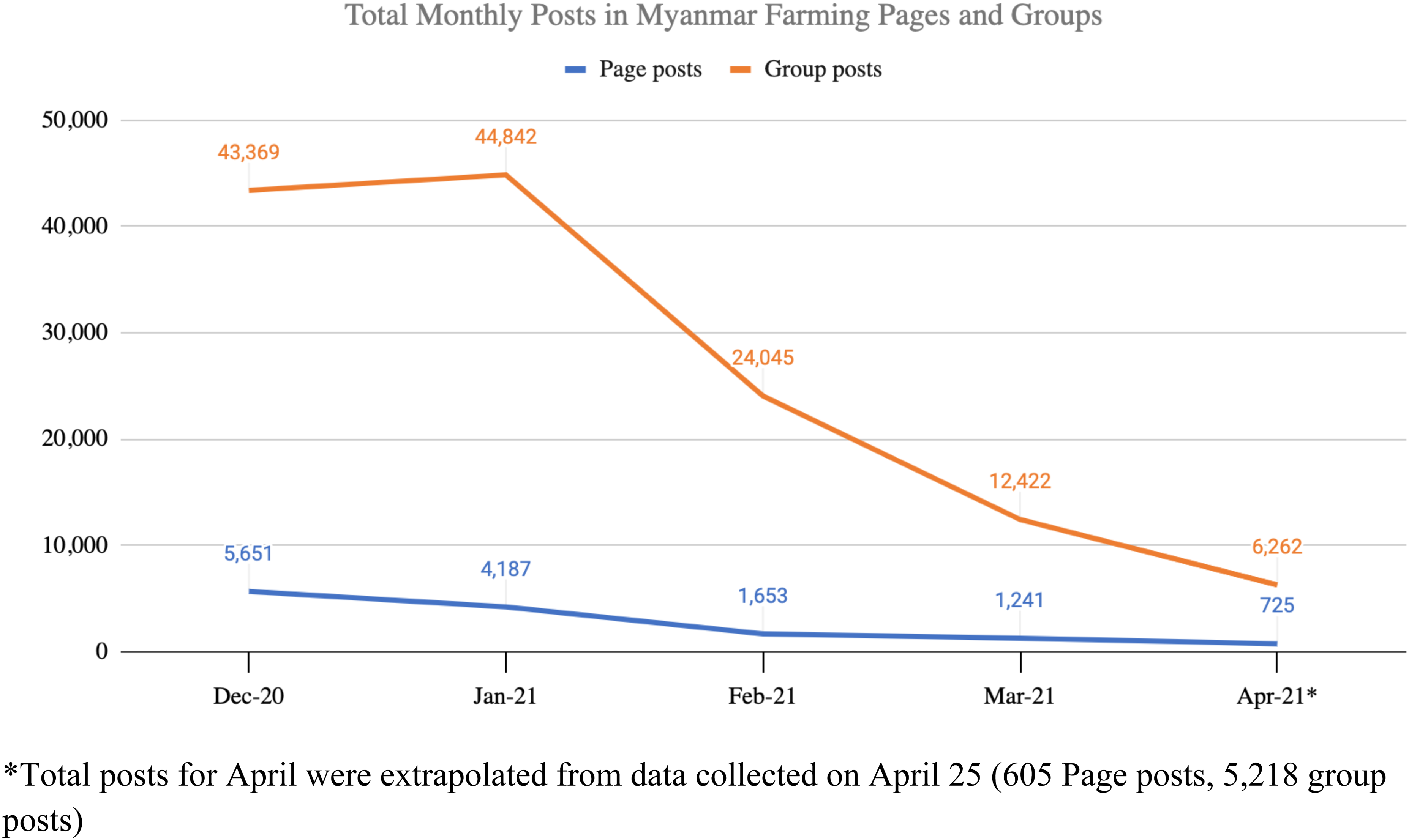
Total monthly posts across pages and groups, December 2020-April 2021*.
This reduction in online activity evidences the power of authoritarian internet control. Our findings are in line with other sources charting a sharp decline in Facebook activity and a shift toward more secure platforms such as Signal and Telegram. 7 But total numbers mask distinct trajectories. For example, the most active page in our original dataset was run by the government Department of Meteorology and Hydrology. In December 2020, the page had over 2.3 million followers and averaged almost 15 posts a day, typically featuring updates on weather and earthquakes. The page went silent after the coup, with almost no posts, interactions, or new followers between February and April 2021. In May, the page restarted and by December it was again the most active page in the dataset, generating 442 posts and almost 350,000 interactions over the month for 2.47 million followers. This U-shaped pattern of silence and resurgence corresponded to the immediate collapse of the government, with widespread participation of civil servants in the Civil Disobedience Movement, followed by SAC attempts to get “back-to-normal.” In contrast, a moderately active independent media page focused on agricultural topics showed a spike in posts and interactions, often featuring pro-democracy content. While it became one of the most active pages in our dataset in the three months immediately following the coup, by December 2021, it had returned to a moderate level of activity. Together, these two pages demonstrate contrapuntal reactions that are indicative of broader responses to the strangling of the internet: silence followed by the resurgence of apolitical or censored content on the one hand, and an initial public outcry swiftly followed by the subsidence of independent media on the other.
Before the coup, Facebook pages and groups bustled with agricultural news, advice, and advertising (Faxon, forthcoming). Photos were by far the most common type of post; our dataset was awash with colorful images of orchids, okra, tractors, and trade. Farmers and brokers discussed seeds, pesticides, and fertilizers as well as tractors and combine harvesters, activity that reflected the major increases both in mechanized agriculture and chemical inputs over the past decade (Belton et al., 2021). They also shared and solicited agricultural advice, from planting techniques to tips for eliminating pests to recipes for organic fertilizer. Facebook also served as a venue for exchanging market information, including daily commodity prices of rice, beans, and watermelons, often shared alongside updates on the status of border trade with China and India, as well as climate and COVID updates. While social media content on both pages and groups was more promotional than political, groups highlighted farmers’ struggles and celebrated rural life. Before the coup, overtly political content was rarely featured and usually took the form of critiquing the government's neglect of agriculture and lamenting farmers’ continued poverty and suffering.
The weeks after the military coup saw shock, defiance, and outrage. Myanmar Facebook filled with news of the coup and pro-democracy rallying cries. Updates on domestic events and international responses, expressions of dissent, and documentation of widespread peaceful protests overtook farming pages and groups previously devoted to sharing tractor news and rice farming techniques. While apolitical content like weather reports and market prices still appeared, the most popular posts were political (see Figure 3). In January 2021, there was almost no political content among popular posts in farming Facebook pages and groups. On February 1, the day of the military coup, political content surged. Spikes in political content correspond with key dates in the Myanmar Spring Revolution. On February 7, the first day of mass protests, 100% of the viral content was political. Political content spiked again on February 17, when protesters piloted a new protest tactic by staging car breakdowns that blocked major roads. General Strike Day, on February 22, saw peaceful protests across the nation, and is also the last day during which more than two-thirds of viral posts were political.

Political and apolitical content in farming Facebook pages and groups before and after the Military Coup, with key dates emphasized.
Politicization was not universal, but played out in distinct ways between pages and groups with different social, commercial, and political entanglements, and in ways that shifted over time. Pages were less likely than groups to take an explicit political stance; corporate pages continued with commodity prices and updates on border trade or issued generic announcements about suspension of services without referencing politics. Several government pages used Facebook as part of the larger apparatus of SAC propaganda, as exemplified by a February post projecting normalcy by displaying an ICT training for government staff. In contrast, independent media pages with relatively little traffic before the coup went into overdrive with political news and CDM updates, while farming groups with previously little political content filled with images of protests in villages and city streets, poetic laments, and tactical debates. Others were more restrained, with administrators issuing admonishments to steer clear of politics. Within the overall decrease in online content due to the authoritarian restrictions documented above, we found a spike in a minority of vocal political groups. Of the 26 groups in our dataset that became more active after the coup, 81% posted about politics. In contrast, of the 71 groups that became less active after the coup, only a third posted about politics. In other words, groups that became more active immediately after the coup became more political.
One of the clearest examples of the politicized character of these online agrarian spaces was groups and pages that changed their banner pictures in opposition to the coup. New images included pictures of NLD leader Aung San Suu Kyi, the unofficial flag of Myanmar's new federal democracy, and oppositional slogans. One went so far as changing its name from “The World of Organic Agriculture” to a popular protest chant “The 2021 Revolution Must Succeed.” The group's “About” section declared: “This group used to be about agricultural care. Now it has been renamed because nothing is more important than the [fate of our] country. The group name will be changed back only after a people's elected government is formed.” A group administrator declared that no posts about agriculture would be allowed after the coup. Its new banner image featured a hand making the anti-authoritarian three finger salute, a symbol that originated in The Hunger Games and gained popularity in the pro-democracy protests in Thailand and Hong Kong. Behind the gesture is the bright red of the National League for Democracy; above flies a dove of peace.
Our research team qualitatively analyzed the shifting tone of viral political content as the Myanmar Spring Revolution unfolded, with early expressions of hope and defiance giving way to sadness and silence in the face of violence (Figure 4). Initially, viral content was dominated by political updates, including domestic news, such as the official announcement of the military-ordered state of emergency, news on international responses, and expressions of dissent, including revolutionary slogans, songs, and poems. Within 48 hours, CDM became the dominant theme. While Myanmar people use the term "CDM" to refer to a specific set of actions, including civil servant strikes, government school boycotts, and refusal to pay taxes and public utility bills, here we refer broadly to nonviolent resistance, including news of and instructions for peaceful protests, public campaigns, and soldier or police defections. Overall, February posts reflected and encouraged peaceful democratic resistance.

The shifting composition of political content—from updates to CDM to violence—in farming Facebook pages and groups before and after the military coup.
By March, violence made up a greater proportion of political posts, and apolitical content was coming back online. While the first days of the Revolution were bloodless, early posts warned of danger and provided instructions for self-protection. The first death of a protester on February 14 inaugurated increasingly brutal crackdowns. Pictures of petitions and peaceful protests gave way to graphic images and videos, including of soldiers attacking, arresting, and torturing civilians. Tactical content pointed out the locations of military snipers and instructed online viewers on how to outfit themselves for offline defense, for example by making body armor from recycled tires. The increase in violence was followed by resurgence in apolitical content in March and April. Though political content remained more common than before the coup, the majority of popular posts were once again apolitical. For example, one “Agriculture and General Knowledge” group posted dozens of viral political posts in the second week of February, but by the end of the month, it posted barely any political content. Groups once again filled with updates on commodity prices and advertisements for seeds and tractors. Sometimes, this return to business-as-usual was accompanied by an apology: “I know now is not the time for selling,” or prayer: “May Myanmar be peaceful.” This type of text acknowledged the crisis while attempting to resume agricultural activities to sustain life as time stretched on. Top posts had gone from pests to protests and back, a finding that underscores the shifting temporalities of online mobilization.
Distinct rural manifestations of political crisis
Above, we demonstrated how digital mobilization was constrained by authoritarian internet restrictions and shaped by national trajectories of offline resistance and violence. In this section, we turn to granular media and discourse analysis of Facebook posts to understand how farmers reacted to political crisis in ways that differed from urban residents. Their posts illustrate the agrarian character of suffering and resistance in the Myanmar countryside, reflecting and enacting a distinct rural response.
Farmers on Myanmar Facebook predicted and documented the impacts of the coup on commodity prices, food supply, agricultural markets, and the country's rural economy. Within the first 24 hours of the coup, one viral post pointed out the immediate impacts on farmers: “Yesterday there was a coup. Today the purchases of farmers’ beans have stopped. Well, you see who is affected first?” Another viral post warned of the specific hardships for farmers that would follow the anticipated re-imposition of international sanctions: “Farmers beware of political repercussions. Sanctions will return. Those working on farms with long-term plans must be especially careful.” Farming Facebook pages and groups commented on disruptions of internet cuts. One administrator of a popular agricultural advice group issued multiple apologies for his slow response due to the bad internet situation, assigning blame with the hashtag “bad people dirty people” (#လူဆိုးလူညစ်). As the weeks went on, farming groups saturated with warnings of currency inflation and crop price fluctuation. A mid-February post announcing that, “We farmers are only worried that the rice market will collapse,” generated almost 1200 likes and 122 comments. While the post focused on the price of agricultural goods, comments drew attention to the broader crisis: “Due to the coup, the whole country is in turmoil. It's not just the price of rice; there will be damage to everything.” Several pointed out that suffering was nothing new for farmers, who had struggled under previous governments: “Was it better before? For how many years have the farmers faced losses from the agricultural markets? We farmers know the most about it.” Indeed, these early predictions proved prescient, with severe inflation and reduced crop yields crippling Myanmar's economy and producing food shortages in the year that followed.
Others speculated about a broader range of future impacts. “They will also come and grab the farmland. Aren’t you scared of that?” one wrote, a reference to the possible repetition of a rural past riddled with land grabs, in which military elites had taken land from small farmers with impunity. Some were more optimistic, for example, pointing out that farmers, who grew their own food, could weather the current crisis better than striking wage workers: “Even if we cannot sell, we can still cook and eat. The CDM staff are going on without anything. Once politics stabilizes, the rice market will come back.” In contrast to this hopeful outlook, others mourned deeper losses: “I am more fearful of the failure of the next generation than the failure of the market,” one wrote, a poignant expression of the depth of the grief felt by people who had dreamed of a life free of dictatorship for their children. “We fear not only for the rice market but also for the future of our generation. So, now the youth are on the road to strike.”
Early warnings soon gave way to documented suffering. “Now, you see what bad times and bad systems are like? The bean prices decrease, the traders pause their work, and the banks are shut down. There is no money circulation. For the workers and the farmers, this hardship is like being kicked in the chest,” one wrote. As banks closed and the currency exchange rate spiked in response to political turmoil, farmers shared complaints about the rising price of gas for tractors and combine harvesters and reported on truckloads of spoiled watermelons stopped at the China border, as border closures disrupted international trade of this key cash crop. One post reported that agricultural machines would no longer be sold in installments due to the collapse of the banking system. Other posts gave advice for volatile times: two posts from late February suggested methods of organic fertilizer to use in lieu of commercial inputs, which had become prohibitively expensive since the coup. Another urged farmers not to panic and sell all their produce, but save it until market prices improved. Others tried to rally support for local farmers by encouraging readers to buy locally grown onions and other crops.
Farmers and agricultural communities faced specific disruptions to their crops, homes, and markets due to the crisis, and this informed the kinds of actions they took within the broader struggle against dictatorship. Politicized Facebook posts in farming groups included popular scenes of urban street protests that circulated broadly in Myanmar and internationally, but they also depicted agrarian forms of resistance. For example, one user shared a market price update that provided the day's bean rates along with a warning that prices might change in the future, prefacing the shared post with original text: “I just share this news to break free from military slavery.” In the early days of February, many Myanmar organizations, including farmers’ unions, circulated images of petitions opposing the coup. In later weeks, farmers joined city dwellers in public protest, sharing photos of marching, including with farmers’ union banners. Viral photos of protests staged in fields, villages, and mines, as well as protest lines of tractor and elephants, asserted rural dissent through localized rural vernaculars. While population density ensured the wide visibility of city protests, social media played a particularly powerful role in amplifying nonviolent actions in remote, rural areas (Figure 5).
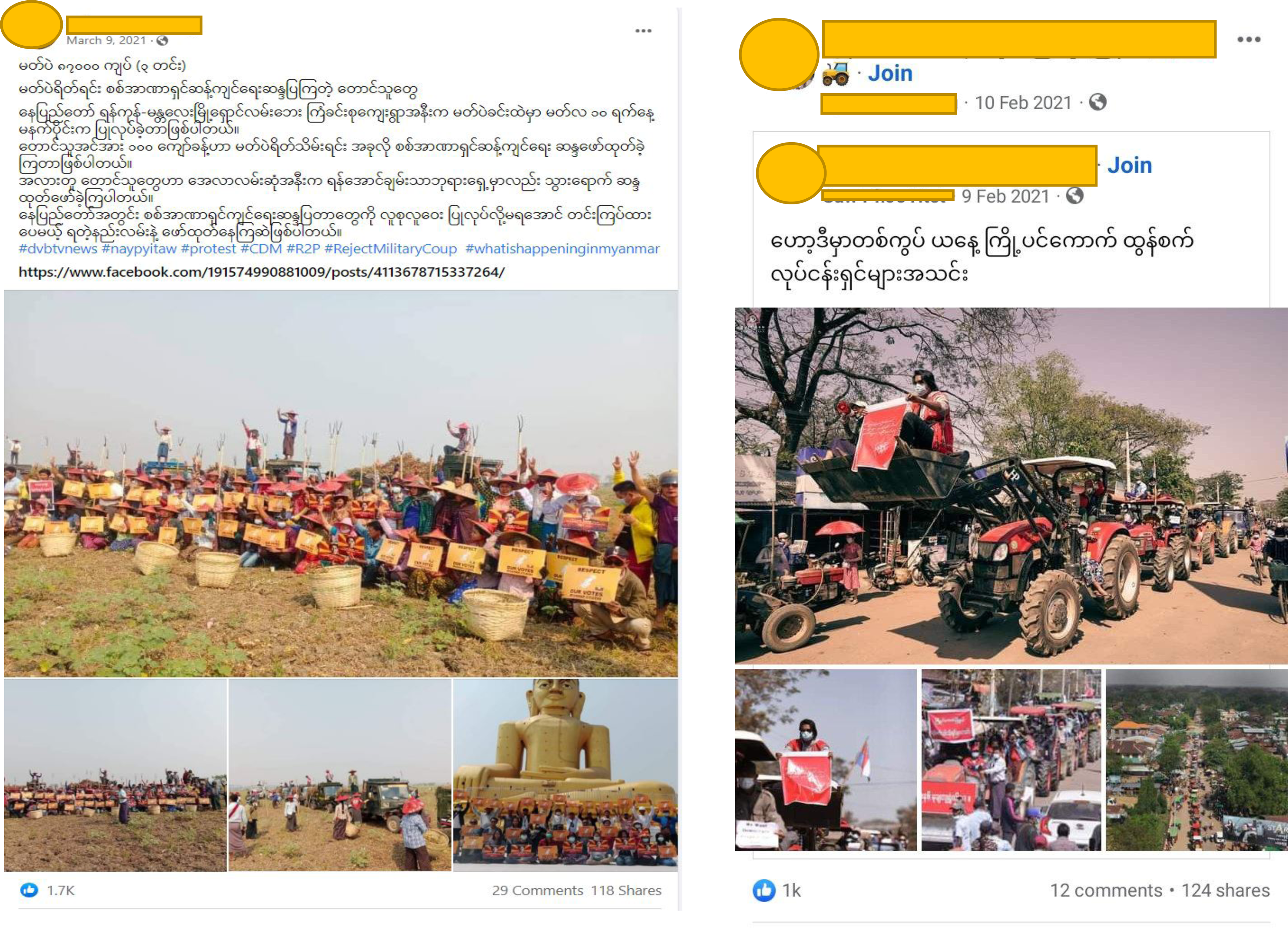
Examples of Rural Resistance.
In one image that circulated across multiple groups, an old man stands with a raised fist in a protest line of men, similarly clad in the familiar rural attire of baseball hats, flip flops, and traditional male skirts, or longyis. In his other hand, he holds a cardboard sign that says: “We farmers don’t want to go back to the era of the rice tax.” This is a poignant reference to the poverty and hardships farmers endured under the socialist-authoritarian junta that took power with General Ne Win's 1962 coup, when each family had to provide rice to the regime. In one post that used this image, the author wrote: “When we were young, we had to pay rice tax after harvesting our rice. My mother asked us how much rice to give as tax and how much rice to take home. Remembering…” By invoking histories of rural repression as grounds for refusing the contemporary coup, such posts exemplify online resistance in an agrarian vernacular.
Facebook posts by Myanmar farmers not only documented, but also enacted the Myanmar Spring Revolution. While employees at offices, schools, and hospitals in rural areas were able to directly participate in CDM, subsistence farmers, who were not waged workers or salaried civil servants, found other ways to participate. Facebook posts encouraged farmers to boycott government services by refusing to repay their seasonal crop loans issued by the national agricultural bank: “Farmers should participate in CDM. Never, never repay the agricultural loans owed to the government until Mother Suu [NLD leader Aung San Suu Kyi] and President U Win Myint are returned to power. If there is suffering, the farmers will suffer. All farmers, take good care of yourselves.” These calls were supplemented by public pledges. Another viral post that circulated in multiple groups declared, “As a farmer, I will not repay my crop loans until I see a speech by NLD leaders on national TV.” In mid-March, government-in-exile announcements of a one-year, interest-free extension on agricultural loans circulated throughout farming Facebook pages and groups, condoning this rural form of CDM.
As peaceful protests gave way to armed struggles across the country, viral content shifted from urban street protest images toward photographs of combat training in the jungles. Images of Ethnic Armed Organizations providing training to young recruits in newly formed Peoples’ Defense Forces at undisclosed remote locations circulated, sometimes accompanied by invitations to join the fight for the revolution. This marked a turn in political opposition, as public dissent and peaceful protest shifted to private organizing and armed revolution in the countryside. While this pattern illustrates the broader shift in political content described above, it also indexed a geographic movement in revolutionary activity, from the city centers that had hosted creative, peaceful protest in February and March, toward the remote strongholds and rural regions that would bear the brunt of armed conflict and sustain the resistance over the years that followed.
Together, these examples of rural digital mobilization underscore the embeddedness of online politics in agrarian landscapes with rooted histories of survival and resistance. Farmers’ responses to the military coup were distinct from those of city-dwellers, rendered in the language of bean prices and rice markets. As time passed, they suffered disruptions of planting calendars, access to inputs and border trade. Facebook provided a forum for rural resistance, in documenting protests in fields and with draft animals and farm machinery, and in calling for actions rooted in particular agrarian relations, such as refusing repayment of government agricultural bank loans. Nested within the broader political economy of the internet and national trajectories of protest and violence, these distinctly rural responses constitute organic online politics.
Discussion
Our findings illustrate the dynamics of organic online politics, as the possibilities for digitally connected democratic mobilization emerge from histories of repression, repertoires of resistance and acute challenges of daily life in rural communities. This is online resistance in an agrarian vernacular, within the evolving constraints imposed by authoritarian control. As digital spaces became key fora for negotiating the crisis and debating responses, understanding online politics required close engagement with Myanmar farmers’ lived realities. While plummeting traffic illustrates the chilling impact of authoritarian control over the internet and the politicization of farmers’ Facebook reflects the temporal arch Myanmar Spring Revolution, the specific forms of dissent articulated by farmers and agricultural traders were grounded in rural conditions and grievances. For Myanmar's farmers, political crisis could not be delinked from corporeal concerns, even as hope and despair were articulated through existing vocabularies of agrarian survival. Organic online politics grows from rooted rural histories, within the constraints of increasing authoritarian violence.
This concept can inform studies of rural activism in other contexts by focusing attention on the analogue histories, acute crises, and local resistance strategies that shape digital mobilization. In Myanmar, farmers used Facebook to document different forms of protest—driving tractors through provincial towns rather than marching in city streets—and to promote different forms of collective action—for example refusing to repay government crop loans—than those that usually feature in studies of urban digital mobilization. Their grievances and predictions concerned not just human rights, but also crop and input prices, land grabs, and a return to coercive agricultural policies. These early warnings emerged from lived experience and have proved prescient, as Myanmar experiences hyperinflation and commodity shortages. Scholarship on rural mobilization suggests that rural populations might be less likely to use social media for overt dissent, and more likely to employ subtle tactics. Yet subtle tactics can still be powerful, as images of mass protest from remote sites such as the Mogok ruby mines played an important role in generating solidarity and momentum for national movements.
Our findings not only temper optimistic prognostications about what digital platforms make possible, but also focus attention on evolving dynamics on the ground. While Facebook proved fertile ground for public dissent in the initial months of the revolution, that role diminished as authoritarian violence increased. In the year after the coup, Myanmar's online activity, previously largely confined to Facebook, splintered across Twitter and Tiktok. To circumvent SAC surveillance, many political conversations moved to encrypted apps like Signal and Telegram. Given the many arrests of social media users and heightened risk across the country, public Facebook posts with blatant dissent are now rare, at least from those who remain inside Myanmar. Digital mobilization for the Myanmar Spring Revolution has not stopped, but rather adapted to dangers and constraints. Today, Facebook is often used to direct users to click to donate campaigns, interactive video games, and YouTube videos of revolutionary songs posted by accounts that promise to use advertising revenue to fund anti-military forces and displaced people. These innovative ways of circumventing online repression to raise funds and boost morale evidence the creativity of resistance and suggest that splintering across multiple, evolving digital platforms is a key tactic for sustaining anti-authoritarian movements. This observation presents new methodological challenges for researchers working in authoritarian contexts. The study we carried out would be impossible now: rising data costs and the chilling of online dissent mean that few rural people in Myanmar use Facebook in the ways we studied in early 2021. This reality illustrates the need for adaptive, ethical approaches that can evolve in relation to intensifying online surveillance, even as it underscores that, whether in Myanmar or Ukraine, wars are ultimately won with weapons, not social media campaigns.
As anti-democratic practices strangle the internet, from Kashmir to Xinjiang, good platform governance is necessary, but not sufficient. In Myanmar, Facebook was applauded for its swift efforts to moderate content and limit Myanmar military activity on the platform in the early days after the coup. However, these actions were ultimately undermined by the military's material control of internet infrastructure and by migration to other platforms—such as Tiktok and Telegram—with less content moderation (The-Thitsar, forthcoming). While good governance of digital platforms through regulation, oversight, and democratic accountability is essential, our study shows the limits of platform power in authoritarian contexts and raises questions about the role of platforms in arbitrating global democratic struggles. We invite future research that situates online politics not only within global political economies of the internet, but also the national trajectories of repression and revolutionary projects and the material concerns of rural communities.
Conclusion
By attending to diverse data practices, we challenge dominant visions of a singular future and open space to consider alternatives (Bronson, 2022). While critical work on big data in urban environments has shown how digital intermediation alters the scales and practices of urban governance (Ashton et al., 2017), this article has highlighted the distinct stakes and strategies of digital intermediation in contested rural hinterlands amidst profound political upheaval. Myanmar farming Facebook pages and groups provide insights into the material and cultural impacts of and responses to democratic crisis among agrarian populations in the Global South. Our work calls attention to such understudied online communities as fertile sites of investigation and makes three major contributions to studies of digital mobilization. Methodologically, we pioneer a mixed-methods approach that integrates computational tools with ethnography. Empirically, we demonstrate how the possibilities for social media platforms to foment democracy are delimited by authoritarian restrictions and bound to the shifting temporalities of protest and violence, but also embedded in grounded agrarian struggles. Analytically, we advance the concept of organic online politics to explain how digital mobilization grows out of evolving concerns, conditions, and repertoires of resistance rooted in particular rural communities. This concept brings into focus the situated agrarian dynamics that shape digital mobilization and repression. Data practices in rural contexts are marked by silences, absences, and coded acts of resistance that can only be interpreted through the localized lexicons of the revolutionary countryside.
As we write, the Myanmar Spring Revolution continues, online and offline. On the first day of the coup, a user we will call Orchid Aunty posted photos of bright purple and yellow orchids with a message: If the internet connections are cut off If we are locked in our homes by ourselves If we can no longer make phone calls Let's think of one another We will be cultivating our flowers while keeping our eyes on what is happening in the world One day we’ll be together again to show off the beauty of our daughters [flowers] to one another Let's not say goodbye, I want cry 

The post rings prophetic in its predictions of restrictions and isolation, as well as its hope for a future online reunion. The month that followed saw almost no political posts in this popular flower-lovers group, but on February 28, the bloodiest day to date in the military's crackdown on peaceful protesters, Orchid Aunty posted again: “Please, let's focus on what is happening in the whole country by not posting the flower pictures, not giving reacts and comments on the existing posts and not sending member requests. Please understand me if I cannot look at the posts about flowers and approve the posts when I’m focusing on the news of today.” Posts in Myanmar's popular flower-lovers’ groups dipped after the coup, but by the last week of April, 51 of the top 100 viral posts in farming groups featured flower pictures.
Our collective review and discussion of the proliferating images of beautiful plants and idyllic gardens revealed that this resurgence indexed not only an abandonment of protest, but also a need for escape and beauty to sustain the possibility of life in an increasingly difficult time. Viewing the posts in late April 2021, one Myanmar member of our research team noted that while at face value these posts appeared to have nothing to do with politics or the revolution, they stirred deep sadness. For some viewers, scrolling through their smartphones amidst authoritarian violence, images of an idyllic countryside served as totems of the loss of things once taken for granted and of a tenuous hope for a better future. Amidst profound disruption, farming social media groups became a site not only of dissent, but also of collective mourning.
Organic online politics may not take the form that pro-democracy advocates, writing from faraway cities, expect. This form of digital mobilization is grounded in cultural vernaculars of resistance and renewal, which draw meaning from rooted landscapes that are both the source of sustenance and the site of sustained violence. Researching in these places, and with these groups, commands deep respect for Myanmar people at home and abroad who employ digital tools in the ongoing struggle for freedom, and a peaceful life, filled with orchids.
Footnotes
Acknowledgments
We gratefully acknowledge the hard work and contributions of Myanmar analysts and support staff during the early stages of this project and very difficult months following the 2021 military coup. At the University of California Berkeley, Erin Foster, Ann Glusker, Stacy Reardon, the D-Lab, and a Ciriacy-Wantrup fellowship provided crucial support. We thank Ei Shwe Sin, Han Htoo Khant Paing, and Win Moe for research support at various stages of this project. Three anonymous reviewers and the journal editors gave useful comments on drafts that improved the quality of this manuscript.
Declaration of conflicting interests
The author(s) declared the following potential conflicts of interest with respect to the research, authorship, and/or publication of this article: Data collect and preliminary analysis were funded by a grant from Facebook Research on digital literacy, demographics and misinformation in Myanmar. Facebook had no control, oversight, or involvement in the research process and has not reviewed the results. This source of funding has not affected our analysis or findings.
Funding
The author(s) disclosed receipt of the following financial supportfor the research, authorship, and/or publication of this article: Data collection and preliminary analysis were funded by an Independent Award from Facebook Research. Work on this article was also supported by funding from the European Union's Horizon 2020 research and innovation programme under grant agreement number 101079069 and a Marie Curie Fellowship.
