



Abstract
The growing availability of expansive social media trace data (SMTD) offers researchers promising opportunities to create rich depictions of societal and social phenomena. Despite this potential, research analysing such data often struggles to construct novel theoretical insight. This paper argues that holistically incorporating temporality enhances data collection and data analysis, subsequently facilitating process theory construction from SMTD. Recommendations to integrate temporality are outlined in the proposed Temporal Dynamics Framework and Methodology (TDFM). We apply the TDFM to investigate the temporal dynamics of mental health discourse on Twitter (now X) across different phases of the COVID-19 pandemic, theoretically framed in the context of innate psychological needs satisfaction. The findings reveal dynamic shifts in social media use, indicating that different phases of the pandemic triggered changes in the needs motivating, and being motivated by, social media use. This illustrative case reflectively evaluates the TDFM's usefulness in contextualising SMTD collection, analytical strategies, and process theory construction by incorporating a dynamic perspective on time.
Keywords
Introduction
The proliferation of digital trace data presents promising opportunities for researchers to develop, refine, replace, and expand theoretical perspectives (Berente et al., 2019; Miranda et al., 2022). Digital trace data, which represent digital records of activities and events occurring on digital technologies, offers a level of granularity that can revolutionise established paradigms (Berente et al., 2019; Grisold et al., 2023; Howison et al., 2011). However, developing theoretical insight from this type of data presents considerable challenges (Maass et al., 2018). Unlike surveys or interviews designed to produce research data, digital trace data is the by-product of other activities that must be adapted for research purposes (Howison et al., 2011: p. 769). These challenges have motivated the development of frameworks and guidelines to construct theoretical insights from digital trace data, broadly defined as Computationally Intensive Theory Construction (CITC) (Berente et al., 2019; Miranda et al., 2022). CITC is rooted in computational theory discovery and the grounded theory methodology (Džeroski et al., 2007; Glaser and Strauss, 1967). Specifically, ‘… computationally intensive theory construction draws from three key genres – mixed methods research, computational social science, and grounded theory methodology (GTM), but is not reducible to any one of them’ (Miranda et al., 2022; p. iv).
Social media trace data (SMTD) represents an important subset of digital trace data. However, leveraging SMTD poses unique challenges that must be addressed to facilitate data collection, data analysis, and theorising (Abbasi et al., 2016; George et al., 2016; Howison et al., 2011). For example, McKenna et al. (2017; p. 90) comment that applying qualitative methods to these types of datasets is difficult due to veracity and volume: ‘… there is less control and less knowledge about the origin of the data, meaning there is potentially much more noise in the data (irrelevant data) which needs filtering’. Furthermore, academics today can access all public Facebook content on pages, groups, and verified profiles, and all public Instagram content created by business, creator and verified profiles (Meta, 2024). While other forms of digital trace data, such as organisational event logs, may possess some level of inherent quality, SMTD lacks broader contextualisation as it represents the interactions of many actors motivated by many interrelated purposes, events, and activities (Kotlarsky et al., 2022; Mirbabaie et al., 2020; Salge et al., 2022). Thus, proposing approaches to reconstruct context and relationships from SMTD can improve process theory construction in data-driven social media research (Berente et al., 2019; Levina and Vaast, 2015).
We argue that integrating rich conceptualisations of time, or temporality, enables SMTD collection and analysis, subsequently facilitating process theory construction. Utilising different approaches to time enables the analysis of different types of events (Howison et al., 2011; Oh et al., 2013; Salge et al., 2022) and their temporal dynamics (Bachura et al., 2022; Baygi et al., 2024; Oh et al., 2015), supporting process theorising from SMTD. This paper builds upon the current discourse on CITC to address the unique challenges and opportunities associated with process theorising from SMTD. To do so, we propose the Temporal Dynamics Framework and Methodology (TDFM) to guide iterative temporal contextualisation, data collection, data analysis, and process theorising. The rest of the article is organised as follows. First, we discuss the importance of temporality and diachronic analysis. Second, we detail each phase of the TDFM. Third, we apply the TDFM to an illustrative case. Fourth, we discuss the constituents of the TDFM and the opportunities and challenges associated with the TDFM. The last section concludes the paper. The temporal dynamics framework and methodology (TDFM).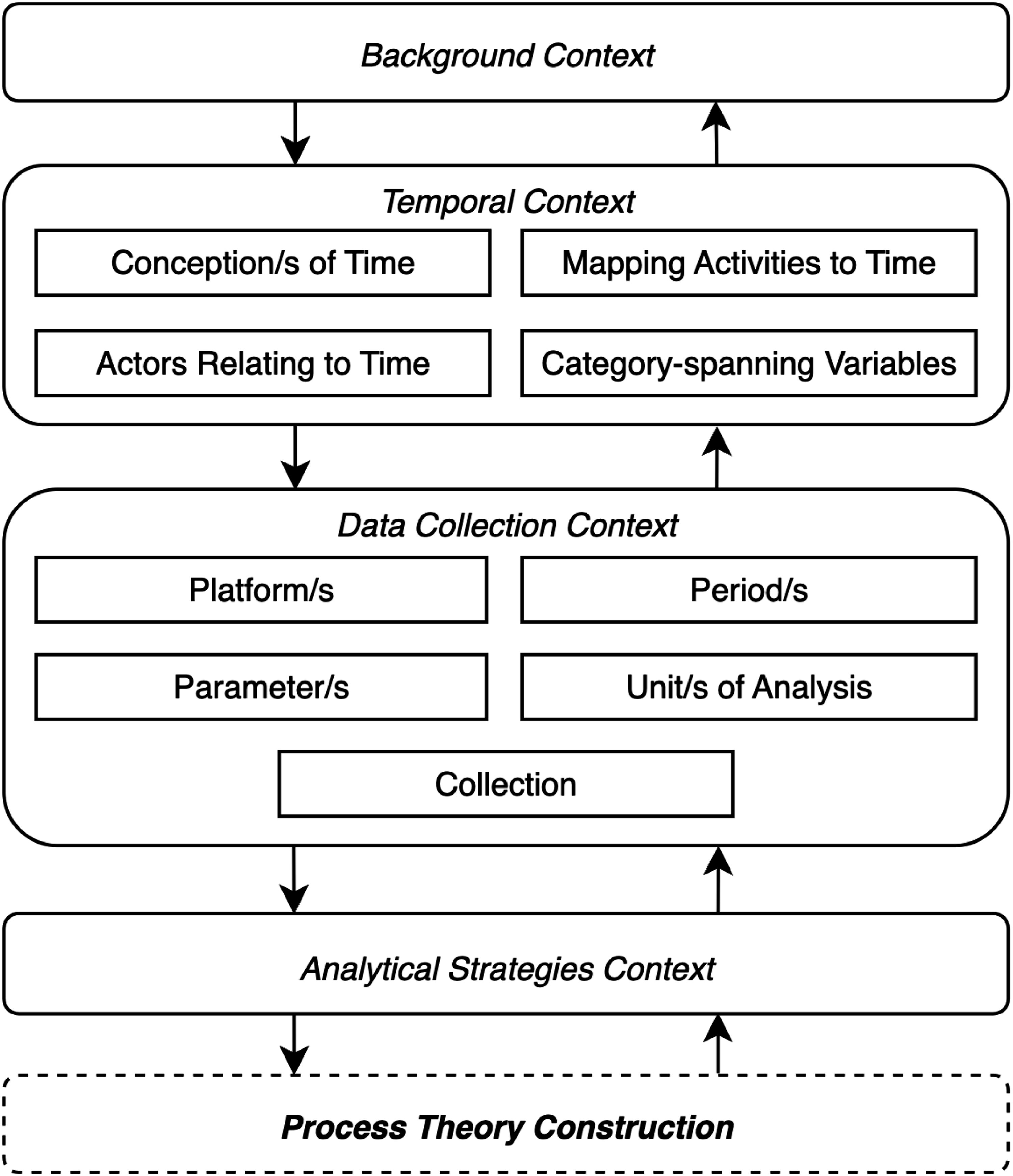
Temporal dynamics of social media trace data
Temporality
Temporality is richly conceptualised in the field of management (Ancona et al., 2001; Cunliffe et al., 2004; Kaplan and Orlikowski, 2013; Langley et al., 2013; Orlikowski and Yates, 2002; Reinecke and Ansari, 2015; Saunders et al., 2018; Shipp and Jansen, 2021), yet remains understudied in the domain of Information Systems (IS). While some earlier research (Cooper and Zmud, 1990; Zhu et al., 2006) and more recent research (Baygi et al., 2021, 2024; Griva et al., 2024; Ivaturi and Chua, 2021; O’Connor et al., 2022; Shen et al., 2015) examine temporality, further attention is needed as our perspective on time varies based upon our assumptions. Venkatesh et al. (2021; p. 36) argue that ‘more explicit attention to time in IS research can make IS scholars aware of critical assumptions that frame and may constrain their research, can introduce useful new constructs into IS research, can improve the research design in the study of IS processes and help develop richer understanding of the phenomenon’.
Exploring how phenomena change as a function of time enriches theory construction from SMTD. Bachura et al. (2022), for example, analysed tweets following the Office of Personnel Management (OPM) data breach, identifying significant changes in online emotional expression over time. Mirbabaie et al. (2020) examined social media participation during Hurricane Harvey, revealing core actor groups participating in online discourse as the disaster unfolded. While neither of these studies focused on the concept of time, both analysed temporal changes in SMTD, thereby generating a richer understanding of the phenomenon. Furthermore, unlike cross-sectional studies, which generate variance theory (Mohr, 1982), temporal studies can generate a different type of theory: process theory. Process theorising represents one approach to understanding change over time by analysing sequences of events that lead to an outcome (Langley, 1999). While time can be theorised using other meta-theories, such as co-evolution and social networks (Niederman and March, 2019), we concentrate on process theorising which addresses the inherent temporal complexities of SMTD.
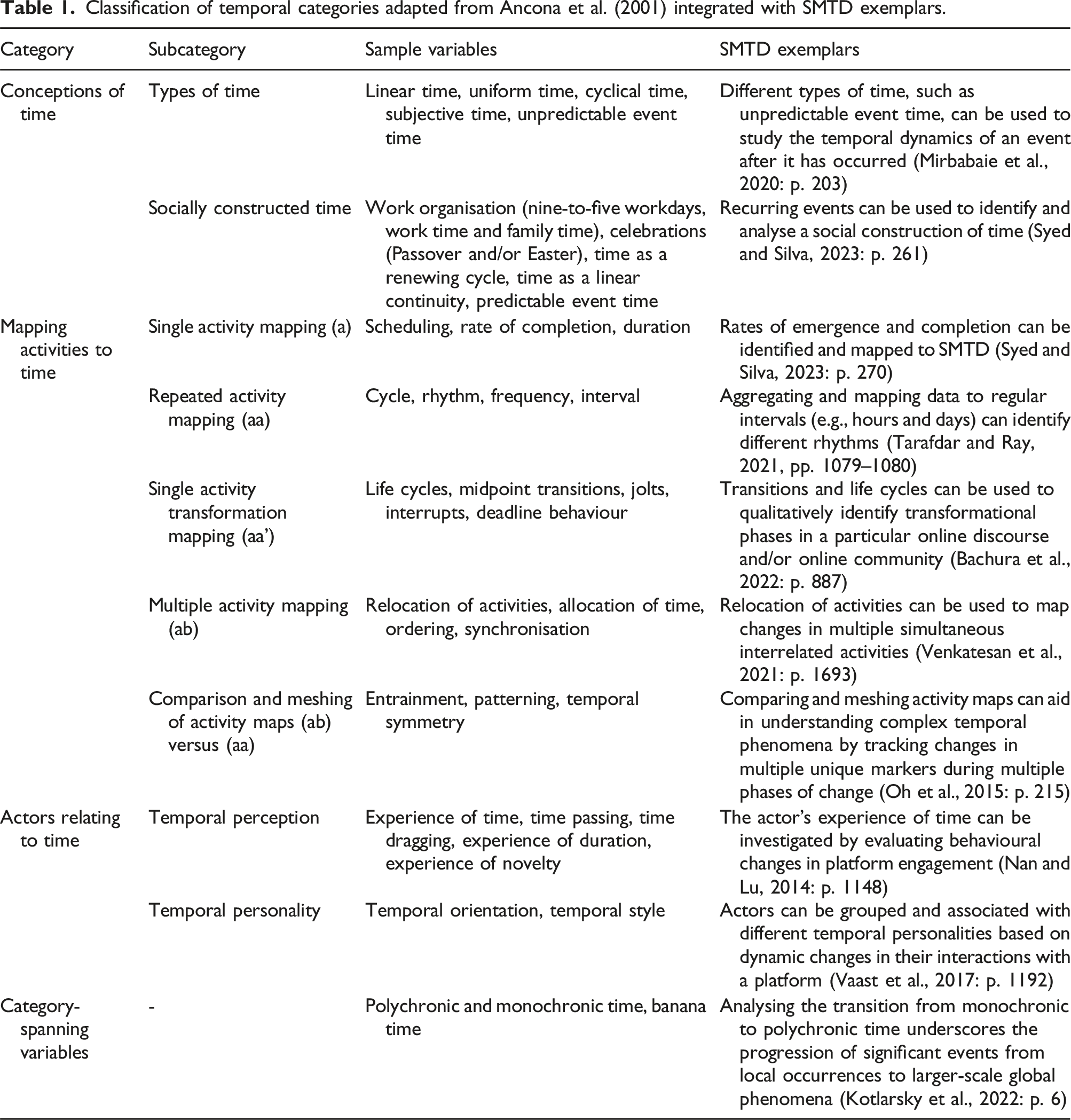
Classification of temporal categories adapted from Ancona et al. (2001) integrated with SMTD exemplars.
Diachronic analysis
Measuring temporal shifts in SMTD requires diachronic analysis (Pentland et al., 2021). Originating from linguistics, diachronic analysis involves studying the evolution of language over time (Saussure, 1916). In organisational research, it refers to changes in action patterns over time (Barley, 1990). In clear terms, ‘a synchronic analysis would compare technologies with each other, whereas a diachronic analysis would contrast earlier and later periods of a single technology’s use’ (Barley, 1990: p. 223). For example, Barley (1990) applied synchronic analysis to analyse multiple technologies used within a radiology department (i.e. radiography, CT scanning and ultrasound) and diachronic analysis to examine a single technology (i.e. CT scanning) over time. From a different perspective, synchronic analysis reveals cross-sectional patterns, static concepts, and static relationships among concepts, whereas diachronic analysis reveals temporal patterns, dynamics, and change (Berente et al., 2019). This research focuses on applying diachronic analysis to construct process theory using SMTD.
Diachronic analysis is strengthened when temporal elements are explicitly addressed, as temporality can help explain changes in structures and processes (Berente et al., 2019). By using unpredictable event time, which represents a type of time, to guide data exploration and analysis, Bachura et al. (2022) segmented SMTD into multiple phases supporting their argumentation. Furthermore, temporal contexts carry ‘surrounding dialogue’ that may sit outside of the discourse being analysed (Levina and Vaast, 2015). Therefore, while diachronic analysis represents a specific approach to investigating temporal aspects of SMTD, it also provides a rigorous foundation to contribute process theory to the existing body of knowledge (Pentland et al., 2021).
The Temporal Dynamics Framework and Methodology (TDFM)
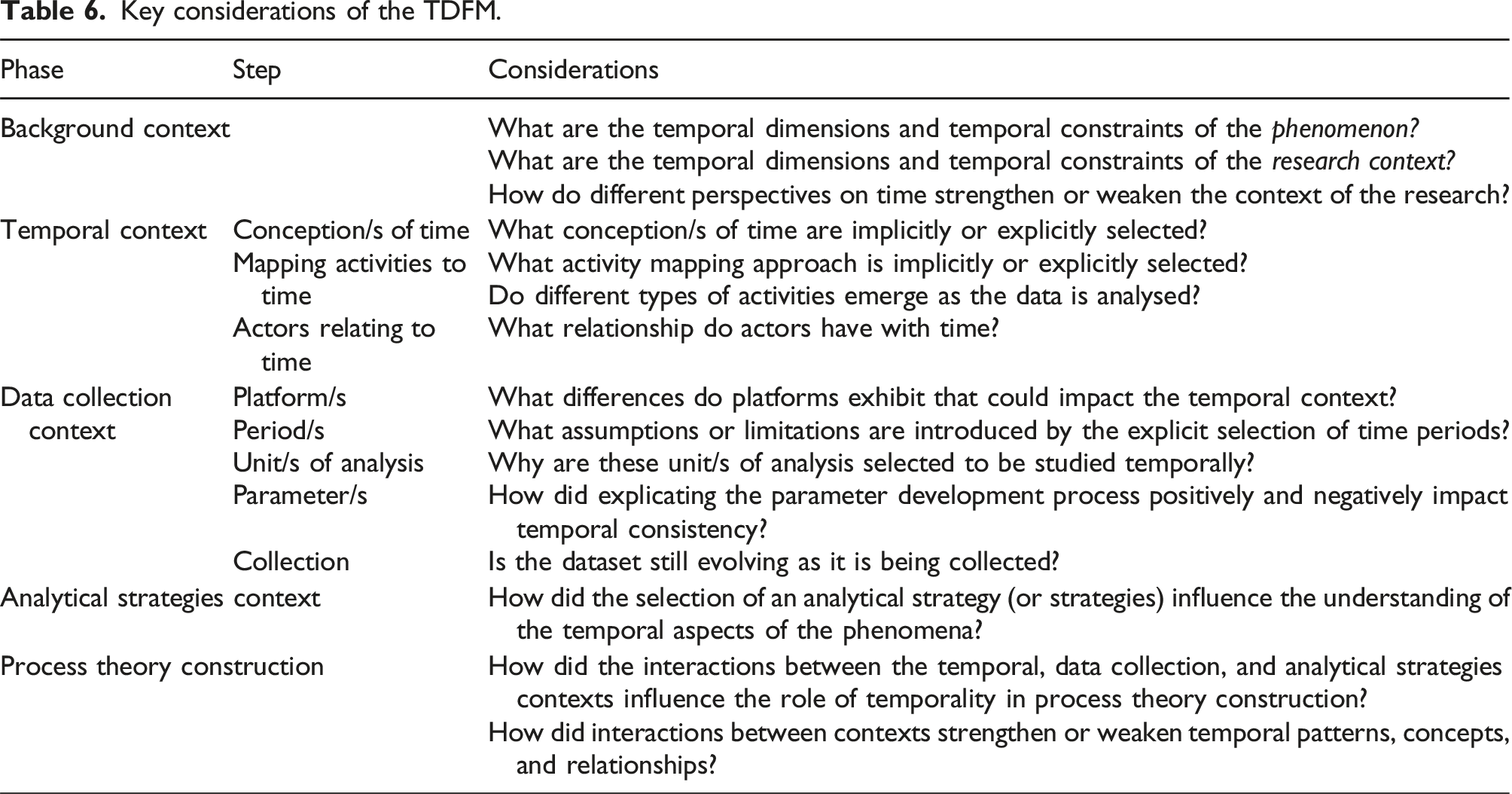
Figure 1 provides an overview of the key phases of the TDFM. Each phase includes considerations supporting the integration of temporality in the analysis of SMTD (Table 6). The TDFM builds upon existing CITC discourse, which emphasises the combination of manual and automated methods for theory construction (Berente et al., 2019; Miranda et al., 2022). While the TDFM operationalises similar components, it specifically focuses on integrating temporality when collecting and analysing SMTD to construct process theory.
Background context
SMTD, a type of digital trace data, offers researchers an inherent opportunity to address real-world challenges (Brocke et al., 2024; Grisold et al., 2023). The IS field is uniquely positioned to generate an in-depth contextual comprehension of real-world problems by harnessing data sources such as digital trace data (Grisold et al., 2023; Hirschheim, 2019; Ram and Goes, 2021). Previous research analysing SMTD has focused on deriving practical insights while remaining theoretically grounded (Mirbabaie et al., 2020; Salge et al., 2022; Vaast et al., 2017; Yoo et al., 2024). Selecting a phenomenon to study, however, introduces both temporal dimensions and constraints including timeframes, events, and contexts. For instance, a recurring online discourse may change significantly during external events, presenting either a limitation or additional contextual richness depending on the study’s purpose. Integrating temporal elements can allow for an in-depth understanding of a phenomenon’s temporal dynamics but requires careful consideration of both the dimensions and limitations involved.
Positioning work using an appropriate theoretical lexicon is essential to contributing to the body of knowledge (Baiyere et al., 2023; Berente et al., 2019). This is particularly important when applying temporality to generate process theory. Transferring time-invariant cross-sectional terms from a well-established body of knowledge to a dynamic, processual context is a challenging task that requires conceptual clarity (Ortiz De Guinea and Webster, 2017). We go one step further and suggest, not only is it challenging, but different concepts and approaches are needed to develop an in-depth understanding of the temporal patterns, dynamics, and change inherent to SMTD.
Temporal context
Ancona et al. (2001) propose a holistic classification of temporal characteristics comprising four high-level categories of variables: conceptions of time, mapping activities to time, actors relating to time, and category-spanning variables. Each of these categories are interrelated and further distilled into subcategories. Table 1 presents temporal categories, subcategories, and IS research exemplars analysing SMTD, which are further discussed below.
Conceptions of time
Conceptions of time consists of two subcategories: types of time and socially constructed time. Types of time encompasses various ways to categorise and understand the continuum of time by portraying time as a linear, divisible, and regular progression (Reinecke and Ansari, 2015). IS research analysing SMTD often leverages unpredictable event time to investigate phenomena such as crises (e.g. Vaast et al., 2017). Socially constructed time reflects how cultures create their own temporal frameworks (Saunders et al., 2004). This category encompasses concepts like the nine-to-five workday and cyclical cultural celebrations like Christmas and Diwali. Recent research has utilised social constructions of time to analyse the year-on-year sustainability of a recurring online social movement (Syed and Silva, 2023). Looking at multiple instantiations of a movement allows for richer temporal theorising on how movements become broader and more persistent over time. While conceptions of time possesses two subcategories, they can also be viewed as inherently intertwined (Jaques, 1982; Shipp and Jansen, 2021). However, IS research, especially research analysing SMTD, often focuses on simpler conceptualisations of time (e.g. clock time and event time). This use of more straightforward conceptions of time often overlooks the more complex socially constructed aspects of time (Orlikowski and Yates, 2002; Pentland et al., 2020; Reinecke and Ansari, 2015; Saunders et al., 2004; Shipp and Jansen, 2021; Törnberg and Törnberg, 2018).
Mapping activities to time
Activities or events can also be explicitly mapped to time to create order. SMTD is particularly amenable to mapping activities due to the temporal granularity of data. This enables researchers to zoom in and out of individual timestamped posts, users, and their interactions, which facilitates a detailed examination of interrelated temporal activities. This category contains five subcategories ranging from single activity mapping (a) (e.g. scheduling) to comparison and meshing of activity maps (ab) versus (aa) (e.g. entrainment). The most prevalent mapping approach in studies examining SMTD is single activity transformation mapping. This method investigates how an existing activity undergoes changes as it transitions into a new form. Notable examples of such activities include life cycles, such as the different stages of a crisis, as demonstrated in Mirbabaie et al. (2020), and transitional phases, as illustrated by Bachura et al. (2022). While these instances underscore the applicability of single-activity transformation mapping, more complex mapping activities such as synchronisation, meshing, and temporal flows are also emerging (Baygi et al., 2024).
Actors relating to time
Actors such as individuals, groups, organisations, and societies socially construct time (Kaplan and Orlikowski, 2013; Saunders et al., 2004). Thus, examining the two subcategories of temporal perception and temporal personality provides insight into how these actors shape, and are shaped by, their temporal frameworks. Temporal perception looks at how actors perceive and experience time. This can be investigated through the creation and redistribution of online content during crises, as exemplified by Mirbabaie et al. (2020). Different actors also possess different temporal personalities. For example, in traditionally slow-moving sectors such as manufacturing, the adoption of clock time is common, where a clear linkage exists between the past and future. In contrast, more uncertain industries, such as IT, may recognise that the past does not strictly determine the future through their temporal frameworks (Ancona et al., 2001). Understanding these diverse temporal personalities provides a nuanced perspective on how different actors adapt to varying temporal dimensions. Categorising actors into groups based on their temporal preferences and analysing the differences between actors and within actors can enrich the analysis of SMTD (Kotlarsky et al., 2022).
Integration of temporal elements
Combining conceptions of time, mapping activities to time, and actors relating to time with category-spanning variables, such as polychronic and monochronic time, provides a rich set of variables and perspectives to explicitly integrate time to construct process theory from SMTD. This holistic approach equips researchers to construct a well-defined temporal framework, adding depth and structure to their investigations. While Ancona et al. (2001) propose a five-step process to integrate existing research and propositions to guide research, incorporating these categories and associated time-related variables in itself enhances the researcher’s toolkit for building a more robust understanding of the temporal dynamics of SMTD. This approach leverages the unique strengths of SMTD, including its multidimensionality, rich temporal granularity, and the ability to zoom in and out to verify temporal patterns.
Data collection context
Collecting SMTD presents unique challenges compared to other forms of digital trace data (Howison et al., 2011). The application programming interfaces (APIs) provided by social media platforms are relatively accessible and can be queried to extract specific subsets of data from defined time periods to examine various topics or events. Ensuring transparency, replicability, and rigour throughout the iterative process of selecting platforms, periods, unit/s of analysis, and generating parameters are crucial to explicating decision-making processes, especially during the investigation of temporal dynamics.
Platform/s
Each social media platform possesses unique affordances and features that are utilised for unique purposes by distinct user groups. Facebook, for example, attracts an older demographic compared to Instagram (Alhabash and Ma, 2017). Facebook’s design supports the sharing of multimedia content including text, images, and videos, whereas Instagram forces users to share images or videos with each update (Chua and Chang, 2016). Furthermore, the dominant user demographics of each platform evolve over time, contributing to the growth and decline of existing platforms while simultaneously shaping the emergence of new ones (Alhabash and Ma, 2017). Therefore, it is crucial to explicitly consider platform-specific differences and how differences may impact the temporal nature of research.
Period/s
As the TDFM focuses on theorising processual dynamics, selecting appropriate time periods for analysis is critical. Given that researchers can access decades’ worth of concurrently emerging SMTD, it is insufficient to simply state that data was collected before and after the occurrence of an event. The selection of time periods should be justified, with any inherent assumptions and limitations explicitly addressed. Different conceptions of time, such as unpredictable events, can help justify the selection of a data collection window (Bachura et al., 2022). Research analysing SMTD can also apply a time-stepped approach to data collection to understand how a predictable event, which attracts a particular community of users, evolves over time (Syed and Silva, 2023).
Unit/s of analysis
The behaviour of user accounts and their discourses, termed as the unit of analysis, can be tracked and analysed over time, providing insights into how specific user behaviour evolves. Specific organisations (Miranda et al., 2015; Yoo et al., 2024) and bots (Salge et al., 2022) are examples of user accounts that were analysed in previous research. SMTD can also be used to reveal how the size, structure, and behaviour of larger online groups change over time as they collectively engage in multiple channels of concurrent content creation. A group of users can be delineated geographically (Kwon and Park, 2022), through specific parameters (Bachura et al., 2022), or by their interaction with specific discourses (Syed and Silva, 2023; Vaast et al., 2017). During unpredictable events, the size of a recurring online group may adaptively grow, and their behaviour may intensify (Nabity-Grover et al., 2020). Furthermore, historical SMTD allows researchers to analyse how particular user groups interacted with specific discourses (e.g. updates using a keyword) and how others engaged with these groups (e.g. resharing updates using a keyword). This enables examination of both the internal dynamics of an online group as well as the external interactions with the group (Syed and Silva, 2023). Iteratively refining the unit of analysis – whether focusing on individual user accounts, groups of accounts, or particular discourses – contextualises the selection of timeframes and parameters, thereby strengthening temporal integration with the data collection process.
Parameter/s
The researcher’s use of time significantly influences how parameters are defined which directly affects the data collected. In the context of Twitter (now X), missing one hashtag could lead to the exclusion of a significant proportion of updates. This is especially important as new potentially relevant parameters may emerge over time. Consequently, parameters should be generated over multiple iterations while explicitly considering differences in temporal phases. Additionally, the inclusion and exclusion of parameters such as reshares and language restrictors influences the type of data collected, as different groups and regions interact with and reshape parameters over time (George and Leidner, 2019). This emergent discourse could be inadvertently excluded if restrictors are applied without considering the temporal evolution of data.
Researchers often begin with a list of seed keywords, hashtags, user accounts, or other platform-specific operators. Following initial data collection, they can extract co-occurring terms over time, re-collect data, and repeat this process. Determining when to stop this process, however, requires consideration. In grounded theory, theoretical saturation represents the stopping point, occurring when ‘no new codes occur in the data’ (Glaser and Strauss, 1967; Miranda et al., 2022; Urquhart, 2013: p. 194). This iterative loop ties data, concepts, and relationships together, requiring multiple iterations before theoretical saturation begins to emerge (Saunders et al., 2018). Identifying these boundaries is further complicated by the scale of SMTD. As noted by Strauss and Corbin (1998; p. 136), ‘there always is that potential for the “new” to emerge’. Large volumes of SMTD can be collected relatively quickly, exacerbating this issue. In dynamic contexts with multiple phases and timeframes, maintaining comparability through equal saturation requires careful parameterisation. Failing to do so may result in the selection of inappropriate parameters, subsequently creating unnecessary noise. While there is no single solution to identify saturation, engaging in this process explicitly ensures due diligence in moving between data, concepts, and relationships. Keeping a log of steps, assumptions, and findings facilitates iterative data collection and sampling which reduces the likelihood of self-selection biases and strengthens the validity of the results (Pratt et al., 2019).
Collection
Parameter development and data collection occur iteratively, with temporal dimensions impacting every aspect of the data collection process. The timing of data collection significantly influences the resultant dataset (Stieglitz et al., 2020). For example, social media updates violating the platform’s Terms of Service are rapidly removed following moderation (Liu and Zhao, 2021). Consequently, data collected months after an event may exclude these updates. Alternatively, real-time data collection presents challenges in identifying updates central to emergent online discourse. This highlights the challenges associated with timing data collection, as both approaches present advantages and disadvantages depending on the purpose of the study. Explicitly acknowledging data collection timing enables transparent process theoplatry construction from SMTD.
Analytical strategies context
Transparent, replicable, and rigorous data collection enables data analysis. Yet, the complexity of SMTD often makes it challenging to extract meaningful insight. In this section, we propose multiple approaches to manipulating, aggregating, and analysing SMTD to reveal dynamic processual change. Given that the foundation of this work is CITC, it is important to emphasise that manually analysing data to generate concepts and associations is crucial to constructing process theory. For instance, reduction or filtering is beneficial in a qualitative context as it allows researchers to extract a subset of data to manually map theoretically relevant concepts (Lindberg, 2020; McKenna et al., 2017). While automated methods may facilitate this process, manual human activities remain indispensable (Shrestha et al., 2021).
Analytical strategies for SMTD.
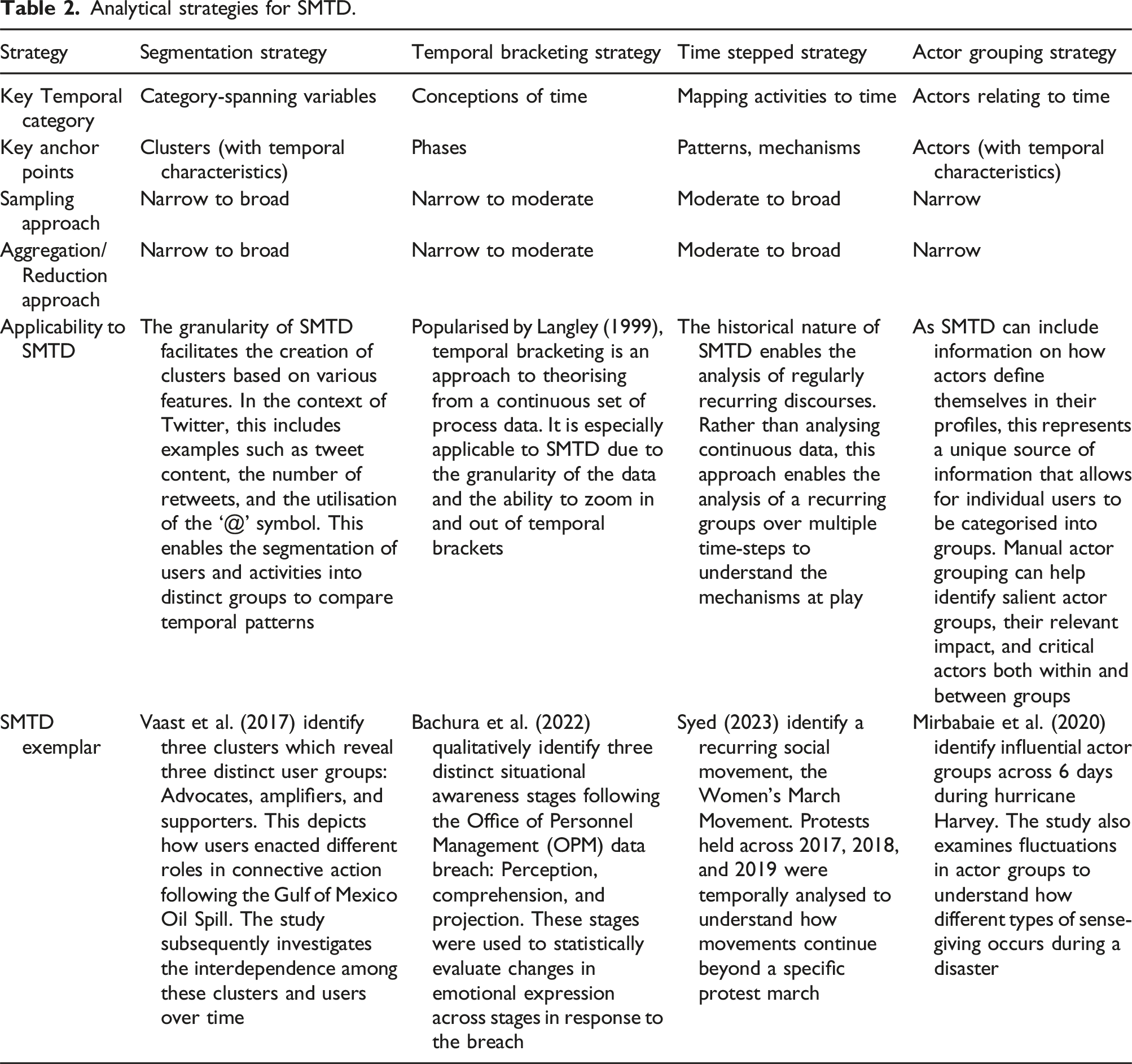
Each analytical strategy can be multi-methodological in nature, as the combination of qualitative, quantitative, and computational methods supports richer theorising (Berente et al., 2019; Miranda et al., 2022). As datasets grow, the distinction between different methods becomes vague ‘as researchers may use all tools available to them to generate stronger theoretical insights grounded in data’ (Levina and Vaast, 2015: p. 222). Thus, the exemplars provided in Table 2 apply multiple methodologies throughout different research phases. In addition, these strategies are also inherently diachronic in nature, as diachronic analysis enables process theory construction (Pentland et al., 2021). Therefore, research investigating SMTD often utilises multiple diachronic methodological approaches. However, these choices require careful consideration as different methodological lexicons carry different perspectives on time. Econometric studies often examine macroeconomic phenomena using time series analyses and event-driven natural experiments (Angrist and Pischke, 2009). Qualitative studies instead focus on evolving narratives and transformational processes (Cunliffe et al., 2004; Langley et al., 2013), and quantitative studies analyse time as discrete periods (Gao et al., 2023; Ortiz De Guinea and Webster, 2017). Similar to multi-methodological research, multiple strategies can also be applied within the context of a singular study, but these choices add lexical complexity, which requires reconciliation (Langley, 1999; Langley et al., 2013; Miranda et al., 2022).
The first analytical strategy, the Segmentation Strategy, focuses on clustering timestamped SMTD to identify groups of users or activities exhibiting similar patterns over time. Calculating markers associated with each user, such as the total number of posts, shares, and use of platform-specific operators, enables the temporal mapping of clusters (Vaast et al., 2017). Topic modelling techniques can also be employed to generate topics based on the textual similarity of content (Yan et al., 2023), with dynamic topic modelling techniques facilitating the analysis of temporal topic evolution (Blei and Lafferty, 2006; Grootendorst, 2022). Both approaches enable the analysis of temporally organised groupings, allowing researchers to compare the dynamic interdependence between groupings using polychronic time, a category-spanning variable. Vaast et al., (2017), for example, clustered 1360 Twitter users into three interdependent clusters: heavy users of all social media features, users primarily sharing original content, and users primarily resharing content. These clusters were classified as advocates, supporters, and amplifiers, respectively, demonstrating the usefulness of relating temporal groupings to theoretical concepts. The sampling approach for this strategy can range from narrow to broad, with a minimum threshold required to temporally map salient groupings. Aggregation for topic modelling may not be necessary, as it uses textual data, but cluster analysis techniques offer flexible aggregation at narrow (e.g. seconds, minutes or hours) and broad (e.g. days, weeks or years) levels, depending on the scale of the dataset.
The Temporal Bracketing Strategy involves qualitatively decomposing a continuous set of SMTD into comparative units for analysis between temporal brackets. These brackets, often constructed as progressions of events or activities, facilitate decomposition (Langley, 1999). Constructing progressions of events aligns with different conceptions of time, explicating different types of time and socially constructed time, which merges how cultures create their own temporal frameworks in relation to external events (Saunders et al., 2004; Shipp and Jansen, 2021). Decomposing data into comparative units adds contextual depth, allowing for phases to be mapped to higher-level concepts. For example, Bachura et al. (2022) qualitatively identified three distinct situational awareness stages following a data breach. The perception stage involved multiple events where the initial information of the breach was made public, the comprehension stage elaborated on key events from the perception stage, and the projection stage discussed future actions once the event was understood. The sampling approach for temporal bracketing can range from narrow to moderate as phases can be defined at a micro- or macro-level. However, increasing the sample size also increases complexity, making it more difficult to identify and verify brackets. Aggregation or reduction approaches can also be narrow to moderate, depending on the length of time analysed.
The Time Stepped Strategy involves identifying a regularly re-emerging phenomenon. Unlike the Temporal Bracketing Strategy, which focuses on analysing continuous data by bracketing significant events or activities, this strategy targets the analysis of recurring events (e.g. predictable events) emerging over multiple time periods. This approach provides a granular perspective on time to analyse ongoing re-emerging phenomena, concentrating on the recurring event. This focus facilitates the study of life cycles, significant transitions and temporal symmetry over extended periods which particularly aligns with mapping activities to time. For example, Syed and Silva (2023) analysed the Women’s March Movement held across 3 years to understand its persistence and recurrence. The researchers examined a short period of time before and during the protest, comparing it to an extended period following the protest. This approach enables the analysis of recurrence, which is particularly suitable to SMTD. As events can recur within days or over multiple years, the sampling approach for this strategy is moderate to broad. Frequencies can be aggregated from various temporal perspectives but suit broad frequency aggregations due to the potential scale of time-stepped events.
Lastly, the Actor Grouping Strategy involves manually categorising users into distinct actor groups based on self-descriptions in their online profiles. SMTD often contains profile descriptions which provide insight into how users define themselves or their account, enabling researchers to organise users into actor groups which exhibit specific goals, motivations, and intentions. By focusing on actors, this strategy aligns with actors relating to time to explore their specific perceptions of time and how their activities interdependently evolve over time. For example, Mirbabaie et al. (2020) categorised 1272 tweets into actor groups such as media organisations, journalists, politicians and private persons. They visualised the relative impact of different actor groups over time by tracking the cumulative retweets received by each group per day. This approach allows researchers to explore both the behaviour of actor groups as well as how others interacted with them using both synchronic and diachronic approaches. Since verifying the validity of individual profiles is a manual task, the sampling approach tends to be relatively narrow. Although this process could be automated, profile descriptions often include multifaceted intentions (Kishore et al., 2023a). This complexity may require actor groups to be continually redefined (Kotlarsky et al., 2022). Consequently, the dataset will likely be aggregated using narrower timeframes, which aligns with the relatively narrow nature of the sampling approach.
Each analytical strategy brings its own set of strengths and limitations. The Segmentation Strategy is particularly well-suited to handling larger samples, as automated techniques such as cluster analysis and topic modelling support the identification of dynamic associations. However, this approach is less likely to represent a sample accurately in comparison to the Actor Grouping Strategy, which necessitates manual upfront engagement to identify both static and dynamic associations. The Time Stepped Strategy enables more complex conceptualisations of time, but these complexities require reconciliation when constructing theory. The Temporal Bracketing Strategy offers a mid-range approach, capable of leaning towards either manual or automated data analysis. Yet, its applicability becomes more challenging as complexity increases and brackets become more difficult to substantiate.
Process theory construction
SMTD frequently lacks the contextual information necessary to explain dynamic change. To recontextualise the data, combining computational methods, which enables automatic aggregation and analysis, allows researchers to engage more effectively in the manual human theorising process (Lindberg, 2020; Shrestha et al., 2021). Both temporality (Table 1) and the analytical strategies (Table 2) offer multiple approaches to iteratively map the characteristics of SMTD to theoretically relevant concepts and associations. Relationships between data points can be derived using a combination of qualitative, quantitative, or computational methods (Berente et al., 2019). For example, the Segmentation Strategy can be applied to a SMTD to computationally extract clusters, qualitatively label clusters, and map clusters temporally (Vaast et al., 2017). Additionally, a combination of methods can be employed to understand the growth and decline of social movements over time (e.g. single activity transformation mapping through lifecycles) or examine the recurrence of regular social movements (e.g. repeated activity mapping through cycles) (Syed and Silva, 2023).
Through iterative categorisation of data into concepts, identification of relationships between concepts, and temporal examination, process theorising occurs. Each phase draws on concepts and relationships defined by an existing scholarly community to inform pre-theoretic understanding and lexical framing, enabling theorising (Miranda et al., 2022). Contributions include both theorising (e.g. creating new theory or extending, adapting, validating or invalidating existing theory) and describing original patterns with theoretical implications (Miranda et al., 2022; p. viii). While analysing SMTD is more likely to generate patterns with theoretical implications, research should attend to the cumulative tradition of an existing scholarly community to construct meaningful theory (Baiyere et al., 2023).
In combination, the TDFM provides practical guidance to utilise the multifaceted construct of temporality to generate process theory from SMTD. While this framework has been depicted sequentially, the phases represent an iterative process that interweaves theory, practice, data collection, and data analysis. In addition, the TDFM is a guiding framework intending to enable, rather than restrict, process theorising from SMTD. Research analysing SMTD does not need to include a temporal element – the construct of temporality presents just one opportunity to process theorising. The TDFM takes advantage of this opportunity by integrating temporality to generate considerations and recommendations, each of which may or may not be applied by researchers investigating the processual dynamics of SMTD.
Illustration
In this section, we apply the phases of the TDFM to investigate the temporal dynamics of social media use in relation to online mental health discourse, theoretically framed in the context of innate psychological needs (IPNs) (Karahanna et al., 2018). We explicitly address each context presented in the TDFM with the aim of constructing process theory from a temporal phenomenon. As discussed in the following subsections, the features of social media platforms enable various affordances, that can fulfil and motivate a wide range of IPNs. Satisfying IPNs in the offline realm became increasingly challenging during the onset of the COVID-19 pandemic, driving an increase in varied social media use (Dimmock et al., 2022). Consequently, social media use dynamically changed during different phases of the pandemic, potentially shifting the IPNs attempting to be satisfied. To study the emergence of temporal dynamics, we analyse SMTD to investigate changes in mental health discourse on the social media platform Twitter (now X). We examine these effects with the purpose of identifying patterns, understanding patterns, and generating process theory from these patterns.
Background context
Satisfying IPNs, particularly social needs, became increasingly challenging during the pandemic (Dimmock et al., 2022). Heightened anxiety levels, reduced access to support networks, and limited in-person professional care led to an international mental health crisis (Biester et al., 2021; Stupinski et al., 2022), with anxiety and depression increasing by more than 25% worldwide (World Health Organization, 2022a; 2022b). During this time, social media platforms helped individuals remain connected and informed through cost-effective reach, continuous accessibility, and anonymity (Nabity-Grover et al., 2020; Yan and Tan, 2014). With a 61% increase in social media use during the onset of the pandemic (Holmes, 2020), exploring the temporal dynamics of social media use throughout different phases of the pandemic requires attention.
May is internationally recognised for raising mental health awareness, with movements such as Mental Health Month (MHM) in the USA and Mental Health Awareness Week (MHAW) in the UK (Makita et al., 2021; Stupinski et al., 2022). Both movements possess a strong social media presence, generating the highest volume of annual online engagement with mental health globally (Mental Health America, 2022; Mental Health Foundation, 2022). Therefore, by focusing on the month of May, we can investigate how social media use evolved across different time-stepped phases of the pandemic.
The Needs-Affordances-Features (NAF) model proposes that social media platforms satisfy IPNs through various affordances and features which drive adoption (Karahanna et al., 2018). Affordances represent generalised action possibilities permitted by social media features that can satisfy the IPNs derived in the NAF perspective (Gibson, 1979; Karahanna et al., 2018). For example, in an empirical study carried out by the authors, they found that Facebook users primarily adopted Facebook’s Friending and Chatting features to fulfil their need for Relatedness (Karahanna et al., 2018; p. A22). The NAF framework integrates Self-Determination Theory (SDT) and Psychological Ownership Theory (POT) to identify seven IPNs that explain social media use (Appendix A). According to SDT, there are three IPNs that individuals are intrinsically motivated to satisfy: autonomy (e.g. the need to act consistently with one’s true self), competence (e.g. the need for feeling effective in one’s environment) and relatedness (e.g. the need to interact and experience caring for others) (Deci and Ryan, 1985). Furthermore, as ‘people have an innate need to possess’ (Dittmar, 1992; Karahanna et al., 2018: p. 740), social media users develop a sense of psychological ownership when they actively generate and maintain content on social media platforms (Pierce et al., 2001). POT contests that feelings of ownership can develop if the need for having a place (e.g. possessing a particular space), the need for self-identity (e.g. to differentiate oneself from others), and the need for efficacy and effectiveness (e.g. to effect one’s environment) can be satisfied.
Unlike Maslow’s Hierarchy of Needs (Maslow, 1943) which focus on learned needs, the NAF model draws on IPNs consistent across cultures (Ryan and Deci, 2017). In particular, the NAF perspective argues that variations in the use of a feature provides insights into the affordances provided by the platform, and in the logic of NAF, into the IPNs that a platform can potentially fulfil (Karahanna et al., 2018: p. 751). Given that greater IPN satisfaction enhances mental health (Cantarero et al., 2021), the NAF model provides a valuable lens to analyse the evolution of online mental health discourse through SMTD. Succinctly, changes in feature use represent changes in affordance activation, which both enable and are motivated by changes in the IPNs attempting to be satisfied. Thus, identifying and explaining the temporal dynamics of feature use provides insights into the varying IPNs attempting to be satisfied through social media use during different phases of a crisis. This motivates our research question: How did social media use related to online mental health discourse evolve during different phases of the COVID-19 pandemic?
Temporal context
Alignment between temporality and contexts.
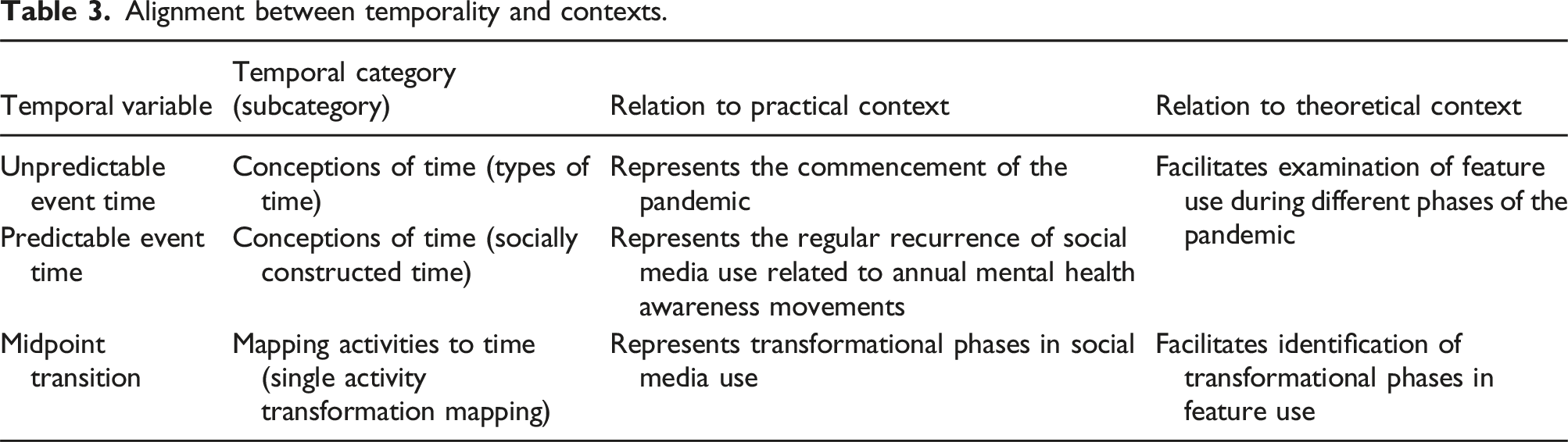
In terms of mapping activities to time, we utilise midpoint transitions which represents single activity transformation mapping. This aligns with our research question, which focuses on understanding how social media use related to a regularly recurring online discourse evolved during different phases of the pandemic. This involves using the occurrence of the pandemic as a transitionary point in social media use. Through this, we can identify the emergence of different transformational phases in a regularly recurring discourse over time.
Data collection context
Twitter (now X), the primary source of data, is one of the most popular social media platforms in the world with over 300 million monthly active users (Statista, 2024). It allows users to maintain a profile, follow other users or be followed themselves, post short updates (known as tweets), and repost other users’ updates (known as retweets). Each message can contain up to 280 characters of text as well as other forms of multimedia. Notably, Twitter allows users to contextualise their tweets by using hashtags. Through hashtags, users can quickly take note of important information and participate in real-time dialogue as information is created and disseminated (Rao et al., 2020).
Both MHM and MHAW possess Twitter accounts and use them actively, especially during the month of May. These movements in combination with other factors make May the most popular month for mental health discourse on Twitter (Kishore et al., 2023b). Data was collected using a time-stepped approach from the month of May spanning 2018 to 2021, which aligns with our utilisation of the Time Stepped Strategy as detailed in Table 2. These 4 months allow us to make precise comparisons in social media feature use before (2018 and 2019) and after (2020 and 2021) the pandemic commenced. We focus on these time periods as they are distinctive. For example, in May 2020 and May 2021, travel restrictions and lockdowns were widely in place (Coccia, 2022). In 2022 and 2023, these restrictions had eased in most countries, but not all (Taylor, 2022). Furthermore, this dataset provides sufficient temporal representation to answer the research question, as it enables the investigation of how social media feature use related to a regularly recurring online discourse evolved during different phases of an overarching crisis.
Parameter development focuses on identifying a group of hashtags that were used consistently over the entire period to maintain comparability. Hashtags contextualise the content that is being shared and simplifies the identification of topic-specific tweets (Harrigan et al., 2021). Mental health is a wide-ranging topic often engaged with from a variety of different perspectives (e.g. satire, raising awareness, seeking help and providing help) (Stupinski et al., 2022). Therefore, focusing on hashtags concentrated parameter development and data collection on the regularly recurring discourse. Four seed hashtags central to the movements were initially adopted: #MentalHealthMonth, #MentalHealthAwarenessMonth, #MentalHealthWeek, and #MentalHealthAwarenessWeek. We used a specialised toolkit to collect tweets using at least one of these hashtags during the month of May from 2018 to 2021. We then identified the most popular co-occurring hashtags over two iterations. In the first iteration, we identified emergent pandemic-related hashtags associated with the seed parameters. These were removed to maintain comparability with pre-pandemic periods, leaving #MentalHealth and #MentalHealthMatters as consistent markers occurring over the 4 years. In the second iteration, we used these two new hashtags to identify any remaining relevant hashtags, resulting in the emergence of #LetsTalk, #TogetherWeCan, and #EndTheStigma. A sample of tweets specific to each hashtag across the 4 years were extracted and manually verified to ensure that the discourse was specific to mental health. Upon completion, this resulted in nine hashtags. Hashtags were not collected further as (1) the volume of tweets was comparatively insignificant and (2) other hashtags had more specific or evolving utilisations. For example, #BodyImage emerged as a popular hashtag in relation to #MentalHealth, but the author team agreed that this discourse was separate from the discourse on mental health in the context of this study.
These hashtags were used to collect tweets in English across the specified time period. The dataset was restricted to English tweets as the primary language of the author team is English. No other restrictions were placed on the dataset, resulting in the following query: (#mentalhealth OR #mentalhealthawarenessweek OR #mentalhealthawarenessmonth OR #mentalhealthweek OR #mentalhealthmonth OR #mentalhealthmatters OR #letstalk OR #togetherwecan OR #endthestigma) lang:en. Data was collected in two batches on the 12th of August, 2021, and the 18th of September, 2021 to ensure stability across time periods, resulting in 3,953,836 tweets. Data was collected directly from Twitter API v2 in line with Twitter’s Terms of Services using a customised toolkit developed by the author team (Kishore et al., 2019).
Analytical strategies context
We employ the Time Stepped Strategy, which guides both data collection and subsequent data analysis. By applying this strategy, we examine how social media use related to a regularly recurring online discourse emerges over multiple years and how this emergence evolves during different phases of a crisis. This strategy aligns with our overarching temporal context, synthesising temporal dimensions of unpredictable event time and predictable event time. Combining both conceptions of time enables continuous identification of the regularly recurring discourse both over time and during different crisis phases. This also aligns with our broader adoption of single activity transformation mapping which provides a mechanism to evaluate the intricacies of the evolution of social media use during different crisis phases.
Retweeting, which involves the dissemination of another user’s tweet, serves as a key measure of a tweet’s importance within a broader discourse (Venkatesan et al., 2021). Previous research indicates that retweeting activity increased significantly during the onset of the pandemic in 2020 (Kishore et al., 2022). To understand why retweeting activity evolved over time, the illustration focuses on analysing the most retweeted tweets across the four distinct time periods. In doing so, we aim to uncover the underlying factors shaping dynamic shifts in retweeting activity as the pandemic unfolded.
We adopt a qualitative interpretive approach to analyse the content of highly retweeted tweets (Klein and Myers, 1999). Examining datasets using multifaceted conceptualisations of time necessitates an in-depth understanding of the meaning behind the text (Walsham, 1995). A recent study adopted an interpretive approach to analyse SMTD related to a recurring movement (Syed and Silva, 2023). We adopt a similar approach by collecting and analysing the time-stepped recurrence of a particular discourse. Using the literature on IPNs satisfaction as a ‘sensitising device’ (Klein and Myers, 1999), our assumption is that each retweet is motivated by one or more of the seven IPNs (Karahanna et al., 2018). To operationalise these needs for qualitative coding, we iterated between data analysis and theory (Glaser and Strauss, 1967; Levina and Vaast, 2015). Drawing from the NAF model, SDT, and POT, the author team engaged in deriving relevant definitions, linking scale items with exemplars from the dataset, and continuously refining operationalisations as data analysis occurred. Additional details are available in Appendix A.
Distribution of IPN categorisations by time-step.
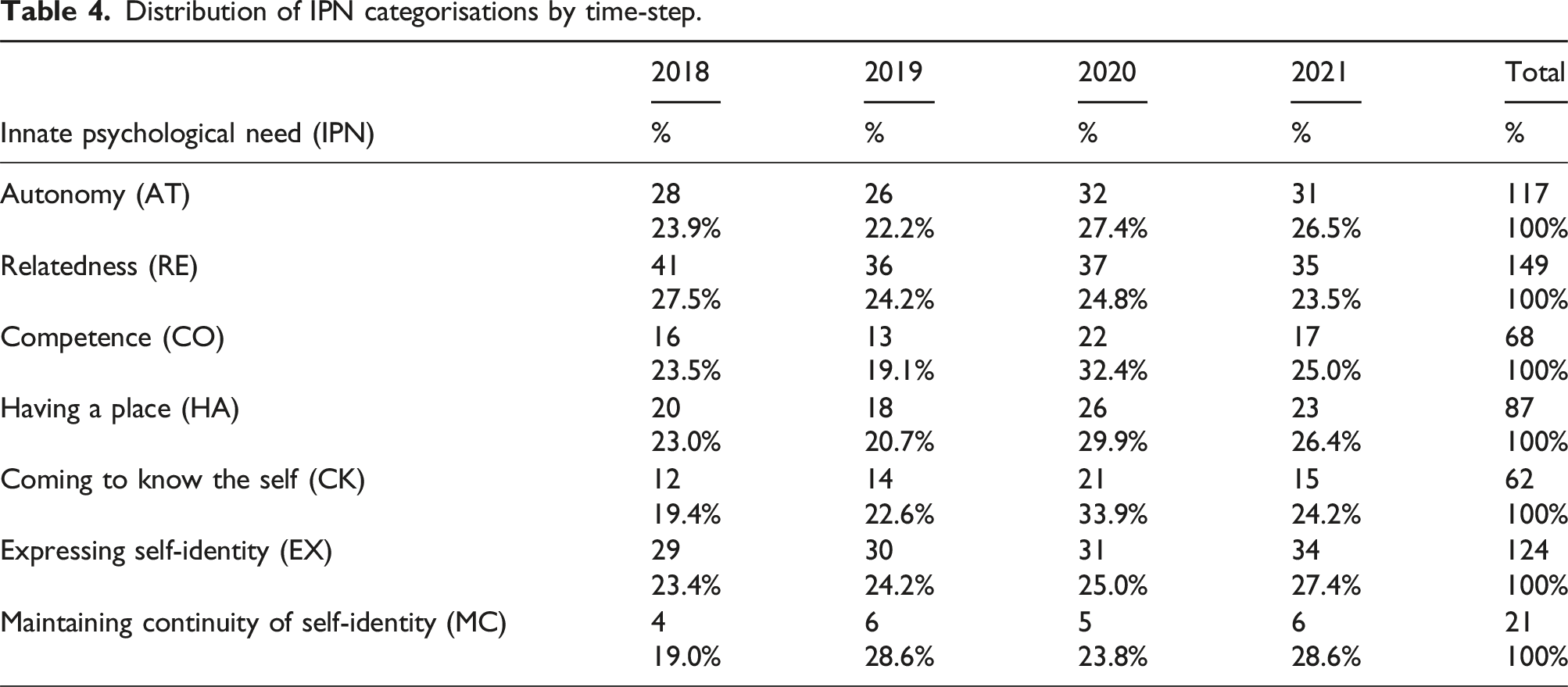
As depicted in Table 4, retweeting was driven by a complex set of IPNs that dynamically evolved over time. The volume of categorisations varied year-to-year, with 2020 exhibiting the highest volume (174). This suggests that the onset of the pandemic led to increased multifaceted engagement with IPNs. Dominant needs including Relatedness (149) and Expressing Self-identity (124) consistently motivated retweeting behaviour throughout the onset of the pandemic in 2020. However, other needs became more prevalent during this period. Temporally, the needs for Competence (9 or 13.3%), Coming to know the self (7 or 11.3%), and Having a place (8 or 9.2%) experienced the largest increases in year-on-year categorisations. All three of these shifts occurred between 2019 and 2020 as the pandemic commenced, highlighting their connection to increases in retweeting behaviour during this period (Kishore et al., 2022).
Competence, as defined by (Deci and Ryan, 1991), reflects an individual’s intrinsic desire to navigate their environment effectively, exert influence, and achieve valued outcomes. The increased need for Competence reflects the users desire to assert control over rapidly changing external environments as the pandemic commenced. Similarly, the increase in the need for Coming to know the self, which involves self-definition and gaining insights into one’s identity (Pierce et al., 2003), suggests individuals engaged in self-reflection amidst the uncertainty of the pandemic. Lastly, Having a place, defined as an individual’s need for a designated territory, space, or ‘home’ (Pierce et al., 2001), highlights the need for security. As social and physical spaces were disrupted by lockdowns and social distancing measures, individuals turned to the digital realm to fulfil this need (Arora et al., 2021). Social media platforms like Twitter provided a virtual ‘home’ where users could establish a sense of community (Dimmock et al., 2022; Nabity-Grover et al., 2020). While these three needs dynamically evolved between 2019 and 2020, these changes only existed transiently. All three needs exhibited a decrease in frequency during the later stages of the pandemic (e.g. between 2020 and 2021). As the external environment stabilised, social media users shifted back to retweeting tweets that satisfied a wide array of needs, utilising other technological and non-technological solutions to satisfy their needs.
In summary, the data indicates that while certain IPNs remained as stable motivators of retweeting behaviour, the early phase of the pandemic saw a significant shift in the prominence of specific needs. These changes reflect the broader social and psychological impacts of the pandemic, demonstrating the evolving role of social media in addressing these needs. This temporal analysis reveals the importance of considering how external crises can dynamically reshape the psychological drivers of social media engagement, providing insights into how platforms can better support users during persistent disruptive crisis events.
Process theory construction
Measuring processual change in SMTD requires diachronic analysis (Berente et al., 2019; Pentland et al., 2021). As diachronic analysis inherently possesses a temporal dimension, engaging with temporal variables has the potential to reveal granular theoretical insight. Thus, the results detailed in the previous section led to a processual understanding of how social media use linked to a regularly recurring discourse evolved during different pandemic phases which we have termed as the Temporal-Needs-Affordances-Features (T-NAF) process model (Figure 2). While other approaches to data analysis and theorising could be applied, the T-NAF process model was developed abductively, as abduction suits studying the temporal evolution of a phenomena (Langley, 1999), especially in the context of SMTD (Amadoru et al., 2021). T-NAF process model.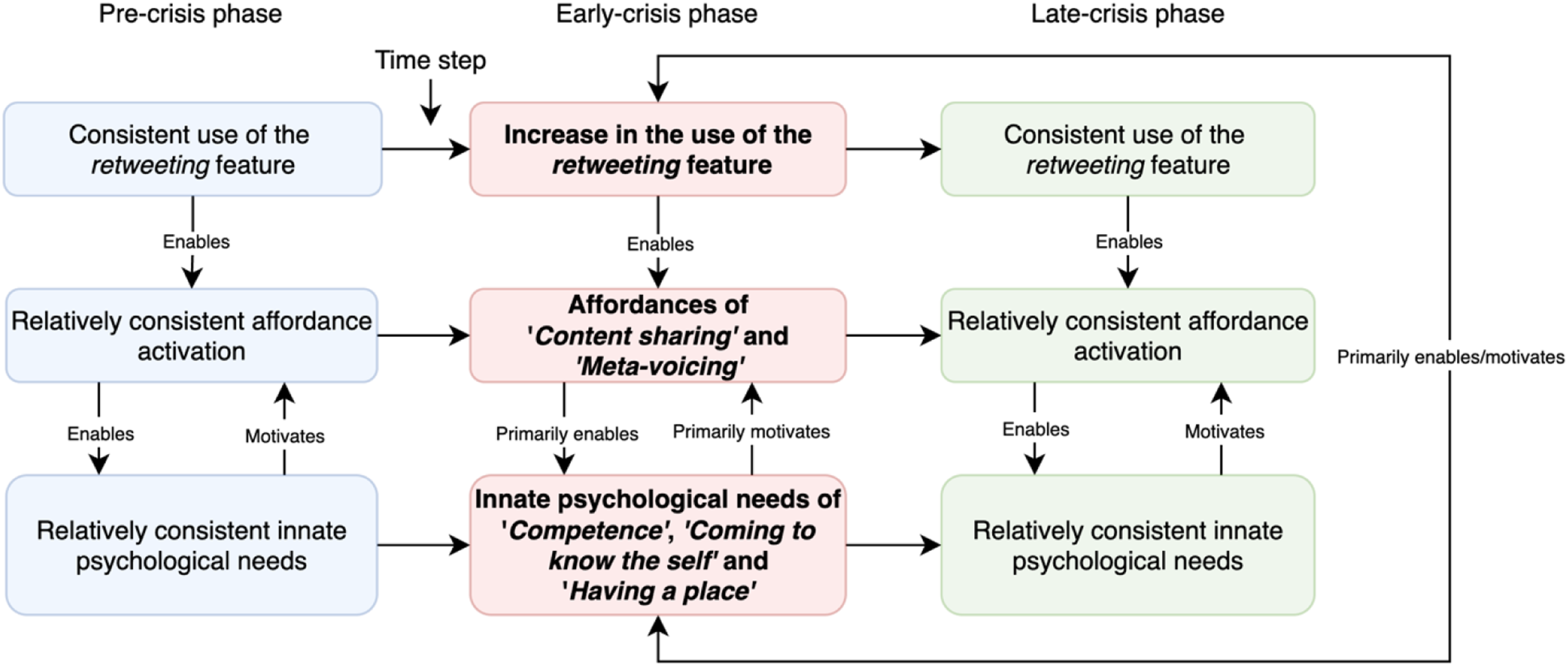
The T-NAF process model presents a processual perspective of the relationship between IPNs, affordance activation, and the utilisation of social media features. We argue that while the IPNs and affordances that drive use are generally stable across multiple time-steps, or recurring predictable events, they are subject to dynamic changes during unpredictable events. Such events can alter user motivations which lead to behavioural shifts. Empirical evidence from the onset of the pandemic (i.e. the early-crisis phase) indicates that shifts in retweeting behaviour correlated with a shift towards a narrower set of IPNs including Competence, Coming to know the self, and Having a place which are discussed in the preceding section. Typically, IPNs can be satisfied both in the offline and online realm, but the pandemic limited personal autonomy and agency, prompting a shift towards social media platforms for engagement with IPNs. Given the public reticence to discuss mental health (Biester et al., 2021; Stupinski et al., 2022), we hypothesise that this change in offline realm encouraged individuals to instead seek psychological satisfaction through resharing behaviour (i.e. retweeting) in the online realm. This relationship is visualised as a bidirectional relationship where the increase in retweeting behaviour primarily enables and motivates a narrower focus on specific needs during the early-crisis phase.
While affordance activation was not measured directly to develop the T-NAF process model, shifts in how a social media platform is used provides insights into the affordances provided, and into the IPNs that a platform can potentially fulfil, indicating a cyclical relationship between features, affordances and IPNs (Karahanna et al., 2018: p. 751). Retweeting is realised through two affordances: Content sharing and Meta-voicing (Karahanna et al., 2018). Content sharing enables users to disseminate information that is not directly related to themselves, such as broadcasting a news article (Kietzmann et al., 2011). Meta-voicing allows users to react to other user’s content, profiles, and activities (Majchrzak et al., 2013: p. 41). Employing abductive reasoning, we infer that fluctuations in retweeting behaviour are linked to fluctuations in these two generalised action possibilities, which both enable and motivate IPNs.
The T-NAF process model comprises three temporally distinct time-stepped phases: pre-crisis (2018 to 2019), early-crisis (2019 to 2020), and late-crisis (2020 to 2021). Pre-crisis provides an initial comparison between time-steps to contextualise our understanding of stability and change before the crisis occurs. Subsequently, early-crisis signifies the onset of the crisis, enabling comparisons between periods immediately before and after the unpredictable event. Late-crisis represents comparison between different stages of the crisis to understand how the crisis continued to evolve after the initial reaction. Collectively, these stages offer a multifaceted perspective to study the temporal dynamics of social media use, providing reference points for analysis and comparison. Relative stability in the observable measure (i.e. social media use) indicates relative stability in the affordances being engaged with, and the IPNs attempting to be satisfied through social media use.
In contrast to the NAF model, which focuses on cross-sectional data, the T-NAF process model highlights the potential for dynamic change in the IPNs that enable and motivate the use of social media over multiple time-steps. As evidenced by the findings, this potential for change persists within a consistently recurring online community. Due to the fluidity of IPNs, the needs attempting to be satisfied in the online realm may represent a deficiency in needs satisfaction in the offline realm (Long et al., 2020). The T-NAF process model further implies that as individuals seek to satisfy their IPNs online, the online community itself becomes a dynamic entity, constantly adapting to the collective shifts in its participants’ needs. Therefore, the T-NAF process model offers a lens through which to view the evolving temporal dynamics shaping, and being shaped by, IPNs satisfaction and social media use in recurring online communities during crisis phases.
Discussion
Applying the TDFM: Opportunities and challenges
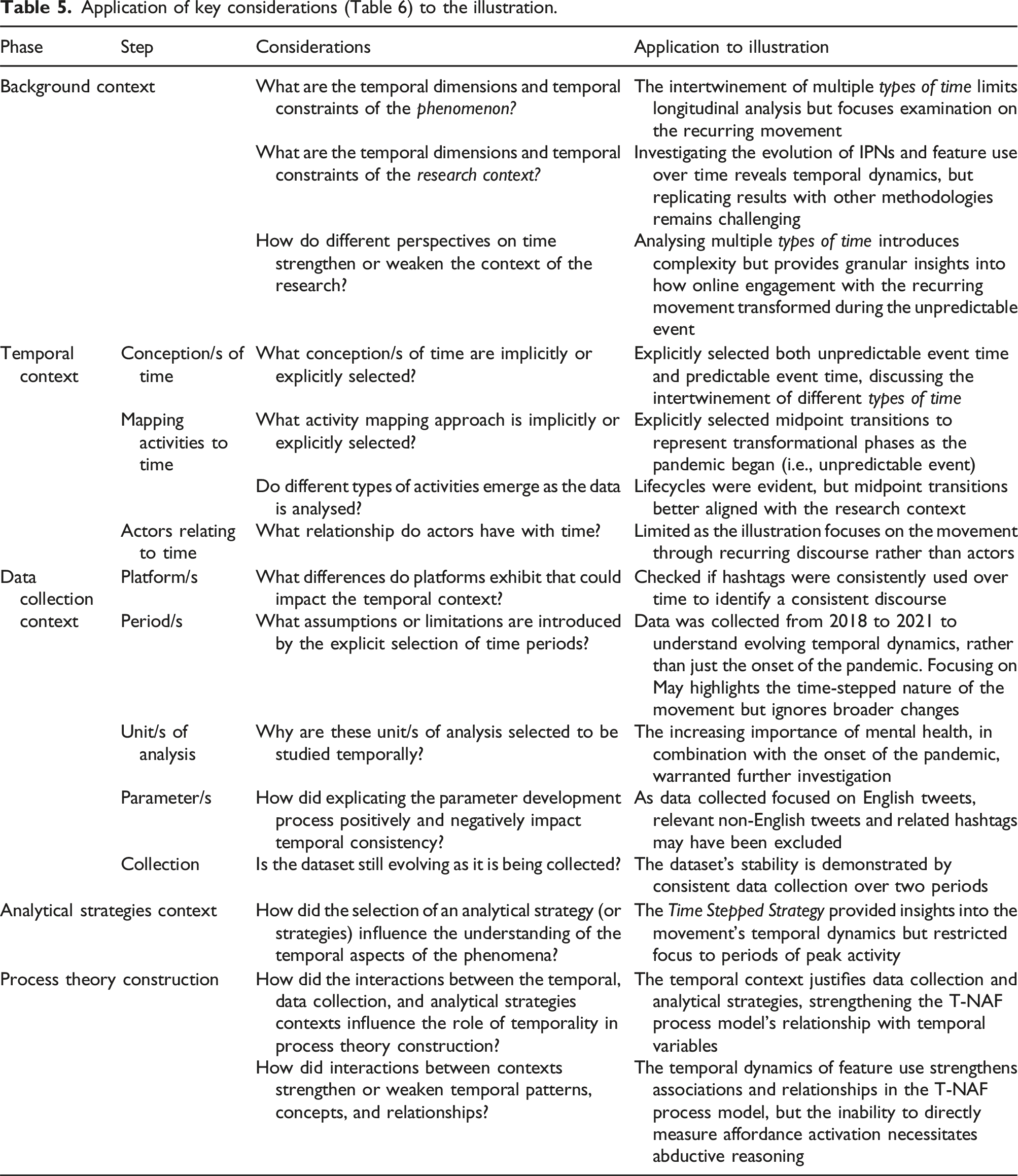
Application of key considerations (Table 6) to the illustration.
Key considerations of the TDFM.
The TDFM facilitates the construction of the T-NAF process model (Figure 2) by integrating temporality with data collection, data analysis, and process theorising. However, the TDFM does not prescribe a fixed approach, instead encouraging explicit consideration of the benefits and trade-offs. For example, the TDFM does not limit data collection, instead facilitating the expansion or contraction of data collection based on research requirements. This is evidenced by the illustration, where the decision to collect time-stepped data limits generalisability to longitudinal contexts, but the Time Stepped Strategy itself remains compatible with longitudinal data. Syed and Silva’s (2023) analysis of the recurring movement, which incorporates longitudinal data to enrich contextual understanding, also exemplifies this compatibility. Furthermore, larger datasets may require significant computational resources, storage and expertise which may create a divide (Grover et al., 2020: p. 278). The illustration highlights the TDFM’s adaptability to contract or expand data collection as required by applying the Time Stepped Strategy and subsequent sub-sampling, minimising barriers to apply the TDFM in resource-constrained settings. In both cases, the decision remains with the researcher while encouraging transparency in the decision-making process.
The illustration also depicts the challenges of transferring terms from a variance-based model to a process model. Terms developed through variance theorising inherently possess independent and dependent variables. Yet, transferring these terms to process theorising in the context of SMTD faces three primary challenges. First, process theorising does not utilise dependent and independent variables, instead explaining how a process unfolds. As noted by Langley (1999; p. 692) ‘process theories provide explanations in terms of the sequence of events leading to an outcome’. Second, this issue is exacerbated by the non-research-specific nature of SMTD, which occurs without specific intention (Howison et al., 2011; H. Xu et al., 2020). Third, processes are inherently complex, possessing multiple levels and units, and this complexity is further exacerbated by integrating temporality (Reinecke and Ansari, 2015: p. 621). Hence, shifting terms such as IPNs, originally linked to affordances and features through survey measures, requires careful re-conceptualisation. Further work is required to clarify these relationships but this also highlights the opportunity to leverage temporal elements to transfer terms to a processual context.
The illustration relies on a qualitative approach to engage in data analysis and process theorising. Intensive engagement with a mix of computational, quantitative, and qualitative approaches present fruitful opportunities for CITC (Yan et al., 2023). Multiple approaches are suited for investigating the complexities of temporality, but we believe that identifying and explaining patterns allows for a methodologically agnostic approach to constructing theory. This aligns with CITC which may involve mixing approaches, ‘but does not require it’ (Miranda et al., 2022; p. ii). By adopting a flexible methodological stance, researchers can adapt analytical strategies to the specific demands of their studies, contextualising the theory development process.
From a broader perspective, future research can investigate extending the TDFM to co-evolution and social network meta-theory (Niederman and March, 2019). Both meta-theories can frame the analysis of SMTD (L. Xu et al., 2020), but further work is required to align these broader conceptualisations with temporality. Exploring processual dynamics represents just one approach to theorising about time, with the integration of other meta-theories providing a more comprehensive understanding of temporality in the context of SMTD.
Process theorising, digital trace data, and temporality
Process theorising and digital trace data share a commonality: time. Yet, the dimension of time is often in the periphery of research, playing an insignificant role in the questions we ask, the data we gather, and our approaches to theorising (Venkatesh et al., 2021). Hence, the purpose of the TDFM is to take time from the implicit to the explicit to support process theory construction from SMTD. Each component of the TDFM, including temporality, process theorising, and digital trace data, possesses strengths and weaknesses when viewed in the context of the broader body of knowledge. We discuss these constituents below.
Time is crucial when investigating the processual dynamics of digital trace data, yet its integration can remain broad. Pentland et al. (2021) propose ‘Process Dynamics’, bridging disparate fields of process theory, originating from sociological and organisational theory (Langley, 1999; Langley et al., 2013; Langley and Tsoukas, 2016), and process mining, originating from computer science (Van der Aalst, 2011). This approach focuses on emergent processes as they constantly shift between states of stability and change. Invariably, time is vital in selecting a unit of analysis to investigate process dynamics. For instance, Pentland et al. (2021; p. 973), identified that ‘clinical work [had] a natural daily rhythm’ and hence used a daily temporal window for aggregation and analysis. The TDFM builds on this by arguing the importance of integrating richer temporal considerations when constructing process theory from SMTD.
While Pentland et al. (2021) focuses on weighted, directed graphs to represent processes, the TDFM offers a holistic approach to process theorising by proposing analytical strategies that offer guidance for processual pattern surfacing, analysis, and theorising. This distinction is important as Pentland et al. (2021) offer specificity in their methodological lexicon, whereas the TDFM’s analytical strategies align with the broader strategies proposed by Langley (1999). Table 2 exemplifies this, as each exemplar engaged with multiple methodologies to construct theory. Therefore, the proposed strategies are an initial step for researchers to integrate conceptions of time, activities in relation to time, and actors in relation to time to construct process theory. Future research can consider developing additional analytical strategies to investigate the intricacies of socially constructed time (Saunders et al., 2004) and its inherent intertwinement with types of time (Shipp and Jansen, 2021).
Digital trace data provides insights into the processual unfolding of events, activities, and their interconnections (Pentland et al., 2020). This allows us to ask different types of questions and identify intricacies that might otherwise be seen as noise (Pentland et al., 2021). However, analysing complex socio-technical phenomena often results in an oversimplification of relationships which limits theorising (Baygi et al., 2021, 2024; Törnberg and Törnberg, 2018). While this type of data consists of a unique set of challenges (H. Xu et al., 2020), the momentum behind digital trace data grows. Digital trace data contains contextual information that can provide insights into real-world problems (Grisold et al., 2023). This aligns with the multifaceted natured of temporality as it comprises of elements that can enrich our contextual understanding of digital trace data (Table 1). While existing conceptualisations of time are rich and varied (Ancona et al., 2001), IS researchers can further refine, extend and combine multiple temporal dimensions with SMTD, and, more broadly, digital trace data. The granularity of digital trace data offers new opportunities to investigate processual dynamics beyond what has been available previously (Brocke et al., 2024; Pentland et al., 2021). Furthermore, the dynamic nature of digital trace data, specifically SMTD, facilities the study of more complex forms of time. For instance, kairotic time can be employed to investigate the temporal characteristics of flows of action including directionalities, intensities, momentums and urgencies (Baygi et al., 2024; p. 431; Ingold, 2015). While examining flows shares similarities with mapping activities to time, it offers an alternative perspective that can be built upon to enhance the temporal investigation of digital trace data. Thus, incorporating rich conceptualisations of temporality with digital trace data offers promising avenues for future IS research.
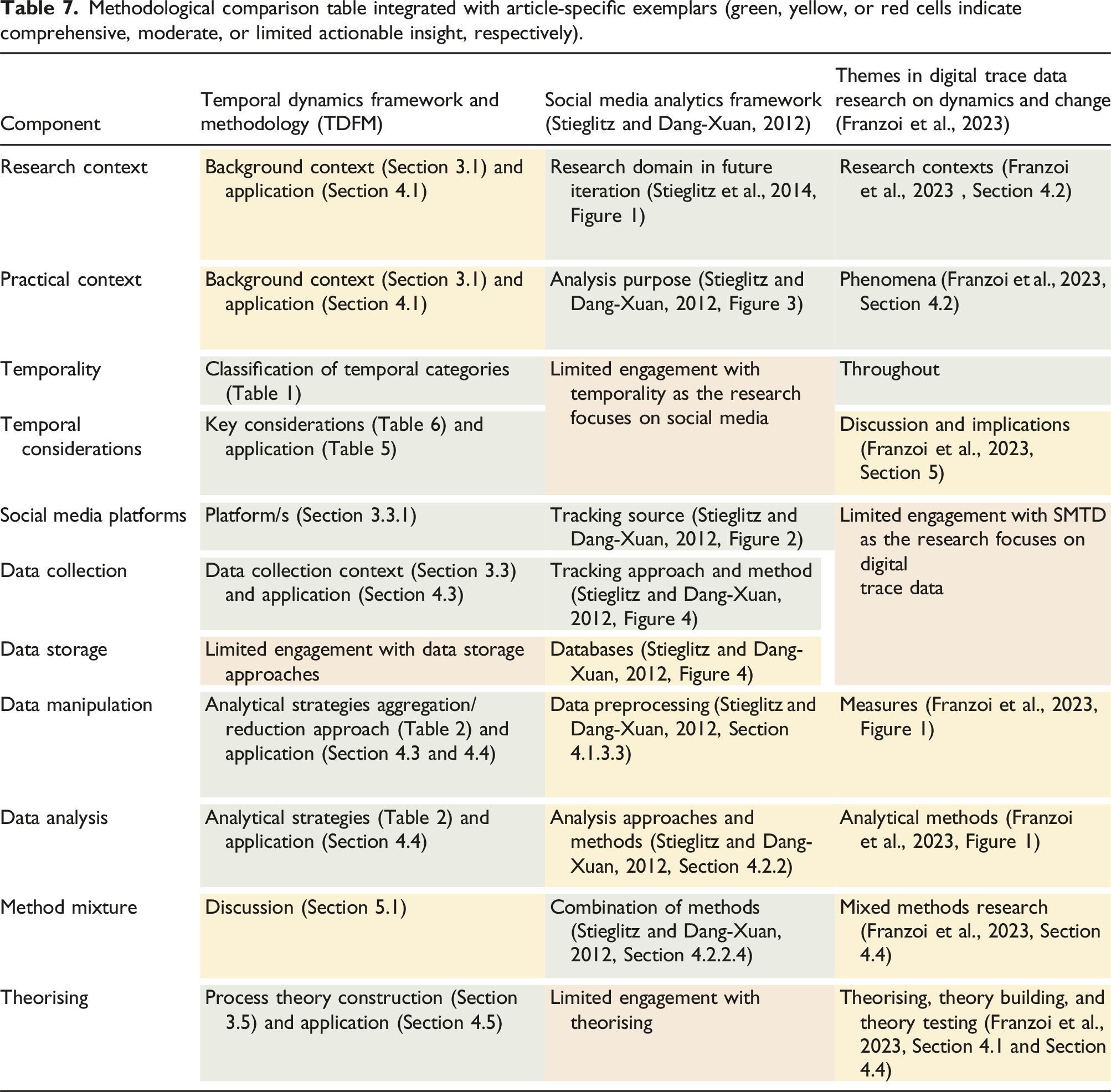
Methodological comparison table integrated with article-specific exemplars (green, yellow, or red cells indicate comprehensive, moderate, or limited actionable insight, respectively).
Summary
The purpose of this paper is to holistically integrate the rich concepts of temporality with SMTD to enhance process theory construction. We have provided a synthesised starting point for IS researchers to integrate temporality more deeply into the analysis of SMTD to enable this type of theorising. We highlight multiple challenges, including transitioning terms, integrating multiple methodological lexicons, balancing resource constraints, and extending beyond process theorising. Concurrently, we highlight opportunities, including integrating temporality, constructing process theory in the digital realm, and the growing significance of digital trace data. These insights aim to encourage future research to leverage rich conceptualisations of temporality.
Conclusion
Social media provides access to a virtually limitless source of digital trace data that can generate a rich depiction of society. These datasets can be fine-grained or aggregated, textual or non-textual, and examined as a cross-section or over time. However, research analysing social media trace data often struggles to construct process theory. To mitigate these challenges, this paper discusses the unique landscape of social media trace data and proposes the Temporal Dynamics Framework and Methodology, which incorporates temporality to guide iterative positioning, data collection, data analysis, and process theorising. We apply the framework and methodology to investigate the temporal dynamics of mental health discourse on Twitter (now X) across different phases of the COVID-19 pandemic, theoretically framed in the context of innate psychological needs satisfaction. Our findings reveal shifts in how social media features were used as the pandemic progressed, indicating dynamic changes in the innate psychological needs attempting to be satisfied. The Temporal Dynamics Framework and Methodology contributes to the ongoing discourse on Computationally Intensive Theory Construction in the specific context of constructing process theory from social media trace data by integrating a dynamic perspective on time.
Supplemental Material
Supplemental Material - A temporal dynamics framework and methodology for computationally intensive social media research
Supplemental Material for A temporal dynamics framework and methodology for computationally intensive social media research by Shohil Kishore, David Sundaram, and Michael David Myers in Journal of Information Technology.
Footnotes
Acknowledgments
We thank the guest editorial team, Ivo Blohm, Susanna Ho, Shaila Miranda and Jan Marco Leimeister, for their excellent guidance. We would also like to thank the two anonymous reviewers whose constructive feedback significantly enhanced the development of the paper.
Declaration of conflicting interests
The author(s) declared no potential conflicts of interest with respect to the research, authorship, and/or publication of this article.
Funding
The author(s) received no financial support for the research, authorship, and/or publication of this article.

Supplemental Material
Supplemental material for this article is available online.
Author biographies
References
Supplementary Material
Please find the following supplemental material available below.
For Open Access articles published under a Creative Commons License, all supplemental material carries the same license as the article it is associated with.
For non-Open Access articles published, all supplemental material carries a non-exclusive license, and permission requests for re-use of supplemental material or any part of supplemental material shall be sent directly to the copyright owner as specified in the copyright notice associated with the article.
