




Abstract
This study investigates how individuals use the imagined audience to navigate context collapse and self-presentational concerns on Instagram. Drawing on the imagined audience process model, we analyze how structural (i.e., social media affordances) and individual factors (i.e., self-disclosure goals) impact the imagined audience composition along four dimensions: size, diversity, specificity, and perceived closeness. In a retrospective diary study of U.S. Instagram users, we compared the imagined audiences on Instagram posts versus Stories (n = 1,270). Results suggested that channel ephemerality predicted a less diverse and less close imagined audience; however, channel ephemerality interacted with self-disclosure goals to predict imagined audience composition. Imagined audience closeness was positively related to disclosure intimacy, but size, diversity, and specificity were unassociated. This study advances communication theory by describing how affordances and disclosure goals intersect to predict the imagined audience construction and online self-presentation.
Keywords
On social media, knowing who is viewing a post is difficult because the interface design and algorithms blur together previously distinct audiences while hiding information about the actual audience of a post (Bernstein et al., 2013; Taylor & Choi, 2022). Unlike in face-to-face communication, where individuals adjust their self-presentation to meet the audience’s expectations and norms (Goffman, 1959), when self-presenting on social media, people find themselves simultaneously engaging with multiple audiences from their social network (e.g., family, co-workers, acquaintances; Marwick & boyd, 2010). This increased visibility of communication on social media challenges individuals’ ability to maintain distinct social spheres (Binder et al., 2009). The resulting context collapse—the convergence of heterogeneous social contexts into one—gives rise to privacy and impression management concerns because people struggle to tailor their self-presentation to the diverse audiences (Vitak, 2012). Failure to engage with the intended audience contributes to dissatisfaction and a sense of disconnection with the audience (Stsiampkouskaya et al., 2021). These self-presentational issues are further complicated by message persistence on social media, as people share content that may be accessed by both current and future audiences, such as potential employers (Pitcan et al., 2018).
The imagined audience, or the “mental conceptualization of the people with whom we are communicating” (Litt, 2012, p. 331), has emerged as a useful lens for understanding how people manage online self-presentation despite context collapse (Bazarova & Masur, 2020). Previous research has explored how the construction of the imagined audience differs from channel-to-channel (French & Bazarova, 2017), affordance-to-affordance (DeVito et al., 2017), post-to-post (Litt & Hargittai, 2016), and goal-to-goal (Bazarova & Choi, 2014). The focus of these studies has predominantly been on persistent social media platforms, such as Twitter or Facebook. However, in recent years, ephemeral social media, which are characterized by time-limited messages, like Snapchat, Instagram Stories, and BeReal, have gained popularity in the United States (Vogels et al., 2022). These ephemeral channels present new opportunities and challenges for self-presentation in situations of context collapse as temporality prevents future audiences from viewing previously shared content (Bayer et al., 2016). Thus, there exist open questions about how ephemeral social media impact the imagined audience and self-presentation strategies.
Our aim is to examine self-presentation and impression management processes in social media, studying factors that influence how individuals imagine their audience. Toward this goal, we extend the Imagined Audience Process Model (IAPM; Litt, 2012) by (1) exploring how the affordance of ephemerality (vs. persistence) predicts imagined audience composition, (2) examining how self-disclosure goals modify the effect of social media affordances on the imagine audience, and (3) clarifying the relationship between the imagined audience and disclosure intimacy. We contextualize our investigation on Instagram, which affords both persistent (i.e., posts) and ephemeral (i.e., Stories) communication, creating an opportunity to explore how ephemerality affects the imagined audience and self-disclosure. 1 In this article, we refer to Instagram posts as a persistent channel, whereas Instagram Stories is an ephemeral channel.
The IAPM
To unpack the mental conceptualization of social media audiences, Litt (2012) proposed the IAPM. According to this model, the imagined audience composition, or the individuals comprising the imagined audience, is determined by both structural and individual factors. Structural factors refer to the social and technical environment of social media that influences communication behavior, such as community rules or socio-technical affordances. Whereas individual factors encompass the communicator’s social and psychological characteristics, including communication goals, age, and digital skills. The IAPM proposes that different combinations of structural and individual factors generate varied imagined audience compositions. Furthermore, the model suggests that the imagined audience influences how impression management is handled in a space of context collapse, ultimately affecting self-presentation strategies, such as self-disclosure, presented to the actual audience. Finally, the model posits that the imagined audience serves as a connecting link between structural and individual factors and communication behaviors on social media.
The imagined audience composition on social media has been investigated in a variety of fashions, such as categorizing interpersonal ties that one intends to communicate with (Litt & Hargittai, 2016) or examining the impact of audience size and heterogeneity on language styles in self-disclosures (Gil-Lopez et al., 2018). In this article, we focus on four dimensions of the imagined audience: (1) size, (2) diversity, (3) specificity, and (4) closeness. Although these dimensions represent key aspects of the imagined audience composition in previous research, other important configurations of the imagined audience exist (e.g., audience similarity in Kornfield & Toma, 2020; audience trustworthiness in Masur, 2019).
Initial research on the imagined audience composition primarily centered around the imagined audience size, referring to the number of people envisioned in the audience. Facebook log data was used to compare the imagined audience size with the actual audience size of posts, finding that the imaged audiences tended to be smaller than actual audiences (Bernstein et al., 2013). Notably, imagined audience sizes fluctuate across posts and can range from thousands to zero (Marwick & boyd, 2010). Another dimension of the imagined audience composition is diversity, which explores the heterogeneity of anticipated social groups. When sharing content on social media, people may envision homogeneous or diverse audiences (Litt & Hargittai, 2016). Research on audience diversity has highlighted a lowest common denominator approach, which suggested that people engage in self-censorship to appeal a diverse audience (Hogan, 2010). This approach has received mixed results. Gil-Lopez et al. (2018) found that Facebook users tended to limit their language variability to maximize message appropriateness for diverse audiences. Whereas, Vitak (2012) showed that network diversity on Facebook predicted more self-disclosure, likely due to the benefits of interacting with a diverse set of social connections.
Imagined audience construction also varies in specificity, indicating the extent to which it defines distinct groups or individuals. Imagined audiences can range from highly specific individuals (e.g., mom, Taylor Swift) to more abstract groups (e.g., fans, everyone) (Litt & Hargittai, 2016). Specific audiences can represent both the ideal and nightmare readers of a post (Marwick & boyd, 2010). For minority youth, their nightmare audience often comprises potential employers or individuals of a dominant culture (Pitcan et al., 2018). Specificity also shapes information sharing practices; people reported more willingness to share COVID-19 infographics when conjuring more abstract audiences (Hodson et al., 2022). Finally, imagined audience closeness is the perceived intimacy or emotional affinity with audience members. Although less directly examined, closeness underlies numerous imagined audience studies. People envision various groups of intimate others as their audiences, including casual friends, work/school friends, close friends, and family members (Kelly et al., 2020). When people have a specific target audience in mind, they most often think of close ties such as friends or significant others (Litt & Hargittai, 2016). To gain a deeper understanding of how individuals construct their imagined audience, we connect these four dimensions (i.e., size, diversity, specificity, and closeness) to the predictors of the imagined audience proposed by the IAPM.
The Predictors of the Imagined Audience
The first proposition of the IAPM argues that the imagined audience is predicted by a combination of structural and individual factors. Litt (2012) theorizes numerous structural and individual factors, but subsequent research has highlighted social media affordances and goals as particularly salient parts of the imagined audience construction process (Bazarova & Choi, 2014). Thus, we investigate the affordance of ephemerality as a structural factor and self-disclosure goals as an individual factor.
An affordance is broadly defined as the complex interrelationship between a user and a technology that facilitates/constrains a range of possible actions and outcomes (Evans et al., 2017). The affordance of ephemerality refers to the degree to which a message remains accessible for others to view after a certain period of time (Fox & McEwan, 2017). On Instagram, ephemerality is a salient communicative affordance. Instagram Stories are videos and photos that are only accessible to others for 24 hr, whereas Instagram posts remain accessible to others on the site indefinitely, unless the posts are manually removed (Chiu & Yuan, 2021). Although other affordances, such as visibility (Y. H. Choi & Bazarova, 2015), are known to alter audience compositions, ephemerality is especially relevant to the imagined audience because the automatic deletion feature mitigates long-term access for future audiences.
In ephemeral channels, such as Instagram Stories, people tend to connect with close ties, with whom they share spontaneous, funny, and mundane content (Bayer et al., 2016). People have a lower expectation of responses and lower self-presentational pressure with Story posting (Trieu & Baym, 2020). In addition, communication on ephemeral channels can help people feel more comfortable being themselves as they imagine familiar audiences (Xu et al., 2016). Thus, applying the IAPM to ephemeral versus persistent channels on Instagram, we hypothesize as follows:
H1: Instagram Stories have a (a) smaller audience size, (b) less diverse, (c) more specific, and (d) more close imagined audience than Instagram posts.
In addition to the structural factor of ephemerality, the construction of the imagined audience is also influenced by individual factors (Litt, 2012). Among the aforementioned individual factors, goals or motivations play a significant role (Litt & Hargittai, 2016). Thus, self-disclosure goals, or the desired rewards of sharing information about oneself, are expected to shape the imagined audience. The functional theory of self-disclosure identifies five main sources of social rewards: social validation, expression, relationship development, self-clarification, and social control (Derlega & Grzelak, 1979). Research extending this model to social media found that social validation, relational maintenance, and self-expression were the most common self-disclosure goals on social media (Bazarova & Choi, 2014; Y. H. Choi & Bazarova, 2015). Hence, we connect the IAPM to these three types of goals. Social validation refers to the goal of seeking social approval or acceptance through self-disclosure. Relational maintenance goals are aimed at developing and maintaining interpersonal relationships. Self-expression goals involve the expression of emotions and thoughts, often in a cathartic manner.
The motivation behind self-disclosure has implications for how the audience is imagined (Litt, 2012). When individuals are primarily concerned with self-presentation, such as seeking social validation or self-expression, rather than focusing on the recipients, they tend to conceptualize more abstract audiences (Litt & Hargittai, 2016). Public channels with a wide and non-directed audience are often associated with social validation goals, while private channels that feature targeted, smaller, and closer audiences are used for relational maintenance (Bazarova & Choi, 2014; Y. H. Choi & Bazarova, 2015). These studies suggest that with social validation goals, people attempt to reach a large, more diverse, less defined, and less intimate audience so as to maximize social acceptance. In contrast, when people prioritize relational maintenance goals, their motivation is to foster interpersonal relationships with a smaller, homogeneous, specific, and close circle of people. We hypothesize as follows:
H2: Social validation goals predict a (a) larger audience size, (b) more diverse, (c) less specific, and (d) less close imagined audience than other self-disclosure goals.
H3: Relational maintenance goals predict a (a) smaller audience size, (b) less diverse, (c) more specific, and (d) more close imagined audiences than other self-disclosure goals.
IAPM suggests that structural and individual factors are mutually dependent antecedents of the imagined audience, indicating that various combinations of affordances and self-disclosure goals predict different imagined audiences. Existing research offers initial evidence of an interaction between ephemerality and self-disclosure goals. For example, the ephemerality of Snapchat combined with relational maintenance goals promote sharing with a small number of intimate ties (Bayer et al., 2016). An experiment found that ephemeral social media afford people a venue to express their true self with less consideration of the audience’s response, whereas the permanent social media does not (S. Choi et al., 2020). This indicates that the imagined audience may be less targeted with self-expression goals than with relational maintenance goals in ephemeral social media but not on permanent social media. Testing the proposed structural and individual interaction of the IAPM, we offer the following research question:
RQ1: How do Instagram Stories and Instagram posts interact with self-disclosure goals to predict the imagined audience size, diversity, specificity, and closeness?
The Outcomes of the Imagined Audience
IAPM posits that the imagined audience composition determines the self-presentational behaviors that are ultimately displayed to the actual audience (Litt, 2012). Y. H. Choi and Bazarova (2020) emphasize self-disclosure’s importance in the self-presentation process, involving intentional sharing of personal information with others. Following IAPM’s logic, the imagined audience composition can influence social media disclosure intimacy because self-disclosure is contingent upon audience members (Masur, 2019). Although direct research testing the IAPM’s prediction about disclosure intimacy as an outcome of the imagined audience composition is limited, audience characteristics impacting online disclosure intimacy have been studied. Masur (2019) discovered a positive relationship between disclosure intimacy and relational closeness to potential message recipients. Facebook users share more intimate details in private messaging that features a bounded circle of audiences, than public channels (Bazarova & Choi, 2014). Even in network-visible channels, such as Facebook status updates, people use verbally personal language when familiar with the intended recipients (Bazarova et al., 2013). Prior studies also examined the effect of audience size on disclosure intimacy: larger audiences lead to less intimate sharing due to content access and privacy concerns (Masur, 2019). However, the impact of the audience size varies across platforms, with larger Facebook networks predicting more disclosure intimacy, while larger protected Twitter networks are linked to less intimacy (Y. H. Choi & Bazarova, 2015).
These studies collectively indicate that audience representations influence disclosure intimacy; therefore, we anticipate that the imagined audience composition will predict the intimacy of Instagram disclosures. People share more private information when envisioning a small audience (Masur, 2019), so we anticipate an inverse relationship between imagined audience size and disclosure intimacy. Greater imagined audience diversity should negatively impact disclosure intimacy due to increased context collapse, triggering people to self-censor messages that are palatable to different social groups (Pitcan et al., 2018). Audience specificity should predict higher disclosure intimacy because people tend to think of family and friends when imagining a specific audience (Litt & Hargittai, 2016). Finally, we anticipate that imagined audience closeness determines disclosure intimacy given the evidence about individuals sharing intimate messages with intended recipients toward whom they feel close (Masur, 2019):
H4: Disclosure intimacy is negatively associated with (a) imagined audience size and (b) imagined audience diversity, but positively associated with (c) imagined audience specificity and (d) imagined audience closeness.
Method
Between December 2020 and September 2021, we recruited 536 participants from a combination of Amazon Mechanical Turk, communication undergraduate classes at the University of Illinois Chicago, and social media posts. Participants were eligible to participate in this Institutional Review Board (IRB)-approved study if they (1) had an active Instagram account, and (2) self-reported posting at least twice on both Instagram posts and Stories in the past 3 months. After removing bots and participants who failed to complete all required tasks, our final sample comprised 346 individuals. Their ages ranged from 18 to 69 (M = 35.43, SD = 10.46). Gender was reported as 56.6% female, 39.0% male, 2.6% non-binary, or others. White was the most common race (75.7%), followed by Asian (11.0%), Black or African American (9.6%), Hispanic/Latinx (7.2%), and mixed race (6.7%), with other races making up less than 5%. Participants had a median of 289.50 followers (M = 740.20, SD = 1,679.74) and were following a median of 305.00 accounts (M = 511.60, SD = 695.92). The average frequency for Instagram use was 6.18 (SD = 1.44) (1 = never, 5 = at least once a day, 8 = more than 10 times per day). Most accounts were private (63.87%), but few were “Finstas” (i.e., fake Instagram accounts, 6.07%). Our a priori power analysis for a repeated-measures (n = 3) ANOVA with two groups, f = .15, α = .05, 90% power, indicated that a minimum sample size of 314 participants was needed to detect small effects for Instagram channel differences.
Procedure
Following Bazarova and Choi (2014), we used a retrospective diary approach. Participants, upon consenting, opened their Instagram profiles to complete the survey. They reported their Instagram usage and perceived affordances, along with their two most recent posts and two most recent Stories (order randomized). Only messages under 3 months old were included. Participants were instructed to access their Stories archive, which did not contain information about who saw the Story after 48 hr; 10 participants who never posted a Story were excluded from reporting Stories. Participants were instructed to provide the post/Story text verbatim and describe photos, mirroring how alternative text is added to images for accessibility. Demographics were collected at the end of the survey. We gathered 1,607 Instagram messages, retaining 1,270 after removing bots and invalid data. All procedures, hypotheses, and data analysis plans were preregistered (https://osf.io/npyb2/files/osfstorage/6501e893767f4a2b60de8eeb).
Measures
All survey items were measured on a Likert-type scale of 1 = strongly disagree to 7 = strongly agree unless otherwise noted. Information about reliabilities (i.e., alpha, omega) and factorial validity (i.e., CFA) for scales is available in Appendix B and C.
Affordances
To capture ephemerality, we adapted the 4-item persistence subscale of the PSACCS (e.g., “Communication on Instagram posts exists long after the initial interaction is finished.”) (Fox & McEwan, 2017). We reverse-coded the items, such that higher scores equaled more ephemerality. Participants reported perceived ephemerality for both Instagram posts and Stories. A t-test was run to confirm a priori determined affordances of channels, revealing that posts (M = 2.22, SD = 0.97) were perceived as less ephemeral than Stories (M = 3.81, SD = 1.62), t(516) = −15.15, p < .001.
Self-Disclosure Coding
Self-disclosure coding followed Bazarova and Choi’s (2014) process: self-disclosure presence, number of goals, and goal category. First, two independent graduate students coded all messages for whether they contained a self-disclosure (κ = .84). Self-disclosure was defined as the sharing of information about the self, including thoughts, feelings, activities, experiences, and so on (Derlega & Grzelak, 1979). Of the original 1,270 Instagram messages, 827 were coded as self-disclosures (65.12%).
Self-Disclosure Goals
On average, participants used 11.10 words (SD = 6.3) to respond to the question “What goal did you try to accomplish with this message?” First, coders determined the number of goals, κ = .79, with most posts reporting one goal (n = 744) and some mentioning two goals (n = 83). We separated goals when there were two by splitting the text, resulting in 910 self-disclosure goals, comprising 505 posts and 405 Stories. Second, we used Bazarova and Choi’s (2014) coding scheme to categorize the goals (Table 1). Coders spent around 30 hr in training and were blinded to whether the message was a post or Story. Intercoder reliability was acceptable on 20% of the goals (κ = .84).
Self-Disclosure Goals on Instagram Posts and Stories.

Note. The affordance comparison column refers to multilevel binomial regressions, with covariates of Finsta account, private versus public account, age, and number of goals. Channel was dummy-coded with post = 0 and Story = 1. Separate models were run for each self-disclosure goal. Models did not converge for identity clarification, information sharing for others, or information storage and entertainment with all covariates. When models did not converge, we ran identical multilevel binomial regressions but only included the dummy variable for affordance, and we removed all other covariates.
Imagined Audience
We treated the imagined audience as a message-level variable because of variability among posts (Litt & Hargittai, 2016). Based on French and Bazarova (2017), participants started by answering an open-ended question: “What people or groups did you have in mind when creating this post/Story?” Examples of responses were “everyone,” “struggling moms,” and “Joe Biden.” Participants self-reported three imagined audience dimensions. To operationalize imagined audience size, we asked participants to answer this question with a number, “Approximately, how many people is [imagined audience]?” The answer option was open-ended, and the median number of audience members was 62, with a mode of 50. Imagined audience size was right-skewed, so we looked at the logarithm of this variable, after removing audiences larger than the population of the Earth. We adapted Manago et al.’s (2012) network diversity measure to assess imagined audience diversity across 13 social groups (i.e., romantic partners, friends, acquaintances, immediate family, extended family, classmates, teacher/professors, co-workers, boss, potential employers, potential romantic partners or friends, people who I don’t know, other people not listed). Participants were asked to select all categories represented in their imagined audience, and we took the ratio of selected groups (French & Bazarova, 2017). A 7-item relational closeness scale (Vangelisti & Caughlin, 1997) was adapted to measure the imagined audience closeness (e.g., “How close are you to this person or group?”). Responses were gathered on a 5-point Likert-type scale (1 = not at all, 5 = extremely).
Imagined Audience Coding
Adapting French and Bazarova’s (2017) coding scheme, we coded participants’ reported imagined audiences into two additional variables: (1) the number of imagined audiences and (2) imagined audience specificity. We first coded the number of audiences, κ = .96. Thirty-five audience descriptions were removed for not following instructions. Most messages were intended for one audience (n = 754), with 121 imagining two or more. We adapted a coding scale for audience specificity: 1 = not at all specific, 5 = very specific. Audience specificity was defined as the degree to which the intended message recipients were clearly conceptualized and defined. In situations with more than one imagined audience, coders were instructed to go with the most specific audience. After at least 8 hr of training and coding on 20% of the data, coders reached reliability, κ = .85.
Disclosure Intimacy
We adapted Bazarova’s (2012) bipolar self-report message intimacy scale into a 4-item Likert-type scale (e.g., “This post was intimate.”).
Results
Analytical Approach
Descriptive data and bivariate between-person correlations of imagined audience dimensions are available in Table 2. Our study used multilevel modeling (MLM) to test the hypotheses and research question. We accounted for nested data by analyzing Instagram message at Level 1 (e.g., disclosure goal) and participant information at Level 2 (e.g., age). We ran four separate models, one for each imagined audience dimension. Model specifications included Instagram channel (i.e., post vs. Story) and a four-level categorical variable for self-disclosure goal as well as the interaction between channel and goal. Our inquiry focused on self-disclosure goals that represented at least 10% of goals: social validation, self-expression, and relational maintenance. All other goals were collapsed into an “other” category. Several covariates were included: number of goals, account type, age, and number of followers. Continuous predictor variables were grand-mean centered. Covariates were reported in Appendix A.
Descriptive Statistics and Correlations for the Imagined Audience and Disclosure Intimacy.

Note. IA = imagined audience; ICC = interclass correlation coefficient.
IA size was log transformed. Correlations represent the aggregated between-subjects correlation across the four Instagram posts/Stories.
***p < .001. **p < .01.
Predicting the Imagined Audience
H1 predicted that Instagram Stories have a (a) smaller audience size, (b) less diverse, (c) more specific, and (d) more close imagined audience than Instagram posts. There was no significant effect of channel on imagined audience size, p = .19, whereas the difference in imagined audience diversity between channels was significant, F(1, 640) = 4.49, p = .035. A post hoc test showed that Stories (M = .25, SE = .02) had slightly less diverse audiences than posts (M = .28, SE = .02, p = .035). There was no main effect of channel on imagined audience specificity, p = .78, but channel predicted imagined audience closeness, F(1, 620) = 5.03, p = .025, with higher level of closeness for posts (M = 3.62, SE = .10) than Stories (M = 3.51, SE = .10). Consistent with H1(b) and in contrary to H1(d), people imagined a less diverse and less close audience when posting on ephemeral channels than on persistent channels.
Next, we tested how social validation goals (H2) and relational maintenance goals (H3) predicted the imagined audience. There was a significant main effect for disclosure goals and specificity, F(3, 759) = 5.37, p = .001. Post hoc comparisons revealed that imagined audience specificity for relational maintenance goals (M = 3.16, SE = .11) were significantly higher than social validation (M = 2.85, SE = .09, p < .001), self-expression (M = 2.88, SE = .10, p = .01), and other goals (M = 2.90, SE = .10, p = .02). There were no significant differences between social validation, self-expression, or other goals. As for other dimensions, there was no significant main effect of disclosure goals on size, p = .51, on diversity, p = .11, nor on closeness, p = .22. Therefore, we only found relational maintenance goals predicting a more specific imagined audience, supporting H3(c).
Our research question asked if the effect of channel ephemerality on the imagined audience depended on the self-disclosure goal. Qualifying the main effect of Instagram channel on imagined audience closeness, we found a significant interaction between Instagram channel and disclosure goal for imagined audience closeness, F(3, 630) = 3.47, p = .02. Mean comparisons (see Table 3) revealed that messages with self-expression goals had more imagined audience closeness than those with social validation goals on Instagram posts, but there was no difference for self-expression versus social validation goals on Stories (p = .96). Therefore, posts were associated with more closeness but only when the goal was self-expression rather than social validation. There is no significant interaction of channel and disclosure goal on size, p = .47, on diversity, p = .10, nor specificity, p = .06.
Estimated Marginal Means for Instagram Channel by Disclosure Goal.
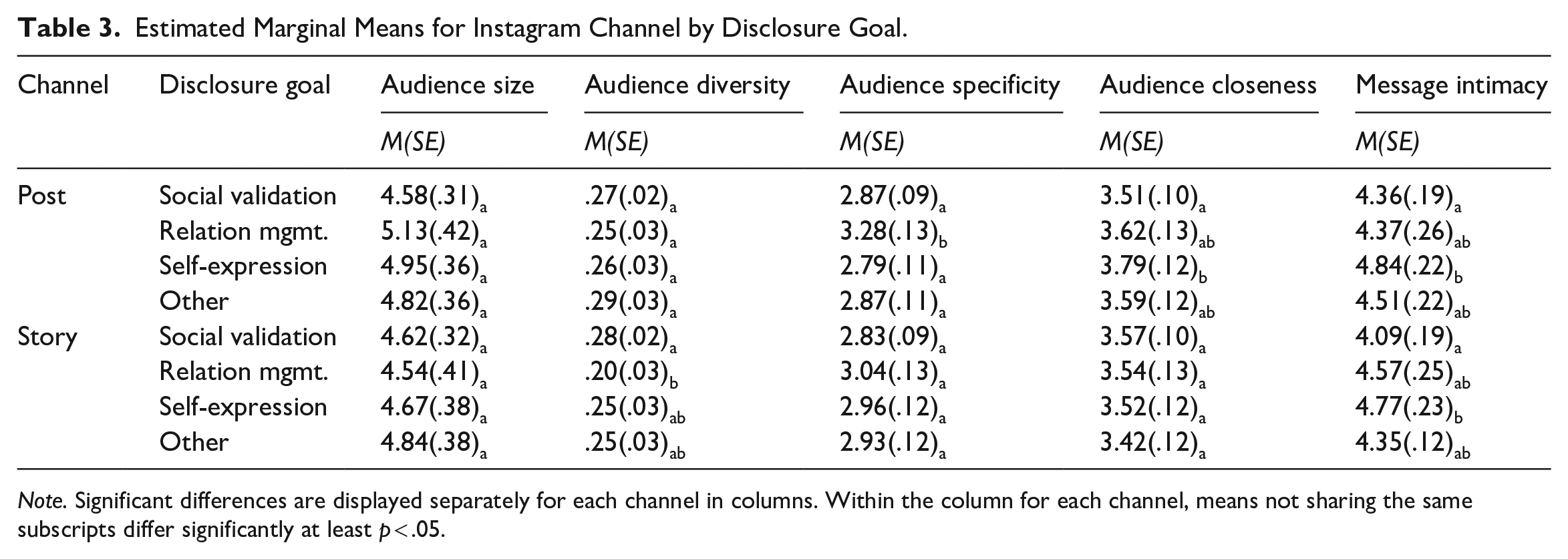
Note. Significant differences are displayed separately for each channel in columns. Within the column for each channel, means not sharing the same subscripts differ significantly at least p < .05.
The Association of Imagined Audience Composition and Disclosure Intimacy
Next, we tested how imagined audience composition affected disclosure intimacy (H4). We ran an MLM with disclosure intimacy as the dependent variable and a random intercept for each participant. Fixed effects included each imagined audience dimension, main and interaction effects for goals and channel, and all other covariates.
Instagram channel was nonsignificantly related to intimacy, F(1, 660) = .51, p = .48, but disclosure goal significantly predicted intimacy, F(3, 744) = 6.75, p < .001. Estimated marginal means that suggested self-expression goals (M = 4.80, SE = .20) predicted more intimacy than social validation goals (M = 4.23, SE = .18, p < .001). No other mean comparisons were significant. Instagram channel did not interact with disclosure goal to influence intimacy, p = .37. After accounting for channel and disclosure goals, we found a significant positive relationship between imagined audience closeness and intimacy, F(1, 802) = 13.18, p < .001. When participants imagined audiences with higher closeness, their Instagram disclosures tended to be more intimate. Disclosure intimacy was not associated with the other audience dimensions: size, p = .08, specificity, p = .56, diversity, p = .15. Thus, we found support for H4(d).
Discussion
Our research aimed to expand the understanding of online self-presentation and impression management by investigating how people construct the imagined audience on Instagram and if the imagined audience predicts self-disclosure. To achieve this, we extended the IAPM in several ways: (1) taking a multidimensional approach to the imagined audience, (2) advancing the affordance of ephemerality as a predictor of imagined audience composition, (3) integrating self-disclosure goals into the model to demonstrate imagined audience variations based on individual motivations, and (4) exploring disclosure intimacy as an outcome of the imagined audience. Our results support IAPM, highlighting the influence of both structural (i.e., ephemerality) and individual (i.e., self-disclosure goals) factors on the imagined audience on social media, ultimately predicting online self-presentational strategies.
We found that persistent channels were associated with a more diverse and closer imagined audience than ephemeral channels. Messages with a goal of relational maintenance exhibited a higher level of specificity in imagined audience compared with those with other goals. Moreover, the effect of Instagram’s ephemerality on imagined audience construction depended upon disclosure goals, such that posts with self-expression goals were linked to more imagined audience closeness than social validation goals, but these differences were not found in Stories. Regarding disclosure intimacy, we found that individuals who perceived greater closeness to their imagined audience engaged in more intimate self-disclosures on Instagram. By integrating audience characteristics, social media affordances, and self-disclosure, this study builds toward a deeper understanding of imagined audience construction and online self-presentation.
A Multidimensional Approach to the IAPM
The IAPM provides a framework for understanding the role of the imagined audience in individuals’ navigation of context collapse on social media. However, one primary challenge that may limit its explanatory power is the ambiguity surrounding imagined audience characteristics, as people often struggle to articulate exactly who they imagine as their audience (Litt, 2012). Previous studies have shuffled a majority of self-reported imagined audiences into an “abstract” category without unpacking their specific characteristics (Litt & Hargittai, 2016; Marwick & boyd, 2010). To addresses this limitation, our study adopts a multidimensional approach by integrating four audience dimensions into the model. Our data show that imagined audience construction spans various dimensions, from specific but not close (e.g., Beyoncè) to nonspecific and large (e.g., everyone). Our analysis reveals that these dimensions, while correlated, exhibit distinct variations across posts and connect to different self-presentational strategies on Instagram.
This advancement creates avenues for future research to explore how individuals construct their imagined audience for given posts based on structural and individual factors. It also helps to unweave the actual/imagined audience tension on social media (Litt, 2012). Researchers can take these dimensions to explore the potential impact of audience feedback features (e.g., explicit audience size information in Instagram Stories) on imagined audience composition, and how they may address the actual/imagined audience size misalignment issue (Bernstein et al., 2013). The multidimensional approach can also shed light on how individual factors, such as online privacy literacy (Masur, 2019) or expectation of audience responsiveness (French & Bazarova, 2017), shape individuals’ imagined communication partners. Future work may explore the role of digital skills in predicting imagined audience characteristics to inform design and policies to help people navigate the impression management challenges posed by context collapse.
Although the multidimensional approach provides opportunities to expand theories about the imagined audience, there remains a lingering question about people’s ability to retrospectively reconstruct their imagined audience. Litt (2012) has argued that a misalignment between participants’ real-time sharing thoughts and retrospective reports affects the construct validity of the imagined audience. When asked to retrospectively construct the imagined audience, the mental conceptualization may blend with other heuristics from the actual audience (Bernstein et al., 2013). Critically, some aspects of the imagined audience may be more influenced by these heuristics than others, such as size, which may be inferred from the number of likes, reactions, or the number of views on Stories. Future research on the IAPM should explore how temporality and heuristics influence the (re)construction of the imagined audience.
The Imagined Audience on Instagram
The imagined audience is an organizing construct of research on self-presentation in social media, but previous research has primarily focused on persistent channels, such as Facebook and Twitter (Y. H. Choi & Bazarova, 2015; Litt & Hargittai, 2016). We extend the IAPM’s claim about structural factors predicting imagined audience construction by examining it on ephemeral versus persistent social media. Our results supported this contention, suggesting that Instagram Stories was associated with a less diverse imagined audience. This finding is consistent with other work on ephemeral channels, which found that they were used to interact with a select group of similar individuals (Chiu & Yuan, 2021; Xu et al., 2016). The ephemerality of Instagram Stories appears to help people navigate challenges presented by context collapse. The less diverse imagined audience and less persistent content on Instagram Stories address two of the defining elements of context collapse: multiple groups and across time. Individuals may invoke less effort to shift between selves or to balance authenticity and audience expectations on Stories with less diverse imagined audiences (Marwick & boyd, 2010). Our findings further explain why people report having fewer self-presentational concerns on Instagram Stories compared with posts (Trieu & Baym, 2020).
IAPM posits that individuals’ motivations for using social media guide the process of imagining audiences (Litt, 2012). Our study tested this proposition and found that relational maintenance goals were associated with more specific imagined audience. Previous studies on self-disclosure goals have revealed a prominence of relational goals in channels with clearer boundaries (Bazarova & Choi, 2014; Y. H. Choi & Bazarova, 2015). When sharing on Instagram Story or post, people confront an audience of their entire network, but it appears that relational maintenance goals drive expectations of interacting with specific individuals. This result indicates that when self-disclosing to foster relationships, people expect directed engagement regardless of who else may view the content, which underscores the need for designs that facilitate response from targeted individuals and prevent unintended audience. Surprisingly, our findings revealed that social validation goals were unassociated with larger, unspecific Instagram audiences, contrasting previous work (Bazarova & Choi, 2014; Y. H. Choi & Bazarova, 2015). This difference may be due to the centrality of visual elements on Instagram, distinguishing it from platforms like Facebook or Twitter. Future research should consider channel comparisons to explain disparities with prior work.
Furthermore, our findings provide support for the IAPM’s claim that structural factors and individual factors combine to shape imagined audiences. We observed that persistent channels and self-expression goals predict a greater sense of imagined audience closeness. Compared with the more common motive of seeking social validation, disclosure posts driven by self-expression goals were directed toward close others. Our results highlight the interplay between social media affordances and individual motivations, which jointly constitute the context of using social media and guide the imagined audience construction. In contrast, Stories were not demarcated by closer imagined audiences, regardless of disclosure goals. The post versus Stories effect could be linked to the lack of visible feedback and perceived low effort when sharing to Stories, which contribute to a lower expectation of responses from either close or weak ties (Trieu & Baym, 2020). This finding differs from other research that emphasizes the exchange of ephemeral messages primarily among close ties, as seen on platforms like Snapchat (Bayer et al., 2016). We suspect one reason for this difference is that Stories take place on public social media channels, which differ from the more private, direct messaging environment of Snapchat. This alternative explanation underscores a key contention of the IAPM: the interaction between affordances combine to generate unique imagined audience compositions (Litt, 2012). Future work should explore how to study the imagined audience construction related to various features and affordance intersections. For instance, the “Close Friends” feature in Instagram Stories offers a possible way to study the interplay between ephemerality and message directedness, and how they impact the imagined audience composition and privacy concerns associated with context collapse. Because algorithms are a central feature in ambiguating the actual audience, another arena of research should consider how algorithms influence the construction of the imagined audience (Taylor & Choi, 2022, 2023).
Imagined Audience and Online Self-Disclosure
The imagined audience is argued as a crucial mechanism that influences the self-presentation strategies people displayed to their actual audience on social media (Litt, 2012). Our study sheds light on this proposition by positioning disclosure intimacy as a self-presentational outcome of the IAPM. Our finding highlights that the imagined audience predicts the intimacy of social media disclosures above and beyond the channels, disclosure goals, or number of followers. This differential is critical for testing the IAPM, as previous studies often used channels (e.g., Bazarova & Choi, 2014), network size and diversity (e.g., Vitak, 2012), or number of followers (e.g., Masur, 2019) as proxies for the imagined audience. Our results suggest that channels, network characteristics, or follower size may not reflect a person’s imagined audience, and interrogation of the imagined audience composition directly is required to understand decision-making related to online self-disclosure.
In our study, participants disclosed more intimate information when they imagined a psychologically close audience on Instagram. Previous work has suggested that people confide distress disclosure to stronger ties across social media platforms (Zhang et al., 2021), and we document this tendency extending to general self-disclosures on Instagram. Importantly, this finding also echoes classic interpersonal communication theories, which suggest that people tend to share intimate information with close connections, perceiving them as co-owners of the shared information (Petronio, 2002). Perceived closeness appears to prompt people to envision a trustworthy audience, enabling them to adjust their privacy boundary lines accordingly. Furthermore, this finding also helps to reconcile other research about self-disclosure and network diversity (e.g., Gil-Lopez et al., 2018; Vitak, 2012), suggesting that perceived closeness to the imagined audience may explain why people share overly intimate content online despite a diverse audience: the discloser was likely imagining that they share this information with close friends or family, rather than their many networked ties.
Limitations
Our findings should be considered within their limitations. First, across all findings, the effect sizes observed were small, suggesting that the effects of channels or goals on imagined audience dimensions and disclosure intimacy were quite modest and should not be overstated. Second, the use of MTurk raises concerns regarding the quality and authenticity of responses (Hauser et al., 2019). We addressed some issues with bots by manually removing problematic responses and supplementing with other sampling methods (e.g., college students and social media recruitment). Third, coding photo-based self-disclosures was challenging due to missed contextual information, which is imperative to understand visual disclosures. Therefore, our codebook relied heavily on verbal disclosures (i.e., the caption of post/Story), potentially excluding some visual disclosures (Masur et al., 2023). Future research may benefit from adopting a more general self-presentational goal approach, rather than focusing on self-disclosure goals specifically, to understand the imagined audience differences in Instagram channels. Our approach also could not disentangle the effect of “Close Friends” feature, which is limited to Stories, in our comparison of persistence and ephemerality. Given that this feature limits audiences, the imagined audience and disclosures on Stories are likely affected. Finally, although our indicators of reliability were acceptable for all measures, confirmatory factor analysis criteria for perceived ephemerality and disclosure intimacy indicated poor model fit, which creates uncertainty about the factor structure for these variables (see Appendix C). These results introduce a challenge to revisit how affordances and message intimacy are operationalized in social media research.
Conclusion
The imagined audience provides a valuable lens to understand online self-presentation and impression management. This study highlights that the imagined audience is shaped by both social media affordances and disclosure goals. Ephemerality and self-disclosure goals predict different imagined audience dimensions, showcasing that both structural and individual factors influence the imagined audience construction. The positive relationship of imagined audience closeness on disclosure intimacy suggests that people may “overshare” personal information online because individuals imagine they are speaking to intimate social bonds, which is consistent with offline communication processes. These results suggest that the imagined audience represents an important way that individuals navigate the ambiguity of self-presentation on social media due to context collapse.
Supplemental Material
sj-docx-1-sms-10.1177_20563051231224271 – Supplemental material for Who’s Viewing My Post? Extending the Imagined Audience Process Model Toward Affordances and Self-Disclosure Goals on Social Media
Supplemental material, sj-docx-1-sms-10.1177_20563051231224271 for Who’s Viewing My Post? Extending the Imagined Audience Process Model Toward Affordances and Self-Disclosure Goals on Social Media by Yueyang Yao, Samuel Hardman Taylor and Sarah Leiser Ransom in Social Media + Society
Footnotes
Declaration of Conflicting Interests
The author(s) declared no potential conflicts of interest with respect to the research, authorship, and/or publication of this article.
Funding
The author(s) received no financial support for the research, authorship, and/or publication of this article.

Supplemental Material
Supplemental material for this article is available online.
Notes
Author Biographies
References
Supplementary Material
Please find the following supplemental material available below.
For Open Access articles published under a Creative Commons License, all supplemental material carries the same license as the article it is associated with.
For non-Open Access articles published, all supplemental material carries a non-exclusive license, and permission requests for re-use of supplemental material or any part of supplemental material shall be sent directly to the copyright owner as specified in the copyright notice associated with the article.
