




Abstract
Both online and offline, audience characteristics have consistently influenced how individuals present themselves. In the context of social media, however, interface design and algorithmic personalization often blur the boundaries between audience groups, leading users to simultaneously interact with multiple audiences—a phenomenon known as context collapse. While this issue has attracted attention from both academia and industry, the psychological and behavioral effects of the imagined audience remain underexplored. Drawing on the Limited Capacity Model of Motivated Mediated Message Processing, this study investigates which audience group users primarily consider when interacting on social media and examines the mediating role of impression management between imagined audiences and social media fatigue. Using a quantitative approach, the study employed quota sampling to collect 430 self-administered questionnaires from Chinese WeChat users. Data were analyzed using SmartPLS and SPSS 27 for structural equation modeling. Results indicate that Chinese youth most commonly perceive close friends as their primary audience when posting on WeChat Moments. Moreover, the imagined audience significantly associated with social media fatigue via impression management strategies. This study is among the first to introduce the concept of the imagined audience into the context of social media fatigue, offering a novel perspective on the complexity of user behavior in digital environments. The findings also refine the theoretical understanding of the relationships among imagined audience, impression management, and fatigue, highlighting the critical role of impression management as a psychological mechanism. Practically, the study offers implications for young users, families, policymakers, and platform developers.
Plain Language Summary
On social media, it’s often hard to control who sees what we share. Friends, family, classmates, and coworkers can all be part of the same audience, making it tricky to know how to present ourselves. This study looks at how Chinese WeChat users think about their audience when posting online, and how that affects their mental state. We surveyed 430 users and found that most young people think mainly about close friends when sharing posts on WeChat Moments. But because they care about what these friends think, they tend to carefully manage their online image. This effort to look good online—called impression management—can become tiring over time. It’s one of the key reasons people feel emotionally drained or overwhelmed by social media, a feeling known as social media fatigue. This research is one of the first to explore the idea of the “imagined audience” as a factor in social media fatigue. It helps explain why people feel pressure when using platforms like WeChat and offers a new way to understand the stress behind staying active online. The findings could help young users, families, platform designers, and policymakers create healthier online environments.
Background
Social media has transformed the way individuals interact across time and space, becoming a vital tool for personal image construction and relationship maintenance. Prior research has identified social interaction as one of the primary motivations for using social media (Ashraf et al., 2021; Gilbert & Barton, 2013; Kelly et al., 2020). However, determining exactly who views one’s posts on these platforms is often challenging, as interface design and algorithmic structures blur audience boundaries and obscure the identities of actual viewers (Yao et al., 2024). As a result, individuals often interact with multiple audience groups simultaneously, such as family, colleagues, and acquaintances, which leads to the phenomenon of context collapse (Boyd, 2008; Marwick & Boyd, 2011; Vitak, 2012).
Whether online or offline, audiences have long played a crucial role in shaping how individuals present themselves. Goffman (1959) argued that during social interactions, individuals perform a “frontstage” self that aligns with the expectations of the audience they perceive. In other words, individuals actively regulate their behavior to manage others’ impressions of them. Litt (2012) and Litt and Hargittai (2016) emphasized that the imagined audience, or the audience people mentally picture, is just as influential as the actual audience in shaping communication behavior.
In the digital environment, however, the size, characteristics, and boundaries of audiences are often vague and difficult to define. Marder et al. (2016) suggested that users typically select an audience group perceived as most valuable and normatively aligned to serve as a reference point for self-presentation. To reduce uncertainty and increase message control, users may categorize their imagined audiences (Brake, 2012; Murumaa & Siibak, 2012; Stsiampkouskaya et al., 2021), enabling them to engage in more strategic and rigorous impression management (Marder et al., 2016). This process helps users cope with varied audience expectations across different social contexts (Su et al., 2022).
Prior research has shown that imagined audiences influence various online behaviors. For example, Zheng et al. (2019) found that imagined audiences moderated the relationship between selfie-posting and self-objectification among adolescent girls, while Ranzini and Hoek (2017) reported that imagined audience salience increased Facebook users’ likelihood of engaging in impression management. Moreover, social media users often anticipate feedback, typically in the form of likes or comments (Chua & Chang, 2016) and discrepancies between expected and received feedback can trigger emotional responses. Li et al. (2018), for instance, discovered that teenage girls felt pressure when their selfies received fewer likes than expected. Similarly, Marder et al. (2016) argued that when projected self-images fail to align with perceived audience expectations, users may experience negative emotions such as anxiety, depression, and frustration.
Empirical studies have confirmed that psychological stress contributes significantly to social media fatigue (Zheng & Ling, 2021), including symptoms such as anxiety, depression, emotional exhaustion, and jealousy (Dai et al., 2020; Liu & Ma, 2020). In China, WeChat is one of the most popular mobile social platforms, and its user connections are typically based on real-life relationships (such as family, friends, and colleagues), which tend to be more intimate and authentic than connections on other platforms. As a result, Chinese users are especially sensitive to issues of online image and reputation.
Furthermore, the social culture of mainland China is characterized by a distinct “acquaintance society” (Au, 2023), in which interactions on social media often overlap extensively with users’ offline interpersonal networks. This relational structure heightens users’ sensitivity to potential audience reactions and evaluations when posting content. At the same time, China’s deeply rooted “face culture” (Au, 2023) encourages individuals to maintain a positive social image and to avoid negative judgments resulting from inappropriate expressions or behaviors. The “semi-private” nature of WeChat Moments further reinforces this impression management pressure, as audiences include not only close ties but also weak ties and peripheral relationships, thereby compelling users to engage in more frequent content filtering and self-monitoring.
Moreover, China’s strong collectivist values emphasize group harmony and adherence to social expectations (Yuan et al., 2024). Within this cultural context, users’ self-presentation is more likely to be constrained by social norms and collective opinion. These cultural characteristics not only shape WeChat users’ behavioral patterns in content sharing and audience management but also provide an important theoretical lens for understanding the relationships among imagined audience, impression management, and social media fatigue. Accordingly, this study focuses on the following two core questions:
This research proposes a new analytical lens, centered on the imagined audience, to understand how digital environments impact users’ behaviors and psychological states. Although the concept of the imagined audience is theoretically significant, empirical evidence regarding its effects on social media use remains limited. By integrating the Limited Capacity Model of Motivated Mediated Message Processing (LC4MP) as the theoretical framework, this study explores the mediating role of impression management between imagined audiences and social media fatigue. In doing so, it not only deepens theoretical insights into audience psychology but also offers a novel perspective for examining the pathways through which social media fatigue emerges.
Theoretical Background
Imagined Audience
The one-to-many communication characteristic of social media blurs the boundaries and scope of audiences (Vitak, 2012). Nevertheless, the need to understand one’s audience persists. As a result, users are compelled to rely on imagination to identify available audience cues in specific communication contexts (Vitak et al., 2015). The concept of the “imagined audience” refers to the mental conceptualization of the people with whom one communicates (Litt, 2012). This notion has long guided individuals’ thinking and behavior in writing and public speaking.
In face-to-face communication, guided by theories of self-presentation and impression management, individuals often tailor their behavior to suit the actual audience to control the impressions others form (Goffman, 1959). Thus, one’s audience provides the foundation for their self-performance. Marwick and Boyd (2011) found that individuals engaging in self-disclosure on social media often face multiple audiences simultaneously within their social networks—such as family, colleagues, and acquaintances. To manage this complexity, users must employ their imagination to construct a perceived target audience. The lack of clear information or cues about audiences leads users to navigate diverse backgrounds and social contexts concurrently—a phenomenon known as “context collapse” (Boyd, 2008).
The imagined audience guides users’ self-presentation, including perceptions of authenticity, self-censorship, and strategic communication practices (Marwick & Boyd, 2011). As imagined audiences play an increasingly important role in social interactions, they have garnered growing scholarly attention.
To better identify imagined audiences, several studies have proposed dimensional categorizations. These include distinctions such as “targeted” versus “abstract” audiences (French & Bazarova, 2017; Litt & Hargittai, 2016). Another important factor in audience categorization is perceived intimacy. For instance, Su et al. (2022) categorized audiences based on perceived relational closeness into “distant” and “close” audiences. Stoltenberg et al. (2022) further classified imagined audiences into four types based on social relationships: personal (friends and family), shared interests (people with similar hobbies), professional (colleagues or supervisors), and imagined or illusory (celebrities).
In most cases, imagined audiences are associated with individuals’ actual social relationships (Stoltenberg et al., 2022). Building on prior research, the current study adopts a relational approach and categorizes imagined audiences into six dimensions:
Family members and relatives, Close friends, Casual friends, Classmates or colleagues, Friends of friends and people you don’t know well, and no specific target audience.
Online Impression Management
The concept of impression management originates from Goffman’s dramaturgical theory presented in The Presentation of Self in Everyday Life, where he described social interaction as a form of theatrical performance. According to Goffman (1959), individuals “perform” to project a desired image of themselves in the minds of others. Impression management, in his view, is ubiquitous, and people adjust their behaviors across different contexts to meet varying social expectations. The main goals are to gain social approval, influence interaction outcomes, ensure smooth interpersonal exchanges, and receive praise or evaluations that may benefit the self.
Compared to offline interactions, social media provides individuals with greater control over the curation and presentation of personal information. Users carefully consider what to share and with whom to share it. Ranzini and Hoek (2017) reported that individuals influenced by their imagined audience are more likely to engage in impression management, particularly through content-centered self-presentation. Similarly, Papacharissi (2018) argued that what users choose to post on social media is shaped by the image they wish to construct in the minds of their audience. Such strategies of impression management facilitate smoother social interactions and help individuals achieve important relational or social goals. Thus, impression management has become a strategic tool for conveying the “right” self to the “right” audience (Ranzini & Hoek, 2017).
Researchers have proposed various theoretical frameworks to explain how individuals manage impressions across different social contexts. For example, Swider et al. (2011), in the context of job interviews, identified three types of impression management strategies: self-focused, defensive, and other-focused strategies—emphasizing how applicants manage impressions to increase their chances of success. Rosenberg and Egbert (2011) introduced a personality-based framework comprising four primary strategies: self-promotion, manipulation, damage control, and role construction.
In the context of social media, Vitak (2012) proposed a dual-component impression management strategy aimed at addressing audience management challenges. This framework includes content-based impression management and web-based impression management. The present study adopts Vitak’s (2012) framework, as it is well-suited to the context of Chinese social media—especially the social ecology of WeChat. Accordingly, we conceptualize impression management as comprising two dimensions, Content-based impression management and Web-based impression management.
Social Media Fatigue
The concept of social media fatigue (SMF) stems from the broader notion of fatigue, which has been extensively studied in occupational and clinical research (Ravindran et al., 2014). Clinically, fatigue is defined as “a subjective, unpleasant feeling of tiredness that varies in duration, unpleasantness, and intensity” (Xia & Liu, 2023; Zheng & Ling, 2021). Extending burnout theories from the workplace to online social contexts, researchers have conceptualized social media fatigue as a multidimensional and subjective experience among users.
In the context of social media, SMF refers to a psychological state characterized by exhaustion, annoyance, anger, disappointment, alertness, diminished interest in communication, or reduced motivation to engage (Ravindran et al., 2014). Zhang et al. (2016) described SMF as a negative emotional response caused by social interactions on social networking sites (SNSs), manifesting as tiredness, energy depletion, apathy, and loss of interest.
Several studies have found that negative emotions and evaluations arising from impression management can lead to social media fatigue (Liu et al., 2024; Ou et al., 2023; Yang & Zhang, 2022). Yang and Zhang (2022) argued that users on social media often strive to publish content that enhances their personal image or taste. However, the perceived benefits of such efforts are frequently minimal, leading to emotional strain such as impression management concerns, which in turn contributes to fatigue. Similarly, Ou et al. (2023) suggested that users often worry whether the content they share may damage their online image. This persistent concern about self-presentation creates a sense of hesitation, which over time, evolves into social media fatigue.
The LC4MP Theoretical Framework
LC4MP provides a theoretical framework for understanding how individuals process media information. LC4MP posits that individuals rely on limited cognitive resources during information processing, and the number of resources required is influenced by the temporal dynamics of the incoming information (Lang et al., 2015). Information processing is typically conceptualized as comprising three sequential subprocesses: encoding, where individuals select stimuli and form mental representations; storage, where these representations are integrated into long-term memory and organized into cognitive networks by linking with prior knowledge; and retrieval, which involves accessing or reactivating stored information to facilitate the comprehension of new stimuli (Lang, 2006).
A central premise of LC4MP is that both audience characteristics and message features can motivate or diminish the capacity available for processing, thereby influencing user behavior (Cappella, 2006; Lang, 2000). LC4MP integrates communication research, psychology, and cognitive science to explain how individuals manage communication and information under capacity constraints (Cacioppo et al., 1999; Lang et al., 2013).
According to LC4MP, the discrepancy between imagined audiences and actual audiences on social media platforms is a common phenomenon that may lead to real psychological consequences and challenges due to cognitive limitations (Bazarova, 2012; Litt & Hargittai, 2016). On social media, users are frequently confronted with multiple and heterogeneous audiences simultaneously, including family members, colleagues, and acquaintances (Marwick & Boyd, 2011). To manage these diverse audiences, individuals often engage in active impression management. However, when users lack sufficient cognitive resources to fully process external information, they may experience cognitive overload or perceptual overload, leading to privacy concerns and impression management stress (Vitak, 2012).
Impression management has been identified as a key driver of social overload (Geen, 2019; Uziel, 2010). In their effort to curate an idealized self-image, users may filter content, and practice self-censorship to control its public visibility. This constant audience management and content regulation can deplete cognitive resources and place an additional burden on information processing (Boyd, 2008). When users exhaust their cognitive resources due to impression management, they are likely to experience cognitive strain, which may lead to negative emotional responses such as stress, anxiety, or fatigue (Yang & Zhang, 2022).
Furthermore, the pressure to maintain social ties, obtain social capital, and sustain a favorable social image compels users to expend significant time and effort in considering the expectations and preferences of their audiences (Figure 1). This ongoing mental engagement can drain cognitive resources, ultimately contributing to social media fatigue (Bright et al., 2015). Based on the theoretical framework outlined above, we propose the following hypotheses:
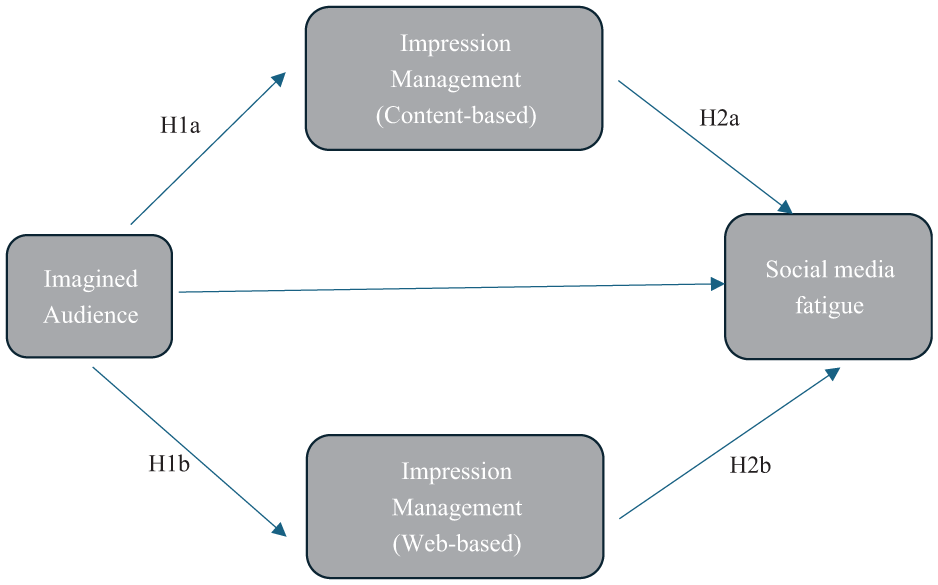
Research framework model.
Method
Data Collection and Sampling
This study was conducted in mainland China between September and October 2024, over a 2-month period. The target population comprised WeChat users aged 18 to 40 residing in urban areas of mainland China. The reasons are as follows. First, individuals in this age range constitute the primary segment of social media users in China and exhibit high engagement with the WeChat Moments feature, making them highly relevant to the research focus. Second, given the vast geographic scope of China and the substantial regional differences in economic, political, and cultural contexts, city tier classification has been widely adopted in prior research as a control variable.
According to the six-tier city classification proposed by China Briefing (2019) and Landgeist (2024), which integrates indicators such as economic development, infrastructure, and commercial vitality, mainland Chinese cities are categorized as follows: first-tier cities (4: Beijing, Shanghai, Guangzhou, Shenzhen), new first-tier cities (15, e.g., Chengdu, Hangzhou, Chongqing, Wuhan, Xi’an), second-tier cities (30, e.g., Xiamen, Fuzhou, Wuxi, Kunming), third-tier cities (70), fourth-tier cities (90), and fifth-tier cities (128). According to Tencent’s (2022) statistics on WeChat user distribution, the proportion of users by city tier is 9.3% in first-tier cities, 19.3% in new first-tier cities, 21.7% in second-tier cities, 23.2% in third-tier cities, 16.9% in fourth-tier cities, and 9.7% in fifth-tier cities. The sample allocation in this study strictly adhered to these proportions to ensure geographic representativeness.
For age stratification, the target group (18–40 years old) was divided into four categories: 18 to 24, 25 to 30, 31 to 35, and 36 to 40 years, with proportions determined based on data from Statista (2022) and Soax (2025). Regarding work experience, prior studies (Brohan et al., 2012; Roberts & Macan, 2006) suggest that individuals with work experience tend to be more cautious in self-presentation, privacy protection, and professional image management on social media. A preliminary pilot survey conducted before the formal sampling revealed that a higher proportion of respondents aged 18 to 24 lacked work experience, whereas most respondents in older age groups had such experience. Consequently, the work experience quota was set at 80% with work experience and 20% without work experience.
A quota sampling method was employed, with city tier, age, and work experience serving as control variables for sample allocation. Data collection was conducted through both online and offline channels. The online survey was administered via the “Wenjuanxing” platform, with quota proportions and eligibility criteria pre-programmed to ensure compliance for each completed questionnaire, yielding 400 responses. The offline survey was designed to supplement underrepresented quotas in the online data, using purposive sampling in high-footfall public locations such as shopping malls, event plazas, and university campuses in cities of different administrative levels. A total of 62 paper-based questionnaires were collected offline. Regardless of mode, participants received a small gift worth approximately 5.00 RMB (around 3.00 MYR) as an incentive for honest participation. The average completion time was 5 to 7 min for online surveys and 7 to 10 min for offline surveys.
Following data collection, a rigorous quality control process was conducted to remove questionnaires with completion times significantly shorter than average, highly repetitive or illogical responses, missing answers to key questions, or respondents aged over 40. Of the 462 total questionnaires collected, 32 were deemed invalid, resulting in a final dataset of 430 valid responses for analysis. Table 1 presents the distribution of respondents by city tier and age group, ensuring the representativeness and reliability of the dataset.
Distribution of Respondents by City Tier, Age Group, and Employment Status.

Measures
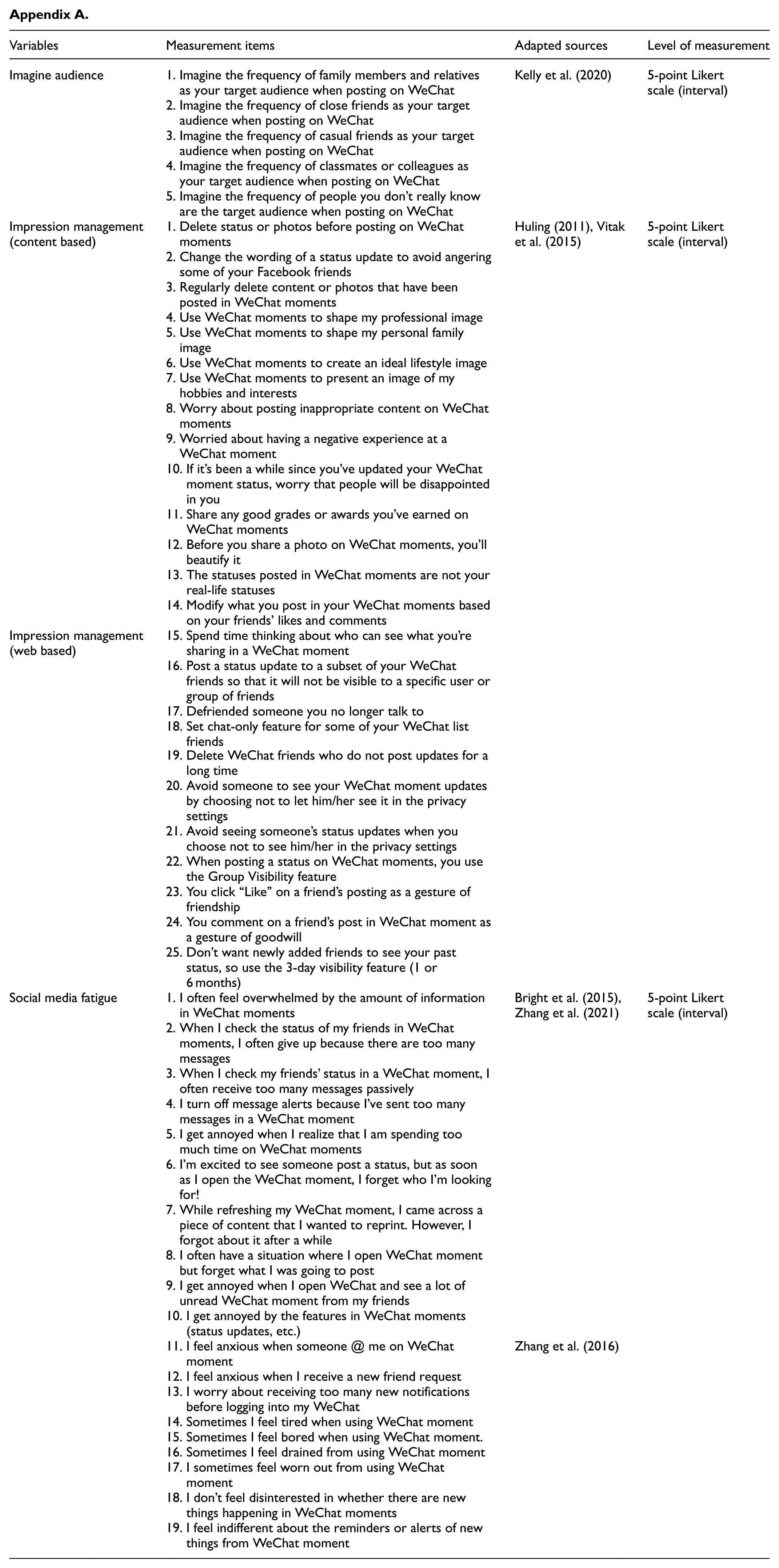
All measurement scales used in this study were adapted from previously validated instruments and modified to fit the specific context of this research (see Appendix A).
Participants were asked to report how frequently they imagined types of audiences when posting on WeChat, using a five-point Likert scale ranging from 1 (Never) to 5 (Very Frequently), as adapted from Kelly et al. (2020). Specifically, participants indicated how often they envisioned six distinct types of imagined audiences: (1) family members and relatives, (2) close friends, (3) casual friends, (4) classmates or colleagues, (5) acquaintances and friends-of-friends, and (6) no specific audience in mind.
The mediating variable, impression management, was measured using a scale adapted from Vitak et al. (2015), Zhu and Bao (2018), and Huling (2011). The instrument includes 25 items and captures 2 dimensions of impression management: content-based and web-based strategies. This section aims to assess the extent to which young users engage in impression management when using the WeChat Moments feature. All items were measured using a five-point Likert scale ranging from 1 (Strongly Disagree) to 5 (Strongly Agree), with higher scores indicating stronger impression management behavior.
The dependent variable, social media fatigue, was measured using items adapted from Bright et al. (2015), Zhang et al. (2016), and Zhang et al. (2021). This section comprises 19 items designed to assess whether and to what extent users experience fatigue when using the WeChat Moments feature. Like the previous sections, all items were measured on a five-point Likert scale from 1 (Strongly Disagree) to 5 (Strongly Agree), with higher scores indicating greater levels of perceived social media fatigue.
The initial English draft of the research instrument was reviewed by three communication experts from the authors affiliated institution to assess its logical consistency, clarity, and appropriateness of wording. Upon receiving unanimous approval from the experts, the researchers obtained ethical approval from the Institutional Review Board of JKEUPM on July 2, 2024 (Ref. No.: JKEUPM-2024-218).
Given that the study was conducted on the WeChat platform in China, the original English measurement items were translated into Chinese and then back-translated into English using the back-translation method (Bhalla & Lin, 1987) to ensure translation equivalence.
In the pretest stage, a small-scale focus group discussion was conducted with 10 potential respondents to evaluate the questionnaire. The discussion focused on whether the instructions were clear, whether the wording of the items was easy to understand, whether the response options were appropriate, whether the completion time was reasonable, and whether the sequence and logic of the items were coherent. Feedback from the participants helped refine the wording and structure of the items. To account for the unique features of WeChat Moments (e.g., visibility groups, hiding certain contacts, and the “last 3 days only” display), relevant items were culturally adapted to better align the questionnaire with the actual usage context of Chinese young users (see Appendix A).
Data Analysis
Data Analysis Tools and Methods
This study first employed SPSS 27.0 to conduct descriptive statistical analyses to present respondents’ demographic characteristics and to examine the audience types that WeChat users most frequently consider when posting on Moments. The descriptive statistics included measures of central tendency (mean, median, mode) and measures of dispersion (range, variance, standard deviation), which provided a comprehensive understanding of the data distribution and laid the foundation for subsequent inferential statistical analyses (Field, 2024). In social media research, descriptive statistics are commonly used to display the frequency distributions and typical characteristics of user behavior.
At the hypothesis testing stage, this study adopted Partial Least Squares Structural Equation Modeling (PLS-SEM) using SmartPLS 4.0. Structural Equation Modeling (SEM) integrates factor analysis and path analysis, allowing researchers to simultaneously address complex relationships among multiple latent variables and their observed indicators. It has therefore been widely applied in the fields of social sciences, psychology, education, and management (Kline, 2023). Compared with covariance-based SEM (CB-SEM), which emphasizes theory testing and requires a larger sample size, PLS-SEM is more suitable for exploratory research and imposes fewer restrictions on sample size and data distribution (Hair et al., 2016).
The choice of SmartPLS in this study is based on three main reasons. First, the research model is relatively complex, involving multiple latent variables and hypothesized paths, and some variables are reflective indicators. PLS-SEM demonstrates high flexibility in handling such models. Second, the sample size of this study is 430, which does not meet the large-sample requirement of CB-SEM, whereas PLS-SEM is more tolerant of smaller samples. Finally, SmartPLS enables researchers to evaluate both the measurement model and the structural model within the same analytical framework, thereby improving the efficiency of hypothesis testing.
In terms of specific analytical procedures, this study first assessed the measurement model by examining factor loadings, composite reliability (CR), Cronbach’s α, average variance extracted (AVE), and variance inflation factor (VIF) values to ensure reliability and validity while excluding multicollinearity issues. Discriminant validity was assessed using the Fornell–Larcker criterion and the Heterotrait–Monotrait ratio (HTMT). After confirming the quality of the measurement model, the structural model was evaluated by applying 5,000 bootstrapping resamples to obtain path coefficients, t-values, p-values, and coefficients of determination (R2). In addition, predictive relevance (Q2) and effect size (f2) were calculated to assess both the statistical significance and the practical relevance of the findings.
In addition, given concerns that the imbalance in the gender distribution of the sample (with females accounting for 62.8%) might affect the estimation of the mediation effects, this study incorporated gender as a covariate in the mediation model for further robustness checks. Specifically, the gender variable was dummy-coded (0 = male, 1 = female) and entered simultaneously into the regression equations for both mediators and the outcome variable. This analysis was conducted using the PROCESS macro for SPSS 27 (Model 4, version 5.0; Hayes, 2022), with percentile bootstrap confidence intervals generated based on 5,000 resamples. The results, after controlling for gender, were consistent with those of the original SEM analysis, indicating that the proposed mediation model is robust and further enhancing the explanatory power and generalizability of the findings.
Evaluation of the Measurement Model’s Reliability and Validity
After data collection, the researchers assessed internal consistency using the PLS algorithm. Reliability is a key attribute of measurement, referring to its consistency and stability (Bollen, 1989; Nunnally, 1978). Cronbach’s alpha is commonly employed to evaluate internal consistency and scale reliability, with a coefficient of .7 or higher generally considered acceptable in most social science research. In addition, internal consistency reliability can be assessed using the composite reliability (CR) value. CR values between .7 and .9 are considered satisfactory, and values above .7 indicate adequate internal consistency (Gefen et al., 2000; Hair et al., 2016). In this study, all instruments achieved Cronbach’s alpha values greater than .7, CR values greater than .7, and Rho_A values greater than .7, demonstrating good internal consistency and reliability (see Table 2).
Convergent Validity.

Note. AVE = average variance extracted; IM1 = impression management (content-based); IM2 = impression management (web-based); SMF = social media fatigue; IA = imagined audience. Bolded entries indicate items with factor loadings below 0.70 but above 0.60, retained for their meaningful contribution to construct validity (Fornell & Larcker, 1981; Sarstedt et al., 2021).
Furthermore, to validate the construct validity of the measurement instrument, confirmatory factor analysis (CFA) within the PLS-SEM framework was conducted to test convergent validity. Convergent validity refers to the extent to which a construct converges in explaining the variance of its items. The primary indicator used to assess convergent validity is the average variance extracted (AVE) for each construct. Generally, an AVE value greater than .50, along with outer loadings above .50 for each measurement item, indicates satisfactory convergent validity (Chin, 1998; Hulland, 1999). Based on exploratory factor analysis (EFA), items with factor loadings below .40, which is widely recognized as the minimum threshold (Hair et al., 2011), were removed. Eliminating these low-performing items significantly improved the measurement quality of the scales, as reflected in higher Cronbach’s alpha coefficients, greater composite reliability (CR), and stronger explanatory power of the latent variables. Ultimately, 20 items were retained, which more closely aligned with the research objectives and provided more effective measurement of the core latent constructs, thereby offering more reliable and valid support for subsequent data analysis and research conclusions.
Overall, in line with established research standards, the three latent variables in this study (Imagined Audience, Impression Management, and Social Media Fatigue) satisfied the criteria for convergent validity. As shown in Table 2, the AVE values of IA, IM, and SMF were all above .50, indicating that these latent variables possessed satisfactory convergent validity.
Discriminant validity is used to assess whether a construct is empirically distinct from other constructs in the structural model. The Fornell–Larcker criterion is one of the most common methods for testing discriminant validity. According to the traditional approach proposed by Fornell and Larcker (1981), the AVE value of a construct should be compared with the squared correlations (i.e., the measure of shared variance) between that construct and all other reflective constructs in the structural model. If the AVE of a construct is greater than its highest shared variance with other constructs, the construct can be considered to have satisfactory discriminant validity. As shown in Table 3, the square roots of the AVE values for all constructs in this study were greater than their correlations with other constructs, indicating that the measurement model demonstrated good discriminant validity and thereby supporting the overall validity of the model.
Discriminant Validity (Fornell–Larcker).
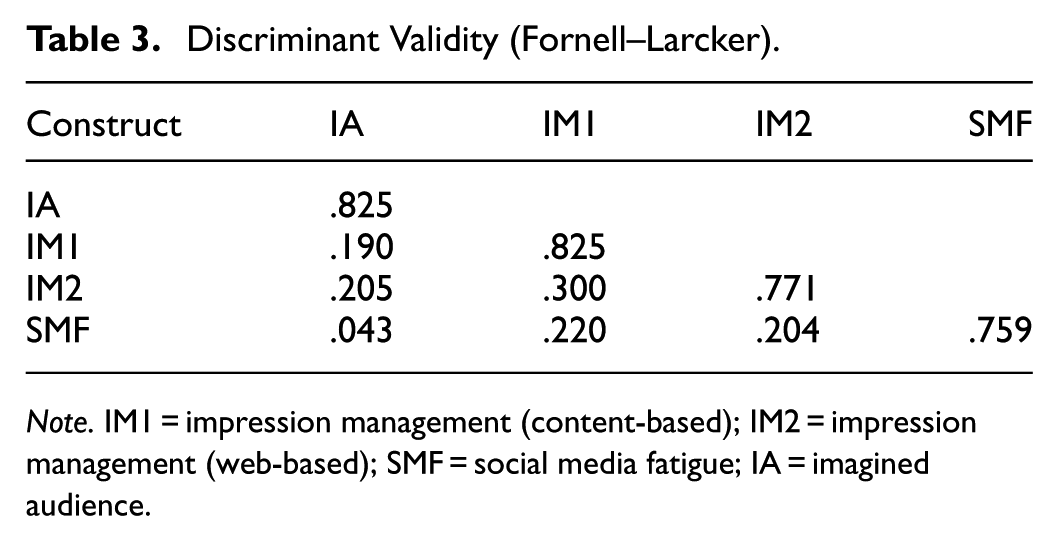
Note. IM1 = impression management (content-based); IM2 = impression management (web-based); SMF = social media fatigue; IA = imagined audience.
In addition to the criteria, Henseler et al. (2015) proposed the Heterotrait–Monotrait (HTMT) ratio of correlations (Voorhees et al., 2016). A high HTMT value indicates a potential issue with discriminant validity. Specifically, discriminant validity problems are considered to exist if the HTMT value exceeds .85 (Kline, 2011) or .90 (Gold et al., 2001). As shown in Table 4, all HTMT values for the constructs in this study were below .90, thereby confirming the discriminant validity of the measurement model.
Discriminant Validity (HTMT Ratio).

Note. IM1 = impression management (content-based); IM2 = impression management (web-based); SMF = social media fatigue; IA = imagined audience.
Structural Model Assessment
Figure 2 present the results of the structural model assessment based on multiple indicators. The standardized root mean square residual (SRMR) was .077, which is below the recommended threshold of .08, indicating a good model fit (Henseler et al., 2015). The coefficients of determination (R2) for the endogenous variables were IM1 = .036, IM2 = .042, and SMF = .070, suggesting that the model had limited explanatory power for these variables. Although the R2 values were relatively low, such results are not uncommon in social science research, particularly in exploratory contexts, and they remain statistically meaningful (Sarstedt et al., 2021). This finding also indicates that the mechanisms underlying complex psychological constructs such as impression management and social media fatigue are influenced by multiple factors, which cannot be fully captured by the variables included in the current model.

Structural model results.
The Stone–Geisser predictive relevance (Q2) results showed that IM1 and IM2 had Q2 values of .028 and .032, respectively, reflecting weak but positive predictive relevance. In contrast, SMF had a Q2 value of −.004, indicating that the model lacked predictive accuracy for this variable (Sarstedt et al., 2021). This result suggests that social media fatigue, as a primary outcome variable, may be determined by more complex factors not fully represented in the current model. Drawing on existing literature, possible omitted variables include personality traits (e.g., extraversion, neuroticism), social comparison tendencies, and platform usage intensity (e.g., usage duration and interaction frequency; Ou et al., 2023). Incorporating these factors in future research could enhance both the explanatory power and predictive validity of the model.
In sum, the structural model demonstrated satisfactory overall model fit, but its explanatory and predictive power was limited. These findings highlight the need to further expand the theoretical framework surrounding the antecedents of social media fatigue and provide practical directions for future research.
Research Findings
Demographic Characteristics of WeChat Users
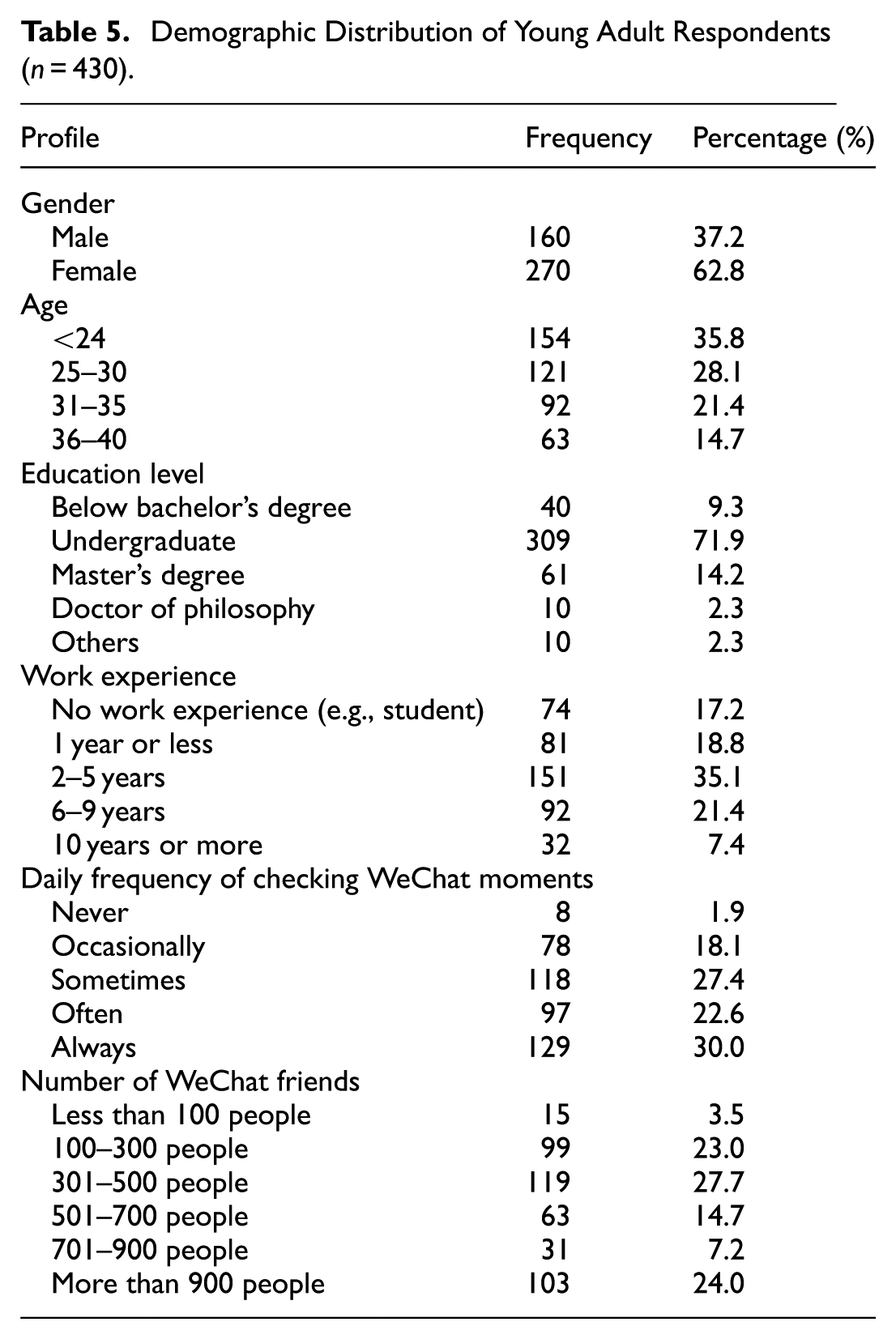
The study sample consisted of 430 young adults between the ages of 18 and 40 (see Table 5). The results indicated that female participants outnumbered male participants, accounting for 62.8% of the sample. The respondents’ ages ranged from 18 to 40, with a mean age of 27.55 years (SD = 5.617). Among them, individuals under the age of 24 comprised the largest proportion (35.8%), followed by those aged 25 to 30 (28.1%) and 31 to 35 (21.4%). Participants aged 36 to 40 represented the smallest group, accounting for only 14.7%.
Demographic Distribution of Young Adult Respondents (n = 430).
Most Frequently Considered Audience Types When Posting on WeChat Moments
A primary objective of this study was to explore which audience types of WeChat users most frequently consider when posting content on WeChat Moments. Table 6 presents the frequency with which participants consider various types of imagined audiences, along with corresponding percentages, means, and standard deviations. Overall, the degree to which users consider their audiences appears to vary significantly depending on the intimacy of the social relationship.
Frequency of Considering Target Audience on WeChat Moments (n = 430).

Note. 1 = never; 2 = occasionally; 3 = sometimes; 4 = often; 5 = always.
Among all audience categories, close friends were the most frequently considered, with a mean score of 3.58 (SD = 1.265). Over half of the participants indicated that they “often” (25.3%) or “always” (30.2%) considered close friends when posting. This suggests that content shared on WeChat Moments is strongly influenced by intimate social ties.
The second most frequently considered group was regular friends (M = 3.31, SD = 1.196). A substantial portion of users reported “sometimes” (31.4%) or “often” (28.4%) taking this group into account, indicating a high degree of social content management for this relational tier.
Classmates or colleagues had a moderate level of consideration, with an average score of 3.03 (SD = 1.172). While 37.4% reported “sometimes” considering this group, only 23.0% selected “often” and 11.2% chose “always,” suggesting that users may be more selective in expressing themselves in academic or professional contexts.
In contrast, friends of friends or acquaintances were among the least considered groups, with a mean score of 2.56 (SD = 1.259). A significant portion of respondents (27.7%) stated that they “never” considered this audience, while 19.3% selected “rarely.” This pattern indicates that users pay relatively little attention to weak ties or distant connections when managing their online self-presentation.
Interestingly, a considerable proportion of users reported not considering any specific audience when posting (M = 3.14, SD = 1.409). While 17.7% selected “never,” 24.7% indicated they “always” posted without a particular audience in mind, reflecting a polarized pattern. This divergence may stem from differences in users’ privacy awareness, content strategies, or perceptions of their audience structure.
Family members and relatives were also relatively less considered (M = 2.68, SD = 1.269), with 31.2% indicating they “sometimes” took them into account and 24.0% stating they “never” did. This result may suggest a tendency among users to avoid familial oversight or to engage more comfortably with peer-based interactions on social media platforms.
Hypothesis Testing Results
For data analysis, hypotheses H1 to H3 were tested using structural equation modeling (SEM). This analytical approach ensured a comprehensive examination of the hypotheses and facilitated deeper insights into the dynamic relationships among imagined audience, impression management (content-based and web-based), and social media fatigue. As shown in Table 7, the study employed the PLSpredict technique and evaluated 5,000 subsamples using SmartPLS to validate the proposed structural model and to test hypotheses H1 through H3.
The structural model analysis (see Table 7) revealed that imagined audience has a significant positive effect on content-based impression management (β = .190, t = 3.609, p < .001). Therefore, H1a is supported. This finding suggests that imagined audience significantly influences WeChat users’ content-based impression management.
Hypotheses Verification (Direct Relationship).

Note. R2 = coefficient of determination; β = standardized regression coefficient; SEs = standard errors; t = t-statistic; p = p-value; LLCI = lower limit of confidence interval; ULCI = upper limit of confidence interval; IM1 = impression management (content-based); IM2 = impression management (web-based); SMF = social media fatigue; IA = imagined audience.
Similarly, imagined audience has a significant positive effect on web-based impression management (β = .205, t = 3.757, p < .001), supporting H1b. The result indicates that imagined audience also plays a critical role in shaping WeChat users’ web-based impression management.
As shown in Table 7, content-based impression management significantly and positively affects social media fatigue (β = .178, t = 3.234, p = 0.001), providing support for H2a. This suggests that increased efforts in managing impressions through content contribute to WeChat users’ experience of social media fatigue.
Additionally, web-based impression management also has a significant positive impact on social media fatigue (β = .156, t = 2.294, p = .022), thus H2b is supported. This finding further highlights that the management of social networks associated with users’ social media fatigue.
Both H3a and H3b were supported in the hypothesis testing. Specifically, imagined audience had a significant indirect effect on social media fatigue through impression management. The first mediation path—IA → IM1 → SMF—demonstrated a significant indirect effect (β = .034, 95% CI [.010, .065]), supporting H3a. The second mediation path—IA → IM2 → SMF—also showed a significant indirect effect (β = .032, 95% CI [.002, .063]), supporting H3b. The variance accounted for (VAF) in these two paths was 44.16% and 42.67%, respectively, falling within the commonly accepted range for partial mediation (20%–80%).
However, the direct effect of imagined audience on social media fatigue was not statistically significant (β = −.023, p = .704, 95% CI [−.142, .094]). According to the criteria proposed by Zhao et al. (2010) and Hayes (2017), this result satisfies the conditions for full mediation from a statistical perspective.
Furthermore, Rucker et al. (2011) emphasized that conclusions about mediation should be based on the statistical significance and theoretical relevance of the indirect path, rather than relying solely on VAF thresholds. Therefore, although the VAF values fall within the “partial mediation” range, the current study interprets impression management as playing a full mediating role in this context.
Further analyses showed that when gender was included as a covariate, the positive predictive effect of imagined audience (IA) on impression management remained robust. The indirect effects of IA on social media fatigue (SMF) through both IM1 and IM2 were still significant (Boot 95% CI excluding zero). Meanwhile, the direct effect of IA on SMF remained non-significant, indicating that the primary mechanism operates through impression management. Taken together, although the proportion of female participants was relatively high (62.8%), gender did not significantly influence the relationships among the key variables, and the overall mediation pattern was consistent with that observed before controlling for gender. This suggests that the gender imbalance in the sample did not pose a substantive threat to the robustness of the findings.
In conclusion, the results confirmed H3a and H3b, demonstrating that impression management plays a significant mediating role between imagined audience and social media fatigue. Specifically, when confronted with imagined audiences, users engage in both content-based and web-based impression management strategies to adjust their self-presentation, a process that substantially increases their psychological burden and fatigue in social media use. Further analyses revealed that the mediation effects remained significant even after controlling for gender as a potential confounding variable, suggesting that the overrepresentation of female participants did not bias the results. This finding not only provides additional support for the applicability of imagined audience theory (Litt, 2012; Marwick & Boyd, 2011) but also highlights impression management as a key psychological mechanism linking imagined audience to social media fatigue, offering robust empirical evidence for understanding the formation of social media fatigue (Table 8).
Mediation Effect Analysis.

Note. Boot SE = bootstrapped standard error; Boot LLCI = bootstrapped lower limit confidence interval; Boot ULCI = bootstrapped upper limit confidence interval; VAF = variance accounted for; IA = imagined audience; IM1 = impression management (content-based); IM2 = impression management (web-based); SMF = social media fatigue. Gender (0 = male, 1 = female) was included as a covariate in all regression equations of the mediation model. The coefficients for gender were non-significant (p > .10), indicating that gender imbalance did not bias the mediation estimates. Bootstrap sample size = 5,000.
Discussion
This study employed a cross-sectional survey design targeting young individuals aged 18 to 40. Using quota sampling, we focused on urban WeChat users residing in mainland China within this age range. The quota sampling criteria included six regional categories, age groups, and employment status. A total of 430 valid questionnaires were collected and used for analysis. The findings addressed our research questions and supported most of the proposed hypotheses.
The first research objective was to explore which type of audience WeChat users most frequently consider when posting to their Moments. Results indicate that among all audience categories, users most frequently considered close friends (M = 3.58, SD = 1.265), followed by regular friends (M = 3.31, SD = 1.196). These findings suggest a clear pattern of differentiated imagined audiences when users post content, whereby individuals are more likely to consider audiences with whom they share a close relationship. Conversely, weaker ties or unspecified audiences were less frequently considered. This trend aligns with prior studies on imagined audiences and impression management, indicating that users engage in deliberate selective self-presentation and information calibration on WeChat Moments. This result is consistent with Su et al. (2022), who found that individuals tend to be more attuned to the preferences and expectations of close audiences and feel safer expressing political opinions in such contexts due to emotional bonds and the buffering effects of social relationships. Similarly, Jiang et al. (2013) emphasized the enhancing effect of intimate relationships on social interaction in online environments such as social media. When interacting with close contacts like family members or romantic partners, individuals are more likely to engage in deeper self-disclosure, which in turn facilitates relational development.
However, somewhat unexpectedly, Chinese WeChat users reported relatively low levels of consideration for family members and relatives (M = 2.68, SD = 1.269). This may suggest a tendency among users to avoid familial interference in their self-presentation or a preference for interacting with peers. Within the context of Chinese culture, younger users often strive to present a positive self-image in front of elders or authority figures while suppressing expressions of negative emotions (Xie et al., 2018).
The second objective of this study was to examine whether WeChat users’“imagined audience” indirectly influences their level of social media fatigue through impression management behaviors. The results indicate that imagined audience exerts a significant positive effect on social media fatigue through two distinct pathways: content-based impression management (β = .034, 95% CI [.010, .065]) and web-based impression management (β = .032, 95% CI [.002, .063]). The Limited Capacity Model of Motivated Mediated Message Processing provides a theoretical framework for understanding this mechanism. According to LC4MP, individuals’ cognitive resources are limited, and when media information processing tasks exceed cognitive capacity, cognitive overload occurs, leading to fatigue (Lang, 2006).
LC4MP emphasizes that media information processing is a dynamic process involving three stages (encoding, storage, and retrieval), each constrained by the limits of individual cognitive resources (Lang, 2006). In the context of WeChat Moments, these stages are reflected in different aspects of impression management and can contribute to cumulative cognitive load.
First, during the encoding stage, users must perceive and initially process information from a diverse audience environment. This not only involves judging the composition and potential expectations of the audience but also interpreting external social cues such as patterns of likes and comments. When the imagined audience is highly heterogeneous (Litt & Hargittai, 2016), the complexity of encoding increases substantially, as users must simultaneously anticipate responses from multiple groups, thereby consuming more attention and working memory resources.
Second, during the storage stage, users retain experiences of audience interactions, feedback, and prior self-presentation strategies in long-term memory to guide future impression management decisions. This ongoing updating and categorization process requires maintaining a “mental archive” of audience profiles and continuously adjusting it based on new social cues—an inherently resource-intensive cognitive activity (Litt & Hargittai, 2016). On dynamic platforms such as WeChat, the imagined audience is not static but constantly reconstructed in response to time, social events, and shifting interpersonal relationships. This contextual fluidity forces users to repeatedly revise their mental models of the audience, thereby intensifying the cognitive burden during storage.
Finally, in the retrieval stage, when users prepare to post or manage existing content, they draw on stored information and strategies to ensure that self-presentation aligns with impression management goals. This often involves a cycle of self-monitoring, strategy adjustment, and content modification—for example, segmenting visibility settings, blocking, or deleting posts depending on the situational context. Frequent retrieval and application of such strategies further increases immediate cognitive load and may contribute to the cumulative effect of social media fatigue.
Therefore, the finding that imagined audience significantly influences social media fatigue through both content-based impression management (β = .034) and web-based impression management (β = .032) represents an empirical manifestation of LC4MP’s limited capacity mechanism within the social media context. The more complex and dynamic the imagined audience, the greater the cognitive resource consumption across the encoding, storage, and retrieval stages, which in turn translates into heightened fatigue through impression management behaviors. This explanation aligns with the perspectives of Bright et al. (2015), Yang and Zhang (2022), and Ou et al. (2023), who argued that the persistent demands of impression management deplete cognitive resources and increase psychological strain, thereby significantly diminishing the quality of social media experiences.
Theoretical Contributions and Practical Implications
This study offers several theoretical contributions. First, it advances the development of impression management theory by laying a foundation for future research on audience segmentation. By incorporating the concept of the imagined audience, this study enables a more nuanced exploration of how users differentiate between various types of audiences (e.g., close friends, colleagues, strangers) and adopt distinct impression management strategies accordingly. This contributes to a growing body of literature on how audience heterogeneity shapes user behavior in online environments.
Second, this study introduces a new perspective to the literature on social media fatigue. Although the findings indicate that specific imagined audiences do not directly cause social media fatigue, the results suggest opportunities for future research to explore additional mediating variables. For instance, individual factors such as privacy awareness, social media use motivations, or expectations of social feedback may serve as potential mediators linking imagined audiences to fatigue. This highlights the complexity of social media use behaviors and opens new avenues for research in this area.
Third, the study validates the applicability of the LC4MP in the context of social media. It demonstrates that the depletion of cognitive resources is a key driver of social media fatigue. Moreover, the study identifies the mediating role of impression management in the relationship between imagined audiences and social media fatigue, thereby offering a novel direction for future theoretical exploration.
From a practical standpoint, the findings have important implications for the design of social media platforms. Platforms should consider providing more flexible and intelligent privacy settings that allow users to more easily manage the visibility of their content to different audience groups, thereby reducing the cognitive burden associated with impression management. For example, smart privacy controls could help users automatically identify and segment their audiences, facilitating more efficient self-presentation.
In addition, social media users can benefit from recognizing that excessive impression management may lead to fatigue. Therefore, reducing the frequency and intensity of self-monitoring can help maintain psychological well-being. Platforms might also consider developing stress-aware features, such as prompts or reminders when users excessively modify posts or personal profiles, to encourage breaks or provide adaptive strategies. Such tools could effectively mitigate the cognitive load caused by impression management and decrease the incidence of social media fatigue.
Limitations and Future Directions
The structural model in this study primarily focused on the mediating pathway through which “imagined audience” influences “social media fatigue” via “impression management.” Although several basic demographic variables (e.g., age and region) were preliminarily controlled, important psychological and behavioral factors that may affect the mediating mechanism were not systematically incorporated, which introduces the risk of explanatory bias. Prior research has shown that personality traits such as self-esteem, self-monitoring, and neuroticism significantly moderate both self-presentation strategies and fatigue experiences in the context of social media use. For example, individuals high in neuroticism are more prone to social anxiety and cognitive overload, making them particularly sensitive to imagined audiences and more likely to frequently adjust their online self-presentation (Seidman, 2013). Similarly, social media use intensity and usage motives have been found to significantly influence impression management behaviors and fatigue levels (Kircaburun & Griffiths, 2019). Failure to account for these factors may have led to overestimation or underestimation of the identified effects of impression management in the model. Future research should therefore consider incorporating relevant psychological traits and usage behaviors as control variables to enhance the robustness and explanatory power of the model.
In addition, this study has certain limitations regarding the gender and age distribution of the sample. The proportion of female respondents (62.8%) was substantially higher than that of male respondents (37.2%), and such gender imbalance may affect the generalizability of the findings, particularly given that gender differences can influence social media use and impression management behaviors (Muscanell & Guadagno, 2012). However, in the mediation analyses, gender was included as a covariate in all regression equations, and its effects were consistently non-significant (p > .10). This indicates that the gender imbalance did not materially alter the direction or significance of the core mediation pathways, thereby enhancing the robustness of the conclusions. At the same time, the sample was primarily composed of young adults aged 18 to 40, without broader coverage of other age groups. This limitation may restrict the applicability of the findings to middle-aged or older adults and adolescents. Future research could adopt stratified random sampling to achieve a more balanced gender distribution and broader age representation, thereby improving the representativeness and generalizability of the study.
Furthermore, because the data were collected from Chinese WeChat users, the findings may not be fully generalizable to social media users in other cultural contexts. Attitudes and behaviors toward imagined audience, privacy management, and social media use may vary across cultures. For instance, in collectivist cultures where face concerns are more salient, impression management demands may be greater, whereas in individualist cultures, the extent of impression management may be lower. Consequently, the present study is limited to a specific cultural setting and cannot fully capture global patterns of social media use. Future research should test these findings across different cultural contexts to enhance the universality of the conclusions.
Beyond sampling considerations, the results may also be influenced by platform-specific features. Different social media platforms vary in terms of interaction structures, privacy settings, and audience composition. Thus, the findings derived from WeChat may not be directly applicable to platforms such as Weibo or Xiaohongshu, raising concerns about external validity. Comparative studies across platforms would be valuable to further validate the generalizability of these results.
Conclusion
This study examined how impression management behaviors, shaped by the notion of the “imagined audience,” influence social media fatigue among WeChat users. Based on survey data from 430 young Chinese users, the findings reveal that imagined audiences significantly exacerbate social media fatigue through two distinct pathways: content-based and web-based impression management. These results align with LC4MP, which posits that ongoing audience monitoring, and self-presentation deplete individuals’ finite cognitive resources, thereby inducing fatigue.
While some perspectives attribute social media fatigue primarily to excessive use or individual traits, this study demonstrates that its roots lie more deeply in the impression management pressures generated by audience heterogeneity and cultural values. Accordingly, social media fatigue should be understood as a product of socio-cognitive processes and cultural context, rather than merely a consequence of “overuse.” The findings not only offer a new theoretical lens for understanding the psychological burden of social media use but also provide practical implications for platform design and user digital well-being. Future research should test these conclusions across different cultural and platform contexts to enhance their generalizability and robustness.
Footnotes
Appendix
| Variables | Measurement items | Adapted sources | Level of measurement |
|---|---|---|---|
| Imagine audience | 1. Imagine the frequency of family members and relatives as your target audience when posting on WeChat | Kelly et al. (2020) | 5-point Likert scale (interval) |
| 2. Imagine the frequency of close friends as your target audience when posting on WeChat | |||
| 3. Imagine the frequency of casual friends as your target audience when posting on WeChat | |||
| 4. Imagine the frequency of classmates or colleagues as your target audience when posting on WeChat | |||
| 5. Imagine the frequency of people you don’t really know are the target audience when posting on WeChat | |||
| Impression management (content based) | 1. Delete status or photos before posting on WeChat moments | Huling (2011), Vitak et al. (2015) | 5-point Likert scale (interval) |
| 2. Change the wording of a status update to avoid angering some of your Facebook friends | |||
| 3. Regularly delete content or photos that have been posted in WeChat moments | |||
| 4. Use WeChat moments to shape my professional image | |||
| 5. Use WeChat moments to shape my personal family image | |||
| 6. Use WeChat moments to create an ideal lifestyle image | |||
| 7. Use WeChat moments to present an image of my hobbies and interests | |||
| 8. Worry about posting inappropriate content on WeChat moments | |||
| 9. Worried about having a negative experience at a WeChat moment | |||
| 10. If it’s been a while since you’ve updated your WeChat moment status, worry that people will be disappointed in you | |||
| 11. Share any good grades or awards you’ve earned on WeChat moments | |||
| 12. Before you share a photo on WeChat moments, you’ll beautify it | |||
| 13. The statuses posted in WeChat moments are not your real-life statuses | |||
| 14. Modify what you post in your WeChat moments based on your friends’ likes and comments | |||
| Impression management (web based) | 15. Spend time thinking about who can see what you’re sharing in a WeChat moment | ||
| 16. Post a status update to a subset of your WeChat friends so that it will not be visible to a specific user or group of friends | |||
| 17. Defriended someone you no longer talk to | |||
| 18. Set chat-only feature for some of your WeChat list friends | |||
| 19. Delete WeChat friends who do not post updates for a long time | |||
| 20. Avoid someone to see your WeChat moment updates by choosing not to let him/her see it in the privacy settings | |||
| 21. Avoid seeing someone’s status updates when you choose not to see him/her in the privacy settings | |||
| 22. When posting a status on WeChat moments, you use the Group Visibility feature | |||
| 23. You click “Like” on a friend’s posting as a gesture of friendship | |||
| 24. You comment on a friend’s post in WeChat moment as a gesture of goodwill | |||
| 25. Don’t want newly added friends to see your past status, so use the 3-day visibility feature (1 or 6 months) | |||
| Social media fatigue | 1. I often feel overwhelmed by the amount of information in WeChat moments | Bright et al. (2015), Zhang et al. (2021) | 5-point Likert scale (interval) |
| 2. When I check the status of my friends in WeChat moments, I often give up because there are too many messages | |||
| 3. When I check my friends’ status in a WeChat moment, I often receive too many messages passively | |||
| 4. I turn off message alerts because I’ve sent too many messages in a WeChat moment | |||
| 5. I get annoyed when I realize that I am spending too much time on WeChat moments | |||
| 6. I’m excited to see someone post a status, but as soon as I open the WeChat moment, I forget who I’m looking for! | |||
| 7. While refreshing my WeChat moment, I came across a piece of content that I wanted to reprint. However, I forgot about it after a while | |||
| 8. I often have a situation where I open WeChat moment but forget what I was going to post | |||
| 9. I get annoyed when I open WeChat and see a lot of unread WeChat moment from my friends | |||
| 10. I get annoyed by the features in WeChat moments (status updates, etc.) | |||
| 11. I feel anxious when someone @ me on WeChat moment | Zhang et al. (2016) | ||
| 12. I feel anxious when I receive a new friend request | |||
| 13. I worry about receiving too many new notifications before logging into my WeChat | |||
| 14. Sometimes I feel tired when using WeChat moment | |||
| 15. Sometimes I feel bored when using WeChat moment. | |||
| 16. Sometimes I feel drained from using WeChat moment | |||
| 17. I sometimes feel worn out from using WeChat moment | |||
| 18. I don’t feel disinterested in whether there are new things happening in WeChat moments | |||
| 19. I feel indifferent about the reminders or alerts of new things from WeChat moment |

Ethical Considerations
This study was reviewed and approved by the Ethics Committee of Universiti Putra Malaysia on July 2, 2024 (Ref. No.: JKEUPM-2024-218). The research design minimized potential risks by ensuring full anonymity, voluntary participation, and the absence of any identifying information. The potential societal and academic benefits of understanding social media fatigue among young adults were deemed to outweigh the minimal risks to participants.
Consent to Participate
All participants were informed of the study’s purpose, their rights, and the voluntary nature of their participation prior to data collection. As the study employed an anonymous online questionnaire, completion and submission of the questionnaire were taken as implied informed consent. This procedure is consistent with the APA Ethics Code Section 8.05(a), which permits the waiver of signed consent in cases where research involves no more than minimal risk and anonymity is preserved. No personally identifying information was collected, and confidentiality was strictly maintained throughout the study.
Authors Contributions
Jingle Sun was responsible for the study design, data collection, and initial drafting of the manuscript. Akmar Hayati Ahmad Ghazali and Rahman Saiful Nujaimi Abdul contributed by reviewing and revising the manuscript for intellectual content and clarity. All authors have read and approved the final version of the manuscript. This study does not include an equal contribution statement; individual contributions are explicitly outlined according to actual roles.
Funding
The authors received no financial support for the research, authorship, and/or publication of this article.
Declaration of Conflicting Interests
The authors declared no potential conflicts of interest with respect to the research, authorship, and/or publication of this article.
Data Availability Statement
The authors guarantee that all data and materials in the study, as well as software applications or custom code, support their published statements and conform to the standards of the field. In addition, data sets related to the study are available from the corresponding author.