



Abstract
Politics and religion are traditionally connected in large democracies, with many examples in the Global South. Recently in Brazil, a specific Bible verse has been assimilated into political expression and amplified by social media: John 8:32 (“And you shall know the truth, and the truth will set you free”). In this article, we employ thematic analysis of Twitter1 data referencing this verse, collected during the 2022 Brazilian presidential election. The analysis shows how the verse became symbolic shorthand for a bundle of values associated with political and religious righteousness, reinforcing the connections between conservative politics and religion. Strongly associated with the persona of former president Jair Bolsonaro, the verse was deployed by his supporters as a symbolic debunking tool against perceived misinformation but was also used ironically by Bolsonaro’s detractors to criticize the former president. By zooming in on the multifaceted use of this Biblical verse in the online political sphere, this article illuminates the multilayered interconnections between political expression on social media, religion, and misinformation in the context of Brazil.
Introduction
The 2022 presidential election in Brazil was a heated race between far-right-wing incumbent Jair Bolsonaro and his center-left challenger, Luiz Inácio Lula da Silva (known as Lula). The latter, who had previously served as Brazil’s president (2003–2010), emerged as the winner. The election attracted keen international attention because of its geopolitical importance around crucial global agendas such as climate change, racial and gender equity, and the rise of authoritarian regimes (e.g., Ionova, 2022; Jingxi & Held, 2022; Käufer & Samuel, 2022). Amid aggressive rhetoric, false claims, and controversy, the appeal to arguments associated with Christianity was prominent throughout the election. This article investigates how a specific biblical verse, John 8:32 (“And you shall know the truth, and the truth will set you free”), was deployed on Brazilian social media to construct political arguments associated with critical thinking, particularly in relation to truth-seeking patterns (Facione et al., 1994). In previous work, we have identified similarities between instructional discourse and rhetorical features of former president Bolsonaro (Russo & Blikstein, 2022, 2023). In this article, we advance that work to shift focus from public figures to internet users who take part in the public debate.
Although Brazil is a lay state, Catholicism has long been a part of the lives of Brazilians, from the colonization by the Portuguese—itself an endeavor driven by Catholic expansionism and economic, imperialist interests—to current-day economic-ecclesiastical conglomerates controlling large portions of the media landscape (Mariano & Oro, 2011). In 2020, 50% of the population identified as Catholic, 31% as Evangelical Christian, and 11% declared no religious affiliation (“50% dos brasileiros são católicos, 31%, evangélicos e 10% não têm religião,” 2020; for data in English, see United States Department of State, 2022). Significantly, religion—especially the country’s Catholic majority—has also shaped Brazil’s political climate, as in the Catholic Church’s crucial support of re-democratization in the 1980s after more than 20 years of military dictatorship. Since the enactment of the 1988 Brazilian Constitution, religious minorities have mobilized and gained expressive political power that includes but goes beyond the electoral process; this political power is yielded, to a large extent, in opposition to progressive causes (Burity, 2020).
Candidates’ religiousness (or lack thereof) has also been known to make or break political campaigns. For instance, Brazil’s former president (1995–2002) Fernando Henrique Cardoso lost one of his early elections—a mayoral race in Sao Paulo in 1985—due to his alleged atheism; later, in 1994, when he ran for president, he frequently made references to God in his campaign (Saad-Filho, 1998), winning that race as well as reelection in 1998. The significance of religion has been noted in recent races for public offices too. For example, 56% of respondents in a poll leading up to the 2022 election stated that religious values and politics should go hand-in-hand (Gielow, 2022). Indeed, in that national election, 21 “religious candidates” (i.e., those adopting religious titles in their political aliases) were elected for legislative seats (Vasconcellos, 2022), and a priest candidate showed up in full regalia to the presidential debates. Bolsonaro, Brazil’s president from 2019 to 2022, was himself elected under the motto “Brazil above everything, God above all.” His speeches frequently included references to the Bible and verses like Luke 22:36 (“If you don’t have a sword, sell your cloak and buy one”) in reference to gun rights (Said, 2022).
Within the context of the 2022 Brazilian presidential election, the present study builds on our previous work that analyzes strategies deployed by the alt-right in Brazil, more specifically during Bolsonaro’s presidential term (Russo & Blikstein, 2022; Russo & Blikstein, 2023; Russo et al., 2021). Here, we focus on one specific Bible verse, employed extensively by former president Bolsonaro and his supporters: John 8:32 (“And you shall know the truth, and the truth will make you free”). Illustrating its prominent role in Bolsonaro’s rhetoric, the verse appeared in his first speech as president-elect in October 2018 and was used to make the claim that Brazilians “have to get used to living with the truth” (Folha de S. Paulo, 2018). In 2019, his first year in office, 11 of Bolsonaro’s Twitter posts still available online referred to that verse (see Figure 1 for an example). As the verse became part of his rhetoric, appearing extensively in interviews and speeches, the rise in his popularity as a politician correlated with a peak in public interest in the verse (see Figure 2). While that correlation does not denote a causal relationship, it is reasonable to assume that Bolsonaro’s use of the verse had a significant effect given his national influence, and it points to an insightful case where an explicitly religious slogan was adopted by a presidential candidate and also their supporters.

A 2019 tweet by Bolsonaro, mentioning John 8:32. 2
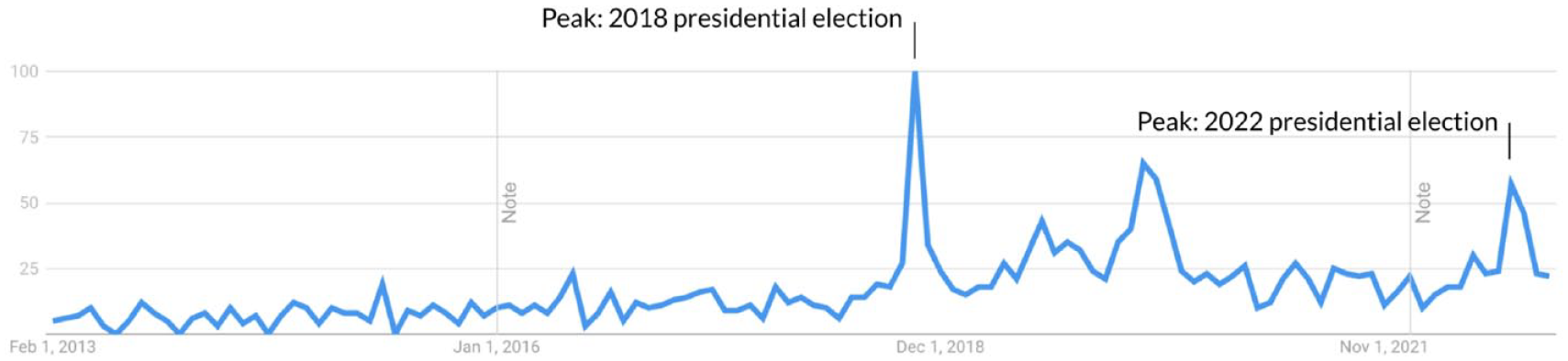
Google search trends for the term “João 8:32” in Brazil from February 2013 to January 2023. The first peak highlighted coincides with Bolsonaro’s election in 2018.
While John 8:32 encourages searching for the truth, it has thus become representative of what danah boyd (2018) calls a “weaponization of critical thinking”—that is, a misuse of aspects of criticality, a gold standard of education for many. This weaponization of critical thinking has been successfully deployed by “post-truth politicians,” who work to “manufacture” the truth that is most convenient to their agendas (Lockie, 2017); post-truth politics has been associated with the recent rise of contemporary populism around the world (see, e.g., Waisbord, 2018). Focusing on Brazil—a country that illustrates this recent reemergence of populism, most markedly demonstrated by the election of Jair Bolsonaro in 2019 (Mendonça & Caetano, 2021)—this study aims to probe the complex interconnections between politics, religion, and the search for truth within the context of the country’s electoral politics. In addition, our study adds to existing literature on political communication and political expression on social media, a field that would benefit from more perspectives from the Global South (Lane et al., 2019, 2022). Examining how these dynamics transpire on Twitter, this article asks: how does a biblical verse promote the weaponization of critical thinking on Brazilian Twitter? To do so, we analyze data collected on Twitter, which has become a prominent venue in the battle for political power in Brazil (Recuero et al., 2020; Soares & Recuero, 2021) and elsewhere (see, e.g., Bimber, 2014; Bracciale & Martella, 2017; López-Meri et al., 2017).
Review of the Literature
Spirituality and Politics on Twitter
Previous research, albeit in contexts other than Brazil, has investigated the crucial role of Twitter in materializing the bond between politics and Christianity. It has been shown, for example, that members of the U.S. Congress frequently expressed religious sentiments in their communication on Twitter (Bramlett & Burge, 2021); especially among Republicans, those communications often included mentions of Jesus and the Bible. A recent investigation in Spanish-speaking countries demonstrated how neoconservative groups connected to Christianity used Twitter to organize and advocate against sexual and reproductive rights (Ferré-Pavia & Sambucetti, 2022). Although some of those neoconservative groups employed hate speech in their political expression, the connection with religiosity was still a marked feature in their communication.
In the context of Brazil, analyses of Twitter data identified the salient role of religion in online discussions, both during election cycles and beyond. For example, a common argument circulating on Twitter was that the left’s rise to power would result in communists’ imposition of atheism (Levy & Sarmento, 2020). After his election, Bolsonaro himself instrumentalized religion as part of a political-fundamentalist populist strategy during the early days of the COVID-19 pandemic (Cunha, 2023). In her analysis, Cunha showed how the former president employed his social media accounts—including his Twitter profile—to portray himself as a “warrior” who brandishes the “weapons of faith” in the fight against communism and COVID-19. She found that Bolsonaro’s official communication as a president followed the same playbook as his electoral campaign, relying on the Bible and Christian imagery to frame himself as a leader who was concomitantly a “man of the people” and the “Messiah” who would save Brazil from enemies (Cunha, 2023).
Recuero et al. (2021) studied the particular traits of political disinformation on Twitter during the 2018 presidential election in Brazil and found that moral values were at the center of users’ argumentation. Users in their sample resorted to moral values to discredit institutions like the Electoral Court and polling institutes, making supposedly “rational” and scientific claims that were discredited by technical bodies (e.g., bringing up presumably sound technical methods that would enable tampering with the electronic ballots). These findings motivated further investigation into topics such as the employment of similar rhetorical devices on Twitter in the following national elections, held in 2022. The adoption of speech that combines concomitantly rationality, the search for truth, morality, and spirituality is indeed a discursive tour de force that motivated us to investigate its dynamics and prevalence more systematically.
Spirituality and Critical Thinking
Of particular relevance to our present focus on John 8:32, studies have also investigated the association between religious belief and critical thinking. For example, quantitative studies have found that atheists and agnostics tended to be more reflective in forming their opinions compared to religious individuals (Pennycook et al., 2016) and that the latter group placed less importance on evidence as a basis for their opinions, mirroring the attitudes of conspiracy theorists (Frenken et al., 2023; Pennycook et al., 2020). However, qualitative studies point to a different direction in terms of how religious individuals perceive these practices. For example, studies on Flat-Earthers found that some members of that group viewed reading the scriptures as opening their eyes to the truth (Peaslee et al., 2020). Drawing a crucial link to religion, Tripodi (2018) described media reading practices by conservative groups as “scriptural reading”: these groups, she argued, tend to read the news in the same way they read the Bible, searching for answers in primary sources, such as presidential speeches and the constitution, rather than trusting mainstream media. Indeed, Ward and Voas (2011) coined the term “conspirituality” to denote the blend between conspiratorial thinking and spirituality, suggesting that the two are bound by the search for truth via the identification of mechanisms that govern the spiritual and material worlds. Identifying those mechanisms requires both faith and the capacity to comprehend phenomena holistically (Ward & Voas, 2011).
“Truth-seeking” has been identified as a component of critical thinking (Facione et al., 1994; Facione & Facione, 1996), and both are traits that individuals take pride in practicing when taking a political position (Marwick & Partin, 2022; Tripodi, 2018; Zuckerman, 2019). Indeed, recent scholarship has found intriguing connections between truth-seeking, critical thinking, and contemporary political knowledge construction within the polarized political environment of the United States, probing the ways in which far-right groups exploit a “do your own research” mindset to advance extremist agendas. For instance, Zuckerman (2019) found evidence that QAnon leaves “crumbs” that encourage followers to formulate theories about politicians being part of conspiracy theories (e.g., “politicians in the establishment are part of a plot to destroy the great American nation”). By encouraging followers to “do their own research,” the group pushes a systematic research approach that involves collecting evidence from a variety of sources and critically reading multimedia texts, albeit in ways that are inconsistent with the democratic goals of critical thinking and media literacy (Marwick & Partin, 2022).
Overview of Contributions
In light of this brief review of relevant research, we seek to contribute to scholarship in three key ways: First, building on Tripodi’s (2018) recent research in the U.S. context, this work seeks to add nuance to our understanding of the intersection between religion, political expression, and critical thinking, especially in advancing conservative agendas. Second, that intersection is even more relevant in Brazil, given the deep connection between religion and politics in the country, as well as the rise of right-wing groups that have been relying on this religion–politics connection in their public communication. Therefore, this study adds to our understanding of these dynamics in the valuable but under-researched context of Brazil, while contributing to the broader scholarly effort to decenter Western perspectives in the field of communication (Arora, 2020; Chakravartty et al., 2018)—especially in political communication (see, e.g., Lane et al., 2022). Finally, most studies that have attempted to address these issues using Twitter data have used quantitative methods. While this approach has fruitfully revealed clusters of political influencers, themes, hubs, and networks (e.g., Recuero et al., 2020, 2022; Soares & Recuero, 2021), in the present study, we chose a qualitative approach that sheds nuances that characterize the juncture of religion and politics on social media.
Methods
The study is based on a qualitative analysis of tweets related to John 8:32, as a lens into the intersection between Brazilian politics and religion. We chose to focus on Twitter as our platform of choice due to the major role of this platform in Brazilian contemporary politics and the demonstrated link between religion and politics on the platform, as illustrated by previous research (e.g., Cunha, 2023; Levy & Sarmento, 2020; Recuero et al., 2021).
Our interest in the specific verse of John 8:32 derives from a distinctive feature of its adoption in the political landscape in Brazil. It has been symbiotically incorporated into political communication both by Bolsonaro himself (e.g., in his address to United Nation’s General Assembly; see Waisbord, 2020) and by his supporters (e.g., “Apoiadores de Bolsonaro e Haddad promovem atos pelo Brasil,” 2018). Although Bolsonaro has made extensive use of religion in general in speeches and social media posts, this specific verse has been foundational to his rhetoric (Cioccari & Persichetti, 2019). Indeed, as Curcino (2019) has argued, Bolsonaro deploys John 8:32 distinctly from other religious arguments, as a sort of self-defense mechanism against allegations of disinformation—and more broadly, as a means to convey his closeness to a godly truth (Demuru, 2021). In addition, although other biblical verses have been employed in political campaigns, 3 John 8:32 is unique in that it has been enthusiastically embraced by citizens in their political discourse, both online and offline (see, e.g., Figure 3 for the use of this verse at a pro-Bolsonaro demonstration). Thus, given the centrality of this verse in Bolsonaro’s political communication and the way it has been adopted by his followers, focusing on this particular verse promised valuable insights into how voters—as opposed to just politicians—instrumentalize religion and integrate biblical themes in their political expression online.

A banner on a truck displaying the verse at a demonstration in Brasília in May 2021.
Data was collected in October 2022 through a search for the keyword “Joao 8 32” (Portuguese for John 8:32). We used Twitter API V2 and the academictwitteR package (Barrie & Ho, 2021) to perform the search and storage of data. This method allowed us to define a specific time range, which in this case was set to September 29 to October 5, 2022. In selecting this timeframe, we chose Brazil’s Election Day (October 2) as our focal point and collected data starting 3 days before and ending 3 days after. In addition, this period was one of great agitation, marked by key milestones in the electoral race (Calendário eleitoral resumido—Eleições 2022, n.d.). Specifically, September 29th was the last day when TV and radio debates were allowed between candidates (and included the airing of the final televised debate), as well as the last day for political party broadcasts; October 5th was the last day for the electoral justice to publicize ballot reports, representing the official closure of the first round of the election.
The search returned 4,713 results for the 7-day period. A preliminary scan of the tweets showed that the vast majority contained references to politics and, more markedly, to the 2022 election. 4 Within that initial set, there were large groups of duplicates (i.e., tweets repeating themselves, except for details like other profile handles mentioned). Those duplicates were deemed irrelevant to the analysis and removed from the final corpus, except for those pertaining to one specific group: a series of identical tweets wherein the author tried to debunk the claim that Bolsonaro was discharged from the army. 5 We decided to keep that one group because of its relevance to our research question, but we separated these tweets from the main corpus to aid a more targeted analysis. This article considers these two subsets, analyzed independently of each other—hereafter, referred to as the “main corpus” (N = 1,399) and the “repeat corpus” (N = 971). The total corpus therefore consisted of 2,370 tweets, out of which 510 were original tweets and 1,860 were replies. Table 1 presents a breakdown of our final corpus per day.
Breakdown of Tweets Per Day in Our Final Corpus.

An abridged version of the search results was stored in a Google Spreadsheet using the googlesheets4 R package (Bryan, 2023). Besides the tweets themselves, stored metadata included tweet ID, author ID, time and date of publication, and whether the tweet was a reply (and if so, a reply to whom). Many posts contained pictures and embedded videos, which were also collected and analyzed in complement to the text-based data.
Our analytical approach was that of thematic analysis (Braun & Clarke, 2012). While thematic analysis is a flexible approach that can be deployed in a variety of ways, according to different paradigmatic and theoretical positions (Braun & Clarke, 2006), here we adopted inductive thematic analysis, in line with an interpretivist epistemological orientation. In doing so, we followed an iterative process. First, we read each tweet in the main corpus, in chronological order, with the primary aim of understanding whether and how it was connected to politics and/or to the presidential race. Reading the corpus chronologically also enabled us to understand how key moments in the election race—such as the television broadcast of the electoral debate or the beginning of the run-off campaign—played out in our data. In this phase, we took ample notes and also paid close attention to visual artifacts (images and videos) that were included in the tweets. Second, we went back to the corpus and pulled illustrative tweets related to these initial codes, while coalescing the codes into larger themes according to topical similarity. In the case of replies, we used Twitter’s web interface to locate the original content and analyze it in context. 6 Finally, we reviewed the initial themes and reduced them to three broader ones that are discussed in the findings section below. For the repeat corpus, the analysis focused on the structure of the message and the recipients of these repetitive replies.
Data were analyzed in Portuguese and examples included in this article have been translated into English by the first author. In the case of the screenshots presented here, the first author manipulated the tweets using Google Chrome’s Developer Tools to replace the Portuguese content with an English translation. Although the tweets we collected are public, we took further precautions to anonymize the data, given the ethical challenges of working with public Twitter data (see, e.g., Fiesler & Proferes, 2018). Thus, the manipulated screenshots we include here use pseudonyms instead of real screen names and handles (except in the case of public figures, such as the President). Further, to verify the likelihood that a reader of this article could find the original tweets and replies, we have undertaken a reverse translation of the content of a subset of examples displayed in the article using Google Translate. The search returned no satisfactory results, indicating that there is a low likelihood that original authors and content can be found via an online search.
Findings
“A Biblical Verse Changed Our Nation”: John 8:32 as a Bundle of Values Associated with Bolsonaro
Our analysis points to the use of this biblical verse to symbolize a “bundle” of values seen as core to Bolsonaro and his supporters. The verse thus functioned as a symbolic shorthand for a wider set of values and ideas, connecting politics, religion, and truth-seeking. Predominantly, tweets in this first theme are attempts by Bolsonaro supporters to praise their preferred candidate and frame his campaign as antagonistic to Lula’s.
The first value associated with this biblical verse is patriotism—and indeed, the religion-patriotism connection was already strongly present in Bolsonaro’s discourse and his political branding, such as his motto “God-Homeland-Family” and his electoral slogan “Brazil above everything, God above all.” Some of the tweets in our corpus were responses to Bolsonaro’s closing remarks in the presidential debate, where his first and last sentences included his electoral slogan. Motifs like flags, national colors, and emojis appeared in tweets alongside “John 8:32,” to remind others of their duty to “protect” Brazil from the enemy represented by left-wing politicians. The tweet in Figure 4 exemplifies this argument and the association of John 8:32 with patriotism. Tagging the profiles of a priest and Bolsonaro, this tweet included the text of John 8:32 (“And you will know the truth and the truth will set you free”) along with an edited video. The video compared Brazil with other Latin American countries (Nicaragua, Cuba, Argentina) where “leftist regimes are expelling missionaries.” After a news montage about each country and its struggle against leftist domination, Lula is shown interacting with one prominent politician from each of those countries, and saying that Brazil will be friends with everyone. The captions at the end drive home the point of the video: “Are you going to let this happen in Brazil too?” and, against a waving Brazilian flag, “Brazilians, we can’t let Lula destroy our Brazil. Voting is our weapon.”

Two frames from a video that associates John 8:32 with patriotism and with support of Bolsonaro, warning of religious persecution if Lula wins the election.
Other tweets containing the bible verse addressed Bolsonaro and Lula’s allies—and their relationship (or lack thereof) to religion. One of Bolsonaro’s allies was the priest-candidate Kelmon, a clergy from a little-known religious denomination who entered the electoral race after his party’s original candidate was judged ineligible. Kelmon’s presence was exploited by Bolsonaro during the TV debate, and Twitter users used that alliance to connect Bolsonaro to God’s will. For instance, a tweet read: “God chose BOLSONARO to close the debate. With the priest praying. Thanks John 8:32 BRBR.” This tweet implies that Bolsonaro’s closing remarks were a moment of revelation prompted by God and witnessed (if not supported) by priest Kelmon: “the priest praying” confers sacredness to the moment.
In stark contrast, Bolsonaro’s supporters depicted Lula and his allies as a party of anti-religion lawbreakers. Priest Kelmon published on Twitter a video from the debate, in which he challenged Lula to “tell the truth” about why he “was authorized” to run for president, as well as to clarify his position on abortion and Christianity. In the video, the priest advanced the narrative that Lula should be in jail (although his prosecution had been deemed illegal by the Supreme Court), that he is “an actor” who constantly lies to Brazilians, and that the political left is against the church. In replies to the priest’s tweet, one user associated the priest’s claims with the Biblical verse: “That’s why all the crooks united to fight against Bolsonaro, because of John 8:32. That infuriated those devils!” In doing so, the verse combines the values of truth, lawfulness, and religiosity to depict Lula and his allies as both “crooks” and “devils.”
Directly illustrating the ways in which John 8:32 was used to telegraph a wider “bundle” of values, a Twitter user shared a basic table consisting of opposite values, associated with Bolsonaro and, respectively, Lula (see Figure 5). In this table of values, “John 8:32” is associated with Bolsonaro and becomes a symbol of truth; indeed, here “John 8:32” is framed as a personal attribute of Bolsonaro (in contrast to “liar” being an attribute of Lula). Reading across, the verse (and symbolically, truth or truth-seeking) is associated not only with Bolsonaro, but with all other causes and values that Bolsonaro is seen to stand for: patriotism, conservative values, and reactionary standpoints against drugs and public safety. The table thus attempts to explain the electoral race by offering an extreme simplification of political agendas, where truth—as well as, more indirectly, other seemingly righteous values—are represented by John 8:32.

Tweets comparing “causes” of Bolsonaro (left side) and Lula (right side).
“I Gave Him a Shot of John 8:32 Vaccine”: John 8:32 as Cure for Misinformation
Another key finding is the association between the biblical verse and perceived practices of debunking misinformation. A large proportion of tweets in our sample—shared predominantly by Bolsonaro supporters—employed the verse to challenge specific mainstream media claims, usually rather vaguely, without explicitly mentioning specific stories, links, or news organization handles. For instance, referring to Lula supporters, one tweet read: “I’m converting a few, today I went for a walk and converted one that for lack of information had already been infected by Lulism. But I gave him a shot of John 8:32 vaccine and freed the poor soul” (Figure 6). Two components of this user’s rationale are especially worthy of note. First, they imply that their interlocutor was infected by “Lulism” because he did not have access to (reliable) information. Second, they use the verse as a metonym for the truth that would free his interlocutor’s soul—positioning themselves at once as both religious savior (“converted,” “freed [his] soul”) and doctor (“infected,” “vaccine”). The user does not provide details about their source or what “lack of information” meant in that context.

John 8:32 as a vaccine against political position-taking based on unreliable information.
Interestingly, a similar instance appeared in another tweet, this time from a user who identified as a Lula supporter: “My aunt sent a fake news video from 2018 about the polls. I answered with news debunking the video and pulled a John 8:32.” Here, the verse—again wielded linguistically as a noun—was invoked as a complement to practices of media literacy. In both this case and the previous, users align the verse with an attitude of critical consumption of information, though in different contexts and based on opposite political stances. 7
The use of this verse in relation to misinformation also offers insight into how individuals react to information seen on mainstream media (e.g., television) in real time. Many of the tweets in our corpus were posted during the September 29 televised presidential debate and referred specifically to the arguments made in that debate. For instance, commenting on Priest Kelmon’s interaction with Lula, a Bolsonaro supporter tweeted “Lula’s exorcism was epic!,” to which another user replied: “Besides, he got a John 8:32 in the face.” Here, the Biblical verse (again deployed as a noun) is used to comment on the priest’s allegations of corruption, leveraged against Lula during the televised debate. After the debate ended, a pro-Bolsonaro user tweeted: “Do you know who won the debate? It was John. One John 8:32.” This post featured the Brazilian flag, both as emojis in the text of the tweet and as a stylized image attached to it.
At the same time, while users in our corpus seemingly watched and responded to the televised debate, our data also revealed a well-documented attitude among alt-right and conservative groups: distrust in legacy media and established epistemologies (Lewis & Marwick, 2017). During his presidential term, Bolsonaro’s critical stance toward mainstream media became a usual theme in his communication, and that perspective was also apparent in his supporters’ tweets. For instance, the first tweet in Figure 7, about how mainstream media and the judicial branch plotted against the former president, promised that this plot “will be debunked” and ended with a warning: “the minority didn’t wake up yet, but they will. John 8:32.” The implication here is that “the system” (the judicial branch) is against Bolsonaro (and laypeople, i.e., “the minority”), but not everyone is ready to see that truth; John 8:32 is evoked as the path to reach that awareness. In another example (second tweet in Figure 7), in response to a famous newspaper’s post, one user tweeted: “While the gang shows a FAKE POLL, the STREETS SHOW THE TRUTH. THE COUP ORCHESTRATED BY THE USUAL CROOKS, IS GOING TO BOW TO THE TRUTH. John 8:32.” Here, John 8:32 refers to the debunking of three alleged untruths or conspiracies. First, popular demonstrations of support for Bolsonaro in public events are to be trusted, polls are not. Second, there is a coup being orchestrated against Bolsonaro, including well-known politicians who are part of “the system” (the “gang”). Third, mainstream media cooperates with the coup and publishes rigged polls to favor “the system.” Throughout these examples, no actual sources are mentioned or linked to back up the user’s claims. In all cases, the verse itself seems to fulfill the need for a reliable source. In this sense, it is no longer simply a rhetorical component of Bolsonaro’s and supporters’ political expression and a means to convey political affiliation; rather, it has also become a conduit for an alternative form of literacy fostered by his followers—it becomes a signifier of unquestionable truth.

“Debunking” the plot against Bolsonaro.
Interestingly, the tweets that made up the “repeat corpus” also focused on attempts to debunk misinformation. What differentiates this effort from previous examples, however, is the inclusion of a news article that supports the main claim in the tweet. As mentioned in the Methods section, one message appeared—with slight variations—in 971 out of the 2,370 tweets in the data. It was always posted by the same user (in reply to different tweets by journalists, comedians, celebrities, as well as regular users) and referred to Bolsonaro’s infamous discharge from the Brazilian army. The first part of the message sometimes varied and referred to the parent tweet, e.g., including a statement that the original tweet is wrong, or an appeal for the user who posted the original message to “study more” or to review their sources. Then, the main body of the tweet was the same:
“This whole story about the Army discharge is fake news from ‘cancelers.’ If you need to lie to advocate for a cause, it’s because the cause is not worth it. John 8:32—And you shall know the truth, and the truth shall make you free.”
The tweet links to a news article that debunks the Army discharge story (Figure 8). Although there is no evidence that the user is a bot, it might be the case that they are an account specifically created to respond to topics that mention certain terms—or perhaps might just be one (or a group of) very disciplined Bolsonaro supporter(s) who employs a lot of energy in attempting to debunk perceived misinformation with the aid of John 8:32.
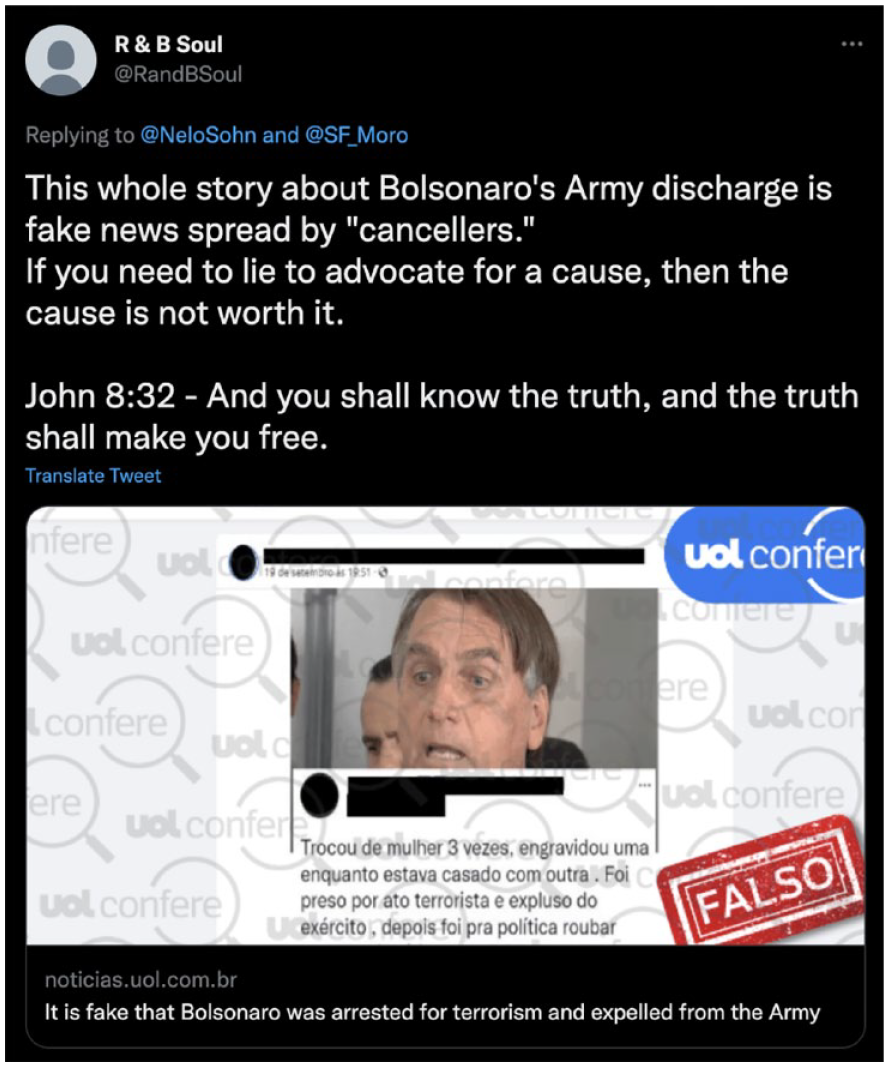
Debunking the fake anecdote about Bolsonaro’s Army discharge.
“Did You Forget About John 8:32, Mr. President?” Irony in Anti-Bolsonaro Tweets
Perhaps surprisingly, the data show that Lula’s supporters also used the verse in their tweets with relative frequency—though predominantly in ironic references to Bolsonaro, 8 rather than to the candidate they support. This illustrates the strong cultural association between this biblical verse and Bolsonaro’s public persona, an association that in some cases backfires against him. The authors of tweets assigned to this theme were predominantly Lula supporters.
Tweets deploying the verse ironically, against Bolsonaro, primarily addressed two topics: Bolsonaro’s use of the 100-year confidentiality decree and his connections with Freemasons. 9 The 100 years confidentiality decree was signed by Lula’s ally, former president Dilma Rousseff, in 2011, but Bolsonaro’s government is associated with excessive use of that legal device: for instance, to conceal his vaccination records or the entry logs tracking his sons’ visits to the presidential palace. Given this context, many tweets in our corpus challenged or mocked Bolsonaro, by bringing up his hypocritical use of the decree against his public adhesion to John 8:32. “Bolsonaro has just requested 100 years of confidentiality for John 8:32. You will know the truth and the truth will set you free. But ONLY IN 100 YEARS! LOLOLOL,” read one of the tweets. Other tweets rhetorically addressed Bolsonaro supporters, questioning their association between the verse and the law: “Your candidate lives by John 8:32 and needs 100 years of confidentiality. How can you sustain that incoherence?” This illustrates how a verse that has been extensively used by Bolsonaro and his base of supporters can also be deployed ironically, to support an oppositional stance. Despite the convoluted logic and a debatable sense of humor, it is noteworthy how this tweet illustrates how connected the verse is to Bolsonaro, even when the content is not in his favor.
Another instance in which Bolsonaro’s opponents used irony in conjunction with John 8:32 was about his appearance at a ceremony of freemasonry. Immediately following the day of the first round of voting, an old picture of Bolsonaro at a masonic lodge began spreading on social media. His opponents used that connection, attempting to damage his reputation among the evangelical electorate—an important portion of his constituency. Many of those tweets took a humorous tone, associating the masonry with satanism. Referring to Bolsonaro’s supporters as “cattle,” one of the tweets read: “Will the cattle be mad if I wrote JAIR MASONRY [on Twitter]? But if JAIR MASONRY is not a real Christian, let the people know the truth. John 8:32.” The tweet thus makes the point that Bolsonaro’s voters would not like it if their leader were associated with masonry, an organization that is not compatible with segments of Christianity. The user seems to imply that the former president was hiding the truth from his Christian voters by obscuring his affiliation with the Masonry (“let the people know the truth”); thus, the verse functions ironically to call out Bolsonaro’s deceitfulness.
Similar to the examples given in the previous section, sources are never provided in the ironic anti-Bolsonaro tweets either. However, the use of the verse and absence of sources are different across these contexts: while tweets in the previous section used the verse as a warrant for their arguments as if it was enough to justify their position taking, the ironic tweets position the verse as part of a behavior that is being criticized, signaling a perceived contradiction between the verse’s meaning and traits allegedly observed in political opponents.
Discussion
Focusing on a platform of crucial importance to Brazilian politics and during a period of great agitation around Brazil’s national elections, this article investigated how Twitter users employed a specific biblical verse, John 8:32, in the context of political expression. Specifically, we found that the verse was used to represent a bundle of conservative values, in line with Burity’s (2020) argument that political players aligned with evangelical leadership—such as Bolsonaro—position their religious and moral values against demands considered progressive. Indeed, in our study, we identified how the verse became so strongly associated with Bolsonaro to the point that it was also used ironically by his detractors, who criticized Bolsonaro for his supposed links with Freemasons or his excessive use of the 100-year confidentiality decree. Illustrating the use of the verse as an alleged debunking tool, the analysis shows how John 8:32 was weaponized and used strategically to persuade others to seek the truth regarding politics—although that truth had different meanings for users affiliating with different political stances. The intertwining of religion with political mis- and disinformation online—as illustrated here through the lens of John 8:32—poses important challenges for fact-checking and content moderation, especially given social media platform companies’ “neglect of consumer rights in the Global South” (Takhshid, 2021, p. 1), combined with the democratic fragility of those countries (Cosentino, 2020). It also poses challenges, as we explain below, for media literacy approaches more broadly.
Our study contributes to a deeper understanding of the instrumentalization of faith in a country whose culture has profound ties with religiosity. Previous research, in the Brazilian context and beyond, has shown how the instrumentalization of faith happens from the perspective of politicians and organized movements (e.g., Burity, 2020; Ferré-Pavia & Sambucetti, 2022; Levy & Sarmento, 2020). However, our study investigates these dynamics in the context of laypeople’s political expression, foregrounding the salient role of religion in social media users’ everyday political talk, and the penetration of politicians’ biblical rhetoric in citizens’ online communication. As we showed here, by incorporating John 8:32 in political tweets, users resorted to faith as an argument both to justify their decisions and to persuade other voters; while this behavior seems to mirror politicians’ employment of faith, such parallels have not been established so far in the existing literature. Furthermore, our study also foregrounds the collective aspects that characterize the political deployment of religion on social media. More than just an element of political self-expression, the verse functioned in this context as an important resource for collective political expression (Literat & Kligler-Vilenchik, 2019, p. 1988), allowing Twitter users (both pro- and anti-Bolsonaro) to deliberately connect to an assumed like-minded audience through the use of this shared symbolic resource.
At the same time, on an epistemological level, our study shows how this biblical verse functioned as more than just a rhetorical tool and a means of collective political expression; indeed, it became an epistemological vessel for an alternative form of literacy driven by religious thinking. The verse prompts readers to not only recognize that the message is coming from a fellow partisan but also that the content is true beyond doubt—it is content that has already been stamped as truth from the beginning. The connective affordances of Twitter (Papacharissi, 2016) were instrumental in this regard, enabling users to engage in the participatory forging of an epistemology (Marwick & Partin, 2022). Much like the QAnon “bakers” analyzed by Marwick and Partin (2022), the Twitter users in our study tapped into the participatory culture of social media to turn absurd claims into components of seemingly reasonable canonical knowledge. This is an important finding with key implications for educational interventions. The development of alternative literacies that are based on identity-driven epistemologies poses crucial challenges for media literacy education, problematizing the solutionist framing of mere media literacy as a panacea (boyd, 2018; Friesem & Friesem, 2021).
Thus, our research contributes to scholarship about the weaponization of critical thinking (boyd, 2018; Marwick & Partin, 2022; Zuckerman, 2019), foregrounding the role of religion and of social media in this regard. In her research in a U.S. context, Tripodi (2018) has demonstrated how radicalized groups construct a specific perception of critical thinking and draw on their literal readings of the Bible to interpret mainstream media. However, this phenomenon remains understudied in the context of developing countries, where religion and democratic institutions might intertwine in different and more complex ways, compared to established democracies. For instance, although Brazil has been a lay state since 1890, religious institutions have long been actively providing assistance in different ways (see, e.g., Machado, 2003; Silva, 2010). In these countries then, religious leaders and institutions can wield a much greater influence, especially on those in lower-income communities (for instance, through the provision of social services that are not made available by the state or market; see, e.g., Souza Junior et al., 2022). This heightened influence can help create a deep connection between religion and how people understand the world—especially in light of the growing distrust of institutions and the rise of populism.
Finally, given the well-documented Western-centric bias of communication studies in general (e.g., Arora, 2020; Chakravartty et al., 2018) and political communication in particular (Lane et al., 2022), we hope the present study contributes to a more nuanced understanding of social media and political expression in the context of Brazil, and more broadly, the Global South. As Daniel Lane and colleagues (Lane et al., 2019, 2022) noted, this Western-centrism is particularly acute—and highly problematic—when it comes to political expression, which is “highly context-dependent” and “may serve different normative goals” in cultures associated with the so-called Global South. While some of the dynamics we identified in this Brazilian study seem to reflect trends previously documented in U.S. contexts (e.g., the intertwining of politics and religion and the weaponization of critical thinking), the cultural, political, and technological context of these practices is quintessentially different. Future research could also explore ways in which religion plays a part in citizen’s political expression vis-à-vis local politics, as opposed to national-level debates such as the one we covered here. In the 2022 national elections, for example, there was a clear divide between the prevalence of Lula in the Northeast and parts of the North, versus Bolsonaro’s dominance in the rest of the country; these regions present important differences in their predominant religions, and further research could investigate how locally dominant religions play a role in political expression. It is our hope that the present study lays a foundation for additional work in this area, by foregrounding the intricacies of religion-infused political expression on social media in the Brazilian context.
Footnotes
Acknowledgements
We thank colleagues from the course Digital Research Methods taught at Teachers College, Columbia University, for their comments on early versions of this work. Thanks also to editor Dr. Zizi Papacharissi and two anonymous reviewers for their feedback, which were instrumental for the enrichment of this work. Thanks also to editor Dr. Zizi Papacharissi and two anonymous reviewers for their feedback, which were instrumental for the enrichment of this work.
Declaration of Conflicting Interests
The author(s) declared no potential conflicts of interest with respect to the research, authorship, and/or publication of this article.
Funding
The author(s) received no financial support for the research, authorship, and/or publication of this article.
