



Abstract
Political memes have become a common way for people to be exposed to political content and express their political views online. However, little is known about who shares political memes online or whether exposure to memes is associated with key attitudinal, emotional, and behavioral political outcomes. To address these gaps, this study uses data from a two-wave survey (YouGov) of American adults fielded during the 2020 U.S. presidential election (N = 1800) to investigate (a) predictors of creating and sharing political memes on Facebook and (b) associated outcomes of exposure to political memes on Facebook. Results reveal that sharing political memes is a form of political expression employed by a variety of people in the United States, including political moderates and people both politically interested and noninterested. The data suggest that people who circulate political memes are motivated to make fun of politicians, but also to persuade and inform others in some cases. Results also highlight potential consequences of exposure to political memes, such as heightened online opinion expression, political participation, and anger toward the opposing presidential candidate. Taken together, the results provide insights into how people engage with memes and their associations with key political outcomes and offer an important foundation for future work on the effects of political memes.
The internet and social media have dramatically expanded both the sources and types of political information available to users. A variety of “curating actors,” such as journalists, strategical communicators, social media users, and algorithmic filters now contribute to online news flows (Thorson & Wells, 2016); however, users are also exposed to political information and ideas in other forms, including opinion posts from family, friends or strangers, political memes, infographics, and other types of visual and video political content that are not explicitly news.
Among the types of political content people see on social media, political memes—which most frequently take the form of humorous text superimposed over images—stand out as a particularly engaging and widely circulated form of political media. On Instagram alone, approximately 1 million memes are shared daily, demonstrating their significant impact (Brown, 2022). Due to their typically brief use of text, emphasis on humor, and frequent use of mimicry, memes are often seen as frivolous and lacking in their capacity to communicate sophisticated ideas (Denisova, 2016). Moreover, while memes are known for their rapid circulation online, only a small number of them “go viral,” making it easy to overlook memes as an important source of political opinion and information. Yet, while not all memes receive widespread attention on social media, those that do often outperform the posts of prominent news organizations in terms of user engagement. Furthermore, memes are increasingly being shared by political elites, including candidates and political parties (Romo, 2023), suggesting they have staying power in contemporary politics. At the same time, the vast majority of political memes are created and shared by citizens (McLoughlin & Southern, 2020), making them a sort of grassroots medium for sharing political ideas.
In recent years, some research has investigated the nature of political memes and their influence in political communication, but most of these studies have employed qualitative methods, such as textual analysis, focus groups, or interviews (e.g., Griffin, 2020; Milner, 2013; Penney, 2020). While these qualitative approaches have advanced our understanding of the content and appeal of political memes—still little is known about who circulates (i.e., creates and shares) political memes, their personal and social characteristics, and their motivations for doing so. Furthermore, it is largely unknown if and how audiences are impacted by exposure to political memes. Thus, quantitative research into political memes is necessary to advance and better generalize our knowledge of this prominent form of political communication. In this study, we test several novel research questions and hypotheses related to the circulators and audiences of political memes using panel survey data collected during the 2020 U.S. presidential election. We first investigate the characteristics and motivations of people who circulate memes before turning our attention to potential outcomes of political meme exposure.
The Role of Memes in Online Political Expression
The term “meme” was coined by Richard Dawkins (1976) to describe “cultural genes,” units of culture such as music, stories, and ideas that undergo variation as they are passed down and propagated throughout a culture. Later, Shifman (2014) described internet memes, specifically, as “(a) a collection of digital items that share common characteristics of content, form, and/or stance; (b) are created with awareness of each other; and (c) are circulated, imitated, and/or transformed via the internet by a large number of users worldwide” (p. 341). Although the definition of a “meme” in popular discourse has expanded to include a range of content types created and circulated in this manner—such as GIFs, videos, or social media challenges (Zulli & Zulli, 2020)—the most typical form internet memes take is that of an image overlaid with humorous text (Beskow et al., 2019).
Despite their surface-level frivolity, memes may be an important form of political participation (Ross & Rivers, 2017). As Shifman (2013) notes, every major public event is now transformed into an indeterminate number of memes that circulate online, relaying information even as they remix that information by referencing other cultural moments and critiquing those in power. Political memes have been used to comment on the mistakes and hypocrisies of politicians (Moody-Ramirez & Church, 2019) and to spread messages and calls to action related to social movements, such as Occupy Wall Street (Milner, 2013) and Black Lives Matter (Miltner, 2018). Furthermore, political memes resonate emotionally with internet users (Griffin, 2020), indicating they play an important role in users’ political information environments.
Perhaps in part because popular memes typically lack source attribution, little is known about the individuals who circulate political memes online. Here, we define circulating memes as consisting of two distinct behaviors: first, creating and posting memes, and second, sharing or posting memes created by others. Previous research indicates that political meme users are politically interested and may share memes for activist purposes or to express their political ideas and opinions (Johann, 2022; Miltner, 2018). Furthermore, sharing memes may constitute only part of a larger agenda of online political expression, given meme users have described the activity as an easy means of engaging in online discourse that supplements other expression and activism activities (Leiser, 2022). Thus, we predict that those who circulate memes on their social media feeds are politically interested individuals who also engage in online political expression more broadly, defined in this study as expressing personal political opinions in original posts and/or in comments on others’ political posts. It is also possible these users participate in politics at higher rates; however, this is less clear given political participation typically requires more effort than posting political memes or opinions online:
Hypothesis 1 (H1). Online political expression will be positively associated with circulating political memes.
Hypothesis 2 (H2). Political interest will be positively associated with circulating political memes.
Research Question 1 (RQ1). Is political participation associated with circulating political memes?
Social media users who frequently circulate political memes may also be more politically partisan, due to the like-minded digital communities in which memes tend to flourish. Prior work indicates that people who circulate memes do so, in part, to establish online communities of like-minded thinkers (McKelvey et al., 2021) and achieve a sense of inter-group solidarity (Penney, 2020). Communities of meme circulators, such as meme pages on Instagram, are often politically polarized groups wherein memes clearly promote a specific political party and its candidates (Al-Rawi, 2021), and content analyses of political memes have identified high levels of polarized content in both liberal and conservative memes (Paz et al., 2021). Moreover, people appear more likely to share memes that align with their political identity (Wong & Holyoak, 2021), suggesting that moderates may be less likely to circulate memes. Thus, we propose the following hypothesis.
Hypothesis 3 (H3). Strength of partisanship will be positively associated with circulating political memes.
Motivations to Circulate Political Memes
While there may be a number of reasons why people share political memes online, we examine here how circulating political memes relates to three specific sharing motivations: persuasion, humor, and sharing information.
The first motivation behind meme sharing we investigate is that of politically persuading others online. Although some work indicates political memes are not primarily employed to sway voters or influence elections, but rather for purposes such as online community building (McKelvey et al., 2021), there is a fair amount of evidence suggesting memes are used as persuasion tools. Some users report that circulating memes allows them to voice political arguments and critiques in an accessible format (Penney, 2020). In fact, despite concerns that memes can trivialize important matters, research indicates that political memes can be used to disrupt and challenge normative power structures while campaigning for political change (Moreno-Almeida, 2021; Mortensen & Neumayer, 2021). Huntington (2016), for example, analyzed how the “pepper spray cop” meme, a meme wherein an image of a police officer pepper spraying a protester is superimposed into various other situations, was used to criticize institutionalized authority and call into question the myth of the American dream. Similarly, “Karen” memes, which reference harassment of Black people by White women, can disrupt White supremacist logics and seek consequences for those who demonstrate public racism (Williams, 2020). Based on extant research, memes have been used globally as a form of political protest (e.g., Soh, 2020; Zidjaly, 2017). Thus, it is possible that users who circulate memes do so with at least some intent to persuade others of their views and call them to action. Indeed, while academic research has not yet investigated this possibility, market research indicates that between 20% and 30% of people who share political memes do so, in part, with the intent to change others’ minds (Dishman, 2020).
Hypothesis 4 (H4). The intention to persuade others about political issues will be positively associated with circulating political memes.
The next sharing motivation we investigate is the intent to make fun of politicians. Memes are frequent vehicles for political satire and criticism (Mortensen & Neumayer, 2021), often using humor to disparage political candidates, reduce their legitimacy, or highlight personal and moral failings (Paz et al., 2021; Ross & Rivers, 2017). Scholars have described the humorous nature of memes as working both in concert with and against generative political discourse. Some, for instance, have expressed concern that the simplicity of meme humor restricts the ability of the genre to stimulate meaningful discussion; rather, they argue memes serve primarily as “in-jokes of digital communities” (Denisova, 2016). Others, however, have argued that memes use playfulness to connect the humorous to the political in a way that allows users to disrupt and challenge political thinking (Mortensen & Neumayer, 2021). Regardless of the utility of meme humor in promoting discourse, there is a consensus that memes are often used to humorously criticize political leaders (e.g., Moody-Ramirez & Church, 2019; Paz et al., 2021); thus, we anticipate this to be a primary sharing motivation held by those who circulate memes:
Hypothesis 5 (H5). The intention to make fun of political candidates will be positively associated with circulating political memes.
Finally, we investigate whether the intention to inform others is associated with creating or sharing political memes. On one hand, existing research has mainly identified noninformative motives for circulating political memes, which, in addition to community building, persuasion, and humor, include self-expression and entertainment (Leiser, 2022). Memes are sometimes seen by audiences as propaganda (Dupuis & Williams, 2019) and may use populist strategies—such as employing polarizing speech, expressing political discontent, and criticizing elites—to convey their messages (Kristensen & Mortensen, 2021), suggesting that providing political information may not be a primary goal of these memes. Furthermore, memes are frequent spreaders of political misinformation (Dupuis & Williams, 2019) and may misconstrue complex concepts such as sexuality and race (Harlow et al., 2020), which raises questions about the political knowledge of those who create and share them. Moreover, McLoughlin and Southern (2020) found the level of policy information in political memes to be low.
Yet, on the other hand, it is also possible that meme creators are politically knowledgeable actors seeking—among other goals—to inform others about politics. Creating memes is a creative and intellectual endeavor that stimulates critical thinking (Wells, 2018), suggesting those who create political memes may be thinking critically about political issues. Moreover, memes have been used to raise awareness about political movements (Milner, 2013; Miltner, 2018), indicating a knowledge flow from meme creators to audiences. It is also possible that some level of political knowledge necessarily precedes the act of creating a political meme. Because the potential relationships between circulating memes, political knowledge, and the intention to inform others are unclear, we will investigate two research questions related to these topics:
Research Question 2 (RQ2). Is political knowledge associated with circulating political memes?
Research Question 3 (RQ3). Is the intention to inform others about political issues or candidates associated with circulating political memes?
Outcomes of Exposure to Political Memes
While we have so far primarily focused on the individuals who circulate memes, there is also a larger group of users to consider, consisting of those who are exposed to political memes. Limited quantitative work has been done to investigate the correlates of exposure to political memes; thus, examining these relationships is a primary goal of this study.
Memes as Democratic Agents
Some research suggests that political memes can be used as pro-democratic instruments. Memes are conducive to the rapid spread of ideas (Denisova, 2016) and can therefore enable online activists to quickly start and spread conversations about overlooked political issues (Moreno-Almeida, 2021). As a result of exposure to such memes, some users may be prompted to engage in political conversation about topics they otherwise may not have considered or do further research into these topics. There is some evidence to suggest that exposure to political memes may prompt young people to become more politically active (Kasirye, 2019), though the often-fleeting nature of memes does call this likelihood into question (Menczer, 2012). Thus, it is possible that exposure to memes may be more likely to encourage more immediate political actions, such as expressing oneself online through a post or comment, as opposed to more long-term behavioral changes, such as participation in politics.
It is unclear whether exposure to political memes may relate to increased political knowledge. On the one hand, political memes do spread awareness about political issues (Miltner, 2018). Occupy Wallstreet memes, for example, spread information related to the movement and stimulated conversation between politically diverse social media users (Milner, 2013). On the other hand, research highlighting misinformation and low levels of policy information in memes suggests they are unlikely to increase political knowledge (Dupuis & Williams, 2019; McLoughlin & Southern, 2020):
Hypothesis 6 (H6). Political meme exposure will be positively associated with online political expression.
Research Question 4 (RQ4). Is political meme exposure associated with political knowledge?
Research Question 5 (RQ5). Is political meme exposure associated with political participation?
Memes as Polarizing Agents
Extant research on political memes suggests that they may promote polarization and partisanship. Users appear to process memes in biased ways, according to their preexisting beliefs (Huntington, 2020); they are more likely to rate memes that conflict with their political beliefs as “propaganda” (Dupuis & Williams, 2019) and more likely to perceive pro-attitudinal memes as credible (Molina, 2023). While these results may simply reflect the tendency of consumers to engage in motivated reasoning when consuming political information generally (Taber & Lodge, 2006), it is also possible that memes are particularly likely to promote biased cognitive processing, which may polarize users. Recent work also indicates that partisan memes promote network homophily; specifically, people engage less with counter-attitudinal memes and are more likely to block those who post them (Kim et al., 2023). While the use of political memes in more homogeneous groups may have some positive effects (e.g., building solidarity and creating spaces for activism), users themselves have expressed concern that these memes may also heighten political polarization (Penney, 2020).
Political memes may also polarize audiences through their emotional character. Political memes often fuse laughter and politically oriented anger to create a sort of emotional “release” for their audiences, frequently by highlighting bleak political realities (Griffin, 2020). This fusion of anger and laughter can be generative, leading to feelings of validation and discussion of issues, but may also heighten audiences’ negative feelings toward political figures (Penney, 2020). Indeed, memes often express negativity toward governments (Moody-Ramirez & Church, 2019) and may have populist undercurrents (Kristensen & Mortensen, 2021). Some even contend that memes promote populist movements (Onge, 2018). As Miltner (2018) argued, “memes often reflect and invoke the rage of the subordinated” (p. 420).
The frequently inflammatory nature of political memes suggests that they can stimulate politically oriented anger (Molina, 2023). Furthermore, because anger is associated with political cynicism (Tian et al., 2020)—and because memes often attack government leaders—it is possible that meme exposure may also relate to political cynicism. However, because political memes may also acclaim or even lionize some political figures, it is unclear whether this relationship will emerge:
Hypothesis 7 (H7). Political meme exposure will be positively associated with strength of partisanship.
Hypothesis 8 (H8). Political meme exposure will be positively associated with anger toward the opposing presidential candidate.
Research Question 6 (RQ6). Is political meme exposure associated with political cynicism?
Method
To test these hypotheses and research questions, we utilized data from a two-wave survey administered during the 2020 U.S. presidential election. We contracted the research company YouGov to collect the data on our behalf. YouGov used a matching technique to ensure the sample reflected the demographic characteristics of the adult U.S. population. Thus, while not a true probability-based sample, the sample closely resembles the American population on gender, age, race, and education when compared to the 2019 American Community Survey (see Table 2 in the Supplemental Information [SI]).
Wave 1 of the survey was fielded in late September and early October 2020. In total, 5382 panel members were invited to respond to the survey; 2153 respondents completed the survey, for a 40% completion rate. YouGov removed 353 respondents to meet quota sampling requirements, ensuring the sample reasonably reflected the U.S. adult population, resulting in a W1 sample of 1800 respondents. Because our study investigates circulation of and exposure to political memes on social media, it is necessary to limit our analyses to social media users. Facebook remains the most popular social media platform in the United States and hosts a more demographically and politically diverse set of users than comparable platforms (Pew Research Center, 2021); furthermore, market research indicates that political memes are more likely to be shared on Facebook than on other social media platforms (Dishman, 2020). We therefore chose to limit our analyses to Facebook users, using items that explicitly asked about respondents’ experiences on the platform. This reduced our W1 sample to 1304 respondents who reported using Facebook in the 14 days preceding their participation in the study (72.4% of full sample).
Demographic data suggests the Facebook users in our W1 sample were reasonably diverse. The mean age was 50.22 (SD = 16.33), the median education level was “some college,” and 59% of respondents were women. The sample of Facebook users was also fairly diverse racially (75.8% White, 8.8% Black, 8.7% Hispanic, 2.2% Asian, 0.8% Native American, 2.1% multiracial, and 1.5% identified as a nonlisted race) and politically (36.6% Democrat, 27.1% Republican, 28.1% Independent). In total, 1265 respondents participated in the second wave of the survey (70.28% retention rate), which was fielded in the week following the November 3, 2020, election. The demographics of Facebook users in W2 closely resemble those from W1.
Measures
Circulating Political Memes
We measured two variables related to circulating political memes on Facebook: creating political memes and sharing political memes. Participants were asked, “On Facebook in the past 14 days, how often have you. . .?” and responded to the subsequent items on a 7-point scale (1 = “never,” 7 = “several times a day”). Creating political memes (W1: M = 1.50, SD = 1.24; W2: M = 1.54, SD = 1.33) was assessed with the following item: “Created and posted a meme about the 2020 presidential election or candidates.” Sharing political memes (W1: M = 2.20, SD = 1.78; W2: M = 2.37, SD = 1.89) was assessed with the item: “Shared or posted a meme about the 2020 presidential election or candidates that was created by someone else.”
Exposure to Political Memes
Using the prompt described above, we measured exposure to political memes by asking participants to indicate how often in the past 14 days they had “seen a meme about the 2020 presidential election or candidates” on Facebook (1 = “never,” 7 = “several times a day”) (W1: M = 3.98, SD = 2.17; W2: M = 4.28, SD = 2.12). The mean scores suggest that exposure to political memes was relatively common during the election.
Online Political Expression
We measured two items related to political expression on Facebook. Using a 7-point scale (1 = “never,” 7 = “several times a day”), participants indicated how often in the past 14 days they had “shared or posted [their] own opinions about the 2020 presidential election or candidates” and “commented on news or information about the 2020 presidential election or candidates that was posted by someone else.” These two items were averaged to create a composite measure of online political expression, W1: M = 2.56, SD = 1.80, r = .77 (p < .001); W2: M = 2.76, SD = 1.85, r = .76 (p < .001).
Political Information Sharing Intentions
Intentions to share political information were measured using the following prompt: “Thinking about what you’ve done on social media, how often in the past 14 days have you shared news or political information for the following reasons?” Each item was assessed on a 7-point scale (1 = “never,” 7 = “several times a day”). The intention to persuade (W2: M = 2.40, SD = 1.84) was measured with the item “To persuade other people about a political issue or candidate”; the intention to expose or make fun (W2: M = 2.42, SD = 1.87) was measured with the item “To expose or make fun of a political candidate or campaign”; the intention to inform (W2: M = 2.78, SD = 1.97) was measured with the item “To provide information to other people about a political issue or candidate.” Due to survey constraints, sharing intentions were measured only in Wave 2 of the survey. While not explicitly measuring motivations to share memes, these items were used to better understand how circulating memes relate to general political sharing motivations.
Anger Toward Opposing Presidential Candidate
To assess anger toward the opposing presidential candidate, we first measured respondents’ voting preferences. Of the sample of W1 Facebook users, 50.5% (N = 658) reported a preference for Joe Biden, while 36.7% (N = 479) supported Trump. The remainder supported a third candidate or were undecided; these participants were excluded from analyses involving anger toward the opposing presidential candidate.
Next, we used two items to measure the degree to which respondents felt anger toward Joe Biden and Donald Trump. On a 7-point scale (1 = “not at all,” 7 = “extremely”), participants were asked how angry they feel when they think about Joe Biden and Donald Trump respectively. Finally, we matched these emotion scores to voter preferences to create a 7-point variable representing anger toward the candidate one opposes (W1: M = 5.39, SD = 2.06; W2: M = 5.48, SD = 1.99).
Additional Variables
In addition to demographics (e.g., age, race, gender, education, and party identification), we measured several other items that will be used in this study: political cynicism, political participation, political interest, political knowledge, partisan strength, traditional news use, online news use, frequency of Facebook use, and exposure to news or political information on Facebook. See the SI for full measurement details (SI 1) and descriptive statistics (Table SI 1) related to these variables.
Results
Exploring Predictors of Political Meme Circulation
We began our analyses by examining potential predictors of both creating and sharing political memes on Facebook. We expected that online political expression (H1), political interest (H2), and strength of partisanship (H3) would be positively associated with circulating political memes. Furthermore, we asked whether political participation (RQ1) and political knowledge (RQ2) would be associated with circulating political memes. Using W1 data, two cross-sectional OLS regression models were built that included each of these variables, as well as a series of control variables. In the first model, creating political memes was included as the outcome variable, and in the second model, sharing political memes was the outcome variable (see Table 1). Consistent with our prediction (H1), online political expression was positively associated with both creating political memes, b = .34 (.02), β = .50, p < .001, and sharing them, b = .73 (.02), β = .74, p < .001; thus, H1 was supported. Contrary to our prediction (H2), political interest was not associated with creating political memes, b = −.01 (.03), β = −.01, p = .643, or sharing them, b = .01 (.03), β = .01, p = .660. Likewise, contrary to our prediction (H3), strength of partisanship was not associated with creating, b = .05 (.03), β = .04, p = .092, or sharing political memes, b = −.03 (.03), β = −.02, p = .340. Thus, H2 and H3 were not supported. Political participation (RQ1) was not related to creating political memes, b = .02 (.01), β = .05, p = .129, or sharing them, b = .01 (.02), β = .02, p = .451. Political knowledge (RQ2) had a small, negative association with creating political memes, b = −.05 (.02), β = −.08, p = .012, and no relation to sharing memes, b = −.01 (.02), β = −.01, p = .759.
Predicting creating and sharing political memes in Wave 1.

Note. Unstandardized coefficients reported. Standard errors in parentheses. All independent variables measured in Wave 1.
p < .001, **p < .01, *p < .05, †p < .10 (all p-values two-tailed).
To test H4, H5, and RQ3—which investigated whether the sharing motivations of persuasion, humor, and informing related to circulating political memes—two additional regression models were built. Because the variables of interest (intention to persuade others, intention to make fun of or expose candidates, and intention to inform others) were measured only in Wave 2, in these models we ran cross-sectional regression analyses using W2 data, plus a number of W1 control variables (see Table 2). In the first model, creating political memes (W2) was included as the outcome variable; in the second model, sharing political memes (W2) was the outcome variable. The intention to persuade others (H4) was positively associated with creating political memes, b = .14 (.05), β = .19, p = .003, but was not associated with sharing them, b = .07 (.05), β = .06, p = .186,; thus, H4 was only partially supported. Consistent with our prediction (H5), the intention to make fun of or expose candidates was positively associated with both creating political memes, b = .13 (.04), β = .18, p < .001, and sharing them, b = .32 (.04), β = .31, p < .001; H5 was supported. The intention to inform others (RQ3) was not associated with creating memes, b = −.03 (.05), β = −.05, p = .452, but was positively associated with sharing memes, b = .14 (.05), β = .15, p = .004.
Predicting creating and sharing political memes in Wave 2.
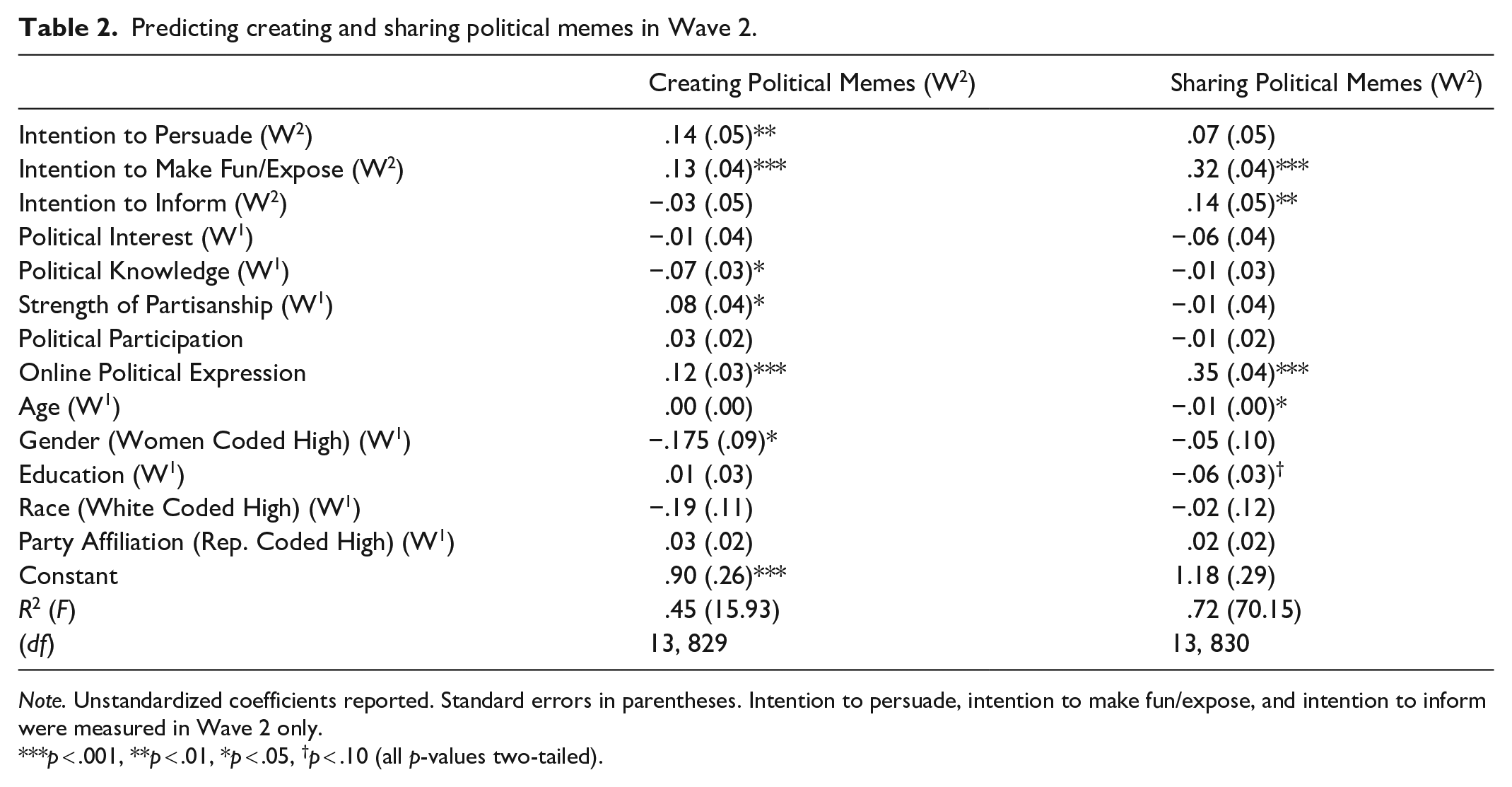
Note. Unstandardized coefficients reported. Standard errors in parentheses. Intention to persuade, intention to make fun/expose, and intention to inform were measured in Wave 2 only.
p < .001, **p < .01, *p < .05, †p < .10 (all p-values two-tailed).
Exploring Outcomes Associated With Political Meme Exposure
Before exploring its outcomes, we first examined the predictors of meme exposure (see Table SI 3). The results indicate that people exposed to political memes on Facebook are typically younger, White, and more politically interested. Meme exposure did not vary as a function of gender, education, or party affiliation. We next explored potential outcomes of exposure to political memes by running a series of lagged OLS regression models. Each model employs a Wave 2 outcome variable regressed on W1 independent variables, including exposure to political memes and several control variables (see Table 3). 1 Consistent with our prediction (H6), political meme exposure was positively associated with online political expression, even when controlling for exposure to political information and news on Facebook, b = .25 (.03), β = .29, p < .001. Contrary to our prediction (H7), political meme exposure was not associated with partisanship strength, b = .00 (.02), β = −.01, p = .900. As predicted (H8), political meme exposure was positively associated with anger toward the opposing presidential candidate, b = .10 (.04), β = .11, p = .018. Political meme exposure was not associated with political knowledge (RQ4), b = −.01 (.03), β = −.01, p = .875, or political cynicism (RQ6), b = .03 (.02), β = .07, p = .117. However, political meme exposure was positively associated with political participation, even when controlling for exposure to political information and news on Facebook (RQ5), b = .10 (.05), β = .09, p = .036. 2 A complete summary of the results for each hypothesis and research question can be found in Table SI 6.
Predicting outcomes of meme exposure.

Note. Unstandardized coefficients reported. Standard errors in parentheses. All independent variables measured in Wave 1.
p < .001, **p < .01, *p < .05, †p < .10 (all p-values two-tailed).
Discussion
Due to their wide circulation (Brown, 2022), resonance with audiences (Griffin, 2020), and frequent dissemination of political ideas (e.g., Ross & Rivers, 2017; Williams, 2020), it is important for researchers to understand the role of political memes in online information environments. This exploratory study uses a quantitative approach to advance knowledge about the circulators of political memes (i.e., the characteristics and sharing motivations of those who create and share memes) and to reveal several correlates of exposure to political memes.
The results suggest that sharing political memes is an act of political expression that occurs in tandem with other forms of expression, as those who circulated political memes on Facebook also expressed their political opinions through posts and comments. This finding supports evidence from qualitative studies indicating that political meme users see sharing memes as supplemental to other forms of online expression (Leiser, 2022). Intriguingly, however, we found that circulating memes did not relate to political interest or strength of partisanship—a finding that departs from other scholarship (Johann, 2022)—suggesting that posting political memes is a method of political expression utilized by a wide variety of individuals, including political moderates and the politically uninterested. 3 This is especially interesting given that much of the literature on political memes focuses on their use in partisan groups (e.g., Al-Rawi, 2021; McKelvey et al., 2021) and argues that meme authors are particularly polarized users (Paz et al., 2021). Although political memes can be used to establish like-minded communities online (McKelvey et al., 2021), our results suggest that memes are also created and shared by nonpartisan users as an everyday form of political expression. Meme circulators were, likewise, not more likely to report high levels of participation in political activities or political knowledge; in fact, creators of memes were slightly less likely than other users to score high on political knowledge. This is perhaps unsurprising, given that analyses of political memes have noted their lack of policy information and proclivity toward spreading misinformation (Dupuis & Williams, 2019; McLoughlin & Southern, 2020). To summarize, our results suggest that people who circulate memes on Facebook are not necessarily more partisan or more politically interested, knowledgeable, or participative (offline) than other users, but they do tend to be politically active online, where they express their politics in multiple ways (posting and commenting, in addition to circulating memes).
This study also revealed potential motivations behind creating and sharing political memes. Both creating and sharing political memes on Facebook were associated with the intention to make fun of candidates online. The findings related to the motivations to persuade and inform were mixed; political meme creators were more likely to express wanting to persuade others (but not inform them), while political meme sharers were more likely to express wanting to inform others (but not persuade them). These results validate work indicating that motivations for creating memes are not predominately informative (Leiser, 2022) but also indicate that, once a meme has been created, individuals may share that meme in part because they want to spread information or awareness about a political topic. Unsurprisingly—given their humorous nature—circulating memes is strongly related to the intention to poke fun at or expose politicians; this reflects the extant literature surrounding memes, humor, and politics (e.g., Denisova, 2016; Mortensen & Neumayer, 2021; Ross & Rivers, 2017). Importantly, however, our results indicate that those who create political memes may have another goal: persuasion. While existing work highlights isolated incidents of memes being used to promote specific political movements (Milner, 2013; Williams, 2020) or protest politicians and governments (Frazer & Carlson, 2017), to our knowledge no academic work to date has investigated the persuasion motivations of meme circulators, broadly. Our results, however, suggest that people who create political memes are also more likely to express wanting to persuade others’ views on political issues and candidates. While it should be noted that sharing political memes was not associated with the persuasion motivation, this suggests that some users (such as meme creators) may view posting political memes as a persuasive act (Dishman, 2020).
In addition to investigating meme circulators, this study sheds light on the audiences of political memes. First, our results indicate that exposure to political memes on Facebook has no association with political knowledge but relates positively to online political expression and political participation. That exposure to political memes is not associated with political knowledge aligns with our finding that those who create memes have low political knowledge and appear unmotivated by a desire to inform their audiences. Due to the survey design, the relationships between exposure to political memes, online political expression, and political participation should not be taken as causal. That said, our results support previous work indicating that exposure to political memes is related to political activity (Kasirye, 2019). Political memes may—despite their temporality (Menczer, 2012)—promote political discussion (Moreno-Almeida, 2021) or otherwise prompt political activity, perhaps through their emotional impact on users (Griffin, 2020). Indeed, our study found that political meme exposure was related to politically oriented anger, supporting claims that political memes resonate emotionally with audiences. Conversely, it is possible that politically active individuals are more likely to selectively expose themselves to memetic political content online. Future experimental work will be necessary to determine the causal order for this and other findings reported here.
Second, our results provide interesting insights into the associations between political meme exposure, polarization, and cynicism. Specifically, we find that political meme exposure is positively related to anger toward opposed politicians but is not related to strength of partisanship or political cynicism. Scholars and meme users alike have expressed concern that political memes may increase ideological polarization (Penney, 2020), a worry supported by evidence that meme content is typically politically one-sided (Paz et al., 2021). Given the null relationship between political meme exposure and strength of partisanship, our results indicate that political meme audiences may be less ideologically polarized than previously thought. However, our findings reveal that these users do have higher levels of political anger toward opposed politicians. Given the established link between political anger and affective polarization (Lu & Lee, 2018), it remains plausible that those exposed to political memes may be more affectively polarized. Notably, recent research has not identified immediate evidence supporting the notion that exposure to partisan memes fosters affective polarization in the short term (Kim et al., 2023). Nevertheless, our results indicate the need for further investigation into this relationship. Because memes typically express negativity toward politicians (Moody-Ramirez & Church, 2019) and have been thought to sour audiences’ views of these figures (Penney, 2020), it is possible that meme audiences feel more negatively toward elite figures but that this negativity does not extend to out-partisans generally.
We also did not find a relationship between meme exposure and political cynicism. On one hand, this may suggest that the sometimes-populist rhetoric of memes (Kristensen & Mortensen, 2021) does not translate to anti-government beliefs among most political meme consumers. On the other hand, our measure of political cynicism—which captures cynicism toward the government as a whole—likely did not pick up on more specific forms of political cynicism, including cynicism toward counter-attitudinal candidates and parties, and other scholars may wish to investigate such outcomes.
While this work does much to illuminate the circulators and audiences of political memes, its findings should be considered in light of several limitations. First, due to the nature of the survey data and analyses, we are not able to make causal claims about the relationships assessed here. We were also limited in some analyses because we did not measure every variable in both waves of our survey. Second, it is important to note that key variables about media use and exposure (e.g., creating, sharing, and seeing memes on Facebook) were measured through self-report, which can introduce noise, and future work would benefit from better tracking users’ exposure to content like political memes. This study is also limited by its assessment of political meme circulation and exposure on Facebook, specifically. Notably, Facebook users in the United States are increasingly older, as younger audiences have shifted to other platforms. It may be that younger users engage with memes differently on other platforms or circulate different types of political memes altogether, both of which are open questions that future studies should address. Furthermore, unlike on some other platforms, users on Facebook are largely connected with their real-world contacts, including friends and family. Thus, the motivations associated with creating and sharing political memes described in this article most specifically shed light on why people share these memes with those they know, as opposed to anonymous others. Therefore, it remains to be seen whether the results of this study translate to other social media users and platforms, where political memes may function differently than described here. It is also important to note that participants in our study were not provided with a definition of a political meme but were left to their own understanding of what constitutes this content. While this allowed us to cast a wide net regarding what variables are associated with “political memes” as the U.S. public understands them, it is possible that respondents’ definitions of a meme varied. Future research may wish to investigate how specific types of memetic content, such as images overlaid with text versus text-only versus video memes may operate differently. Finally, it is crucial to note that this study only investigated data from one country, the United States, which differs significantly from other contexts in terms of its political system, high levels of polarization, and media use. Thus, our findings may not extend to other contexts, and further research should be conducted to ascertain whether the findings presented here are more broadly applicable.
In an increasingly fragmented media environment, it is crucial to understand how newer types of political content, bred by and for the digital age, factor into audiences’ political information diets. Political memes constitute one of these new types of political content. Our work suggests that these memes are employed by users with varying levels of political interest to—in concert with other online political activities—make fun of politicians and, in some cases, inform and persuade others. Furthermore, this study broaches the possibility that exposure to political memes relates to increased political expression, activity, and anger toward political opponents, suggesting that future work should further investigate the effects of political memes.
Supplemental Material
sj-docx-1-sms-10.1177_20563051231205588 – Supplemental material for Memeing Politics: Understanding Political Meme Creators, Audiences, and Consequences on Social Media
Supplemental material, sj-docx-1-sms-10.1177_20563051231205588 for Memeing Politics: Understanding Political Meme Creators, Audiences, and Consequences on Social Media by Audrey Halversen and Brian E. Weeks in Social Media + Society
Footnotes
Declaration of Conflicting Interests
The author(s) declared no potential conflicts of interest with respect to the research, authorship, and/or publication of this article.
Funding
The author(s) disclosed receipt of the following financial support for the research, authorship, and/or publication of this article: This work was supported by the Howard R. Marsh Endowment in the Department of Communication and Media at the University of Michigan.

Supplemental Material
Supplemental material for this article is available online.
Notes
Author Biographies
References
Supplementary Material
Please find the following supplemental material available below.
For Open Access articles published under a Creative Commons License, all supplemental material carries the same license as the article it is associated with.
For non-Open Access articles published, all supplemental material carries a non-exclusive license, and permission requests for re-use of supplemental material or any part of supplemental material shall be sent directly to the copyright owner as specified in the copyright notice associated with the article.
