




Abstract
Citizens have increasingly diversified their use of social media platforms, raising questions about which platforms are adopted and for what purposes. We use survey data from four countries (Canada, France, the United States, and the United Kingdom) gathered in 2019 and 2021 (n = 12,302) about Facebook, YouTube, Instagram, Twitter, Reddit, Snapchat, and WhatsApp. Political ideology predicts the adoption and political uses of all platforms, but Reddit, Snapchat, and WhatsApp are distinctive. Right-wing users are more likely to report exposure to and posting of political content on these platforms; this pattern is consistent across all four countries. We relate these findings to the distinct network features compared to other platforms. Our large sample size allows us to document a funnel process where large numbers adopt a platform, fewer see political content, and even fewer post. In this funnel process, ideological differences become larger. The findings have implications for the formation of homogeneous communities.
Facebook has been the most popular social networking site since 2012, while other platforms, such as Instagram, have increased their adoption rate (Auxier and Anderson, 2021). Based on a survey conducted in 50 countries, Kemp (2023) reports that people use, on average, seven different social media platforms, making it important to study a variety of platforms rather than focus on Facebook. As the digital media landscape continues to diversify, social media platforms offer different models of interaction and content that vary along their digital architectures (Bossetta, 2018). Although citizens ultimately decide which platforms to use and how, the features offered by a platform’s architecture can attract certain types of users and shape how a platform is subsequently used for political purposes.
We use a comparative approach to study the adoption and political uses of seven platforms (Facebook, Instagram, Twitter, YouTube, Reddit, Snapchat, and WhatsApp), capitalizing on a large sample size that enables a platform-specific analysis. Theoretically, we compare these platforms based on their networking features. Our conceptual framework highlights the importance of both “structural” (user connectivity, anonymity, and privacy settings) and “social” features (perceived audiences, temporary vs strong ties, and social norms of interaction). We argue that networking features relate to patterns of platform adoption, exposure to political content, and willingness to post political information on these platforms. We cannot directly observe how networking features shape user experiences on a platform. However, by comparing seven different platforms and their political outcomes (exposure and posting), we can gather insights about how differing networking features might explain the adoption and political uses of these platforms.
Furthermore, since political ideology is integral to current academic debates surrounding echo chambers and political polarization (Bail, 2022; Kubin and von Sikorski, 2021), we examine the role of political ideology in the political uses of the seven platforms under examination. We consider two questions. First, what is the role of political ideology in the adoption of social media platforms and their use for political information and content sharing? Second, how do these relationships differ by platform?
This study examines citizens’ adoption and political utilization of seven platforms across four countries (Canada, France, the United States, and the United Kingdom) and across two time periods (2019 and 2021). We use a cross-national survey (n = 12,302) to offer robust model-testing across similar country contexts (Seawright and Gerring, 2008). Our cross-platform and cross-national analyses significantly advance scholarship by moving beyond a particular country context or the study of a single platform. We find that the ideological differences in exposure to and posting of political content on Reddit, WhatsApp, and Snapchat are consistent in all four countries. We explain this consistent finding in terms of platform features, which may be more important in predicting these online political activities than cultural or institutional differences.
Right-wing users are more likely to post on all social media platforms, which we explain in terms of discontent with mainstream media and a preference for platforms enabling closed, private discussions, such as WhatsApp and Snapchat. Furthermore, we find that right-wing users are more likely to post on Reddit than left-wing or moderate users, which we explain in terms of a greater comfort posting in anonymous spaces with temporary connections. These findings have implications for discourse around echo chambers in terms of creating settings for like-minded discussion on specific platforms. Also, if different groups use different platforms, the public sphere may be divided, limiting opportunities to discuss policies and identify a compromise solution to political issues.
Literature review
Key definitions
We use the broad definition of social media offered by McCay-Peet and Quan-Haase (2017: 46) as Internet-based “services that allow individuals, communities, and organizations to collaborate, connect, interact, and build a community by enabling them to create, co-create, modify, share, and engage with user-generated content.” We are particularly interested in social media as services enabling the reception, creation, and sharing of political content (Ruess et al., 2023). Accordingly, for this study, we define political uses of social media as consuming and/or posting of political content.
Newman et al. (2021) examine news exposure on numerous platforms in various countries (see Appendix Table 9), finding that news or political information is a small component of people’s online content. Nonetheless, this content sharing has significant impacts on political participation (Boulianne, 2019), as well as on trust, knowledge, populism, polarization, and echo chambers in news exposure (Lorenz-Spreen et al., 2022). While the Digital News Reports focus on news and current events, we use a broader definition of political content. When discussing exposure to and posting of political content, we include current events in the world, news about elections, information about political figures, information about government performance, debates about public policy, and other political issues.
We are interested in the role of ideology in the adoption and political uses of social media platforms. Ideologies “crystallize and communicate the widely (but not unanimously) shared beliefs, opinions, and values of an identifiable group,” “describe or interpret the world as it is,” and “envision the world as it should be” (Jost et al., 2009: 309). The right-left distinction is the most commonly applied contrast in analyzing ideology (Jost et al., 2009). Some studies employ party preference or partisanship as an indirect measure of ideology. However, political parties can change their ideologies, and measures of partisanship pose challenges for cross-national comparative research.
Political ideology
Political ideology may affect if and how citizens use social media for politics. Political ideology affects users’ level of exposure to news, with right-leaning individuals more prone to avoid traditional news based on a 35-country study (Toff and Kalogeropoulos, 2020) and more likely to follow politicians on Twitter who share their ideological position (Wojcieszak et al., 2022). In the United States, Pew Research demonstrates that Democrats are more likely than Republicans to use various social media platforms (Vogels et al., 2021), but more recently, Republicans are more likely to post on Twitter than Democrats (Chapekis and Smith, 2023). Political ideology (Kaiser et al., 2022: Germany) and ideological extremity (Skoric et al., 2022: United Kingdom, United States, and France) also affect the maintenance (or severing) of social ties on social media. Online interactions on Twitter with cross-partisans can further fuel partisanship (Bail et al., 2018). Finally, politically polarized users tend to share more negatively connoted content online on Twitter (Weismueller et al., 2022).
Merely focusing on polarized or politically extreme citizens may obscure some distinctions particular to parts of the political spectrum, as noted based on a US study (Grossmann and Hopkins, 2015). Right-wing citizens may be less likely to consume mainstream news media because they perceive these media as biased as noted in US-based research (Brenan, 2021; Lee, 2005), especially those on the far right (Kakavand, 2023). Due to their perceived media hostility, they may seek alternative news sources, including those shared and discussed on social media platforms. Of course, using social media for politics may further add to hostile media perceptions, as observed in the United States (Weeks et al., 2019). Hostile media perceptions have been found to fuel political expression on social media as a form of corrective action (Barnidge and Rojas, 2014) as noted in Colombia.
Social media may offer a space to discuss alternative viewpoints, creating counter-publics. However, which spaces are used by whom may differ. For example, using digital trace data about people’s following patterns to determine their ideological preferences, Freelon (2019) claims the “center left” is the largest user segment on Twitter. Munger and Phillips (2022) argue that posting and viewing of content on YouTube are biased toward the right; likewise, Knüpfer et al. (2023) analyzed YouTube content and found an increase in topics associated with the alt-right. At the same time, several alternative social media platforms have sprung up to cater to right-wing users, specifically Gab, Parler, and Truth Social. This pattern is explained in terms of those on the right assuming politically hostile content moderation by major social media platforms based on studies conducted in the United States (Barrett and Sims, 2021; Vogels et al., 2020). We examine these patterns (and related theories) beyond the US context. We propose the first research question:
Research question 1 (RQ1). What is the role of political ideology in (a) the adoption of social media platforms and (b) exposure to and (c) posting of political content?
Platform differences
We compare seven social media platforms based on their networking features. Conceptually, we argue that platforms can be distinguished by both their “structural” and “social” networking features.” “Structural” networking features refer to aspects of the platform architecture that directly enable, constrain, or shape user interactions. These features govern users’ ability to connect (user connectivity), opt out of being located on the platform (privacy), and reveal or cloak their offline identity (anonymity). In contrast, the “social” element of networking emerges from users’ perceptions about the interests of the platform’s audience, the type of ties users can establish (strong and enduring vs weak and short-term), and social norms around interaction. While the social element of a platform’s networking features can vary at an individual or cross-cultural level, a platform’s structural networking features are more stable across contexts. For a more comprehensive assessment of platform affordances, see Kakavanda’s (2023) systematic review.
Structural networking features
We distinguish three distinct yet interrelated categories of structural network features: user connectivity, privacy, and anonymity (Table 1). User connectivity refers to how connections between accounts are initiated and established (Bossetta, 2018). Here, we consider whether the platform supports an open (follow) versus closed (friend) connectivity structure. An open connectivity structure could facilitate political uses by making user-generated content more visible and accessible. At the same time, some users may not wish to share their political thoughts publicly and thus be more politically engaged on platforms with a closed connectivity structure (e.g. if they fear social repercussions). Some platforms, such as Reddit and YouTube, do not prioritize horizontal network formation, which is secondary to a vertical model of content subscription to creators (YouTube) or interest-based topics (Reddit). Three platforms (Instagram, Twitter, and Snapchat) allow users to toggle how connectivity occurs, directly affecting privacy. In a systematic review of 56 studies on social media affordances and the far right, Kakavand (2023) points to the lack of research on identifiability (and related concepts of anonymity and privacy).
Platform comparison of structural network features.
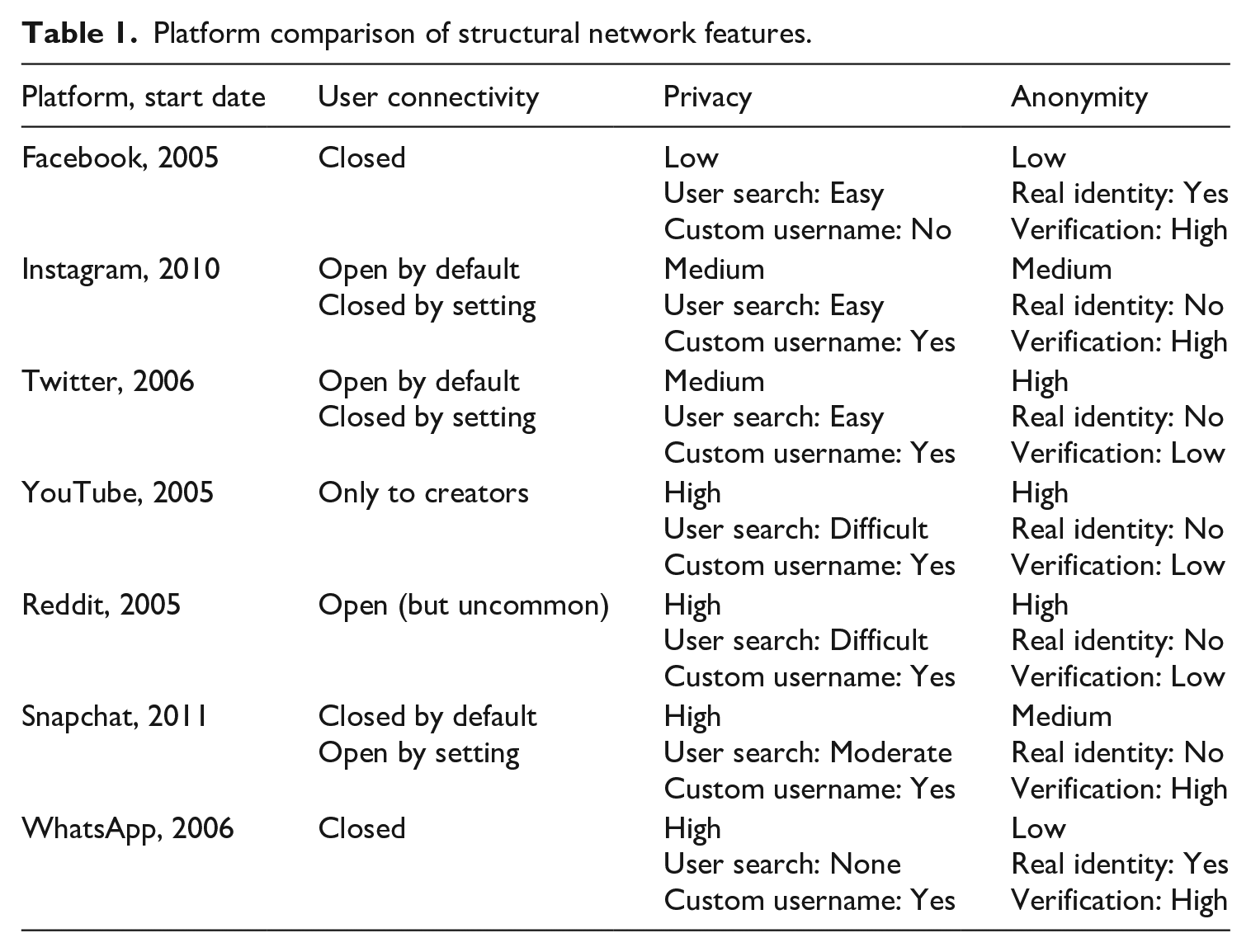
Default privacy settings are also important, as some platforms (Twitter, Instagram, and Snapchat) allow users to adjust these settings to increase or decrease privacy (Table 1). The literature on privacy and political uses of social media suggests that privacy concerns discourage political expression—except for highly politically interested or engaged individuals (Hoffmann and Lutz, 2023). Social norms on a platform shape whether a user decides to change the default privacy settings. For example, on Twitter, it is possible to increase privacy with a closed account, but this is not the norm. On social media, especially, users tend to focus on social or so-called horizontal privacy, that is, the protection of personal data vis-à-vis other users (Quinn et al., 2019). Mitchelstein et al. (2021) compared Twitter, Facebook, WhatsApp, and Instagram, pointing out that there could be differences in political expression due to privacy and the degree to which the content is public versus private. However, their study is limited in that they did not measure political expression on these specific platforms.
Platforms differ in the extent to which they allow users to be anonymous, incentivize users to disclose their offline identity, or leave the choice up to the user. The privacy settings of some platforms, that is, Instagram and Twitter, allow users not to disclose their identity. Anonymity relates to political expression, with some arguing that it might facilitate uncivil political discourse (cf., Jaidka et al., 2022). Reddit is a distinctive platform compared to Facebook and Twitter (Table 1), as users can maintain some degree of anonymity because the platform does not require identity verification, which may increase users’ willingness to engage in (uncivil) political discussions (Proferes et al., 2021).
Social networking features
While structural features are important, users’ agency and perceptions are also critical to adoption and political uses of platforms. We focus on three “social” elements: perceived audience, social ties, and social norms.
Users can choose to adopt and use platforms in different ways. Politics is only one content genre available to social media users (Newman et al., 2021; Wojcieszak et al., 2023), who may utilize platforms primarily for non-political purposes such as entertainment, networking, or to promote one’s identity (Alhabash and Ma, 2017; Boczkowski et al., 2018; Kircaburun et al., 2020). Kemp (2023) reports that Facebook users’ most popular motive is connecting with family and friends; for Twitter users, current events and news; Reddit users, fun or entertainment; and Instagram and Snapchat users, posting of photos and videos. On Twitter, there may be a perceived audience for political content.
Users’ motivation to use specific platforms depends on their prior interests and perceptions about the types of networks on different platforms. People adopt platforms based on where their networks or friends are (McCay-Peet and Quan-Haase, 2017). In this case of “network effects,” we might see ideology driving the adoption of particular platforms to the extent that people want to form spaces with like-minded others, as documented in cross-national studies (Gil de Zúñiga et al., 2022; Kalogeropoulos, 2021). Users may seek out spaces where their friends are discussing political topics that interest them; in other words, there are norms supporting political discussion. Furthermore, users may feel more comfortable expressing their own views within these networks if they believe the space is composed of people supporting their viewpoints (Valeriani and Vaccari, 2018).
The nature of social ties (strong vs weak; temporary vs enduring) are also important. Having enduring ties, such as on Facebook and Instagram, may decrease the posting of political content to avoid potential political conflict, albeit this relationship likely depends on political interest (Valeriani and Vaccari, 2018). WhatsApp has a very different network structure from Reddit and YouTube. People use WhatsApp to maintain existing relationships more so than explore new ones (Kircaburun et al., 2020). The contact list is restricted to those with whom one has shared their cell phone number, indicating a close connection. This application “enables perpetual contact in relatively more intimate, closed, and controlled environments” (Valenzuela et al., 2019: 5). Gil de Zúñiga et al. (2021: 201) further argue that WhatsApp offers immediacy and privacy, which creates a “private and controlled environment for discussion, where users feel safer and less vulnerable to social sanctions.”
Similar to WhatsApp, Snapchat includes these extended privacy settings and offers the immediacy of messaging, as well as more intimate network ties (Valeriani and Vaccari, 2018). However, Snapchat is distinctive in relation to greater self-expression and more playful social interactions, supported by the ephemerality of messages and the lack of permanent content (Bayer et al., 2016). In the case of WhatsApp and Snapchat, exposure to political content may depend on whether one’s contacts are interested and post content; willingness to share political content may depend on one’s perceptions about their contacts’ political interest (audience) and posting behavior (norms). In both cases, the closed network structure may increase the sharing of political content among like-minded others because such partisan outrage sessions are not publicly accessible, and the platforms offer a safe space for these disclosures. In a study of Spanish citizens, Lobera and Portos (2022) argue that right-wing users disproportionately seize these advantages.
Both structural and social features of a network shape the adoption and political uses of platforms. We propose a second research question to explore these platform differences:
Research question 2 (RQ2). How do platforms with different network features vary the role of political ideology in (a) the adoption of social media platforms and (b) exposure to and (c) posting of political content?
Methods
This article uses survey data gathered in four countries in 2019 and 2021 (n = 12,302). The sample is based on an online panel with quotas used to ensure representation of the population in each country (sex, age, education). For age, sex, and education, the sample characteristics match each country’s census or official statistics. We report on the same version of these variables used for establishing the census-based quotas, which means dichotomizing the variables. For sex, females are coded as 1 (males as 0). For education, we coded as 1 any respondent with some post-secondary education; all others are coded as 0. Respondents had to be at least 18 years old to participate. For age, we introduced a series of age groups and then used seniors (aged 65 years or more) as the comparison group. Approximately 51% of the sample are female, and 51% have some post-secondary education. In the pooled sample, 11% were young adults, 23% seniors, and then about 16% in each of the other age groups. The sample in each country mimics the population characteristics. For a more detailed comparison of sample and population characteristics, see Table 2.
Comparison between survey statistics and official statistics.
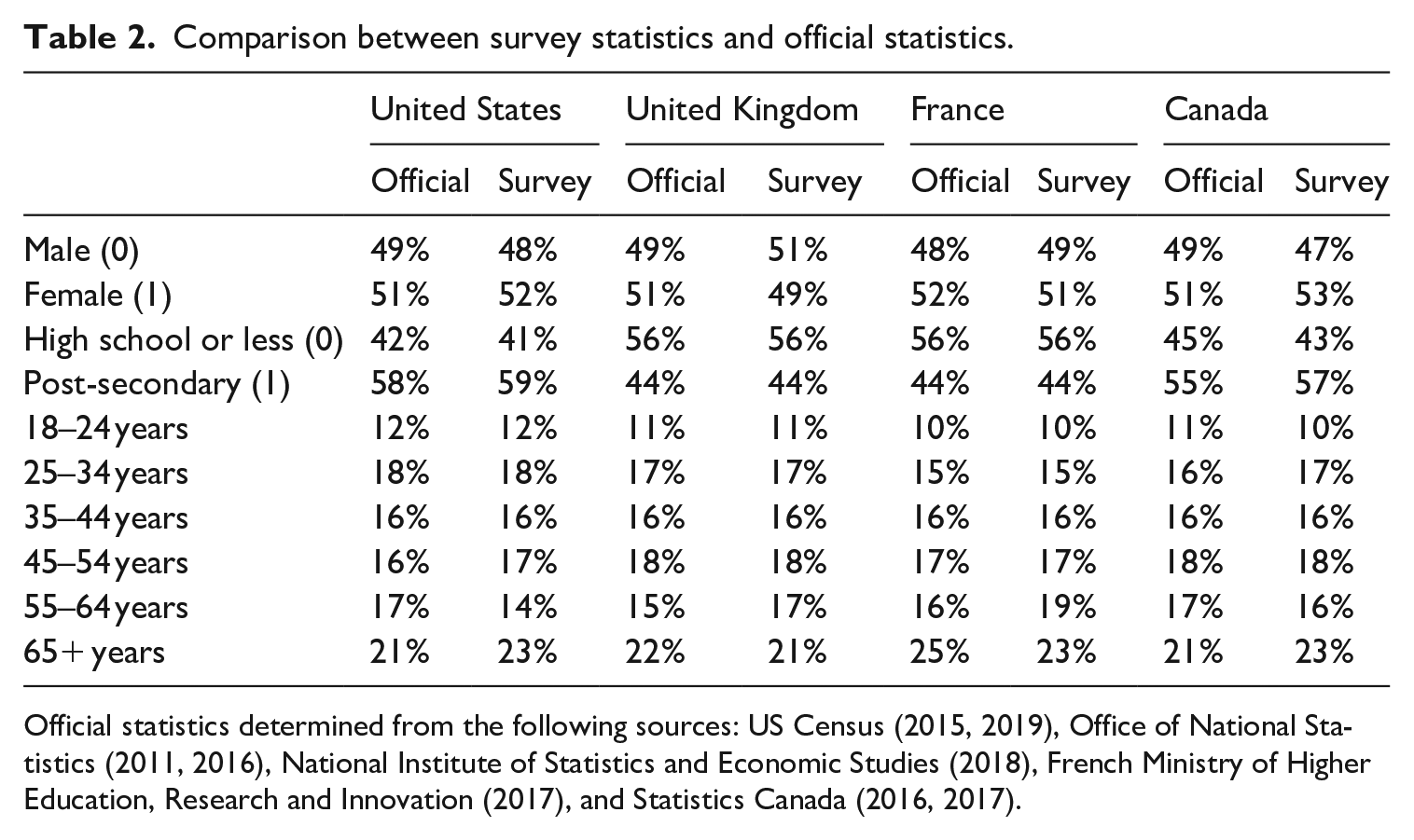
Official statistics determined from the following sources: US Census (2015, 2019), Office of National Statistics (2011, 2016), National Institute of Statistics and Economic Studies (2018), French Ministry of Higher Education, Research and Innovation (2017), and Statistics Canada (2016, 2017).
The survey was administered by Lightspeed Kantar Group to 3200 people from the United States, 3042 from the United Kingdom, 3010 from France, and 3107 from Canada. Each year in each country, there were roughly 1500 respondents; each year included a new set of respondents. The surveys were conducted in October 2019 and February 2021. The countries were chosen with Canada as a focal point given the funding source; United Kingdom and France are the settler societies for Canada, and the United States is Canada’s only neighbor. These countries are well-established, stable democracies (Freedom House, 2021 scores: United States = 83, United Kingdom = 93, France = 90, and Canada = 98), so we are model-testing using similar country contexts (Seawright and Gerring, 2008). This large sample enables a platform-specific approach while retaining a large sample for analysis. For example, our smallest subsample of platform users is for Reddit, which is a critical platform, theoretically and empirically. We have more than 2800 Reddit users, ensuring sufficient statistical power. With this smallest sample size of 2800 Reddit users, we can detect effects as small as .05 (.75 power level; Ellis, 2010: 140).
The survey funding is from the (Canadian) Social Sciences and Humanities Research Council (grant no.: 435–2019–04–94). The surveys received human subjects ethics approval before implementation (file numbers: 101662 and 101856). The data file and replication files are available at https://doi.org/10.6084/m9.figshare.25897726.
Dependent measures
The 2019 and 2021 surveys asked about different platforms, but this study focuses on the seven platforms included in both surveys. We added the year of data collection to reflect the possible differences between the 2019 and 2021 samples. The survey questions ask respondents to report on their use of platforms in the past 12 months, covering election periods in three of the four countries (Canada 2019, UK 2019, US 2020). Analyzing the 2019 data (electoral context in Canada and the United Kingdom) separately from the 2021 data did not reveal any differences based on electoral versus non-electoral contexts.
We asked about the frequency of platform use in the past 12 months, offering responses of never, rarely, sometimes (time to time), and often. For analyzing platform adoption, we dichotomized the variable into non-use (never) and use (other responses) because the distributions were highly skewed, especially for platforms with low adoption (see the Appendix for the analysis using the original version of the variable). Furthermore, the dichotomized variable about adoption helps us match our statistics to Pew estimates (Auxier and Anderson, 2021; Chapekis and Smith, 2023; Vogels et al., 2021) and the Digital News Report (Newman et al., 2021), which are both reported as use/non-use (see Appendix Table 9). For those using a platform, we asked follow-up questions about exposure to political content and posting political content.
Measures based on self-reports have problems related to recall (Guess et al., 2019) and over-reporting (Haenschen, 2020). Haenschen (2020) finds that the discrepancy between self-reports and digital trace data is larger for sharing news on Facebook than for sharing political pages on Facebook. She also finds that over-reporting is higher among the most active Facebook users. Dichotomizing our variables into “post” versus “did not post” helps to address this over-reporting issue among active users. She also encourages scholars to include political interest as a predictor to account for this issue, which we have done.
In terms of asking about exposure to political information, we used current advice about improving the accuracy of self-reports to measure exposure to political information. Comparing self-reports in surveys and digital trace data, Guess et al. (2019) found some discrepancies that can be fixed by defining “political” content. They recommend that surveys provide topics to be included. As such, we prompted respondents: “Please think about current events in the world, news about elections, information about political figures, information about government performance, debates about public policy, and other political issues.” Then, we asked respondents how often they saw this type of content and how often they posted this type of content on the platform in the past 12 months. Specifically, we asked, “During the past 12 months, how often have you seen this type of content when you are using [site name]?” After this question, we asked, “During the past 12 months, how often have you posted this political content on [site name]?” We focus on posting political content because this measure offers clarity related to our narrative on digital architecture, but there are many ways to measure political expression on social media (see the review of 66 studies by Lane et al. (2022)). To simplify the analysis, we dichotomized both exposure to and posting of political content due to an extreme skew in the distributions, especially for the rare activity of posting political content. However, the analysis using the original variables can be found in the Appendix; this analysis proves the robustness of our findings using both measurement approaches.
Key independent variable
To ease the interpretation of logistic regression coefficients, we dichotomized all variables. For ideology, we used an 11-point scale and coded the four lowest categories as “left-wing” and the four highest categories as “right-wing.” This scale is popular in the scholarship about social media and political polarization (see the systematic review by Kubin and von Sikorski, 2021). Those who provided a number in the middle of the scale or responded “don’t know” or “neither left nor right” are the reference group for analysis. Using political ideology instead of partisanship is common in international surveys such as those of Toff and Kalogeropoulos (2020) and Skoric et al. (2022), as well as surveys outside the United States (Kaiser et al., 2022). Approximately 19% of the sample is left-wing (United States: 19.06%, United Kingdom: 16.40%; France: 19.71%; and Canada: 20.08%), and approximately 26% of the sample is right-wing (United States: 33.72%, United Kingdom: 24.79%; France: 24.26%; and Canada: 18.93%). In the Appendix, we replicate the analysis and findings using the original versions of political ideology, providing a robustness check of all results.
Control variables
Aside from the sociodemographic variables mentioned earlier, we include political interest as a control variable. Respondents were asked, “How interested would you say you are in politics?” For political interest, we coded those with no or little interest as 0; those reporting to be fairly or very interested were coded as 1. There are significant cross-national differences in political interest (United States: 63.91%; United Kingdom: 57.13%; France: 41.20%; and Canada: 54.93%). Overall, 54% of the sample reported some level of interest in politics. As noted, the Appendix includes a robustness check using an analysis of the original political interest variable. Specifically, using the dichotomized political interest variable, we find that this variable is statistically significant in all 21 regression models presented in this article. Likewise, using the original version of the political interest variable, we find that political interest is statistically significant in all 21 regression models presented in this article.
Findings
We begin by presenting some descriptive findings on platform adoption and uses. We note some cross-national differences, but overall, the variations across platforms are larger than differences by country. We then discuss bivariate correlations for the role of ideology on adoption, exposure, and posting across seven platforms and four countries. Correlations are ideal for comparisons across platforms and countries. Finally, we further explore ideological differences (RQ1) across platforms (RQ2) based on multivariate logistic regression analyses. We present regression analyses for all three dependent variables: (a) adoption, (b) exposure to political content, and (c) posting of political content across seven platforms, which produces 21 regression models. Findings related to our research questions are highlighted in the figures.
Descriptive findings
Regarding platform use (Table 3), YouTube and Facebook are the most popular (82% and 77%). Instagram, Twitter, and WhatsApp have similar proportions of users (40% of the sample). For WhatsApp, there are strong cross-national differences in use, with 65% of respondents from the United Kingdom using this platform compared to 24% of respondents from the United States. Snapchat (29%) and Reddit (23%) have the smallest proportion of users. Reddit is most popular in the United States (31%) and least popular in France (13%). Our estimates for Twitter and Reddit are higher than Pew estimates for the US population (Auxier and Anderson, 2021).
Descriptive statistics of platform adoption.
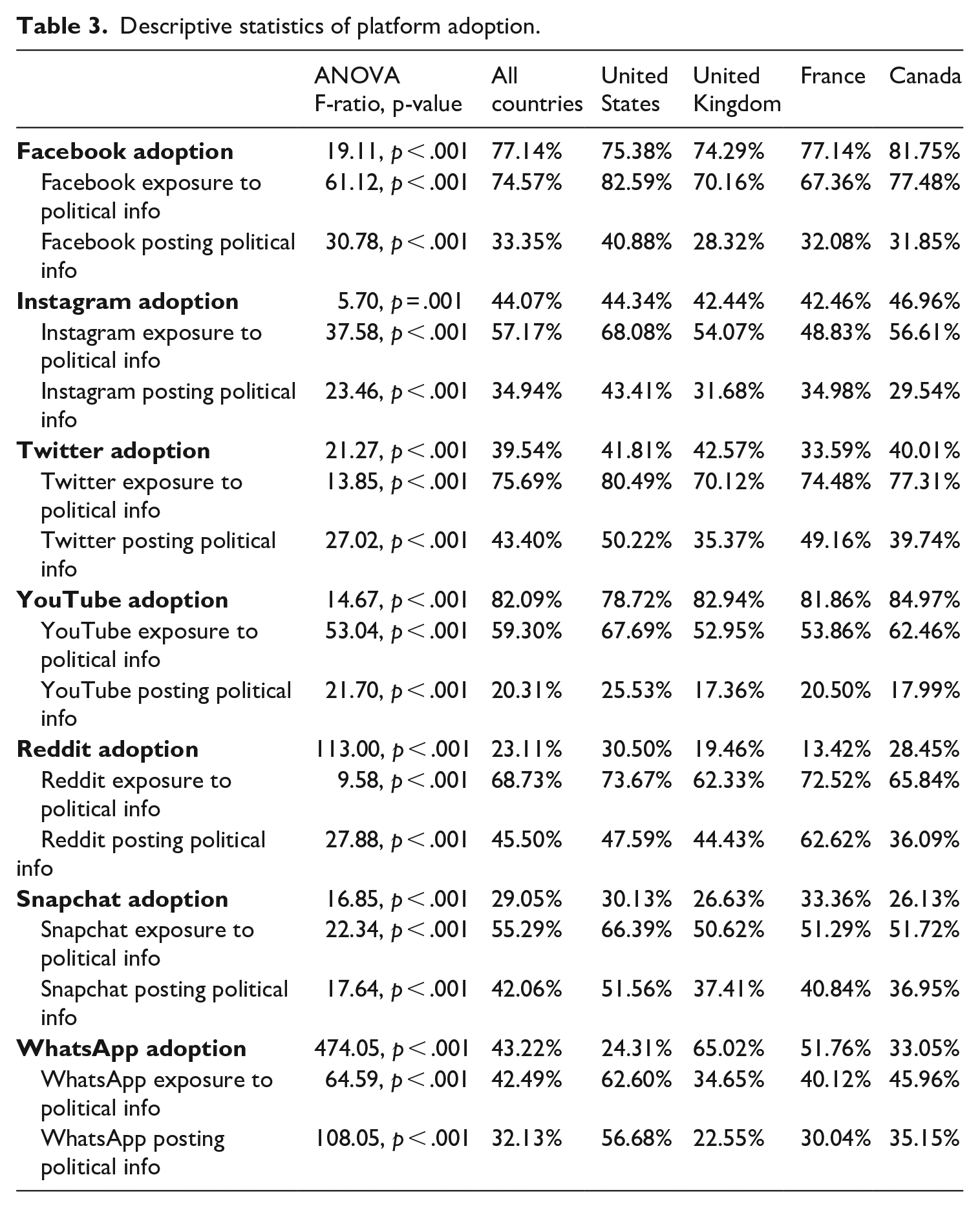
As mentioned earlier, for the subset of users of specific platforms, we asked two follow-up questions: (a) Have you seen political content on this platform? and (b) Have you posted political content to the platform? Facebook (75%), Twitter (76%), and Reddit (69%) have the highest rates of exposure to political content (Table 3). Regarding cross-national differences in exposure to political content on a given platform, these differences are largest for WhatsApp; 63% of US respondents reported seeing political content on this platform compared to 35% of respondents from the United Kingdom.
Across all platforms, the rate of posting political content ranges from 20% (YouTube) to 46% (Reddit). WhatsApp use for posting varies by country; 57% of US respondents vs 23% of UK respondents use this platform to post political content. Given the cross-national differences, we include country variables (a series of dummy variables with the United States as the reference point) in the multivariate analysis.
Correlational analysis
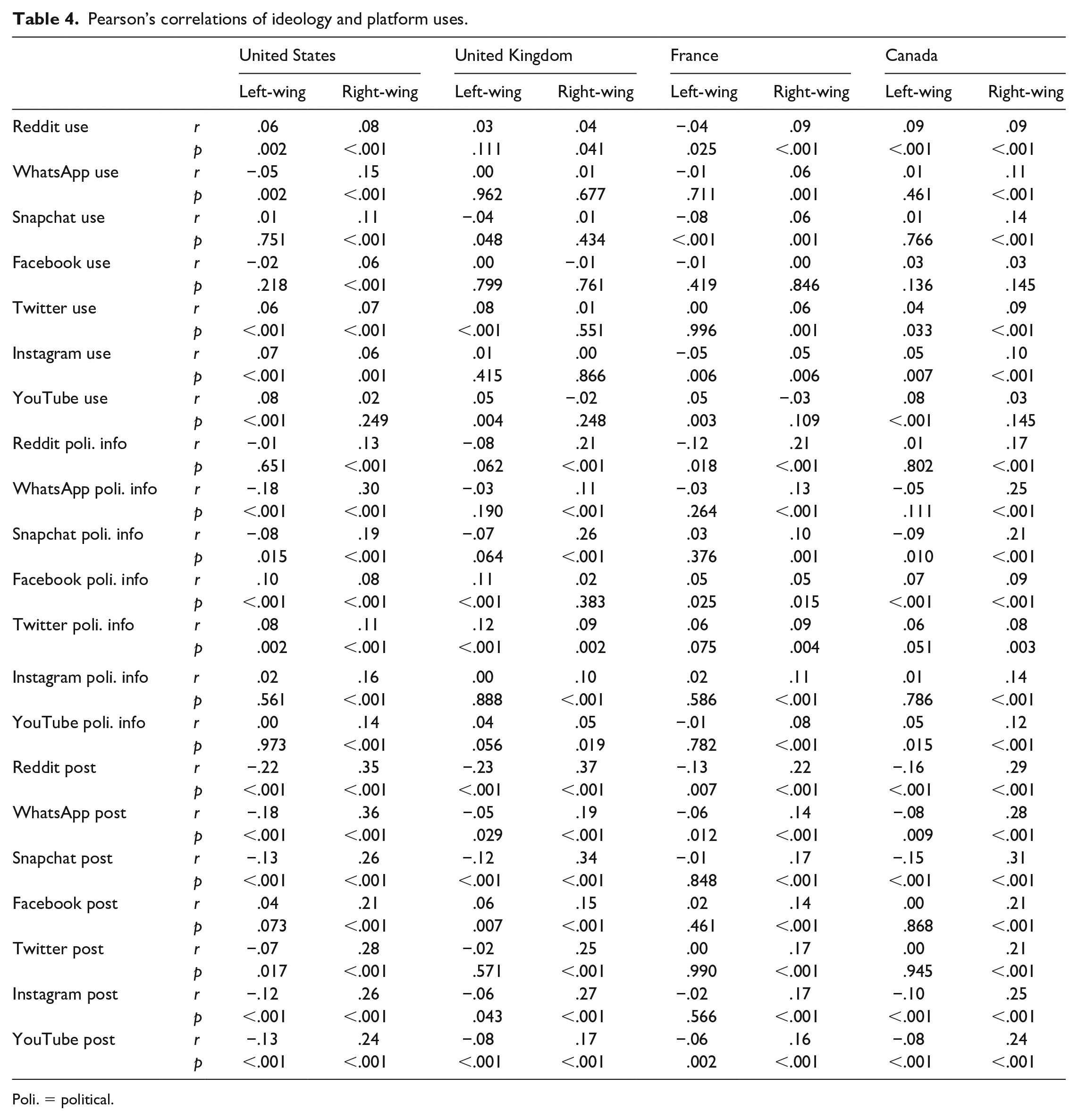
In Table 4, we present the correlation matrices for political ideology and platform uses for each country. These simple statistics illustrate a consistent pattern of ideological differences, particularly in relation to right-wing users and political uses of the platforms (exposure to and posting of political content). Focusing on the largest correlations in the table, we see that right-wing users are more likely to post content on Reddit. In the United States, this coefficient is .35; in the United Kingdom, it is .37; in France, it is .22; and in Canada, it is .29. The right-wing biases are consistently positive and significant across the four countries.
Pearson’s correlations of ideology and platform uses.
Poli. = political.
The US sample tends to yield the highest positive correlations between right-wing ideology and the key variables, but this is not always the case. For example, for right-wing ideology and exposure to political information on Reddit, the two European countries have larger correlations (.21) than the United States (.13). Snapchat shows a similar pattern (United States = .19 vs United Kingdom = .26). For right-wing ideology and posting political content on Snapchat, the United Kingdom (.34) and Canada (.31) have larger correlations than the United States (.26). In summary, the United States is not exceptional or the deviant case; in many cases, the correlations for the Canadian sample mimic those of the United States, especially in terms of right-wing ideology and posting on Facebook and YouTube.
Multivariate regression analysis (RQ1 and RQ2)
Platform adoption (n = 12,302).
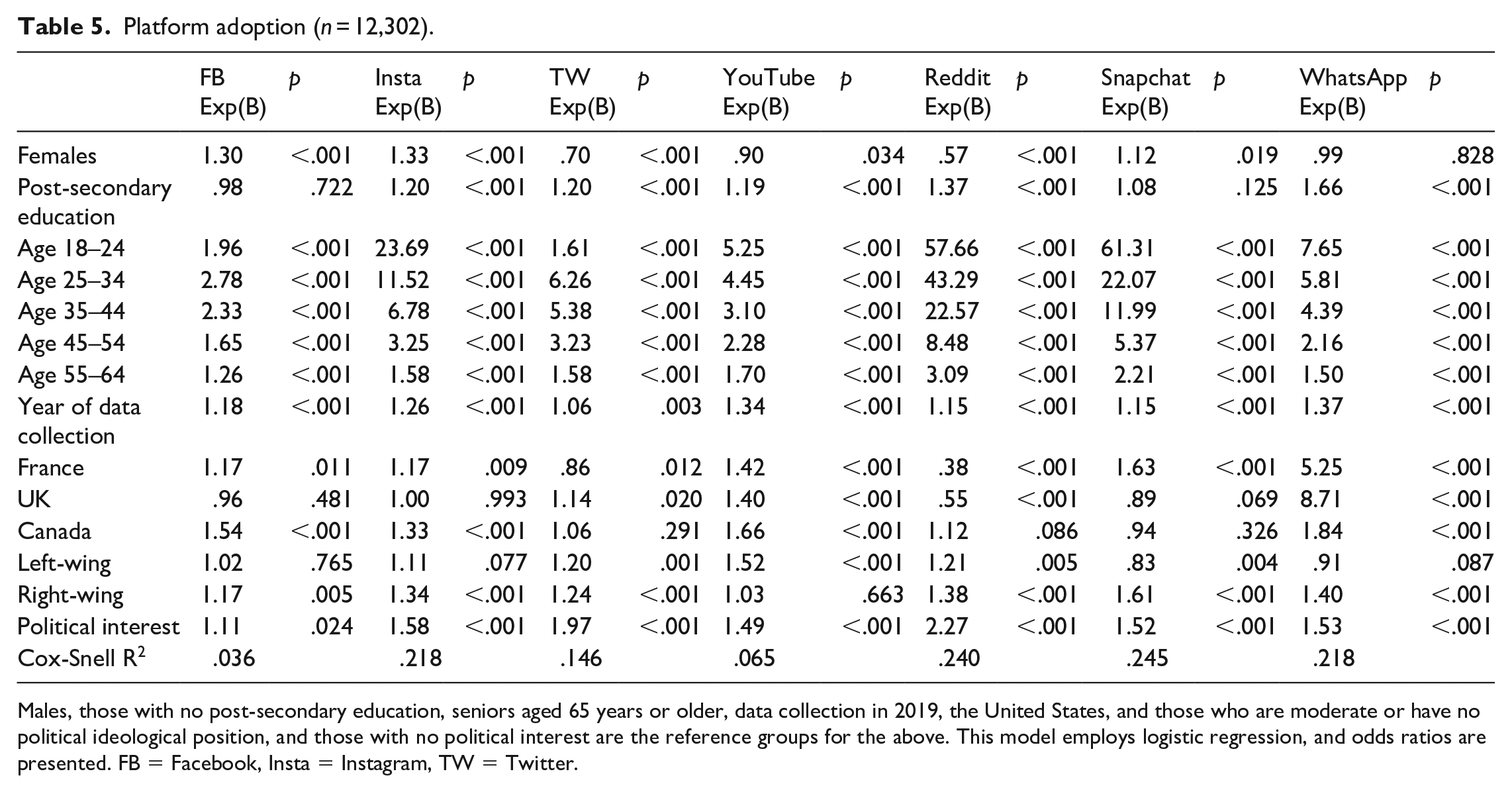
Males, those with no post-secondary education, seniors aged 65 years or older, data collection in 2019, the United States, and those who are moderate or have no political ideological position, and those with no political interest are the reference groups for the above. This model employs logistic regression, and odds ratios are presented. FB = Facebook, Insta = Instagram, TW = Twitter.
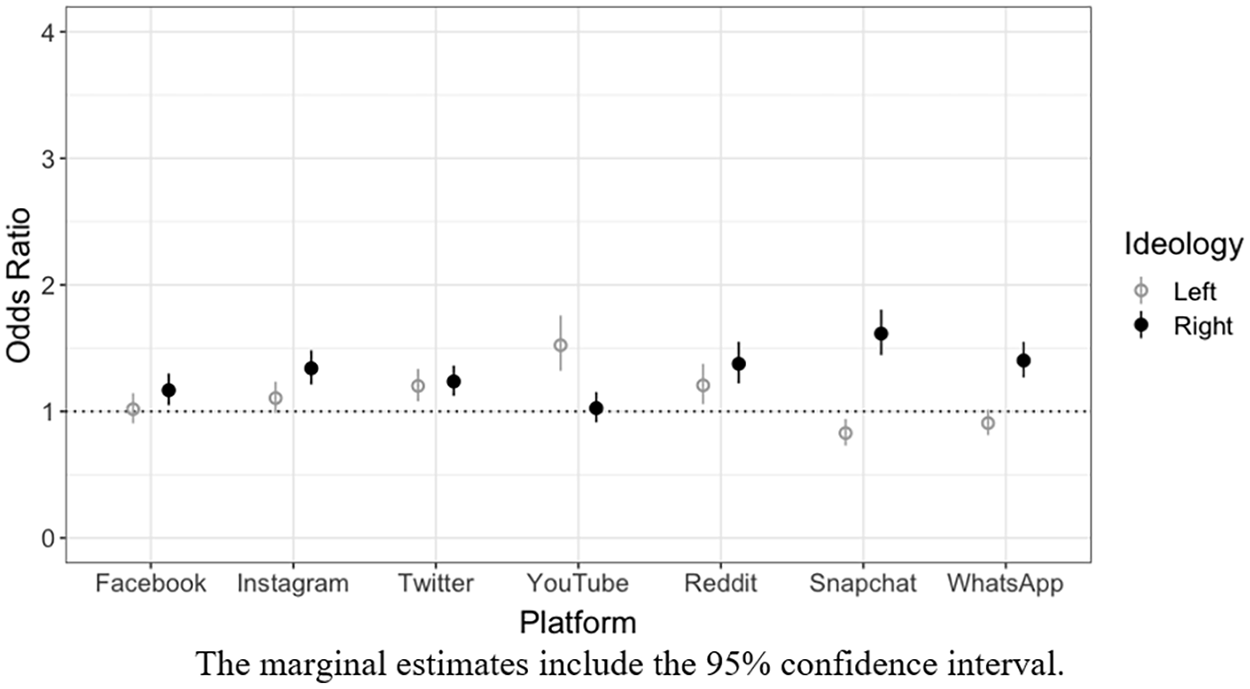
Marginals of ideology and platform adoption (logistic regression, odds ratios).
Exposure to political content on platform.
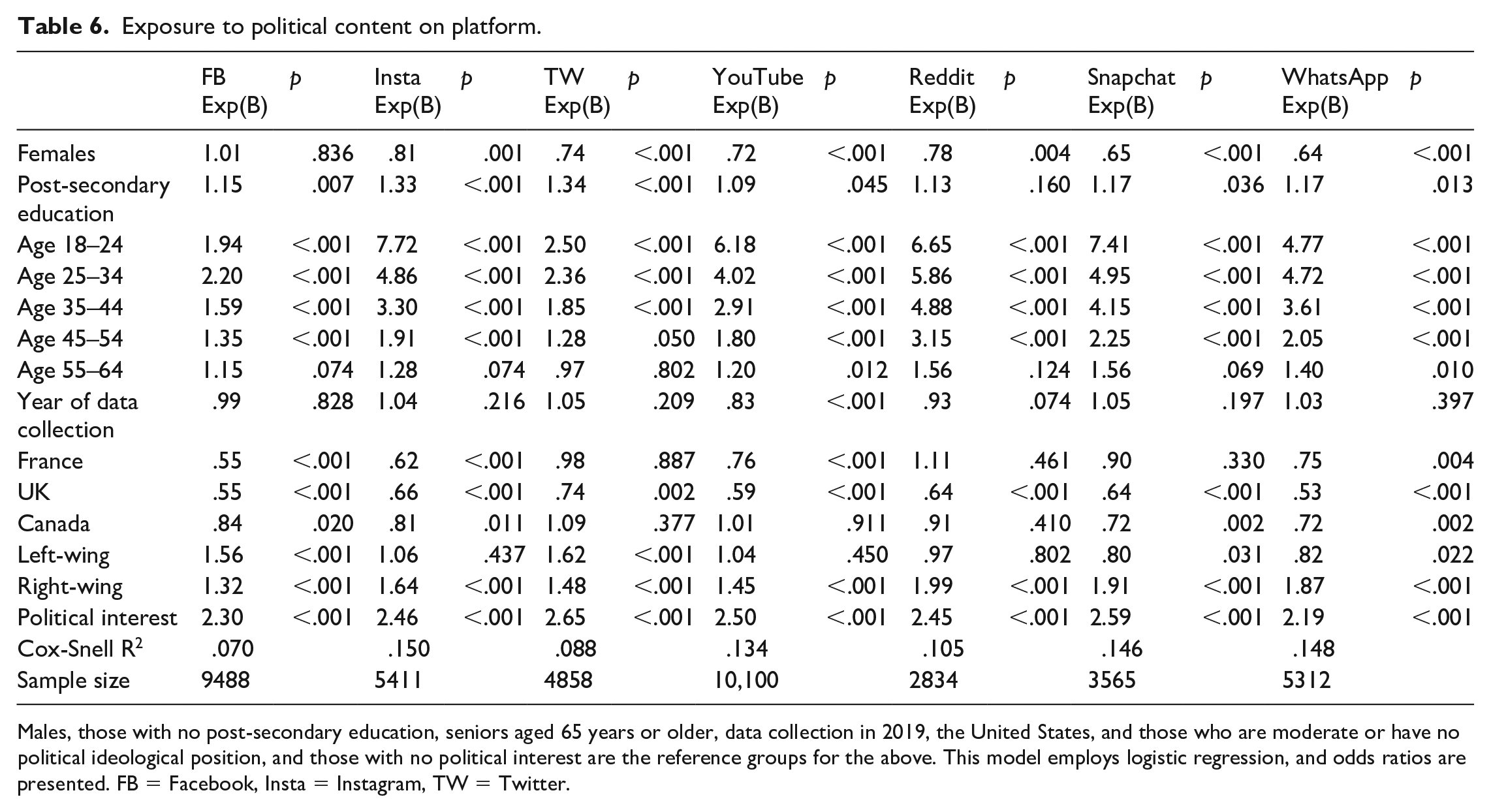
Males, those with no post-secondary education, seniors aged 65 years or older, data collection in 2019, the United States, and those who are moderate or have no political ideological position, and those with no political interest are the reference groups for the above. This model employs logistic regression, and odds ratios are presented. FB = Facebook, Insta = Instagram, TW = Twitter.
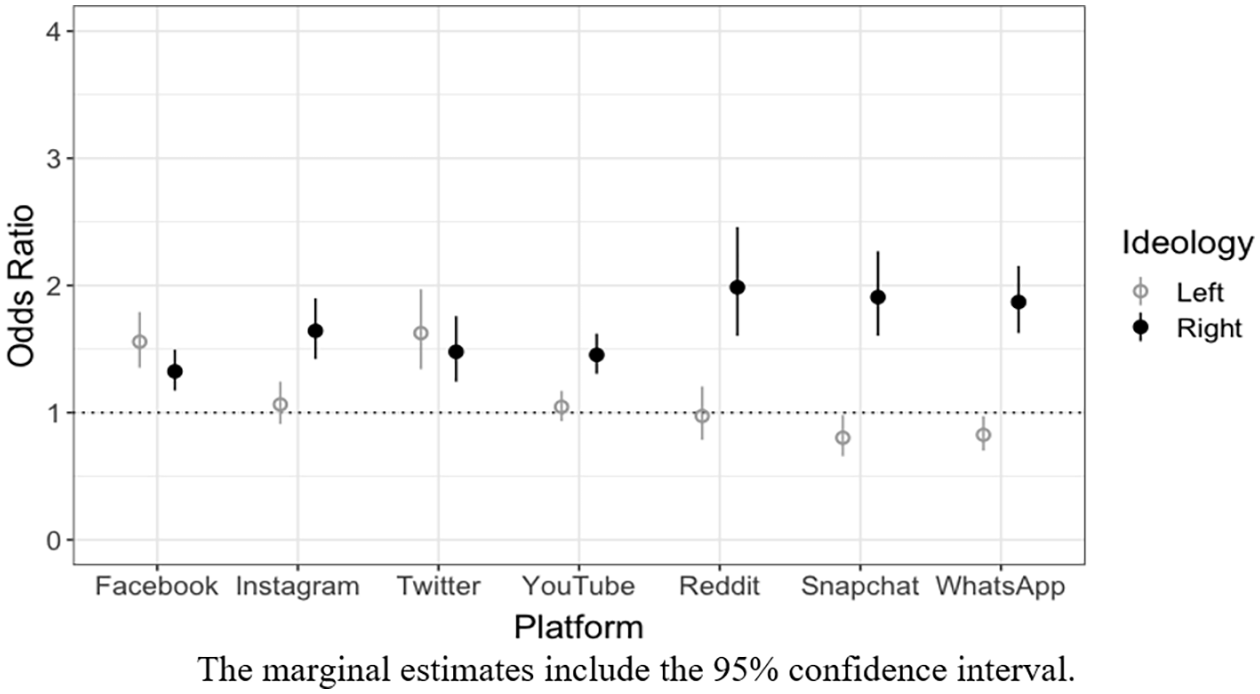
Marginals of political ideology and exposure to political content (logistic regression, odds ratios).
Compared to moderates and those with no ideological position, left-wing users are more likely to report exposure to political content on Facebook and Twitter but less likely to report exposure on Snapchat and WhatsApp. For the other platforms, there are no differences between those on the left and moderates/no affiliation regarding exposure (Table 6).
Posting political content to platforms.
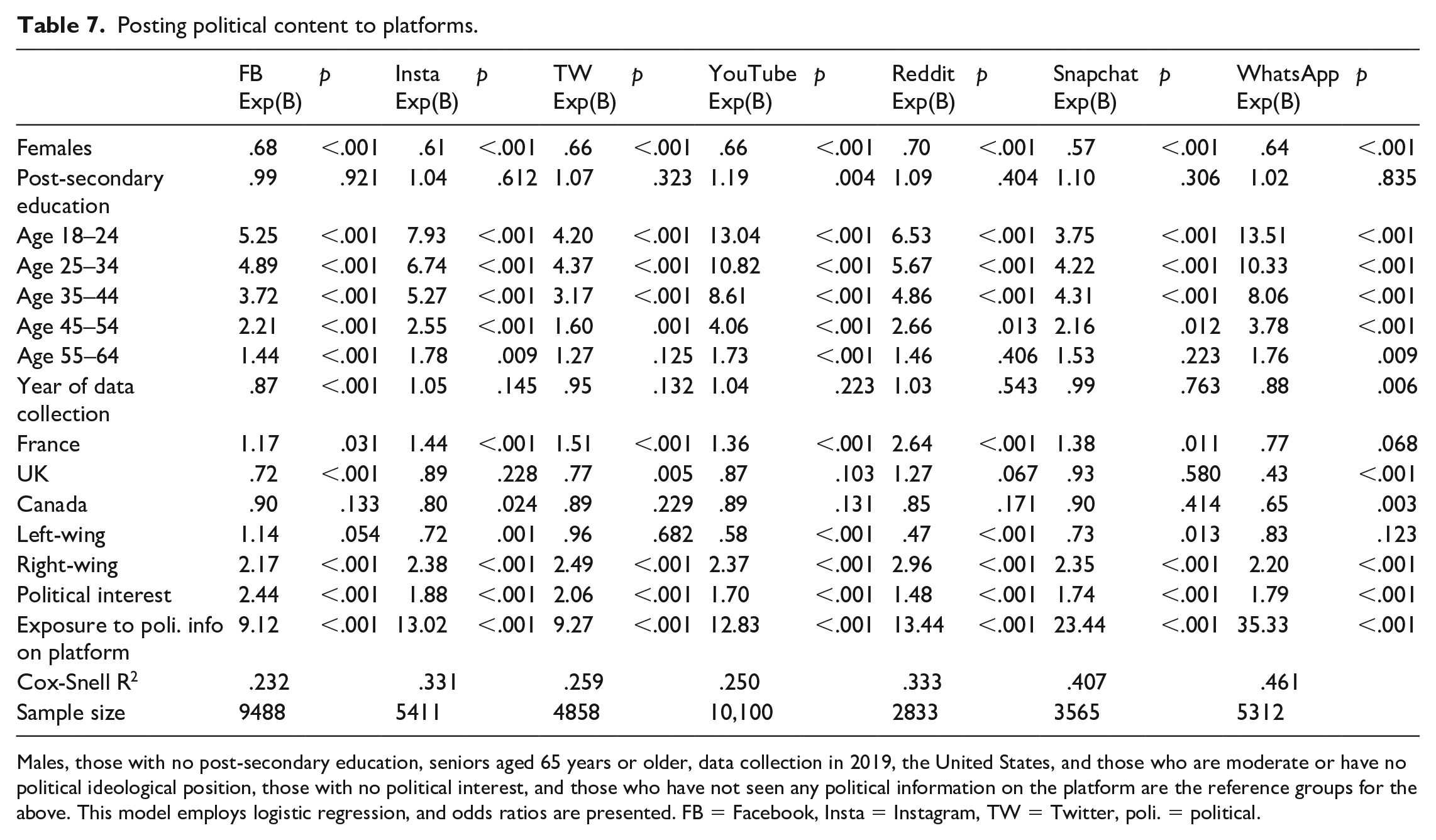
Males, those with no post-secondary education, seniors aged 65 years or older, data collection in 2019, the United States, and those who are moderate or have no political ideological position, those with no political interest, and those who have not seen any political information on the platform are the reference groups for the above. This model employs logistic regression, and odds ratios are presented. FB = Facebook, Insta = Instagram, TW = Twitter, poli. = political.
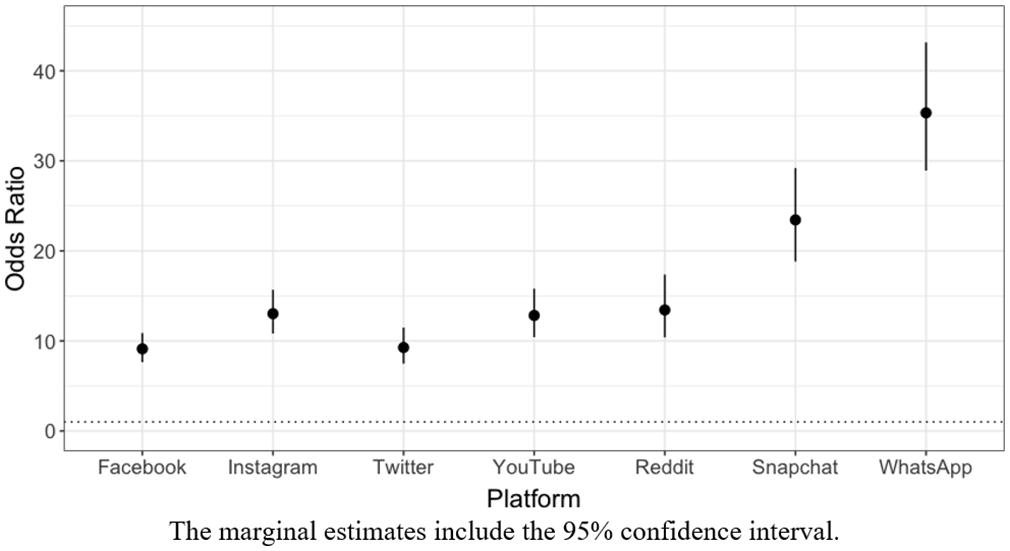
Marginals of exposure to political information and posting political content (logistic regression, odds ratios).
Regarding ideological differences (RQ1c), left-wing ideology is not a consistent predictor of posting political content on different platforms (Table 7). Left-wing ideology does not predict posting to Twitter, Facebook, or WhatsApp. Those with left-wing views are far less likely to post to Instagram, YouTube, Snapchat, and Reddit than those in the middle or without an ideological position. Reddit is quite distinctive in the strength of this relationship (RQ2c). For Reddit, right-wing respondents are three times more likely, whereas those on the left are about 50% less likely to post on this platform than those in the middle or without an ideological position (Figure 4). For other platforms, those with right-wing views are twice as likely to post political content compared to those in the middle or without an ideological position. As noted, these relationships are consistently positive and significant across the four countries (Table 4).
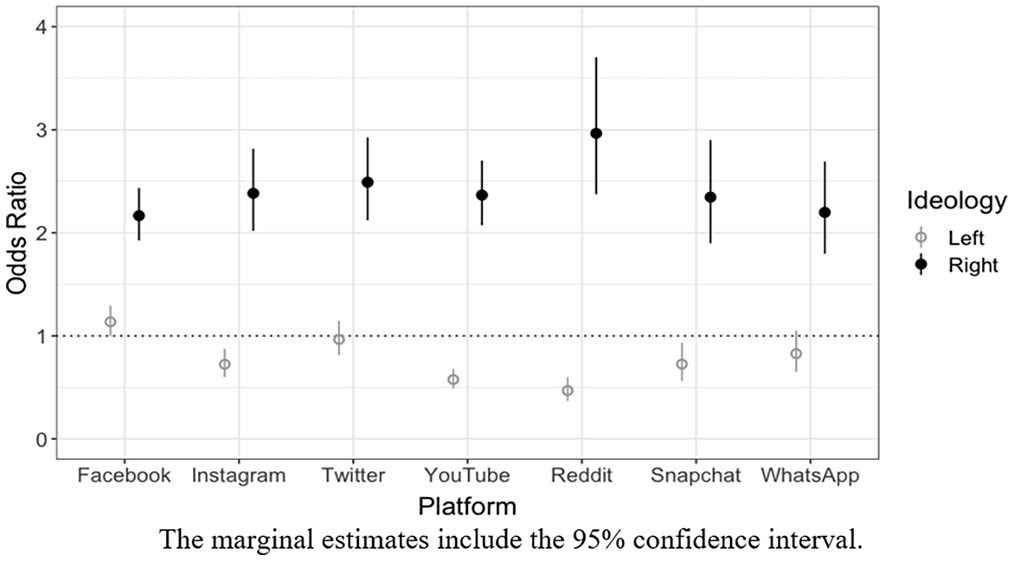
Marginals of ideology and posting political content (logistic regression, odds ratios).
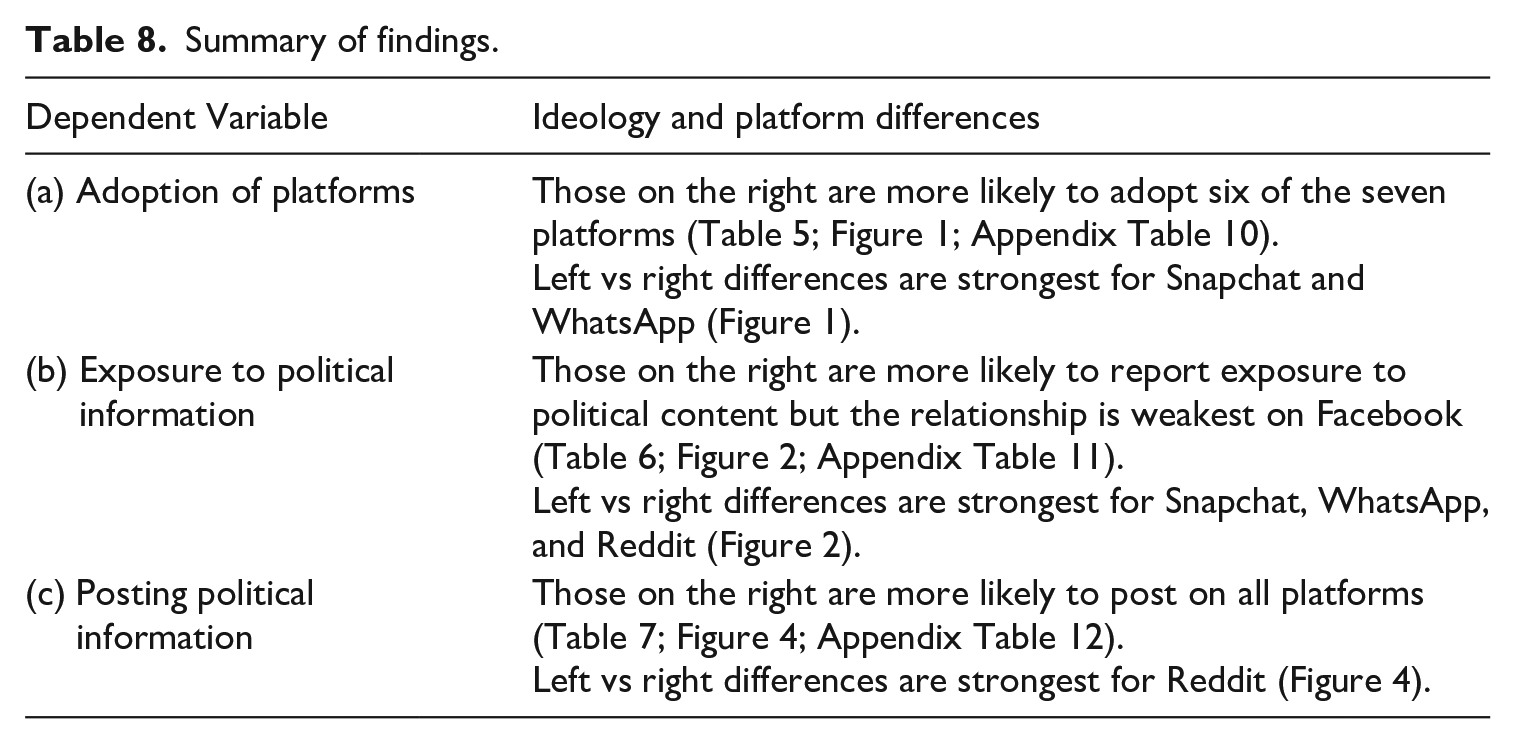
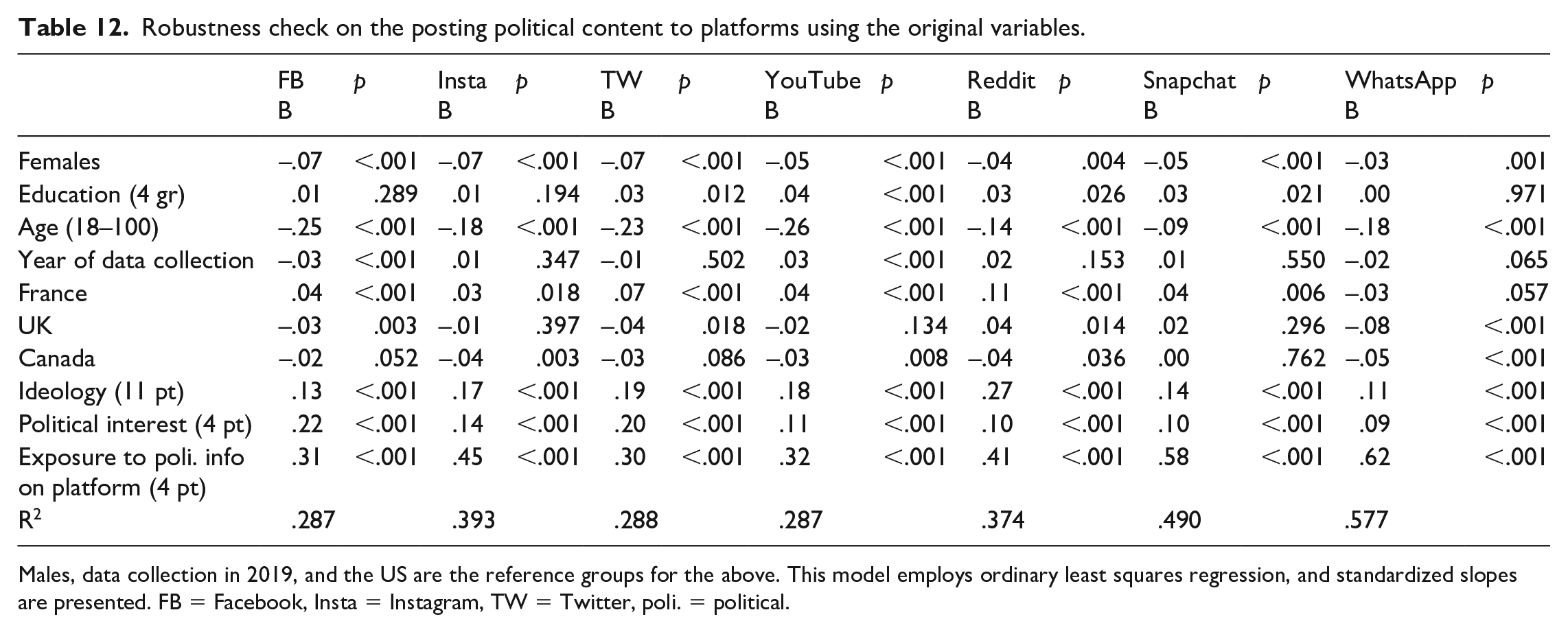
Appendix Tables 10–12 include robustness tests with the original variables. All key findings are replicated using the original versions of the variables. These key findings are summarized in Table 8. As such, our decision to simplify the variables to address skewed distributions and to enable visualizations of the results did not impact key findings. Snapchat and WhatsApp are distinctive in terms of right-wing ideology predicting the frequency of platform use (RQ1a, RQ2a). As noted in the prior analysis, Snapchat, WhatsApp, and Reddit are distinctive regarding the relationship between right-wing ideology and exposure to political information (RQ1b, RQ2b). However, Reddit is distinctive in relation to the frequency of right-wing users posting political content (RQ2c), but right-wing ideology relates to posting on all social media platforms (RQ1c).
Summary of findings.
Discussion
Facebook has long been the dominant social media platform (Auxier and Anderson, 2021; Kemp, 2023; Newman et al., 2021). However, this platform should not be considered the prototype for social media platforms; platforms differ in their structural networking features, particularly privacy, anonymity, and connectivity (Table 1). Throughout the results, we see that Facebook is the exception or deviation in a variety of patterns. Particularly, this platform had some of the smallest correlations between political ideology and adoption, exposure to political content, and posting political content (Figures 1, 2, and 4), which means the networks are ideologically heterogeneous. This platform has a closed network structure (Table 1), which might motivate political expression, but the platform has a large user base and does not offer anonymity as Reddit and YouTube do (RQ2). In addition, Facebook served as a general-purpose platform that addressed a variety of needs (Alhabash and Ma, 2017; Boczkowski et al., 2018; Kircaburun et al., 2020), which may lead users to avoid overtly political discussions (Miller et al., 2016). Indeed, if the user does not perceive there to be a receptive audience on Facebook for political content, they will refrain from posting. However, if the user perceives that there is a good deal of political content on the platform (exposure), social norms may lead them to provide additional political content (posting).
We offer consistent evidence that Reddit, Snapchat, and WhatsApp are distinctive in the results (Table 8). Snapchat and WhatsApp are instant message applications that create intimate ties among known users (Boczkowski et al., 2018; Gil de Zúñiga et al., 2021; Valenzuela et al., 2019; Valeriani and Vaccari, 2018). Both services offer higher privacy settings than Twitter or Facebook (Table 1). Political ideology strongly predicts experiences on these platforms, particularly for adoption and exposure to political information (RQ2). For both WhatsApp and Snapchat, exposure to information is strongly linked to posting political information because if one receives information from a (close) social tie, one may feel more compelled to respond to this information. In other words, the user gets a strong sign that the audience is interested in politics and, thus, replies by posting their own political content. The combination of receiving political posts and posting this content establishes a social norm for (political) platform use. The closed networks combined with strong ideological biases in adoption enable political discussion on like-minded networks, which may contribute to political polarization (RQ2).
While Valenzuela et al. (2019) did not find that political ideology predicted posting political content to WhatsApp in Chile, we do find such differences in our cross-national study. Our seven-platform comparison supports the claim by Valeriani and Vaccari (2018) that WhatsApp and Snapchat are ideal spaces for sharing content among like-minded network members. They find that those on the political extremes (either left or right) were slightly more likely to post political content on Mobile Instant Messaging Services (MIMS) than moderates. They explain these findings in terms of MIMS users censoring themselves on other platforms and instead discussing politics on MIMS because of the more intimate, closed, and controlled settings offered by these applications (Valeriani and Vaccari, 2018). Our findings suggest these dynamics are more important for right-wing users. Future research should include Latin American countries, such as Chile, Western democracies (Valeriani and Vaccari, 2018), and other countries to determine the broader relevance of these theories and findings.
Right-wing users are distinctive in their patterns of social media use (RQ1). They are more likely to post political content on all platforms. Chapekis and Smith (2023) find that Republicans are more likely to post on Twitter than Democrats. While Koc-Michalska et al. (2021) find that those with right-wing views (in the United States and United Kingdom) are more likely to post political content on Facebook and Twitter, we see this pattern on all seven platforms considered. While the scholarship has focused on the US context, the United States is not a deviant case, and the role of right-wing ideology is consistently positive and significant across the four countries. We relate these findings to previous insights on right-wing individuals perceiving mainstream media as politically hostile (Brenan, 2021; Lee, 2005), which may inspire social media use as an alternative source of information and forum of political discourse. In previous scholarship, this theory has been used to explain the media consumption of those on the far right (Kakavand, 2023). Similarly, political expression in social media has been described as a form of corrective action (Barnidge and Rojas, 2014). Previous studies find that right-wing media content generates more social media engagement than liberal media content (González-Bailón et al., 2022). Right-wing users, in particular, may use social media to find a sense of community among like-minded individuals (Lobera and Portos, 2022) and once they are on these platforms, they are more likely to post because they use these platforms to offer a counter-narrative (or create a counter-public) to mainstream media.
In contrast, left-wing users may feel more represented by established media institutions (cf., Fletcher et al., 2021, for US case, in particular) and, thus, do not feel as compelled to adopt social media platforms and use these platforms as tools for political expression. However, these patterns may shift in bursts of hashtag activism, which may be more popular on the left (Freelon et al., 2020).
Looking across our three dependent variables (adoption, exposure, and posting), we see that the ideological divide becomes greater when we move from the overall user group to those who are exposed to political content to those who post content (RQ1). In other words, large numbers adopt a platform, fewer see political content, and even fewer post; in this funnel process, ideological differences become larger. Our large sample size can decipher this pattern. The pattern is also evident when we split the sample into specific countries. For example, the correlation between right-wing ideology and Reddit use ranges between .04 and .09, but the correlations range between .13 and .21 for exposure and then .22 to .37 for posting. However, more research is necessary to disentangle whether this pattern is mainly driven by differing user choices, distinctive platform incentives, or both. In other words, while right-wing users may be particularly motivated to use social media for political expression and content amplification; networking affordances may further bolster this propensity (cf., Huszár et al., 2022). Based on the “spiral of silence” theory (Noelle-Neumann, 1974), we could speculate that right-wing users perceive these online spaces as more supportive of their viewpoints, and thus, they are more likely to post, while left-wing users may perceive their views as unwelcome.
Our methodology relies on self-reports collected as part of a cross-sectional survey. Studies indicate that self-reports do not align with the actual behavior (Guess et al., 2019; Haenschen, 2020). As such, we incorporated advice about how to improve the accuracy of recall. Guess et al. (2019) suggest defining political activities. Still, while the accuracy of self-reports remains a limitation of survey research, we accurately capture respondents’ perceptions of their political activity across platforms. This is important in light of current debates around perceived platform censorship, which highlights how users’ perceptions of political content on platforms—even if not entirely accurate—has a demonstrable impact on people’s views about the role of platforms in politics. For example, right-wing users’ perceptions of hostile content moderation by major social media platforms (Barrett and Sims, 2021; Vogels et al., 2020) fuel the adoption of alternative platforms on the right (Freelon et al., 2020). Thus, we argue that studying citizens’ perceptions of their political information exposure and expression is important, although future research might consider web-tracking data to validate these self-reports.
Conclusion
This article offers an original contribution by looking at the role of political ideology in platform adoption, exposure to political content, and posting of political content. We identify an ideological divide that becomes greater when we move from the overall user group to those exposed to political content to those who post content. This finding is an important contribution since most scholarship in this field has focused on exposure to and posting political content, but the ideological divide occurs at the point of platform adoption and expands from there. Using a combination of structure and social features of networks, we argue that ideology is important in the choice of platforms for use, and this choice has downstream effects on exposure to political content and posting political content. The role of ideology differences differs by platform, which we explain in terms of the unique networking features of Reddit, WhatsApp, and Snapchat. We find these patterns to be consistent across country contexts.
The ideological differences in patterns of use are concerning in terms of democratic health. In particular, the strong ideological differences related to Snapchat, WhatsApp, and Reddit suggest that these platforms might create echo chambers. As noted, echo chambers and their implications on political polarization are key issues related to social media and democracy (Bail, 2022; Kubin and von Sikorski, 2021). Like-minded networks can facilitate extreme views, radicalization, and lower tolerance (Wojcieszak, 2010). On the other hand, these ideological homogeneous spaces could also provide a sense of community and a greater likelihood of participation in civic and political life, which could be interpreted as positive outcomes for democracy. However, an imbalance in posting content to platforms has detrimental effects on the creation of a public sphere. The public sphere within these platforms has limited diversity in opinions. Furthermore, our results suggest a splintering of the public sphere across different platforms, which limits opportunities to hear and understand the other side and settle on a compromise (Mutz, 2006). While Pfetsch (2018) and others had concerns about the Internet contributing to a dissonant public sphere and segmentation into issue publics, social media platforms offer further opportunities to create and sustain these fragmented public spheres.
Footnotes
Appendix
Robustness check on the posting political content to platforms using the original variables.
| FB |
p | Insta |
p | TW |
p | YouTube |
p | Reddit |
p | Snapchat |
p | WhatsApp |
p | |
|---|---|---|---|---|---|---|---|---|---|---|---|---|---|---|
| Females | −.07 | <.001 | −.07 | <.001 | −.07 | <.001 | −.05 | <.001 | −.04 | .004 | −.05 | <.001 | −.03 | .001 |
| Education (4 gr) | .01 | .289 | .01 | .194 | .03 | .012 | .04 | <.001 | .03 | .026 | .03 | .021 | .00 | .971 |
| Age (18–100) | −.25 | <.001 | −.18 | <.001 | −.23 | <.001 | −.26 | <.001 | −.14 | <.001 | −.09 | <.001 | −.18 | <.001 |
| Year of data collection | −.03 | <.001 | .01 | .347 | −.01 | .502 | .03 | <.001 | .02 | .153 | .01 | .550 | −.02 | .065 |
| France | .04 | <.001 | .03 | .018 | .07 | <.001 | .04 | <.001 | .11 | <.001 | .04 | .006 | −.03 | .057 |
| UK | −.03 | .003 | −.01 | .397 | −.04 | .018 | −.02 | .134 | .04 | .014 | .02 | .296 | −.08 | <.001 |
| Canada | −.02 | .052 | −.04 | .003 | −.03 | .086 | −.03 | .008 | −.04 | .036 | .00 | .762 | −.05 | <.001 |
| Ideology (11 pt) | .13 | <.001 | .17 | <.001 | .19 | <.001 | .18 | <.001 | .27 | <.001 | .14 | <.001 | .11 | <.001 |
| Political interest (4 pt) | .22 | <.001 | .14 | <.001 | .20 | <.001 | .11 | <.001 | .10 | <.001 | .10 | <.001 | .09 | <.001 |
| Exposure to poli. info on platform (4 pt) | .31 | <.001 | .45 | <.001 | .30 | <.001 | .32 | <.001 | .41 | <.001 | .58 | <.001 | .62 | <.001 |
| R2 | .287 | .393 | .288 | .287 | .374 | .490 | .577 |
Males, data collection in 2019, and the US are the reference groups for the above. This model employs ordinary least squares regression, and standardized slopes are presented. FB = Facebook, Insta = Instagram, TW = Twitter, poli. = political.
Funding
The author(s) disclosed receipt of the following financial support for the research, authorship, and/or publication of this article: Funding was provided by a Social Sciences and Humanities Research Council (SSHRC) Insight Grant (435-2019-04-94) and Canadian Heritage.
