



Abstract
This study analyzes how platform affordances, their appropriation by movement actors, and these actors’ leveraging of information ecosystems—in combination—helped form a digital counterpublic during the COVID-19 pandemic. It draws on public communication data sent by more than 300 Telegram channels and group chats affiliated with the Querdenken movement over a 2-year period, and combines automated and manual text classification with network analysis. The study demonstrates how Telegram afforded connective and collective action in distinct ways that reflected the movement’s organizational structure and aims, as well as the impact of individual information-sharing on the process of movement-building itself. Accounting for time-dependent dynamics, the study also found that different parts of the counterpublic latched onto and sustained distinct information ecosystems to articulate their claims and mobilize contentious action.
Introduction
The COVID-19 pandemic spurred resistance against governmental actions and restrictions of fundamental individual rights to contain the pandemic worldwide. With massive marches in the streets and digital mobilizations, protesters fought back against controversial measures but, likewise, used the opportunity to politicize broader agendas. Rallies and organized protests surfaced in several European countries (Neumayer et al., 2021)—as well as the United States (Pressman & Choi-Fitzpatrick, 2021), Canada (Dyer, 2022), Australia (Meese et al., 2020), and New Zealand (O’Brien & Huntington, 2022)—after COVID-19 containment policies were imposed.
In Germany, the so-called Querdenken (“lateral thinking”) movement established itself as the main forum of mobilization and criticism against containment measures enforced by federal and state governments (Loucaides et al., 2021). Through street protests and online collective and connective actions (Bennett & Segerberg, 2012), particularly on the messenger platform Telegram, the movement put scientific knowledge and democratic institutions’ problem-solving capacity into question.
Without a doubt, a strong polarization existed early on between most of the German citizenry, who eagerly complied with containment policies (Jaschke et al., 2023), and the newly emerged movement questioning containment measures and scientific knowledge (Grande et al., 2021). However, within Querdenken, the movement’s formation and consolidation the movement’s dynamics were less clear-cut.
Our study focuses on the Querdenken movement’s digital communication to better understand the movement’s development over time and the extent to which we witnessed extreme actors and topics gain relevance throughout its development. To do so, we analyze Querdenken’s communication on the messenger platform Telegram and theorize it as a networked counterpublic. A significant share of opinion leadership in counterpublics is constructed collectively via personalized information-sharing (Xu, 2020). By analyzing this key feature of connective action (Bennett & Segerberg, 2012), we capture Querdenken’s self-embedding in a specific, broader Telegram-internal and -external information ecosystem conducive to fostering particular issue agendas and attracting attention. Furthermore, we acknowledge the specific features of Telegram as a hybrid platform that may afforded distinct uses for collective and connective actions, as well as sustained the movement’s development.
To date, studies have researched the topics of and radicalization dynamics within Querdenken on Telegram (Schulze et al., 2022; Zehring & Domahidi, 2023). However, our study expands this research by addressing how divergent platform features and their appropriation by movement actors, as well as the leveraging of information ecosystems, contribute to movement- and public-building. We argue that both processes’ interplay is essential for understanding the Querdenken digital counterpublic’s dynamics.
The messenger platform Telegram constituted the main platform for organizing contentious action and establishing networks and collective identities among German Querdenken protesters (Holzer, 2021). Therefore, our study analyzes these dynamics based on Querdenken’s digital communication on Telegram. However, the movement’s digital communication was not only confined to within-movement and within-platform communication, but also included the broader information ecosystem during the movement’s development. We rely on the content distributed via 395 public German Querdenken channels and group chats on Telegram between April 2020 (when the movement was founded) and December 2021. Using automated text classification (structural topic modeling), network analysis, and manual quantitative content analysis, our article demonstrates how strongly platform affordances, information ecosystems, and the combination of both influence movement formation within a networked counterpublic. While public Telegram channels afford collective action—for example, identity and movement-building—by organized activists of a movement, public group chats allow for personalized information-sharing and connective action. The information shared is sourced from Telegram-internal and -external sources, depending on the topic and how a channel or group chat positions itself in the movement as a whole.
The following section outlines this study’s theoretical background concerning the history of the Querdenken movement, Telegram’s platform affordances, and the formation of digital counterpublics. The “Study Design and Methods” section lays out the study’s design and methods used, the “Results” section presents the results, which are then discussed in the “Discussion and Conclusion” section.
Querdenken as a Digital Counterpublic
The Querdenken Movement
After COVID-19 first surfaced in 2019–2020, country after country was forced to take governmental action to respond to the burgeoning pandemic. In Germany, parts of the population opposed to containment measures mobilized online and offline through street protests, fighting back against controversial measures (Neumayer et al., 2021), and also politicizing broader agendas (Trenz et al., 2021).
The Querdenken movement provided the main forum for mobilization and criticism against containment measures (Holzer et al., 2021) as a social movement with a “sustained campaign of claim-making, using repeated performances that advertise the claim, based on organizations, networks, traditions, and solidarities that sustain these activities” (Tilly & Tarrow, 2015, p. 11). What started as a small demonstration with around 50 participants in Stuttgart in April 2020 as a reaction to initial contact restrictions quickly spread to several other German cities. With a professional managment of the protests and an organization and communication infrastructure forming online, the organizers built a network of supra-national movement organizations, regional chapters, and individual supporters that organized offline protests as the pandemic progressed (Holzer et al., 2021), with up to 30,000 participants hitting the streets in August 2020 (Grande et al., 2021). Studies on these street protests noted that the claims brought forward on the streets changed over time, shifting from calls for economic assistance and solidarity to more open rejections of containment measures. Increasingly, the Querdenken movement in particular put scientific knowledge and democratic institutions’ problem-solving capacity more fundamentally into question (Grande et al., 2021, p. 110).
Early surveys among Querdenken participants revealed that members’ views spanned a diverse political spectrum (Koos, 2021; Nachtwey et al., 2020), but later studies indicated within-movement dynamics pointing toward a stronger emphasis on views more closely aligned with conspiracy theories and right-wing politics (Grande et al., 2021; Lange & Monscheuer, 2021; Nachtwey et al., 2020; Schulze et al., 2022). Furthermore, survey studies among German citizens who demonstrated very high or high comprehension of the people who participated in demonstrations against the COVID-19 measures also reported a shift to the right and a greater susceptibility toward conspiracy theories (Grande et al., 2021).
While analyzing COVID-19-related mobilizations and participation on the streets is highly insightful in its own right, it misses a great part of a movement’s strategic communication and mobilization activities. Therefore, in this study, we turn to Querdenken’s digital communication on Telegram to corroborate described dynamics and better understand how platform affordances and the leveraging of information ecosystems interact in this development.
Telegram as Hybrid Platform
Digital platforms and media profoundly have changed how movements can articulate their grievances, mobilize, and build organizations while circumventing traditional media. Using existing digital platform infrastructures, movements leverage their resources to form a common identity and action frames to engage in collective action (Bennett & Segerberg, 2012; Margetts et al., 2016, pp. 9–11). Movements enabling a more decentralized communication space in which individuals contribute to a common goal through self-motivated content-sharing and individual expression make room for a logic of connective action (Bennett & Segerberg, 2012). Particularly in times of a pandemic, with imposed restrictions on face-to-face communication, digital communication is a central means in movements’ strategic action repertoire (Trenz et al., 2021).
Prior studies have established that the messenger platform Telegram has been particularly important in the context of mobilizing COVID-19 skeptics (Holzer, 2021; Schulze et al., 2022). Although the platform addresses a global, general audience, it frequently has been touted as a “safe” place for “deviant” forms of activism of all sorts, ranging from networked forms of protest in repressive political settings—for example, Belarus, Russia, or Hong Kong (Bodrunova, 2021; Herasimenka, 2019; Ting, 2020)—to mobilizations by groups that feel persecuted or shunned in more democratic settings, or who mobilize for more contentious and radical actions. In this respect, Telegram has been linked to militant and violent groups, for example, ISIS (Islamic State of Iraq and Syria) (Bloom et al., 2017), and mobilizations by far-right networks (Schulze et al., 2022; Simon et al., 2022). This is due to Telegram’s reputation as a platform that does not cooperate with law enforcement agencies (Frischlich et al., 2022; Rogers, 2020), affording enhanced privacy and anonymity while simultaneously offering outreach to articulate public claims and foster mobilization and identity building (Urman & Katz, 2022). Following the example of other right-wing communities in Germany (Rothut et al., 2023; Schulze et al., 2022; Urman & Katz, 2022), and due to de-platforming on other social media (Holzer, 2021), Querdenken’s main digital communication infrastructure was established on Telegram.
Telegram functions as a specific type of hybrid platform with differential affordances, that is, platform capabilities and their perceived usefulness by particular users in a given situation (Evans et al., 2017): The platform’s features include broadcasting channels through which administrators can provide information and real-time updates on current events and distribute them to broader audiences. Channels offer one-to-many communication in which administrators retain authority over their messages’ content and visibility. Furthermore, Telegram features public group chats that allow many-to-many communication among group members, enabling participation and exchange through various feedback mechanisms that support coordination, building a following, and establishing a sense of community, with messaging options in group chats (Dargahi Nobari et al., 2021; Rogers, 2020; Urman & Katz, 2022). We can expect that these platform features structure the movement’s digital communication. Urman et al. (2021, p. 18) argued that the platform might “foster synergetic development of connective and collective action, promoting community building on the local level and the connections between such local communities.” Indeed, Querdenken’s initiators soon established strong organizational coordination with a supra-national hub and regional chapters (Holzer et al., 2021), providing a communicative infrastructure for potential collective action through websites and social media accounts on platforms, such as Facebook, Twitter, and Telegram (QUERDEN-KEN—711, n.d.), held together by a unified structure and a corporate image. The regional chapters increasingly were founded over time and established corresponding digital spaces online. Newly created chapters were advised to adhere to the standardized scheme of Querdenken’s social media presence, even though not every chapter followed the introductions (QUERDENKEN—711, n.d.). On Telegram, each chapter provides a specific channel, accompanied by a distinct group chat, localizable via the chapter’s local landline ZIP code. The group chats allow members to message and connect with each other, and hold the potential to coordinate and establish a shared narrative. Furthermore, by forwarding a message, channel administrators can increase the popularity of other channels’ content or promote users’ content by forwarding it to the channel. Likewise, users can forward other users’ messages, as well as share channel messages in group chats (Dargahi Nobari et al., 2021). Thus, the case of Querdenken and its communication infrastructure established on Telegram offer a prime example through which to scrutinize further how platform features afford distinct action types and, thus, might contribute to a movement’s development.
Querdenken as a Digital Counterpublic and Its Information Ecosystem
We understand Querdenken’s digital communication on the messenger platform Telegram to constitute a networked counterpublic. Counterpublics are alternative communicative spaces created by actors characterized by their opposition to hegemonic views within public discourse, factual or self-perceived exclusion, and the desire to influence and expand public discourse (Fraser, 1990). Querdenken laid out its counter-hegemonic self-identification already in its name, suggesting an oppositional stance toward “mainstream” thinking.
Counterpublic theorizing has expanded its scope to spotlight anti-democratic actors (Downey & Fenton, 2003; Kaiser & Rauchfleisch, 2019) and particularly to focus on online communication. Here, digital counterpublics form through the interplay between social media platforms’ affordances (Evans et al., 2017) and their appropriation by distinct actors to create a communicative space to spread their counternarratives, engage their followers, and establish a shared identity (Jackson & Welles, 2015). Thus, following Toepfl (2020), the Querdenken counterpublic on Telegram can be characterized by the actions of active participants involved in it (i.e., channel administrators and active members of group chats) and the leveraging of a particular communication environment. Using Telegram’s infrastructure (i.e., public channels and group chats), participants can engage in intra-platform information dissemination across channels and group chats via forwarded messages, establishing a networked information ecosystem through which the salience and prominence of appealing content are promoted and rebroadcast to personal networks.
However, Querdenken’s digital communication is not confined to content originally created within the movement itself. Through hyperlinking external content from a variety of digital platforms and media sites, active participants can latch on to a broader information environment online. Such cross-platform references also support and provide background for their claims (Klein, 2012; Mayerhöffer & Heft, 2022) to distribute information and promote the visibility of like-minded actors, organizations, and content further; mobilize for action; or criticize and distance themselves from opponents (Ackland & Gibson, 2013; Theocharis et al., 2015). With both strategies, Querdenken’s participants comprise a networked counterpublic conducive to fostering particular actors and issue agendas.
Research Questions
In this study, we analyzed Querdenken participants’ activities and prominence in the diffusion of information, as well as their ability to appeal to participants and supporters through particular patterns of self-embedding and content. Following previous studies and observations reported above, our study aimed to determine whether extreme content gained relevance within Querdenken’s digital communication, and to scrutinize how platform affordances align with and potentially sustain this development. In particular, we acknowledge the specific features of the hybrid platform Telegram that can afford distinct uses for collective and connective actions. Through the communication infrastructure that Querdenken established, the movement’s organizers can distribute authoritative information to an unlimited number of channel subscribers, engaging in collective action. By also providing an organized infrastructure for within-movement individual information-sharing, parts of the movement can organize with a connective mobilization logic simultaneously. We differentiate between channel and group chat communication, and address this interplay between topical development and platform affordances with our first research question:
RQ1: How topically diverse is the Querdenken digital counterpublic, and to what extent do Telegram’s platform features afford distinct types of uses?
We have argued that the leveraging of particular information ecosystems can help fostering the prominence of actors and issue agendas’ prominence to sustain Querdenken’s development. Through their digital communication, Querdenken’s participants boost the prominence of specific actors whose content can attract further distribution among movement members, thereby reinforcing the strength of particular actors and their claims. Furthermore, we can expect counterpublic participants to try and sustain their claims by embedding external content, which might provide legitimacy and support for their claims, and again foster their prominence. Therefore, in this study, we differentiate between platform-internal and -external information distribution and communication. We capture actors’ self-embedding in a specific Telegram-internal and broader Telegram-external information ecosystem. To characterize this ecosystem and its actors’ political alignment, we ask:
RQ2: What information ecosystem does Querdenken embed itself in, how does it develop over time, and how is it aligned with platform affordances?
Finally, we argue that platform affordances and Querdenken’s leveraging of information ecosystems—in combination—are elementary for understanding the Querdenken digital counterpublic’s dynamics. To understand whether we observe a uniform development, we ask:
RQ3: How does the interplay between platform affordances and information ecosystems shape the counterpublic’s structure, and how does this mutual relationship develop over time?
Study Design and Methods
To examine the Querdenken counterpublic’s formation, we relied on public German Querdenken channels and group chats on Telegram. Our study comprises the time period spanning from April 2020, when the movement was founded, to December 2021, thereby capturing several waves of COVID-19 containment measures and oppositional offline mobilizations in Germany.
Due to Telegram’s dual technical features for public communication and Querdenken’s organizational structure of maintaining channels and group chats for local chapters, the choice to collect both types of Telegram entities allows for the most thorough reflection of the movement’s internal communication and self-embedding in information eco-systems.
We accessed the data via Telegram’s open application programming interface and the Telethon Python library. 1 To develop a sample of Querdenken group chats and channels that is as complete as possible, we relied on a snowball sampling approach. The seed sample to detect new entities iteratively was constructed via Telegram’s built-in search engine. Because the naming of the local Querdenken chapter is usually [“Querdenken”]+[landline ZIP code], we queried Telegram’s search engine for a combination of the word “Querdenken” and all German ZIP codes. This search yielded 168 results. As the quality of Telegram’s native search function is limited (Jalilvand & Neshati, 2020), previous studies (Baumgartner et al., 2020; Hoseini et al., 2023; Urman & Katz, 2022) have relied on within-entity referencing to detect new entities. Therefore, the results from this initial search were used as a seed sample for a snowball sampling process. Unrestricted snowball sampling of Telegram’s group chats and channels by following each forwarded or mentioned entity resulted in an exponentially growing list of entities to scrape. Baumgartner et al. (2020) and Urman and Katz’s (2022) approaches aimed to map large connected parts of the platform’s communities and their interconnectedness, that is, apart from prioritizing which entity is the most important one to scrape at each step of the snowball sampling, there are no qualitative restrictions on which channels or group chats to choose. In this study, the sampling aimed to find as many Querdenken group chats and channels as possible, thereby excluding non-Querdenken entities from data collection and limiting the exponential growth of candidate entities to scrape. Thus, our three-stage snowball sampling process was conducted in two parts, comprising two snowball iterations each. In the first part (seed collection and the first iteration), all references found in the seed sample were scraped and searched for more references. In the second part, another criterion for scraping was introduced: Only the group chats and channels using the term “Querdenken” in their name or self-description were scraped. At the end of the sampling process, we arrived at a sample of 395 distinct entities (201 group chats and 194 channels) self-identifying with the Querdenken movement and a total of 2,599,615 messages sent between March 2020 and December 2021.
Conceptually, we distinguished between explicit Querdenken actors and those who latched on during the movement’s information distribution and communication. With respect to the sociotechnical infrastructure, we differentiated between platform-internal and -external communication, as well as between specific features of channels and group chats on the platform.
We operationalized the broader information ecosystem in which individual local chapters and the movement as a whole embedded itself through the information sources revealed through reference sharing. Thus, we selected messages forwarded from other Telegram-internal entities (584,744 messages), messages containing hyperlinks to platform-external sources (165,612 messages), and messages containing both (209,909 messages) for further analysis.
To analyze the content of information sources shared by members of Querdenken group chats and channels, and to answer RQ1, we employed topic modeling using forwarded messages and preview texts of shared hyperlinks as a corpus. This allowed for an analysis of information source topics on the message level and its aggregation to the group chat level, as well as a temporal analysis of topic distributions. An aggregate temporal analysis of topic prevalence aimed to answer the question of whether reported radicalization of Querdenken in terms of a tendency toward topic centralization over time (e.g., toward a higher salience of conspiracy theories and far-right content; Grande et al., 2021; Schulze et al., 2022) can be detected in the topics that information sources shared, both from within and outside Telegram, and in both types of public communication that the platform affords. To investigate whether topic shifts in the movement occurred across all the geographically dispersed chapters of the movement, or whether distinct fractions of chapters converged into a different topical focus, we used community detection to identify clusters of group chats and channels that shared similarities concerning their shared topics.
While topic models based on latent Dirichlet allocation (LDA; Blei et al., 2003) tend to underperform on corpora constructed from short text messages (Hong & Davison, 2010), our corpus was constructed from forwarded messages and hyperlink preview texts (mean message length: 663.42 characters) instead of rather short text messages shared by Telegram group chat members (mean message length: 270.87 characters). Given the model features of including covariates of the topic estimations and the possibility for documents to be assigned to multiple topics with different proportions, the structural topic model (STM) approach was chosen and implemented in the R-package “stm” (Roberts et al., 2019). Using the richer forward and hyperlink corpus, as well as choosing source type and message date as STM covariates, added robustness to the topic model results derived from this analysis.
The preprocessing steps for the corpus construction began by identifying all messages in the data set that contained hyperlinks and/or had been forwarded from other Telegram entities. For each identified message, the hyperlink preview title and hyperlink preview text, as presented in Telegram, were combined. After extracting all hyperlinks from the corpus, the preprocessing steps of tokenization, lowercase transformation, removal of German stop words (from the “marimo” stop word list implemented in the R-package “quanteda”; Benoit et al., 2018), and stemming (Porter, 2001) were conducted based on best practice recommendations by Maier et al. (2018). Many Telegram messages ended with a call for action, encouraging the audience to subscribe to other channels and platforms, or to share a certain message. These advertising phrases were not viewed as noise and, thus, were not removed, as they can be understood as a property of referenced messages contingent on their respective authors and, therefore, containing information. A grid search using different hyperparameter settings for the STM with LDA initialization resulted in a parameter combination of η = 0.001 (topic-word hyperparameter), K = 35 topics, and α = 1/K, which yielded the best combination of topic exclusivity, topic coherence (Roberts et al., 2019), and—after manual inspection—qualitative interpretability. During the next step, the authors further aggregated the topic output estimated (35 topics; see Appendix A.1) into topic areas using an inductive and iterative procedure. Each author qualitatively inspected the topics, then grouped them into broader categories based on their highest probability and FREX terms. The resulting categorizations have been compared, discussed, and consolidated based on mutual agreement. This procedure resulted in five topic areas as the basis for subsequent analyses.
To investigate whether potential shifts in topic prevalence stemmed from a uniform behavioral change across the whole movement, or whether distinct fractions of the movement shared divergent content, the individual channels and group chats were clustered based on their topic distributions over time. The clusters then were analyzed further to determine whether the counterpublic’s dynamics and structures were aligned with Telegram’s affordances and the information ecosystem’s dynamics to answer RQ3. A network was constructed for every observed time step (quarterly, from the second quarter of 2020 through the fourth quarter of 2021), in which every node represented a scraped Querdenken entity active during this quarter. Each node’s attributes were constituted through its distribution of topic areas. The network was constructed as a full graph, in which the respective edge weights represented cosine similarity between topic distributions of two nodes. To detect communities of Querdenken entities with topics similar to each other and dissimilar to other communities, Louvain community detection (Blondel et al., 2008) was implemented via R’s “i-graph” package (Csardi & Nepusz, 2006). To ensure the correct labeling of communities over time (i.e., consistent identification of a community in different time steps), communities during each time step were matched to communities from the previous time step via their Jaccard similarity. This procedure of dynamic network community discovery, introduced by Greene et al. (2010), identified, for example, a detected community in time step t as Community A if the Jaccard similarity of this community’s member nodes was closest to Community A in time step t–1.
To answer RQ2 and gain a better understanding of the actors that populate the information ecosystem, Querdenken members embedded themselves in the sources of Telegram-internal forwarded messages, and Telegram-external hyperlinks were classified via quantitative manual content analysis. For Telegram-external actors, actor coding was conducted in the second-level domain (e.g., https://www.washingtonpost.com). For actors active on one of the largest non-anonymized social media platforms (Twitter, YouTube, or Facebook), the coding was conducted on the account or page level. All actors were ordered based on the number of citations they received in Querdenken group chats and channels. For classification, we selected and categorized the actors responsible for the top 80% of the platform-internal links and the top 80% of the platform-external hyperlinks posted in the German Querdenken Telegram group chats within our study’s time frame.
Altogether, 715 Telegram-external actors and sites that were linked via hyperlinks, and 579 Telegram-internal actors and accounts were classified. The coding captured the actor types by differentiating between actors belonging to different societal subfields (political, legal, economic, research, cultural, media, and civil society) and several subcategories within these fields. Their detailed definitions were provided in the present study’s standardized codebook (see Variable Act 1a and Act 1b under Supplementary Material B.1). Furthermore, we classified the actors’ geographical scope and, if they were not German, their country of origin (Variable Act 2 and Act 2a). Based primarily on actors’ self-description of their accounts, we classified their ideological orientations, following established categories as provided in the literature (see Variable Act 3 and the detailed descriptions in the codebook).
Four coders conducted the coding. Intercoder reliability tests for Telegram-internal links resulted in coefficients between 0.91 and 0.78 ([n = 50, Holsti]/0.75–0.48 [n = 50, Krippendorff’s alpha]). For Telegram-external links, reliability coefficients were between 0.94 and 0.79 ([n = 51, Holsti]/0.80–0.55 [n = 51, Krippendorff’s alpha]). For all coefficients per variable, see Supplementary Material A.4.
Classifying actors’ ideology within the Telegram-internal environment was particularly difficult, resulting in less-robust classifications than one usually would accept. Our coding was based on an established instrument, so that, we viewed this as reflecting the actual “hybrid” and “fluent” character of actors in this specific platform, as well as our topical context’s peculiarities. First, the information given on actors’ backgrounds, aims, and ideological orientations often was quite limited. Second, ideological stances often are not stated clearly, but rather “veiled” behind references to, for example, freedom or human rights and other argumentative figures, requiring expert knowledge to decode their meaning. Third, many actors appeared to lie “somewhere in between” and deviate from the traditional left-right paradigm by addressing a broader range of values and concerns. Fourth, some actors also “evolved” ideologically in the course of the pandemic, which led to ambiguous ideological signals for coding. Also, with respect to actor types, classification is more ambiguous than in previous research and reflects the increasingly blurred boundaries of public communication, particularly regarding the demarcation between information distribution (journalism) and mobilization (civil society actors). To account for this, extensive consistency and cleaning checks were conducted, and analyses of actor types and ideologies were conducted on aggregated variable classifications with n = 10 (types) and n = 3 (ideology) categories.
Results
Examining the Querdenken movement’s temporal activity on channels and group chats revealed that both types of public communication features were used in significant amounts. Starting with relatively few messages at the beginning of the movement, the chapters’ activities peaked in Q4 2020. This increased messaging activity coincided with COVID-19 containment measures imposed by federal and state governments in Germany (Grande et al., 2022), and with various offline political protest waves in Germany (p. 109). While our investigation of Querdenken’s intra- and cross-platform information ecology required examining forwarded messages and shared hyperlinks, a summary of these message types indicated that they formed a major part of the movement’s overall messaging activity. Altogether, 25.41% of all messages sent during the time frame observed shared hyperlinks, and 38.64% were forwarded from other Telegram entities. The relative amount of information-sharing as a portion of all messages sent increased further over time, as reported in Appendix A.2.
Topic Distribution Dynamics
After examining Querdenken communications overall, the most prevalent topic area was “Information distribution and advertisement” (Figure 1). This topic area captured messages that promoted further information distribution channels both within Telegram and on other platforms. While decreasing in prevalence over time, from 0.36 in Q2 2020 to 0.27 in Q4 2021, it remained the most frequent topic referenced. Conversely, the “Medical Discussion” topic increased in prevalence steadily, from 0.12 in Q2 2020 to 0.18 in Q4 2021. Messages related to “Medical Discussion” encompassed COVID-19 symptoms, vaccinations, and alternative medicine. The reason for this might be the Querdenken movement becoming relatively established among the German public (thereby decreasing the need for advertising) and the introduction of COVID-19 vaccines in the winter of 2020. The more concrete the measures, the more targeted the public mobilization. The topic “Conspiracy Theories” encompassed messages relating to conspiratorial narratives, for example, Bill Gates’ role in the pandemic or QAnon content. It was the second-most-prevalent topic area over time, but it did not increase or decrease drastically, instead remaining a significant portion of information shared within Querdenken’s public communication. Finally, two more topical areas emerged in our analysis: First, “Mobilization” encompassed mobilization of offline protests and information about local rallies. Second, COVID-19-related “Political Discussion” comprised posts and discussions about government policies, distinct politicians, or regional and federal elections held during the pandemic. Overall, a change in the tendency to share information concerning “Mobilization” content or political discussion was not detected over time.

Topic area prevalences (a) over time and (b) over time and differentiated by entity types.
However, our data corroborated the assumption that features of channels and group chats afforded different uses within the movement and performed distinct functions. Therefore, the topic areas contained in the shared messages were differentiated and compared regarding where they were posted, that is, channels and group chats (results from two-sample t-tests are reported in Appendix A.5). We found that conspiratorial posts were highly prevalent in discussion group chats. Furthermore, mobilization posts’ prevalence also was higher in group chats. However, discussions about political and medical issues were slightly less prevalent on channels compared with group chats, whereas under “Information Distribution,” no such tendency was detected.
This result supports the interpretation that Telegram’s various features for public communication and community building offer distinct affordances to the outward and inward communication of movements, including Querdenken, that is, in group chats, many authors aggregated and distributed content focusing more on mobilization and conspiratorial content than on officially administered channels. However, the channels, where only organized members of the movement could compose messages, seemed to focus more on topical content. As their local chapters’ authoritative voices, content shared on channels was more concerned with establishing a movement identity and organizational self-image that appealed to both outside observers and sympathizers. Therefore, the chats seemed particularly conducive to connective action to mobilize for online and offline action without organizational consent. However, the chats likewise helped distribute a multitude of views—and the content that gained prominence here more often than not was conspiratorial in nature. Overall, the group chats functioned as information brokers for movement-internal and movement-external information as more calls for offline mobilization proliferated.
Information Ecosystem Dynamics
Identifying each document’s source type in the corpus enabled analysis of which sources comprised Querdenken’s information ecosystem (Figure 2). From an infrastructural perspective, these can be differentiated as forwarded posts from Telegram-internal sources, hyperlinks pointing to Telegram-external platforms, and forwarded messages that contained hyperlinks. Discernibly, forwarded messages from the Telegram were more likely to contain “Conspiracy Theories”-related content than hyperlinked messages or mixed messages (results from pairwise two-sample t-tests are reported in Appendix A.6). This suggests that the conspiracy-theoretical part of Querdenken’s information ecosystem could be found mainly on the platform itself. However, “Medical Discussion” and “Political Discussion” content appeared to be more prevalent in messages with hyperlinks, that is, these topics’ information sources primarily were located outside of Telegram. Mobilizing messages, again, were shared more frequently from Telegram-internal sources, while the difference was not as clear-cut for “Information Distribution” content. The reason why this latter topic was evenly distributed between Telegram-internal and -external sources possibly lied in the related messages’ content because many webpage preview texts and forwards contained some level of self-promotion that highlighted the cross-platform informational infrastructure that the Querdenken organization established.
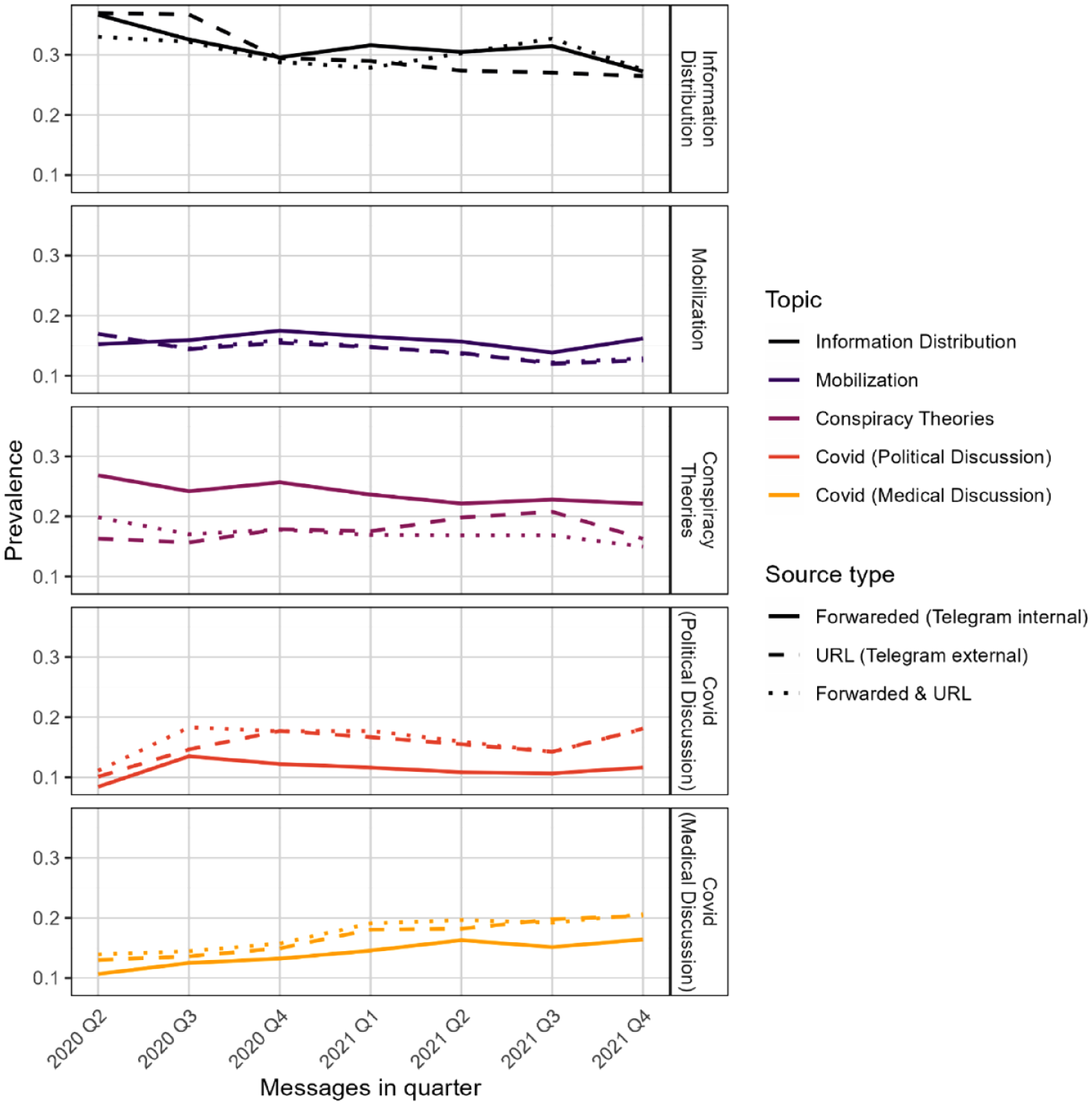
Topic area prevalence over time and differentiated by source type.
These results indicate that information referencing practices diverged between topic areas. “Conspiracy Theories” and “Mobilization” content mainly was forwarded from Telegram-internal sources. “Mobilization” content tied to Querdenken’s offline protests was more likely to originate from other Querdenken-affiliated actors, which communicated via Telegram. Also, most information regarding “Conspiracy Theories” was forwarded from other Telegram-internal sources. This supports the view that Telegram, as a platform, provides a fertile breeding ground for dissemination of conspiratorial content. Regarding political and medical discussions, Telegram-external information sources seemingly were deemed more reliable to complement the information ecosystem in which Querdenken participants were embedded.
The actors’ activity on Querdenken channels and group chats varied in terms of actor type and ideology (Figure 3). In the sources referenced, civil society actors (taking explicit anti-containment measures and others) and the group of media actors comprising alternative media that view themselves as correctives against a perceived media mainstream (Holt et al., 2019)—for example, influencers, bloggers, and others (for details, see the codebook under Supplementary Material B.1)—are the most salient actor types. Notably, only the smaller share of actors could be identified clearly and/or categorized ideologically. The figure presents these actors compared with the total number of sources without explicitly stating ideological markers, including explicit Querdenken actors classified as special-issue actors, and also official sources, for example, media, experts, or legal actors obliged to be neutral. Right-wing and special-issue actors were referenced heavily and consistently over time, while explicitly left-leaning sources were negligible in Querdenken’s information ecology. The actor types brought to attention by Querden-ken differed significantly between the Telegram entity types shared in and between reference types (Figure 4). The Telegram-internal ecology largely comprised civil society actors and alternative information distributors—for example, alternative media, bloggers, vloggers, and influencers—both on channels and group chats. Differentiating between channels and group chats demonstrated that channels share more messages from actors directly opposing anti-containment measures, that is, primarily other Querdenken chapters. The group chats’ referencing was more diverse, as they drew attention to the movement’s organizational communication but, to a similar extent, distributed information through other mobilization actors and the whole spectrum of alternative media and influencers active on Telegram. The Telegram-internal information ecology supplied Querdenken actors with information from their own organization and from adjacent organized groups and influencers. Therefore, movement-related information was shared, and attention was drawn to information flows that occurred on Telegram itself. Observing this referencing practice revealed Telegram’s critical affordance of enabling networking and self-embedding in the movement-building process.

Results from quantitative actor classification. (a) The share of actor types classified. (b) The share of actor ideology classified.

Results of quantitative actor classification of (a) actor types and (b) actor ideology across Telegram entity type and information ecosystems.
The broader information ecology referenced and used in Querdenken communications through external hyperlinks prominently featured media actors—including legacy media and “other” actors. “Other” media actors mainly comprised regional media sources, so that hyperlink references were vital as connections to local information sources. To feed information from legacy or “other” media sources into their communication, hyperlink referencing was necessary for Querdenken actors, either because hyperlinks to media websites were deemed more reliable sources or because those media actors did not maintain a presence on Telegram. This observation applies to group chats and channels.
Content from alternative media, influencers, blogs, and so on, was shared via both reference types, but more frequently and increasingly, Telegram-internal sources were referenced. Civil society actors, likewise, had a higher share in Telegram-internal references than they obtained in the share of Telegram-external references, even though this share increased over time.
Overall—after differentiating between Telegram’s public communication affordances and different reference types—the interplay between platform-internal and -external information ecology becomes visible. The ecology’s Telegram-internal part was more homogeneous and used mainly to feed information about movement-adjacent actors into Querdenken communities. Hyperlinks to platform-external information sources then were used to enrich and diversify the information ecosystem. The topic model results indicated that the information referenced was used to address and substantiate political and medical opinions, and amplify conspiracy theories.
Among the ideologically defined actors, it became evident that sources with right-wing ideologies prevailed, in both Telegram-internal and -external communications. In particular, the percentage of external hyperlinks through which right-wing sources were shared through Querdenken actors has been rising slightly over time on channels and in group chats. The increase has been most prominent when comparing the earliest quarters of movement formation against the later ones.
The Dynamic Interplay Between Platform Affordances and Information Ecosystems
Cluster Summary
To understand whether the topic and actor dynamics described above were part of a uniform development of the whole of Querdenken’s counterpublic, or whether the results were driven by a distinct set of Querdenken entities, dynamic network community detection (see the “Study Design and Methods” section) was applied. Based on topic area similarities between Querdenken group chats and channels over time, we identified three communities with distinct topical profiles (Figure 5). Distinguishing between these clusters enabled a nuanced view of discursive communities within the movement and their information ecosystems, formed more independently from the channel and group chat dichotomy. The main clusters (1 and 2) were present during the whole observation period. The topic prevalence of messages shared in Cluster 1 mainly concerned “Information Distribution,” thereby diverging from the overall topic distribution presented in Figure 1. The second most prevalent topic area was “Mobilization,” which increased over time, followed by “Conspiracy Theories.” The second cluster was characterized by a comparably smaller prevalence of “Information Distribution.” It had a higher prevalence of “Conspiracy Theories,” which increased over time, as well as “Medical Discussion.” The third cluster appeared sporadically in four of five observed quarters. Information shared in entities of this cluster had a particularly high prevalence of “Mobilization” content. The cluster’s appearance coincides with the imposition of governmental anti-containment measures (Grande et al., 2022).

Topic area prevalence in topic clusters computed.
Summary statistics on the clusters’ compositions (Figure 6) indicated that the amount of nodes in each cluster has been rising over time as new Querdenken entities were founded (Figure 6a). In terms of member group chats and channels, Cluster 2 consistently remained the largest cluster. The channels comprising Cluster 3 at various points in time were a minority in the overall movement (Figure 6b). Cluster 2 also was dominated by group chats (approximately two-thirds of member entities), while Cluster 1 comprised an above-average share of channels, as did Cluster 3 (Figure 6b). The number of messages sent consistently was the highest in Cluster 2, both in absolute and relative terms (Figure 6c and d). Topic centralization, measured as the Gini coefficient of the distribution of topic areas of a cluster in a given time step, was the most centralized in Cluster 1 (dominated by “Information Distribution”) and Cluster 3 (dominated by “Mobilization”). The prevalence of topics shared in Cluster 2 was distributed more evenly. Comparing the average age of the members of each cluster (quarters since the group chat’s founding) shows that the clusters did not seem to form around prestige or establishment that might be inferred from an entity’s seniority in the Querdenken movement.

Descriptive statistics of cluster characteristics over time. (a) Number of entities per cluster. (b) Share of channels within clusters. (c) Messages sent per cluster. (d) Mean messages sent per cluster and entity. (e) Gini coefficient of mean topic vectors per cluster. (f) Mean entity age per cluster.
Notably, no cluster formed around one specific entity type exclusively; therefore, the dynamic community detection employed did not simply reproduce different topic distributions for each entity type presented in Figure 1. Also, the decreasing trend in the topic centralization of all clusters contradicts the notion of a narrowed discourse by Querdenken participants.
Comparison of Within-Cluster Information Ecosystem Dynamics
While the channels provide authoritative information from the organizational top of the movement, most activity and engagement through forwarding content happened in the group chats, which provided an accessible distribution infrastructure central for mobilizing individual networks. Therefore, the authoritative information from the top was distributed, but the networked infrastructures supported a variety of topics brought into the discussion. To differentiate whether certain actor types and ideologies were subject to preferential promotion in distinct clusters over time, a comparison of referenced actor types was conducted. Figure 7 indicated how the different clusters of Querdenken actors varied in their attention to and diffusion of actors, differentiated between clusters and source types. Apart from their differing distributions of prevalent topic areas, the clusters also differed in their references to actors with different ideological leanings. Left-leaning sources were almost completely absent overall and in the different clusters. Querdenken entities in Cluster 2 (the largest cluster with a greater emphasis on “Conspiracy Theory”-related and “Medical Discussion” topics) referenced more right-wing actors than those in Clusters 1 (mainly concerned with “Information Distribution”) and 3 (“Mobilization”). While right-wing sources in Cluster 2 were referenced more often via forwards (i.e., stemming from the Telegram-internal part of Querdenken’s information ecosystem), this separation was not as clear-cut in Clusters 1 and 3, in which the share of reference types was more equal. The share of special-issue actors referenced in Cluster 2 was constant and nominally comparable to the share in Cluster 1, in which the share of special-issue actors rose sharply over time. At the end of the observation period, forwards and hyperlinks referencing special-issue actors exceeded Cluster 2 levels. Cluster 3, in which “Mobilization” topics mainly were prevalent in the shared information, did not demonstrate any central tendency regarding shared sources. These observations support the notion that Querdenken’s organizational layer, mainly comprising channels, did not openly relate to right-wing sources in contrast to the movement base, which mainly was active in public group chats.

Results from quantitative actor classification of actor ideology across clusters. For better visibility, focal actor ideologies are highlighted with colors, while the others are in gray.
Also, with respect to types of actors, Figure 8 demonstrates how the Querdenken clusters differed remarkably in the information ecosystem in which they embedded themselves. The visualization of all actor types is reported in Appendix A.4. Public service and legacy media information mainly were shared in Cluster 2’s entities and barely indicated any relevance in Cluster 1. Civil society actors from the Telegram ecosystem also (with a decreasing trend) were promoted in Cluster 2 to a much greater extent, while the referencing of civil society actors via external hyperlinks over time moved nearly parallel in all clusters. Alternative media also were more relevant as an information source in Cluster 2 than in Clusters 1 and 3. Sources that subscribed to the Querdenken movement or to an anti-containment measure agenda were major information sources in Cluster 1, where their relevance sharply increased over time. Again, entities in this cluster relied on sources of this actor type from Telegram-internal and -external sources to a similar extent.
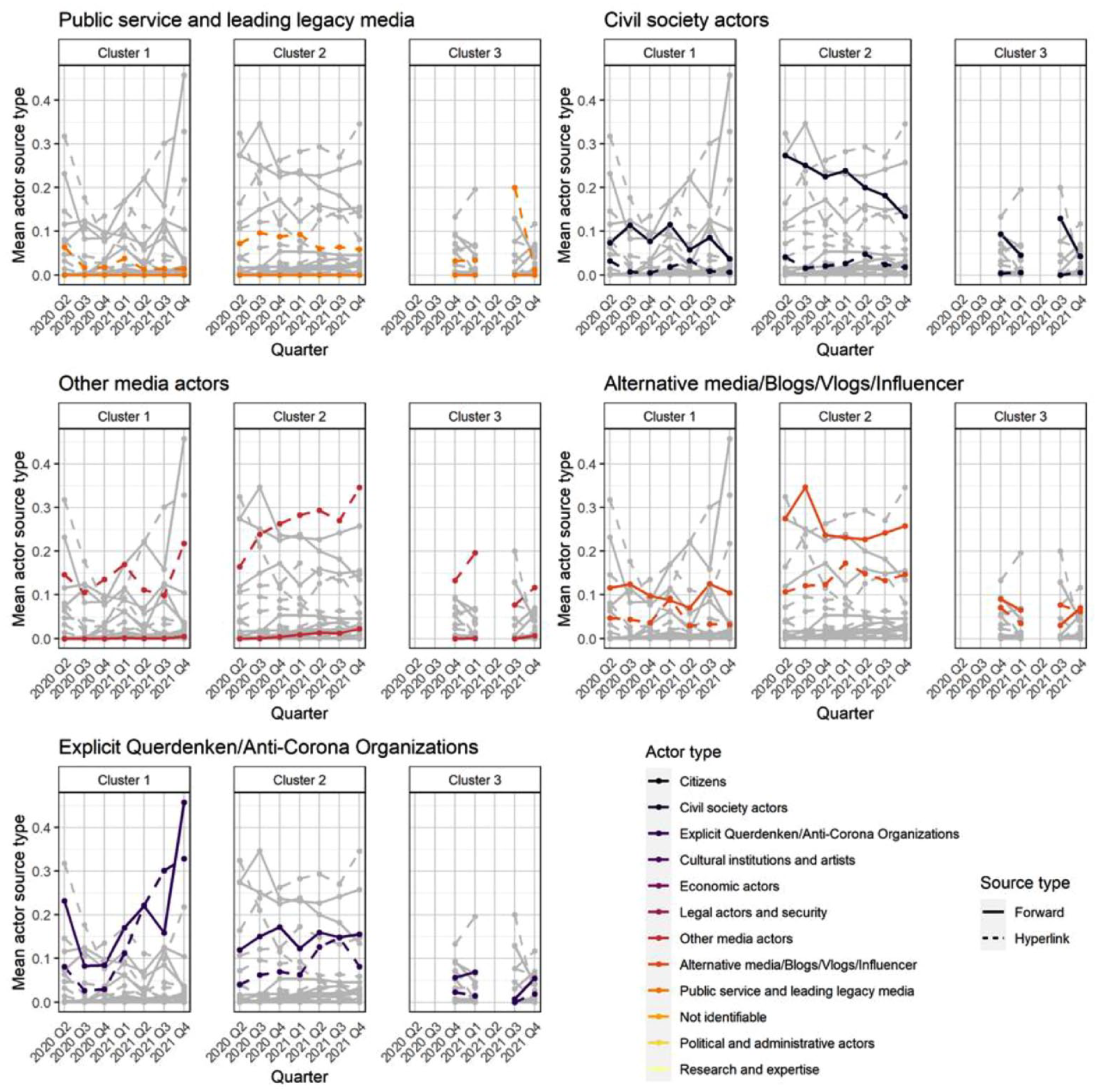
Results from quantitative actor classification of actor types across clusters. For better visibility, focal actor types are highlighted with colors, while the others are in gray.
Discussion and Conclusion
Our study set out to assess the Querdenken digital counterpublic’s dynamics and contribute to our understanding of how both platform features and the uses and functionalities they afford for a movement’s needs—as well as a movement’s self-embedding in specific information ecosystems—reflect, shape, and sustain the movement’s development. We conceptualized Querdenken’s digital communication on the Telegram platform as a networked counterpublic and analyzed the interplay between the platforms’ affordances, their appropriation by Querdenken actors, and these actors’ leveraging of specific information ecosystems to articulate and sustain their claims, mobilize contentious actions, and build the organization, network, and identity.
With respect to the question of the Querdenken digital counterpublic’s “radicalness” throughout the first 2 years of the movement’s development, our study partly corroborates research findings and public debate that describe a move toward the political right and heightened extremeness of actors (RQ2) and content (RQ1) (Grande et al., 2021; Nachtwey et al., 2020), particularly during the latter observation periods. Overall, the movement’s general information distribution and self-promotion have been decreasing in favor of more targeted political and medical content, reflecting increasing politicization. However, conspiratorial content is—and remains—the second-most relevant topic area throughout the whole time period examined in our study. In terms of actors, right-wing actors’ relevance increased, particularly in the third quarter of 2020, while it remained stable in the following time. These overarching findings are in line with previous research that has analyzed Querdenken’s movement communication (Zehring & Domahidi, 2023) and radicalization (Schulze et al., 2022) on Telegram.
While our study partly supports the expected patterns of Querdenken’s development toward more “extreme” contention and mobilization based on movement-induced digital communication, it adds to our understanding of counterpublic development. The interplay between Telegrams’ platform affordances for actors and their leveraging of specific information ecosystems for their specific goals shaped the counterpublic’s structure. To answer RQ3, we particularly demonstrated that (a) the developments within the Querdenken counterpublic and its ecosystems were not uniform and differed between channels and public group chats. Furthermore, (b) distinct ecosystems were established—internally on Telegram itself and externally in the broader cross-platform information space online. Finally, we found that (c) affordances structure this communication, as well as the process of movement-building and organization in rather distinctive ways: Channels administered by movement organizers predominantly differed from chat groups in the information ecosystem they embed themselves in, resulting in a division of information input between movement followers and organizers.
Our data indicated that the channels were the movement’s authoritative spaces through which movement-internal information was distributed. Channels reflected the movement’s organizational hierarchy, emerging as the main aggregators and distributors of information from other Querdenken anti-containment measure groups, which are more topic-focused and more often discuss concrete political and medical issues. While the channels provided limited access, they exerted somewhat more control over the movement’s framing and established the basis for building the organization and its collective action.
However, group chats enabled counterpublic participation by a more diverse range of actors. In this way, they functioned as information brokers for movement-internal and -external communication and information circulation. They further distributed the movement’s organizational communication, but to a similar extent shared other actors’ content. While they invited engagement and were conducive to connective action by mobilizing members and their networked relations, they, likewise, were more open to distributing and sustaining radical positions, as indicated in their tendency to provide more room for conspiratorial content. This is supported by a platform-internal ecosystem on Telegram, as well as alternative external sources that can be used to appeal to audiences.
Regarding the role and structure of Querdenken’s self-embedding in specific information ecosystems, our study demonstrates that the Telegram-internal ecosystem that Querdenken connects to and makes use of has been characterized by more conspiratorial content and a greater share of mobilizing messages that likely originated from Querdenken itself and affiliated actors who used the platform for mobilization and deviant communication. This ecosystem represents itself as homogeneous, largely comprising civil society actors and alternative information distributors, and it supplies Querdenken actors with information from their own organizations and from adjacent organized groups and influencers. This platform-internal referencing practice discloses Telegram’s critical affordance of enabling networking and self-embedding in the movement-building process itself.
The external information ecosystem seems to be used as a resource for more topic-focused content, as a reliable information source and connection to the broader public, and as a means to enrich and diversify the Querdenken ecosystem. However, right-wing actors and content also increasingly have been fed into Querdenken’s ecosystem through external sources, highlighting the cross-platform interconnectedness of connective action and the availability of a broader information ecology conducive to sustaining and supporting the movement’s claims.
Clustering the different channels and group chats based on their most prevalent topics reveals that the counterpublic’s communication structure is shaped and manifested by the interplay between platform affordances and information ecosystems. The topical clusters neither precisely reproduced the channel-group divide of the data sample, nor were they delineated by the predominant use of internal or external sources. It appears that the organized movement actors within the overall counterpublic—who maintained the Querdenken channels mostly, but not completely—focused on topics that the rest of the counterpublic’s actors, who shared content in Querdenken group chats, did not. Instead, a dynamic and time-specific distribution of roles within the networked counterpublic overall can be observed.
Our study revealed how platform affordances and information ecosystems, in combination, structure and sustain a movement’s communication. These findings not only deepen our understanding of the emergence of digital counterpublics, but also inform societal debates about countermeasures against anti-democratic mobilizations and disinformation by highlighting platform architectures’ important and differentiated role, as well as their particular appropriations, which need to be considered when designing platform regulations. Furthermore, the findings indicate that it is essential for both research and platform regulators to consider the entire cross-platform information ecosystem in its networked connectedness and mutual interaction.
Collective and connective actions are practiced not only in the digital realm, but also through offline organization building and protest mobilization, which comprise a significant share of a movement’s activities. Therefore, analyzing Querdenken’s public online communications covered specific parts of the movement’s overall activity. While the aim of the snowball sampling process was to arrive at a sample that was as complete as possible, missing channels and group chats could not be ruled out. We argue that our extensive seed sample and the snowball sampling’s property of detecting high-degree nodes (Kurant et al., 2010) enabled us to discover the most important actors. Telegram channels and group chats belonging to the Querdenken counterpublic that were not part of our sample were likely much less connected to the main counterpublic or already were deleted at the time of data collection (Buehling, 2023). Also, a certain amount of loss in topic model precision caused by noisy text data and message ephemerality could not be ruled out, even though forwarded and hyperlink messages appear to be less ephemeral than organic content (Buehling, 2023). Furthermore, the observed Telegram entities’ geographic locations were distributed unevenly across Germany: More group chats and channels were created in West Germany, while in East Germany, mobilization seemed to rely on pre-existing political networks (Hunger et al., 2022). Thus, future studies on how Querdenken chapters and adjacent regional legacy movements might differ in their information ecosystem embedding and utilization of Telegram’s affordances can enrich the spatial analysis of online counterpublics.
Supplemental Material
sj-docx-1-sms-10.1177_20563051231199430 – Supplemental material for Pandemic Protesters on Telegram: How Platform Affordances and Information Ecosystems Shape Digital Counterpublics
Supplemental material, sj-docx-1-sms-10.1177_20563051231199430 for Pandemic Protesters on Telegram: How Platform Affordances and Information Ecosystems Shape Digital Counterpublics by Kilian Buehling and Annett Heft in Social Media + Society
Footnotes
Declaration of Conflicting Interests
The author(s) declared no potential conflicts of interest with respect to the research, authorship, and/or publication of this article.
Funding
The author(s) disclosed receipt of the following financial support for the research, authorship, and/or publication of this article: This work was supported by the German Federal Ministry of Education and Research under grant numbers 16DII125, 16DII135, and 13N16049 (in the context of the call for proposals “civil security—societies in transition”).

Supplemental Material
Supplemental material for this article is available online.
Notes
Author Biographies
References
Supplementary Material
Please find the following supplemental material available below.
For Open Access articles published under a Creative Commons License, all supplemental material carries the same license as the article it is associated with.
For non-Open Access articles published, all supplemental material carries a non-exclusive license, and permission requests for re-use of supplemental material or any part of supplemental material shall be sent directly to the copyright owner as specified in the copyright notice associated with the article.
