



Abstract
In June 2022, the German government implemented a transit policy offering travelers an unlimited ticket to ride the country’s regional train system all summer long for a mere 9€. Conservative pundits and commentators decried the policy, worrying that the rabble would use their 9€ tickets to overwhelm posh tourist destinations like the island of Sylt in the North of Germany. An overwhelming invasion never materialized, but a fair share of raucous punks did set up shop in Sylt’s public squares in the days after the ticket became available. Just as significant as the physical “invasion” of Sylt were the flurry of memes produced surrounding the Sylt controversy. Through memes, social media participants simultaneously mocked conservative worry about Sylt and punk presence on Sylt. All this memetic play inspired participants to become. Through a mix of identification and disidentification, memes hailed participants into political stances characterized by specific modes of expression. Sylt memery was lulzy, agonistic, and ephemeral. In other words, it was indicative of the broader ambivalence that characterizes public participation inflected by the internet culture. The Sylt story therefore holds lessons about the potentials and pitfalls of collective expression on social media. Memetic becoming, at best, can help people speak truth to power. At worst, it can inspire only a nihilistic smirk as the pixels speed across the screen.
Keywords
The Punks Come to Sylt
Sylt — the island of the rich and beautiful, off the German North Sea. In the center of the 10,000-soul town of Westerland, where normally the more modest tourists of the island promenade, a bizarre scenario unfolds in early June 2022. A group of around 50 punkers has spread out on the central square in front of an Edeka supermarket. They are guzzling bottled beer; a loudspeaker powered by a solar panel is blaring rock music; a woman—who, judging by her tent and sleeping bag has set herself up for a longer stay—is “fishing” for alms with a modified fishing rod; a man in a leather jacket and Dr Martens boots throws himself onto an inflatable rubber unicorn in the central fountain where he floats comfortably. Some bewildered tourists and locals watch the scene from a safe distance. They are not the only ones wondering: Well, how did we get here?
It started in early May, when the German government forwarded the idea of the so-called 9€-ticket. For just 9€, people would be allowed to use the country’s entire regional train system during the months of June, July, and August to compensate for the increased energy and fuel prices resulting from Russia’s war against Ukraine. That may have sounded like a good idea, especially since people with less money would find it much easier to make a trip. But long before the ticket was available for purchase, conservative newspapers published alarmist articles about unintended consequences, like a collapse of infrastructure under the weight of new demand from the rabble. The feared invasion of Sylt became the emblematic horror story for this collapse (“Sylt nicht optimal gerüstet für zu erwartenden ansturm,” 2022). On 2 May the tabloid BILD headlined: “Sylt in fear of the 9-Euro vacationers” (Drechsler, 2022). This was, of course, perfect meme material: The rich and beautiful on Sylt are afraid of the plebs? Well, then the plebs, whatever that means, are happy to burst into the peaceful island paradise—at least in memetic imagination (Figure 1).
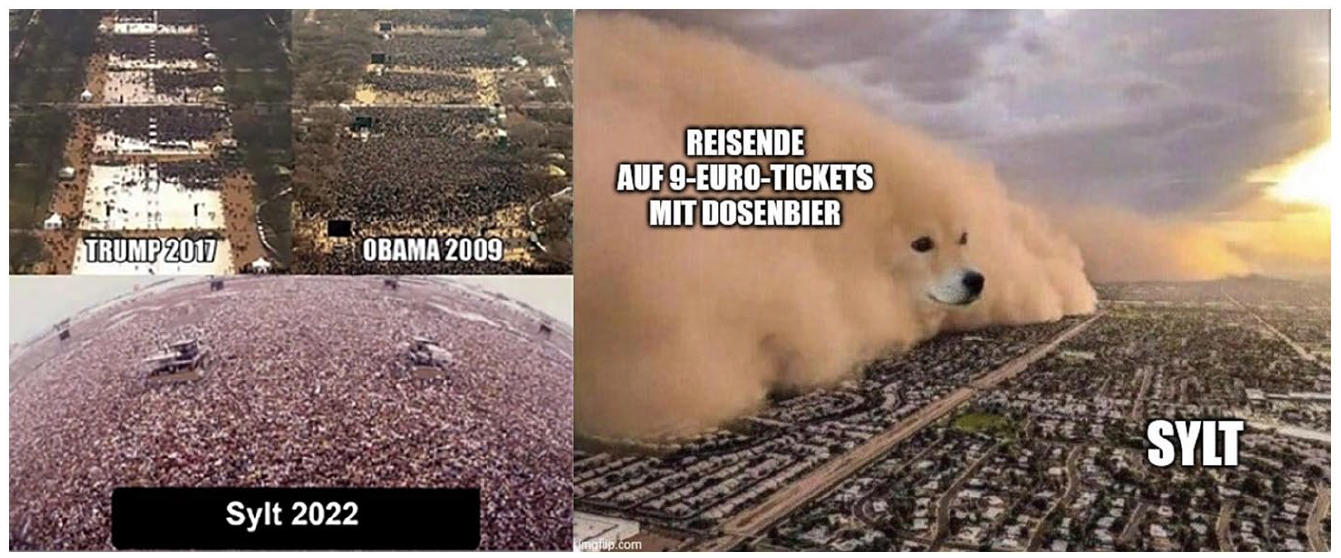
Memetic images depicting the invasion of Sylt by throngs of plebs. Right image translation: “9-Euro-Ticket travelers with canned beer; Sylt.” Collected June 2022.
Stories like Sylt happen all the time. First comes the news, then come the memes—the jokes and the fun, the assertions and counters. And with Sylt, there came the punks, hopping on the rolling meme train that took them to the island for only 9€. Once the social media bandwagons that accompany so many current events and public debates get going, they’re hard to stop. When something significant enough happens, when that something gets enough attention, ephemeral publics will be there to play, create, comment, circulate across social media, and, sometimes, spill out beyond it. As they do, these publics express political identities, identify political comrades, and mark political adversaries. At least for as long as they’re interested in the source material.
At once personal and collective, micro and massive, internet memes like the Sylt punk memes invite their participants to become. They ask those creating them or sharing them or just scrolling through them to adopt a perspective or a premise, to accept a logic or a worldview or an immutable truth. However briefly, however ironically, the images in figure one, for instance, invited readers to accept, first, that a horde was descending on Sylt, and second, that the horde was, honestly, the place to be. On the whole, Sylt memes imagined Sylt punks as a scrappy rabble wrestling happiness (albeit diversely defined) from an elite enclave, and they invited readers to partake in that triumph.
Milner (2016) says that memes work through a combination of appropriation, resonance, and collectivism. Together, these logics constitute the becoming that drives memes forward. When participants apply a reference or an idea to a new situation, when they’re energized or amused by the application, when they create in concert with a jampacked online crowd, they are becoming. They are—at least temporarily, even for a few fleeting seconds—becoming someone else, but also part of a collective beyond themselves. To connect with a meme, to decode that meme well enough to be able to laugh with its premise, to be able to laugh at its targets, requires the smallest bit of becoming. It requires jumping on the train as it speeds across the screen and riding it to its conclusion. And when riders enjoy the journey well enough to spread the word through a like or a share, they invite others to become as well.
Because memes invite people to become, they are essential to the identity and identification at the heart of democratic participation. They’re also often silly and pithy and snarky and fleeting. Their consequence is therefore ambivalent and ambiguous. Sylt memes were all these things and are therefore uniquely instructive. They showcase the how of memetic becoming: how memes hail people into political identities, and how those people identify with, and against, other identities in the process. Sylt memes exemplify the types of publics created during memetic participation. They are a case study in the implications of this ever-present, but constantly churning, mode of public conversation. And that’s no small lesson. As Tim Highfield (2016) points out, memes are a commonplace way to transform significant events into collective fun, not to mention the other way around. The train we’re riding is memey, snarky, finicky, playful, and pushy. It’s fueled by becoming, and that fuel is in no short supply. It’s in our best interest to understand why, how, and to what effect.
How Memes Hail Us
Memes hail their recipients in a playful, non-authorial, deceptively anarchic way. Unlike in Louis Althusser’s (1971) famous scenario in which a police officer hails a subject in the name of the state by yelling “hey, you there” at an individual, memes tend to act on no one’s behalf (and if so, they usually hide it). Authorship etymologically stems from authority (Schaffrick & Willand, 2014), and memes typically lack both. Instead, memetic play with a public moment happens because that moment resonates with the people doing the playing (Milner, 2016). To resonate, a meme has to be on the same wavelength as its recipients; it has to refer to something that’s already there. Something about a memetic moment clicks and inspires the creation, circulation, and transformation that make a meme a meme. That click could be humor or sentiment or outrage, but often underneath is an idea bigger and older than the internet: identification. “I’m sharing this because I see something of myself in this. Because it connects to something I believe.” By inspiring that click memes can hail participants, strengthening existing identities, activating latent ones, or waving people into new subject positions. And if this process is repeated often enough, the amplifying dynamics of resonance sometimes turn a click into a loud bang.
Online or offline, identities are constructed by this click, by what we’re hailed into and the invitations we choose to accept (van Zoonen, 2013; Wittkower, 2014). We feel consistent and coherent, but aspects of ourselves are highlighted or hidden by where we are, what we’re doing, and who we’re with. The beliefs that grow alongside our identities are, to Stuart Hall (1985), “linkages.” How we see the world is intertwined with how we see ourselves in that world, and how we’re “positioned and situated in different ways, at different moments throughout our existence” (p. 16). It’s not that we have no agency in the process. Rather, to Hall (1996), we both recognize ourselves in identities and author ourselves into them.
Absent clear authorial authority, memes hail users through their stance, or, more specifically, how readers interpret that stance. Limor Shifman (2013) says the stance of a memetic text is its perspective, the voice and values it evidences. What’s portrayed as good? What’s portrayed as bad? What’s beautiful, ugly, interesting, boring, weird, cool, cute, or just not relevant at all? Who’s the implied ingroup? Who’s marked as an outsider? What are audiences implicitly being asked to cheer for? To root against? Through an interpretation of its stance, a meme can resonate even if audiences don’t know the identity of its creator, why they created it, or the identities and motivations of any of the countless people who adapted and circulated it after.
Political memes, even ones about transit policy, invite participants to affiliate with something bigger than themselves. Identity is as collective as it is constructed, even if it feels as personal as it feels intrinsic (Harwood, 2006; Turner, 1982). We seek community and belonging, and memes can resonate because they activate that sense of belonging. Bradley Wiggins (2020) catalogs how queer communities online used the titular creepy character from the 2014 horror film The Babadook to hail insiders and create collective identity. Brian Ekdale and Melissa Tully (2014) tell a similar story about the memetic construction in Kenya of the character Makmende Amerudi. Makmende, a remixed internet riff on a tough guy music video character, functions as a “meme of aspiration.” Through photoshops and written jokes and all the usual memery, Kenyan social media participants show off Makmende’s badassery and hail each other into an equally badass collective identity.
Of course, memes aren’t always so affirmative. And neither is identification. Instead, we are often hailed into groups—and often respond to that hailing—because of who those outside the group are not. A heroic us is more resonant when there’s a villainous them (Islam & Hewstone, 1993; Tajfel et al., 1971). Identifying with marginalized, oppressed groups is easier when there’s a hegemony, a ruling class, a common enemy to rally against. Identification by disidentification fits the snarky play so common in memes, and it rides parallel to belonging. “I’m sharing this because I see something I dislike. I am nothing like them. Because look how wrong and stupid they are for what they believe.” This becoming via negativa tracks with political reality. Our “public sphere” is really a multiplicity of interlocking publics and counterpublics, collectives who organize and contest, choosing and assigning sides based on identity and identification (Asen & Brouwer, 2001; Fraser, 1993). The agonistic take on democracy articulated by Chantal Mouffee (2005, 2009) centers on adversarial, collective publics. On who you are not as much as who you are.
Sylt memes played an agonistic game by (re)telling the story of “us against the rich.” This worked because Sylt is a symbolic place in West German history for its money and fame: In the post-World War II era, the island has become an almost mythical setting for the rich and beautiful, including the celebrities of the Hamburg media landscape, such as the notorious BILD editor Axel Springer or the literary critic Fritz J. Raddatz (Knipphals, 2022; Reiter, 2021), flashy entrepreneurs, and groups of foreign playboys. To this day, it is probably the place with Germany’s highest density of Porsches and second homes. In other words, it’s an exclusive place, not only spatially set apart from the mainland, but also shielded from the rest of the world by a financial barrier. Ironically, many former Syltians who still work for the island’s hospitality and tourism industry can’t afford the rents anymore; shut out financially, they have to undertake the stressful transfer between island and mainland on a daily basis—usually by train, which is the only workable connection if you can’t afford a private jet or a yacht. Sylt memes, in contrast, offer inclusion for everybody who feels excluded from the island’s myth of wealth. That is a very heterogeneous public: regular Twitter users as well as regular and occasional train riders, academics, students, workers, down-to-earth people, and those who consider themselves as such.
Against this backdrop, Sylt memes can be read as imagined assemblies of what Judith Butler (2015) calls the “disposable.” Armies of orcs or masses of people clinging to a hopelessly overcrowded train in India, two common subjects of Sylt memes, metaphorically represent gatherings of those who are displaced, substituted, and made invisible by the neoliberal economy if they do not function as they are supposed to. Both the memes and the anticipated assemblies in Sylt thus exercise, as Butler puts it, “a plural and performative right to appear, one that asserts and instates the body in the midst of the political field” (p. 11).
Taking up space is exactly what lies at the heart of politics according to Jacques Rancière (2001). In his modification of Althusser’s police officer scenario, the police don’t intervene by hailing individuals, but by breaking up demonstrations: “Move along; there is nothing to see here!” “Politics,” Rancière says, “consists in transforming this space of ‘moving-along’ into the space for the appearance of a subject: i.e., the people, the workers, the citizens” (p. 22). Ultimately, Sylt memes transformed the island into a space where the Sylt punks made their appearance and asserted their right to stay put. Through this assertion, online and offline, the affordances of spaces, as designed by consumer culture and neoliberal ideology, were subverted: a fountain became a pool, a means of consumer transport a holiday vehicle, and the internet a temporary carnival.
On Reddit, this carnival had uniquely political associations. The subreddit r/SyltRevolution emerged from Sylt meme play, associating Sylt visitors with radical leftist movements. Instead of beer-drinking tourists, the memes shared here often featured communist and anti-fascist symbols, a variation of the widespread “ASyl(t)um for all” sticker, as well as historical images of leftist resistance fighters (Figure 2).
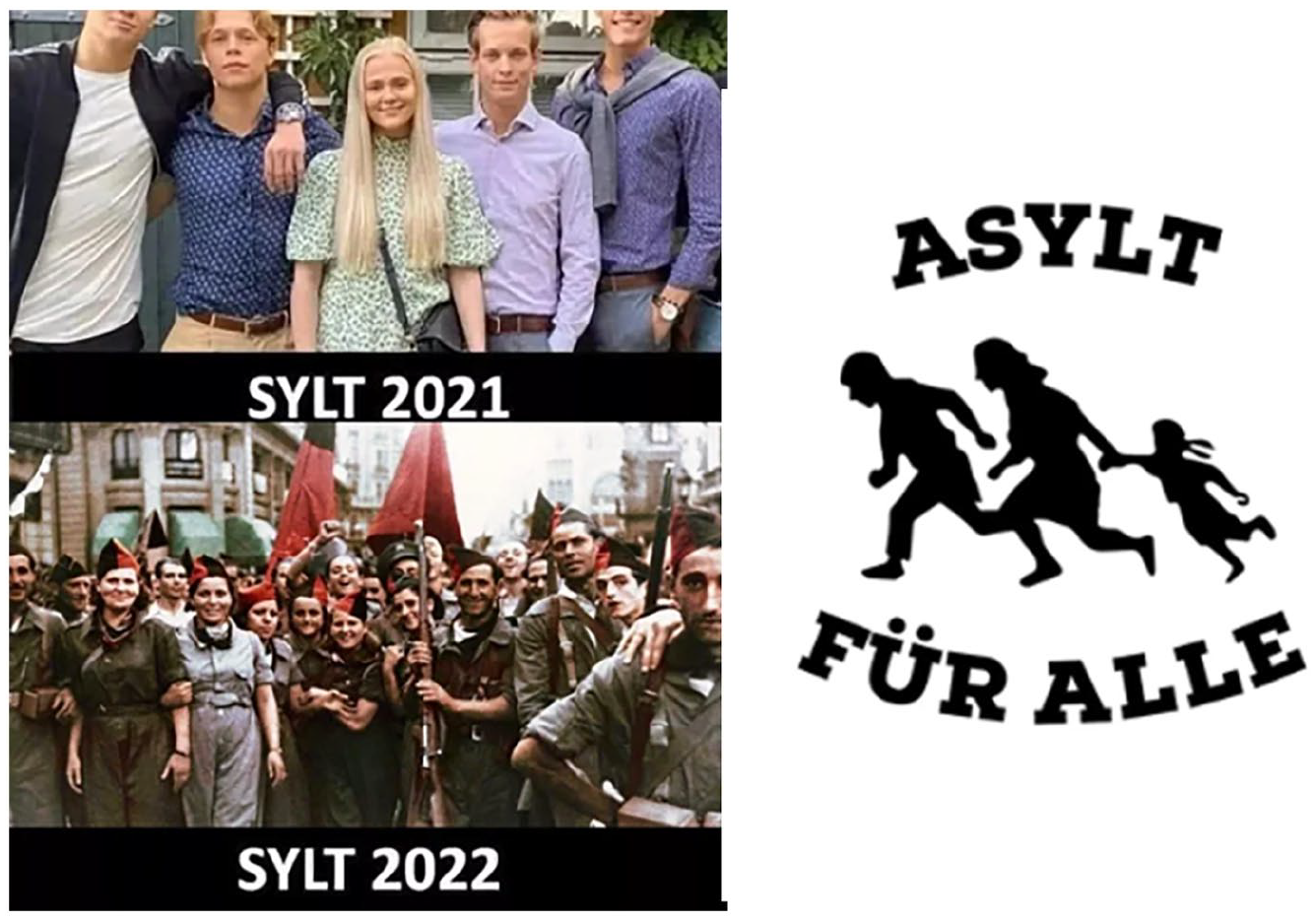
Memetic images depicting Sylt travelers as freedom fighters and refugees. The left image, translated “asylum for all,” is conveniently a pun on “Sylt.” Collected June 2022.
Despite this veneer, and befitting a politics of staying put, most Sylt memes weren’t really hardcore leftwing memes but rather normcore middle-class memes. In contrast to the apparency (and abrasiveness) of radical leftwing politics, normcore is a stance which seeks freedom and happiness via belonging, adaptation, and the unremarkably “normal” as a deliberate choice (K-HOLE, 2013). The ironic of fun of leftist Sylt memes is that, while their stance was radical, their policy position was consciously in line with civic green politics, which advertise the train as the most sustainable means of transport in comparison to cars and especially planes. Sylt train memes negotiate the question of (sustainable) mobility, an issue of everyday politics. Riding on a train is not exactly a rebellious, individualistic, or cool act, but that’s exactly what Sylt memes were about: portraying train travel as desirable and cool, replacing the car as a symbol of social status, consumerism, and freedom of movement. As a symbol, the car not only stands for the (US) American dream and the historical German upswing of the postwar years but is also to this day used by neoliberal politicians for neoliberal policies: Parallel to the 9€ ticket initiated by the Green Party, the neoliberal party pushed through a fuel discount, which was vehemently criticized as subsidizing the oil companies. In mid-July, a good month after the 9€ ticket furor, the luxurious wedding of Germany’s neoliberal minister of finance on Sylt and the much-discussed arrival of the Conservative Party leader to this wedding by private jet revived those discussions. Again, the political elite presented itself as a model of disidentification for the Sylt memers.
The ability of memes to hail participants into a collective identity, to provide a sense identification, and even disidentification, can have civic value. As Peter Dahlgren (2005) explains, people need to see themselves as connected citizens to activate their social consciousness and form empowered civic cultures that are therefore harder to dispose of and disperse. Anahita Neghabat (2021) tells the story of what inspired her to create the popular leftwing Instagram meme account she manages. After a rightwing scandal led to a leftwing political win in her native Austria, Neghabat says, “people were protesting, hugging, and singing—and making memes. Loads of amazing memes. Their memes inspired me, so, in the spur of the moment, I downloaded a random meme-making app” (p. 133). Years later, the account has tens of thousands of followers, and Neghabat says, “at this point, I cannot count the number of politically involved people I got to know through my memes.” (p. 138).
We can’t, of course, know just by observing, just mere months later, whether Sylt memes activated any sort of similar class consciousness. Maybe, in some corner of the internet, Sylt memes inspired civic cultures and hailed working-class activists and will bear fruit long term. Maybe they cobbled together a coalition against the elitism of the island, inviting citizens from all walks of life to become more conscious of class inequality or conscientious about our environmental precarity. Or maybe a bunch of people just had some fun making fun of Sylt denizens and Sylt punks alike before they moved on with their lives. Something resonated either way, for a few days at least, and what it was and how it manifested shows the significance, and ambivalence, of online public participation.
The Train We’re Riding
When meme creators play with political moments like Sylt, they collectively hail each other; they invite others to become through collective identification and disidentification. Understanding the significance of this memetic becoming requires knowledge of how it operates. Memetic bandwagons, Sylt memes included, tend to be lulzy, agonistic, and ephemeral. By connotation alone that may seem like bad news for democratic discourse, but it’s instead an ambivalent mix of potentials and pitfalls. The trick is recognizing both, maximizing the good, minimizing the bad, and choosing well the train we’re riding.
The Fragility of Lulz
Humor is important to hailing because it cements in-group identification (Archakis & Tsakona, 2005). That’s the case with online humor too (Baym, 1995; Papacharissi, 2012). Yasmeen Khaja (2021), studying Kuwaiti memes about the nation’s infrastructure woes, says “for those who get the joke, something like a bond is created” (p. 76). And André Brock Jr. (2020) highlights memes on Black Twitter as a tool for signifying connection to the collective. Fun, in other words, can create and sustain civic cultures because fun makes identities appealing and makes people want to stick around. Both are especially significant in the face of inequality. As Neghabat (2021) explains, humor can be “used by marginalized people to build resilience through a process of self-affirmation” (p. 141).
But memes often aren’t just funny; memes are often lulzy, and that makes all the difference. Lulz, Whitney Phillips (2015) explains in her study of early 2000s internet trolls, is targeted laughter at another’s expense, and it feeds off both identification and disidentification. Adeyemi Adegoju and Oluwabunmi Oyebode (2015) found as much in their study of memes circulated during Nigeria’s 2015 presidential election; the memes worked through a mix of positive portrayals of ingroups and negative portrayals of outgroups. The resonance of Nigerian election memes depended on their agonistic stance toward political others. This lines up with Asaf Nissenbaum and Limor Shifman (2018), who say that the “emotional palate” of memetic expression “tilts toward the negative” (p. 294). In memetic humor, anger, and snark play better than happiness, which when expressed is mostly expressed ironically. Sylt memes were no exception (Figure 3).

Memetic images depicting affluent Sylt residents as mockable elites. Left image translation: “How Giesela and Harald will defend their beach chair.” Right image translation, center front: “Sylt bigwigs”; background left to right: “drunk students,” “me and my friends (also drunk),” “more drunks.” Collected June 2022.
Barbed irony isn’t always all bad. Lulz can speak truth to power, and lulzy memes can get a court jester’s pass to make fun of the king. Najma Al Zidjaly (2017) says Omani political memes allow citizens to express their concerns, “but indirectly and playfully” (p. 580). Anirban K. Baishya (2021) says that memes are valuable as “light critique” of Hindu rightwing politics in India (p. 1130). An Xiao Mina (2014) says memetic play with politics in China “temporarily suspends hierarchies” so that citizens can express dissent with less risk (p. 361). And in the US, Sarah Jackson and Brooke Foucault Welles (2015) observe that critical play with the New York Police Department’s #MyNYPD campaign relied on humorous juxtaposition rather than explicit critique. Sometimes it’s safer to wear a political identity lightly and playfully, and memes provide just that opportunity.
But a threat also lingers in that safe ambiguity. Phillips and Milner (2017, 2021) have articulated the pitfalls of distant, ironic, lulzy laughter that gets its joy from the suffering of others. The pitfalls of being able to hide hatred, not empowerment, behind the “only joking” mask. Of expressing bigotry just long enough to “joke” about it and then chastise others to “lighten up” when you’re called out. Benjamin Burroughs (2013) explains how lulzy fun allowed citizens critiquing US President Barack Obama during the 2012 election season to articulate political emotions they wouldn’t otherwise. This would be pretty liberatory except that so many of those political emotions were conspiratorial racism and xenophobia.
Sheila Bock (2017), in a study of disgraced Southern US celebrity chef Paula Deen, calls this ambiguity “the fragility of the joking frame” (p. 156). In 2013, Deen was caught in racist behavior, and participants took to Twitter to satirically skewer her. Using the hashtag #PaulasBestDishes, they amended traditional Paula Deen meals with racist associations (“Ku Klux Kasserole”) to connect her one brand with her other. The problem was that after a while, intermingled with jokey critiques of Deen’s racism were jokey acts of apparent actual racism. Posters joined in on the “fun” by attaching a racial slur or a negative stereotype about Black people to a random dish. Then there were the folks who missed the message entirely and made jokes about how Paula Deen cooks with too much butter. As all these potential meanings intermingled on the hashtag, it lost poignancy. The joking frame lost its ability to create empowering identification and critique injustice.
Many Sylt memes were similarly ambiguous. As aesthetic and highly referential artifacts rather than unmistakable messages, they often incorporated implicit metaphoric meanings and thus demanded significant background knowledge and interpretive efforts from their recipients. The more dense the referentiality, the more dots to connect, the more room for mixed messages. For example, despite backing cheap transport for all, Sylt memes were often not free from classism. The assembled disposables were the predominant focus of Sylt punk memes, and the stance of these memes largely asserted their power to appear and persist in spaces where they’d historically been shut out. Yet, the compliments were often backhanded. Depicting 9€ vacationers as an army of orcs or as the uncouth characters from the television series New Kids on the Block (Figure 4) didn’t necessarily paint a pro-working-class picture. Very often, the populist heroes of the Sylt revolution were portrayed as little more than simple-minded recreational boozers.

Memetic images with a stance depicting Sylt visitors as social undesirables. Left image translation: “Sylt; 9-Euro-Ticket-Vacationer.” Collected June 2022.
Casting Sylt invaders as undesirables helped create distance between those invaders and the audiences memeing them, even as the stance of the memes appeared sympathetic to the Sylt punk cause. That distance and that dissonance was managed in part by the absurdity of the idea—the whole premise of a Sylt invasion began in mockery of hand-wringing conservative pundits, after all. In fact, so laughable was the meme that, right before the punks actually did it, it became a common Twitter joke that on the first weekend of June, the trains would probably be crowded only with sensationalist journalists. A German-Turkish Twitter user even mentioned that the whole 9€-ticket hype was a very German thing that no one with a migratory background would participate in (@Domibln, 2022). Through Sylt memes, Sylt punks existed as both folk heroes and fictional abstractions.
What to make of Sylt memes was ultimately muddled, especially since the Sylt holiday premise itself was an incongruity, and that was half the fun. Become a punk rebel by embracing government policies and relying on robust green infrastructure to go fuck up a pretty little island, which who on earth would ever actually do that except, oh no, some people actually did. With so many layers of irony to the joke, with so many chances to be sincere or sarcastic, with so few concrete connections or clues about motivation, who participants became while they played wasn’t always evident. This is a tension endemic to lulz. What Phillips (2015) calls “the mask of trolling” is a sort of barbed becoming. To dawn the mask of trolling is to become giddy in the disorientation you cause others and to relish in their frailty. It’s a magnetic stance to adopt; there’s comfort and satisfaction in being part of the us who gets to laugh at the them. The tradeoff is a lack of moral clarity. The efficacy of Sylt memes was fragile, and the liberatory messaging undercut, because, as Viktor Chagas et al. (2019) said of memes about the 2014 Brazilian presidential election, “everything was a reason for goofing.”
Agonism and Its Discontents
While lulzy memes that rely on ambivalent social identity shortcuts may not seem like bastions of democratic deliberation, there’s potential merit in their agonistic stance. As Robert Asen and Daniel Brouwer (2001) explain, public discourse doesn’t have to meet the gold standard of rational consensus building to be valuable. Instead, “expressing identity, raising awareness, celebrating difference, and enabling play” are all helpful in creating civic cultures (p. 7). Memes can do all that, in the process becoming part of what Jackson and Welles (2015) call the “constant negotiation and struggle” required for a just public sphere (p. 938). Clowning on the New York Police Department’s hashtag propaganda didn’t solve police brutality or invite citizens of varying views and backgrounds to the table to create consensus on a path forward. Sylt memes didn’t help the liberals and the greens craft a sensible transit policy. But perhaps they didn’t have to, provided that they established transportation as a trending topic for over a month and created identification with the disposables taking up space in an exclusionary elite enclave. Participants reading Sylt memes through that lens received a liberatory message.
Ambivalence creeps in when the message stops at the meme, when participants are only hailed into the most cartoonish version of a political identity. Sometimes the lack of depth during ephemeral memetic play is as frustrating as the wide breadth is invigorating. Zizi Papacharissi (2002) expresses a similar sentiment about early internet fragmentation. “The ability to discuss any political subject at random, drifting in and out of discussions and topics on a whim can be very liberating,” she says, “but it does not create a common starting point” (p. 17). To post a Sylt meme or share a Sylt meme or argue with a Sylt meme, a person doesn’t need to have read Marx or know the geopolitics of gas prices or be steeped in the history of 21st-century German partisanship. They don’t need to join an actual political party or attend an actual public meeting on transit infrastructure. They only need to feel something resonate and have a Starship Troopers picture handy (Figure 5).

A memetic image of ambivalent stance portraying collective identification. Translation: “When the fatherland recruits me with the 9€ ticket.” Collected June 2022.
With memes, the ticket to becoming is cheap, and it’s easy to jump on and off the train. Could be that a person doesn’t jump off. Could be a Sylt punk meme takes them down the line to Marx or geopolitics or 21st-century German partisanship. Could be that they share an image that inspires a conversation that gets them to a political meeting. But simplified identities and quip-sized assertions alone won’t do the trick.
On the contrary, simplified identities and quip-sized assertions can pull public conversations away from vibrant voice. Collective identification is a powerful engine, but the train can move in a few different directions. Memes have proven very successful at hailing people into oppressive ideologies (Trillò & Shifman, 2021; Tuters & Hagen, 2020). Memetic identification is also a pressure point exploited by manipulative forces, whether they be destabilizing trolls (Stewart et al., 2018) or repressive regimes (Wong et al., 2021). Chris Rodley (2016), examining the flurry of internet memes produced during the 2014 Israel–Gaza conflict, calls the memes “viral agitprop,” saying they didn’t add much to the conversation except the univocal manufacture of consent. Aarushi Bapna and Ajitesh Lockehand (2021) dive deep into that manufacture of consent, examining how rightwing meme makers in India employ a mix of old and new propaganda techniques to lead publics to regressive politics through reductionist memes.
Even more liberatory projects can fall victim to univocal memetic hailing. The empowerment of Kenya’s meme of aspiration, Makmende Amerudi, was ambivalent; Makmende memes were often hypermasculine and misogynistic (Ekdale & Tully, 2014). Their stance built up young Kenyan men at the expense of other genders and orientations. Noam Gal et al. (2016) found similar ambivalence when they analyzed the 2010 “It Gets Better” viral video meme. “It Gets Better” videos were a response to homophobic bullying and its resulting self-harm. In the videos, LGBT adults assure LGBT youths that “it gets better” as they get older and implore them to hang on until then. An uplifting message, but one that left little room for nuance, struggle, or identities and perspectives outside its singular stance. Only one version of LGBT identity and one vision of LGBT liberation existed in the videos.
Propagandistic memes are effective at hailing participants into identities and ideologies in part because it’s so tempting to let them. Resonance can be code for confirmation bias, and we’re more eager to step into positions that feel consistent with the ones we’re already sympathetic too. Heidi E. Huntington (2020) analyzed audience reception of political memes and found that people viewing memes they agreed with scrutinized them less than memes they disagreed with. Memes are great for making an assertion, but that very strength makes them short on the nuance and complication that often marks political reality.
Hailed Today, Gone Tomorrow
Steeped in disembodied disidentification, the Sylt punks were not a tight-knit collective. Instead, they were a temporal community whose gathering on Sylt as well as on social media was limited in time from the beginning. Their memes, as Marc Tuters and Sal Hagen (2020) say of memetic play on 4chan, brought together “a cross-section of actors who may not necessarily share a common political agenda, but who are nevertheless temporally united through affective bonds” (p. 2220). In the case of Sylt memes, of course, the affective bonds were more about who wasn’t in the group than who was. This fits the literature. During online interactions that are less interpersonal, with fewer cues about individual identity, participants will gravitate toward social identity affiliations in their conversations with and assessments of others (Carr et al., 2013; Utz, 2003). When you don’t know who you’re talking to, in other words, stereotypes fill in the gaps. It’s easier to construct a them and become an antipode to everything that them stands for. Memetic becoming, like all identity, is a spiraling track: defining the self by defining who it’s not, which reinforces who the self is, which reinforces who it’s not. That process speeds up when the only identity cues are the pixels shooting across the screen.
It’s not a long ride from the claim that disembodied online identities are ephemeral to the claim that the anonymity afforded by the internet discourages the creation of sustained civic cultures. However, the anonymity isn’t always the issue. The anonymous participation of disembodied publics can be downright liberatory, especially when those participating belong to marginalized groups. Anonymity alleviates fears of repression for Indian meme makers (Baishya, 2021). Anonymity can help empower online networks of Black trans and queer women (Bailey, 2016). Anonymity, or pseudonymity or disembodiment of whatever degree, reduces the cost of memetic becoming. And this becoming, at its best, can create collective bonds and get people on the path to positive change.
The problem with memetic participation is not that it’s ephemeral as in anonymous. The problem is it’s ephemeral as in fleeting. Memetic play is assertive and fun and can tell resonant stories about heroes and villains and the kind of citizen you should become. But memetic play alone tells us nothing about the beliefs or actions of the posters outside of their posts. We don’t know who’s just acting, divorced from more substantial identities and beliefs. Posting a populist Sylt punk meme does not a populist Sylt punk make. It’s easy enough to playact a revolution from a position of comfort. To become a Sylt punk long enough to post like one before going back to whatever ease awaits in embodied life.
If memetic becoming stops with the memes, it doesn’t lead to sustained mobilization or social change. Instead, the next trending topic can act as the shooing police officer imagined by Rancière (2001). The most salient identity in the attention economy is, really, someone moving along. On platform after platform, by affordance after affordance, we are shepherded—to the next hashtag, to the next outrage, to the next joke of the week or villain of the day. To affect real change, though, you sometimes have to stay put. You have to doggedly refuse to move along.
The few examples that bridge social media momentum and sustained social action—like the liberatory Black Lives Matter movement, for better, and the regressive resurgence of explicit white nationalism, for worse—organize beyond fleeting participation. They leverage spontaneous hailing into grassroots action. There are, though, far more examples of memetic moments that don’t sustain affective bonds and don’t translate them into embodied action. Paolo Gerbaudo (2016) said that the 2011 leftwing protests in both Egypt and Spain created moments of “digital enthusiasm,” but those moments “were typically fickle, and levels of user engagement dropped rapidly” over time (p. 256). Vicari and Murru (2021) uncover a similar pattern in Italian COVID lockdown memes, saying that the memes never amounted to any “subsequent political action or collective undertaking” (p. 2).
Some Sylt punks (to their credit?) got a little closer than that. A few punkers did storm Sylt and drink a fair amount in public plazas and make a bit of a mess in a posh town square or two before they rode a 9€ train back home. The connection between the punkers who showed up on Sylt and all the meme makers, retweeters, and commenters ambivalently sharing anti-elite jokes all over the internet was never wholly clear, especially since the punkers were seemingly themselves the butts of many jokes. Maybe the memers and the invaders weren’t ever members of the same public, really. Maybe they happened side-by-side, with only slight nods across two parallel tracks. Regardless, the story stopped when the punks left Sylt, and it faded from public consciousness when the hashtag stopped trending.
The collective becoming that occurs during moments of memetic play is certainly the result of people feeling inspired to jump on the train, but the same digital affordances that enable those connections can also hinder deep and sustained collective action. As Gadi Wolfsfeld et al. (2013) said when evaluating the role of social media during the Arab Spring, to build a movement, “politics comes first.”
Becoming Our Punker Best
As memes cement themselves as a lingua franca for the digital age, memetic becoming is significant in its pervasiveness and the consequences of that pervasiveness. Virtually every big public discussion, every substantial public moment, from liberal transit policies to rightwing insurrections, is fodder for memetic play. Through this play, participants adopt perspectives and reject others, all through the little clusters of pixels they send speeding across their screens.
As internet memes zoom by, so ceaselessly and so intimately, they carry a unique power to hail, to invite participants into shared identities. Through a combination of appropriation, resonance, and collectivism, they give participants the power to become someone or something, for however many posts on however many platforms about however many issues. This becoming is an ambivalent mix of identification and disidentification, of glorifying protagonists and maligning antagonists, one joke at a time, sometimes with inscrutable irony.
The best version of memetic becoming creates consciousness and a sense of place and solidarity for the disposable, the marginalized, and the powerless. It speaks truth to power and laughs in the royal court. The worst version hails people into an us by scapegoating a them. It uses ironic joking to nihilistically mock issues of substance or uses “ironic” joking to mask sincere oppression, squashing dissent and vibrant difference.
Both the best and the worst versions of memetic becoming succeed by creating sustained political momentum that doesn’t stop at jokes on the internet. For better or worse, memetic moments stick when they resist the attention economy’s prod to move along. When they—like Neghabat’s (2021) Austrian meme account—slow down the train long enough to become a sustained presence and give others the chance to hop on. In an age where we are constantly being goaded along, maybe Walter Benjamin (1940/2003) was right; maybe revolution requires that we pull the emergency break.
However fast or slow we go, however long or short we stay, when we play with memes, we are becoming. And we are inviting others to do the same. Lulzy laughter, agonistic contestation, and ephemeral distance are ambivalent tools plied toward ambivalent ends. They fuel many trains going in many different directions. As we choose which one to ride, it’s up to us to mind our memes, know their potentials and their pitfalls, and to stay put long enough to become the Sylt punks we want to see in the world.
Footnotes
Declaration of Conflicting Interests
The author(s) declared no potential conflicts of interest with respect to the research, authorship, and/or publication of this article.
Funding
The author(s) disclosed receipt of the following financial support for the research, authorship, and/or publication of this article: Funded by the Deutsche Forschungsgemeinschaft (DFG, German Research Foundation) under Germany’s Excellence Strategy in the context of the Cluster of Excellence Temporal Communities: Doing Literature in a Global Perspective – EXC 2020 – Project ID 390608380.
