



Abstract
While numerous studies have explored the participatory benefits of social media use for political participation, the empirical literature on the mobilizing role of political memes is nearly absent. In addition, most of the attention has been on Western democratic contexts. By employing survey data from an Asian context—Singapore—this study scrutinizes the impact of exposure to political memes in the interplay between political use of social media and online political participation. In addition, it investigates the contingent role of political cynicism. First, the results show that political social media use is associated with online political participation and that association is mediated by exposure to political memes. Further, moderation analyses indicate that social media use provides participatory gains only for individuals exhibiting low political cynicism. However, when such social media use facilitates exposure to political memes, it primarily mobilizes those with high political cynicism into active online political participation. The results suggest that memes can mobilize disengaged groups into active participation.
In the contemporary democratic landscape, political participation and its determinants, particularly political cynicism, have become central to academic discourse. Active citizen participation, manifesting in institutional forms such as voting and non-institutional ones like recording demonstrations, underpins the health of democratic systems (Soep, 2014). However, a rising tide of political apathy, particularly among the youth, has been observed across various societies, posing a significant challenge to democratic ideals (Pontes et al., 2017; Putnam, 2000; Zhang, 2022).
Central to this discourse is the role of media, especially political social media use, in shaping political engagement. While political cynicism, characterized by distrust in public institutions, has been linked to decreased political participation, its relationship with media consumption is multifaceted. On one hand, negative portrayals of political figures in the media can amplify political cynicism, potentially deterring political engagement (Guggenheim et al., 2011; Kleinnijenhuis et al., 2006). Conversely, passive news consumption on social media platforms has been associated with heightened political cynicism (Song et al., 2021). Nevertheless, informational media use, spanning both traditional and social platforms, has been shown to foster greater political involvement by informing and engaging citizens in political discourse (Boulianne, 2017; Delli Carpini & Keeter, 1996; Gil de Zúñiga et al., 2019; Skoric, Zhu, Goh, & Pang, 2016).
Amid this complex interplay, a novel form of political expression has emerged on social media: political memes. These have rapidly become a significant facet of participatory culture (Ross & Rivers, 2017; Shifman, 2014). The politicized nature of memes has been explored in various settings, such as elections (Ross & Rivers, 2017), political campaigning (Lukianova et al., 2019), political misinformation (Al-Rawi, 2021), geopolitical topics (Dynel, 2022), and political activism (Milner, 2013). Political memes can influence political attitudes (Paz et al., 2021) and be understood as citizen-initiated political participation (McLoughlin & Southern, 2020). However, the intricate relationship between political memes, cynicism, and participation remains underexplored. This study seeks to bridge this gap, examining the impact of political memes on online political participation, with a particular focus on their potential to engage political cynics.
Expanding upon the thesis of political memes as an emerging mode of political communication on social platforms, this study delves deeper into the dynamics between political social media use, political memes, and political cynicism. We posit a hypothesis linking political social media use to online political participation and further examine the mediating role of political memes in this relationship. Recognizing the correlation between political cynicism and political apathy (Dean, 1965; Delli Carpini & Keeter, 1996; Putnam, 2000), we introduce political cynicism as a potential moderator. This suggests that political cynicism may influence the direct and indirect effects of political social media use on online political participation. While existing scholarship has extensively covered the relationship between political social media use and political participation (Boulianne, 2017; Skoric, Zhu, Goh, & Pang, 2016), our focus on political memes offers a fresh perspective, emphasizing their potential to facilitate or inhibit participation. By integrating political cynicism into our framework, we discern how varying levels of cynicism impact the benefits of political social media use, especially when exposed to political memes.
In addition, while numerous studies have paid attention to Western democracies within the context of political participation and, more recently, the political effects of memes (Al-Rawi, 2021; Galipeau, 2022; Paz et al., 2021; Penney, 2019; Ross & Rivers, 2017), attention to Asian democracies continues to be limited. This study situates its inquiry within the context of Singapore. Characterized as a politically apathetic society (Ong, 2021), Singapore presents a unique backdrop for this exploration. Recent evidence confirms the reinforcement of online political participation gaps between the engaged and disengaged groups (Ahmed & Gil-Lopez, 2022). However, some have hinted at the potential of memetic content to spur political engagement in this region (Chen, 2016; Soh, 2020; Sreekumar & Vadrevu, 2013). Yet, comprehensive empirical studies probing this relationship are absent.
In the following section, we delve into the literature encompassing political social media use and its implications for political participation, the influence of exposure to political memes, and the nuanced role of political cynicism, respectively. In the subsequent section, we present a review of the literature and the case of Singapore. Next, we detail the methodology employed, present the findings, and conclude with a comprehensive discussion.
Political Social Media Use and Political Participation
Social media platforms, now deeply embedded in individuals’ daily routines, have emerged as primary conduits for political information (Newman et al., 2018), democratizing access to information and fostering vibrant spaces for civic discourse and political engagement. The ease of information access and the interactive nature of these platforms have democratized political participation, bridging the gap between traditional and digital realms (Mossberger et al., 2007) by complementing traditional political participation with new forms of socio-political information exchange (Gil de Zúñiga et al., 2012). In other words, social media platforms have the potential to replicate offline political engagement by providing an online space to engage in any political activity remotely (Gil de Zúñiga et al., 2012; Shirky, 2011). Therefore, the exponential growth of social media platforms expanded the avenues for information exchange and revolutionized how individuals engage with political and public affairs (Gil de Zúñiga et al., 2012; Shirky, 2011). Meta-analyses of the published research have highlighted a consistent positive correlation between the informational/political use of social media and offline and online political participation across diverse political and cultural landscapes (Boulianne, 2017; Skoric, Zhu, Goh, & Pang, 2016, Skoric, Zhu, & Pang, 2016). Therefore, before we discuss the effects of memes on online political participation, we propose our confirmatory hypothesis based on the above-discussed literature:
H1. Political social media use will be positively associated with online political participation.
Political Social Media Use and Political Memes
In today’s digital landscape, social media offers vast content, ranging from in-depth political analyses by renowned journalists to light-hearted posts shared within personal networks. Central to this eclectic mix are internet memes. These rapidly spreading digital materials have become integral to online interactions, standing out as a unique blend of humor, culture, and information sharing (McKelvey et al., 2021; Moody-Ramirez & Church, 2019).
Internet memes are “artifacts of participatory digital culture” (Wiggins & Bowers, 2014, p. 6). They are also defined as “mediating mechanisms via which cultural practices are originated, adopted, and (sometimes) retained within social networks” (Burgess, 2008, p. 2). Internet memes are more important than ever in political contexts worldwide and are considered a means for individuals to express themselves politically in digital spaces (Leiser, 2019). Memes encompass a variety of formats, including text, images, sounds, and behaviors. They not only proliferate individually but also influence broader societal structures. As Shifman (2013) notes, memes “diffuse at the micro level but shape the macrostructure of society” (p. 372), replicating through imitation and operating under the principles of competitive selection.
The presence of political memes, memes focusing on political issues or subjects, in digital spaces, especially on social media platforms like Facebook, Instagram, and Twitter, is increasingly attracting scholarly attention in the field of political communication (Chen, 2016; Ross & Rivers, 2017; Shifman, 2014; Sreekumar & Vadrevu, 2013). This is especially relevant in the context of the evolving role of social media as the primary news source. News outlets and journalists regularly incorporate memes in their social media updates, mainly to adhere to social norms (Bebić & Volarevic, 2018) and to appeal to a broader demographic (McLoughlin & Southern, 2020). Some viral memes gain attention from traditional news media outlets and become part of a broader public debate, such as Pepe the Frog in the context of the United States (Milner, 2013; Shifman, 2014). In sum, news production, presentation, and consumption today considerably incorporate elements of memes. Given the above, it is conceivable to expect that active political social media use would lead to greater exposure to political memes on social media. Therefore, it is imperative to delve deeper into the evolving dynamics of online political participation.
As digital platforms burgeon as primary sources of political information, they also introduce users to varied participatory formats. Among these, political memes have emerged as a potent tool, resonating with users due to their blend of humor, relatability, and succinct political commentary. Their participatory and persuasive nature offers innovative avenues for idea-sharing, community-building, and cultural engagement (Bülow & Johann, 2023; Shifman, 2014). The allure of memes, particularly in politics, possibly lies in their humor and sarcasm (McClure, 2016). Humor fosters interpersonal interaction (Flamson & Barrett, 2013) and makes traditionally polarizing (political) topics more palatable (Meyer, 2015). Since political memes have such strong communicational potential, many political parties and leaders have also started using them to run effective campaigns in addition to grassroots movements (Harlow, 2013; Lukianova et al., 2019). This phenomenon has also been reported to be prominent in Singapore (Sreekumar & Vadrevu, 2013).
Furthermore, prior research suggests that when disseminating memes, the humorous style and emotionally charged visualization of the information increases audiences’ overall receptivity to encoded messages (Denisova, 2019). Political memes reportedly increase the sense of political efficacy and interest in political topics (Pearce & Hajizada, 2014). However, most prior studies are qualitative (Chen, 2016; Lambrecht, 2023; Sreekumar & Vadrevu, 2013) and meme-content analysis (Bülow & Johann, 2023; Moody-Ramirez & Church, 2019) with limited empirical attempt to draw attention to the relationship between the political meme exposure on social media and online political participation. Scholars emphasize that political communication on social media, especially through memes, profoundly influences democratic participation (Ross & Rivers, 2017; Shifman, 2014). Exposure to political memes often spurs individuals to engage more deeply with political issues and partake in discussions, thereby boosting political participation. Consequently, as political social media use increases exposure to such memes, it may become a pivotal determinant of online political engagement. In essence, the relationship between political social media use and political participation may be intricately linked with one’s exposure to political memes. Hence, we proposed the following mediation hypothesis:
H2. The association between political social media use and online political participation will be positively mediated by exposure to political memes.
The Contingent Role of Political Cynicism
Political cynicism refers to a lack of trust and confidence in political institutions, leaders, and processes (Cappella & Jamieson, 1997; Miller, 1974; Schudson, 1999). It is a multifaceted construct that includes various dimensions, such as distrust of politicians, skepticism about the effectiveness of political institutions, and disillusionment with the political processes (Schudson, 1999). Cynicism, according to Miller (1974), “refers to the degree of negative affect toward the government and is a statement of the belief that the government is not functioning and producing outputs in accord with individual expectations” (p. 952). It is a widespread phenomenon that affects the attitudes and behaviors of citizens in a political system (Miller, 1974). Studies have shown that political cynicism is prevalent among citizens in many countries (Dalton, 2004; Pharr & Putnam, 2000; Schuck et al., 2013; van Dalen et al., 2011). For example, a survey conducted by the Pew Research Center in the United States found that 64% of Americans believe that elected officials do not care what they think, and 58% believe that the political system is broken (Perrin, 2015).
Furthermore, the term cynicism refers to a broad range of beliefs and actions that include various forms of dissatisfied political experiences (Keenan, 1998). However, scholars also argue that populist political actors take advantage of existing dissatisfaction and amplify the extent and range of such discontent (Krouwel & Abts, 2007). For example, Rooduijn et al. (2017) showed that individuals’ exposure to populist messages leads to political cynicism. Similarly, others have also shown that populist attitudes are correlated with political cynicism (Espinosa et al., 2022; Papaioannou et al., 2022). Populist political actors also tend to mobilize reactionary and exclusionary forms of politics among those who are politically cynical, ultimately resulting in a more rigid and widespread negative assessment of politics among them (Krouwel & Abts, 2007). Importantly, scholars have found that populist movements around the world rely extensively on social media platforms to propagate their populist rhetoric and discourse (Engesser et al., 2016; Ernst et al., 2017; Gerbaudo, 2018).
Political cynics feel that the political system and governments are corrupt and ineffective and cannot be trusted (Cappella & Jamieson, 1997). The more cynical attitudes people grow, the less likely they are to participate in political activity, and they may eventually withdraw from political processes (Pinkleton & Austin, 2004). The existing literature illustrates the complexities of political cynicism and its impact on the democratic process. For instance, several studies have found that individuals who hold cynical attitudes toward politics are less likely to engage in political activities, such as they are less likely to join political organizations, participate in community events, vote, attend political meetings, or contacting politicians (Delli Carpini & Keeter, 1996; Putnam, 2000). As mentioned before, Singapore is no exception. Many Singaporeans are politically apathetic, do not actively participate, and lack interest in politics and the political processes (Ong, 2021). Hence, high levels of political cynicism may thus cause a reason for greater political apathy in society.
Based on this background, it is conceivable to argue that the direct effect of political social media use on online political participation may vary depending on individuals’ political cynicism. The effect may not exist for individuals with greater political cynicism than their counterparts. Hence, we propose the following hypothesis:
H3. Political cynicism will moderate the association between political social media use and online political participation, such that the association will be weaker for individuals with greater political cynicism.
Nevertheless, one can still argue that the indirect effect of political social media use on online political participation through exposure to political memes may be more substantial for individuals with greater political cynicism. Studies show that exposure to political memes affects participants’ confidence in political knowledge and spike interest (Pearce & Hajizada, 2014; Schiazza, 2022). Heiskanen (2017) argues that political memes can engage voters who would not ordinarily participate in the electoral process; however, this claim has yet to be supported by empirical evidence. Given that memes can be used for political communication and involvement (Chagas et al., 2019; Lambrecht, 2023; Shifman, 2014) and be effective in engaging politically cynic individuals in politics due to their humor component (Harlow, 2013; McClure, 2016; Meyer, 2015), exposure to political memes may influence political cynics more than their counterparts because those who are not cynics may have trust in political figures and processes regardless. Since this relationship has not been explored in prior studies and because of the lack of empirical evidence on the proposed proposition, we argue that political social media use facilitated exposure to political memes may varyingly influence individuals’ online political participation across their levels of political cynicism. Hence, we propose the following research question:
RQ1: How does political cynicism moderate the mediation association between political social media use and online political participation through exposure to political memes on social media?
The conceptual model is included in Figure 1.

The conceptual model.
Study Background: Singapore
We investigated our proposed hypotheses and research question in the context of Singapore, a country with high internet and social media penetration and politically unique characteristics. Singapore is a single-party dominant political system, with limited room for opposition from other parties, and is characterized as a hybrid democratic city-state (Skoric, Zhu, & Pang, 2016). More specifically, it is noteworthy that levels of political apathy in Singapore are reported to be among the highest in the world (Key, 2021; Ong, 2021). For example, most Singaporeans do not even engage in low-cost political activities like petitioning (Caplan, 2009). A report found that most Singaporeans have little political leanings; about 40% of respondents said they never discuss politics with friends, more than 50% said they do it occasionally, and only 7.1% said they often do it (Ong, 2021). The number of politically disengaged Singaporeans across more costly political actions is also high. For example, they overwhelmingly do not participate in a boycott (79.1%), a peaceful demonstration (74.2%), or an informal strike (88%), nor organize a political activity (90%) (Ong, 2021). Therefore, it is unsurprising that Singapore ranks at the lower end of civic engagement levels than Western societies. Some scholars argue that lacking attention to political news contributes to political apathy in Singapore (Zhang, 2022). However, Singapore’s case is unique in that it is challenging to promote political participation offline, so there may be more online participation (Ahmed & Gil-Lopez, 2022; Ahmed & Lee, 2023). As Singapore has many laws to prevent the country’s stability from being compromised, many laws also apply in the digital spaces. Singapore’s position in Asia also matters globally because of its close economic ties and shared democratic values with Western countries. Here, we argue that it is necessary to look beyond traditional factors associated with political participation and explore the role of an evolving memetic culture that can potentially engage apathetic citizens in politics in Singapore (see Chen, 2016; Soh, 2020; Sreekumar & Vadrevu, 2013). Hence, in this study, we examine the relationship between social media use and online political participation through exposure to political memes and whether this mechanism differs across individuals’ levels of political cynicism.
Method
Sample
An online survey was fielded in Singapore and administered by Qualtrics LLC. Qualtrics maintains a panel of residents in numerous countries and is frequently used by researchers for survey and experiment studies (Ahmed, 2021; Wang et al., 2023). Using quota sampling strategies, we matched the sample to population parameters, focusing on age, gender, and education quotas. Such an approach increases the generalizability of the findings (Min, 2021; Nelson et al., 2021). A total of 550 respondents were part of the study. The demographic details of the sample are included in the “Measures” section.
Measures
Online political participation was measured by asking the respondents how frequently they engaged (1 = never to 5 = daily) in the following political activities online: (a) participated in any online demonstrations, (b) donated money online to a campaign or political issue, (c) signed or shared an online petition, (d) joined a social media group devoted to political issues, and (e) contacted a politician or public official online. The responses were averaged to create a scale of online political participation (M = 1.61, SD = 0.84, α = .93).
Political social media use was measured by asking respondents how frequently (1 = never to 5 = daily) they engage in the following activities concerning social, political, or public affairs news: (a) post in their timeline, (b) comment on posts, (c) share posts, (d) read posts on their news feed, and (e) go to friends’ timelines to read the news. The response to the five questions was averaged to create a scale of political social media use (M = 2.47, SD = 1.04, α = .80).
Political meme exposure was measured by asking the respondents how frequently (1 = never to 5 = daily) they come across memes on politics, political issues, or politicians on (a) social media sites (such as Facebook, Twitter, Instagram, etc.), (b) instant messengers (such as Telegram, WhatsApp, etc.), and (c) the internet (other than social media sites). The responses to the three items were summed to create a scale of political meme exposure (M = 1.94, SD = 0.98, α = .85).
Political cynicism was measured by four items asking respondents to rate their level of agreement (1 = strongly disagree to 5 = strongly agree) with the following statements: (a) politicians are particularly interested in their interest, (b) politicians spend too much time discussing and too little governing, (c) politicians are corrupt, and (d) politicians do not understand what is going on in society. The responses to the questions were averaged to create a scale of political cynicism (M = 3.32, SD = 0.78, α = .85).
We also controlled for several demographics and motivational controls. These include age (M = 43.18, SD = 13.87), gender (49.5% males), education (M = 5.23, SD = 1.38, 1 = no formal education to 8 = doctoral degree), income (M = 5.51, SD = 2.53, 1 = less than US$1,000 to 11 = more than US$20,0000), race (82.7% Chinese), marital status (57.2% married), political interest (M = 2.48, SD = 0.83, 1 = not at all interested to 4 = extremely interested), and traditional media news use (M = 2.89, SD = 1.25).
Analytical Decisions
First, we rely on ordinary least squares (OLS) regression models to check the direct effect among the variables of interest on the outcome variable (online political participation) (H1). Next, we use the PROCESS macro for SPSS (Model 4, Hayes, 2017) to test the mediation effect (H2). Here, political social media use is modeled as the primary independent variable (X), political meme exposure (M) as the mediator, and online political participation (Y) as the outcome. Finally, we use the moderated mediation analyses (PROCESS macro for SPSS Model 15, Hayes, 2017) to test the conditional role of the moderator (W) for the last set of questions (H3 and RQ1).
Results
First, we ran a hierarchical regression model with online political participation as the outcome variable. The results are included in Table 1. The first model (Model 1) included only the control variables. We observe that younger respondents and those identifying as single are less likely to engage in online political participation (age, β = −0.42, p < .001; marital status, β = −0.16, p < .001). Likewise, those with higher political interest were more likely to engage in political participation (β = 0.25, p < .001). A similar pattern was observed for those with higher traditional media new use (online political participation: β = 0.23, p < .001). We noted that, in Model 1, age has the most significant contribution (see coefficient size) compared to other significant controlled factors.
Predicting Online Political Participation and Political Meme Exposure.

Note. arefers to dummy. N = 549; *** p < .001; ** p < .01; * p < .05.
Next, the other independent variables were introduced in the regression models (Model 2). In support of H1, we find that political social media use is positively associated with online political participation (β = 0.14, p < .001). Thus, those frequently using social media for political purposes will likely be politically engaged online. A similar relationship was found among those who had more exposure to political memes (β = 0.45, p < .001). However, we did not find a statistically significant direct effect of political cynicism on online political participation.
Next, we used PROCESS macro (Model 4, Hayes, 2017) to run a mediation model to test H2. The relationship between the variables is illustrated in Figure 2. The results for a regression model predicting political meme exposure are also included in Appendix.

Illustration of the mediation paths.
Formal statistical testing of the mediation process suggests that the relationship between political social media use and online political participation is significantly mediated by political meme exposure (indirect effect: b = 0.11, SE = 0.03, LLCI = 0.11 ULCI = 0.20). Therefore, H2 is supported.
Finally, we employed a moderated mediation model to test the last hypothesis and research question (H3, RQ1). First, the relationship between political social media use and online political participation was found to be moderated by political cynicism (b = −0.10, SE = 0.04, p < .01). The conditional effects of the social media at different values of political cynicism (−1SD, M, and +1SD) are illustrated in Figure 3. Probing the interaction suggests that the moderation is significant for 76.32% of the sample (political cynicism below 3.82). The results indicate that at higher levels of political social media use, the participatory benefits are exploited by those with average (b = 0.12, SE = 0.03, p < .001) and low (b = 0.19, SE = 0.05, p < .001) levels of political cynicism. On the contrary, the online political participation levels for those with a high political cynicism level do not change across political social media use levels (b = 0.04, SE = 0.04, p = .29).
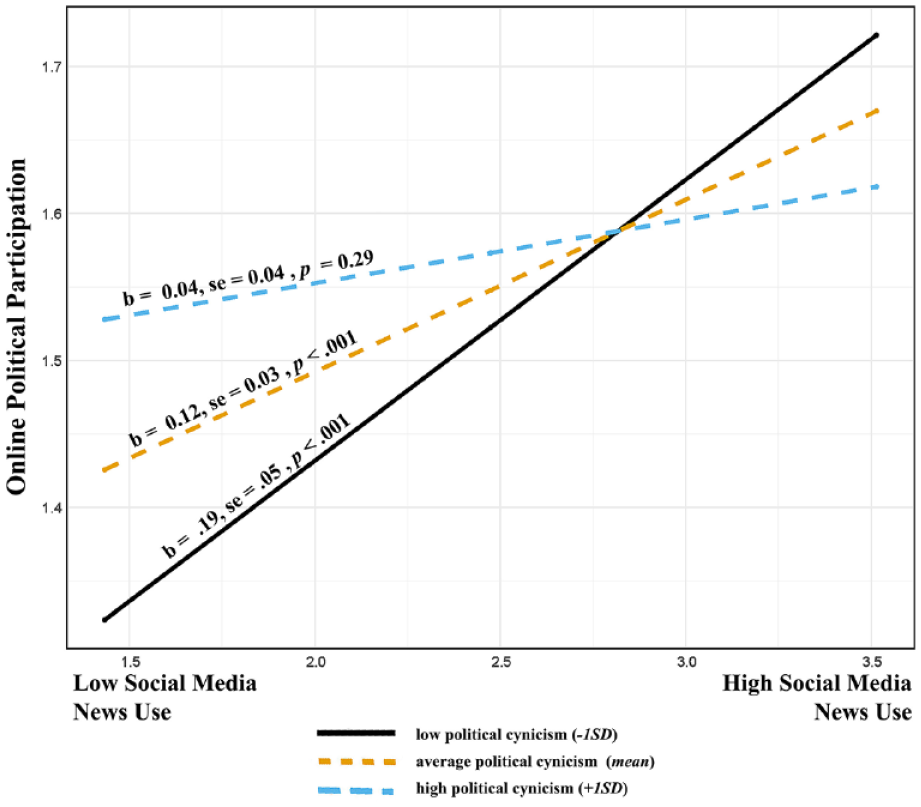
Illustration of the moderation relationship between social media news use, political cynicism, and online political participation.
Next, the moderation of the indirect path was also statistically significant (index of moderated mediation: index = 0.07, SE = 0.03, LLCI = 0.02, ULCI = 0.13). The conditional indirect effects are included in Table 2. The interaction term is also statistically significant (b = 0.17, SE = 0.04, p < .001). The conditional effects are illustrated in Figure 4. Probing the mechanism through the Johnson–Neyman significance test suggests that the moderation is significant for 93.08% of the sample (political cynicism above 2.14). The strength of the indirect effects increases with an increase in political cynicism. The results combined with the interaction findings (Figure 4) suggest that at higher levels of political meme exposure, those with higher political cynicism (b = 0.48, SE = 0.04, p < .001) are more engaged in online political participation than those with average (b = 0.34, SE = 0.04, p < .001) and low cynicism levels (b = 0.21, SE = 0.06, p < .001).
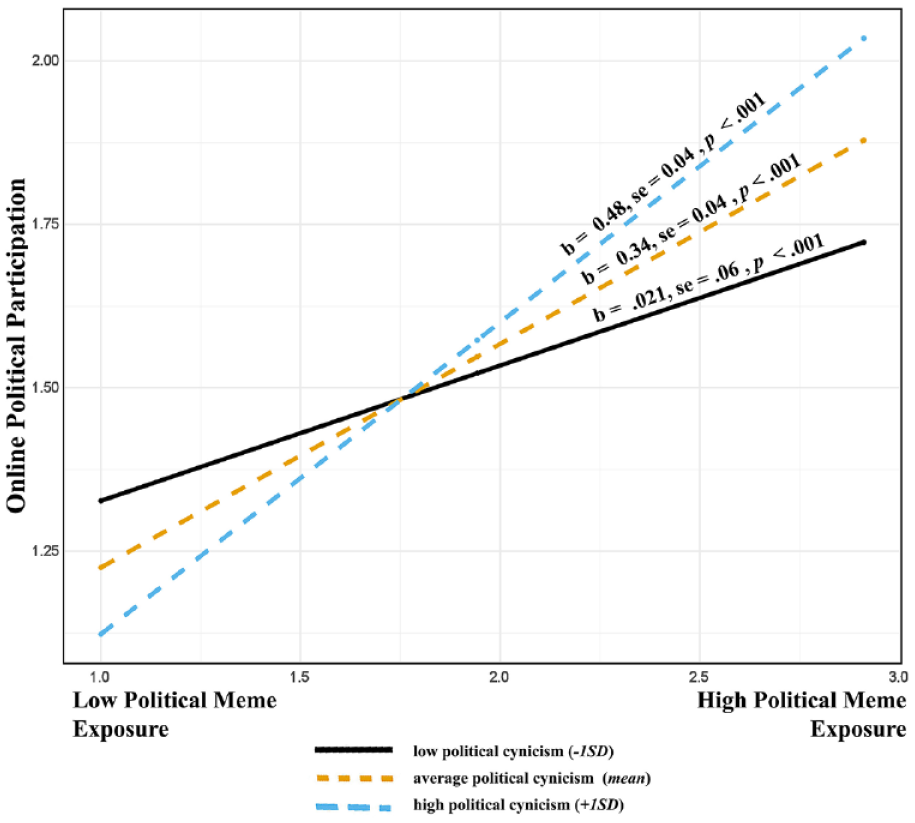
Illustration of the moderation relationship between exposure to political memes, political cynicism, and online political participation.
Conditional Indirect Effect of Political Social Media Use on Online Political Participation Through Political Meme Exposure.

Discussion
This study aimed to understand the impact of exposure to political memes on online political participation, especially for political cynics. We first found, consistent with previous literature, that those with more frequent use of social media for political purposes were likelier to engage in online political activities. Meanwhile, this relationship is also mediated by exposure to political memes. Furthermore, exploring the conditional role of political cynicism suggests that political social media use provides participatory gains but only for those with low political cynicism. However, if such social media use facilitates exposure to political memes, it can draw those with high political cynicism into active online political participation. We discuss these results in detail in the following paragraphs.
First, we found that political social media use is positively associated with online political participation. Second, in extending the scholarship on political social media use and online political participation, we find that exposure to political memes positively mediates this link. Those who frequently use social media for political purposes are exposed to political memes more, facilitating their online political participation. Third, the introduction of political cynicism in the conceptual framework illustrates who gains explicitly and more from the effect of political social media use facilitated political meme exposure.
These results corroborate some observations from Western societies, where citizens are moving away from traditional offline engagement (such as signing petitions or contacting public officials) and moving toward emerging forms of participation online (Wolfsfeld et al., 2016). By showing that the findings generalize to Singapore, the findings reveal that social media channels can facilitate political engagement online even in Singapore—a context with a more tightly controlled news and offline political participation environment (Chan et al., 2018; Rodan, 1998). Citizens in Singapore have been found to predominantly consume and produce political content online compared to offline avenues (Kwan, 2021). Many are also turning to non-conventional forms of political participation online, where memes are deployed as a strategy of pragmatic resistance in political affairs, allowing social media users to evade any charges of sedition (Soh, 2020). Singaporeans use political memes not only as a means of political expression but also as devices of communication with the government (Soh, 2020). Thus, political meme exposure may act as a catalyst for further engagement in online political activities.
Concerning our dataset, the direct impact of age on online political participation piqued our interest, prompting an exploration of the conditional effect of age. Subsequent moderation analyses failed to reveal any statistically significant relationship between meme exposure and age in predicting online political participation (additional findings not included for brevity). The absence of a significant relationship suggests that the influence of meme exposure may not be contingent on age in Singapore. However, it is crucial to recognize that while more empirical research is needed to validate the participatory advantages of memes, the humor and relatability embedded in political meme content may attract a broad spectrum of attention across generations in politically indifferent Singapore, contributing to the civic education of citizens on political matters and public affairs.
Second, our moderation analyses reveal two distinct patterns. Simple moderation showed that individuals with low political cynicism appear to harness the participatory benefits of social media compared to their more cynical counterparts. Such individuals, characterized by a trusting attitude toward politics (Erber & Lau, 1990) and a heightened sense of efficacy (Rodgers, 1974), likely view social media as an indispensable tool for political engagement. They utilize news content to stay abreast of political developments, engage in discussions, and expand their knowledge base. This proactive approach allows them to capitalize on the participatory advantages offered by social media. These findings are consistent with studies based on Western democracies, where those with higher trust gain more participatory benefits in online political participation (Ardèvol-Abreu et al., 2018).
Conversely, moderated mediation results showed that those with high political cynicism demonstrate more significant mobilization in online political participation when it comes to exposure to political memes. This indicates that traditional modes of political information dissemination may fall short for cynics. Political memes, with their ability to distill complex political narratives into digestible and often humorous content (De Leon & Ballesteros-Lintao, 2021), resonate more deeply with this group. Such memes, such as those critiquing the establishment, align with the cynics’ inclination toward anti-mainstream sentiments, further fueling their sense of identification with counter-cultural narratives (Bergh, 2004). For instance, memes serve as a unique political speech genre in Singapore, distinct from traditional media outputs (Soh, 2020). This alternative and simplified mode of political communication not only addresses their grievances but also bolsters their political engagement. Furthermore, exposure to these memes can amplify social validation among cynics, reinforcing their beliefs and spurring them to participate more actively. These results also indicate that online engagement, in the form of memes, may provide channels for political participation among those who do not engage formally in the offline environment. Other scholars have observed similar findings concerning social media platforms, where individuals with higher political distrust have a more significant probability of online participation than those with greater trust (Koivula et al., 2021).
Despite the novelty of this study, it comprises a few limitations which need to be addressed. First, it is important to note that our theorization of political participation is in line with democratic participation principles, and our measures of online political participation do not indicate whether these actions are aimed at undermining the democratic values or vice versa. It is important to note that the likelihood of the type of political participation that undermines the Singaporean government is low because of numerous laws introduced by the state to prevent harming the stability of the country compared to other countries. Therefore, in Singapore, the odds of political participation that are against the ruling regime are less likely. Thus, findings should be inferred with caution in this regard, especially when referring to politically cynical groups in Singapore. Similarly, some of the activities measured in online political participation are more costly than others. While this practice (measure) is used in a number of previous studies, it is important to acknowledge the differences.
Second, it is worth mentioning that the construct of exposure to political memes may introduce some biases. There could be some discrepancies in audience interpretations of memes. Moreover, given the way people communicate online, it should be noted that there are varying degrees of meme exposure and engagement. We did not analyze the nature of meme content. Recent research suggests that some political memes can be used for hate speech and lead to polarization (Galipeau, 2022; Paz et al., 2021). Therefore, future research should also consider the nature of memes to evaluate their participatory benefits.
Third, the cross-sectional nature of the survey data restricts us from making any causal inferences. Panel surveys and experimental studies should be conducted to replicate the current findings. Fourth, although the context of Singapore is similar to that of some regional countries, such as Malaysia and China, in terms of Confucian culture, Singapore has unique contextual characteristics, especially compared to Western democracies. Thus, similar studies should be conducted in other political contexts to examine whether the findings replicate.
Regardless, the findings of this study have implications for the context of the study. As mentioned earlier, Singapore is one of the politically apathetic societies in the world (Ong, 2021; Zhang, 2022). The growing culture of political memes reported in prior studies (Chen, 2016; Soh, 2020; Sreekumar & Vadrevu, 2013) and the findings of this study indicate that political memes could potentially increase political participation among those who use social media for political purposes, such as to consume news and express opinion, primarily benefiting politically cynical citizens. This association could be a result of political knowledge gained from exposure to political memes, which can be explored in future studies. It also suggests that the reported patterns of political apathy in Singapore may decrease with an increase in the memetic communication of politics on social media.
Footnotes
Appendix
Predicting Political Meme Exposure.

| Predictor variable | Political meme exposure | |
|---|---|---|
| β | β | |
| Model 1 | Model 2 | |
| Age | −0.33*** | −0.19*** |
| Gender a (ref = male) | −0.04 | −0.02 |
| Education | 0.13*** | 0.07 |
| Income | 0.01 | −0.03 |
| Single a (ref = married) | −0.09* | −0.07 |
| Divorced a (ref = married) | −0.01 | 0.02 |
| Widow a (ref = married) | 0.06 | 0.06 |
| Separated a (ref = married) | −0.02 | −0.02 |
| Eurasian a (ref = Chinese) | 0.02 | 0.02 |
| Indian a (ref = Chinese) | 0.02 | 0.02 |
| Malay a (ref = Chinese) | 0.02 | 0.01 |
| Others a (ref = Chinese) | 0.02 | 0.02 |
| Political interest | 0.29*** | 0.21*** |
| Traditional media news use | 0.27*** | 0.12*** |
| Social media news use | - | 0.43*** |
| Political meme exposure | - | - |
| Political cynicism | - | 0.16*** |
| Total R2 | .287 | .449 |
Note. arefers to dummy. N = 549; *** p < .001; ** p < .01; * p < .05.
Declaration of Conflicting Interests
The author(s) declared no potential conflicts of interest with respect to the research, authorship, and/or publication of this article.
Funding
The author(s) disclosed receipt of the following financial support for the research, authorship, and/or publication of this article: The study was funded by Nanyang Technological University.
