



Abstract
The digital age has seen a rise in digital hoarding behavior, which is defined as the behavior of accumulating digital files, resulting in stress and disorder. However, little is known about the causes and psychological mechanisms of digital hoarding. To address this research gap, this study proposed and empirically tested a moderated mediation model of social networking site (SNS) users’ causes of and psychological motivation for digital hoarding behavior using an online questionnaire method. We surveyed a total of 556 SNS users online. The results revealed that social comparison of this sort increased individuals’ digital hoarding behaviors and that fear of missing out (FoMO) mediated this effect. In addition, dispositional greed moderated the relationship between this comparison and FoMO as well as the relationship between FoMO and digital hoarding behavior such that these relationships were stronger for SNS users with high dispositional greed. Our research improves our understanding of the operative psychological mechanisms and boundary conditions in the relation between upward comparison via SNSs and digital hoarding behavior.
Introduction
We live in an increasingly digital age, and as people share more digital information on social networking sites (SNSs) (Boyd & Ellison, 2007), an increasing number of opportunities arise for them to accumulate digital materials. To describe this phenomenon, the term digital hoarding was introduced in the literature in 2015 to indicate “the accumulation of digital files to the point of loss of perspective, which eventually results in stress and disorganization” (van Bennekom et al., 2015, p. 1). Since the publication of this case study of digital hoarding, several attempts have been made to verify the existence of digital hoarding behavior (Vitale et al., 2018). Moreover, scholars have attempted to develop a psychometrically valid questionnaire to measure digital hoarding behavior (Neave et al., 2019) and confirmed the general existence of digital hoarding behavior. In addition, certain negative consequences of digital hoarding behavior have been identified. For example, qualitative studies have used thematic analysis to identify the negative consequences of digital hoarding behavior, such as its negative effects on productivity and psychological well-being, issues with cybersecurity, and connections to physical hoarding behavior (Sweeten et al., 2018). Thus, scholars have agreed that digital hoarding behavior is common and has negative consequences for digital hoarders.
Although the literature has provided deep insights into the detrimental impacts of digital hoarding behavior (Sweeten et al., 2018; E. B. Tugtekin, 2022; van Bennekom et al., 2015), the antecedents of and potential psychological mechanisms underlying digital hoarding behavior have thus far received only limited scientific investigation compared with physical hoarding. While most studies of digital hoarding have focused on the workplace context, we continue to have only limited knowledge regarding general digital hoarding behavior (for example, at home and the workplace) in the SNS context. Exploring the relationship between upward social comparison via SNSs and digital hoarding behavior as well as the psychological mechanisms underlying this phenomenon is theoretically important because doing so allows us to acquire more comprehensive and accurate information regarding the psychological states that lead to digital hoarding behavior in a digital era. In practical terms, digital hoarding behavior may be a new disorder similar to physical hoarding disorder that may hinder personal information management (PIM) (Boardman & Sasse, 2004). Thus, the task of exploring the antecedents of and mechanisms underlying digital hoarding behavior can help to improve PIM. PIM is a general term used to describe how digital users collect, store, organize, and retrieve digital items (Boardman & Sasse, 2004; Lansdale, 1988). Knowledge of the psychological mechanisms associated with digital hoarding behavior can be used to identify less destructive means of preventing hoarding behavior, which may improve PIM.
In this study, by drawing on the literature concerning mass self-communication (Bandura, 2001b; Castells, 2007; Valkenburg et al., 2016), we explore the question of whether upward social comparison via SNSs leads to digital hoarding behavior. However, while the mass self-communication literature has noted that upward social comparison has implications for individuals, this stream of research is silent regarding the ways in which upward social comparison affects individuals’ SNS use, and it says little regarding the mechanisms that link upward social comparison to SNSs and digital hoarding behavior. To elucidate the specific pathways by which upward social comparison on SNSs affects digital hoarding behavior further, we draw on the literature pertaining to the fear of missing out (FoMO) (Przybylski et al., 2013) and posit a mechanism to explain the indirect effect of upward social comparison via SNSs on digital hoarding behavior. Specifically, we suggest that upward social comparison via SNSs may increase the presence of a social emotion, that is, FoMO (Przybylski et al., 2013). FoMO is relevant because it contributes to an individual’s psychological states and behaviors in the context of SNSs (Alt, 2015; Scheinfeld & Voorhees, 2022; Tandon et al., 2022; U. Tugtekin et al., 2020). FoMO is individuals’ pervasive concerns regarding missing out on experiences that other people might be enjoying (Przybylski et al., 2013), representing the SNS user’s affective responses (Papacharissi, 2015). In turn, FoMO increases digital hoarding behavior.
Moreover, the literature pertaining to mass self-communication media has posited that personal factors shape individual behavior (Bandura, 2001a). Specifically, the literature has suggested that individual behaviors are influenced by dispositional traits. Accordingly, we extend our theory by identifying individual dispositional greed (Seuntjens et al., 2015) as a moderating factor in the relationship between upward social comparison via SNSs and digital hoarding behavior, since people who exhibit dispositional greed may never be satisfied with the digital files that they currently possess and may continually desire more digital materials. We suggest that dispositional greed may strengthen the relationship between upward social comparison via SNSs and digital hoarding behavior.
This research makes two notable theoretical contributions to the extant literature pertaining to digital hoarding behavior and upward social comparison via SNSs. First, echoing the suggestions of certain scholars to employ a quantitative method to study digital hoarding behavior, we theoretically propose and empirically test a dual-stage moderated mediation model in which the relationship between upward social comparison via SNSs and digital hoarding behavior is mediated by FoMO, with dispositional greed serving as a dual-stage moderator with respect to this mediated effect (Figure 1). Second, our moderated mediation model illuminates the potential detrimental effect of upward social comparison via SNSs on digital hoarding behavior and the boundary conditions of this relationship, thereby revealing the psychological mechanism underlying the potential digital hoarding problem. Although the literature has hinted at the possible negative consequences of upward social comparison via SNSs (Lian et al., 2017; Liu et al., 2019), our study represents the first attempt to explicitly highlight and empirically examine the questions of how and when upward social comparison via SNSs harms digital hoarders.

The hypothesized moderated mediation model.
Theoretical Background and Hypothesis Development
The Mass Self-Communication Literature and SNSs
To understand the possible detrimental effects of upward social comparison via SNSs, we draw on the social cognitive theory of mass communication (Bandura, 2001b), which has proven useful for understanding social media effects on SNS users. Bandura noted that this theory provides a theoretical agentic framework to understand the psychological mechanisms by which symbolic communication impacts human thought, emotions, and behavior (Bandura, 2001a) Specifically, the theory proposes a socially mediated pathway according to which media influences link individuals via social networks to provide personalized guidance for desired behavioral change (Bandura, 2001b; Valkenburg et al., 2016). Importantly, given the rise of the internet and SNSs, media use has become increasingly individualized, thus enabling a new form of communication that remains distinct from mass communication. Castells (2007) has called this new mode mass self-communication. As a result, SNS users select media content to serve their own social and emotional needs. This “new form of socialized communication,” like mass communication, can facilitate interaction with a large audience, but it focuses on self-related emotions and behaviors (Castells, 2007, p. 248).
Based on the concept of mass self-communication, we posit that SNSs, as a typical medium for mass self-communication, may represent a social cue that induces the social emotion of fear and leads to negative behavioral consequences. Moreover, upward social comparison via SNSs may induce a typical fear response inspired by SNSs, that is, FoMO (Przybylski et al., 2013), and thereby result in the accumulation of digital files via social media. In addition, the literature has suggested that personal traits may strengthen the impact of media effects on psychological states and behavior (Bandura, 2001a). We thus propose that dispositional greed may strengthen the impact of media effects on psychological and emotional states and behavior. From this agentic perspective, we are able to produce a coherent picture of the detrimental effects of social comparison via SNSs on social media users.
The Negative Consequences of Upward Comparison via SNSs
This article focuses on the detrimental effects of social comparison via SNSs. We choose this focus because SNS users frequently engage in social comparison. People compare themselves with others who are deemed socially superior in some way (Festinger, 1954). This type of upward social comparison has become ubiquitous and easier via SNSs in the digital era. Specifically, upward social comparison via SNSs may occur on many types of SNSs. Whether on private SNSs such as WeChat or public SNSs such as Weibo, upward social comparison via SNSs can have negative emotional effects and behavioral consequences. We are most interested in the joint or combined effects of these types of SNSs. We proposed that users in these pervasive SNSs can easily become “affective publics” (Papacharissi, 2015) due to the wide upward social comparisons via SNSs. Upward social comparison via SNSs may induce FoMO for several reasons.
First, upward social comparison via SNSs may increase the visibility of the possibility of missing out on activities. As social media is always accessible online, SNS users can easily discover that they have missed out on many activities due to limitations on their time and energy, and they may thus experience negative emotions such as nervousness, anxiety, feelings of exclusion, and experiences of relative deprivation, which can increase FoMO (Baker et al., 2016; Buglass et al., 2017; Hunt et al., 2018). Second, upward social comparison via SNSs may increase FoMO with respect to online activities. Social comparison via SNSs presents SNS users with information, which causes them to believe that others have better experiences than they themselves have, thus increasing FoMO (Bloemen & De Coninck, 2020; Burnell et al., 2019; Yang et al., 2022). Third, upward social comparison via SNSs may increase FoMO with respect to offline activities. On the one hand, upward social comparison via SNSs requires individuals’ time, which reduces the time they can spend on offline social interactions and interpersonal communication, thus causing users to miss out on offline experiences (Alt, 2018; Beyens et al., 2016; Duvenage et al., 2020). On the other hand, life online cannot serve as a substitute for life offline. Therefore, upward social comparison via SNSs may result in FoMO with respect to more meaningful events and experiences offline.
In summary, we propose that upward social comparison via SNSs may increase FoMO by increasing the visibility of the possibility of missing out as well as users’ FoMO on online and offline experiences. Thus, we propose the following:
We further argue that upward social comparison via SNSs is associated with digital hoarding behavior. Individuals who frequently engage in upward social comparison via SNSs experience a high level of negative emotion (Liu et al., 2019), which may result in the accumulation of more digital information regarding activities on which they have missed out, thus increasing their feelings of resistance with respect to suggestions to delete this digital information (Sweeten et al., 2018). Furthermore, the negative emotions associated with upward social comparison via SNSs further increase SNS users’ motivations to engage in digital hoarding behavior (Sweeten et al., 2018). In contrast, when individuals do not frequently engage in upward social comparison via SNSs, they may experience a low level of negative emotion and may have more time and energy to engage in additional experiences offline, thereby decreasing the frequency and probability of accumulating digital items. Overall, we hypothesize the following:
The Mediating Role of FoMO
Based on the literature pertaining to FoMO, individuals’ psychological states may impact their behavior. A high level of FoMO may increase digital hoarding behavior since FoMO may increase the likelihood of accumulating information and files (Przybylski et al., 2013). Moreover, individuals with high levels of FoMO may have more trouble deleting their digitally hoarded items, as they experience more emotional attachment to these items (Holte & Ferraro, 2020). Finally, individuals with high levels of FoMO have been motivated to hoard digital items to compensate for their negative emotions (Buglass et al., 2017; Milyavskaya et al., 2018). In contrast, individuals with low levels of FoMO have less motivation to accumulate useless digital files and are more likely to delete such files. Moreover, these individuals may experience less fear concerning the accumulation and deletion of digital files.
Based on these arguments, that is, on the claims that upward social comparison via SNSs is positively associated with FoMO and digital hoarding behavior and that FoMO is positively related to digital hoarding behavior, we propose the following:
The Moderating Role of Dispositional Greed
Thus far, we have proposed a mechanism—FoMO—through which upward social comparison via SNSs may affect digital hoarding behavior. In this section, we explore the question of the conditions under which upward social comparison via SNSs becomes more or less detrimental for media users. In particular, dispositional greed can strengthen the detrimental effects of upward social comparison via SNSs on FoMO and digital hoarding behavior.
Dispositional Greed as a First-Stage Moderator
Upward social comparison via SNSs is likely to cause negative emotions (Liu et al., 2019) such as FoMO (Y. Y. Li et al., 2021; Oberst et al., 2017), which may motivate individuals to make more social comparisons and to expand their desire. Accordingly, the detrimental effects of upward social comparisons via SNSs on FoMO are more serious for individuals who exhibit a strong tendency toward expansive desires, that is, dispositional greed (Seuntjens et al., 2015). Thus, the social cognitive theory of mass media suggests that dispositional greed strengthens the detrimental effects of social comparison via SNSs on FoMO.
SNS users with high levels of dispositional greed have increased motivation to expand their desires and to remain unsatisfied with their current situation, which may increase their motivation to make upward comparisons and thereby exacerbate FoMO (Przybylski et al., 2013; Zhang & Leung, 2015). Moreover, high levels of dispositional greed may increase SNS users’ perceptions of dissatisfaction, which may further exacerbate negative emotions and result in FoMO (Buglass et al., 2017). In contrast, low levels of dispositional greed may be less likely to increase upward comparisons and dissatisfaction, thereby decreasing FoMO. Thus, we propose the following:
Dispositional Greed as a Second-Stage Moderator
High levels of dispositional greed strengthen SNS users’ motivations to accumulate digital files by constantly causing them to expand their desires and leading them to remain unsatisfied (Seuntjens et al., 2015). In addition, high levels of dispositional greed may cause SNS users to desire to preserve what they have (Seuntjens et al., 2015), thereby causing them to be less likely to delete their digital items. Thus, the motivation to hoard and the resistance to delete that are caused by high levels of dispositional greed may increase digital hoarding behavior (Sweeten et al., 2018). In contrast, individuals with low levels of dispositional greed are less likely to hoard and more likely to delete useless digital items.
Combining this rationale with the hypothesis proposed above, namely, that FoMO is associated with digital hoarding behavior, we further propose that dispositional greed strengthens the relationship between FoMO and digital hoarding behavior. Thus, we propose the following:
Materials and Methods
Participants and Procedure
For both theoretical and empirical reasons, we planned to recruit SNS users for our study. Theoretically, our proposed model indicated that SNS users’ upward social comparisons lead to negative consequences, including digital hoarding behavior. Our research focused on the comprehensive question of “what works for whom” in the context of SNSs to explore the internal psychological mechanism of social media users’ hoarding behaviors. This psychological mechanism is difficult to observe directly through social media big data because of personalization in SNSs (Park, 2014). It is more appropriate to use the self-reported data of users, and SNSs provide a feasible way to recruit social media users in practice.
Data collection was administered in two phases. First, we posted our invitations on typical SNSs (WeChat, Weibo, blogs, and BBS). These SNSs are ubiquitous in China. According to one survey, 85.1% of Chinese people have used WeChat (China Internet Network Information Center, 2020). Thus, these SNSs provided a feasible source to recruit participants. We set only one criterion: we wanted to recruit people who had used SNSs. Empirically, previous studies have used similar methods to recruit SNS users (Lian et al., 2017; Liu et al., 2019). Second, participants were prompted to provide informed consent and to complete the survey. They subsequently received 5 yuan (RMB) to compensate them for their time. To ensure the reliability and validity of the scale, all the scales in this study are mature and have been used by researchers in the Chinese environment (W. Li et al., 2019; Wang & Xie, 2021). Before the formal measurement, we used the original scale through the standard translation–back translation procedure and then invited experts (N = 8) in the field (two professors, three associate professors, and three lecturers) to discuss the construct validity of the scale. Furthermore, a pilot test was carried out in the laboratory to optimize and adjust the testing procedure.
A total of 556 SNS users in China completed the survey in question. The average time that these SNS users spent on social media per day was 4.41 hr (SD = 2.74), with responses ranging from 1 to 18 hr per day. This result verified that our recruits were SNS users. The mean age of participants was 31.81, with ages ranging from 17 to 72; 36.5% of participants were male; and participants’ average yearly income for the previous year was approximately 12.34 (10,000 yuan) (SD = 11.48).
Measures
Upward Social Comparison via SNSs
We measured upward social comparison via SNSs using a six-item scale (Bai et al., 2013). This scale has been used by previous studies to assess Chinese SNS users’ degree of upward social comparison (Liu et al., 2019). Participants were asked to indicate their level of agreement with the included statements (1 = “strongly disagree,” 5 = “strongly agree”). A sample item was as follows: “On social networking sites, I always like to compare myself with others who perform better than me” (for the entire scale, α = .81).
FoMO
Przybylski’s FoMO scale was used to measure FoMO (Przybylski et al., 2013). A research team developed a Chinese version of this FoMO scale, and their results showed that the 10-item Chinese version of the scale exhibited good validity and reliability (Y. Y. Li et al., 2021). Participants were asked to indicate the extent to which the included statements reflected their experiences (1 = “not at all true of me,” 5 = “extremely true of me”). A sample item was as follows: “I fear that others have more rewarding experiences than I do” (for the entire scale, α = .79).
Digital Hoarding Behavior
The digital hoarding scale developed by Neave et al. was used to examine digital hoarding tendencies (Neave et al., 2019). Based on this scale, Wu et al. (2021) used interviews and confirmatory factor analysis (CFA) to develop a digital hoarding behavior scale that was applicable to individuals from a Chinese cultural background, and their results showed that this Chinese version of the scale demonstrated good reliability and validity. We adapted this 13-item Chinese version of the digital hoarding behavior scale to measure digital hoarding behavior. Participants were given the following clear instructions: Modern people often use computers, mobile phones, cloud accounts, apps, USB flash drives, hard disks, CD ROMs and other ways to store a wide variety of digital materials, such as film and television resources, digital documents, spreadsheets, photos, music, email, software installation packages, game resources, web pages, and e-books. Therefore, the “document” in the following questions includes digital files in all forms and contents. Please carefully consider the type and quantity of digital files in your various storage devices before answering.
Participants were asked to indicate their levels of agreement with the included statements (1 = “strongly disagree,” 5 = “strongly agree”). A sample item was as follows: “I accumulate files that others may not keep” (for the entire scale, α = .84).
Dispositional Greed
Following previous research, we measured dispositional greed using a seven-item dispositional greed scale (Seuntjens et al., 2015) that has previously been used to measure dispositional greed in Chinese cultural contexts (W. Li et al., 2019; Wang & Xie, 2021). Participants were asked to indicate the extent to which they agreed with the included statements (1 = “strongly disagree,” 5 = “strongly agree”). A sample item was as follows: “I always want more” (for the entire scale, α = .84).
Control Variables
We measured SNS user age, gender, education level, and yearly income for use as control variables. The literature has confirmed that the amount of time users spend engaging with SNSs predicts their emotions (Arampatzi et al., 2018). Thus, we also measured the amount of time per day users spent engaging with SNSs via an open-ended question: “On average, how many hours per day do you spend on SNSs (e.g., Weibo, Facebook, Twitter, and WeChat)?” (Liu et al., 2019).
Analytic Strategy
We used Hayes’ PROCESS (Hayes, 2017) software to examine our proposed moderated mediation model. In PROCESS, the ordinary least regression function enables the statistical testing of mediation, moderation, and moderated mediation models. PROCESS has frequently been used in the fields of psychology, business, communication, and health sciences for hypothesis testing. Based on our proposed model, Model 4 was used to test the simple mediation model. Model 58 was selected to test our dual-stage moderated mediating model. The main difference between Model 58 and Model 59 is whether the moderator variable acts on the relationship between the independent variable and the dependent variable. Specifically, in Model 59, dispositional greed directly moderates the relationship between upward social comparison via SNSs and digital roaming behavior. The point is whether dispositional greedy people interact with upward social comparison via SNSs and have a direct effect on digital hoarding behavior. If the interaction term is significant, greedy people will hoard unimportant files and not delete any unnecessary digital files and then make upward social comparisons via SNSs even if they have FoMO. However, greedy people may delete some unimportant digital files through their greed for digital things. Thus, we would expect our results to support Model 58. Nevertheless, we run both Models 58 and 59 to test whether dispositional greed directly moderates the relationship between the independent variable and the dependent variable or whether the moderation relationship requires a third mediator variable. Following previous studies (Hayes, 2017; Jo et al., 2022), we set the high/low level of the moderator as the mean plus or minus a standard deviation, respectively. Bootstrapping with 5000 resamples was employed to test the significance of our proposed hypotheses. Prior to testing the moderated mediation model, Harman’s single factor test was conducted using SPSS software, and CFA was conducted to test the dimensionality of the factors using Mplus software (Muthén & Muthén, 2017).
Results
Preliminary Analysis
Before testing our hypotheses, we conducted preliminary analyses. First, Harman’s single factor test was used to determine variance for the single-factor solution (variance = 21.79%, that is, <40%), which indicated that the present research was not affected by common method variance (CMV) (Podsakoff et al., 2012). Second, CFA was used to test the goodness-of-fit indicators of all variables in the moderated mediation model. The model fit of the indices indicated that the hypothesized model exhibited acceptable model fit according to the standards established by a previous study (Hu & Bentler, 1999), χ2(588) = 1,717.51, p < .001; χ2/df = 2.92; comparative fit index (CFI) = 0.83; standardized root mean square residual (SRMR) = 0.06; root mean square error of approximation (RMSEA) = 0.05; RMSEA 90% confidence interval (CI) = [0.05, 0.06]. Given that the sample size was more than 200, the significance of the p value of χ2 was justified (Joreskog & Sorbom, 1996). Thus, these results were encouraging with respect to the discriminant validity of our focal variables.
The descriptive statistics and correlation matrix pertaining to our focal variables are shown in Table 1. Subsequently, we conducted a regression analysis to test Hypothesis 1a and 1b. In support of Hypothesis 1a, upward social comparison via SNSs was positively related to FoMO (b = .34, p < .001); this effect persisted after controlling for SNS user age, gender, education level, frequency of SNS use, and yearly income (b = .31, p < .001). In support of Hypothesis 1b, upward social comparison via SNSs was positively related to digital hoarding behavior (b = .35, p < .001); this effect persisted after controlling for SNS user age, gender, education level, frequency of SNS use, and yearly income (b = .31, p < .001).
Descriptive Statistics and Intercorrelations Among Variables (N = 556).

Note. Gender was coded as follows: 1 = male, 2 = female. The unit of yearly income used was 10,000 yuan (RMB). SD = standard deviation; SNS = social networking site; FoMO = fear of missing out.
p ⩽ .05. **p ⩽ .01.
Model Testing
Hypothesis 2 posited that upward social comparison via SNSs has a positive indirect effect on digital hoarding behavior via FoMO. Mediation analysis results for the effect of upward social comparison via SNSs on digital hoarding behavior via FoMO revealed that this indirect effect was significant, b = .11, 95% confidence interval (CI) = [.07, .15], when using the bias-corrected bootstrap confidence intervals. This indirect effect persisted after controlling for SNS user age, gender, education level, frequency of SNS use, and yearly income (b = .10, 95% CI = [.07, .14]). Thus, Hypothesis 2 was supported.
Hypothesis 3a and 3b posited that dispositional greed serves as a dual-stage moderator of the mediation effect of upward social comparison via SNSs on digital hoarding behavior via FoMO. As expected, both the mediator variable model, F(8, 547) = 31.96, R2 = .32, p < .001, and the dependent variable model, F(9, 546) = 25.44, R2 = .30, p < .001, were significant after controlling for age, gender, education level, frequency of SNS use and yearly income. As shown in Table 2, social comparison via SNSs and dispositional greed predicted FoMO (b = .11, p < .01), and FoMO and dispositional greed predicted digital hoarding behavior (b = .08, p < .05). Figures 2 and 3 depict the relevant interaction plots. As shown in Figure 2, although upward social comparison via SNSs was positively related to FoMO when dispositional greed was low (b = .18, p < .01), this effect was lower than the conditional effect when dispositional greed was high (b = .35, p < .01). Similarly, as shown in Figure 3, the conditional effect of FoMO on digital hoarding behavior was significant when dispositional greed was low (b = .29, p < .01), but this effect was lower than the conditional effect of FoMO on digital hoarding behavior when dispositional greed was high (b = .42, p < .01).
Conditional Process Analysis (N = 556).

Note. Unstandardized regression coefficients are reported. Bootstrapping sample size = 5,000. FoMO = fear of missing out; SNS = social networking site.
p ⩽ .05. **p ⩽ .01. ***p ⩽ .001.
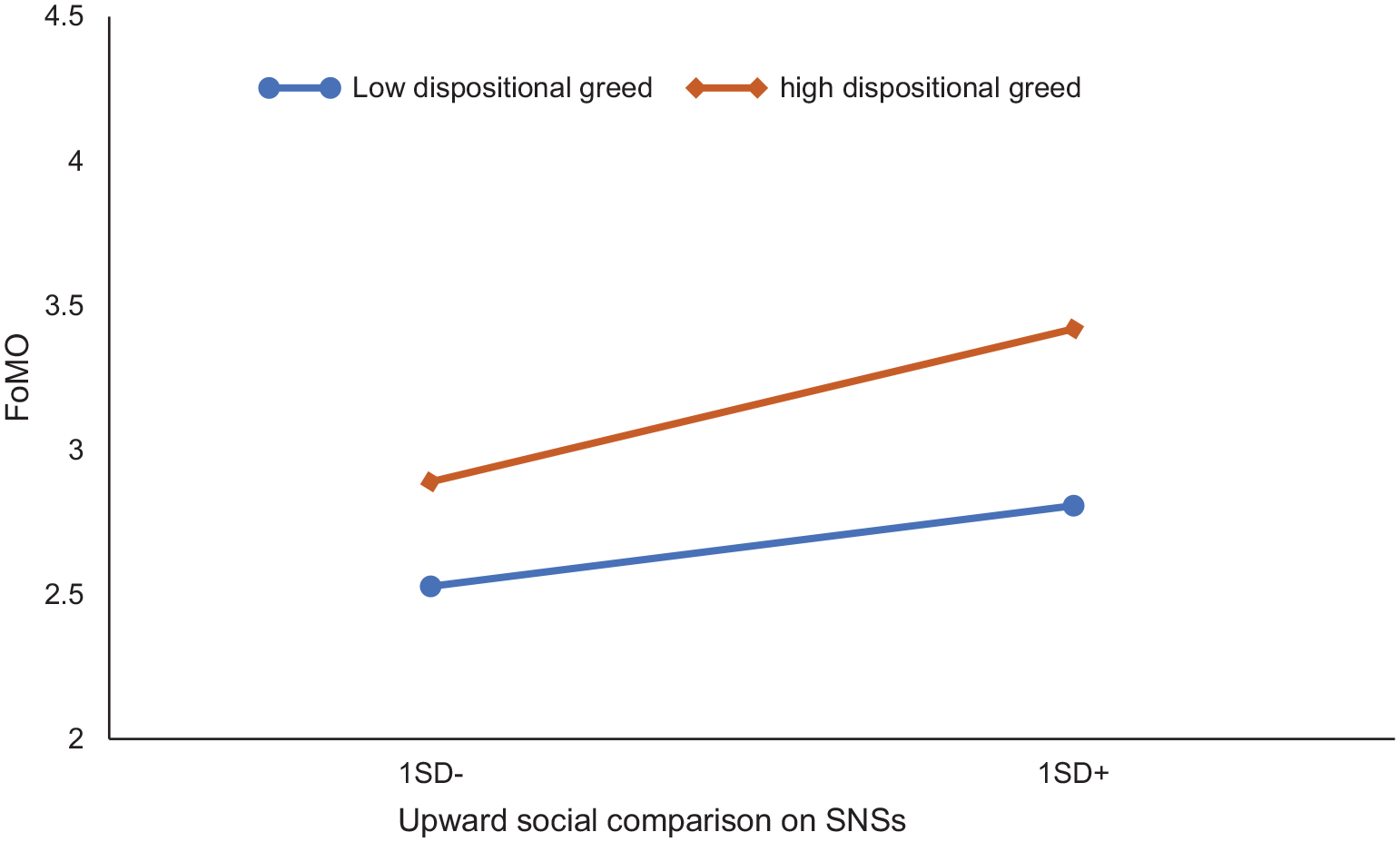
The effect of the two-way interaction between upward social comparison via SNSs and dispositional greed on FoMO.

The effect of the two-way interaction between FoMO and dispositional greed on digital hoarding behavior.
In addition to the two-way interactions, the results further supported a significant moderated mediation model according to which the association between upward social comparison via SNSs and digital hoarding behavior as mediated by FoMO was further moderated by dispositional greed. For SNS users with high levels of dispositional greed, the indirect effect was significant, and the effect for these users was stronger (b = .14, 95% CI = [.08.21]) than for users with moderate (b = .09, 95% CI = [.06, .13]) or low levels of dispositional greed (b = .05, 95% CI = [.02, .09]). These results suggested that dispositional greed strengthens both the positive association between upward social comparison via SNSs and FoMO and the association between FoMO and digital hoarding behavior. Thus, Hypothesis 3a and 3b were supported.
In addition, the main difference between Model 58 and Model 59 is whether the moderator variable acts on the relationship between the independent variable and the dependent variable. Specifically, in Model 59, dispositional greed moderates the relationship between upward social comparison via SNSs and digital hoarding behavior. We further run the data with Model 59, setting dispositional greed to directly moderate the relationship between upward social comparison via SNSs and digital hoarding behavior. The results did not support the interaction term of dispositional greed plus upward social comparison via SNSs (b = .001, p = .32). Thus, our data did not support Model 59.
Discussion
Discussion of Findings
The antecedents of and psychological mechanisms underlying the hoarding of physical objects are already well understood (Frost & Gross, 1993; Grisham & Barlow, 2005; Nordsletten et al., 2013; Steketee & Frost, 2003; Tolin, 2011); however, very little is known regarding the antecedents of and psychological mechanisms underlying the hoarding of digital materials. Therefore, based on mass self-communication theory and its use in the SNS literature, this study constructed a moderated mediation model to examine the effects of upward social comparison via SNSs on digital hoarding behavior and the psychological mechanisms underlying these effects. Our findings revealed that upward social comparison via SNSs was indirectly related to digital hoarding behavior through FoMO and that dispositional greed strengthened the relationship between upward social comparison via SNSs and FoMO as well as that between FoMO and digital hoarding behavior. This integrated model addressed the aspects of both mediation and moderation in one model, thus answering the question of “What works for whom?” in the context of SNSs. Specifically, our moderated mediation model showed that upward social comparison via SNSs increased FoMO and digital hoarding behavior and that these relationships were stronger for SNS users who exhibit high levels of dispositional greed. These results, which could not have been obtained by examining the two questions separately, provide valuable information that can facilitate the early identification and prevention of digital hoarding disorder.
Theoretical Implications
Our research makes several key theoretical contributions to the literature pertaining to digital hoarding behavior and the social cognitive theory of mass communication. First, by showing that upward social comparison via SNSs indirectly affects digital hoarding behavior through FoMO, our study broadens our understanding of the antecedents of digital hoarding behavior (van Bennekom et al., 2015). While previous studies have explored digital hoarding behavior mostly by using qualitative methods (Sweeten et al., 2018; Vitale et al., 2018), quantitative methods have been largely overlooked. To address this gap, our study is the first to propose and empirically verify that upward social comparisons on SNSs can positively predict digital hoarding behavior through FoMO.
Second, our research also contributes to the project of developing a coherent picture of the negative consequences of upward social comparison via SNSs to SNS users, particularly by taking FoMO and digital hoarding behavior into account. On one hand, we found that upward social comparison via SNSs has detrimental effects on SNS users. While certain negative consequences have already been identified (Coundouris et al., 2021; Liu et al., 2019), it remains worthwhile to explore other possible consequences given the wide-ranging impacts of SNSs. On the other hand, by revealing the detrimental consequences of this practice on FoMO, our integrated, two-stage moderated mediation model is the first model to verify the claim that Chinese SNS users’ upward social comparisons can positively predict digital hoarding behavior via FoMO. This finding is consistent with the rare examples of extant literature concerning digital hoarding behavior and the PIM literature (Bergman et al., 2003). Thus, our quantitative study addresses one critical gap in the literature.
Third, our research contributes to the digital hoarding behavior literature by determining when this digital hoarding is more or less likely to occur among SNS users. To obtain a comprehensive understanding of the antecedents of and psychological mechanisms underlying the digital hoarding behavior of media users, it is not only important to examine these antecedents; in addition, the boundary conditions under which relevant antecedents or mediators have stronger or weaker effects must be explored. Based on the social cognitive theory of mass communication (Bandura, 2001a), we found that the extent to which upward social comparison via SNSs promotes FoMO and the extent to which FoMO promotes digital hoarding behavior depend on dispositional greed. Specifically, the positive effects of upward social comparison via SNSs on FoMO and those of FoMO on digital hoarding behavior are greater when SNS users have high (vs. low) levels of dispositional greed (i.e., mean score of greed scale ± SD). Thus, for SNS users with high levels of dispositional greed, engaging in social comparison via SNSs first produces FoMO and subsequently inspires digital hoarding behavior.
Fourth, while the social cognitive theory of mass communication (Bandura, 2001b) provides a useful perspective on the actor-based effects of SNS users’ social comparisons via SNSs on digital hoarding behavior, the current research also complements this theory. Specifically, we expand the scope of social cognitive theory by identifying upward social comparison via SNSs as an important medium for mass self-communication that leads to relevant emotional and behavioral consequences (Castells, 2010). Previous research has focused on so-called mass media (e.g., newspaper, magazines, radio, and television), finding that these forms of mass media affect individuals’ thoughts, emotions, and behaviors (Roberts & Bachen, 1981; Swire & Ecker, 2018). However, we proposed and verified the claim that SNSs, that is, a form of so-called mass self-communication media, can also affect individuals’ thoughts, emotions, and behaviors. More importantly, our results are consistent with those of previous studies regarding SNSs (Buglass et al., 2017; L. Li et al., 2022; Oberst et al., 2017; Zhang & Leung, 2015).
Practical Implications
Our research findings have several important practical implications. First, our research sheds light on one possible reason why SNS users hoard digital items. Specifically, upward social comparison via SNSs increases FoMO and subsequently digital hoarding behavior, although upward social comparison may also have many positive effects. Moreover, our findings also shed light on the psychological mechanisms underlying digital hoarding behaviors. Digital hoarding behavior research is novel, and a more sophisticated understanding of the psychological mechanisms involved in this process is greatly needed. On one hand, our study finds that FoMO is an important psychological mechanism that can produce digital hoarding behavior. This knowledge can be used to identify interventions that could reduce FoMO and thus digital hoarding behavior. On the other hand, FoMO has detrimental impacts on SNS users (L. Li et al., 2022), and these psychological harms should be prevented. Thus, it is desirable to design interventions that target FoMO and digital hoarding behavior simultaneously.
Second, we found that dispositional greed moderates the positive relationship between upward social comparison via SNSs and FoMO as well as that between FoMO and digital hoarding behavior, such that these relationships are stronger for SNS users who exhibit high levels of dispositional greed (i.e., mean score of greed scale + SD). Because people differ in terms of their tendency to exhibit such greed (Seuntjens et al., 2015; Zeelenberg et al., 2022) and because individuals with high levels of dispositional greed are more likely to experience FoMO and engage in digital hoarding behavior, we should pay closer attention to individuals who exhibit high levels of dispositional greed.
Third, our research results have policy implications for how to intervene in social media platforms. When designing SNSs, it is necessary to avoid encouraging excessive upward social comparison. As users search or recommend content to others, attention should be given to controlling the content and frequency of encouraging social comparison to avoid psychological and behavioral problems. For example, some scholars have proposed reducing upward social comparison signals (Aral, 2021), such as the “like” label in Moments on WeChat. With regard to the design of social media, excessive upward social comparison produces psychological and behavioral barriers that impact users’ coping strategies when using SNSs (Lin et al., 2021). Therefore, combining online and offline activities is a measure that can be considered for policy intervention to control the dark side of SNSs (Fu et al., 2020; L. Li et al., 2022).
Limitations and Future Research Directions
Drawing on social comparison theory and the social cognitive theory of mass media, we explored the antecedents of and psychological mechanisms underlying digital hoarding behavior and investigated whether these relationships were contingent on users’ levels of dispositional greed. Although the current research has a variety of strengths (e.g., by producing a theory-driven moderated mediation model, it represents the first study in the digital hoarding behavior literature to propose and empirically verify that upward social comparison via SNSs can positively predict digital hoarding behavior through FoMO), certain limitations and directions for future research are also worth noting.
First, based on our proposed theoretical model, we identified FoMO as the mechanism and dispositional greed as the moderator. We acknowledge that other individual difference factors (such as anxiety or procrastination) could be involved, and we do not imply that dispositional greed is the only factor. Rather, we suggest that dispositional greed is one such individual difference that may strengthen the relationship between upward social comparison via SNSs and digital hoarding behavior. Moreover, scholars have found that anxiety may be a factor in digital hoarding (Neave et al., 2020). Thus, it would be interesting to compare FoMO and anxiety in a future study to explore other individual difference factors and digital hoarding behavior.
Second, the relationship between upward social comparison via SNSs and digital hoarding behavior was explored by employing a cross-sectional method, which did not enable us to investigate the causal relationships among these variables. Future studies could consider experimental designs to explore the causality of the relationship between upward social comparison via SNSs and digital hoarding behavior. It would also be helpful to use big data combined with artificial intelligence to further identify digital hoarding behavior and explore the differential effects of SNS type on digital hoarding behavior (Sreedevi et al., 2022).
Third, because the current research focused on the user-centric effects of upward social comparison via SNSs, we collected data from social media users via quantitative methods. This approach, however, may involve the risk of CMV (Lindell & Whitney, 2001). We, therefore, followed suggestions by previous scholars to minimize CMV (Tandon et al., 2020): (a) the focal scale items for different variables were distributed unevenly throughout the survey; (b) user anonymity was emphasized; (c) users were encouraged to complete the survey truthfully by emphasizing the purely academic nature of the survey; (d) the questionnaire system recorded users’ IP addresses, allowing the survey to be accessed only once; and (e) we provided contact information to allow users to ask questions about the survey. Moreover, Harman’s single-factor test showed that CMV was not a problem for our study. Nevertheless, future studies should use longitudinal designs to further mitigate CMV when examining the psychological mechanisms underlying digital hoarding behavior.
Fourth, it would be an interesting direction for future research to investigate whether cultural background influences the effects of upward social comparison via SNSs on subsequent digital hoarding behavior to address the limitations of our research sample. For our Chinese sample, we used validated Chinese versions of the relevant scales to measure our variables. These scales employed the translation/back-translation procedure to ensure validity and showed good psychometric characteristics with respect to Chinese culture (W. Li et al., 2019; Y. Y. Li et al., 2021; Wang & Xie, 2021). Therefore, these scales were appropriate for assessing Chinese SNS users’ psychological states and behaviors. On the other hand, cultural differences may be relevant to hoarding behaviors (Timpano et al., 2015). Therefore, we believe that considering the role of culture by comparing the Chinese sample with other country samples when investigating the psychological motivations underlying digital hoarding behavior could be a fruitful direction for future research.
Conclusions
This study represents an initial attempt to explore when and how upward social comparison via SNSs affects users’ digital hoarding behaviors. In particular, we highlight the potential antecedents of and psychological mechanisms underlying digital hoarding behavior, including upward social comparison via SNSs and FoMO. These relationships are strengthened by dispositional greed. This knowledge can be leveraged to intervene effectively in cases of digital hoarding via interventions that target users’ FoMO and SNS policies. Moreover, more attention should be given to people with high levels of dispositional greed. We address this gap in the literature by clarifying the mechanisms underlying digital hoarding behavior. We hope that our study will fuel scholarly interest in further exploring the psychological mechanisms underlying digital hoarding behavior.
Footnotes
Data Availability
The data used in this study are available from the corresponding author upon reasonable request.
Declaration of Conflicting Interests
The author(s) declared no potential conflicts of interest with respect to the research, authorship, and/or publication of this article.
Funding
The author(s) disclosed receipt of the following financial support for the research, authorship, and/or publication of this article: This work was supported by the Program of National Natural Science Foundation of China (grant numbers 72174075; 72002139; 71801109); Humanity and Social Science Youth Foundation of Ministry of Education of China (grant number 19YJCZH073); and National Science Foundation for Post-doctoral Scientists of China (grant number 2018M640879).
