



Abstract
Modern politics is permeated by blame games—symbolic struggles over the blameworthiness or otherwise of various social actors. In this article, we develop a framework for identifying different strategies of blaming that protesters use on social media to criticize and delegitimize governments and political leaders. We draw on the systemic functional linguistic theory of Appraisal to distinguish between blame attributions based on negative judgments of the target’s (1) capacity, such as references to their incompetence and policy failures; (2) veracity, questioning their truthfulness or honesty via references to deceitful character or dishonest acts and utterances; (3) propriety, questioning their moral standing by references to, for instance, corruption; and (4) tenacity, suggesting that the politicians are not dependable due to, for example, dithering. We add to this a further threefold distinction based on whether blaming is focused on the target’s (1) bad character, (2) bad behavior, or (3) negative outcomes that the target either caused or did not prevent from happening. To illustrate the approach, we analyze a corpus of replies by Twitter users to tweets by British government ministers about two highly contentious issues, Covid-19 and Brexit, in 2020–2021. We suggest that the methodology outlined here could provide a useful avenue for systematically revealing and comparing a variety of realizations of blaming in large datasets of online conflict talk, thereby providing a more fine-grained understanding of the practices of protest and delegitimation in modern politics.
Keywords
Introduction
Questions of who deserve blame and for what are at the heart of political struggles and protest. Competing public articulations of blame are powerful tools for political persuasion and can be used to challenge or protect an existing social order, legitimize and empower particular actors as “fixers” of the problem, and create new political alliances (Stone, 2012, p. 224). For non-elite groups, blaming may be an effective instrument for pressurizing policymakers to be more attentive to their demands (Johannesson & Weinryb, 2021).
From a discourse-analytic perspective, blaming constructs particular relations between blame makers, blame takers, and their audiences. Protesters who generate blame do not simply express their opinion or signal a sentiment but position themselves discursively in relation to others and try to persuade someone to behave in a certain way. For example, if an ill-treated citizen claims that “policymaker X deserves blame for [bad policy],” it tends to imply that the speaker would like to see the policymaker X removed from power and/or the disadvantageous policy devised by policymaker X ditched. Given that language is a fundamental vehicle for blaming that can affect political decision-making and shape the political landscape, it is vital to develop a fine-grained understanding of the ways in which blame can be generated and used strategically in public communication.
The specific ways in which protesters and other disaffected government outsiders blame the government have remained understudied. While researchers have started to develop automated methods for measuring negativity in political campaign messages on social media (Petkevic & Nai, 2022), to our knowledge, there is no generally applied method for systematically identifying and comparing instances of blame in large datasets of (online) text and talk and differentiating between its various discursive forms. The reason for this lacuna could be that, linguistically, blaming as a constitutive feature of conflict talk may be manifested in various direct and indirect ways (Wodak, 2006). Blaming does not have a typical syntactic structure that could be always easily (automatically) identified in text and talk. It is a complex activity that can be analyzed in terms of discursive strategies—conventionalized conversational practices adopted by speakers or writers to achieve particular goals (e.g., political, social, and psychological). 1 The strategies of blaming could be seen as topic-specific and context-specific calculated uses of linguistic resources for evaluation and argumentation: blame makers use language to negatively evaluate a social actor, behavior, or outcome and argue more or less explicitly that a particular actor should be blamed for their bad character or (in)action.
In this article, we put forward an approach to analyzing discursive strategies of blaming based on the particular uses of evaluative language. From a linguistic perspective, evaluation is fundamental to blaming as it involves expressing a negative judgment of a person, their character, behavior, or outcome of their actions. We suggest that the linguistic framework of Appraisal—an established approach to exploring how linguistic patterns construct evaluation 2 —offers a useful set of categories that we can use to distinguish between different types of blaming. Blaming can be performed more or less explicitly, using more or less explicit evaluative language. When applied to a large corpus of political text from social media or the press, Appraisal analysis can offer important new insights into what aspects of a particular politician, government, or policy have generated public criticism.
In what follows, we first briefly explain the role of blaming in politics. Second, we conceptualize the strategies of blaming in terms of their evaluative basis (type of judgment) and focus (character, behavior, or outcome). We then illustrate the application of the framework by identifying and comparing blaming strategies in a corpus of Twitter messages concerning the government’s contentious policies on Brexit and the Covid-19 pandemic in the United Kingdom. In conclusion, we suggest that the proposed approach could be fruitfully used to identify and compare different ways of blaming in relation to other topics and in other contexts.
Blame and Protest in Politics
Since the 1980s, a growing number of scholars working within several fields have drawn attention to the role of blame in political life. Within political science, there is a substantial body of literature under the rubric of “blame avoidance in government” that illuminates how the risk of receiving blame and losing power affects the policy choices, institutional arrangements, and communicative behavior of officeholders (e.g., Hansson, 2015, 2018b; Hinterleitner, 2020; Hood, 2011; Weaver, 1986). Blame generating is seen as a strategy politicians may use to delegitimize their rivals in the eyes of the public, mobilize their own base voters, and change the policy positions of those they target by blame (Weaver, 2018). Political challengers are particularly incentivized to launch negative campaigns and engage in “attack politics” in an attempt to oust the incumbents (Nai, 2020).
Within sociology and media studies, there has been much interest in political scandals (e.g., Adut, 2008; Allern & von Sikorski, 2018; Entman, 2012; Kepplinger, 2018; Thompson, 2000) and political protest (e.g., Jasper, 2008; Jasper et al., 2018). As political communication, including protest, increasingly takes place online, new forms of blame firestorms have emerged—‘digital outcries’ generated by self-organized or individual activists on social media (Johnen et al., 2018). All of these studies highlight how politicians, journalists, and activists may influence public opinion and bring about significant changes in political leadership, institutions, and policies by attributing blame to certain actors who may be seen as transgressing some norm.
Blaming in politics could be seen as part of a battle over reputations and the cultural construction of certain morally negative characters—‘villains’ or ‘minions’—out of particular people (Jasper et al., 2018). It has been noted that protesters often target blame at governments as “all-purpose villains” (Jasper, 2008, p. 120). There is some evidence to suggest that on social media, people may be more inclined to use uncivil language, such as mockery, pejorative expressions, profanity, and personal character attacks, when addressing political elites (Rossini, 2021).
The blame targeted at political leaders and institutions often revolves around four broad kinds of issues that invite negative public judgment. First, moral transgressions, such as corruption, abuse of power, and inappropriate behavior, have been typical themes of widely publicized blame firestorms—political scandals—in modern democracies (Thompson, 2000). Officeholders’ immoral behavior that may spark a scandal ranges from (more or less) legal to illegal actions and may take place both in the private and in the public realms (Entman, 2012). In the domain of public policymaking, officeholders may be seen as morally flawed if their decisions seem to be driven by malicious motivations rather than public good (Leong & Howlett, 2022).
Second, officeholders are frequently criticized for engaging in deceptive communication or dishonest acts that may undermine citizen’s trust in political representatives and democratic institutions more generally (e.g., Arendt, 1972; Garland, 2021; Mercieca, 2020). Normatively, the truthfulness of the political leaders is vital for democracy (Hansson & Kröger, 2021), and surveys indicate that people expect politicians to display integrity and keep their promises (e.g., Valgarðsson et al., 2021).
Third, the government’s capacity to address social problems, protect people against hazards, devise and implement policies, and manage state institutions is a common basis for evaluation of the government in the eyes of the public (Green & Jennings, 2017). Officeholders may attract blame for incompetence, ineffectual leadership, and various forms of policy failure, ranging from inability to devise desired policy or implement policies as intended to inability to obtain public support for their agendas (McConnell, 2015).
Fourth, people expect political leaders not only to possess the capacity to adequately address social problems and various risks and hazards but also to display commitment and determination when doing so. Lack of energy, motivation, and resolve in public office is generally associated with negative dispositions that deserve condemnation. Leaders who are seen as indecisive, “waffling,” “flip-flopping,” and too slow, tend to be construed as not suitable for office (Bernheim & Bodoh-Creed, 2020). In a similar vein, complacency is regarded as a “vice” in policymaking (Leong & Howlett, 2022).
As we explain in the next section, the linguistic framework of Appraisal provides tools for a systematic analysis of how judgments regarding these basic normative expectations—that political leaders should display propriety, veracity, capacity, and tenacity—are expressed in political text and talk.
Analytic Framework for Strategies of Blaming
Basis of Blaming: Types of Judgment
Originally developed by Martin and White (2005) within the systemic functional linguistics tradition (e.g., Halliday, 1994), Appraisal analysis is concerned with the linguistic resources (e.g., words, phrases, sentences) people may use to express attitudes toward others and the world in three subdomains: Affect (emotional responses, e.g., “worried”), Appreciation (aesthetic evaluation of things, e.g., “ugly”), and Judgment (moral evaluation of human behavior and character, e.g., “corrupt”). Evaluations in each domain can be further categorized in terms of polarity, that is, whether these are positive (e.g., “honest”) or negative (e.g., “dishonest”), and in terms of explicitness, that is, whether the evaluation is inscribed, that is, stated explicitly using attitudinal lexis (e.g., “bad”) or invoked, that is, implied by the information given.
The Appraisal framework has been applied to political language as a means of comparing how politicians attack their opponents in their social media interactions (Ross & Caldwell, 2020) and how opinions about politicians are shaped in mainstream media coverage (Mayo & Taboada, 2017). In our article, we build on this work to show how the Appraisal framework—specifically the Judgment subdomain (Martin & White, 2005, Ch 2.3)—can help us uncover the different ways in which language can be used to evaluate the behavior and character of political figures with respect to social norms. The Appraisal framework proposes that expressions of Judgment may be focused on propriety (how ethical someone is), veracity (how honest someone is), capacity (how capable someone is), tenacity (how resolute someone is), or normality (how unusual someone is). We suggest that the first four of these categories 3 provide a useful theoretical foundation for distinguishing between discursive strategies of blaming in terms of what aspect of the actor, action, or outcome is being evaluated.
Judgments of propriety are assessments of ethical or moral standing, that is, “how far beyond reproach” the behavior or person’s state is. These judgments may be realized via adjectives such as “corrupt,” noun phrases such as “your corruption,” or sentences such as “you’ve broken the ministerial code.” It may also be implied by using a negation of being ethical, such as “the only thing you don’t care about is interest of the public.” 4
Judgments of veracity are assessments regarding the person’s truthfulness or honesty, dependent on social contextual values. This judgment may be realized via adjectives, such as “deceitful” or “dishonest,” using labels that evaluate honesty such as “you are a liar,” or references to dishonest acts or utterances, such as “You lied to us about your oven ready deal.” Negative judgment of veracity may be invoked by referring to the appraised actor’s words as “utter bollocks,” their actions as “betrayal,” or demanding them to refrain from dishonest behavior, for example, “stop gaslighting people.”
Judgments of capacity are assessments of competence and ability. Linguistically, this may be realized via adjectives such as “stupid” or “incompetent,” noun phrases such as “your incompetence,” and sentences such as “you are completely out of your depth” or “you are unfit for public office.” It can also be expressed via negation of competence, such as “you are clearly not able to operate at this level” and “failure of statecraft,” or comparison, such as “we are not as stupid as you.”
Judgments of tenacity are assessments of psychological disposition with regard to determination and resolve, that is, how dependable someone is. Judgments of tenacity may be realized via adjectives such as “reckless,” noun phrases such as “your dithering,” and negations, such as “resign, so we can have a proper leader who isn’t so weak willed.”
The four common normative bases for government-targeted blame attacks described in the previous section map onto these four types of judgment in the Appraisal framework. Martin and White (2005) suggest that the first two—propriety and veracity—may be categorized as judgments of social sanction that are more often formalized in writing and backed up by penalties and punishment, while the latter two—capacity and tenacity—are judgments of social esteem that are generally policed more informally via storytelling and humor.
Focus of Blaming: Character, Behavior, or Outcome
Blaming can be expressed through negative judgment at a micro-linguistic level in various ways that focus more or less directly on the blame takers’ character, behavior, or outcomes of their (in)action. To identify such micro-linguistic patterns, it is necessary to combine the discourse-semantic categorization of Appraisal with some more detailed lexical grammatical analysis (Su & Hunston, 2019).
Targeting blame at the overall bad character of an actor, thereby attacking an opponent personally (argumentum ad hominem), can be an effective persuasive move that questions the credibility and overall moral standing of the target rather than focusing on a single negative event. Blame makers may depict their targets of blame as prototypical “villains” and directly attribute all sorts of negative traits to them (e.g., “incompetent,” “corrupt”, “liar”). At the micro-linguistic level, judgments of character are often expressed through adjectival patterns in two typical ways: through complementation patterns, such as “You are completely unfit to be PM” (negative judgment of capacity) or by using adjectives to modify noun phrases that insult the target of the blame, such as “You have no credibility” or forms of name calling like “Boris the liar” (both negative judgments of veracity). These patterns are used to evaluate the character or attribute of the target of blame without reference to any actions or outcomes that give grounds for the assessment.
Blame makers may argue that their target deserves blame for their bad behavior, that is, for engaging in an act that transgresses some norm (e.g., lying, stealing, killing), although they had an obligation and capacity not to behave badly. In such cases, the behavior is depicted in a negative light (e.g., by calling it “foolish” or “evil”). Negative judgment of behavior is also often expressed through clauses where the target of blame is constructed as an agent who has carried out some kind of action. From a systemic functional linguistic perspective (e.g., Halliday, 1994), these actions can be further subcategorized semantically according to whether they involve their external actions (material processes, such as “you have failed to deliver a deal”), their mental processes (e.g., “you have learned nothing”), or what they say (verbal processes, such as “you keep saying ‘I know . . . ’ but you don’t”).
In the context of government-related blame games, blame makers often argue that the government or a particular officeholder caused a negative outcome (e.g., devised and implemented a harmful policy, such as Brexit in the United Kingdom, or failed to protect citizens against some harm, such as the Covid-19 pandemic), did it intentionally, and had an obligation and capacity to prevent it (Hansson, 2018a). Such attributions of blame may involve formulating an actor-agent performing a blameworthy action, and relative temporal ordering of actions in discourse, so that bad events are depicted as “consequent events” brought about by the actor-agent (Pomerantz, 1978). In those instances, judgment can be inferred from the way that the outcomes of human behavior are evaluated. From the perspective of Appraisal, the evaluation of outcomes (i.e., Appreciation of products and processes) may in certain cases be seen as evoking the judgment of human behavior (Thompson, 2008). This includes possessive noun phrases where the entity evaluated is attributed directly to the person who has produced them (e.g., “your record is one of failure”) or where the actions of the blame target have been nominalized, thereby backgrounding their agency (e.g., “a failure of statecraft”), and existential constructions where the outcome of person’s actions are described as a state of affairs (e.g., “this is a complete shambles”).
The different linguistic formulations of judgment that underlie blaming may be seen as carrying different rhetorical and argumentative import. If an expression of blame focuses on character alone and evaluates the attributes of a person, then it may seem difficult to dispute in a reasonable debate as it could be dismissed by some as a mere act of name-calling or an ad hominem attack. If negative evaluation focuses on an outcome, it backgrounds the agency of the person responsible for that outcome and therefore blame may be seen as less personally focused. However, it could ideally trigger a meaningful debate over the causes and magnitude of the outcome that has been referred to. Judgments that evaluate the behavior of a person strike a mid-point between the former two: the person’s actions are at stake and these can be further justified or criticized depending on the context.
It should be noted that debates are continuing among scholars working within different disciplines as to how blame could be conceptualized. Within these debates, the extent to which “blaming someone for something” (Simion, 2021) focuses on the evaluation of character is an ongoing issue. 5 We have chosen to include all three possible foci of blaming—character, behavior, and outcomes—in our analysis instead of restricting it to only behavior or outcomes. As our aim is to explore possible avenues for differentiating between various ways in which blame may be expressed in public protest, we deliberately take a broader view of what could be seen as blaming. This broader view is also necessary because people who express blame do not always make the causal link between the bad character of the actor and a bad outcome explicit—this is often implied. Blaming should be seen as conversational by nature (McKenna, 2012), so the meaning of each utterance derives in part from what was said before. For instance, blame makers on social media usually do not respond to a politician’s post by saying “I hereby blame you for being corrupt and thereby causing harm to the country’s economic outlook.” Therefore, we use concrete textual references to “being corrupt” (character) or “acting in a corrupt way” (behavior) or “corruption in government” (outcome) as the best possible—while admittedly not perfect—indicators of blaming.
While adopting a broader view of blaming, we clearly distinguish this type of evaluation from other forms of negative expression. For instance, blaming may be part of negative campaigning but campaign negativity does not only involve blaming. The former has been conceptualized in political science in terms of negative tone, policy attacks, character attacks, and incivility (Petkevic & Nai, 2022) while we conceptualize blaming from a linguistic perspective in terms of basis and focus. 6 Character assassination may include expressions of all kinds of negative evaluations beyond moral judgments, such as those concerning aesthetics (“he is ugly”) or affect (“we are really angry with him”). Moreover, various forms of impolite expressions that are used for character attacks do not fall under blaming, such as personal negative vocatives and condescensions (“you dirty little pig”) and ill-wishes (“go to hell”) (see Culpeper, 2015). In line with our use of Appraisal theory, we are concerned with the evaluation of character as an indicator of blame, where this evaluation implies (more or less directly) negative Judgment, that is, the failure to meet moral and social expectations of appropriate behavior. We summarize our proposed framework for analyzing blaming discourse in Figure 1.

Analytic framework for blaming discourse.
Explicitness of Blaming: Invoked and Irrealis Judgments
It is important to remain attentive to how blame may be expressed in multiple covert or roundabout ways. As mentioned earlier, evaluations may be stated explicitly using attitudinal lexis (i.e., inscribed) or implied by the information given (i.e., invoked). While it is relatively easy to spot inscribed judgments as these contain negative adjectives like “bad,” “stupid,” or “dishonest,” the identification of invoked judgments relies on (culturally and contextually specific) inferences and is therefore more complex. For example, blaming via invoked judgments may incorporate metaphorical expressions that in a particular context imply a lack of capacity (e.g., “book yourself in for a full medical and psychiatric assessment” said to the Prime Minister alludes to weakness and limited mental capacity), propriety (e.g., “hand yourself in to the police” said to the Prime Minister implies criminality), veracity (e.g., “don’t you think people can’t see through you” implies that the target is deceiving), and tenacity (e.g., “you have kicked the can down the road”). While less explicit, blaming via invoked judgments does not necessarily have a lesser persuasive power. For instance, metaphors—a common resource for invoking evaluation (Martin & White, 2005)—may be used persuasively to highlight negative features of blame takers and arouse the audience’s negative feelings toward them (Charteris-Black, 2018).
Blaming may involve not only the negative evaluation of a person, action, or outcome as of now or in the past but also the requirement of future changes on the part of the blame target. From the perspective of systemic functional linguistics, judgments may be expressed either as already actualized “realis” judgments or as yet to (potentially) be so “irrealis” judgments (Liu & Hood, 2019, p. 600). The irrealis judgments that concern potential/future states or actions can be constructed through the use of tense and aspect and through the use of cause–effect relations. Negative judgments can appear, for example, in the form of imperatives (e.g., “tell the truth”) and conditionals that imply a cause and effect and call for changes in the target of the blame (e.g., “if you actually believed that, then you would resign”). While these irrealis expressions do not contain explicit negative evaluative lexis such as “lie” or “liar,” both may be seen as powerful blame attacks as they not only judge the veracity of the blame taker negatively but demand that future actions be taken to make reparation for the negative behavior, outcome, or character at stake.
Case Study: Blaming Strategies in Replies to Governmental Tweets about Covid-19 and Brexit
To test and demonstrate the application of this analytical approach to blaming, we analyzed a corpus of social media messages where people responded negatively to policymakers’ statements concerning two different contentious policy issues. We were guided by two research questions:
RQ1. What kind of blaming strategies occur in responses to officeholders’ messages?
RQ2. How do the uses of blaming strategies differ in responses to officeholders’ messages about different policy issues?
Data and Method
For our study, we used a bespoke R script by the third author to compile two corpora of messages posted on Twitter (“tweets”) from the 3-month period between 31 October 2020 and 31 January 2021 when the UK government faced the risk of ending the Brexit transition without reaching a trade deal with the European Union and announced the second and third Covid-19 lockdowns, thereby attracting heavy public criticism. The first corpus, “Governmental Tweets,” consists of 3,968 English Language tweets by 9 ministers and 10 government departments in the United Kingdom (97,668 words). The selection of Twitter profiles for this corpus (listed in Appendix A) was based on the direct involvement of the minister/department with devising Brexit and Covid-19 policies, and having a high number of followers on Twitter. The second corpus, “Replies,” consists of 579,958 English Language replies to these official tweets from Twitter users (11,572,787 words). In this paper, we focus on the second corpus to explore how blame is expressed in replies to the tweets by ministers and government departments about Brexit and Covid-19.
We chose these two topics because both the UK government’s policies related to the leaving of the United Kingdom from the European Union as well as the policy responses to the Covid-19 pandemic have been at the center of intensive political blame games (see, for example, Hansson (2019) and Hansson and Page (2022) on Brexit, and Flinders (2021) on the pandemic). Another important consideration was that the two conflictual issues differ in significant ways: Brexit is a policy devised by the government and seen as economically and/or politically harmful by about half of the voters while the Covid-19 pandemic is universally regarded as a public health hazard against which the government should protect all citizens. Therefore, the study is more likely to find a broader range of blaming strategies than by looking just at a single case, and also allows us to demonstrate how blaming strategies used within different blame firestorms to attack the government can be compared quantitatively.
We began the analysis using a corpus-driven approach and carried out an exploratory keyword analysis of the replies. 7 The keywords from the reply corpus were identified using the Covid-19 corpus in Sketch Engine as a reference corpus, with a minimum frequency of 1,000. The results revealed that “resign” was the most frequently occurring (raw frequency of 10,115) keyword that evoked negative judgment and indicated that the users wanted an officeholder to be removed from the office. Calls for resignation occurred in replies that responded to 1,108 tweets. These blame-triggering tweets included posts that reported governmental actions taken in relation to both blame issues of interest in this study: Covid-19 and Brexit.
As a second step, a subset of 1,000 replies was selected for manual annotation from all those calling for resignation: 500 responding to governmental tweets about Covid-19 and 500 responding to governmental tweets about Brexit. We wanted the sample to contain replies to tweets that had garnered the most calls for resignation, but there was a much greater number of tweets about Covid-19 among those. Therefore, to balance the sample topically, we randomly selected 100 replies from each of the five Covid-related tweets which had garnered the most frequent calls for resignation and included all replies to the 15 Brexit-related tweets that had garnered the most frequent calls for resignation. A summary of the originating tweets, the number of replies containing calls for resignation, and number of replies selected for each blame issue are given in Appendix B.
Each reply was annotated using the UAM CorpusTool 8 for Martin and White’s (2005) subcategories of judgment (capacity, tenacity, veracity, and propriety), the polarity of judgment (positive or negative), and the directness of the judgment (inscribed or invoked). The target of the judgment and the evidence offered in support of the judgment were also coded. These categories were first tested and refined on a pilot sample of 200 randomly selected replies (100 related to each of the two topics), allowing the two coders to discuss the annotations they were uncertain about and agree on the categorization. After the annotations had been reviewed and any discrepancy in coding resolved, a detailed annotation manual was drafted to guide the final coding. 9 This was followed by independent coding of the whole subset of replies. The frequencies of annotated items under each subcategory were identified using the UAM CorpusTool. Each item was then further read and analyzed using systemic functional principles to distinguish between instances of blame that focused on behavior (expressed with an agent who carried out an action), character (a person’s attribute described using an adjective complementation pattern), or outcome (judgment invoked by evaluation of products or processes), and where irrealis judgments were expressed using imperatives and conditionals.
Bases of Blaming
Our analysis allowed us first to identify the uses of the four general evaluative bases of blaming in the replies to governmental tweets in our dataset and compare their relative frequency in terms of the topic of the tweet (see Figure 2).
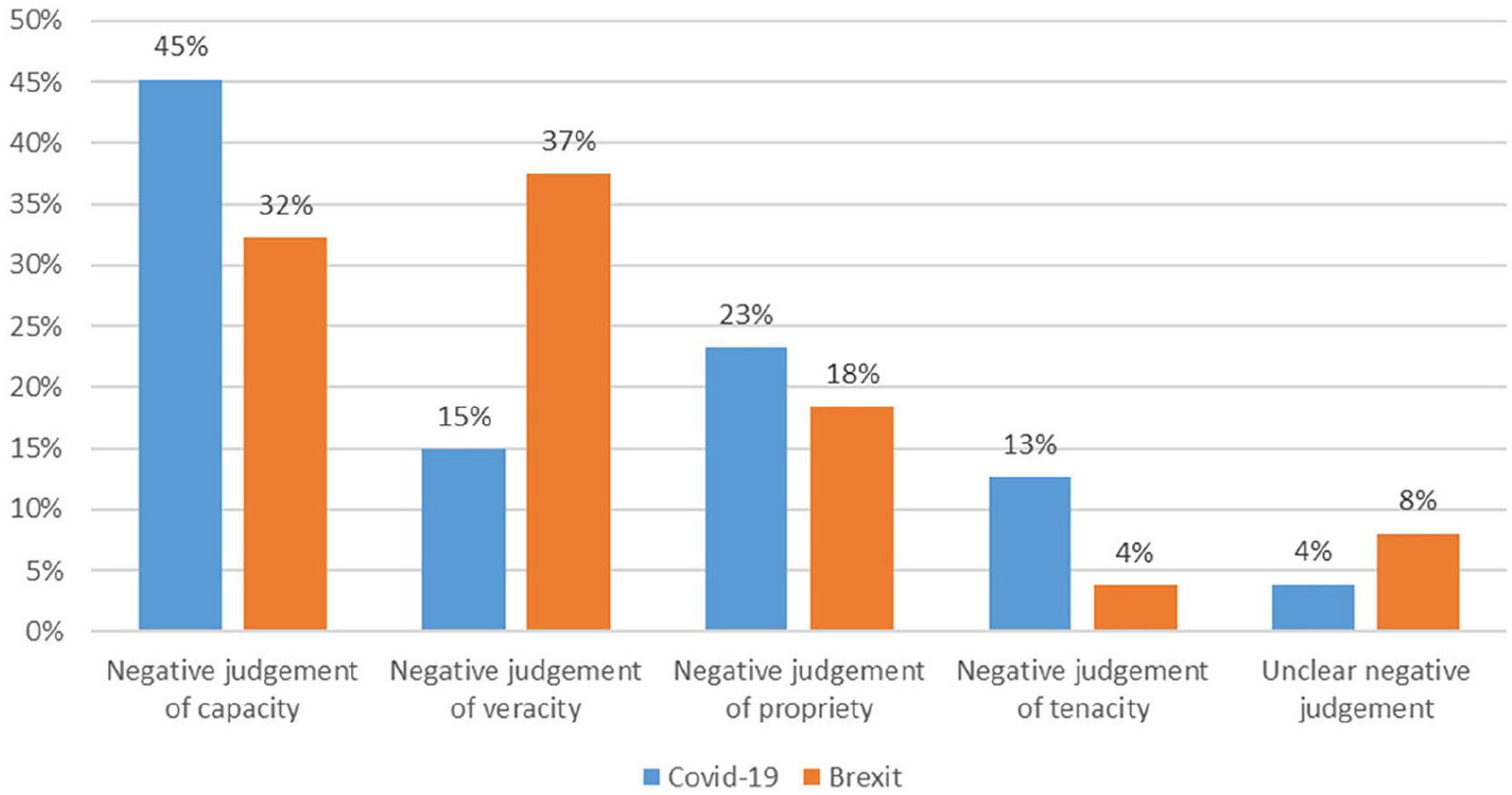
Relative frequency of the evaluative bases of blaming by topic (Covid-19 and Brexit) in Twitter users’ replies to governmental tweets.
Overall, the largest share of blame attributions targeted at a minister or the government as a whole were based on negative judgments of their capacity, such as references to incompetence and policy failures. For example, in their responses to a Prime Minister’s tweet, Twitter users wrote “You are breathtakingly incompetent,” “You have lost the plot,” and “This inept #Government lurches from one disaster to another.” The second most frequent basis for blaming was negative judgment of veracity, questioning the person’s truthfulness or honesty via references to their deceitful character or dishonest acts and utterances, for instance, using expressions such as “You lied on the Brexit bus, you haven’t stopped lying since” and “You sold a lie to the British people.” Notably, it was the most frequent basis for blaming in the replies to governmental tweets about Brexit. Somewhat less common were expressions of blame based on negative judgments of propriety (questioning the moral standing of officeholders by references to, for instance, corruption) and negative judgments of tenacity (suggesting that the politicians are not dependable due to, for example, dithering). We also noted that in some instances the judgments underlying an expression of blame remained unclear. 10
The relative frequencies of these judgments point to the centrality of evaluating the government’s ability to fulfill its duties and reflect people’s desire for truthfulness and sincerity in government communication. The prevalence of certain types of judgment should be interpreted in relation to the particular events at the time and the content of the officeholders’ messages that people responded to on Twitter. The frequent negative judgments of capacity may be seen as triggered by the high number of deaths in the United Kingdom due to the Covid-19 pandemic that blame makers construed as a result of government’s failure to prevent and contain the health crisis. The frequent negative judgments of veracity were related to the Prime Minister’s negotiation of the UK’s post-Brexit trade deal, which he (misleadingly) described as analogous to Australia’s trade agreement with the European Union. This led to accusations of broken promises, lies, and betrayal. For example, in response to the Prime Minister’s tweet, Twitter users wrote “Australian deal?! You’ve just made that bollocks up!” and “This is not what you campaigned on or promised.” The lower frequency of propriety-based judgments—those related to, for instance, corruption, criminal negligence, and lack of empathy—suggests that neither of the blame issues were seen by critics primarily as matters of propriety at the time (although scandals over integrity did later emerge in relation to Cabinet ministers’ apparent disregard of the Covid-19 restrictions).
Foci of Blaming
Our micro-level analysis allowed us to further delineate between the expressions of negative judgment in terms of whether these focused on behavior, character, or outcomes attributed to government officeholders. The results of this analysis are summarized in Table 1.
Frequency of Negative Judgments by Topic and Focus in Twitter Users’ Replies to Governmental Tweets.

These results show that overall, the expressions of blame in responses to officeholders’ tweets were most frequently focused on their behavior, accounting for nearly half of the judgments (47%), while their character was directly evaluated less (29%) and the outcomes of their (in)action less still (24%). The high proportion of behavior-focused negative judgments was similar for both conflictual topics overall, accounting for 48% of the judgments in the replies about Covid-19 (n = 140) and 45% of the judgments in the replies about Brexit (n = 171).
A closer look suggests, however, that the proportion of behavior-focused expressions of blame varied by the type of judgment. In the replies concerning Covid-19, the behavior-focused judgments of tenacity appeared relatively more often than those of capacity or veracity. This highlights how in the case of the pandemic, lack of tenacity became a focus for outcries about the government’s unsatisfactory approach to decision-making: either failing to make decisions in a timely manner or making decisions that were later revoked as “U-turns.” For example, responses to the Prime Minister’s tweet contained expressions such as “Your inability to make tough, timely decisions has caused the deaths of thousands” and “You again just kicked the can down the road!” The replies concerning Brexit contained the largest proportion of behavior-focused judgments of veracity. This finding underlines how government’s veracity was questioned due to the government’s misleading description of the trade deals being negotiated as the United Kingdom completed its transition from the European Union, and more generally, due to public doubt over whether the government’s approach to Brexit was consistent with their previous pledges.
Name-calling and insults, along with statements which negatively evaluated the person’s character, were used in replies concerning both Covid-19 and Brexit. Character-focused blaming based on the negative judgment of capacity was particularly prominent in the replies about Covid-19. These addressed the Prime Minister, representing him as inadequate via claims such as “you are not up to the job,” “you are incompetent,” and “you are Captain Ineptitude.” Outcome-focused blaming based on negative veracity was relatively frequent in the replies about Brexit. These disputed the Prime Minister’s deceptive use of the term “Australian deal” when referring to the possible outcome of the UK’s free trade negotiations at the time, and were expressed in a range of ways, including repeated use of the term “bollocks.”
In sum, the comparisons of the blaming strategies used in relation to different types of controversial policy issues point to different triggers for blame (in the case of the pandemic, failure of leadership, in the case of Brexit, betrayal of public trust) and reveals variation in terms of what kind of rhetorical effects particular blame attributions may have: outcome-focused judgments seem more specific and may background human agency while character-focused blaming is more generalized and face-threatening.
By crossing the four types of judgments and the three foci of blaming discussed earlier on a matrix, we can make a theoretical distinction between 12 general discursive strategies of blaming. The matrix is heuristically useful as it illustrates the range of rhetorical options (and a pool of linguistic resources) blame makers may strategically choose from when deciding how to express blame in a most persuasive manner in a particular context. For example, in certain circumstances protesters may choose to target a political leader with character-focused blame based on negative judgment of propriety rather than behavior-focused blame based on negative judgment of capacity. The examples of discursive strategies of blaming identified in our dataset are mapped out in Table 2.
Discursive Strategies of Blaming (Examples from Twitter Users’ Replies to Governmental Tweets about Covid-19 and Brexit).

Conclusion
In this article, we have demonstrated how the linguistic framework of Appraisal and corpus-assisted discourse analysis might provide a useful new avenue for identifying the presence, characteristics, and particular articulations of blaming in larger datasets. The proposed approach comprises three steps:
Keyword analysis allows us to establish whether the frequency of words carrying negative evaluation and possibly referring to instances of blaming (such as “resign” or “failure”) in a particular corpus is unusually high.
Appraisal analysis allows us to identify and compare judgments of capacity, veracity, propriety, and tenacity in the corpus.
Subsequent micro-linguistic analysis of annotated texts allows us to make a further distinction in terms of whether the judgments are focused on the negative character of the target, their bad behavior, or some bad outcome that the target presumably either caused or did not prevent from happening.
This study offers three main contributions to the research into the language of political protest and public blame games. First, the proposed typology of blaming strategies built along two primary dimensions—judgmental basis and focus—offers a structured template for analyzing blaming discourse in political text and talk. It provides useful methodological groundwork for future topic-based and target-based comparisons of blaming as well as dialogical and diachronic studies of blame games. By compiling topic-specific corpora (e.g., texts about concrete political events), it is possible to compare blaming strategies used in relation to two or more different blame issues, protest initiatives, or scandals. A systematic comparative study could reveal, for instance, how scandal X primarily engenders blaming for dishonesty while scandal Y is primarily based on accusations of incompetence. Similarly, by compiling target-specific corpora (e.g., texts that address particular officeholders or political leaders), one can compare blaming strategies targeted at two or more blame takers. By compiling a corpus of responses to a particular message (e.g., a social media post by a politician), one can carry out a more detailed dialogical analysis in terms of what kind of blaming has been triggered by that message. Moreover, the dynamics of blame games could be captured via diachronic studies of how the uses of blaming strategies evolve over the course of a scandal or policy controversy.
Second, our study demonstrates the multiplicity of and variation in linguistic resources that could be used for public protest. Our case study of government-targeted blaming in relation to Covid-19 and Brexit suggests that there may be significant variation within strategies that are used to blame the government over one particular policy failure or controversy. It also shows how several controversial policies that differ in important respects may sometimes attract the same type of blame. Compared to sentiment analysis that may indicate the overall “tone”—traces of positive or negative affect—in political texts (e.g., Young & Soroka, 2012), the systematic identification of specific strategies of blaming provides a more fine-grained understanding of persuasion, delegitimation, and protest in new media environments.
Third, the analysis draws attention to the methodological challenges posed by the variation within expressions of blame at the micro-linguistic level. The language of blame does not always contain explicit negative lexis. Blame may be invoked in multiple ways, such as via negations of positive traits, blame implicating metaphorical expressions, or irrealis judgments that concern desirable future states or actions. We have also pointed at opportunities for (semi-automated) quantitative analysis of blaming strategies in larger corpora of political discourse (e.g., some of the lexical and syntactic patterns discussed in section “Focus of Blaming: Character, Behavior, or Outcome” could provide ways into exploring large datasets from a corpus linguistic perspective).
Admittedly, the proposed approach has limitations. As values and evaluations are culture-specific, the four judgment types used in our analysis may not cover all possible evaluative bases for blaming in every context. Future studies could reveal additional judgmental bases of blaming, or subcategories within the four general types of judgment that underlie expressions of blame. It is also important to acknowledge that evaluative language is often ambiguous. As our analysis confirmed, some instances of judgment may be clearly negative and could be seen as part of blaming, but it may remain unclear whether the evaluation concerns capacity, propriety, veracity, or tenacity of the target.
Beyond systematically describing the semantics of blaming acts and identifying patterns in public opinion on policies and politicians, our pool of blaming strategies could provide insights for protest movements as to how better engage in blaming as “diagnostic framing” (Snow & Benford, 1988) that could effectively pressure policymakers to be more attentive to their demands. From the perspective of political leadership, being able to identify and systematically monitor how blame about government and policies is expressed online should be regarded as a vital part of democratic debates over important issues in public life. It should be part of the effort to develop skills for digital listening both by government officeholders (Macnamara, 2016) and by activists (Karpf, 2018). This calls for further systematic discourse-analytic studies into blaming on social media in other contexts and on other topics.
Footnotes
Appendix
Tweets from which the sample of replies containing “resign” (n = 1,000) was selected.

| Tweet | No of replies | Sample size |
|---|---|---|
|
|
||
| https://t.co/Uxa7dDmyl0 | 445 | 100 |
| Do you have a question about coronavirus that you’d like to ask the government? | 255 | 100 |
| I want to say to everyone right across the United Kingdom that I know how tough this is, I know how frustrated you are, I know that you have had more than enough of government guidance about defeating this virus. 1/3 | 245 | 100 |
| As Prime Minister, it is my duty to take the difficult decisions, to do what is right to protect the people of this country. (1/3) | 229 | 100 |
| Our hospitals are under more pressure than at any other time since the start of the pandemic, and infection rates continue to soar at an alarming rate. The vaccine rollout has given us renewed hope, but it’s critical for now we stay at home, protect the NHS and save lives. | 162 | 100 |
|
|
||
| Now is the time for the public and businesses to get ready for the Australian option on January 1st. https://t.co/lLJfmIy9XI | 165 | 165 |
| As things stand we are still very far apart on key issues. There’s still a deal to be done, but the most likely thing is that we’ve got to be ready for Australia terms on 1st January. Go to https://t.co/gxJU2BeRs2 to get prepared. https://t.co/o8DGPZQwiC | 86 | 86 |
| The deal is done. https://t.co/zzhvxOSeWz | 48 | 48 |
| I spoke to @vonderleyen this evening on UK-EU negotiations, stressing time is short and the EU position needed to change substantially. Read here: https://t.co/FJsfdFAX2z https://t.co/Bf9ZzukxKj | 39 | 39 |
| This evening I spoke with @EU_Commission President @vonderleyen. We have asked our Chief Negotiators and their teams to prepare an overview of the remaining differences to be discussed in a physical meeting in Brussels in the coming days. Full statement: https://t.co/NcB2Aq9j2Q https://t.co/cj7bmibDa3 | 33 | 33 |
| There is a way to go in the negotiations, but it is looking very, very likely that we will have to go for an Australia-style solution. https://t.co/7fEXe1FJTF | 28 | 28 |
| This Government promised to end free movement, to take back control of our borders and to introduce a new points-based immigration system. Today, we have delivered on that promise. Our points-based immigration system is now live. https://t.co/WPj0kNvbtS | 22 | 22 |
| Just spoken with @eucopresident Charles Michel. I welcomed the importance of the UK/EU Agreement as a new starting point for our relationship, between sovereign equals. | 16 | 16 |
| This is a great vote of confidence in the UK and fantastic news for the brilliant @Nissan workforce in Sunderland and electric vehicle manufacturing in this country. https://t.co/W6nN1ki3Lq | 17 | 17 |
| On my way to Brussels to meet @EU_Commission President @vonderleyen. A good deal is still there to be done. But whether we agree trading arrangements resembling those of Australia or Canada, the United Kingdom will prosper mightily as an independent nation https://t.co/6z1Tlr1ltI | 13 | 13 |
| Welcome news that we’ve secured a fantastic trade agreement with Singapore This is an important part of our vision of the UK trading with a network of dynamic nations across #AsiaPacific Well done @trussliz & all those involved in the negotiations. https://t.co/JY6JHTfAuL | 9 | 9 |
| By signing this deal, we fulfill the sovereign wish of the British people to live under their own laws, made by their own elected Parliament. https://t.co/FQDj1Nnqan | 7 | 7 |
| This deal takes back control of our money, borders, laws, trade & fishing. @BorisJohnson has delivered on what the British people voted for. It is time to take full advantage of the fantastic opportunities available to us as a newly and truly independent nation. | 7 | 7 |
| “By signing this deal, we fulfil the sovereign wish of the British people to live under their own laws, made by their own elected Parliament.” Yesterday Prime Minister @BorisJohnson signed the Trade and Cooperation Agreement with the EU. https://t.co/GqPc1J6PEV | 5 | 5 |
| We have secured a vital deal allowing service professionals to work in Switzerland visa-free for 90 days This agreement locks in our existing services relationship, worth over £17bn, & is part of our strategy to enhance the UK’s status as a global services hub (1/2) https://t.co/JM0dscILba | 5 | 5 |
Declaration of Conflicting Interests
The author(s) declared no potential conflicts of interest with respect to the research, authorship, and/or publication of this article.
Funding
The author(s) disclosed receipt of the following financial support for the research, authorship, and/or publication of this article: This project has received funding from the European Union’s Horizon 2020 research and innovation program under the Marie Skłodowska-Curie grant agreement No. 891933.
Notes
Author biographies
 .
.
.