



Abstract
This study investigates the social meaning of softblocking, a practice on social media in which a user blocks and then immediately unblocks another user, causing a mutual unfollowing. This study finds that softblocking highlights that social media users exercise agency in creating imagined affordances through novel use of pre-installed features to do social work. It also discusses what the rise of softblocking suggests about the demand for reciprocity within social media interaction. With a corpus of 96,541 tweets mentioning softblocking from 2009 to 2020 and corpus-assisted discourse analysis, this study explores (1) how softblocking is differentiated from pre-packaged affordances, (2) how softblocking is negotiated metadiscursively, and (3) how expectations of reciprocity are addressed by softblocking. I find that users expect sustained interaction and value-sharing with those they are in mutual following relationships with and also expect these relationships to be broken reciprocally. This study argues that softblocking meets the demand for disconnective action in a mutual manner, in line with emerging norms of politeness on social media that see reciprocity as politeness.
Introduction
In October 2021, X (formerly and henceforth Twitter) introduced a feature called Remove This Follower, which allows users to force another to unfollow them. This outcome, however, could be achieved long before Remove This Follower appeared, via softblocking. 1 This practice involves, writes a popular media article, “simply block[ing] [another user], but then immediately unblock[ing]. The result is that you have forced this person to unfollow you without their knowledge” (Feldman, 2019). However, the user who initiated the softblock is still visible to the softblocked user. In cases of mutual following relationships, where two users mutually follow each other, their connection is completely severed if one user softblocks the other (see Figure 1). Both Remove This Follower and softblocking are examples of disconnective practices (Dvir Gvirsman & John, 2015; Light & Cassidy, 2014), also including unfriending, unfollowing, muting, and blocking. The emergence of softblocking contributes insights into the relationship between social media and society: first, it highlights the agency users exercise in creating new affordances through novel use of existing features, and second, the metacommentary around the use of softblocking reveals the social norms around reciprocity that underlie the demand for such imagined affordances (Nagy & Neff, 2015) in the first place. This study hopes to contribute an exploration of why this softblocking has emerged, and what the metadiscourse around it might say about the level of reciprocity users expect of others in both relationship sustenance and relationship severance on SNS.

Schematic of the impact of softblocking on mutual follow relationships.
Literature review
Disconnections on social media
Connections with other users on social networking sites (SNS) can be undirected (such as Facebook, with all connections necessarily reciprocal in nature) or directed (such as on Twitter, where users follow another without necessarily being followed back). As Gruzd et al. (2011) state with regard to Twitter, “If you follow me, I do not have to follow you” (p. 1294). Users who wish to terminate social ties on SNS with undirected connection models do so in an inherently mutual manner, a process often known as unfriending (e.g. Zhu & Skoric, 2022). However, users of directed SNS such as Twitter can break the social tie in a single direction, unfollowing a user without affecting whether that user follows them. Such disconnections are not random (Hilmar, 2021), but socially determined, and might also be crucial to users’ continued participation on SNS (Light & Cassidy, 2014).
Previous work on the motivations for disconnective action find it might be prompted by polarizing posts, posts about unimportant subject matter, a users’ offline behavior (Sibona, 2014), or privacy concerns (Light, 2014). Other studies find reasons include posting a high volume of tweets, topic-based disinterest or disagreement, or a user posting too many mundane details of their life (Bevan et al., 2012; Kwak et al., 2011; Sibona & Walczak, 2011). Disconnection can also form a part of activist behaviour, cutting ties with those on the opposing side of a conflict or contentious political situation (Dvir Gvirsman & John, 2015; Skoric et al., 2018; Zhu & Skoric, 2022).
Work on the motivations and metacommentary around blocking, on the other hand, is more limited, and mostly focuses on blocklists or blockbots, tools which automatically hide tweets from any account on a predetermined list. Such tools can prevent harassment, blacklisting users who create toxic content, allowing users to avoid seeing their posts without having to sort through the accounts or posts individually (Geiger, 2016; Wheatley & Vatnoey, 2020). This type of disconnective act also intersects with activism, presenting a solution to online harassment that might emerge around the discussion of political issues. In an important contribution to the understanding of blocking as a disconnective practice, Krämer and Otto (2023) examine German language discourse on blocking. They argue that block talk, the metadiscursive commentary around blocking including block announcements, documentations, advisories, and other metadiscursive elaborations, is undergoing a process of metapragmatic enregisterment (Agha, 2005). Users are able to talk about others in the knowledge those they have blocked cannot see their posts, 2 providing a space to air grievances in relative security. Softblocking does not permit such an opportunity, rendering users disconnected but still visible to those they have disconnted from. Its use prompts us to consider why this variant of blocking has emerged, how it differs from blocking, and what its emergence might tell us about sociality on SNS. Borrowing from Krämer and Otto’s term block talk, I term metacommentary about softblocking softblock talk.
The existence of softblocking suggests that a need exists for the kind of social work not facilitated by Twitter’s built-in features. I argue that the emergence of softblocking is underpinned by the demand for reciprocity of both connection and disconnection among SNS users.
Reciprocity
Reciprocity refers to the exchange between two actors, often for mutual benefit (Lewis, 2015), and this concept helps us account for the interpersonal dimension of softblocking. According to Molm’s (2010) work on the structure of reciprocity, there are three key aspects to the concept which are also important for how it influences behaviour on SNS. Reciprocity can be direct (in the form of one-to-one exchange), indirect (a one-to-many exchange with the broader community), and can be occasional or sustained over time. As Lewis points out, SNS is built on the notion of social exchange, so reciprocity makes significant contributions to the manner in which such exchange takes place. Previous scholarship around reciprocity on SNS has mostly focused on exchange of what Lewis (2015) calls “information ‘gifts,’” mutual exchange of news in SNS journalism. Other aspects of social exchange, such as likes, have also been analyzed within a framework which includes reciprocity notably in terms of social capital. Instagram users are more willing to give unreciprocated likes to users they are socially close with, but expect a reciprocal like-for-like style of engagement with those they are less familiar with (Stsiampkouskaya et al., 2023). Users also feel more likely to visit a business if they receive a reply on Twitter (Guadagno et al., 2024). This study finds that following another user can also function as a “gift,” 3 and softblocking makes possible the reciprocal disconnection of such gifts, upholding the idea of reciprocity in social exchange on SNS.
On undirected social networks like Facebook, a friend request increases the number of friends of both users, bringing about mutually beneficial social capital. On Twitter, however, a user can benefit from the social capital of additional follower without the requirement to reciprocate. Little scholarly attention has been paid to whether reciprocity norms exist with regard to following on SNS, so this study explores the role of reciprocity in SNS underpinning the emergence of softblocking.
Softblocking is inherently interpersonal in nature, and thus we must attend to the ways in which interactive expectations contribute to this phenomenon. Another aspect to softblocking is what it tells us about the relationship between users and SNS technologies, and to explore this aspect of the phenomenon, we turn to imagined affordances.
Imagined affordances
There is no universally accepted definition of the term affordance and scholars have adopted different variations (Ronzhyn et al., 2023), but all refer to the material possibilities brought into being by the digitally mediated context, that is, what one is able to do on a SNS platform as a result of the technological capabilities of that platform. Users employ SNS’s capabilities in a socially- and economically-conditioned manner, taking into consideration the technological capabilities of the platform in addition to these other factors (Williams & Edge, 1996). Metadiscourse around affordances, named by McVeigh-Schultz & Baym (2015) as affordance talk, has proven to be a productive site for the exploration of how users of communicative technologies make sense of the tools available to them (Lopez & Ovaska, 2013).
Imagined affordances “emerge between users’ perceptions, attitudes, and expectations; between the materiality and functionality of technologies; and between the intentions and perceptions of designers” (Nagy & Neff, 2015), and perhaps even incorporate global flows of consumption and spending (Hurley, 2019). For example, liking posts on Facebook or Instagram has social meaning in the realms of politics (Marder, 2018) and interpersonal relationships (Stsiampkouskaya et al., 2023).
This article uses the term imagined affordance to acknowledge the fact that before Twitter introduced the Remove This Follower feature, users of Twitter exercised agency and innovation to use existing features in a new way, catalysing the emergence of softblocking. 4 Imagined Affordances also helps to distinguish between phenomena like softblocking, and “official” platform features such as Remove This Follower. While acknowledging the techno-social factors that facilitated softblocking’s inception, exploring the social importance of reciprocity attends to the reasons why such an imagined affordance was in demand in the first place.
Corpus-assisted discourse studies
This study employs a corpus-assisted discourse studies (CADS) approach (Partington et al., 2013). This methodology makes possible the collation of quantitative corpus findings and qualitative close readings to get an overall impression of trends and features in the text that is informed by language use in context. It has been used fruitfully in the analysis of discursive reckonings of climate change (Collins & Nerlich, 2016; Liu & Huang, 2022), migrants (Salahshour, 2016; Taylor, 2014), and sexuality (Coimbra-Gomes & Motschenbacher, 2019). Since tweets are short (280 characters at most, following the recent expansion of the character limit), close reading is easily achieved and is used to verify suggestions from tools such as keyword analyses. Other studies employing the CADS methodology have applied this tool to the Twitter context (e.g. Aljarallah, 2017; Harvey, 2020; Kutlu & Kircher, 2021). Thus, CADS appears ideal for exploring metadiscursive reflections on softblocking and the conceptions of reciprocity and politeness on SNS underlying it.
The present contribution aims to investigate the reasons behind the emergence of softblocking, the differences in social meaning of softblocking when compared to blocking and unfollowing, to understand how this practice came about, and what its use might tell us about SNS sociality more broadly. The research questions for the study are therefore as follows:
How has softblocking become socially differentiated from blocking?
How is the act of softblocking constructed and negotiated discursively?
What does discourse around softblocking tell us about emerging social norms on Twitter?
First, I discuss the data collection and processing, as well as the relevant methods. Then, I analyze the keywords from the corpus to examine the larger discursive context in which softblocking appears. I then examine concordance lines featuring both softblock and unfollow, to understand the similarities and differences in their discursive representation. Following this, I explore a subset of the overall Softblock corpus, to understand the speech acts underpinning commentary around softblocing, which will be followed by close discourse analysis of tweets from this subset, which illuminate the discursive construction of softblocking and suggest how it is operationalized within the social norms on Twitter.
Data and method
I collected the tweets via the Twitter Academic API Track and the academictwitteR package for R (Barrie & Ho, 2021). In the search, which took place in August 2022, I specified the search terms softblock(s), softblocking, or softblocked. Following this, retweets were removed to prevent interference with frequency-based analyses. Search settings specified the time period spanning 2007–2020. This was both to ensure the corpus documents the time prior to the introduction of the Remove This Follower feature, and also that tweet collection would be possible with the available computational power. The Softblock corpus comprised 96,541 tweets and 1,712,063 words. While the term soft blocking (including a space character) is also used to refer to this practice, in order to avoid the accidental inclusion of tweets in the corpus that happen to mention the term soft in addition to blocking (in different contexts), this term was not included in this corpus.
I used Sketch Engine, along with both raw frequency scores and those derived from statistical analyses to account for the frequency of tokens in the corpus. To illustrate keyness, I used the simple maths method (Kilgarriff et al., 2015) as it allows for comparison of corpora of different sizes and is employed by Sketch Engine as standard. This method assesses the relative frequency of tokens in the focus corpora compared to the reference corpora. Thus, using this method makes it possible to assess this corpus relative to the reference corpus, for which I used the EnTenTen21 corpus. This corpus is part of the TenTen family of corpora (Jakubíček et al., 2013), which focus on scraping large amounts of online data across a range of domains. The 2021 edition of the English TenTen corpus contains data obtained between October and December 2021.
For ethical reasons, tweets displayed in this article are fabricated, following Markham’s (2012) framework. This is to ensure tweets featured here cannot be traced back to the users who wrote them. While this study involves a corpus of anonymized posts, any direct quotation could render tweets searchable (boyd, 2010) so for the protection of users, their posts have been altered with synonymous substitution.
Analysis
Figure 2 shows the tweets in the corpus by creation date. The term softblock first occurred very early in the existence of Twitter, but these uses were limited and referred to software engineering practices. The first use of softblock to refer to the practice of blocking and unblocking occurred on May 28, 2009, marked on Figure 2 with a red line. As the graph shows, tweets using this have term rapidly increased year-on-year since then. Important to note is that for 2020, only tweets up to January 31 were collected, so the small number in that period only reflects one month, suggesting 2020 saw even more tweets about softblocking than 2019. It is worth mentioning here the potential limitation that older tweets may have since been deleted, or indeed entire accounts, meaning earlier discourse around softblocking may not be completely captured by this dataset. Since 2023, there have been significant changes to data collection via the Twitter API and prevents further investigation of more recent tweets featuring softblocking at this time due to financial burden.
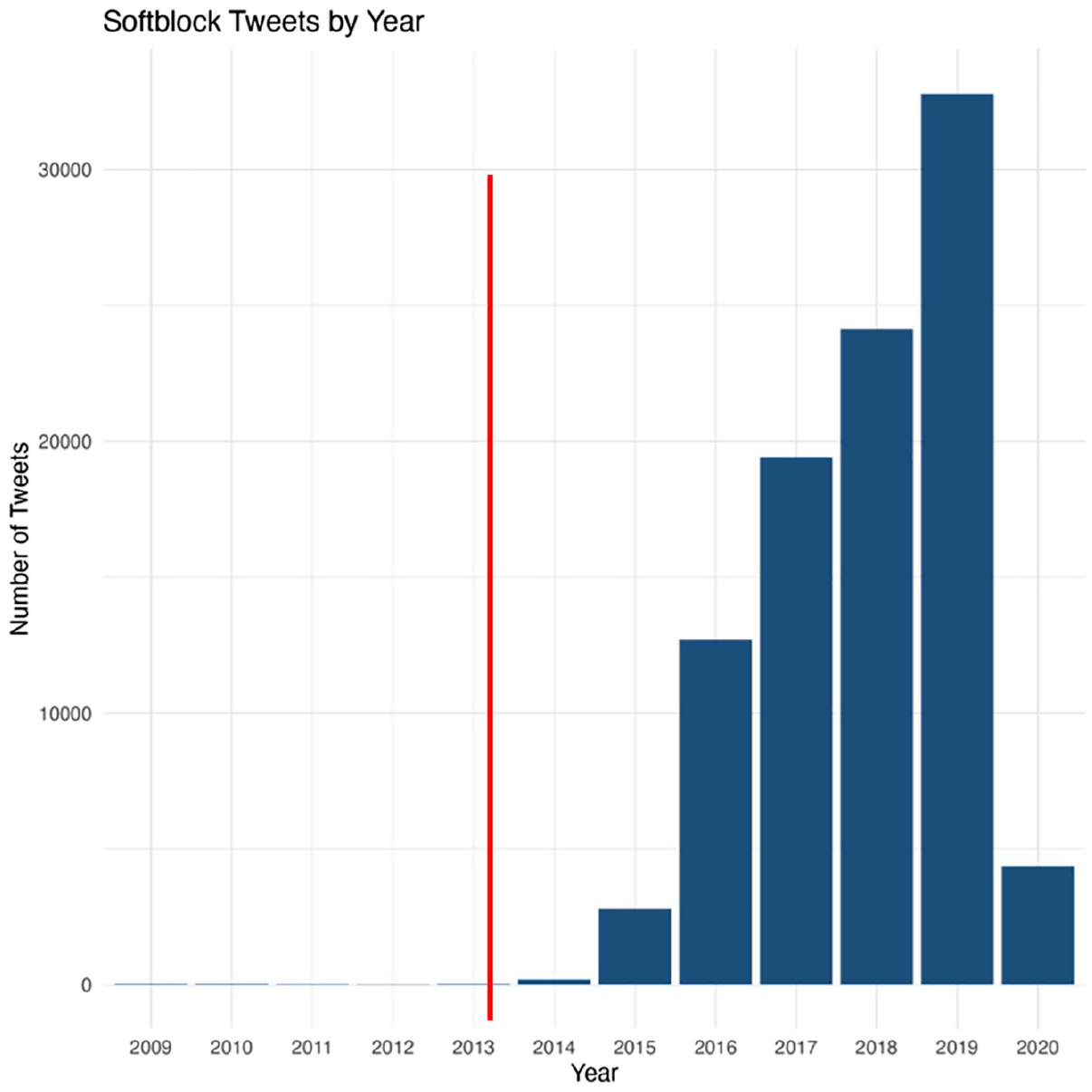
Number of tweets featuring the term softblocking per year. The first time where the term softblocking is mentioned in the relevant sense is marked with a red line (2013).
Corpus analysis
Keywords and semantic groupings
First, to address the context in which softblocking discussions appear, I carried out a keyword analysis in Sketch Engine. The top 20 single-term keywords are listed in Table 1. They reveal that some characteristics about softblock talk. Naturally, the top three keywords comprise the terms that were used in the initial Twitter API search query, so all tweets are expected to include one of these terms. The top 20 keywords are dominated by 4 semantic areas: Twitter affordances, terms referring to the author’s audience (both novel and conventional), and phatic terms referring to interpersonal conflict or awkwardness, and common online acronyms.
Top 20 Key Terms for the Softblock Corpus.

One common semantic area was audience address terms, including two neologisms to refer to a user’s followers. The terms yall and ppl (a contraction for the term people) both operate as indirect forms of address, in addition to the more specific terms oomf [one of my followers] and mutual, which usually takes the grammatical role of an adjective, but in this corpus was used as a noun more frequently (6884 times, compared to 5222 times as an adjective). Mutual in this context refers to “mutual followers,” and a user might refer to “my mutuals” collectively, or in the singular. A shorter derivative of mutual, the term moot, appeared 1241 times in this corpus. It ranked at number 31 in the keyword list, but due to the polysemy of this term it appeared frequently in the reference corpus, mostly referring to a moot point or moot court. Thus, it is likely this term has a higher keyness score than this measure belies. Thus, it appears softblocking often occurs in contexts with indirect addressees, and as part of a repertoire of platform competence, in which users with the know-how (including lexical) conduct softblock talk.
The frequency of indirect address terms suggests a departure in softblock talk from what Krämer and Otto’s (2023) study finds about block talk, where users make frequent use of the @-mention to directly point out users they are blocking. This could have causes related to the visibility of tweets for a blocked user in comparison to a softblocked user. Unlike with blocking, softblocked users can still see tweets from a user who softblocked them, so it is possible that users engaging in softblocking undertake more indirect address strategies when discussing their disconnective practice, and this is further illustrated in the discourse analysis.
Phatic terms referring to discomfort or awkwardness, namely oof and yikes, which usually occur in awkward, negative, or undesirable situations, also frequently appear in the corpus. However, these terms appear 1542 times as part of a meme satirising commentary around softblocking, so their high frequency is partly due to their appearance in this meme (see Analysis section for more on this). Regardless, the fact that softblocking has become so well-recognized that it can be legibly mocked in the form of an overt parody.
Another notable semantic area is Twitter’s platform affordances. Other than the search term, these are all “real” affordances (as opposed to the imaginary nature of derived practices like softblocking). The terms unfollow, unfollowed, unfollowing and unf (a contraction of unfollow), PRIV (a contraction for Private, referring to Twitter’s Protected account type), deactivate, tl (timeline, the stream of tweets are presented with while using the platform), and mute (a feature where users can choose to not be shown tweets from a certain user without blocking or unfollowing them) all appear frequently in the corpus. Discussions of softblocking, therefore, occur in the context of discussion of other functionalities and features of the platform. Notably missing from this list, however, is the term block. This term appears 4597 times in the corpus, with a keyness score of only 15.3.
Thus, it appears that the way users discuss softblocking departs in some ways from what Krämer and Otto (2023) find to be the characteristics of block talk. Instead, the imagined affordance of softblocking is discursively positioned as closer to unfollowing than blocking. Thus, addressing RQ1, it appears that softblocking and blocking are simply not discussed in the same context in the majority of cases. Meanwhile, softblocking and unfollowing are frequently discussed in concord, which prompts a closer investigation of the differences between the way these practices are discursively constructed.
The semantic groupings of keywords explored here suggests that discourse around softblocking is embedded in a larger metadiscursive register that focuses on the platform features of Twitter, but also the relations between users and those they follow. This register highlights the importance of both the way users employ Twitter features to carry out their social life on the platform, but also an emphasis on maintaining relationships with users one follows and/or is followed by. It is clear that in order to understand the difference between softblocking and unfollowing, it is pertinent to undertake qualitative close reading of concordance lines from the corpus.
Concordance analysis: softblock and unfollow
Thus, I generated 100 random concordance lines featuring the terms unfollow, unfollowed, or unfollowing via Sketch Engine’s concordance generation tool. I then analyzed them with respect to how they discuss the difference between unfollowing and softblocking, as shown in Table 2. Sixty-eight percent made a distinction between the two affordances, considering them not interchangeable, while only 27% implied they were equivalent alternatives to one another. The most common sentiment among users was that a user unfollowing another should softblock instead of unfollowing (46% of this sample dataset). It thus seems that users see unfollowing and softblocking as acts with vastly different underlying social meanings. and levels of appropriateness. In cases of mutual following, unfollowing is a rude and presumptuous practice in which a user suggests followers are akin to their “fans,” as they remain following after they themselves have been unfollowed. The reciprocal nature of following in these social situations is very important, and if there is to be no mutual following relationship, user would rather there is no connection at all.
Concordance Lines for Softblock and Unfollow by Differentiation Stance.

It is therefore clear that a majority of tweets in this corpus perceive that softblocking and unfollowing are distinct practices and that in certain situations, one is more appropriate than the other. Particularly in cases where users are mutual followers, softblocking appears as the preferred action from the perspective of tweeters in this corpus. To further understand the social meaning of softblocking as well as other ways in which softblocking might be discursively constructed, I sampled concordance lines on softblocking and another affordnace on Twitter: muting.
Concordance analysis: softblock and mute
I generated a sample of 100 random concordance lines using the terms
Concordance Lines for Softblock and Mute by Differentiation Stance.

Tweets mentioning these two affordances often imagine them sometimes on a scale, where muting is the first step taken when one is faced with a disagreeable user. However, most tweeters in the corpus feel that, especially for mutuals, muting is rude. Users should softblock instead if they do not wish to see a user’s posts. As such, muting is seen as more similar to unfollowing, both of which form more inappropriate alternatives to softblocking, especially for one’s mutual followers.
Mute is generally perceived as temporally limited, allowing users to hide content from others for a time, such as during an event that a user might be participating in interested in. In a vein similar to unfollowing, muting a mutual follower is rude, and users state they would rather be softblocked if a mutual follower wants to mute them.
Discourse analysis
Speech acts
I generated 100 random concordance lines featuring the term softblock, softblocking, or softblocked, as shown in Table 4. I coded these inductively, taking cues from the work of Jones et al. (2022) and the speech act framework used by Krämer and Otto (2023) in their analysis of block talk. This aids in comparing both how the practices of blocking and softblocking are discussed and underpins the upcoming discourse analysis.
Breakdown of the Close Reading Subset.

Following this, two tweets deemed representative of each of the categories were selected for close discourse analysis. I selected four tweets, each representative of a key discourse around softblocking taken from the breakdown of the concordance lines: Announcing a Softblock, Advising a Softblock, Documenting a Softblock, Discussion of Softblocking, and a meme that has circulated around softblocking. These were selected based on their correspondence with the speech act categories, in an effort to provide discourse analysis across all four of the categories, in addition to accounting for the use of a meme to parody discourse around softblocking. This was chosen partly as the terms appearing in the meme appear in the keyword analysis, mainly due to the frequency of this meme within the corpus. To account, then, for the structure of this meme and hence why those terms were included (and why they are therefore so frequent in the corpus), as well as what a parody can tell us about the social meaning of softblocking and softblock talk more generally, this meme was also selected for analysis.
Announcing a softblock
The most common speech act in the corpus was the announcement of a softblock (36%). These tweets usually adopted a curatorial stance toward one’s feed, where users exercise agency in shaping exactly what content they want to see from others they follow, but also the kinds of people they follow. Users warn in these tweets that they will softblock users who supported a certain viewpoint, followed a certain user, or consumed a certain media: 22827: wow that’s disgusting, it’s actually funny how trashy some people are. you guys should unfollow this person or ill just softblock you:)
In this tweet, the user threatens the use of a softblock if their followers continue to follow another person who the tweeter deems ‘trashy’, enforcing a curation of the user’s timeline based on the kinds of people behind the account, not only the content they share. The use of a smiley face at the end of the tweet suggests the tweeter is confident in their stance and not worried about the consequences of tweeting such a statement. From this example, it seems that Twitter users curate both their timeline the users they mutually follow through tweets like this, threatening to softblock users not only based on their posts, but who they associate themselves with. This practice echoes conceptualizations of unfriending as a form of activism, using disconnective action to distance oneself from users deemed to have violated some social expectation or norm. These tweets almost all featured the indirect forms of address mentioned in the keyword analysis: 25311: can yall seriously PLZ [please] just put how old you are somewhere in your profiles because i keep having to softblock people who dont and when I cant tell ur age.
In this warning of an impending softblock, the user requests their followers (referred to with the indirect addressee term yall) to add their age to their bio (the short self-description visible on their Twitter profile). The user pronounces that they “have” to softblock those not adhering to their stipulation, suggesting the outcome is somehow out of their hands as a sort of requirement to only follow users of a certain age. The use of capitalization on the word PLZ is particularly striking, given the lack of punctuation or other capitalization in the tweet, placing strong emphasis on this word and the exasperated disposition of the user in making this request. The tweet reads almost as a warning to the user’s mutuals, threatening the cutting of ties if they do not present themselves to the author in a way the author feels is required. The term yall, however, offers sufficient ambiguity for the user to avoid directly naming anyone they have actually done this to, distancing them from potential conflict, and suggesting the user has already carried out multiple softblocks due to others’ failure to list their age. Both the example tweets provided here adopt a slightly confrontational tone, suggesting exasperation at the fact users have to be directly informed of a user’s softblock policies and the social norms underlying use of Twitter.
Advising a softblock
Another common speech act was advice on who to softblock (28%), which most frequently involved users giving permission to others to softblock them. Reasons for advising others to softblock most commonly centered on users’ age, and also the sharing of NSFW (not safe for work, often pornographic) content, and this discourse represented 18 of the 28 tweets in this category. The frequency of the trigram “feel free to” is almost exclusively represented by these kinds of tweets. This trigram appears 1267 times in the corpus (510.22 per million tokens). This projects an accommodating and understanding self-image, one in which users acknowledged others’ ability to curate their feed: 80512: listen if for whatever reason you don’t like following me or my tweets feel free to mute or softblock me (or even hardblock if you feel that strongly)!
The reasons given for softblocking in this tweet suggest the author believes in users’ right to curate an online space, regardless of any obligation to explain why they might find another user or piece of content disagreeable. The tweet’s accommodating tone and use of the trigram feel free to, and the qualification that users are even permitted to hardblock (a term referring to standard blocking, used to differentiate the feature from softblocking) illustrates that the tweeter strives to acccomodate other users, even if it means being softblocked. Users believe that they and others should be able to exercise a great amount of agency over what kind of tweets appear in their timeline, and softblocking forms an important part of how this takes place.
Another large section of advising a softblock were tweets in which users requested those wishing to unfollow them softblock them instead (10 tweets): 23502: begging you to softblock if you wanna unfollow; i honestly look like a clown trying to be a loyal mutual follower to u when we aren’t even mutuals anymore bc you unfollowed.
This user sees unfollowing as a betrayal, humiliating the tweeter who might otherwise continue to interact when in fact, another user had unfollowed them. The expectation of reciprocity of connection here is clear: users would rather be softblocked than continue interacting with a user who they no longer mutually follow. The phrase “I honestly look like a clown” emphasizes the embarrassment at interacting with a user as if they were ha mutual (“trying to be a loyal mutual follower”) when they are in fact not. This stance presupposes a distinct way of interacting with other users purely based on whether they are mutuals, independent of whether direct interaction has occurred in the past, or whether the users have spoken in Twitter’s Direct Messages feature. Simply being mutuals with someone engenders different norms of behavior and interaction, which this user labels “trying to be a loyal mutual follower.” Thus, unfollowing someone means a user feels they deserve the social capital of having an additional follower, while declining to reciprocate that following, and the same can be said for interaction. Softblocking removes the target user from one’s following list, but also ensures that user does not see any of one’s own tweets in their timeline, from which they might try to perform these “loyal mutual follower” acts, such as liking or replying to that users’ tweets. Therefore, softblocking saves users from the embarrassment of exerting communicative or interactive effort with those who have decided they wish to not reciprocate. Softblocking appears to serve as a mark of respect, severing the connection reciprocally rather than leaving a user hanging on.
Regarding RQ2, softblocking is constructed discursively by users as distinct from other options Twitter offers, such as muting, blocking, and unfollowing. These features form a constellation of social tools with which users can navigate with precision and care the relationships they cultivate with others on Twitter. Softblocking allows users control over their experience on the platform, helping them to curate their experience but also to do relationship and face work, such as terminating a relationship without leaving other users “hanging”. Softblocking also provides a gentler alternative to the block feature (known as the hardblock within softblock talk), so users can disconnect without the permanence and social weight of a full block. Softblocking also provides an intermediate step a user can take before blocking, so the a “hardblock” can be employed when the user deems the situation calls for such a definite act. The differing social meainings of unfollowing, muting, blocking, and softblocking show that a constellation of affordances, some in-built and some imagined, exist for the tweeters in the Softblock corpus, and that they all serve but slightly different roles over the course of a user’s time on the platform.
Documenting a softblock
222: i ended up softblocking him because i don’t like his idea and i believe he’s too deluded. i hope he finds peace with it and i couldn’t give less of a fuck over what he wants to do w his life. you should avoid arguing with people like that as well, just avoid them altogether.
This tweet exemplifies an important aspect of softblocking: the avoidance of direct conflict. The author states they softblocked someone because they disagreed with him but advises others to avoid arguing on these issues with “people like that,” the meaning of which remains ambiguous, but implies those “in the know” will understand the disagreeableness at hand. The author advises readers to avoid people (presumably referring to those they disagree with, or who are “deluded”) altogether. This stance aligns with work on disconnective action as both activism and harassment protection, but the tweet above remains vague enough that users need to be sufficiently embedded in the community to be able to piece together exactly who is being spoken about, and what the author is referring to. This kind of ambiguity also underpins the addressee strategies mentioned previously and represents another form of conflict avoidance in that conflicts are not even mentioned in passing. This kind of tweet is an example of indirect reciprocity—this tweet serves as advice for its reader, warning about a character deemed problematic and a documentation of how the author deals with it. Softblocking serves here to help the author, and possibly other users, avoid users they disagree with, halting potential sources of conflict in their tracks.
Another aspect of reciprocity elucidated by softblock documentation is the expectation for sustained interactive reciprocity by users in mutual following situations: 270: So I just softblocked everyone who is inactive and doesn’t interact with me anymore. No hard feelings please, I want friends just not followers.
This user’s statement they want friends instead of followers suggests that not only is reciprocity of the social capital associated with having a follower expected, but consistent interactions with that user are also a condition of mutual following. One must maintain the reciprocal connection otherwise the relationship could be ended, as the tweet above documents. But this termination still occurs in a reciprocal manner, removing the insufficiently interactive user altogether, rather than retaining them as a mere “follower.” This suggests users are not merely in the business of collecting as high a follower count as possible, but instead prize consistent interactions with their online connections, and would rather have no connection at all than a connection that goes unreciprocated. Such documentations also serve as a promotion for reciprocal interactional behavior among other users who see such posts, reinforcing the importance of such reciprocal behavior on SNS.
Discussion of softblocking
2400: Once again I’d like to repeat. If you find out anyone I follow is an outright awful bastard, please tell me. I will listen, softblock right away, as long as there’s a good enough reason.
This tweet represents a common metadiscursive pattern in softblock talk. This utterance centers on softblocking those deemed problematic, and an assumption of indirect reciprocity (i.e. users are assured their values will be shared by the tweet author, and any disconnective action they take to censor a problematic user via a softblock will be mirrored by the tweeter). No method for determining the “good enough” reason is given, and the criteria for being an “outright awful bastard” are not specified, suggesting the reader should know these criteria if they are properly embedded in the tweeter’s community and familiar with their norms. While centring on interpersonal relationships and does contain some emotive language (such as “outright awful basard”), the majority of the tweet uses a formal and almost professional tone. While not all tweets in this category feature the same register, this tone suggests the seriousness with which the tweeter regards their interpersonal relationships on Twitter, and the sense of responsbility with which they regard their audience. This category of tweets fit clearly with tweets announcing and advising a softblock, giving a great deal of freedom to one’s audience to dictate whom one follows, and also the individual’s right to do the same. Individual users can announce they want followers to softblock if they believe/participate in/carry out a certain action or belief, users can express permission for others to softblock them for doing the same. Finally, users can announce to their followers they will softblock followers if they meet the aforementioned criteria, committing to a kind of indirectly reciprocal reinforcement of community values by mutual agreement to softblock those deemed to have broken norms. This delicate balance relies heavily on both politeness and social expectations among this group of users.
Parody of softblocking discourse
One particularly interesting aspect of the corpus is that it reveals the presence of satire of the kinds of softblock talk. Such tweet parody the commitment to indirect reciprocal softblocking mentioned above, wherein users agree to softblock those deemed to be problematic. One example of such parody from the corpus is: 16702: oof. Yikes thanks for letting me know. Im softblocking him right now. Sorry i saw a joke tweet he made a while back so followed. didnt know he was the one who assassinated archduke franz ferdinand in Sarajevo and triggered the first world war
This tweet is what is known as a copypasta, a type of meme involving the repetition of a humorous written text with changes with each iteration (Topinka, 2022). This particular copypasta was first used in July 2019, and features the text: oof. Yikes thanks for letting me know. Im softblocking him right now. Sorry I saw a joke tweet he made a while back and followed. didn’t know he’d [overly exaggerated and humorous evil behaviour]
It was originally posted by a user called @Truman_Police (Know Your Meme, 2020). This meme accounts for 1536 tweets or 1.59% of the overall corpus. The use of the terms oof and yikes parodies the way that users speak about others during softblock talk, expressing the awkwardness that comes with finding out someone has conducted themselves poorly. The apology included in the copypasta references the pressure users feel from others to isolate those deemed unacceptable, and the absurdity of the reasons that some users give for softblocking. The overly exaggerated “poor behaviour” featuring in the copypasta parodies way tweeters might curate their timeline via softblocking users based on behaviours that are in fact benign. The excessively evil acts cited in these parody tweets implies behaviours given as justification for softblocking (such as enjoying certain media, or following certain users), are exaggerated in their severity through positioning them as equivalent to clearly abhorrent behaviours such as the assassination of a political figure and the triggering of a world war.
The prevalence of a meme like this shows that the process of softblocking, as well as that of users requesting others softblock those they find objectionable, speaks to how enregistered this practice has become (see RQ3), to the point it can become subject to parody. The appearance of a copypasta on the subject of softblocking also reinforces the fact that softblocking appears as part of a repertoire of competences within Twitter. Only users “in the know” are familiar with the social expectations related to softblocking, and it is only those users who would have enough contextual knowledge to find a meme like the softblocking copypasta humorous. The exaggerated “sins” committed by users in this parody mock the minor issues over which users might demand a softblock, by taking them to their extreme. This parody suggests some Twitter users are frustrated by the excessive curation some users enforce through softblocking. Following a user does not promote that user’s tweets to one’s own followers, so it could be argued that the users one follows should not be any concern of their followers. However, the wider prevalence of tweets announcing, advising, and documenting softblocks suggests that users feel a deal of authority over the kinds of users their mutual followers follow.
Discussion
It appears that users now expect a degree of reciprocity in the behavior of their network on SNS. Breaking a mutual following is clearly a socially significant act, and it is impolite to simply unfollow someone without softblocking. Softblocking thus emerges as a form of politeness, forming an additional burden from the user initiating the disconnection. Furthermore, it appears that Twitter users are more likely to request followers in their network closely resemble themselves in views and values, and request divergent followers remove themselves from the user’s network via softblocking.
The emergence of softblocking illustrates the demand for reciprocity amongst SNS users both in following and interaction. Softblocking helps users to police those failing to interact (or follow) reciprocally, and also maintain reciprocity when undertaking disconnective action. If users feel mutual followers are not fulfilling their duty of reciprocal interaction, softblocking allows them to uphold their need for reciprocity, severing cleanly any mutual followings.
By participating in witnessable (Frosh, 2019) accounts of their disconnective acts (Dvir Gvirsman & John, 2015; Zhu & Skoric, 2022) on Twitter, users can display their proficiency in the communicative norms of the community, and thus can stake claim to their membership within this group. These norms of communication continue to be shaped and reinforced by users making public their softblocking, recommending softblocks to others, or making metapragmatic commentary. As this article has shown, SNS is imbued with expectations of reciprocity not accounted for in previous theorizations.
Softblock talk allows users to push back on the directed friendship model of Twitter and demand greater reciprocity of interaction, following, and values from those they are mutually connected with. The hard-coded Twitter features, insufficient for carrying out this reciprocity work, beget the innovation of the softblock as an imagined affordance to imbue disconnective actions with a sufficient degree of reciprocity.
Conclusion
This study has explored the emergence and metadiscourse around softblocking as an imagined affordance underpinned by the demand for reciprocity on SNS. Direct reciprocity, expected in the establishment and termination of mutual followings, emerges with users requesting those wishing to disconnect use softblocking rather than unfollowing. The desire for indirect reciprocity, on the other hand, becomes visible in discussions of softblocking, where users uphold standards of conduct by documenting softblocks when other users who do not meet standards of behavior, even prompting parody. Finally, sustained reciprocity of interaction is clearly expected through documenting softblocks of users who fail to hold up their end of the interactive expectation.
From this exploration of softblock talk we are able to draw several conclusions. First, the practice is discursively differentiated from hard-coded features of Twitter such as unfollowing, muting, and blocking, and as such has its own unique use cases. Namely, these use cases are (1) aiding users in curating a set of followers who do not hold views or interests they find disagreeable, (2) allowing users to broadcast their permission for others to curate their own feeds, even if that comes at the cost of being softblocked, and (3) facilitating the neat cutting of ties if a user wishes to unfollow another, terminating mutual following relationships in a reciprocal manner. The mute function has taken on social meaning as a cowardly half measure, and a way to ignore other users without taking the active step of disconnecting. Blocking, on the other hand, is seen as either too confrontational or too dramatic for most everyday conflicts, or as a tool to be held in reserve in case of further transgressions by offending users. The tools available to Twitter users each have clear social connotations and allow users to do nuanced relationship work. Another conclusion is that users covet reciprocity of following and interaction vis-à-vis other users. To merely unfollow a mutual follower has taken on a social meaning of great rudeness, and softblocking allows the expected degree of reciprocity to be retained when disconnecting from other users. Finally, the examination of softblocking shows us that reciprocity, in a variety of forms, is very important to SNS users. They desire sustained reciprocal interaction with their followers, mutual agreement on shared values, and reciprocity in the termination of social connections.
The introduction of the Remove This Follower feature illustrates Twitter’s propensity to formalize features that were previously imagined, as well as the size of the demand for a feature to perform this specific disconnective function. Future studies would benefit from an exploration of softblocking after the introduction of the Remove This Follower feature, as well as across other SNS sites (Instagram is mentioned repeatedly in the corpus so is perhaps a useful comparison point). It is possible that softblocking use has declined since the introduction of the Remove This Follower feature, but it is also possible that its use continues, and there might even be distinctions being negotiated between softblocking and Remove This Follower. Ethnographic methods would also no doubt assist in developing a holistic understanding of this phenomenon, as would investigations of the expectations around reciprocity that users have of their mutual followers. In addition, studies beyond the English language are vital to exploring this social norm and the terminology associated with softblocking beyond the Anglophone world.
Footnotes
Acknowledgements
My great thanks to Devyani Sharma, Agnieszka Lyons, and Ray Hogan for their guidance and mentorship in the creation of this work. I would also like to thank the two anonymous reviewers for their numerous improvements to the paper.

Funding
The author(s) disclosed receipt of the following financial support for the research, authorship, and/or publication of this article: This work was funded by the London Interdisciplinary Social Science Doctoral Training Partnership (LISS-DTP), part of the Economic and Social Research Council (ESRC). Grant number ES/P000703/1.
Declaration of Conflicting interests
The author(s) declared no potential conflicts of interest with respect to the research, authorship, and/or publication of this article.