



Abstract
The term “wanghong women” has been in a state of flux in China’s public discourse since its inception in 2015. In particular, the COVID-19, while causing major economic setbacks across the world, has, to some extent, boosted the growth of the wanghong industry and altered public attitude towards wanghong women in China. Against this background, this study aims to investigate how wanghong women are linguistically represented in the six leading official English language newspapers in China. A corpus-assisted discourse analysis of 156 English news articles (i.e., 140,931 words), covering the years between 2015 and 2022, was conducted. The study revealed a significant attitudinal shift in the editorial stance on China’s wanghong women phenomenon since the COVID-19 epidemic: the semantic prosodies of the word “wanghong” has shifted from women who are stereotypically young, fashionable, and attract online attention by using pretty face and sexualized body shape to women who can boost the national digital economy, contribute to the state’s agenda of rural regeneration, and help spread timely instructions regarding the pandemic. The findings shed new light on the evolving Chinese gender politics which is shaped by the entangled forces of traditional patriarchy, commercialization, and the government’s crisis management strategies during the pandemic.
Plain language summary
This study aims to investigate how wanghong women are linguistically represented in the six leading official English language newspapers in China. A corpus-assisted discourse analysis of 156 English news articles (i.e., 140,931 words), covering the years between 2015 and 2022, was conducted. The study revealed a significant attitudinal shift in the editorial stance on China’s wanghong women phenomenon since the COVID-19 epidemic: the semantic prosodies of the word “wanghong” has shifted from women who are stereotypically young, fashionable, and attract online attention by using pretty face and sexualized body shape to women who can boost the national digital economy, contribute to the state’s agenda of rural regeneration, and help spread timely instructions regarding the pandemic. The findings shed new light on the evolving Chinese gender politics which is shaped by the entangled forces of traditional patriarchy, commercialization, and the government’s crisis management strategies during the pandemic. The wanghong phenomenon has been still evolving in China at remarkable speed. Further studies can conduct a comparative analysis of the media representation of wanghong men and wanghong women to shed light on gender differences and stereotypes in China.
Keywords
Introduction
The global COVID-19 pandemic in 2020 has significantly reshaped microcelebrity culture as the world was temporarily halted, and people acclimated to the lockdown life (Abidin et al., 2020; Pöyry et al., 2022; Schweinberger et al., 2021). The pandemic and changing social communications forced microcelebrities to consider how to maintain their exposure by integrating COVID-19-related content that is needed by the general public into their feeds. Studies on media representations of micro-celebrities in the time of COVID-19 have proliferated in a variety of disciplines, such as digitalization (Abidin et al., 2020; Craig et al., 2021), advertising (Abidin et al., 2021; Pöyry et al., 2022), public messaging and misinformation (Abidin, 2021).
In the particular context of China, which this study is concerned with, the media coverage of the “micro-celebrities” phenomenon, or the so-called “wanghong women” in Chinese soared during the pandemic. While the crisis created instability in the global economy, it has, to some extent, helped change public attitudes towards wanghong women in China (Craig et al., 2021; Wu & Fitzgerald, 2021). To effectively connect with the public for collective actions, doctors, medical experts and research teams collaborated with wanghong women to either spread timely information regarding the pandemic or to promote complicated medical knowledge on social media (Abidin et al., 2021). Such new forms of social media feeds democratize the expert knowledge relating to the pandemic, and wanghong women are commended in official news media as grassroots activists who made positive changes in the time of crisis management. In addition to public health communication, wanghong women were co-opted into the state’s larger project of national employment promotion and rural poverty alleviation to reconstruct social equilibrium in the crisis context (Craig et al., 2021). For example, livestreaming has been widely adopted by rural wanghong women to promote products on Chinese e-commerce platforms such as Douyin and Taobao. In early 2020, many Chinese local farmers and county mayors even joined these livestreaming shows to help sell agricultural products, whose sales were heavily impacted by the COVID-19 (S. Wang & Xiong, 2020). As a result, wanghong industry, as noted by Craig et al. (2021, p. 92), is “one of the few to benefit from the COVID-19 crisis, tripling in revenue from 2019 to 2020.”
Paradoxically, during the few years before the pandemic, the neologism “wanghong” was widely regarded as “a sexual slur” (see Han, 2021; Xu & Yang, 2021), and “wanghong culture” even once experienced a significant backlash from the public and the media (Y. Wang & Feng, 2022). Particularly, this neologism gained a negative connotation in 2016, following salacious reports of “a high-end lifestyle festival for the Chinese new rich where female wanghong models reportedly exchanged sex for money” (Jing-Schmidt & Peng, 2018, p. 389). Since then, moral panic towards wanghong phenomenon was prominent in both Chinese official discourse and popular media, arguing that wanghong women’s self-media feeds function as a form of female sexual commodification to “promote materialism, hedonism, and other capitalist ideologies which contradict the Chinese traditional value system” (Y. Wang & Feng, 2022, p. 3).
Jing-Schmidt and Hsieh (2018, p.519) pointed out that, neologisms, more than any other linguistic elements, can “instantly and immediately reflect changes in society and its zeitgeist.” As a representative of Chinese cyber neologisms, the term “wanghong” influences can be regarded as a product of “massive networked communication,” capturing “the pulse of contemporary Chinese society” (Jing-Schmidt & Peng, 2018, p. 386). Therefore, by exploring the attitudinal variations involved in news reports on wanghong women, the study aims to shed light on gender politics and social change in contemporary China, which may contribute to social actions toward gender and power equality.
Previous studies mostly focused on the development of wanghong fashion culture (Liao, 2021), how wanghong women craft and sell intimacy online (Sandel & Wang, 2022), and how their virtual identities contribute to the Chinese wanghong market (Han, 2021; Y. Wang & Feng, 2022). Methods to engage with the topic of “wanghong women” can be broadly categorized into three approaches: economic (Craig et al., 2021; Han, 2021; Y. Wang & Feng, 2022), institutional (Abidin et al., 2021; Wu & Fitzgerald, 2021), and demographic (Liao, 2021; Xu & Yang, 2021). Meanwhile, previous studies on wanghong women have tended to adopt sociological, ethnographic, and anthropological approaches, or come from a broader cultural studies frame, examining its causes or results (see Han, 2021; Liao, 2021; Wu & Fitzgerald, 2021). This study intends to approach “wanghong women” not as an accepted demographic reality with a causal explanation, but as a process of discursive media construction (c.f. Feldshuh, 2018).
Researchers have observed that media report in all its forms is seldom a value-free reflection of the facts (Biber et al., 1998; Eckert & McConnell-Ginet, 2016; Fairclough, 2015; Feng, 2023). The media discourse, like all discourse, relates to its own institutional and economic position, and is impregnated with ideology (van Leeuwen, 2008). Media representations of women, in particular, can “both challenge existing stereotypes and further preconceived notions” (Feldshuh, 2018, p. 4). In addition, due to the inevitable process of “discursive simplification” (Fairclough, 2015, p. 55), it is practically impossible for media discourse to be “fully independent or impartial from a discourse-theoretical perspective” (G. Wang, 2018, p. 647). With these two premises in mind, we adopt a corpus-assisted discourse analysis to investigate the linguistic patterns which may not be obvious to the naked eye and unveil the underlying ideologies of the Chinese outbound media press in their reporting on wanghong women in China. Specifically, we will mainly focus on two research questions: (1) How are wanghong women represented in the main English language newspapers in China before and during the pandemic? (2) How have the attitudes of the Chinese government and Chinese people towards wanghong women changed before and during the pandemic?
Gender Order and the Media Representation of Women in China
Being profoundly affected by both the discourse turn and the performance turn (Butler, 1990; Cameron, 1995; McRobbie, 2009), postmodern scholars view gender, and thus gender language, as being “fundamentally embedded in social practice, deriving their meaning from the human activities in which they figure” (Eckert & McConnell-Ginet, 2016, p. 29). As such, gender is not an individual property, but a “social construction” (Butler, 1990; Eckert & McConnell-Ginet, 2016), an “ongoing process” (Cameron, 1995; Y. Wang & Feng, 2022), or a “continuous performance” (Honig & Hershatter, 1988; Lazar, 2009; Uhm, 2021). To map out the evolving myth of wanghong women in the Chinese media, we borrow the notion of “gender order” proposed by Eckert and McConnell-Ginet (2016), which emphasizes the importance of examining the institutional and ideological dimensions of gender arrangements. According to Eckert and McConnell-Ginet (2016, p. 22), gender order can be defined as “a system of allocation, based on sex-class assignment, of rights and obligations, freedoms and constraints, limits and possibilities, power and subordination.” It is “supported by—and supports—structures of convention and ideology” (Jing-Schmidt & Peng, 2018, p. 399).
In the particular context of China, gender order comprises a multidimensional framework in which the ideologies of traditional patriarchy, commercialization, and the State’s governance all serve as extraordinarily powerful forces in the maintenance of the Chinese gender order (Feng, 2023; Honig & Hershatter, 1988; Li, 2016; Y. Yu, 2023). These forces are so interwoven that it is often difficult to separate gender from other aspects of life. In terms of the traditional patriarchal ideology, it can be traced back to the practice of Confucian values, which has long played a guiding role in the regulation of how women should behave under certain circumstances (Liu, 2014; Tang et al., 2021; Zheng, 2010). It emphasized the importance of “being morally pure, practicing rites, and filial piety” (Orozco, 2017, p. 8). The virtue of women lies in their lack of talent and wisdom (Y. Yu, 2019b); the attractive women are often criticized as “hongyan huoshui” (femmes fatales) (Tang et al., 2021).
With the founding of the People’s Republic of China (PRC) in 1949, the State’s governance played a key role in regulating the gender order in socialist China. The socialist system encouraged Chinese women to step out of their domestic seclusion and directly entered into the new nation-state as dignified new masters (Quan, 2019). Under Mao’s leadership (1949–1976), the pursuit of gender equality was regarded as a form of class struggle and promoted through political campaigns. In this regard, Chinese women were so deeply connected with the State, and their social consciousness was far above individual consciousness (Liu, 2014; Y. Yu, 2019a). The national media represented women as versatile and capable socialist constructors, and called on their active participation in the socialist revolution since this was understood as the way to achieve women’s liberation (Zheng, 2010). In socialist works of art and reportage, Chinese women were referred to as “funv tongzhi” (women comrade), a term strongly related to politics rather than self-identity (Li, 2016, p. 33). In the political propaganda posters, the female role models were either represented as good daughters of the party or loyal guardians to Chairman Mao. The body of Communist women (mostly composed of rural and ethnic women), as noted by Quan (2019, p. 19), was politicized as “state-owned property” to symbolize a modernized socialist ideal.
Fast forwarding to the post-reform era since 1978, China began to experience a period of high-speed economic development with marketization and commercialization in all aspects (Dong, 2018). Women’s emancipation, once a collective project premised upon participation in socialist production in China, was broken down into dispersed individual capacity of “participating in the private market,” with a highlight on individualism and self-entrepreneurship (Meng & Huang, 2017). Although education has strengthened female earning potentials, the State’s reluctance to intervene with discriminatory practices in the workplace led to the reconstruction of a male-dominant labor market (Orozco, 2017). Such a labor market succeeded in “keeping urban women in a transient, lower-paid, and subordinate position in the workforce” (Honig & Hershatter, 1988, p. 321). Paradoxically, as victims of institutionalized gender and power disparity, women were regarded as the primary target of blame for the conspicuous moral decline in society. As Peng et al. (2021) pointed out, instead of blaming the disloyalty and irresponsibility of elite men, young women who took the shortcuts were condemned as “predators” by the public outcry. The ubiquitous female pejoration (such as misogynistic labels involving the morpheme biăo “slut” in luäã chá-biăo “green-tea slut” and xīnjī-biăo “cunning slut”) in the Chinese online community, for example, has led to blunt sexism and perpetuated a gender order the quintessence of which is a relationship of subservience and domination (Jing-Schmidt & Peng, 2018).
Moreover, due to the increasing divorce rates and declining birth-rate crisis, the Party-state administratively commited to promoting pro-family policies, which in turn re-inscribed patriarchal gender order (Feldshuh, 2018; Quan, 2019). Normative female ideals have been promoted nationwide, urging women to “take on attributes of care, emotionality, communicativeness, and gentleness deriving from their role as reproducers and nurturers” (Liu, 2014, p. 20). In the analysis of the gendered discourse of “Double Eleven” shopping festival, for example, Meng and Huang (2017) find that Chinese women have always been charged with managing the daily functioning of the household (in their roles as wives and mothers), hence acting as “consumer-in-chief” in the dominant gendered division of labor. Although official women role models, such as female scientists, entrepreneurs, and celebrities, were promoted by the State, these women were constructed as having never lost their femininity and managing a perfect home-work balance (Li, 2016).
Data Collection and Research Method
Data
Instead of focusing on the Chinese local newspapers (c.f. Feng, 2017; Han, 2021; Liao, 2021; Sandel & Wang, 2022), this study examines the English language newspapers in China that supposedly have broader international exposure (G. Wang, 2018; Y. Yu, 2019a, 2019b, 2023). First, the target readership of the English language newspaper includes both overseas English speakers and young Internet users with high education background in China (G. Wang, 2018; Y. Yu, 2023). In order to attract a wider readership, the English language newspapers in China have embraced a more globalized, critical and innovative stance in pursuit of Western-style journalism. Although these news media are state-run, they claim to be more liberal compared to the local Chinese language media because they “encourage attention to sensitive topics and shine a light on usually controversial issues” (Y. Yu, 2019a). Thus, by investigating how the English language newspapers present such a controversial issue, the study attempts to position itself within international standards and lay the groundwork for future research on media representations of feminity and womanhood.
Second, the reporting of the official English language newspapers in China is found to closely adhere to the government discourse and official narrative (G. Wang, 2018; Y. Yu, 2019a, 2019b). As noted by Weber and Jia (2007), to maintain a positive China image on the international stage, the government implements tactical censorship to control opinions on the official English language news media, while at the same time “using the media to reinforce the uniqueness of Chinese values and practices” (p. 774). These news outlets epitomized the complexity of the State’s gender politics in multiple dimensions. A discursive examination of the attitudinal variations involved in the news reports and editorials of English language newspapers in China on wanghong women allows us to trace the tensions and contentions between the State’s constant preoccupation with women’s liberation and its shifting priorities in political, economic and social affairs (Zheng, 2010).
In order to build an English language corpus of media representations of wanghong women (CMRWW), the study collected the news data (including both news reports and opinion articles) from the Factiva archive (available at https://professional.dowjones.com/factiva/) by searching the phrases with wildcards: wanghong woman OR wanghong women OR wanghong girl OR wanghong girls OR female wanghong OR microcelebrities OR influencers. The time frame for these searches was from January 2015 to September 2022, that is, the first time wanghong appeared in the Chinese media and the time we conducted our study. During the data collection period, we read through all the news report paragraphs (including both headlines and body text) to ensure that the primary topic of the news was relevant to wanghong women and there were no duplicated texts. After manually reading, we identified and removed 32 irrelevant articles (which were mainly concerned with wanghong men, wanghong restaurants and wanghong food) and 11 duplicate articles. In the end, we were able to compile a total of 156 relevant news reports, with 140,931 word tokens. The online news portals from which the 156 articles were taken include People’s Daily, CGTN, China Daily, Global Times, Shanghai Daily, and Shenzhen Daily. The news articles we collected belong to “soft news,” which primarily reports on lifestyle, wardrobe, society, culture, and opinion (Y. Yu, 2019a). They were originally written in English by Chinese journalists and were therefore not translated from Chinese into English. Next, we grouped the 156 news texts into two datasets, Dataset 1 (“before the pandemic”) and Dataset 2 (“during the pandemic”) relative to January 2020—the period when reports about the novel coronavirus in China started to develop. The source material in Dataset 1, published from January 2015 to December 2019, consisted of 69 news texts (61,475 word tokens). In Dataset 2, the source material consisted of 87 news texts (79,186 word tokens) published from January 2020 to September 2022.
Research Method
The central role of discourse in Chinese gender studies has been observed by many scholars over the past 20 years (see Jing-Schmidt & Peng, 2018; Peng et al., 2021; Quan, 2019; Y. Yu, 2019a, 2023; Zheng, 2010). Our analysis is premised on Foucault’s (1980) conceptualization of discourses as socially constructed knowledge. Informed by social theory, a discourse approach aims to unveil the structural relationships between the power structure and gender order reproduced in news text. It engages with social changes in China by “investigating a commonality they share, namely, their enactment and realization through various forms of discourse and communication” (Feng, 2023, p. 6). Specifically, the discourse analysis includes two aspects: (1) how discourse changes because of Chinese gender-order change, and (2) how the Chinese news discourses, using various discursive techniques, transform power structures, enact gender orders, and construct gender identity, etc (c.f. Feng, 2023). Taken together, the analysis of discursive news discourses is essential for understanding the broader processes of gender realities and power changes in contemporary China. However, discourse analysis has always been criticized for lacking a level of objectivity and generalizability (see Biber et al., 1998; G. Wang, 2018; Y. Yu, 2019a, 2023). Researchers tend to rely on the close reading of a small number of texts and based on their own preconceived notions (Feng, 2017, p. 555).
Corpus linguistic (CL) analysis, on the contrary, tends to “focus on low-level lexical features and neglect the discursive nature of meaning” (Feng, 2017, p. 554). It can be used for the examination of the frequency of lexis, collocations, and concordance lines in a large volume of empirical data. The current study, therefore, includes quantitative calculations of the distribution of attitudes based on manual analysis of frequency lists and concordance lines, as well as qualitative explanations of how media representation might (re)produce and legitimize structures of gender orders in contemporary China. With the combination of qualitative CDA and quantitative CL analysis, the result can be generalizable on the one hand, and nuanced on the other hand.
There were mainly two steps involved in the analytical procedure. In the first step, we used the corpus tool AntConc to establish the top-frequency keywords and main themes in the two corpora. Following the AntConc keyword analysis, we used the Concord function to generate collocates of “wanghong” within a span of five words on either side of the search term in each respective corpus. To understand how the collocates are used and form wanghong discourses, a qualitative discourse analysis was undertaken. In the second phase of the analysis, our primary goal was to evaluate how the main social actors, that is, Chinese people and the government, think of the wanghong phenomenon. We searched relevant collocates of Chinese people and the government respectively; then we manually examined their co-texts to evaluate their attitudinal shifts during the “before” and “during” COVID-19 periods.
Findings
To answer the first research question as described in the “Introduction” section, we compared the relative word frequencies to total word tokens. We obtained the 40 strongest keywords in both datasets as shown in Table 1. It can be observed that the similar keywords in both datasets are “influencers,”“internet,”“celebrities,”“Chinese” and “China.”
Keywords Derived from Comparing the Two Datasets and Relative Frequency.

The salient terms in the keyword list of Dataset 1 were “Douyu” (livestreaming platform), “Douyin” (short-video sharing platform), “Taobao” (e-commerce platform), “Xiaohongshu” (picture-based platform), and “Weibo,” the four most prominent and popular apps in China, focusing on the areas of game-playing, entertainment, consumption, and fashion. It indicates that wanghong women in China have moved across platforms frequently for different purposes and different target audiences. As noted by Wu and Fitzgerald (2021), by engaging in the multi-platform practice, wanghong women can further professionalize their content to incubate their own media brands, aggregate their fan communities, and spread online impact. Meanwhile, the high frequency of indefinite article “a” and personal pronouns such as “I” and “she” in Dataset 1 indicates that, during this period “wanghong women” are represented as individual social actors (van Leeuwen, 2008, p. 37). In contrast, in Dataset 2, wanghong is mainly used in the plural form as in wanghong women, and the frequently occurring words, such as “number,”“phenomenon,” and “market,” imply that these women in most cases are represented as social groups, and are treated as a “type” or an abstract “social phenomenon.”
The salient terms in the keywords list of Dataset 2 were “COVID-19” and “pandemic.” They are all related to the information on Coronavirus Disease, which broke out across the Asia Pacific since December 2019. Another noticeable feature in Dataset 2 was the high frequency of “worth,”“marketing,”“sales,”“yuan,”“economic,” and “digital economy.” On the one hand, it may indicate that wanghong women at this stage have successfully monetized their media content through social platform business models. On the other hand, it may also suggest that the media has come to realize the huge commercial value brought by wanghong women (Craig et al., 2021). To further explore the first research question, that is, how these six media outlets discursively represent wanghong women, we further examined the collocates of wanghong.
Wanghong Women: From a Problematic Social Group to Role Models
Table 2 shows the frequent collocates of wanghong. As noted by Biber et al. (1998), the positioning of a qualifier before or after its subject is often utilized to define its attributes. After carefully identifying the qualifiers used to modify the term “wanghong,” we categorized them into nouns, adjectives, and verbs, as shown in Table 2. The most frequent co-selected nouns (i.e., face, body) in Dataset 1 period focus on wanghong women’s physical appearance. Here, wanghong woman is not primarily discussed as an entrepreneur, but first and foremost as “a sexualized woman whose value is predicated upon where she may sit on the beauty scale” (Peng et al., 2021, p. 10). To access the business context, wanghong women have to compete and define their positions within a matrix of “femininity and sexuality” (Sandel & Wang, 2022; Uhm, 2021). In our dataset, possessing a standard “wanghong face” and a sexualized body shape constitute the two notable characteristics of their appearance. In terms of the wanghong face (13%), the media reports always highlight the “glamour labor” involved in pursuing the standard look (Y. Wang & Feng, 2022). For example, Extract 1 points out that the wanghong face is not a result of born beauty, but instead involves a process of plastic surgery. As for the sexualized body shape (10%), the media focuses on how wanghong women render their figure into a site of erotic interest for “heterosexual male pleasure” (Uhm, 2021, p. 7). For example, Extract 2 shows that, by wearing short, figure-revealing clothing and doing seductive dancing, wanghong women engage in the performances of sexualized labor. Such performances of sexualized labor, drawing a recognizable soft porn-chic aesthetic, reinforces a sense of “commodity fetish” towards the female body (Quan, 2019). In contrast to the socialist aesthetics, which tends to politicalize women’s bodies as an index of the State’s progressiveness (cf. Quan, 2019; Zheng, 2010), the contemporary “commodity fetishism” focuses more on the capital value of the female body, thus “as a commodity benefit for consumption and capital accumulation” (Quan, 2019, p. 20). As suggested by Jing-Schmidt and Peng (2018), female sexual objectification and commodification, which has long been attributed to Chinese moral decline, is in fact a result of gender and power disparity in contemporary China, since “it is female sexuality that is being exchanged in material transactions, and it is elite masculinity that dominates those transactions” (p. 400).
Collocates of “Wanghong” and Its Synonyms.

Extract 1: There’s the concept of Extract 2:
In Dataset 2, the co-selected nouns (i.e., “market,”“phenomenon,”“trend,” and “China”) represent wanghong women as a unique social phenomenon in China (47%). Here, wanghong women are referred to as a homogeneous group by using the strategies of aggregation and assimilation: aggregation refers to the practice of using the co-selected nouns (e.g., “number,”“figure,” and “data”) to aggregate all the wanghong women with statistics (e.g., “the number of wanghong women”); assimilation refers to the practice of omitting the “women” part and using the term “wanghong” directly (see Extract 3). Moreover, instead of focusing on their standard wanghong face or sexualized body shape, the frequent co-selected nouns, such as “entrepreneurs,”“sellers,”“businesses,” and “brands,” represent wanghong women as entrepreneurial subjects, who engage in the practice of self-promotion (19%). This construction is associated with the notion of “enterprising femininity,” a subjectivity built through the processes of self-empowering rooted in the consumer marketplace (Y. Wang & Feng, 2022). Such a notion according to feminist theorists (e.g., Lazar, 2009; McRobbie, 2009), can be regarded as a type of pseudo-feminism, which is aligned with neoliberal capitalism and advocates women’s full responsibility for their self-care. As noted by McRobbie (2009), by recasting issues of social justice in individualized terms, pseudo-female-empowerment defines women as autonomous individuals and pays little attention to institutionalized gender inequality.
Extract 3: When it comes to
In terms of the co-selected actions, the majority of actions (68%) in the Dataset 1 period are enacted by other participants or the society. In most cases, wanghong women are the “patients” who are subject to name-calling and labelling (54.5%). Being used in the passive voice, the terms like “called” or “labelled” always leave the agents to become omitted. Such practice of deagentialization, as noted by van Leeuwen (2008, p. 66), tends to “denote a sense of involuntary action,” and the metaphorical use of the term “label” further indicates wanghong women are treated as “nonhuman objects” (Y. Yu, 2019b, p. 385). Moreover, such referential instances are strengthened by the fact that individual wanghong women’s proper names are rarely mentioned in the dataset, and instead they are systematically replaced by the designated gendered reference of “wanghong,” which makes these women “an aberration to the norm, an attachment, a subsidiary of the entrepreneur context” (Peng et al., 2021, p. 12). When wanghong women are the agent (45.5%) in Dataset 1, their frequent co-selected material actions are more often represented as non-transactive. For example, the frequent collocate of become (14%) is non-transactive. It involves only one participant, the “actor,” whose behavior is rarely represented as having a purpose or an effect on the world (Machin & Mayr, 2012). As van Leeuwen (2008, p. 61) points out that, since the ability to “transact” requires a certain power,” the actions of actors who hold lower-status within the social hierarchy (e.g., migrants) are mostly represented as “nontransactive” (e.g., they “immigrate,” constitute “an influx”).
In contrast, in Dataset 2, wanghong women are always depicted as engaging in real material actions, such as promoting, presenting, and collaborating. In this regard, wanghong women are “something one does, rather than something one is” (Butler, 1990). For example, as shown in Extract 4, the wanghong woman is depicted as actively engaging in a local anti-poverty program. Here, in this goal-oriented purpose construction (with the insertion of a purpose link “to” and the purpose itself “promote eggs”), wanghong women are engaged in what van Leeuwen (2008, p. 126) refers to as the “moralized actions,” which “trigger intertextual references to the discourse of moral values.” The expression of “Promote eggs and kiwifruit” invokes discourse of philanthropy and draws values from philosophical traditions such as utilitarianism and pragmatism. Such a dramatic attitudinal shift indicates the considerable influence COVID-19 had in changing the public perception of the wanghong women phenomenon in China. As suggested by Pöyry et al. (2022), since citizens have heavily relied on the Internet for information during the prolonged social distancing period, the general public has become fully aware of the efficacy of using wanghong to disseminate timely instructions regarding the pandemic.
Extract 4: In a more benevolent version of the trend, prominent
In terms of the collocating adjectives, wanghong women are mainly appraised in Dataset 1 in terms of aesthetic values—cute, pretty, stunning, beautiful, and sparkling, which tend to “assume, perpetuate and recreate the stereotype of femininity” among the whole cohort of wanghong women (Peng et al., 2021, p. 10). In contrast, in Dataset 2 they are evaluated according to social judgment: cool, responsible, practical, kind, hard-working, and industrious (Extract 5) (see Machin & Mayr, 2012). Such adjective usage difference, together with different usage of collocating nouns and verbs in both datasets, appears to indicate a possible attitudinal shift in the English language media’s representation of wanghong women from a superficial type of young women who only pay attention to their physical appearance to one who open up career-opportunity for young Chinese.
Extract 5: Doesn’t being an entrepreneur, a freelancer or a
The Attitude of Chinese Governmental Bodies
In the second phase of the analysis, our primary goal is to answer the second research question, that is, evaluating how the main social actors, that is, the government and Chinese people, think of the wanghong phenomenon. First, Chinese governmental bodies are generally considered to be responsible for addressing the social issue associated with the wanghong phenomenon. We classify them into two categories, that is, the national government and local authorities. While the national government is represented by the China Administration of Cyberspace (CAC), the Chinese central government, the Ministry of Culture (MoC), the State Administration of Press, Publishing, Radio, Television and Film (SAPPRFT), and All-China Women’s Federation (ACWF), the local authorities are represented by regional governments, such as the Shanghai government, the county government, Town People’s Government. Table 3 lists the frequencies of references to these social actors in the two datasets. Meanwhile, to evaluate the contextual information relating to these Chinese governmental bodies, we further divide their associated actions into two categories, that is, governance of wanghong women, which is characterized by using direct surveillance measures (e.g., “banning problematic wanghong women” and “accelerating the regulation and censorship of the platform”), and governance through wanghong women, which is characterized by supporting and co-opting wanghong women (e.g., engaging wanghong to promote patriotic values) (see Table 4).
The Frequency of References to the Governmental Bodies.

The Discursive Construction of Chinese Institutional Actors’ Actions on Wanghong Women.
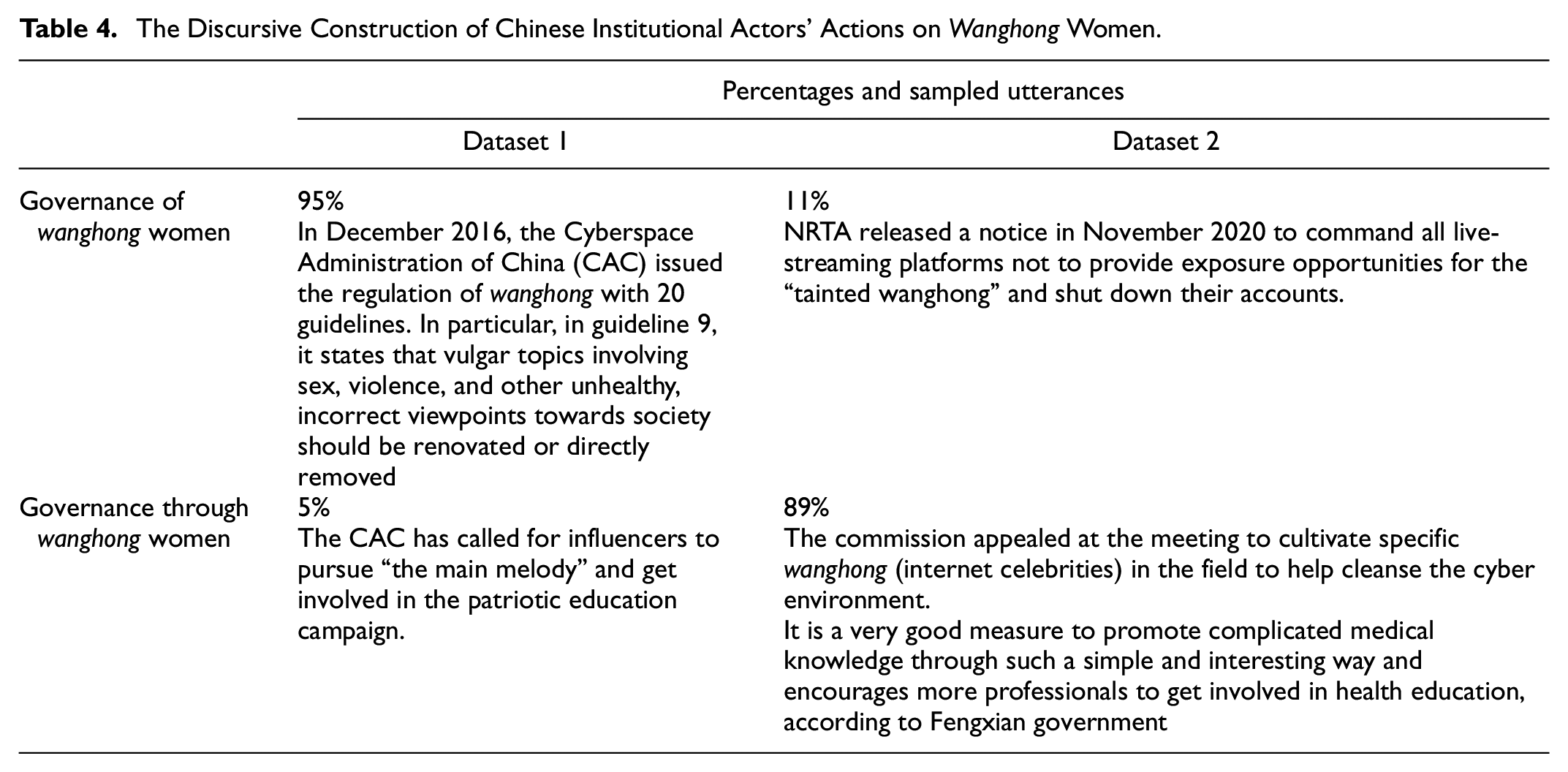
In Dataset 1, references to the central administrations (71%) appear more frequently than references to local government (29%), and their associated actions are dominated by the “governance of wanghong” type (95%). It indicates that during the pre-pandemic period, as a main target of state governance, wanghong women and their associated cultural products are under the strict surveillance of the national regulations. In particular, the governance of wanghong women in the pre-pandemic period mostly involve the ad hoc top-down ban of “harmful”wanghong women and law enforcement to regulate and supervise wanghong women. It implies that during this stage wanghong phenomenon is still considered as a problematic issue on which the state always keeps a vigilant eye. As suggested by Lagerkvis (2011), in China’s platform economy, the “state-capitalist power alliance” always works to sanitize cyberspace and ensures the sustainability of internet enterprises.
In Dataset 2, the percentage of references to local governments (70%) was much higher than that of the central (30%), and instead of continuing the direct governance measures, the regional governments have come up with a series of techniques to govern wanghong women through a series of co-optation practices (89%). As a softened approach to ideological governance, co-optation, as defined by Xu and Yang (2021, p. 210), is “the process of absorbing new elements into the leadership of an organization as a means of averting threats to its stability or existence.” Through co-optative tactics, the State intends to bring wanghong women’s cultural products in line with official dictums, thereby “forging an alliance and reinforcing the hegemony” (Zou, 2019, p. 6). As shown in the samples, during the pandemic, regional governments become more active in leveraging Chinese wanghong to manage the online information landscape and reinforce the State’s cultural leadership. They also formally enlist the help of wanghong women—alongside doctors, officials, and experts—in terms of “helping spread accurate health information” (Abidin, 2021, p. 116). Such a dramatic attitudinal shift indicates the considerable influence COVID-19 had in changing the governmental perception of the wanghong women phenomenon in China.
The Attitude of Chinese People
The wanghong phenomenon was one of the most discussed topics among Chinese people, whose particular debate bespoke a particular discursive site around the discourse of gender order in contemporary China (Y. Wang & Feng, 2022). As shown in Table 5, the percentages of the references to Chinese people are roughly the same in both datasets.
The Frequency of the References to Chinese People.

The attitudes of Chinese people towards wanghong women also undergo a dramatic shift from Dataset 1 period to Dataset 2 period. In the pre-pandemic period, we identify the stereotypes and prejudice against Chinese wanghong women, who are constructed as “a social and economic nuisance” (Nartey & Ladegaard, 2021, p. 196). The comments deploy a masculinist discourse that position the wanghong women’s body and the feminine as a site of subordination, penetration, and insult. Moreover, the absence of counter-arguments reinforces the prejudiced discourse associated with the wanghong women through their construction as “outcasts and a dangerous threat that ought to be eliminated” (Feldshuh, 2018, p. 4). For example, Extract 6 delegitimizes wanghong women’s social media content by the appropriation of warfare-related metaphors (using the terms “bombarded” and “assaulted”). According to this rationalization, wanghong women are inherently problematic and inadequate, and in need of intervention by the state (Lazar, 2009). Moreover, the anti-wanghong rhetoric is reinforced in various stigmata in the corpus. The stigmatization of wanghong women is manifest in the stereotypical characterization that puts an emphasis on their alleged illicitness and disgracefulness. For example, in Extract 7, women with a “wanghong” title are regarded as “sarcastic” due to their past scandalous behaviors and illegal business practice in Chinese society. It reaffirms an imaginary of a wanghong woman’s scandalous career path, which echoes “existing Chinese patriarchal norms that frame women’s socio-economic dependence upon the opposite sex in their everyday lives” (Liu, 2014, p. 24). In other five instances (28%), the delegitimation of wanghong women is realized through the process of what Machin and Mayr (2012, p. 19) call the “structural oppositions,” which refers to the practice of using “different referential choices or actional lexis to imply opposites.” We can see how the opposition to wanghong women is expressed overtly in Extract 8. We find that, on the one hand, this text takes a celebrative stance towards the “pillars” of our society, that is, the real artists and contributors, such as scientists, doctors, teachers, and everyone else; on the other hand, it takes a derisive stance towards the so-called “wanghong,” who are criticized as leading a rather easy and glamorous life. Through perpetuating myths appropriate and inappropriate roles in the workplace for women, the pre-pandemic “wanghong” discourse works to “police women who defy traditional gender roles” (Feldshuh, 2018, p. 9). The acceptance of patriarchal values by huge numbers of Chinese people, showcases the persistence of limited awareness of structural gender discrimination against wanghong women, and the absence of the pursuit of gender equality in their agenda (Jing-Schmidt & Peng, 2018).
Extract 6: “We are bombarded with product placements and visually assaulted with branded content from KOLs to Extract 7: Qin said, “It is more like sarcasm rather than a compliment when you call someone a Extract 8: “We need real artists and contributors- the pillars of our society such as scientists, doctors, teachers and everyone else, not those so-called
In Dataset 2 period, by examining the co-texts of all 21 instances, we find that although 28% of the semantic prosodies still regard the wanghong women phenomenon as controversial, the majority of Chinese citizens (40%) have started to see wanghong women as a form of grassroots activism who are utilizing the social media as a form of emancipation. For example, as shown in Extract 9, this citizen closely associates wanghong women’s personal business success with the state’s project of rural poverty alleviation. In this regard, wanghong women are manipulated into “working ‘outside the system’ (体制外) and innovating the CCP’s ideological and publicity work”(Xu & Yang, 2021, p. 211). This type of micro-philanthropic practice is interpreted by H. Yu (2018, p. 11) as “morally uplifting” efforts for wanghong women, who are “eager to secure their legitimate place in the moral economy of charitable activities and hence…to keep up their reputation.”
Meanwhile, there are 32% of the semantic prosodies that regard the wanghong women phenomenon as a profitable opportunity for business, e-commerce, and China’s economic development. In particular, our analysis shows that media coverage during COVID-19 repeated the discursive correlation between wanghong women and hyper-visible or visually-oriented industries, such as fashion, travel, and food (Abidin, 2021). Wanghong women are mostly represented as arbiters of good taste in these genres “where personal taste can be visibly presented” (Dong, 2018, p. 2). In contrast to the media representation of wanghong women as “a social and economic nuisance” in the pre-pandemic period, here wanghong are reconstructed as an emerging Chinese urban middle-class, whose identity revolves around aspirational consumption and commodification (Y. Wang & Feng, 2022). As shown in Extract 10, by indicating his trust in wanghong women’s aesthetic preference for good-quality wine, Jing highlights their identity of “being sophisticated, of knowing what is of good taste and of having access to an exclusive lifestyle” (Dong, 2018, p. 18). Although these opinions are made by individual Chinese citizens, the fact that they have been published by the newspapers suggests that the official Chinese outbound media is “willing to reproduce the stereotypes and prejudices expressed in the extracts” (Nartey & Ladegaard, 2021, p. 195).
Extract 9: “I hope more grassroots wanghong in Liping will spring up, like the Qixiannü [a popular wanghong woman], promoting our culture and local products to fight poverty.” he said. Extract 10: “You know, some professional wanghong sommelier really have good taste and I followed their guidance to buy red wine.” said Jing Chun
Discussion
The findings of this study reveal that the English language media in China have undergone an attitudinal shift regarding news reports on wanghong women after the outbreak of the COVID-19 pandemic. Initially criticized as “a social and economic nuisance,”wanghong women then got appropriated by the State and finally transformed into a term encompassing young patriotic female entrepreneurs more broadly during the pandemic. The empirical analysis of the mystical transformation of wanghong women from a “problematic social issue” into a “successful role model” sheds light on the evolving nature of the Chinese gender order which is shaped by the entangled forces of traditional patriarchy, commercialization, and the State’s crisis management strategies during the pandemic.
First, the media pathologization of wanghong women during the Dataset 1 period reflects traditional patriarchal ideology in Chinese postsocialist gender order (Orozco, 2017). Since the beginning of the reform era in 1978, Chinese women have entered the public sphere in very large numbers yet still occupied subordinate positions (Meng & Huang, 2017). Female financial dependence “takes away women’s epistemological agency and emotional autonomy and facilitates female sexual objectification, self-objectification, and sexual commodification” (Jing-Schmidt & Peng, 2018, p. 401). Social issues, such as surging divorce rates, normalization of premarital sex, rampant extramarital affairs and infidelity, and the return of prostitution (Jing-Schmidt & Peng, 2018; Peng et al., 2021; Y. Yu, 2023), have become prominent in national media, portraying an image of callous, selfish, and money-hungry Chinese women (Orozco, 2017). For a young woman looking to succeed in this market economy, catering to the desire of elite men or, to use the words of De Beauvoir (1949, p. 347), “modeling herself on his dreams,” becomes a rational strategy. This explains how the media depicts young wanghong women as fixated on competitive femininity, sexualized body shape, and the tactics of seduction to transform themselves into perfect objects of male desire.
Meanwhile, the ubiquity of wanghong women pejoration we see in the pre-pandemic period data is symptomatic of an enduring misogynistic tendency to blame women for moral decline in Chinese society (Jing-Schmidt & Peng, 2018; Peng et al., 2021). As noted by Tang et al. (2021), while using physical attraction to garner men’s attention is a common tactic in today’s hyper-commercialized society, Chinese society’s palpable pressure still prevents women from doing so, as it runs counter to the patriarchal ideologies entrenched in traditional Chinese gender order. Compared to the local Chinese newspaper, the English media is expected to have a more globalized and liberal stance, and provide critical and perceptive analysis of wanghong women’s gender identities (G. Wang, 2018; Y. Yu, 2019a, 2023). However, our analysis shows that all newspapers seldom interrogated the relations between women’s sexual objectification and women’s inferiority in the gender power hierarchy. Instead, they deployed a masculinist discourse that position the wanghong women’s body as the site of subordination, so as to legitimize existing gender order in Chinese society.
The attitudinal shift in the news media in Dataset 2 period reveals the commercial force in the reconstruction of the Chinese postsocialist gender order. After the outbreak of the COVID-19 pandemic, the demand for wanghong women’s services and expertise for digital marketing has skyrocketed, as they were deemed to be more cost-efficient during the pandemic (Abidin et al., 2020). By outsourcing content production to wanghong women who could still produce content independently from their homes and who engage with audiences with their “interactive communication ability,” many companies attempted to continue their business and maintain their relationships with prospective consumers (Abidin et al., 2021). Under this socio-economic context, the media representations of wanghong women are associated with China’s high-level policy, which “pivot to building the world’s most advanced digital economy and a robust domestic consumer economy rather than relying on cheap exports” (Craig et al., 2021, p. 21). As such, instead of pathologizing wanghong girls’ social media content as “narcissist” or “misleading,” the discourse in Dataset 2 associates the wanghong women phenomenon with a booming business that involves multiple economic value chains. Accordingly, the general public’s attitude towards wanghong women has also shifted, regarding their job as attractive and worthwhile.
Lastly, the reinvention of wanghong discourse in Dataset 2 period also reflects the creative efforts of the State to co-opt wanghong women to shape positive public opinion and get citizens involved in the fight against COVID-19. As noted by Yang (2021, p. 181), in the crisis context, “explaining the purposes and consequences of COVID-19 prevention can most effectively help citizens understand the situation and form a good premise for public engagement.” As such, the new media represented wanghong women as responsible and credible social actors, whose self-branding content has transformed from an entertainment/commercial tool to crisis-related social activities, such as spreading timely instructions regarding the pandemic (demonstrating their important role in public health communication and helping promote agricultural products and local tourism).
On a critical note, Khamis et al. (2017) argued that microcelebrities in the western media context strive to challenge the patriarchal discourse through demonstrating their volition, celebrating self-empowerment, and pursuing a sense of professionalism in the competency-based meritocratic business model. In contrast, as the representations of the new generation of Chinese professionals, wanghong women have to gain social recognition through following neoliberal market ideology to please audiences on the one hand, and adhering to state-level regulations on the other.
Conclusion
This study has demonstrated how wanghong women are linguistically represented in the English language newspapers in China by employing a corpus-assisted approach to discourse analysis. The study reveals a significant attitudinal shift in editorial stance on China’s wanghong women phenomenon especially after the outbreak of the COVID-19 epidemic. Such attitudinal shift reflects the governance of wanghong women has evolved from the ad hoc ban of “harmful”wanghong to a more holistic co-option governance to manage the everchanging lucrative wanghong industry and culture.
Admittedly, there are some limitations in this research. First, in the data collection period, we found that there are a growing number of reports that are concerned with wanghong men, who have achieved huge commercial success by entering traditionally wanghong women’s specialized areas (such as the beauty and cosmetic industry). Further studies can conduct a comparative analysis of the media representation of wanghong men and wanghong women to shed light on gender differences and stereotypes in China. Second, this study merely focused on the traditional media representation of wanghong women. Thus, how the wanghong women phenomenon provoked public debate on Chinese social media is also an interesting issue worth exploring further. Furthermore, our study is based on the analysis of a moderately sized corpus. In this regard, we cannot generate as broad trends of linguistic usage as the techniques (such as data mining and visualization) may provide for us (c.f. Schweinberger et al., 2021). The results might be more convincing if a corpus-driven text-mining approach could be used, and the research findings could be more helpful to practitioners in their future work.
The wanghong phenomenon has been still evolving in China at remarkable speed. As the Internet has been penetrating every fabric of society at an unprecedented rate, new forms of meaning-making resources in media discourse are emerging rapidly and require an explicit theoretical account. This study is a step towards such an understanding, and it is hoped that it can inspire further wanghong and gender-related studies.
Footnotes
Declaration of Conflicting Interests
The author(s) declared no potential conflicts of interest with respect to the research, authorship, and/or publication of this article.
Funding
The author(s) disclosed receipt of the following financial support for the research, authorship, and/or publication of this article: This work was supported by Shaanxi Provincial Social Science Fund Project (Grant No. 2021ZXWT04) and Shaanxi Provincial Social Science Fund Project (Grant No. 2023HWT04).

Data Availability Statement
Data sharing not applicable to this article as no datasets were generated or analyzed during the current study.