



Abstract
Spanish-Moroccan mixed couples exemplify a case of cultural hybridization that reflects the colonial past between these two countries. In this context, social media is a space of opportunity and risk to face discrimination and othering. In this article, we draw upon postcolonial theory and Internet studies to consider TikTok affordances as tools that are relevant to understand how cultural, national, and religious identities are shaped and presented in digital spaces. In this sense, this study constitutes the first exploratory analysis of Moroccan-Spanish mixed couples’ (self)representations and identity construction as reflected by their TikTok content. The memetic and intersectional aspects of the mixed-couple identity emerge as central in the convergent nature of the platform and their lived experiences. Through an initial analysis of 8,653 TikTok videos, we identified 6 creator accounts with more than 10K followers to conduct a deeper multimodal content and discourse analysis of 146 videos. This enabled us to explore how these creators portray their hybrid identity through short, vertical videos harnessing TikTok’s vernaculars and affordances. The results enable us to propose the concept of performative hybridization, which involves discursive markers within these couples’ TikTok content that reflect a fluid integration of two cultures, while the pervading visual and narrative components reflect the dominance of one set of identity traits over the other. In this case, Moroccan culture is more prevalent.
Introduction
This study explores Moroccan-Spanish mixed couples’ (self)representations and hybridized identity constructions by creating content on TikTok. We delve into the ways in which they harness the unique affordances of this platform within its communities of creators, larger societal structures, and existing cultural, national, and religious differences. The article derives from a qualitative, multimodal content analysis of TikTok videos created by six tiktokers who are part of a mixed couple with a following of more than 10K. The analysis draws upon postcolonial theory situated in platform and Internet studies that are applicable to the TikTok context and is centered on two analytical dimensions: (1) uses of TikTok affordances for identity building and representation and (2) uses of TikTok affordances to respond and interact with existing colonial beliefs about them.
Since 2008, the Moroccan community has expanded in Spain and according to the Spanish Statistical Office (2020) it is the largest foreign community in this European country. Moreover, research suggests that there is an important relationship between immigration and a higher number of mixed couples (Rodríguez-García et al., 2021). Romantic relationships between Spanish and Moroccan individuals reflect structural changes that emerged in the times of the Spanish Protectorate (Mateo-Dieste, 2012) but continue to expand in contemporary society due to increased immigration—and forms of coupling—that reflect cultural hybridization and the increased availability of communication technologies (Steingress, 2012).
In this context of migratory flows and centuries-old colonial relationships, TikTok emerges as one of the most downloaded apps in Spain (Statista, 2022). This platform has become synonymous with contemporary digital cultures as a space that goes beyond representation to shape the ways in which creators connect to each other through uniquely connective affordances that promote imitation (Zulli & Zulli, 2020). We consider Khazraee and Novak’s (2018) description of two types of affordances: for discourse and for performance.
Considering these theoretical underpinnings, two research questions guide this study: (RQ1) How are Tiktok affordances used by mixed couples to construct and represent their identity? (RQ2) How do mixed couples use TikTok affordances to face colonial discriminatory narratives? Through this analysis, we expand current understandings of the broader implications of social media in the construction and representation of postcolonial relationships between Spaniards and Moroccans, as well as their possibilities to resignify their hybrid identities through the creation of TikTok content, in this case within a mixed couple. The analysis also considers the reactions they receive from their surrounding communities as evidenced in their content.
We begin by positioning current debates about Moroccan-Spanish cultural differences, cultural hybridization, and social media such as TikTok as relevant for the analysis of identity construction and expression. We then describe the methodology used and report on the findings. The results enable us to propose the concept of performative hybridization which involves discursive markers within these couples’ TikTok content that reflect a fluid integration of two cultures, while the pervading visual and narrative components reflect the dominance of one set of identity traits over the other, in this case Moroccan culture is more prevalent.
Cultural Hybridization and Mixed Couples
Anthropologist Néstor García-Canclini (2005, p. XXV) defined cultural hybridization as the set of “sociocultural processes in which discrete structures or practices, previously existing in separate form, are combined to generate new structures, objects, and practices.”
García-Canclini (2005) goes on to suggest that identity should not be understood by separating individual traits but by gaining a deeper understanding of the mixing processes that give way to said identities and their implications, which expand future possibilities of modifying culture and politics. He also emphasizes the power clashes that exist in these hybridization processes. Thus, our study considers the concept of hybridity as key for the analysis of mixed couples as fluid and changing relationships in a context that still features colonial beliefs and structures such as Spain. Following this conceptualization of hybrid cultures, we take a social constructivist approach to identity as one that is built through a constant negotiation with one’s context (Hall, 2019). Internet studies scholar Theresa Senft (2013) has explained how identity is constructed through a set of behaviors and actions taken within digital spaces.
Bhabha (2004) expands on these ideas of identity and hybridity by describing a “third space” where cultural symbols and meanings become less fixed, more ambivalent, and contradictory. He goes beyond social constructionist ideas of identity to include the encounter of diverse cultures and identities in this “third space.” This occurs in a process where subjects who are different construct and negotiate their subjectivities in this ambivalent space. Bhabha argues that this “third space” has the potential to enable empowering forms of cultural hybridity.
Within mixed couples, the representation of White femininity as the ideal is also significant. As sociologist Kumiko Nemoto (2009) explains, “white women are viewed as the possessors of ideal femininity” (p. 107). This quote reflects the racial dimensions intersecting with ideals of morality and perfection within contemporary conceptualizations of White femininity. These beliefs limit the ability of mixed couples that involve a White woman to be accepted and recognized in a (mostly) White society such as Spain. Nemoto (2009) goes on to cite gender theorist Judith Butler to connect this view of White womanhood with the notion of their role as “guardians of European civility” (p. 107). Although Nemoto’s work describes relationships between North American women and Asian men, the view of White women as the protectors of traditionally European values and societies can be applied to the case of Moroccan-Spanish couples.
Moreover, anthropologist Josep Mateo-Dieste (2012) describes that at the time of the Spanish Protectorate in Morocco, the main type of mixed relationship was between Moroccan men and Spanish women. He goes on to describe how these couples were persecuted in the decade of the 1940s for being a danger to Spanish domination in Morocco. Today, Moroccan-Spanish mixed couples are still rejected because they counter contemporary colonial structures that continue to shape the construction and representation of subjects (Young, 2016). Therefore, the mediated presence of mixed couples—such as the sample of creators analyzed in the present study—constitutes a challenge to Orientalist perceptions of Eastern cultures as inferior, degenerate, and unchangeable (Said, 2003).
Considering the various considerations related to identity and discrimination, Al Areqi (2016) argues that people who are part of a hybridization process—such as mixed couples—often face negativity from both cultures, as both are considered the “other” by engaging in such a romantic relationship (Rodríguez-García et al., 2021). Gilroy (2004) explains that this is due to the perceived “civilizational betrayal” represented by their hybridity, which requires a sort of cleansing to maintain the idea—by the hegemonic group—of an unattainable “pure culture.” The same author argues that the cosmopolitan ideals—of diverse groups coexisting within modern societies—fail because inclusion is conditional on a set of social rules that foster new forms of colonialism and reinstate the discursive and practical aspects of colonial hegemony.
The colonial past between these countries impacts the discourses and the messages these creators receive, and it could be considered a contemporary form of colonial domination (Gilroy, 2004). In this study, postcolonial theory is understood on the basis of Said (1994) and Hall (1996) who describe how culture is key in the negotiation, perpetuation, and reproduction of power relations. According to sociologist Stuart Hall (1995), identities are built based on the differences and similarities that one has with the “others” which serve to locate and question certain dominant notions.
Hence, we argue that TikTok is a relevant case study to explore these postcolonial interactions, representations, and narratives. We suggest that TikTok becomes a space where these processes of hybridization and negotiation of the couple’s identity develop through specific narratives and (self)representations that are also shaped by the platform and its available affordances.
The Role of TikTok in Postcolonial Identity Construction
The self-representative practices of mixed couples on social media are relevant to understand how cultural, national, and religious identities are shaped and presented in digital spaces. However, it is important to consider critical perspectives about the possibilities of social media representations for significant social change. For instance, sociologist Herman Gray (2013) argues that the current proliferation of minority identities on social media signal the increased visibility of these groups but no real recognition. The celebration of diversity, he continues, is framed in a neoliberal framework rather than an actual recognition of the struggles and structural issues suffered by individuals within minority groups. This is why, according to Gray, social media fails to offer a space for these groups to challenge existing structures of domination.
Furthermore, some authors have argued that identity is shaped in relation to the beliefs and discourses that surround individuals. For instance, Weber and Mitchell (2008) argue that young people’s online identities comprise both their own self-perception and that of their followers and viewers. In relation to Islamic identity construction, Meer (2014) suggests that Muslim self-consciousness is developed around islamophobic beliefs and discourses.
Within postcolonial theory, islamophobia refers at its simplest to the various manifestations of discrimination toward Islam and Muslims (Awan, 2016). It goes beyond religion to include other identity traits such as ethnicity, race, nationality, and culture that are traditionally connected to Muslim identity (Meer, 2014). For the purposes of the present study, we consider Imran Awan’s (2016) five walls of Islamophobic hate in his analysis of Facebook: (1) the understanding of Muslims as terrorists, (2) the interpretation of Muslims as rapists, (3) the conception of Niqab/hijab as a threat, (4) the view of Muslims against “us,” and (5) support for deportation. Islamophobic content has been found to bypass moderation policies on social media (Civila et al., 2020), leading to polarization and social conflict.
Researchers have explored the motivations of Muslim creators to generate YouTube videos and found that their main drive was to promote the merits of their religion and its teachings, including the use of the hijab as a choice rather than an oppressive practice while also contesting other negative content about Islamic communities (Mosemghvdlishvili & Jansz, 2012). Additional research has been done on YouTube to unveil how racist ideas are challenged by interracial couples. Their results show that the member of the stigmatized group tends to justify their motivations to be in a mixed couple more than the person who is a member of the non-stigmatized group within the couple (Sobande, 2019).
Recent research has explored female Muslims and the hijab as a form of digitally mediated representation of empowered femininity, choice, and entrepreneurship on Instagram (Baulch & Pramiyanti, 2018); the analysis of the hijab as a clothing item that becomes central to their identity, modesty, and fashion style through Instagram posts (Boy et al., 2018); researchers have also used a post digital feminist approach to understand Arab women’s empowerment and agency through their uses of Instagram (Hurley, 2021); while other scholars have found the ways in which Islamic views of modesty and faith have adapted to digital spaces and attention economies (Kavakci & Kraeplin, 2017).
In the next section, we explore the specificities of TikTok as a relevant platform to explore mixed couples and their (self)representative practices of content creation.
TikTok in the Social Media Ecosystem
TikTok is a social media platform that evolved from Musical.ly, its predecessor, through the purchase of the former by ByteDance in 2017 and the merger of both apps (Ghosh & Yang, 2021) it has grown to be the seventh social media platform in terms of users with 689 million monthly active users (Mohsin, 2020). Moreover, TikTok was the most downloaded App during 2020 in Spain (8.4 M) (Mena-Roa, 2020) and has grown 25% in 2021 (IAB, 2021).
The concept of affordances is central to our analysis due to the uniqueness of this platform. In this sense, TikTok offers an expanded set of affordances that allow an individual or group to connect to other creators, communities, and the algorithmic feed, such as the reuse and imitation affordances described by Jaramillo-Dent et al. (2022). For the purposes of this article, we consider the social constructivist functions of affordances as tools offered by the platform that enable users to build their own identities, communities, and social relations (Wellman, 2001). In this sense, affordances can be shaped through users’ behaviors and interactions with the platform and between them. That is, the way in which the users combine affordances with their narratives contribute to creating patterns of digital behavior among members of a group (Khazraee & Novak, 2018). In this case, user interactions with TikTok’s design and structure contribute to generating and increasing the visibility of their identities (Jaramillo-Dent et al., 2022). Platform affordances are also involved in the construction of a social imaginary and their analysis allows us to understand how certain issues are represented (McVeigh-Schultz & Baym, 2015).
For our purposes, we consider Khazraee and Novak’s (2018) description of two types of affordances: some of which are used for discourse and others used for performance. The former refers to those tools that allow identity and collective discourse, sharing personal stories and promoting the negotiation of meaning. The latter encloses those that allow discourse to be spread through the staging and performance of identity using creative elements beyond the narrative. These enable us to identify cultural forms such as symbols and clothing. These affordances help highlight the role of textual versus visual aspects of the content to build a hybrid identity and reach larger audiences.
TikTok comprises vertical videos that can last from 15 s to 3 min, and it features an algorithmic for you feed that provides unprecedented virality possibilities for specific videos, leading to video-based popularity rather than profile-based celebrity (Abidin, 2021). TikTok has been identified as a structurally mimetic social media platform, due to the ways in which it promotes imitation and the reuse of creative affordances, as well as configurations that make mimesis easy within the content creation process (Zulli & Zulli, 2020). Audio is a relevant affordance within TikTok, since it enables the classification of content, making videos searchable using the audio track (Abidin, 2021).
In the current research, we examine how Spanish-Moroccan tiktokers, who are part of a mixed couple, discuss their experiences using TikTok affordances (for discourse and performance). In this process, we delve into the nuances and specificities of these couples and how they self-represent and build their own identity while facing diverse reactions and interactions from other tiktokers and followers.
Method
Sample
A research profile was created, and we used a modified version of the virtual snowball sampling method (Baltar & Brunet, 2012) which helps identify content created by hard-to-reach populations.
The search was conducted between 19 April 2021 and 10 May 2021, by identifying TikTok videos using the hashtags #mixedcouples and #SpainandMorocco in their Spanish and English versions. We then identified other hashtags of interest that appeared together with these and found other relevant videos. We viewed a total of 8,653 videos and found 6 profiles from creators that self-identified as being part of a Spanish-Moroccan mixed couple with more than 10K followers, which is the threshold at which TikTok begins paying creators (TikTok, 2021). These accounts comprised a total of 1,369 videos. We watched all the videos in each profile three times to identify content that fit the following criteria: (1) discussed cultural aspects or topics related to the identity and integration of the members of the couple and (2) had more than 30K views. The final sample comprised a total of 146 videos from 6 accounts (20/25 from each account).
Although romantic relationships between Moroccans and Spaniards statistically feature a slightly higher prevalence of male/Moroccan and female/Spaniard than the opposite (Rodríguez-García et al., 2021), it is noteworthy that the totality of profiles identified in this study feature a Moroccan male and a Spanish female. We were unable to find profiles that featured the opposite relationship. Moreover, most females in these pairs express their thoughts on conversion to Islam. While some of them are undecided, others are in different stages of conversion. This may have to do with the perception that religious endogamy will ensure increased acceptance in the family of the Islamic partner in Spain (Tarré, 2019).
All the videos were downloaded and analyzed using ATLAS.ti 8. The positionality of the authors is relevant since one of them is part of a Spanish-Moroccan mixed couple and the second author is an immigrant in Spain. So, these specific vital experiences have a role in the analytical process (Table 1).
Sample Information.

Source. Created by the authors.
Codebook Development
The hybrid codebook includes theoretically derived codes related to Islamophobia (Awan, 2016; Civila et al., 2020), and codes derived through an inductive approach carrying out iterative rounds of coding to identify themes of interest derived from the data itself, namely those related to cultural aspects, specific identity narratives, and TikTok affordances. The code groups used in the present analysis are included in Table 2.
Code Groups.

Table 2 also includes a column entitled affordances which reflects additional coding rounds that occurred later, where we classified the coded content into two types of affordances, following Khazraee and Novak’s (2018) conceptualization of affordances for discourse and for performance.
To respond to the research questions, a multimodal analysis was carried out to understand how meanings are constructed on TikTok by these creators. Multimodal analysis allows interpreting both verbal and nonverbal data and exploring different representative modes (Dicks, 2019). Multimodal analysis combines all forms of communication on TikTok including visual, textual, interactive, and other modes (Korhonen, 2010).
The data were classified in an iterative process of analysis. In the first round, the affordances used by this group were considered and in the following rounds, the specific functions of these affordances—including those for discourse and performance—in relation to the phenomena of analysis are outlined.
Ethical Considerations
In the present study, the researchers have gone through a critical and reflective process of decision-making to make sure the data collection, storage, and analysis was conducted with the utmost care for the creators involved considering their privacy and the ownership of such data (Metcalf & Crawford, 2016). Also, to the extent possible, the content and profiles have been anonymized due to the implications of utilizing social media content without the user’s consent (Boyd & Crawford, 2012).
Results
It is important to note that platform affordances are not experienced in isolation, but within digital contexts and among particular users. Users give these tools specific functions, enabling new ways of representing, speaking, combining communication forms, and building communities. Thus, the results are classified according to the research questions: (RQ1) the uses of affordances by mixed couples on TikTok to construct and represent their identity; and (RQ2) the uses of TikTok affordances to negotiate and face colonial discriminatory narratives.
Uses of TikTok Affordances by Mixed Couples for Identity: Conceptualizing Performative Hybridization
The most relevant affordances deployed by mixed couples on TikTok include audio, vernacular visual, hashtags, emojis, and answer-comment. In this section, we will delve into the use of some of these affordances to establish these couples’ individual and collective identities as illustrated by their TikTok content. This will enable us to better understand their navigation of the TikTok space through content creation for (self)representation and expression.
The reuse of existing popular music tracks in combination with vernacular visual affordances (Gibbs et al., 2015; McVeigh-Schultz & Baym, 2015) and relevant visibility and identity hashtags 1 enable mixed couples to integrate their identity-related claims to more extended TikTok challenges. Although the use of popular tracks and specific hashtags may contribute to increasing their visibility (Jaramillo-Dent et al., 2022), according to Gray (2013) visibility does not equate to recognition. For instance, Figure 1 reflects the use of trending audio within videos of (self)representation. In one case, the creator discursively defends the hijab. In another case, the creator delineates the Moroccan cultural aspects that make her mixed relationship better.
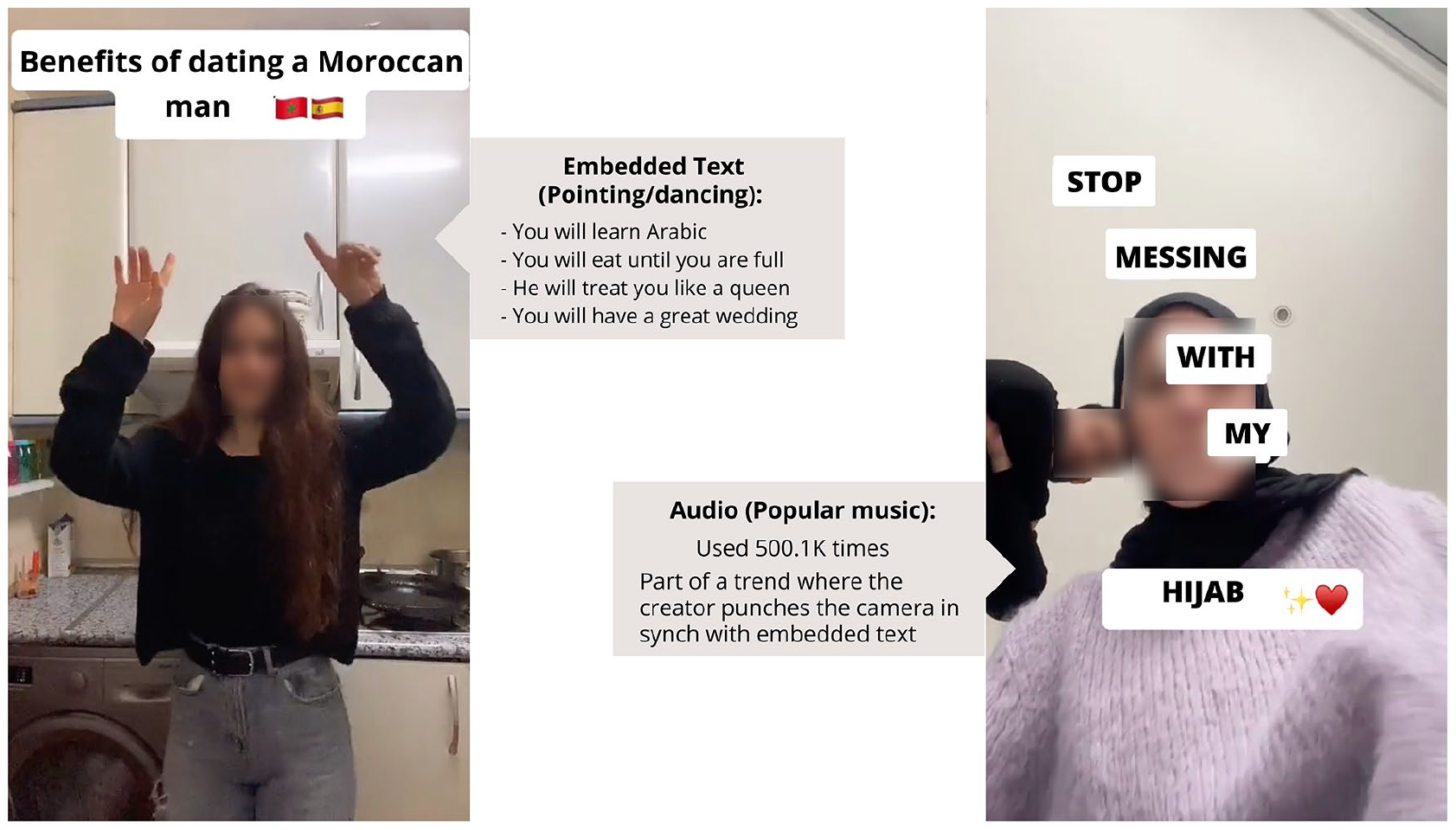
Use of popular audio tracks and visual vernaculars.
On the surface, these creators reflect pride about their own cultural hybridization process by deploying discourse affordances (Khazraee & Novak, 2018) such as embedded text and oral statements. Arguably, through their use of vernacular TikTok affordances for visibility—such as trending music and visibility hashtags—they are commodifying their performed hybridity to present an imaginary of the mixed couple as an ideal of inclusion and integration. In reality, the Muslim aspects of the couple’s identity dominate the narrative. This reflects Gray’s (2013) argument that the forms of diversity represented on social media follow neoliberal models prioritizing certain aspects of minority identities due to their popularity and marketability. In the case of these creators, the emphasis on certain identity traits—through their deployment alongside specific TikTok affordances—may help them increase their viewership or follower count.
Figures 2 and 3 illustrate the convergence of affordances for discourse and performance among these creators (Khazaraee & Novak, 2018). Textual and oral aspects of the content provide insights about the cultural hybridization process. We observe a mutual interest to learn the language, and pride about the combined customs, beliefs, and traditions of the couple, as well as a positive perspective of the convergent nature of the mixed couple (Figure 2).
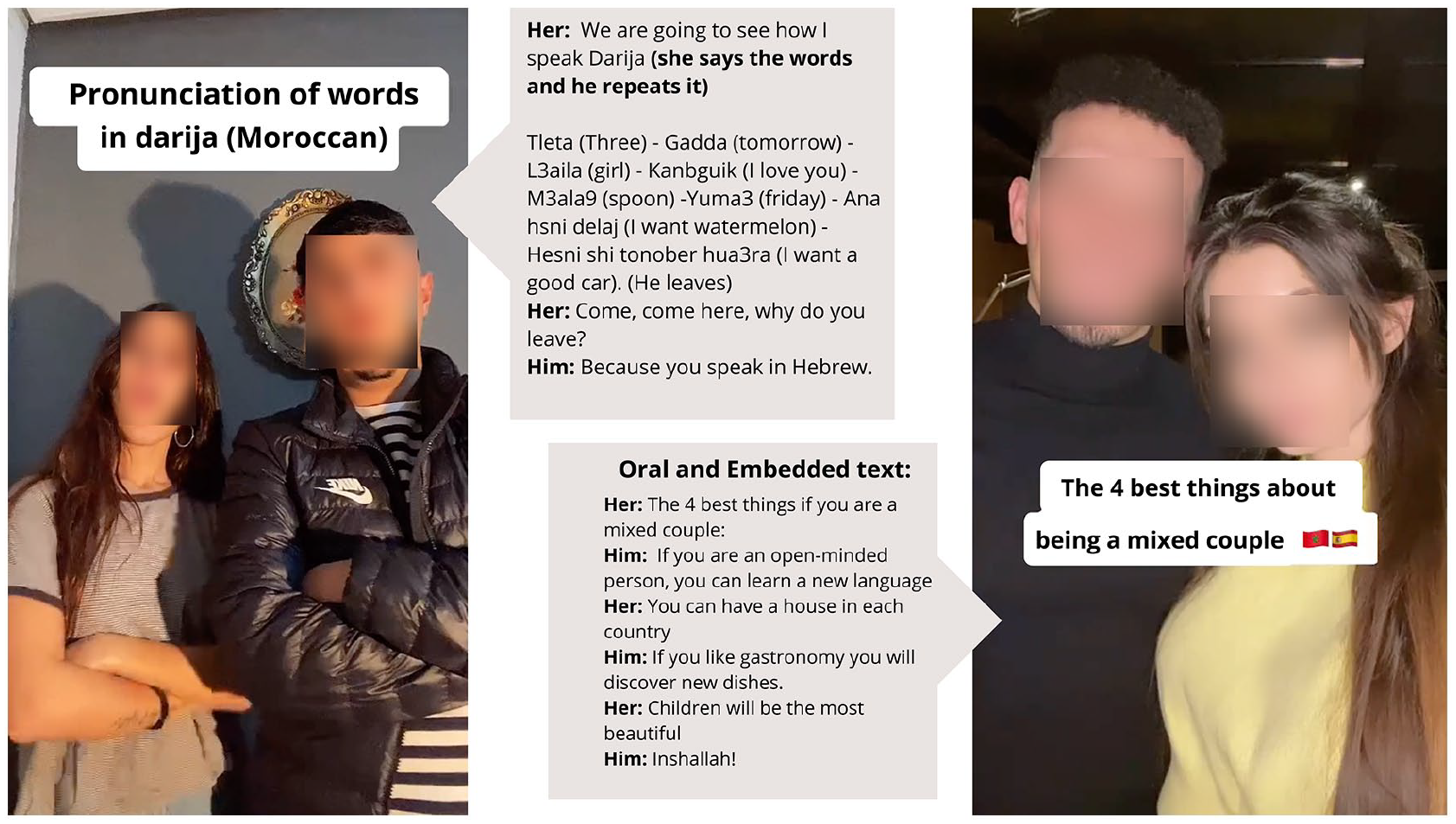
Use of textual and oral aspects to show cultural hybridization process.

Example of Moroccan cultural elements visually present on TikTok.
Meanwhile, these videos reflect an identity that constantly adapts within the romantic relationship, and they suggest that discourse affordances—what is said and written in text—reflect a process of hybridization. Meanwhile, the performative affordances—visual and multimodal—show mainly Moroccan cultural aspects (clothes, food, religion, emojis, hashtags) (Figure 3). This leads us to argue that creators within the mixed couple deploy a sort of performative hybridization.
This concept refers to the staged presentation of a mixing process between members of a mixed couple where there are discursive markers that suggest a fluid integration of two cultures and the pervading visual and narrative components reflect the dominance of one set of identity traits over the other.
It is possible to argue that performative hybridization occurs in a digital version of Bhabha’s (2004) proposed “third space” offered by TikTok as a platform for self-expression. Among the mixed couples studied, we see the discursive existence of both identities through oral and written narratives—affordances for discourse such as embedded text, captions, and oral audio—illustrated by the videos in Figure 2. Moreover, the visual embodiment of culture reflects mostly Moroccan cultural symbols as portrayed in Figure 3. Therefore, the hybridization expressed by these couples is performative, since the multimodal narrative is positioned on one cultural pole—Moroccan—while there are discursive markers that describe an intermediate reality located “in between,” as Bhabha (2004) proposed.
The use of other TikTok affordances such as emojis and hashtags illustrates the multimodal nature of performative hybridization on this platform. Creators often use emojis in an attempt to pair identity with culture multimodally, through religious/cultural emojis such as the mosque, a woman wearing a hijab, or the blessing icon. Figure 4 presents the different emojis used by these creators that are relevant to their (self)representation as individuals and as members of a couple. These icons also reflect the prevalence of Moroccan culture and Islam in these couples’ identities.

Relevant emojis used by mixed couples on TikTok.
It is important to note that although the main character in the video is the woman—White, Spanish, European—in this case the main cultural aspects that are present in the videos are those of the male—who in all cases is Moroccan. But it would be equally problematic if the opposite happened. In this sense, performative hybridization can happen when either the traditionally hegemonic or the traditionally marginalized member of the couple replaces most of their identity traits by those of the other, which far from reflecting a hybridization process reflects new forms of domination.
In this case, the female within the mixed couple expresses her choice through the integration of different cultural and religious markers from her partner, while blurring her own “whiteness.” This could respond to the pluralism proposed by third-wave feminism, which supports women’s freedom of choice, even if these choices sometimes fall into patterns that may be seen as oppressive or anti-feminist (Snyder-Hall, 2010). According to this argument, the integration of Moroccan culture within the woman’s portrayed identity can be seen as a form of self-determination. This is reflected in Figure 1, when female creators defend their choice to wear a hijab, and in Figure 5, where the different versions of Muslim femininity and their explanations are portrayed. This female integration of Muslim/Moroccan culture props up traditional hegemonic gender systems due to the female submitting to her male counterpart. However, this female portrayal of Muslimhood and Moroccan culture counters traditional colonial structures that suggest that the colonized attempt to take the colonizer’s identity traits in processes of hybridization (Bhabha, 2004; Gilroy, 2004). In this case, she (White, Spanish, European) takes his (Moroccan, Muslim, African) identity traits. Our proposal of performative hybridization stands because Moroccan/Spanish cultures don’t coexist, but one displaces the other within these couples.

Women performing their version of femininity.
In this case, our results are different from those of Nemoto (2009), who argues that mixed couples between White females in the United States and Asian men serve to prop up the social capital and position of the male through his adaptation to the dominant culture. In this case, we see that it is her who adapts to his culture, suggesting that depending on the national context (US vs Spain) and the race/nationality of the minority member of the couple (Asian/Moroccan) the experiences of identity building and hybridization processes among mixed couples may change.
Moreover, it is possible to argue that she is experiencing an identity crisis where she is ambivalent about the aspects of Moroccan culture she will incorporate, in what Bhabha (2004) calls “unhomeliness” or uncertain cross-cultural initiation. In our data, we observe this cross-cultural initiation when female creators perform their own version of Muslim femininity which includes (1) ambivalence about the hijab (appearing with and without the hijab); (2) reflections on their individual stage in the conversion process, from undecided to convert; (3) appropriation of the partner’s cultural traits in detriment of her own; and (4) absence of identity traits unrelated to the romantic relationship. As we can see in the examples of video themes by some of the female creators listed below and Figure 5:
“Someday Inshallah I will wear the hijab”;
“My first time in the mosque (daily vlog of her experience)”;
“Video reciting Surat Al Fatiha in Arabic.”
Two of the analyzed tiktokers published a recording of their shahada 2 showing that they have already officially converted to Islam. In terms of TikTok affordances, in one of the videos she uses the answer-comment affordance to explain that they have indeed converted to Islam. In the other they use embedded text to facilitate understanding of the shahada rite for non-Arabic speakers. The inclusion of the shahada in their TikTok content reflects the importance they give to this event in their lives as part of their conversion to Islam and to their partner’s religion. This is, in many cases, a social requirement for them to be accepted into their partner’s family and for the advancement of the relationship (Allievi, 2006). Thus, it also reflects the dominance of Islam in the couple’s identity (Figure 6).
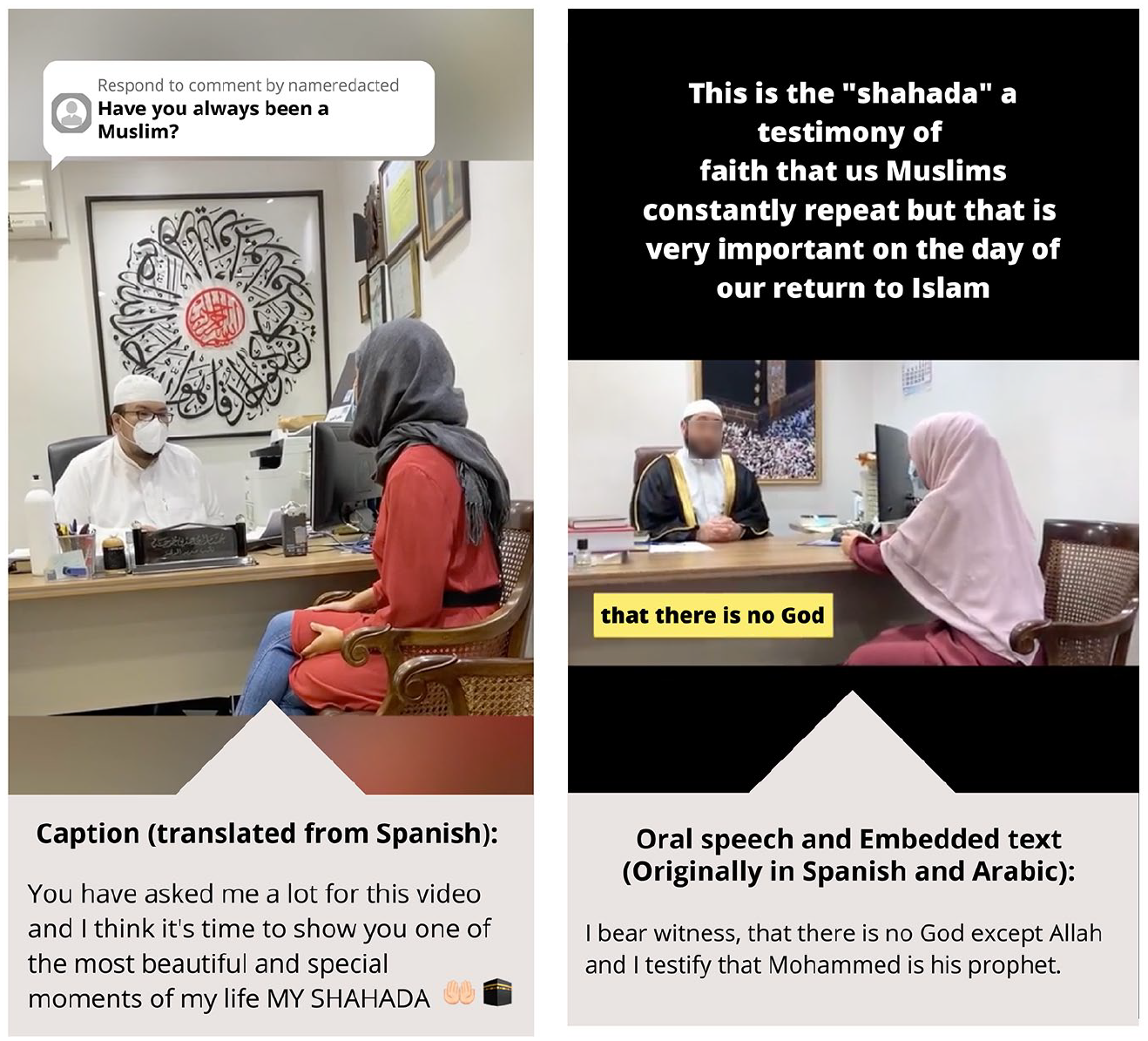
Screenshots from women’s shahada.
In the next section, we will analyze the role of TikTok in challenging discriminatory content that reflects colonial beliefs in the face of their romantic relationship.
Mixed Couples’ Use of TikTok Affordances to Negotiate and Face Colonial Discriminatory Narratives: Recognition of Discrimination
The most used TikTok affordance for discourse deployed to negotiate and face discrimination is answer-comment. This feature enables a tiktoker to create a video around a comment received on a previous video. This affordance enables these minority creators to counter discriminatory discourses through the unique connective and mimetic nature of the platform (Abidin, 2021; Zulli & Zulli, 2020). Although other platforms such as Instagram have integrated this affordance, it has really become part of TikTok’s logics and grammars.
According to our analysis, the presence of rejection and attacks toward the mixed couple in the form of TikTok comments supports Gilroy’s (2004) argument that hybridity is seen as a civilizational betrayal. According to the colonial past of these two nations, in our data we see that both, the Moroccan and the Spanish communities, express their rejection toward this relationship. While their comment feed features many kinds of comments including support and recognition of their value as a couple, as can be seen in the examples below, these creators rarely respond to positive messages.
“I love your husband’s humor, you see how often we get carried away by gossip, keep it up you guys are great . . . by the way where do you live?”
“Brave. Simple. Concise. No need to explain much more.”
“I’m not Muslim, but I think it’s very nice that you share your experiences in this new stage of your life, regardless of your religion.”
It is noteworthy that the mixed couples analyzed overwhelmingly choose to feature and respond to negative comments that criticize them. Below we detail the types of messages they chose to respond to using the answer-comment affordance.
Islamophobic: These remarks relate to religion and are based on the rejection and the stereotyping of Islam as violent as well as a generalization of the group. Some users express discrimination toward these couples because what they represent in terms of culture and religion is seen as old fashioned and strict. They are judged as a possible threat to the advancement of modern societies. It is worth noting how the prevalence of responses to islamophobic comments supports Meer’s (2014) argument that Muslim consciousness—understood as their self-perception within the different aspects of their Muslim identity—is built around Islamophobia and other forms of discrimination.
“If it flies it’s Superman, if it climbs it’s Spiderman, if it explodes it’s Muslim.”
“You are going to convert to Jihad”
Haram/halal frontier: This narrative shows how the Halal-Haram 3 ratio of the analyzed couples is questioned. Allievi’s (2006) explanation of the importance of this haram/halal divide among Muslim converts and established Muslims is relevant. In this case, followers police whether the creators lifestyle corresponds to Islamic principles. Below are some examples of the Haram/Halal messages that were featured by these creators using the answer-comment affordance:
“A Muslim is born, not made. It’s like if I want to become a Latina, you can’t renounce who you are.”
“What I see on the table is salami and minced meat. I don’t care about the minced meat, but what about the salami? I don’t judge you, but then you upload videos.”
Sexist: This type of content refers to cultural prejudices related to Moroccan men’s treatment of women. We also detected contempt and humiliation related to Islamic feminine values presented in videos. This behavior is reflected by attacks on women for wearing hijab or for wanting to use it in the future. Although they reinforced that wearing hijab among Muslim women is seen as a sign of empowerment by the hijabi (Baulch & Pramiyanti, 2018). Below are some examples of the sexist messages that were featured by these creators using the answer-comment affordance (Figure 7):
“I hope you get along well with the other wives.”
“Your boy lets you go around wearing lipstick?”
Messages questioning whether the couple is haram/halal and sexist messages vilifying a woman’s decision-making process to use the hijab illustrate that followers across both cultures castigate the woman’s cultural ambivalence. This can be seen in content reflecting her adoption of the Muslim religion and related identities, supporting our previous argument that her state of unhomeliness or uncertain cross-cultural initiation (Bhabha, 2004) leads to rejection by both the Spanish and Moroccan communities.

Screenshots including examples of messages the creators choose and their answers.
At first sight, the selection of these discriminatory messages may suggest an attempt to fight stereotypes and counteract discriminatory discourses; but if we delve deeper, we can observe how the selection of these messages constitutes a key aspect in their identity-construction process that is based on a contemporary form of colonial domination. According to Gray (2013) by prioritizing such messages they may be perpetuating certain forms of stigmatization by widening the gap between Spanish and Moroccan societies. In Internet studies, the relationship between the expectations of viewers as determinant in the characteristics of the content produced and identity markers displayed by content creators has also been well established (Hearn & Schoenhoff, 2016). In this case, we see the convergence of digitally mediated social pressure to conform to certain expectations and creators’ use of discriminatory content to present specific versions of what it means to be a mixed Moroccan-Spanish couple.
It is possible to argue that the narrative practices by mixed couples on TikTok, built around three types of comments, emerge in response to the static and unchangeable nature of orientalist notions (Said, 2003). The interactions between followers and creators as reflected in the described uses of the answer-comment affordance suggest that judgmental followers attempt to push these creators toward one cultural pole or the other (either Spanish/European/Western or Moroccan/Muslim/Eastern). In these exchanges, change processes and fluidity are penalized, in line with Gilroy’s (2004) assertion that modern societies will attempt to maintain an impossibly “pure” culture. Recognition of hybridity (Gray, 2013) becomes difficult due to the need to align with one of the two cultures and push these creators to move toward more homogeneous cultural forms within the cycle of hybridization (Brian Stross as cited by García-Canclini, 2005). Although, on the surface, TikTok’s affordances seem to provide opportunities to dismantle colonial beliefs, we observe that the way these users combine the affordance with their narrative provides visibility and recognition to discrimination, orientalism, and Islamophobia, rather than their value as a couple and the benefits of cultural hybridization.
Conclusion
The exploration of TikTok content created by mixed couples unveils interesting details about their preferred (self)representations and the aspects of their identities that they choose to emphasize and keep private. It is important to note that this analysis provides only a glimpse of the experience of mixed couples in Spain, but it points to some key aspects that Spanish-Moroccan couples consider important in their identity-construction process. The ambivalent notions of cultural hybridity are especially interesting, as well as the way in which this hybridization takes the form of audiovisual interactive TikTok content.
In this sense, in relation to our first research question (RQ1), our analysis suggests that these creators use TikTok affordances to stage and make visible what we have called their performative hybridization. In these contents, they orally and textually describe hybridization as the ideal while the main narrative and visual plots in their content suggest the dominance of Moroccan culture and Islam. This reflects the divide between these two societies and the difficulties they face in attempting to challenge existing societal norms. The aspects of their identities that they choose to emphasize in their content are relevant, considering the rejection they face from both cultures and societies.
Moreover, their overwhelming use of the answer-comment affordance reflects their need to respond and clarify the merits of their religion and its teachings (Mosemghvdlishvili & Jansz, 2012). On the contrary, the comments selected to be answered emerge in response to static and unchangeable orientalist notions, suggesting that the fluidity of change in their purported hybridization process is penalized in society, pushing them to one of the two cultures.
In this way, answering the second research question (RQ2), the analysis suggests that TikTok enables these minority creators to become visible and influential within the platform and use their own voice through the unique connective and mimetic nature of TikTok (Abidin, 2021; Zulli & Zulli, 2020). However, the way in which these content creators navigate TikTok, far from empowering them, provides visibility and recognition to the discrimination in the messages they choose to highlight.
The role of gender is also noteworthy within answer-comment uses by these creators. In this sense, sexism and, more specifically, islamophobic sexism, become key topics within answer-comment uses by these creators, suggesting that ideas about gender in Moroccan and Spanish cultures are highlighted and placed at the forefront of their mediated identity-construction process. The emphasis these women place on religion as the main identity-related aspect in their adaptation suggests that it is also the one that needs more explanation and justification. This leads to a performance of their own forms of Muslim femininity as explained previously.
This exploratory study has limitations related to the size of the sample and the fact that it focuses on one platform (TikTok) and creators who have achieved a significant following (excluding those who have less followers). This provides a limited perspective on the Moroccan-Spanish experience but one that is relevant to current digital opportunities offered by social media platforms such as TikTok. Future lines of research could explore the perceptions of followers who consume this content and the effects of such narratives on their opinions about these individuals and couples. Future research could also delve into the reasons why most mixed couple accounts with a large number of followers are comprised of a Moroccan male and a Spanish female to understand the cultural and societal motivations for this.
Footnotes
Declaration of Conflicting Interests
The author(s) declared no potential conflicts of interest with respect to the research, authorship, and/or publication of this article.
Funding
The author(s) received no financial support for the research, authorship, and/or publication of this article.
