




Abstract
When TikTok started as a youth-oriented platform, it was mostly used for light entertainment, including music, songs and dance clips. Today, however, it is often relied upon as a hub for social and political activism. Hashtags are an important affordance to create visibility and attract attention. Using a qualitative multimodal thematic analysis, this study examines the shifting patterns in TikTok’s nature as a social media platform and investigates its various affordances in the realm of activism, in general, and feminist activism, in particular. Adopting a comprehensive approach, which takes into account various dynamics, including the overall political and social context, the various actors and the deployed tools and tactics, this study investigates why and how some feminist TikTok campaigns, such as #MahsaAmini which erupted in Iran to resist the imposition of the hijab following the murder of Mahsa Amini, are more likely to go viral and gain more international visibility than other TikTok feminist campaigns, such as #HandsOffMyHijab which erupted in France to resist the hijab and niqab ban. Findings revealed how various factors contributed to increasing the virality and international visibility of the Iranian Mahsa Amini’s #WomanLifeFreedom campaign, including the used online tactics, the support of media and political actors, the power of celebrities and social media influencers, and the online and offline support by male figures. The undertaken thematic analysis identified different dominant themes and representations of hijab in the two online social movements, reflecting varying expressions of feminisms, activisms and resistance. In so doing, the study offers a conceptual model for understanding these online dynamics within the appropriate socio-political and cultural contexts.
Introduction
When TikTok was launched as a youth-oriented platform by the Chinese company ByteDance, it was mostly used for light entertainment, including music, songs and dance clips. Today, however, it is often relied upon as a hub for social and political activism. Hashtags are ‘an important affordance to create visibility and boost attention’ (Literat and Kligler-Vilenchick, 2019: 1992). Specifically, Hashtag feminism on social media platforms has become an effective strategy for fighting gender inequalities globally (Clark, 2016). Scholars argued how discursive feminist activism through individual expressions on social media can lead to collective online/offline action. For example, when a post/tweet is combined with ‘the networked power of hashtags, the political fervor of digital activists, and the discursive influence of collective storytelling, online personal expressions can grow into online collective action’ (Clark, 2016: 13).
Using a qualitative in-depth thematic analysis, this study examines the shifting patterns in TikTok’s nature as a social media platform and investigates its various affordances in the realm of activism, in general, and feminist activism, in particular. Adopting a comprehensive approach, which takes into account the overall political and social context, the various actors and the deployed tools, this study investigates why and how some feminist TikTok campaigns, such as #MahsaAmini and #WomanLifeFreedom, which erupted in Iran against the imposition of the hijab following the murder of Mahsa Amini (2.6 billion views), are more likely to go viral and gain more international visibility than other TikTok feminist campaigns, such as #HandsOffMyHijab which erupted in France to resist the hijab and niqab ban achieving 10.7 million views.
Unlike previous studies on cyberactivism, in general, and feminist activism, in particular, which tend to focus on either the actors or the tools, this study adopts a nuanced comprehensive approach which takes into account the intersectionality between the different online dynamics, including the overarching political and social contexts of activism, the actors or the players who are engaging in it, and their different demographic markers, such as age, race, gender and ethnicity, as well as the affordances of the tools which are being used to exercise it. By doing so, the study offers a much-needed theoretical expansion which deepens our understanding of the different factors which contribute to the success and virality of online feminist social movements, or lack thereof. To this end, this article draws upon the ‘actors, tools, tactics, and contexts’ model developed by Khamis et al. (2013) as well as the three functions of mediated feminist movements (Radsch and Khamis, 2013) as guiding conceptual frameworks.
Hence, this study attempts to answer the following three research questions:
Activism, networked feminism and Islamic feminist movements
Cyberactivism refers to ‘the reliance on digital tools to advance a cause which is difficult to advance offline’ (Howard, 2011: 145). As Mattoni (2013) pointed out, social movement actors develop repertoires of communication that are dynamically changing with regard to emerging technologies and choose to utilize certain sets of activist media practices to reach various actors inside and outside the social movement milieu. Online discourse can serve as a ‘form of activism‘ capable of initiating sociopolitical change, even without the aid of offline collective action (Shaw, 2012).
With its wider reach, accessibility, and large user base that crosses borders and languages ( George and Leidner, 2019), cyberactivism has particularly flourished within the current feminist movement. Digital feminist activism has allowed all types of women to engage in feminist protests in their own way following their specific agendas and causes. Hence, social media activism, especially on Twitter, can be seen as a catalyst of the so-called fourth wave of feminism which involves using technology to advance global and diverse feminist movements for a variety of women starting in the 2010s (Shiva and Kharazmi, 2019). While critics argue that online activism might be less impactful than on-the ground activism (George and Leidner, 2019), online feminist activism has led to significant offline change. For example, the #MeToo movement led to the creation of the Time’s Up organization which created a legal fund to allow women resources to bring cases of harassment to court (Shiva and Kharazmi, 2019). However, scholars warned of the potential influence of algorithmic design and bias in social media and search engines on shaping the visibility and reach of certain feminist activist voices and narratives over others. For example, Noble (2018) argued how the monopolistic control of a few internet search engines and the regeneration of real-world human biases in algorithmic coding result in biased search algorithms that favour whiteness and discriminate against people of colour, especially women of colour.
Adopting a post-colonial approach which prioritizes women’s lived experience, varied realities and self-expresses identities, this study explores the concept of ‘networked feminism’ which refers to ‘a form of contemporary political action that is characterized by complex connectivity and which operates at the intersections of online and offline’ (Fotopoulou, 2016: 49). The term encompasses ‘broader questions of how technology shapes the social imaginaries of feminist politics’ (Vachhani, 2024: 1033). An interconnected concept is ‘digital feminist activism’ which relates to specific digital practices and online spaces that activists engage with to promote feminist voices and experiences.
In investigating digital feminist activism, this study pays special attention to why, and how, different groups of women are taking advantage of the new affordances of technologically-enabled platforms, in this case TikTok, to advocate for the causes that they are most passionate about and interested in. In doing so, the study unpacks their different articulations of the concepts of women’s rights and women’s empowerment which oscillate between secular and religious understandings, interpretations and forms of expression. It will unpack the intersections, as well as the divergences, between those who advocate for a feminist stance from a secular perspective, which aligns more closely with Western values, and those who advocate for a form of ‘Islamic feminism’ (Tzoreff, 2014), which contextualizes the call for women’s empowerment and the protection of women’s rights within the context of Islamic values and teachings, rather than without it.
In unpacking these phenomena, the study pays special attention to the complexity, hybridity and dynamism of these concepts and how they give birth to highly charged contestations and push-and-pull mechanisms in both the online and offline spheres, simultaneously. We argue that both spheres are constantly feeding into each other, since whatever takes place online both shapes and reflects the realities on the ground, and vice versa.
TikTok’s affordances as a catalyst for cyberactivism
Scholars perceive technologies as social artefacts that both shape and are shaped by social, political and economic relations (Davis, 2020). Social media affordances refer to ‘the physical properties or features of objects and settings that “invite” actors to use them in particular ways’ (Lievrouw, 2014: 23). However, Davis (2020: 10) argued for treating affordances as mechanisms shifting the focus from ‘what objects afford to how objects afford, for whom, and under what circumstances’. Recently, TikTok has been cultivating a new arena for cyberactivism. Affordances pertaining to TikTok’s quick-paced nature, filters and voiceovers breed a form of activism characterized by creativity and playfulness (Jin and Abidin, 2023). These aspects of the platform contribute to its appeal as a powerful tool of persuasion offering a personalized experience and a diverse user base.
One of the attributes of TikTok as a social media platform that led to its global takeover is its fine-tuned algorithm which tailors what TikTok users see according to their interests and even their identity (Schellewald, 2023). Another aspect of the TikTok experience that sets it apart is the fact that users may feel that they are escaping their own reality by using TikTok. This level of engagement can sometimes cross the line and feel ‘addictive’. While this can eventually create a negative association with the use of the app, it allows users to feel connected to the app on a level that feels more integral to their lives. In particular, TikTok’s prioritization of mimesis through its layout and digital features, such as icons and video-editing, is a useful communicative and interactive affordance for both the platform and its users where imitation and replication are tied to user profitability and can ‘engender content production and spreadability in unparalleled ways’ (Zulli and Zulli, 2022: 1884). This memetic culture created ‘imitation publics’ who have the potential to promote certain political or social causes, and/or online social movements ‘if they are packaged as “challenges” or “checks” that they can replicate’ (p. 1886).
These affordances contribute to how TikTok has proven itself as a powerful tool of activism. Activism on TikTok relies less on goal-based organization, but more on community building and mobilizing based on shared values, humour and interests (Jin and Abidin, 2023). Due to its captivating and personalized format, users of the platform not only get engaged by activism-related content, but also feel emotionally invested and personally connected to it (Schellewald, 2023). But its playfulness does not mean that the TikTok activists do not have an impact as TikTok activism action has played a major part in global movements such as #Black Lives Matter and #Free Palestine (Cervi et al., 2023).
In particular, Hautea et al. (2021) highlighted visibility, editability and association as three key TikTok affordances behind the success of online social movements as they allow creators to ‘construct and propagate multi-layered, affect-laden messages with varying degrees of earnestness, humor, and ambiguity’ (p. 1). Visibility refers to how information is made easily perceivable and locatable by others through shares, comments, likes, or the use of multiple hashtags on TikTok (Abbas et al., 2022; Hautea et al., 2021). Editability describes the user’s ability to easily create and edit content including music, icons, text in video, text in caption using the app’s native video editor (Hautea et al., 2021). Association implies the capacity to link disparate social actors or combine old and new content together using duet and stitch functions that help ‘creators edit their own clips together with existing TikToks hashtags and sounds link to automatically generated pages’ (p. 6).
Case studies of hashtag feminist movements: #MahsaAmini and #HandsOffMyHijab
The fourth wave of feminism has manifested itself in various social movements within various countries and social contexts that can all fall under the umbrella of (Hashtag) feminism. For example, the #MahsaAmini social media campaign was launched in response to the killing of an Iranian woman, Masha Amini, on 16 September 2022 by the Iranian Morality Police for inappropriately wearing her hijab (Navarro and Peres-Neto, 2023). The killing was initially followed by swarms of in-person protests and riots against the Islamic republic rule, but when the Iranian government suppressed protestors with violence, the activism moved online (Navarro and Peres-Neto, 2023). The online campaign involved women sharing videos of cutting their hair as an act of protest (see Figure 1). The emotionally evocative videos shared by high-profile and regular women allowed for discussions on women’s rights in Iran. Also, in response to the killing of Masha Amini, the #WomanLifeFreedom and #HairForFreedom hashtags spread throughout social media and even inspired in-person protest efforts (Cai, 2023). The impact of the hashtag was evident even during the World Cup with people having the slogan written on banners during the globally watched games.
Another example of social media allowing marginalized voices to protest is the 2021 #HandsOffMyHijab campaign (Khamis, 2023). Since Muslim voices and anti-racist arguments are often confined to university and left-wing circles in France where Islamophobia is a serious political practice affecting Muslim people (Dawes, 2021), the online movement was trending across social media in response to the French senate proposing a law that would ban the wearing of the hijab in public places by girls under 18 years (Khamis, 2023). The online campaign started in France, but spread globally, calling for an end to systemic religious discrimination. The hashtag started by regular French Muslim young women from their family homes gained global support from politicians and celebrities. These young women who ordinarily would not have influenced political spheres were empowered by the far and wide reach of social media. Like #HairforFreedom and #WomanLifeFreedom, this campaign addressed the actions of a powerful political state trying to control women’s right to choose how they live. In these cases, the hashtag is a key tool in disseminating these messages and allowing any social media user to participate (Cai, 2023).
Theoretical frameworks
Contextualizing feminist networked activism: A postcolonial intersectional approach
This study adopts a postcolonial intersectional feminist approach which takes into consideration the relationship between different forms of oppression, across gender, race, ethnicity and other identity markers, and the struggle against colonial legacies and Western hegemony and domination (Abu-Lughod, 2013; Al-Ali, 2012; Joseph, 2000; Moghadam, 2003). This approach is also informed by the conceptualization of feminism as the relationship between awareness and action, consciousness-raising and mobilization, and the importance of individual personal experience to acknowledge women’s diverse realities and amplify their varied voices (Radsch and Khamis, 2013).
Therefore, it challenges rigid and standard conceptualizations of Western feminism which can obscure the diversities and complexities of women’s lived experiences, forms of agency and expressions of activism (AlKhaled, 2021). It also offers a novel approach in the realm of investigating the multiplicity, plurality and hybridity of transitioning feminisms and activisms (Tzoreff, 2014).
Moreover, this approach compels us to investigate the complexities and nuances of shifting feminist identities and resistances beyond the ‘gender norms’ vs ‘modernity’, or the ‘tradition’ vs ‘modernization’, or even the ‘religious’ vs ‘secular’ dichotomies, since it acknowledges that all of these modes of feminist resistance are not mutually exclusive, rather they coexist in parallel and they overlap, giving birth to new hybrid identities.
This necessitates moving away from the mindset of adopting a ‘one size fits all’ model of feminism and acknowledging the multiple forms of feminisms, activisms and resistances, while denouncing the adoption of a Western-centric, ethnocentric, uniform feminist model, which privileges the Western-defined mode of feminism as the only valid form of feminism to be emulated and adopted by women everywhere (Abu-Lughod, 2013; Al-Ali, 2012; Joseph, 2000; Moghadam, 2003; Walby, 2011).
A number of scholars adopting the postcolonial intersectional feminist approach asserted the necessity of moving away from this orientalist approach, through acknowledging the necessity of appreciating the multiple forms of activisms and feminisms which prevail in Muslim societies among different groups of women representing varying demographics, experiences and manifestations of religiosity. This entails resisting the stereotypical orientalist misperceptions of Islam, Muslim women’s gendered identities and their varied forms of identity-expression, including wearing the Islamic headscarf or the hijab (Abu-Lughod, 2013; Moallem, 2005; Yegenoglu, 1998). Adopting such an approach also necessitates avoiding the so-called ‘save the Muslim woman syndrome’ (Abu-Lughod, 2013) which implies that women in the Muslim world are helpless beings who lack agency and, therefore, need to be saved by ‘Others’.
A growing body of recent scholarship is paying attention to bringing transnational and postcolonial approaches into the analysis of digital feminism, particularly networked activist and feminist movements in the Global South. Some of these studies address the potentials, nuances, limitations and complexities of digital and networked feminist movements across the North–South binaries, while also challenging the dichotomies between secular and Islamic feminism in some Muslim countries such as Iran (Asadi Zeidabadi, 2023).
Moreover, in order to provide a strong theoretical and historical grounding for addressing the different socio-political and cultural contexts of the two hashtag campaigns under study, it is important to investigate the growing body of knowledge which unpacks the postcolonial intersectional feminist analyses of discourses around the complex, and oftentimes intertwined, issues of veiling and Islamophobia, and how they contribute to amplifying and proliferating misrepresentations and misconceptions about Islam, Muslims and especially Muslim women (Basmechi et al., 2022; Malek, 2021; Rahbari et al., 2021; Ranjbar, 2021; Seddighi and Tafakori, 2016; Shaban, 2022; Tafakori, 2021; Varma and Shaban, 2024).
Conceptualizing online dynamics in networked activism: The actors, tools, tactics and contexts model
When analysing the phenomenon of ‘cyberactivism’, it is important to avoid adopting the approach of technological determinism, which over-credits the role of the deployed tools of communication, at the expense of other factors. Rather, it is crucial to adopt a holistic and comprehensive approach which takes into account all the interrelated and intersectional factors that can account for the effectiveness of a digitally-based campaign in shaping public opinion around a certain issue, or lack thereof, as well as its ability to inspire on the ground action and organization among ordinary citizens around this issue.
The myriad factors which need to be carefully considered and examined include: (a) actors, which refers to the competing parties and players who are using digital tools to advance certain causes; (b) tools, which refers to the means of communication that are used by these actors in their struggles; (c) tactics, which are the approaches adopted by the actors and players to frame and proliferate their competing messages; and (d) contexts, which refers to the historical, cultural and socio-political set of factors and circumstances within which these actions are embedded (Khamis et al., 2013).
In analysing the selected online social movements in this study, we are keen to shed light on who is undertaking the acts of online activisms and resistances and who provides them with the needed support and solidarity, both online and offline, to achieve their goals; what tools of communication are being deployed and what are the affordances and capabilities of these specific platforms which make them especially best suited to support, advance and proliferate these causes; which tactics, approaches, and strategies are being used by the propagators of each online campaign and with what effects and implications; and which factors, historically, culturally, politically and socially, are invoked by the organizers and supporters of each online campaign to contextualize their messages, expand their outreach and boost their visibility.
We argue that, without examining each of the above mentioned factors in depth, in addition to investigating the overlaps, intersections and dynamics between them, we cannot arrive at a full and deep understanding of the act of cyberactivism, with all its nuances and complexities.
Mediated feminist movements: Three functions
In investigating the previously mentioned phenomena, we argue that mediated feminist movements in cyberspace mostly engage in three parallel functions, namely education, documentation and mobilization (Radsch and Khamis, 2013), in order to exercise their multifaceted struggles and resistances.
The first function of education refers to raising awareness about the issue, or issues that they are advocating for through influencing and shifting – the societal mindset in favour of positive change and constructive transformation. We argue that deploying digitalized forms of resistance through using online platforms, such as TikTok, allows for this form of education and awareness-raising to spread beyond the local, or even regional, boundaries to reach a global audience.
The second function of documentation refers to recording and sharing the necessary content which provides evidence in favour of supporting a particular cause. Digital platforms which have highly sophisticated audio-visual affordances and capabilities, such as TikTok, are particularly best suited for serving this function since they can be best used to capture impactful images, sights, sounds and digital effects. The combination of these audio-visual resources ideally serves the function of documentation.
Finally, the third function of mobilization refers to the ability to create some form of on-the-ground networking and support for a mediated online campaign, through raising the needed solidarity among large numbers of people. This implies a crossover from the digital online sphere into the real world everyday sphere, which is essential for the success of any social movement. We argue that, without the presence of this trickledown effect, no social movement could ever succeed in achieving its intended goals.
This study will provide evidence as to how the advocates of both the first and second social movements have used the audio-visual affordances of TikTok to fulfil these three functions, albeit in different forms, using varied tactics and with varying degrees of success and effectiveness.
Research methods
The qualitative study employs inductive (multimodal) thematic analysis to explore the recurring themes in the top 300 most viral TikTok videos on the two hashtags #MahsaAmini and #HandsOffMyHijab (150 each) which were selected because of their popularity and relatively high views. Our multimodal analysis involved a frame-by-frame examination of ‘the interaction of affordances, caption text, screen text, images, music, sound and cultural context in the video sample’ allowing for layered interpretation (Hautea et al., 2021: 5). We used the hashtag as a methodological tool for data selection (see Abbas et al., 2022; Jackson and Foucault-Welles, 2015; Literat and Kligler-Vilenchik, 2019). To collect our sample, we used the ‘Top’ feature on TikTok as it ‘allow(s) users to directly access the most viewed collection of videos related to a specific keyword or hashtag’ (Abbas et al., 2022: 296). Our unit of analysis is the single TikTok video and its accompanying caption. All the videos in our dataset were publicly shared by TikTok users excluding any contributions from private TikTok accounts.
Our analysis involved looking at how different actors or competing parties used the two hashtags to construct and distribute their messages, what themes their messages included and which tools and/or TikTok design features and affordances they employed as a means of communicating their competing activist messages. Our analysis further examined how creators on the two hashtags used TikTok affordances including visibility, editability and association (Hautea et al., 2021) to reinforce their messages. Therefore, the study employed Braun and Clarke’s (2006) six-phase of thematic analysis guide that involves familiarizing yourself with data, generating initial codes, searching for themes, reviewing themes, defining and naming themes, and producing a final report. In this process, we first conducted open coding to identify and list recurrent ideas and emerging themes about digital hijab narratives from the multimodal (video + textual) data extracted from the two hashtags. Next, we grouped codes into categories and made new connections among them using the process of axial coding to develop theoretical extensions (Webb, 2017).
Hence, the initial inductive data analysis involved a line by line hand-coding of the multimodal (audio-visual + textual) content of the two samples of hashtagged TikTok videos and captions, and led to inductively developing a code list of general themes to which more focus was given during the subsequent data collection stages. For example, in the open coding of #HandsOffMyHijab, 12 general emerging themes were found in the video content: (a) victim narratives (either as documentation or self-report of violations against hijabi women); (b) perpetrator profiles; (c) media representation; (d) legal implications of anti-hijab crimes; (e) hijab in different contexts; (f) call for preventive measures against hate crimes; (g) psychological impacts of hijab-related discrimination; (h) myths/stereotypes about hijab and women’s rights in Islam; (i) intersectionality in anti-hijab narratives; (j) colonial impact on attitudes towards hijab; (k) historical roots of Islamphobia; and (l) history of hijab ban laws in Europe. These initial themes describe the main observed topics/issues in the videos. Based on their dominance and frequency, the most recurrent three themes were identified and grouped into bigger categories.
For example, we observed that documenting and reporting anti-hijab hate crimes, promoting transnational solidarity, creating counter narratives to challenge stereotypes against hijab, and analysing the roots of Islamophobia and colonization impact are four recurrently connected activities practised by TikTok influencers to advocate for women’s rights in wearing hijab in their videos. Thus, those practices were grouped together under a more abstract thematic category which we referred to as ‘Empowering Hijabi Voices through Advocacy and Education’. A similar process was conducted to identify the most dominant themes in the #MahsaAmini online movement and to cluster them under a broader category named ‘Defiance against government and religious authority’.
Data from the TikTok posts were entered into the Nvivo 14 software for more detailed coding. This allowed for ‘organizing all of the text excerpts connected to particular themes in one place and facilitated grouping relevant themes together, categorizing them and mapping out new connections on a more abstract level’ (Arafat, 2021: 2180). We checked inter-coder reliability to point out any potential flaws existing in defining categories in the initial coding scheme. Since we analysed 300 videos in the original sample, an inter-coder reliability check was conducted on only 10 percent of the sample (30 videos, 15 in each hashtag) which were coded by a second examiner to ensure coding is not biased by individual coder differences.
Research findings
Dominant themes and actors in the online feminist movements
Our thematic analysis of TikTok videos revealed how #HandsOffMyHijab hashtag served as a space to construct online hijab narratives and engage in forms of hashtag activism, including awareness campaigns and solidarity movements that facilitated documenting assaults against hijabi women, expressing counter opinions and solidarity with victims of anti-hijab hate crimes, challenging the French hijab ban laws and addressing misconceptions regarding hijab in Islam. Female hijabi influencers were the dominant actors in the top viral videos under this hashtagged TikTok videos sample, with the exception of a few videos created by non-hijabi women or male influencers about the Hijab ban.
Findings identified three dominant themes in the hashtagged video content, highlighting the educational and documentary roles within mediated feminist movements (Radsch and Khamis, 2013). These themes can be collectively categorized under a more abstract theme called ‘Empowering Hijabi Voices through Advocacy and Education’. The first predominant theme ‘Reporting Anti-Hijab Hate Crimes/Incidents’ is action-oriented with a focus on promoting victims’ narratives. As a form of online activism, the majority of the videos in this theme involved mostly hijabi female creators from different nationalities and ethnic backgrounds sharing either their own personal stories of anti-hijab attacks or humiliation, or raising awareness about real anti-hijab hate incidents against women in France and other parts of the world. Some creators asked their followers to show transnational solidarity with hijabi women who encounter discrimination in France, the US and India through taking action. For example, two creators asked their followers to use the contact numbers and emails they left in the comments section to pressure an elementary school in New Jersey to hold a teacher accountable after forcibly removing the hijab off a young student in the class (TikTok source: @theworldwithmnr, February 2022), see Figure 1. In other examples, some Hijabi content creators criticized how it is socially acceptable to cover a woman’s head and hair with a hoodie or a beanie while it is considered oppressive to cover it using a religious head scarf or hijab (TikTok source: @sfkhader, April 2021).
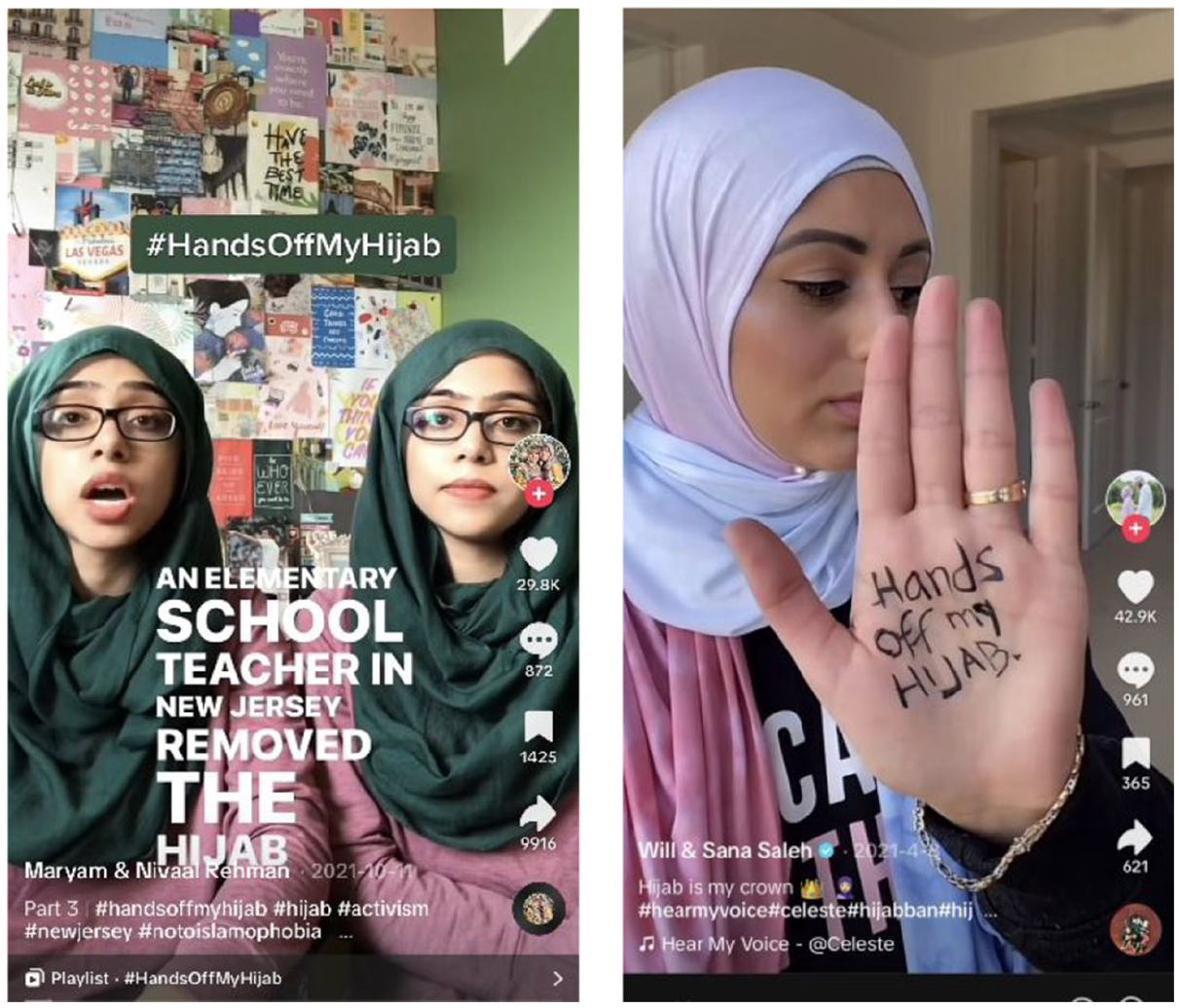
Screenshot examples from publicly available TikTok videos by Hijabi creators sharing stories of anti-Hijab attacks in support of #HandsoffMyHijab movement (Sources from left: @the worldwithmnr and @Salehfamily)
The second most recurrent theme ‘Challenging Stereotypes against Hijab’ involved content creators explaining the dominant myths where hijab is perceived as a symbol for patriarchal oppression against women. As a counterstrategy to negative mainstream media messages about hijab, some content creators offered alternative narratives about why they enjoy wearing hijab as a form of dedication to God without being forced to. For example, a hijabi influencer was asked by her husband in one of the videos if she was forced to wear hijab, and she explained: ‘There is no compulsion in Islam, hijab cannot be forced upon anyone . . . I did not wear the headscarf for 20+ years and I came to it on my own and I love it. Hijab is my crown’ (TikTok source: @Salehfamily, May 2021). Videos used the captions ‘Oppressive or choice?’, ‘Hijab is my crown’, and ‘Stop hypocrisy’. Some videos under this theme came in the form of commentary ‘reactions’ where TikTok influencers were either responding to media coverage or French politicians’ quotes about hijab using various audio-visual multimedia screenshots, photos, music and subtitles.
The third recurrent theme under this hashtag is ‘Islamophobia and Contestation of Colonization and Hijab Freedom’ where creators gave analytical and historical backgrounds about how some European and French laws oppressed Muslims’ rights to practise religious rituals perceiving hijab ban as a form of racism and reinforcement of Islamophobic practices. For example, two female creators reported that hijab was perceived as a threat to French colonial identity and criticized how former colonizers like France ‘believe that they must civilize the people they colonize and look down on other cultures and religions’ (source: @theworldwithmnr, August 2021). Another influencer explained how the French hijab ban ‘is a direct attack on the Muslim community in France and denies your basic human rights to have freedom of belief and faith’ (source: @Nevtalkspolitics, April 2021). Based on these narratives, many TikTok creators framed their persistence to wear the hijab as a fight for liberation and empowerment in Europe using video captions such as ‘France is creating Islamophobic rules’, ‘Not even trying to hide the Islamophobia’ and ‘Stop taking away my Freedom’. As a content creator noted: I choose to cover this way because I am fighting against a systematic oppression against women in which women’s bodies are being sexualized and objectified. This is a different perspective and a different form of empowerment. (TikTok source: @Zainabjabak, April 2021)
While the top most viral videos on TikTok’s #HandsOffMyHijab hashtag did not exceed 285,000 views, the most viral videos on #MahsaAmini received 21.6 million views on the platform. Our analysis showed several factors that contributed to the virality and international visibility of the latter social movement over the former. Various social actors contributed to the success of the Iranian online movement bringing more visibility and engagement to it including: (a) media actors: the wide coverage of international mainstream media of the Iranian protests such as The Washington Post, Vice News and CBC News and their use of #MahsaAmini hashtag in their TikTok posts to document human rights violations during and after the protests or showing protestors knocking turbans off the heads of clerics; (b) political actors: the circulation of viral videos for EU politicians who either advocated for the Iranian protests or cut their hair in solidarity with Iranian women’s rights such as the Swedish lawmaker Abir Al-Sahlani who cut her hair in the EU Parliament; (c) power of celebrities and social media influencers: international and local celebrities such as YungBlud, Angelina Jolie and Nazanin Boniadi and others who publicly talked about Iranian women’s oppression, including the Iranian football team who refused to sing the national anthem in solidarity with Iranian protests in the 2022 Qatar World Cup; (d) online and offline support by male figures: many of the videos on the hashtag involved videos of men either shaving their hair or protesting against the Iranian morality policy supporting and protecting female protesters against police. See Figure 2 for examples.
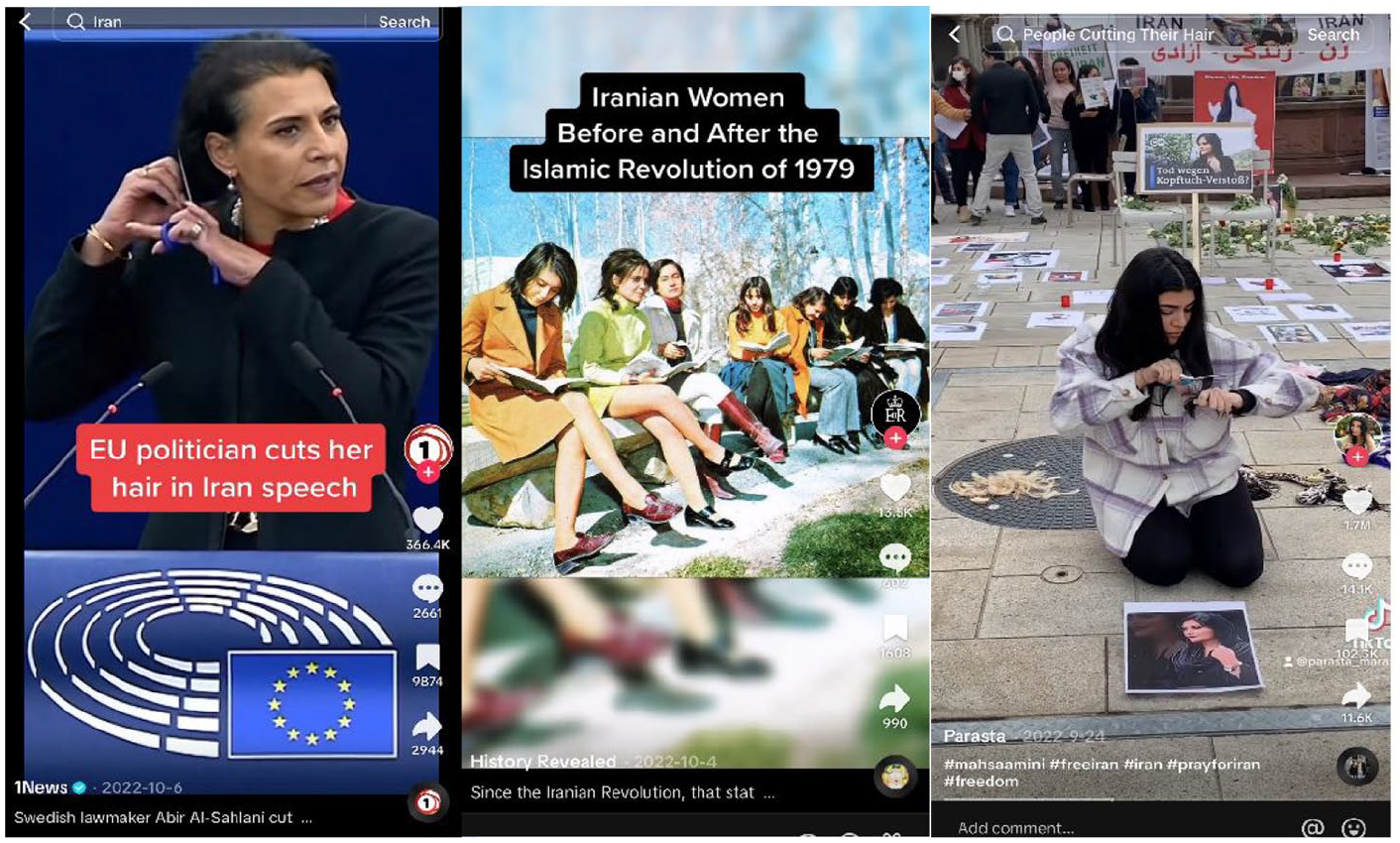
Screenshot Examples from publicly available TikTok videos showing female politicians and protesters cutting off their hair in solidarity with #MahsaAmini (Sources from left: @1newsnz, @history_revealed, and @parasta_marandi)
Analysis further revealed three main dominant themes in the top videos under #MahsaAmini hashtag that can be categorized into the overarching theme ‘Defiance against Government and Religious Authority’. These themes entail a clearer focus on the mobilization function of mediated feminist activism (Radsch and Khamis, 2013). The most recurrent theme is ‘Taking off Hijab and Cutting Hair for Rebellion and Solidarity’ which involved dozens of Iranian and international male and female protestors and content creators challenging the patriarchal dominance over Iranian women’s freedom by taking off their compulsory head scarfs, burning them, or cutting their hair while carrying Mahsa Amini’s photos and telling her police detainment story. The emotional representation of Mahsa Amini as a symbol for the Iranian liberation protests inspired many influencers to replicate the outfit she was arrested for wearing and use several photos and videos showing her in a coma at the hospital before death. Creators used various motivational captions asking for support and action or showing resilience such as ‘Save Iran’, ‘Do you hear us?’, ‘I wanna fight’, ‘We are close to Freedom’, ‘Now men and women are fighting for their freedom shoulder to shoulder’, and ‘Help spread the word’. Within this theme, the sub-theme ‘Telling Personal Hijab Stories’ emerged as creators used the hashtag to share their own experiences of being forced to wear hijab at a young age and their continuous fear of taking it off. The murder and arrest of Iranian protesters increased people’s anger, urging more content creators to post videos to spread the word.
The second theme is ‘Iranian Women between the Past and the Present’ where creators showed photos for Iranian women freely wearing short and revealing clothes before the Islamic revolution of 1979 versus being obliged to wear full black cover now using slogans like ‘Let’s fight to bring the old Iran back’. For example, one of the videos explained how ‘Iran went from being a country that crowned women to being a country that kills women for “improperly” covering their hair’ (source: @Cameliakatz, September 2022). Another creator showed how Iranian women used to wear makeup in 100 years reflecting the change in the identity and male power over the years (source: @nikaazarrii, December 2022). There was a clear sense of nostalgia, or longing for the past, especially Iran’s secular past, which was clearly evident in these posts.
The third recurring theme involves forms of ‘Resistance against the Iranian Regime, Morality Police, and Religious Clerics’ where videos of women refusing to wear hijab despite the heavy police presence and others yelling at clerics or taking off their head turbans for condemning them of immodesty were popular. Also, many videos involved calling for releasing detained protesters, asking people to share and say their names, and showing photos and videos of them to lobby and pressure the government. This involved calls for an instant foreign interference to protect women’s rights. For example, an American influencer called for Biden’s government to ‘open a third-party investigation into Iran’s crimes against women’ (source: Joshhelfgott, September 2022).
TikTok affordances and digital hijab narratives
While general TikTok affordances, including short-form video creation, music integration, filters and effects, duets and collaborations, live streaming, user interactivity and in-app editing tools, were extensively used by creators in hashtags for both social movements, influencers using #MahsaAmini went the extra mile by employing unique affordances that increased the interaction with, and the virality of, their hashtag video content.
The multimodal analysis demonstrated how videos on #MahsaAmini hashtag involved more visual creativity and artistic expression reinforcing the editability and affect-sharing features of TikTok as proposed by Hautea et al. (2021) (see Figure 3). For example, most of the videos on #HandsOffMyHijab hashtag involved content creators telling their hijab stories talking directly to the camera with the movement’s slogan written on their palms. However, viral videos on #MahsaAmini involved more artistic use of songs, dancing clips of protesters, face and body colouration with Iranian flag colours, and emotional textual content in both captions and subtitles. For example, female creators and makeup artists used fake blood and sketched bruises on their faces to symbolize violence against women in Iran. These videos went viral despite being marked as sensitive content by TikTok (e.g. source: @Mavvni, October 2022; source: @dj.angelx, September 2022). Other videos focused on viral memetic content commenting on the mural created by the Italian artist AleXsandro Palombo outside the Iranian consulate in Italy featuring Marge Simpson cutting her hair in solidarity with Iranian women’s courage. Another creator re-mediated clips from the 2007 movie Persepolis showing the struggle of an Iranian hijabi woman who encounters discrimination and insults by a clerk in front of her daughter with the title ‘watch to better understand the Iran protests’ (source: @anaphaesia, September 2022). Hence, TikTok’s editability features empowered the creation of artistic content through enabling creators to easily edit the different multimedia content including music, icons, text in video and text in caption using the app’s native video editor.
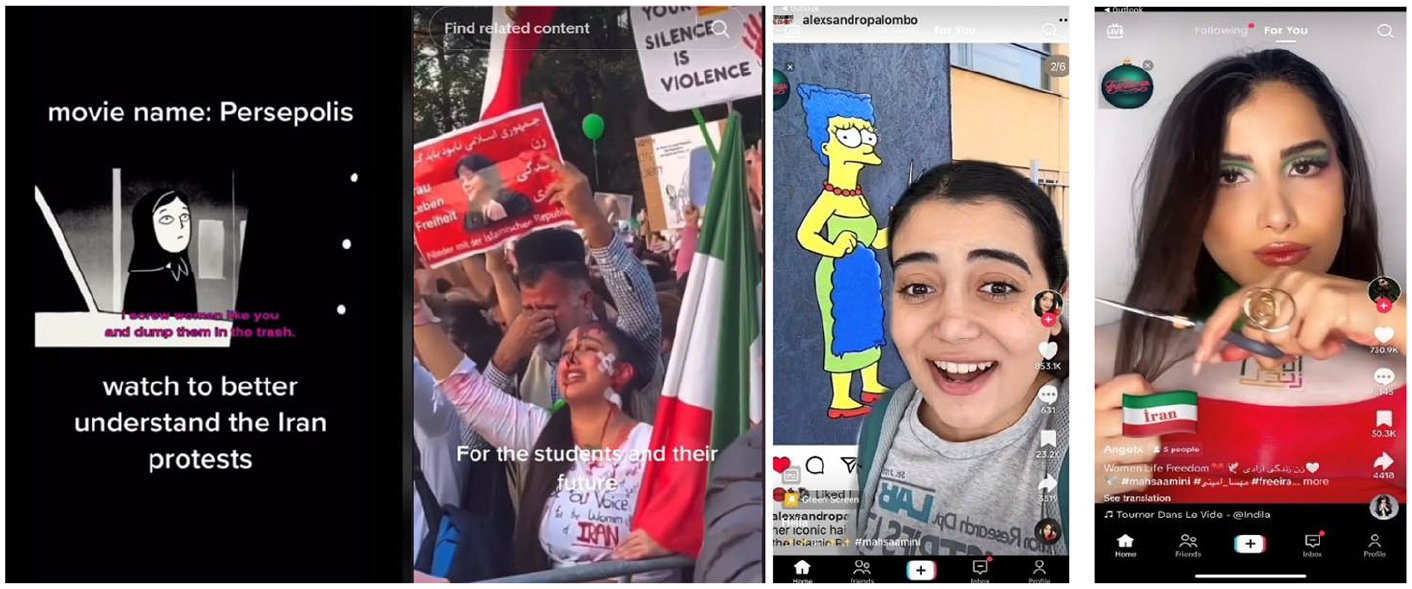
Screenshot examples from publicly available TikTok videos that show visual creativity and artistic expression in using fake blood, makeup, memes and clips from animated movies to support #MahsaAmini (Sources from left: @anaphaesia, @Mavvni, and @dj.angelx)
To enhance collaboration, interaction and content generation, our findings revealed how TikTok’s affordance of association was also more widely used by content creators in the #MahsaAmini Hashtag. The reuse of soundtracks and pre-made video templates was made possible by TikTok’s stitch function that allows users to integrate a snippet of another user’s video directly into their own. For example, most of the viral #Mahsa Amini’s videos combined old and new content together, especially old clips of Mahsa Amini dancing and photos of her injured body during her last days in the hospital.
Also, many videos that gained over 21 million views involved the reuse of soundtracks of popular feminist songs such as ‘Unstoppable’ by Sia and ‘Another Love’ by Tom Odell as background music while showcasing scenes of women cutting their hair or shots from protests of women hugging each other (e.g. source: @Parasta_Marandi, September 2022).
To bring more interaction and engagement, some creators used the ‘One Thing About Me’ famous TikTok trend/challenge that used the music from Nicki Minaj’s popular song ‘Super Freaky Girl’ and composed new lyrics for the song aiming to raise awareness about Iran and tell stories about oppression in a creative and playful song form which reinforces political expression and resistance (source: @Taragrammy, October 2022).
Enabling sharing, liking, commenting features on videos was another affordance offered by TikTok that contributes to its virality. To enhance visibility in the two studied online social movements, creators employed multiple popular hashtags on each video aiming to maximize its virality. Based on the work by Xiong et al. (2019), we clustered hashtags into the following groups: (a) event-specific hashtags, e.g. #HijabBanFrance, #iranprotests2022, #womenlifefreedom, #muslimlivesmatter, #womensrights: (b) platform-specific hashtags, e.g. #foryou, #iraniantiktok, #tiktokarab; (c) call to action hashtags, e.g. #freeiran, #helpiran, #noban, #hearmyvoice); and (d) location-related hashtags (mainly the location of solidarity protests), e.g. #Tehran, #London, #France).
Contextual factors in digital feminist movements
The analysis further identified two main contextual factors that enhanced the virality of and engagement with one feminist social movement over the other.
First, the role of symbolism in mobilizing a collective action. Since the #HandsOffMyHijab online movement depended on the diversity of opinions and experiences of women expressing their opposition to the hijab ban laws in France or telling individual stories about abuse or discrimination, the movement did not have a single symbol or spokesperson for people to rally around. In contrast, the late Mahsa Amini was perceived as a symbol for oppression and resistance for the #WomanLifeFreedom movement and its relevant hashtags. This symbol mobilized mass demonstrations and dominated a big part of the online and offline anti-compulsory hijab narrative. Her oppression story ignited waves of sympathy that resulted in the influencers’ extensive use of Mahsa Amini’s photos and videos in their online content where taking off hijab, cutting hair, using fake blood and colouring their body and face with the Iranian flag colours were the most frequently used visual representations to symbolize resistance and civil disobedience.
The second factor is the socio-political context itself as Mahsa Amini’s online movement and its relevant hashtags were not only used to tackle Iranian women’s rights and human rights violations, but were also used by several actors, including local and foreign politicians, activists, celebrities and media outlets as a platform for discussing the weakness and failures of the autocratic Iranian government and its Islamic rule from a wider perspective. For example, one creator used the words ‘anti-regime demonstrations’ and ‘brutal and terrorist Islamic regime in Iran’ in his video captions and subtitles (e.g. source: @gghamari, November 2022). Many other videos used the title ‘get ready with me to get killed in Iran’ or ‘getting ready to be murdered in Iran’ showing women getting dressed modestly and wearing a headscarf to reflect the regime’s restrictions on women’s freedom (e.g. source: @lilpersianprincess, October 2022). In contrast, discussing the French political context was not the main focus of the narrative in #HandsOffMyHijab movement as Tiktokers focused mainly on the Hijab ban law and its influences on the minority group of female Muslims in the country. In other words, while the #MahsaAmini, #WomanLifeFreedom campaign has been deeply contextualized and embedded within the overarching socio-political and historical context in Iran, the #HandsOffMyHijab campaign was framed as a minority group members’ struggle against the loss of individual freedoms in secular France, which is deeply grounded in Islamophobia. This has been evident in the first campaign’s reliance on political resistance messages and slogans, in contrast to the second campaign’s intense focus on individual stories and personalized testimonies.
These two contextual factors influenced the international support and reach of the two social movements, with the first one receiving wider and stronger international support and more visibility due to the symbolic power of Mahsa Amini, as the face of this movement, coupled with the anti-Islamic Iranian regime messaging which resonated with a largely secular global audience.
Discussion and conclusion
This study makes a number of important contributions to the existing body of literature in the areas of cyberactivism, networked feminism, social movements and social media studies. Steering away from the technological determinism approach which privileges the tools which are being deployed to support a certain cause and prioritizes them as the main cause behind the success and visibility of any cause or movement, this study adopts a comprehensive and nuanced approach which takes into account myriad factors, as reflected in this study’s findings, and as shown in Figure 4.
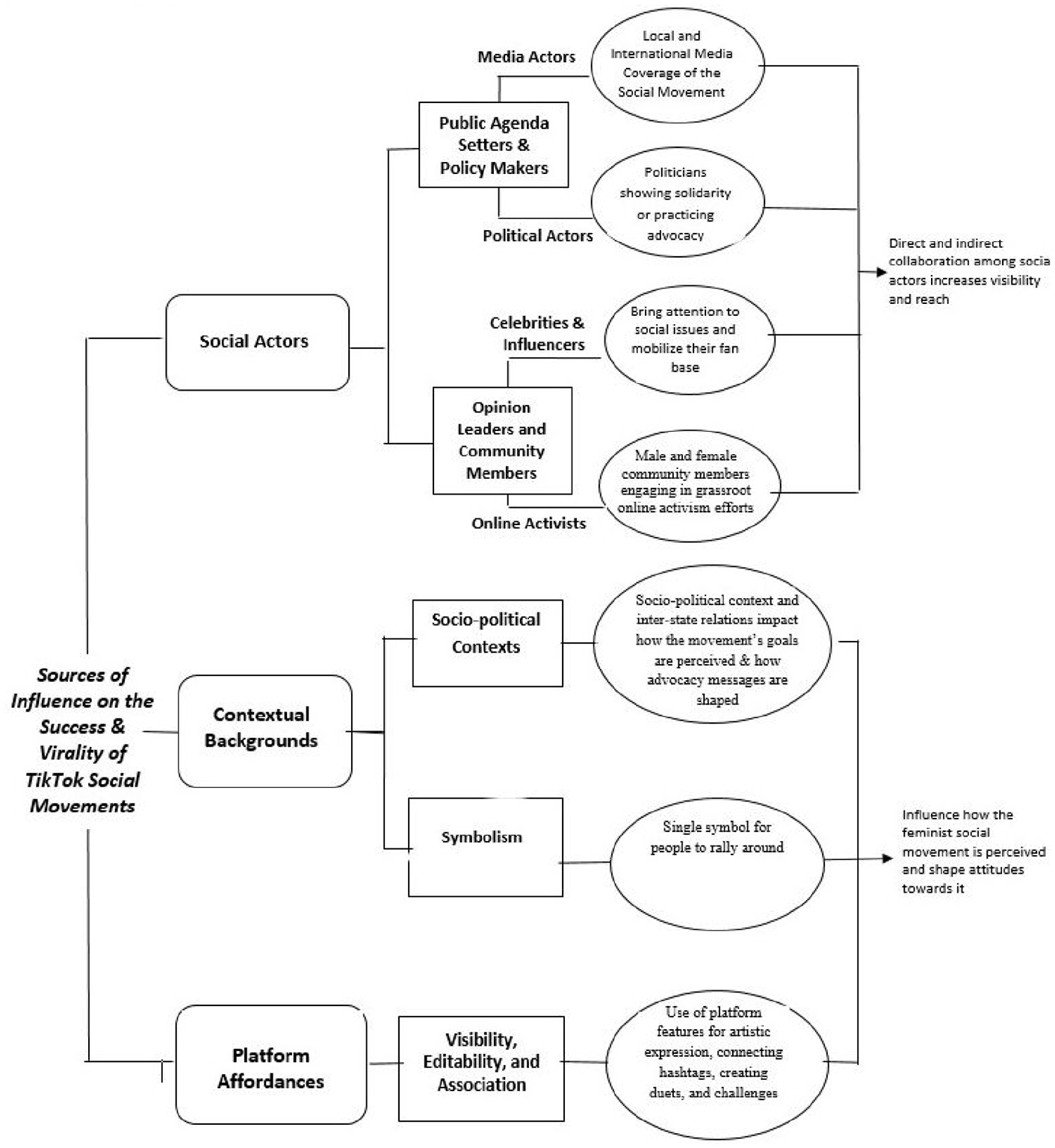
Dynamics influencing the success and virality of TikTok feminist movements.
Through deliberately avoiding the technologically deterministic approach, ‘We contend that social media may be necessary, but are not sufficient, tools for pursuing and achieving sociopolitical transformation’ (Khamis et al., 2013: 2). In other words, we adopt the position that ‘technology does not cause . . . change . . . but it does provide new capacities and impose new constraints on . . . actors’ (Howard 2011: 12). We argue that it is always the will and the determination of the actors, as well as their skills, creativity and technological savviness, which can bring about the desired change and determine the success of a campaign, or lack thereof.
Most importantly, in adopting this overarching approach which analyses the various components of the studied online social movements, we did not study these dynamics and factors, namely the actors, tools, tactics and contexts, as separate from each other, rather we closely investigated the overlaps between them, recording how they constantly feed into each other. Also, we did not perceive them as static factors, rather we acknowledged their dynamism.
For example, when investigating the actors who launched each campaign, we took note that they were mostly young women who were passionate about the cause they stood for and who were avid users of social media, especially TikTok. Yet, we noticed that the supporters of the anti-hijab movement in Iran were much more varied than those who supported the pro-hijab movement in France as they encompassed more demographic categories, such as male supporters and international supporters, including those with international fame and visibility, such as actors and actresses, prominent media figures, and so on. This speaks to the wider appeal of this campaign which attracted more online and offline actors and fans.
There are a number of reasons behind this phenomenon. First, the better reliance of the Iranian campaign on the visual and artistic capacities and affordances of TikTok as a digital platform, such as using music and sound effects, effective visualizations and strong images, as well as editing functions in a more creative way. Second, the use of a human symbol to garner support and strengthen solidarity, in this case it was young Mahsa Amini who became the icon for this movement. They succeeded in capitalizing on her name and fame, as well as the international solidarity which her death created globally. This was not the case in the second campaign since there was no specific human face or icon for this movement.
Third, effectively invoking Iran’s past and contextualizing the campaign within Iran’s historical context to draw a comparison between what they framed as a liberal past which is perceived as safeguarding women’s freedom and a contemporary conservative reality which is perceived as depriving Iranian women of liberal privileges.
The pro-hijab campaign in France, however, did not provide historical contextualization. Rather, it was mostly framed as a movement which aims to protect the individual rights of Muslim women in France and to safeguard them against the dangers of Islamophobia. The framing of this campaign was, therefore, more individualistic, rather than collectivist.
Adopting a postcolonial intersectional approach, we argue that it is not possible to separate the online from the offline, or the local from the global, as they constantly feed into each other, creating ongoing and intertwined realities. This is clearly evident in the fact that, although both campaigns are directly related to human rights and women’s rights, the Iranian campaign has been perceived by some as neatly aligned with Western stereotypes about Islam, which has been widely misperceived as oppressive to women, thus necessitating a global intervention to save Muslim women (Abu-Lughod, 2013). This, coupled with the West’s negative attitude towards Iran which is mostly perceived in Western media as a threatening and destabilizing force in the world, provided the incentive for Western celebrities to express utmost solidarity and support with the Iranian women who were seen as rebelling against oppression and misogyny.
As for the pro-hijab campaign in France, the stereotypical orientalist misperceptions of Islam and Muslim women (Abu-Lughod, 2013; Moallem, 2005; Yegenoglu, 1998), especially those wearing the hijab, provide one explanation as to why this campaign did not receive the same degree of international solidarity, visibility and support, although both campaigns are advocating for human rights and women’s rights. Studies investigating the intertwined relationship between veiling and Islamophobia, and how it contributes to the global images of Muslim women could also unpack some of these complexities (Basmechi et al., 2022; Malek, 2021; Ranjbar, 2021; Rahbari et al., 2021; Seddighi and Tafakori, 2016; Shaban, 2022; Tafakori, 2021; Varma and Shaban, 2024).
However, we prefer to expand this discussion beyond these assumptions through adopting a position of in-between-ness to better understand networked feminist movements and their dynamics. This requires abandoning flawed dichotomies between tradition and modernity, conservatism and liberalism, and the religious and the secular (Asadi Zeidabadi, 2023).
Through broadening the discussion of these campaigns to encompass a variety of factors, we can better understand the differing articulations of women’s rights and women’s empowerment, as manifested and expressed through these online campaigns.
Notably, this study unpacked the ability of different actors and players to use the very same tool and platform, in this case TikTok, to articulate and propagate entirely different understandings and articulations of the concepts of human rights, women’s rights, women’s freedom, independence and feminism. This compels us to refer to these concepts in the plural, instead of the singular, as we can no longer talk about a uniform or standard form of women’s activism and feminism, both online and offline.
Finally, this study revealed three functions that have been adopted by the actors in these campaigns, despite their differences, namely raising awareness, engaging in documentation and rallying support. These functions of education, documentation and mobilization (Radsch and Khamis, 2013) have been expressed through these campaigns in various forms and with varying degrees of success and effectiveness. Yet, the fact remains that they constituted a common denominator and a shared basis for digitalized social movements.
Through unpacking this amalgamation of complex factors, this study provides the reader with a holistic analysis of the myriad forms of feminist representation, agency and resistance which have been taking place using a new social media platform, namely TikTok, which has been transformed from a medium for entertainment to a medium for serious socio-political debates and mobilization. This study illustrates what this transformation looks like and what it means in terms of the shifting affordances of this particular platform, and its new roles in the realms of social, political and religious advocacy.
Footnotes
Funding
The authors received no financial support for the research, authorship and publication of this article.

Author biographies
Address: University of Maryland at College Park, USA. [email: