




Abstract
Memes are a key feature of participatory digital cultures and have been found to play an important role in collective identity formation. Limited scholarship has explored the role of memes within closed communities, where perceived privacy and trust may impact the ways users demarcate the in-group (us) and out-group (them) through humor. This article draws on analysis of semi-structured interviews with Australian donor-conceived people (people conceived with donor sperm or eggs) and a collection of memes they shared. We take an interdisciplinary approach to analysis, combining reflexive thematic analysis informed by interpretive traditions within sociology with an analysis that applies the iconization framework from social semiotics. Our findings explore how donor-conceived people view memes as: texts that “only we get,” that are “light and fun” and that provide “a way to deal with emotions.” We conceptualize memes as bonding icons: semiotic artifacts which foreground shared feelings and invite alignment around a collective identity. More broadly, we argue that “getting” a meme requires alignment with the values construed, a process which reinforces ties to the community. In doing so, we explore how everyday social and linguistic practices contribute to individuals’ sense of belonging.
Introduction
Meme creation and sharing has become a key feature of participatory digital cultures. The term “meme,” coined before the digital era, describes the cultural transmission of an idea, fashion, or style (Dawkins, 2006). Internet memes are a set of texts with shared characteristics, which are circulated and transformed by users online (Gal et al., 2016; Shifman, 2013). Several factors contribute to meme proliferation online, such as the scope and speed at which content is able to be shared, user-friendly tools which permit remixing of content, and “internet ugly” aesthetic, which promotes simple and low-quality texts (Douglas, 2014; Shifman, 2013). Some types of memes, such as image macros (memes that combine an image with superimposed text), feature across different social media platforms (Zappavigna, 2020), although a platform’s affordances can also shape patterns of mimesis, for example, scholars have argued that TikTok can be conceptualized as a mimetic text in itself (see Zulli & Zulli, 2020). Memes are social texts in that the actions, behaviors, and norms of social groups are negotiated alongside and through memes (Gal et al., 2016; Knobel & Lankshear, 2007). While many users share memes on their general social media feeds, meme-focused pages and groups, often organized around thematic foci such as a shared interest, experience, or identity, have become popular spaces for niche meme sharing (see Procházka, 2018). Limited scholarship has focused on memetic practices within closed communities, such as closed Facebook groups, in which users feel they are interacting with others “like them,” and where collective identity and belonging is created and negotiated (Archer et al., 2021). On Facebook, users are required to be identified (use their real name as per Facebook’s policy) and closed group administrators are able to screen for inauthentic intruders and restrict access through criteria for membership, filter questions, and security settings (Yeshua-Katz & Hård af Segerstad, 2020). This boundary work within peer-only groups often enhances users’ sense of privacy, safety, and trust and, accordingly, many users experience these closed Facebook groups as “digital safe havens” (Archer et al., 2021; Yeshua-Katz & Hård af Segerstad, 2020). However, it is unclear how this sense of privacy and trust shapes the kinds of humor shared between peers in closed groups.
One example of such peer spaces is a closed Facebook meme group for donor-conceived people; that is, people created through third-party reproduction (with a sperm or egg donor/s). The donor conception meme group, the focus of this article, represents a particularly interesting and timely example for exploring how memes are oriented toward collective identity formation because donor conception has historically been shrouded in secrecy, and as such, the emergence of the identity of “donor-conceived” is relatively recent. Due to the shame and stigma associated with gamete donation, up until the late 20th-century clinicians promised gamete donors’ anonymity, encouraged parents to withhold information about conception from their child, and failed to keep medical records or kept inaccurate records (Adams & Lorbach, 2012; Swanson, 2012). While the right to know one’s identity and maintain direct contact with one’s parents is enshrined in international legislation (see United Nations Convention on the Rights of the Child [United Nations General Assembly, 1989]), many donor-conceived people are still unaware of their conception status and others, particularly those conceived during the era of anonymity, continue to face barriers to securing information about their medical and genetic histories and their biological parent/s and siblings (Allan, 2017). These barriers thus represent a form of disenfranchisement. In the last decades, there has been a significant shift in social values whereby openness has been promoted, one consequence of which has been greater visibility around donor conception (Allan, 2017). In addition, two important technological advancements have enhanced donor-conceived people’s opportunities to establish connections with kin and peers: the rapid popularization of affordable direct-to-consumer DNA testing for searching for biological family members (Adams & Lorbach, 2012; Crawshaw, 2018) and the widespread uptake of social media including closed spaces for donor-conceived people (Crawshaw et al., 2016; Darroch & Smith, 2021). While many closed Facebook groups for donor-conceived people focus specifically on exchanging social and emotional support, others, like the meme group, are oriented to sharing humor which builds on shared values and experiences. Humor within such peer groups, where there is a sense of privacy and trust, can serve to unite members in semiotic terms (Knight, 2010).
Drawing on in-depth interviews with eight Australian donor-conceived meme group members and a set of donor conception memes as our focus, we explore participants’ perspectives about closed meme groups and examine the values at stake within the memes themselves. This study focused on the following research questions: How do memes function to unite donor-conceived people around shared values? How do everyday practices such as meme sharing in closed Facebook groups contribute to formation of collective identities and processes of belonging? We argue that while some users may view meme sharing as a light-hearted or frivolous activity, over time and through everyday engagement, these texts contribute to individuals’ affiliation with collective identities and sense of belonging.
Background
Connection, Community, and Storytelling on Social Media
For members of minority groups, or those disenfranchised from the systems that govern individual rights to recognition and participation, access to social media has offered significant opportunities for connection with peers. Participatory digital technologies have been found to strengthen individuals’ sense of identity and community, particularly through access to more diverse representation and visibility (Craig et al., 2021; Gal et al., 2016; Kirby et al., 2021). On social media, groups which identify as distinct from the mainstream are able to craft self-representations absent in the media, subvert power dynamics, and permit narrative agency and counternarratives (Craig et al., 2021; Williams, 2020). Studies have examined how individuals produce content to be recognized by their peers, as well as searching for stories in which they recognized themselves (Balleys et al., 2020). Indeed, contemporary forms of storytelling are an important device in personal and collective identity formation, particularly for those with minority identities (Gal et al., 2016). In the field of donor conception, Petra Nordqvist (2021) has argued that the dominance of heteronormative reproductive stories that assume genetic ties between parents and children has created a notable absence of social scripts for donor families to talk about donor conception within broader social networks. As such, memes generated by donor-conceived people provide an interesting and timely case study: storytelling through memes provides opportunities to “invent identities for ourselves and others and locate ourselves in these imaged maps” (Plummer, 1995, p. 20), providing a means to counter the secrecy that has long been associated with donor conception and a way to co-create and define a sense of a shared donor-conceived identity.
Facebook Meme Groups and Reinforcing Ties to Community through Humor
In Australia, Facebook remains the most popular social media platform, with many people staying on the platform due to the relational connections it offers through everyday encounters with Facebook friends and groups (Lupton & Southerton, 2021). Of the array of Facebook groups accessed by the approximately 1.8 billion Facebook users (Facebook, 2021), meme groups represent a small but important subset. Akin to other contexts in which humor emerges, meme groups provide an important domain for constructing collective identities. Research has examined how, through humor, participants establish a relational identity, which contributes to a sense of group membership (Boxer & Cortés-Conde, 1997; see also Dynel & Chovanec, 2021; Sinkeviciute, 2019). Humor can offer disenfranchised groups resources to critique authorities, to cope with painful experiences and to create solidarity with peers (Sandberg & Tutenges, 2019; Williams, 2020). Specifically, joking about an “absent other” has a bonding function, defining and uniting those participating in the humor as the in-group and those who do not or cannot participate as the out-group (Boxer & Cortés-Conde, 1997). Scholars have argued that memes construe solidarity between participants in the form of “I get it”; “I’m part of this”; or “I’m like you,” demarcating those who understand the specific form of humor as part of the “in group” (Knobel & Lankshear, 2008, p. 29). Memes typically incorporate insider jokes, language features and motifs, and references to popular culture, and unpacking memes requires socially shaped digital literacies (Kanai, 2016; Knobel & Lankshear, 2008). Participation in meme cultures requires assimilation of the visual and linguistic practices of a community; the “light bulb moment” of comprehension occurs when the reader, drawing on specific knowledge of the community, is able to align the image and caption within a meme (Kanai, 2016, p. 3; Milner, 2012). In this way, meme groups may offer individuals unique opportunities to reinforce ties to their communities.
Memes as Bonding Icons: Negotiating Values through Everyday Texts
Meme creation and sharing involves the constant negotiation of shared values (Procházka, 2018; Zappavigna, 2020). Scholars have argued that values form the core social units through which we establish who we are in relation to others and thus negotiate collective identities moment-to-moment (Knight, 2010). Therefore, in contrast to previous approaches to understanding memes and collective identity (Gal et al., 2016; Shifman, 2013), this article adopts a social semiotic approach oriented toward examining the values construed in memes. Specifically, we draw on work by Stenglin (2008) on the concept of bonding icons to provide a useful analytical approach. Simply put, bonding icons are semiotic artifacts which have accrued shared interpersonal meaning beyond their original experiential meaning. Therefore, bonding icons operate as “emblems or powerfully evocative symbols of social belonging” that have a rallying or privileging function for particular communities (Stenglin, 2004, p. 406). Examples of bonding icons include flags, company logos, or more everyday phenomena such as coffee where individuals rally around the shared positive values which this beverage has accrued such as productivity and conviviality (Zappavigna, 2014). Bonding icons offer a means to construe collective identities: “icons provide the meaning resource for the production and consumption of identity texts, and the texts in turn sustain the icons as socially legitimate ways of talking about identity” (Tann, 2013, p. 380). Therefore, in this article, we explore how memes operate as bonding icons, and consider how the values expressed within memes relate to the broader communities in which they are (re)produced.
Method
Data Collection
Our analysis of donor conception memes forms part of a multi-method study on Australian donor-conceived people’s experiences, perspectives and support needs. Ethics approval was provided by the UNSW Sydney Human Research Ethics Committee (HC190998). This article draws on rich data collected in semi-structured interviews (n = 8) that lasted between 1 and 3 hr, recorded in 2020. Participants who were donor-conceived, over 18 years old, Australian citizens or permanent residents, and members of Facebook groups for donor-conceived people were recruited through donor conception networks, community organizations, and social media. Interviews were audio recorded and then transcribed verbatim, checked for accuracy, and de-identified, and all participants received an AUD $30 voucher. Participants had learned about their donor-conceived status at ages ranging from childhood to their 30s.
The interview schedule employed in our study explored a range of topics including participation in Facebook groups for donor-conceived people. Although we did not anticipate that participants would discuss memes, our approach to data collection foregrounded the co-creation of meaning and as such permitted exploration of memes during the interviews, when the topic was raised by a sub-group of participants. Donor conception memes and participation in an international Facebook meme group for donor-conceived people were discussed as an important outlet for exploring collective identity and rich data were generated. The Facebook meme group described in these data, which had just more than 300 members at time of writing, is a closed group in which potential members are screened to confirm that they are donor-conceived. The group is governed by a rule that stipulates that members must request permission from a meme creator before sharing memes outside the group. Given this rule and the sensitive nature of the topic of donor conception, we sought retrospective ethics approval to include in our analysis the specific memes which were provided to the researcher by participants during interviews. Participants who had discussed memes were also invited to share examples of memes they had spoken about in their interview, as well as others they had permission to share, via email. As with the interview data, we analyzed the memes using inductive qualitative analysis with a focus on identifying patterns of meaning, and, therefore, were not seeking a representative sample.
Data Analysis
Following the interdisciplinary approach of the study, we sought to meaningfully analyze two forms of data using two distinct but complementary forms of inductive qualitative analysis. The first analysis, informed by the interpretive traditions within sociology (Charmaz, 2006), focused on the semi-structured interview data, and followed Braun and Clarke’s (2020) method of reflexive thematic analysis. This analytic process commenced during data collection when participants began to speak about the meme group, providing an opportunity to continue exploring the ways in which participants made sense of meme creation and sharing. Using NVivo 12, GN coded the data inductively and themes were developed in an iterative process. GN had been a member of several Facebook groups for donor-conceived people for a number of years prior to the study as a donor-conceived person herself (see also Newton, in press), which informed this approach. In reflexive thematic analysis, the researcher’s subjectivity is viewed as a resource which contributes to the co-production of knowledge between researcher and participants (Braun & Clarke, 2020). All participants were made aware of the researcher’s “insider” status as a donor-conceived person (see Newton & Southerton, 2021), and the manner in which issues of community confidentiality would be managed. This positionality was also viewed as advantageous in an empirical analysis of humor, as scholars have noted the importance of cultural awareness and sensitivity to local contexts (Sandberg & Tutenges, 2019).
The second form of analysis, which sought to explore how memes function as bonding icons, followed a social semiotic approach with a focus on the interpersonal function of language (Halliday, 1978). Memes were analyzed qualitatively applying Tann’s (2013; see also Zappavigna & Martin, 2018) tripartite iconization model (see Figure 1). This framework encompasses: “Communitas” which represents the community or sub-community (following Turner, 1974), “Doxa,” borrowing from Barthes (1977), which encapsulates shared core values, and “Bonding icon,” semiotic artifacts which radiate values for the specific community to commune around (see Stenglin, 2008). This framework was selected because, first, it provides an analytical approach to consider the interpersonal aspects of memes, that is, how individuals (dis)align with values expressed in memes, and second, because it emphasizes understanding meaning-making in its functional context, that is, how the memes were operating in relation to the everyday practices of donor-conceived people. In our analysis below, the values within the bonding icons are annotated using square brackets, with ideation (the subject or experience being construed) and associated feelings separated by a semicolon, for example, [memes: positive feelings].
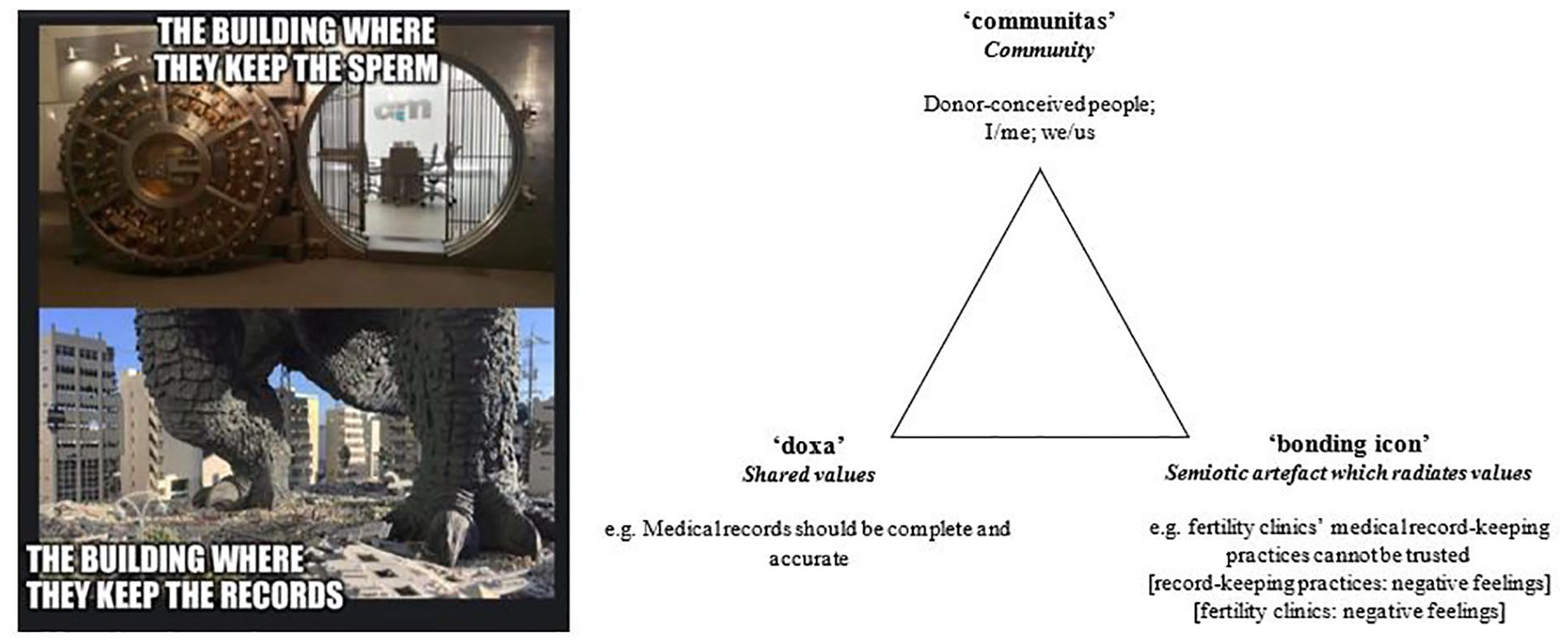
Iconization framework and application to medical record meme (meme provided by participant).
Figure 1 demonstrates how the iconization framework with “Communitas” (community), “Doxa” (shared values), and “Bonding icon” (semiotic artifact which radiates values) is applied to a meme. This meme, created and shared within the donor-conceived community, draws on the shared value that medical records should be complete and accurate. The key values being negotiated within the bonding icon relate to feelings toward record-keeping practices and fertility clinics, as depicted in the contasting images of a pristine and secure ferility clinic compared to the dinosaur stomping on the building where the medical records are kept.
In what follows, we describe the results by combining our reflexive thematic analysis which derived three thematic domains and social semiotic analysis applying the iconization framework. In doing so, we aim to offer two complementary perspectives on the role memes play in construing shared values and collective identity, and contribute to processes of belonging.
Results
A Place for Us: “Only We Get It”
The first theme derived from our analysis explores how meme groups offered participants a private space for connecting with their peers. Memes provided a resource to reflect on the complexities of both forming and protecting peer spaces. As previously mentioned, the rules for the meme group for donor-conceived people state that memes cannot be shared outside the group without permission from the creator. In general, participants were aware of these rules however, differing views emerged about this rule, given that memes are typically designed to be shared. Some participants believed that this rule went against “the point” of memes or recognized that there may be unauthorized sharing outside the group due to the inability to enforce such rules. This skepticism that the rules would be followed reflected a perceived lack of control for meme creators once they were posted on the internet. For instance, Shane argued that Nobody can own a meme. You can try. You can try and say it’s your meme. I’m sure it’s not gonna help you in court. . . In the meme wasteland, there are no rules. Once you put something out there, I think at some level you have to let go of it. (Shane)
Others viewed the rule as a means of ensuring that the group was able to function as a safe space. By emphasizing the importance of safety, participants reflected on the value of contexts in which donor-conceived people, as a disenfranchised group, were able to communicate candid feelings and experiences: You know, memes are broadly used to share something widely and often, you know, with the kind of intent of it going a bit viral and being shared elsewhere . . . The aim of making this group is more about connection with other donor-conceived people (Mabel)
Mabel went on to suggest that she viewed the meme group as a space that supported intimate connections between peers: It’s another way of kind of relationship-building, you know. You might share something quite personal with someone as a way of kind of connecting and saying, “Hey, I’ve had this experience.” And the other person might say, “Yeah, I’ve had a similar experience,” and it’s a nice kind of way of bonding. (Mabel)
Given that the majority of donor-conceived people do not have contact with other donor-conceived people in their daily lives, having a space to share donor conception content was viewed as unique and valuable. Participants noted that the forms of humor in memes shared in the group would only be understood by donor-conceived people and would be lost on other people within their personal networks. For instance, It’s nice having a group where you can go “you’ll get why I thought this was so funny.” . . . Why would I share that on my main Facebook page? No-one else is going to get it. (Athena)
Furthermore, Shane described a meme that captured this sense of a “place for us”: It’s the meme format of I think like the Greek philosophers walking through the agora and then next to it is a picture of a parent with a toddler, trying to get the toddler to play with the toy. And it’s me talking about being donor-conceived with donor-conceived people versus me talking about being donor-conceived with the recipient parents. And so what that communicates is that there are different levels of understanding of issues around being donor-conceived between donor-conceived people and recipient parents. (Shane)
As Shane explains in the above excerpt, the stance represented in this meme (Figure 2) is that between donor-conceived people (dc people) issues associated with donor conception are able to be discussed with sophistication and depth, whereas conversations with recipient parents (rps; prospective or current parents through donor gamete/s) require the donor-conceived person to simplify the issues or educate the recipient parent. On the left-hand side of the image, two donor-conceived peers are depicted as Greek philosophers walking side by side and looking toward each other as equals. In the image on the right, a donor-conceived person is portrayed as a mother and a recipient parent is portrayed as a toddler. The mother is bent down, looking down at the toddler with one hand on the child’s shoulder and the other showing the toddler an object.

DC peers walking through the agora meme (provided by participant).
Here the shared feelings invited are: [donor-conceived people: positive feelings] and [recipient parents: negative feelings]. To align with the meme, the reader must first recognize the in-group abbreviations “dc” and “rps” as well as align with the notion that peers understand each other, while “outsiders,” such as recipient parents, have a poorer understanding of donor-conceived people’s values (see Figure 3). In Tann’s (2013) terms, this constitutes collectivization, where the producer constructs binary identities: an opposition between “us” and “them.” Therefore, this text functions to highlight the shared understanding between peers and validate their collective identity. Bonding icons draw upon shared values of the community; when a reader aligns with the feelings expressed in the bonding icon, their ties to the community are reinforced. This ongoing process of aligning around values and reinforcing a collective identity creates a sense of belonging for members.
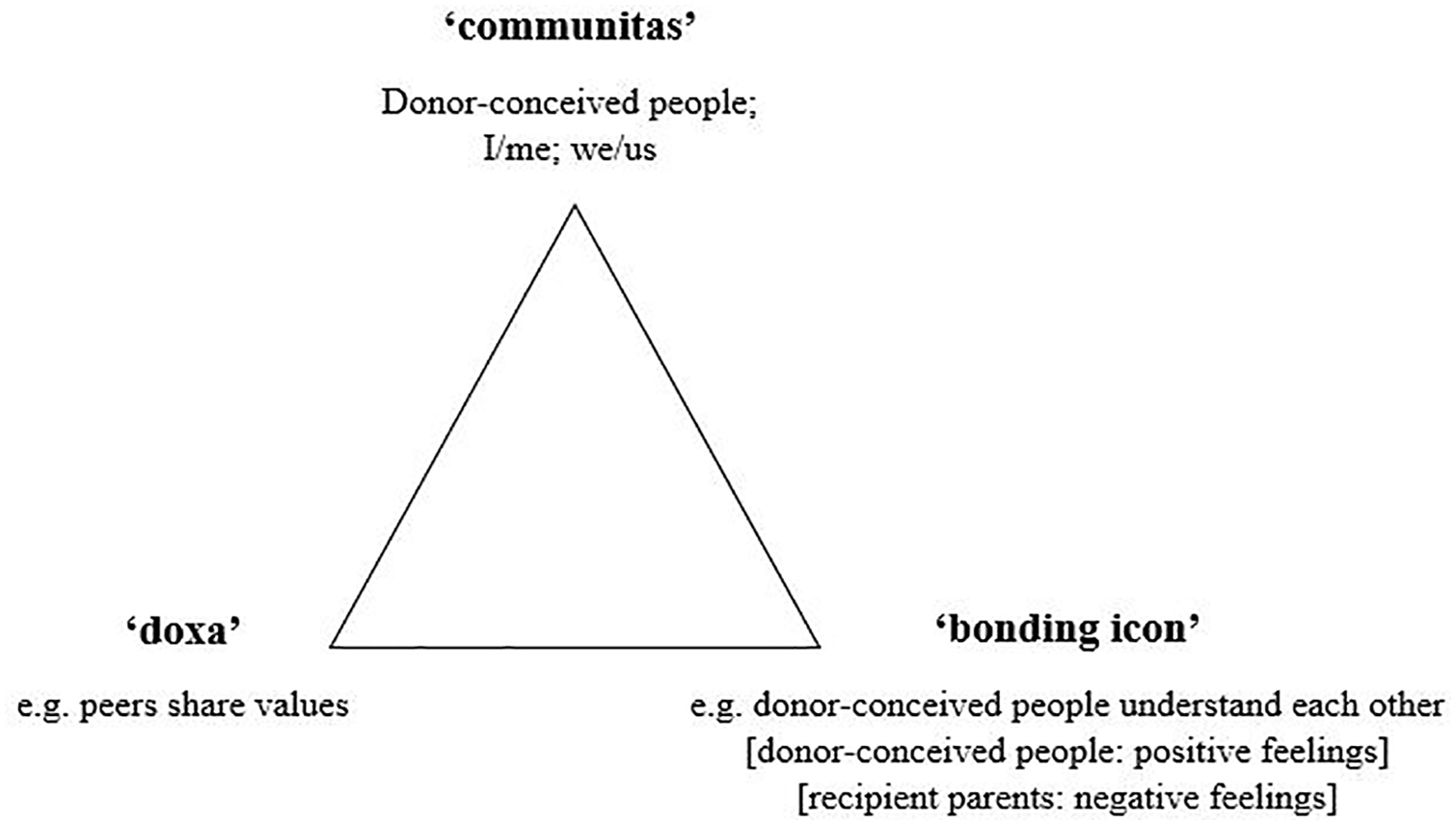
DC peers walking through the agora meme as “bonding icon” in relation to “communitas” and “doxa.”
“Light” and “Fun”: Meme Groups as an Escape
For many donor-conceived people interviewed, memes were seen to provide a “light” and “fun” way to make sense of being donor-conceived while also connecting with their peers: The memes, yeah, it’s a bit like of a more light-hearted thing and a bit of comic relief I guess, which is nice. Nice to have a bit of a laugh. Bit like, “oh yeah, that’s relatable ha ha.” (Leah)
Another participant explained: They’re [the memes are] pretty light. They’re just a way to lighten the mood, yeah. Very serious subject, so . . . But that’s what they’re used for: serious things. It’s humour, isn’t it? Humour’s always about the most taboo and difficult-to-talk-about topics of the moment. (Ruth)
While describing memes as “light,” Ruth recognized that humor could often help people to broach a serious subject matter. Participants also spoke directly to the ways in which the donor conception meme group compared with other donor conception groups, which they viewed as contexts in which users could seek advice and tell stories related to more “serious” matters. Several participants made remarks similar to the following: Some of the groups where you can share your experience or people share that they’ve just found out they’re donor-conceived, or they’re having an issue with their parents or their donor parents, or their siblings, they’re really valuable, but it can be quite heavy. And I think I liked the idea of having this group where it was a bit lighter and it was a bit less formal. People could see a picture and have a bit of a laugh about something that was probably a bit of an in-joke in the donor conception community. (Mabel)
Some participants also described their participation in “triad groups” (see Adams & Lorbach, 2012), that is, groups that included gamete donors, recipient parents, and donor-conceived people. Participants spoke about how they contributed significant emotional energy and labor to these triad groups, and therefore meme groups represented a “fun” alternative: I would say out of the three groups that I’ve been really active in that’s my favourite because it’s very rare for me that donor conception stuff is just light and fun. If I’m engaging on the Internet, I’m doing advocacy or emotional labour, and this is just . . . Oh my God, isn’t this just ridiculous kind of sharing fun stuff? (Athena)
When discussing the topics that memes most often drew upon, Ruth describe one salient theme: The constant search for siblings. That one’s constant. Yeah. That one crops up. The never-ending search. And having 50-plus siblings, yeah, that one. (Ruth)
Across the study, participants recognized that the search for donor siblings was often a lengthy process with no determined end point, as people often struggled to access information about the total number of siblings they had. However, participants viewed this topic as something they could leverage in the donor conception memes they were creating, for example, You know, it’s terrible that some people have 300 siblings but you can make a really funny meme about, you know, “National Siblings Day.” (Athena)
In addition to the sensitive and socially controversial issue of large numbers of siblings, participants also described waiting for information on siblings as something that was a shared experience in this social group: Like you could just be sitting there one day like floating along, life’s great, and then boom! One [sibling] pops up and it rocks your world. . .It’s so weird not knowing whether it’s gonna be tomorrow, a month from now, a year from now or heaps of years, or never. (Emily)
The meme presented in Figure 4 touches on this experience of waiting, and provides an example of how humor is used to tell stories to connect with peers in this context:

DC Kermit sad montage compilation meme (meme provided by participant).
The image macro in Figure 4, referred to as “Kermit sad montage compilation,” features the Muppet’s character Kermit the frog. In the superimposed text which reads: “Me: waiting for new siblings to find me,” the meme producer inserts themself into Kermit’s position via the projection function of the colon in “Me:.” “Getting” this text involves recognizing that Kermit represents a donor-conceived person waiting for their donor siblings. We see the process of iconization occurring: the everyday meaning (the inclusion of an image of Kermit the frog) is backgrounded, while the emotional significance (the feeling of waiting longingly) is foregrounded. The meme creator draws on shared values, such as the experience of waiting for a donor sibling, to invite communion around shared feelings associated with being donor-conceived, such as longing.
Applying the iconization framework to the Kermit meme in Figure 4, we can see that the meme producer draws on community values such as “the right to identifying information about one’s biological siblings” to create a super charged icon: a bonding icon (see Figure 5). In turn, the bonding icon invites community members to unite around shared feeling of longing. “Getting it” reinforces the viewer’s ties to the community in question, highlighting that they belong within the community. Equally, viewers can reject the values expressed, creating consequences for their perception of their ties to the community.

Kermit meme as “bonding icon” in relation to “communitas” and “doxa.”
Participants’ observation that memes were “light” and “fun” was relative in that participants viewed meme creation and sharing as a less serious form of interaction compared with the other online environments for donor-conceived people, which were dominated by text-based communication such as comment threads. In contrast, within the meme group, posts containing memes typically received few (if any) comments and were instead negotiated through likes or “haha” reactions from peers. Therefore, the framing of memes as “light” and “fun” also reflects how memes contain complex textual play within a single multimodal text that could be swiftly negotiated. Furthermore, through incorporation of popular cultural symbols, such as Kermit the frog, memes presented users with an opportunity to creatively depict their experiences of donor conception, in a way that would resonate for others. However, in the interviews, some participants also recognized that humor often depicted difficult-to-talk-about topics, a subject that will be explored in further detail in the final thematic domain.
Facing the Hard Stuff: Dealing with Emotions Through Memes
Participants in the study identified memes as a positive means of dealing with the range of emotions associated with donor conception, and frequently described humor as “healing,” “therapeutic,” or “cathartic.” For example, I try to find a way to kind of find the humorous side of things because I think it’s really good therapy. You know, laughing at something can really change the dopamine, serotonin levels in your brain, being able to laugh at something, I think there is true benefit. (Lisa) [Those] feelings that are difficult to express. It’s a way to get them out. It feels good. You have a laugh and then you physiologically change, and you feel a bit better. That’s humour. It’s pretty simple. (Ruth)
Lisa and Ruth both highlighted the benefits that humor represented for donor-conceived people. Participants made sense of the benefits of humor using neuroscientific and psychological discourses, ascribing the benefits of humor to physiological changes within the body that improve mood. As such, participants viewed memes as a resource that contributed to their well-being.
In addition, participants talked about how a donor-conceived identity was not well understood within the broader society, and that their sense of self was often impacted by assumptions and silences from other parties such as parents and friends. For example, participants described how the humor shared between donor-conceived people often questioned social expectations regarding the “right way” to be donor-conceived, such as being “grateful” rather than “demanding” or “angry.” Participants described how they valued opportunities to discuss how difficult it is to live with and push back against these expectations. For instance, regarding the meme group, Shane explained that It’s the best one because it’s donor-conceived people talking shit about everyone else, making fun of the things our parents do, the way that society treats us. That’s a really good group because it lets you laugh at it [donor conception] and gives you that catharsis of all this, all this pain [from] being told to be quiet. (Shane)
Through memes, participants could invert inflammatory or triggering comments made by non-donor-conceived people. In doing so, participants could make light of the perceptions of outsiders’ (to the donor-conceived peer group) or “absent others” (Boxer & Cortés-Conde, 1997), such as parents, friends, or recipient parents, and gain control over the framing of what it meant to be donor-conceived. Here we see how memes are used to demarcate the in-group from the out-group. Shane’s comment about “the pain [from] being told to be quiet” is particularly significant, as it communicates the lack of autonomy experienced by many donor-conceived people who wish to discuss the injustices they experience in relation to attempts to secure more information about their genetic relatives and the associated legal and social barriers (see also Newton & Southerton, 2021). Shane went on to provide an example of the way that conversations with family or friends often went: You’re trying to have this conversation with them, and you get questions like, “Don’t you love your parents?” Or, “Would you rather have not been born?” And so it’s like the trauma bit is wanting to express how the experience of being donor-conceived has impacted on me as an individual. And, when I try and do that, having the broader part of society tell me that I am wrong to feel the way that I do, yeah, that really sucks. And there are a lot of donor-conceived people who I’ve talked to, who share that frustration of not feeling able to talk about their experiences, not feeling heard. (Shane)
Shane’s point about not being able to speak honestly about one’s experience of being donor-conceived, and particularly the experience of not feeling heard is represented in the meme in Figure 6.

“All my parents are real” meme (provided by participant).
This meme references a specific cultural narrative that views biological ties as less significant than social ties (see Andreassen, 2017). This narrative was first conscripted into the legal and clinical representations of donor conception many decades ago, as a way to justify not disclosing donor conception status and prohibiting donor-conceived people’s access to identifying information about their donors. The narrative has also been employed to bolster the positioning of the non-biological parent (in contexts of two-parent families) as equal (Andreassen, 2017). While some people still downplay the role of genetic information and relationships, over the last decades this narrative has received more criticism, particularly from many donor-conceived people. It is worth noting that a statement such as “all my parents are real” may be socially prohibited in many other contexts, as it may cause conflict, offense, or confusion but is able to be expressed in the closed group due to the perceived privacy and safety. Therefore, a context in which participants could reflect on their shared values in an open and honest—and slightly mocking—manner was valued by participants.
The meme in Figure 6 employs the template “what if I told you . . .,” in which the lower text acts as the revelation or punch line in the joke, in this case: “all my parents are real.” The protagonist (actor Will Ferrell) looks directly at the viewer and addresses them with the pronoun “you.” The revelation being expressed in this instance of the meme is that biological parents are significant in many donor-conceived people’s lives. In this meme, the addressee, “you,” represents an outsider or “absent other” (Boxer & Cortés-Conde, 1997) to the donor-conceived peer group, yet given the meme is shared within a private peer group, addressing an outsider represents a hypothetical situation.
The iconography underlying the meme is represented in Figure 7. The shared values being negotiated in this meme relate to the right to relationships with biological parents (and siblings), a core value among many donor-conceived people. Again, we see attitudes charged into the meme, in this case [biological parents: positive feelings], which the viewer, the Facebook meme group member, can either rally around or reject.

“All my parents are real” meme as “bonding icon” in relation to “communitas” and “doxa.”
Memes, then, offered donor-conceived people an opportunity to connect around shared values. As asserted by Tann (2013, p. 388) “successful retrieval and identification with these icons leads to the renewed communion between author and reader, while unsuccessful ones result in alienation and outrage.” In other words, the process of identifying with the values expressed in donor conception memes, in this example the right to a relationship with biological parents, reinforces members’ sense of belonging to the donor-conceived community. Therefore, a key component of the “therapy” consists of not feeling alone in one’s values and feelings, and instead feeling a sense of connectedness with a collective identity.
Discussion
In this article, we contribute an innovative approach to exploring memes, combining reflexive thematic analysis from interviews with social semiotic analysis of memes to explore how memes operate and the impacts they have on the individuals that create and share them. This approach extends Shifman’s (2013) “typology of three memetic dimensions” and Gal and colleagues (2016) research on collective identity to offer a distinct framework for analyzing memes which specifically attends to the values construed in memes. Indeed, application of the concept of bonding icons (Stenglin, 2008) and iconization framework (Tann, 2013) allows for closer examination of the interplay between memes, the community in which they are (re)produced and their values. As we have explored above, memes created by donor-conceived people draw on shared values, such as the right to information about and relationships with biological relatives, and the value of peer connection. Specifically, we have demonstrated how readers align with the values embedded in memes; “getting” the meme strengthens an individual’s affiliation to the collective identity.
Meme groups represent a rich site of inquiry for social media researchers as memes are complex, layered, identity texts; “a social anchor for the communities that form around them” (Procházka, 2018, p. 78). In this qualitative study, we drew on interviews with a limited number of Australian donor-conceived people and memes shared by them. Despite the relatively modest sample size, participants revealed rich accounts of participation in meme groups. While we do not claim generalizability of our findings, we expect that the indicative themes and conceptual insights are likely to resonate with other contexts. We suggest that future research could explore memes as bonding icons in relation to other interests, identities or experiences where forms of humor are impacted by the perceived privacy of closed groups. Memes could also be used as an elicitation tool in interviews to generate situated insights from participants. Future work could also consider how memes evolve over time, as suggested by Tann (2013) “intertextually, the icon is continually revised by the community in ever new understandings of their identity against the background of other identities” (p. 389).
This study is among the first to examine how donor-conceived people forge communities of connection and support online. Although social scripts within donor families can be limited (Nordqvist, 2021), this article has revealed how, specifically within peer-only contexts, donor-conceived people are able to tell stories about themselves and negotiate what this emerging identity means to them through everyday social and linguistic practices. Our analysis generated three salient themes from the reflexive thematic analysis, each revealing the key affordances of memes, and their utility for managing emotions and disenfranchisement. In the meme group we studied, donor-conceived people were able to constitute a sense of a shared donor-conceived identity that participants felt was not yet understood or recognized broadly by society. While the interviews revealed varied experiences (and extents) of disenfranchisement and vulnerability, participants agreed that the group represented a safe space to express hardship, distress or criticism. In this way, our analysis complements previous research that has explored humor as a mechanism for coping with adversity, trauma, and conflicting values (see Knight, 2010; Sandberg & Tutenges, 2019; Williams, 2020). Participants expressed how through memes they were able to demarcate between the donor-conceived in-group and non-donor-conceived people out-group, including through humor that depicted the “absent other” as afforded by the closed group context (Archer et al., 2021; Boxer & Cortés-Conde, 1997; Yeshua-Katz & Hård af Segerstad, 2020). Moreover, among our sample of donor-conceived participants, we heard accounts that revealed how donor-conceived people were able to push back against normative or morally laden ways of being. In this way, the creation and exchange of memes offers donor-conceived people opportunities to write their own social scripts and bring their collective identities into being.
While our findings contribute to scholarship on donor conception, they also add to sociological understandings of identity and belonging, the latter concept receiving considerable interest in the social sciences in recent times (see for example May, 2011; Yuval-Davis, 2006). Here, we have sought to contribute to conceptualizations of belonging by unpacking the everyday social and linguistic practices in which collective identities are negotiated and reinforced. As we have explored, identities are made up of complex patterns of values. Memes seek to elicit shared feelings among users, and in doing so, invite users to reinforce their alignments with collective identities. Exploring belonging through the lens of bonding icons, we posit that when a reader identifies and aligns with the values construed in a meme, they recognize that they are the intended audience of the text, and that they belong to that community. Internet memes thus offer productive opportunities for connection and belonging.
Conclusion
Closed Facebook groups have emerged as an important site for the mediation of disenfranchised identities, including for those who are donor-conceived. In turn, memes have come to represent various attempts to relate and belong despite, or in response to, the experience of restricted or absent rights, recognition and opportunities for participation in mainstream systems and cultures. In this context, memes, as bonding icons, can cultivate and sustain experiences and feelings of belonging. As such, our analysis of memes, supported by interview accounts from those who create and share them, situates memes as important icons around which donor-conceived people can align. Importantly, the sharing of memes, and participation within closed group contexts, provides privacy and safety for disenfranchised identities to collect and coalesce. The reinforcing of ties to such collective identities makes visible the significance of memes, for coping, for criticism, and for community.
Footnotes
Acknowledgements
The research would not have been possible without the donor-conceived participants. The authors sincerely appreciate their time and trust in sharing their experiences and views with us. Heartfelt thanks to the audiences at the Digital Intimacies Symposium 2020 and at the 2021 Systemic Functional Linguistics PhD seminar series for their generous feedback which shaped this article. Thanks also to Emma Kirby for ongoing help with the development of my thinking and writing. Finally, thanks to the editors and reviewers who helped enrich the article’s ideas and structure.
Declaration of Conflicting Interests
The author(s) declared no potential conflicts of interest with respect to the research, authorship, and/or publication of this article.
Funding
The author(s) disclosed receipt of the following financial support for the research, authorship, and/or publication of this article: Giselle Newton is supported by an Australian Government Research Training Program Scholarship.
