



Abstract
As a performance venue, online social spaces afford users a variety of ways to express themselves. Many of these expressions include social identity work, such as the articulation, affirmation, or policing of a shared identity. In this study, we examine one online space in which users engage in social identity work: a Reddit forum (r/starterpacks) that primarily generates and discusses image memes of a very specific format: the “starter pack.” Users leverage these image memes to convey what we refer to in this article as prototypes of social identities. Many of these prototypical depictions are necessarily influenced by offline social groups and/or consumer culture, and are furthermore constructed around gendered, racial, or ethnic stereotypes. To understand how these image memes are used to form and perpetuate prototypes of social identities, we employed content analysis to evaluate a sample of 500 image meme artifacts created, shared, and upvoted by the subreddit’s users. We discuss the process of applying visual analysis techniques to articulate themes identified in the image meme expressions, in particular: (1) the default of the White, male identity in starter pack characterizations; (2) the production of oppressive social identities through the use of visual and textual content; and (3) the dedication to a stance of “consumption” in assembling starter pack memes, both through body politics expressed therein and use of consumer goods in images. Finally, we draw on reader response theory to frame the challenges of researchers “reading” starter pack memes, despite employing systematic methods of analysis.
Introduction
In 2006, Time declared “You” the person of the year (Grossman, 2006). In October 2015, a New York Times article claimed that year to be “the year we obsessed over identity” (Morris, 2015). During the 2016 Presidential elections, pundits discussed the seeming failure of “identity politics,” and the resulting schism between liberal and conservative voters, as a reason for the unexpected election of Donald Trump (Lilla, 2016). Accordingly, during the past decade—with an increase in access to and use of social media—we have seen a rise in identity work taking place online (e.g., Abokhodair, Hodges, & Vieweg, 2017; boyd, 2014; Dabbish, Farzan, Kraut, & Postmes, 2012; Papacharissi, 2010).
Although prior research has focused on the link between self-presentation and individual identity work, users also accomplish social identity work through collaborations and collective acts in online spaces (e.g., Bennett, 2012). One common unit of online content that enables such social identity work is that of memes. Image and text memes are a popular unit of production, remix, and sharing. Many memes are easily produced with a personal computer or smartphone (e.g., combining text and image to create an “Advice Animal” format meme) and are even more easily shared. The affordances (e.g., designed for and/or intended uses; see Hutchby, 2001) of prominent social media sites—such as Facebook, Twitter, and Tumblr—facilitate sharing memes through the “share,” “retweet,” and “reblog” functions, respectively.
The creating and sharing of memes increases the amount of content for users to consume, and such content is often intended to be humorous (e.g., Knobel & Lankshear, 2007; Milner, 2013). However, with such a strong potential for virality (Guadagno, Rempala, Murphy, & Okdie, 2013), it is also important to examine the meanings conveyed and the social identity work accomplished through the production and sharing of memes. Specific to the concept of social identity, it is also important to understand how the components and construction of memes promote recognition of the identities being conveyed or defined.
In this study, we focus on starter packs as a meme conveying complicated social identity messages in a deceptively simple format. We define starter packs as memes consisting of one or more images accompanied by (1) titles providing commentary and/or context and (2) illustrating a prototype of a cultural artifact, member of a community, or shared experience. Our dataset is drawn from a specific online space dedicated to sharing such memes: the subreddit r/starterpacks. Using this dataset, we examine starter pack memes as a mode of social identity work. For example, in a meme image titled “I peaked in high school” starter pack (for women) (see Figure 3(c)), we examined how a prototypical woman’s socioeconomic class, age, sexuality, and reproductive choices are packaged and promoted in the use of both text and the collection of images chosen for the meme.
At a time when the goal of achieving information literacy is beset by issues such as “fake news” and filter bubbles, it is particularly important to understand how common forms of online content facilitate the creation and diffusion of social identities. By focusing on the online space of r/starterpacks, we examine a space purporting to reject prejudice. However, we find some social identity expressions hosted in the subreddit perpetuate harmful and/or oppressive social identity prototypes, which may have negative effects on marginalized groups. The research question guiding our analysis, findings, and discussion is: How is social identity conveyed or expressed in starter pack memes?
Our contributions in answering this question are twofold. First, we build on previous research (e.g., Nakamura, 2002; Shifman, 2014) to expand understanding of online participation and identity work by recognizing and describing engagement with memes as social identity work. (Here, and throughout the article, we refer to the construction of identities for groups of people as social identity work, although previous studies on this topic have also used the term collective identity work). Second, we analyze the starter pack meme, which is not yet widely covered in academic literature. As Shifman noted in 2014, “we need to take Internet memes seriously . . . Internet memes may help us decipher contemporary political, cultural, and social processes” (p. 172). The findings from this study suggest that—although starter pack memes are relatively simple from aesthetic and technical assemblage perspectives—the production and sharing of these memes performs sophisticated social identity work. This study is a response to Shifman’s call to “take Internet memes seriously,” treating them as artifacts meriting careful inquiry.
Background
Previous research has examined social media platforms such as Reddit, the production and sharing of meme artifacts, as well as social identity as it is created, expressed, and perpetuated online. We give an overview of each of these research areas below.
Reddit is a social media platform on which users submit two kinds of content: original posts consisting of text, or hypertext links to other content on the web. Reddit employs an upvote/downvote algorithm to sort content (Gilbert, 2013). The exact user experience on the site is impacted by this proprietary vote algorithm, which is tweaked periodically (e.g., KeyserSosa, 2016), as well as the individual’s own user preference settings.
Reddit is a complex platform with many components. Accordingly, researchers have studied Reddit using a number of units of analysis. First, Reddit has been studied as a content sharing platform, for example, in terms of user engagement with the voting algorithm (Gilbert, 2013), as well as a site that has evolved in terms of content types shared (Singer, Flöck, Meinhart, Zeitfogel, & Strohmaier, 2014). In other studies, researchers have considered users in terms of their use of language as related to their personal values (Chen, Hsieh, Mahmud, & Nichols, 2014) and as volunteer workers who “welcome” and integrate new visitors to the site (Hsieh, Hou, Chen, & Truong, 2013).
Researchers have also investigated how Reddit functions as a social system, where major events can affect user engagement and interaction (Matias, 2016). In prior work, Reddit is consistently recognized as an intrinsically social system built on a technical platform that engenders and rewards the sharing of content that resonates with others, resulting in “upvotes” and (often) signaling quality (Stoddard, 2015). As Gillespie (2010) explained previously in relation to platforms like YouTube, Reddit is a platform primarily for facilitating the generation of user content, rather than an intermediator in content quality or messaging. We contribute to this body of work by analyzing a specific type of content (starter pack memes) shared via Reddit, and focusing on a particular subreddit (r/starterpacks), as opposed to the entire Reddit platform, its users, or function as a social system.
Memes
The concept of “memes”—originally used the term to refer to biological replication—originated with Richard Dawkins, 1976 book The Selfish Gene. The idea of the “meme” has since transformed into the replication of cultural ideas. Ferrara et al. (2013) define a meme as a “unit of information that can spread from person to person through the social network.” This definition is particularly helpful in this study, as we consider a specific “unit of information” (the starter pack meme image) as it spreads through the social network of r/starterpacks.
As units of information, memes can be particularly valuable in exchanging shorthand information in the “new public sphere” of the Internet (Papacharissi, 2002). The production and sharing of memes supports the role of Internet users as “prosumers,” wherein the acts of production and consumption become mixed, and users start to create their own set of meanings around units of information, such as brands (Ritzer, Dean, & Jurgenson, 2012). Memes themselves can become a type of brand, as specific groups of memes converge on recognizable formats, wherein images and text can be re-mixed to express new concepts using a familiar formula (e.g., Advice Animals memes, also popular on Reddit; for example, Ding, 2015; Dynel, 2016). Notably, the use of images in meme formats can be particularly potent to express emotion (e.g., Bourlai & Herring, 2014; Dynel, 2016; Martineau, 2017).
Starter pack memes, specifically, use a combination of images (usually four to eight images downloaded from another place on the Web) and a text title. Starter pack memes can be posted to Reddit, as well as other social media platforms, such as Instagram, KnowYourMeme, Twitter, and Tumblr (Burns, MacLachlan, & Rees, 2016; Daly-Buajitti, 2016). The title of a starter pack meme is meant to “bundle” the images in a coherent way and synthesizes a combined meaning. (For example, in Figure 1, seemingly disparate images of a slight, young, White male wearing a short-sleeved tee shirt and sitting in a brown plaid recliner while raising his arms to his sides with his fists clenched above his biceps, a container of “Muscle Milk” protein powder, a Black, branded “Tapout” tee shirt, and an eight-pound barbell are presented as a cohesive whole beneath the title: “Kid thinks he’s badass after going to the gym starter pack.” In the right-hand corner of the meme, overlaying the image of the barbell is: “#starterpackbuilder.com.”) Despite their popularity, there is little research on starter pack memes, though scholars have previously examined starter packs as part of online Millennial culture (Daly-Buajitti, 2016) and as objects of discussion in classroom teaching (Burns et al., 2016).
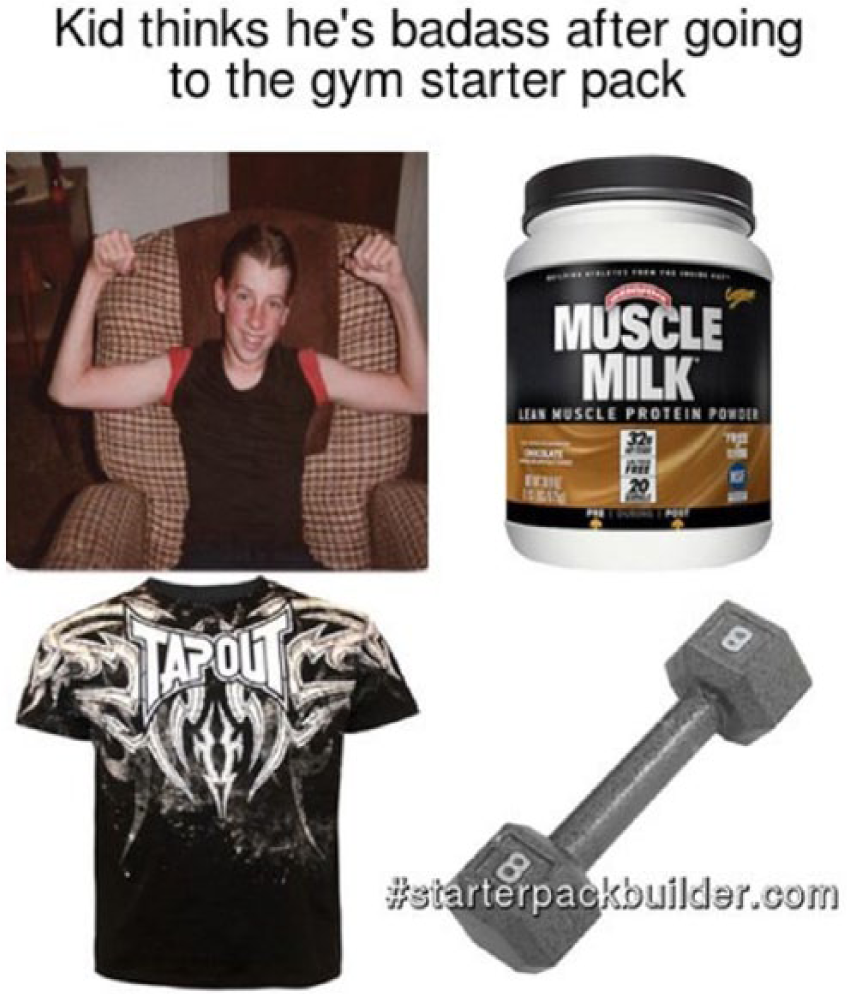
Typical layout of a starter pack meme.
Starter Pack Memes and r/starterpacks
Starter pack memes first appeared on another social media platform, Twitter, in September 2014, when a now-deactivated account with the handle @ItsLadinaPlis posted three photos (a top knot bun hairstyle, an ear with a large hoop earring, and a “Monroe” facial piercing) with the words: The “I date black guys” starter pack (Starter Packs, n.d.). Prior to this tweet, the term starter kit had been associated with LOLcat images as early as December 2011. However, it was @ItsLadinaPlis’ tweet that sparked the spread of starter packs as multi-image, satirical memes. Because @ItsLadinaPlis identified as a Black woman in her Twitter bio, starter packs were first associated with “Black Twitter” (e.g., Bowen, 2016; Lennox, 2014).
The r/starterpacks subreddit was founded in late 2014 and featured a call for moderators in early December of that year (Reddit, 2014). As of the writing of this article, there are four moderators, and two of these moderators have been active for 2 years. The tagline for the r/starterpacks subreddit is: No prejudice here. As of August 2017, there are approximately 215,000 subscribers to r/starterpacks, which places this subreddit at the rank of 375 out of 1.1 million subreddits (Reddit metrics, n.d.). Users can filter politics, or allow all posts. The rules for r/starterpacks are listed in Figure 2.

Screenshot of r/starterpacks side bar as of August 2017.
The r/starterpacks subreddit is unique in that it is aggregates all starter pack memes in one place, defining the purview of the subreddit by content type rather than topic (r/baseball or r/movies) or interaction type (r/AMA or r/AskReddit). Although r/starterpacks is not the only subreddit dedicated to a particular type of content—for example, r/trippinthrutime, which aggregates meme content based on classical art—it is the adherence to the particular content conventions that defines the r/starterpack space and its focus (see also Lin, Salehi, Yao, Chen, & Bernstein, 2017).
Reddit, Memes, and Social Identity
Social identity is defined, for our purposes, as “how people make sense of you [an individual]” (Donath, 2014). Donath goes on to describe the process of this sense-making as observing minimal social cues, such as gender, dress, voice, age, and race, and inferring other information about a person based on previous interactions in the social world (p. 229). Starter pack memes are the barest expression of these types of “minimal social cues.” These memes are constructed of a kind of “semiotic bricolage” (Schwalbe & Mason-Schrock, 1996, p. 119), using images and concepts from many cultural artifacts, such as music, advertising, news media, government, and street life (Figure 3).

Four different starter packs from our sample of n = 500. (a) The “Black woman bus driver” starter pack. (b) The 2016 Fuck Boy starter pack. (c) The “I peaked in high school” Starter Pack (for women). (d) The autistic child starter pack.
Both the platform of Reddit and memes on and off Reddit have been the subject of numerous studies on social identity. Hsieh et al. (2013) identify positive behavior related to social identity and Reddit use, finding many users took on the volunteer work of welcoming and integrating new users to Reddit’s various subforums. However, Reddit’s subforum structure also leads to fragmentation (Singer et al., 2014), which can consist of a more malicious side of social identity engagement on the platform. For example, Milner (2013) previously identified the “constructed centrality” of whiteness in Reddit’s use of meme images, particularly “Successful Black Man” and “Sheltering Suburban Mom.” Related to this, Massanari (2015) examined the “toxic technocultures” of Reddit (p. 5) and argues that “othering” is a hallmark of Reddit subcultures. Massanari states that although barriers to using Reddit from a practical point of view are low, individuals who identify as being a part of subordinated groups (e.g., non-male, non-White) might encounter enough hostile behavior to result in an emotional or psychological barrier to use.
Memes are connected to social identity by the “set of competencies and knowledge” required to properly construct and understand their format and content (Kanai, 2016). In one notable example, the “It gets better” YouTube meme led to a collective construction of gay identity privileging White men’s voices (Gal, Shifman, & Kampf, 2015), an outcome that is particularly stark given the meme’s video format clearly expressed gendered and racialized identities. Kanai pointed to the “What Should We Call Me” gif meme—popular on Tumblr—that required a certain knowledge of White, feminine Western culture to understand the meme’s format. Finally, the quality of meme construction itself, as judged by users, can lead to assumptions about identity. For example, Miltner (2014) describes how users identified “noobs” as individuals who attempted and failed to create and share a particular meme type (in this case, LOLcats), unlike the in-group, who produced “quality” LOLcats.
Reddit’s structure and affordances (e.g., Leavitt & Robinson, 2017; Massanari, 2015) as a social media platform—particularly one where memes are produced and shared as a type of “karma currency” to garner upvotes—demonstrates potential for facilitating social identity work performed by users in the space. In addition, as evidenced by previous research, engagement with meme culture also overlaps substantially with social identity work. In the following section, we describe our methods in examining the meme production and sharing in the r/starterpacks subreddit.
Methods
Our methods were approved in advance of any data collection by our institution’s Human Subjects Division and are described in more detail below. In pursuit of answering our research question (How is social identity conveyed or expressed in starter pack meme artifacts?), we examined a sample of starter pack memes posted to the forum.
Data Collection
We were most interested in examining “successful” memes by the subreddit users’ standards. In other words, we wanted to collect and analyze memes that resonated with the users as being meaningful or worthwhile, using net upvotes at the date of data collection as a proxy for such measures. Accordingly, we used a Python script to scrape the top 500 image memes submitted to the r/starterpacks subreddit since its inception, according to the Reddit algorithm, as of 22 May 2016. After the image artifacts had been scraped, one of the authors assigned random IDs to obscure the exact rank of the images to discourage any tendency to use relative rank as information pertinent to coding. Both authors assigned categories to each of the 500 images, characterizing the type of image shared, so that we could describe the mix of images collected. These types and the count of images coded to each type are listed in Table 1.
Meme Categories Identified in our Data Sample (n = 500).

Data Analysis
We used Dropbox to store the memes and an Excel spreadsheet to perform content analysis of the meme artifacts. Both authors started with open coding and worked to iterate through a subset of images (n = 25) until the two coders agreed upon (1) a shared coding schema, including codes, definitions, and examples thereof and (2) consistent application of the codes therein (Krippendorff, 2012). We applied content analysis to text as well as image data in the starter pack artifacts, employing Rose’s (2011) viewpoint of visual analysis, which takes a “critical approach” and “thinks about the social conditions and effects of visual objects” (p. 15).
We note that, to converge on a shared coding scheme, we needed to agree on a hermeneutical approach to examining the starter packs memes as content units. Specifically, although we used content analysis to code observations of sub-units (i.e., images and words) in the meme artifacts, we also considered how text and images were used in combination to convey social identity. This gave us valuable code co-occurrence data. For example, the co-occurrence of using words related to specific racial groups in the starter pack title with types of images, or the combination of titles referring to the feminine gender and the images used to depict women’s bodies.
However, race and gender were not coded based only on starter pack titles and the words used in the starter pack memes. Rather, we coded race and gender based on the images selected to convey concepts (e.g., photos of body parts and any gender, racial, or ethnic signaling therein) as well as a meme’s assigned title (e.g., Black Woman Bus Driver). Our greatest challenge in converging on, and organizing, the codebook was therefore deciding when signaling related to gender, racial, or ethnic information was overt enough to code. In general, we defaulted to leaving such information uncoded, unless the signaling was consistent between words and images used. The length of iteration in discussing and finalizing the code book—over several iterations in as many months—indicates the difficulty of analyzing this complex meme format, as well as our dedication to selecting most valid and reliable hermeneutic unit and coding approach.
As a final check to the validity of our coding process, we asked two researcher-peers to test the codebook early on. These peers were both men, and one was reared and educated in a non-Western country. We elicited feedback from these peers about the codebook; although both were familiar with content analysis as a method, neither was familiar with the starter pack format. Through this process, we were able to identify biases in our codes from two people who had different world views than we did, which we reasoned was important for an analysis of social identity signals.
Researcher Stance
Both researchers recognize our situatedness—and privilege—as White, cisgendered, able-bodied women, and we do not wish to “other” users who create or share starter pack memes (Fine, 1994). To account for our biases, we incorporated a coding schema that required our recognition of the social identities expressed in the starter pack memes we analyzed. Specifically, we coded the following:
If we could be considered an individual befitting the social identity expressed in the starter pack (arguably, we fit some of the depictions of a “basic bitch”);
If we recognized the social identity expressed;
If we did not recognize the social identity expressed.
We acknowledge we are not the core audience for starter pack memes, and we found that 18% of the images we coded contained content with references not always clear to us, although we were able to use Internet search engines to research unrecognizable words and images. For example, we found Urban Dictionary and YouTube to be particularly helpful sources.
Findings
As we assembled our content analysis, taking notes and comparing coders’ impressions of themes accumulating from the dataset, we uncovered several themes. We articulate below two major interrelated themes from starter pack content. First, we comment on users’ employment of consumption tropes in the selection of images themselves, both in terms of using pictures of brands and products, as well as of the human body. Second, when we detected social identities conveyed for non-White, non-male group identities, we observed social identity depictions that appeared to engender oppressive identity work, which we define below.
Consumer Culture Signals
The prevalence of consumer goods (e.g., branded clothing, cars, smartphones, or food and drink; see Table 2 for code co-occurrences with meme categories) is unsurprising for two reasons. First, starter pack memes rely on visual cues, and images of branded products can be potent visual symbols (Douglas & Isherwood, 1978; Ritzer et al., 2012). Second, in a post-industrial society, consumer goods can signal group membership (e.g., social identity) all by themselves. As Katz-Gerro (2004) stated, “Social stratification in post-industrial society is moving into a culturalist phase based on subscription to distinctive lifestyles and tribe-like configurations built on cultural consumption” (p. 23). This link between consumer goods and social identity has been studied in terms of ritual act (Afflerback, Anthony, Carter, & Grauerholz, 2014) as a proxy for culture, in the case of food (Silva, de Melo, Almeida, Musolesi, & Loureiro, 2014) and as a method for transforming feelings of disempowerment among certain social identities, including young Black men (Lamont & Molnár, 2001).
Co-occurrence Among Meme Types and References to or Depictions of Concepts Such as Race, Gender, and Human Bodies.
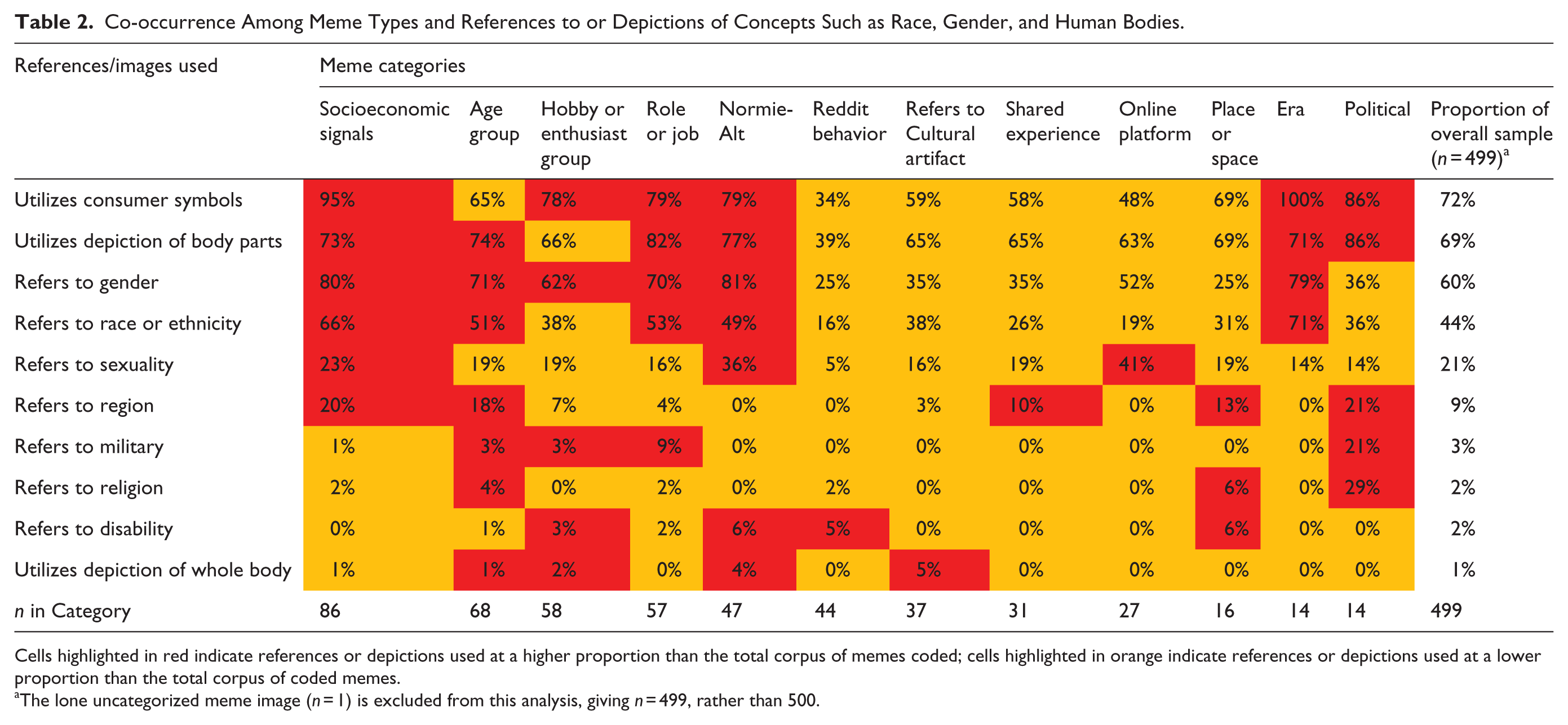
Cells highlighted in red indicate references or depictions used at a higher proportion than the total corpus of memes coded; cells highlighted in orange indicate references or depictions used at a lower proportion than the total corpus of coded memes.
The lone uncategorized meme image (n = 1) is excluded from this analysis, giving n = 499, rather than 500.
We coded symbols of consumerism to denote the use of images that included products like vehicles (e.g., minivans were used as shorthand for stay-at-home moms or nerdy dads), or use of brand logos or depictions of brand-name products (e.g., iPhones or Juicy Couture brand pants). Consumerism signals were used in 71.6% of all memes coded, and at the highest rates for memes coded as expressing concepts about socioeconomic groups (95%) and political views (86%). The overlap between consumerism signals and socioeconomic groups makes sense, as patterns of consumption are observable traits of concepts individuals or groups choose to project, such as wealth or poverty. This finding resonates with Bourdieu’s (1984) recognition of objects as social markers with the power to reproduce social inequality.
Another specific, if complex, consumerism signal we observed multiple times in the dataset was the image of a pack of Marlboro Lights. On its face, this seems like a simple signal, but the meaning tied up in such a signal could be far more complex, particularly in the use of the image of Marlboro Lights to comment on health behaviors and comparative consumption (i.e., the implication that certain socioeconomic groups “choose” smoking over a nice vehicle; see Figure 3(c)).
Finally, the overlap between consumerism signals and political views is perhaps less obvious, and this had to do with the confounding tasks of the meme makers, who sometimes seemed to depict both socioeconomic groups and political or economic viewpoints. One example of this “confounding” work is that of the “redneck” meme, which often cited xenophobic signals, such as titles referring to “sending immigrants home,” but also incorporated images such as lifted sport trucks and name-brand clothing popular with rural middle-class men (i.e., Tapout).
Gendered Language and Images
Overall, textual or image depictions of gender were used in more than half (60.9%) of the memes coded in the dataset, although proportion of gender depictions varied significantly depending on the meme category, χ2 (12, n = 500) = 83.8, p < .01. Memes depicting behavior in online platforms, including Reddit, referenced gender less than average (35.2%), possibly due to the anonymous nature of Internet use and interaction.
Gender was used most often to depict a schism between “normie” and “alt[ernative]” (e.g., individuals who tried to differentiate themselves from the mainstream through interests, clothing, or other aspects of appearance, such as piercings) behaviors. About 4 in 5 (80.8%) of memes in this category referenced gender. The use of gender in memes depicting socioeconomic groups was used slightly less often (80.2%), and much of the gender expression in this category also had to do with images of clothing. Notably, use of the feminine gender co-occurred significantly more often with references to sexuality than did use of masculine or non-gendered content (χ2 (2, n = 500) = 46.0, p < .01).
Finally, the starter pack memes overwhelmingly used depictions of partial bodies, rather than whole bodies, in the images assembled, for both gendered and non-gendered social identities. Various parts of women’s bodies were used to express social identities, such stilettos and body-conscious (bodycon) dresses (but no heads or faces) in a “Mexican weather woman” meme. This theme is not unique in the history of pop culture artifacts; Mulvey (1999) previously explained the woman’s body as a subject of male gaze—in psychoanalytic terms, the application of scopophilia to the female form—in cinema, in particular.
In addition, the starter pack meme depicting a “fuckboy” (a masculine social identity) used a side view of a high and tight retro haircut on a man to express the general “look” of this identity. In the vast majority of instances, we saw evidence of face-ism (Archer, Iritani, Kimes, & Barrios, 1983), the relative prominence of a human face in an image with a prevailing focus on men’s faces (vs women’s faces) and women’s bodies (vs men’s bodies).
Less Popular Signals
In iterating through the coding process, there were certain, rare image or textual signals that stood out for their specificity. One was reference to “military recruits” or “military wives.” We observed this signal in only a small number of memes (2.6%). It is plausible these observations are due to the age group of Reddit users—largely young, White men (e.g., Duggan & Smith, 2013; Results of the Reddit Demographics Survey, 2016). Thus, the users are at an age where peers are making a decision to enter the military or are headed off to basic training, a common reference of a subtype to “the military.”
Another less common, but striking, signal used in textual and image components of the memes we coded was that of “being autistic.” We observed references to autism, and other disabilities, in particular for memes related to hobby or enthusiast groups, other Reddit users, and for normie/alt group distinctions (see Figure 4 for an example; in this figure, the meme suggests that fans of the My Little Pony cartoon series—“Bronies”—are associated with autism in one of the images displayed). r/starterpacks has not existed for very long, and this is not a longitudinal study; therefore, it is impossible for us to discern whether references to autism have increased or decreased in production of these memes. However, given the low prevalence of autism references in the most popular memes of all time submitted to the subreddit, we surmise such references are tolerated but not upvoted like a popular expression of concepts that distinguish groups such as hobbyists or “alt” teens.

References to autism were often linked to groups of hobbyists or enthusiasts.
Discussion
In this section, we consider the exact function of the social identities expressed in the work accomplished by starter pack memes. Specifically, we argue that starter pack memes contribute to ideas about social identity prototypes over other “categorizing work.” We then discuss the hazards of these prototypes to marginalized populations and conclude by commenting on the difficulties of working with this particular dataset.
Are Starter Pack Memes Stereotypes?
In synthesizing themes in our findings, we experimented with and subsequently discarded several terms to describe the nature of starter pack memes’ depictions group identities. When beginning this work, we referred to starter packs as conveying stereotypes (Lippmann, 1946). Stereotypes have been used to describe other group identity work online, such as with sexual stereotypes associated with fictional feminine characters (Fast, Vachovsky, & Bernstein, 2016), the “nerd stereotype” in the context of technology enthusiasts (Kendall, 2011), and with stereotypes reinforced in image search for professional roles (Kay, Matuszek, & Munson, 2015).
In working to analyze the dataset, we realized many of the depictions proffered by the artifacts we examined were more complex than stereotypes. For one thing, the “semiotic bricolage” contained in the mix of images (Schwalbe & Mason-Schrock, 1996) drew from many cultural signifiers simultaneously. In the same vein, we discarded the notion of starter packs as caricature, which is not only both abstracted and simplified, but is also associated with artistic creation, rather than the collage-type format of the starter pack meme (Medhurst & DeSousa, 1981).
We also tried and dismissed the term archetypes to describe starter pack expressions. The starter pack meme has been described as depicting an “archetype of a celebrity, company or subculture” (Daly-Buajitti, 2016; Starter Packs, n.d.). An archetype is a depiction of a type of individual with specific interests, loyalties, or possessing particular qualities. However, the notion of an archetype is one drawn from a “collective unconscious” (Jung, 1928) that does not take into account the iterative, collective work of starter packs production and sharing—and frequently, remixing and refining.
Lisa Nakamura’s (2002) cybertype is another term we considered, though it is primarily concerned with race. However, Nakamura conceptualizes cybertype as coinciding with the agency of privileged Western users to assume a fluid identity, thereby rendering their own experiences online as expressing a kind of “‘postbody’ ideology” (p. 5). What we observed in the memes we analyzed, though, was much closer to Nakamura’s assertion that the Internet is actively enabling new forms of racism (p. 30) and sharpening—rather than blurring—the categories of and boundaries between racialized identities online. In addition, we did not observe depictions of racialized identities in all of the memes we analyzed.
Synecdoche is another term we tried to describe expressions in the starter pack. As defined by Huntington (2013), synecdoche is a depiction that consists of parts, and leaves its blanks to be “filled in,” and which can only be interpreted in terms of socio-political context. This term is closer to the starter pack expression than the terms stereotype, caricature, or archetype because it considers the collection of parts that are assembled to convey a particular meaning. However, synecdoche fails to adequately address the assemblage and consequent conflation of various parts to form one whole.
Ultimately, we have adopted the term prototype to describe the starter pack unit of meaning related to social identity. This is due to Donath’s (2014) articulation of the relationship between identity prototypes and social identity. That is, Donath reduced an individual’s understanding of social identities to the least common denominator, the prototype: a set of minimal social cues that a person can use to infer other information about an individual’s social world. Although Donath focuses on the individual, in the context of Reddit, we argue that the construction of these social identity prototypes is a fundamentally collective act, which is facilitated by the mechanisms of the platform. Specifically, users have the ability to easily share image memes, comment on or remix existing images memes, and can engage in “upvoting” or “downvoting” to collaboratively curate what is seen upon viewing the subreddit. We argue, then, that starter pack memes provide a format and mode of content creation that afford the collective expression and recognition of these prototypes. In the following section, we discuss the finding that the prototypes conveyed in starter pack memes are largely derived from a White, male “default” point of view.
White (Race) and Male (Gender) as Default
Reddit has been identified in previous research as an overwhelmingly White and masculine space (Massanari, 2015; Milner, 2013). More broadly, online spaces are associated with a “nerd” social identity, which is also an overwhelmingly White and masculine identity. Of this association, Kendall (2011) writes, “the ubiquitousness of the nerd stereotype has enabled it to be distilled to just a few essential elements which then conjure up the whole.” This observation, we should point out, also sounds very much like the format of a starter pack meme, which distills a social identity to a handful of images, along with some text to synthesize the message.
Essentially, previous research supports the notion that White and male is a normative viewpoint online, while racial, ethnic, or gender identities outside of this normative position can be subjugated. For example, Dickerson’s (2015) research examining the way White and Black athletes are depicted in meme images found the physical sacrifices of White athletes were compared to those of Black athletes favorably as a form of “White backlash politics.” Ding (2015) examined image memes about Asian social groups (e.g., “High Expectation Asian Father”) and found such content supported the stereotype of Asians as “model minorities.” Alternatively, memes appropriate cultural artifacts from minority racial or ethnic groups to become viral sensations for largely White meme creators, for example, “Harlem Shake” videos (Steele, 2013).
But what damage can perpetuating race-, ethnicity-, and gender-based stereotypes cause? Previous research suggests the perceptions and feelings about online and offline world blur when racial and ethnic minorities must encounter memes referencing race stereotypes. For example, Williams, Oliver, Aumer, and Meyers (2016) found people of color who reported experiencing racial microaggressions offline were more likely to rate racial-themed memes as more offensive. In addition, memes can contribute to the process of naturalization of ideology, such as oppression of non-White or non-male individuals. Yoon (2016) describes naturalization as “how ideological representation comes to be seen as non-ideological common sense”; that is, production of a race stereotype in the potent form of an image meme, which has the potential to achieve virality by moving from Reddit to other platforms, can damage an audience’s ability to distinguish between the force of ideology and proven fact. For one chilling example, see the case of Dylann Roof (Hersher, 2017). In the following section, we discuss the link between representation of social identity, ideology, and potential oppression work achieved by these memes.
Starter Packs and Oppressive Social Identities
Schwalbe and Mason-Schrock (1996) have identified two types of “altercasting” (Weinstein & Deutschberger, 1963, as cited in Schwalbe & Mason-Schrock, 1996) in social identity work: first, oppositional identity work, and, second, oppressive identity work. The distinction between these two types of identity work involves the power dynamics of in- and out-groups. Oppressive identity work takes place when a group with more social power or capital imposes an identity on others, namely individuals with less social power or capital. Schwalbe and Mason-Schrock characterize oppressive identity work to be, at worst, an effort to actively working to maintain or reduce social power or capital or, at best, “not politically innocent.” An example of oppressive identity work could be the characterization of rural, White individuals with Southern accents in the larger United States population as “rednecks,” a social identity that imposes a reading of their lifestyle as blue-collar (i.e., manual labor over intellectual labor), less educated, and more influenced by bigotry in worldview and political leanings.
On the other hand, oppositional identity work is the act of members of subordinated groups attempting to transform a discrediting identity into a crediting one; that is, taking an aspect of social identity that is ridiculed or stigmatized and turning it into one that could be a mark of pride and belonging. One such example: the engagement with cigarette brands through their merchandise program; instead of feeling stigmatized by tobacco use behavior, consumers can increase engagement with brands to proudly wear t-shirts or jackets of their favorite cigarette brand. The content analysis of the 500 images we examined could not, by itself, show evidence of oppositional identity work related to race and/or gender.
Finally, we note, oppressive race and gender social identities were not detected in the majority of meme artifacts coded. However, the important observation in the discussion of these oppressive identities is not their frequency, but their perpetuation of harmful societal stereotypes and points of ridicule related to “othering” groups of individuals.
Applying Reader Response Theory to Understand Starter Pack Memes
Our difficulties were numerous, we found, in merely applying content analysis to the (deceptively simple) meme structure. If we use reader response theory (Fish, 1982) as a lens, we are able to frame—and better understand—the challenges of “reading” starter packs (and other kinds of memes and media) shared online. Fish (1982) describes how “understanding is always possible, but not from the outside” (p. 303) by situating interpretation as context-specific and communal. For example, our similar stance as researchers prevented us from understanding certain “in-jokes” regarding online “alt” behavior, such as the apparent overlap between Tumblr and alternate sexuality-identities, or obscure references to cultural artifacts such as hobbyist interest in gaming consoles.
In addition, we determined that analysis of the comments we scraped (n = 29,404) along with the meme postings was outside of our scope for this article. When we examined the comment threads, there was a wide variety of commenting volume on the meme data set; 50% of the memes exhibited short threads (fewer than 50 comments) of limited substance. Furthermore, comment threads showed substantial topic drift (Weninger, Zhu, & Han, 2013), giving little extra insight as to the community’s attitudes about identity prototypes.
It is possible, also, that user comments on certain starter pack posts could reveal, in particular, users engaging in oppositional identity work. To this end, we attempted to utilize Linguistic Inquiry and Word Count (LIWC) for early analysis of both starter pack titles and comments posted in response to the 500 starter packs we analyzed. We found that LIWC—though often used by social media researchers—has crucial limitations with regard to the content of its dictionary, which is why we did not mention it in our “Methods” section above. For example, LIWC’s dictionary evidences little flexibility and nuance regarding words associated with racial and/or ethnic identities (e.g., “Black” refers to the color rather than to any racial groups or identities; “Asian” and “Chinese” are not included). Although LIWC users can add personalized dictionaries, these dictionaries are generally language-based (e.g., Spanish and Chinese), and LIWC’s default dictionary does not account for slang, vernacular, and/or folksonomy (e.g., Pasupathi, Henry, & Carstensen, 2002; Wu, Morstatter, & Liu, 2016). One may argue this was never the purpose of LIWC (Pennebaker, Mehl, & Niederhoffer, 2003). This point leads us to our study’s limitations and future work.
Limitations and Future Work
Our data were collected prior to some major upheaval on Reddit’s site due to the 2016 United States Presidential election, which appeared to consistently attract interest from the “alt-right” movement supporting Donald Trump’s campaign. It is possible this shift on the platform affected the tone or content of top all-time starter packs, but without a longitudinal analysis we are unable to comment on this trend.
We also did not engage r/starterpacks users directly (e.g., through interviews), although we intend to do so in future work related to this topic. Interviews would allow us to explore themes that we noted, but were unable to delve into without directly interviewing users and/or moderators. These themes include (1) use of health-related information to express disgust with certain groups portrayed (e.g., unwed mothers) and (2) memes that seemed to convey warnings about certain types of individuals (e.g., older men who attempt to date underage girls). Without talking directly to meme creators and consumers, it is impossible to infer the intentions for meme messaging, but we see this as a fruitful avenue of future inquiry.
Conclusion
Today’s online identity work extends beyond self-presentation. In this article, we have described meme production and sharing behavior in a particular online space (r/starterpacks) using a particular format (the images and text combination of the starter pack). Although the tagline for r/starterpacks is “No prejudice here,” and its first rule is “No blatant racism,” we found evidence the social identity prototypes expressed in these memes contain potent imagery and messaging around race, ethnicity, and gender. The imagery and messaging of these memes, furthermore, might have real implications for the starter pack meme audience, and impact their conceptualizations and understandings of social identities. Clearly, the starter pack memes and the affordances of Reddit facilitate sophisticated collective activity around social identity work. At a time when information literacy is crucial in the Western world, and particularly in the United States, it is important to understand how these artifacts embody or perpetuate ideology resulting in real harm to marginalized or minority populations.
Footnotes
Acknowledgements
Thank you to our peers who tested the content analysis codebook.
Declaration of Conflicting Interests
The author(s) declared no potential conflicts of interest with respect to the research, authorship, and/or publication of this article.
Funding
The author(s) received no financial support for the research, authorship, and/or publication of this article.