




Abstract
In this case study on Denmark, we particularly focus on trajectories of participation, the question of increasing mobilization, and the perceived outcomes in terms of efficacy. Contrary to other studies, we seek to establish a coherent perspective including the “silent majority.” By combining studies of participation, mobilization, and efficacy, we wish to provide not only a rigorous documentation of mobilization and efficacy of social media during election campaigns, but also a historic documentation of the participatory use and perception of social media as a democratic and political tool during three national election campaigns from 2011 to 2019.
Introduction
Social media made their first appearance in a Danish election campaign in the fall of 2007. At a time where the use of Facebook exploded, from 50,000 Danish users in the summer of 2007 to more than 1 million before Christmas, the November election campaign acted as a public relation machine for the novel social network and generator for social media involvement in general. The incumbent Prime Minister Anders Fogh Rasmussen bragged that he had “5000 friends on Facebook, more than the main opponent Helle Thorning-Schmidt” (Jensen, 2008) and celebrated by inviting his Facebook friends for a run in the park.
Since then, social media have moved from novelty to becoming an established feature of everyday life. Due to the media hype surrounding Facebook in 2007, journalists might have overestimated the impact on the election; only 5% of the population used social media during the election campaign (Jensen et al., 2008). In later elections, figures for social media use increased exponentially and, in the campaign of 2019, only a few candidates did not have social media presence. While effects on election outcomes or the general political agenda are hard to measure and conclusions might be only tentative (see for instance, Gibson & McAllister, 2006; Hoff, 2010), we can gain much knowledge on political participation through social media and its trajectories over time.
In a broad and now classic definition, political participation is action that influences the distribution of social goods and values (Rosenstone & Hansen, 1993, p. 4). Whereas traditional political scientists tended to focus on formal forms like party membership and voting, more updated definitions include direct as well as indirect forms (Conge, 1988). Newer definitions also include, for instance, political consumerism (Strømsnes, 2009). The Internet and social media further challenge traditional definitions with hybrid forms of participation (Chadwick et al., 2016) and easy, informal forms like “slacktivism” and “clicktivism” (Halupka, 2014).
While patterns and concepts of participation obviously have changed over time, a certain direction in political science focuses on structural explanations behind participation, for instance, in the resource models of political participation (Brady et al., 1995). A common claim in literature on the Internet and politics is that resources explaining inequality in political participation lose influence, thus equalizing the access to political participation. The idea that the Internet can mobilize larger groups is known as the mobilization hypothesis (Jensen, 2013; Norris, 2001).
Norris also discussed mobilization in terms of a potentially increasing digital divide. Since then, other critics have raised similar concerns, such as Davis, who speculates how new media may fail to engage the ordinary citizens and hereby reinforce prior engagement patterns leading to a “fat democracy” (Davis, 2010). Such research is in line with the normalization hypothesis, the idea that new media will soon be “politics as usual” and infer no major changes to the political power dynamics between citizens and politicians or among political parties (see, for instance, Margolis & Resnick, 2000; Wright, 2012).
There is an excess of studies on social media, participation, and mobilization that focus specifically on the youth. This is related to an increasing worry during the early 21st century that the youth are becoming increasingly apathetic, although this has largely been dismissed as a misunderstanding and lack of understanding of the new ways whereby the youth engage in politics (Bennett & Segerberg, 2012). One of the more ambitious research designs on youth and participation online is the cross-country study by Xenos et al. (2014) comparing survey data from Australia, the United States, and the United Kingdom. In the study, they provide a surprisingly optimistic conclusion by demonstrating a strong positive relation between social media use and political engagement among the youth across all countries. The reason for this very optimistic conclusion may be the focus on young people who are generally considered heavy users of social media.
However, in a meta-study of all research on social media and participation from 2015, Boulianne (2015) concludes that most studies demonstrate a positive relation between social media use and participation, though the impact of social media use on election participation was minimal. A more recent systematic literature review on political communication and social media also finds that the majority of studies included are leaning toward the mobilization hypothesis (Schwartz, 2019). There are even studies who argue that the mobilization potential is greater for the less educated (Sasaki, 2017) or people who have previously been less engaged (Vaccari, 2017) and hereby directly addressing the concern for a digital divide. Even if these studies can be difficult to compare, and there are nuances to these findings, it does seem that a consensus is shaping around the idea that social media can mobilize in most aspects of political life.
Furthermore, citizens might also be active and participate in a more indirect manner than described by traditional approaches to political participation. In a now classic study, King and Anderson (1971) discussed the “silent majority” who followed politics but not voiced their opinion. In Internet research, similar focus has been put on the so-called “lurkers” (Nonnecke & Preece, 2003) as a less publicly visible but nevertheless an active audience (Ellison & Trie, 2020). Although not explicitly present, they still follow debates, possibly affecting their knowledge on politics and experience of “being part of the game.” This might, in turn, lead to more manifest political participation, especially among younger voters (Moeller et al., 2014).
Hereby, we also address the question of possible increased democratic knowledge, capacity, and empowerment through social media participation. In literature, this is often discussed in terms of political efficacy (Barnes & Kaase, 1979) or subjective political competence (Almond & Verba, 1963). As such effects are latent and thereby difficult to observe directly, researchers normally examine them by asking the citizens themselves of their perceived effects. A common strategy to examine efficacy has been by survey questions based on manifest statements answered on a so-called Likert-type scale, measuring level of agreement with certain statements (Maurer & Pierce, 1998). Based on such a framework, Halpern et al. (2017) have demonstrated how social media contribute to sense of efficacy on a collective as well as an individual level.
Whether examining participation, efficacy, or other aspects of political social media use, there are surprisingly few longitudinal studies. As mentioned in the introduction to this special issue, most studies of social media in elections focus on a single election in a single country.
In this case study on Denmark, we particularly focus on trajectories of participation, the question of increasing mobilization and the perceived outcomes in terms of efficacy. Contrary to other studies, we seek to establish a coherent perspective including the “silent majority.” By combining studies of participation, mobilization, and efficacy, we wish to provide not only a rigorous documentation of mobilization and efficacy of social media during election campaigns, but also a historic documentation of the participatory use and perception of social media as a democratic and political tool during three national election campaigns from 2011 to 2019.
Based on three consecutive surveys, we focus on citizens’ use of social media, not only demographic patterns of social media involvement compared to offline participation, but also to Internet participation in general. We also analyze the experienced effects on democratic knowledge, what we define in terms of efficacy. Finally, based on the results, we ask the question whether involvement on social media in election campaigns has already peaked, as some of our data indicate, and we reflect on causes and consequences for future election campaigns. In sum, we ask these four research questions:
How do Danish citizens interact on social media during election campaigns?
Do social media mobilize citizens?
Do social media have any effects on citizens’ sense of efficacy?
What long-term trends of citizens’ social media use can be observed during election campaigns?
Methods
In the original research design, we have opted for survey questionnaires rather than in-depth interviews. The method is well established in political participation research when it comes to measure habits, behavior, and attitudes. Although somehow reductive, survey questionnaires sent to a large number of respondents allow for a representative sample of the relevant population. Besides, they are easier to replicate, allowing for longitudinal and comparative analysis as data are more standardized, and surveys can be replicated over time. Surveys are also widely used in order to estimate personal effects, although answers necessarily will be based on subjective self-evaluation, leaving us with the possible problem of “social desirability” (see, for instance, Nederhof, 1985). However, as personal effects are difficult to measure objectively at a large scale, we accept the possible social desirability affiliated with self-evaluation.
We include data from surveys of three national election campaigns of 2011, 2015, and 2019. The participants in 2011 and 2015 were recruited through online panels of Gemius, a Polish research company, whereas in 2019 they were recruited by Danish YouGov as Gemius had then left the Danish survey market. Procedures for recruitment and participant sampling remained the same throughout the surveys. N was 1,973 in 2011, 3,589 in 2015, and 1,970 in 2019. The average response rate is between 25% and 35%, similar to other online surveys. We are aware that variations in N might have impacted the results but do not see systematic skewness, for instance, in the 2015 survey with a very large N. We have used stratified sampling to attract an adequate number of participants in all demographic categories. However, women, foreigners, and those with less than 9 years of schooling were slightly underrepresented. Therefore, the final data set was weighted in order to be representative for the general voter population.
Data analysis is based on frequencies and correlation for relevant questions. Furthermore, for more advanced analysis, three additive indexes are constructed that will be discussed further in the relevant section below.
By replicating the research design and survey questions in three consecutive surveys, the data provide us with a unique time series analysis of the citizens’ perception of social media in election campaigns across a time span of almost a decade.
An Outline of Danish Elections and Social Media From 2011 to 2019
To contextualize the findings, we start with a brief overview of the Danish political system and social media in Danish elections with a specific focus on trajectories in candidates’ use of social media in elections of 2011–2019.
The Danish political system is a multi-party system mostly based on minority coalitions supported by non-government parties. The Danish voting attendance is relatively high for a voluntary system at 84.5% in 2019. It has been fairly stable around that level since the early 1970s in comparison with other Western countries who have experienced more fluctuation or even declining turnout. The Danish general elections are held every four years. The short election campaigns range between 2 and 4 weeks starting on the day that the prime minister announces the date of the election.
The Danish population, in general, has high media usage and 95% have access to Internet from home. 1 Danish citizens also have been quick to adopt social media in everyday life as the current social media penetration rate is at 80%. Although social media were used and discussed already in the 2007 election, the 2011 election was a breakthrough for social media. 40% of citizens used social media for following or participating in the election campaign; more than half of all candidates had a Facebook profile and 15% a Twitter profile, as shown in Table 1. For the first time, there was significant cross-media interaction, for instance, when the prime minister challenged the trustworthiness of the opposition leader in a TV debate, causing widespread discussion on social media. On the contrary, legacy media also referred to events and content from social media and kept trace on social media interaction.
Social Media Profiles of Parliamentary Candidates, 2011–2019.

Based on observational data during each election. Thanks to Troels Runge for contributing to this dataset.
In the 2015 election, the figure for social media use among citizens was up to 61% and parties started using social media for strategical, targeted communication toward the voters. About 62% of candidates had a public Facebook page and 48% a normal Facebook profile. Several had both a page and a profile and very few had none of the two. Twitter use had exploded as 68% of all candidates now had a Twitter profile, a trend that was not reflected in the broader population where about 12% uses the platform (Newman et al., 2020). Parties made systematic strategic use of the social media. They targeted possible segments of voters through online advertising, not at least on Facebook. Furthermore, party soldiers were mobilized to write on Twitter and Facebook during TV debates in order to support their own parties and denounce the opponents. The Internet in general played an increasing role in the election campaign as, for instance, TV stations focused massively on the election campaign online through daily programs. The 2015 election campaign was also a breakthrough for “second screens” in election campaigns; citizens followed and engaged in on Facebook and Twitter while watching TV debates prior to the election.
The year 2019 was generally an election with more of the same in terms of strategic use of social media platforms by political parties. The only notable change was the increasing use of Instagram as a key strategic platform for parliamentary candidates (see Table 1). The adoption of Twitter seemed to have stagnated from last election at 68% adoption by candidates whereas Facebook continued to be the preferred platforms with an almost complete 100% adoption, counting the pages as well as the profile presence (including candidates who had both). There is a change from profiles as the preferred Facebook presence in 2011 (55%) to the public Facebook page as the dominant choice in 2019 (72%), signifying a professionalization of Facebook use toward more public and formal relations.
How Do Danish Citizens Interact With Social Media During an Election Campaign?
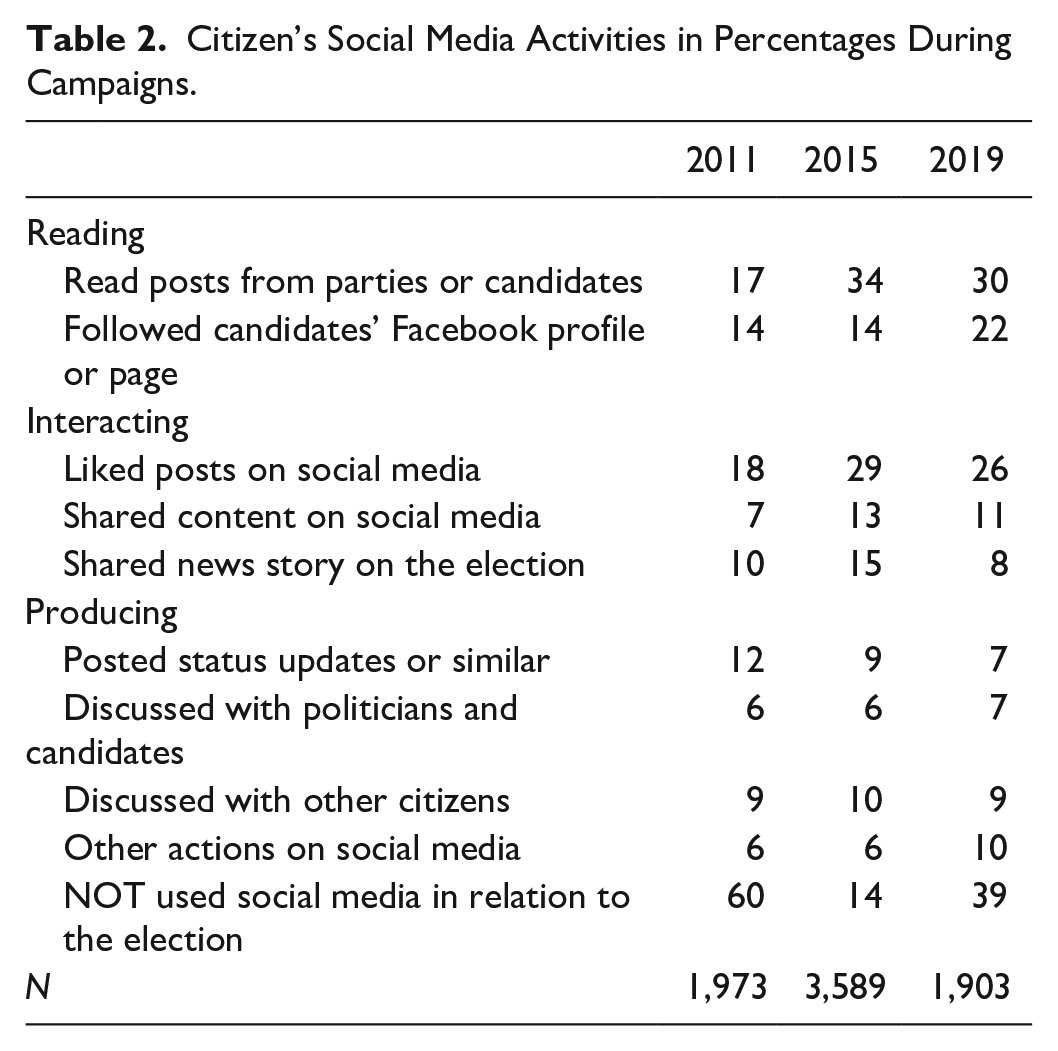
Addressing our first research question, we start with an overview of citizens’ usage of social media during election campaigns from 2011 to 2019. In general, there was an exponential increase in social media use, from 5% in 2007 (Jensen, 2008) to 30% in 2011, 65% in 2015, and a small drop in 2019 back to 60%.
We have distinguished among three forms of social media use from the “passive” reading, to the more “active” interacting and producing. It is clear that the most common social media activities are reading, following, and liking. Fewer share content and even slightly fewer post updates related to the election or engage in discussions with politicians and fellow citizens. “Likes,” visiting, and following politicians’ and parties on Facebook and Twitter account for most of the social media activity, what Halupka (2014) has defined as “clicktivism,” informal and non-obliging online political participation.
Such inequalities of participation are well discussed in literature. The Nielsen group spoke about participation inequality back in 2006 and came up with the now famous 90-9-1 rule of thumb (Nielsen, 2006), which propose that 90% of Internet users are lurkers, 9% contribute a little, and 1% contributes the majority of the content. Another commonly used rule of thumb is the “pareto principle” (Mitzenmacher, 2004), which divides the inequality between consequence and cause into an 80–20 division, where the 20% in the context of Internet studies becomes the vital few. It is important to remember that both of these principles are only supposed to serve as a rule of thumb, rather than a natural law as such. Nonetheless, they do serve as a rough explainer for our data.
Looking at each level, we see that reading doubled from 2011 to 2015 and then went down a little in 2019. Following political candidates have been on the rise at each election. Regarding interaction, we also see a steep increase of people liking candidates from 2011 to 2015, which once again drops in 2019. Sharing is most popular in 2015 but relatively stable each year. In terms of content creation, posting status updates has gone down from 2011 to 2019, but discussion seems rather stable at each election. In general, most forms of participation seem to have peaked in 2015, although differences are small between 2015 and 2019.
The figures also reveal a mystery. We see that in 2015, 65% indicates they have used social media during the election campaign. In 2019, the corresponding figure is slightly lower, 60%. When asking the reverse question, however, we see that in 2015 only 14% indicated they had NOT used social media versus 39% in 2019. This might indicate an even bigger decline in social media use in 2019 than discussed above. Figures might also indicate that when confronted with actual examples of social media use, more respondents remember their actual behavior than when only asked about social media use in general.
In Figure 1, we propose a “social media engagement ladder,” based on our findings. The formally “passive” acts of participation, “reading” and “liking” dominate and it requires involvement of an effort to reach the next levels and engage more visibly, for instance, by following and sharing. Even fewer move up to the next level and become active “producers” by commenting and posting.

Social media engagement ladder based on survey data, 2011–2019.
Do Social Media Mobilize Danish Citizens?
In the next research question, we ask whether social media contribute to mobilization. According to the mobilization hypothesis, online media have the propensity to mobilize the younger voters with higher information, communication, and technology (ICT) literacy and thereby probability of online participation. It is also claimed that online media can “level the playing field,” eliminating or decreasing existing inequalities of political participation based on education, income, and social background.
This part of the analyses is based partly on three additive indexes: a social media index, an online participation index, and an offline participation index. First, the social media index is based on the number of usage forms listed in Table 2: reading, following, liking, sharing political content, sharing news stories, posting updates, discussing with politicians and candidates, discussing with other citizens, and “other actions.” As an additive index, it does not distinguish among the different aspects of social media use (reading, interaction, and producing) but rather summarizes the number of participation forms. The online participation index summarizes the following forms of Internet participation: read information on party or candidate website, read election stories in news media, tested political attitudes in online tests and quizzes, posted or commented on a party or candidate website, engaged in online debates with other citizens, contributed with content (outside social media), and watched videos online. Finally, the offline participation index summarizes six forms of offline participation: rallied for a candidate or a party, been at a political meeting, distributed election material, written letters to the editor, discussed the election with friends and colleagues face-to-face, and watched election debates on TV. The three indexes are all standardized, allowing a range of scores from 0 to 10, increasing reliability and comparability. It must be noted that these additive indexes are quantitative rather than qualitative; they address the level and scope of participation but not the depth and inherent quality. One might score high because of widespread participation forms, whereas a party soldier using 1 month at rallying for a politician might only score on one variable, thus getting a low overall index score. However, the purpose of indexes is exactly to outbalance such outliers, making more solid and reliable measures.
Citizen’s Social Media Activities in Percentages During Campaigns.
Next, the indexes were correlated with demographic variables of age, income, and education, all transformed into ordinal variables with three to four categories, from low to high, allowing for analysis on an ordinal level with correlations and significance tests based on gamma values. The correlations between gender, age and education and the three indexes for all elections are shown in Table 3.
Social Media Use and Demographic Correlation.

Numbers in bold indicate significant correlation at 99% level.
If we first look at social media use, we see significant positive correlations for gender in 2011 and 2015 that disappear in 2019; in the first two elections, females are more likely than males to use social media during the election campaign, a correlation that has disappeared in 2019. However, we find an even stronger correlation for age where we see an expected negative correlation between age and social media use that decreases by age, indicating that the young are still the most eager social media users, also in election campaigns. The correlation is much lower in 2019, however, indicating a recent more equally age-based use of social media. Finally, there is no clear correlation between education and social media use. Although the correlation in 2015 is significant, the values remain very low, between .12 and −.03.
Looking at online political participation in general, we see more or less the same patterns, although gender remains a significant predictor throughout the period; women are more likely than men to engage politically online. Age remains a strong (reverse) predictor, although level of education once again matters less.
Finally, we look at demographic patterns for offline (traditional) political participation. Here, education is the strongest predictor, where correlations for age are weak or non-existing across the elections. This is contrary to participation through social media and demonstrates that social media tends to involve the younger more than traditional participation. Furthermore, the traditional education gap in (offline) political participation seems to almost disappear bringing social media in. Both figures confirm the mobilization hypothesis; education effects are leveled, and the usually less active young people participate more through social media.
The same tendency can be spotted for level of education, although the argument here goes the other way around; for offline participation, education level remains a predictor across the elections, with gamma scores between 0.14 and 0.18. For social media participation, the correlations are low and not significant, indicating that education level has no effect on the level of social media use. If stretching the conclusion, at least, that does not run contrary to the mobilization hypothesis; usual significance of education for political involvement is not present on social media.
Finally, when looking at overall patterns across time, there is no clear tendency across the elections. Correlations remain relatively stable. Thus, a hypothesis of increasing (or decreasing) mobilization over time can be rejected.
Do Social Media Have Any Effects on Efficacy of Danish Citizens?
Next comes the research question on social media and efficacy. As mentioned in the first section, the concept of efficacy addresses citizens’ experience of democratic capability and knowledge (Almond & Verba, 1963; Barnes & Kaase, 1979). We measured the concept through manifest statements, the same in all surveys, based on a Likert-type scale from “1” (strongly disagree) to “5” (strongly agree). The results are shown in Table 4.
Social Media Use and Efficacy.

Percentages that “agree” or “strongly agree” in the statements.
Significant at 95% level.
First, we see a clear tendency that people feel increasingly more informed on politics over time, illustrated with a gamma at 0.23, a semi-strong correlation. Similarly, social media seem to have affected opinions on important issues, not at least in the 2019 election, illustrated by a correlation of 0.19. Even more interesting, an increasing number of citizens claim that social media have affected or changed their choice of party, although the correlation for change is significantly lower. Overall, these figures are very interesting; as discussed in the beginning, direct effects of use of certain media on elections and elections outcomes are hard to measure, but at least, according to citizens themselves, there seems to be an effect on efficacy and even on candidate and party choice. Social media make people feel more informed. On the contrary, we also have to acknowledge that roughly half of the respondents state that social media have had no effect on efficacy, a figure that is slightly decreasing across the time span. The explanation for this might be that respondents are already steadfast and dedicated in their political views, which are not easily changed or affected. It may also be a more general product of an increasingly complex and fragmented media environment where effect is rarely ascribed to a single media platform (Bennett & Iyengar, 2008).
Overall, it seems like social media use during election campaigns has certain effects on the level of efficacy. If that continues, social media will have a role to play on election outcomes also in the future.
Long-Term Trends in Citizens’ Social Media Use During Elections
In our study so far, we have described how Danish citizens have increasingly adopted social media during election campaigns from 2011 to 2019. All in all, our study shows interesting trends moving in different directions. We confirm that social media participation is largely focused on low threshold engagement such as reading and liking content and we document that these engagement forms have increased from 2011 to 2019, meaning that even more people read and like political content during a Danish election campaign. This shows how passive engagement or lurking is an important part of social media use during elections, even if this type of engagement is less visible and, therefore, may not be considered as engaged citizenship or active members in the public debate.
We also see some minor changes over time that would otherwise be missed by simply looking at the data from one election and comparing them to a rough estimate of the commonly known Internet inequality measures. Looking at these numbers in a longitudinal sense, we see that reading, following, and liking content or politicians during an election campaign has become a much more common practice for Danish citizens over the three elections. Even though all these activities might be regarded as lurking and, therefore, passive engagement, it is not only the most dominating but also an increasingly common practice. By simply writing this as a foreseeable extension of the pareto principle, we miss important nuances in the smaller changes over time. Much of this activity is hidden, in the sense that it does not produce new content on social media.
Furthermore, it is important to note that most activities on social media are active in the sense that a wide range of engagement that we used to think of as passive can influence the algorithmic visibility and distribution of content. This means that activities such as liking content, clicking links, or even simply watching a video on auto play in the news feed, can impact the visibility and distribution of content (Schwartz & Mahnken, 2021). Piconet et al. (2019) introduce the concept of “small acts of engagement,” defined as “productive audience practices that require little investment.” In the article, they argue that these smaller acts should not be regarded as insignificant, since they could become powerful political acts in aggregation. Because of this, we have to revise our understanding of passive and active engagement, not only as a philosophical view, but also as a technical misleading term.
Our study also confirms that internal and external efficacy increase in each election even when active participation such as sharing, posting, and commenting decrease from 2015 to 2019. This suggests that social media platforms have become increasingly important tools for mobilizing and informing the Danish citizens even if these platforms are not used either primarily or increasingly for production.
If we combine this with the data on activity patterns, it is clear that the number of people who have become more informed and even changed opinions during an election, is much higher than the number of active users who produce status updates or discuss politics on social media. Strategically, this means that politicians and parties might miss the largest potential for influence, if they only focus on their visible minority of content producers on their Facebook pages. It might even be the least relevant audience in terms of changing the mind of voters, who are not already partisan and mobilized for the cause.
On the contrary, the verbal minority does have an important role, since their content becomes visible for the silent majority. A critical comment by a citizen might, therefore, have a large impact on the interpretation of a status update made by a politician or a party. In this sense, the silent majority might be the influenced, while the verbal minority are the influencers. Therefore, future research should study the influence of the verbal minority on the silent majority and more generally explore the relation between these two types of Internet use and users.
This might seem like a return to one-way communication models, but this would be a misunderstanding of the role of the majority of Facebook users who do not produce original content. Many users seem to be listening as an active process, and as a consequence, many do feel more informed and might even change opinion and party choices. The silent majority might even be better at listening than the people who participate in discussions in comment sections and so on. Returning to the concept of lurking as political activity, Crawford (2011) offers a different conceptualization of the lurker as an intersubjective listener in order to emphasize the potentially active role of the lurker. This definition makes even more sense on social media, as the listener will often have to go through a range of active choices in order to read content such as following politicians or liking particular content. In this sense, we argue that the lurker may indeed be an active and engaged listener that needs to be taken seriously in order to understand the true potential of social media as a key tool for political communication during election campaigns. Furthermore, the silent majority plays a key role as networked distributors of information on social media. Their “invisible” activity will increase visibility of content and create new paths of networked distribution, which is key for any content’s life cycle on social media. In this sense, the silent majority is not only listening but also interacting in a gray area of engagement that we are missing if we think only in terms of active or passive users.
Conclusion
Through our longitudinal study of citizens’ use of the social media during the Danish general election campaigns from 2011 to 2019, we have documented some stable and some changing patterns of use. First of all, we find that the majority of social media users prefer to read and interact with political content during election campaigns, which means that only a small minority is actually producing new content. This is not a new insight as such, and the inequality of participation have been a commonly known fact for many years (Nonnecke & Preece, 2003).
In our survey data, we see a small drop in citizen engagement on social media from 2015 to 2019. The most obvious explanation for this may be lesser interest in social media as a political space, and opinion that may be an effect of scandals such as Cambridge Analytica leading up to the Danish election in 2019. Another explanation for the drop in political activity might be the algorithmic change implemented in 2018 by Facebook to focus on “meaningful interactions” between friends and family rather than public pages such as those of political parties. 2 As a consequence, the Danish population may see less content from public pages such as news sites, political actors etc. about the election. Interestingly, though, the algorithmic change did not have an effect on efficacy levels, which continues to increase at every election.
We conclude that social media mobilize and engage citizens as well as increase citizen efficacy. While mobilization through social media did correlate with gender, age, and education in earlier elections, these numbers seem to equalize during the last election where only age was correlated in small measures. This seems to suggest that social media have become a more diverse space in terms of demographic balance, contrary to how it used to be and what earlier studies have suggested. The findings are interesting in comparison with offline mobilization where education remains an important predictor, thus suggesting that social media mobilization have a wider educational span.
In this article, we argue for a return to the study of lurking as a potentially important political engagement, or rather a reconceptualization of what it means to be engaged on social media in a political and technical sense. One reason why lurking activity is important on social media platforms is because it is increasingly more common than content production. If we focus only on the users that are engaging in content production, we are missing all of the citizens who are clearly engaged through reading and thus potentially influenced by the communication of politicians, news sites, and their social peers during the election campaign. Even if we could simply dismiss this group as an unengaged majority, there is no evidence that they are less emotionally engaged or less likely to be influenced. On the contrary, it is likely that the content producers are also the users who are less likely to change their mind, because they are more likely to be partisans of one political position (Mutz, 2006), rather than undecided voters who are more interested in listening in order to find key insights to make a decision.
Our study, therefore, reaffirms common knowledge about public social media engagement but we also introduce important nuances in description of how the engagement patterns have changed over time through a longitudinal perspective. Our study points toward a need for the development of a less dichotomous conceptualization of social media engagement as either passive or active toward one that integrates the various modes of engagement ranging from a public and verbal engagement mode to a less visible and listening-oriented mode. Both are indeed active in both political and technical sense, and the traditional lurkers may prove to be the audience with the greatest political potential on social media in terms of persuasion, efficacy, and mobilization. This hypothesis, however, is something that needs to be explored further, as our research design does have explanatory limitations in relation to questions of effect and causality.
Footnotes
Declaration of Conflicting Interests
The author(s) declared no potential conflicts of interest with respect to the research, authorship, and/or publication of this article.
Funding
The author(s) received no financial support for the research, authorship, and/or publication of this article.
