



Abstract
This special issue of Social Media + Society develops a cross-national, longitudinal perspective on the use of social media in election campaigns. Australia, where leading social media platforms such as Facebook and Twitter were adopted early and widely by the general population, and where federal election cycles are unusually short (often less than 3 years), provides a particularly suitable environment for observing the evolution of social media campaigning approaches. This article extends our analysis of previous federal election campaigns in Australia by examining Twitter campaigning in the 2019 election; to allow for a direct comparison with previous campaigns, it builds on a methodological and analytical framework that we have used since the 2013 election.
Introduction: The Revolving Door of Australia’s Prime Ministership
This special issue of Social Media + Society develops a cross-national, longitudinal perspective on the use of social media in election campaigns. Australia, where leading social media platforms such as Facebook and Twitter were adopted early and widely by the general population, and where federal election cycles are unusually short (often less than 3 years), provides a particularly suitable environment for observing the evolution of social media campaigning approaches. This article extends our analysis of previous federal election campaigns in Australia by examining Twitter campaigning in the 2019 election; to allow for a direct comparison with previous campaigns, it builds on a methodological and analytical framework that we have used since the 2013 election.
This long-term stability in our research methods contrasts markedly with the substantial political instability at the federal level that Australia has experienced for more than a decade: in the 13 years since 2007, it saw six changes of Prime Minister (PM). This rapid turnover contrasts starkly, for instance, with the period of 1975 to 2007: during those 32 years, the leadership changed hands only three times. Remarkably, such instability is only partly due to the changing mood of the electorate, as expressed at the ballot box: of the six leadership changes since 2007, four were brought about by personal and policy disagreements within the respective governing parties.
Figure 1 demonstrates this leadership turmoil. After more than 11 years in office, long-standing PM John Howard from the conservative Liberal Party (which rules in a permanent Coalition with the agrarian-protectionist National Party) lost the federal election in a landslide in late 2007 to Kevin Rudd from the more progressive Labor Party, yet Rudd was removed by his own party toward the end of Labor’s initial 3-year term amid concerns about both his leadership style and his prospects in the 2010 election; this was won narrowly by his Labor successor, Julia Gillard. Gillard, in turn, was replaced shortly before the subsequent election by the returning Rudd, in an attempt to improve Labor’s electability in the face of persistently poor opinion polls for Gillard. This last-ditch effort to thwart a Liberal/National win failed, installing conservative PM Tony Abbott in the 2013 election. Abbott’s abrasive style and erratic decision-making saw his popularity fade quickly, however, and his party replaced him with the somewhat more moderate Malcolm Turnbull, less than 2 years into the government’s term. Turnbull narrowly won the 2016 federal election, but clashed repeatedly with conservatives in his party over climate change, same-sex marriage, and contentious issues; therefore, only 2 years after his 2016 win, he was finally replaced by the former Immigration Minister and Treasurer Scott Morrison, in August 2018. As PM, Morrison went on to contest the next Australian federal election, held on 18 May 2019.

Australian Prime Ministers, 2007–2019.
Such political turmoil is unusual in Australia as the country’s electoral system is designed to furnish governments with stable majorities, at least in the lower house of parliament (which elects the PM). Members of Australia’s House of Representatives are elected using a preferential first-past-the-post system in which voters number all candidates standing in their electorate in order of preference. The candidate with an absolute majority of first-preference votes in an electorate is selected as its representative; if no candidate receives such an absolute majority, the votes for the candidates with the least amount of support are redistributed to more popular candidates on the basis of voter preferences. This tends to result in a House that is dominated by representatives of the Liberal/National Coalition or the Labor Party (or their regional variations, such as the merged Liberal National Party in the state of Queensland), and only occasionally includes minor-party or independent candidates with a strong personal following in their local electorates.
However, the major-party dominance that this system conserves also results in the substantial internal differences behind the recent leadership turmoil: socially progressive Labor candidates from urban electorates may disagree profoundly with their party colleagues representing blue-collar, regional seats; neoliberal, free trade-friendly Liberal Party members from the cities will clash with their Coalition colleagues from the National Party who seek to protect their rural, farming areas from international competition. Such divisions cannot be resolved by forming separate parties, however: this would simply reduce their overall electoral chances. As a consequence of the resultant disunity, overall public trust in politicians from all sides, and in democracy as such, has declined to an all-time low (Evans et al., 2018); put simply, Australian voters can no longer be sure that the PM they (indirectly, but implicitly) elect by supporting a specific party at the ballot box will lead the government for the full 3-year parliamentary term.
This distrust does not simply result in declining voter participation, however, due to a second key feature of the Australian electoral system: that is, its use of compulsory voting. The legal requirement that all eligible citizens must cast their vote in the election further means that there is no need for parties to operate “get out the vote” campaigns, and that they cannot win elections by mobilizing their own base while discouraging oppositional supporters from voting (as, for instance, in the United States); the committed, “rusted-on” voters are virtually guaranteed to support their party’s candidates. Rather, Australian elections are won and lost as a result of changes in the behavior of a smaller group of genuine swinging voters who do change their candidate choices (and preference rankings) from election to election. In contrast to political strategies elsewhere (Gelman et al., 2021; Nuernbergk & Conrad, 2016; Usherwood & Wright, 2017), Australian campaigning on social and other media is thus targeted strongly at such swinging voters. Importantly, this negates much of the “social media incumbency advantage” that Enli and Naper (2016) postulate for the United States and other electoral systems: in Australia, incumbency, and the visibility on social (and mainstream) media that it generates, does not discourage oppositional votes to the same extent.
Twitter in Australian and International Election Campaigns
Over past electoral cycles, social media have come to play an increasingly important role in Australian campaigning. As early as 2007, then-PM John Howard released several messages on YouTube; these were somewhat ineptly produced, but nonetheless demonstrated that such platforms would need to form part of the communicative arsenal of modern election campaigns (Bruns et al., 2007). Australians are comparatively early, enthusiastic adopters of social media (Sensis, 2017), and more than half now use social media as a key source of news (Newman et al., 2018: 127); combined with the fact that voting is compulsory and that this results in the (possibly decisive) participation of voters who may pay very little attention to the news in general, and to political news in particular, it is, therefore, critical for election campaigns to reach such politically disinterested electors through the channels they most engage with.
The present article, then, investigates the use of Twitter in the 2019 Australian federal election campaign. It builds on the methodological approach established in our analyses of the 2013 and 2016 campaigns (Bruns, 2017; Bruns & Moon, 2018), contributing to the further extension of a longitudinal dataset that enables an examination of the evolution of social media campaigning and its reception over the course of multiple electoral cycles, and can form the basis for further comparison with future elections. In the classification developed in Jungherr’s (2016) systematic literature review of research into the election-related uses of Twitter, we address Twitter uses both by parties and candidates, and by electoral publics, rather than in specific mediated campaign events; further, as we outline below, we contribute to the small number of studies that analyze broader datasets beyond selected election or campaign hashtags.
Our past studies documented the use of Twitter during the 2010, 2013, and 2017 federal elections (Bruns, 2017; Bruns & Burgess, 2011; Bruns & Moon, 2018); in particular, we showed that during the turbulent 2013 election, as Labor’s central campaigning strategy was disrupted by the brief return of Kevin Rudd to the Prime Ministership, local Labor candidates appeared to actively embrace Twitter and other social media, in combination with in-person campaigning, as a final effort to reduce the scale of their anticipated defeat and retain as many seats as possible. In 2016, however, with the government and opposition roles reversed, Coalition candidates did not seem to replicate this electorate-level strategy, while Labor candidates remained enthusiastic users of Twitter in their campaigning (now also aided by a more organized party campaign). This produced a mere one-seat majority for the Coalition in the House of Representatives. These observations diverge notably from Jungherr’s summary of the overall literature, according to which “parties and campaigns in opposition appear more likely to use Twitter than those in government” (2016: 84); this divergence may result from the unique features of the Australian electoral system that we have outlined. For 2019, we thus hypothesize that
H1. Labor candidates will continue to use Twitter more actively than their Coalition counterparts.
In both elections, meanwhile, ordinary Twitter users’ overall engagement with candidate accounts focused predominantly on the current government; we concluded from our comparison of the 2013 and 2016 elections that it is primarily the underlying political constellation (which party is in power), rather than campaigning efforts (how enthusiastically each party uses Twitter) or ideological positioning (whether a party represents the left, center, or right of the Australian political spectrum) that appears to drive user engagement with political candidates. (Bruns & Moon, 2018: 442)
However, in 2016—but not in 2013—we found considerably more retweets for posts by opposition candidates than for their government counterparts. Such retweeting amplifies candidate posts, and in the context of an election may thus be read as support and endorsement. If, due to public frustration with both party blocs at the time, the lack of retweets for either side of politics in 2013 is treated as an aberration, this broadly aligns with international findings: “supporters of governing parties appear to use Twitter less intensively than those from opposition parties” (Jungherr, 2016: 78). We thus expect to see the pattern recur in the 2019 election:
H2. In total, more tweets will be directed at government than opposition candidates.
H3. More retweets will be directed at opposition than government candidates.
While our past studies have only touched in passing on the themes of tweets directed at candidate accounts, we found that in both 2013 and 2016 opposition critiques of government policies were a significant topic (Bruns & Moon, 2018: 443) on Twitter, too. This departs somewhat from the international research, which finds that “most of the commentary on candidates and parties tends to be negative in tone” (Jungherr, 2016: 78): for Australia, we therefore hypothesize instead that
H4. Tweets at government candidates will criticize the government’s performance over the concluding legislative period.
H5. Tweets at opposition candidates will support opposition policies for the coming period.
Finally, in light of recent methodological developments and continuing concerns about attempts to interfere with the authentic expression of political perspectives on social media (Boichak et al., 2021; Neudert et al., 2017), we are also interested in testing for evidence of automated inauthentic activities—primarily, social bots. We anticipate that
H6. Bots will seek to disrupt the conversation on Twitter, and promote partisan disinformation.
As Australia approached its May 2019 federal election, the unstable and complicated electoral situation we have outlined remained very much in place. Scott Morrison, elected by the Liberal/National parliamentary partyroom as something of a compromise candidate between its moderate and conservative factions, had been in power for less than 1 year; the Coalition parties had trailed Labor consistently, by a margin of up to eight percentage points, in opinion polls; and Labor’s Opposition Leader Bill Shorten and his team appeared confident of victory. This article examines the Twitter conversations by, with, and about candidates that took place, against this backdrop, during the election campaign. We outline our methodological frameworks in the following section, before presenting the results of our analysis and interpreting them against the political context of the 2019 Australian federal election and the longitudinal data from past electoral cycles.
Dataset and Methods
Following the approach established in our previous studies, we again began by identifying the Twitter accounts of all election candidates—from major and minor parties, as well as independents—once the official candidate rolls closed on 22 April 2019. We then used the Twitter Capture and Analysis Toolkit (TCAT; Borra & Rieder, 2014) to capture all tweets by these candidate accounts, as well as all tweets directed at them in the form of @mentions and retweets, for the entirety of the official campaign period to 17 May 2019. This data gathering approach matches that implemented in our previous studies, thanks to the relative stability of the public Twitter API, and of the TCAT software, over these three election cycles. Although Twitter as a sociotechnical construct may have changed considerably over these 6 years, it has remained possible to comprehensively capture these tweets using identical methods.
As in our previous analyses, we deliberately exclude the election day, 18 May 2019, itself, as tweeting patterns by and at candidates during this day typically diverge substantially from the preceding campaigning period: rather than addressing political and ideological points, tweets on election day typically focus on the voting process itself, on paraphernalia such as the “democracy sausage” available at voting booth barbecues (Zappavigna, 2014), and on rolling commentary, analysis, and early celebrations and recriminations as election results emerge in the evening. Election day is thus not properly part of the campaign, and, therefore, not relevant to our analysis of social media campaigning strategies and their resonance in the Twittersphere.
We take this candidate-centered approach—rather than following election-related hashtags such as #ausvotes—because we argue that it produces a more differentiated picture of the Twitter debates relating to the election. Hashtags are by definition self-selective; they invite users to mark their tweets as relevant to a particular issue, and thus implicitly as deserving or demanding the attention of the imagined public following the hashtag. But users who do not seek such enhanced visibility, perhaps because of the unwanted attention from political opponents that it could generate, will still make political statements on Twitter; indeed, their statements are likely to be considerably more representative of broader political sentiments than those of the smaller group of highly vocal participants who dominate the major political hashtags. Such users expressing themselves outside of hashtags still engage with local candidates, or leading national politicians; they may retweet candidates’ posts to support or amplify them, @reply to express support or criticism, or @mention to strike up a conversation, ask questions, or express approval or disapproval. Our dataset, therefore, represents a rich collection of (successful or unsuccessful) attempts by ordinary users to interact with candidates, and vice versa, as well as of tweets by and between candidates.
We acknowledge that this introduces other limitations—in particular, an explicit focus on interactions rather than on statements about the election that are made by users without specifying a distinct addressee. Another, yet more comprehensive approach to gathering data during an election campaign would, therefore, combine our approach with the gathering of tweets that contain any of a large number of hashtags and keywords related to the election, regardless of whether these tweets are directed at candidate accounts or not. Like pure hashtag collections, however, this faces the practical challenges of identifying such keywords and hashtags ahead of collection, of updating them continuously as unforeseen election-relevant terms emerge during the campaign, and of reliably removing the potentially large volume of false positives that result from the concurrent use of such terms in contexts other than election discussion. We, therefore, suggest that our approach charts a sensible, pragmatic course between the limited, “easy data” of hashtag collections and the prohibitively “hard data” of variable keyword collections (cf. Burgess & Bruns, 2015).
We identified Twitter accounts for 107 Labor and 85 Coalition candidates (of these, 58 represented the Liberal Party, 6 the National Party, and 21 the merged Liberal National Party [LNP] in Queensland), as well as 43 Greens and 26 Independent candidates and 8 candidates from other minor and micro-parties. We captured 18,941 tweets from these accounts, as well as 1,327,065 tweets directed by other Twitter accounts at one or more of them. We first examined the patterns in these engagement activities through basic statistical analysis, examining especially the volume, type, and features of the tweets sent and received by the accounts representing the different parties; furthermore, we also investigated the patterns of interaction between the candidate accounts and the wider public.
Second, we utilized computational textual analysis methods to examine the content of tweets, identifying the key topics and messages that circulate at both micro (single candidate) and macro (whole party) scales. We combine simple n-gram text statistics and Latent Dirichlet Allocation (LDA; Blei et al., 2003) to conduct a thematic analysis of how candidates and parties frame their outward communication, and in what ways they are themselves framed and addressed by Twitter users. We also examine how these messages intersect with known campaign developments and activities.
A key consideration in the application of LDA to Twitter data is the “short-text” problem: most text mining approaches are designed for large document sets, not relatively short tweet texts. Among popular topic modeling and text mining approaches, LDA performs better than most on short-text data (Albalawi et al., 2020). To ensure strong reliability, following systematic studies of topic models applied to social media text (Jacobs & Tschötschel, 2019; Maier et al., 2018; Rodriguez & Storer, 2020), we took the additional step of combining n-gram statistics with a selective close reading of key tweets from specific topical categories. To derive the LDA model, we used an intrinsic evaluation approach to determine model suitability, comparing numerous models of varied topic dimensions (K = 10, 20, 30, 40, 50, 60) created using the Gensim 3.7.3 Python package (using default settings except for eta and alpha set to automatic, and chunk size = 100). Through analysis of the top word lists in the dimensions of each model, and overall model interpretability using LDAVis (Sievert & Shirley, 2014), we settled on the 40-topic model as the most suitable for our purpose of high-level thematic exploration of the main topics discussed throughout the election campaign.
Finally, considering current concerns about the impact of bots and other inauthentic automated actors on the public discussion of political matters, especially in the wake the 2016 Brexit referendum and US presidential election (Bessi & Ferrara, 2016; Rizoiu et al., 2018), we also utilized the Botometer tool to examine the presence of automated accounts in the dataset (Sayyadiharikandeh et al., 2020). Botometer uses a trained machine learning model to generate a “bot score” for Twitter accounts, based on their characteristics and behavior. For this study, we focus on the Completely Automated Probability English score (CAP English). This ranges between 0 and 1, and defines the probability that a given account is controlled by software, that is, is a bot in the conventional sense (Sayyadiharikandeh et al., 2020). Following Botometer guidelines, we set a relatively strict threshold of 0.95 for classifying accounts as bots. This means that 95% of the time we are correct in labeling an account with a CAP score > 0.95 as a bot. Similarly, we set a threshold for labeling an account as “human,” with a conservative threshold of CAP < .2. This produces three reference populations: human < 0.2 ⩽ other ⩽ 0.95 < bot. We ran Botometer for all unique accounts in the dataset that sent a tweet, and were able to collect scores for 79,121 accounts.
Using these approaches, we analyze the activity patterns captured in our dataset in the following section. We then conclude with a broader discussion of these findings against the context of our studies of the use of Twitter in previous Australian federal elections, and an outlook for future research.
Analysis
Overall Patterns of Interaction with the Candidates
We begin by examining the activities of the candidate accounts themselves. Here it is notable that, even accounting for their slightly greater overall number of accounts, Labor candidates substantially outperform their Coalition counterparts (Figure 2): collectively, they posted nearly 8,800 tweets over the course of the campaign, compared to fewer than 2,300 tweets by the candidates representing the three constituent parts of the Liberal/National Coalition. Meanwhile, the Greens, which stood only about half as many tweeting candidates as the Coalition, posted more than double the total number of tweets, at some 4,800 tweets overall.

Volume and type of tweets posted by election candidates, aggregated by party, 22 April to 17 May 2019 (percentage totals for tweet types exceed 100% because tweets can be both retweets and @mentions at the same time).
Tweeting styles also differed somewhat: Labor and Greens candidates were especially active in retweeting other accounts (predominantly their party leaders, colleagues, other affiliated accounts, and favorable media coverage); some 53% of all Labor tweets and 49% of Greens tweets were retweets. Coalition accounts engaged in considerably less retweeting: 33% of Liberal, 32% of LNP, and only 19% of National Party tweets were retweets. This may indicate a less coordinated social media strategy, with less emphasis on the collective amplification of key tweets from party leaders or campaign headquarters, but could also result from the more fragmented organizational structure of the Coalition: National Party candidates may not wish to retweet their Liberal colleagues, and vice versa, if they are concerned about maintaining a distinct party identity within the overarching Coalition or if their policy positions differ due to factional disagreements. Independents, finally, also tend to retweet less, at under 22% of all tweets; this is an inevitable result of their lack of party affiliation, which affords them fewer fellow travelers to endorse and be endorsed by.
Conversely, Labor and Greens candidates post the smallest percentage of original tweets—that is, tweets that do not engage with other Twitter users by @mentioning or retweeting them: only 25% or Labor and 27% of Greens tweets fall into this category, compared to 34% of Liberal, 35% of National, and fully 58% of LNP tweets. Whether endorsing others through retweeting, or addressing, interrogating, or responding to them through @mentioning, these divergent patterns indicate a different understanding of the affordances of campaigning via Twitter: Coalition accounts appear considerably more focused on simply posting campaign messages, while Labor and Greens accounts take a considerably more discursive approach.
This is evident also from the distribution of tweets directed at other candidates (Figure 3). Where retweeting between candidates occurs, it remains almost exclusively within the same party or party bloc; only National candidates also retweet their colleagues in the merged LNP party in Queensland, and (much more rarely) Liberal candidate accounts such as that of the Liberal PM, Scott Morrison, while LNP candidates predominantly engage with Liberal candidates such as the PM and occasionally also retweet other LNP colleagues, but do not return the Nationals’ favor by also retweeting their candidates. These patterns also reflect the relative hierarchy within the Coalition: the Liberal Party is the largest, dominant component, receiving attention but not returning it; the LNP is a special Coalition construct for the state of Queensland and thus supports the Liberal leadership elsewhere; and the National Party is the junior partner whose support is received by both other Coalition parties, but not returned in kind.

Percentage of @mentions and retweets per party targeting other candidate accounts.
Even @mentioning largely remains within the same party: only 8% of Labor tweets mention Coalition candidates, and only 10% of Liberal tweets mention Labor or Greens candidates. Greens and Independents take a somewhat more aggressive approach, however: 18% of Greens and 19% of Independents tweets address the candidates of other parties. This reflects their less favorable starting position in the electoral race: rather than arguing from a relative position of strength as the official government or opposition, they are forced to show more clearly how their views contrast with those of the major parties, and in doing so also address those parties and their candidates directly through @mentions.
The remainder of candidates’ retweets and @mentions are directed at accounts other than candidates; this includes central party accounts, journalists, media outlets, affiliated groups from industry lobbyists to labor unions, and occasionally also ordinary Twitter users; these other accounts are shown in gray in Figure 3.
Predominantly, however, candidates are the recipients rather than senders of retweet and @mentions; the volume of such activity from other Twitter users substantially outstrips that of the tweets posted by the candidates themselves (Figure 4). Here it is immediately notable that the considerably smaller amount of tweets posted by Coalition candidates has not resulted in their being overlooked by ordinary Twitter users: rather, at over 648,000 tweets received, the Liberal Party candidates alone are addressed in considerably more tweets than their Labor counterparts (569,000 tweets). This pattern is in keeping with our observations from the previous two elections (Bruns, 2017; Bruns & Moon, 2018): here, too, the candidates representing the incumbent government (Labor in 2013; the Coalition in 2016) were addressed in substantially more tweets than opposition candidates.

Volume and type of retweets and @mentions received by election candidates, aggregated by party, 22 April to 17 May 2019 (percentage totals for tweet types exceed 100% because tweets can be both retweets and @mentions at the same time).
We also observe a continuing decline in attention toward Greens candidates, in comparison with Independents: while in 2013, Greens accounts received a greater amount of tweets than Independents, in 2016 Independents were slightly more frequently addressed than Greens, and in 2019 they are well ahead (at 102,000 tweets received) of the Greens (40,000 tweets)—even despite the Greens’ considerably greater tweeting efforts. This may also result from the changed political context: in 2013, having supported the Labor minority government through the preceding period, the Greens received a greater amount of commentary than in 2016 and 2019, when they were one minor party voice among others.
Examining the types of tweets directed at candidate accounts, it is immediately obvious that opposition parties received a significantly greater percentage of retweets than the Coalition: 18% of all tweets directed at Labor candidates, 21% of tweets at Independents, and 23% of tweets at Greens accounts are retweets; by comparison, only 3% of tweets at Liberal, 2% of tweets at National, and less than 1% of tweets at LNP candidates are retweets. While occasionally, reasons other than support and amplification may lead a Twitter user to retweet a candidate’s post, we must nonetheless read this predominantly as a greater willingness to spread the electoral messages of opposition candidates. These patterns are in line with previous observations: while during the 2013 election, Twitter users were neither prepared to retweet the candidates of the dysfunctional Rudd–Gillard–Rudd Labor government nor willing to endorse the widely disliked Abbott-led Liberal opposition, in 2016 retweets of oppositional Labor, Greens, and Independent candidates were well ahead of retweets of Coalition government accounts, by a similar margin.
Such patterns are also replicated for individual candidates. Figure 5 shows the 10 candidates who received the greatest number of tweets, and shows, first, that the 2 primary candidates for the Prime Ministership, Labor Opposition Leader Bill Shorten and Liberal PM Scott Morrison, were also the center of attention on Twitter. With 379,000 and 361,000 tweets directed at them, respectively, attention is evenly distributed; however, the sitting PM receives a considerably smaller percentage of retweets (1%) than his challenger (7%).

Volume and type of retweets and @mentions received by election candidates, 22 April to 17 May 2019 (10 candidates with the greatest volume of tweets received).
Shorten’s ability to attract support in the form of retweets is significantly below the party average of 18%, however, or that of the other prominent Labor candidates as shown in Figure 5: Labor frontbenchers Chris Bowen (33%) and Tanya Plibersek (20%) outperform their leader substantially on this measure. This points to the fact that—as much post-election analysis also suggested—Shorten’s personal appeal was limited, even in comparison to that of other leading Labor figures, and that this lack of popular enthusiasm for a PM Shorten contributed to Labor’s election loss. Meanwhile, the other Liberal, National, and LNP candidates struggle like their leader to generate support and amplification through retweets for their messages; on this metric, the best performer in this top 10 is former PM Tony Abbott, whose contest with Independent challenger Zali Steggall would end in Abbott’s defeat in the electorate of Warringah, and his exit from parliament. Some 6% of all tweets directed at Abbott, and 7% of those directed at Steggall, are retweets.
Campaign Themes and Their Resonance
Our examination of the thematic content of the tweets begins with a bigram and trigram analysis of tweets by the candidates, including all retweets, @mentions, and original content. We pre-processed these to remove hashtags, URLs, @mentions, and stop words (low-level, high-frequency grammatical terms such as: I, of, and, the, in, and so on). We also applied basic word stemming to remove pluralization and tense variations. The top 50 bigrams (Figure 6) and top 50 trigrams from all candidate tweets were extracted, summed, and then averaged by the total number of tweets sent per party, to assess how common these top 50 n-grams were in tweets by candidates of each party.

Top-50 bigrams in election candidates’ tweets, averaged according to party affiliation, 22 April to 17 May 2019.
Climate change featured as one of the most prominent bigrams in candidate tweets, with Greens candidates tending to use it most frequently. Climate change was also notable because, while most trigrams extended thematically from the top selection of bigrams (for example, Labor Government may extend to Shorten Labor Government), climate change as a concept was present in seven of the top 50 trigrams (see Figure 7).

Trigrams relating to climate change in election candidate tweets, averaged according to party affiliation, 22 April to 17 May 2019. (Parties whose candidates’ tweets contained none of these trigrams are omitted.)
The various trigrams relating to climate change vary in the intensity and urgency of their language (arranged in Figure 7 from left to right in order of most urgent to least urgent), and their use tends to correlate with the political parties’ established views on climate change itself. Historically, the National party, Liberal National Party, and other minor right-leaning parties have tended to question or reject the scientific consensus on climate change. It is thus unsurprising that their tweets did not contain any of the top trigrams relating to climate change (or even the bigram climate change itself). Conversely, in addition to strong framing of action (on) climate change, the Greens tended to use other qualifiers such as strong, real, and take to promote a stronger sense of seriousness and urgency. Labor also used some of these hedges, but not to the same degree as the Greens, with real as its preferred intensifier when used. The Liberal Party preferred the more benign climate change policy, and action (on) climate change, while Independents, some of whom—like Zali Steggall—successfully challenged long-held conservative seats, fell somewhere between the Liberal and Labor Parties.
Looking beyond climate change, the list of top bigrams can be grouped into four subsets: those that reference politicians and parties; policy (on child care, or penalty rates paid to workers on weekends); events during the campaign (the death of former PM Bob Hawke, the Australian and New Zealand Army Corps (ANZAC) Day military commemoration); or campaign slogans (cuts [and] chaos, time [to] change). For the first group, references to politicians and parties, it is notable that when not using @mentions to refer to their party leader, the major parties tended to use the leader’s surname, and optionally the party, followed by “government”—for example, Morrison Government, (Shorten) Labor Government. When referencing their opponent, they tended toward that leader’s full name.
At a policy level, candidates tended to focus on a few key policy areas, notably playing to their own strengths. Coalition candidates focused mostly on small business, an area they are traditionally associated with, and on attacking Labor over its economic policy to reform franking credits payments to stock market shareholders—a policy characterized as a reasonable economic reform by commentators (Coates & Wood, 2019), but used by the Coalition and right-leaning minor parties as the basis of a scare campaign. Labor’s most mentioned policy-related bigrams focused on the reversal of tax cuts for big business or the top end of town, as they often characterized it; restoring penalty rates for hospitality and other workers doing work outside of normal business hours (which had been cut by the previous Morrison government); and a range of other social policy foci. As seen in the trigram analysis, the Greens focused squarely on climate change and renewable energy, while independents and other minor parties tended to focus on many of the already mentioned policy areas, at a lower level of activity.
In terms of slogans, the Australian ideal of a fair go was invoked especially by Labor, and to a lesser degree by the Coalition. The slogan time (to) change was also used by many Labor candidates, harnessing a sense of unpopularity toward the incumbent government. The Coalition, by comparison, focused significantly on community funding announcements, with government invest(ing/ment) emerging as one of their highest-ranked slogans. After the election, it was discovered that they had misallocated sports grant funding toward marginal electorates explicitly against the direction of the government body set up to establish funding suitability (Martin, 2020). This “Sports Rorts” scandal led to National Party Senator Bridget McKenzie’s resignation as Minister for Sport and deputy leader of the National Party on 2 February 2020; she remains in parliament.
While a degree of consistency in messaging can be expected (and was observed) in candidates’ tweets, the high textual variability and lack of central coordination in tweets by the wider public means that an n-gram analysis is less likely to yield useful insights. Therefore, for the more substantial collection of tweets directed toward candidates, through @mentions or retweets, we used an LDA topic model to generate qualitative insights into the top topics, focusing on which topics aligned most prominently with specific parties. We pre-processed input text similarly to the n-gram analysis, removing grammatical “stop-words,” performing full lemmatization, and removing or replacing non-alphanumeric characters such as emoji and punctuation. Punctuation processing was performed in line with common Twitter norms to preserve meaning where possible: for example, a specific Twitter vernacular is the insertion of emoji (often the handclap emoji) between words, in which case emoji were replaced with white space to avoid the concatenation of terms. Once constructed, the LDA model was used to code the tweet texts, generating a list of terms for each topic dimension, while also tagging each tweet for prominence against each of these 40 topic dimensions. These topic prominence scores were combined to help determine the topics that aligned most closely with specific political parties. The word lists, and a subset of roughly 20 of the most closely aligned tweets per topic dimension, were inspected to interpret each dimension of the topic model, and understand the specific sentiment relating to these topics.
Major themes in tweets directed toward candidates included: taxation; climate change and coal; social policy and infrastructure; truth in political advertising and media; preference deals between parties; the “Watergate” scandal; and workers’ rights and conditions (see Table 1). Some of these high-level topics reflect a general distrust of government and politicians, but several also demonstrate the public’s focus on specific policy agendas, party announcements, and events that occurred during the campaign, offering criticism or support.
Top Topics in Tweets Directed toward Specific Parties, 22 April to 17 May 2019.

UAP: United Australia Party.
Supportive messaging directed toward Labor candidates addressed their policies to protect penalty rates, create jobs, and restore funding to public services. Another substantial set of the tweets toward Labor, however, addressed the “death tax” scare campaign—a disinformation campaign promoted by minor conservative parties, most prominently One Nation, and by several Liberal and Liberal National Party members (Murphy et al., 2019), that suggested Labor (also with support from the Greens) would introduce a severe new inheritance tax. Labor candidates tended not to address this commentary directly on Twitter, attempting (unsuccessfully) to deprive such disinformation of attention. Notably, the same disinformation campaign was promoted again by the United Australia Party (UAP) during the 2020 Queensland state election, in which the incumbent Labor government managed to retain power. Here, however, Labor challenged these claims more directly than it did in the 2019 federal campaign, advising candidates to directly refute the lie (Smee, 2020) and calling on Facebook and Twitter to remove UAP-backed messaging that promoted such disinformation (Pollard, 2020).
Tweets directed at Liberal candidates were predominantly critical, focusing primarily on the past election’s broken promises not to cut essential services; claiming that their economic policies favored the wealthy; and criticizing the party’s preference deals with controversial minor parties such as the UAP (that is, its advice to voters to order their list of party preferences on the ballot paper in a specific way). Together with their Coalition partners in the National Party, Liberals were also targeted for their role in the “Watergate” scandal: a controversy, continuing at the time of writing, involving irrigation water rights purchases dating back to 2017, with former Nationals leader and Minister for Water Barnaby Joyce allegedly authorizing the purchase of A$80 m in water from a company cofounded by one of his Coalition colleagues, Angus Taylor. In addition to the apparent significant conflict of interest, the purchase price has been criticized by auditors for being grossly excessive (Slattery & Campbell, 2020). By contrast, the only positive messaging Coalition candidates received in tweets directed at them related to the perception that they had been able to reduce the national debt.
Greens and Independent candidates received similar and mostly positive interactions on the issue of climate change, with tweets supporting their progressive policies and proposed action on this issue. Greens candidates were also addressed in tweets that focused on human rights issues, such as Australia’s abhorrent practice of indefinite detention for asylum seekers, which the Greens strongly oppose.
Finally, of all political parties, the UAP received some of the most critical attention on Twitter. Tweets mentioning the UAP focused on party leader Clive Palmer’s failure to pay workers at his Queensland mines and related businesses; on his involvement in setting up preference deals as a means of gaining favor with the Liberal party; on his corporate interests being underwritten by taxpayers; and on his coal mining interests being antithetical to action on climate change.
Evidence of Bots in Tweeting Activity
In the third component of our analysis, we examined the dataset for evidence of coordinated interference by bot accounts. Overall, however, we find little evidence of bot-like tweeting activity. The distribution of bot scores (using Botometer’s CAP English measure) is extremely positively skewed: most accounts are very likely human. Using the CAP score thresholds outlined previously, only 137 accounts are classified as “bot” (0.17%; CAP > 0.95), compared to 72,215 “human” accounts (91.27%; CAP < 0.2) and 6,769 accounts in the “other” category (8.56%; 0.2 ⩽ CAP ⩽ 0.95). The accounts we classified as bots authored a total of only 289 tweets (0.02% of all tweets), and the average bot sent 2.1 tweets, whereas human accounts sent 1,167,121 tweets altogether (96.7%), with an average of 16.2 tweets per account. Tweets by bots targeted the different parties in a proportion similar to tweets by ordinary accounts (Figure 8): a two-sample t-test shows that the difference in means is not statistically significant (p = .08). But we do observe marked differences in the account details: the average bot has 98 followers (median 7), compared to an average of 2,460 for humans (median 540); this low follower count suggests that bot accounts are much less likely to reach an audience and generate engagement.
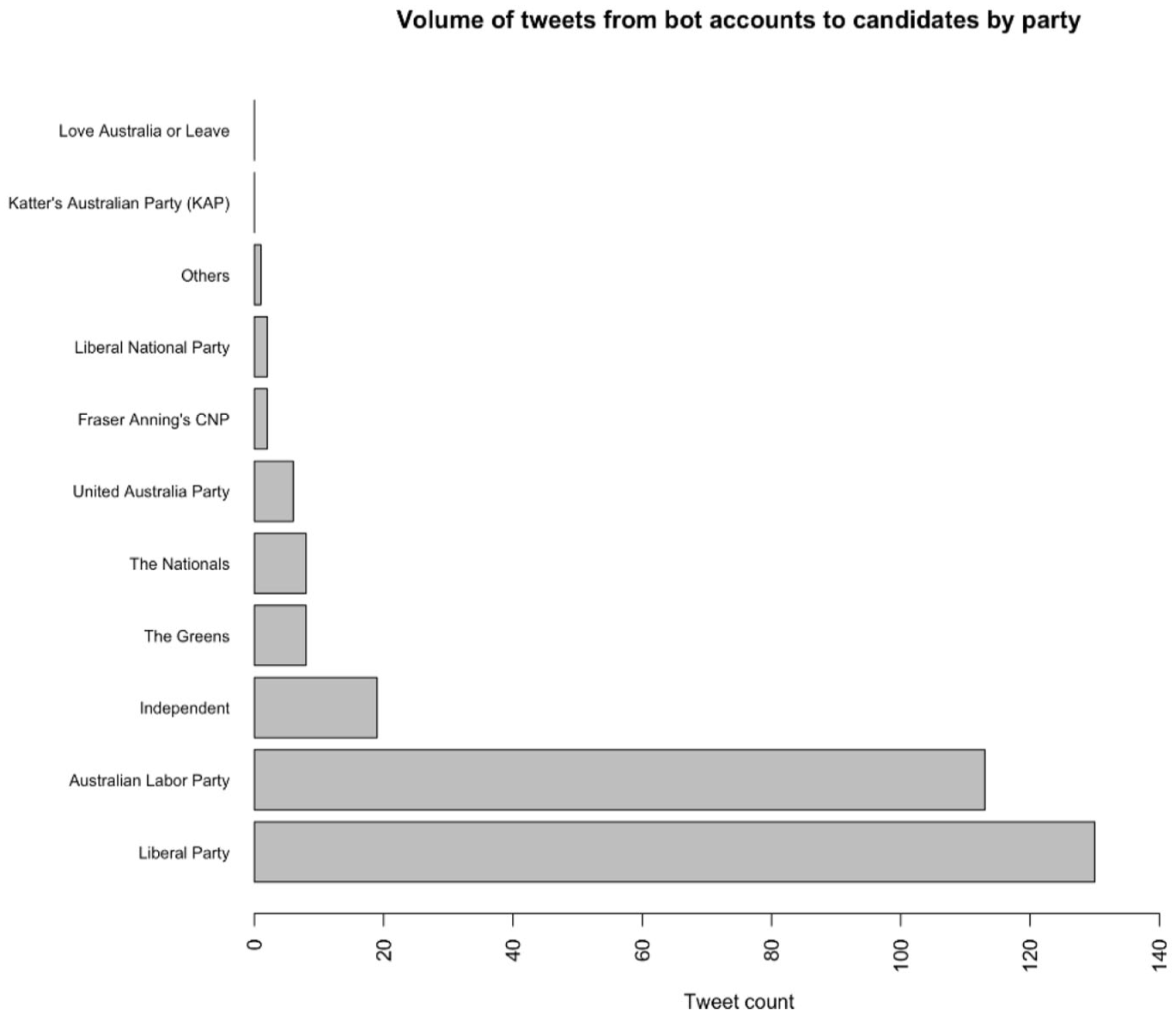
Number of bot-authored tweets directed at the candidates of each party, 22 April to 17 May 2019.
Overall, then, the number of bot-like accounts, their volume of tweeting, and their audience is so minuscule compared to accounts that present as human-operated that it appears extremely unlikely that bots would have substantially affected public debate about the election on Twitter. However, we note here that this does not rule out the presence of election-related activity from automated actors on platforms other than Twitter, activity not captured in our dataset, or bot accounts that were not detected by Botometer.
Discussion and Conclusion
Combining the findings from the three components of our analysis—interaction dynamics, thematic patterns, and bot detection—several key observations stand out. In part, these confirm and extend the findings of our analyses of Twitter campaigning efforts in previous Australian federal elections; at the same time, however, various specific features related to the particular context of the 2019 Australian federal election also emerge. In keeping with the longitudinal perspective of this special issue of Social Media + Society, we will particularly highlight these comparisons in the following discussion.
In the first place, as in 2013 and 2016, Labor candidates are the most enthusiastic tweeters overall, while Coalition candidates remain reluctant at best; this supports hypothesis H1, and may reflect a lingering perception of Twitter as no more than “electronic graffiti,” as Coalition PM Tony Abbott once put it (Snowden, 2015). Nonetheless, the greater volume of user interaction is directed toward Coalition candidates representing the incumbent government—this supports hypothesis H2, which, therefore, holds even in campaign years like 2019, when government candidates themselves are relatively reluctant and inactive Twitter users in comparison to their opposition challengers. Furthermore, this user attention is strongly centered on the two major party blocs’ candidates for the Prime Ministership—reflecting a shift to a more presidential style of campaigning even despite the underlying structures of Australia’s parliamentary system, where the make-up of the House of Representatives, which in turn elects the PM, is decided by 151 distinct local electoral contests.
Notably, and in substantial contrast to apparent patterns elsewhere, interference from bots played no significant part in the Australian election campaign, at least as far as our approach was able to observe: we find no evidence of bot-driven activities by domestic interest groups, nor any signs of foreign interference, and must conclude instead that the interactions we have observed are driven overwhelmingly by human actors. This means that hypothesis H6 is not supported, and refutes common perceptions that political opponents are now regularly utilizing bots as tools in their campaigning—but as the “death tax” case shows, it does not mean that the election was free from other disinformation campaigns. It is also possible that any bot campaigns that were attempted during the 2019 campaign operated in ways that did not generate a significant footprint in our dataset (e.g., by targeting election hashtags and keywords rather than candidate accounts).
Furthermore, we have shown that Twitter users provide substantially more endorsement and amplification, via retweeting, to opposition candidates than to members of the government; this supports hypothesis H3. The patterns we have observed in 2019 replicate those seen in 2016, but diverge from those found in 2013, when (in the wake of the Rudd–Gillard–Rudd leadership turmoil for Labor and with the unpopular Liberal leader Tony Abbott as alternative PM) neither of the major party blocs could mobilize significant retweeting support. Our observations from 2016 and 2019 thus appear to signal a return to some degree of normalcy after the unusual political constellation of 2013: rather than simply choosing the lesser of two evils without any enthusiasm, by endorsing their candidates through retweeting opposition supporters are once again showing some degree of trust that the other side of politics could do a better job than the incumbent government. Such renewed support is evident also in the eventual election results: while in 2013, the Coalition replaced the spent and fractured Labor government in a landslide, winning 90 of the 150 seats in the House of Representatives, the 2016 and 2019 election were considerably tighter affairs: in 2016, the Coalition won a one-seat majority of only 76 of 150 seats, and in 2019 it merely retained that narrow margin by winning 77 of now 151 seats.
However, although these narrow margins might give it some hope, Labor nonetheless failed to return to power at the federal level despite the limited popularity of the incumbent Coalition government: unlike the Coalition did in 2013, when voters finally gave up on the Rudd–Gillard–Rudd Labor party, Labor was unable to capitalize on the Coalition’s own internal divisions (which saw Abbott replaced by Turnbull, and Turnbull replaced by Morrison, since 2013) in the 2019 elections. While we acknowledge that Twitter and other social media platforms represent only one element of the overall election campaign, our analysis of the key patterns and themes in Twitter activity during the campaign provides some indications of key reasons for this failure to exploit the Coalition’s weaknesses.
Here it is evident that Twitter discussions about the governing Coalition were largely negative in tone: they highlighted key policy shortcomings, and in the case of the National Party focused very predominantly on one major allegation; of the major issues raised in interactions with its candidates, only the reduction of the national debt can be seen as a net positive for the Coalition. This largely supports hypothesis H4. By contrast, tweets directed at Labor, Greens, and Independent candidates mainly highlighted the positive aspects of their election platforms—with the singular but critical exception of the “death tax” that Labor was alleged to be planning. This partly supports hypothesis H5. It is obviously impossible to assess from our data alone how damaging to Labor’s election chances the disinformation campaign (which appeared on Twitter, in other social media platforms, and in online, broadcast, print, letterbox, and billboard advertising) turned out to be—but it is clear from contemporary news reporting that the allegation produced a substantial amount of media coverage, repeatedly forced the Labor leadership to explicitly deny the existence of “death tax” plans, and thus occupied valuable communication space during the campaign (Tran et al., 2019).
Labor’s decision to take this reactive response, and to ask (with limited success) the major social media platforms to take down this misleading information, rather than to proactively combat the “death tax” lie from the start, may have further exacerbated the problem: by contrast, as we have noted, when these claims resurfaced during the Queensland state election in October 2020, the incumbent Labor state government encouraged its candidates to forcefully call out the lie, which effectively neutralized the disinformation campaign (Smee, 2020). This change in strategy is foreshadowed in Labor’s internal review of its 2019 federal election campaign, which notes the inadequacy of its digital response:
However, it is too easy to blame Labor’s failure to win government on a single scare campaign; our data also reveal that, despite greater support on Twitter for opposition than government parties, Labor leader Bill Shorten, in particular, failed to attract the personal support (through retweets) that several other Labor figures generated; he even fell short of reaching the average retweet rate for Labor candidates. This supports a narrative of Shorten’s lack of personal appeal that persisted throughout the campaign; even Labor’s election review acknowledged that the “unpopular leader” was a significant factor in its defeat (Emerson & Weatherill, 2019: 25). In this, our observations from the Twitter data, therefore, align with broader patterns well beyond this platform.
If Shorten failed to fully cut through to the electorate (not just on Twitter, but across all of Labor’s campaigning efforts), however, the same is also true for much of the government’s campaign, which similarly received little endorsement from the electorate. Few of the government’s own campaigning topics are taken up strongly in ordinary users’ engagement with Coalition candidates; instead, tweets directed at these candidates are predominantly addressing the government’s problem areas. This, too, is a messaging failure: Twitter audiences, at least, appear to have been left unconvinced by the Coalition’s presentation of its successes in government. Furthermore, Coalition leaders and candidates receive far fewer retweets than their Labor challengers; only Greens and Independents attract both substantial retweeting and engagement that centers overwhelmingly on their own policy proposals.
In the end, then, to the extent that we are prepared to correlate our Twitter analysis with contemporary coverage of the wider campaign beyond Twitter, the positives and negatives for both major Australian party blocs that we have observed here appear to have largely canceled each other out: the 2019 election result mainly returned the status quo. On balance, the Coalition retained a precarious majority of 77 of 151 members, gaining only one seat (but in a parliament that was enlarged by that one seat in this election); Labor lost one seat, down from 69 to 68; and one more seat was won by an Independent candidate (increasing the total Independent and minor party representation in the House of Representatives from 5 to 6). This represents a far from enthusiastic endorsement of either major political bloc by the Australian electorate—after more than a decade of leadership turmoil on both sides of the House, support for both Labor and the Coalition remains qualified, and finely balanced, providing a space for Independents and other alternatives to flourish.
Overall, since Twitter first emerged as a campaign feature in the 2011 election, and certainly since we began to systematically track candidate accounts using our current methods in the 2013 election, the patterns of Twitter use by and Twitter engagement with party candidates have remained largely stable, then: even despite the considerable fluctuations in the Australian political landscape, and the substantial changes in national and international political contexts over these 10 years, our longitudinal analysis across the 2013, 2016, and 2019 elections indicates that Twitter has settled into a specific role in Australian electoral campaigning. Labor and Greens candidates remain substantially more enthusiastic users of Twitter, but overall voter engagement focuses on the incumbent government while retweets favor its challengers (except in the atypical 2013 election), whoever they are in each electoral cycle. Our more extensive analysis in the 2019 election further suggests that critical and emergent issues (from genuine scandals to unfounded allegations) attract substantially greater attention from Twitter users than official policy platforms, regardless of the topics addressed in the candidates’ own tweets—but also that bots and related automated activities play no role in generating such attention, while human-operated disinformation operations like the “death tax” scare campaign can affect public perceptions. But given the supercharged nature of the Australian electoral cycle, the next extension of this longitudinal analysis is already just around the corner: we intend to add to our long-term investigation of Twitter electioneering trends in Australia by repeating this analysis again for the coming federal election, expected to be called in late 2021 or early 2022.
Footnotes
Declaration of Conflicting Interests
The author(s) declared no potential conflicts of interest with respect to the research, authorship, and/or publication of this article.
Funding
The author(s) received no financial support for the research, authorship, and/or publication of this article.
Author Biographies
 , and he tweets at @snurb_dot_info.