



Abstract
In this article, we reconstruct the academic discourse surrounding social media and elections in an Italian context. We follow Neumayer and Rossi’s conceptualization of academic discourse concerning political protest and digital technology as constructed out of three components: (a) the social phenomena under investigation, (b) technological development, and (c) methods and techniques. In the context of social media and elections, these three components may be identified as (a) the research questions that researchers seek to answer, (b) the social media platforms and data used for the analysis, and (c) the methods adopted to analyze the data. While these three dimensions are deeply intertwined, we argue that, when analyzed independently, it is possible to better see both the longitudinal evolution of each dimension and their interdependencies.
The Need for a Longitudinal Perspective: Questions, Data, and Methods
Research into the relationship between digital media and political elections typically (and understandably) focuses on the most recent developments. Many studies aim either to understand how new platforms or technologies will influence political communication or to explain how such influence occurred while we were looking elsewhere. Focus on recent developments is not a bad thing, but it does risk researchers missing out on the longitudinal perspective. While attending to the risks posed by disinformation spreading on the next TikTok, we can easily forget the longer evolution of digital media, political practices, and the research that led us here. We believe that maintaining a longitudinal perspective is important for the academic discourse even when it aims to provide answers for pressing societal issues.
In this article, we reconstruct the academic discourse surrounding social media and elections in an Italian context. We follow Neumayer and Rossi’s (2016) conceptualization of academic discourse concerning political protest and digital technology as constructed out of three components: (a) the social phenomena under investigation, (b) technological development, and (c) methods and techniques. In the context of social media and elections, these three components may be identified as (a) the research questions that researchers seek to answer, (b) the social media platforms and data used for the analysis, and (c) the methods adopted to analyze the data. While these three dimensions are deeply intertwined, we argue that, when analyzed independently, it is possible to better see both the longitudinal evolution of each dimension and their interdependencies.
Disentangling the relationships between phenomena, social media platforms, and methods is useful for highlighting what changes as well as what remains stable in the academic discourse surrounding social media platforms and elections: Do we keep asking the same questions, just about different platforms? Does the introduction of new research methods prompt the asking of new research questions that had previously been impossible to study? Do new platforms (or new data accessibility) lead toward new methods?
We shed light on some of these questions by performing an in-depth longitudinal literature review that covers 8 years of research. We analyze each paper according to the three dimensions of data, methods, and research questions, aiming to build a longitudinal narrative.
We have applied this approach to academic discourse focusing on the Italian context (not necessarily developed in Italy or in the Italian language) not only because of our personal experience and cultural proximity but also because we believe that understanding of the Italian context can contribute to the broader international perspective. While rarely associated with innovation in digital technologies, Italy has often been a laboratory for political experimentation (Hobsbawm, 1977). The past 30 years of Italian experience have demonstrated the challenges that emerge when media technologies and politics combine. In this article, we do not focus on the results of the papers we analyze; this is not a meta-analysis, we focus instead on the academic discourse underlying those papers, on its combination of questions, methods, and data.
In summary, we will address the following research question: In the context of the research on social media and political election, how has the focus on research questions, digital data, and methods evolved in the period 2013–2020?
Italy: From a Mass to Social Media Republic
At the end of the first decade of the 2000s, Italy was, if possible, even less politically stable than usual. Starting from 2010, the Berlusconi government had been fighting internal scandals and external pressures due to the country’s economic fragility. The climax came in November 2011 when, under extreme pressure from President of the Republic Giorgio Napolitano, Silvio Berlusconi resigned after Italy’s public debt reached a critical level. The new government, led by former EU Commissioner Mario Monti, ended a political era that had begun in 2001 with Berlusconi’s second (and largest) electoral victory.
Silvio Berlusconi was more than just a long-lived political leader on the volatile Italian scene. He was among the world’s most prominent cases of the problematic relationship between media and the political system (Hine, 2001; Statham, 1996). Berlusconi’s Mediaset media empire was and still is pervasive in Italy, controlling publishing companies, three national TV stations, national and local newspapers, and magazines. When one adds this to the considerable influence that the Italian government has on the public broadcasting service, it becomes clear that Berlusconi directly or indirectly controlled most of the Italian media system and public discourse. Although Silvio Berlusconi’s conflicts of interest were staggering, they were also deeply rooted in traditional mass media. The core of Berlusconi’s media empire was built in the 1980s around a group of local TV stations that he grew into national relevance. The “satellites” of the empire were newspapers, magazines, and several other types of media outlets that were acquired over the decades. Digital media were notably missing, and the Mediaset corporation remains largely focused on mass media even today. With the mass media space mostly dominated by Berlusconi’s center-right coalition (there were notable exceptions over the years that we will not cover here), the internet became the obvious platform on which to initially gather and organize political dissent and then present a political alternative at a later stage.
Among the many political experiments that emerged during the period of Berlusconi governments, the most relevant one, which was to play a significant role in Italy’s political future, was undoubtedly the Movimento 5 Stelle (5 Stars Movement, hereafter 5SM), spearheaded by comedian-turned-politician Beppe Grillo. Grillo’s career is deeply intertwined with Italian media history. In 1987, when he was already a well-known stand-up comedian, Grillo appeared on the popular Saturday night primetime show “Fantastico 7,” where he attacked the Italian Socialist party and then-Prime Minister Bettino Craxi with a ferocious joke: In reference to Craxi’s recent trip to China, Grillo asked: “If Chinese people are all socialists, who do they steal from?” The attack referred not to the socialists in China but was instead a broadside against the corrupt Italian political system, embodied by the Socialist and Christian Democratic parties, which led the governing coalition.
This joke rendered Grillo persona non grata on state TV for a decade. When he finally returned, he hosted a successful one-man show that generated enormous controversy and marked Beppe Grillo’s final appearance on Italian public television. The role of outcast suited the comedian, who had built a successful career with sold-out live shows while cementing his reputation as an independent voice, capable of standing up to political power. When the barrier between comedian and anti-corruption activist became thin, his blog emerged as a major source of satire and counter-information. The blog (www.beppegrillo.it) achieved astounding success, ranking among the top-10 most visited websites in the world in 2008. A key figure for understanding Grillo’s evolution from a comedian into a politician and the creation of his political movement is Gianroberto Casaleggio. Casaleggio was co-founder of the internet publishing company “Casaleggio Associati,” which drove much of Italy’s digital strategy and encouraged belief in the disruptive power of internet-based communication, envisioning a new type of political movement (Natale & Ballatore, 2014).
The blog format perfectly fitted Beppe Grillo’s narrative of the comedian banned from public television who had established his own, free new media space. Grillo’s popularity and activism reached a pinnacle on 8 September 2007, when he organized the first “Vaffanculo Day” (Fuck-off Day) to collect the signatures required for a popular initiative bill aimed at removing corruption and malfeasance from parliament. The event was an enormous success and resulted in the collection of over 340,000 signatures, with millions of estimated participants. This was followed by a second “Vaffanculo Day,” also known as V2 Day, on 25 April 2008. If the first V Day was aimed directly against politics, V2 Day was focused on newspapers and the traditional press. The objective was to collect signatures to organize referenda to abrogate laws on public financing to newspapers. It was once again an enormous success in terms of collected signatures and mobilized people. This burgeoning political participation allowed the creation of a political movement (5SM rejects the term “party”) on 9 September 2009, which subsequently participated with growing success in local and regional elections. In 2013, running for the first time in a national election, 5SM won the second-highest number of votes, blocking the formation of a politically homogeneous government and forcing the creation of a “grand coalition” that fundamentally changed the national political landscape. 5SM, a newborn political actor with no history, with an ultra-light organizational structure, and with no traditional media power, had already altered Italian politics without even being part of the government. Just 5 years later, 5SM found itself in government.
If we consider the above story from the perspective of the relationship between media and political elections, it is clear that 2013 was not just the year in which a new type of political actor entered the arena; it was also a point of fracture between a pre-2013 world—when TV and newspapers were perceived as the “media that matter” to reach the vast majority of the voters—and a post-2013 world in which 5SM—the “platform party” (Gerbaudo, 2019)—demonstrated the power of social media and digital communication. While it would be oversimplistic to suggest a techno-deterministic reading of 5SM’s electoral success, these events presented a serious challenge to mainstream understandings of the preconditions for a successful political project. 2013 was the start of a new era of Italian political communication, with 5SM leading and all the remaining parties following behind. From this perspective, 2013 not only anticipated the start of what is journalistically known as the “Third Republic,” with the forcing into existence of a bipartisan government due to 5SM’s unexpected success. 2013 highlighted the decline of Berlusconi’s center-right political proposal, supported by his TV-centric media conglomerate, and the rise of social media as the new space for political campaigning, communication, and opinion formation. While the years between 2010 and 2013 were, in terms of the relationship between Italian politics and social media, clearly oriented toward media’s past, 2013 leapfrogged into media’s future.
From a structural perspective, 2013 was not a time of immense change in the digitalization of Italian society. In 2013, Italy was near the bottom of the European rankings for daily internet users (56% of the population) and was still below the EU28 average in 2019 (73% of the population) (Eurostat, 2020). Despite this relatively limited internet penetration, by 2019, online sources for news consumption rivaled the long-standing monopoly of TV, and Facebook had become a source of news for 54% of population (Newman et al., 2019). This apparent contradiction notwithstanding, 2013 marked the start of a new political movement with a populist ideology that put the internet and participatory democracy at the center of its program, a strategy that led to rapid electoral success (Vaccari, 2013). Italy made visible early on the relationship between social media platforms and populist movements, which would grow in importance in other countries and would be at the heart of much of the academic research in the years to come.
Looking back on 2013, it is fair to say that this was an intense time not just in terms of politics but also in terms of research: Researchers of Italian politics, media, and digital media were confronted with a new set of critical questions to be answered, necessitating the expansion and adaptation of existing research practices to address new types of data and, eventually, methods. This is the process we describe below.
Data and Methods
Inspired by Neumayer and Rossi (2016), we reported a decade of research through the lens of academic discourse. This choice is reflected in the data sources we analyze (academic articles), in the intrinsic criterion of relevance applied to the data (academic citation), and in the conceptualization of the phenomenon at hand (the relationship between social media and elections). Neumayer and Rossi (2016) regard the academic discourse concerning technology and political action as composed of: (a) the social phenomena under investigation, (b) technological development, and (c) methods and techniques. We apply a similar approach within the more specific domain of the relationship between social media and elections by conceptualizing the academic discourse surrounding it as composed of: (a) research questions considered relevant by researchers, (b) methods and techniques applied to data collected from the selected platforms, and (c) social media platforms perceived as worth studying. It is worth noting that because we limit our research to academic literature, and because we use number of citations as a relevance criterion to select our data, we not only observe how researchers have “combined” platforms, methods, and research questions but also observe which specific combinations were better received within academia.
We created the dataset in the following manner: first, we selected a set of keywords related to social media, elections, and Italy and performed a literature search on the academic databases Scopus and Web of Science (queried through the official websites) and Google Scholar (queried through the “Publish or Perish” software). We used the following English-language query: “(“Social media” OR “Social Network” OR Facebook OR Twitter OR Instagram OR Snapchat OR TikTok) AND (election* AND Ital*).” The Italian-language query was identical but composed of Italian words where appropriate: “(“Social media” OR “Social Network” OR Facebook OR Twitter OR Instagram OR Snapchat OR TikTok) AND (elezion* AND Itali*).”
Of the results, we kept the first 2,000 contributions (1,000 in Italian and 1,000 in English) published from 2013—when the 5 Star Movement (5SM) “platform-party” (Gerbaudo, 2019) achieved its first electoral success—until and including 2020. After having de-duplicated the retrieved documents, we read the collected dataset to exclude irrelevant content. Finally, we selected the 10 most-cited papers for each year, ending up with 80 contributions, cited around 5,000 times overall and published in 49 different academic sources in 8 years. The three authors performed content analysis based on a coding scheme. Bearing in mind the small number of papers, no formal intercoder agreement measure was calculated, but several independent quality checks have been made on the dataset to ensure validity. Figure 1 shows the most recurrent academic sources that published the most-cited papers in our dataset. The list of journals in our dataset provides two insights. First, the dominant academic area is, by far, new media and communication studies, with two highly regarded journals in the field (New Media & Society and Information, Communication & Society) ranked in the first two positions. Beyond the area of new media and communications studies, there is a relevant presence of academic journals focused on political science and political communication, and then a small presence of interdisciplinary venues and open access archives. The second aspect worth noticing is that, out of the 14 academic sources with 2 or more papers, there are just 2 Italian journals, Comunicazione Politica and Problemi dell’informazione. While this can easily be affected by having used the 10 most-cited articles within each year of publication, it also shows an international relevance of research mainly or partially focused on the Italian case. The overall picture is one in which, on one hand, despite the perceived centrality of the topic, the relationship between social media and political elections remained a somewhat discipline-specific concern, at least in the Italian context. On the other hand, it is interesting to observe how Italy proved to be a case of international interest, both by being used in comparative research and being a case study capable of forming the crux of articles published in journals with an international audience (Figure 2).

Academic sources with two or more papers in the dataset of most-cited contributions.

Studies focusing solely on Italy versus studies using Italy in a comparative analysis.
Before we present the results, the unavoidable temporal delay between the time when a research is done and the year of publication should be noticed. To minimize this temporal distance, we used, whenever possible, the year of the online first publication that represents the first official timestamp. Nevertheless, this possible delay exists and the readers should take it into account.
Overview of Selected Papers
A first look at the dataset aimed to assess the national or cross-national focus of the studies, the type of elections under consideration, and the main topics of the paper. The analysis showed that a large proportion of studies in the dataset were conducted within national boundaries (69%) and also that a considerable number of papers (31%) framed national cases in a wider cross-national context, adopting a comparative approach. Figure 3 shows that between 2013 and 2015 attention focused on national case studies, especially because of the recent 2013 general elections. A peak in cross-national studies occurred between 2016 and 2018, when the worldwide rise in populism and problematic information issues received wide attention. The cross-national approach was also characterized by a greater reliance on surveys as the main data collection method, which is included in 50% of publications; in comparison, just 14% of national studies conducted between 2016 and 2018 used surveys. After 2018, focus moves back to the national level, with most attention paid to the 2018 national elections, sometimes analyzed alongside the European elections held the following year.

Contributions by period of observation (proportions).
Bearing in mind the period of observation (Figure 3), most studies in our dataset focused on general elections (41%), while European elections were far less present (17%), consistent with the lower degree of attention traditionally accorded to such “second-order” elections (Reif & Schmitt, 1980). More niche elections—in terms of territorial relevance (e.g., local elections, 7%), socio-political relevance (e.g., primaries, 2%), or political topic (e.g., referenda, 4%)—were even more neglected. Other studies treated elections and political communication from a more general perspective, without placing exclusive emphasis on specific elections. The distribution of analyses across years seems to partly follow election cycles, without noticeable peaks.
When analyzing the main topics of the selected papers, we performed an unsupervised hierarchical lexical clustering and correspondence analysis (a common exploratory text mining approach) to acquire an initial understanding of the content of the papers. This analysis (Figure 4) led to identification of four main clusters of papers organized along two main dimensions (i.e., the axes of the plot, the polarities of which generally distinguish between clusters in accordance with their degree of difference), explaining over 70% (39.2% and 33.3% respectively) of variability in the data. While outputs of automated classification techniques inevitably include some noise, the analysis made possible an overall interpretation of the dataset content. Looking at the cartesian plan, the first dimension (horizontal axis) contraposes studies on 5SM on the left (or negative) side (Cluster 1, including 17 contributions), with studies on problematic aspects of online political communication, such as misinformation and disinformation, polarization, echo chambers, incidental exposure, bots, and fake accounts on the right (or positive) side (Cluster 4, 20 contributions) of the plot. Halfway between these sets of papers and closer to the center lies Cluster 2 (19 contributions), which emphasize populism and have overlapping boundaries with the other clusters. The second dimension (vertical axis) contraposes studies on emerging political communication phenomena on the top (or positive) side with studies on more traditional political communication regarding elections and campaign communication on the bottom (or negative) side of the plot.
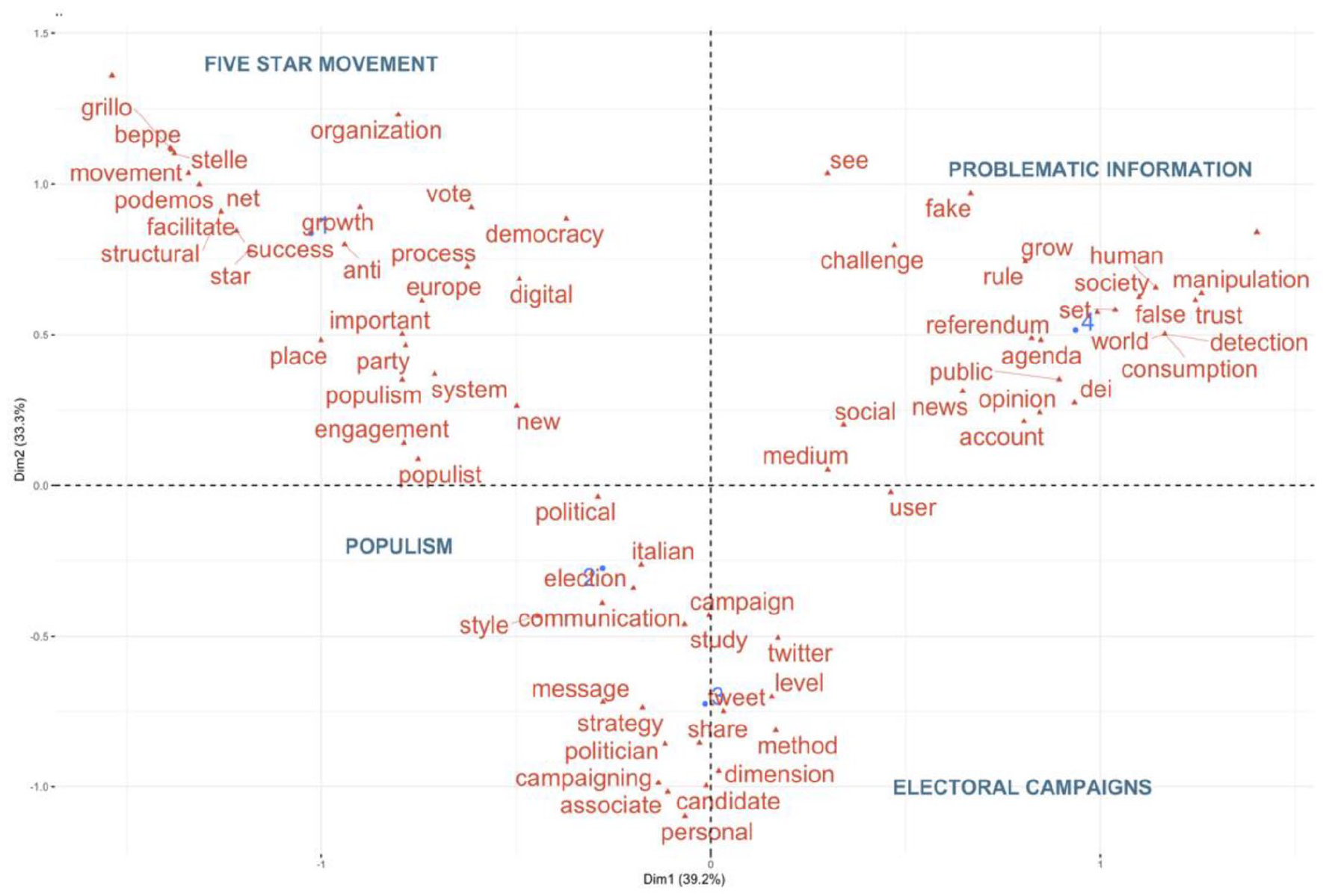
Correspondence analysis of lexical clusters (top lemmas by contribution).
Ten Years of Questions
Following a general overview of the content of the dataset, we will now dive into a longitudinal reconstruction of the three aspects of research questions, data, and methods. The goal is not to merely report chronological lists but also to highlight the longitudinal evolution and, hopefully, the connections between various phases within each dimension.
In terms of research questions asked by the researchers working on social media and elections, our longitudinal analysis begins at a point when focus remained on how digital technologies and social media are having a more generally transformative effect on the relationship between politicians and voters. Considerable focus was placed on data collected from the popular social media platforms Twitter and Facebook, widely used by politicians to reach members of the public (Figure 5), and researchers investigated how candidates or political parties could use these new opportunities to communicate with potential voters (Hermans & Vergeer, 2013; Vergeer et al., 2013). This line of research was developed in conceptual continuity with reflections upon the growing personalization of political communication (Cassetta & Cobianchi, 2013) that had been dominant for several years. Although the focus on the new opportunities that social media offered for personalized strategies was part of a global research trend (see, for example, Larsson & Moe, 2012), in the Italian context this meshes with reflections upon the “post-Berlusconi” era. Berlusconi was, according to many (Campus, 2010; Fabbrini, 2013; Sampugnaro, 2013), a prime example of personalization of political communication in the Italian context. Parallel to this focus on the future of political communication, we see initial attention to 5SM, which had already achieved remarkable results in the 2012 local elections, aimed at understanding its organizational structure and its relationship with digital technologies (De Rosa, 2013).

Contributions per data source used.
Moving forward in our longitudinal analysis, we observe how, in 2014, researchers focused more clearly on 5SM, investigating whether it should be considered as a unique and irreplicable experiment or as indicative of new understandings of political action and political communication. Several authors (Corbetta & Vignati, 2014; De Wilde et al., 2014) observed how 5SM’s strategic use of the internet had enabled it to occupy portions of the public sphere that had been left empty by other parties. From this perspective, it is interesting to observe how 5SM’s success relates to the movement’s ability to give voice to Italy’s growing anti-European sentiment. This contrasted with the mainstream perception of Italy as among the most Europhile countries in Europe.
2015 represented the peak of the research phase that had conceptually begun in 2013 with 5SM’s surprise electoral success. Two lines of research began emerging as a means of studying 5SM’s success, which few traditional pollsters hard predicted. On one hand, starting in 2014, there was a theoretical effort aimed at understanding the new structure of political action and the public sphere. On the other hand, prompted by the perceived failures of traditional methods used to research and represent public opinion, researchers started exploring the possibility of using social media data to better understand public opinion and, ultimately, predict election results. Although this effort did not prove particularly successful (Rossi & Orefice, 2015), it is interesting to frame this line of research as emerging out of both the availability of large amounts of digital data and the perceived inability of traditional polls to represent the public opinion. It is also interesting to consider the connections between the new theoretical efforts and the new methodological efforts.
In 2016, these still-emergent lines of research underwent significant development. While social media data, represented by Twitter data, remained central to the research questions investigated by researchers, the conceptualization of this social media data was changing. Whereas social media data had previously been used as a proxy for the population, researchers now began using social media data to investigate specific phenomena or subgroups of the population. Here, we observe a short-lived interest in practices of social TV (Marchetti & Ceccobelli, 2016), which soon expanded its scope to investigate the more general relationship between social media and mass media agendas (Ceron et al., 2015). 2016 also marked the emergence of topics that would come to dominate the research agenda in the coming years: echo chambers. While many of the labels that would later become settled were at this stage still being negotiated, it is interesting to note a conceptual connection between research that moved beyond naïve assumptions of social media as a large and reliable proxy for society and the formation of a very different metaphor for social media as a network of disconnected communities, trapped within their own echo chambers. This new guiding idea is observable in some of the problems investigated in the selected papers, such as accidental news exposure (Guidetti et al., 2016; Vaccari et al., 2016; Valeriani & Vaccari, 2016).
The research activity published in 2017 suggests a consolidation of the research into a set of interconnected trajectories that are largely still at the center of today’s agenda. Guided by both national and international events, populism emerged as a central keyword (Ernst et al., 2017). Researchers sought to define and understand populist political communication (Bracciale & Martella, 2017), populist political strategies (Mazzoleni & Bracciale, 2018), and the interplay between populism and social media platforms (Bickerton & Accetti, 2018; Bobba, 2019; Ernst, Blassnig, et al., 2019). It is interesting to observe how the focus on populism serves as an extension of many previous lines of research: from the new forms of political protest (Chiaramonte et al., 2018; Mosca & Quaranta, 2017) to the ability of populist movements to set the agenda (Alonso-Muñoz & Casero-Ripollés, 2018). Populism in its various forms dominates the publications in both 2018 and 2019, with surprisingly few papers focusing on fake news (Bradshaw & Howard, 2018; Ferrari, 2018) and just a small amount more on polarization (Belcastro et al., 2019; Giglietto et al., 2019; Marozzo & Bessi, 2018), topics that received substantial research in other national contexts. It is not that these issues were ignored or deemed irrelevant in the Italian context. Instead of being seen as distinct issues, unsupported claims and emotional and divisive language were framed as unavoidable parts of the populist style of communication (Macagno, 2019). As a result, research into the roles of social media platforms in the Italian context differs somewhat from such research elsewhere. In the Italian context, the underlying research question focuses on how social media platforms can facilitate (or be functional to) a populist style of communication (Ernst, Blassnig, et al., 2019; Ernst, Esser, et al., 2019).
It is only in 2020, when we observe research based on 2018 election data, that we see a clear focus on fake news (Cantarella et al., 2020), disinformation (Pierri et al., 2020), and media manipulation (Giglietto et al., 2020).
Ten Years of Platforms
Social media platforms represent an unprecedented source of data in terms of opportunities to observe a wide range of phenomena: political opinions of individual members of the public, political actors’ campaigns, media outlets’ agenda settings, and users’ news consumption. These opportunities encouraged researchers to find new techniques to gather and analyze social media data, focusing their attention on technical challenges in terms of methodological approaches as well as solutions to the limitations imposed by social media platforms. At an international level, these data-intensive research practices gave rise to debate concerning ethical implications in terms of users’ privacy and even safety. In Italy, this debate seems to be either secondary when not entirely absent.
A large proportion of the corpus of articles we analyzed focuses on studying communication strategies of political actors, leaders, or parties during election campaigns. During the first half of the decade, some studies are based on web platforms, including both webpages (Hermans & Vergeer, 2013; Vergeer et al., 2013) and personal blogs (De Wilde et al., 2014). This line of research continued when researchers moved from blogs to social media: focus was often on analyzing political actors’ profiles/pages and the content they have generated (e.g., Ernst et al., 2017; Vaccari & Valeriani, 2015). Several studies nevertheless focused on analyzing the social media behaviors of members of the public in relation to measures of political discussion and participation (e.g., Dutton et al., 2017; Guidetti et al., 2016).
Although 5SM received considerable attention due to its status as the first Italian political actor to exploit digital media’s propaganda potential, articles focused on 5SM tended not to be based on analyzing its communication strategy on specific social media platforms; especially during the first half of the decade, they generally instead referred ill-defined innovative “cyber” characteristics of the “platform” party (e.g., Bickerton & Accetti, 2018; De Rosa, 2013).
Focusing more specifically on social media, most of the analyzed studies drew upon Twitter and Facebook data, with Twitter gaining the lion’s share. This preference was generally related to the easier access to data collection facilitated by the platform APIs and by the inherently simpler nature of Twitter data. This tendency can also be connected to a bias in public opinion, which has long seen Twitter as a platform for political information and public debate. The use of Twitter as a platform for measuring public opinion during campaigns is partially reflected in research concerning social media and Italian elections. Indeed, a few studies between 2013 and 2015 focused on analyzing the relationship between election outcomes and Twitter users’ sentiments during the election campaign to assess the predictive role of user-generated content on the platform (Ceron et al., 2015; Ceron & D’Adda, 2013; Coletto et al., 2015).
In terms of data collection, most of the studies use computational techniques through applications based on Twitter’s API. In these studies, authors generally gathered real-time tweets using keywords and hashtags to monitor topics at the center of public debate (e.g., Marchetti & Ceccobelli, 2016) or to measure users’ sentiments (e.g., Caldarelli et al., 2014). Part of the remaining articles were based on survey data.
The second popular social media platform for case study was Facebook. Observing Figure 6, we can note that Facebook became a constant source of data from 2016. Despite the so-called APIcalypse that limited researchers’ potential for gathering data from Facebook (Bruns, 2019), the platform gained a prominent role in research about social media and elections as a main driver of online populism and extremism. In contrast to Twitter, relatively few studies were based on computational data collection (e.g., Del Vicario et al., 2017). Some studies employed an ethnographic approach to analyzing political actors’ or institutions’ Facebook timelines (e.g., Lovari, 2016). More recently, it is possible to find research exploiting new tools recently made available by Facebook for journalistic and research purposes (e.g., Giglietto et al., 2020), which allow researchers to apply quantitative techniques to larger amount of data. Finally, others used data retrieved by national online surveys, such as those based on ITANES data (e.g., Barisione et al., 2014).

Contributions by approach (proportions).
While research into other social media platforms, such as YouTube and Instagram, was relatively uncommon internationally, it was completely absent in the Italian context. When these platforms were part of the research, the data were usually collected through a survey. Focus on other social media, such as YouTube or Mobile Instant Messaging Services (MIMS), could be found in studies that compared leaders’ or parties’ communication strategies or users’ behavior on multiple platforms. For instance, Fletcher and Nielsen (2018) used survey data to analyze incidental exposure in high-choice media environments while Valeriani and Vaccari (2018) analyzed data gathered through a comparative survey into how users deploy MIMS to discuss politics. In general, we note a lack of analyses on popular social media platforms that are not considered “fitting” for online political debate or that address a younger audience, such as Instagram (which has been studied in other national contexts) (Bossetta, 2018; Ekman & Widholm, 2017).
Ten Years of Methods
Methodological choices have a major impact on the types of data that can be managed and analyzed and the types of questions that can be answered. For instance, analysis of digital traces, such as those left by social media users, can require computationally intensive approaches. These allow researchers to observe spontaneously occurring behaviors, but their observational nature produces certain limitations. Surveys allow researchers to interview digital users but rely upon a less natural setting. Quantitative, deductive research designs make it possible to test theoretically grounded hypotheses, while qualitative studies could favor the development of innovative concepts and theoretical interpretations. All methodologies have their strengths and weaknesses, and the methodological choices traditionally adopted in a field of study influence that field’s development (Neumayer & Rossi, 2016). In our case, methods adopted by the sample of studies have been critically assessed with reference to two main aspects: (1) the overall methodological approach (adopting the traditional distinction between qualitative and quantitative studies but also including theoretical analysis and more specific types of contributions, such as reviews) and (2) the data analysis techniques employed to answer research questions.
Quantitative methods were by far the most widespread approach (Figure 6) during the research period (71%). Theoretical papers are the second most frequent category (18%). They were mostly published between 2013 and 2015 and often aimed to analyze and understand characteristics of 5SM and the reasons for its political success.
Data analysis approaches (Figure 7) primarily revolved around traditional and well-known statistical techniques, such as statistical tests of hypothesis and regression analysis (frequently adopted for survey-based studies), while fewer studies employed manual coding procedures (e.g., Mascheroni & Mattoni, 2013; Mazzoleni & Bracciale, 2018). Simpler exploratory statistical techniques, such as frequency analysis, were often used, and it is sometimes possible to encounter multivariate exploratory analysis such as Multiple Correspondence Analysis (e.g., Bracciale & Martella, 2017) and dimensionality reduction approaches such as Factor Analysis (e.g., Vergeer et al., 2013). Other data mining techniques are rarer. As far as computational methods are concerned, text mining was implemented mainly though machine learning algorithms for supervised classification of textual content, often to measure the “sentiment” of messages published on social media (e.g., Ceron et al., 2014), while social network analysis (e.g., Colleoni et al., 2014) and more complex analysis employing articulated and heterogeneous data analysis approaches were less frequent (e.g., Marozzo & Bessi, 2018). Approaches relying on time series analysis were relatively infrequent. There was thus a tendency to rely on traditional political science approaches, such as surveys, with little methodological innovation until the final years of the study period, when computational techniques, such as natural language processing and social network analysis, gained ground. The paucity of qualitative studies, which could assist in the development of new categories of analysis and grounded, data-driven theories, is also noteworthy.

Contributions by data analysis approaches (proportions). Each study can use more than one data analysis technique.
Social Media and Elections: A Longitudinal Perspective
Having observed the evolution of research questions, platforms of interest, and methods for 8 years of research allows us to draw an overall picture of the Italian context. This will be built upon all three aspects under consideration and will highlight interconnections between them.
While nearly 10 years of research unavoidably includes several different trends and dynamics, we find three main phases, which are summarized in Table 1. Each phase can be described in terms of general research questions, collected data, or methods adopted for analysis. Although each dimension can tell part of the story, we will now attempt to analyze the overarching emerging story.
Overview of the Temporal Evolution.

2013–2014: A Time of Campaigning
Phase I was clearly shaped by the emergence of 5SM: a new and unexpected movement that was scarcely classifiable in traditional political terms. It is fair to say that 5SM, a self-branded internet-centric movement, forced research regarding Italian political dynamics out of the mass media-centricism of the 2000s and into a space dominated by digital platforms and social media. Despite the later emergence of 5SM as a prime example of a populist movement, this first phase of research focused on the organizational structure of the “platform party” (Gerbaudo, 2019) and its relationship with the (then-dominant) paradigm of “personalization of politics” (Cassetta & Cobianchi, 2013). Over the course of 2013–2014, we find the closing of a research phase that had focused on how individual politicians or political parties used online communication to reach voters. This focus on “personal uses” is reflected in the platforms used for the data collection: blogs or politicians’ personal pages on social media receive little attention beyond this phase. It is important to highlight that, even when the data platform remains the same (e.g., social media such as Twitter and Facebook are well represented in this phase), focus frequently rests on personal pages/accounts in the social media rather than use of social media to study the public conversations.
From a methodological perspective, this phase was characterized by the adoption of exploratory analysis as well as statistical methods widely used in political science and in the study of voting dynamics. It is interesting to observe the large number of theoretical papers in this phase. These papers were building theoretical foundations for understanding the aforementioned revolution introduced by 5SM and its hybrid nature as an internet-centric populist party. Following these reflections and driven by 5SM’s unpredicted success at the 2013 local elections, questions regarding the observability of this kind of political movement came to the fore. It is after this phase that social media emerged as a fully legitimate data source for observing and describing social dynamics that traditional approaches had failed to grasp.
2015–2017: Focus on Election Campaigning
From a research perspective, Phase II (2015–2017) involved the rapid adoption of social media data (Twitter) for the study of a transformed public sphere (Bruns & Highfield, 2015; Fuchs, 2014). With the benefit of hindsight, it is interesting to see how quickly research moved from using social media as a big data proxy for the whole of society (Del Vicario et al., 2016) to more nuanced perspectives that sought to frame social media as part of a larger and more complex media ecosystem (Del Vicaro et al., 2017; Giglietto et al., 2019; Iannelli & Giglietto, 2015; Vaccari et al., 2016). This social media turn was clearly reflected in the research methods as well as in the data used for research, with Twitter becoming the most-used data source in our sample for 2017. While the research in the Italian context did not yet fully embrace computational methods, research in the second phase was characterized by a quantitative turn that led to an absence of qualitative methods-based papers in our sample. More traditional statistical methods were dominant, but computational methods were slowly growing in popularity, amounting by the end of the phase to 25% of papers in our sample. It is possible to see Phase II as empirical and methodological consolidation of the research ideas and theoretical developments that had been emerging in Phase I. From this perspective, it is interesting to observe the limited degree of theoretical production, as though the theories produced in the previous phase now simply needed to be tested empirically. Had we not mapped out the papers in terms of questions, platforms, and methods, all that would be visible would be that Phase I featured numerous highly cited theoretical papers and that these were absent from Phase II. It is only by considering the various aspects of the papers in tandem that the nuances become clear.
2018–2020: A New Landscape
Phase III (2018–2020) shows a return of older features as well as the consolidation of new dynamics. In terms of research questions, the paper refocused their interest on the issue of populism, but especially after 2019, this focus was coupled with parallel issues that emerged in the international debate, such as fake news (Cantarella et al., 2020) and disinformation (Pierri, Antoni & Ceri, 2020). 2018 saw a slight increase in theoretical papers, characterized by a focus on populism and its international dimensions (Bickerton & Accetti, 2018; Chiaramonte et al., 2018). In Phase III, particularly after 2018, Twitter and Facebook were the dominant data sources, and research methods were overwhelmingly quantitative in nature. Within this perspective, it is interesting to observe how the restrictions to social media data access that were put in place in the wake of the Cambridge Analytica scandal (Bruns, 2019; Puschmann, 2019) did not slow down the adoption of computational methods based on social media data; in fact, computational approaches became dominant in the final part of this phase.
2013–2020: Social Media, Italian Elections, and the Rest of the World
The overall picture emerging from analysis of the three phases shows that, in under 10 years, research concerning social media and elections underwent significant changes in terms of research questions (from a focus on the personalization of politics to the emergence of fake news and populism), data sources (from national survey data to social media data), and methods (from statistical analysis to combinations of computational methods). The emergence of a new type of political actor (internet-centric populists) produced a flurry of theoretical production that was then followed by a phase of empirical research. This new type of political actor furthermore induced researchers to explore new data sources to fully understand its voters.
While most of this transformation can be observed around the world and is not uniquely Italian, the timeline suggests that Italy anticipated the global trend with regard to the research questions. International academic attention to the issue of populism, its relationship with social media, and the threat it poses to contemporary democracies became clearly visible after 2016 when Donald J. Trump was elected president of the United States and after the outcome of the Brexit referendum. Italy’s “Trump” moment had come a few years earlier, demonstrating yet again that it is what Hobsbawm (1977) termed a laboratory for political innovation.
Footnotes
Declaration of Conflicting Interests
The author(s) declared no potential conflicts of interest with respect to the research, authorship, and/or publication of this article.
Funding
The author(s) received no financial support for the research, authorship, and/or publication of this article.
