




Abstract
The ability of social media users to express themselves online should be influential for opinion formation, including potential polarization. Still, little is known about how expression interacts with users’ psychological predispositions, especially for controversial topics. The potential for expression to relate to support for social media-based racial justice movements, which could also be affected by underlying feelings of racial resentment, is particularly interesting. We apply the Differential Susceptibility to Media Effects Model (DSMM) to the study of the relationship between social media expression and issue polarization regarding Black Lives Matter. In a survey of social media users conducted during the 2016 U.S. presidential election, we find that racial resentment moderates the relationship between social media expression and support for racial justice movements. Among low-resentment social media users, more frequent expression was associated with less support for Black Lives Matter. In addition, low- versus high-resentment users who expressed themselves on social media more frequently were more polarized in their support for All Lives Matter but less polarized in their support for Black Lives Matter. In line with the DSMM, our findings highlight that users’ psychological predispositions must be taken into account when determining how social media expression relates to issue polarization.
The potential for social media sites, such as Facebook and Twitter, to influence social movements (e.g., #MeToo, #BlackLivesMatter) has been critical (Jackson et al., 2020; Mundt et al., 2018). Not only can social media expose users to a wealth of information and perspectives, but users can also use social media to express themselves by sharing and commenting on the posts they encounter. Users may share and comment on social media content that may be consistent or inconsistent with their own views on an issue. Likewise, expression plays a central role in opinion formation. Thus, social media expression should be related to users’ attitudes regarding issues they are likely to encounter online. Still, whether expression frequency is related to greater or lesser opinion polarization is not yet well understood.
The current study applies the Differential Susceptibility to Media Effects Model (DSMM; Valkenburg & Peter, 2013) to examine the relationship between social media expression and the degree of issue polarization. According to the DSMM, effects of media use are conditional, contingent on differential-susceptibility variables (e.g., psychological attitudes) and media response states (e.g., cognitive elaboration). Thus, media use may not have the same relationship with relevant outcomes, depending on various factors related to the specific media being used, predispositions of the user, and the user’s cognitive responses to media content. We examine media use in the form of social media expression: sharing or commenting on social media content. Scholars have called for research to elaborate on mass self-communication and expression effects within computer-mediated communication (CMC) contexts such as social media (Valkenburg et al., 2016). The benefits of expression have been established within the extant literature (Gil de Zúñiga et al., 2013, 2014), and theories of cognitive elaboration identify expression as especially important for how individuals form their own opinions around issues (Pingree, 2007; Valkenburg et al., 2016). Heightened levels of cognitive elaboration are also likely to invoke psychological predispositions relevant to the issue at hand (Holt, 2018). These relevant psychological predispositions may factor into the conditions in which social media expression will be associated with either greater or lesser opinion polarization as the result of differential effects of media use.
Particularly consequential is the relationship between social media expression and support for social media-based racial justice movements. Racial justice movements such as Black Lives Matter (BLM) have found success via social media (Freelon et al., 2016; Mundt et al., 2018), and psychological predispositions related to intergroup attitudes, such as racial resentment, are likely invoked when users engage with these issues online (Valkenburg & Peter, 2013). Yet there is scant research on how a psychological predisposition such as racial resentment, deeply relevant to the issue of racial justice, may interact with social media expression to predict support for social media-based racial justice movements. The DSMM is well suited to address how social media expression relates to polarization regarding support for online racial justice movements, depending on individual users’ psychological predispositions. Taking advantage of survey data collected during the 2016 U.S. presidential election, the current study examines how social media users’ racial resentment interacts with their expression on social networking sites to provide a nuanced understanding of when users’ support for BLM and All Lives Matter (ALM) are more or less polarized.
This study contributes to the extant literature in four ways. First, we extend the range of the explanatory power and the scope of the predictive power (DeAndrea & Holbert, 2017) of the DSMM by applying the model to opinion polarization, a context in which it is not often used. Although the DSMM is frequently applied to studies of media use among children and young adults or in health-related contexts (e.g., Piotrowski & Valkenburg, 2015; Riddle et al., 2018), little work has employed the model to the study of polarization around sociopolitical issues such as racial justice. Second, we answer calls for further investigation of mass self-communication and expression effects in CMC contexts (Valkenburg et al., 2016). In doing so, we look at a feature of social media that has been less explored in the context of opinion polarization. Rather than examine exposure to politically relevant information on social media, we investigate how expression on social networking sites is related to polarization around issue attitudes. We examine expression as it is theoretically more impactful on attitude formation than mere information exposure (Cho et al., 2009; Eveland, 2004; Gil de Zúñiga et al., 2013; Pingree, 2007).
Third, as opposed to other types of polarization, such as affective or partisan polarization (e.g., Beam et al., 2018; Settle, 2018), less is known about how social media expression relates to opinion polarization regarding specific issues. This study adds to our understanding of how expression on social networking sites is related to attitudes about specific sociopolitical issues. Finally, there is little research regarding how psychological predispositions such as racial resentment interact with features of social media such as expression. The present study contributes to the extant literature by providing a nuanced understanding of social media expression in the context of social media–based racial justice movements. Specifically, we examine how individual differences in racial resentment interact with social media expression and result in differential outcomes for social media-based racial justice movements.
The Differential Susceptibility to Media Effects Model
According to the DSMM, effects of media use are conditioned on differential-susceptibility variables of three types: dispositional, developmental, and social (Valkenburg & Peter, 2013). Such variables may act as predictors and/or as moderators of media use, depending on the specific media use variable in question. When acting as moderators, differential-susceptibility variables may obscure the relationship between media use and outcomes (Valkenburg et al., 2016; Valkenburg & Peter, 2013). Effects of media use may be difficult to detect because the nature of the relationship between the media use variable and the outcome variable differs depending on the level of the moderating differential-susceptibility variable. The current study investigates the role of dispositional-susceptibility variables, namely, the attitudes that social media users hold regarding the social group relevant to the BLM and ALM movements, that is, Black people. Because of the prevalence of these movements on social media networks, the relationship between social media expression and support for these race-based social justice movements may be moderated by users’ racial resentment toward Black people. Specifically, the relationship between social media expression and movement support may be different for users with varying levels of racial resentment.
Relationships between media use and any effect thereof are further mediated by cognitive, emotional, and excitative response states. Because media content is not homogeneous, cognitive response states may particularly depend on the specific media being used (Piotrowski & Fikkers, 2020; Valkenburg & Piotrowski, 2017). In the case of social media expression, users may share or comment on content that is either consistent or inconsistent with their views. Particularly regarding the latter, using media that is inconsistent with one’s views could either lead to greater understanding of alternative viewpoints, or to psychological reactance (Brehm & Brehm, 1981). Although we do not explore such a mediation effect in the current study, we discuss cognitive response states (specifically, elaboration, reactance, and counter-arguing) as an explanation for the relationship between social media expression as a media use variable and BLM/ALM support as the outcome variable.
In accordance with the DSMM (Valkenburg & Peter, 2013), we envision racial resentment as a dispositional differential-susceptibility variable that could serve as a moderator in the relationship between social media expression as a media use variable and support for online racial justice movements as an outcome. A consequence of this moderation relationship is varying degrees of polarization in support for these movements between higher- and lower-resentment social media users, based on their frequency of social media expression. In the following sections, we detail the relevant literature on: (a) social media expression and polarization (our hypothesized predictor and outcome), (b) racial resentment as the dispositional differential-susceptibility variable (i.e., our hypothesized moderator), and (c) online racial justice movements (the context in which we examine the hypothesized relationships).
Social Media Expression and Polarization
Social Media Expression
Social media expression is a media use variable of the mass self-communication variety (Valkenburg et al., 2016; Valkenburg & Peter, 2013). In addition to social media platforms such as Facebook and Twitter being frequent sources for people’s political information (Duggan & Smith, 2016), the utility of social media for expression has been well established (Gil de Zúñiga et al., 2014; Yamamoto et al., 2015). When expressing themselves on social media, users share information and opinions and discuss issues with other users with whom they would otherwise not necessarily come into contact. Scholars have found that expression and discussion, beyond mere information exposure, are related to increased cognitive activity and reasoning, which are precursors to learning and action (Cho et al., 2009; Gil de Zúñiga et al., 2013). The use of social media for expression is consequential due to the ability of message composition and expression to affect message senders themselves (Pingree, 2007; Valkenburg et al., 2016). Even when users share posts without necessarily having previously discussed the post’s content, anticipatory elaboration (Eveland, 2004) may lead to greater information processing due to the potential for future discussion. These cognitive response states (Valkenburg & Peter, 2013) carry potential consequences for when social media expression may lead to greater or lesser opinion polarization.
Social Media and Polarization
Scholars of media and politics have taken great interest in the type of information users are exposed to and share on these platforms, as well as the ramifications of these behaviors in terms of users’ attitudes. More specifically as it relates to the current study, how is expressing one’s opinions on social media related to users’ attitudes? Will users who frequently express their opinions be more or less divided in their attitudes than users who rarely express themselves on social media? More frequent expression could result in two possible outcomes: (a) more similar attitudes (lesser polarization) or (b) more conflicting attitudes (greater polarization).
First, it is important to identify what we mean by “polarization.” Polarization may refer to a number of phenomena, such as affective polarization, or how individuals sort themselves into and feel about members of opposing political parties or who follow an opposing political ideology (J. K. Lee et al., 2014; Mason, 2013). In this study, we examine issue polarization, defined as differences in how groups of people feel about a particular issue (Mason, 2013). Although recent work has focused mainly on affective polarization (Beam et al., 2018; Settle, 2018), less research has determined the relationship between social media expression and issue polarization (Kim, 2015; J. K. Lee et al., 2014). Thus, the existing literature can tell us much more about how social media use is associated with our attitudes about political others, but is less helpful in ascertaining under what conditions issue attitudes may be more or less polarized.
When social media users express themselves, they may share and comment on content that may be both consistent and inconsistent with their own viewpoints. Thus, more-frequent expressers may have greater awareness of and tolerance for legitimate rationales for other viewpoints (Mutz, 2004; Price et al., 2002), resulting in lesser polarization among more-frequent expressers. Conversely, this exposure to uncongenial perspectives could lead to counter-arguing and other forms of psychological reactance (Brehm & Brehm, 1981; Petty & Cacioppo, 1979), resulting in more polarized attitudes. Issue-specific polarization may also more likely arise at times of intensified political conflict, such as during an election (F. L. F. Lee, 2016), which is also the context of the present study. Findings for issue-specific polarization have been mixed. J. K. Lee and colleagues (2014) found that social networking site network heterogeneity was related to increased partisan and ideological polarization, but not polarization along specific issues. Conversely, Kim (2015) found that perceiving disagreement with political discussion partners actually mitigated the effect of selective media exposure on issue-specific opinion polarization. In short, the conditions in which more or less polarized attitudes are found among social media users remain unclear. Furthermore, there is a dearth of information about how social media expression is associated with issue-specific opinion polarization.
Considering the importance of social media expression in this light, the association between expression and attitudes regarding social media-based social justice movements becomes even more significant.
Social Justice Movements on Social Media
The relationship between social media expression and support for social media–based racial justice movements is of particular interest, given that racial justice movements such as BLM have flourished on social networking sites (Freelon et al., 2016; Mundt et al., 2018). BLM seeks to address police brutality against Black people and racism within the criminal legal system more broadly. It was founded in 2013 and flourished on social media, particularly after an unarmed Black teenager named Michael Brown was shot and killed by a White police officer in Ferguson, Missouri, in August 2014 (Freelon et al., 2016). Besides being a network of specific local, national, and global organizations, BLM exists more broadly as part of a movement of people within and in solidarity with the Black community who seek to end police brutality and reform the criminal legal system. Social media afford movements such as BLM the opportunity to convey their messages to a broader audience, without the filtering and gatekeeping that occurs through traditional media systems (Earl & Garrett, 2017; Freelon et al., 2016; Jackson et al., 2020; Mundt et al., 2018). This is especially important, given general perceptions that Black people are violent (Dixon & Maddox, 2005) and that people protesting against police violence are violent “thugs” or “criminals” (Reinka & Leach, 2017). Because perceiving a protesting group as nonviolent, rather than violent, can lead to greater movement support (Bruneau et al., 2017; Wasow, 2020), social media is a critical tool for movements such as BLM to counter less favorable depictions of themselves that may appear in other media. BLM has found notable success at agenda-setting regarding the racialized nature of police brutality and challenging dominant narratives about race and policing (Clark et al., 2017; Everbach et al., 2018; Mundt et al., 2018).
Of course, not all social media users necessarily support racial justice movements such as BLM. In fact, the BLM movement has met with considerable resistance, particularly from White Americans, who are generally less supportive of anti-police brutality efforts (Reinka & Leach, 2017) and have sometimes accused BLM of being anti-White (Capehart, 2016; Lane et al., 2019). In response to the affirmation that “Black lives matter,” some individuals began to retort that “all lives matter.” ALM originated due to opposition toward BLM (Carney, 2016; Gallagher et al., 2018). ALM is less a movement itself and more a rhetorical counter-narrative attempting to frame BLM as illegitimate and opposed to police (Carney, 2016; Gallagher et al., 2018). Especially on social media, ALM is often used by White people employing a power-evasive (Neville et al., 2013) frame that ignores how police brutality is racialized while also accusing BLM of privileging Black people over other groups and simultaneously employing anti-Black racism (Carney, 2016). Because the statements that “all lives matter” and “Black lives matter” are not mutually exclusive and one can theoretically support both sentiments, BLM supporters sometimes hijacked the use of ALM in furtherance of their original goals (Carney, 2016; Gallagher et al., 2018). Thus, social media acts as a public square in which people express themselves regarding ALM and BLM and contest the meaning and justifications behind these movements.
Among other things, support or opposition for these movements is likely a result of underlying attitudes pertaining to the social groups and identities involved within these movements. Specifically, race-based attitudes may be of particular concern for social justice movements because of their ability to lead to polarization (Earl & Garrett, 2017; Wojcieszak, 2012). For example, social media use for policing-related content is related to BLM support among individuals who are more, rather than less, aware of privilege and oppression (Lake et al., 2021). In contrast, Thomas et al. (2019) found that exposure to information about the Syrian refugee crisis on social media was associated with weaker support for refugees among high-social dominance orientation (SDO; Pratto et al., 1994) individuals but did not have an effect for low-SDO individuals. Holt (2018) found that high SDO was predictive of negative attitudes about BLM and suggested that racial resentment may also be predictive of the same. Since the core sentiment of ALM is that BLM unfairly privileges Black people over White people, support for ALM should also theoretically be tied to racial resentment. Thus, racial resentment serves as a dispositional differential-susceptibility variable at play in the relationship between social media expression and support for online racial justice movements.
Racial Resentment
Racial resentment is particularly relevant to attitudes about Black people in the United States. Rather than old-fashioned racism based in White superiority over Black people, racial resentment, or symbolic racism, is more related to feelings of hostility toward Black people. This hostility derives chiefly from perceptions that Black people violate traditional American values such as individualism, self-reliance, Protestant work ethic, obedience, and discipline (Kinder & Sears, 1981). Racial resentment is related to a feeling that Black people, through violation of American norms and values, are unfairly given access to undeserved resources, at the detriment of more “deserving” groups (Henry & Sears, 2002; Kinder & Sears, 1981). In this way, racial resentment is an anti-Black psychological predisposition rooted in concerns for fairness and equity, or more specifically, the lack thereof. Racially resentful individuals feel that American society is unfair not to Black people who have actually been subjugated for centuries, but particularly to White people whom they perceive as being on the losing end of a transfer of resources to undeserving Black people. To high-resentment people, any gain for Black people may be seen as a loss for White people (Norton & Sommers, 2011). Still, racial resentment is not a predisposition confined solely to White people; in fact, Asian Americans sometimes score just as high in resentment as White Americans (Henry & Sears, 2002).
Racial resentment should be especially relevant to attitudes to which pro-Black advocacy and threat to Whiteness are central components, such as racial justice movements. BLM is such a movement, as it is explicitly tied to a Black racial identity that many White people may perceive as threatening, even though BLM has never been anti-White (Capehart, 2016; Lane et al., 2019). In sum, racial resentment is an important psychological predisposition that should theoretically moderate how social media expression relates to BLM and ALM support.
There are few studies (Lake et al., 2021; Thomas et al., 2019) that examine how psychological predispositions such as racial resentment interact with either differential information exposure or expression on social media. The existing literature on these features of social media largely fails to account for individual differences in underlying attitudes when determining opinion formation and reinforcement, in particular issue-specific opinion polarization. In line with the DSMM (Valkenburg & Peter, 2013), the current study examines how individual differences in racial resentment interact with social media expression to provide a nuanced understanding of issue polarization in the context of support for BLM and ALM.
The Current Study
Our data were collected in late October 2016 (1 week prior to the 2016 U.S. presidential election), during a period of heightened racial discourse due to the election, as well as highly publicized protests started by professional football player Colin Kaepernick. Kaepernick, then a quarterback for the San Francisco 49ers, began sitting, later taking a knee, on the sideline during the National Anthem in protest of police brutality and racial discrimination against Black people in the United States (Sandritter, 2017). In addition to Americans being divided about the protests along racial lines (Moore, 2016), then-presidential candidate Donald Trump also weighed in on the controversy (Sandritter, 2017). Despite Kaepernick not having any formal connection to the BLM organization, reporting on the “take-a-knee” protests often put the protests in the context of the BLM movement. This was partly due to the prominent role BLM activists had played in the election cycle up to that point, including influencing the Democratic Party platform regarding criminal legal system reform (Massie, 2016). Meanwhile, Trump employed “law and order” rhetoric when vowing to expand harsh policing tactics (Alcindor, 2016). Similarly, “all lives matter” was levied as a rebuttal to the protests (Veronica, 2016). The demands of BLM, the rebuttals of ALM, and the conditions of racism in the United States more broadly took center stage during the run-up to the election when the data were collected.
As detailed previously, the DSMM and other conditional-effects theories posit that relationships between media use (i.e., social media expression) and outcomes (i.e., movement support and polarization thereof) may be obscured by individual-level differences among media consumers (Valkenburg et al., 2016; Valkenburg & Peter, 2013). There is no clear reason to believe that social media expression would be independently associated with BLM or ALM support. Because social media may allow BLM to present itself more positively than traditional media and expression should be related to greater elaboration (Eveland, 2004; Pingree, 2007), more frequent expression could be associated with greater support for BLM and lesser support for ALM. Conversely, users may be just as likely to share and comment on social media content opposing BLM and supporting ALM. Similarly, strong prior attitudes are especially influential in determining people’s opinions regarding social movements, meaning that any direct relationship between expression and movement support may be moderated by relevant underlying attitudes (Earl & Garrett, 2017; Valkenburg & Peter, 2013; Wojcieszak, 2012). Therefore, we ask the research question:
Research Question. Will social media expression be independently associated with BLM or ALM support?
Because of the crucial role of race-based psychological predispositions regarding racial justice movements, we expect racial resentment to have an independent effect on support for BLM and ALM. Considering the notion that BLM privileges Black people over White people, which is a component of resentment, we hypothesize that:
Hypothesis 1a (H1a). Racial resentment will be positively associated with ALM support.
Hypothesis 1b (H1b). Racial resentment will be negatively associated with BLM support.
Consistent with the DSMM (Valkenburg & Peter, 2013), relevant psychological predispositions may serve as moderators for media use variables (Lake et al., 2021; Thomas et al., 2019). We might find different relationships between social media expression and our issue-specific beliefs, depending on individuals’ psychological predispositions. In this case, BLM and ALM support should be predicted by the interaction of both social media expression and racial resentment. Thus, we hypothesize that:
Hypothesis 2 (H2). The relationship between social media expression and support for ALM (H2a) and BLM (H2b) will depend on users’ level of racial resentment.
The consequences of these differential relationships are still in question. Expression could be associated with more mutual understanding on different sides of an issue (Mutz, 2004; Price et al., 2002), meaning that users who express more frequently may be less polarized in their views than users who express less frequently. Conversely, expression regarding an uncongenial viewpoint could lead to reactance, counter-arguing, and the reinforcement of existing beliefs (Brehm & Brehm, 1981; Petty & Cacioppo, 1979), especially during such a politically contentious time (F. L. F. Lee, 2016). This could result in greater polarization among more-frequent expressers than among less-frequent expressers. Here, we test two competing hypotheses:
Hypothesis 3a (H3a). The difference in support for a movement between individuals with lower versus higher resentment (i.e., issue polarization) will be greater for individuals who engage in expression more frequently than for individuals who do so less frequently.
Hypothesis 3b (H3b). The difference in support for a movement between individuals with lower versus higher resentment (i.e., issue polarization) will be lesser for individuals who engage in expression more frequently than for individuals who do so less frequently.
Method
Participants
Research Now, a survey research company, recruited participants for an online survey with quotas allowing for roughly equal estimates of self-identified Republicans (35.94%) and Democrats (34.06%), with the remaining participants identifying as Independents or members of some other political party. 1 Three hundred and twenty participants who reported using social networking sites provided complete responses (Mage = 45.71, SDage = 15.68; 53.13% female). Most (82.50%) respondents identified as White, 5.31% as Hispanic, 4.69% as Black or African American, 3.13% as East Asian, 2.81% as South Asian, and the remaining 1.56% as some other racial/ethnic category. The average respondent identified as politically moderate on a scale of political ideology (M = 3.98, SD = 1.58 on a 1–7 scale from extremely liberal to extremely conservative). Descriptive statistics and raw correlations for all variables are reported in Table 1.
Descriptive Statistics and Bivariate Correlations for All Measures.

BLM: Black Lives Matter; ALM: All Lives Matter.
p < .05. **p < .01. ***p < .001.
Measures
Social Media Expression
Five items assessed how frequently respondents shared and commented on posts/tweets that were consistent and inconsistent with their opinion on an issue and expressed their political views on social media. All items were coded from 1 (never) to 6 (multiple times per day) and averaged into a single index (α = .93), with high values indicating more frequent expression. See the supplemental appendix for question wording and response options. Although respondents shared and commented on posts/tweets congenial to their own views slightly more frequently (M = 2.05, SD = 1.28) than they did posts/tweets uncongenial to their own views (M = 1.71, SD = 1.12), t(627.05) = 3.56, p < .001, these two behaviors were strongly correlated, r = .77, t(318) = 21.42, p < .001. 2
Racial Resentment
Resentment was measured using seven items from the symbolic racism scale (Henry & Sears, 2002). Examples include: “Irish, Italians, Jews, and other minorities overcame prejudice and worked their way up. Black people should do the same without special favors” and “Over the past few years, Blacks have gotten more economically than they deserve.” See the Supplemental Appendix for question wording and response options. Items were combined into a single index scored from 0 to 1 (α = .85), with high values indicating greater resentment.
Support for BLM/ALM
To assess support for these two movements, respondents were asked, “To what extent do you favor or oppose the following movements?” measured from 1 (strongly oppose) to 5 (strongly favor).
Results
To test our RQ and H1, we ran separate linear regressions predicting ALM and BLM support with expression and racial resentment in Step 1. To test H2, we added the interaction between expression and resentment in Step 2. Because the number of non-White respondents was too small to make meaningful intergroup comparisons, and because our argument lies in individuals’ levels of resentment rather than their racial identity, we control for respondent race (White vs non-White) in all analyses. 3 We also control for conservatism and age. Standardized scores were used for expression, resentment, and conservatism.
Our RQ asks whether social media expression would be associated with any difference in BLM or ALM support. The main effect of expression was nonsignificant for both models, ALM: β = −.02, SE = 0.07, p = .796; BLM: β = −.05, SE = 0.06, p = .417 (see Table 2). In other words, expression frequency is not significantly independently related to BLM or ALM support.
Linear Regressions Predicting Support for ALM and BLM.

Ninety-five percent CIs are based on 5,000 bootstrapped samples. Standardized scores were used for resentment, expression, and conservatism. N = 320 for all models. ALM: All Lives Matter; BLM: Black Lives Matter; CI: confidence interval.
p < .10. *p < .05. **p < .01. ***p < .001.
H1 posited that greater resentment would predict greater ALM support (H1a) and lesser BLM support (H1b). The effect of resentment was significant for both models, ALM: β = .35, SE = 0.08, p < .001; BLM: β = −.73, SE = 0.07, p < .001 (see Table 2). In other words, as racial resentment beliefs increase, there is also increased support for ALM and decreased support for BLM, supporting H1.
Our second hypothesis was that the relationships between expression and BLM and ALM support would depend on users’ racial resentment. The interactions between resentment and expression were significant, ALM: β = .14, SE = 0.07, p = .043; BLM: β = .14, SE = 0.06, p = .024 (see Table 2). To confirm the interactions, we used 5,000 bootstrap samples to calculate 95% CIs. The CIs included zero, ALM: CI = [−.01, .28]; BLM: CI = [−.01, .27] (see Table 2). Nonsignificant interaction terms indicate that the relationships between expression frequency and BLM/ALM support do not vary across the range of racial resentment. Still, the relationships between expression and BLM/ALM support may be significant at meaningful values of resentment even if the interaction terms are nonsignificant (Brambor et al., 2006). Thus, we performed simple slopes analyses assessing the relationship between expression and ALM (H2a) and BLM (H2b) support for low (–1 SD) and high (+1 SD) resentment users.
The relationships between expression frequency and ALM support were not statistically significant for either low-resentment (β = −.18, SE = 0.10, p = .084) or high-resentment (β = .10, SE = 0.09, p = .243) users (see Figure 1). Johnson–Neyman analyses show that the relationship between expression and ALM support is statistically significant at the p < .05 level for the small number of users (n = 6) with resentment scores lower than −1.98 SDs. 4 This offers only qualified support for H2a. For BLM, expression was associated with lesser support among low-resentment users (β = −.20, SE = 0.09, p = .024), but there was no relationship between expression and BLM support for users with high resentment (β = .07, SE = 0.08, p = .363; see Figure 2). Johnson–Neyman analyses show that the relationship between expression and BLM support is statistically significant at the p < .05 level for individuals at .52 SDs below the mean of resentment. H2b was supported. The moderation patterns for both ALM and BLM support are what Holbert and Park (2020) refer to as contingent moderation: there is a statistically significant expression–support relationship for users with lower resentment (below −1.98 SDs for ALM and below −0.52 SDs for BLM), but no significant relationship for users with higher resentment. In line with the DSMM, we find that there is an expression–support relationship for lower resentment users—one that would be undetectable without considering that this relationship is conditioned on users’ racial resentment.
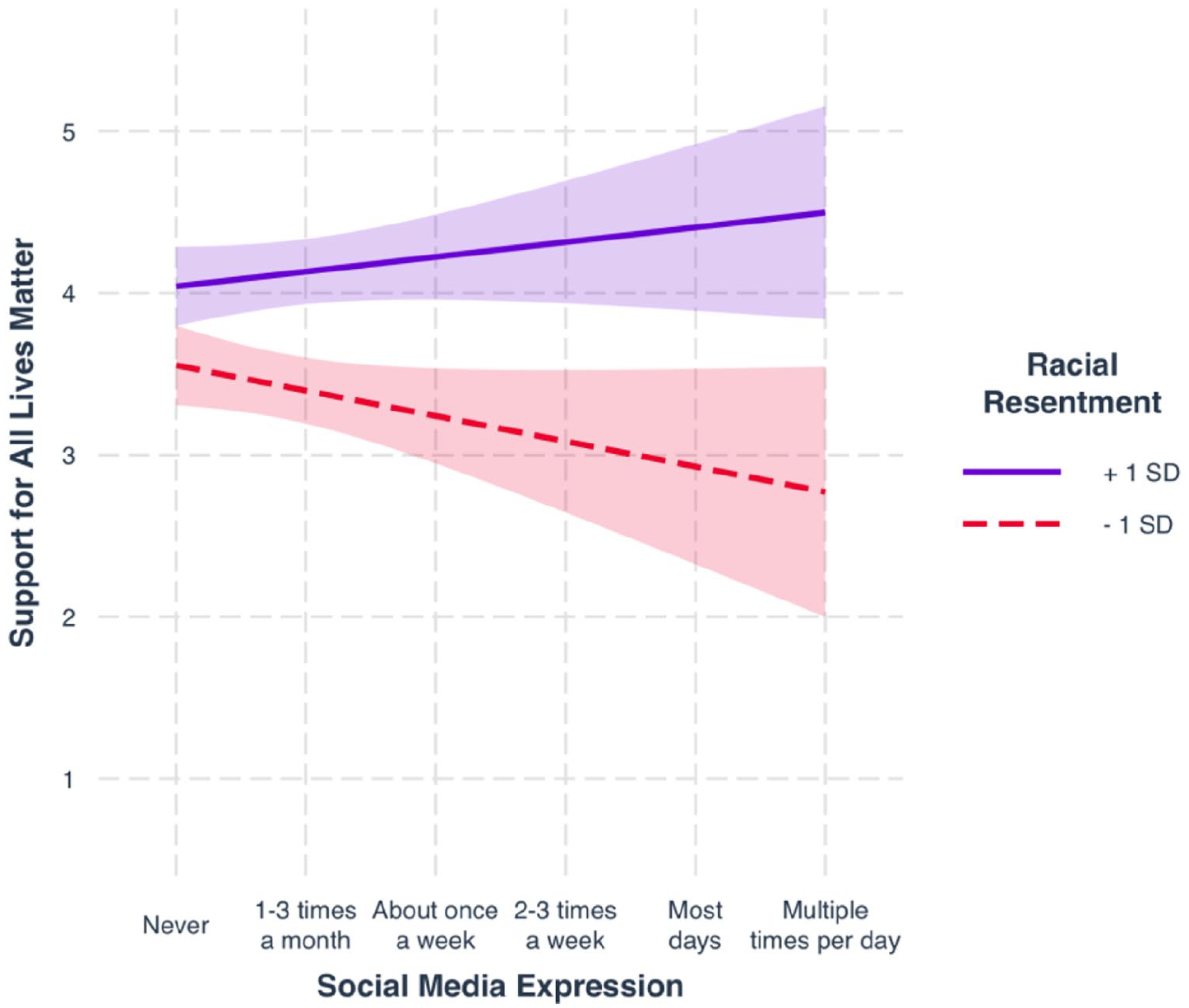
Interaction plot depicting the moderation of expression by resentment on ALM support, with 95% confidence intervals.

Interaction plot depicting the moderation of expression by resentment on BLM support, with 95% confidence intervals.
To test H3a and H3b, we calculated the difference in support for each movement between individuals who score low versus high in resentment, at two different values of expression, for each of our 5,000 bootstrap samples. Because −1 SD (0.73) of expression is below the scale minimum of 1, we calculated the difference in support for each movement between low- versus high-resentment individuals at the minimum (1.00) and at +1 SD (3.00) of the expression scale. In effect, this tells us how social media users with high versus low resentment differ in support for each movement depending on if they report never using social media for expression, or if they report engaging in expression about once a week. Low- versus high-resentment users who never engaged in expression differed in their ALM support by M = 0.49 (SD = 0.21), whereas low- versus high-resentment users who engaged in expression about once a week differed in their support by M = 0.99 (SD = 0.23). A Welch two-sample t-test confirmed that this difference was significant, t(9881) = −114, p < .001. Low- versus high-resentment users who never engaged in expression differed in their BLM support by M = 1.66 (SD = 0.15), whereas low- versus high-resentment users who engaged in expression about once a week differed in their support by M = 1.19 (SD = 0.23). A Welch two-sample t-test confirmed that this difference was significant, t(8641.2) = 118.74, p < .001. These results support both H3a and H3b: social media expression was associated with greater polarization for ALM support, but less polarization for BLM support.
Discussion
The current study investigated how social media expression, together with users’ psychological predispositions, is associated with polarization regarding issue-specific attitudes. Applying the DSMM (Valkenburg & Peter, 2013), we examined how expression, as moderated by racial resentment, would relate to BLM and ALM support. We find that resentment, but not expression, was a strong, independent predictor of ALM and BLM support. Resentment moderated the relationship between expression and support for these race-related movements. We find support for both greater polarization (for ALM) and lesser polarization (for BLM). Notably, expression was only a predictor of movement support for less resentful individuals. Our findings contribute to a broadening understanding of how social media expression is associated with issue support and polarization. Theories of elaboration (Eveland, 2004; Pingree, 2007) point to expression as integral to how people form their own opinions around issues. This heightened level of elaboration is particularly likely to invoke relevant psychological predispositions. The DSMM is well suited for integrating these variables and explaining the relationships between them.
In support of the DSMM, we demonstrate that investigating the role of social media expression frequency alone could obscure potentially meaningful findings if users’ relevant psychological predispositions are not also considered. Future research should examine how expression and underlying issue-specific attitudes are related to greater or lesser polarization for other social issues. For example, support for the #MeToo movement may be differentially related to expression frequency depending on users’ attitudes about women. Yet, because social identities are not constructed, enforced, and reinforced in the same ways throughout society, the same pattern may not emerge for other movements centered around different social identities.
The results of this study also reveal the conditions under which issue-specific opinions are more or less polarized depending on how frequently people express themselves on social media. Rather than finding a relationship between expression and movement support for all individuals, expression frequency was only related to movement support for people low in racial resentment, an issue-relevant psychological predisposition. This particular detail should be of great interest to social justice movement organizers, as it indicates that social media expression may be largely unrelated to the race-related attitudes of racially resentful individuals. Still, expression frequency may be predictive of the opinions of those who harbor less resentful feelings toward Black people.
In addition, low-resentment individuals who expressed themselves on social media more frequently were less supportive of BLM (and marginally so of ALM) rather than more supportive (Lake et al., 2021). One explanation is aversive racism (Dovidio et al., 2016): less resentful, high-expression respondents’ attitudes about BLM were negatively affected by the “take-a-knee” protests, which some people called unpatriotic and disrespectful to service members and veterans (Sandritter, 2017; Veronica, 2016). Seven in ten White people disapproved of the protests at the time, including half of White Democrats (Moore, 2016). It is possible that low-resentment people who more frequently shared and commented on social media posts did so with content that provides a facially non-racist reason to offer less support to BLM, such as content critical of the “take-a-knee” protests. In other words, the current results could be specific to the “take-a-knee” protests that were a highlight of much of the political discussion at the time of data collection and which one could use to “justify or rationalize a negative response on the basis of some factor other than race” (Dovidio et al., 2016, p. 271). At the same time, critics—including White moderates and liberals—have consistently invented reasons to delegitimate racial justice movements (Reinka & Leach, 2017). If not the “take-a-knee” protests, some other act in which protesters are seen as having “gone too far” may allow aversive racism to suppress support for racial justice movements among low-resentment individuals. Aversive racism is a potential mechanism that should be explored in future studies.
Another explanation for the lesser polarization finding is opinion uncertainty (Mutz, 2002). In this case, less resentful people who frequently engage in social media expression are less supportive of BLM not because they gain increased tolerance of other viewpoints, but because they are less assured of their own convictions regarding BLM. Because opinion uncertainty is linked to political ambivalence (Mutz, 2002), a less resentful individual being less assured of their support for BLM could be associated with decreased political action on behalf of the movement. Future research should explore whether the mechanism for decreased support is indeed opinion uncertainty and if that uncertainty is associated with lesser degrees of political action. It could very well be that any gain in political behavior or self-efficacy due to more frequent expression is offset by opinion uncertainty related to that same expression. Still, in line with the DSMM, this opinion uncertainty would only be occurring among the less resentful, not for individuals who hold more racist views.
A second limitation is that because our expression items were agnostic as to specific issues, it is unclear whether respondents’ ALM and BLM support are related to expression about ALM and BLM specifically, or even racial justice in general. Still, political discussions on social media at the time of data collection likely involved BLM, police brutality, or associated issues. Furthermore, asking explicitly about BLM/ALM may be affected by hypothesis guessing on the part of respondents, whereas asking about expression in general around the election was likely to tap into the same concept without raising this concern. Future research should examine under what conditions attitudes are more or less polarized when engaging with sociopolitical content on social media that specifically addresses BLM, ALM, or issues of racial inequality (Lake et al., 2021).
Because the current study employs a cross-sectional design, we cannot make causal claims regarding the role of social media expression in support for BLM and ALM. Future research should employ alternate methods to determine whether more frequent expression causes changes in support for these movements. Still, longitudinal research may find very little variation in users’ expression over time, making it difficult to identify a causal relationship between expression frequency and movement support (Beam et al., 2018). 5 Likewise, randomizing participants to engage in more or less frequent social media expression may unrealistically alter their normal patterns of social media use. Thus, there is much room for future research to triangulate the relationship between social media expression frequency, users’ psychological predispositions, and social justice movement support. Finally, there are limitations to using single items to measure BLM or ALM support, as such items cannot capture the breadth of ways that an individual can support movements. Future research should use a series of items to measure social justice movement support, including behavioral measures of support, such as attending rallies or donating money (Lake et al., 2021).
Despite these limitations, the current study expands the range of the explanatory power and the scope of the predictive power of the DSMM (DeAndrea & Holbert, 2017). By examining social media expression as the media use variable, we also respond to calls for further study into mass self-communication and expression effects within CMC contexts (Valkenburg et al., 2016). Our findings support the DSMM and validate its utility in examining the multiple factors underlying issue-specific opinion polarization as an outcome of psychological predispositions and social media expression. We provide evidence that these underlying beliefs can be powerful predictors of issue-specific opinions on their own, while they also act as dispositional differential-susceptibility variables to influence the relationship between the frequency of social media expression and those same opinions. In this case, our findings evidencing both greater and lesser issue-specific polarization leaves ample opportunity for future research into when these differential phenomena may occur.
Supplemental Material
sj-docx-1-sms-10.1177_20563051211052907 – Supplemental material for Social Media Expression and User Predispositions: Applying the Differential Susceptibility to Media Effects Model to the Study of Issue Polarization
Supplemental material, sj-docx-1-sms-10.1177_20563051211052907 for Social Media Expression and User Predispositions: Applying the Differential Susceptibility to Media Effects Model to the Study of Issue Polarization by Stewart M. Coles and Muniba Saleem in Social Media + Society
Footnotes
Declaration of Conflicting Interests
The author(s) declared no potential conflicts of interest with respect to the research, authorship, and/or publication of this article.
Funding
The author(s) received no financial support for the research, authorship, and/or publication of this article.

Supplemental Material
Supplemental material for this article is available online.
Notes
Author Biographies
References
Supplementary Material
Please find the following supplemental material available below.
For Open Access articles published under a Creative Commons License, all supplemental material carries the same license as the article it is associated with.
For non-Open Access articles published, all supplemental material carries a non-exclusive license, and permission requests for re-use of supplemental material or any part of supplemental material shall be sent directly to the copyright owner as specified in the copyright notice associated with the article.
