




Abstract
Using #BlackLivesMatter as a case study, this research documents the tensions and harms associated with trademarking online social movement hashtags. Grounded in the work of critical race theory and intellectual property scholars, this study analyzes the inconsistencies in the U.S. Patent and Trademark Office application practice. The contradictions signal a limited or “mis”understanding of the utility of citizen-created hashtags and online social movement slogans. We propose a provisional networked trademark that would grant limited protection to social movements to show that their marks demonstrate the kind of secondary meaning required for a traditional trademark.
Social media have changed modern protests and political engagement. Specifically, networked communication has changed how society expresses and collects itself around social, cultural, and political issues. Social media platforms like Twitter have helped to lend voice to many socially marginalized and politically oppressed communities and have raised the visibility of new and counter networks of individuals and groups (Borge-Holthoefer et al., 2011; Valenzuela et al., 2012). Specifically, hashtags, once used as subject aggregators, are now used for collective action as a way for movement actors to organize, mobilize, and spread real-time messages widely across social media (Bastos et al., 2015).
Hashtag use associated with contentious social and political issues and movements such as #BlackLivesMatter, #JeSuisCharlie, and #MeToo have also provided a way for the general public to rally around and with activists on these issues. Specifically, hashtags have helped activists to stand against autocratic governments by connecting their protest work and messages to the watching outside world. For example, in 2011, the fast-moving spread of Twitter messages helped protestors explain to a global audience their political fight during the Tunisian Revolution (Castells, 2015; Chaundhry, 2014). Occupy Wall Street organizers staged a protest in September 2011 in New York’s Zuccotti Park and used the hashtags “#Occupy” and “#OccupyWallStreet” to express grievances as part of their anti-capitalist movement (Conover et al., 2013). By using these as group action hashtags, the Occupy movement stirred and mobilized the participation of thousands of people to stage similar Occupy group actions around the world (Castells, 2015).
The mobilization of people through networked communication has not only expanded the formation of online coalitions but has also reshaped political speech and what it looks like within online contexts (Freelon et al., 2016). Like their legacy brick-and-mortar civil rights brethren (Karpf, 2012; Kreiss, 2012), some online movements seek the same social recognition and legal protections as their offline predecessors. The use of hashtags by grassroots movements has moved beyond pure political speech and into commodified territory. It is not uncommon to see hashtags on poster boards; sold as T-shirts; and used with donations, correspondence, and advertising during collective action events (Kaplan, 2014). In fact, some activists favor assigning trademark protection to hashtags (and other digital organizing tools), arguing increased activism benefits from such rights (Stronach, 2014).
Other activists, in particular, those associated, for example, with the Black Lives Matter (BLM) movement, have complained about remixed and hijacked hashtags that infringe upon or dilute the value and power of movement messages (M. Clark, personal communication, March 18, 2016). A recent revelation that Russian trolls, in their attempts to manipulate the 2016 election, were “obsessed with Black Lives Matter” amplifies cooptation concerns (Glaser, 2018). Simply put, both the real and social capital attached to social movement hashtags has grown. But how do activists protect their labor investment? This new reality presents significant challenges to the current trademark regime and to the U.S. Patent and Trademark Office (USPTO), which is being asked to protect a number of remixed and hijacked hashtags before the creators can apply. Tensions between political and commercial speech have increased, and trademarking movement hashtags is just one symptom of a larger struggle.
We examine these tensions grounded in the work of critical intellectual property and critical race scholars. Our case study explores the tensions with and potential benefits associated with limited trademark protections for online social movement hashtags like #BlackLivesMatter. Studying the Black Lives Matter movement hashtag presents a fruitful opportunity to rethink and reinterpret trademark protections and suggest new law and policy directions (Wagner, 2019). As a cultural mark that signals a powerful public message (“stop killing black and brown people”) and a private good—namely a collection of people who identify with changing how the system carries out justice for Black and Brown people in the United States – #BlackLivesMatter has high value. Notably, the social movement hashtag also represents an increasing phenomenon of co-constitutive virtual culture moving into and eventually merging with elements of real commerce, or “citizen-created hashtags” (Roberts, 2017). As the distinctions between real and virtual commerce and political and commercial messaging begin to collapse, intellectual property laws like trademark will need reexamination.
This study has four goals: First, we review current trademark law and consider efforts by the USPTO to grapple with technological developments—namely trademarking hashtags. Second, we examine trademark law through the theoretical lens of Critical Race Theory and Intellectual Property (CRT-IP), an emerging interdisciplinary framework that focuses on “the racial and colonial non-neutrality of the laws of copyright, patent, trademark, right of publicity, trade secret and unfair competition using principles informed by critical race theory” (Vats & Keller, 2018, p. 740). This growing body of CRT-IP scholarship challenges the dominant “law and economics approach” to intellectual property law and, in its place, reveals decades of systematic intellectual property appropriation and exploitation to “facilitate the ability of all citizens, rich or poor, brown or white, man or woman, straight or gay, to participate in making knowledge of our world and to benefit materially from their cultural production” (Sunder, 2012, p. 23). Third, we use a case study research approach to analyze applications seeking federal trademark protection for “lives matter” hashtags and compare that against how the government has treated trademark applications for #BlackLivesMatter. Using a case study design opens space to examine a phenomenon and to help generate new ideas and develop new names for unprotected practices (Vats & Keller, 2018). Finally, in our discussion, we offer a novel expansion of the trademark system called provisional or collective status. Movement marks, specifically hashtags, seeking protection, hold this trademark status until they meet the legal trademark requirements (Murray, 2016; Stronach, 2014).
U.S. Trademark Law and USPTO Policy
Trademark law protects the value associated with names and symbols in commerce. For decades, U.S. trademark law has expanded to protect against unfair competition in business and lessen consumer confusion about product or service sponsorship or affiliation (Beebe, n.d.; Gerhardt, 2012; Horwitz & Levi, 1996). 1 However, the advent of the internet has complicated that expansion with the onset of domain names, adwords, metatags, and hashtags, creating confusion within businesses and courts about the role of trademarks online (Barrett, 2006). Several difficulties arise when considering whether, for example, a mark primarily used online to reference social movements might receive trademark protection. Some of the difficulty lies in connecting brick-and-mortar trademark with the more numerous, quickly created, and less permanent online identifiers of a good. The other difficulty lies in extending intellectual property protections to online identifiers that may be best left open to reuse under free speech and/or fair use principles.
First, because trademark law requires and relies on a “use in commerce,” there are significant problems with labeling a social movement mark (i.e., slogan or hashtag) as a traditional “use in commerce.” Second, because sociopolitical phrases such as “Black Lives Matter” are arguably “descriptive” in nature, there are concerns about whether such marks acquire the necessary “secondary meaning” to qualify as trademarks. As discussed below, we define and explain both “use in commerce” and “descriptive marks.”
Use in Commerce
As defined by the Lanham Act, a trademark is any word, name, symbol, design, or any combination used in commerce to identify and distinguish the goods of one manufacturer or seller from those of another and to indicate the source of those goods (15 U.S.C. §1127). Trademark law permits applications for registration of “a trademark used in commerce” or in which a person “has a bona fide intention . . . to use a trademark in commerce” (15 U.S.C. §1051). As such, there is often debate about what qualifies as “in commerce,” particularly when the mark has political undertones. When considering whether a mark qualifies as “use in commerce,” the Lanham Act outlines two requirements: (a) the mark must be placed on the goods or documents associated with the goods, and (b) the goods are sold or transported in commerce (15 U.S.C. §1127). 2
Disputes about “use in commerce” can arise at the point in which an application for a federal trademark or service mark is submitted, as well as when an infringement lawsuit is filed. Different jurisdictions employ a “case-by-case” analysis to determine what defines “use” and what defines “commerce” (Int’l Healthcare Exch., Inc. v. Glob. Healthcare Exch., LLC, 2007). More recently, disputes over “use” have been extended to include presales promotion of a mark. Due to changes in commercial practices and marketing techniques, the Third Restatement of Unfair Competition states that “the breadth of activities sufficient to constitute use on ‘associated’ displays continues to expand” (Restatement of Unfair Competition, 1995). In addition, marks that are simply “functional” will not generally qualify as a “use in commerce.” Hashtags are oftentimes tools that simply index material, making them less likely to qualify for trademark status (Roberts, 2017).
Similar wrangling also occurs over the term “commerce.” In modern marketing and sales, the definition of “commerce” has been challenged. Although courts have granted trademark protection only to marks that appear on goods or services sold in commerce, a few courts have ruled, “actual sales are not necessary to establish trademark rights” because a press release was enough to be a “use in commerce” (see Specht v. Google Inc., 2010). In addition, Congress expanded, [T]he term ‘commerce’ to include racial discrimination at local establishments that either (1) serve interstate travelers or (2) sell products which come from out of state, then Congress has equal power to control and register marks used to identify the goods sold by such establishments. (McCarthy, 2019)
These expanded definitions of “commerce” both help and hurt efforts to address how best to deal with the explosion of hashtags online, as discussed in the following section.
Source of the Goods
Trademark law also requires that marks be “distinctive,” meaning that the mark indicates the source of a good or service. The widely used Abercrombie test, developed by the U.S. Court of Appeals for the Second Circuit in Abercrombie & Fitch Co. v. Hunting World, separated distinctive marks into four categories: generic, descriptive, suggestive, and arbitrary and fanciful. The first category, as it does not indicate a clear source, does not receive trademark protection from USPTO examiners; the last three categories generally do receive protection, although marks determined to be “descriptive” must acquire “secondary meaning” to receive protection. A “descriptive mark” is one that “directly and immediately conveys some knowledge of the characteristics of a product or service.” 3 Such a mark can potentially signal a class of users of the goods and services. 4 “Secondary meaning” requires that the mark “acquire a special significance so that to the consuming public the word has come to mean that the product is produced by that particular manufacturer” (Nims, 1947). However, it is not necessary “that the purchasing public can identify the maker by his specific name or the place of manufacture by precise location” (Manhattan Shirt Co. v. Sarnoff-Irving Hat Stores, 1933; Shredded Wheat Co. v. Humphrey Cornell Co., 1918). Instead, the source may be anonymous (McCarthy, 2019).
Both direct and circumstantial evidence may be provided to show secondary meaning for descriptive marks. Such evidence “may consist of either the testimony of random buyers in court or ‘quasi-direct evidence’ by means of consumer surveys, professionally conducted” (McCarthy, 2019). In cases involving disputes over the trademarks of phrases, very few courts in the last decade have found that descriptive marks acquired enough secondary meaning to qualify for trademark protection (See Douglas v. Osteen, 2008; Kelly–Brown v. Winfrey, 2016). In some cases, the phrase or slogan was generic. In other cases, the trademark holder failed to provide sufficient evidence demonstrating secondary meaning (See CG Roxane LLC v. Fiji Water Co. LLC, 2008).
USPTO Policy on Trademarking Hashtags
In 2013, the USPTO clarified the Trademark Manual of Examining Procedure (TMEP) to include guidelines for granting trademark protection for hashtags. The TMEP first defines a hashtag as a “form of metadata” that is “often used on social-networking sites to identify or facilitate a search for a keyword or topic of interest” (TMEP §1202.18). The policy states that a hashtag (symbol or term) can be trademarked or qualify as a service mark if it “functions as an identifier of the source of the applicant’s goods or services.” The office also explains that because hashtags are typically used for categorization or search, “if a mark consists of the hash symbol or the term HASHTAG combined with wording that is merely descriptive or generic for the goods or services, the entire mark must be refused as merely descriptive or generic” (TMEP §1202.18).
As Roberts (2017) points out, the USPTO’s new policy makes a number of assumptions about hashtags that instantly create problems. First, the Office assumes that hashtags are primarily a form of computer code used for search. Second, the new policy assumes consumers will also perceive hashtags as trademarks in their earliest uses—in other words, that hashtags always serve as source identifiers. In addition, she argues, hashtags are often user-generated, an entirely different construction of marks not accounted for in the new policy. Indeed, Roberts suggests that the USPTO should better define the contexts for hashtags and identifies four types of context-specific hashtags. Here, she suggests potential categories: “producer-selected,” “marketer-deployed,” “consumer generated,” or “citizen-created.”
For our purposes, Roberts’ (2017) “citizen-created” designation best fits the history of the Black Lives Matter hashtag. She defines this final category as hashtags “created by members of the public” in response to “rallying cries for social justice” or “reactions to current events.” Johnson (2013) writes that it is “widely understood that the possibility of exclusive, national rights in media amplified words and catchphrases has created a veritable race to the trademark office among both entrepreneurs and opportunists seeking to harness the strength of media publicity” (p.97). Roberts (2017) agrees: Given the lack of connection to any goods, services, or brands, it might seem unnecessary to analyze citizen-created hashtags as marks. Yet, repeatedly would-be registrants have seen an opportunity to capitalize on hashtags in this category by pairing them with goods or services—most often, apparel—and applying to register them as trademarks, sometimes retaining the hash mark and other times dropping it. (p. 1619)
Our study provides evidence of such a phenomenon and the need to look more closely at “citizen-created” hashtags and their potential for misappropriation, particularly the misappropriation of marks collectively created by minority communities. CRT-IP helps to address this issue in more detail below.
CRT-IP Analysis of Trademark Law and Hashtags
CRT-IP scholars focus on an intellectual property system that has long privileged status quo notions of property at the expense of Black and Brown people who were once property themselves, but more work is needed, particularly in the area of trademark (Greene, 2008). Renewed attention to CRT-IP scholarship is coalescing around a new biennial conference titled “Race + IP” (The last of these was held in 2019 at New York University).
CRT-IP grew out of critical race theory (CRT), which sought to address the gaps in the critical legal studies (CLS) movement of the 1960s, led mostly by White scholars at the nation’s top law schools (Vats & Keller, 2018). In contrast, CRT embraced a movement of left scholars, most of them scholars of color, situated in law schools, whose work challenges the ways in which race and racial power are constructed and represented in American legal culture and, more generally, in American society as a whole. (Crenshaw et al., 1995)
CRT-IP, therefore, “refers to the interdisciplinary movements of scholars connected by their focus on the racial and colonial non-neutrality of the laws of copyright, patent, trademark, right of publicity, trade secret, and unfair competition using principles informed by CRT” (Vats & Keller, 2018). For our purposes, we define CRT-IP scholarship as exposing legal and other institutional structures that exploit the intellectual fruits of marginalized communities online and through those structures channel remuneration away from both original creators and/or communities of creation.
For trademark law specifically, CRT-IP scholarship has highlighted two principal problems for marginalized communities. First, scholars have emphasized that trademark law, with its focus on commerce and neoliberal economies, underestimates trademark’s role in the marketplace of ideas and notions of community generated labels and content. Second, scholars rely on Harris’ (1993) groundbreaking historical legal work on slave ownership and property to draw comparisons to the intellectual property appropriation and exploitation of minority voices and their creations.
Katyal (2010) has written about the complex role trademark plays in the marketplace of ideas for marginalized communities and the need for lawmakers to better balance the tensions between trademark’s dual roles in commerce and communication: The law governing trademarks presumes that a mark is a type of economic property—it has a fixed presumption of meaning as a brand, and as an identity in the marketplace of goods. However, a variety of nonowners who are affected by a mark posit just the opposite view—that trademarks are far more expressive than economic in nature, and are thus inherently unstable because they can mean so many different things within the marketplace of ideas . . . Since trademarks inhabit a multiplicity of meanings, they can operate as devices of owned property, and at other times, they can also operate as devices of expression and culture. (p. 1605)
The U.S. Supreme Court’s recent decision in Matal v. Tam illustrates this proposition. In that case, the Supreme Court struck down a part of trademark law that prohibited the registry of disparaging marks. The Court concluded that the disparagement provision of trademark law, which prohibited “immoral, deceptive, or scandalous matter; or matter which may disparage or falsely suggest a connection with persons, living or dead, institutions, beliefs, or national symbols, or bring them into contempt, or disrepute,” violated the First Amendment. Although the Tam case is not the focus of our study, the heart of Tam represents an example of a mark that was about the tensions between speech and commerce, illustrating Katyal’s (2010) point.
Other scholars have talked about CRT-IP trademark tensions in terms of social enterprise (Stronach, 2014), meme culture (Johnson, 2013), and community brands (Murray, 2016). In these scholars’ works, trademark is addressed from the perspectives of co-constitutive cultural creation and idea sharing—not from the simple perspective of a merchant looking to trademark a good to prevent consumer confusion. In other words, marginalized populations often create new works as a collective and share in ways that run counter to neoliberal principles, and especially to the economic principles that underlie western intellectual property law.
Still, to the extent that marginalized communities create marks collectively and must exist within western constructs of property law, particularly in online communities, there may be needs that the law, as currently written, is unable to address. Katyal (2010) argues that trademark is a “mixed public good,” and as such, should be viewed as a value instrumental to equality, rather than an end in and of itself . . . the social meaning of a mark can be changed, altered, and recoded in creative ways, and there is some evidence that trademark law can be employed to honor this transition when it has fully unfolded, when the empirical and anecdotal evidence suggests a fuller and more complete shift in meaning. (p. 1695)
Appropriation of intellectual property created by marginalized communities is also a major theme in the work of CRT-IP scholars. Greene (2008) has spent two decades tracking the cultural appropriation and subsequent copyrighting and remunerative theft of African American music by White artists and producers. Mtima (2015) has long argued that if Western intellectual property regimes are to remain “relevant and viable,” they must shift away from IP disenfranchisement and refocus “toward the enlightened vantage point of intellectual property social justice” (p. 3). Mtima calls for a new theory of “intellectual property empowerment” to address decades of intellectual property theft from minority communities. As he writes, “From the age of chattel slavery and throughout the era of Jim Crow and beyond, African Americans and other marginalized groups have been robbed of the credit for and economic fruits of their intellectual property achievements” (p. 15). Entrepreneurship is key re-empowering minority groups.
In their seminal piece surveying the field, Vats and Keller (2018) identify several areas of CRT-IP work addressing appropriation, including the unauthorized use of “traditional knowledge,” “indigenous knowledge,” and “folklore” under international intellectual property and human rights laws. They also identify scholarship focused on “framing and reframing concepts of ‘infringement’, ‘counterfeiting’ and ‘piracy’.” The thrust of this scholarship is that marginalized communities do not rely on western notions of the “romantic author,” who singularly brings his or her genius to new intellectual creation. Communities of color and other marginalized groups often regularly create, borrow, remix, and share among themselves without the requisite structures of IP law determining what can and cannot be done.
Given globalization, however, many if not most of these communities are forced to revisit their work and adopt traditionally White and western IP practices to protect their own creations from appropriation by those with more economic and political power (Vats & Keller, 2018). In addition, scholars point out that social movements have become increasingly commodified (Stronach, 2014) at the same time that trademark law favors large over small organizations, putting minority groups at a disadvantage (Choi, 2019). Our case study suggests such a rising tension, particularly for online social movements.
Method
To better understand the difficulties that can arise through the trademarking process, we offer an examination of hashtag applications seeking federal protection over a 10-year period. We specifically reviewed #BlackLivesMatter applications and applications where the root phrase, “lives matter,” was incorporated. #BlackLivesMatter represents a clear example of a descriptive online movement hashtag where traditional trademark requirements of “use in commerce” appear problematic. Previous studies have yet to examine the trademark processes of international online movements like Black Lives Matter. CRT-IP scholars are considering new ways of thinking about how intellectual property law can advance with technology.
Case Background
The hashtag #BlackLivesMatter was first publicly introduced in the summer of 2013 by community organizer Patrisse Cullors. She used the hashtag on Facebook in response to a post written by Alicia Garza, another community organizer, who urged activists to fight against institutional racism. Both posts came after neighborhood watchman, George Zimmerman, was acquitted in the shooting death of 17-year-old Trayvon Martin of Florida. Two years after Martin’s death, #BlackLivesMatter was used again in response to the killing of another unarmed Black teen, 18-year-old Michael Brown of Ferguson, Missouri. Use of #BlackLivesMatter exploded across social media platforms and become more than a rallying cry. In fact, since 2013, the hashtag has evolved into a movement of national and international actors concerned with ensuring justice for people of color (Anderson et al., 2018; Simon, 2018). However, unlike conventional social movements with brick-and-mortar representations, the Black Lives Matter movement is funded by donors and has maintained its 28 chapters nationwide and in Canada through decentralization (NPO Spotlight, 2016).
After its introduction in 2013, the rapid and intense rise of #BlackLivesMatter also caught the interest of individuals and groups seeking to exploit and appropriate the Black Lives Matter moniker. Thus, central to the question of whether to trademark movement hashtags, we examine more than 100 hashtag trademark applications filed over a nearly 10-year period with the federal government that resemble hashtags of current movements for social change. “Black Lives Matter” applications—or iterations of the “lives matter” name—found in the USPTO database were our units of analysis.
Trademark Electronic Search (TESS) System
The USPTO trademark database stores thousands of applications of individuals, groups, and businesses seeking IP protection. The TESS sorts registered and denied mark applications. For example, at the time of this writing, the keyword “hashtag” returned 1,916 registered and denied marks that included the term hashtag (e.g., #HASHTAG BEAUTY SALON) or the pound sign symbol (e.g., #FINDYOURBLISS, #MOMTRIBE). As part of the present analysis, the authors searched TESS for “lives matter,” which yielded 301 applications. We explored all “lives matter” applications filed from the first “lives matter” application filing until the time of this writing (see Table 1).
USPTO “Lives Matter” Application Filings January 2012–August 2018.
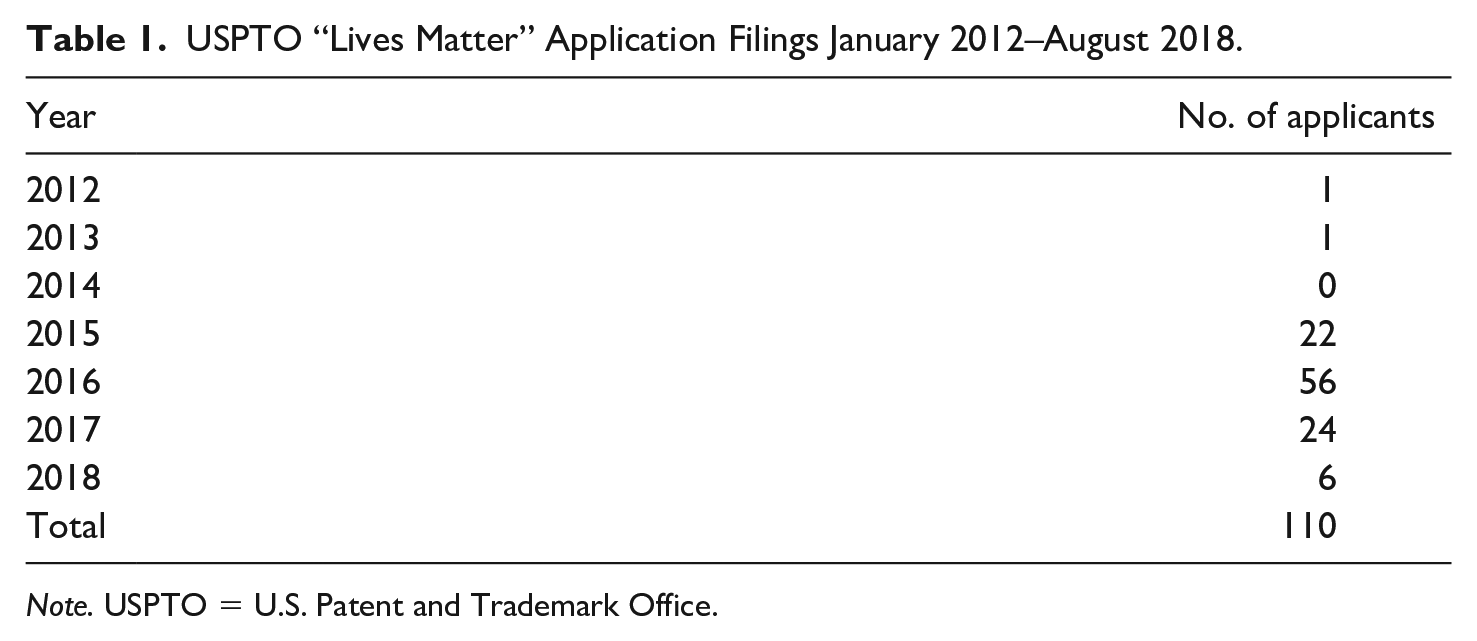
Note. USPTO = U.S. Patent and Trademark Office.
The recognized power of #BlackLivesMatter is realized in the 30 trademark applications filed during the study period that attempt to seek credit for the “lives matter” slogan (see Table 2). To understand why “lives matter” applications were registered or denied, we reviewed trademark examining attorney comments assigned to each submission. Trademark examining attorneys provided detailed comments to applications denied, to which applicants could appeal. In some cases, an initial refusal later became a granted registration. In addition, to understand how, if at all, individuals and groups that applied for “lives matter” trademarks were connected to the Black Lives Matter movement, we searched for public information about the applicants.
Central USPTO “Lives Matter” Applications January 2012–August 2018.
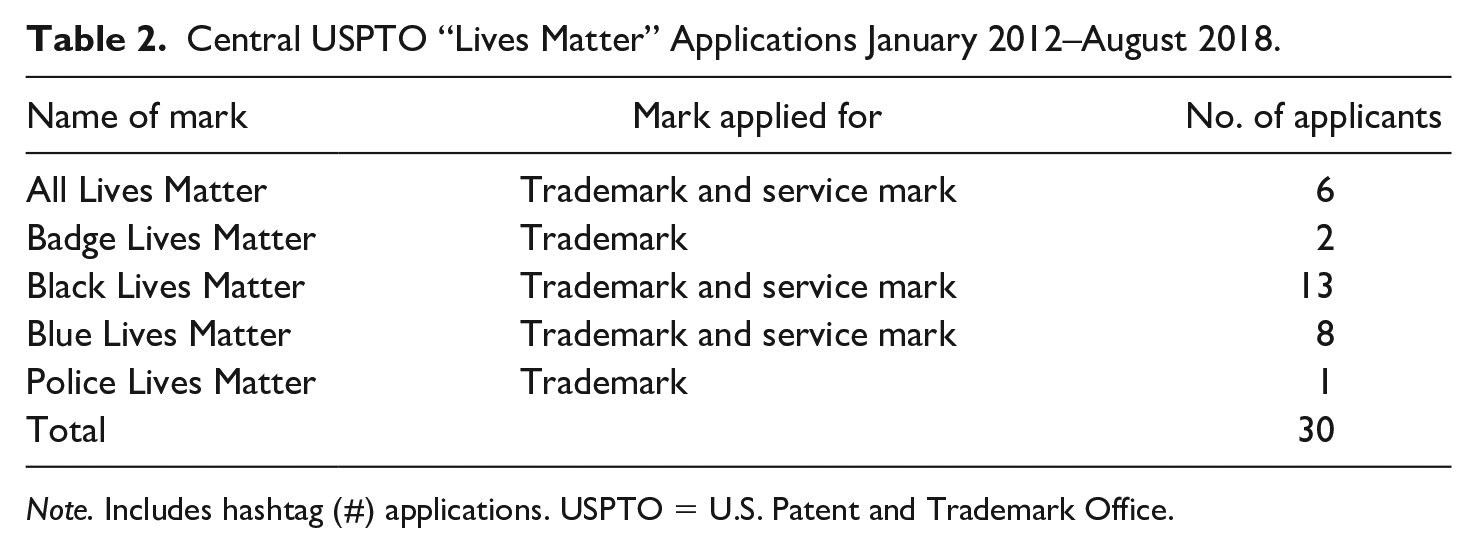
Note. Includes hashtag (#) applications. USPTO = U.S. Patent and Trademark Office.
Trademarks Granted
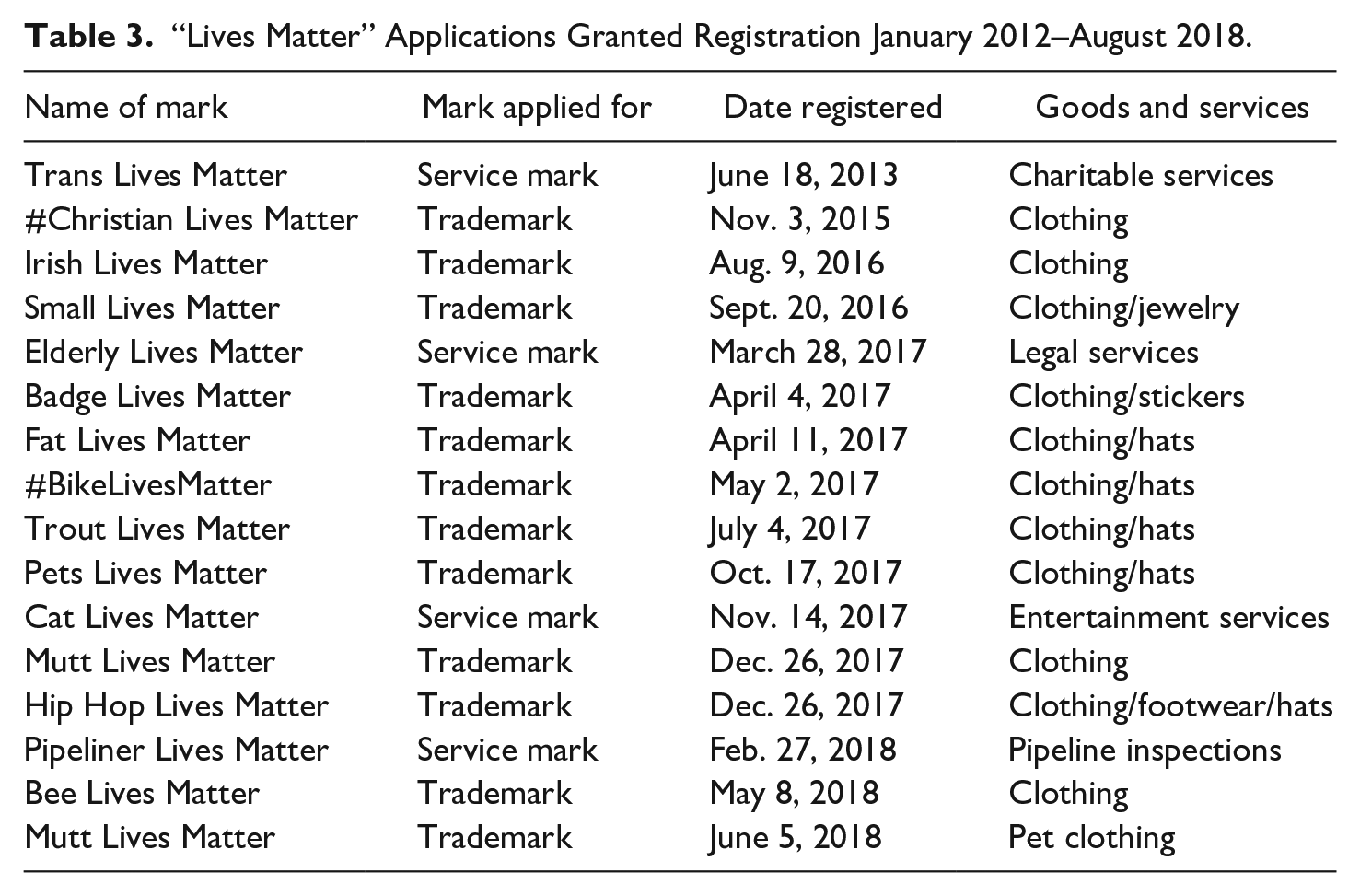
Sixteen “lives matter” requests were registered between January 2012 and August 2018 for goods and services ranging from clothing for people and pets to entertainment and charitable services (see Table 3). Table 4 shows eight of the 16 applications were initially refused but later granted trademark or service mark registration. In each instance, the USPTO examining attorneys alerted the applicant to something either visually in the mark or in language about how the mark would be used that needed to be addressed.
“Lives Matter” Applications Granted Registration January 2012–August 2018.
“Lives Matter” Registrations Granted After Initial Refusal January 2012–August 2018.
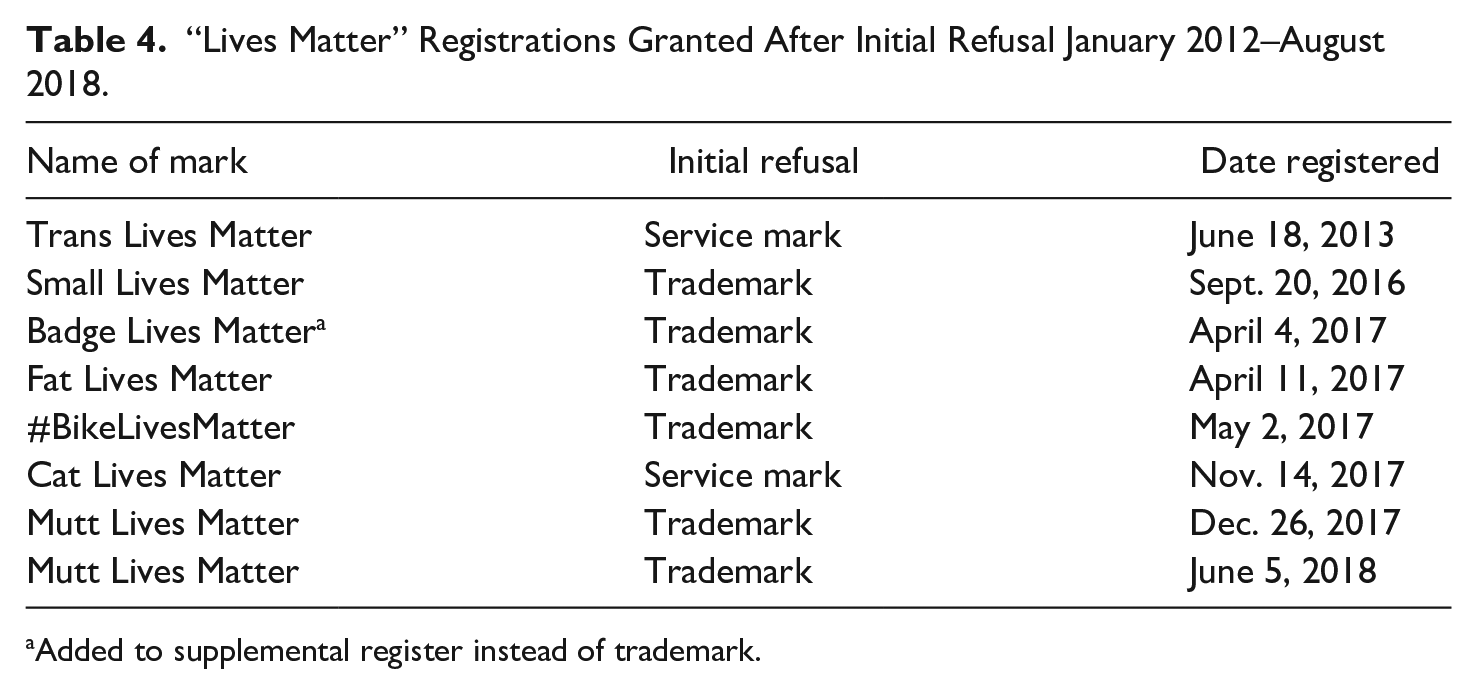
Added to supplemental register instead of trademark.
Registered trademarks for “lives matter.”
Trans Lives Matter
Trans Lives Matter filed an application on October 8, 2012, which predates the first known public use of Black Lives Matter. The application also appears to be the first “Lives Matter” trademark or service mark request presented to the trademark office. The owner, Trans Lives Matter (Seattle, Washington), filed for protection of charitable services (e.g., organizing and conducting volunteer programs and community service projects) was informed by the assigned trademark examining attorney that because “TRANS” is a descriptive word, the applicant had to disclaim “TRANS” exclusive rights apart of their mark. After doing so, the application was granted service mark registration June 18, 2013. That said, we were unable to verify the owner, Trans Lives Matter. However, a Twitter search of “Trans Lives Matter” reveals that a page that uses the profile Trans Lives Matter and the handle @OurTransLives. The profile states that the “Seattle org” is “committed to developing sustainable solutions to trans issues” (Trans Lives Matter Profile, 2011).
#Christianlivesmatter
#CHRISTIANLIVESMATTER is trademarked and owned by Diane Lohmeyer of Pattersonville, New York. The supplemental trademark was granted November 3, 2015 for “wearable garments and clothing.” At the time of this writing, we found the #CHRISTIANLIVESMATTER shirt being sold by Lohmeyer through a website called ContinuetoGive.com. Continue to Give is a cloud-based donation platform for nonprofit organizations “to raise money online, collect text to give donations, and manage all the donation sources coming in (Continue to Give, 2019).” Furthermore, the website’s description for Christian Lives Matter fundraising effort reads, With a donation of $25 or more, you have the option of receiving a custom designed #Christian Lives Matter t-shirt or $45 for a hoodie . . . Proceeds forwarded to Franklin Graham’s Samaritan’s Purse who has resources in the Mideast and are helping the displaced Christians with food, water, and other basic necessities. Visit our website www.SaveWorldChristians.com where we post revelent [sic] articles about the persecution Christians are facing everyday. PLEASE send us a SELFIE wearing your #Christian Lives Matter shirt so we can post it on our website to
In addition, Christian Lives Matter’s mission statement on ContinuetoGive.com commits itself to representing the Christian faith and acknowledges movements like #BlackLivesMatter: We’ve heard so much lately about #BlackLivesMatter or #BlueLivesMatter and rightfully so. We feel the need to state that #ChristianLivesMatter too! They are being tortured and killed by the 100,000s around the world annually but it barely makes the news. (Continue to Give, 2019)
Irish Lives Matter
An application for Irish Lives Matter for Polo shirts, shorts, sweatpants and sweatshirts, and T-shirts was filed by John Vrana and Kevin G. O’Haire, both of Mount Laurel, New Jersey. According to Justia.com, Vrana has filed nearly 60 other trademark applications between 2015 and 2018 including unsuccessful attempts to register Unborn Lives Matter, Isis Lives Matter, Make America Sane Again, and Make America Happy Again. Vrana has 19 registered trademarks including Irish Lives Matter. No other information was found about Vrana or O’Haire.
Elderly Lives Matter
T. Patrick Ford Jr., William A Dean, and Michael J. Rotundo own the Elderly Lives Matter trademark for legal services. A Google search shows the group appears to be trial lawyers working on behalf of the elderly. A website that lists their names states, “Based in Aventura, we represent elders and their families across Miami and Florida” (Ford, Dean, & Rotundo, P.A., 2019). The trio also applied for and was granted a trademark for Where Elderly Lives Matter.
Badge Lives Matter
The Badge Lives Matter trademark application was granted a supplemental trademark on April 4, 2017, for T-shirts and stickers. According to Justia.com, this application was one of two Badge Lives Matter applications filed at the same time by owner Badge Lives Matter, LLC of Summerville, South Carolina. The application for the mark’s use on stickers was refused. At the time of this writing, shirts with the Badge Lives Matter mark were being sold on Facebook. The page explicitly describes the moniker as a movement: Badge Lives Matter is a movement committed to showing honor and respect for those who take a risk everytime [sic] we make the call . . . Show your support for the Badge Lives Matter movement and all those who support us, by purchasing Badge Lives Matter apparel. A percentage of every purchase will go to various First Responders and supporting organizations. (Badge Lives Matter, 2017)
No additional information on the owners of the application was found.
Fat Lives Matter
A trademark was registered to Shane A. Shiflet of Randleman, North Carolina for clothing, footwear, and headgear. Shiflet also holds the trademark for another mark—The Big Oval—for headgear. A Google search that matches the address on the USPTO application with Shane Shiflet Photography.
#Bikelivesmatter
John Nocine of Pittsburgh filed two applications for #BikeLivesMatter on January 2, 2016, and January 12, 2016. The later of the two applications was refused because of duplicative efforts. No additional information on the applicant was found.
Mutt Lives Matter
Although one of two applications filed for #BikeLivesMatter was denied because of duplicative efforts, two registrations for Mutt Lives Matter filed by Julie Schwenzer of West New York, NJ were granted. The first application was filed July 23, 2016, for clothing and was registered December 26, 2017. The second Mutt Lives Matter application for pet accessories, which includes pouches for holding pet waste, was filed November 9, 2017, and trademarked June 5, 2018. Schwenzer currently has five of seven registrations granted. The other registrations include the following: The Muttly calendar, BYE FUR-LEASH-A, and Barking for change. An internet search found that Julie Sinha Schwenzer is the creator and Co-Founder of the Muttly Crew, LLC. The Muttly Crew Store website states in its mission: We noticed our mixed breed best friends usually take backstage to the purebreds . . . Mutts make up a majority of dogs in homes that are rescued across the world . . . we want to give them props . . . talk to the paw!!! (The Muttly Crew Store, 2019)
Hip Hop Lives Matter
Rodney Thornton, owner of the Hip Hop Lives Matter trademark, for clothing, registered December 26, 2017, has 46 other Hip Hop application filings such as the following: Hip Hop High the Musical, Hip Hop High Radio, Urban News Network, and Hip Hop TV. In total, Thornton has 22 trademarks. Additional information on this applicant was not found.
Finally, no additional owner/applicant information was found on the final six registered trademarks in this study (see Table 3): Small Lives Matter, a mark owned by The Teaching Creche; Trout Lives Matter by owners Timothy Taber and Gene Tomasco; Peter and Joann Curran own Pets Lives Matter; Cat Lives Matter is owned by Cat Lives Matter, LLC; Pipeliner Lives Matter is owned by Austin Choate as Black Label Pipeline Inspection, LLC from Marlow, Oklahoma; and Bee Lives Matter is owned by Gaiser Bee, LLC from Cincinnati, Ohio.
Trademark Refusals
Perhaps as revealing as the registered trademarks and the existing tensions between political and commercial speech doctrines in the law are the reasons why Black Lives Matter applicants were refused trademark protection. The examining attorney assigned to an application, in most cases, provided comments if the application was denied.
Refusal of Black Lives Matter applications
Black Lives Matter
Thirteen Black Lives Matter applications were filed between January 2015 and August 2018 (see Table 5). The mark requests were for greeting cards, clothing, pamphlets, newsletters, charitable fundraising, and educational services that “featur[e] topics of interest to those in the fields of activism and community organizing in the Black community”. Each application was denied the requested trademark or service mark. Interestingly, all but two Black Lives Matter applications, those from owners Perkins, Inc. and Damon Turner, were denied by the same examining attorney. In her reasoning, this particular examining attorney stated, [T]he applied-for mark BLACK LIVES MATTER merely conveys an informational social, political, religious, or similar kind of message” and fails to “function as a trademark to indicate the source of applicant’s goods and to identify and distinguish them from others.
“Black Lives Matter” Applications Denied January 2015–August 2018.
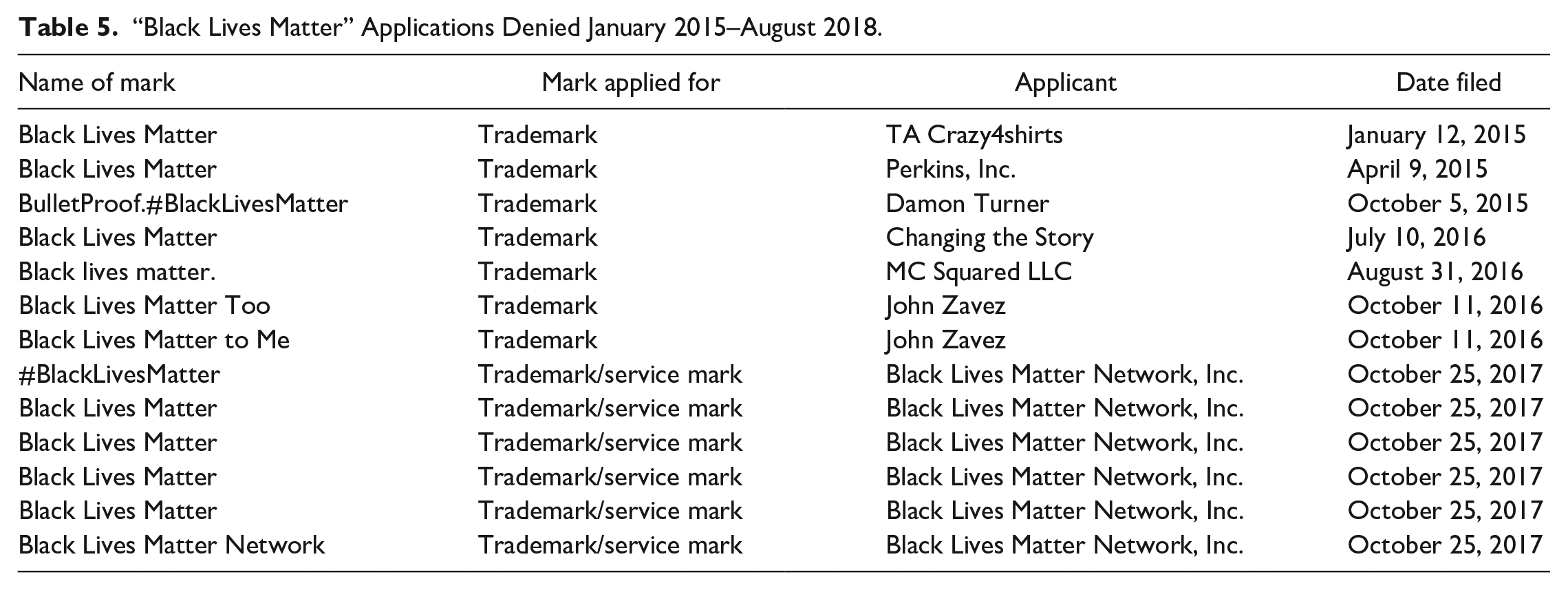
The examiner also said, “the public would not perceive the slogan BLACK LIVES MATTER as source-identifying matter that identifies [the] applicant as the source of the goods but rather as an expression of support for anti-violence advocates and civil rights groups”. Furthermore, the attorney claimed that consumers “would simply purchase the clothing because they want to support the cause that the slogan represents, not because they believe the slogan indicates source”. In each instance, applicants did not appeal the examining attorney’s decision and therefore, the application went no further and was considered abandoned.
In January 2015, Michael Southern of Chicago, d/b/a TA Crazy4shirts, was one of the first groups to file a trademark application to use the Black Lives Matter slogan on clothing. TA Crazy4shirts’s attempt to trademark the phrase was reported as part of a story published by the legal news service, Law360, about the trademark rejection of, “I can’t breathe.” “I can’t breathe” was a slogan used by protesters after the 2014 killing of Eric Garner by New York City Police Department (NYPD) officers. Donahue (2015) pointed to the discrepancies between rejections for “I can’t breathe” and Southern’s application for Black Lives Matter: The examiner said such a registration [I can’t breathe], to an Illinois woman with no connection to Garner or his family, would falsely imply that her goods were somehow connected to Garner or the mass protests his death inspired . . . [whereas Black Lives Matter] “merely conveys an informational social, political, religious, or similar kind of message . . . (Donahue, 2015)
Three months later, in April, Perkins, Inc., a California-based organization applied to trademark Black Lives Matter to use on greeting cards, calendars, and other stationery items. According to Buzzfile (n.d.), a company information database, Perkins, Inc., is owned by Gary Perkins who also operates under the name African American Expressions. African American Expressions has operated for nearly 28 years and is in the gifts and novelties industry. The organization is estimated to generate nearly US$4.6 million in yearly revenues, and employs approximately 14 people at its Sacramento, California location (Buzzfile, n.d.).
In October 2015, Damon Turner of Georgia applied to trademark BulletProof.#BlackLivesMatter for clothing, footwear, and hats. The application was denied.
In addition, Cortlan J. Wickliff Holdings, LLC, d/b/a Changing the Story, from Texas, also applied for and was denied the trademarked use of Black Lives Matter for clothing, hats, and wristbands. Cortlan J. Wickliff Holdings, LLC is believed to be owned by Dr. Cortlan J. Wickliff, Esq. According to an author write-up of the book, “Young and Driven,” Cortlan J. Wickliff was accepted to college at the age of 14 and became the youngest engineer in the nation to graduate from Rice University at age 19. Furthermore, at age 22, Wickliff was one of the youngest African American Harvard Law School graduates in the school’s history (Amazon, n.d.).
It was more difficult for the authors to determine who owns MC Squared LLC, which wanted to trademark “Black lives matter,” for clothing. The address listed on the application was cross-referenced with Google Maps and indicates MC Squared may be/have been operated out of an apartment with no further information available. A second cross-reference of MC Squared LLC with Justia, an online database of trademarks, reflects the same limited information as provided by TESS and general web searches.
Similarly, John Zavez who applied to trademark Black Lives Matter Too and Black Lives Matter to Me, wanted to use the slogan on clothing as well. Both applications were denied. However, the Justia database shows a third trademark application of a different sort submitted by Zavez (“Never Trust Anyone Over 30 . . . % Body Fat”). At the time of this writing, a decision for that trademark is still pending.
Finally, six of the remaining 13 Black Lives Matter applications were filed October 25, 2017, by the Black Lives Matter Network, Inc. of Wilmington, Delaware. Each application listed six uses for the trademark: (a) downloadable electronic publications and periodicals . . . newsletters and pamphlets featuring topics of interest to those in the fields of activism and community organizing in the Black community; (b) printed publications . . . pamphlets, newsletters, and guides featuring topics of interest to those in the fields of activism and community organizing in the Black community, and posters; (c) clothing . . . shirts, t-shirts, tank tops, hoodies, sweatshirts, sweatpants, caps, hats, skullcaps, and jackets; (d) providing a website that promotes public awareness of principles of freedom and justice for Black people, and providing a website that facilitates networking among people, or otherwise connecting like-minded individuals, in the fields of activism and community organizing in the Black community; (e) charitable fundraising services for causes related to activism or community organizing in the Black community; and (f) educational services . . . organizing and conducting conferences on subjects of interest to those in the fields of activism or community organizing in the Black community; producing documentary films featuring stories about activism or community organizing in the Black community; and providing a website featuring non-downloadable publications in the nature of articles, photos, tweets, and other social media platform content featuring topics of interest to those in the fields of activism and community organizing in the Black community.
Through legal documents, the authors verified that the six Black Lives Matter applicants were filed on behalf of the founding members—Cullors, Garza, and Tometi—of the original Black Lives Matter movement and subsequent Network. The documents list the registered agent of the Black Lives Matter Network, Inc. as Corporation Trust Company, which is the same organization that filed the USPTO applications on behalf of the six applicants (Doe v. McKesson, 2019; McKesson v. Smith, 2020; Smith v. McKesson, 2017).
To round out our analysis, between All Lives Matter, Blue Lives Matter, and Police Lives Matter marks, 15 applicants wanted trademarks or service marks. Each mark, however, was refused for reasons previously provided to Black Lives Matter applicants—the marks conveyed an informational, social, or political message that did not function as a trademark or service mark that relates to the source of the applicant’s goods or services. These marks were considered slogans or terms. Examining attorneys stated, The more commonly a term or slogan is used in everyday speech, the less likely the public will use it to identify only one source and the less likely the term or slogan will be recognized by purchasers as a trademark or service mark.
Discussion and Conclusion
In our review of applications for phrases that implicitly or explicitly refer to Black Lives Matter, we identified a few trends. First, requests for trademarks for Black Lives Matter or similar marks were denied outright primarily on the basis that such marks were considered political and/or informational slogans that do not indicate a sole source. That said, a number of registered trademarks previously described in Table 3 have relied on the social capital from Black Lives Matter by using the “lives matter” portion. As a result, these marks are now allowed to take credit and financially profit from marks that resemble the Black Lives Matter name.
Although trademark registration inconsistencies are not unusual, the approved registrations for the marks listed in Table 3 (e.g., Irish Lives Matter, Small Lives Matter, Fat Lives Matter, and #Christian Lives Matter) are particularly problematic from a CRT-IP perspective. USPTO approval of these marks represent exactly the kind of “colorblind conventions” and “ways that state and cultural apparatuses protect the privileges of whiteness at the expense of people of color” described by critical race and CRT-IP scholars (Crenshaw, 2011; Vats & Keller, 2018).
Without the comments of federal examining attorneys in granting these applications, it is difficult to know why these marks were accepted and others were not. The lack of examining attorneys’ comments in approvals also raises serious questions about the “habits of disciplinary thought” that go unchallenged (Crenshaw, 2011). Although comments were not available for these approvals, it would appear that Irish [citizens], small people, and Christians, for example, somehow represent single sources in a way that Blacks in Black Lives Matter do not. With no explanation for these approvals, it is unclear and again, from a CRT-IP perspective, is troubling.
Furthermore, for those applications that were denied, the notion that the “source indication” was lacking to grant trademark protection is also problematic from a CRT-IP perspective for a couple of reasons. First, the government’s conception of a “source” relies on traditional notions of commerce, ones that existed long before the kind of community creation we see happening online today, particularly across minority communities. As concepts of “use” and “commerce” continue to expand, and as ideas of “use” and “commerce” look different online, institutions like the USPTO will increasingly face challenges and will have to adapt. Citizen-created hashtags create a hybrid form of communication that reflects aspects of both political and commercial speech. Those who look to trademark such hashtags will face increasing challenge under the USPTO’s old definitions. Trademarks are increasingly a mixed public good, and “the social meaning of a mark can be changed, altered, and recoded in creative ways,” particularly on social media. As such, trademark law can and should honor this transition over time, when evidence suggests a “fuller and more complete shift in meaning” (Katyal, 2010). Therefore, a reimagining of trademark law is necessary.
We are careful, however, not to presume that all online social movements want intellectual property protection, given that social movements like #BlackLivesMatter may view institutions that grant such protections part of the problem. However, to the extent that the founders of online social movements are interested in such protections—or that their identity as a source grows over time online and the need for such protections emerges—it can be argued that online social movements and citizen-created hashtags represent a new kind of source altogether, and one that might be acknowledged by trademark law. One possibility may lie in adaptations to trademark’s “collective membership mark” (15 U.S.C. §1127) and envisioning new uses for the mark (Katz & Page, 2013; Murray, 2016; Stronach, 2014).
The Lanham Act protects collective marks that are designations used by members to indicate that they are members of a union, association or any other organization. As such, they are unique in the Lanham Act in that they are the only registrable symbols that are not used by the sellers of anything. Instead, they are used to signify membership of an individual (emphasis added). (McCarthy, 2019)
Because a collective mark is owned by its members and is “adopted for the purpose of indicating membership in an organized collective group” and its “sole function . . . is to indicate that the person displaying the mark is a member of the organized collective group,” we can envision circumstances in which citizen-created hashtags could be eligible for a collective mark, or something like it, particularly when there is evidence of secondary meaning over time (USPTO, n.d.; USPTO §1302, 2015). Examples of traditional collective marks include members of the Florists’ Transworld Delivery (FTD) Association, the American Automobile Association (AAA), or the Society of Certified Public Accountants (CPA).
Some kind of temporary mark with limited protections might also be considered, similar to what the USPTO’s supplemental register provides. The supplemental register is “a listing of non-mark designations (such as descriptive words) that are only ‘capable’ of someday becoming a ‘mark’ upon the acquisition of secondary meaning” (Johnson, 2013; McCarthy, 2019). Examples of supplemental marks are highly descriptive phrases like “Super Nutrition” or “Sweet Lollipops” that describe goods or services but are not distinctive (Gerben, 2020). With the supplemental register concept in mind, we propose a type of Provisional Hashtag Mark (PHM). Applicants with evidence of growth in secondary meaning could attain limited protection for a defined period, perhaps 2 years, to allow for the continued growth of source indication. We recommend that applicants conduct and submit to the USPTO a consumer perception survey of 300 or more participants every 2 years demonstrating the state of the hashtag and how it is acquiring secondary meaning and qualifies for full protection. 5 Such evidence should follow federal rules of evidence 6 and general guidance from the U.S. Supreme Court explaining the principles of survey design. 7
Limited protection would include benefits similar to the supplemental register, including inclusion in the trademark search databases, use of the ® symbol, assistance with foreign registration of the mark, and proof of exclusive use in the application for the principal trademark (15 U.S.C. §1091). At the end of the 2-year period, applicants would need to show that their provisional mark was able to demonstrate the kind of secondary meaning required for a traditional trademark. Here, we suggest the introduction of social science survey evidence by the PHM applicant. Such evidence would demonstrate that a majority of social media users recognize the PHM has reached secondary meaning and would include an opportunity for those opposed to full trademark rights to submit evidence in opposition to the application. Applicants unable to demonstrate the acquisition of secondary meaning would lose their “PHM.”
Finally, from a CRT-IP perspective, USPTO trademark application practices must be reviewed to address the problem of cultural appropriation. The registration of similarly related “lives matter” marks after the success of Black Lives Matter signals USPTO misunderstanding about the utility of hashtags and online social movement slogans. Hashtags often do more than “facilitate categorization and searching with online social media.” In today’s digital age, citizen-created hashtags are, over time, capable of becoming a new kind of source identifier for the public. These marks can be directly linked to the movement’s identity and purpose as well to its source. Our article addresses the further marginalization of those who are currently situated at the edges of the intellectual property system. Furthermore, we stress the importance for the USPTO to reconsider not only its hashtag rule and application practices but also the possibility that social movement hashtags like #BlackLivesMatter, over time, actually do point toward a single source. Limited protection might be provided to such a movement under some variation of a “collective membership mark” or “provisional hashtag mark (PHM)” paradigm.
Footnotes
Declaration of Conflicting Interests
The author(s) declared no potential conflicts of interest with respect to the research, authorship, and/or publication of this article.
Funding
The author(s) received no financial support for the research, authorship, and/or publication of this article.
