




Abstract
From its origins in Black grassroots activist and political consciousness raising spaces, the term ‘woke’ has shifted in its significance. Now broadly synonymous with statements on social media that are assumed to indicate an investment in tackling social injustices, specifically, antiblackness and racial injustice, it has also become the subject of heated critique. Using key case studies such as the ‘I take responsibility’ and Instagram ‘blackout’ campaigns of 2020, this commentary clarifies how the cultural conventions and affordances of both social media and celebrity have shaped conceptualizations of ‘wokeness’. In its marketization, we suggest that ‘wokeness’ goes beyond the associations of progressive politics that advertisers attempt to attach to brands. Rather, we suggest that ‘wokeness’ is also conceptualized in terms of the quality of individual practices connected with antiracism and left politics more broadly. Observing that desires for ‘wokeness’ underpin its visibility and contestation, we explore the affective entanglements of ‘wokeness’ with whiteness, neoliberal identity culture, genres of social media content, and perceived expressions of sincerity. In doing so, we theorize the digital development, hyper-visibility, and marketization of ‘wokeness’, to grapple with how internet, consumer, and celebrity culture is implicated in contemporary understandings and expectations of social justice work.
Introduction
In June 2020, 14 white American celebrities participated in an antiracism campaign called ‘I take responsibility’. Created by the entertainment production company Confluential Content in partnership with the NAACP, the campaign recruited high profile actors such as Julianne Moore, Stanley Tucci, and Aaron Paul, Olympic gymnast Aly Raisman, pop singer Kesha, and others in a dramatic montage filmed in black and white. Featured facing front on to the camera, with occasional soft piano tones in the background, the celebrities appear somber and earnest. Referring to police brutality and the killing of Black ‘brothers, sisters, family and friends’ in the wake of the murder of George Floyd in May 2020, one by one, the celebrities declare that they will ‘take responsibility’: For every unchecked moment Every time it was easier to ignore than call it out for what it was Every not so funny joke Every unfair stereotype Every blatant injustice, no matter how big or small Every time I remained silent
The montage ends with Aaron Paul’s injunction to ‘take action’ at ITakeResponsibility.org, where the viewer can avow responsibility for previous inactions chosen from a drop-down menu, then choose a number of actions to take, including petition signing and donating to frontline organizations (Figures 1 and 2).
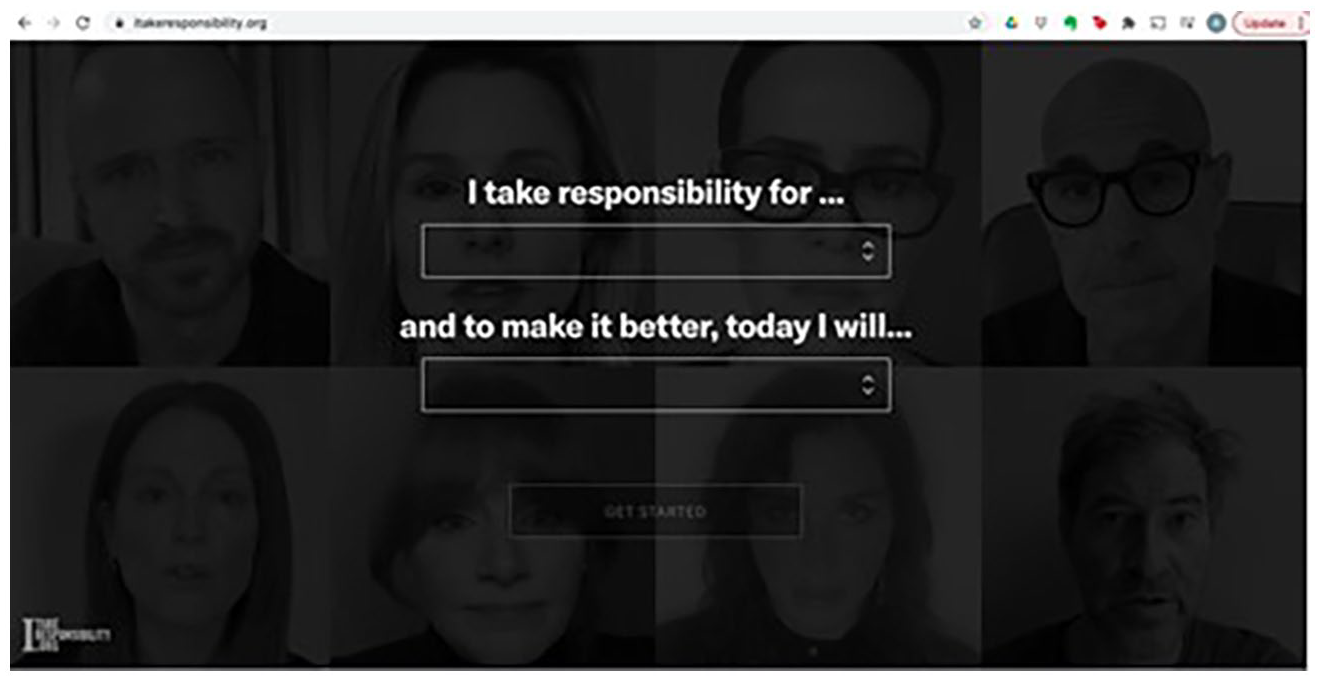
Screenshot of the ‘I take responsibility for. . .’ website homepage.
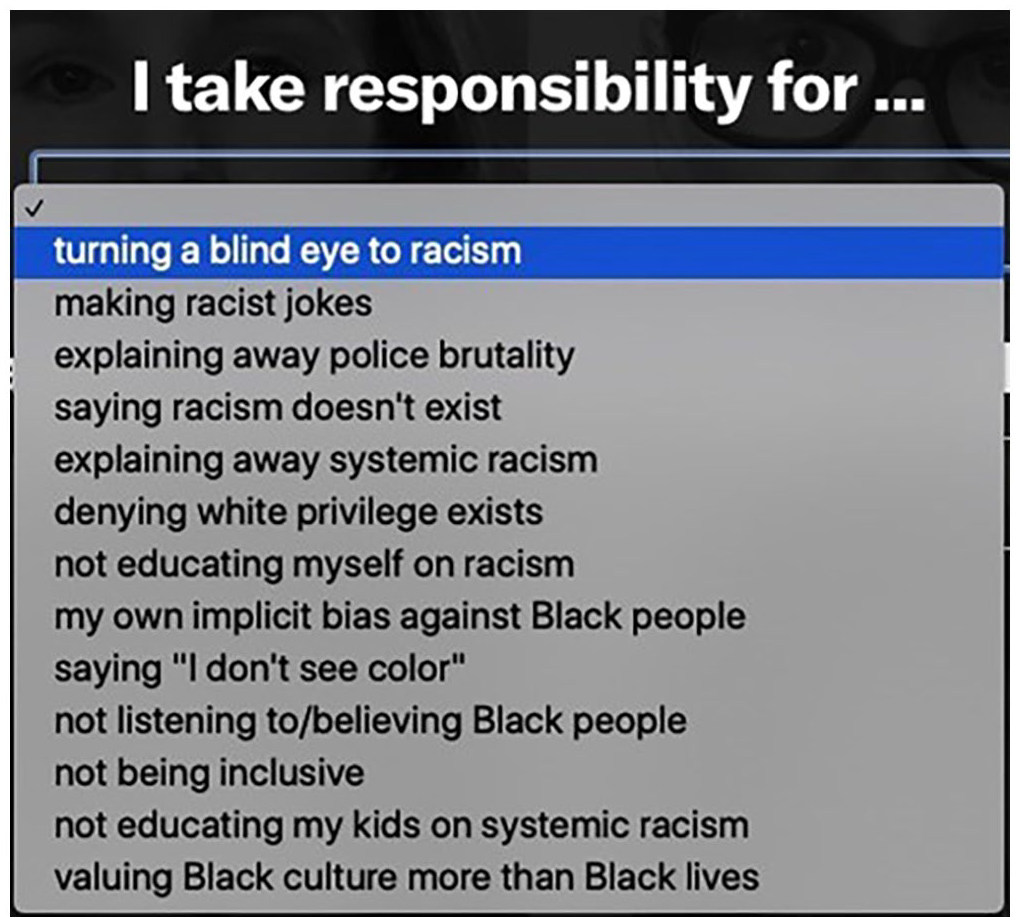
Screenshot of the ‘I take responsibility for. . .’ website drop-down menu.
The intensely earnest and highly stylized ‘I take responsibility’ campaign received wide circulation and reporting in the blogosphere, on social media, in tabloid as well as broadsheet press. The campaign initially encouraged viewers to film their own ‘I take responsibility’ video and upload it to social media, somewhat predictably resulting in the widespread spoofing of the initial campaign film. ‘I take responsibility’ was met almost instantaneously with ridicule online, with parodies and jokes abounding in relation to the esthetics, tone, and perceived self-importance of the celebrities involved. Some of the critiques that emerged implied that the campaign was symptomatic of the crass ‘celebrification’ of racial justice work (Coley, 2020; Sobande, 2022), a process that involves (often white) celebrities becoming the (palatable) face of activist movements. On Twitter, users joked about their audition videos not being welcomed for the campaign, the overly dramatic montage format, and the repetitive nature of the script. Others skewered the actors for presuming they could solve violence through appearing in this campaign.
The sentimental and savior style tone of ‘I take responsibility’ seemed to be reminiscent of the widely critiqued 2017 PepsiCo ‘Live For Now’ commercial, which featured model and media personality Kendall Jenner offering a police officer a can of Pepsi which miraculously appeared to diffuse tension between protesters and police. Just as ‘Live For Now’, arguably, responded to the visibility and work of Black Lives Matter (BLM), so too did ‘I take responsibility’. In other words, the ‘I take responsibility’ campaign was an exemplar in a contemporary genre of media and marketing that unironically foregrounds white American celebrities as part of messages about racial justice and activism more generally.
While ‘I take responsibility’ certainly garnered a high degree of visibility, the merit of such visibility was highly contested, even as this contestation raised the visibility of the campaign itself. Central to such contestations was critique of how the campaign appeared to platform white celebrities in ways that involved forms of virtue signaling (e.g. acknowledging ‘white privilege’), rather than indicating their involvement in substantive action to address antiblackness and white supremacy.
We discuss this campaign as an illustration of the contemporary cultural terrain, a moment in which judgments of so-called ‘wokeness’ or ‘performative wokeness’, as it is also termed, have become a shorthand for assessing antiracist activist identity. As ‘woke’ has become a vague but polarizing catch-all for wide-ranging concepts such as activist, feminist, liberal, anti-capitalist, and of course, antiracist, it has moved considerably beyond its resistant roots in African American culture in ‘staying woke’.
We outline three dominant frames through which ‘woke’ has been understood. ‘Woke’ circulates first, in connection with ironic right-wing humor and critique mobilized against a perceived left wing, ‘social justice warrior’ sensibility. ‘Woke’ thus materializes as the latest iteration of the ongoing ridicule of ‘snowflake’ millennial and Gen Z culture. Second, and with some connections to the first, ‘woke’, most commonly articulated as ‘performative wokeness’, is connected to criticisms of inauthenticity in social media culture. ‘Woke’ here draws on discourses of online ‘slacktivism’ as opposed to ‘real’ work for change. Third, ‘woke’ becomes visible as aspirational corporate culture aligning itself with social justice values; ‘woke’ is a desirable brand identity packaging socially progressive affects in consumer form. We finally propose a fourth way of seeing ‘wokeness’, as an everyday response to the personalized calls to ‘make change’ within an unequal economy of visibility within which (self)representations are seen as a primary form of meaningful action (Banet-Weiser, 2018), including as embodied by celebrities (Kanai, 2020). We thus seek to complicate but also draw connections between these dominant lenses, arguing that in the iconic ‘woke’ subjectivities that circulate, the affective circulation of irony, authenticity and what we note as ‘white sincerity’ require further analysis.
Understanding the contemporary terrain of ‘wokeness’
Frame 1: ‘Woke’ as the new snowflake
The so-called ‘culture wars’ of online political culture have become well known in recent years. These ‘embarrassing and toxic’ culture wars, represented by a vitriolic and violent alt-right and an ‘unhinged’ left, as Nagle (2017:117) has famously argued, structure the antagonism that follows sincere attempts to ‘do right’. As such, scholars have highlighted the abusive and bad-faith engagements with the idea of ‘woke’, but less attention has been paid to how the racial politics of perceived expressions of sincerity are entangled with notions of ‘wokeness’ and genres of social media content.
In the contemporary terrain of ‘wokeness’, figures such as the social justice warrior (SJW) exemplify the structures of such antagonism. As Phelan (2019) suggests, the mobilization of such ‘woke’ figures, or ‘default antagonists’, often serve as a way through which right-wing identities secure ideological coherency. Positioned as a common antagonist, the SJW enables an ideological affinity between the alt-right and self-described ‘classic liberals’ like Jordan Peterson. Interestingly, the term ‘snowflake’, which is sometimes used interchangeably with ‘SJW’, alludes to whiteness (that of a snowflake). Accounting for the various ways that ideas about and images of whiteness circulate amid discourse on ‘wokeness’, we consider how allusions to ‘white sincerity’ animate contentious campaigns such as ‘I take responsibility’. By ‘white sincerity’ we mean the concerted use of the image of white celebrities and an acutely earnest tone in portraying a serious investment in addressing racism. Similar in some ways to the intense earnestness Banet-Weiser (2018) notes in relation to high profile popular feminist campaigns, moving beyond merely critiquing the campaign, we consider what key components of it and responses to them reveal about both the racial and celebrity politics of notions of ‘wokeness’.
Importantly, Phelan (2019) situates the SJW as part of the broader neoliberal practice of ‘moralizing Others’, as demonstrated by similar terms like snowflake and the politically correct. In Joe Rogan’s podcast, The Joe Rogan Experience, the SJW is positioned as a hysterical and overperforming figure comparative to the host, who attempts to appear ‘reasoned and logical’ (Phelan, 2019). Indeed, in his podcast on June 16, 2020, Rogan made fun of the ‘I take responsibility’ video, labeling the celebrities as virtue signaling and desperate for attention. Rogan mocked the celebrities saying they constantly need to be told ‘how great they are’ and described them as so ‘wrapped up in liberal progressive ideology, they can’t see how dumb this looks’. Although the underpinnings of Rogan’s critique are decidedly right-wing, the cynicism that is conveyed is not exclusive to that political position. Such critique of the perceived posturing and performing in ‘I take responsibility’ reflects how racial justice campaigns that appear to convey a sense of ‘white sincerity’ are interpreted in ways which include skepticism and sometimes, derision, by other white people across the political spectrum.
In the ‘I take responsibility’ campaign, the influencers and celebrities who put themselves out there in ‘taking responsibility’ became high profile examples of white people who ‘got it wrong’ while trying to ‘do right’. As Graefer (2016) writes of affective capitalism, the ridicule and shaming of celebrity is an established genre of entertainment; yet, while such critique might be seen to be ‘democratizing’, it further embeds audiences within circuits of consumption that reinforce unequal structures of individuality under capitalism. For example, there is the tendency in such ridicule to perpetuate the practice of centering the individual, such as the celebrity, in an effort to expose and reveal one’s subjective motive. We add to this that such ridicule, while seemingly ‘on point’ in mocking high status white celebrities, does not necessarily fundamentally grapple with whiteness as a form of relationality or critically grasp the racial capitalist market logic which incites media and marketing professionals to draw on white sincerity in campaigns such as ‘I take responsibility’. Indeed, as Ahmed (2004) indicates, declaring whiteness can shield from accusations of complicity; and in an environment in which the ‘call out’ (Clark, 2020) also participates in economies of visibility.
Frame 2: ‘Woke’ as inauthentic
There are some continuities between the ridicule of ‘woke’ as a ‘soft’, sensitive subjectivity and the critiques of ‘woke’ as a self-serving and inauthentic form of activism. Here, ‘woke’ is considered ‘Instagram’ activism, associated with superficiality and the purely esthetic. As Corbett (2021) notes in Refinery29, when writing about ‘How Instagram Changed Protesting’, ‘activism took an aesthetic form on social media’. This esthetic form often denotes ‘the pastel-hued, swipeable explainers that condense complex issues of racism and inequality into digestible, social media-ready form’ as put by Morris (2021) for Metro. In Frazer-Carroll’s (2021) words in The Independent on the rise of Instagram infographics on injustice, ‘as their dominance has grown, so has criticism (and the memes), with some pointing out their propensity to oversimplify complex issues and mocking their now-ubiquitous pastel aesthetic’. Articles such as ‘The Rise of the Wokefluencer’ (Wolf, 2020) reflect increasing media, marketing, and public discussion about the nexus of notions of ‘wokeness’, branding, commerce, and influencer culture.
What we gather from these critiques of ‘wokeness’ as inauthentic is the knottiness between social media’s support of visibility as a primary means of doing politics, and visibility as highly entangled with judgments around authenticity and sincerity (Banet-Weiser, 2012). Indeed, questions around sincerity are exemplified by the ‘I take responsibility’ video, which we situate as part of a wider genre of social media that is implicated in the ‘celebrification’ of social justice and political issues, including the ‘Imagine’ video and Annalynne McCord’s video addressing Putin.
The ‘Imagine’ video was posted by actress Gal Gadot in March 2020 at the start of the coronavirus (COVID-19) pandemic. The video featured celebrities such as Natalie Portman, Zoë Kravitz, Kristin Wiig, and Will Ferrell singing a line from the iconic song of the same name. Gadot captioned the post, ‘We are in this together, we will get through it together’. Many criticized the video as ‘tone deaf’ and it was widely ridiculed with many parodies made in reply. In another instance, this time in response to Russia’s invasion of Ukraine, former 90210 actress AnnaLynne McCord uploaded a video of herself on Twitter earnestly reciting a poem directed toward Putin: ‘Dear Mister President Vladimir Putin, I am so sorry I was not your mother / If I was your mother / The world would have been warm / So much laughter and joy / Nothing would harm’. The poem went viral and McCord met with widespread derision for her ‘gloriously unhinged’ video that ‘completely disregard[ed] complex geopolitical realities’ (Di Placido, 2022).
There is much to be said about how purported critique of this ‘inauthenticity’ itself feeds on economies of visibility. For example, Influencers in the Wild, a humorous Instagram account with 4.9 million followers, has based their account around posting submissions ‘catching out’ influencers in the moment of their content creation. During BLM activity in 2020, Influencers in the Wild posted several photos of influencers posing at protests; most often, but not only, young white women. George Rech, who runs the account, told The Guardian, the ‘difference between authentically participating in the movement and using it as a photo op is obvious to most followers’. Influencers in the Wild exemplifies the invitation to audiences to continually monitor claims of authenticity, legitimacy, and consequently, sincerity, in participation, without itself dismantling such practices of hypervisibility. Unfortunately, the antiracist message, we suggest, often gets lost when ‘wokeness’ is contested primarily through the parameters of superficiality and depth, while intensifying what are often highly gendered stakes of ‘fakeness’ and failure (Bratich, 2011).
Frame 3: ‘Woke’ as branding
On other occasions, the label of ‘woke’ becomes a badge of honor for brands whose reputation appears to set them apart from less ethical competitors (Erving, 2021).
Indeed, the visibility of ‘wokeness’ as a cultural shift has exploded precisely as advertising and branding professionals have become increasingly keen to assuage consumer concerns about the values of corporations (Kanai and Gill, 2021; Rosa-Salas and Sobande, 2022; Sobande and Klein, 2022). For Mogaji and Nguyen (2021: 4), ‘[p]eople are more aware, brands are “woke” to the prospects of commercialization and consumers are more demanding’.
While corporate culture in the wake of the anti-globalization movements of the 1990s was understood in an antithetical relationship with social justice, it is now presented as leading in terms of advocacy. For example, in 2018, Nike sponsored the Black American athlete Colin Kaepernick in the wake of his expulsion from professional football for his performance of solidarity with the #BlackLivesMatter (BLM) movement (Crockett, 2018, 2022). In a spectacularly less successful campaign in 2017, PepsiCo also attempted to align its brand with BLM, in an advertisement featuring Kendall Jenner in a youthful protest culminating in a peaceful encounter with police.
The mixed reception of Pepsi’s advertisement, however, does not negate the pull of social justice for corporate giants as a form of branding, whether it be in promising ‘inclusion’ of diverse bodies in advertising (Kanai and Gill, 2021); or athletes exemplifying ‘Black excellence’ (Sobande, 2019). Historically marginalized and minoritized populations in the West are now frequently highlighted as brand ambassadors; diversity in commercial representation is held up as perceived proof of companies’ commitment to change, but such changes at the level of media representations should not be mistaken for significant structural shifts (Warner, 2017). Corporate culture is thus a high-profile culprit for what can be understood as the normalization and depoliticization of ‘wokeness’. The work of Rossi and Táíwò (2020) on ‘woke racial capitalism’ offers crucial insights regarding the rise of brand ‘wokewashing’ and ‘the limits of representation’. Further still, such work examines esthetic dimensions of what they term ‘woke racial capitalism’ (Rossi and Táíwò, 2020), such as an ‘increasingly popular newfound antiracist aesthetic of the ruling class’.
Yet, in acknowledging the complexity of these contests over meaning, we also wish to avoid portraying the direction of movement on this terrain as purely one of commercialization and consequent ‘depoliticization’. It is important to note the contemporary significance of ‘wokeness’ is due, in part, to the commercial success won by Black writers, creatives, and cultural producers specifically addressing racism. For example, ‘woke’ enjoyed greater visibility in 2008 in singer Erykah Badu’s song Master Teacher, and more recently, in 2017, the impact of the song Redbone by hip hop artist Childish Gambino arguably contributed to the notion of ‘wokeness’ being taken up within contemporary mainstream media culture. The repeated refrain ‘stay woke’ of Gambino’s song plays in the opening scene of Peele’s (2017) award-winning directorial debut Get Out, a film achieving mainstream release that deals with the horrors of antiblackness and white supremacy.
Accordingly, we need to consider how the temporalities of this moment, driven by the digital sphere, gives the impression of ‘accelerated rhythms of political shifts’ (Hardt, 2017: 90), inviting not only corporations, but high-profile creatives, activists, and everyday citizens to work out ‘how to metabolize such a moment, how to metabolize race “happening”’ (Jackson, 2020). The feeling that something is ‘happening’, and action needs to be taken, also speaks to the diversity of antiracism, as Lentin (2004: 238) writes, ‘the temporal differences between anti-racisms in different settings, their varying speeds, the diversified conceptualisations of ‘race’ and racism and the radically different standpoints of activists’ appear to ‘contribute to ensuring that something is always “going on”’.
Frame 4: The ambivalence of ‘wokeness’
When examining how ideas about ‘wokeness’ have developed in and through popular and consumer culture, it is worth also understanding a broader discursive and affective shift in media and popular culture in the place accorded to activist movements. If we take seriously such movements as part of shifts in culture, it is necessary to unpack these movements, not simply in terms of binaries of ‘commercial’ versus ‘grassroots’, nor ‘conservative’ versus ‘progressive’. Rather, it is essential to examine the ambivalence at play amid discussions and debates about ‘wokeness’.
Social media supports visibility as a primary means of doing politics (Banet-Weiser, 2018). In this context, we suggest that ‘woke’ is a response to both the increasing but uneven pressures and rewards of being recognized as ‘woke’, heightened by the rhythms and infrastructures of social media. This requires making the self visible in particular ways to audiences, and to be attributed with enlightened progressive values as a personal and/or brand identity. The ambivalent status of ‘wokeness’ is thus evident if we reflect on the conflicting ways in which the actions of people may be simultaneously praised and policed for allegedly being ‘woke’.
We suggest it is most productive, then, to understand ‘woke’ as a terrain beyond the binaries that can emerge in the above three frames: it is not simply about the calculated appropriation of social justice by corporations; the trouble, concerted right wing attacks on left politics; nor the question of effective politics versus slacktivism. Rather, ‘woke’ crystallizes the contestations over subjectivity that arise when visible declaration and taking a witnessable stance on racism and other social justice issues, become the dominant, legible form of doing politics. It indexes the anxieties and ambivalence felt by citizen-consumers desiring to participate in culture and leave their ‘mark’ in a different way, driven but also complicated by the politics of authenticity, neoliberalism, commodity activism (Banet-Weiser, 2012; Mukherjee and Banet-Weiser, 2012), and heightened backlash against progressive movements that intensify the awareness and feeling that something is ‘happening’. Such desires are multifaceted and interweave with ‘whiteness as usual’, and in an environment where white people disproportionately benefit from visibility.
For example, among critiques of the use of speech are observations of moments when so-called ‘woke’ white people are perceived as speaking over or for Black people on systemic social injustices such as antiblackness in a proprietary and self-congratulatory way (e.g. the ‘I take responsibility campaign’). Indeed, these sometimes self-congratulatory practices are exemplified by the popularity of Robin DiAngelo’s concept of ‘white fragility’ through which such confessions of whiteness have now become a popular way to accrue social capital and praise. At the peak of the BLM movement in 2020, notably, antiracist reading lists, collections of texts, including DiAngelo’s book, meant to elevate the public’s knowledge of the struggles of Black people, were widely circulated on social media, including as part of efforts to express a sincere concern with addressing racism. The hypervisibility of such lists aiming to better ‘educate’ the self on race also brought to light the question of who is imagined as an antiracist actor. When Jackson (2020) asks: ‘who is this for?’, we are reminded of Ahmed’s (2012) observation that ‘antiracism’ is increasingly thought of as a white attribute. Despite the well-meaning nature of antiracist reading lists, they also capture the fragility and anxiety that exists around a moment potentially passing by without being able to leave one’s digital mark on it.
We take care to note, however, that visibility does not necessarily negate political potential. For example, the 2015 ‘BlackOutDay’ on Twitter and Tumblr, as distinct from the 2020 ‘BlackOutTuesday’ on Instagram, was one in which Black users of these platforms aimed to collectively ‘flood the system’ with images of their own faces, carrying hugely affirmative resonances for many (Cho, 2018). Cho (2021) writes that this would be easy to dismiss as ‘millennial clicktivism’ but the mundane and everyday nature of this form of digital participation via the selfie was precisely why it ‘came to matter’ (p. 191). What we argue is that while visibility, and particularly, visible speech, is thus advocated as a primary means of activism in the current moment, speech itself must be located in its relationality (e.g. who is speaking; who is it for), and the performativity of its content. Just as some people may regard ‘silence’ as a form of violence, others may interpret unhelpful ‘white noise’ (Rault, 2017) as being equally potent in its potential to enable, or at least, leave social injustices unscathed.
‘Woke’, then, through this framework, leaves room for ambivalence – it is not an object in need of rescue from right wing attack; it also is not necessarily measured for its ‘effectiveness’. It is subject to the politics of visibility that are refracted through everyday resources, pressures, and maneuvring.
Conclusion
In conversation with work on ‘woke racial capitalism’ (Rossi and Táíwò, 2020) which poses the poignant question ‘What exactly are the interests, actors, and coalitions at play?’, our article highlights the nuances of how digital cultures of hypervisibility are connected to discourses of ‘wokeness’, including related interests (desires to be seen as ‘woke’ and speaking up) and actors involved (from celebrities, influencers to everyday social media users).
The push toward visibility as a bedrock of social media, does not lend itself to straightforward political effects. A simplified account of wokeness on social media might track ‘wokeness’ in some ways as ideas about, and expressions of, activism, resistance, the diagnosis of white complicity, and how social media has significantly provided possibilities of connection and voice for marginalized groups (Jackson et al., 2020), but has degenerated mainly into self-branding or the ‘performance of wokeness’. Yet, the way such dynamics play out can be quite complicated. The competition for visibility and attention in digital culture means that identity categories themselves may often be simplified, mistakenly assumed, reified, and distorted according to the needs of ‘searchability’ and perceived mass appeal (Noble, 2018). Such dynamics of compulsory visibility may not only structure the purported performance of wokeness via white sincerity but additionally the critique of such performance.
Consequently, while our article elucidates key aspects of the relationship between discourses of ‘wokeness’ and digital culture, in doing so we acknowledge the fluid and increasingly contested nature of notions of ‘wokeness’ and the need to bring care and clarity to the ways in which ‘woke’ is operationalized. Overall, our work sheds light on the affective entanglements of ‘wokeness’ with whiteness, the valorization of visibility, and neoliberal identity culture which is digitally mediated. As a result, we theorize the digital development, hyper-visibility, and marketization of ‘wokeness’ in ways that grapple with how internet, consumer, and celebrity culture is implicated in contemporary understandings and expectations of social justice work.
Footnotes
Funding
The author(s) disclosed receipt of the following financial support for the research, authorship, and/or publication of this article: Francesca Sobande would like to acknowledge the support of Cardiff University (School of Journalism, Media and Culture) in covering the open access charge for this article. Akane Kanai would like to acknowledge the support of the Australian Research Council’s Discovery Early Career Research Fellowship in writing this article.
