




Abstract
Throughout its history, the Black Lives Matter (BLM) movement has elicited strong opposition that risks stifling anti-racist progress. This paper examines how support for BLM is argued about and challenged in online settings, focussing on the use of alternative ‘Lives Matter’ hashtags and slogans. BLM and anti-BLM material from 2020 was identified across six online platforms, which generated 1242 data items. Data were subjected to discourse analysis informed by critical discursive psychology. Arguments over the context of racism were a recurrent feature of responses to BLM-supporting posts. The analysis demonstrates the varying ways that alternative ‘Lives Matter’ formulations can be used to display opposition to and undermine BLM. Of these, ‘All Lives Matter’ was used most prominently but also ‘White Lives Matter’ and others. All alternatives to BLM function to obscure or deny the discrimination that Black people face, and so work to maintain the racist status quo.
Keywords
Introduction
This paper examines how the Black Lives Matter (BLM) social movement has been co-opted and undermined on social media by the use of alternative versions of the ‘Lives Matter’ formulation. While the use of the ‘Black Lives Matter’ slogan has been studied, there is as yet no detailed analysis of how this slogan and alterative versions that challenge it are debated in online interactions. Our specific focus shows how anti-racist campaigns more generally might be argued about, challenged and rendered less impactful in online settings, whether intentionally or unintentionally, through the use of particular discursive resources. The paper begins with a brief description of the BLM social movement before outlining the discursive and rhetorical approach as it applies to race talk. That approach underpins the research presented in this paper.
The Black Lives Matter (BLM) social movement
The hashtag (a system used on Twitter to identify messages about a specific topic) #BlackLivesMatter/#BLM was first used in July 2013. It came to prominence after the Ferguson protests in Missouri, USA in August 2014 which followed the fatal shooting by police of Michael Brown, an 18-year-old Black man. Freelon et al. (2016) show how the hashtag was used in social media to draw attention to the killing (over 40 million times on Twitter in the year ending May 31 2015). The BLM campaign states that its ‘mission is to eradicate white supremacy and build local power to intervene in violence inflicted on Black communities by the state and vigilantes’ (blacklivesmatter.com). BLM came to prominence again in 2020 following the murder of another Black man, George Floyd, by a police officer in Minneapolis, USA. At this point the Black Lives Matter movement, which has been described as ‘the civil rights issue of our time’ (Holt and Sweitzer, 2020: 16), went global with demonstrations all over the world. This included the UK where demonstrations took place in cities across the country, with perhaps the most notable event being the toppling of a statue of slave trader Edward Colston in the city of Bristol, in the west of England. Alongside the demonstrations, there were other public displays of support for BLM, including the ‘taking the knee’ gesture by some (mainly opposition) politicians and sports figures, including all high profile ‘Premier League’ football (soccer) teams before the start of each match. As the analysis will illustrate, these gestures were often controversial. Black Lives Matter was therefore a prominent news event in its own right, meaning that debates about race and racism were once again high on the political and news agendas of many Western countries.
Hashtag activism
Alongside the physical BLM demonstrations, which coincided with many Covid lockdowns, there was also an increased use of the #BlackLivesMatter/#BLM hashtag on social media. Online campaigns like this have been termed ‘hashtag activism’ (D’Ambrosio, 2019), that is, discursive campaigning or protest by social media users through the use of hashtags. These can function to spread awareness of social issues through the use of ‘cause hashtags’ (Konnelly, 2015: 2), although attention has been drawn to the limitations of such activism (Chen et al., 2018; Dadas, 2017).
Ince et al. (2017) investigated the use of #BlackLivesMatter/#BLM hashtag and variations of it when it first came to prominence in 2014. They analysed over 60,000 tweets that used it and identified five co-occurring types of hashtag. Of these, four were supportive, making reference to the Ferguson protest, police violence, tactics (for protest) and displays of solidarity. The fifth related to counter protest and opposition to BLM, including hashtags such as #kkk (a reference to the Ku Klux Klan), but also #AllLivesMatter/#ALM and #WhiteLivesMatter. The latter are examined in detail in the analysis offered by the present paper. Other related hashtags that have been studied include #BlueLivesMatter (e.g. Bock and Figueroa, 2018), which has been used to stress the value of police lives, mostly in response to violence against police linked to BLM protests. According to Solomon and Martin (2019) those who use #Blue Lives Matter’ are engaged in ‘competitive victimhood’, the process by which groups attempt to establish that they have suffered more than opposing groups.
In their quantitative study of preferences for BLM and ALM, West et al. (2021) found that those who supported ALM presented it as less racist than BLM. However, they also found that those who benefit most from the (racist) status quo were most likely to show a preference for ALM as well as opposition to BLM. West et al. argued that support for ALM arises from a failure to recognise anti-Black racism and anti-Black bias and that the (supposedly) race-neutral ALM can help perpetuate this racist status quo. These and other studies (e.g. Gallagher et al., 2018) show clearly that, in this contemporary socio-political context as in others, hashtags function not simply as discourse markers but as ideological resources or weapons in the form of slogans in a struggle for discursive control (D’Ambrosio, 2019).
Discursive and rhetorical approach to race talk in online settings
In contrast to much quantitative research, the broad discursive and rhetorical approach to interaction that is used in the present paper does not attempt to understand what speakers or authors ‘really believe’ about issues around race. Instead, it focuses on what is accomplished in interaction about topics, including race (Edwards and Potter, 1992). From this perspective, racist speech is that which ‘sustains and legitimates social inequalities’ (Wetherell, 2003 : 21). This approach has developed a detailed understanding of the ways in which talk about race and racism, that is, ‘race talk’, operates and functions.
Augoustinos and Every (2007) provide a clear overview of five key features of race talk: (1) ‘The denial of prejudice’; (2) ‘The grounding of views as reflecting the external world’, where hearably racist arguments are presented as factual; (3) ‘Positive self and negative other presentation’; (4) ‘Discursive deracialisation’, where the (arguably) racial content of an argument is removed; and (5) ‘Liberal arguments for illiberal ends’, where classic liberal tropes of freedom, individualism, equality, and progress are mobilised to justify racial inequalities. All five of these features of race talk, which can be used separately or in different combinations, can be drawn upon by speakers to abide by the ‘cultural norm against “prejudice”’ (Billig, 1988: 94) whereby presenting prejudicial views can be deemed irrational (Edwards, 2003). Despite this, making accusations of racism can be seen to be a difficult thing to do (e.g. Goodman and Burke, 2010).
There is a growing discursive and rhetorical literature on online race interactions. Goodman and Rowe (2014) demonstrated how online discussions can topicalise what counts as racist itself. Burke et al. have applied the discursive approach to online race interaction, demonstrating that this can be a site of extreme talk, including, for example, displays of explicit support for Nazis and the gassing of Muslims (Burke and Goodman, 2012; Burke et al., 2020). This suggests there may not be such a clear norm against prejudice operating in online settings. Burke et al. (2020) showed how the Facebook page of a far-right group in the UK (The English Defence League) contained representations of Muslims as the ‘new Nazis’ in discussions of reopening concentration camps. Their analysis demonstrated how, in doing this, both Muslims and Jews were othered whilst terrible dehumanising acts were supported. Durrheim et al. (2015) also showed how internet users avoided making overtly racist arguments and denied any racism on their own and others’ behalf in discussions that were discursively deracialised (Augoustinos and Every, 2007). However, Durrheim et al. (2018) analysis demonstrated how deracialisation and denials of racism made talk about race and racism possible. They went on to show how accusations of racism, such as those implied by the use of BLM, can be used to actively mobilise those accused of racism so that they can draw on ‘identify performances’ that can further various agendas relating to racialised issues. Given the anti-racist aims of BLM, these possibilities underline the need to understand how BLM is debated in online settings.
To date, few studies have looked in detail at the use of the All Lives Matter/ALM hashtag. Kil (2020: 30), like West et al. (2021), showed how ALM can be used to undermine the message of BLM because it ‘prioritizes Whiteness through a race-neutral disguise’. Through the use of critical discourse analysis, she identified three discursive strategies through which this is done: (1) the co-option of Black social justice work, where ALM was treated as an equal or interchangeable concept to BLM; (2) fear of Black power or ‘blue’/police power, where US news coverage treated ALM, BLM and ‘Police Lives Matter’ as interchangeable equals, until they were not; and (3) equating ALM with White power, where ALM either meant ‘White Lives Matter’ or at least helped to legitimate WLM.
Carney (2016: 190) looked at how the #AllLivesMatter hashtag has been used to undermine BLM, showing that ‘Many social media users deployed #AllLivesMatter as a way to deny the specific and prominent violence against Blacks by appealing to a larger universal. Thus, in the guise of presumably broader politics, it depoliticized and deracialized the specificity of #BlackLivesMatter’. Equally, D’Ambrosio (2019) and Paul (2019) demonstrated how ALM functioned to remove race from the discussion. Specifically, they showed that ALM deracialised the claims of BLM and thereby maintained the (racist) status quo, while appealing to liberal norms of anti-racism. The use of the ALM hashtag can therefore be seen as the opposite of what Clark (2019) termed ‘digital allyship praxis’ in relation to racial justice, that is, affirming and taking informed action on social media on behalf of a subjugated group. Indeed, its use to undermine BLM could be described as digital antagonism praxis, negating or delegitimising claims about the subjugated status of a group on social media.
We therefore know that #BlackLivesMater works as hashtag activism in support of anti-racist endeavours but that there is also opposition to BLM and, with it, calls for greater equality, often in the form of ‘All Lives Matter’. Despite this there is little detailed understanding of exactly how alternative versions of ‘Lives Matter’ are used in online interactions to resist the BLM campaign, which is why the analysis presented in this paper is necessary. The research question for this analysis is: how are alternative ‘Lives Matter’ formulations used, supported and resisted in online discussions about BLM?
Method
Data
Data were gathered from six social media platforms and contexts. Twitter, Facebook and YouTube were chosen as these are among the most popular global platforms where contributions can involve both text and images (in contrast to Instagram, e.g. which is image-focussed). Twitter generated the most data involving interaction. The comment sections of the online editions of three UK newspapers were included: the Daily Mail, The Sun and The Guardian. These three outlets are seen as embodying and orienting to different political stances and audiences with the Daily Mail and The Sun representing more right-wing views and The Guardian being more left-leaning.
Tweets, posts and comments were gathered from these platforms/contexts in relation to two dates each month (the 8th and 22nd) between May and September (inclusive) in 2020. Those dates were selected to capture material immediately preceding and in response to the death of George Floyd in May 2020. BLM and anti-BLM material was identified by the second author manually entering relevant search terms and hashtags (or hashtag content) into each platform’s search facility (e.g. Black Lives Matter/BLM, All Lives Matter/ALM, White Lives Matter/WLM and also Blue Lives Matter and Police Lives Matter) and, in the case of Facebook, by searching for popular and potentially relevant groups and examining their posts. Given the study’s focus on interaction, original tweets, posts, comments and responses to these were included in the data corpus.
Ultimately the data corpus consisted of 1242 data items (i.e. original contributions plus responses). The ethics of online research are contentious (e.g. Roberts and Sipes, 2018) and there is no universally agreed way of conducting online research without risk. It was decided that the priority was to protect the anonymity of private individuals by removing their names and any profile photographs. Data provided by public figures or organisations were not anonymised.
Analytic procedure
Data were subjected to a form of discourse analysis referred to as critical discursive psychology. The tenets of this approach were expounded by Wetherell (1998) and were initially applied in her work on masculinities with Nigel Edley (e.g. Wetherell and Edley, 1999, 2009). Integrating key aspects of other major approaches to discourse analysis within psychology, critical discursive psychology attends both to the detail of linguistic interaction in a particular context and to broader patterns in collective linguistic sense-making (Locke and Budds, 2020).
The data set was coded by the three authors independently and then collectively, with coding focussed on text and emojis. The authors met regularly online to discuss the coding and analysis. Although images and videos featured in the data set, these were not coded for their properties as images but rather in relation to how they were addressed in comments.
The coding began by identifying explicit instances of ‘Lives Matter’ where the ‘find’ function in Word was used alongside manual coding. Next, these different instances of ‘Lives Matter’ were coded in relation to what was being discursively achieved or oriented to by the comments and specifically by the use of hashtags and hashtag slogans. That is, coding focussed on the ‘action orientation’ of these resources in relation to BLM and its commitments. For example, data extract 1 in the ‘Findings’ section of this paper starts with a news report of the murder of a Black jogger. The initial response to the report (‘Black Lives Matter!’) and the subsequent response (‘All lives matter’) identified the extract as relevant to the research question. The line-by-line coding for categories and discursive constructions noted the specification of the victim’s racial background in the news report headline; the unelaborated use of the ‘Black Lives Matter!!’ slogan in response, albeit with two exclamation marks; the use of ‘All lives matter’, a four-part list of racial colour terms, and a definitive equality or equivalence of ‘race[s] and colour[s]’ in the subsequent turn; and a contestation of that in the next turns, with Black people represented as more likely to experience ‘this type of barbaric acte’ [sic] and with ‘White Supremacists’ invoked to demonstrate that ‘All lives matter’ is not a hegemonic outlook and/or as a call to anti-racism action.
Periodically, codes were reviewed and clustered in terms of their shared or related features and action orientations. For example, the action orientations of deracialisation and re-racialisation were discerned in the codes generated from extract 1. That extract was ultimately used to exemplify ‘ALM as a more inclusive position than BLM’ on the basis of the first two responses to the news report. The codes can be seen to inform the write-up in the next section. However, as noted, other interactional work was observed in the extract and it could also have been used to exemplify resistance to ALM as an alternative to BLM. The presentation of findings in the next section draws principally upon Twitter data as that platform yielded much more extended interactional data than the other platforms.
Findings
This analysis demonstrates how a variety of differently formatted ‘Lives Matter’ slogans and hashtags can be used as digital antagonism praxis to undermine the key message of Black Lives Matter. The most available alternative version of BLM, which is addressed first, is ‘All Lives Matter’ (ALM). This is shown to operate in the following three ways: (i) a supposedly more inclusive assertion of digital allyship than BLM; (ii) a way of signalling direct opposition to BLM; and (iii) a way of demonstrating support for more extreme anti-BLM messages, including ‘White Lives Matter’. While All Lives Matter appears to appeal to a liberal, deracialised, ‘colour blind’ sensibility, the more extreme White Lives Matter, which is addressed second, does not. The use of this alternative slogan is shown to be explicitly about race and is more clearly oppositional to BLM, which can come to be accused of being racist itself because of its focus on Black people, allegedly at the expense of White people. In the third and final section, the analysis demonstrates that it is not just ALM and WLM that are used in online interaction in challenging BLM but that a range of different ‘Lives Matter’ formulations can be seen to be used creatively and flexibly. These function to undermine BLM in three main ways: (i) working to move the debate onto other social issues; (ii) ridiculing BLM; and (iii) attempting to push BLM forward and deal with some of its complexities.
1(i) ‘All Lives Matter’ (ALM) as a supposedly more inclusive position than ‘Black Lives Matter’ (BLM)
In this first example, which is typical of the ways in which different ‘Lives Matter’ formulations are employed, we see ALM being used in its more inclusive form. However, we also see that even this version of ALM is contentious and is itself challenged.
Extract 1. Twitter, 8th
May 2020. ALM as a more inclusive position than BLM.
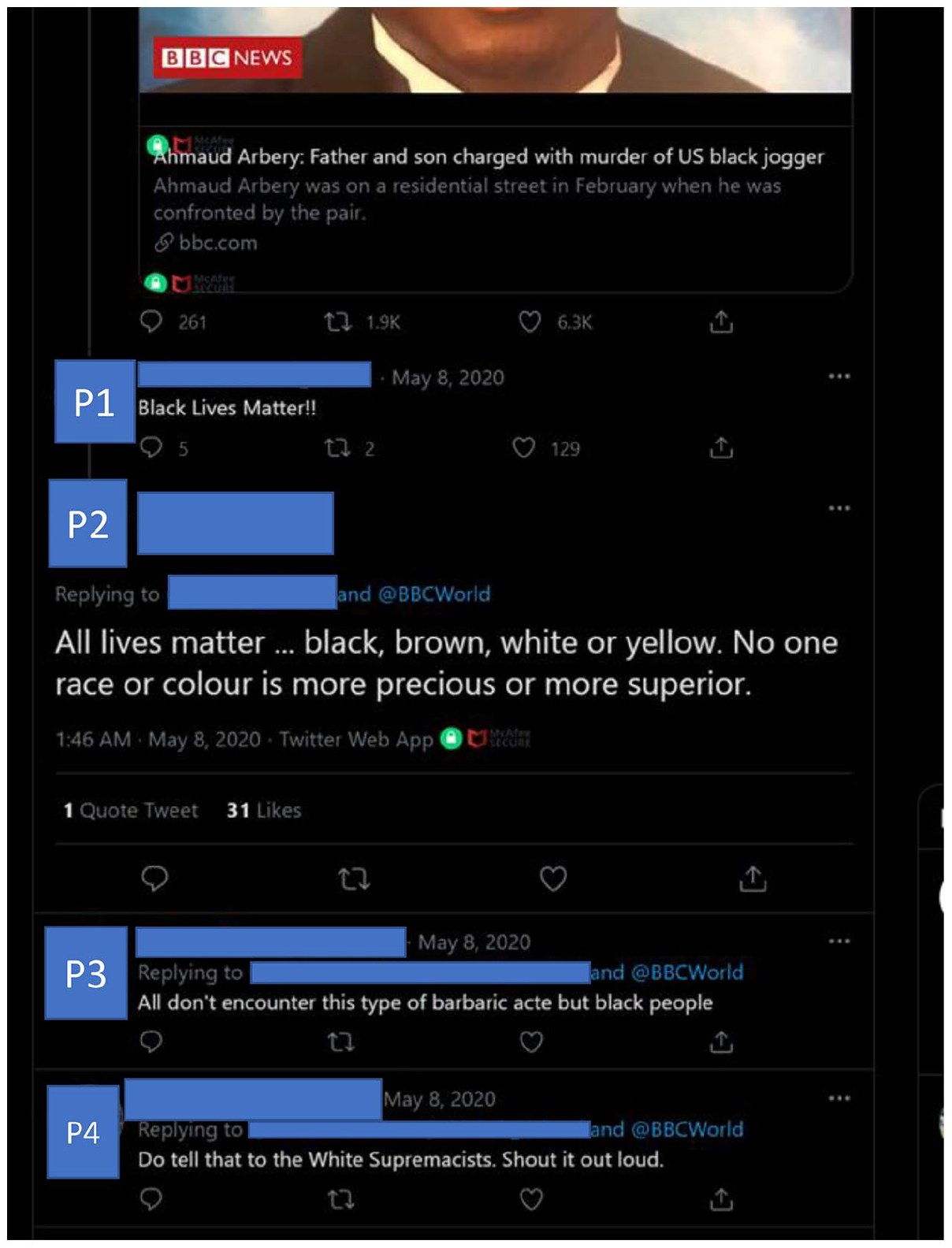
The extract begins with the tweeting of a news report about a murder. The headline makes relevant the victim’s racial background (‘black jogger’) which prompts a response taking the simple form of restating the BLM slogan (‘Black Lives Matter!!’). One response to this use of BLM contains a deracialising argument that begins with a statement of the counter slogan ‘All lives matter’, followed up with four different racialised colours and a statement that all ‘races’ are equal. This use of ALM is supposedly inclusive; it is explicit that Black people are equal to others but this also has the effect of removing the racialised context from the (supposedly racist) murder.
The presentation of ALM as more inclusive decontextualises the racism that Black people experience. In response to P2’s attempt at decontextualising, two of the replies directly orient to this decontextualisation, each in different ways that allude to structural racism. The first claims that Black people are singled out for this kind of violence: ‘All don’t encounter this type of barbaric acte [sic] but black people’. The second, ‘Do tell that to the White Supremacists. Shout it out loud’, makes reference to racism by pointing out the existence of White supremacy. This therefore demonstrates that ALM can be used to decontextualise the racism implicit in both the murder and the use of the BLM slogan but that particular use of ALM is met with resistance that takes the form of highlighting structural racism and therefore recontextualising the racism. As will be seen throughout this analysis, arguments over the context of racism are a recurrent feature of responses to BLM-supporting posts. This is evident in the following extract.
Extract 2. Twitter, 22nd
June 2020. Debating the idea that Black Lives Matter (BLM) means that White Lives do not Matter.
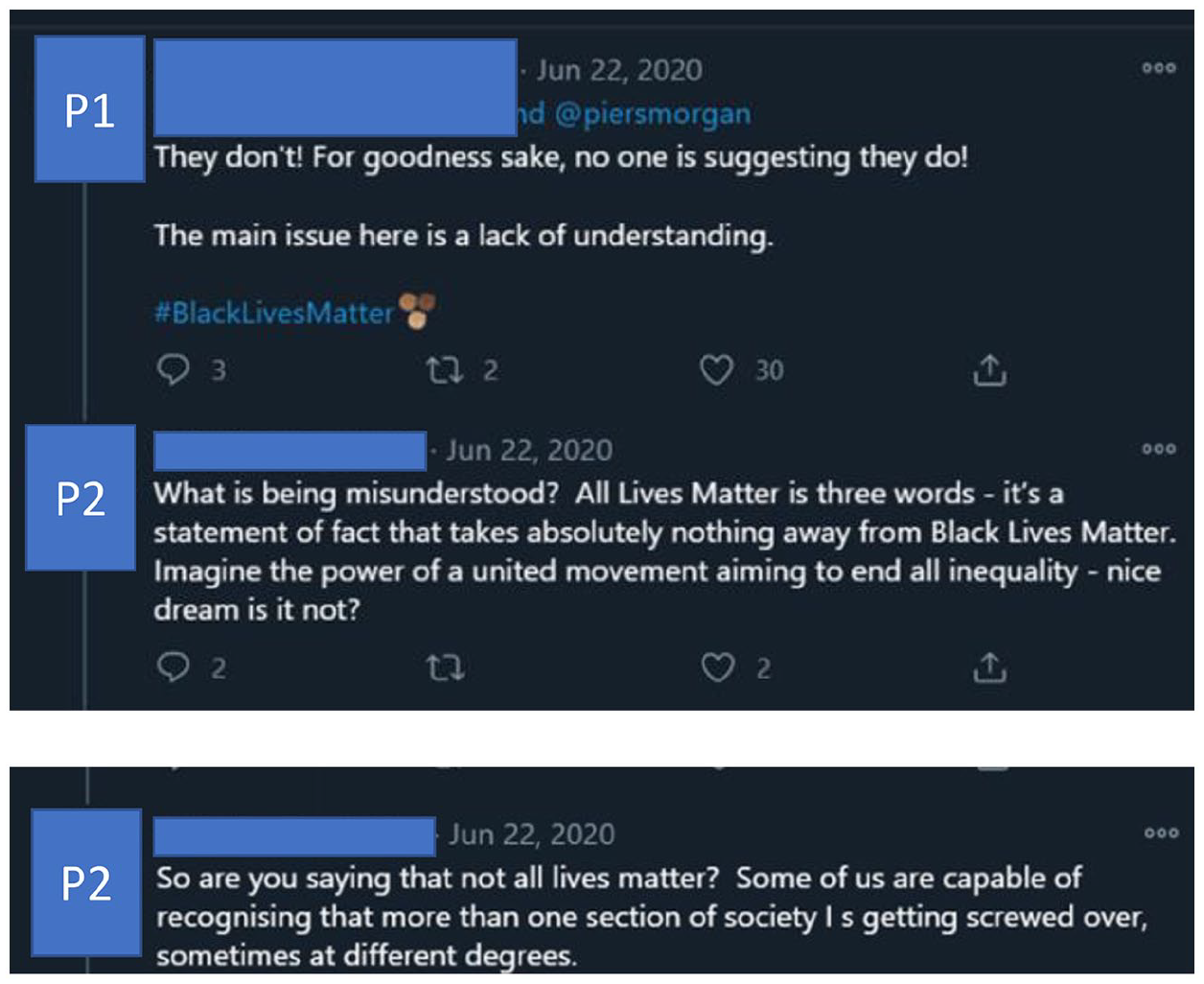
This extract contains a response to a preceding question and comment that presents BLM as exclusive (‘Why should white lives matter less than black lives? We’re all equal #ALLLIVESMATER [sic]’). (That comment is addressed in detail in extract 7a.) P1 takes issue with the idea that BLM means that White lives matter less than Black lives with a direct rejection of this idea (‘They don’t!’). The next line suggests that people do not understand BLM. A ‘lack of understanding’ (or education) is a commonly-used argument and overlaps with insults around ignorance which can often be part of accusations of racism (e.g. Goodman and Rowe, 2014). This explicit rejection of the commonly-used anti-BLM argument that BLM is anti-White is completed with the BLM hashtag. This again demonstrates how hashtags can be used to punctuate comments and to work as an act of defiance. P2 takes issue with P1’s claim that there is a lack of understanding and instead states that ALM does not detract from BLM, even though, as this analysis has demonstrated, it can be used to undermine and replace BLM. ALM is then presented as being about equality (unlike BLM, which is not) and therefore as being a more positive aim.
1(ii) All Lives Matter (ALM) as way of signalling direct opposition to Black Lives Matter (BLM)
As well as being used as a more inclusive alternative to BLM, All Lives Matter can also be used to signal more direct opposition to BLM. An example of this can be seen in the following extract.
Extract 3. Twitter, 8th
June 2020. ALM as direct opposition to BLM.
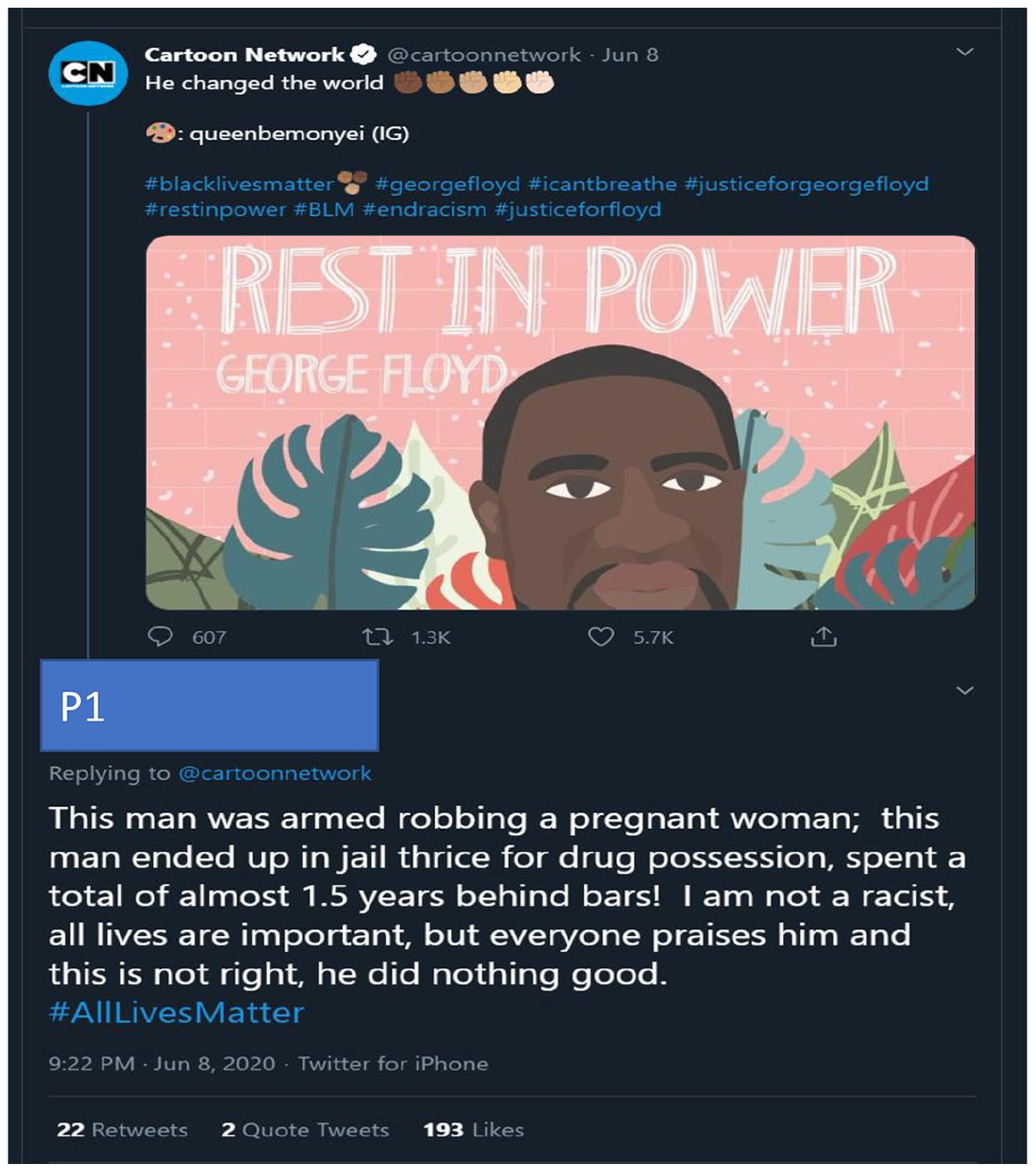
Here the children’s channel Cartoon Network tweets its support for George Floyd and the BLM movement more broadly. This is signalled through the use of two versions of the BLM hashtag (#BLM and #blacklivesmatter) as well as through the different coloured raised fists and the image of George Floyd. One of the many replies takes the form of a criticism of George Floyd who is presented as someone who did not matter, signalled through the presentation of him as violent, a criminal and a drug user. This works to position him as immoral and therefore not worthy of individualised support. The criticism of Floyd, which contains a classic disclaimer (‘I am not a racist’; Hewitt and Stokes, 1975), illustrates how ‘All Lives Matter’ does not actually refer to all lives, and excludes those deemed not worthy enough (see Tileagă, 2007, on moral exclusion), including here the person whose murder reignited the BLM movement. ‘All Lives Matter’ (here used with the hashtag) can therefore function interactionally to signal opposition to BLM.
In this next example, ALM can be seen being oriented to as a way of delegitimising BLM.
Extract 4. Twitter, 7th
/8th
May 2020. ALM is oriented to as a strategy to undermine BLM.
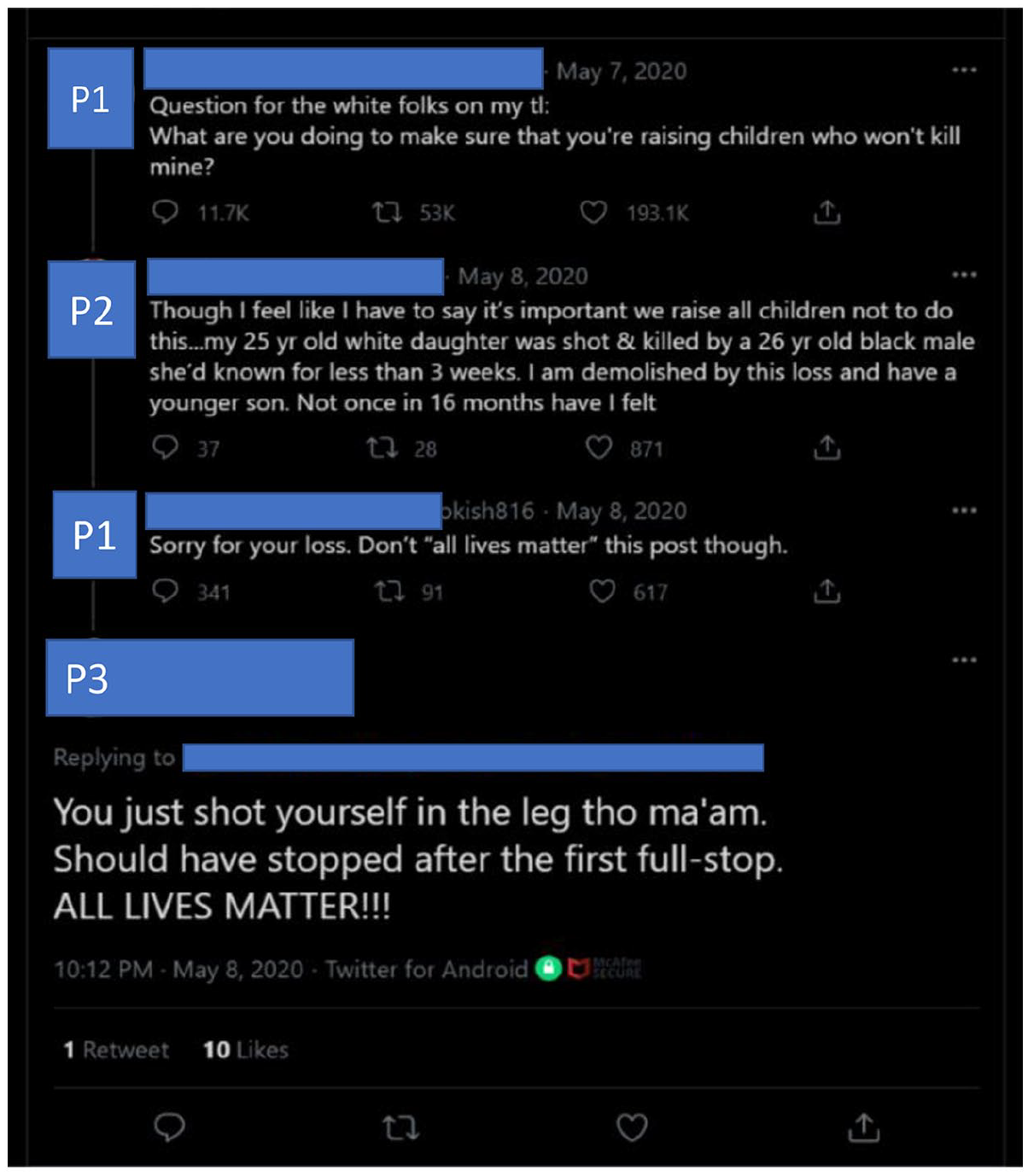
In this example, no direct reference is made to BLM but the first poster makes race and racism salient through the use of a rhetorical question which places the solution to racism in the hands of White parents. The response to this post offers an example of ‘reverse racism’ (Johnson and Goodman, 2013) and uses a personal experience to illustrate a murder committed by a Black perpetrator against a White victim. This crime therefore offers a challenge to the BLM narrative of systemic racism against Black people. It is this challenge that is picked up by the original contributor who acknowledges the crime and its impact, albeit in a limited and minimising way (‘Sorry for your loss’). The contributor then issues a pre-emptive warning against anyone using ALM to undermine her question’s rationale that a specific focus on protecting Black lives is needed. This can be seen in the way in which ‘all lives matter’ is presented as a verb and a recognisable strategy for attempting to undermine the BLM position. This is clearly a critique of and response to the uses of ALM seen in the previous extracts.
One of the many responses to this post presents it as problematic and self-defeating (‘You just shot yourself in the leg tho ma’am’ and ‘Should have stopped after the first full-stop’), suggesting that only ‘Sorry for your loss’ and not the reference to ALM was acceptable. The criticism of ALM seen in the phrase ‘Don’t “all lives matter” this post though’ is therefore deemed inappropriate and something that should not have been stated. This is punctuated by a bold, direct, capitalised and double exclamation-marked statement of ALM which makes a very clear demonstration of rejecting the idea that using ALM to undermine BLM is a problem. This also acts as a further example of ALM being used to signify opposition to BLM arguments.
The following extract shows another argument over the extent to which BLM is exclusive and ALM is inclusive. It picks up a YouTube video in which ALM is being debated, here beginning with the claim that ALM and BLM are compatible.
Extract 5. YouTube, July 2020. Arguing over the inclusivity of BLM and ALM.
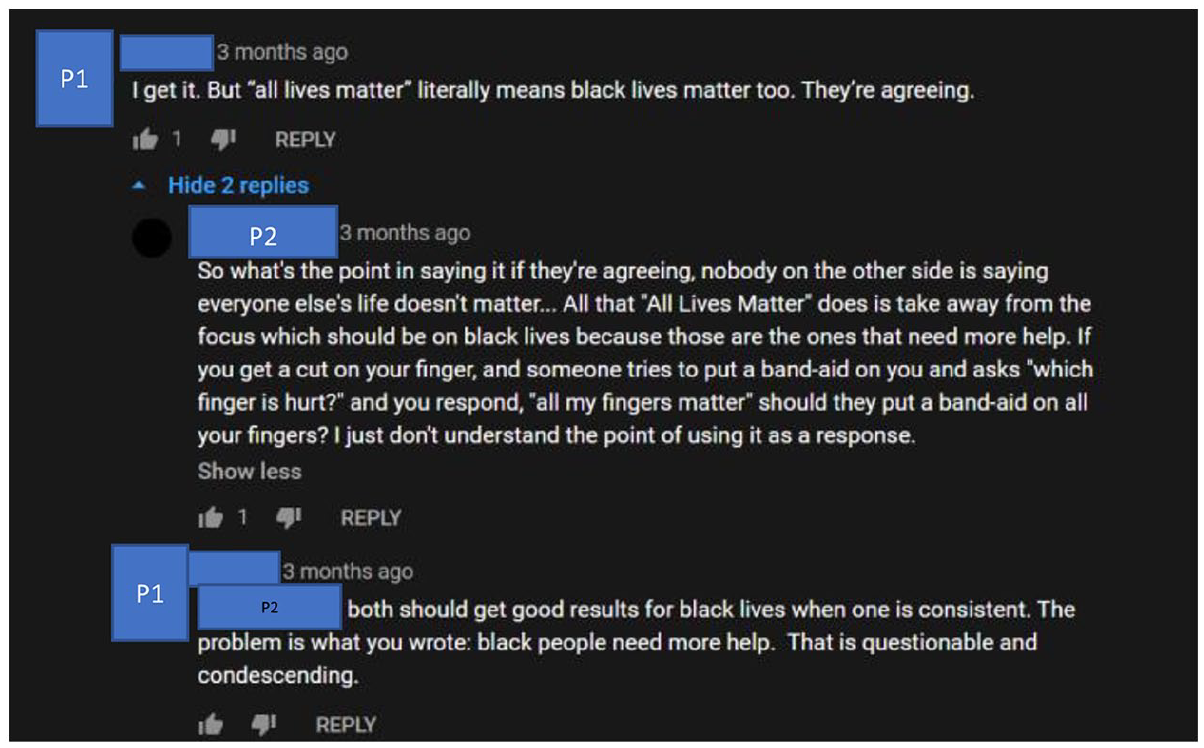
The challenge to BLM here is brought about by explicitly stating that ALM includes BLM, emphasised through ‘literally’. This is an example of the inclusive but decontextualising use of ALM identified in extract 1. There is then a response to this where the point about inclusivity is challenged precisely on the grounds that ALM decontextualises the racism that Black people face and hence operates to ‘take away from the focus’. An analogy of a cut finger is used in an attempt to illustrate how ALM is diverting attention away from where it is needed. The ironic ‘all my fingers matter’ version of the ‘Lives Matter’ format is used to show how ALM can work as misdirection and remove the focus from where it is needed. ALM is therefore criticised as being used only in the service of removing the central message of BLM, so this response serves as a call to recontextualise the anti-racist message of BLM. By making a display of not understanding the use of ALM as a response to BLM, the contributor further challenges its use.
The original poster then responds by reiterating the original argument that ALM does include BLM (‘both should get good results for black lives when one is consistent’) and then addresses the issue of racial context by challenging the claim that ‘black people need more help’. By presenting this as questionable, the contributor is again able to remove the racist context in which BLM exists and hints at such claims themselves being unfair (‘condescending’) to Black people. This opens up the possibility of an accusation of racism being made against those using BLM rather than ALM.
1(iii) All Lives Matter (ALM) as a way of demonstrating support for more extreme anti-BLM messages
As well as working to challenge and undermine BLM, ALM can go beyond signalling opposition to BLM by being used to support more extreme anti-BLM messages, such as White Lives Matter (which is addressed below). In the following example, the argument over ALM versus BLM leads to the use of a recognisably racist argument.
Extract 6. You tube, July 2020. Racist response to arguing for BLM over ALM.
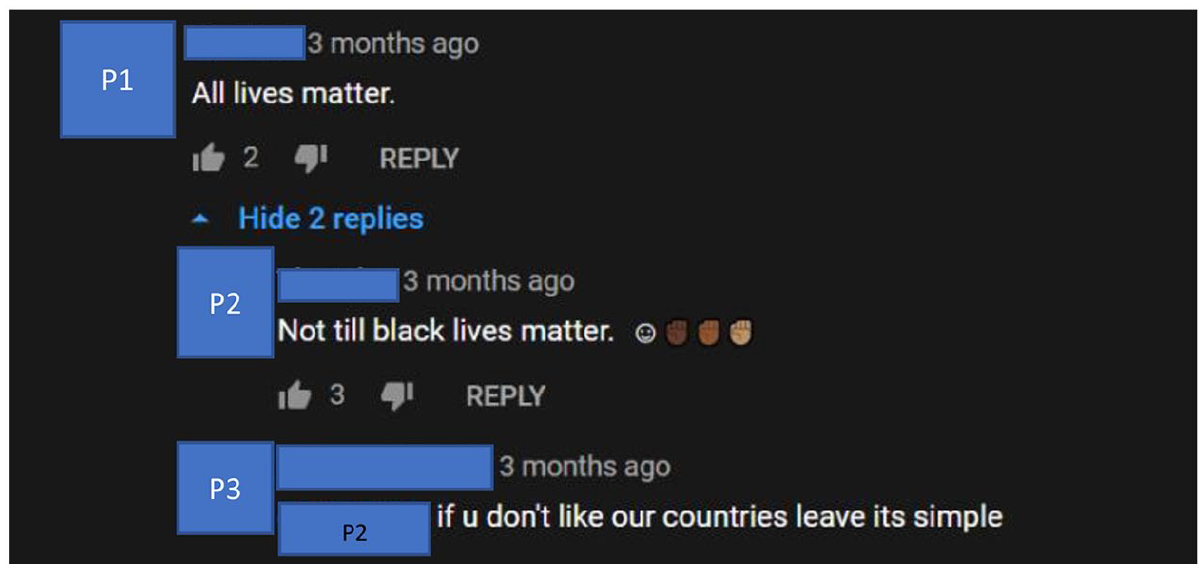
This short interaction begins with a post that simply states ‘All lives matter’. The analysis has by this point demonstrated that while ALM can be seen as inclusive, it can also function in more negative ways. This may explain why the response challenges ALM and attempts to recontextualise ‘Lives Matter’ within its original focus on protecting Black people. This response is punctuated with a smile emoji and three raised fist emojis, each in a different ‘skin tone’ colour to represent resistance to racism. This is a simplified version of the anti-ALM argument seen in the previous extracts. In this example though, the pro-BLM and anti-ALM argument is met with a well-recognised racist trope, ‘if u don’t like our countries leave’ (see Stollznow, 2020). This post therefore does a number of things. First, it challenges BLM. Second, as it is invoked in a thread about ALM, it also works to align with that message. Furthermore, it presents those who assert BLM as being outside of ‘us’ and hostile to the ALM-supporting poster’s country, which implies that Black people do not belong in Western countries and are outside of ‘us’. Because of the use of this racist trope, it also implies that those supporting BLM are themselves Black rather than a mix of people opposed to racism.
2. White Lives Matter (WLM) as resistance to ‘Black Lives Matter’ (BLM)
This analysis has so far shown how ALM can be used to attempt to resist BLM. In the next examples, a more overtly anti-BLM slogan, in the form of White Lives Matter (WLM), can be seen being used to directly oppose BLM. The examples that follow are all in response to a news story about a banner being flown over a soccer stadium in the UK. The banner, which can be seen in the picture below, read ‘WHITE LIVES MATTER BURNLEY’ (Burnley was one of the teams involved in the soccer match).
Extract 7a. Twitter, 22nd
June 2020. Criticism and support for White Lives Matter (WLM).
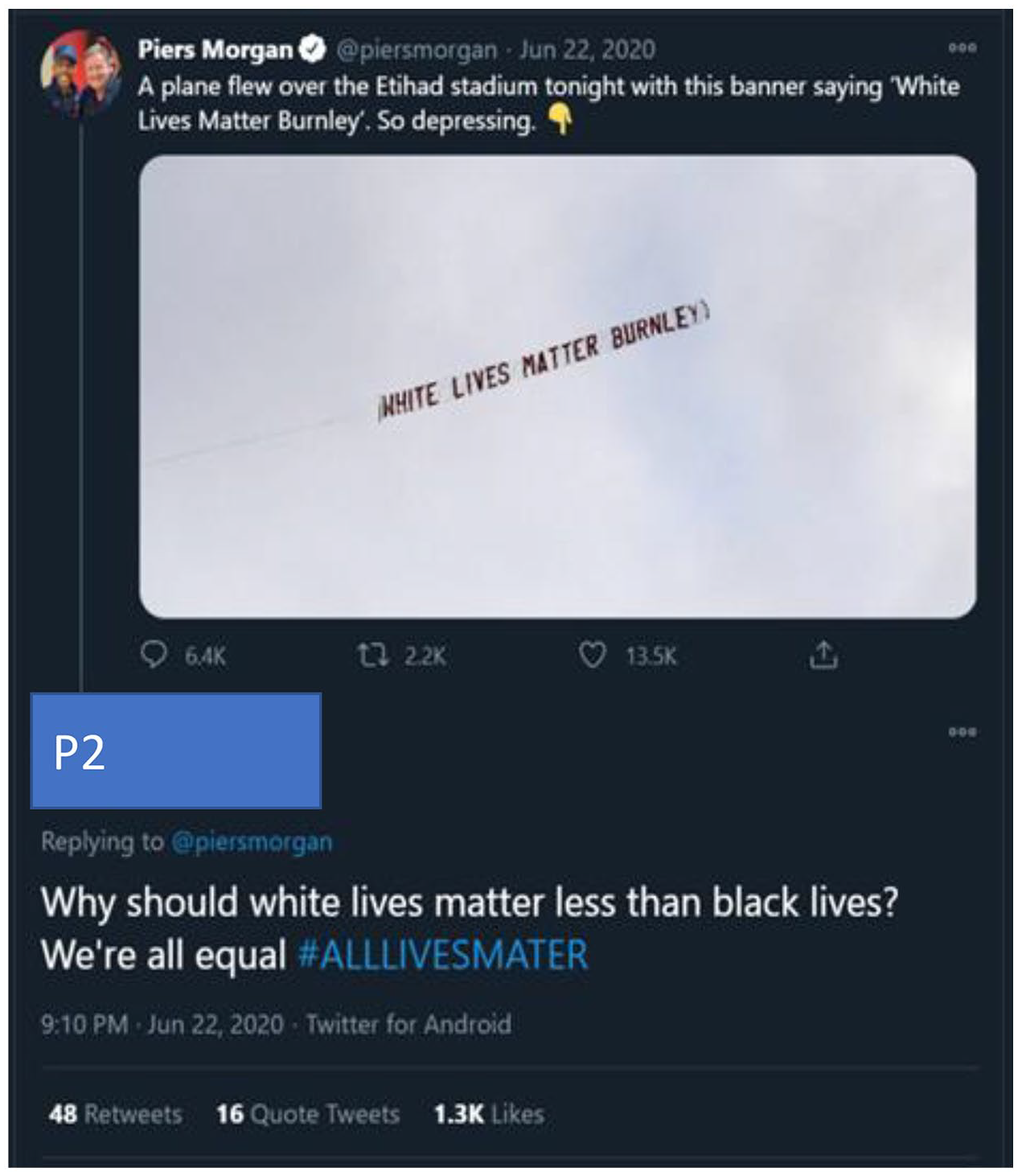
This extract begins with a tweet by a well-known, controversialist British broadcaster, Piers Morgan. The tweet contains an image of the White Lives Matter banner. As the high-profile soccer match included the pro-BLM ‘taking the knee’ gesture (a symbolic gesture against racism whereby an individual kneels upon one knee), it seems likely that the banner was flown in direct response to this. The text of Morgan’s tweet reports on the event and adds his evaluation (‘So depressing’). This makes clear his opposition to the banner, which also highlights how the White Lives Matter statement is controversial. The reference to ‘depressing’ suggests that there is resignation to the existence of racism, which functions to present it as something to be expected and also hard to challenge.
One of over 6000 replies that the tweet generated includes P2 responding by challenging Morgan’s criticism. This criticism is brought about through the use of a rhetorical question which implies that BLM is about ‘reverse racism’ (Johnson and Goodman, 2013) whereby Black people are favoured over White people. The reply concludes with a capitalised All Lives Matter hashtag which, as with previous examples, is used as a show of defiance against BLM. What is particularly noteworthy is that while both the banner being discussed and this post refer to White lives, it is still the All Lives Matter (not WLM) that is used here. This post is clearly critical of BLM and, while White lives are referred to, it is nevertheless the more overtly egalitarian ‘all’ that is used in defence of the ‘White’ lives matter banner. We can see one of the many responses to the first reply in the next extract.
Extract 7b. Twitter, 22nd
/23rd
June 2020. Discussing the merits of Black Lives Matter (BLM) vs White Lives Matter (WLM).
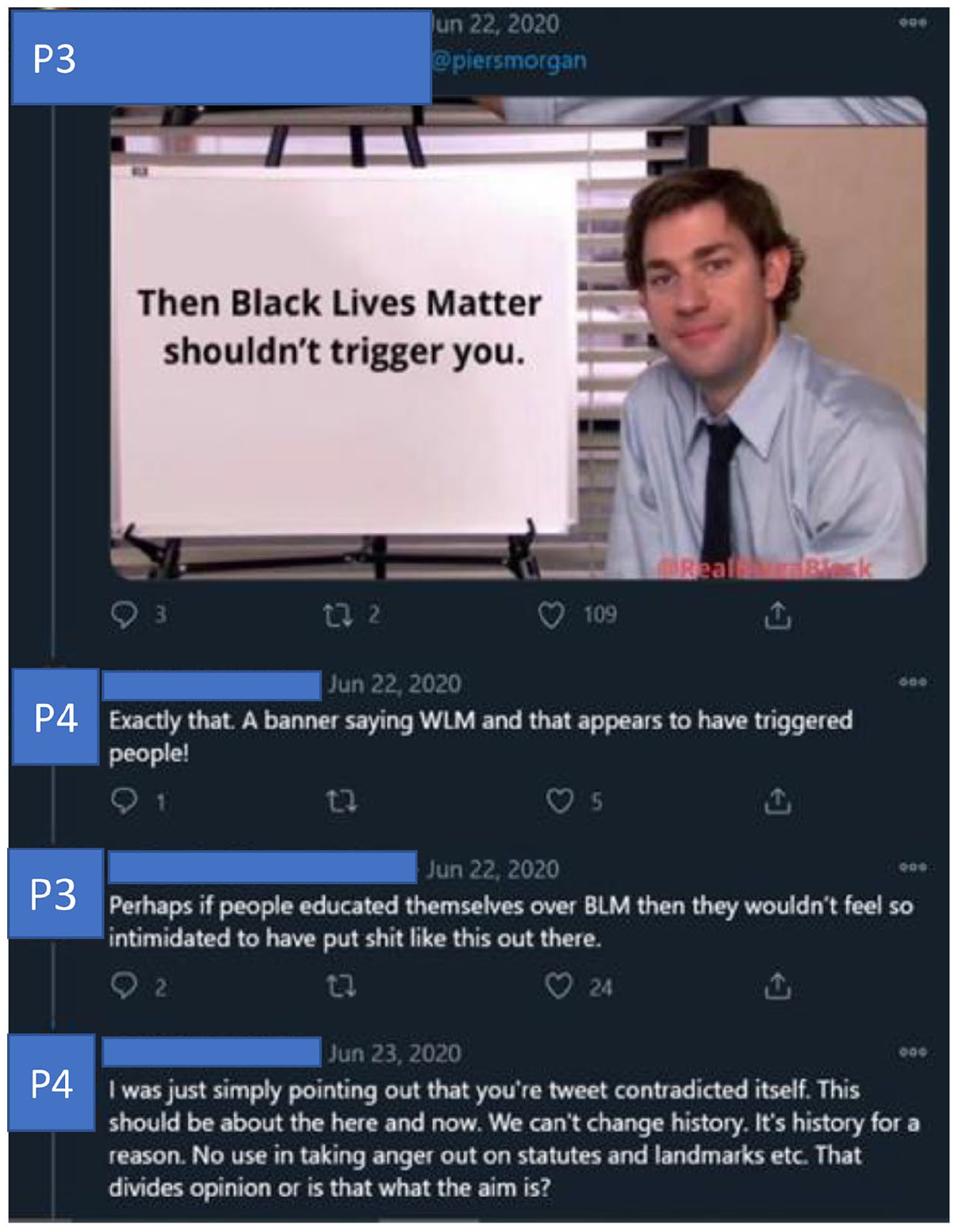
This extract works as a response to the ALM-supporting tweet that was itself a criticism of Morgan’s initial anti-WLM tweet. This tweet (by P3) invokes a very different image, this time of the actor John Krasinski appearing as the character of ‘Jim’ from the US comedy programme The Office, with a message that reads ‘Then Black Lives Matter shouldn’t trigger you’. This implies that, following the logic of the previous post (that everyone is equal), there should be no issue (‘trigger’) with BLM. This is therefore a clear rejection of the suggestion that ALM should replace BLM. P4 criticises this rejection and criticism of ALM by first showing agreement with P3 (‘Exactly that’.) before moving onto the main point which is that WLM should not trigger people. The implication is that if it does, then ‘reverse racism’ is occurring. Next, P3 responds with many of the key features of an accusation of racism (an insult based on a lack of intelligence: see Burke and Goodman, 2012). P4 replies again, stating that the logic of P3’s post is flawed. P4 then attempts to explicitly remove the historical context from BLM, something that is more implicitly brought about by the use of All Lives Matter. This positions racism as something from the past, not the present (van Dijk, 1992), alongside criticism of BLM’s methods, and thereby attempts to undermine the message of BLM. This interaction shows that arguments about support for WLM can be brought about by both invoking ALM and attempting to remove the context (in this case, history) from BLM.
While both ‘All’ and ‘White’ can replace the ‘Black’ in Black Lives Matter to work to undermine its key message, other forms of the ‘Lives Matter’ slogan were seen in the social media interactions about the movement. Broadly, these performed three different functions: (i) working to move the debate onto other social issues; (ii) ridiculing BLM; (iii) attempting to push the movement forward and deal with some of its complexities. Each of these is now addressed in turn.
3(i) Use of alternative ‘Lives Matter’ formulations to move the debate onto other social issues
In this first example, following a Guardian (left-leaning newspaper) article about BLM, the writer invokes three different alternative ‘Lives Matter’ hashtags.
Extract 8. The Guardian, 8th
June 2020. Arguing for a refocus onto other social inequalities.
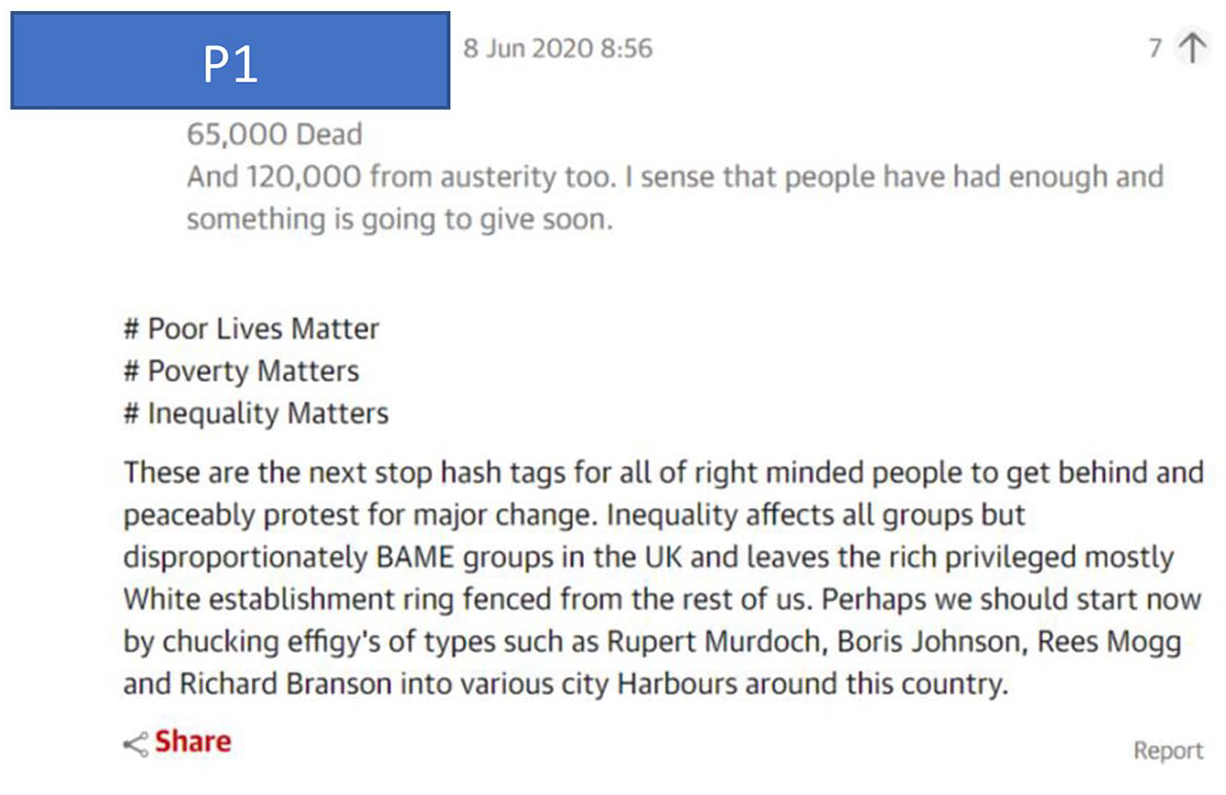
The post begins with a restatement of an earlier comment that refers to austerity and Covid deaths. The post itself begins with three different hashtags. The first of these takes the standard BLM format and replaces ‘Black’ with ‘Poor’. The remaining two continue with the financial inequality focus but drop the ‘lives’, keeping only the ‘matter’ (here ‘Matters’) part of the original format including both poverty and inequality. The rest of the post sets out the argument for why these should be the ‘next stop’ phrases because of the seriousness of inequality and because of how it intersects with ethnicity too, making a claim that the poor are more likely to be ‘BAME’ (an acronym that includes Black people: ‘Black, Asian and Minority Ethnic’) and that those in charge are more likely to be White. While the post is clearly not entirely serious (as the reference to effigies of prominent public figures demonstrates), it does contain a serious point which suggests that there could be a development of BLM that includes an arguably bigger social inequality. Although this post maintains the importance of BLM, it nevertheless reduces its importance and places it lower than income inequality in a hierarchy of inequalities. This can work to downgrade the urgency of addressing racism that BLM calls for.
3(ii) Use of alternative ‘Lives Matter’ formulations to ridicule BLM
The next two examples are of people ridiculing the message of BLM. Both of these follow a report of a pro-BLM dance routine that was included in a popular UK Saturday night television entertainment programme.
Extract 9. The Sun, 8th
September 2020. Geordie Lives Matter.
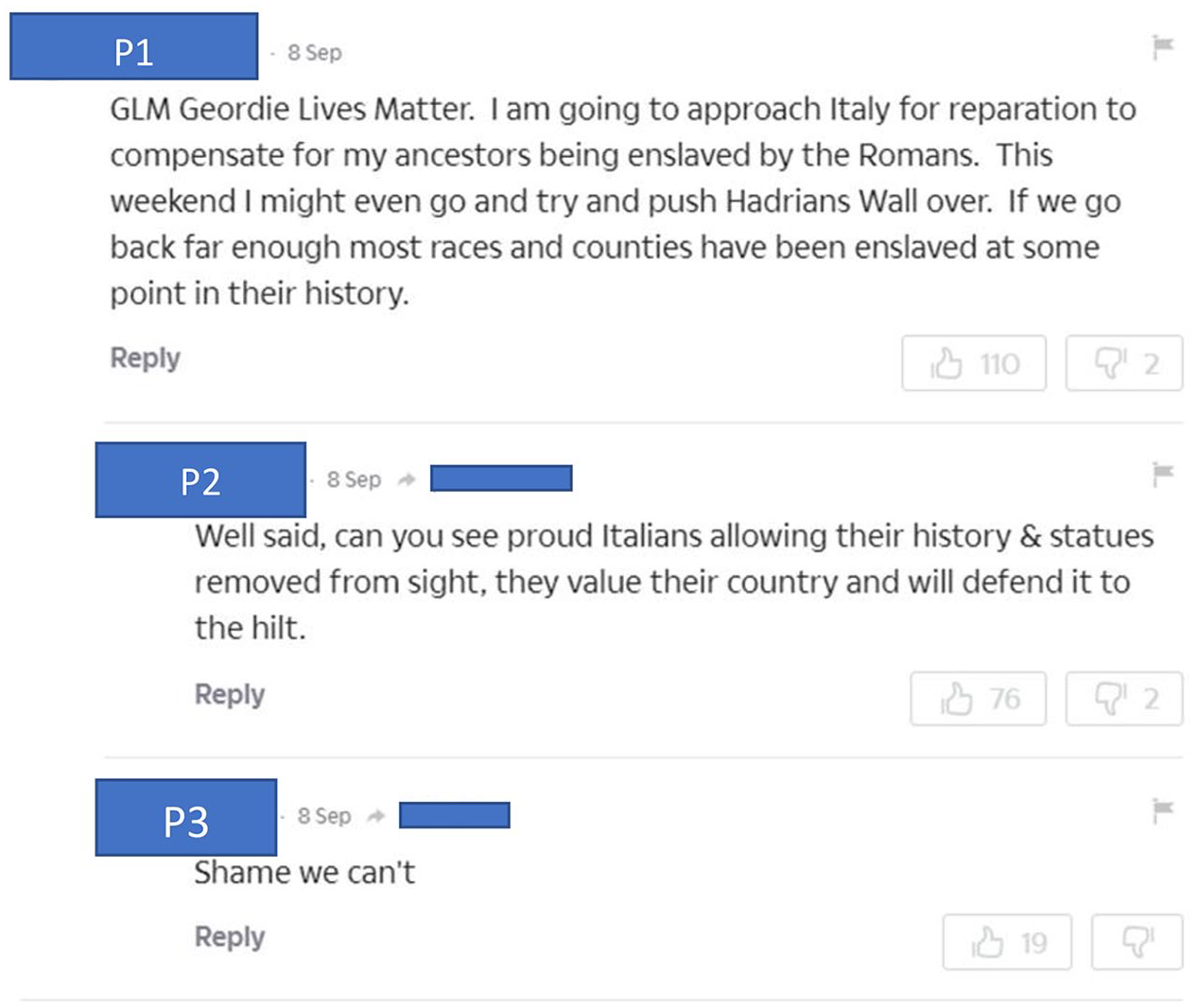
This popular post begins with a joke alternative to the BLM slogan, taking the form ‘GLM Geordies Lives Matter’. (‘Geordie’ is a colloquial term for people who come from the north east of England.) In this post, Geordies are positioned as a minority group that has a history of oppression (here at the hands of the Romans). The initial point is presented as a joke (referring to an event as old as the Roman occupation of Britain and pushing over a symbol of that occupation in Hadrian’s Wall). Yet a more serious point is made that works to criticise and undermine BLM, which is that historically most groups (here ‘races’) have been oppressed. This implies that BLM is concerned with complaining about historic rather than current injustice and is therefore unreasonable, as presumably all groups could find oppression in their histories. This post therefore seeks to present the racism that BLM is protesting against as historical and therefore not currently relevant. (See Kirkwood et al., 2005, for more on history talk in the context of oppression.) In this initial post, it is through the explicit reference to (supposed) racial oppression that the actual racist context of BLM can be undermined and ridiculed.
This initial post was popular and the comments that followed were supportive of the serious point that is made. They did not orient to the less serious part of the post that includes the ‘Lives Matter’ formulation. The first of these supportive responses makes an unfavourable comparison between Italians, as the descendants of the Romans referred to in the original post, and British people, who are criticised for not embracing their history (arguably including its imperial past). According to this post, BLM should be resisted because it is critical of British history and therefore does not value the country. This response is also popular and has its own supportive response, ‘Shame we can’t’, which hints at a more robust opposition to BLM being required.
Overall, this interaction begins with something of a joke but moves quickly to undermine BLM and suggest that it needs to be strongly challenged for its lack of pride in the UK. The next extract also begins with a jokey play on the BLM format that rapidly descends into a racist trope.
Extract 10. The Sun, 8th
September 2020. Benefit lives matter.
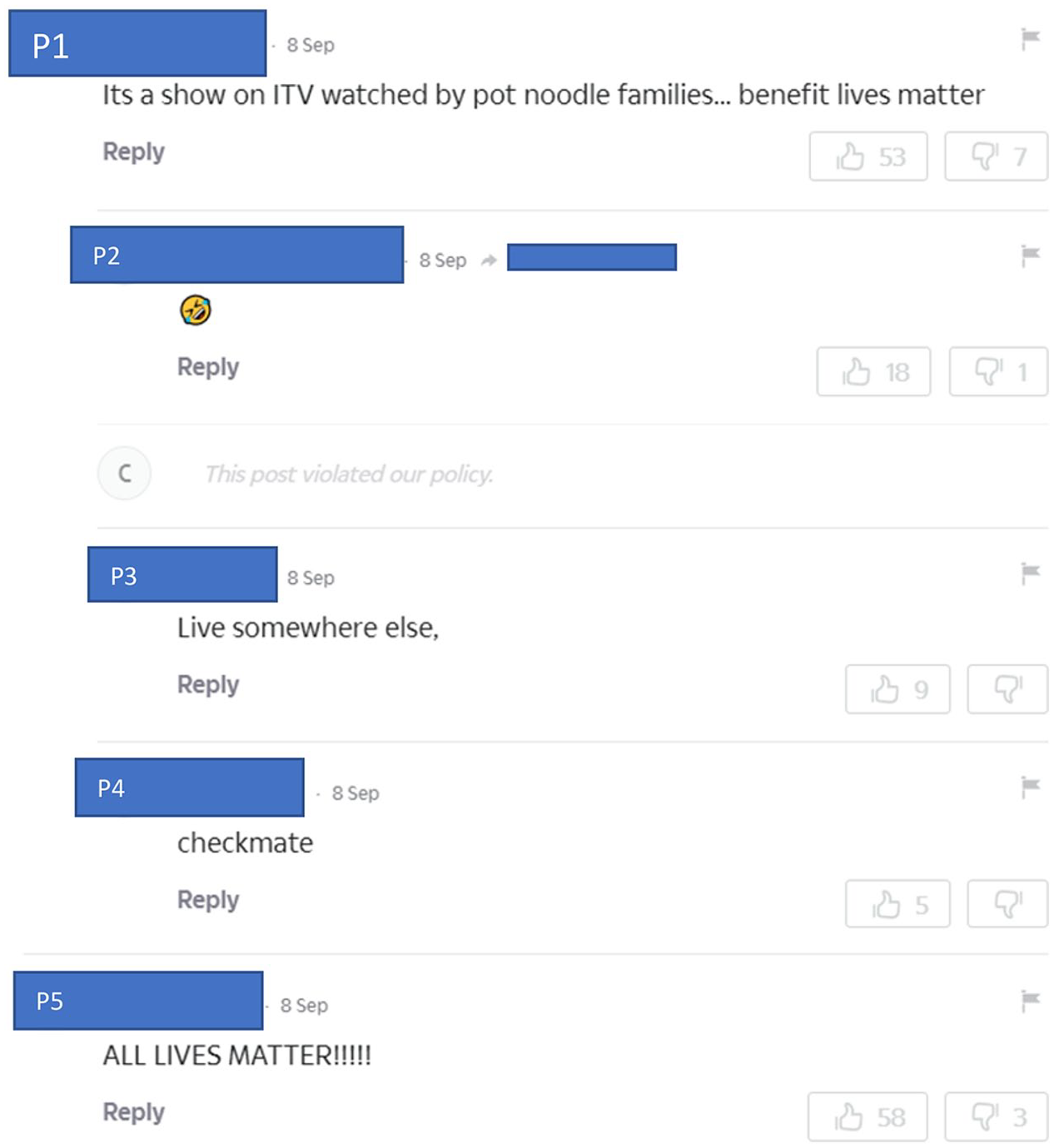
The post begins by criticising not the pro-BLM dance routine itself that sparked extracts 9 and 10 but the programme in which it featured, and this is done by insulting the supposed audience as being ‘pot noodle families’. This is a classist remark based on the cheap and unsophisticated reputation of ‘pot noodle’ (a cheap ‘ready meal’). The insult is then extended to suggest that the audience consists of people on welfare benefits, implying that it is made up of lazy and unemployed people (Jensen and Tyler, 2015). It is the term ‘benefit’ that replaces ‘Black’ in the BLM formulation, which means that the BLM acronym remains unchanged. The first response to this post is supportive but also treats it as a joke through the use of a laughing emoji. The next response is unavailable because it ‘violated our [the forum’s] policy’. The following response ‘Live somewhere else’ is a well-recognised racist trope that if Black people complain about the country in which they live (also their country of birth in the case of the dancer in question), they should leave (see the same trope in extract 6 and also a discussion of this in relation to Muslim people by Farkas et al., 2018). This response also receives a supportive ‘checkmate’ response and positive ratings (with no negative ratings). As with the previous extract, a joke response quickly became antagonistic, this time resulting in the use of a standard racist argument. This can be seen as evidence for Billig’s (2001) assertion that there is a link between hatred and dehumanising humour. It is noteworthy that, following this interaction, there is also a standard ALM response, this time being used as a simple statement of opposition to BLM.
3(iii) Use of alternative ‘Lives Matter’ formulations to move BLM forward and address its complexities
The final, and very different, extract shows how the BLM slogan can be developed to further an argument about the complexities of BLM.
Extract 11. Twitter, 22nd
July 2020. All Black Lives Matter.
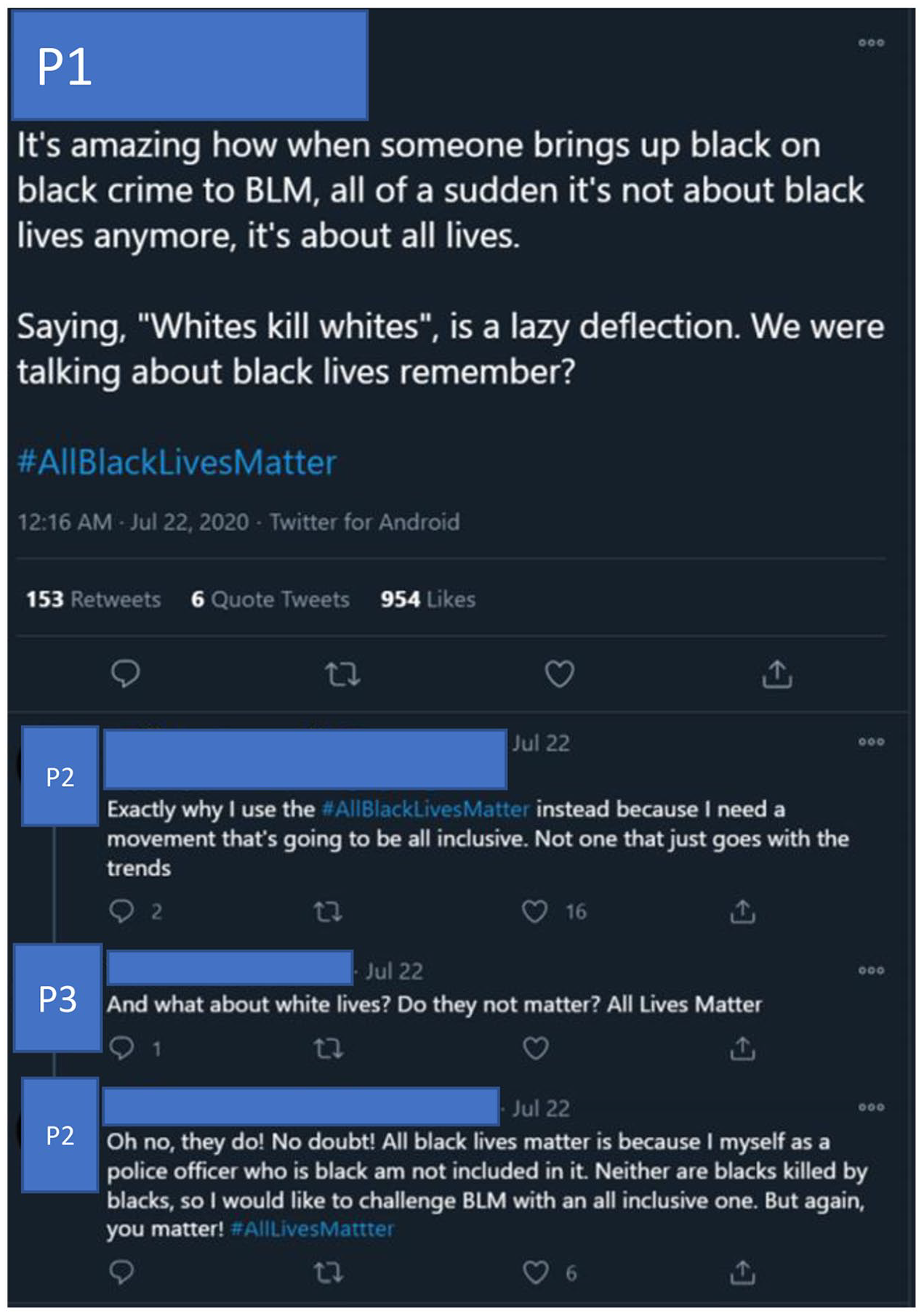
This extract begins with a criticism of the strategy of referring to Black crime as a way of attempting to undermine BLM and also of how responses to this argument that refer to White crime are not useful because they remove the racial context that is relevant to BLM. This is punctuated with the elaborated hashtag ‘#AllBlackLivesMatter’. This does not just contain the standard BLM but also includes the ‘All’ alternative in a way that maintains the focus on Black lives. One of the many responses to this, from P2, comes in the form of support that explicitly reuses the ‘All Black Lives Matter’ hashtag with a more detailed explanation of why this is used – here because this hashtag is designed to be inclusive. One of the follow-up responses to this original response contains a standard use of ALM, alongside a rhetorical question asking if White lives do not matter. Forms of this question were typically posed in response to Black Lives Matter (see extract 7a, for example) so it is not surprising to see it recur in response to a close variant. P2 responds to this use of ALM by agreeing that White lives matter, but then the use of All Black Lives Matter is further qualified. This is done by drawing on P2’s claimed identity of being both Black and also a police officer, which produces a ‘category identity puzzle’ (e.g. Stokoe, 2012: 281) of two categories that may more often be expected to be in conflict than embodied in one person (especially in the context of BLM). BLM here is presented as being ‘challenged’ to be more inclusive. However, the post ends with a restatement of a more defencive position that White lives also matter and with the ALM hashtag rather than the All Black Lives Matter hashtag that the poster originally used and then defended. This interaction demonstrates that the use and function of the hashtags and slogans can develop and adapt throughout the interactions in response to other users and challenges to the BLM message.
Discussion
Whatever way ALM is used in these examples, including the purportedly more liberal, inclusive version, it functions to decontextualise the racist status quo that the BLM movement opposes by deracialising the movement (West et al., 2021). Those opposing ALM come to be challenged for denying that everyone is equal. Therefore, much of the opposition and resistance to the use of ALM functions by explicitly highlighting the (racial) context of BLM in a bid to re-racialise its message and deny any special favouritism for one group (Black people) over others (particularly the White majority). This means that the cultural norm against prejudice (Billig, 1988) can come to be used as a tool against an anti-prejudice campaign, in service of maintaining a prejudicial status quo.
The analysis demonstrates that there are debates around the preference for BLM or ALM and that whether there is alignment with or resistance to the use of either phrase depends on the extent to which a context of racism is accepted or not. BLM is preferred where there is an acceptance that racism exists and must be challenged and ALM is preferred where the racism is decontextualised. This means that arguments over the use of the slogans BLM versus ALM are proxies for arguments about the extent to which anti-Black racism exists.
While the interactions following the use of WLM did show support for it, usually on the grounds that BLM favours Black people over White people, most of the support for WLM, except in more extreme cases, was brought about by aligning with All lives, rather than White lives. This suggests that WLM is deemed to be more extreme than ALM but it also shows that the two are used as opposition to BLM. ALM and WLM were both seen to be used in some cases as clear signals of opposition to BLM, often punctuating the end of tweets with anti-BLM messages. These slogans can be seen simply as a rejection of BLM and as constituting digital antagonism praxis. It is noteworthy that these ‘Lives Matter’ phrases all operate as ‘hashtag activism’ slogans: they all have the self-sufficient, matter-of-fact quality of interpretative repertoires (Potter and Wetherell, 1987), despite the possibility of them all being challenged with alternative slogans.
Examples of other versions of ‘Lives Matter’ featured in this analysis include ‘Benefit’ and ‘Geordie’ lives, which both start as responses that change the standard BLM/ALM format into more humorous versions that mock and undermine BLM. They also allowed for less humorous and more overtly anti-BLM messages that worked to police who belongs in the British/Western ‘us’ (generally those who oppose BLM) and who does not (generally those supporting BLM). Alternative uses of ‘Lives Matter’ therefore overwhelmingly functioned to undermine BLM, but there were exceptions to this, illustrated in this analysis, that were not so directly oppositional. One of these is the ‘Poor lives matter’ example, in which poverty and inequality were presented as equally important to and intersecting with racial inequality. Even this example can work to downgrade the racism that BLM is protesting against, however, compared to other inequalities that are presented as more pressing. This shifts the blame for discrimination and inequality to the system of capitalism rather than racism. This does hint at the importance of addressing intersecting inequalities as well as analysing them individually. The ‘All Black Lives Matter’ example is unusual in that it merges both BLM and ALM, but even this exchange ended with the decontextualising ALM being used. This suggests that any alternative formatting of ‘Lives Matter’ that replaces ‘Black’ is likely to work to deracialise the BLM message and therefore undermine its reason for existing.
This analysis develops the existing discursive work on race talk, particularly in online settings by showing how debates about BLM play out in interactional settings and how the racial context of BLM is debated. It has also shown how the use of ALM draws on the norm against prejudice to deracialise BLM’s message in a way that both eclipses and maintains the racist status quo. The analysis therefore highlights the urgent need to focus on online discussions about BLM because it is important to understand attempts to undermine and delegitimise efforts to overcome racial discrimination. More widely, this shows the need to understand online debates about discrimination aimed at all victimised groups from an interactional approach, with particular attention required to how statements supporting discrimination can be aligned with or challenged.
While this analysis shows that more research is needed in the area of BLM and online discrimination more broadly, there are some potential suggestions for how best to support BLM and to challenge the many alternatives and criticisms that are levelled at the campaign and those aligned with it. For example, given the decontextualising effects of the alternative ‘Lives Matter’ responses, it would seem sensible that those advocating for BLM should attempt to maintain the focus on the racialised context in which BLM developed and exists.
To conclude, this analysis has illustrated the varying ways that alternative versions of the ‘Lives Matter’ hashtag and slogan can be used to potentially undermine and display opposition to the Black Lives Matter movement. A variety of differently formatted ‘Lives Matter’ slogans, most prominently ‘All Lives Matter’ but also ‘White Lives Matter’ and other takes on the slogan, have been identified as being used and debated in online discussions about BLM. It appears that alternatives to BLM can function to attempt to remove and obscure the discrimination that Black people face, so these alternatives must be challenged for their part in maintaining the racist status quo.
Footnotes
Acknowledgements
The authors would like to thank Steve Kirkwood (University of Edinburgh), Cristian Tileagă (Loughborough University), Emma O’Dwyer (University of Greenwich) and two anonymous reviewers for their helpful comments on an earlier version of this paper.
Declaration of conflicting interests
The author(s) declared no potential conflicts of interest with respect to the research, authorship, and/or publication of this article.
Funding
The author(s) disclosed receipt of the following financial support for the research, authorship, and/or publication of this article: The author(s) received financial support from De Montfort University for costs towards a research assistant. The authors did not receive any other support for the research, authorship, and/or publication of this article.