



Abstract
Scholars have recognized emotion as an increasingly important element in the reception and retransmission of online information. In the United States, because of existing differences in ideology, among both audiences and producers of news stories, political issues are prone to spark considerable emotional responses online. While much research has explored emotional responses during election campaigns, this study focuses on the role of online emotion in social media posts related to day-to-day governance in between election periods. Specifically, this study takes the 2018–2019 government shutdown as its subject of investigation. The data set shows the prominence of journalistic and political figures in leading the discussion of news stories, the nuance of emotions employed in the news frames, and the choice of pro-attitudinal news sharing.
Introduction
Twitter is one of the most prominent social networking sites in U.S. politics, with more than 300 million monthly active users (Statista, 2019) posting upward of 500 million tweets per day (Internet Live Stats, 2019). For Twitter users, it is not only a site for self-expression and interpersonal communication but also a platform on which they read news and learn about current events. The core functions—follow, at, repost, and like—suggest how information is disseminated through the network, and how that information resonates within the tiny portion of that network that each user experiences.
Previous studies of the role of Twitter in U.S. politics have suggested that emotion plays an important role in information diffusion (Harber & Cohen, 2005; Kühne & Schemer, 2015; Stieglitz & Linh, 2013). Emotional motivations trigger users to comment on news stories or generate their own posts. Emotional tone also affects traditional media, as an increasing number of news reports adopt an emotional or affective tone out of economic, technological, and popularity concerns. Previous studies have found that emotion is an important element in news value (Beckett & Deuze, 2016).
Emotion is a strong factor in users’ reception of partisan news. Studies have shown that one’s political orientation points to a strong homophile network. Often, users show anger or anxiety when news stories oppose their political orientation, and feel positive emotions when stories match their views. These emotions affect how people receive and retransmit the information in stories. The political sentiment exposed on Twitter during an election campaign, expressed through reposts, likes, and comments regarding a political issue, has been featured in many studies that have sought to identify political alignment and predict election outcomes (Bermingham & Smeaton, 2011; Conover et al., 2011; Chung & Mustafaraj, 2011; Pla & Hurtado, 2014). This article focuses not on elections, but instead on governance. We argue that the significance of Twitter discourse goes beyond the campaign trail; debates about current issues also affect day-to-day governance.
This article focuses on the government shutdown that took place between December 22, 2018, and January 25, 2019, which generated considerable emotional sentiment on Twitter. In this case, the controversy centered on President Trump’s proposal for funding a border wall. When the funding plan for the border wall was not approved by the Congress, the president announced the shutdown of the federal government starting on December 22. The announcement led to the temporary closure of certain government agencies, the furlough of thousands of government employees, and the pausing of certain government responsibilities.
Focusing on this event, this study investigates the role of emotion in the news coverage, online dissemination, and public reception of the 2018–2019 government shutdown. The intention of this study was to evaluate the political discussion on social media through the lens of emotion. After collecting Twitter posts sharing news stories during the shutdown, we studied the emotional frames of popular news stories and used a machine learning method to analyze the emotional elements present in the posts.
Literature Review
Causes and Consequences of the Government Shutdown
In recent decades, federal government shutdowns have occurred as a result of political disputes over budgetary issues within Congress or between Congress and the White House (Brass, 2018; Meyers, 1997; Williams & Jubb, 1996). Each year, Congress is required to pass a new appropriation bill before October 1, the start of the new fiscal year. Failure to do so typically leads Congress to enact a continuing resolution, and if such a resolution does not pass, funding gaps appear and result in the shutdown of governmental agencies (Brass, 2018; Feld, 1989; Meyers, 1997; Williams & Jubb, 1996).
The most direct outcome of a government shutdown is the furlough of certain employees at government agencies. Further effects that draw the attention of the public involve government operations such as health and human services, law enforcement and public safety, national parks services, and other responsibilities of the federal government (Brass, 2018). For example, Merchant et al. (2014) conducted sentiment analysis on users’ tweets related to health during the 2013 government shutdown when government-operated health-related accounts stopped posting. Their findings suggest that analyzing tweets can provide useful insight for crisis communication of the government in such times.
Actors in Political Discussions on Twitter
Because government shutdowns are political events that evoke wide public discussion, a number of studies have examined important actors leading or affecting the discussion on Twitter. Regarding the October 2013 government shutdown, Barberá et al. (2014) and Casas and Wilkerson (2017) focused on party leaders and members of Congress as important figures in the dissemination of political information. Casas and Wilkerson (2017) suggested that online agendas issued by party leaders served as a kind of branding campaign that highlighted the efforts of their own party to resolve the shutdown. Barberá et al. (2014) analyzed Twitter data in a longer, 15-month period covering the shutdown. Their findings of the study suggested that members of Congress are responsive to followers on Twitter, but the influence of such responses on the public agenda of their followers is limited, with Republicans more susceptible to pressure from their core followers and Democrats interested in responding to their core followers and to broader liberal audiences (Barberá et al., 2014).
Journalists compose another important group in the information diffusion process. As shown by Russell et al. (2015) in their analysis of journalists’ Twitter posts during the 2013 U.S. government shutdown, journalists are more likely to promote their own stories or stories of their own agencies through links, and show a bias toward traditional news sources over online news.
A general look at the Twitter news stream about the 2018–2019 government shutdown reveals that a considerable portion consists of tweets by political figures and media professionals. Building on the aforementioned literature, this article would like to investigate the major contributors to the online discussion:
Partisan Inclination and Political News Sharing
In the United States, under the two-party system, political inclinations and the standpoint of media institutions can be simply expressed along a continuum between the most liberal and the most conservative viewpoints, a practice used by the Pew Research Center (2016) and fact-checking websites such as Media Bias/Fact Check (2019). When people come across news stories that agree or conflict with their viewpoints, they may experience different emotional reactions. The hostile media effects theory suggests that people express anger when the news they consume runs counter to their political beliefs. Sagi and Dehghani’s (2014) study of political rhetoric suggested that communities that align with the two major political parties each favor moral rhetoric that enhances cohesion within their own community. Iyengar and Krupenkin (2018) identified this preference as strong in-group favoritism, with each group treating the other as a “stigmatized outgroup” (Iyengar & Krupenkin, 2018). The studies of Lin et al. (2016) and Y. Kim (2017) suggested that the group membership of a person is a strong predictor of hostile media bias. Furthermore, opposing views can lead to more active political participation (Y. Kim, 2017), such as in discursive activities (Hwang et al., 2008) and sharing of information on social media (Hasell & Weeks, 2016).
A few studies with contrary findings are also worth noting. Parsons’s (2010) analysis of the American National Election Studies (ANES) panel promotes a “depolarization” hypothesis that learning about contrasting viewpoints from one’s social network would induce negative emotions toward one’s own side while developing positive emotions to one’s opposite side. Bendersky’s (2014) experiment in the context of the 2013 government shutdown suggested that affirmation from members of opposing ideological groups tends to reduce members’ psychological defensiveness, thus providing an approach to potentially reduce and resolve political conflicts.
Past studies suggest two types of motivations toward sharing news on Twitter: status-led motivations and emotion-led motivations. Status-led motivations address the fundamental reasons why people share news. This category usually ascribes behavior to the need to boost the image of the individual and to improve his or her social standing. Emotion-led motivations suggest that users’ behavior is based on a need to share news due to a perceived emotional connection (Bright, 2016). According to the emotional broadcaster theory by Harber and Cohen (2005), users’ need for disclosure after emotional experiences leads them to share their own stories and news reports. Messages with more intense emotional cues can be spread farther and more quickly in social networks (Harber & Cohen, 2005). Status-led motivations are generally believed to be the primary predictor of information retransmission (Hasell & Weeks, 2016), but emotion-led motivations are also important determinants (Stieglitz & Linh, 2013).
Emotional Elements in News Reports
In recent years, journalism scholars have recognized emotion as an important element in news reporting. Beckett and Deuze (2016) summarized three factors that led journalists to adopt emotion as a tool in their reporting. First, embedding emotion in news reports creates a sense of involvement among audience members, which makes news reports more accessible and easier to promote when competing with other news institutes. Second, using emotion can attract people’s attention, which makes it much easier for news stories to be retransmitted on social media. Third, emotion is also a key part of people’s news selection behavior. Also contextualized in the online environment, Papacharissi (2014) recognized that by interacting with news stories and contributing their own stances and experiences, users convey their subjective feelings and thus contribute to the “affective news stream.”
Conceptually, emotion, affect, and sometimes feeling are often used in studies to denote the subjective, affective status that people engage in. To differentiate, emotion is often described as “episodic,” to be based on “concrete events, objects and situations” (Mulligan & Scherer, 2012, p. 346) and last shorter, whereas affect is a longer, persisting state. Feeling, on the contrary, is more complex and consists of elements from outside of the affective state (Mulligan & Scherer, 2012). In studies, emotion can be examined just by valence, or by individual discrete emotions (Nabi, 2003). Psychological studies suggest there are many dimensions to position different emotions. Smith et al. (1985) proposed pleasantness, anticipated effort, certainty, attentional activity, responsibility, and control as means to accurately describe emotions and the underlying cognitive appraisal. In the Berger and Milkman (2012) study of content virality, valence and the amount of arousal are proven to be important factors on the content’s transmission. Negative emotions with a heightened state of arousal, such as anger and anxiety, are often featured in studies of political polarization and partisan media (Berger & Milkman, 2012). News opinionation, which is a style of reporting that blends personal opinions into news reporting, frequently provokes emotional responses from audiences. Individuals often perceive news reports to be biased if the content conflicts with their political orientation and beliefs; this can result in anger and criticism toward the reporters and agencies responsible for the story (Arpan & Nabi, 2011; Nabi, 2003). If primed by frames of anger or fear, individuals can also have tendencies to seek information related to such emotions (Nabi, 2003).
Because journalists seek to incorporate emotions to better transmit their reports in the social media environment (Beckett & Deuze, 2016), and such emotional frames may affect the users’ selection on subsequent information retrieval (Nabi, 2003), this article asks the following research question:
Method
Data Collection
Twitter’s 7-day time limit for API downloads had passed when we entered the stage of data collection, so we manually sourced and collected the tweets using Twitter’s search engine. Same as data retrieval as API, manual searching and copying Twitter content comprises a small sample of the entire Twitter data for the study, and a previous study shows that manual search returns results of up to 7 days or 1,500 tweets (A. E. Kim et al., 2013). Manual searching also requests careful choice of search term (A. E. Kim et al., 2013). For the searching, we initially explored more specific terms such as “federal government shutdown,” “government shutdown,” or “partial government shutdown,” but found that in more casually phrased tweets, the incident would simply be referred to as “shutdown.” Thus, we used only “shutdown” as our search term to yield more comprehensive results.
For the convenience of browsing and collecting all tweets shown on the results page, we divided the time range into 2-day periods throughout the shutdowns. Each time we searched, we used the advanced search function to focus on tweets that contained the key word “shutdown,” written in English, and entered two adjacent days within the time range of the shutdown. On the results page, we used the “news” tablet to focus on collecting the shared news stories. Each of the results was a list of tweets presented in reverse chronological order between 8: 00 a.m. of the previous day and 8:00 a.m. of the next day.
By acknowledging that the public discussion on Twitter may not fully represent the discussion over the issue, there is room to further evaluate the impact of Twitter as a platform on the discussion. We are also aware that the collection of tweets is dependent on how the Twitter algorithm determines and displays results. This study looks at the trend of news sharing on Twitter in the course of a long government shutdown, and the same algorithm that applies to the tweet collection each day would still be comparable here. It is the same reason why we believe the daily number of tweets gathered is representative of the activity of discussion on Twitter. Using the “news” tab in this process significantly reduces the results to the sharing of journalistic output, which suits the purpose of the study, as we are looking for the evolution of emotional elements during this period in news stories and in the reaction to them on Twitter.
During the process, a small number of tweets in the results were not related to the topic of the government shutdown because the word shutdown had different meanings in other contexts. These tweets were excluded after manual inspection of the content of each tweet. We put all relevant tweets, their specific tweet (the URL to the tweet, content of the tweet, time of posting, hashtags used in the tweet, users “at” in the tweet), information about the shared news stories (media source of the story, title of the story, link to the story), and information about the user account (name of the account, page of the account, self-introduction to the account, specified webpage of the account, and tweets followers and following counts) on a spreadsheet. The initial collection totaled 6,602 tweets. Because we narrowed to a one-on-one relationship between media choice and political orientation, we excluded from the spreadsheet a small number of tweets that contained more than one news source. After verifying the links to the news stories, we excluded tweets with invalid links. Ultimately, the data collection yielded a clean data set containing 6,554 tweets.
Coding and Measurement
Account Types
After collecting and browsing through all the tweets, one general impression is that a large number of news-sharing tweets come from media institutions’ official accounts or affiliated journalists. A few political figures are also notable for contributing disproportionately to the retweets of a story. We then coded users in one of the following categories: (1) media institutions, (2) journalists, (3) political figures, (4) political advocacy groups, (5) nonpolitical nongovernment organizations, (6) personal accounts, (7) accounts of fictional characters, (8) private companies, and (9) explicitly indicated bots. We set the initial coding to be more specific to capture more trends in the accounts. Then, we recoded them into broader categories: Types 1 to 2 were grouped as journalistic accounts; Types 3 to 4 were political-affiliated accounts; and Types 5 to 9 were the general public.
Political Inclinations
Many of the accounts we inspected, including many users who belonged to political advocacy groups or the general public category, indicated their political leaning in their account name or introduction, which we used to categorize their political inclination as liberal or conservative. Such indicators can be straightforward naming of having a liberal or conservative view or specific wording or hashtags in the user’s introduction such as “resist” associated with a liberal point of view, or #MAGA associated with a conservative point of view.
Because part of the analysis looks at the difference of pro-attitudinal and nonattitudinal news sharing, we also coded the political inclination of the media institution that published the story. Our coding was based on the report of audience ideology by the Pew Research Center (2016) and the categorization by the website Media Bias/Fact Check (2019).
Emotional Valence and Affect in Tweets
To demonstrate the trend in affect and emotional valence in the tweets, we used the language analysis software LIWC2015. LIWC, which stands for Linguistic Inquiry and Word Count, is a Java-based software developed by researchers to “capture people’s social and psychological states” (LIWC, 2020). LIWC has been utilized in a small number of past publications (Berger & Milkman, 2012). It analyzes text by going through the vocabulary in built-in dictionaries and returns results with multiple outputs about language use. In this study, we focused on the elements of affect, positive emotion, and negative emotion. LIWC (2020) returns results on positive emotions and negative emotions by assessing the frequency of emotional words used, which in this study shows the degree of positive emotion and negative emotion in the tweets.
Emotional Frames
As Nabi (2003) suggests, emotions like anger or fear can affect users to access information relevant to these emotions. Emotions with heightened arousal were also featured in studies on political polarization (Berger & Milkman, 2012). To understand how emotion acts in the popularity of news stories circulated on Twitter during the course of the shutdown, with the data set of tweets that share a news story about the shutdown, this article seeks to conduct frame analysis on the stories shared in the most retweeted posts. Ranking the posts by their retweeting numbers, I focused on the top 100 posts and then accessed the 79 stories that were shared in the 100 tweets.
Results
Daily Tweet Counts
Figure 1 shows the daily tweet count during the government shutdown. Because this study focuses on the tweets that share news stories, the daily tweet count is not a large number (M = 182.79, SD = 62.75). The number of tweets gathered fluctuates from day to day but shows an increase toward the end of the shutdown. When matching the daily tweet count with the major events in the shutdown period (Al Jazeera, 2019), as seen in Figure 1, some of the fluctuation in tweet count can be explained. Starting on December 22, the government shutdown was also referred to as “the holiday shutdown” and showed a lower number of tweets at the beginning, as many journalists and audiences were paying less attention to Twitter news. After the holidays, a series of major events took place in quick succession and the daily tweet count increased.

Daily tweet count with major events during the shutdown.
This graph shows the number of news-sharing tweets, with annotations of important events during the shutdown. The number of shares suggests the level of activity in the discussion. One major issue from this graph is that discussions became more active during later days of the shutdown.
Retweets
In a right-skewed distribution, the number of retweets (Figure 2) mostly resides in a smaller number (M = 160.38, SD = 549.25).

Average number of retweets.
Figure 2 shows average retweets during each day of the shutdown.
Account Types
After recoding the account types into three categories, we examined the differences of news sharing between types. Journalistic accounts contributed for the majority of sharing of tweets: Of the 6,554 tweets gathered, 4,558 were posted by either a media institution or a journalist. Journalistic accounts make up for 70% of tweets, followed by a 23% from the general public and the last 7% from political accounts.
For RQ1, in the number of tweets, media institutions and journalists are the major contributors of news sharing on Twitter. In the number of retweets the news stories have on Twitter, the data suggest that political-affiliated accounts yield more retweets than other types, but there is no statistical proof for that claim.
Emotional Frames
To understand the emotional element in the tweets, we first analyzed the affect, positive emotion, and negative emotion on a day-to-day basis, and found a slight upward trend as suggested by Figure 3.
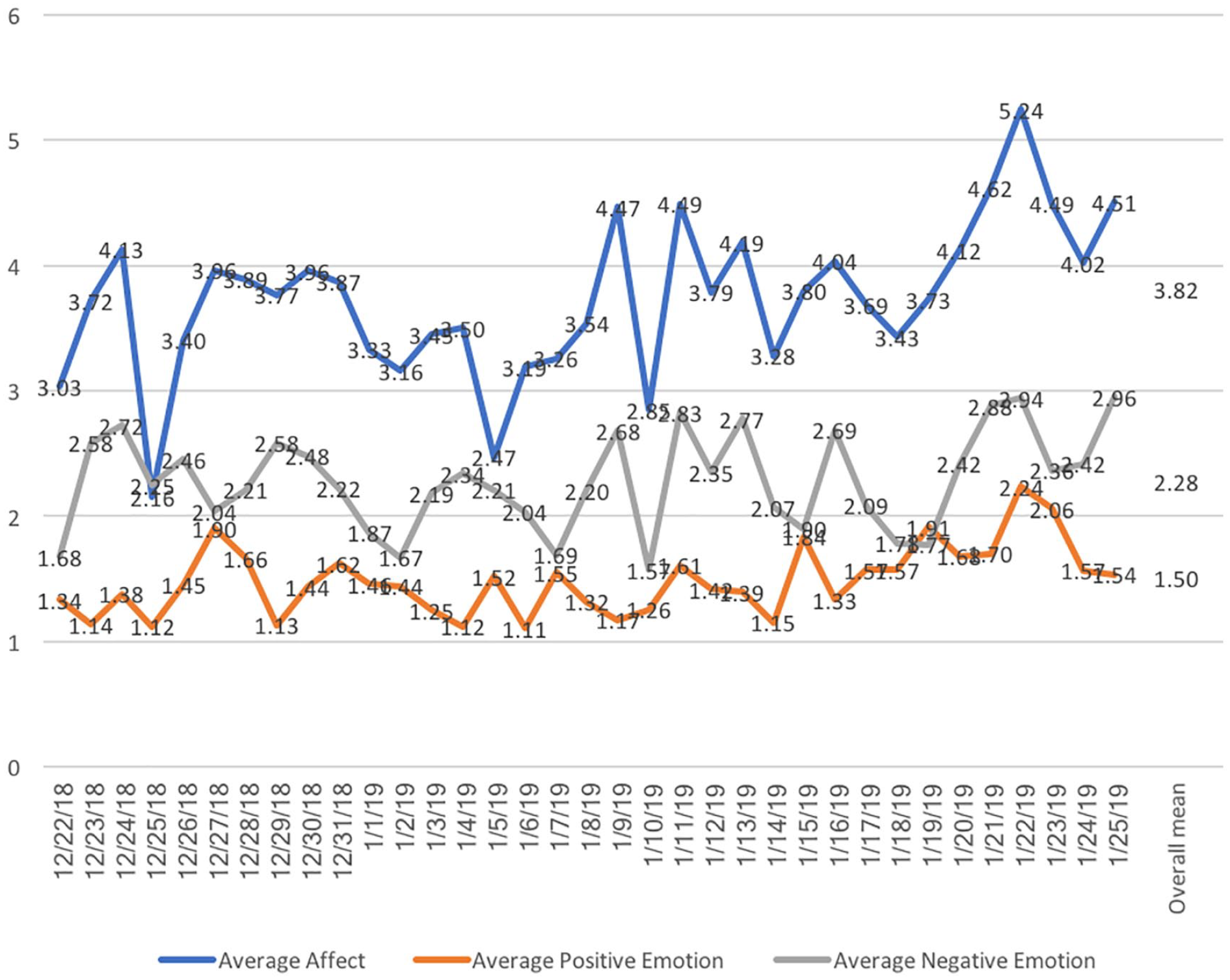
Trend in average emotional sentiment of daily tweets.
Figure 3 shows the average affect, positive emotion, and negative emotion per day. The data are calculated by averaging the LIWC 2015 outcomes on affect, positive emotion, and negative emotion on each day of the shutdown. This shows the proclivity to tweet emotion-related vocabulary. Overall, affect, positive emotion, and negative emotion report an increase at the end of the shutdown period despite fluctuations.
Then, to address RQ2 from a different perspective, we chose to conduct a frame analysis of the news stories in the 100 most retweeted Twitter posts. These 100 posts have an average retweet number of 3,437.08 (SD = 2,647.42) and are distributed closer to the midpoint and later time period of the shutdown. Of the most retweeted 100 tweets, 60 were from journalistic accounts, 17 from political accounts, and 23 belonged to the general public.
Figure 4 shows the temporal distribution of the most retweeted tweets. The graph also provides evidence of the intensification of discussion toward the 2-week mark and in the final days of the shutdown.

The distribution in time of the 100 most retweeted posts.
Because some tweets shared the same news stories, the 100 tweets included a total of 79 different news stories. A closer examination of the topic and emotions displayed in the stories suggested some insight for Twitter users’ interest in political stories. The results are displayed in Figure 5. The topic that appears the most is the negative impact of shutdown on everyday life. Of the 79 articles, 23 fell into this category. They looked into the negative impact of the partial government shutdown on airlines, national parks, food industry, safety issues, and so on. Bearing a grim tone, they tend to appeal to the readers by evoking a sense of anxiety and concern about everyday matters. The second most popular topic is the development of the shutdown. These stories often adopted a plain and direct narrative that did not carry much emotion. News stories that analyzed the situation also were widely retweeted. Depending on the amount of opinion in the story, they can include less or more satire.

Topics by the 79 Stories.
We used six categories when analyzing the topics of the 79 most shared stories: poll information, analysis and commentary of the event, act of goodwill, anecdotes of prominent political figures, impact of shutdown, development of the issue, and others. The categories “impact of the shutdown,” “development of the issue,” and “analysis/commentary” have the most stories.
Because this government shutdown was the longest in U.S. history and spanned more than two paychecks for affected federal employees, furloughed workers emerged as an important topic. Six stories focused on how the government shutdown posed financial difficulties to federal workers, and evoked sympathy, anxiety, and concern over the matter. Language used in these articles carry a negative tone that stressed the misfortune of these individuals. For example, an article in the New York Times on January 8, “As Government Shutdown Goes On, Workers’ Finance Fray: ‘Nobody Signed Up for This,’” included the use of negative words such as “nobody” in the title, and more in the text, when it described a worker who “used to live paycheck to paycheck. Now, she is living nothing to nothing.” A similar style can be found in other news stories of the same topic. The Washington Post article, “Coast Guard Families Told They Should Have Garage Sales to Cope With Government Shutdown” published on January 10, included a single sentence “bankruptcy is the last option,” in its third paragraph, suggesting rising levels of anxiety for workers suddenly without a paycheck. Individual stories were featured, and quotes from these individuals were used extensively to make the stories more real and the feelings more intense. A different angle was employed from CBS Chicago’s “Pawn Shop Owners Say He Sees 10-20 Federal Employees Every Day During Shutdown.” Seeing the issue through the eyes of a third party (a pawnshop owner), the article depicts the economic crisis of furloughed employees, and using his sympathy (“I feel sorry for them”), the article engages the audience in a sympathetic story frame.
Anecdotes of the political figures draw stories that feature nonrelevant aspects of political figures, such as Nancy Pelosi vacationing in Hawaii, or Ivanka Trump and Jared Kushner at Mar-a-Lago. The contrast between anecdotes of wealthy government leaders and ordinary workers in the government shutdown generated more intense emotion in the stories.
Despite the shutdown being an issue with considerable negative emotion, several stories that advocated one person’s good deeds to help during the shutdown also were widely retweeted. CBC’s pizza delivery story carried positive emotion, as well as a sense of humor and satire contrasting the generous citizens of Canada with the inept government of the United States.
Discussion
Over the course of its 35 days’ duration, the shutdown passed Christmas and the New Year. The festive atmosphere of the holidays, juxtaposed with the negative mood toward the government shutdown and its consequences, made the event ideal to study the element of emotion in the discussion of an event of governance. Many studies have looked at Twitter as a means of probing public opinion (Casas & Wilkerson, 2017; Merchant et al., 2014; Michael & Agur, 2018). The 2018–2019 government shutdown similarly generated a vast discussion on Twitter. By focusing on the “news” segment of the tweets, we closely examined 6,554 tweets, their emotional components, and the news stories shared by the tweets.
By comparing the fluctuation of the number of news-sharing tweets, the average amount of retweet, and the distribution of most shared stories by the 100 most retweeted posts, we are able to gauge where public interest lands during the government shutdown. In a similar sense, the number of tweets per day (Figure 1), the average retweets (Figure 2), and the temporal distribution of the most shared tweets (Figure 4) suggest that public attention in the government shutdown intensified a few days after the start of the shutdown. Earlier reports of the government shutdown were still doubtful that the shutdown would continue after the holidays, adding that the Christmas holiday may have hampered Twitter use. As a result, both the number of tweets and the average retweets were low in the first few days, and none of the most retweeted posts fell into that time period. Data on the number of tweets per day, the average retweet on a single day, and the average affect, positive emotion, and negative emotion in a tweet per day all reached a low point on the Christmas Day, and bounced back after Christmas as the news about the failure of the negotiations spread. The most retweeted posts peaked on January 6, and two other peaks on January 9 and 10. This was similar to the trend in the number of tweets, which reached a peak on January 6 and a second peak on January 10. The average retweets also suggested a peak on January 5 and 6 and another on January 9 and 10. These spikes corresponded with the major events of the days: On January 4, President Trump threatened to declare a national emergency for the wall funding; on January 8, the President addressed the nation in a televised speech, to which the Democrats responded; on January 9, a subsequent meeting between Trump and the Democrats took place; and on January 10, Trump visited the U.S.–Mexico border and renewed his threat to declare a national emergency. The series of events showed that the public discussion was widely sparked by major events that took place during the government shutdown.
In the 79 stories represented by the 100 most shared tweets, a topic analysis of the most popular news stories shows a mixture of microscopic and macroscopic angles that draw most public attention. After categorizing the topics of the 79 stories, we found that most topics focused on the development of the shutdown. Eighteen stories were straightforward reporting of the development of the issue, spread out during the range of the shutdown. Twenty-three of the stories showed the public’s interest in the consequences of the shutdown on their everyday lives. On a micro level, much public attention is drawn on the shutdown of certain branches of the government, such as the U.S. Food and Drug Administration (FDA), the National Park Service (NPS), and the Transportation Security Administration (TSA).
A major reason why the stories emerged as their own category was the continuance of the holiday theme. Media outlets grasped public interest by addressing workers’ concerns during the holiday period. These interests included government responsibilities such as the safety of transportation and food inspections. The impact of these stories was well observed, as the category they belonged to made out the largest portion of the most shared stories.
Another angle in the shutdown emphasized furloughed government employees as the victims of the shutdown. Stressing the fact that the 2018–2019 government shutdown was long enough to include two paycheck cycles, a string of stories looked at the financial difficulties the shutdown posed on furloughed government employees. On a macro level, the majority of popular stories show public interest in the development and nature of the issue. The topics of the most shared stories suggest the efforts of learning about facts and details from the news stories in the first place. The fact that they comprised the second largest portion of the most shared stories showed that the public were using Twitter to follow up with the development of the government shutdown.
A much smaller portion of stories shared were categorized as analysis/comments of the stories, showing that the function of reading and sharing news on Twitter may lean toward knowing the happenstance than understanding the event in depth. Some of the categories of the topics show more deliberate efforts on the journalistic side to generate emotions in the audience. With the shutdown being overall an event with negative impact, three stories elaborated on the goodwill of people and stood in contrast to the negative theme. The stories were about the unemployment benefits offered to furloughed workers in California, that Air Canada sent pizza to furloughed U.S. employees, and that a chef offered free food to furloughed employees. By zooming in on the good acts of a select few stories, a mixture of feelings can be produced. The actions of goodwill from Americans and foreigners wanting to offer support contrasted with the government’s inability to come to a solution, and the satire or humor of this contrast can be contributing factors toward retransmission of such stories. Similarly, many stories involving anecdotes of well-known political figures, including Donald Trump, Ivanka Trump and Jared Kushner, and Nancy Pelosi, contrasting their lifestyles with those of the government employees affected by the shutdown, using satire and channeling the anger felt by audiences.
Past research has suggested that political and journalistic accounts are important political actors in the Twitter discussion of the government shutdown (Barberá et al., 2014; Casas & Wilkerson, 2017; Russell et al., 2015). In a previous study, scholars suggested that Twitter could become a platform of political branding (Casas & Wilkerson, 2015). Judging from the number of news-sharing tweets collected in the range of the shutdown, advocacy, and branding by political figures was as common. Political figures also yielded the largest number of average tweets, due to their prominence as public figures. However, journalistic accounts generated the most news-sharing posts. Of these posts, a large number were shared by the media institution automatically promoting their stories. Journalists also participated in promoting news stories that they had written or that their colleagues had written by their affiliated agencies, or commenting on the issue. By the type of media agencies, news sharing on Twitter stemmed mostly from traditional news sources.
The literature points to two different directions as to how political orientation of the user would affect their choice of media with a different political stance. The hostile media effect reflected the anger generated because of the difference in political stance between the reader and the media (Y. Kim, 2017; Lin et al., 2016). By specifying the political orientation of the user account, and the political orientation of the media of choice, this study adds to the substantiation of in-group favoritism in political issues (Iyengar & Krupenkin, 2018). The analysis of the data suggests a significant preference for pro-attitudinal news sharing versus counter-attitudinal sharing. Contrasting to what Y. Kim (2017) and Lin et al. (2016) posit as the hostile media effect, there does not seem to be significantly more negative emotion in the tweets about counter-attitudinal news sharing. This insignificance may be due to the vast contrast in volume of pro-attitudinal and counter-attitudinal news-sharing tweets. Also, differing from the projection of Parsons (2010) and Bendersky (2014) on the issue of the government shutdown, the political stance of the user account does not point to sharing of news stories of opposite views and does not lead to resolving the clashes between different stances. With the strong preference of pro-attitudinal news sharing, the interchange of different political orientation is scarce, and what can be seen is a strengthening of original political beliefs during a prolonged government shutdown.
As we have indicated in the topics of the most prominent news stories, a majority of the most news stories picture a “matter-of-fact” tone to explain to the public in macroscopic and microscopic perspective the consequences of the government shutdown. Only a few of the most prominent stories are commentary that feature more dramatic language use. However, it is typical that in the stories reporting facts to embed emotions. Because of the nature of the event, most analytical pieces bear a negative tone in reporting. Stories concerning the impact of closed government agencies on the general public are especially accustomed to embed a sense of anxiety and fear when they explore the potential negative outcomes. Anger and satire appear less in the stories, but are common in commentary pieces. It is noticeable that during the analysis of emotional frames, certain topics were often paired with certain emotional frames (Kühne & Schemer, 2015; Nabi, 2003). Stories of the furloughed employees can raise emotions of sympathy and anxiety. Stories about the closing of government employees can also spark anxiety, fear, and sometimes anger. Stories that attribute the cause of the shutdown to the opposing political parties generate satire and fear.
Conclusion
This study offers a close-up view of the political discussion over government shutdown. By focusing on the element of emotion, we are able to see how opposing views are displayed through the selective retransmission of news stories on Twitter in a period of day-to-day governance, instead of the more oppositional period of an election. Although there is no direct evidence linking to the number of retweets to specific emotional elements or political sides, the study suggests that the rigidity of one’s political views and one’s echo chamber in terms of news retransmission will shape users’ responses to news stories. The prevalence of pro-attitudinal sharing and the general negative tone in the discussion suggests that anger and other negative emotion are present and hard to change in the time of great political divide. A homophily network such as Twitter may have reinforced existing divisions, and even in such an open discussion on an open platform, exchange of stories is scant. Lack of interchange in political views and strengthening of original political beliefs contribute to heightening in political discussion, especially as the event ensues after a long period of time. This study offers a method to track public discourse on governance for a longer period of time to improve the evaluation of political discourse in the future.
In this study, we narrowed down the range of tweets by focusing on the “news” tablet in the twitter search results. Using Twitter’s categorization of news stories allows for a concentration on news sharing in the study and improves efficiency by filtering out tweets about the issue that may not qualify for analysis. However, this step in the methodology also makes this study subject to the Twitter algorithm that determines the “news stories.” It should be acknowledged that both the number of tweets per day and the selection of tweets are determined by the Twitter algorithm, which may be difficult to determine. Knowing Twitter’s classification of news, and the way in which tweets are pulled out, may help explain whether there is a structural interference in the finding of bias toward traditional media, and the political actors in the news discussion. A way to improve this methodology is to download all tweets on the matter of shutdown, then sort out news stories about the U.S. government shutdown, and categorize the tweets using machine learning–based techniques. To analyze the trend in the affect and emotional valence of the tweets, this study used a developed linguistic analysis tool (LIWC) to identify the emotional component of tweets. The software helped with processing the large number of tweets gathered in the data set and generated values used for analysis, and conveniently provided the analysis needed for the purpose of this study. However, because the results of the LIWC program contained a limited number of emotional elements (affect, negative emotion, positive emotion, anxiety, anger, and sadness) and are based on frequency of the words, future studies that investigate beyond basic emotions and explore more dimensions of emotion can employ more advanced tools in machine learning and contribute to the automatic emotion analysis literature. This study also focused on a small portion (relative to the total) of tweets to manually code and generate the topics of the most shared stories. Although manual coding on the small number of stories did show a pattern for better transmitted stories in the period, seeking a way to automatically analyze the topics would collaborate better with the efforts to manage the large data set and help bring a general picture for the political discussion.
The data in this study show the prominence of journalistic and political figures in the news discussion on Twitter during the shutdown. Despite the focus on emotion and news selected for this study, other perspectives can also be taken on examining the conversation. Automatic topic mining after classifying the three groups may help address whether a gap exists between the three groups. Additional efforts can be made to identify the impact of each type of account on the follower network of Twitter. It would also be useful to combine more details in the analysis of Twitter than trends and variances during a relatively long period. Focusing on specific accounts, keywords, and hashtags as some previous studies did can bring more nuance to the story. When combined with statistical testing and modeling, this approach can yield a richer, more detailed understanding when probing online discussion of political issues.
Footnotes
Declaration of Conflicting Interests
The author(s) declared no potential conflicts of interest with respect to the research, authorship, and/or publication of this article.
Funding
The author(s) received no financial support for the research, authorship, and/or publication of this article.
