




Abstract
Politicians communicate on social media not only by direct utterances, but also by where they choose to direct followers’ attention using strategic interaction, audiovisual content and outlinks, i.e. their information sharing practices. Political communication research has focused on the former, but the latter is a relevant way to foster advantageous informational environments and interact with media systems. This is especially important for radical right-wing populists, due to their reliance on social media and adjacency to disinformation. Portugal, Spain, and Brazil provide important research cases due to media system characteristics and the different positions within the political system of the relevant leaders, which generates different opportunity structures. This article approaches relevant radical right-wing populist leaders’ information sharing practices by analysing the non-textual content of tweets (n = 6087), emphasizing how they reflect relations with local media systems.
Keywords
Introduction
Contemporary media systems are hybrid (Chadwick, 2017), high-choice environments where political messages compete for attention with other kinds of content (van Aelst et al., 2017).
The legacy news media's gatekeeping function is diminished through competition with other sources of news (Bennett and Pfetsch, 2018), but its relevance is ensured by its ability to introduce and frame debates to general audiences (Zhou and Moy, 2007).
Politicians adapt by professionalizing their operations (Gibson and Römmele, 2009) and finding megaphones to amplify their claims (Dollbaum and Dollbaum, 2023). Social media is an important tool for seizing discursive power in hybrid media systems (Jungherr et al., 2019), since it can be leveraged to influence public perceptions and set the media agenda through direct utterances but also through shared content, i.e. what politicians want their followers to see, read, or hear, which is especially important for nonmainstream movements, like radical right-wing parties. This kind of “remix activity” can enhance leaders’ popularity and engagement, as well as that of their movements (Mazzoleni and Bracciale, 2018: 3); similarly, they can promote advantageous informational environments by linking to favorable stories on mainstream news media, partisan sources, and pseudo-media (Palau-Sampio, 2022), or by attempting to discredit unfavored media outlets as purveyors of “fake news” (Alvares and Dahlgren, 2016). Where populists choose to direct social media followers’ attention matters in contexts where most people get their news from digital sources (Newman et al., 2023), but few visit news sites directly (Wojcieszak et al., 2024), increasing the relevance of incidental news exposure on social media (Valeriani and Vaccari, 2016). Additionally, leaders are central in right-wing online ecosystems, their social media profiles more impactful than official party accounts because they have more followers and generate further media exposure (Enli, 2017).
This article focuses on the cases of Portugal, Spain, and Brazil not only because Southern Europe and South American cases are underrepresented in political communication research, but also because all three share features of polarized pluralist media systems (Hallin and Mancini, 2004), namely, the tendency to disproportionately cover right-wing populist movements (Castelli Gattinara and Froio, 2019), although the media systems retain relevant differences. At the time of data collection—from January 2021 to March 2022—the three relevant radical right-wing populist leaders occupied different positions in the respective political systems, creating different opportunity structures: André Ventura was the leader of a small but burgeoning party, Santiago Abascal presided over a sizable contingent in the Spanish Parliament, and Jair Bolsonaro was the embattled president of Brazil, dealing with scrutiny relating to the management of the COVID-19 pandemic and corruption cases.
This article focuses on Twitter 1 because, despite recent policy changes restricting data access via its Application Programming Interface (API) (Hickey et al., 2023), it has been the most politically influential platform for more than a decade, due to being heavily used by journalists and politicians (Conway-Silva et al., 2018) because its affordances allow for flexible communication fulfilling different goals (Enli, 2017), and it is prolifically used by the relevant leaders.
Therefore, the article seeks to answer two questions:
RQ1: Who and how do radical right-wing populist leaders in Portugal, Spain, and Brazil interact with on Twitter? RQ2: What is the prevalence of news media content in the relevant leaders’ information sharing practices, and how does it compare with other kinds of content?
The article is structured as follows: first, it outlines the theoretical grounding of the approach and its usefulness to radical right-wing populist political communication studies, then it briefly approaches local media and political systems to adequately contextualize the relevant political actors. The second section explains the methodological approach, and the third presents the analyses’ results and limitations, which are discussed in the final sections.
Literature review
Contemporary media systems are hybrid, in the sense that they not only combine legacy and social media logics, but also that legacy and social media source content from each other (Chadwick, 2017), providing myriad channels to disseminate nonmainstream ideologies and sidestep traditional media gatekeepers (Bennett and Pfetsch, 2018; Esser et al., 2017). Additionally, contemporary media logics favor personalization as well as conflict and strategic frames (Klinger and Svensson, 2015), contributing to shape the media agenda and issue framing favorably for populists (Engesser et al., 2017a; Ernst et al., 2019b). Even if populist political actors do not use social media uniformly or obtain the same benefits from their use (Moffitt, 2018), platforms offer frictionless and ostensibly unmediated communication (Ernst et al., 2019a). But research has shown that populist leaders scarcely engage in actual interaction with other social media users (Bentivegna et al. 2017; Enli and Skogerbø, 2013; Ernst et al., 2017), instead using social media to broadcast, fulfilling goals such as burnishing leaders’ images, justifying exclusion of outgroups and articulating ideology (Krämer, 2017), circumventing scrutiny and attacking political enemies (Waisbord and Amado, 2017), eroding media resistance to stigmatized positions (Salgado, 2019), creating transnational issue networks through interaction with foreign leaders and media outlets (Baele et al., 2020; Froio and Ganesh, 2019), and presenting as both mainstream and distinct from “the establishment” (Pytlas, 2022). Therefore, studying how right-wing populist leaders interact on social media can be informative regarding their communicative strategies.
Populist leaders’ communication on social media is not restricted to their direct utterances, but also includes the content they share. For instance, they share mainstream media content when it presents leaders and their preferred issues favorably (Wettstein et al., 2018) or their opponents unflatteringly (Lasser et al., 2022), especially if the content originates from outlets that are already popular among supporters (Heidenreich et al., 2022); they disseminate fabricated stories, propaganda, and conspiracy theories spread by disinformation networks (Haller and Holt, 2019; Pirro and Taggart, 2022) in textual or audiovisual support (Weikmann and Lecheler, 2023), and memes (Wagner and Schwarzenegger, 2020). Another, more passive and less costly, way to expose followers to content is by strategically engaging with certain users by replying or retweeting, increasing their reach (Enli, 2017).
Directing followers’ attention to specific content through nontextual elements, outlinks (i.e. hyperlinks to other websites), and strategic interaction on social media can foster advantageous informational environments, which contribute to the strengthening of populist attitudes and support for leaders (Bennett and Seyis, 2023; Lewandowsky et al., 2020). Research has long recognized that hyperlinks provide useful information (Thelwall, 2004). Gibson and Ward (2000) consider hyperlinks crucial to the network function of their candidate website analytical framework, Ackland and Gibson find evidence that hyperlinks are used in a “networked or relational manner (…) to promote parties’ outlooks, policy messages and critical mass or presence” (2013: 241), and de Maeyer (2012) interprets hyperlinks as resulting from strategic choices and, thus, a reflection of social and cultural communities. The popularization of social media further complexified online environments, reducing barriers to entry and multiplying ways for information to circulate, emphasizing the need for analytical frameworks that could cope. The ecological approach was developed within terrorism and extremism studies (Macdonald et al., 2019), intending to “understand how extremist communities (…) interacted and were influenced by social media and technology” (Hutchinson et al., 2022: 3). It was soon applied to radical right-wing politics, comparing users’ behavior on mainstream and alt-tech platforms (Droogan et al., 2022), characterizing national right-wing online networks (Macdonald et al., 2022), and exploring transnational information ecologies (Heft et al., 2021). These approaches take the concept of an online ecosystem as a useful metaphor, highlighting the complexity of digital systems wherein people interact with each other and with technological affordances, and their interconnectedness (Hutchinson et al., 2022: 31). Outlinks are the most visible generator of interdependent communities of entities within dynamic information environments (Baele et al., 2020), and analyzing them provides important cues regarding how entities behave and interact with the universe of networked users.
Information sharing practices can also be analyzed with an eye toward investigating populist leaders’ relation with media systems. Political elites, in general, are more likely to engage with ideologically aligned news media to boost their public profile and the saliency of preferred issues (van Aelst and Walgrave, 2016), but social media platforms present additional ways of engaging with content: for example users can drive traffic to a website by including an outlink in a tweet, but they could share just a screenshot, decontextualizing the content and denying traffic to its originator. In short, online opportunity structures are cumulative to those provided by legacy media, but more fluid (Chadwick, 2017; Engesser et al., 2017b).
Despite often being overlooked by political communication research, the Portuguese, Spanish, and Brazilian cases are compelling in terms of their protagonists and their interaction with local media systems: they present significant similarities and differences, resulting in distinct opportunity structures. All three media systems have been considered examples of the polarized pluralist model (Azevedo, 2006; Hallin and Mancini, 2004; Hallin and Papathanassopoulos, 2002; Santana-Pereira, 2016), despite research acknowledging trends toward liberalization, especially in Portugal (Brüggeman et al., 2014; Hallin and Mancini, 2017). Nevertheless, the media systems display important similarities, such as symbiotic press-politics dynamics that engender deferential treatment of politicians and “revolving doors” (Paiva et al., 2015; Salaverría and Baceiredo, n.d.; Salgado, 2022), as well as the propensity to disproportionately cover political movements that use protest or conflict frames (Araújo and Prior, 2021; Castelli Gattinara and Froio, 2019; Mendes and Dennison, 2020; Salgado, 2022). However, the media systems are markedly different in market size, political parallelism, and consumer trust. Portugal is a small market (Puppis, 2009), whereas Spain and Brazil are regional and global players (Bastian, 2019; Salaverría and Baceiredo, n.d.). Political parallelism in Portugal is obscured by a confluence of legal and commercial considerations that restrain outlets from overtly endorsing parties and candidates (Salgado, 2022); this is not the case in the other countries: Spanish media are organized along the two main axes of progressivism-conservatism and regionalism-centralism (Salaverría and Baceiredo, n.d.), resulting in an ideologically diverse media landscape (Majó-Vazquez and González-Bailon, 2022), that also supports a coterie of right-wing pseudo-media outlets that spread disinformation and reframe issues in partisan light (Palau-Sampio, 2022); Brazilian media is explicitly political, sometimes presenting as a representative of the people and openly endorsing and opposing candidates (de Albuquerque, 2005). Trust in news media is another difference between the countries. The Reuters Institute Digital News Report (Newman et al., 2023) ranks Portugal as the third country where the news media is more trusted (58%), Brazil as the 14th (43%), and Spain as the 33rd (33%) among 46 media markets.
The relevant leaders are all prolific social media users, leveraging platforms to enhance their profiles and coverage (Biscaia and Salgado, 2022), amplify favorable media messages and articulate ideology (Marcos-Marne et al., 2021), as well as contest negative media coverage and direct followers to less-strictly moderated platforms (Monari, 2021). All three base their claims on nativist and authoritarian agendas (Biscaia and Salgado, 2022; Goldstein, 2019; Rama et al., 2021), but their degrees of success in previous elections had been different: in January 2021, Ventura was his party's (Chega) sole MP but was ascendant, eventually making the party the third-largest political force in Portugal, taking advantage of snap elections in 2022 and 2024 to increase Chega's representation to 12 MPs (7.2%) and 50 MPs (18.1%) in 230, respectively; by 2021, Abascal (Vox) was already leading Spain's third-largest party (52 MPs in 350, 15.9%) and seeking to achieve king-maker status (Guerrero-Solé et al., 2021), although the party's result in 2023 reduced Vox's representation to 33 MPs (12.4%); Bolsonaro had been the President of Brazil since 2019, but his term had become embattled due to corruption allegations and failure to effectively attend to the COVID-19 pandemic (Campello, 2022)—he would lose the 2022 election and later be banned from running in elections for eight years after being convicted of abusing the office (Tribunal Superior Eleitoral, 2023). The leaders’ political movements were also different, with Chega often being considered a “one-man show” (Halikiopoulou and Vlandas, 2022), Vox considered a departure from radical right-wing populist parties’ usual personalistic leadership style due to promoting a leadership group in addition to Abascal (Barrio et al., 2021), and Bolsonaro lacking a party structure and, consequently, centering his communication strategy around himself, his sons and close allies in cabinet (Bucci, 2020).
Twitter provided an appropriate setting for studying these radical right-wing populist leaders’ social media information sharing practices between January 2021 and March 2022. Although Twitter is not representative of the wider public as it has a smaller user base than competitors like Facebook, and Twitter users interested in politics skew male, urban, and strongly ideologically committed (Barberá and Rivero, 2015), the platform has been considered especially effective in influencing the political agenda, as it is heavily used by journalists and politicians (Conway-Silva et al., 2018) and the latter used it to disseminate information on their issue positions (Hameleers et al., 2021) and comment on media content to generate further coverage (van Aelst and Walgrave, 2016). Additionally, affordances such as character limit and the ability to share content in different ways encouraged users to adopt flexible information sharing practices, including outlinking, embedding audiovisual content, and retweeting, quote-retweeting, and replying. Different types of tweet fulfill different communicative goals: original posts are a paradigm of one way communication, retweets a way to amplify other users while benefiting from reduced responsibility for the specific utterance they share (Marsili, 2020), quote-retweets can either fulfill the same goal as retweets or be used to contest the quoted tweet's content (Agarwal et al., 2021), whereas replies can be a form of direct communication (Bentivegna et al. 2017) but are more commonly used to compile threads (Delany, 2021). Finally, Twitter's data access policies via its API made it amenable to researchers looking to analyze large amounts of data and, thus, a frequent setting for political communication research (e.g. Vaccari and Valeriani, 2018).
Previous research has recognized the relevance of studying right-wing populist leaders’ social media communication practices, recognizing their centrality to their parties’ communication strategies and to right-wing populist digital ecosystems, in general, due to amassing larger followings than their parties (Mazzoleni and Bracciale, 2018), and the impact they have on media agendas (Enli, 2017). Most of these studies have focused on discursive elements like populist key messages (e.g. Wirz, 2018) and styles (e.g. Hameleers et al., 2021), but not as much effort has gone into understanding information sharing practices. This complementary approach adds to extant literature by investigating how nontextual content can foster advantageous informational environments by elevating favorable media outlets and stories or directing attention to allies’ profiles, as ways to reinforce their message, or to spread it by endorsing others’ utterances. By doing so, it highlights the importance of the context wherein leaders operate, as well as the different opportunity structures engendered by local media systems, enriching extant scholarship with an alternative approach to the political communication of radical right-wing populist leaders on social media, and specifically on Twitter.
Method
This article approaches three radical right-wing populist leaders’ information sharing practices on Twitter by analyzing 6087 tweets from André Ventura (@AndreCVentura), Santiago Abascal (@Santi_ABASCAL), and Jair Bolsonaro (@jairbolsonaro), focusing on interactions with other users, nontextual elements, and outlinks. Leaders are conceptualized as entities in interaction with other users as well as with local media systems, both through textual and nontextual elements of posts.
Data collection was performed as a continuous task between January 2021 and March 2022, using the academictwitteR R package (Barrie and Ho, 2021) to collect all tweets by the relevant actors. The procedure yielded 1518 tweets from Ventura, 3763 from Abascal, and 2466 from Bolsonaro (n = 7747). Since electoral campaigns occurred in Portugal and Spain, but not in Brazil, during the relevant period, comparability was ensured by analyzing a constructed 365-day routine period: tweets published in official campaign periods were removed from the Portuguese and Spanish samples, and an equivalent number of days—25 and 42, respectively—was added from 2022; since there were no campaign periods in Brazil, every Bolsonaro post from 2021 was included, and no content from 2022 was added. Consequently, this article analyzes 1213 posts from Ventura, 2892 from Abascal, and 1982 from Bolsonaro. The unit of analysis is a single tweet including embedded media and outlinks, if present. The coding scheme was developed bearing in mind communicative intents in different types of tweet and the different kinds of content that can be shared on Twitter.
Regarding type of tweet analysis, tweets were coded as (1) original tweets (OT), (2) retweets (RT), (3) quote-retweets (QT), or (4) replies (R). In a second step RTs, QTs, and replies were coded according to the type of interaction they represented: (1) Self-RT/QT/R, i.e. the actors interacting with their own content (self-RTs—but not self-QTs or replies—were excluded from further analyses to prevent duplication), (2) General users, those not visibly associated with the leaders or their parties, (3) Political allies, members or public supporters of the same party, (4) Party organizations, such as local branches, (5) International allies, e.g. foreign radical right-wing populist politicians, (6) Opponents, including politicians from other parties or public detractors, (7) Journalists who work at news media outlets, (8) Major national media, news media outlets ranked among those with the most reach by Newman et al. (2023), (9) Other media, i.e. news media outlets not included in the previous category, (10) Blogs/YouTube channels, referring to private outlets, and (11) Government organization, including official ministerial accounts, public organizations, and institutions.
The analysis of information-sharing practices looked at content embedded or linked to in tweets. They were coded using the following categories: (1) Major national news media: links to websites or social media accounts of outlets ranked among those with most reach by Newman et al. (2023), (2) Screenshot of major national news media, i.e. screen captures (still images or video) of content produced by outlets categorized as (1), (3) Other national news media, links to websites or social media accounts of outlets not categorized as (1), (4) International news media, links to websites or social media accounts of foreign news outlets, (5) Screenshot of other news media, or screen captures of content produced by outlets coded as (3) and (4), (6) Promotional material, i.e. party-branded or self-produced content meant to promote events or present the leader positively, (7) Own social media/party website, links to or screenshots of other partisan social media accounts or websites, (8) Footage of political event, depicting the leader or partisan events, (9) Candid footage, including selfies and footage showing the leader engaging in not explicitly political activities, (10) Blog, links to blogging platforms or sites functioning as blogs, (11) Other social media, including hyperlinks to or screen captures of content on social media accounts that are not associated with the political actor, (12) Memes/viral images, humorous content circulated on platforms and shared with little or no modification, (13) Governmental/institutional material, links to or screen captures of official content directly produced by government, and state institutions, and (14) Other, which includes content that does not fit any of the aforementioned categories (e.g. stock photography). If a tweet could fit more than one category, the most prominent was chosen (e.g. if a tweet contained embedded promotional material and an outlink to YouTube, it would be coded as (6), but the outlink would still be registered).
Tweets containing outlinks were coded using the applicable categories - (1) Major national news media, (3) Other national news media, (4) International news media, (7) Own social media/party website, (10) Blog, (13) Governmental/Institutional, and (14) Other -, and the top-level domain was registered for further analysis.
An intercoder reliability test was conducted to address any possible ambiguity in the coding scheme and assess the findings’ reliability. A random sample accounting for 5% of the original tweets (n = 304) was counter coded, leading to the demonstration of the coding scheme's reliability, as every variable produced almost perfect to perfect agreement using the Cohen's Kappa measure of intercoder reliability: the mean for dichotomous variables was Kn = 0.977 (no individual variable dropped beneath Kn = 0.92), and for the ordinal variable (type of media embedded in tweet), it was Kn = 0.965.
Findings
All relevant leaders use Twitter mainly to broadcast their message, i.e. for one way communication: original tweets account for 40.6% of analyzed content, retweets for 37.3%, quote-retweets for 5.2%, and replies for 16.9% (Table 1).
Types of Tweet (aggregate).
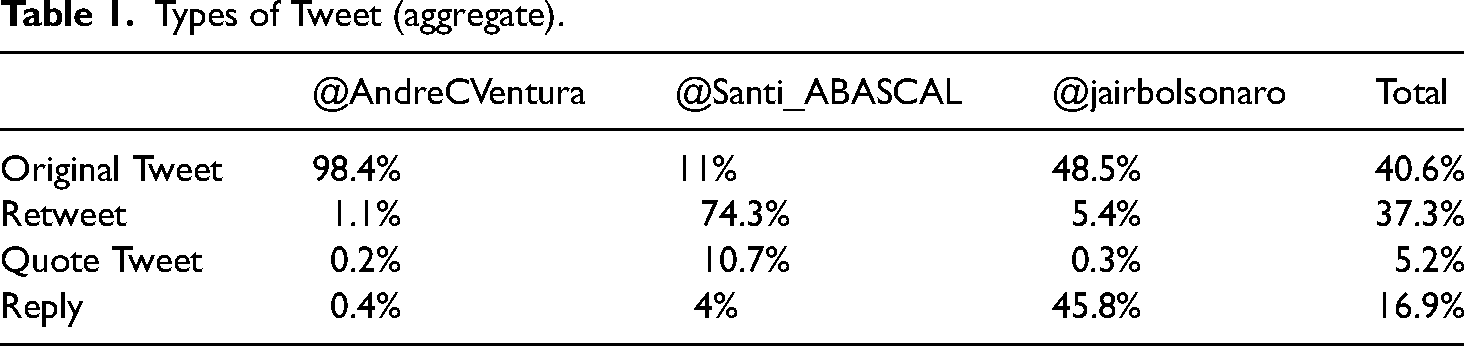
The broadcast quality of leaders’ outputs is reinforced by further analysis of their interactions. Ventura's output consists overwhelmingly of original tweets (98.4%), rarely interacting with other users: retweeting is restricted to Chega's official Twitter profile, then-party Vice President Nuno Afonso, and Italian Lega leader Matteo Salvini, while quote-retweets and replies are directed at opponents, such as BE (Bloco de Esquerda, Left Bloc) MP Mariana Mortágua (e.g., “The dishonest and deceitful Mariana Mortágua, instead of clearing up what she still needs to explain, comes to Twitter to spew nonsense. She should explain why BE voted against Chega's proposal to criminalize illicit enrichment,” Ventura, 2021). Threading is used in a single occasion, comprising four tweets. Conversely, Abascal retweets more often than he posts original tweets, which are just 11% of his output. Actual interaction is similarly scarce: Table 2 shows that the @Santi_ABASCAL account is the second-most frequent recipient of its own retweets and the one it most frequently replies to—while the former type of tweet is meant to increase impressions (Gabielkov et al. 2016), the large proportion of self-replies is caused by threading. Abascal amplifies 36 different Vox members and allies, as well as 31 different party accounts, suggesting a broader communication strategy: Vox's official account (@vox_es) alone was retweeted 902 times; additionally, Abascal uses retweets to signal alignment with foreign political actors, including Ventura and Bolsonaro (e.g. “It has been a pleasure to accompany @AndreCVentura and @PartidoCHEGA at the start of the Portuguese electoral campaign. We wish you the success you deserve, because it would be a success for the entire [Iberian] Peninsula, and for Europe,” Abascal, 2022), and takes advantage of the functional ambivalence of quote-retweets, using them to amplify the @vox_es account, comment on news stories published by mainstream media accounts like El Mundo and other outlets like Europa Press, and contest opponents’ tweets.
Types of users in retweets, quote-retweets, and replies as percentage of each leader's total output.
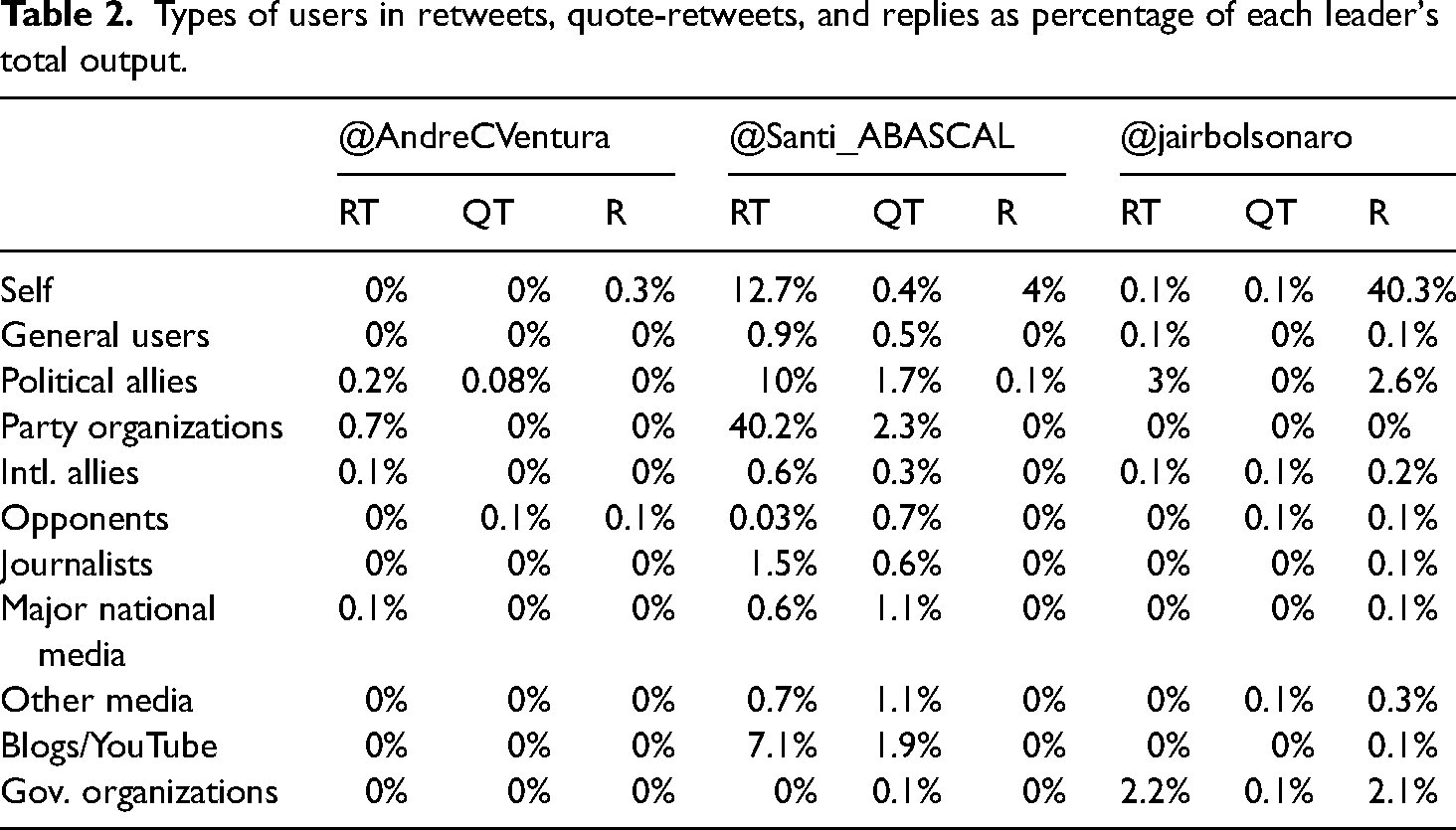
Bolsonaro is the most prolific user of replies, which make up nearly half his output, and the only leader to reply to regular users; this, however, happened just three times, and the bulk of replies was used to build threads and communicate agreement, alignment, or gratitude to political allies, especially to his cabinet members and governmental institutions, frequently through the use of emoji (e.g. “ ,” Bolsonaro, 2021a). Bolsonaro amplifies supporters and allies less than Abascal: 103 of his 107 retweets were of close relations such as son Carlos Bolsonaro, and institutional accounts such as the Brazilian Air Force. Quote-retweets were infrequent, and no user features more than once.
It is, thus, clear that Ventura, Abascal, and Bolsonaro only scarcely and superficially interact with other users and, when they do, they focus primarily on amplifying political allies’ reach on the platform.
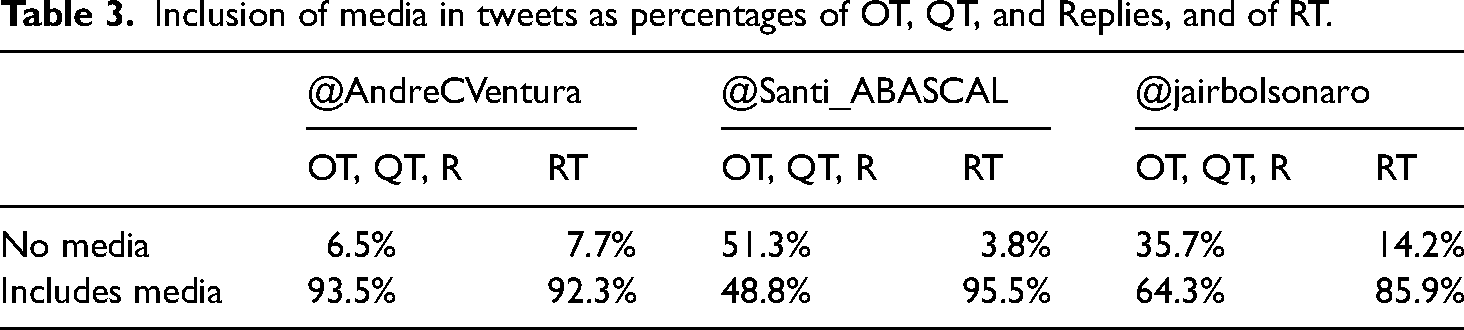
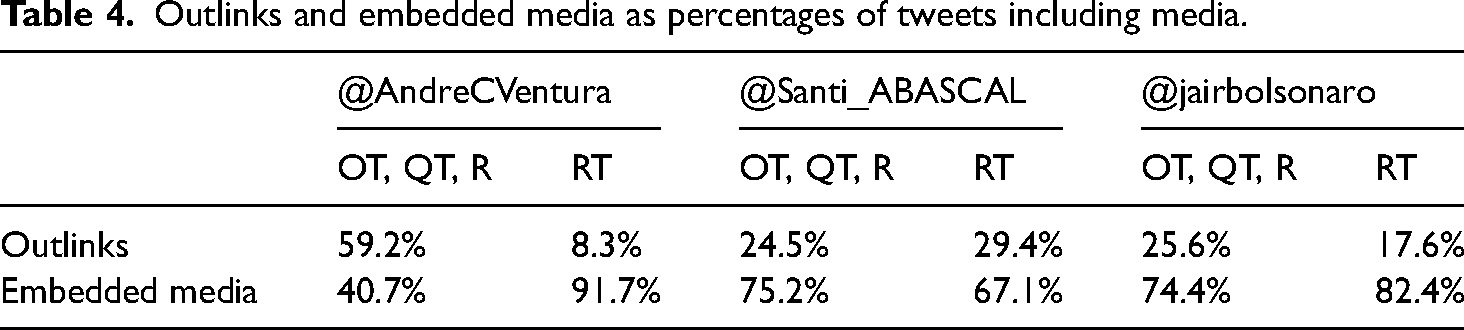
Despite similarities in how they interact with other social media users, Ventura, Abascal, and Bolsonaro use nontextual content differently. While all leaders show a preference toward including media in all types of tweets (Table 3), Ventura's preference for outlinks—present in 59.2% of his tweets, quote-retweets and replies including any kind of media—is more pronounced that those of Abascal (24.5%) and Bolsonaro (25.6%). In contrast, retweets are more likely to contain embedded media, which accounts for 91.7% of Ventura's output, 69.5% of Abascal's, and 82.4% of Bolsonaro's (Table 4).
Inclusion of media in tweets as percentages of OT, QT, and Replies, and of RT.
Outlinks and embedded media as percentages of tweets including media.
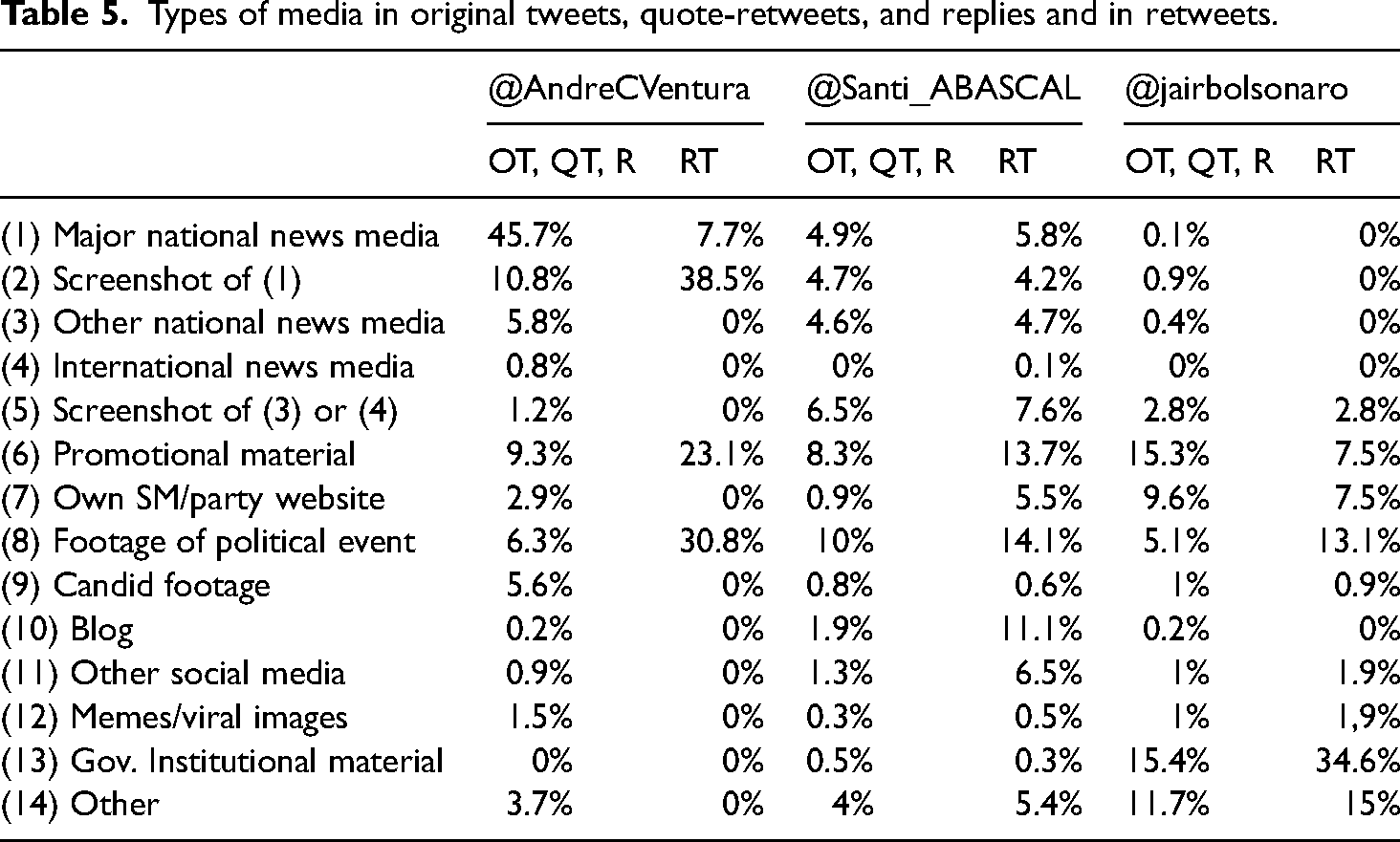
The types of media featured in tweets also vary among the political actors (Table 5). Ventura prefers content produced by major national news media, which he shares directly in 45.7% and a further 10.8% of his tweets through screenshot containing media. Abascal and Bolsonaro do not share that reliance. The Spanish leader has the most diverse output, with footage of political events and promotional material being the most common categories and the only to feature in at least 10% of original tweets, quote tweets, and replies, and blogs being the only other category to rise above that threshold in retweets, particularly La Gaceta de la Iberosfera, run by Vox-affiliated think tank Fundación Disenso (La Gaceta de la Iberosfera, n.d.). Bolsonaro is more starkly in contrast with Ventura, eschewing news media content almost completely. Instead, Bolsonaro primarily shared content from sources he controlled, namely governmental or institutional material (15.4% of original tweets, quote-retweets, and replies, and 34.6% of retweets) and his own promotional material (15.3%, and 7.5%, respectively). Mentions of Bolsonaro's other social media channels were also relatively frequent, appearing in nearly 1 in 10 of his tweets.
Types of media in original tweets, quote-retweets, and replies and in retweets.
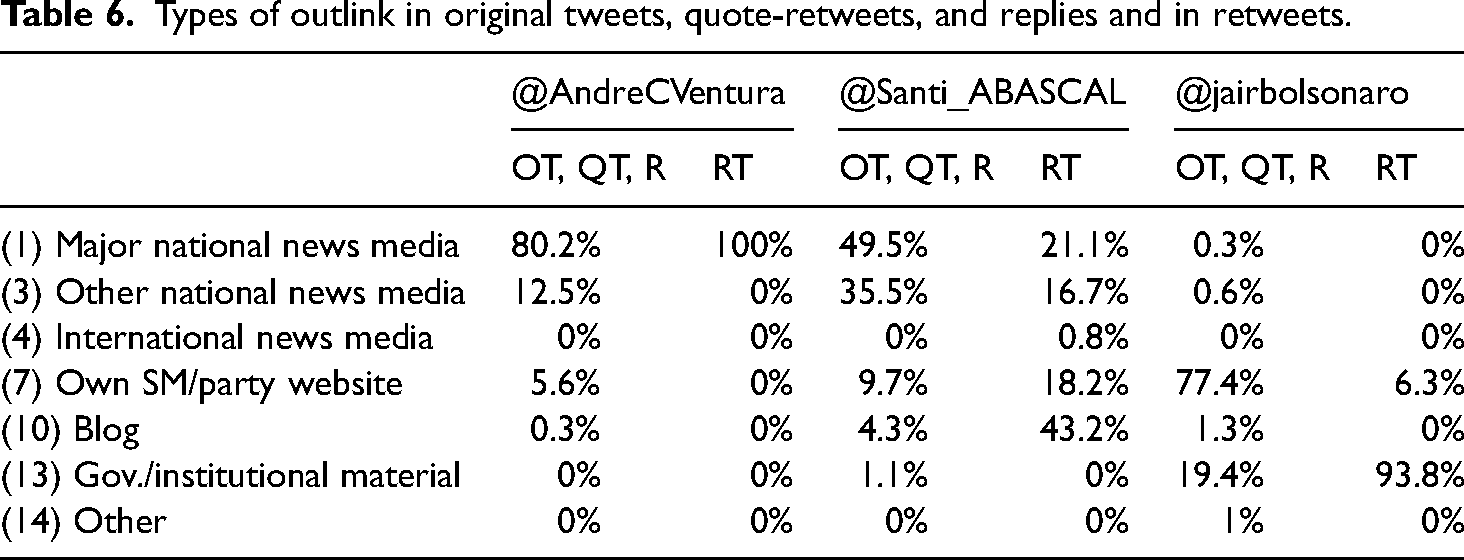
Finally, outlink analysis allows a closer look at where leaders direct followers’ attention (Table 6). Regarding Ventura, it confirms his reliance on major national news media, namely outlets like observador.pt and TVI24/CNN Portugal, to which 80.2% of the outlinks in his original tweets, quote-retweets, and replies direct to. Links to other national news media, and Ventura and Chega's other social media channels, specifically to party-operated YouTube channel ChegaTV appear sporadically. Further analysis of Ventura's retweets is precluded by his limited output in this category (only 13 RTs), but it proves illuminating regarding Abascal's information sharing practices: it makes the relevance of news media content in his relatively small sample of original tweets, quote tweets, and replies clear, linking to conservative-leaning major national news media outlets such as El Mundo and ABC, and right-wing media such as Libertad Digital (Majó-Vazquez and González-Bailon, 2022); on the other hand, 43.2% of outlinks in the larger sample of Abacal's retweets are to pseudo-media blogs, including the aforementioned La Gaceta de la Iberosfera and Contando Estrellas. The outlinks in Bolsonaro's original tweets, quote-retweets, and replies, meanwhile, concentrate on his own media channels and governmental and institutional websites: the former account for over three quarters of the outlinks in these types of tweet, and the latter for 19.4%, including platforms such as YouTube, Telegram, and Gettr, again suggesting a predilection for non- or less-strictly moderated channels he could direct and control. Also of note is the almost total absence of any type of news content, with major national news media making a single appearance, when Bolsonaro contested a Globo piece questioning Bolsonaro's use of “Russian app” Telegram by replying to a tweet and further promoting his channel in that platform (“Thank you for the publicity, even if the stated reasons are Fake News. Follow us on the new social network Telegram to expand your information network.” Bolsonaro, 2021b).
Types of outlink in original tweets, quote-retweets, and replies and in retweets.
Discussion
This article analyzed three radical right wing populist leaders’ information sharing practices on Twitter, namely their use of strategic interaction, nontextual elements, and outlinks in their tweets, departing from two research questions and the expectation that differences between media and political systems would engender different opportunity structures:
RQ1: Who and how do radical right-wing populist leaders in Portugal, Spain, and Brazil interact with on Twitter? RQ2: What is the prevalence of news media content in the relevant leaders’ information sharing practices, and how does it compare with other kinds of media?
The first question was addressed by analyzing the types of tweet leaders used and the interactions they represented, revealing similarly one-sided uses of the platform, in line with findings for comparable political actors (Enli and Skogerbø, 2013; Ernst et al., 2017). Ventura's overwhelming use of original tweets illustrates the point vividly, but Abascal and Bolsonaro also rarely interact, self-retweeting and using replies to build threads. The latter two leaders also use their accounts to amplify the reach of political allies, reflecting their distinct position within the political system and differences between their movements: Vox promotes a leadership group alongside its leader (Barrio et al., 2021), and Abascal frequently amplifies not only the party's official account, but also other party members like MEP Hermann Tertsch and Catalonia regional MP Ignacio Garriga Vaz; Bolsonaro, despite being president, did not have a party structure and, thus, predominantly retweeted cabinet members and relatives. None of the actors frequently engage with foreign leaders or media and, thus, they cannot be said to meaningfully participate in emerging transnational digital-right wing networks or issue networks (Froio and Ganesh, 2019; Heft et al., 2021), suggesting a peripheral status within the wider movement.
The second question was addressed by analyzing the content and outlinks leaders shared by the relevant actors, showing that they direct followers’ attention to different kinds of media. While content from Portugal's largest and widest-reaching outlets is prevalent in André Ventura's output, it coexists with promotional material, blogs and pseudo-media in Santiago Abascal's, and is almost totally absent from Jair Bolsonaro's, which is primarily aimed at driving traffic to other social media channels.
The differences can be explained in terms of leaders’ relations with local media systems. Ventura operates within a media system where outlets do not reveal political preferences, but have nevertheless developed a center-right dominant thinking (Correia and Martins, n.d.), and disproportionately cover small parties (Salgado, 2022); the Portuguese media system provides favorable opportunity structures for Ventura's communication strategy: despite initial resistance, media coverage has now normalized radical right-wing populist ideology and its political actors and, therefore, media can be leveraged to showcase Chega's message, and commenting on media content generates further coverage. Vox's communication strategy is broader than its Portuguese counterpart: not only is it geared to promote a leadership group rather than a single leader, it is also more complex, with dominant types of media varying between original tweets and retweets—the former favoring Vox promotional material, footage of political events, and content from major national news media sources, whereas the latter prioritizes links to blogs and pseudo-media. Abascal takes advantage of the Spanish media system by using tweets to interact with major and alternative right-of-center outlets. Since Spanish outlets state political preferences and, thus, specialize in certain audience segments (Majó-Vazquez and González-Bailon, 2022), Abascal focuses on outlets which are already popular among his supporters, while simultaneously exposing followers to more explicitly partisan and ideological content via outlinks to blogs and pseudo-media. Finally, Bolsonaro almost totally avoids news media and uses embedded content rather than outlinks in his tweets, suggesting an unwillingness to engage with media scrutiny and, on the other hand, a desire to drive followers towards less-strictly moderated platforms. Bolsonaro's output relies on content produced by his communications team, namely political promotional material, and official government propaganda, produced through SECOM (Media Secretariat). Outlink analysis also confirms Bolsonaro's predilection for the same types of content since he links primarily to other social media platforms.
Limitations
Despite these findings, the research underlying this article is limited in ways that could inform future efforts. Firstly, although its tight focus on information sharing practices by radical right-wing populist leaders on Twitter is purposeful and predicated on the complementarity of this approach to what can be gleaned from applying more common discursive and communicative approaches, it also means that it does not engage with explicit utterances in the tweets it analyses. Relatedly, while it distinguishes between several categories of nontextual elements, it does not analyze the content itself: for instance, the category “footage of political event” contains images from such disparate events as Vox's “España en Pie” festival/rally, and Bolsonaro's “motociatas” (motorcycle rallies) which produce distinct visuals and could, thus, engender rich visual content analysis, for instance pertaining to the leaders’ self-presentation. Also, while it identifies the different kinds of news media these radical right wing populist leaders choose to share with followers on Twitter, it does not consider the specific content or emotional valence of the stories in question, which could provide valuable information, for instance about the role of negativity in populist communication logic (Engesser et al., 2017b).
Finally, there are questions over Twitter's future as a relevant social media platform: after Elon Musk's acquisition, in October 2022, the platform has experienced a host of issues, including problems caused by layoffs of technical and moderation staff, as well as those caused by new policies intended to increase monetization, but resulting primarily in the decrease of deliberative exchange (Hickey et al., 2023), prompting some users to quit Twitter in favor of alternatives like Threads or Bluesky. Politicians’ and journalists’ interest in Twitter is instrumental and, if they cease to find the platform valuable to reach audiences and sources, they will follow suit; if the platform loses its influential user base, it will become even more unappealing to advertisers who are already wary due to the rise in hate content (Benton et al., 2022), threatening its business sustainability. While all these questions are outside of this article's scope, they are still crucial to understand how political actors spread their messages and court voters through digital political communication, and research tying these strands together would prove useful.
Conclusion
The analysis focused specifically on the relevant leaders’ interactions with other users of the platform through retweets, quote-tweets and replies, and on their use of nontextual content, particularly outlinks, as these types of content were considered appropriate for gleaning information about their communicative strategies, as well as their relations with local media systems which generate different opportunity structures. User interaction is the central proposition of social media, although research has shown that political actors use platforms as broadcasting tools directed at voters and the media (Enli and Skogerbø, 2013); the use of nontextual content can be understood in the context of “remix activity” geared toward increasing the popularity and engagement of political accounts on social media platforms (Mazzoleni and Bracciale, 2018); finally, outlinks are an important part of the online infrastructure (de Maeyer, 2012), connecting different websites, and, in this case, an indicator of where radical right-wing populist leaders intend to drive their social media followers’ attention in order to create favorable informational environments. Type of tweet and interaction analyses reveal that, like other political actors, the relevant leaders use Twitter primarily as a broadcasting tool to get their messages across, hardly interacting with other users, except for political allies. Ventura's output illustrates the one-way communication trend most clearly, while Santiago Abascal's demonstrates the promotion of official party accounts along with those of other members of the party's membership group, reflected in a high proportion of retweets, and Jair Bolsonaro uses both original tweets and replies to interact with cabinet members and close allies, since he did not lead a party.
Analyzing these leaders’ information sharing practices also reveals relevant differences between them, deriving from distinct positions in local political systems, and the way they relate with media systems: Ventura, as the leader of a small but quickly growing party in a media system that rewards protest and conflict frames and where outlets conceal their political orientation but have developed a center-right dominant thinking, relies on popular mainstream news outlets, which account for the majority of his outlinks; Abascal, leading the third-largest party in Spain, focuses on sharing content from right-wing leaning major national news outlets, while also relying on Vox promotional material and outlinks to partisan blogs and pseudo-media; finally, Bolsonaro, whose tenure as president had become embattled due to corruption allegations and inability to deal with a pandemic, and had established an antagonistic relation with the media (Campello, 2022), almost totally eschews media content, opting instead to drive traffic to other social media platforms, and spread his message through the use of promotional and governmental material.
This article helps to illuminate how radical right-wing populist leaders’ information sharing practices are influenced by the context wherein they operate, and the particular importance of how they relate with local media systems, which can engender different opportunity structures, forcing them to adapt. To do so, it analyzed André Ventura, Santiago Abascal, and Jair Bolsonaro's information sharing practices on social media by analyzing their Twitter output between January 2021 and March 2022. Leaders can choose to direct social media followers’ attentions to media outlets if the coverage leaders are afforded is favorable but, if it is not, they can also choose to divert attention to other content, namely self-produced content and that which stems from outlets they can more tightly control, such as partisan blogs or less moderated channels where leaders can spread their message free from media interference.
Footnotes
Declaration of conflicting interests
The author declared no potential conflicts of interest with respect to the research, authorship, and/or publication of this article.
Funding
This work was supported by the Fundação para a Ciência e a Tecnologia under Grant Nos. PTDC/CPO-CPO/4361/2021 (https://doi.org/10.54499/PTDC/CPO-CPO/4361/2021) and 2021.07542.BD ( ).
).