




Abstract
What news spreads on social media equally depends on what news users do and do not share. However, prior research has predominantly focused on successful news sharing, overlooking the equally consequential behavior of deliberate news withholding. This study addresses that gap by proposing a self-presentation model of deliberate news withholding on social media, integrating three dominant approaches previously used to examine successful news sharing: (1) the informational approach focusing on the virality of news content, (2) the structural approach emphasizing social media network characteristics, and (3) the relational approach centered on users’ self-presentation and management of relationships with their audience. Specifically, this study combines two types of data: (1) survey data from 408 users and (2) a text analysis of news content they withheld in their three most active chatrooms. We examine how users selectively withhold news with varying levels of emotionality, argumentativeness, and hard or soft news value, depending on the characteristics of their audience networks – particularly network size and tie strength – and in relation to three self-presentational goals: self-construction, privacy protection, and audience-pleasing. Findings show that users strategically withhold varied types of news content across different user-audience networks to meet distinct self-presentational goals, thereby managing audience expectations and curating their online image. By shifting attention from news sharing to news withholding, this study offers a more complete account of how everyday users shape news flows and social discourse on social media.
Keywords
The advent of social media has impacted the construction and discourse of news. Formerly passive consumers, social media users have transformed into active agents who generate and share news in the public domain (Westlund, 2015). How users relate to others and how they want to communicate news with them determine what news spreads in the media landscape. In essence, news sharing on social media is a form of relational communication that extends beyond the mass diffusion of information, encompassing the interpersonal dynamics between news sharers and their audience (Walther & Valkenburg, 2017).
Previous research has harnessed three approaches to examine news sharing on social media (Kümpel et al., 2015): (1) an informational approach to news content that goes viral; (2) a structural approach to social media networks where news spread; and (3) a relational approach focusing on users’ self-presentation goals in sharing news to convey their public images and nurture relationships with their audience. While the three approaches tackle varying facets of news sharing, they together complete a relational understanding of news-sharing behaviors: users share news not only because of its informational characteristics or specific network structures. They selectively share specific news content that aligns with their networks or relationships with their audience to present themselves in ways that enhance their public image and maintain those relationships. A relational approach to integrate the separate lines of research is necessary for a comprehensive understanding of news-sharing behaviors.
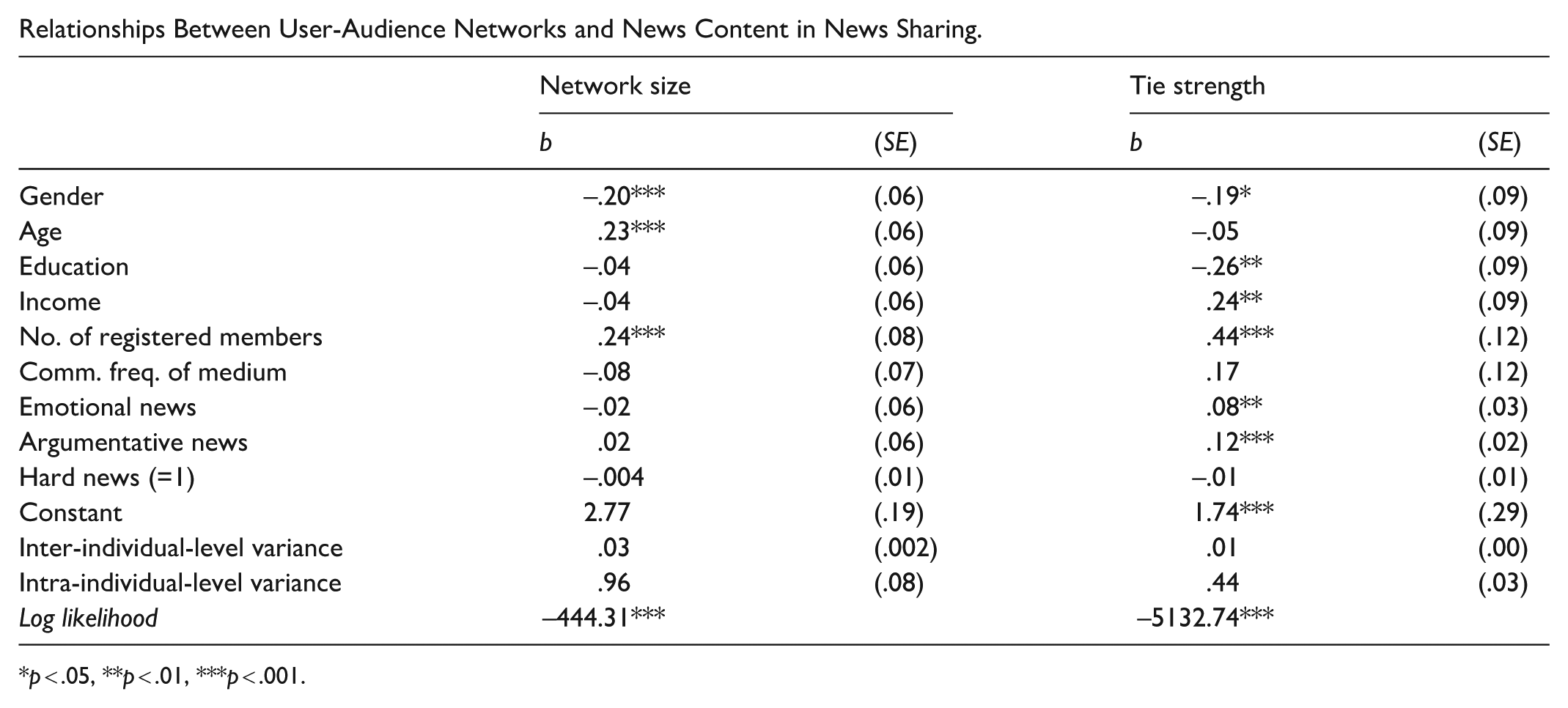
Furthermore, news-sharing research has predominantly focused on factors that induce “successful” news sharing on social media (Kümpel et al., 2015). The phenomenon of not sharing news has largely evaded scholarly attention, despite being far more prevalent than sharing itself (Walker & Matsa, 2021). Not sharing news is not a passive act that stands simply as the opposite of sharing; rather, withholding news is a conscious and active decision, shaped by the deliberate consideration of self-image and audience expectations across diverse audience groups. In fact, our separate analysis, in addition to the analyses presented in this article, suggests that the factors related to news withholding differ from factors related to news sharing; each analysis does not simply reverse the signs of the same factors (see Appendix 1 for news sharing results). For instance, users shared news with large audience networks to build strong public images for self-constructive goals. Conversely, they withheld news from small audience networks – not due to the same self-constructive goals, but to please their audience and avoid discomforting their intimate circles. Furthermore, users shared highly argumentative news with their strong ties, but there was no significant finding of users withholding such news from weak ties. In essence, the decision to withhold news does not exactly negate the goal behind sharing news. To understand how and what news ultimately shapes the news sphere, research needs to investigate why individuals decide not to share news with a certain audience while sharing it with others.
Therefore, this study adopts a relational approach to investigate the behavior of deliberately not sharing news on social media. We first sampled users who had shared a particular news item with a specific audience comprising a chatroom. These users did not share the same news with all of their audiences, but intentionally withheld it from some. In this case, news withholding is as much a deliberate behavior as news sharing. We term such users’ intentional decision not to share particular news with a specific audience while sharing it with others as “deliberate news withholding.” We introduce a self-presentation model of deliberate news withholding that integrates the three lines of previous research, identifying (1) the information in the news withheld from, (2) user-audience networks as structural cues for activating, and (3) self-presentation goals. While a recent study has unraveled goals for general news-withholding behaviors (Mathews et al., 2022), our study is one of the pioneers in examining the deliberate news withholding. We also use two types of data: (1) survey data to reveal news withholders’ goals and their relationships with the audience and (2) actual text data of news content that the same news withholders withheld, overcoming the limitations of survey data that only revealed users’ news withholding intention or the limitations of text data that did not correlate the content to users.
Self-Presentation Goals and Deliberate News Withholding
Self-presentation theory postulates that individuals aim to project themselves in alignment with their ideal self-images while meeting the audience expectations (Baumeister, 1982; Baumeister & Hutton, 1987). As a result, when they communicate with others, they develop “faces” for varied situational contexts and “perform” in front of their particular audience for better self-presentation (Goffman, 1959). Correspondingly, prior research has found that when users share news, they have self-presentation goals to convey their ideal selves and please their audience (Ihm & Kim, 2018).
However, what “faces” users choose to “perform” pertains to not only news sharing but also news withholding. Whenever users decide to withhold certain news from a certain audience group, they hide facets of their identity, spanning from their interests to their political viewpoints (Mathews et al., 2022; J. Shin & Thorson, 2017; Sleeper et al., 2013). In this way, they achieve self-presentation goals to carefully construct public images that only resonate with their desired ideals, and ensure that they do not discomfort their audience. This section applies self-presentation theory to identify three distinct goals in news withholding (Mathews et al., 2022): self-constructive goals, privacy-protection goals, and audience-pleasing goals.
First Is Self-Constructive Goals
Self-presentation theory posits that individuals want to present themselves to craft a public self that is congruent with their ideal self-image (Baumeister, 1982; Baumeister & Hutton, 1987). Social media users also have self-constructive goals to express and bolster their ideal self-image to their audience (Lee & Ma, 2012; Picone et al., 2016). For instance, they may not want to share news that discloses their lack of taste or damages their reputation (Berger, 2014). Interviews with social media users found that they were reluctant to share news, because they were “mindful” of self-images they make to their audience when they share news (Costera Meijer & Groot Kormelink, 2015, p. 674), and they did not want to “be represented in that way” (Mathews et al., 2022). Thus, when users perceive that sharing a specific news article with a certain audience could contradict their self-constructive goal, they may deliberately choose to withhold it.
Second is Privacy-Protection Goals
Self-presentation theory underscores that when individuals fail to construct an ideal self-image as intended, it may not only damage their public reputation but also violate their private self (Baumeister, 1982). Social media users are always situated in the privacy paradox: a tension between the desire to exhibit their identity in public while harboring apprehensions about the potential misuse of personal information disclosed (Gruzd & Hernández-García, 2018; Taddicken, 2014). As a result, users with higher privacy-protection goals and stronger privacy concerns set more boundaries to protect their private self and prevent certain parts of their identity from becoming public (Cho & Hung, 2011; Litt, 2013). Similarly, users may deliberately withhold news to maintain desired levels of privacy and refrain from “present(ing) herself (themselves) too much on social media” (Costera Meijer & Groot Kormelink, 2015, p. 674).
Finally Is Audience-Pleasing Goals
Self-presentation theory suggests that individuals have audience-pleasing goals to present themselves in ways that match audience expectations. Social media users also have a strong audience-pleasing goal to meet their audience’s tastes and interests and foster positive audience relationships (Lee & Ma, 2012). Before sharing news, they meticulously assess whether the news aligns with the specific audience expectation and will not harm their relationships (Ihm & Kim, 2018). When they anticipate that a particular news may displease their audience, they may withhold it for audience-pleasing goals. In previous research, users indicated that they withheld news due to concerns about potential audience reactions and discomfort (e.g., “I’m afraid my friends will find it offensive,” “I don’t know how my friends will react,” “I don’t want to offend people”; Mathews et al., 2022; Picone et al., 2016). Users were also less likely to share extremely controversial (Chen & Berger, 2013; E. M. Kim & Ihm, 2019) or hard news (Bright, 2016) because they wanted to avert the risk of unsettling their audience and challenging their relationships.
This section discussed three self-presentation goals in deliberate news withholding on social media. However, users do not randomly select or pursue all three goals when withholding news. Self-presentation theory suggests withholding news for specific goals is a decision based on both (1) the news content and (2) users’ networks with their audience. After reading a news article, users assess its characteristics such as its tone or topic and decides to withhold it from certain audience networks if it seems inappropriate. As a result, users’ self-presentation goals may vary depending on which news they choose to withhold and from which audience. For instance, users might withhold news about an irrational politician from colleagues for self-constructive goals to avoid misrepresentation, while withholding highly emotional news from close friends for audience-pleasing goals to prevent discomfort. The next two sections weave these two strings into the self-presentation model of deliberate news withholding: (1) the news content withheld and (2) the users’ audience networks, which together lead to different self-presentation goals (see Figure 1 for the model).

Self-presentation model of deliberate news withholding.
Withholding Different News Content for Three Self-Presentation Goals
Numerous investigations have concentrated on the informational dimensions of news sharing, delving into the tones (e.g., articles with high emotionality, negativity, novelty, and utility, Berger, 2014; H. S. Kim, 2015; Trilling et al., 2017) and topics (e.g., soft news, Bright, 2016) of viral news on social media. However, self-presentation theory suggests that users do not automatically decide to share or withhold news content solely based on its tone or topics; they consider how sharing such content will impact their self-presentation (Berger, 2014). They weigh whether sharing this news could ruin their image, invade their privacy, or displease their audience.
This section examines how users may withhold different types of news for three self-presentation goals, focusing on three types of news characteristics: emotionality of news, argumentativeness of news, and hard (and soft) news. Emotionality of news refers to the extent to which the news tone arouses emotions in the audience (H. Shin et al., 2012). Argumentativeness of news refers to the degree to which the news tone reflects users’ distinct arguments and opinions within the content (H. Shin et al., 2012). Hard news (and soft news) represents a binary concept: hard news covers topics related to public affairs, including political, economic, and societal issues, while soft news pertains to human interest, sports, and entertainment-centered stories (Boczkowski & Peer, 2011; Lehman-Wilzig & Seletzky, 2010).
When users perceive different types of news, they may withhold it for different goals. First, users may withhold news with high emotionality for audience-pleasing goals to maintain appropriate relationships with their audience. Sharing emotionally charged content can reveal users’ intimate feelings and may directly affect users’ relationships with the audience (Cappella et al., 2015). While emotional content can facilitate the sharing of heartfelt feelings (H. S. Kim, 2015), it may also displease the audience if they do not expect such empathetic connections or do not wish to share the same level of intimacy with the users. Thus, users may choose to withhold such news to avoid the risk of discomforting the audience and jeopardizing their relationships.
Regarding the argumentativeness of news and hard news, users may withhold highly argumentative or hard news for self-constructive goals and privacy-protection goals. News lacking strong opinions or soft news about a popular musician may not significantly contribute to shaping a public image or revealing one’s private self. Conversely, news with strong arguments or hard news, such as that concerning a politician or political party, exposes personal beliefs, and political affiliations, which are integral to one’s public image and private self. As a result, sharing such news carries the risk of constructing a strong public image that does not align with users’ ideal identities; it may also pose a risk of privacy invasion (Costera Meijer & Groot Kormelink, 2015; Mathews et al., 2022). Users may choose to withhold such news to avoid misrepresentation (Bright, 2016) and to prevent the misuse of their personal information in hiring decisions or stigmatization (Gruzd & Hernández-García, 2018). Thus, we hypothesize:
H1. Withholding news with high emotionality is positively related to audience-pleasing goals.
H2. Withholding news with high argumentativeness is positively related to (a) self-constructive goals, and (b) privacy-protection goals.
H3. Withholding hard news is positively related to (a) self-constructive goals, and (b) privacy-protection goals.
Linking User-Audience Networks to Self-Presentation Goals in News Withholding
The previous section explored a component of the self-presentation model of deliberate news withholding by examining the relationship between new content and self-presentation goals. This section introduces another component: the network between the user and the audience. Self-presentation theory underscores the pivotal role of the audience within the decision-making processes in self-presentational behaviors (Baumeister, 1982; Baumeister & Hutton, 1987). When users decide to withhold news, this does not imply a total abstention from sharing, but rather a deliberate decision to withhold it from a specific audience. This process hinges on a careful evaluation of the audience, harmonizing with the individual’s self-presentation goal (Berger, 2014).
A structural approach to news-sharing research has concentrated on describing the social media networks where news spreads (Kümpel et al., 2015). This line of research has identified how various actors (e.g., influencers, spreaders; Kwak et al., 2010; Park et al., 2021) form different types of ties (e.g., original posting, reposting; Peng & Marculescu, 2013; Truong et al., 2022) or follow distinct structures (e.g., clusters, heterogeneity, reciprocity; Kwak et al., 2010; Park et al., 2021) over varying time spans (M. Kim et al., 2014; Peng & Marculescu, 2013). In these studies, network structures represented the conduits through which news spreads.
However, news does not spread autonomously through social media networks; it is users’ decisions to share or withhold news that determine whether the news is distributed to the users’ audience networks. While a few studies have focused on news-sharing networks as the relationships between users and their audiences (e.g., homophily or tie strength between users and the audience; E. M. Kim & Ihm, 2020; Sun et al., 2022), they have often overlooked how user-audience networks may be associated with users’ varied self-presentation goals when deciding to share or withhold news.
Social media users build diverse relationships with their audiences (e.g., close friends, followers; Litt & Hargittai, 2016). Such different user-audience networks may determine how users want to present themselves to the audience. For instance, regarding their followers, users may be concerned about protecting their reputation (i.e., self-constructive goal), while they may be cautious about not displeasing their close friends (i.e., audience-pleasing goal). Thus, this study examines two network attributes between users and audiences to theoretically investigate the link from user-audience networks to users’ goals for withholding news. We focus on two aspects of user-audience networks: (1) network size and (2) tie strength.
Network Size
Individuals navigate a spectrum of network sizes on social media, from intimate chatrooms involving merely three participants to vast audiences numbering in the millions. Some research has focused on the size of users’ audience networks as an indication of how broadly news spreads from a focal user (Kwak et al., 2010; Park et al., 2021; Truong et al., 2022). However, further research suggests that the size of users’ audience networks determines the type of communication between the users and their audience and is closely related to users’ self-presentation goals. In smaller networks, communication tends to be private and personal, fostering a sense of concern for maintaining relationships with the limited number of audiences (Y. H. Choi & Bazarova, 2015). Consequently, users may selectively withhold news to avoid discomforting their audience in their small, private networks and jeopardizing these precious relationships (E. M. Kim & Ihm, 2020).
As networks expand, communication becomes less personal and more public, with users increasingly prioritizing their public image over individual relationships (Y. H. Choi & Bazarova, 2015). This shift arises from the practical challenge of managing numerous relationships in large networks, and the power of larger networks that may shape users’ online reputation. As a result, users may withhold news from larger audiences to mitigate the potential risk of harming their public image (E. M. Kim & Ihm, 2019). In-depth interviews have revealed that larger networks also heighten users’ privacy-protection goals, as users grapple with uncertainty regarding whom to trust and reveal themselves to (Brandtzæg et al., 2010). The difficulty in controlling the dissemination of private information once shared in large networks exacerbates these concerns. A study on Facebook users underscored this by demonstrating increased self-censorship when users perceive a larger online audience (Das & Kramer, 2013). Thus, we hypothesize:
H4. The audience network size from which users withhold news is positively related to (a) self-constructive goals, and (b) privacy-protection goals, but negatively related to (c) audience-pleasing goals.
Tie Strength
Tie strength refers to “a combination of the amount of time, the emotional intensity, the intimacy (mutual confiding), and the reciprocal services which characterize the tie” between the user and the audience (Granovetter, 1973, p. 1361). Previous research has suggested that users prioritize the cultivation of relationships with their strong ties over their weak ties because they value their close relationships (e.g., family and best friends) and the social resources built into their strong ties (Ihm & Kim, 2018). Studies have also found that with strong ties, users care more about nurturing emotional interactions and sustaining relationships than crafting enhanced public images (Lee & Ma, 2012; Weeks & Holbert, 2013). Correspondingly, research has found that users withheld extremely controversial news from their strong ties due to an audience-pleasing goal of preventing discomfort and preserving valuable ties (E. M. Kim & Ihm, 2019).
With weak ties, users may care more about self-constructive goals than audience-pleasing goals. Users lack a precise estimation of the actual social media audience who read their posts beyond their immediate circles of strong ties who consistently engage with their posts (Litt, 2012). As a result, they view weak ties as conduits to reinforce and extend their public images rather than as an audience for sophisticated relationship management (E. M. Kim & Ihm, 2019). Indeed, users were more likely to withhold medium-high controversial information from non-friends because they did not want to jeopardize “social acceptance” of their self-images to non-friends than friends, achieving a self-constructive goal (Chen & Berger, 2013).
Furthermore, with weak ties, users may have stronger privacy-protection goals regarding news withholding. Individuals share their personal and private realms with their strong ties, while they do not disclose the similar information with their weak ties (Granovetter, 1973). When they share news, users reveal their thoughts and opinions related to the content (Lee & Ma, 2012). As a result, users may withhold news with weak ties because weak ties have less information about the users and the risk that weak ties will (mis)use private information from the news sharing may be heightened (Brandtzæg et al., 2010). Therefore, we hypothesize:
H5. Tie strength with the audience from which users withhold news is negatively related to (a) self-constructive goals and (b) privacy-protection goals, but positively related to (c) audience-pleasing goals.
Withholding News Content From Different User-Audience Networks
The previous two sections examined how news content and user-audience networks shape different self-presentation goals. Closing the loop, self-presentation theory further suggests a link from news content to user-audience networks. When users decide to share a certain news content, they take account of their audience (Berger, 2014). After reading the content, they gauge its appropriateness for a particular audience and deliberately share or withhold it based on how well it aligns with the audience’s preferences or interests (Ihm & Kim, 2024).
In terms of network size, larger networks tend to involve less personal but more public communication (Y. H. Choi & Bazarova, 2015). Prior research has suggested that sharing news with high emotionality conveys the emotions aroused by the news and expresses their heartfelt feelings (Cappella et al., 2015; H. S. Kim, 2015). On one hand, users may withhold news conveying their intimate emotions from large networks; they may hesitate to share their personal feelings with large networks who may come from diverse contexts and may not empathize their situations (Beam et al., 2018). On the other hand, users may withhold highly emotional news from smaller networks because they tend to be more cautious about their relationships and the sharing of empathetic connections in such personal communications (Y. H. Choi & Bazarova, 2015); the wide diffusion of news with high emotionality in open social media environments supports this point (Cappella et al., 2015; H. S. Kim, 2015). Together, prior research does not point to directional hypotheses regarding the relationship between news with high emotionality and audience network sizes. Thus, we explore the following research question:
RQ1. How is the withholding news with high emotionality is related to audience network sizes?
Regarding news with high argumentativeness and hard news, users may withhold such news from large networks. Such news conveys users’ strong opinions and viewpoints. They may not want to risk their privacy or public image toward audience who are composed of more varied contexts and tastes (Beam et al., 2018), and thus more difficult to accommodate and more powerful to spread about their reputation (E. M. Kim & Ihm, 2019). Thus, we hypothesize:
H6. Withholding news with (a) high argumentativeness and (b) hard news is positively related to users’ audience network size.
Regarding tie strength, weak ties often preclude emotional exchanges (Granovetter, 1973) due to a lack of mutual trust or willingness to express feelings (Krackhardt, 1992). Consequently, users may withhold news with high emotionality from weak ties, given the absence of openness for emotional exchange or support. However, users may also be concerned about their intimate, important relationships with strong ties (Ihm & Kim, 2018). They may withhold news with high emotionality from strong ties to avoid overwhelming or discomforting these important relationships due to extreme emotions.
Furthermore, strong ties are frequently characterized by the sharing of redundant information and similar perspectives (Marsden & Campbell, 1984). As a result, users may decide to withhold highly argumentative news or hard news from strong ties. Such news may merely reiterate established information or opinions the audience already holds (E. M. Kim & Ihm, 2019). Conversely, users may also withhold such news from weak ties to protect their public image and privacy. They may not want to reveal their strong opinions or ideologies to weak ties who lack extensive information about them (Granovetter, 1973); weak ties may misunderstand users’ identities or misuse their private information (Brandtzæg et al., 2010). Thus, instead of proposing directional hypotheses, we pose the following research question regarding the relationship between different types of news and tie strength:
RQ2. How is the withholding news with high emotionality, high argumentativeness, or hard news related to tie strength with the audience?
Methods
Sample and Procedure
The sample for this study was obtained from general online panel data available from Embrain, an online survey company in South Korea (www.embrain.com). A screening question was used to retain only those between 20 and 49 years old who lived in the Seoul area and had shared news on KakaoTalk, the most popular Korean social media platform, in the past 3 months. We decided to only include users who had shared news in the past 3 months because these users make deliberate decisions to share or withhold news. This sampling allows us to reveal how news content and the network structure are correlated to an individual’s news withholding decisions and to combine three previous approaches used in news sharing research (i.e., informational, structural, and relational; Kümpel et al., 2015). Examining users who do not share news at all could not capture this association because they do not make deliberate decisions to withhold news because of their network structures or the type of the news content; we could only attribute their withholding behaviors to individual goals (e.g., Mathews et al., 2022, see Appendix 2 for additional rationales of sampling).
We asked Korean adults in October 2020 about their news-sharing experiences, media use habits, and audience in KakaoTalk. The survey company randomly chose and sent invitation e-mails to 23,405 Koreans among the company’s 1,148,766 opt-in online panels. The chosen individuals were invited to participate in the anonymous survey by clicking a link in the e-mail. Among those who received the link, 17,526 clicked on the survey; 15,792 of these individuals were deemed unqualified to meet the screening questions and excluded from the survey. Among the remaining 1734 who clicked on the survey, 504 completed it (completion rate: 29.07%). Responses with invalid or missing data (e.g., malfunctioning news links) were excluded from the analysis, resulting in a sample of 408 individuals (see Appendix 3 for demographics). All participants were granted anonymity, and the first author’s Institutional Research Board approved all procedures.
We first asked the participants to open their KakaoTalk application and copy and paste the actual online link of one news item they had shared with others on the medium most recently in the past 3 months. We provided visual instructions for a KakaoTalk function called “Talk Drawer.” This feature allows users to (1) see all of the links they have shared on the platform as a whole and (2) separate according to the chatroom in which they shared it, with the most recent at the top of each list. We also provided the participants with a definition of news based on previous research (i.e., daily news articles, online news, news on portal websites, and news relevant to their interests and life; Ihm & Kim, 2018). Second, participants were asked to indicate the three group chatrooms in the medium in which they had the most active communication. A group chatroom was operationalized in the survey as “a chatroom having at least 3 participants including yourself.” The participants were asked to give a nickname to each chatroom based on the people in it (e.g., colleagues and family) and state the characteristics of the chatrooms (e.g., frequency of communication, and size of audience). Then participants indicated whether they had shared the news in each chatroom, respectively, using the “Talk Drawer.” If they had not shared the news with a certain chatroom, they indicated why based on the measures below.
Measures
News Content
We asked participants to copy and paste the actual link of a news item they had shared in the medium most recently over the past 3 months. We then analyzed the news item that was withheld from any of the three most active chatrooms, in two ways. First, we categorized the news into hard news or soft news. Among many operationalizations and definitions (Boczkowski & Peer, 2011), we focused on the news topic, identifying news about politics, economics, or society as hard news and the rest as soft news based on a previous operationalization (Lehman-Wilzig & Seletzky, 2010). Naver is the most popular online news portal in Korea (Korea Press Foundation, 2020). It has six sections: politics, economics, society, lifestyle, world, and information technology/science. Knowing that many users access news on this site, we looked for each news article on Naver, checked which section it is in, and coded it accordingly. We collapsed categories such that news articles in the sections of politics, economics, and society are considered hard news (=1) and the rest are soft news (=0; M = .53, SD = .50).
Second, we gathered the actual text of the news items and conducted a text analysis on them. Because all news items were in Korean, we used Korean Sentiment Analysis Corpus (H. Shin et al., 2012), a prominent software for analyzing Korean text (S. Choi et al., 2021), to extract the text features of “emotion” and “argument.” The “emotion” score indicates the degree to which the text conveys emotions (e.g., gladness, pain, fear, and happiness; H. Shin et al., 2012). The “argument” score represents the degree to which the text delivers arguments (e.g., persuades, refutes; S. Choi et al., 2021; H. Shin et al., 2012). This study used each score to determine the degree of emotionality (M = .12, SD = .15) and argumentativeness of news (M = .22, SD = .04), respectively (range: 0–1).
User-Audience Network Attributes
We measured users’ network size by evaluating the total number of members in the chatroom (Y. H. Choi & Bazarova, 2015, M = 16.44, SD = 29.54). We measured tie strength using the same measure from prior research on tie strengths in chatrooms, which focused on communication frequency (Ihm & Kim, 2018). We asked, “How many times per month do you have a conversation for a while with more than two participants in this chatroom?” (M = 97.10, SD = 95.33). These count measures were log-transformed in the analysis.
Deliberate News-Withholding Goals
For self-constructive (M = 2.25, SD = 1.06) and audience-pleasing goals (M = 3.04, SD = 1.20), we adapted measures from prior research that evaluated the two news-sharing goals on social media (Ihm & Kim, 2024). We changed each item to indicate goals for news withholding (e.g., “Because sharing this news distracts from conveying my personal identity”) and examined how much participants agreed with the items (1: strongly disagree, 5: strongly agree). For privacy-protection goals, we used a measure from a prior study on social media (1: strongly disagree, 5: strongly agree, Cho & Hung, 2011; M = 1.97, SD = .93). To test the validity of the five goals, the three-factors model was tested and reached a good fit of reflecting different constructs (Hooper et al., 2008): χ2 (31) = 209.26, root mean square error of approximation (RMSEA) = .04, Tucker–Lewis Index (TLI) = .99, and comparative fit index (CFI) = .99 (see Appendix 4 for results and full items). Factor scores were used to evaluate each goal.
Analysis
Each participant gave answers about their three chatrooms, so multilevel modeling was conducted. First, we conducted three multilevel models (i.e., three news withholding goals as dependent variables) on the relationships among news content, user-audience networks, and news withholding goals (see Table 1). Second, we conducted two multilevel models (i.e., network size, and tie strength as dependent variables) on the relationships between news content and user-audience networks (see Table 2). In every analysis, we controlled for the following variables: the number of total registered members in the medium (M = 404.94, SD = 423.59), the total communication frequency in the medium per week (M = 32.35, SD = 31.71), and individual users’ gender, age, education, and monthly household income. Again, count measures were log-transformed in the analysis.
Relationships of News Content and User-Audience Networks With News-Withholding Goals.

p < .05, **p < .01, ***p < .001.
Relationships Between User-Audience Networks and News Content in News Withholding.

p < .05, **p < .01, ***p < .001.
Results
H1 examined the relationship between news with high emotionality and audience-pleasing goals. There was a positive relationship between the two variables (b = .32, p < .05). Therefore, H1 was supported.
H2 examined relationships between news with high argumentativeness and (a) self-constructive and (b) privacy-protection goals. Withholding highly argumentative news was not related to any goals. Thus, H2 was not supported.
H3 examined relationships between hard news and (a) self-constructive and (b) privacy-protection goals. Withholding hard news was positively related to self-constructive (b = .27, p < .05) as well as privacy-protection goals (b = .27, p < .05). thus, H3 was supported.
H4 hypothesized relationships between network size and news-withholding goals. The result suggests that network size is negatively related to audience-pleasing goals (b = –.38, p < .01). There was no relationship between network size and other goals. H4-c was supported. H4-a, and H4-b were not supported. Thus, H4 was partially supported.
H5 hypothesized relationships between tie strength and news-withholding goals. Results suggest that tie strength was negatively related to self-constructive goals (b = –.13, p < .05) and privacy-protection goals (b = –.12, p < .05). Tie strength was not related to audience-pleasing goals. H5-a, and H5-b were supported. H5-c was not supported. Thus, H5 was partially supported.
RQ1 examined the relationship between news with high emotionality and audience network size. There was no relationship between the two variables.
H6 hypothesized positive relationships between two news types and network size. Withholding highly argumentative news was positively related (b = .13, p < .01), while hard news was negatively related to network size (b = –.26, p < .001). H6-a was supported. H6-b was not supported. Thus, H6 was partially supported.
RQ2 investigated the relationship between news content and tie strength. There was no relationship between the tested variables.
Together, the results suggest that network size may mediate the relationships between (1) highly argumentative news and audience-pleasing goals, and (2) hard news and audience-pleasing goals. To further examine these potential mediations, post hoc tests of indirect effects were conducted using Monte Carlo simulations appropriate for multilevel models (Preacher & Selig, 2010). There were indirect effects of highly argumentative news and hard news on the audience-pleasing goal, mediated by network size (see Appendix 5 for results).
Discussion
This article examined a self-presentation model of deliberate news withholding on social media. Results from H1, H2, and H3 indicate users withhold different types of news for varied goals. Every news content characteristic was related to audience-pleasing goals either directly (emotionality of news) or indirectly (argumentativeness of news, hard news). These findings suggest that users consider various dimensions of news content – specifically, the topic (i.e., hard news) and tone (i.e., emotionality and argumentativeness) – for the goal of maintaining relationships with an audience. Maintaining relationships may require more nuanced consideration of news content that accommodates diverse audience preferences and contexts (Beam et al., 2018). In the meantime, hard news, which reflects a news topic, was related either directly or indirectly to all three goals. Consistent with previous research (Bright, 2016; Cho & Hung, 2011; Litt, 2013; Trilling et al., 2017), users appear to care about news topics in all situations, likely because hard news poses direct risks to their reputation, privacy, and relationships compared to the subtler tones of other news (i.e., emotionality and argumentativeness).
Results from H4 and H5 suggest that the network between users and their audience determines how users want to present themselves to their audience, activating different self-presentation goals. The negative association between network size and audience-pleasing goals suggests that users with smaller networks seem more concerned about not discomforting their audience during their intimate communication (Y. H. Choi & Bazarova, 2015); users with larger networks seem less concerned about relationship maintenance as their communication becomes more public and they cannot accommodate to every context and taste in such networks (Beam et al., 2018). The negative relationships between tie strength and both self-constructive goals and privacy-protection goals indicate that users with weaker ties to their audience are more worried about revealing their private selves and identities to whom may misunderstand or misuse their private information (Granovetter, 1973).
Results from H5, H6, RQ1, and RQ2 suggest that users withhold different types of news from different user-audience networks. Tie strength did not show any significant relationship to the news content withheld. However, withholding highly argumentative news or hard news was related to the network size. Tie strength, measured by frequency of communication, may not totally capture the nuanced relationship between the user and the audience (e.g., having formal colleagues as frequent communication partners). Network size, on the other hand, may determine the type of communication between the user and the audience – private or public (Y. H. Choi & Bazarova, 2015)—because chatrooms with very large audience sizes (e.g., hundreds or more) can make the communication resemble public communication.
Together, this study offers implications for three different approaches in prior news-sharing research. First, the relational approach in news-sharing research has emphasized that users with stronger self-presentation goals are more likely to share news (Ihm & Kim, 2018). Research has also shown that users may withhold news due to general self-presentation goals (Costera Meijer & Groot Kormelink, 2015; Mathews et al., 2022). Building on these studies, this study identifies three specific self-presentation goals that may lead users to withhold news. Furthermore, this study suggests that news withholding is not a simple mechanism where users withhold all news from all audience networks because of their self-presentation goals. It proposes a nuanced perspective, where users selectively withhold certain news from particular networks depending on the specific type of self-presentation goal.
Second, the structural approach has focused on how news spreads in certain network structures (Kwak et al., 2010; Park et al., 2021; Truong et al., 2022). This study redirects attention to understanding networks as relationships between users and their audiences. It further views network size not merely as an indicator of the potential reach of news dissemination, but rather as a reflection of the type of relational communication between the user and the audience (i.e., public or private; Y. H. Choi & Bazarova, 2015). In this way, this study offers deeper insight into earlier findings by shifting the focus from identifying specific network structures where all news spreads well or fails to spread, to revealing specific user-audience networks from which users strategically withhold news for their self-presentation goals.
Third, an informational approach has focused on the general characteristics of viral news content (Berger, 2014; Bright, 2016; H. S. Kim, 2015; Trilling et al., 2017). This study further distinguishes between news tones and topics as characteristics of news, building on findings that users differentiate the two aspects based on how they want to present themselves to their audience. It also suggests that news with certain characteristics may not always spread or persist in the social media landscape. Consequently, it challenges the informational approach that it is not only the characteristics of news content, but also users’ goals and decisions, and furthermore, their relationships to their audiences, that determine “viral” or “contagious” news on social media (Berger, 2014; H. S. Kim, 2015).
In this way, this study integrates three lines of prior news-sharing research and applies them to news-withholding behaviors, a topic that has received limited focus (Kümpel et al., 2015). It suggests meaningful associations among three factors that prior research has examined separately—news types, audience networks, and news-withholding goals—and indicates that these associations are not random. Specifically, there was a distinction between factors related to self-constructive goals and privacy-protection goals (i.e., hard news and tie strength) and those related to audience-pleasing goals (i.e., highly emotional news and network size). These results suggest that the types of news users withhold, the audience they withhold it from, and their self-presentation goals are closely interconnected. This close relationship may indicate two different types of news-withholding mechanisms. For example, one mechanism might involve users withholding hard news from weak ties due to self-centered goals (i.e., self-constructive goals and privacy-protection goals), while another might involve withholding highly emotional news from smaller networks for audience-centered goals. Consequently, the study synthesizes previous research on news types, networks, and goals and offers a comprehensive understanding of news-withholding behaviors.
Conclusion
This study introduced a comprehensive model of deliberate news-withholding on social media based on self-presentation theory. It contributes to communication research in three ways. First, it integrates journalism and communication research, addressing the call for research on the convergence of mass and interpersonal communication (Walther & Valkenburg, 2017). Previous research has viewed news through three distinct lenses: (1) information for mass diffusion, (2) content that mass spreads within social media networks, and (3) interpersonal links that connect users (Cappella et al., 2015; H. S. Kim, 2015; Kümpel et al., 2015; Lee & Ma, 2012). However, users withhold news not only due to specific information, network structures, or goals; they withhold certain news from particular audience networks for distinct self-presentational goals. By combining actual news text with individuals’ survey responses about their networks, audiences, and goals, this study bridges the three lines of prior research, offering a more complete theoretical understanding of withholding news.
Second, it contributes to communication research by unveiling news-withholding behaviors on social media. Research has primarily focused on successful news sharing, viewing it as the main mechanism shaping the news landscape on social media (Kümpel et al., 2015). This study redirects attention to deliberate news-withholding, which may influence public news discourse as much as news-sharing behaviors do. Furthermore, it extends the limited research that has discussed general news-withholding behaviors for self-presentation goals (e.g., Mathews et al., 2022) by identifying three distinct self-presentation goals, as well as diverse networks and news types, within deliberate news-withholding behaviors. In this way, this study provides a theoretical classification for different self-presentation goals in news withholding and enhances the understanding of news withholding not merely as the opposite of news sharing but also as an active and intentional behavior involving deliberate decisions, goals, and considerations for relationships.
Finally, it enriches audience and journalism research by extending our understanding of news audiences and applying network concepts to them. This study uncovers how common social media users, instead of professional journalists, identify and reckon with nuanced relationships with the audience in the news distribution (and withholding) process and shape the news sphere as active agents (Costera Meijer, 2019, 2020; Swart et al., 2022; Westlund, 2015). In this way, this study embodies “the audience turn” in journalism research (Costera Meijer, 2020), and provides future directions on journalism scholarship to investigate the audience of common users who actively transform the news sphere differently from traditional journalists and news organizations. Furthermore, this study operationalizes the news audience by network attributes. In this way, it offers a systemic conceptualization of the social media audience in relation to previous research (e.g., Litt, 2012) and contributes to the theoretical advancement in the audience research.
This study has several limitations. First, the sample for this study was active social media users who had shared news on social media in the past 3 months. Although an increasing number of users share news via social media, many news readers still do not share news at all (Walker & Matsa, 2021). We intentionally included people who have the experience of news sharing because we wanted to reveal how the network structure and news content are correlated to an individual’s news withholding decisions. Examining individuals who do not share news at all could not capture this association. Future research that includes people who never share news might take a different approach to understanding why, and would represent a more general population of social media users. Second, this study is based on cross-sectional data. Participants must have read the news to decide whether to share it with or withhold it from a specific audience for their goals, but future studies from longitudinal data may further contribute to understanding the news-withholding process. Finally, this study focused on news that users selectively did not share. Comparing this study’s findings to results on news sharing (see Appendix 1) may provide a more comprehensive picture of news-related behaviors on social media.
News sharing on social media has increasingly become a major conduit of news, but the amount of news that individuals share is much less than the amount of news they keep to themselves. In this way, both shared and withheld news shape social media discourse. Just as news sharing is a public behavior, news withholding is a different type of “public” behavior that considers self-presentation to the public. By focusing on this “public,” yet concealed behavior, this study extends the understanding of how the news sphere and discourse are constructed on social media.
Footnotes
Appendix 1
Relationships Between User-Audience Networks and News Content in News Sharing.
| Network size | Tie strength | |||
|---|---|---|---|---|
| b | (SE) | b | (SE) | |
| Gender | –.20*** | (.06) | –.19* | (.09) |
| Age | .23*** | (.06) | –.05 | (.09) |
| Education | –.04 | (.06) | –.26** | (.09) |
| Income | –.04 | (.06) | .24** | (.09) |
| No. of registered members | .24*** | (.08) | .44*** | (.12) |
| Comm. freq. of medium | –.08 | (.07) | .17 | (.12) |
| Emotional news | –.02 | (.06) | .08** | (.03) |
| Argumentative news | .02 | (.06) | .12*** | (.02) |
| Hard news (=1) | –.004 | (.01) | –.01 | (.01) |
| Constant | 2.77 | (.19) | 1.74*** | (.29) |
| Inter-individual-level variance | .03 | (.002) | .01 | (.00) |
| Intra-individual-level variance | .96 | (.08) | .44 | (.03) |
| Log likelihood | –444.31*** | –5132.74*** | ||
p < .05, **p < .01, ***p < .001.
Appendix 2
References in Appendix

Ethical considerations
This study received ethical approval from the Kwangwoon University Institutional Review Board (IRB) on July 30, 2020 (approval #2020-06-002).
Consent to participate
All participants provided written informed consent to take part in the study.
Consent for publication
All participants provided written informed consent for the publication of their anonymized data in this study. No identifiable personal details, images, or videos are included. The authors confirm that written informed consent for publication is held on file by the first author.
Author contributions
Jennifer Ihm participated in data analysis and the writing of the article. Eun-mee Kim participated in the writing of the article.
Funding
The authors disclosed receipt of the following financial support for the research, authorship, and/or publication of this article: This work was supported by Korea News Agency Commission in 2020. This research was also supported by the College of Media and Communication at Korea University.
Declaration of conflicting interests
The authors declared no potential conflicts of interest with respect to the research, authorship, and/or publication of this article.
Data availability statement
Due to privacy and ethical considerations, the data from this study are not publicly available.