




Abstract
We investigated how sharing performance on Facebook and Twitter is influenced both by news articles’ content characteristics and the availability of additional news articles reporting on the same news topic. We conducted a multi-method study, integrating automated data collection and manual/automated content analyses of 1,764 German online news articles. Our findings show the influence of news factors and, more importantly, news outlets on sharing performance, while simultaneously highlighting differences between the logics of news sharing on Facebook and Twitter. We also find that the first article reporting on a news event is shared more often than subsequent articles.
The widespread use of social network sites (SNSs) has brought about new dynamics in the way we find, consume, and engage with news content. According to a survey from the Pew Research Center, 68% of Americans report that they obtain at least some of their news from SNSs, with Facebook and Twitter being the most important sites in that regard (Matsa & Shearer, 2018; see also Newman et al., 2018). SNSs not only facilitate a process that Choi (2016) labeled as news internalizing, that is, consuming encountered news content, but also as news externalizing, that is, disseminating, recommending, or sharing news for others to read (for an overview see Kümpel et al., 2015). Such news-sharing activities play a vital role in the current media environment—both for online news outlets and the average SNS user. While news outlets get a significant proportion of their much-needed referral traffic from SNSs (VanNest, 2016), SNS users can also profit from news sharing in democratically desirable ways. Indeed, news-sharing activities were found to be related to greater interest and involvement in the shared stories (Oeldorf-Hirsch & Sundar, 2015) as well as to increased levels of political participation (Lane et al., 2017).
While both the effects and the antecedents of news sharing (i.e., the motives and intentions for sharing) have been examined in the literature (e.g., Karnowski et al., 2017; Lee & Ma, 2012), we need to learn more about the content characteristics that determine whether news is shared widely or is not disseminated at all. Some studies have already investigated the influence of content characteristics on the sharing performance of specific news articles (e.g., Trilling et al., 2017; Valeriani & Vaccari, 2016), highlighting the importance of both formal characteristics and news factors. These studies, however, focus on single news articles as the unit of analysis, neglecting the fact that a specific news topic is often reported on in multiple articles. Thus, the interdependencies among the sharing performances of multiple articles reporting on the same news topic have largely been neglected. To shed further light on the process of news sharing on SNSs, we investigated the interdependencies between the amount of sharing of multiple articles reporting on the same news event while also taking the content characteristics of the news articles into account. To do so, we carried out a multi-step, multi-method study that integrates automated data collection and both manual and automated content analyses of 1,764 online news articles published in 2015 by four major German online news outlets.
Characteristics of News Use on SNSs
To analyze the determinants of the news-sharing performance on SNSs, we first need to consider the overarching structures of SNS news use. As discussed above, consuming news on SNSs has become an important phenomenon in recent years and has changed the way in which users are exposed to—and engage with—news (Newman et al., 2018). Consuming news on Facebook or Twitter is different to traditional news consumption from the TV, radio, or newspapers in two important ways. First, consumers of “traditional” news encounter news in bundles, for example, in a daily newspaper or from a news broadcast covering multiple news items. On SNSs, users typically encounter detached news articles in the form of single referrals on their timeline or in their news feed (Ju et al., 2014). Second, these referrals are enriched by additional social cues that can inform the user about other users’ consumption of, and opinion about, each news article. The number of shares or (re-)tweets is an example of a popularity cue that can affect both the visibility of a specific news article and users’ perceptions of it, for example, through indicating relevance or by affecting public opinion perceptions (Haim et al., 2018; Porten-Cheé et al., 2018). Therefore, metrics, such as click rates, increasingly influence editorial decisions in news organizations (Cherubini & Nielsen, 2016) and can be seen as an adequate measure with which to gauge news articles’ sharing performance on SNSs (e.g., Trilling et al., 2017).
Content Characteristics as Predictors of News Articles’ Sharing Performance on SNSs
News articles’ sharing performance on SNSs results from an interplay between users’ motives for sharing (especially social motives; Karnowski et al., 2017; Ma et al., 2014) and the characteristics of the articles. Indeed, research has already identified different content characteristics as drivers of news sharing, highlighting the importance of both formal characteristics (Khuntia et al., 2016; Trilling et al., 2017) and news factors (Trilling et al., 2017).
The Influence of Formal Characteristics
The news outlet that originally published the shared article has a strong influence on its sharing performance (Keyling et al., 2013; Trilling et al., 2017). The article’s length and the news section influence sharing performance as well, for example, articles from the sports section being shared much less frequently than other articles are (Keyling et al., 2013; Khuntia et al., 2016; Trilling et al., 2017). Aiming to corroborate these findings, we formulated our first research question as follows:
Further formal characteristics, such as article visualization, have also been identified as relevant for sharing performance on SNSs (Khuntia et al., 2016; Trilling et al., 2017). Drawing on empirical results not only on the sharing of news articles on SNSs, but the sharing of content on SNSs more generally, we further assumed that humor and emotions might influence articles’ sharing performance. Several studies have found that humorous content is shared more often on SNSs than non-humorous content is (e.g., Kalsnes & Larsson, 2018). The same is true of emotional content, with positive and arousing content being shared more often (e.g., Hasell & Weeks, 2016). Therefore, we also aim to investigate the following question:
The Influence of News Factors
News value theory is one of the most widely used approaches to explain news-related selection decisions, especially regarding the value judgments that are made when journalists decide which issues or events will or will not become news. The empirical foundation of news value theory is ascribed to Galtung and Ruge (1965), who defined 12 “factors influencing the flow of news” (p. 64), or news factors for short. They argued that the more these news factors—which include cultural proximity, negativity, personalization, and controversy—apply to events or topics, the more likely they are to be reported. Galtung and Ruge (1965) acknowledged that such selection processes occur not only among journalists, but also among the audience and “all the middle-men” (p. 71). The idea of news factors as universal relevance indicators was taken up by Donsbach (1991) and in particular by Eilders (1997, 2006) who developed the audience-focused variant of news value theory and showed that “news factors can be regarded as efficient selection criteria in both media use and the retention of news items by the audience” (Eilders, 2006, p. 10). Arguments supporting the idea that news factors are indicators of relevance are derived primarily from evolutionary psychology (for news factors such as damage, conflict, and unexpectedness) or from theories of socialization and cognitive accessibility (for news factors such as cultural proximity and prominence). We thus have reason to believe that users who share news on SNSs rely on news factors in their selection decisions as well, particularly as their role as gatewatchers or news curators is increasingly overlapping with the role of professional journalists (Bruns, 2018; Thorson & Wells, 2016). Thus, news factors lead SNS users not only to select certain articles for their own reading, but also to disseminate them to other users.
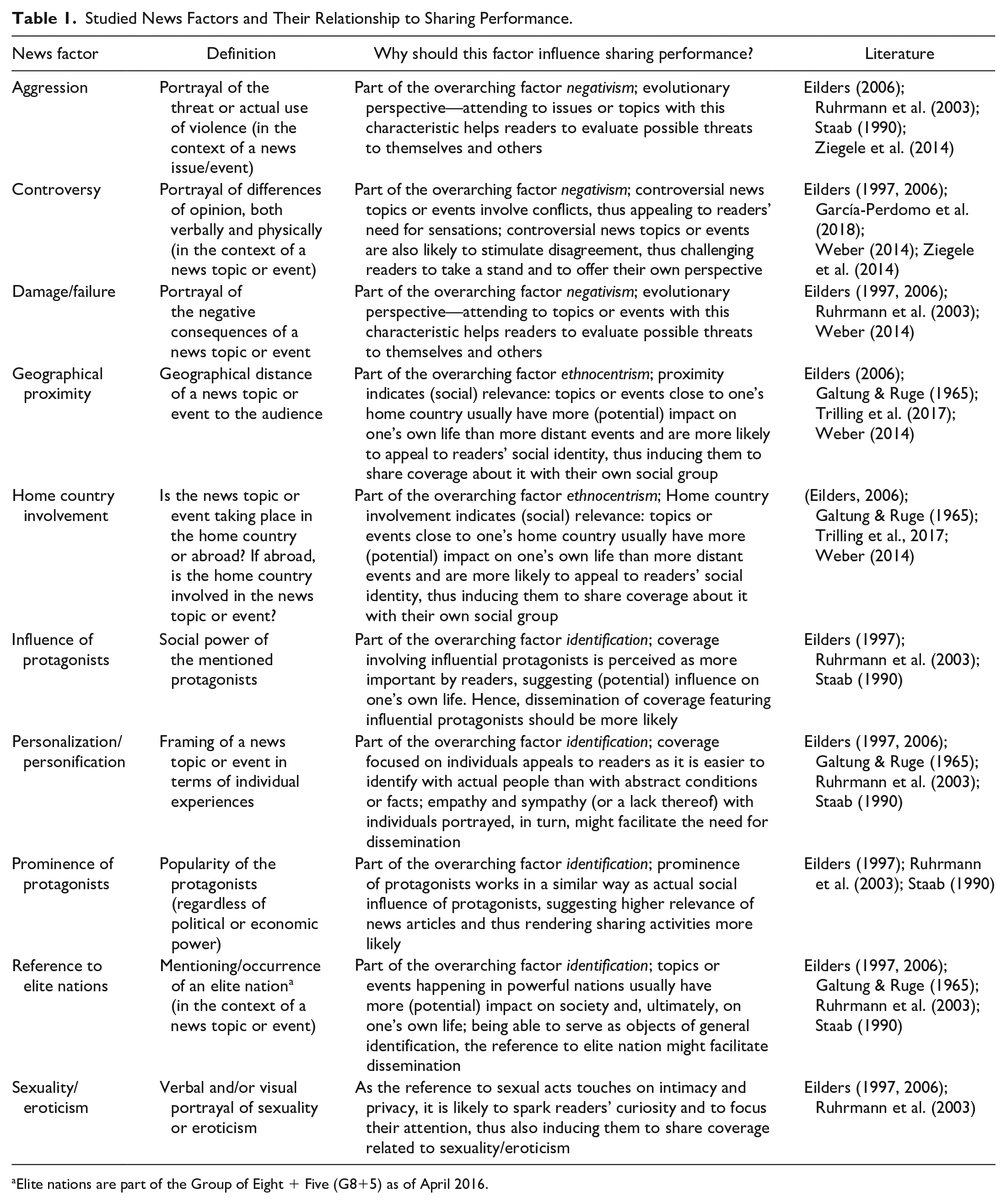
Following this rationale, a few studies have investigated the influence of news factors on sharing performance on SNSs (e.g., Trilling et al., 2017; Valeriani & Vaccari, 2016), albeit by focusing on heterogeneous sets of news factors. This diversity in predictors is hardly surprising considering that news value research has always relied on a number of news factor catalogs of varying comprehensiveness and complexity. Building on both the studies mentioned above and earlier studies on news value theory (e.g., Ruhrmann et al., 2003; Staab, 1990), the present study focuses on 10 news factors that are hypothesized to be predictive of news sharing on Facebook and Twitter, as described in Table 1.
Studied News Factors and Their Relationship to Sharing Performance.
Elite nations are part of the Group of Eight + Five (G8+5) as of April 2016.
Aggression, controversy, and damage/failure all belong to the overarching factor of negativism. Their influence on sharing performance could be explained from an evolutionary perspective because attending to issues or topics with these characteristics helps readers to evaluate possible threats to themselves and to others. Several studies have shown all three factors to be influential in offline news consumption (Eilders, 1997, 2006; Ruhrmann et al., 2003; Staab, 1990) and in some online news use behaviors as well (Weber, 2014; Ziegele et al., 2014). Still, the empirical evidence on these factors’ role in online news behaviors more broadly and in news sharing on SNSs specifically is still limited, making it worthwhile to further investigate their influence. This more nuanced look is especially important as previous studies have found that factors, such as controversy, can yield two-sided effects on people’s inclination to discuss a topic, both facilitating and inhibiting conversations (Chen & Berger, 2013).
Geographical proximity refers to the geographical distance of a news topic or event to the audience. The proximity of an event to a user’s home country signifies social relevance because it has a greater (potential) impact on that user’s life than more distant events do. This social influence is also signified by home country involvement. Several studies on news values have shown both factors to be influential in offline news consumption (e.g., Eilders, 2006; Galtung & Ruge, 1965). Evidence of their impact on news sharing on SNSs (Trilling et al., 2017) and on other online news behaviors (Weber, 2014), however, is limited, thus warranting further analysis.
The potential to identify with a news topic is reflected in four factors (influence of protagonists, personalization/personification, prominence of protagonists, and reference to elite nations). Through boosting identification with an issue or event, all of these factors can facilitate a user’s need to disseminate or discuss the related articles, suggesting an influence on overall sharing performance. However, to the best of our knowledge, these four factors have only been addressed in the offline context (Eilders, 1997, 2006; Galtung & Ruge, 1965; Ruhrmann et al., 2003; Staab, 1990). Finally, sexuality/eroticism reflects the verbal and/or visual portrayal of sexual or erotic themes in a news article. As these themes usually pertain to topics of intimacy and privacy, they are likely to spark readers’ curiosity and attract their attention (Eilders, 1997, 2006; Ruhrmann et al., 2003), inducing them to share coverage related to this factor.
Building on these previous findings, we investigated the influence of the 10 news factors mentioned above on the sharing performance of news articles on SNSs. The corresponding research question is as follows:
News Topics, Events, and Articles
All of the research cited above dealt with single news articles as the basic unit of analysis. This implies that characteristics of a single news article—such as formal characteristics or news factors—were measured to explain its sharing performance on SNSs. However, news articles deal with a specific news topic, which is usually covered by more than one news outlet, resulting in a (smaller or larger) number of news articles on the same topic. For example, it is quite unlikely that only a single news outlet would report on the results of the US midterm elections or the annual United Nations Climate Change Conference. Consequently, news diffusion research, which predates research on news sharing on SNSs, never focused on single articles when analyzing the (offline) sharing of news among the audience, but rather on the diffusion of a news topic, regardless of the specific source that recipients had heard about it from (e.g., Greenberg, 1964).
Going beyond single-article analysis and focusing on the broader coverage of a news topic is even more important in the SNS environment. As discussed above, the distribution of news via SNSs disassembles the traditional bundling of news, so that users encounter only single, isolated articles potentially coming from various sources. This particularity of SNS news use makes it more likely that users will encounter multiple news articles that deal with the same topic. While only a few SNS users follow the page of a news outlet directly—a situation that was observed in Germany (Hölig & Hasebrink, 2018), the majority of users encounter news through sponsored posts or posts shared by friends, thus making a broader variety of news encounters more likely.
Accordingly, we have to assume that the decision to share a news article cannot be regarded independently of the existence of other articles on the same topic. When studying news sharing on SNSs, we therefore have to consider the topic of news articles as well. The nature of news topics has been discussed broadly, especially in research in the tradition of agenda setting. Yagade and Dozier (1990) distinguish three levels of abstraction: events, concrete issues, and abstract issues. They argue that single events are occurrences of issues that are “the grist of journalistic writing” (Yagade and Dozier, 1990, p. 5). In our investigation of the overlapping of sharing processes of several news articles on a shared news topic, we thus focus on this finest and empirically most accessible level, that is, the single news event. Following Rogers and Dearing (1988), we characterize a news event through a specific combination of protagonist(s), action, and time. In doing so, we first focused on the influence of competition, that is, the extent to which the existence of other news articles about the same event can influence a news article’s sharing performance (p. 566). In addition, we assumed that despite the competition from other articles about a news event, the first article covering it is likely to stand out. Hence, we resolved to inquire into the importance of being the first article among several to cover a given news event. Thus, our last research question reads as follows:
Method 1
To answer the research questions, we carried out a multi-step, multi-method study that integrated automated data collection with both manual and automated content analyses (see Table 2).
List of Article-Related Data, Sorted by Data Collection Method.
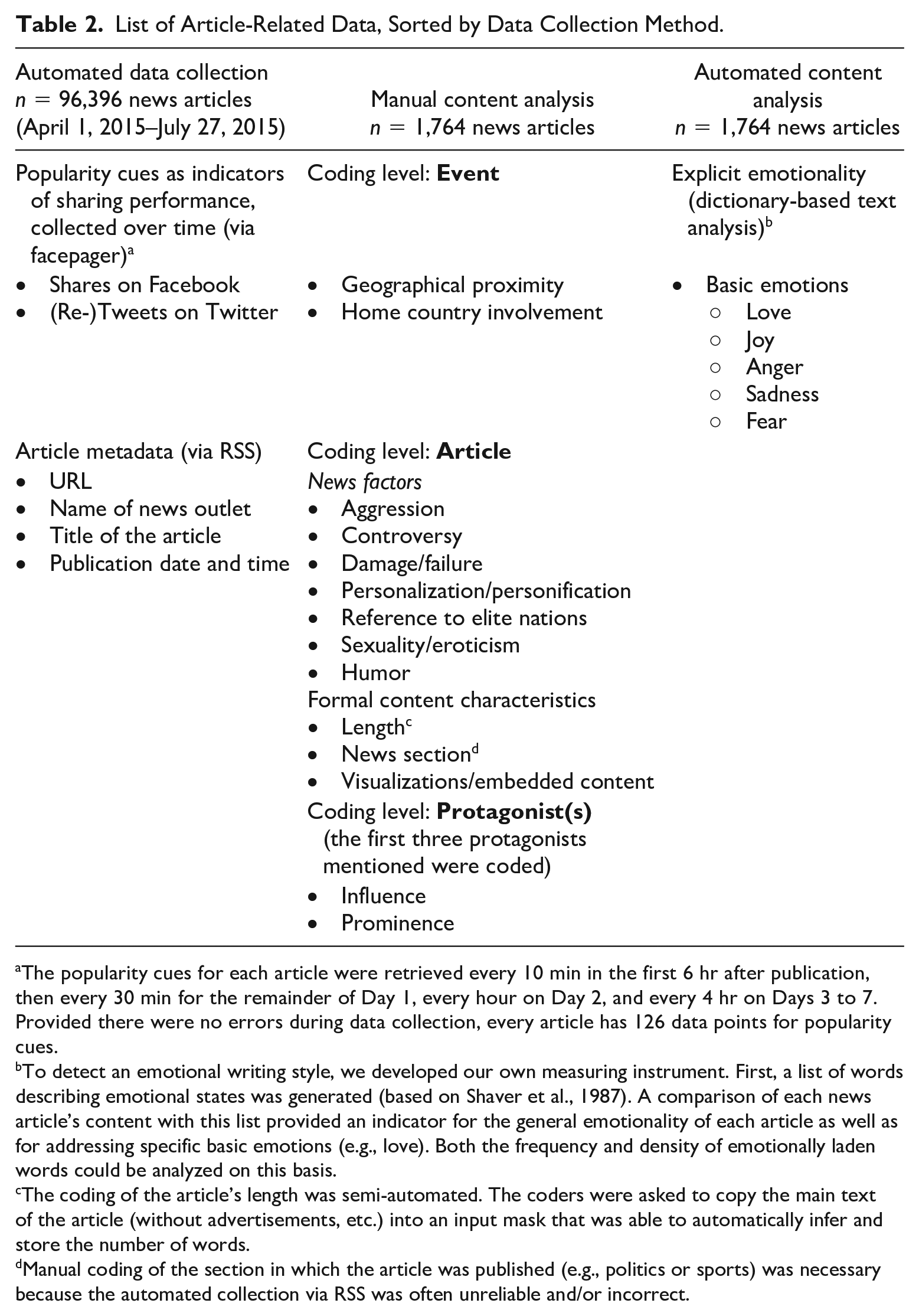
The popularity cues for each article were retrieved every 10 min in the first 6 hr after publication, then every 30 min for the remainder of Day 1, every hour on Day 2, and every 4 hr on Days 3 to 7. Provided there were no errors during data collection, every article has 126 data points for popularity cues.
To detect an emotional writing style, we developed our own measuring instrument. First, a list of words describing emotional states was generated (based on Shaver et al., 1987). A comparison of each news article’s content with this list provided an indicator for the general emotionality of each article as well as for addressing specific basic emotions (e.g., love). Both the frequency and density of emotionally laden words could be analyzed on this basis.
The coding of the article’s length was semi-automated. The coders were asked to copy the main text of the article (without advertisements, etc.) into an input mask that was able to automatically infer and store the number of words.
Manual coding of the section in which the article was published (e.g., politics or sports) was necessary because the automated collection via RSS was often unreliable and/or incorrect.
Design and Data
Our analysis covered news articles published between April 1, 2015, and July 27, 2015, and focused on four German news outlets: bild.de, spiegel.de, focus.de, and ntv.de. At the time of the study, these four online news sites had the highest usage rates in Germany (AGOF, 2014).
In a first step, we automatically gathered all articles published on these sites during the study period using the news sites’ RSS feeds. Virtually all online media enable access to their recently published articles and the corresponding URLs through an RSS feed. We automatically collected these RSS feeds in 10-min intervals, and saved the articles’ URLs, titles, times and dates of publication, and the names of the news outlets in a database. Altogether, we were able to gather 96,396 articles published during the study period.
Using the tool facepager (Jünger & Keyling, 2017), we accessed real-time data provided by the APIs of Facebook and Twitter to gather the news articles’ popularity cues, which we used as indicators of sharing performance. Relying on defined intervals (for details, see footnote 1 in Table 2), the cumulative total number of Facebook shares and Twitter (re-)tweets for each article were recorded and stored. This process was stopped after 7 days (measured from the first mention of each article in the RSS feed) because news articles generate almost no further interaction on SNSs after the initial 5-day period (Keyling et al., 2013). While there are many different ways to measure the popularity or performance of news articles on SNSs—particularly for the posting news outlets (see Nelson & Webster, 2016)—we opted to rely on Facebook shares and Twitter (re-)tweets as these (a) are publicly available and automatically collectable, (b) have been used successfully in previous studies on SNS news diffusion (e.g., Trilling et al., 2017), and (c) seem to be good proxies for other and more diverse measures of audience engagement (Haim, 2019, p. 261).
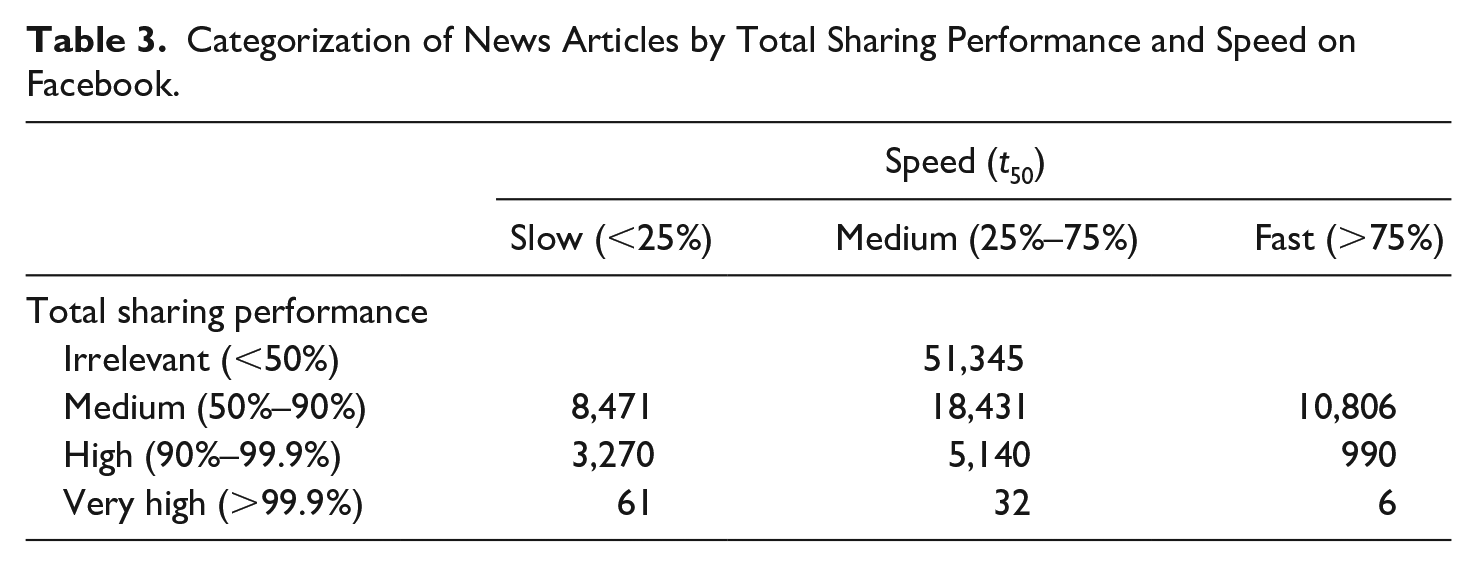
To be able to draw a subsample for the manual content analysis, we then categorized the news articles based on their sharing performance on Facebook and Twitter. The sharing performance was operationalized by both the total sharing performance of a news article (i.e., its maximum number of shares or [re-]tweets) and the speed of the sharing performance. Speed was defined as the amount of time it took for the article to reach 50% of its total sharing performance (t50). As we aimed for a stratified sample representing different types of sharing, the total sharing performance was categorized into four categories based on the 50th, 90th, and 99.9th percentiles, respectively. These percentiles were chosen based on the actual distribution. The lowest category contains sporadically shared articles (less than 5–10 shares, depending on the platform), followed by a category of articles that had been shared by a few dozen to a few hundred users. The top category comprises outstanding articles with more than 5,000 shares or (re-)tweets (again, depending on the platform). Speed was divided into three categories based on the 25th and 75th percentiles. Again, categories with different weights were created to adequately represent articles in the sample that were shared or re-tweeted unusually slowly or quickly. This categorization led to a total of 10 categories (see Table 3, based on the figures for Facebook shares) of news articles’ sharing performance. In absolute numbers, articles with a total sharing performance below the 50th percentile were shared less than 16 times (Facebook) or 10 times (Twitter), leading us to their classification as irrelevant.
Categorization of News Articles by Total Sharing Performance and Speed on Facebook.
In the next step, based on these 10 categories of sharing performance, 2 we drew a layered sample of 514 articles. Trained coders then identified the news events—characterized by protagonist, action, and time—that these articles reported on. We excluded 103 articles (20%) from further analysis because they reported on broad historical episodes (e.g., SS crimes during the Nazi regime) or societal phenomena in general (e.g., the “instapot” cult) rather than reporting on specific events. Each news event was manually associated with search terms that allowed for the identification of other articles on the same news event in the overall corpus of 96,396 articles. This procedure resulted in a sample of 1,764 news articles that were then manually coded by trained student coders to measure their content characteristics. In addition, the explicit emotionality of the articles was measured using an automated, dictionary-based approach (see Table 2).
Measures
Dependent variables
As described above, sharing performance was measured by the number of Facebook shares as well as Twitter (re-)tweets a news article reached in the first 7 days after its publication. These numbers were collected automatically via the tool facepager (Jünger & Keyling, 2017).
Independent variables
In addition to the article metadata (URL, name of the news outlet, title of the article, and publication date and time) compiled automatically via RSS feeds during data collection, the independent variables that were measured in the manual content analysis included news factors and formal content characteristics (see Table 2). We also recorded whether an article competed with other articles about the same news event and whether it was the first to report on the event.
Formal characteristics
At the article level, several formal characteristics were manually coded for such as length (word count of the body text), presence of visualizations or embedded content (photo, α = .86; video, α = .78; embedded social media content, α = .78), and the news section (α = .97) where the article appeared (e.g., politics, business, sports). Finally, the coders were asked to indicate whether the article—regardless of the inherent qualities of the event—contained humor (α = .45), even if only in single paragraphs or quotes.
Supplementing these manually coded variables, the explicit emotionality of an article was coded for automatically based on a dictionary covering five primary emotions (love, joy, anger, sadness, and fear). To create this dictionary, we first translated “135 ‘good’ examples of the emotion domain” (Shaver et al., 1987, pp. 1065–1067) to German and added synonyms, resulting in a list of 742 words. After word stemming (Schmid, 2013; 723 word stems), automated inflection (Schmid et al., 2004; 7,700 theoretical word forms), matching with the complete corpus of 125,000 journalistic articles in our study (only 2,919 word forms were part of our corpus), and the manual removal of word forms with ambivalent meanings depending on the context, we created a German dictionary of emotion words specifically tailored to our study and containing 2,353 (full) word forms. The word frequency was coded for each emotion and then aggregated to an overall measure of explicit emotionality (the ratio of emotion words per 1,000 characters) at the article level (see Table 2).
News factors
News factors were coded for manually. Most of them were measured at the article level, following operationalizations by Ruhrmann et al. (2003). Reference to elite nations (α = .87) was coded for whenever countries belonging to the Group of Eight + Five (G8+5) were mentioned either explicitly, in the form of specific cities, or as single representative protagonists in the article (occurs vs. does not occur). The news factor personalization/personification (α = .87) captures the attention paid to individual persons when covering a news event. Its possible values are no person named, low personalization (person/s named, but merely as representatives of an institution), and high personalization (person/s depicted as individuals, regardless of their function). Damage/failure (α = .72) was coded for whenever the depiction of events explicitly included negative consequences, using the following values: no damage/failure; minor damage/failure (material, immaterial, and political, as well as temporary existential damage); and major damage/failure (deterioration in central human areas, e.g., long-term illness, deprivation, immaterial, or political harm). If the article referred to the threat or use of violence, different stages of aggression (α = .89) were coded for, with the following possible values: no aggression; minor aggression (threat of violence, violence against things/animals, bodily injuries of persons); major aggression (kidnapping, violent riots injuring people, murder, injury); and maximal aggression (war, terror). The news factor controversy (α = .57) refers to the explicit presentation of differing opinions, either conveyed verbally or in written form, but not physically. The following were the possible values: no controversy, minor controversy (objective presentation of diverging views or claims), and major controversy (fierce debate, accusations that deny others’ fairness, or the legality of their conduct). Another news factor at the article level was the verbal or visual depiction of (or allusion to) sexuality/eroticism (α = .71).
In addition to these news factors that were applicable to each article as a whole, our research questions made it necessary for us to also include news factors at the event level. These referred to the specific event about which the article was reporting. As our analysis focused on articles from German news outlets, home country involvement (α = .84) in a news event was measured in several stages: no location of event mentioned; event abroad without German involvement; event abroad with German involvement; event in Germany with foreign involvement; or event in Germany without foreign involvement. In a similar vein, geographical proximity (Germany: α = .82; Europe: α = .94) was operationalized as the distance between the country where the event took place and Germany: least proximity (e.g., Asia, North and South America, and Australia); low proximity (e.g., Middle East and North Africa); close proximity (European countries not bordering Germany); and closest proximity (European countries bordering Germany).
We also coded news factors at the protagonist level, taking into account the first three protagonists named in each article. A protagonist was defined as a person or an organization that either acted or spoke actively or was passively affected or referred to. Apart from the number of protagonists (up to three), the news factors of prominence of protagonists (α = .61) and influence of protagonists (α = .74) were assessed for each of the coded protagonist(s). When assessing the prominence of protagonists, the degree of popularity of a named person or institution was measured, regardless of his or her political or economic power (ordinary people/person or institution known only among experts vs. person or institution in politics, sports, culture, entertainment, or economics known predominantly at the national level vs. person or institution in politics, sports, culture, entertainment, or economics known at an international level). Influence of protagonists, defined as the social power of a named individual, group, institution, or its representative, was measured from least to maximum influence by means of an extensive list, of examples, serving as coding guidelines.
Other articles about the same news event
Based on the event-based sampling described above, an article’s competition with other articles covering the same news event could be assessed. 3 Based on the publication date and time, we also identified which news article had been the first among multiple articles within our corpus to report on a given news event.
Results
In order to answer our research questions, we ran single-level regression models with the number of Facebook shares and Twitter (re-)tweets reached by each article after 7 days as dependent variables. Despite the analyzed articles being nested in news events (see the “Method” section), we decided to run single-level models, as the number of news articles per news event varied considerably, following a longtail distribution with more than 200 news events only being reported in a single news article. To accommodate this overdispersion of the data, we ran a negative binomial regression model (Berk & MacDonald, 2008; Cameron & Trivedi, 1990; Cox, 1983) using the R package msme (v0.5.3, Hilbe & Robinson, 2018).
We added the predictors in several steps, starting with formal characteristics (see Table 4; for the entire range of models see Tables A1 for Facebook and A2 for Twitter in the Online Appendix). In order to highlight increases in the model fit (Kullback–Leibler divergence-based R2 for generalized linear models, Cameron & Windmeijer, 1996; calculated using the R package rsq, v1.1, Zhang, 2018), as well as the influence of each factor at each step when controlling for all factors included in the analysis, we report our analysis in a stepwise manner and report on both the incidence rate ratios (IRRs) yielded in the respective steps as well as in the final models.
Step 1: Influence of Formal Characteristics on Sharing Performance. a
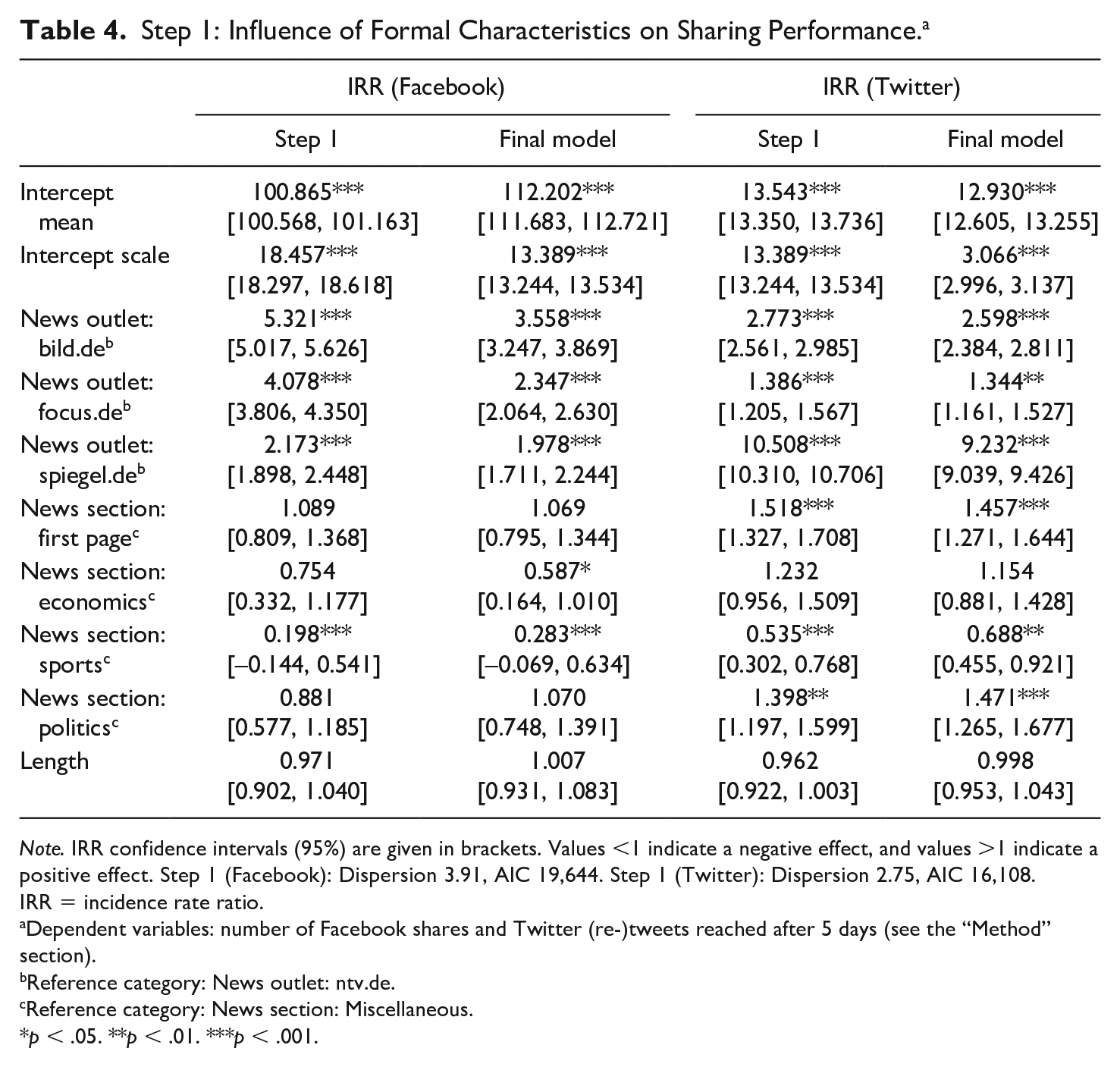
Note. IRR confidence intervals (95%) are given in brackets. Values <1 indicate a negative effect, and values >1 indicate a positive effect. Step 1 (Facebook): Dispersion 3.91, AIC 19,644. Step 1 (Twitter): Dispersion 2.75, AIC 16,108. IRR = incidence rate ratio.
Dependent variables: number of Facebook shares and Twitter (re-)tweets reached after 5 days (see the “Method” section).
Reference category: News outlet: ntv.de.
Reference category: News section: Miscellaneous.
p < .05. **p < .01. ***p < .001.
Influence of Formal Characteristics of News Outlet, Length, and News Section
The first models (see Table 4)—including news articles’ formal characteristics—result in a model fit of R2 = .134 for Facebook shares and of .440 for Twitter (re-)tweets. Answering
Influence of the Formal Characteristics of Visualizations, Humorous and Emotional Elements
In a second step (see Table 5), responding to
Step 2: Influence of Visualizations, Humor, and Emotions on Sharing Performance. a
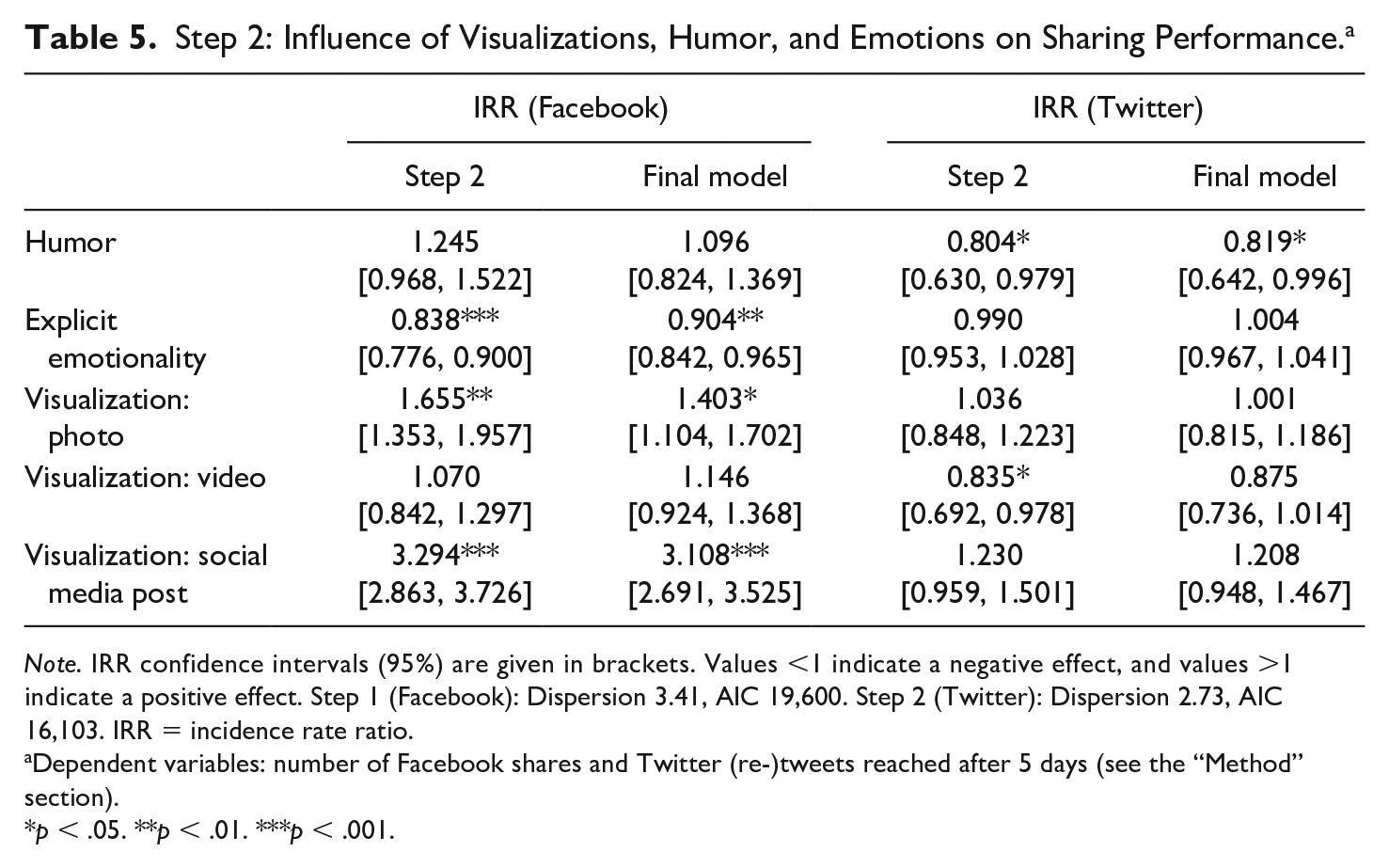
Note. IRR confidence intervals (95%) are given in brackets. Values <1 indicate a negative effect, and values >1 indicate a positive effect. Step 1 (Facebook): Dispersion 3.41, AIC 19,600. Step 2 (Twitter): Dispersion 2.73, AIC 16,103. IRR = incidence rate ratio.
Dependent variables: number of Facebook shares and Twitter (re-)tweets reached after 5 days (see the “Method” section).
p < .05. **p < .01. ***p < .001.
Influence of News Factors
In response to
Step 3: Influence of News Factors on Sharing Performance. a
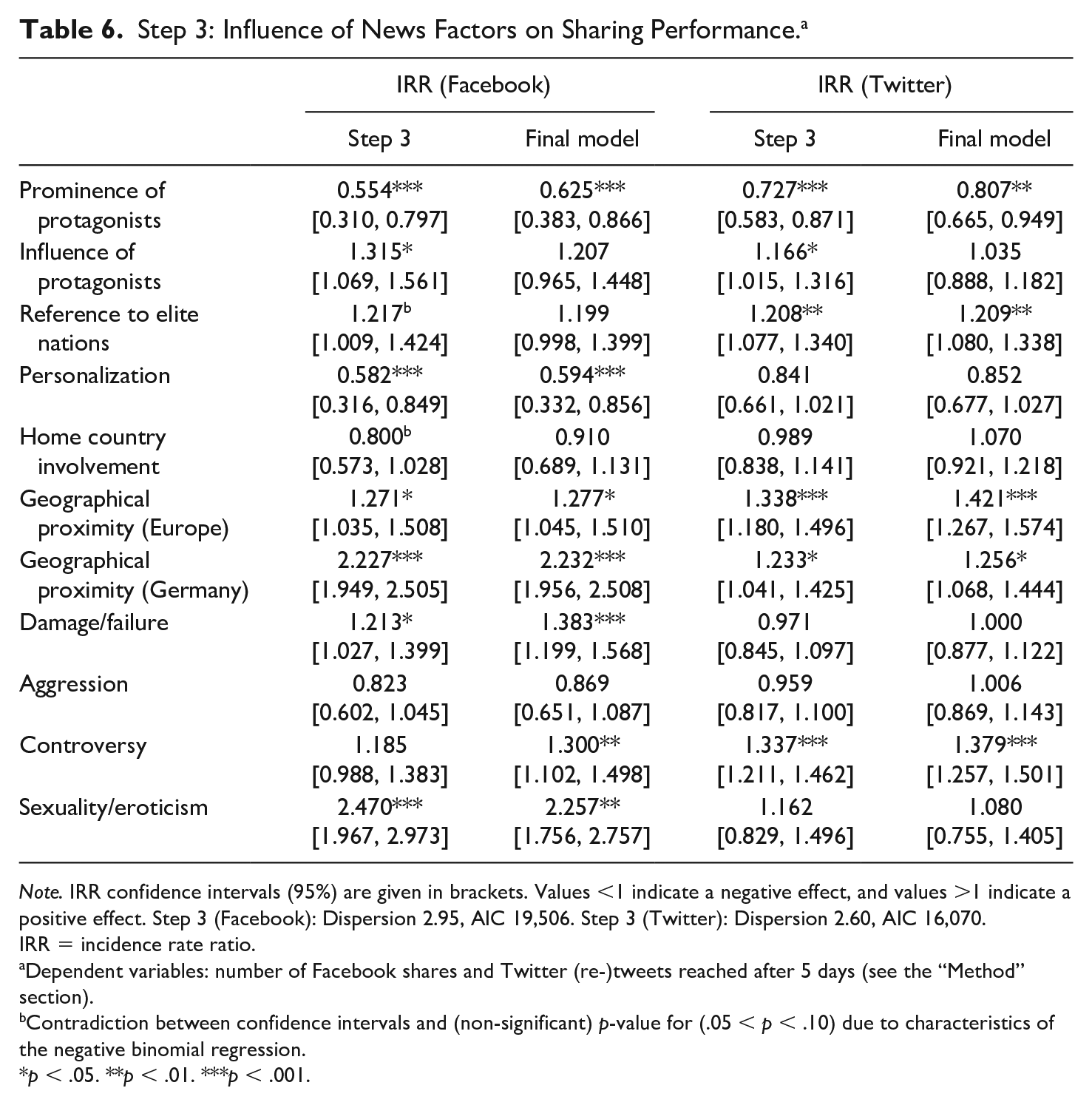
Note. IRR confidence intervals (95%) are given in brackets. Values <1 indicate a negative effect, and values >1 indicate a positive effect. Step 3 (Facebook): Dispersion 2.95, AIC 19,506. Step 3 (Twitter): Dispersion 2.60, AIC 16,070. IRR = incidence rate ratio.
Dependent variables: number of Facebook shares and Twitter (re-)tweets reached after 5 days (see the “Method” section).
Contradiction between confidence intervals and (non-significant) p-value for (.05 < p < .10) due to characteristics of the negative binomial regression.
p < .05. **p < .01. ***p < .001.
Influence of Other Articles About the Same Event
In the fourth and final step (see Table 7), we added the influence of other news articles reporting about the same news event on sharing performance, answering
Step 4: Influence of Other Articles About the Same News Event on Sharing Performance. a
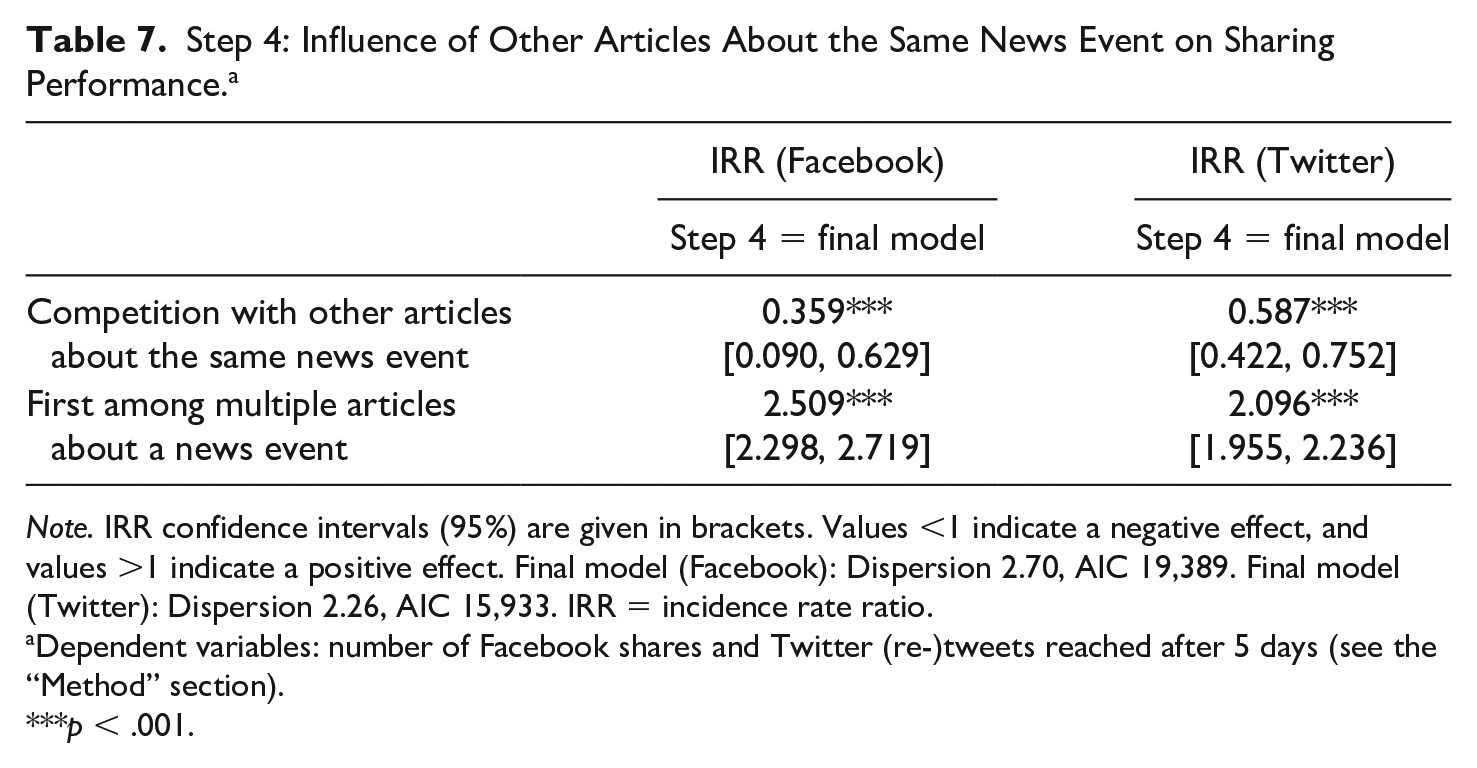
Note. IRR confidence intervals (95%) are given in brackets. Values <1 indicate a negative effect, and values >1 indicate a positive effect. Final model (Facebook): Dispersion 2.70, AIC 19,389. Final model (Twitter): Dispersion 2.26, AIC 15,933. IRR = incidence rate ratio.
Dependent variables: number of Facebook shares and Twitter (re-)tweets reached after 5 days (see the “Method” section).
p < .001.
Discussion
The present study attempted to investigate the influence of news articles’ content characteristics on news-sharing performance on Facebook and Twitter and to analyze the interdependencies of sharing performance among multiple news articles reporting on the same news event. Corroborating findings by Trilling et al. (2017), we found that the news outlet that originally published the article influences its sharing performance the most (
More specifically, we noticed that the logics of sharing performance on Facebook and Twitter differ considerably. The statistical models based on formal characteristics and news factors could explain a far greater part of sharing performance for Twitter (R2 = .440) than for Facebook (R2 = .134). Moreover, when looking at the single determinants of sharing performance, the platform logics vary considerably. While the news outlet bild.de is the most influential for sharing performance on Facebook, spiegel.de exerts the greatest influence on Twitter.
Despite the heterogeneity between the two studied platforms, an article’s news outlet is the most important predictor of its sharing performance on SNSs, confirming earlier findings by Trilling et al. (2017) in the Netherlands. This influence can be partly attributed to the online news outlets’ overall reach. Bild.de and spiegel.de were the two most widely used online news outlets in Germany at the time of data gathering, with their user bases being of a similar size (AGOF, 2014). Nonetheless, given the differences in their influence on sharing performance on Facebook and Twitter, we see that a news outlet’s overall reach can only partly explain its influence on sharing performance. Regarding the influence of specific news sections, the logics again vary between Facebook and Twitter. Whereas news about economics spread more than other news on Twitter, no such influence could be identified for Facebook. Only the news section sports hinders sharing performance on both Facebook and Twitter, confirming earlier results by Keyling et al. (2013).
Interestingly, we did not observe any relevant influences from the characteristics of the news article’s main text, such as explicit emotionality or length, on sharing performance either on Facebook or Twitter. This may be due to the fact that users do not necessarily read a news article’s main text before sharing it, but rather decide to share it based on the header or the teaser. Studies focusing on Twitter support this claim (Gabielkov et al., 2016), but, again, this assumption will have to be tested more thoroughly by future research.
Enhancing previous findings on SNS news sharing (Trilling et al., 2017, Valeriani & Vaccari, 2016), we found a positive influence arising from ethnocentric news factors, such as geographical proximity, as well as a positive influence of factors that are able to boost identification with a news event (i.e., influence of protagonists; reference to elite nations). This influence of the ethnocentric—and thus socially motivated—news factor of geographical proximity probably reflects the social aspects of news sharing on Facebook, as demonstrated in several studies on sharing motives (e.g., Karnowski et al., 2017). Overall, news factors’ contribution to sharing performance remains modest, exerting more influence on Facebook than on Twitter.
As expected, being the first article out of multiple articles about the same news event does positively influence sharing performance on both Facebook and Twitter. Hence, future research should refrain from the artificial focus on single news articles in favor of a more comprehensive focus on the sharing performance of news events or news topics on SNSs. To further analyze the interdependencies among the sharing performances of several news articles reporting on the same news event or topic, researchers could focus on specific news events/topics and track their development from the very beginning.
Taken together, the considerable heterogeneity among the determinants of sharing performance on Facebook and Twitter highlights how SNSs cannot be treated as a homogeneous entity—all platforms follow their own logic based on their respective audiences (which are quite heterogeneous, see Hölig, 2018; Smith & Anderson, 2018). We might speculate that these logics are not just platform-specific, but rather platform-and-region-specific, because the audience structures of SNSs vary across regions and nations (e.g., Frees & Koch, 2018, as compared with Smith & Anderson, 2018). Future research will have to test this assumption.
Our findings cannot be interpreted without discussing the inherent limitations. First, despite the considerable methodological efforts invested in this study, we only covered news articles published by four German news outlets and we needed to considerably reduce the sample for the manual content analysis. To uncover both commonalities and divergences in the findings, future studies may want to include additional news outlets and different countries or different media systems. Second, some of the independent variables measured in the manual content analysis yielded barely satisfactory reliability coefficients. Especially, humor and controversy proved hard to code reliably. These latent constructs require coders’ subjective interpretations based on their individual mental schemata. Although we thoroughly trained the coders to reach intersubjectively shared interpretations (as suggested by Potter & Levine-Donnerstein, 1999), the reliability scores remained only barely satisfactory. While this is not uncommon for these constructs (e.g., Holton & Lewis, 2011), we suggest that future researchers should use other measurements.
Third, we had to ignore the nested structure of our data due to limitations in the number of articles per event. Future studies might employ different sampling strategies to circumvent such limitations. Fourth, we have to acknowledge that online news media are simply not as static as print news. During data collection, we observed that articles were edited, added to, or removed after their initial online publication. We did not account for changes made to an article after its initial publication, so our content analysis was always based on each article’s earliest published version. In addition, a change in an article’s headline often went along with a change in its URL. This caused a few articles to come up twice in our dataset, albeit as different versions. As both Twitter and Facebook list these “edit-duplicates” as well as their metrics separately, we opted not to remove them from our dataset. Overall, less than one in 1,000 articles were re-published with nearly the same content (i.e., a restricted Damerau–Levenshtein distance of less than 10%) but different URLs, while 2% of the articles were re-published with substantial edits. Still, we cannot rule out the possibility that articles on prominent issues are more likely to be edited and re-issued than less relevant articles are. Finally, like all research dealing with media behaviors tied to SNSs, this study has a “moving-target problem” (Bayer et al., 2020, p. 485); that is, the tools, platforms, and practices we study change constantly. Nonetheless, by focusing on distinctive sets of influencing content factors (i.e., formal characteristics, news factors, and competition among news articles) that are not inherently tied to SNSs, and contrasting these between two specific SNSs, we give insight into more overarching factors influencing sharing performance (e.g., news outlet, competition) and factors that are tied more strongly to the logics of specific platforms (e.g., specific news categories or news factors).
Overall, we confirmed the results of earlier studies demonstrating the influence of news factors and especially of news outlets on news articles’ sharing performance on SNSs. We also highlighted the differences between the logics of sharing on Facebook and Twitter—differences that may be due to their different audiences. The implications of these findings are somewhat mixed: The high importance of news outlets for sharing performance is surely a positive signal for news organizations in their constant struggle to cope with changes in our media ecology. However, the divergent findings concerning Facebook and Twitter clearly highlight the fact that we cannot underestimate the differences in audiences among different SNSs. In the end, sharing performance only reflects the importance attributed to a news topic by the platform’s audience—and these audiences do not necessarily reflect the overall population.
In addition, we clearly demonstrated the influence of other news articles about the same news event on a news article’s sharing performance on both Facebook and Twitter. Hence, our suggestion for future research on the news-sharing performance on SNSs is to no longer focus on single news articles, but rather to study news events or topics more comprehensively, including the interrelations among the sharing performance of multiple news articles covering the same news topic or event.
Supplemental Material
Tables_Appendix_Worth_to_Share_final – Supplemental material for Worth to Share? How Content Characteristics and Article Competitiveness Influence News Sharing on Social Network Sites
Supplemental material, Tables_Appendix_Worth_to_Share_final for Worth to Share? How Content Characteristics and Article Competitiveness Influence News Sharing on Social Network Sites by Veronika Karnowski, Dominik J. Leiner, Anna Sophie Kümpel and Larissa Leonhard in Journalism & Mass Communication Quarterly
Footnotes
Declaration of Conflicting Interests
The author(s) declared no potential conflicts of interest with respect to the research, authorship, and/or publication of this article.
Funding
The author(s) disclosed receipt of the following financial support for the research, authorship, and/or publication of this article: This work was supported by the German Research Foundation (research group “Political Communication in the Online World,” subproject 1, grant no. 1381).
Supplemental Material
Supplemental material for this article is available online.
Notes
Author Biographies
References
Supplementary Material
Please find the following supplemental material available below.
For Open Access articles published under a Creative Commons License, all supplemental material carries the same license as the article it is associated with.
For non-Open Access articles published, all supplemental material carries a non-exclusive license, and permission requests for re-use of supplemental material or any part of supplemental material shall be sent directly to the copyright owner as specified in the copyright notice associated with the article.
