




Abstract
How do audiences make sense of and interact with political junk news on Facebook? How does the platform’s “emotional architecture” intervene in these sense-making, interactive processes? What kinds of mediated publics emerge on and through Facebook as a result? We study these questions through topic modeling 40,500 junk news articles, quantitatively analyzing their engagement metrics, and a qualitative comment analysis. This exploratory research design allows us to move between levels of public discourse, zooming in from cross-outlet talking points to microsociological processes of meaning-making, interaction, and emotional entrainment taking place within the comment boxes themselves. We propose the concepts of delighting and detesting engagement to illustrate how the interplay between audiences, platform architecture, and political junk news generates a bivalent emotional dynamic that routinely divides posts into highly “loved” and highly “angering.” We argue that high-performing (or in everyday parlance, viral) junk news bring otherwise disparate audience members together and orient their dramatic focus toward objects of collective joy, anger, or concern. In this context, the nature of political junk news is performative as they become resources for emotional signaling and the construction of group identity and shared feeling on social media. The emotions that animate junk news audiences typically refer back to a transpiring social relationship between two political sides. This affectively loaded “us” versus “them” dynamic is both enforced by Facebook’s emotional architecture and made use of by junk news publishers.
Introduction
Facebook has been a key site for the propagation of junk news, content that Liotsiou et al. (2019) define as publications that present themselves as news sites, but do not adhere to journalistic norms and ethics, and instead select, frame, and distort evidence to suit their political agenda. While the term itself does not imply a specific political ideology and manifestations exist on both sides of the aisle, empirical research suggests that that junk news is predominantly a right-wing phenomenon, and often ideologically extreme (Liotsiou et al., 2019; see also Pierri et al., 2020). Junk news have caused concern as they have been associated with challenges to democratic discourse and the upsurge of far-right populist, conservative, and nationalist movements (cf. Pierri et al., 2020). It is also a phenomenon intimately linked with social media’s attention economy and its mechanics of information circulation (Venturini, 2019). Social media’s affordances increasingly comprise interactive, “emotional architectures” that encourage emotional signaling and evolve in response to it (Wahl-Jorgensen, 2019). Junk news seem both native to and exploitative of this context: they mobilize “attention-grabbing techniques” and are characterized by their affective style: they often contain emotionally driven language, emotive expressions, hyperbole, and inflammatory viewpoints (Liotsiou et al., 2019, p. 3).
Junk news engagement on Facebook exemplifies the entwinement of the political, emotional, and the technological. Yet, details of the emotional reactions and “affective meaning-making” (Wetherell, 2012) found that such content triggers on social media are still poorly understood. Why? Alice Marwick (2018) argues that social researchers have imagined social media audiences of political junk news predominantly as “cultural dupes”—a stance which renders the issue of how political junk news land among them a non-question. Yet, we hold that knowledge about how problematic right-wing content is received in practice and made sense of by empirical audiences is important if we wish to grasp the cultural, political, and affective impulses behind its consumption. Moreover, and as suggested, we must also consider how Facebook’s emotional architecture intervenes in and frames user engagement. As we illustrate, Facebook’s affordances and algorithms shape the expressions and conversations taking place among junk news audiences. They direct audiences’ dramatic focus and organize conversations along emotional lines, as well as encourage some emotive expressions over others. If, as Papacharissi (2016, p. 4) suggests, the “textual rendering” of audiences qua publics (cf. Livingstone, 2005) is part of their very becoming—in a circular fashion informing their self-image and trajectory—then understanding how social media’s emotional infrastructures intervene in this process becomes paramount.
In this article, we target the operation of emotion among audiences of right-wing junk news with the concepts of delighting and detesting engagement, understood as products of users’ interactions with and around news stories on a social media platform that encourages emotional signaling of certain types and evolves in response to it. The concepts emerged from a computational-qualitative analysis of how audiences respond to right-wing junk news on social media. More specifically, we topic-modeled a dataset of over 40,000 articles that were posted to Facebook by over 20 US junk news sources in Spring 2019. Topic modeling made it possibly to identify, based on our data, wider issues, and thematics that were salient in far-right-wing media at the time. We then studied the “reactions” the posts had received on Facebook, of which there are six types: like, love, haha, wow, sad, and angry. We discovered that the interplay between junk news (producers), audiences, and Facebook’s emotional architecture generates a bivalent emotional logic: “love” and “angry” reactions rarely co-occurred, and correlated most strongly with different other reactions. To explore this emotional logic further, we conducted qualitative comment analysis of high-performing 1 posts that had been either positively or negatively received. Current discussions on the emotional dimension of political disinformation tend to focus exclusively on how it ignites negative feelings, like outrage and hate (cf. Bakir & McStay, 2018; Clark & Zhang, 2018; Keener, 2018; Onge, 2018). In contrast, our study highlights the complementary role of buoyant expressions and positive self-imagining—enabled in part by Facebook’s “pro-social” affordances—in powering the far-right-wing digital media ecosystem.
As “news” spread through sharing and algorithmic promotion, they aggregate emotive responses that become part of the “news” itself. Delighting and detesting engagement not only illustrate how Facebook’s emotional affordances figure in the interaction between junk news (producers) and their audiences, but also make room for interrogating the emotional work that algorithmically promoted engagement performs. Bursts of affectively valenced mass engagement bring audience members together and open up moments to express and negotiate emotion, and moral and social boundaries. Based on our analysis, we argue that the nature of political junk news is performative as they become resources for emotional signaling and the construction of group identity and shared feeling on social media. We suggest that fundamentally, delighting and detesting engagement have less to do with the contents of any single news article per se, and more with an evolving and agitated relationship between different political sides—an antagonism junk news feeds from and reinforces. Mass engagement does not, then, merely represent pre-constituted audience sentiment, but as we argue, mediates and intensifies it. Before moving on to lay out our data, methods, and analysis in the next section, we draw together lines of argument that are needed to define delighting and detesting engagement beyond an empirical pattern, and give them theoretical depth.
Delighting and Detesting Engagement
Delighting and detesting engagement testifies to how platform architecture and emotions come together, engendering mediated publics through inscriptive processes. We analyze this phenomenon through the forcings of platform architecture, relational emotions, and audiences becoming publics. The collectivities called into being by social media are shaped not only by their shared social characteristics, but also by the properties of the digital architectures that enable their emergence (boyd, 2010). They organize information circulation and enable and constrain users’ interactive behaviors in platform-specific ways (boyd, 2010). As observed by Wahl-Jorgensen (2019), these architectures are increasingly “emotional.” Facebook, the context of our study, is an example of what some call “affective computing” (cf. Kleber, 2018). In 2016, the company introduced “reactions”: an “extension of the Like Button” intended to be used “to express how you feel” (Facebook Brand Resources, 2020). Facebook’s affordances not only encourage emotional responses, but also algorithmically promote emotionally engaging content. These two technical characteristics are critical in terms of generating delighting and detesting engagement, understood as products of users’ interactions with and around junk news on a platform that encourages emotional signaling and evolves in response to it.
Next, there is the question of emotion. What, exactly, is the nature of the emotional processes that underpin delighting and detesting engagement? Much influential work on affect study it as direct, somatic responses that “by-pass subjectivity” (Protevi, 2009, p. 9; Thrift, 2008). Yet, it seems to us that the most fruitful sociological questions regarding emotion and affect have to do precisely with the ways in which emotions register not as physiological or preconscious intensities, but as culturally recognizable practices and performances (Wetherell, 2012); how they figure in discursive meaning-making (Wetherell, 2012); and how they are not autonomous or unpredictable, but structured and patterned in ways that reflect the social arrangements and relationships from within which they emerge (Wetherell, 2012; see also Burkitt, 2014). In our quest to conceptualize affective online engagement with junk news beyond irrational reactivity or suggestibility—often posited in post-truth discourse as the driving force behind disinformation consumption (cf. Durnová, 2019)—we approach emotional responses to Facebook posts as self-conscious expressions performed to others through the use of the semiotic resources afforded by the platform, and oriented toward the actions and interpretations of other users. Users express their emotions from culturally recognizable “affective subject positions” that are relational in that they “are responsive to what has gone before, and are often loosely paired with each other” (Wetherell, 2012, p. 86). From this relational perspective, we draw attention to how mediated emotion is not inherent to the individual, but achieved in interaction as users jointly and continuously create contexts for each other’s feeling and expression (Burkitt, 2014; Wetherell, 2012).
The third tier of our theoretical argument concerns junk news audiences themselves. What are they? Where are they? How do they change as a result of delighting and detesting engagement? The concepts of “audience” and “public” are sometimes collapsed, yet generally, the former tends to emphasize spectatorship, whereas the latter a shared orientation (Livingstone, 2005). Based on our analysis, we argue that viral engagement surfaces audiences qua publics. Delighting and detesting engagement bring otherwise disparate audience members together and direct their dramatic focus toward objects of collective concern, anger or joy. While the attention expanded by singular audience members may be fleeting, they often enough leaves traces in the form of a response, which rapidly accumulate and spur further interactions. As Papacharissi (2016) argues, the being of mediated publics is inscriptive: they “become what they are and simultaneously ‘a record or trace’ of what they are” (p. 610). They may not have an existence independent of their “textual rendering” (Papacharissi, 2016) on social media—yet they still have performative effects. The same applies to delighting and detesting engagement. As platform-mediated emotions, they constitute of circulating, affectively valenced inscriptions that orient meaning-making and generate political discourse. They carry over time and space, indicating the mediated public’s changing contours and communicating its constitution, claims, and tenor to participants and onlookers alike.
Operationalization, Data, and Methods
The Concept of Junk News
As defined in the works of Liotsiou et al. (2019), Bolsover and Howard (2018), and Howard et al. (2018), the term “junk news” refers to various forms of propaganda and ideologically extreme, hyper-partisan, or conspiratorial political news and information. The term includes news publications that present verifiably false content as factual news, and also covers propagandistic, ideologically extreme, hyper-partisan, or conspiracy-oriented news and information, or commentary that is presented as news. The term refers to a news source overall, that is, it is based on the content that is typically published by a source, rather than referring to an individual article. Liotsiou et al. (2019) use five criteria to identify junk news sources. If a website satisfied the majority, that is, three or more, of these five criteria, it was considered a source of junk news. These five criteria are: professionalism, style, bias (left-wing or right-wing), and counterfeit. Full descriptions of each criterion can be found in Table 1 of Liotsiou et al. (2019).
Data Collection and Modifications
Between 4 February 2019 and 17 April 2019, we retrieved the URLs and Facebook URLs of approximately 48,000 junk news articles from the Junk News Aggregator (from now on JNA), a public project by the Oxford Internet Institute (Liotsiou et al., 2019), in combination with scraping their original URLs to extract the articles’ titles and text bodies. At the time of our data collection, the JNA aggregated URLs and Facebook URLs of articles posted to Facebook by 50 US junk news sources, selected based on the above operationalization of the term junk news (for more information on the sampling methodology, see Liotsiou et al., 2019). We limited ourselves to the 35 publishers that posted actively to Facebook in November 2018 when we initiated our research project and started developing the scrapers. In addition, we extracted the engagement metrics of the Facebook posts linking to the scraped articles. We opted for scraping, because Facebook’s free Graph API returns only the sum total of different reactions. Moreover, manually comparing the Facebook posts to reaction counts acquired via the Graph API and by web scraping revealed that while the scraped data matched what was publicly visible on Facebook, engagement data acquired via the API did not. Scraping was therefore both a more accessible and reliable method of data collection. As Mancosu and Vegetti (2020) note, scraping public, not personally identifiable information like aggregate engagement metrics is both ethically and legally acceptable for researchers. Moreover, because the information was publicly available, extracting it was possible without subscribing to Facebook’s TOS that imposes scraping restrictions (Mancosu & Vegetti, 2020, p. 6; see also Beurskens, 2013). The metrics we scraped comprise the number of shares and comments on one hand, and reactions on the other. Facebook only displays the three most common reactions for a post, which illustrates the predominant emotional response, enabled by Facebook’s affordances, a post has received. We acquired the engagement metrics with a time lag of above 3 days, after which news engagement on Facebook drastically decreases/practically stops (Castillo et al., 2014, p. 90).
Before moving on to data exploration and analysis, we deleted duplicates and did quality checks on the data. We took random samples to double-check for any “dirty” data (e.g., excess HTML tags), and preprocessed the data accordingly. At this point, we excluded 7,526 articles that had little to no text (less than 100 words) from the final dataset; 7,035 of them originated from one highly prolific publisher that was then excluded from the analysis. These articles contained typically either an embedded YouTube video with no text at all or a very short description. Audiovisual content fell outside of the methodological scope of our paper, an important part of which was topic modeling, a text-based method (see the “Topic Modeling” section). After training the topic model, we ruled out some news sources from the analysis of Facebook reactions. First, we excluded Shareblue and Raw Story, the only left-wing outlets in our dataset, as we were interested in the affective positioning of right-wing junk news’ audiences. However, we excluded Shareblue and Raw Story only after training the topic model, because right-wing disinformation is not confined to the far-right media ecosystem (Venturini, 2019). Comparisons showed that the topic model did not change meaningfully whether left-wing sources were included or not, likely because their posts comprised a small minority (n = 2,191 or .05%) of the total dataset. We thus opted for mapping the whole topical space. At the same time, we also factored out articles published by David Harris JR (n = 775), Daily Caller (n = 2,364), and NWOReport (n = 1,586), whose Facebook posts’ engagement metrics we were unable to acquire (the posts were no longer available on Facebook, so they had likely been deleted). The final dataset for exploring Facebook reactions contained 31,729 articles and 29 publishers.
Topic Modeling
We used latent Dirichlet allocation (LDA) to learn, from our data, some of the central talking points of far-right-wing media in the Spring of 2019. LDA, a form of topic modeling, is an unsupervised text analysis technique to inductively explore semantic patterns in a large corpus of documents. The output consists of word clusters called topics. Instead of being assigned to only one topic, documents are defined as distributions of topics based on the words (in our case, both uni- and bigrams) they contain.
Topic modeling is an iterative process, where different ways of preprocessing data (e.g., lemmatizing, stemming) and parameter values—for example, number of topics, thresholds for filtering out common, or uncommon words—are assessed first and foremost in relation to the pragmatic value of the model. In other words, parameters are “evaluated using more qualitative methods, according to whether they generate meaningful and analytically useful topics” (A. Törnberg & Törnberg, 2016, p. 407). In our case, after experimenting with different parameter values for the number of topics (k = 10, k = 30, k = 50, and k = 100), and carefully examining the model’s output, we settled on a topic number of 30. The hyper-parameters alpha and eta were set at = 1/k. We filtered out words that appeared in less than 10 documents and in more than half of all the documents. We did not use stemming or lemmatizing, as they did not improve the model.
It is not atypical that even in topic modeling solutions that yield the most practically valuable outputs, some to many of the topics the algorithm retrieves are either not useful from the perspective of the research question (A. Törnberg & Törnberg, 2016, p. 411) or cannot be given an interpretation to, and are therefore discarded from further analysis. In our case, using a topic number of k = 30 gave enough granularity to enable us to identify seven topics that could be given an interpretation to as representing a distinct talking point in the far-right-wing media sphere in the early Spring of 2019. For each topic, we took 20 top documents (i.e., articles that were the most distinctive of each topic based on their word distribution), and explored them manually to fully interpret the meaning of the topic.
The topics were: border security; reproductive rights, gun control, progressive congresswoman Alexandra-Ocasio Cortez and her climate proposal Green New Deal, accusations of anti-semitism against progressive congresswoman Ilhan Omar, the Mueller investigation on Trump’s potential collusion with Russia, and finally, black gay actor Jussie Smollett, who in January 2019 reported having been physically attacked by two Trump supporters shouting homophobic and racist slurs at him. The incident spurred public concerns about the normalization of bigotry after the presidential election of Donald Trump. Later, the hate crime was found to be staged by Smollett himself, causing media frenzy and a criminal investigation. As these seven topics do not cover all of the dataset, but only a portion of it, we are not claiming to provide a complete depiction of the far-right-wing media discussion in the Spring of 2019. Rather, our use of topic modeling winnowed out distinct talking points that appeared across a number of more or less established far-right-wing news outlets, and that we could then concentrate on—examining audiences’ emotional meaning-making vis-à-vis them.
Zooming into Outliers
In the final stage of the analysis, we blend quantitative and qualitative methods, using digital data not to find linear dependencies (which indeed may be impossible due to the nonlinear characteristic of social media networks (P. Törnberg, 2018, p. 1), but to “juxtapose, contrast and find revealing outliers” (Savage, 2013, p. 17). We first assigned documents into mutually exclusive topic categories based on topic scores, which we inferred from each document’s topic distribution. For example, in order to be assigned to topic category A, the document had to have the highest topic score for topic A, and this score had to be above 20. The threshold value of 20 was based on extensive manual data exploration, which concluded that a lower or a higher threshold would result in a larger amount of false-positives or -negatives, respectively. For the seven identified topic categories presented above, the number of documents per topic was: borders (n = 1,104) the Mueller investigation (n = 278), abortion (n = 2,017), Jussie Smollett’s hate crime hoax (n = 711), gun control (n = 415), Alexandria Ocasio-Cortez and the Green New Deal (n = 1,117), and Ilhan Omar (n = 765). After obtaining the documents, for each above-mentioned topic category, we compared the 20 posts with the most “angry” reactions to the 20 posts with the most “love” reactions. Our reasons for choosing the love and angry reactions/affordances for sampling cases for qualitative analysis were twofold. First, they were relatively common and their meanings are clear and opposing. Second, and most importantly, we found that “love” and “angry” reactions not only rarely co-occurred, but also correlated with different other reactions, which we will come to in more detail in the next section.
We not only read the texts of the articles the Facebook posts linked to, but also analyzed the Facebook posts’ comments sections. We used a grounded approach whereby analysis is guided by researchers’ prior knowledge, yet is open-ended, iterative, and reflexive in nature (Thornberg, 2012). Patterns found from the data are theoretically reflected upon, and guide further analysis and concept elaboration (Thornberg, 2012). Due to data protection reasons, we chose not to retrieve the comments and save them. Instead, we followed the links (originally retrieved from the JNA) to the actual, public Facebook posts, and carried out the analysis by carefully reading their comment sections and simultaneously making extensive notes on the emotions people expressed, the values, beliefs, and lines of reasoning that underlay their positive or negative emotional responses, as well as on the interchanges and negotiations between users regarding appropriate emotional response and feeling. The qualitative analysis was intensive and took several weeks, during which we got to know the data closely. Based on assessing the behavior of the commenters, we did not detect bots. However, we are aware that we cannot know the real identities and intentions of the commenters. We do not consider this a major issue, though, because we are primarily interested in the “textual rendering” of junk news audiences on Facebook, to use Papacharissi’s (2016, p. 14) wording—not, for example, their demographic composition. Furthermore, we focus on comments evaluated by other (emic) members of the audience as valid, receiving endorsements and sparking further interactions.
Because the analysis focused on articles that were high performing and could have thousands of comments, we analyzed only a subset of comments for each article, reading the comment section, and taking notes until the data began to saturate (approximately 100 comments). It is important to note that Facebook provides three options for viewing comments, which structure what one does and does not see, and thus render the audience in different ways. These are: “most relevant” (i.e., comments that are the most “engaging” or originate from profiles with the “verified” badge), “all comments” (shows all comments, yet in the order of their aforementioned “relevance”), and “newest” comments. We used the “all comments” option for carrying out the analysis. It does not filter out comments, yet comes close to how an everyday user browsing Facebook on default-mode would encounter them. We also found that the comments marked “relevant” by the Facebook algorithm typically provided richest data for qualitative analysis: they were typically longer than less “relevant” comments and (had) generated further affective interactions. The comments that are featured in the following analysis have been anonymized by concealing the profile name. They are provided as examples of emotional and interactive patterns that emerged from the grounded analysis, and illustrate central features of delighting and detesting engagement.
Analysis
Engagement Metrics: Loving and Sharing Junk News
Over 30% of the articles in our final dataset had less than 10 shares or 20 likes, while only a handful of posts had over 40,000 of either. While this kind of “long tail” is typical for social media engagement in general, it is usually overlooked in discussions on junk news, which tend to center the highly “popular” and spreading (cf. Venturini, 2019). The staggering quantity of low-performing content (see Figure 1) focuses attention to the struggle of producing media texts that generate engagement in digital networks that are flooded with information. In this context, high-performing junk news stand out. They bring together otherwise disparate users, directing their dramatic focus.

Distribution of shares across the dataset (zoomed).
Exploring the different types of Facebook reactions against each other, a nuanced image of engagement emerges. Even with the limited affordances users have to express their emotional response, there is observable dispersion. Generally, “angrys” seem to co-occur predominately with “sads” and “wows,” whereas the relationship between “loving” and “liking” content is highly positive (Figure 2). Meanwhile, “loves” and “angrys” are most strongly associated with different other reactions. This suggests the division of Facebook posts into positively and negatively received that we study qualitatively in the following sections and argue is characteristic for junk news engagement.
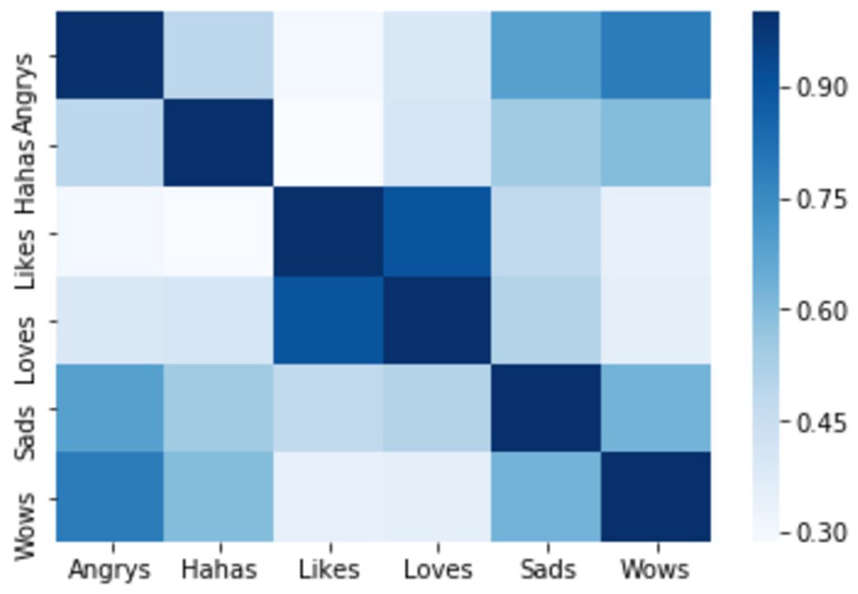
Heat map visualizing correlations between different Facebook reactions.
Topic Modeling: Emerging Themes
Topic modeling enabled us to tease out wider subject matters and talking points that were highly politicized and got sustained attention across far-right-wing outlets during the time of our data collection. To reiterate, the topics we identified were: reproductive rights, gun control, Alexandra Ocasio-Cortez the Green New Deal, accusations of anti-semitism against Ilhan Omar, the Mueller investigation, and actor Jussie Smollett’s alleged hate crime hoax. We are not interested in these topics in and of themselves but rather in how audiences related to and made sense of them, and what kind of cultural and emotional work they performed among audiences. Therefore, we do not describe the topics here in detail, but have weaved in relevant information about them with the qualitative comment analysis. Furthermore, we discovered that there were many commonalities in how audiences responded to highly “loved” and highly “angering” articles that were about different topics. Thus, instead of describing the audience response to each topic separately, we rather focus on these emergent themes, dynamics, and types of interaction. The topics are, however, still highly relevant for our analysis. For a public to emerge, feelings must be oriented toward an object or a target that calls for collective action and expression (see also Ahmed, 2014, p. 227).
It is noteworthy that the topics dealt with talking points and issues that are known to be divisive along partisan lines, like gun control or abortion (cf. Clary & Helmstetter, 2019; North, 2019). Moreover, Donald Trump’s promised border wall—which many of the articles on border security were about—was one of the cornerstones of his presidential campaign. It is almost uniformly resisted by the Democrats. The Mueller investigation made many Republicans even less likely to support the impeachment of Donald Trump (Resto-Montero, 2019). The effect was the opposite among Democrats—who were more likely to support impeachment to begin with (Resto-Montero, 2019). As we will show, due to their divisive nature, the topics provided a hotbed for delighting and detesting engagement, enabling junk news audiences’ to publicly display which side of the partisan divide they were on through expressing either exhilaration or indignation vis-à-vis “happening issues” (Marres, 2015). For example, among the most “loved” posts on border control were articles titled such as Trump Will Sign Border Bill, Declare National Emergency and Trump Plans To Get Even Tougher On Illegal Immigration. In contrast, articles titled such as Illegal Alien Accused of Repeatedly Raping 15-Year-Old Girl in Kentucky and NYC to Allot Extra $1.6M to Lawyers of Illegal Aliens Facing Deportation were featured in posts that had gotten the highest amount of angry reactions. Note how these articles gain a specific, politically effective meaning only in relation to one another: Democrats favoring dangerous and undeserving illegal immigrants, Trump fighting back for “real” America. This insight points to the insufficiency of a singular news story as a unit of analysis when it comes to understanding the dramatic effect of junk news. Our sampling, based on topic modeling on one hand, loving and angry audience responses on the other, teases out right-wing junk news’ “portrayal of the contending forces in the world” (Carey, 2009, p. 16) and users’ participation as engrossed, implicated, and devoted observers. In the next sections, we will delve into these dynamics qualitatively.
Detesting Engagement
The actively lived and felt dimension of values and ideology came to light in users’ emotional–evaluative utterances. Detesting engagement accumulated expressions of anger, disappointment, moral indignation, sadness, and urgency. Because emotions are inherent to the act of evaluation, they play their part in political and moral reasoning (Burkitt, 2014). Posts that referred to Democrats who had allegedly crossed a moral boundary were effective at generating detesting engagement. For example, a detested post on abortion linked to an article titled: Elizabeth Warren compares abortion to “Getting your tonsils out.” (Here, Warren’s words are twisted: she has said in a Senate floor speech that “abortions are safer than getting your tonsils out” (Senator Elizabeth Warren, 2018)). This kind of exposure was effective at weakening trust and increasing cynicism as it hampered not only the social standing of the public figure under scrutiny, but by association also the legitimacy of the values, groups, and institutions they were seen to represent (see Adut, 2005, pp. 219–220). The relatively common #WalkAway hashtag used by the commenter in Figure 3, targeted to Democrats “ready to leave their party,” illustrates both the relational quality of emotion and its directional orientation (Ahmed, 2014, pp. 25, 209). Detesting engagement indicated movement away from those who, or that which, was experienced as disappointing, wrong, or hurtful:

Part of a Facebook post.
Collective emotion does not pre-exist communication, but is a continuous and fragile achievement, created in and through social interaction (Burkitt, 2014; Wetherell, 2012). For example, one’s interlocutors can either sympathize with one’s anger or ridicule it as unjustified. Among junk news audiences, emotions were rendered characteristics of the group first and foremost through emotional expressions that could be endorsed by other users. The wide range of tonalities and affective practices we observed for any single story—from cynical detachment to heartfelt grief or knowing irony—points to the fact that while political disinformation undoubtedly affects its readers, it does not operate through emotional contagion, or by transmitting a feeling all readers would experience identically. Yet, the most appealing expressions of an emotional self were rewarded by fellow audience members with empathic reactions and praise, making them seem more legitimate than others. Expressing the correct emotional state, or claiming a morally righteous affective position could grant one social status in the eyes of others (see Figure 4, which has gotten above 1,000 endorsements in the form of likes, “loves,” and “sads” that signal sympathy). Such comments got further visibility and legitimacy as they were algorithmically ranked as “relevant” and displayed right below the post itself, creating a feedback loop of positive engagement. Meanwhile, comments with fewer reactions sank to obscurity. Algorithms thus took part in the interaction/conversation itself, affecting its framings, trajectory, and emphases.

Moral indignation. A comment on a post on progressive pro-choice congresswomen.
At the same time, emotional rejection rendered one’s belonging in the group suspect. Although, as Aistrope (2019) notes, “moments of affective dissonance mark sites of resistance and openings for critical engagement” (p. 19), these openings were short-lived as users who did not express emotional resonance with the news or with their peers were either rejected or ignored. By displaying side-by-side comments that had received the most endorsements on one hand and the most pushback on the other, Facebook’s emotional architecture indicated how audience members ought to feel about a post or a topic in order to belong. An illustrative example takes place as one user remarks that an article on abortion, presented as breaking news, is in fact multiple months old. “So what? Doesn’t make it any less disgusting,” goes the somewhat passive-aggressive reply—that had gotten further endorsements in the form of love reactions. In line with the populist epistemology that prioritizes experience over journalistic integrity, what we find here is political identity manifested as an “authentic”—and therefore irrefutable—emotional–evaluative response, which simultaneously casts “them” as amoral and “us” as having our hearts in the right place. A key element of belonging therefore comprised not only of one’s self-proclaimed position on the political spectrum, but also of one’s emotional response to events presented by junk news. Complaining about journalistic standards signaled that one had lost their dramatic focus.
Delighting Engagement
Positive sentiments played their role in powering the disinformation ecosystem. Conservative politicians were met with delighting engagement. They were praised for safeguarding conservative values: for “standing up for righteousness” or “having a common sense.” Posts that reported on the far right’s “round wins” in the partisanized issues, such as abortion, gun control, the US–Mexico border wall or the Mueller investigation gave rise to feelings of victory, hope, pride, and solidarity. The intertext of sports was present in both the posts and the comment boxes. For example, see the image of Trump’s body language and the audience cheering for him after he had, according to far-right-wing media, “defeated” Democrats who had accused him of foul play (Figure 5). Comments in Figures 6 and 7 cheer Trump’s success. The intertext of sports is potent: it evokes affective practices that engage the whole body of readers who feel both “the dismay of defeat” and the “exhilaration of victory” as they root for their team (Aistrope, 2019, p. 8). They are affected because of their devotion to the game: they have stakes in it; it makes a difference to them. Indeed, much like ardent sports fans, expressive partisans—that is, those who have internalized a partisan identity—experience their party’s victories as well as failures personally and emotionally (Huddy et al., 2015).

Alleged exoneration and the sports intertext.

Rooting for one’s team.
Seemingly saddening news could give rise to a joyous response. Many of the most “loved” articles on the topic of gun control dealt with cases where someone had been killed. Upon closer inspection, these were situations where an everyday citizen had shot an alleged perpetrator in defense of themselves, their loved ones or their property (e.g., Suspects Allegedly Point Gun at Woman’s Head, Get Shot Dead). Incidents like these provided audiences with stories that affirmed their conservative ideology; ones that they could mobilize in a real or imagined debate on firearm regulation (Figures 8 to 10). That junk news provided far-right-wing audiences with information that affirmed their beliefs was interpreted as a sign of solidarity from the publishers’ part. Meanwhile, the mainstream media not reporting on such events was seen as a sign of their bias, and further solidified one’s trust in junk news. The interactivity of Facebook’s algorithms in assembling not only enraging, but also indeed pleasurable encounters with information is made explicit by the comment in Figure 10. Affirmative stories effectively brought audience members together, reminding them of the ideals and values that bind them (like individual liberty), and thus enabling them to explore and articulate the “positive” dimension of their identification: not just what they were fighting against, but also what they were fighting for.

“Good guys with guns stop bad guys with guns.”
Audiences likewise adored seeing members of the opposite political side condemned and ridiculed (see reactions to comment in Figure 11). For example, the most-loved articles on AOC were often about public smears against her, such as: James Woods Rips ““Arrogant Idiot” Alexandria Ocasio-Cortez: “You Work for Us,” “Greenpeace Founder Calls Rep. Ocasio-Cortez ‘Pompous Little Twit.’” Posts about young, progressive women of color Representatives Ocasio-Cortez and Omar received perhaps the most hate and name-calling, evoking expressions of revulsion, and even danger and “invasion” (see Figure 12).

Positioning oneself vis-à-vis AOC’s left-wing politics.

Politics of disgust.
How to understand the seemingly paradoxical intertwining of malice with affection that characterized the conversations under study? The self-romanticization, feelings of belonging, and joy that right-wing junk news audiences articulated were typically predicated on exclusion and reactionary negativity. The affective practices of love and solidarity, on one hand, and hate and othering on the other, are thus interrelated (see also Ahmed, 2003). This grounding of animus in affection—which also functioned as a potent rhetorical device—became especially visible as one commenter encouraged her peers to “fight back with truths, not more name calling and insults.” She was told that it was in fact not viciousness, but love of the country and devotion for the cause that underlay her peers’ hateful disposition toward the out-group (Figure 13).
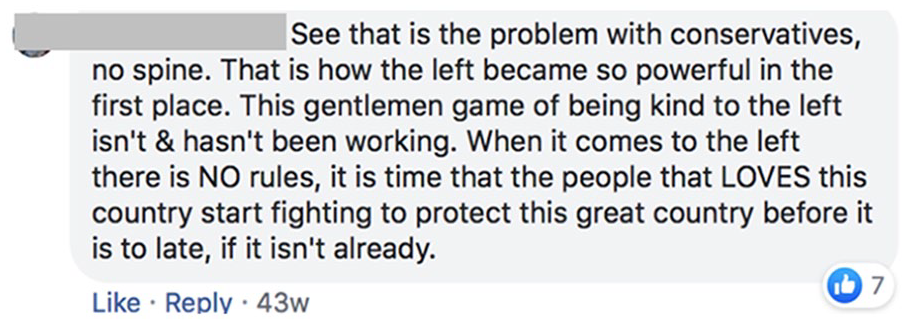
Justifying hate.
Here, meanings, values, and appropriate emotions are negotiated and reconfigured in situ. A more “traditional” Republican, who associates conservatism with certain manners and a respectable disposition is met with Trumpists for whom a hateful and politically incorrect style of talk marks devotion and even love. Not feeling similarly indicates not thinking similarly—indeed, it means not even agreeing with the tactics (Figure 14).
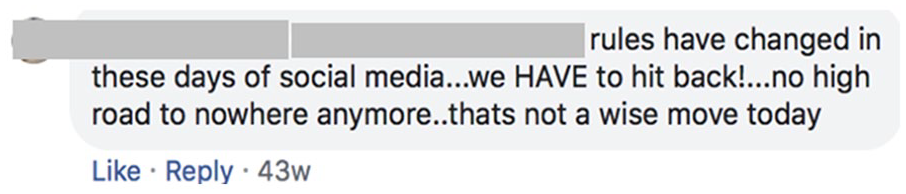
“No high road to nowhere anymore”.
In some domains, both intentional and unintentional expressions of racism and sexism are increasingly identified, seen as inappropriate and policed. For example, people are more aware of the workings of microaggressions or internalized misogyny and understand their negative impact on individuals and the society overall. Troublingly, the Facebook sites of far-right-wing news outlets are pockets where resisting this socially aware mind-set (and the norms and symbols that come with it) is accepted and functions even as a status symbol and a sign of belonging—hinting at the co-development of left- and right-wing “feeling rules” (see also Boler & Davis, 2018). This relational, reactive dynamic seemed almost like an engine of renewal and evolvement for the disposition and vernacular of the mediated far-right (Figure 15):

Relational self-positioning.
The relationality of mediated emotions
Far-right media has undoubtedly bolstered attitudes regarding the political issues at stake. It has presented exaggerated and unfounded threats to the identities, values, and lifeworlds of white, Republican Americans. Yet, it is because the opposing social force is depicted and experienced as unalert to these dangers, or even as endorsing or representing them, that they can become politically effective. Therefore, to lend the words of Wetherell (2012), research on the politics of emotion should not begin “with a stimulus or with a response, but with the whole social pattern unfolding or coming into being” (p. 359). The reference to unfolding social pattern points to the mutual constitution of liberal and conservative feelings and identities. When the other side feels defeat or anger, the other side expresses exhilaration—and vice versa (see Figure 16). Moreover, far-right-wing audiences’ affective subject positions were taken and constructed in response to Democrats’ alleged thoughts, actions, and expressions. In Figure 17 for instance, the commenter cynically distances herself from leftists’ “woke” convictions. Meanwhile, the comment in Figure 18—and many others like it—implies that Democrats are sore losers, and therefore make groundless claims against Donald Trump and his supporters. This narrative works to fill the latter with righteous indignation and gives them all the more reason for distrusting the left. What this and the other examples illustrate is that affective displays by far-right-wing audiences are not spontaneous, irrational outpourings, but more often “socially recognised routines or affective practices” that refer back to a “normative back and forth” (Wetherell, 2012, p. 81) with the (mediated) left.

A picture of Rachel Maddow, who covered Mueller Report for MSNBC.

A comment on a post about (largely unfounded and exaggerated) accusations of the supposed anti-semitism of Ilhan Omar.
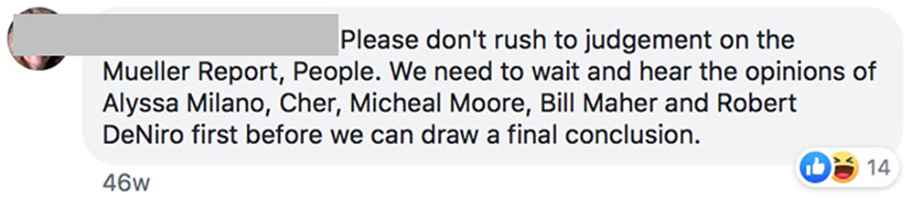
A comment on a story about the Mueller report being inconclusive.
Self-affirmation was a recurring affective practice in both delighting and detesting engagement, and was typically carried out through playing back progressive critique or ironically responding to it. To quote the commenters, it was the left that “promoted hate and division” and was “famous for making up their own “facts.” The posts on Jussie Smollett in particular—who had staged a hoax hate crime against himself by two men wearing MAGA hats—enabled far-right-wing audiences to claim positions as targets of politically motivated accusations, and to articulate feelings of being misrepresented and discriminated against (see Figure 19). In what looks like photoshopped images, audience members even presented themselves as political martyrs, excruciated by the opposing side for their devotion to a leader (Figures 20 and 21).
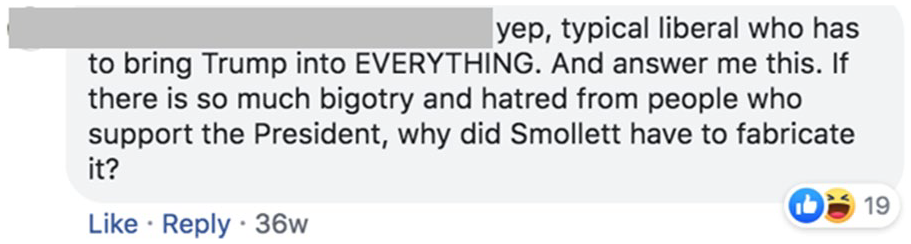
Claiming misrepresentation.
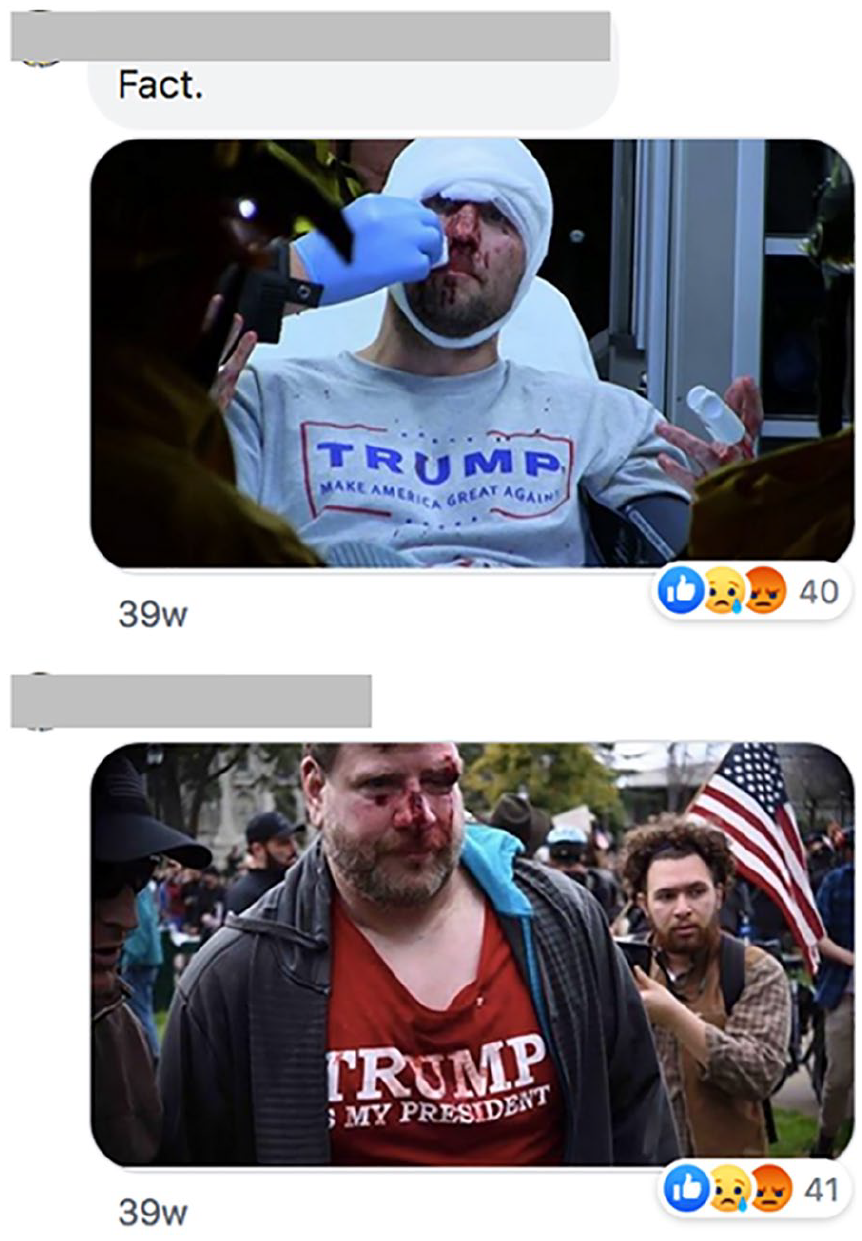
Claiming victimhood as the real object of targeting and discrimination.
Importantly, this type of rumination was encouraged by the publishers. For example, under a post about an article titled BREAKING: Jussie Smollett Indicted on 16 Counts in Hate Hoax Attack, Breitbart had linked a piece on Celebrities who blamed “Trump” and the “deplorables” 2 for Smollett’s hoax attack on himself. In other words, junk news sources made use of the relational constitution of emotion by selectively presenting Trump supporters with allegations liberals had made against them. Commenters who took a critical view to junk news were written off as Democratic trolls or “stupid snowflakes,” embodiments of the opposing political side far-right-wing media had spent much time and effort in typifying and vilifying. Indeed, the comment boxes were like a microcosm within which junk news audiences could reproduce and take part in the unfolding drama of contending forces that was presented to them in the posts and articles. Instead of giving rise to dialogue and self-reflection, each real or alleged criticism from the part of a Democratic commenter—who were quite common, indicating that this was not a wholly homogeneous social environment—seemed to polarize junk news audiences even further.
There is always layeredness and irresolution to affective experience and interchange. Self-affirmation, for example, may carry within it traces of vulnerability or shame (Burkitt, 2014)—emotions whose expression could perhaps motivate more open, and less divisive political discourse. What is at stake with detesting and delighting engagement, then, is how through inscriptive and algorithmic processes, certain emotional (mis)interpretations—such as having been unjustly treated by the opposing political side—become spread, fortified, and promoted over others. Social media’s emotional architecture favors both novelty and repetition: the appetite for new content is endless, but this content should be optimized to match users’ preferences as inferred from their past behavior. Through algorithmically promoted mass engagement, then, junk news audiences’ attention and sentiment become habitually and repetitively channeled in ways that enforce social, cultural, and political boundaries, and seemingly make constructive communication across them more difficult.
Conclusion
In this article, we have studied how social media’s emotional architecture surfaces publics affected by happening issues. More specifically, we found that in a bipartisan context, the interaction between audiences, affordances, and political content seems to be effective at generating or catalyzing a bivalent emotional dynamic that, broadly speaking, divides posts into highly “loved” and highly “angering.” This emotional logic is, furthermore, made use of by junk news sources, whose reporting systematically afforded users’ positions of not only defeat, cynicism, and hate, but also victory, affection, and self-vindication. Delighting and detesting engagement, then, brought far-right-wing users together and shaped their political identification by directing their dramatic focus toward both what was loved and what was hated. In the qualitative analysis, we have sought to highlight the complexity and relationality of mediated political emotions. The expressions of solidarity, care, and delight we encountered entwined with distrust and resentment, often presupposing the exclusion of others and taking place at their expense.
Within the comment boxes of high-performing posts, affective subject positions were displayed and aggregated, with the most appealing ones garnering praise and endorsements. Algorithmically organized encounters with pleasurable and enraging content not only moved users, but also drew them nearer to those who were similarly moved. Meanwhile, affective dissonance rendered one’s belonging in the group suspect. The supposedly subversive hyper-partisan space was in fact highly self-policed. Challenging junk news’ journalistic integrity resulted in social sanctions. Other commenters did not disapprove of the content of the criticism per se, but of the very act of critique itself, which signaled that the critic had lost dramatic focus. Fellow feeling and a disposition that reveled in—or could at minimum tolerate—political or factual incorrectness became requirements for inclusion. We found that fundamentally, delighting, and detesting engagement boiled down to a transpiring, agitated relationship between different political sides: irrespective of the topic, the articles were made meaning of within an “us” versus “them” framework. In this context, the epistemic value of a news story was not a priority. The role of the news was performative: information could have emotional resonance or be used for movement-building, fostering solidarity, and signaling identity even if it was unfactual, outdated or not representative. It seems, then, that combatting junk news must take place not at the level of fact-checking or media literacy alone, but through introducing novel narratives and transforming political allegiances.
Our study does not support the assumption, critiqued also by Marwick (2018), that the post-truth era and related political polarization has to do with audiences being merely passively exposed to emotionally laden disinformation. Rather, on social media, conversations with their distinctive vernaculars and affective practices manifest and propagate. The participants of these conversations are largely self-selected, and negotiations regarding truth and appropriate emotion take place seemingly completely on their own terms—which again strengthens these terms and participants’ trust in them. However, when analyzing this process, the complementary responsiveness of algorithms to users’ interactions with both publishers’ content and with each other should also be taken into account. Indeed, it seems to us that by encouraging and promoting some information and expressions over others, Facebook’s architecture influences which emotional definitions of the situation become strengthened and catalyzed, and what kind of political discourse gets generated at the platform–audience interface. High-performing junk news are accompanied by an emotional value—afforded and structurally enforced by social media’s emotional architecture—that orients audiences’ attention, affective meaning-making, and identification.
As Papacharissi (2016) suggests, the “textual rendering” of networked publics is perhaps the primary modality of their existence. Nonetheless, studying junk news audiences as and through “records and traces” of social media engagement has its limits and difficulties. For example, the online conversations and negotiations about news stories and their meaning that we’ve studied on Facebook likely spill over to offline contexts, taking place between friends and family, at work or over a drink. Addressing how these conversations resemble or differ from the ones we have examined—and whether they could be less overdetermined, open to more varied interpretations and states of being moved—would be an interesting question for further study. Moreover, our study has focused mainly on analyzing the cultural and emotional logic of algorithmically promoted junk news engagement. We call for further, more detailed explorations of underlying mechanisms, such as the extent to which manufactured support (e.g., fake accounts) is able to introduce affective and interpretative frames into user conversations and contributes to crafting the image of the mediated far-right. Another interesting avenue would be to study audience responses to multimedia-centric content. However, even though automated image recognition techniques are improving, it is still an open question how to analyze social media images and videos on a large scale in a valid and fine-grained manner. Finally, emotions play a role not only in coming together, but also in coming apart. Our dataset does not make visible the reasons for, and states of, being affected in ways that made former participants want to distance themselves from junk news and the mediated far-right. However, those individuals undoubtedly exist. Perhaps learning about their experiences could help us think how to incite critique toward far-right-wing disinformation among audiences for whom the very act of consuming it is already an act of—however ill-considered—resistance and self-affirmation.
Footnotes
Acknowledgements
We would like to thank Associate Professor Minna Ruckenstein (University of Helsinki), Professor Mika Pantzar (University of Helsinki) and the Social Media + Society reviewers for providing insightful feedback on earlier versions of the manuscript. This work was carried out on the Dutch national e-infrastructure with the support of SURF Cooperative.
Declaration of Conflicting Interests
The author(s) declared no potential conflicts of interest with respect to the research, authorship, and/or publication of this article.
Ethical Approval
The Junk News Aggregator project activities were approved by the University of Oxford’s Research Ethics Committee, CUREC OII C1A 15 044, C1A 17 054.
Funding
The author(s) disclosed receipt of the following financial support for the research, authorship, and/or publication of this article: The Junk News Aggregator project was funded by the European Research Council through the grant “Computational Propaganda: Investigating the Impact of Algorithms and Bots on Political Discourse in Europe,” Proposal 648311, 2015–2020, Philip N. Howard, Principal Investigator, and the grant “Restoring Trust in Social Media Civic Engagement,” Proposal Number: 767454,2017-2018, Philip N. Howard, Principal Investigator. The project received additional support from the Open Society Foundation and Ford Foundation.
