




Abstract
Political polarization, seen as a key threat to contemporary democracy, has been tied to the rise of digital social media. However, how this process develops in the context of a social media environment characterized by multiple platforms—with differing norms, contents, and affordances—has not been sufficiently explored. In the present article, we propose a distinction between positional polarization, that is, people’s view on a political issue, and interpretative polarization, that is, how that political issue is contextualized and understood. We use this distinction to examine an issue of political controversy in Israel, examining how polarization develops over time, on three social media platforms—Facebook, Twitter, and WhatsApp. We find that contrasting positions are strongly connected to conflicting interpretations, both of which are clear from the start, with only minor overtime shifts. Moreover, while sharing broad similarities, the three platforms show a few distinctive polarization dynamics—both positional and interpretative—that can be connected to their varied socio-technical affordances. The study advances our theoretical understanding of polarization by examining how different social media platforms may shape distinct polarization dynamics over time, with different implications for democratic debate.
Over the past decade, numerous salient controversies around the globe have reignited the public and scholarly debate about the nature, alleged rise, and suspected perils of political polarization (e.g., Lelkes, 2016; van Aelst et al., 2017). In particular, the challenge of political polarization has been tied to the rise of networked digital and social media as a venue for political discourse. As voters rely increasingly on commercial social media platforms for political information and discussion, scholars have begun examining the ways in which social media may have contributed to the transformation, fragmentation, and political polarization of contemporary public spheres around the globe (e.g., Settle, 2018; Stroud, 2010; Sunstein, 2003). Yet, to this date, remarkably little work has studied comparatively how different social media platforms give rise to different polarization dynamics (Bode & Vraga, 2018), or examined the overtime dynamics of polarized debates, which social media environments permit us to observe directly.
Our aim is to better understand how the specific norms, contents and affordances of different social media platforms contribute to their political polarization dynamics. To do so, we examine how disagreement around a controversial political issue in Israel played out over time on Facebook, Twitter, and WhatsApp. In our study, we distinguish positional polarization—people’s stand on a political issue—from interpretative polarization, the process wherein different groups in a society contextualize a common topic in starkly different ways. Building on a large-scale dataset of just under a quarter of a million texts from these three social media platforms, our diachronic cross-platform comparative analysis shows how positional and interpretative polarization are related to each other, over time, and across platforms. Our findings further show how—despite broad common trends—different social media platforms shape different polarization dynamics over time. By discussing implications for the theoretical conceptualization and operational measurement of polarization as a discursive process, we contribute to a deeper understanding of political polarization in the context of today’s multi-platform digital media environment.
Political Polarization and Social Media
Departing from a normative ideal of a healthy political debate, wherein preferences are centered around widely acceptable moderate positions, the concept of polarization consists of a gradual shift of preferences toward opposing political extremes (Fiorina & Abrams, 2008). Yet despite a long history of studies on polarization, there is remarkably little agreement on what exactly this concept entails, what are its key drivers and implications, or how it should be measured (Baylis, 2012). Given the wide variety of approaches, each reflecting a somewhat different notion of polarization, several scholars have identified a pressing need to restore conceptual clarity (e.g., Lelkes, 2016). In the following, we briefly examine some of the theoretical foundations of polarization, to ground our focus on positional and especially interpretative polarization.
Polarization—Positional, Interpretative, and Over Time
Most classic studies of polarization have focused on the static distribution of issue positions or attitudes on some political issue, with polarization generally measured by a bimodal distribution of preferences (e.g., Abramowitz, 2015; DiMaggio et al., 1996). We refer to this aspect of polarization, which focuses on people’s positions toward a certain political issue, as positional polarization. Importantly, positional polarization implies that extreme preferences are incompatible with each other, such that satisfying one side will inevitably frustrate the other side (Fiorina & Abrams, 2008; Lelkes, 2016). Yet thinking about polarization as a dynamic process means that we should be studying not only a single point in time but also an overtime shift of preferences that move from moderate to more extreme. To date, diachronic studies of polarization remain rather rare (though see Stroud, 2010, for an exception).
In addition, relatively few studies have explicitly addressed what is the explanatory mechanism for political polarization as a dynamic process. To understand why different people adopt increasingly differing views on a specific political topic, political communication scholarship on framing has shown how different contextualizations of the same issue can lead people to apply different considerations and thus evaluate it differently (e.g., Chong, 1996; Stroud & Curry, 2015). For example, whether a political informer is interpreted as a brave whistleblower or as breaching national security may drive people to take different positions toward said informer.
Of course, people are typically able to process multiple frames and evaluate an issue from more than one perspective. However, where competing groups rely exclusively on contrasting frames and reject (or are unaware of) those frames underlying divergent preferences, they may arrive at contrasting interpretations that sustain irreconcilable positions. This is what we refer to as interpretative polarization: the process wherein different groups in a society contextualize a common topic in starkly different ways (Baden, 2015). Interpretative polarization implies that those frames used by one camp are deemed unfounded, inappropriate, or illegitimate by other camps (Shmueli et al., 2006). Where interpretative polarization is strong, different groups conceptualize the same topic in such vastly different terms that meaningful conversation between groups is almost impossible. Interpretative polarization can be mitigated when groups share frames and considerations, or acknowledge that competing interpretations are generally sound (Chong, 1996; Risse, 2002).
Interpretative polarization may reinforce positional polarization, when differing interpretations make it increasingly difficult to adopt the view advanced by one camp without discrediting the other camp (Baden & David, 2018; Hyde & Bineham, 2000). Previous research has suggested that the salience of contrasting issue interpretations can be a key driver of positional polarization (Hetherington & Weiler, 2015; Shmueli et al., 2006). We continue this line of research to examine the relationship between interpretative polarization, which is the context in which an issue is understood, and positional polarization, which is the stance on the political issue. Moreover, we consider how this plays out across multiple platforms which differ in the way they afford and structure political discussion.
Political Polarization on Multi-Platform Social Media
The abundance of political discourse on digital and particularly social media has enabled new approaches to examine political polarization, as political views are expressed organically within naturally occurring contexts (see, for example, Barberá et al., 2015; Bruns, 2019; Himelboim et al., 2013). Over the past decade, the major trend has been public concern around social media as exacerbating political polarization, an approach that has been generally supported by academic research. Numerous scholars have proposed that social media might be structurally geared toward political polarization (J. K. Lee et al., 2014; Settle, 2018; Tucker et al., 2018; van Aelst et al., 2017; Yardi & boyd, 2010).
Most prominently, Sunstein (2001, 2003) argued that social media’s reliance on personally curated networks and algorithms reinforcing personal interests may lead audiences to be disproportionately exposed to only congenial viewpoints and information (see also Himelboim et al., 2013). To the extent that social media “filter bubbles” (Pariser, 2011) shut out dissonant voices, the unavailability of frames justifying different views may lead users to perceive existing opposition as marginal and, where it exists, as unfounded and illegitimate (Gentzkow, 2016; Himelboim et al., 2013). Moreover, selective exposure within congenial “echo chambers” may lead users to falsely perceive both available information and majority opinion to support their pre-existing interpretations and positions (Müller et al., 2017; Wojcieszak, 2011). Thus confirmed in their perceptions, they may be induced to consider increasingly extreme positions (Gaffney et al., 2013).
Yet some recent evidence goes against this assumption, suggesting that most social media users actually remain regularly exposed to opposing standpoints (e.g., Bruns, 2019; Gentzkow, 2016). Although social networks centered around strong ties (such as family and friendship relations) are mostly homophilic, some studies that have considered also weaker ties have argued that cross-cutting exposure may have actually increased through the advent of social media (Barberá, 2015; Bruns, 2019; Yardi & boyd, 2010). Therefore, whether the flow of political information on social media primarily fosters or counteracts political polarization remains a hotly contested debate.
How Platform Contents, Norms, and Affordances Shape Polarization Dynamics
In this article, we argue that one explanation for the divergent findings obtained so far around social media and polarization may lie in the differing nature of social media platforms. Most studies of political polarization focus on a specific platform (e.g., Settle, 2018 on Facebook; Himelboim et al., 2013 on Twitter), yet often make inferences about “social media” as if these were a relatively unitary phenomenon. Recent scholarship has increasingly called for studies acknowledging the important differences between social media platforms in shaping political communication dynamics (see Bode & Vraga, 2018). Moreover, even within one social media platform, the specific context (e.g., the national context) may differentially shape its use (Miller et al., 2016) and its resulting polarization dynamics, necessitating a detailed explanation of context (see Rojas & Valenzuela, 2019).
We thus offer a comparative cross-platform approach examining the debate around an issue of controversy on three social media platforms—Twitter, Facebook, and WhatsApp—in the context of Israel in 2016–2017. In this timeframe, we selected contents relevant to our debate from Twitter, a publicly open platform; from Facebook, using all public pages and posts open to the public; and from WhatsApp, using two organic large-scale groups dedicated specifically to political discussion. 1 To better understand how these different social media may distinctly shape political polarization, we will briefly consider the norms, contents, and affordances of these three platforms in relation to political discussion (see also Literat & Kligler-Vilenchik, 2020).
Norms
A first aspect shaping polarization dynamics may be social usage—which populations tend to use a certain platform, as well as how the platform is perceived—particularly, whether it is seen as an appropriate space for political discussion (Mor et al., 2015; Thorson et al., 2014). In Israel, WhatsApp is continuously the most popular communication app, used by around 91% of adults (“Bezeq Internet Report,” 2019). Like other countries with a collectivist orientation (see, e.g., Boczkowski et al., 2018 on Argentina), Israelis are avid users of WhatsApp groups, which run the gamut from private chats among close friends to large-scale groups dedicated to discussion of professional matters. Here, we focus on journalistic WhatsApp groups where politically interested individuals come together for the purpose of engaging in political discussion (see Kligler-Vilenchik, 2019; Kligler-Vilenchik & Tenenboim, 2020; Yarchi et al., 2020). Facebook is generally seen in Israel as the “mainstream” social media platform, that is, most popular among adults (“Bezeq Internet Report,” 2019). Facebook is known as a platform for personal, community- and interest-based networks; however, specifically in its public pages and discussions, it is also home to a more activist nature, geared toward the formation of political identities and an attempt to influence wider political debates (Ben-David & Matamoros Fernandez, 2016). In Israel, like many other countries, Twitter is used primarily by political elites, journalists, and activists for purposes of professional communication and public campaigning. This is in contrast to other countries—notably, the United States—where the platform is popular among the general population. Due to its public nature and its user demographics, Israeli Twitter is generally seen as an appropriate venue for discussion of political issues.
Contents
Beyond their different audiences, different social media platforms may vary on the extent to which users choose to post political content and the extent to which political contents of different kinds are made salient and accessible to others. As is widely known, Facebook uses a powerful algorithm that curates a personalized newsfeed composed primarily out of posts from people with whom we have strong ties. Political discussions among friends are likely to mostly involve congenial positions and interpretations (Vraga et al., 2015), while the platform’s algorithm may further favor showing users views that are similar to their own (Settle, 2018). On Twitter, all content is accessible publicly, though the personalized newsfeed is shaped by whom each user chooses to follow. At the same time, users can also retrieve content by hashtags, which may cut across diverse political viewpoints. On WhatsApp, contents are shaped by members of a conversation or group, which may be more or less heterogeneous. The WhatsApp groups we study here include politically interested members that are relatively heterogeneous politically (Kligler-Vilenchik, 2019).
Affordances for Political Talk
We use Gibson’s (1986) approach to affordances, which considers what the environment “offers the animal, what it provides or furnishes, either for good or for ill” (p. 127). Building on Evans et al. (2017), we see affordances in the technological sense as going beyond design features, emerging instead from the interaction between a technology’s design and the choices made by its users. Here, we’ll consider the three platforms across two main affordances: connectivity (the ability to construct ties) and expressivity (the ability to construct content). We see these affordances as shaping—though not determining—the resulting political expression.
In terms of the structuring of ties, Facebook’s acceptance-based friendships focus most user interactions on strong social ties, but permit users also to asymmetrically follow certain public pages. Asymmetric ties, which require no confirmation by the followed user, are characteristic for Twitter. Consequently, on Twitter, it is much easier to establish links that are not underpinned by existing relationships, facilitating the formation of diverse networks. On WhatsApp, users decide independently what groups to join, but have little control over the composition of the group. And on Facebook, it is likely to create interactions mostly with others holding similar positions and interpretations. Twitter networks should be somewhat more diverse, while those WhatsApp group studied here may expose users to a rather diverse range of voices.
With regard to expressivity, Twitter’s narrow character limitation facilitates brief expressions of support or contestation, but relies on linked content for further elaboration. The loose organization of tweets also contributes to a fragmentation of discussions. By contrast, Facebook’s capacity to carry complex multimedia messages facilitates more substantial posts and threaded conversations. WhatsApp’s sequential structure supports ongoing discussions, but focuses interactions on near-simultaneous conversations, while past content rapidly disappears from view.
Based on our review of the respective norms, contents, and affordances of the different social media platforms, we examine their distinct contributions to political polarization dynamics. We ask the following research question:
RQ. How does polarization (positional and interpretational) play out over time across different social media platforms?
Case Study and Methods
Given the fiercely contested Israeli public discourse and the vast ideological differences underlying Israelis’ attitudes toward the Israeli−Palestinian conflict, the Israeli context lends itself well to the study of political polarization (Aronoff, 1984). To study polarization across platforms, we analyze social media conversations about a highly controversial incident in Israeli politics.
In March 2016, Israeli soldier Elor Azaria was caught on video shooting and killing an incapacitated Palestinian assailant. The incident sparked a heated debate, wherein many praised Azaria’s deed as heroic, while others denounced him as hateful murderer. In a representative poll conducted in August 2016, at the height of the trial, the public split evenly, with 47% of the Israeli population viewing the shooting as justified in the context of defense against violent terrorism, while 45% regarded it as extrajudicial killing (Israel Democracy Institute, 2016). While Azaria’s right-wing supporters dominated public opinion, numerous powerful voices with access to mainstream media (including political actors, NGOs and journalists) continued to oppose the shooter and demanded his punishment. When Azaria was found guilty in January 2017, 51% of the public disagreed with the verdict, while 36% agreed (Mako, 2017). Azaria was eventually sentenced to 1.5 years, of which he served 9 months. The controversy around Elor Azaria generated considerable amounts of heated discussion over an extended period of 16 months, which saw his indictment, trial, conviction, and eventual sentencing.
Data Collection
For the study, we collected content from three social media platforms, as previously discussed: Twitter, public pages and publicly open discussions on Facebook, and two large-scale WhatsApp groups dedicated to political discussion. We collected all contributions referencing the case posted on each platform over the entire duration of the controversy, from the day of the shooting incident (24 March 2016), through Azaria’s trial and conviction, until 30 July 2017, when his appeal against the verdict was rejected.
Given the different structures of the sampled platforms, we employed slightly different methods to retrieve contents, based on both practical and ethical considerations. Facebook and Twitter data were collected through Buzzilla, an Israeli social media company. On Twitter, we identified all tweets referring to the case by a range of validated keywords. 2 Given the public nature of Twitter, we retrieved all relevant tweets and all comments responding to them using the Twitter API. For Facebook, we focused on public Facebook pages and publicly open discussions, and used the same procedure to retrieve all relevant posts and dependent comments from them. For WhatsApp, which is a closed platform, we obtained consent from the groups’ host and participants to join the political discussion groups as an observer, download and analyze the conversations. This procedure was approved by the institutional review board (IRB). On these contents, we used keywords to identify potential segments of discussion, and subsequently hand-coded all contributions for pertinence to the case. All content was de-identified for use.
In total, our sample comprised 29,250 tweets with 61,772 comments, 6,508 Facebook posts with 145,542 comments, and 6,245 WhatsApp messages. Thus, the total corpus contained just under a quarter of a million texts, ranging from short (as little as one word) WhatsApp messages, to 140-character tweets, 3 to elaborate Facebook posts. To enable examining the development of the debate over time, we organize our data into four main phases: Phase I extends from the shooting incident to the opening of the trial on 9 May 2016; phase II extends over the duration of the trial; phase III commences with the announcement of the verdict on 4 January 2017 and ends with Azaria’s sentencing on 21 February 2017; phase IV finally ends with the rejection of his appeal on 30 July 2017. Figure 1 shows the extent of social media posts around the topic over these four phases.

Social media activity over four phases: after the shooting, trial, sentencing, and appeal.
Analysis
To classify the contents of collected messages, we used Hybrid Content Analysis—an innovative computational extension to content analysis—which combines an algorithmic extraction of recurrent patterns with a manual classification of the identified patterns (Baden et al., 2019). Specifically, we computed a structural topic model (using the R package stm; Roberts et al., 2019), modeling each document as being composed of a number of topics, each of which is expressed through a maximally distinctive set of words (including non-word expressions, such as emojis). The specific algorithm was selected because it permitted us to model topic prevalence as dependent on the platform that a sub-corpus was derived from, thus enabling a cross-platform comparison (explicated in our methodological article, Baden et al., 2019). Using the package’s inbuilt tools for model evaluation, we estimated a broad range of models (K = 30, 40, . . ., 200, 250). Among those models performing best with regard to exclusivity and semantic coherence (K = 70, . . ., 120), we manually validated estimated topics’ interpretability and univalence with regard to our coded categories, selecting the model with K = 100 topics for offering optimal fit and interpretability. 4
Each topic was manually classified based on a codebook 5 that determined its stance toward the actions of Elor Azaria (supportive: glorifying his deed or demanding his acquittal; oppositional: condemning his deed or demanding his conviction; ambivalent: expressing contravening, but not mutually exclusive considerations; otherwise, neutral/irrelevant). To study what interpretations were expressed in the collected posts, we distinguished between seven broad thematic domains (the shooting, the military, law enforcement/legal procedures, politics, the media, society, other), which grouped different kinds of considerations suitable for evaluating the controversy. For instance, “society” referred to considerations foregrounding shared identity, solidarity, and community values; “politics” included references to the role of political institutions in the affair; law enforcement referred to considerations emphasizing legality and procedural justice, and so on. See Appendix for a list of sample posts/comments per thematic domain. Finally, we coded the intensity (emotionalized, not emotionalized) and sentiment (positive, mixed, negative, neutral/irrelevant) of emotional expressions.
Coding was done by two authors who are native speakers of Hebrew and deeply familiar with the cultural context. Krippendorff’s alpha indicated high intercoder reliability (M = 0.88, SD = 0.10, range: 0.74–1.00). Finally, each original post was automatically classified based on its inclusion of the coded topics. Multiplying the matrix of coded topics (all categories converted into dummies) with the theta matrix of topic prevalence per document, we considered a category to be present in a document when its combined weight over all topics included in the document exceeded 0.5, thus obtaining a unique classification of each document on each variable.
The hybrid coding strategy was validated against a direct manual classification of 200 documents based on the same codebook, yielding high precision (0.89) and recall (0.89). In addition, we checked the robustness by repeating the entire procedure with models estimated separately for each platform, coding each topic solution and comparing the resulting document classifications (Holsti: 0.80).
Findings
Descriptive Findings
In terms of the position toward shooter Elor Azaria, we find that despite the relatively balanced distribution of positions in the population, contributions across all three social media platforms are overwhelmingly supportive of Azaria. Out of the 38.7% of posts that expressed an explicit stance, 87.6% were supportive, 10.3% expressed mixed views, and only a small minority (2.1%) clearly opposed Azaria. Aggregating posts per user, the posts of 45,093 (79.7%) users are predominantly supportive, 9,351 (16.5%) ambivalent, and 2,162 (3.8%) critical. Moreover, supporters posted somewhat more frequently than the other groups.
This positional distribution may make the case seem almost consensual. Yet while Azaria’s right-wing supporters are dominant numerically, those who opposed the shooter included numerous highly visible actors, including politicians, journalists, artists, and other public figures. That is, Azaria’s supporters included very many individuals with relatively little public visibility, who contributed disproportionately many posts; but in terms of visibility, Azaria’s opponents maintained a strong voice in the public debate.
Users’ posts most commonly interpreted the case in the context of societal solidarity and shared values (25.3% of classified contributions), followed by the context of legal procedure and criminal prosecution (22.1%) and the role of the military (7.5%). Interpretations referred less frequently to the shooting itself (4.8%), the role of the media (4.6%), and politics (4.5%). Almost one-third of interpretations were classified as mixed.
Polar Positions and Interpretations across Platforms
To examine how interpretative polarization is related to positional polarization, we divided the social media contributions by stance toward the shooter (Azaria’s supporters, opponents, and ambivalents), and examined how each group contextualized the case. Our data show strong evidence of a connection between interpretative polarization and positional polarization, on all platforms. As Figure 2 shows, posts supporting Azaria interpreted the case primarily by referring to societal solidarity and shared values (marked yellow), while also highlighting the role of the military (marked green). In this narrative, Elor Azaria is seen primarily as a soldier who acted to defend his society, and who thus deserves societal protection. By contrast, posts opposing Azaria did not at all consider these two contexts (both values not significantly different from zero 6 ), and focused instead on the incident of the shooting (marked black)—a context almost completely disregarded by the supporters (confidence intervals: 2%–5%). That is, opponents presented Azaria not primarily as a soldier doing his duty, or as a member of society, but rather focused on his deed—shooting an incapacitated person. These differences between opponents and supporters are significant and consistent across platforms, as confirmed by a series of analyses of variance (ANOVA).
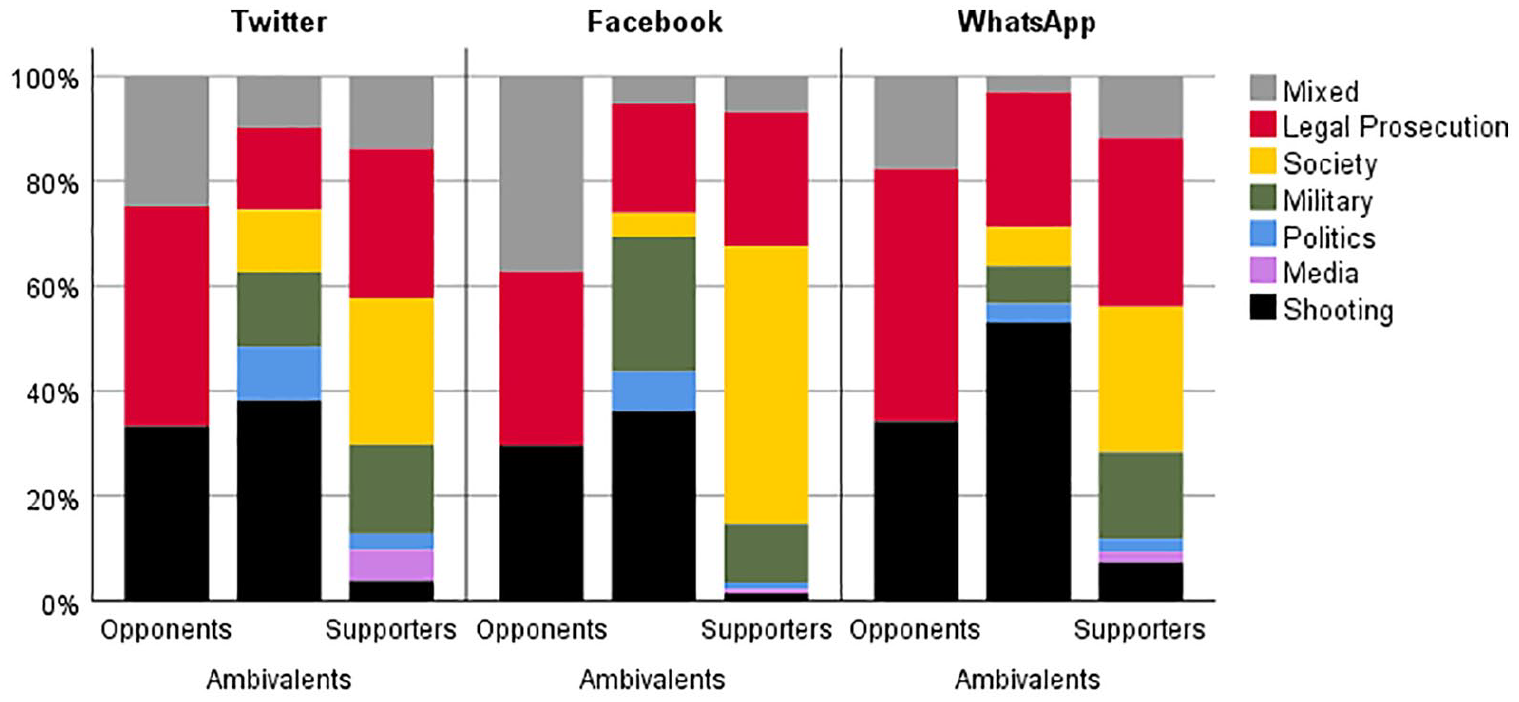
Prevalent contexts of interpretation by stance, across platforms.
The only interpretative context shared by both camps consisted of references to the legal prosecution and trial (marked red). Yet while this is a shared context of interpretation, supporters’ calls for the immediate acquittal and release of Azaria and opponents’ demands for his punishment as a hateful murderer still reflect irreconcilable interpretations.
Differences between the platforms are quite minor. Among opponents, we find no significant differences between platforms except for the legal context, which is less salient on Facebook. Among supporters, the societal context is more salient on Facebook than on Twitter and WhatsApp, while references to the military and legal matters are less common. A factorial ANOVA, predicting the topical focus of interpretations by a user’s camp and platform, shows that, while all factors are significant (p < .001), users’ position regarding Azaria explains by far the most variance, F range: 150–4,899, M = 1,338 for position (df = 3); F range: 18–83, M = 59 for platform (df = 2); F range: 7–493, M = 181 for the interaction (df = 6).
While opponents and supporters seem practically irreconcilable due to their differing interpretations, we see that ambivalent contributions partially bridge the disconnect. Ambivalent posts shared opponents’ concern about the shooting, but also referred to the role of the military, and—to a marginal extent—considered Azaria’s embedding within Israeli society (the primary framing applied by the supporters). Interestingly, ambivalent posts were the only ones to raise the political realm as a salient context for interpretation, contextualizing the case in the context of Israeli left−right politics.
Positional Polarization—Across Platforms and Over Time
After confirming a relationship between interpretations and positions, we next examined these two interdependent processes over time and across platforms. To assess diachronic changes in the positions expressed, we tested for possible changes in the share of posts classified as supportive, ambivalent, and oppositional on the three platforms. As is illustrated in Figure 3, overtime changes on each platform are relatively small; rather, the distribution of opponents versus supporters is polar from the outset, and remains quite stable over time. On Facebook and WhatsApp, we find a small but significant increase in the share of ambivalent posts at the expense of supportive posts, suggesting a slight depolarization. On no platform do we find significant changes in the share of opposing posts.

Positional polarization over time: Stance toward Azaria by platform and phase.
To further investigate positional polarization dynamics, we analyzed the sentiment (positive, negative, or mixed) expressed by posters of different positions on each platform over time.
7
Sentiment can be expected to become more extreme over time, as people who are aggravated may use increasingly negative sentiment. As is shown in Figure 4, negative sentiment dominates the discourse. Positive sentiment is rather rare

Expressed sentiment by phase, stance, and platform.
Taken together, the picture in terms of positions expressed is not one of increasing polarization but rather of relative stability. On WhatsApp there is even consistent evidence of depolarization in terms of the distribution of posts, as well as decreasing negativity. On Twitter, while positions remain stable, we do see an overtime rise in negativity. Facebook presents two parallel trends with contradicting influence on polarization: rising negative sentiment on one hand and a small but significant increase in the weight of ambivalent contents (reflecting possible moderates) on the other.
Interpretative Polarization—Across Platforms and Over Time
In terms of interpretative polarization over time, as Figure 5 shows, the overall picture remains essentially stable, with some minor changes observed in the weights of different interpretative contexts.

Interpretative polarization: contexts of interpretation by phase, stance, and platform.
As an analysis of linear trends confirms, the proceeding criminal prosecution increasingly brings legal matters (marked red) into focus. Other trends are more minor. On Facebook, the disproportionate focus on societal values (yellow) decreases a bit over time, slightly mitigating the crass divide between supportive (graph #4) and opposing (graph #6) interpretations. On Facebook and on WhatsApp, similarly, opponents’ preoccupation with the shooting (marked black) diminishes slightly in the last phase (graphs #6 and #9, respectively). Thus, contrary to a hypothesis of increasing polarization, we mostly see a gradual decrease in emphasis on the contexts fragmenting supporters and opponents (social solidarity and the shooting, respectively), and a greater role of legal interpretations, which is a shared context. At the same time, in no camp do we record a significant acceptance of opposing camps’ interpretative contexts: While both sides progressively refer to the legal dispute, their polar interpretations remain unreconciled.
Discussion
By examining political discussion across three social media platforms, this study shows empirically the close connection between incompatible interpretations and antagonistic political preferences. Different camps interpret the same political incident in starkly different terms, to the extent that there is hardly any common ground left between them (Kepplinger et al., 2012; Shmueli et al., 2006).
That said, our findings give little reason to speak of polarization (positional or interpretative) as increasing over time. In fact, the controversy over Elor Azaria was polarized from the outset. Drawing upon ideological preconceptions already firmly established in Israeli public discourse and culture, each camp quickly interpreted the events in the context of its values and familiar narratives. Neither prevalent interpretations nor positions required any time to get settled. Despite the idiosyncrasies of our investigation, we hypothesize this pattern may be a common one, conspicuously echoing the findings reported by Yardi and boyd (2010) about the discussion between American pro-life and pro-choice advocates on Twitter. Where communities in society adhere to contrasting political–ideological worldviews, polarized interpretations and positions can be expected to materialize more or less immediately, building on existing stereotypes and frames to perceive events, which shape one’s resulting position on them. Invoking Lippman’s (1922) famous words, we “do not first see, and then define, we define first and then see” (p. 44).
However, an important piece of the story pertains to those holding ambivalent views. Users expressing ambivalent views used one frame that was exclusive to them: politics. By reading the incident through the lens of political considerations, ambivalent users could negotiate between the otherwise incompatible interpretations of the two camps, acknowledging the relevance of either camp’s considerations, without subscribing to their conclusions. Speaking to the arguments of Huckfeldt et al. (2004), intermediate views should not be mistaken for weak opinions, but instead reflect multiple, possibly strong attitudes. Our data points to the importance of these ambivalent voices that can integrate conflicting considerations and thus may provide a more holistic appraisal of an issue.
Beyond an examination of polarization dynamics over time, we examined how these processes play out distinctly on different social media platforms, with their specific norms, contents, and affordances (Literat & Kligler-Vilenchik, 2020). Facebook’s personalized newsfeed, the activist focus of many public pages, and the network’s strong community orientation (Bakshy et al., 2015; Valenzuela et al., 2018) are often hypothesized as an environment conducive for polarization (Settle, 2018). On Twitter, in comparison, the easy availability of cross-cutting contents and ties, as well as the lesser prominence of personal communication, could limit polarization (Barberá, 2015). On WhatsApp, shared interests and group-based identities could play contrasting roles, aggravating tribal echo chambers or incentivizing sincere conversation across political fault lines (Kligler-Vilenchik, 2019).
Our findings resonate with some of these expectations, while contradicting others. Our Facebook data showed two contradicting trends in terms of polarization dynamics: on one hand, a small but significant increase in ambivalent posts indicating slight depolarization; on the other hand, an increase in negative sentiment over time. At the same time, Facebook’s orientation toward community appears to fit users’ focus on interpretations highlighting social solidarity. Yet social solidarity is not necessarily extended toward one’s political opponents; most of supporters’ positive sentiment seems to be directed toward Azaria himself.
On Twitter, the platform’s predominant use by professional elites and media fits well with the relatively neutral stance expressed on this platform, as well as a greater concern for the role of the media in interpreting the shooting incident. In terms of positional polarization, we see an overtime rise in negative sentiment, though the ambivalent group runs somewhat counter to this trend.
The most interesting polarization—or rather depolarization—dynamics were found in our WhatsApp groups. In the political talk groups on WhatsApp, ambivalent voices slightly increased and negative sentiment lessened. These depolarizing dynamics point to the important role of shared purposes and mutual respect in the debate (Kelly et al., 2005). Members of the WhatsApp discussion groups are characterized by a commitment to cross-cutting discussion, legitimizing the presence of conflicting viewpoints (Kligler-Vilenchik, 2019). Moreover, their sustained interactions, facilitated by WhatsApp, likely contributed to a growing familiarity with, and tolerance of, other users’ views, which may explain the declining negativity in the debate.
Thus, both the technical-algorithmic configuration of a social media platform and its sociocultural appropriation influence the ways in which users post and receive political contributions, and thereby shape the prevalent dynamics of political polarization.
Limitations and Conclusion
Our study is subject to several limitations. To begin, both the case and the context of Israeli public debate are somewhat idiosyncratic. Building upon a long history of polarized disputes related to the Israeli–Palestinian conflict, the Israeli public may have been quicker to interpret and judge Azaria’s deed than could be necessarily expected with less established issues. Likewise, the heavy imbalance between supporters and opponents reflects the specificity of Israeli public discourse, which may have obstructed polarization dynamics that occur with less power-imbalance between camps (e.g., opponents may have been less verbal owing to spiral of silence effects; DiMaggio et al., 1996). In addition, our focus on two dedicated discussion groups on WhatsApp obviously permits no generalization toward other kinds of WhatsApp groups, which may be less hospitable to cross-cutting interactions.
Finally, one key limitation concerns the enterprise of studying polarization in social media discourse per se (Himelboim et al., 2013). As the unit of analysis in our study is the contribution, users who post many times are naturally overrepresented, whereas non-posters are ignored. While we can draw conclusions about the polarization that is apparent in the debate, we cannot say whether observed patterns reflect the distribution of interpretations and preferences in Israeli society at large (Baldassarri & Bearman, 2007; Lelkes, 2016). Each platform includes a different, non-random segment of Israeli society, and it is possible that entirely different dynamics would be uncovered using a representative panel study. In addition, many users enter and exit the debate over time, complicating even the interpretation of diachronic trends: For instance, users may have become increasingly frustrated over time, but it is equally possible that more even-tempered users simply dropped out of the debate, leaving the field to their more emotionally involved peers.
In conclusion, our study contributes to two key agendas that have been hitherto neglected in the study of political polarization. First, it emphasizes the need for theoretical clarification, conceptualizing political polarization as the dynamic interplay of two interdependent aspects: positional and interpretative polarization. Second, our study underscores the importance of distinguishing between the different online environments where polarization processes take place. Through our comparative design, we have shown that social media are not a unitary environment, but that different platforms shape online discourse—and, specifically, political polarization—in different ways.
In this study we have presented an avenue for studying political polarization within naturally occurring public debates, over time and at scale. Given the potential danger posed by polarization for democratic political debates, we hope that this study can help connect the salient public and scholarly concern with theoretically and empirically grounded scholarship.
Footnotes
Appendix
Sample posts exemplifying the coding of thematic domains:
Declaration of Conflicting Interests
The author(s) declared the following potential conflicts of interest with respect to the research, authorship, and/or publication of this article: The first author has received research funds from WhatsApp Research for a different study on preventing the spread of misinformation.
Funding
The author(s) received no financial support for the research, authorship, and/or publication of this article.
