



Abstract
There is considerable disagreement among scholars as to whether social media fuels polarization in society. However, a few have considered the possibility that polarization may instead affect social media usage. To address this gap, the study uses Dutch panel data to test directionality in the relationship between social media use and affective polarization. No support was found for the hypothesis that social media use contributed to the level of affective polarization. Instead, the results lend support to the hypothesis that it was the level of affective polarization that affected subsequent use of social media. The results furthermore reveal heterogeneous patterns among individuals, depending on their previous level of social media usage, and across different social media platforms. The study gives reason to call into question the predominating assumption in previous research that social media is a major driver of polarization in society.
Introduction
The notion that social media may fuel political polarization has been at the forefront of popular and scientific debate for some time now. There is empirical evidence to suggest that usage of some social media platforms may elevate polarization (Bail et al., 2018; Garimella and Weber, 2017; Quattrociocchi et al., 2016). However, evidence is mixed and other studies even suggest that social media use may attenuate polarization (Barberá et al., 2015; Beam et al., 2018; Semaan et al., 2014). Still others have concluded that the rise of the Internet, and social media in particular, likely plays a limited part in polarization processes vis-à-vis other social and political forces (Boxell et al., 2017; Prior, 2013). Included within these are increased polarized rhetoric among political elites in the competition for voters’ attention (Iyengar et al., 2012), and the increase in a more partisan set of voting options (Fiorina and Abrams, 2008). To date, considerable disagreement thus persists regarding the nature of this relationship, not least in countries beyond the United States and in multiparty contexts in general.
As others have previously noted (Tucker et al., 2018), the most plausible reason behind the disparate conclusions in the field is that the relationship between social media and political polarization is complex and likely heterogeneous. In this article, I mainly address one potential complexity that has systematically passed under the radar in previous research, theoretically and empirically, the matter of reciprocity. Reciprocity in this context would mean that any correlation between social media use and polarization is not uni-directional. That is, it is not caused by social media driving polarization. Instead, it would at least partly reflect the reversed causal order in which polarized attitudes precede social media usage. I argue that this could be the case in relation to social media use. This could be, for instance, if the tendency of a highly visible and vocal minority of users with strong opinions to attract a disproportional amount of attention has been (falsely) mistaken to indicate that social media fuels polarization. In any case, there is no doubt that this scenario also has consequences for public debate and, therefore, needs to be taken seriously.
The aim of the study is to test the direction of the relationship between an individual’s level of social media use and one specific type of polarization, commonly referred to as affective polarization. Affective polarization implies an identity-based sorting of people as belonging to either an emotionally favored in-group (us) or an emotionally disfavored out-group (them; Iyengar et al., 2012). Affective polarization is commonly defined as a growing dislike and distrust of politically defined out-groups such as certain parties and their supporters (Druckman and Levendusky, 2019). As such, affective polarization is related to, but conceptually different from, ideological polarization based on left or right attitudes on specific policy domains, and social polarization along, for example, socio-economic or racial lines (Iyengar et al., 2019). Some level of affective polarization is inevitable in pluralist societies and may function as a catalyst for political involvement (Mouffe, 2005). Nonetheless, escalating levels of affective polarization have been associated with various disconcerting consequences including erosion of constructive political debate, social trust, and inter-party cooperation, as well as with declined willingness to accept electoral defeat (Iyengar et al., 2019; Levendusky, 2013; Reiljan, 2020)—something that became brutally clear in the aftermath of the 2020 US presidential election following Donald Trump’s defeat. Unpacking the effects and drivers of affective polarization is important because the implications of polarization are arguably more troubling when it manifests as inter-group dislike and distrust rather than, say, differences of opinions.
This study relies on panel data from the LISS (Longitudinal Internet studies for the Social Sciences) project, covering a random sample of Dutch citizens surveyed yearly between 2014 and 2020. The LISS panel provides remarkably rich data, spanning a relatively long period of time, and thus providing unusually good possibilities to overcome some of the confinements of cross-sectional data and to approach making causal inferences. The article makes two main contributions. First, it makes a theoretical contribution by exploring possible reasons behind why affective polarization could potentially affect subsequent social media use. Second, the article makes an empirical contribution by taking a first step toward untangling the direction of the relationship between social media and affective polarization. I provide substantial evidence suggesting that the direction of the relationship in the Dutch case mainly ran from affective polarization to the frequency of social media use—contrary to common assumptions. The article furthermore makes an extended empirical contribution by disentangling the effects of increased Facebook and Twitter use respectively from a composite measure of overall social media use. The results suggest that individuals who were non-users or moderate users in the previous wave attained more polarized attitudes, elevating their subsequent usage of Facebook. However, moderate Twitter users reduced their subsequent usage as they gained more polarized attitudes.
The article proceeds in the following manner: It first lays the foundation for two contrasting hypotheses about the relationship between social media use and polarization, with an overview of related work. Thereafter, the data, analytical strategy and measurements are described and discussed in-depth before the results are reported. The article concludes with a summary of the main findings and a discussion of the limitations and implications of the study, including avenues for future research.
Theory 1: social media affects political polarization
The first set of mechanisms by which social media may impact polarization processes in general, and affective polarization in particular, can be linked to the information flow and network configurations shaped by social media. Following the lead of Sunstein (2001), previous research has suggested that social media provides ample opportunities to impact which kind of updates and information appear in an individual’s news feed and to opt out of exposure to unwanted information. Together with the algorithms that structure and personalize most social media platforms through the recommendation features, this has been assumed to create an environment characterized by filter bubbles and echo chambers where most information repeats and reinforces the pre-conceived notions of individual users (Bakshy et al., 2015; Beam et al., 2018; Sunstein, 2001).
Besides leading homogeneous groups to become attitudinally ever more streamlined, selective exposure through an echo chamber dynamic can also fuel negative affect toward out-group members through a few interrelated mechanisms. Social media exposure to pro-attitudinal information may prime people to continuously recall their own political identity and contribute to making identification with the political in-group more salient (Levendusky, 2013). A long line of social psychological research has shown that social categorization and stronger identification with an in-group in itself tends to be accompanied by more negative evaluations and affect toward out-group members (Iyengar et al., 2012; Tajfel and Turner, 1979). Activation of partisan identification may be especially pertinent in relation to social media, which has been shown to expose users to a higher share of hyper-partisan information that portrays politics as a battle between irreconcilable political interests compared to offline communication and traditional media channels (Tucker et al., 2018).
An echo chamber dynamic like this does not however simply reiterate pre-conceived opinions and strengthen the sense of in-group belonging. It also provides possibilities to highlight the distinctiveness and correctness of the in-group vis-à-vis political out-groups. Portraying political opponents as unreliable or morally inferior may cater to an inadvertent need to justify debunking or disregarding arguments from politically dissenting groups to avoid experiencing cognitive dissonance and ensuing distress (Festinger, 1954; Levendusky, 2013). As such, selective exposure through an echo chamber dynamic may further accentuate existing social and political barriers, amplify group mentality, and fuel negative affect toward differently minded groups over time (Sunstein, 2001).
Taking these concerns seriously, a growing body of empirical research has sought to assess the accuracy of the echo chamber thesis. Contrary to common expectations, some studies have found that, while clustering admittedly occurs on many platforms, social media is a rather pluralist environment that regularly exposes users to cross-cutting viewpoints (e.g. Bakshy et al., 2015; Barberá et al., 2015; Dubois and Blank, 2018; Semaan et al., 2014). Thus, in addition to asking whether social media may fuel polarization because of selective exposure, we should also consider how social media exposure to cross-cutting messages may impact polarization processes.
While echo chamber dynamics should uni-directionally lead to an expectation of increased polarization, there are two different possibilities associated with networks characterized by attitude pluralism. On one hand, cross-cutting communication gives participants the opportunity to become familiarized with the perspectives and experiences of “the other side,” which should facilitate inter-group understanding. As such, it should decrease the risk that biased and prejudiced views are uncritically reproduced and fortified, which can translate to an expectation that cross-cutting communication may de-polarize attitudes and emotions insofar as these are not already perfectly reasoned and unbiased (Kim, 2015; Mutz, 2006).
On the other hand, a long line of psychological scholarship has contended that concurring information is typically perceived of as reassuring and “safe,” whereas disagreement tends to provoke frustration, anger, or feelings of insecurity (Festinger, 1954; Marcus et al., 2000; Wojcieszak, 2010). Psychological mechanisms triggered by cross-cutting encounters may thus prompt an inadvertent need to rationalize dismissal of political opponents to avoid distressing emotional reactions and cognitive dissonance—a tendency known as motivated reasoning (Taber and Lodge, 2006). Such rationalizing may include ascribing out-group members’ unfavorable intentions and traits such as dishonesty or hypocrisy, thus paralleling some of the cognitive responses that may be activated through echo chamber dynamics. Instead of facilitating attitude adjustment and inter-group understanding, mechanisms involving motivated reasoning and disconfirmation bias may instead drive attitudes toward a more extreme or intolerant version of themselves and bolster polarization processes (Bail et al., 2018).
In addition to the mechanisms elicited by homogeneous and heterogeneous network configurations, social media may influence polarization processes through the specific communication environment associated with it. There is evidence to suggest that many users perceive of social media as a rather toxic environment where discussions on controversial issues often turn provocative involving, for instance, uncivil and ad hominem rhetoric (Baek et al., 2012; Kruse et al., 2018; Pew Research Center, 2020). Exposure to uncivil rhetoric, then, especially in combination with social categorization triggered by identity and group cues, reduces the likelihood that arguments provided by out-groups members are perceived as legitimate (Mutz, 2007) and generally, risks leading to more toxic out-group relations by further augmenting negative associations in relation to out-group members (Sunstein, 2001).
In sum, previous research has suggested different routes from social media to polarization processes. There is reason to suggest that social media use may attenuate affective polarization under certain circumstances of network heterogeneity. However, most evidence points in the direction that social media, if anything, should rather act as a polarizing medium. To explore each possibility, I pose the following hypotheses:
H1a. Increased social media usage is associated with higher levels of affective polarization.
H1b. Increased social media usage is associated with lower levels of affective polarization.
Theory 2: polarization affects social media use
Previous literature has linked polarization to other related variables that have traditionally been regarded as antecedents of information processing and consumption rather than as consequences. Stroud (2010), for instance, noted that conceptions of polarization are “strikingly” similar to ideas about being certain and confident in the superiority of one’s own political views. It is possible that affectively polarized individuals are confident enough in the accuracy of their own position to resist experiencing cognitive dissonance in the face of counter-attitudinal messages. People who are less confident in their political views may be more prone to experience cognitive dissonance or distress in a combative social environment, which could discourage extensive usage of social media (Lee et al., 2015; Noelle-Neumann, 1974).
Social media has been described as an environment that facilitates a sense of group belonging in combination with exposure to cross-cutting perspectives. In this setting, people with a firm political identity may mobilize the in-group to pursue their common interests, while simultaneously disarming incongruent information in spite of convincing facts or arguments that contradict their core perceptions. This scenario has been described as “trench warfare dynamics” (Karlsen et al., 2017). This dynamic could make users more resilient to stressful reactions in response to cross-cutting discourse and thus more prone to maintain or increase social media use. However, the opposite is also a possibility. People with little interest in politics may harbor less passionate political feelings and feel more indifferent in the face of controversy. As such, they may be better equipped to resist cognitive or emotional distress in response to disagreement compared to people who feel that the stakes are higher.
Other pieces of evidence further indicate that emotionally charged and morally laden online content tends to attract users’ attention and go viral to a greater extent than neutrally disseminated messages (Brady et al., 2017). This suggests that at least some social media tend to reward and encourage emotionally laden content that poignantly targets oppositional viewpoints. Thus, more balanced and nuanced entries may get lost in the feeds in favor of passionate entries by users who make use of social media as a way to satisfy an expressive interest. For people who have passionate opinions or feelings, trying to convince others of the validity of their views may become a matter of personal and moral integrity (Moles, 2007). Individuals who come to more strongly oppose out-group parties and their supporters may be more drawn to social media as a venue that allows them to realize an expressive need.
The concept of affordances has furthermore been commonly employed to highlight the various opportunities and constraints built into different social media platforms (Nagy and Neff, 2015). The affordances of various social media likely attract different clientele and influence them differently depending on their personality, interests, purpose of usage, and the content they are exposed to. For example, forums that invite anonymity (e.g. 4chan, Reddit) may be the first choice for people who wish to express opinions without self-censorship or having to conform to norms of conduct (Halpern and Gibbs, 2013). Platforms that mainly reproduce offline social ties (e.g. Facebook, Instagram) are more likely to attract a larger share of users for the purpose of maintaining social relationships rather than as a means of taking part in political content. Experiencing political controversy regularly in such a context, especially among politically uninterested individuals, may stir annoyance and possibly aversion against such platforms. Even when social media platforms that provide personal cues are used as a means to retrieve political information or engage in political debate (e.g. Facebook, Twitter), such platforms may attract and repel users differently depending on the extent to which interactions are based on offline social ties (Facebook more so than Twitter) and the sense of social accountability that comes with it (Oz et al., 2018).
To sum up the discussion, pre-attained levels of affective polarization could affect social media use, either by encouraging or discouraging usage. I, thus, propose the following hypotheses:
H2a. Increased levels of affective polarization are associated with more social media usage.
H2b. Increased levels of affective polarization are associated with less social media usage.
Finally, it is possible that any effect of affective polarization on social media use depends on a person’s past level of usage. Individuals, who did not already use social media often, or at all, at any given point in time, had probably deemed social media as unappealing for different reasons. Gaining more affectively polarized attitudes may provide a rationale for becoming a user or to increase usage from very low levels—perhaps because of an awoken expressive interest. It is further possible that any gain in polarized attitudes may not lead to a major decrease in usage among long-standing or already frequent users because they may have other compelling social reasons for maintaining usage. Thus, it is not unlikely that any relationship from affective polarization to the level of social media use is most pronounced among individuals who were non-users or moderate users in the previous year(s) rather than among frequent users. As a further qualification of the results, I propose and then test the following hypothesis:
H3. Any relationship between affective polarization and social media usage as posited in H2 is conditional on the previous level of social media use.
Data and measures
The data for the study come from survey responses collected within the LISS project covering a random sample of Dutch households annually surveyed between 2014 and 2020. The final analyzed sample consisted of 3581 individuals observed a total of 8551 times. The sample was held constant throughout the main analyses by excluding respondents with missing values for any of the modeled variables to make sure that any differences between the models testing H1 and the models testing H2 are not related to differences in the analyzed sample. Keeping the sample constant, in this way, resulted in a final sub-sample with an average slightly higher proportion of females and individuals with a higher than average level of education, income, and age compared to the full sample. Importantly however, robustness checks where weights for education, income, age, and gender were applied to the models (see Supplemental Appendix E.1 and E.2) did not produce any conflicting patterns compared to the findings in Tables 1 and 2, which is a strong indication that the conclusions of the study generalize to the full sample.
The available data are unbalanced, which means that the number of respondents was not identical throughout the panel period because some respondents decided to withdraw and others were recruited. Response analyses conducted in 2015 showed that attrition was highest among people aged 75 years and above and among households with at least three members in paid employment. No systematic attrition was found among other strata. While this interferes with the representativeness of the full sample to some extent with respect to the population, I nonetheless argue that the benefits of using these data exceed the shortcomings in terms of representability by means of facilitating unusually good opportunities for causal inferences about the relationship of interest.
Measure of affective polarization
The measure of affective polarization was based on an item asking the respondents; “how sympathetic do you find the political parties,” where “parties” refers to all parties represented in the Dutch national parliament each year (0 = very unsympathetic, 10 = very sympathetic). Thus, the scope of analysis was limited to the dimension of affective polarization that involves unsympathetic feelings toward political parties and elites rather than their supporters 1 (Druckman and Levendusky, 2019). Compared to measuring affective polarization in bi-partisan systems, measuring affective polarization in multiparty systems is more challenging because political identities tend to follow less clearly delineated political lines. My operationalization of polarization follows Wagner’s (2020) “Affective polarization index” (API) especially developed to measure polarized affect on the individual level in multiparty systems. In this measure, an individual with a very low level of polarized attitudes has a similar level of sympathy toward all parties, whereas very different levels of sympathy for different parties, or clusters of parties, are indicators of high polarization.
The spread of sympathy measure is each respondent’s average deviation in sympathy scores each year from her own individual mean weighted by the vote share of each party. As a comparison, I also report analysis with a corresponding unweighted measure in Supplemental Appendix D. The final measure has been normalized such that it takes on the value of 0 if there was no variation in sympathies and the value of 1 if there was maximum deviation from the mean. The formal equation (adapted from Wagner, 2020) is as follows:
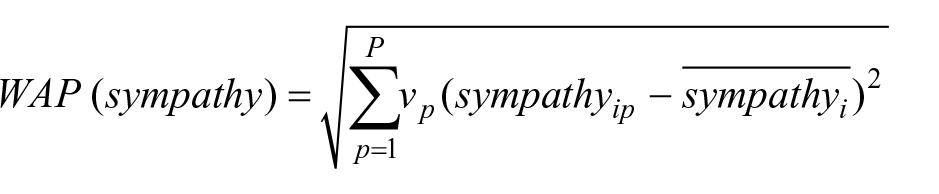
where sympathyip is the sympathy score for any given party for each respondent each year and sympathyi is the mean sympathy score across all parties for each respondent over the entire panel period. vp is the vote share of each party in the most recent election, measured as a proportion ranging from 0 to 1. The mean affect is also weighted by party size:

A potential objection against this measure is that it risks conflating affective polarization and ideological polarization or even voting preference. That is, conflating whether the respondents reacted on an instinctive, emotional valuation of the parties or a rational assessment of the policies of the parties. While it is possible that the measure captures an element of both, I argue for two main reasons that it likely invoked a reasonable share of an affective evaluation. First, Lelkes (2019) has previously used party cues as an indicator of an affective evaluation and policy cues as an indicator of an ideological assessment and found that they tapped into different types of assessments. Second, similarly to the findings of Iyengar et al. (2012), the measure I employ is only vaguely correlated with an identically coded weighted measure based on a question of the percentage chance that the respondents would ever vote for the political parties (r = .137). 2
Measure of social media use
Broadly defined, social media consists in online platforms that allow users to form a social network through which they can take part in or share content and/or interact without necessarily sharing an interest in a particular topic (Carr and Hayes, 2015). Widely used platforms include Facebook, Twitter, Instagram, YouTube, Snapchat, and WhatsApp (Reuters Institute for the Study of Journalism, 2020a).
I used three measures of the respondents’ social media habits. The measures were based on three separate indicators asking the respondents to appraise how many times per week they use social media (1 = never, 2 = less than once a month, 3 = 1–3 times per month, 4 = once a week, 5 = several times per week, 6 = everyday, 7 = several times per day), and Facebook and Twitter, respectively (1 = never, 2 = less than once a week, 3 = once a week, 4 = 2–4 times a week, 5 = daily).
Facebook and Twitter can be regarded as influential cases because they reach out to a large number of people. In 2020, about 60% of Dutch citizens used Facebook, whereas about 16% used Twitter—numbers that are in line with the proportions in other western countries. This places both of them among the most widely used social media outlets in The Netherlands and around the world (Reuters Institute for the Study of Journalism, 2020a, 2020b). Nonetheless, they are not representative of all social media platforms. Affective polarization and social media may have a different connection in relation to less mainstream platforms (Mendonça, 2015), which calls for future research that investigates potentially heterogeneous effects across a larger number of platforms.
Control variables
In the main analyses, I opted for a parsimonious model in which I control for variables that are at least weakly exogenous to and conceptually distinct from the explanatory variable, to avoid that the main effect is absorbed by a mediating variable. It is, for instance, difficult to determine with confidence the causal direction between ideological polarization or voting preference, and affective polarization. If I included the alternative measure of ideological polarization discussed above as a control variable, I may under- or overestimate the effect of both of the variables. The same could be the case with, for instance, political interest. Since I apply individual fixed effects to all models (see discussion below), I limited the main models to the inclusion of the following time-varying, at least weakly exogenous control variables that are well-known to correlate strongly with many other attitudinal and behavioral variables (Jeynes, 2002). Therefore, the following variables may pick up and remove the influence of unknown confounders: level of education, age in years, and net income in Euros. As robustness checks, I report models in Supplemental Appendixes E.1 and E.2 that also include variables with a less clear relationship with the main variables in terms of time order. These are as following: the alternative measure of ideological polarization discussed above, political ideology, and interest in following the news (for information about scales, see Supplemental Appendix A).
Analytical strategy
Panel data observe the behavior of a set of units (in this case, individuals) over at least two measurement periods (in this case, annually above 6 years). Thus, one chief benefit is that panel data enable analyses of changes in any given individual’s attitudes or behavior over time instead of comparison of different levels between different individuals. By applying individual fixed effects, all individual time-invariant factors that may confound the relationship, including factors that are unobservable, are effectively removed (Angrist and Pischke, 2008). Examples of such time-invariant factors include gender, ethnicity, stable personality traits, and year of birth, as well as cultural factors and experiences in a person’s background. Besides significantly improving possibilities to estimate effects rather than correlations, adopting individual fixed effects was a priority in the study based on a view of which type of variation that is most consequential for society writ large. Similar to Prior (2013: 102), I contend that in order for social media to fan higher levels of polarization in society, the people who use them must develop more unaccepting attitudes toward out-group parties and members compared to their entry level. The crux of the matter is thus that attitudes must actually change. Thus, an individual fixed effects model corresponds to the variation of interest in the study since it isolates the within-unit effect. 3 All models furthermore included fixed effects on the basis of the year. This means that yearly changes that affected all individuals similarly were accounted for.
To test H3, I report models that include an interaction between the main independent variable and a set of dummy variables indicating the past level of social media/Facebook/Twitter usage (1:4–1:6 and 2:4–2:6). Interacting main effect with past values of the dependent variable, however, introduces some statistical complexity. Including the lagged dependent variable in a fixed effects model is usually regarded as inappropriate due to correlation between the lag of the dependent variable and the residual (Achen, 2000; Nickell, 1981). A similar problem may potentially arise in the interaction models if the constitutive term of the lagged dependent variable is included. However, dropping the constitutive term from the interaction models produced basically identical results (not reported here). Therefore, the interaction models follow the convention to include all constitutive terms in the interaction models (Brambor et al., 2006).
The formal equation for the full ordinary least squares (OLS) regression model including the interactions is as follows:

Models 1:1–1:3 and 2:1–2:3 in Tables 1 and 2 are more restrictive models in which I test the average effect of the main variable of interest (social media use or affective polarization), that is, H1 and H2, respectively. Here, a
The items included in the LISS panel are divided into different thematic modules that are disseminated during different months over a year. Thus, some included variables are part of a module collected in the beginning of each year and other pieces of data are collected in the latter part of each year. The structure of the data thus makes it impossible to estimate completely contemporaneous effects. Therefore, I used the first preceding value of the main independent variable throughout in order to guarantee that the predictor variable preceded the outcome variable temporally. The timeframe (number of months) between the collection of each variable for each panel wave (year) is reported in Supplemental Appendix B. Since the lag structure of the models that test H1 (Models 1:1–1:6) and H2 (Models 2:1–2:6) is temporally asymmetrical because of the data structure just described, I report models where I use a different lag structure as robustness checks in Supplemental Appendix E.1. 4
Results
Table 1 reports the results of a series of analyses testing the hypothesis that social media use affects the level of affective polarization (H1). Looking at the average effects conveyed in Models 1:1–1:3 in Table 1, none of the coefficients indicate that increased social media use substantially elevated affective polarization on average, nor did it attenuate it. Moreover, all models failed to reach any conventional level of statistical significance (p > .1). Thus, contrarily to common expectations, as well as H1a and H1b, I did not find any evidence that an individual’s level of social media use markedly fueled or attenuated affective polarization among users on average.
Effects of the three measures of social media use on affective polarization (H1).
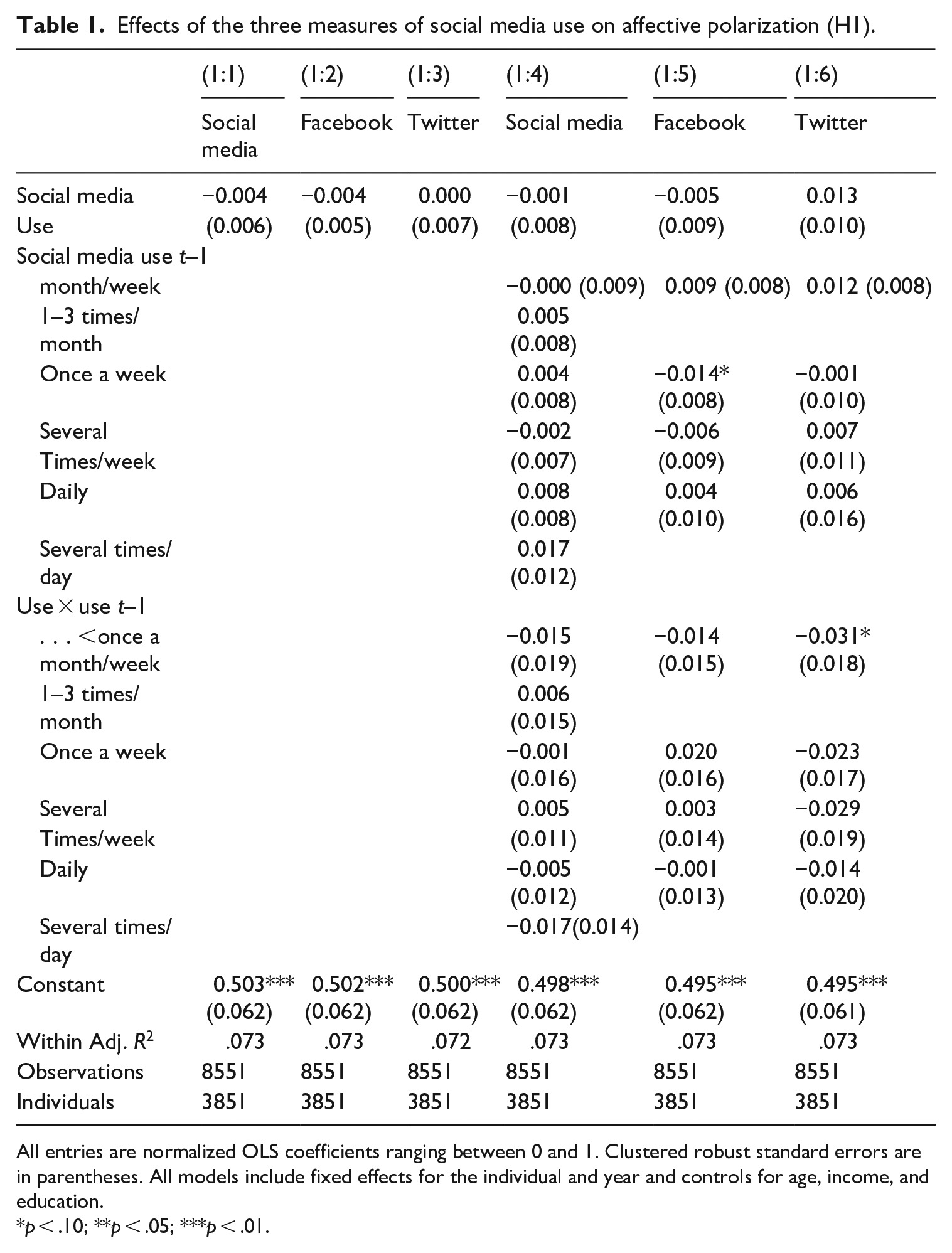
All entries are normalized OLS coefficients ranging between 0 and 1. Clustered robust standard errors are in parentheses. All models include fixed effects for the individual and year and controls for age, income, and education.
p < .10; **p < .05; ***p < .01.
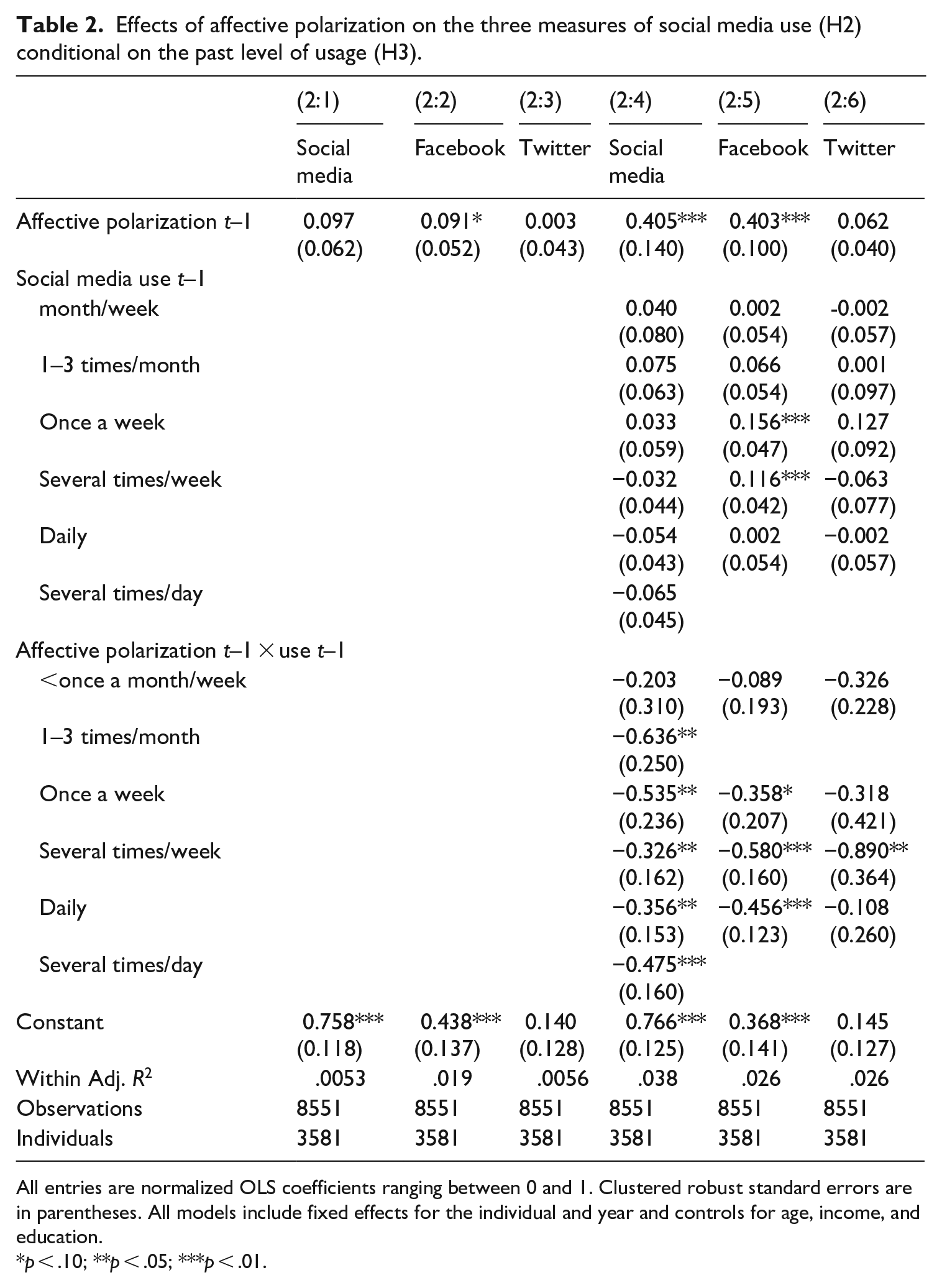
Table 2 reports on a series of analyses testing the counter-hypothesis that the level of affective polarization instead affects the level of social media use. Turning to Models 2:1–2:3, the coefficients, again, lend no support to the notion that the direction of the relationship mainly runs from affective polarization to social media use.
Effects of affective polarization on the three measures of social media use (H2) conditional on the past level of usage (H3).
All entries are normalized OLS coefficients ranging between 0 and 1. Clustered robust standard errors are in parentheses. All models include fixed effects for the individual and year and controls for age, income, and education.
p < .10; **p < .05; ***p < .01.
However, when the various measures of social media use at t–1 were introduced as moderating variables the picture changed rather drastically in a theoretically intuitive way. In Models 2:4–2:6, the statistically significant interaction terms indicate that there was in fact an effect of past values of affective polarization on social media use that is conditional on past levels of social media usage, which lends support for H3. Thus, the average null effects in Models 2:1–2:3 are likely due to the conditional effect of previous level of usage. Simply put, the heterogeneous effects seem to cancel out the average effect.
The strongest positive and significant effect of rising levels of polarization was in relation to overall social media use and Facebook use. Since all coefficients have been scaled to range between 0 and 1, Models 2:4 and 2:5 show that moving from no polarization to high levels of affective polarization (or vice versa) resulted in an average of about 40% increase in usage among previous non-users (p < .01).
However, the most sizable effect overall was negative and obtained in relation to Twitter use in Model 2:6. More specifically, the effect of moving from the lowest level of polarization to the highest level of polarization among users who had used Twitter several times per week in the preceding year yielded an average decrease in Twitter use of a striking ≈83% (p < .05). In fact, an increase in affective polarization resulted in noticeable reductions in Twitter use for most respondents who were moderate users in the past wave but not for previous non-users (which is unsurprising) and daily users.
For the composite social media measure in Model 2:4, moderate users at t–1 reduced their usage by approximately 23% (p < .05) as they gained more affectively polarized attitudes. For moderate Facebook users at t–1 in Model 2:5, the corresponding reduction was at most ≈18% (p < .5). Basically, there were no substantial effects across the board for individuals who used social media daily or more than once a day. Figure 1 visualizes the conditional effects of affective polarization on the various measures of social media use depending on past level of usage (H3).
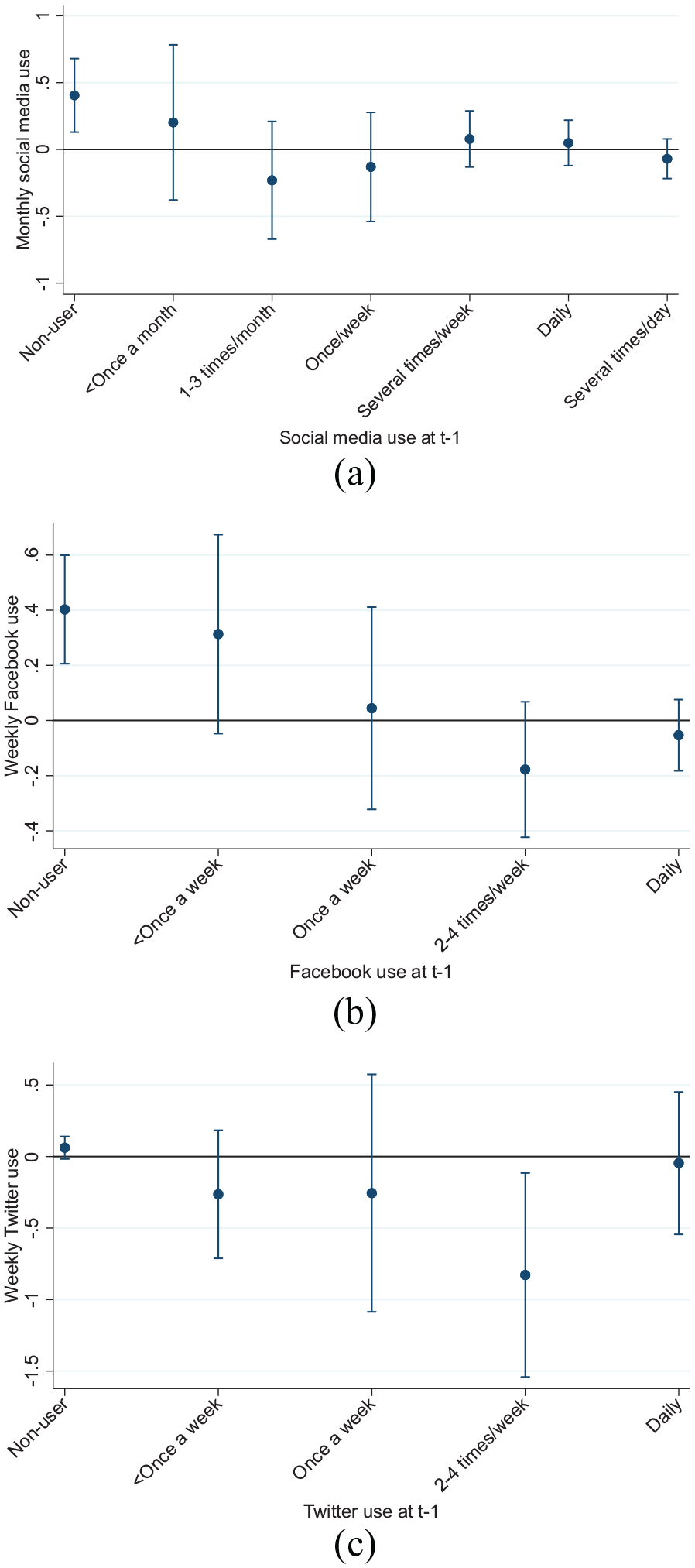
Conditional effects of affective polarization on the three measures of social media usage. Estimates retrieved from Models 2:4 to 2:6 in Table 2. (a) Conditional effects of affective polarization at t–1 on social media use with 95% Cls. (b) Conditional effects of affective polarization at t–1 on Facebook use with 95% Cls. (c) Conditional effects of affective polarization at t–1 on Twitter use with 95% Cls.
To check the robustness of the results, I conducted a series of supplementary analyses in which various restrictions were imposed or loosened on the models (Supplemental Appendixes E.1 and E.2). Taken together, the results from the extended analyses replicated the results from the main models. There were minor deviations in the magnitude of the coefficients but the overall patterns remained unchanged. Hence, the results were robust to alternative model specifications including adding additional controls and modeling the lagged dependent variable among the covariates, loosening the sample restrictions, changing the lag structure, applying sample weights, and using the unweighted alternative measure of affective polarization.
Conclusion and discussion
The study shows that starting using social media or elevating usage did not impact an individual’s level of affective polarization over time—contrary to H1 and to common assumptions. Instead, the results suggest that affective polarization affects social media usage, in line with H2, depending on the history of previous usage, as suggested in H3. These results should essentially be good news from a democratic point of view and should alleviate the widespread worry that social media is a major driver of polarization in society.
As with any study, some remaining questions and limitations need to be discussed. To start with, as others have previously noted (Prior, 2013), in strict terms, causal inferences require exogenous variation. Nonetheless, there is widespread agreement in the literature that panel data are the best non-experimental data for approaching making causal inferences (Allison, 2005: 1). Moreover, I have taken several important measures to reduce the risk of temporal and non-temporal confounders and the patterns remain the same regardless of model specification. It furthermore deserves to be highlighted that panel data often have the upper hand vis-à-vis experimental treatments in providing a picture of processes as they naturally unfold rather than in a manipulated setting.
Turning to a discussion about the measures of affective polarization and social media use; I only had access to a measure of polarization that tapped into the respondents’ sympathies for political parties, but polarization can take on many other, and perhaps more troubling, expressions. Nevertheless, to the extent that dwindling sympathies for out-group parties appear in concert with increasing inter-group hostility and distrust that follow political lines, it is arguably something we need to be wary of.
Because of data limitations, the scope of the study was furthermore limited to inferences about the average effect of/on usage of various social media platforms. This measure had the important property of providing a picture of whether social media use as such seems to be a driver of affective polarization in society from an aggregate point of view. Nonetheless, qualitative aspects, such as purpose of usage and the content users are exposed to, are likely crucial for a deeper understanding of the mechanisms through which affective polarization and social media are connected.
The study was furthermore limited to the study of one particular country. Recent evidence suggests that The Netherlands exhibits lower levels of affective polarization than most other western countries (Reiljan, 2020) possibly making it a least likely case for detecting a relationship between these. Theorizing from a comparative perspective is beyond the scope of this study, but cross-country differences should certainly be of interest to future research.
The most striking, and complex, finding of the study calls for some reflection; namely that there was heterogeneity in how polarization affected the amount of social media usage. First of all, those who were non-users to moderate users in the previous wave increased their level of Facebook use and decreased their level of Twitter use significantly as they gained more polarized attitudes. One possibility is that individuals who developed an expressive need turned to platforms such as Facebook because they judged their chances of impacting their strong-tie and weak-tie offline relationships to be greater than their chances of impacting their more distant Twitter followers. Others may increasingly have shied away from Twitter because of unease or anger as a result of exposure to polemical Twitter debate and instead resorted to platforms that allow users to take part of a larger share of apolitical content. A third possibility can also be raised. Some strongly polarized and frustrated social media users may have abandoned conventional social media platforms in favor of other more alternative and niched platforms or even abandoned them altogether (Purhonen et al., 2021). In fact, this happened among many Trump supporters following the suspension of the account @realDonaldTrump from Twitter in the aftermath of the Capitol riots on 6 January 2021. All these explanations may have some element of truth to them, but the former should be less troubling than the latter ones. For instance, people can have legitimate reasons for feeling upset. Social media doubtlessly fills an important deliberative function as an arena for people with an expressive interest “to call something to the attention of a wide audience” (Moles, 2007: 54). However, to the extent that social media increasingly becomes a megaphone for aggressive or divisive rhetoric, this is more troublesome. There is a risk that some people with an expressive need engage in a “spiral of silence” and refrain from voicing their concerns because of a worry of being subjected to resentful comments or social exclusion (Kruse et al., 2018; Noelle-Neumann, 1974).
Second, according to the results, rising levels of polarization exerted a much stronger effect on previous non-users or moderate users than more regular users, in line with H3. This gives some substance to the notion that a variety of rationales besides affective polarization drives frequent usage and that everyday users are more resilient to reducing their level of usage, even if they acquire more polarized attitudes.
A final thought on perhaps the most consequential finding of the study vis-à-vis previous research; namely that increased social media use did not seem to amplify affective polarization. It is probably warranted to be skeptical of unlimited usage of social media for several reasons. For instance, it may gradually make us more tolerant of uncivil behavior, invoke unhealthy social comparison, and reduce occasions for in-depth in person contacts. Still, the results give reason to doubt the notion that elevated affective polarization is among the suggested sinister consequences. Insofar as the findings translate to other contexts as well, they suggest that social media may not be a reliable barometer for assessing affective polarization in society and that explanations for any surge of polarization should primarily be found elsewhere. This discursive correction is important because the stronger the impression that we are deeply polarized, the higher the risk that we eventually judge it as pointless to engage in cooperation and dialogue across ideological lines. This would surely be detrimental for society and for democracy. My hope is that these results spur an interest in future evaluations of the causal direction of the relationship to avoid unnecessary consequences of what may potentially be an erroneous perception.
Supplemental Material
sj-pdf-1-nms-10.1177_14614448211044393 – Supplemental material for Affective polarization in the digital age: Testing the direction of the relationship between social media and users’ feelings for out-group parties
Supplemental material, sj-pdf-1-nms-10.1177_14614448211044393 for Affective polarization in the digital age: Testing the direction of the relationship between social media and users’ feelings for out-group parties by Maria Nordbrandt in New Media & Society
Footnotes
Acknowledgements
In this article, the author makes use of data from the LISS (Longitudinal Internet studies for the Social Sciences) panel administered by CentERdata (Tilburg University, The Netherlands). Valuable feedback on earlier drafts was provided by the participants of the Polsek seminar at the Department of Government, Uppsala University, and the participants of the workshop “Theoretical and Methodological Approaches to the study of Affective Polarisation” held under the auspices of ECPR in 2021. She also thanks two anonymous reviewers and the Editor of this journal for their constructive comments.
Funding
The author(s) received no financial support for the research, authorship, and/or publication of this article.

Supplemental material
Supplemental material for this article is available online.
Notes
Author biography
References
Supplementary Material
Please find the following supplemental material available below.
For Open Access articles published under a Creative Commons License, all supplemental material carries the same license as the article it is associated with.
For non-Open Access articles published, all supplemental material carries a non-exclusive license, and permission requests for re-use of supplemental material or any part of supplemental material shall be sent directly to the copyright owner as specified in the copyright notice associated with the article.
