




Abstract
Politicians have been criticized for not exploiting the deliberative potential of social media platforms. We complement previous definitions of politicians’ success on social media through the lens of network media logic: Despite the lack of deliberation, some succeed in building large digital followerships, which spread their messages via reactions through the network. Analyzing a data set of personal, structural, and social media characteristics of Swiss politicians, we used path analysis to determine which predict their success on Facebook (n = 63) and Twitter (n = 108). Politicians, who are active in parliament, represent urban regions and receive substantial amounts of traditional media coverage also have larger digital followerships on both platforms. Digital followership in turn influences the average number of digital reactions on Facebook, but not on Twitter. Thus, politicians’ success on social media depends on their personal background, political activity, and media coverage, and also their followership and the platform.
The social media performance of most political actors on social media platforms cannot be called a success story. In interviews, they glorify the interactive potential of these platforms and promise to exploit it intensively in the near future (Brändli & Wassmer, 2014; Enli & Skogerbø, 2013), yet that is mostly what can be called cyber-rhetoric (Jungherr, 2016; Kreiss, 2011; Stromer-Galley, 2014). Instead, political actors use these Web 2.0 platforms to disseminate information in a Web 1.0 style, in what has been labeled a “Web 1.5” way of using these platforms (Jackson & Lilleker, 2009).
However, this definition of “exploiting the potential of social media” may be too narrow. Previous empirical studies have shown that political actors may benefit from social media communication in other ways. Their posts might set the agenda of traditional media and thus improve visibility (Parmelee, 2014); their performance can attract new party members, substituting for the general decline in party membership (Gibson, Greffet, & Cantijoch, 2016); and the lowered transaction costs on these platforms might facilitate micro-donations through which political actors can raise millions (Margetts, John, Hale, & Yasseri, 2016). Through the lens of network media logic (Klinger & Svensson, 2015), we argue that the premise for all these beneficial outcomes is a large digital followership (e.g., fans or followers) that actively reacts to politicians’ public messages (e.g., likes or retweets) and thus enables messages to spread through the network. Hence, the success of political actors’ communication on social media should be defined as their ability to build a large digital followership and trigger as many reactions from their followers as possible.
But political actors do not enter digital ground on equal footing. Drawing on previous research, we assume that their social media success can be predicted by a set of personal (age, gender, education, party affiliation, ideology, parliamentary activity, and urbanization of his or her constituency), structural (incumbency, key position, vote percentage, media coverage, and financial resources), and social media (adoption date and activity) characteristics. Our main research question analyzes which characteristics of Swiss parliamentarians lead to success on Facebook and Twitter in terms of followership and reactions. We use path analysis to examine a unique data set of the social media communication of Swiss parliamentarians between 5 December 2011 and 15 March 2015 and their personal, structural, and social media characteristics.
We start our article with discussing what political actors’ success on social media means from the perspective of network media logic (Klinger & Svensson, 2015) and why political actors benefit from a larger digital followership which actively reacts to their social media contributions. After identifying possible impediments to their success on these platforms, we describe the special case of Switzerland, our data set, and the methods. Then we present our results for the two platforms, Facebook and Twitter. Finally, we put our findings in a broader context and discuss implications for future studies focusing on politicians’ success on social media.
Political Actors’ Success on Social Media
In research on politicians’ performance on social media, scholars have focused on the discursive potential of social networks, that is, the hope that political actors use social media to debate with citizens (Coleman & Blumler, 2009). Yet, political actors mostly use social media platforms like they use traditional media: They disseminate their information in a Web 1.0 style over these Web 2.0 platforms (known as a “Web 1.5” style of use, see Jackson & Lilleker, 2009”). It is not that they do not know about the potential for deliberation on these platforms. In interviews, they explicitly talk about this potential and their intention to engage in discussions with citizens on these platforms (Brändli & Wassmer, 2014; Enli & Skogerbø, 2013). They integrate these remarks about the potential of the Internet and social media, the so-called cyber-rhetoric (Jungherr, 2016; Kreiss, 2011; Stromer-Galley, 2014), into their communication. Often as not, their usage of these platforms only has a symbolic purpose (Jungherr, 2016): to show they are modern and close to the people. Thus, political actors strategically choose to use these platforms in a Web 1.5 manner. Communication on social media platforms is still from political actors to citizens, and is less interactive than it could be.
Whereas according to the mass media logic politicians’ messages must overcome gatekeepers to reach an audience, according to the network media logic politicians can directly disseminate their information to partisan citizens (Klinger & Svensson, 2015). Yet, most political actors do not have a large digital followership that they can directly address (Vaccari & Nielsen, 2013), and their messages compete with a vast amount of other content on these platforms for visibility. To determine which content is visible, the number of reactions to a post or tweet indicates their popularity (van Dijck & Poell, 2013). The more reactions a post receives, the more popular it is, and the higher are the chances that it reaches more of a platform’s users (Karlsen & Enjolras, 2016). That is, a political actor’s post needs reactions such as likes, comments, or shares on Facebook or replies, likes, or retweets on Twitter to increase its visibility against competing content and to reach more than just their few fans and followers. Thus, network media logic asserts that political actors’ social media success hinges heavily on users’ reactions.
Yet, scholars have critically debated the impact of “likes”: The mere clicking on social media buttons—such as liking a politician on Facebook—has been dismissed in one strand of research as “clicktivism” and “slacktivism.” An aimless digital reaction on its own was assumed to have almost no impact in the real world and might even prevent subsequent action for the cause, thus strongly differing from “real” activism (Skoric, 2012). However, another strand of research described it as a “legitimate political act” (Halupka, 2014, p. 130). Receiving a lot of “likes” can be part of a wider hybrid campaigning strategy that involves many additional communication tools (Karpf, 2010), and the “like” itself is not the end goal: It must be seen as part of an ongoing political process (Gerlitz & Helmond, 2013). One “like” often leads to another—and in rare cases even to hundreds of thousands—which can have serious political consequences (Margetts et al., 2016). Experiments showed that sharing a video increases people’s willingness to engage in offline helping behavior (Lane & Dal Cin, 2017) and that value alignment between the supporter and the cause and a strong connection to the organization combat slacktivism (Kristofferson, White, & Peloza, 2014).
We argue, furthermore, that such reactions determine whether communication on social media platforms is successful in five ways (see Table 1). First, reactions on platforms such as Facebook and Twitter are valuable to political actors because each reaction is visible to both the followers and their respective networks. Through these broader networks, political actors’ messages can reach people who do not follow politics attentively (Vaccari, 2016). A large number of reactions might also lead to more media coverage, thus increasing both their online and offline visibility (Parmelee, 2014). Second, these reactions inform social media users about which of their friends on these platforms share similar political opinions; they might be invited to also follow certain political actors. Given the general decline in party memberships (Gibson, 2015), parties greatly benefit from facilitating a network of possible volunteers. Thus, a large and active followership might serve as an alternative to traditional forms of organization through party membership. Third, social media platforms lower the transaction costs and thus facilitate micro-donations, through which political actors sometimes raise millions; social cues—such as the number of people who have already donated—influence whether others also donate (Margetts et al., 2016). Fourth, exposure to political messages on social media influences voting intention (Kobayashi & Ichifuji, 2015) and political participation (Dimitrova, Shehata, Strömbäck, & Nord, 2014). Successful communication on social media (Gibson & McAllister, 2014) and many reactions on Facebook (Kovic, Rauchfleisch, Metag, Caspar, & Szenogrady, 2017) can lead to a higher vote share in elections or transform into large-scale participation such as in the Arab Spring (Margetts et al., 2016). While very few mobilization attempts succeed on such platforms, those that do may lead to unpredictable and extreme outcomes due to the dynamics of sharing on such platforms (Margetts et al., 2016). Fifth, the future communication of political actors on social media is driven by the amount and quality of feedback they receive (Jungherr, 2016). There are multiple options for users to provide feedback: likes, comments, retweets, favorites, and so on. By looking at the reactions to their messages, political actors are able to evaluate which arguments or pictures communicate their position most effectively, at little to no cost.
Five Desired Outcomes of a Large and Active Digital Followership on Social Media Platforms.
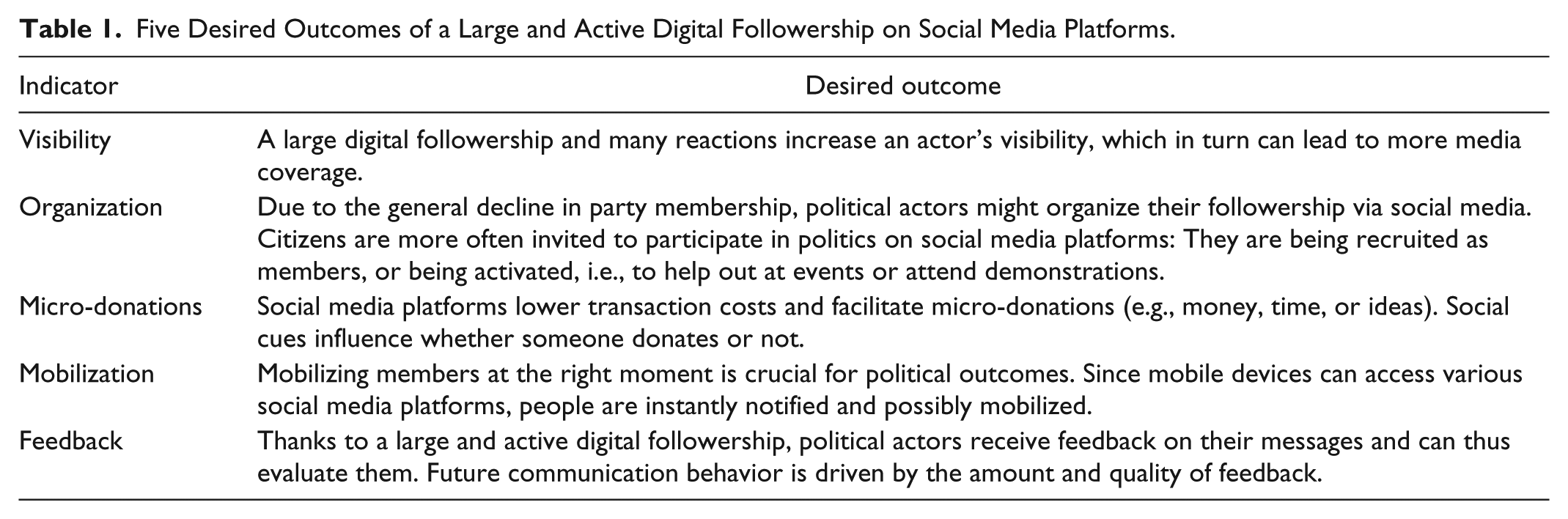
Hence, following these observations and according to the network media logic (Klinger & Svensson, 2015), the success of political actors’ communication on social media platforms should be defined not by digital debates, but by the size of their followership (e.g., fans and followers) and the number of reactions their social media actions receive (e.g., likes and retweets).
Impediments to Success on Free Social Media Platforms
Most political actors use free social media platforms due to their low costs, their popularity among citizens, and the ability to easily integrate features into their own websites (Jungherr, 2016). Few are able to build their own social network sites like “myBarackObama.com.” Yet, political actors face at least three general challenges in using these free platforms compared with building their own proprietary platform.
First, most users did not initially join the platform to follow political actors. In contrast to a social network site like “myBarackObama.com,” users of free platforms such as Facebook and Twitter might agree with the opinions of certain political actors, but may not want the people in their network to know this. Hence, political actors need to transfer their members from offline to online, and to attract new people with successful communication on these platforms. To find out how successful political actors have been in building a digital followership, there is a public indicator on most platforms such as the number of fans on Facebook or followers on Twitter, which may motivate additional users to join.
Second, there is a lack of control of these platforms compared with proprietary platforms. Due to their business models, political actors depend on possibly biased information about a platform, for example, regarding the reach of paid posts. Due to stricter data sharing laws and stronger reservations concerning privacy outside the United States, it is almost impossible to confirm the success of micro-targeting attempts with data not provided by the platform itself, that is, with independent data on concrete voting behavior. Regarding the reach of unpaid social media posts, political actors need to adjust their way of communicating to the platforms’ algorithms and selection criteria to make their postings visible to as many as possible (Bene, 2016). They use messages in a personal tone to adapt to the platforms’ style of communication, to show their followership that they are “like you and me,” and thereby to increase the number of reactions to their posts (McGregor, 2018).
Third, although various platforms merge and influence each other, new platforms continue to be developed. Political actors cannot realistically engage on every platform; they must choose the ones that best fit the goals of their digital communication strategy. The user base varies by platform, so the communication strategy must be adapted accordingly. For example, about 50% of the population of Switzerland use Facebook, and about 17% use Twitter passively and about 6% actively (Latzer, Büchi, & Just, 2015). Facebook thus represents the Swiss population more effectively than Twitter, the members of which mainly belong to the political elite or media organizations (Rauchfleisch & Metag, 2016). Politicians can most effectively reach other political actors and journalists via Twitter, and better address the general public using Facebook.
Normalized Use—But Also Normalized Success?
In addition to these challenges, political actors do not access social media platforms on an equal footing. Well-funded political actors and those with a strong presence in traditional media dominate digital political communication flows. Therefore, political communication continues to be “normalized” (Margolis & Resnick, 2000; Rauchfleisch & Metag, 2016). Previous research on the impact of politicians’ personal and structural characteristics on their online political communication has focused mostly on the adoption of (and activity on) various platforms (e.g., Larsson & Kalsnes, 2014). The results of this focus are mixed, and most of them indicate normalization. Some of the discrepancies between results may be due to the use of different indicators for personal and structural advantages and different dependent variables (Strandberg, 2008, 2013). Therefore, we propose a set of personal and structural characteristics to systemize this field of research: Personal characteristics such as age, gender, education, party affiliation, and parliamentary activity are important predictors of platform adoption and activity, but structural characteristics such as incumbency, key position, vote percentage, media coverage, and financial power are important for interpreting results in terms of normalization and equalization (Keller & Kleinen-von Königslöw, in press).
Since for many political actors being active on social media platforms has become a necessary (although not sufficient) condition for political success (van Dijck, 2013), they have gained knowledge about how social media platforms work and how to generate digital reactions. Some of them have hired (external) community managers to improve their social media communication (Gálvez-Rodríguez, Haro-de-Rosario, & Caba-Pérez, 2017) or are early adopters and thus have more experience than newcomers in how to build up a followership and provoke reactions. Other political actors may be very prolific and post several times a day, creating a stronger social media presence. Therefore, it is unclear whether personal or even structural characteristics still play such a crucial role in success on these platforms. For our analysis, we distinguish between personal, structural, and social media characteristics to find out which predict success (i.e., digital followership and reactions) on these platforms. Our research question explores: Which characteristics of political actors lead to success on Facebook and Twitter?
Personal characteristics predict the use of social media platforms very well in the Swiss population (NET-Metrix, 2014). Younger members of the Swiss Parliament from urban regions are more likely to have adopted Twitter early and to actively tweet on the microblogging service (Rauchfleisch & Metag, 2016). Because users of these platforms probably feel better represented by members of parliament who are of a similar age and engage in similar social media behavior, we expect that younger members of parliament from urban regions attract a larger followership. In addition, we assume that politicians who actively submit parliamentary proposals win more fans and followers on these platforms since they can report on their parliamentary efforts, which might help explain why many users follow politicians on these platforms. Therefore, we hypothesize:
H1: a) Younger members of parliament who b) actively submit parliamentary proposals and c) represent urban regions attract a larger digital followership on Facebook and Twitter.
Although political actors disseminate information in a Web 1.0 style, most have a steadily rising number of digital fans (Klinger, 2013). The distribution of followers among politicians is usually heavily skewed; for example, while few politicians in the U.S. midterm elections had more than 100,000 followers, most of them only had a few 1000 (Vaccari & Nielsen, 2013, p. 209). We assume that political actors with structural advantages such as incumbency, vote percentage, key position, media coverage, and financial resources have more fans on social media platforms than structurally disadvantaged ones, since these advantages may lead to greater popularity, professional support, and to more statements they can recycle on their page. We assume that structural characteristics explain in a normalized fashion why some political actors have built a larger digital followership than others.
H2: Structurally advantaged political actors have a larger digital followership on Facebook and Twitter than structurally disadvantaged ones.
Building a large followership does not on its own reflect how successfully political actors perform on the platform. Politicians depend on reactions such as likes or retweets, which enable their public messages and tweets to spread through the network, to compete against the vast number of other public messages and extend their visibility beyond their followership. While personal and structural characteristics should influence who attracts more fans and followers, it seems less likely that they have a strong impact on the success of individual posts and tweets. For example, whereas a politician’s age or key position might influence the one-time decision of a citizen to “like” or “follow” her on the platform, for daily decisions of which posts or tweets to like or retweet, social media characteristics such as adoption date and activity are more likely to predict the number of reactions politicians receive. These two social media characteristics function as indicators of politicians’ experience on these platforms; we expect that the more experience they have gained on these platforms, the more reactions they will receive on their Facebook posts and tweets on Twitter. That is, members of parliament who joined the platform early and actively post public messages probably know better how to provoke reactions. In addition, those with a larger followership generally reach more people, which make it more likely that they will receive more digital reactions (Casero-Ripollés, Feenstra, & Tormey, 2016). Therefore, we hypothesize:
H3: Early adoption and active use lead to more reactions on Facebook and Twitter.
H4: The larger the digital followership of a political actor, the more digital reactions the actor receives, on average, on Facebook and Twitter.
Method
Our case study focuses on political actors in Switzerland, which serves as an ideal case for studying success on social media platforms in a hybrid media system (Chadwick, 2013) due to its media and political plurality (246 members of parliament from 11 parties in 2015, for media plurality see Appendix A). The country’s political system further encourages permanent campaigning (Norris, 2003) and permanent contact between political actors and the citizenry: Swiss citizens are invited to participate in direct democracy at the ballot box multiple times a year (e.g., four times in 2016). Furthermore, every 4 years citizens elect the members of the two chambers with a list on which they can add or remove people from their canton; they are even allowed to put a name twice on a list. Hence, political actors are in constant competition for attention. These instruments of direct democracy make Switzerland a special case (Rauchfleisch & Metag, 2016) and might contribute to politicians’ success on social media as the latter need to continuously campaign and citizens need to continuously keep informed as part of their civic duty. In countries with other political systems—less permanent campaigning and fewer instruments of direct democracy—politicians might have more difficulties in winning a large followership, which reacts to their social media postings.
Politicians also differ starkly in their personal and structural characteristics. Since Switzerland’s parliamentarians are not full-time professional politicians, permanent campaigning needs an easy-to-handle and not resource-intensive solution to connect to the public. Therefore, social media platforms are very appealing to them. A survey of Swiss political actors showed that Facebook and Twitter are of growing importance (Brändli & Wassmer, 2014), for example, political actors’ adoption rates of Twitter steadily rose from 2.5% in 2009 to 13.5% in 2011 to 34% in 2013 (Rauchfleisch & Metag, 2016, p. 2422). In our data collection of 2015, 108 (44%) of the 246 members of Swiss parliament used Twitter and 63 parliamentarians (26%) used Facebook pages.
Data were collected for all members of the Swiss Parliament using R (R Development Core Team, 2017) and the packages “Rfacebook” (Barbera, Piccirilli, Geisler, & van Atteveldt, 2016), and “twitteR” (Gentry, 2015). All pages, posts, and counts of reactions were automatically downloaded from the beginning of the 49th legislation period (5 December 2011) on 15 March 2015: This included 63 parliamentarians’ Facebook pages with 14,264 posts and 108 Twitter accounts with 54,385 posts. This timeframe allowed us to analyze how political actors in Switzerland used social media platforms to build a digital followership that actively spreads their messages during a non-election period. Despite the growing importance of permanent campaigning (Norris, 2003), these periods between elections have mostly been neglected in research (Vaccari, 2016). There are two dependent variables: Digital followership is the count of fans on Facebook and followers on Twitter as of 15 March 2015. Digital reactions is the average of the sum of likes, comments, and shares on Facebook and of favorites and retweets on Twitter for the study period. The replies on a tweet could not be retrieved via twitteR.
Similar to Larsson and Kalsnes (2014), in our study, we differentiated between politicians’ personal and structural characteristics, but also added social media characteristics and important predictors identified in other studies (such as education). The personal characteristics age, gender, education, and party affiliation were drawn from the official website of the Swiss Parliament (Bundesamt für Statistik, 2015; Parlamentsdienste, 2015). The ideology of political actors is ranked on a scale from −10.0 (left) to +10.0 (right) based on Schoenenberger (2014). A ranking of parliamentary activity for each political actor was retrieved from Parlamentsdienste (2015) and the degree of urbanization of their constituency from BADAC (2001).
The variables for the structural advantages incumbency, key positions, and vote percentage were collected via the official website of the Swiss Parliament (Bundesamt für Statistik, 2015; Parlamentsdienste, 2015). Media coverage is based on a search for each member of parliament in 54 print, 37 online, and 16 television news outlets and three news agencies covering all three national languages during the 49th legislation using the online archives of the media outlets (see Appendix A). Financial resources corresponded to the number of paid ads in 65 news outlets adapted from a study by Bühlmann, Gerber, Salathe, and Zumbach (2015). The two platform-specific variables are adoption, which represents the number of days since the account was created and the first post was published, and activity, which describes the number of posts per day during the legislative period.
We first report descriptive results to allow readers to form an impression of the success of Swiss politicians’ social media communication. We then conduct a path analysis based on negative binomial and multiple linear regression analysis (for additional information, see Appendix B) to find out which characteristics lead to a larger digital followership and more digital reactions in line with our proposed hypotheses. We also conducted regression analysis for each type of reaction (likes, retweets, etc.) separately as a robustness check (Appendix C).
Results
In Switzerland, the success of politicians’ performance on social media is mostly an outlier phenomenon (see Figures 1 and 2). Almost every party has a few politicians who attract many times the number of fans or reactions compared with others.

The size of followership on Facebook and Twitter of Swiss members of parliament.

Average number of reactions that Swiss members of parliament receive on their Facebook posts and tweets on Twitter.
The 63 Facebook accounts analyzed have an average digital followership of 2,106 (SD = 529, median = 286). Oskar Freysinger of the right-leaning Swiss People’s Party (SVP) acquired the most fans on Facebook (24,466), followed by his colleague from the same party, Natalie Rickli, who had 17,596. Lukas Reimann (8,178) and party leader Toni Brunner (6,613), both SVP, also curate popular Facebook sites. Among the exceptional performers are not only political actors from the largest right-leaning party: Cédric Wermuth of the left-leaning party, Social Democratic Party of Switzerland (SP; 9,359) and the leader of the centrist party, Christian Democratic People’s Party of Switzerland (CVP), Filippo Lombardi (6,700) also reach many citizens.
Although Twitter is a niche social media platform in Switzerland, the average followership of the 108 political actors who use this platform is even higher than on Facebook with 2,533 followers (SD = 488, median = 345), which illustrates the importance of Twitter in political communication in Switzerland. Whereas right-leaning accounts dominate on Facebook, in the Twittersphere political actors from the left have a larger digital followership: Cédric Wermuth (SP) had the most with 25,105 followers, followed by SP Party leader Christian Levrat (12,650), Balthasar Glättli (10,768, Green Party), Jacqueline Badran (8,937, SP), Bastien Girod (8,589, Green Party), and Pascale Bruderer (8,581, SP). Of the right-leaning parties, Natalie Rickli (13,625, SVP) and Christoph Mörgeli (9,270, SVP) have built up large followerships on Twitter.
A Facebook post receives on average 38.2 likes, comments, and shares (SD = 12, median = 8.1). Again, Oskar Freysinger (672.7, SVP) leads the chart, followed by Natalie Rickli (328.9, SVP) and Lukas Reimann (128.1, SVP). In this SVP-dominated platform, Guillaume Barrazone of the centrist party CVP (123.2) is a noteworthy exception.
Four political actors receive the most reactions per tweet: Daniel Vischer (14.7, Green), Kathrin Bertschy (14.5, Green Liberal), Pirmin Bischof (14.4, CVP), and Oskar Freysinger (14.3, SVP). Following by quite a distance with around seven reactions per tweet are Christoph Mörgeli (7.3, SVP), Alfred Heer, (7.2, SVP), and Pascale Bruderer (7.2, SP). Political actors receive on average 2.3 reactions per tweet (SD = 2.8, median = 1.5).
We conducted path analysis based on negative binomial (for the number of followers) and multiple linear regression (for the average number of reactions) analysis to determine which personal, structural, and social media characteristics explain the success in terms of digital followership and digital reactions.
Seven characteristics predict the size of the followership on Facebook (see Figure 3): Younger politicians did not win more followers on Twitter (Exp(B) = 0.990, SE = 0.019, p = .574, rejects H1a). Yet, supporting H1b and H1c, politicians from more urban regions have 1.3% more fans (Exp(B) = 1.013, SE = 0.007, p = .074), and each parliamentary submission increases the size of the followership by 1.6% (Exp(B) = 1.016, SE = 0.006, p = .012). In addition, male politicians win more fans (Exp(B) = 0.444, SE = 0.326, p = .013).
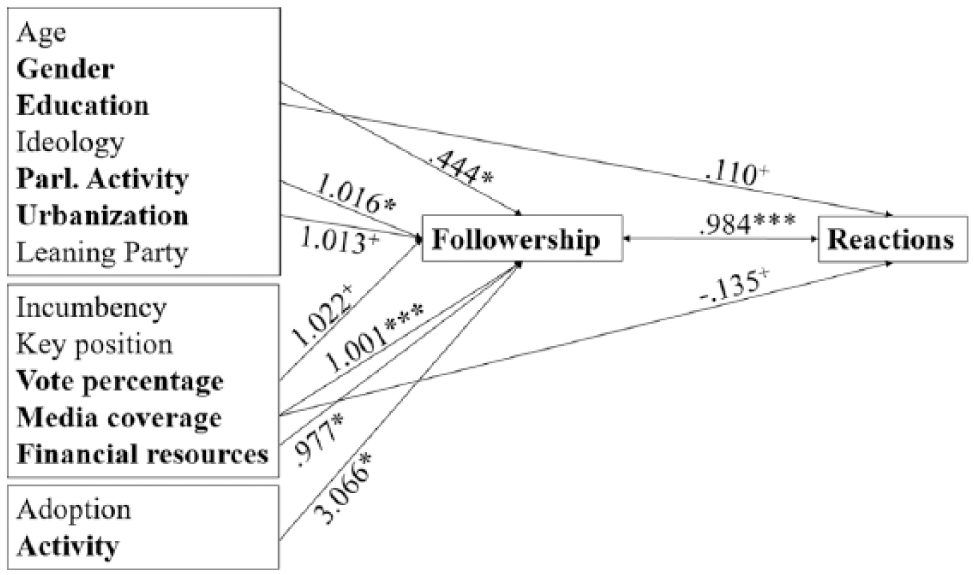
Path analysis of Swiss politicians’ characteristics predicting success on Facebook.
Of the structural characteristics, a one-unit increase in vote share raises the number of fans by 2.2% (Exp(B) = 1.022, SE = 0.12, p = .073) and each presence in a news article leads to an increase of 0.1% (Exp(B) = 1.001, SE = 0.000, p < .001; supports H2 on Facebook). Yet, an increase in financial resources leads to a decrease in the followership by a factor of 0.98 (Exp(B) = 0.977, SE = 0.011, p = .028) diminishing support for H2 on Facebook. Of the social media characteristics, only activity explains the size of the followership: Those who increase their posting activity on average by one post per day raise the expected number of fans by an extraordinary 306.6% (Exp(B) = 3.066, SE = 0.506, p = .027), supports H3 on Facebook.
In turn, digital reactions correlate the strongest with the number of digital fans (b = .984, SEM = 0.001, p = .000; Model 2: R2 = .892, adjusted R2 = .858; support for H4 on Facebook). Whereas a strong media presence leads to more fans, it hinders the average number of digital reactions (b = −.135, SEM = 0.13, p = .072). Other structural characteristics do not appear to influence the number of reactions on Facebook. Of the personal characteristics, higher education leads to more digital reactions, on average (b = .11, SEM = 11.16, p = .067). In contrast to our expectations, none of the social media activity characteristics affects the number of reactions on Facebook (rejects H3 for Facebook). The reduced model (only significant variables included in the path model) does not change R2 significantly (change in R2 = .020, p = .718).
On Twitter, six characteristics predict the number of followers (see Figure 4): Younger politicians (Exp(B) = 0.962, SE = 0.010, p < .001), left-leaning politicians (Exp(B) = .953, SE = 0.016, p = .003), those who actively submit parliamentary proposals (Exp(B) = 1.007, SE = 0.004, p = .053), and those representing an urban region (Exp(B) = 1.011, SE = 0.004, p = .007) won more followers (supports H1a, H1b, and H1c). In addition, each mention in a news article increases the number of followers by 0.1% (Exp(B) = 1.001, SE = 0.000, p < .001, support for H2 on Twitter). Finally, for each day earlier that a politician adopted Twitter, there is a 0.1% increase in the his or her followership (Exp(B) = 1.001, SE = 0.000, p < .001).

Path analysis of Swiss politicians’ characteristics predicting success on Twitter.
Personal, structural, and social media experience variables have little impact on the average number of digital reactions (Model 4: R2 = .269, adjusted R2 = .150). Users are more likely to react to politicians who are structurally disadvantaged in terms of key positions (b = −.209, SEM = 0.237, p = .043) and a low vote share (b = −.202, SEM = 0.018, p = .062), but who receive a lot of media coverage (b = .470, SEM = 0.001, p = .001). Contrary to expectations, late adopters are favored with more reactions (b = −.278, SEM = 0.001, p = .011, rejects H3 on Twitter). More followers also do not lead to more digital reactions on Twitter (rejects H4 on Twitter). As for the reduced Twitter model, R2 does not change significantly when only the significant variables were included (change in R2 = .057, p = .501).
Discussion
This study contributed with a unique data set of personal, structural, and social media characteristics of the members of the Swiss Parliament to enhance understanding of politicians’ varying degrees of success on social media platforms. We argue that political actors’ social media success should be evaluated not (only) based on their interactions and political debates with citizens, but on the size and activity of their digital followership—which potentially lead to greater visibility, low-effort organization and low-threshold recruitment, more micro-donations, better-timed mobilization and illuminating feedback for future communication strategies, and to potentially large-scale social movements.
Three personal characteristics increased politicians’ chances of attracting a larger digital followership. Confirming our first hypothesis, younger politicians who actively submit parliamentary proposals are more popular on social media platforms, presumably because users expect politicians to be engaged, and active politicians are more interesting to follow. Furthermore, those who represent citizens from an urban region also become popular on these platforms. We assume that this is due to the sociodemographic characteristics of the user base of these platforms: Members of parliament who resemble the users of a platform (younger, urban) might find it easier to enlarge their network. Future studies should investigate the fit between the sociodemographics of a platform’s users and the politicians seeking to attract them, how the content of more and less active politicians differs, and the expectations of citizens who follow politicians on social media.
On both platforms under investigation, Facebook and Twitter, the structural advantage of high levels of media coverage best predicts social media success (H2 confirmed). First, citizens “like” and “follow” political actors who are often covered by traditional media. Second, media coverage is key for digital reactions on both platforms—but in different ways. Media coverage directly leads to more digital reactions on Twitter. On Facebook, the impact of media coverage is less clear-cut: Although it appears to indirectly increase reactions via the digital followership, its direct impact is negative, leading to fewer reactions. We assume that people “like” political actors who are often covered by traditional media, but react less frequently when they are often visible in traditional media, maybe because the social media message only repeats the message already heard via traditional media, or because people think the respective politician does not need help spreading his or her messages on social media. By contrast, political actors on Twitter receive a lot of digital reactions when they dominate traditional media coverage. Again, this can be explained by the news-like character and the motivation of users to receive news and live events (Stieglitz & Dang-Xuan, 2012).
In addition to media coverage, one other structural advantage indicates a normalization on Facebook: Politicians with a larger vote share attract more fans on Facebook. They do well to build a large digital followership that actively reacts to their posts and can be mobilized during the next election or vote.
Yet, contradicting our second hypothesis, we also found indications of equalization on both platforms: Politicians who spend less money on ads in traditional media have larger digital followerships on Facebook. We assume that they do not need to pay for as many ads in print media as those with fewer digital fans because they have already built large followerships. That is, they manage to reach thousands of people without paying for traditional ads. Hence, future studies should dig deeper and analyze whether these politicians use Facebook ads to raise their visibility: They may simply have shifted from paying for traditional to digital ads.
Although we did not find any direct effects of social media characteristics on reactions (H3 rejected), on both platforms neither early adaption nor intensive activity led to more reactions. However, there is an indirect effect (H4 confirmed). On Twitter, it is not the greater social media experience and savviness of early adaptors that assures more reactions, but the greater professional follower networks they were able to build in the early years of Twitter (whereas latecomers have more problems to get noticed), which then leads to more reactions per tweet. By contrast on Facebook, activity leads to more fans and thus to more reactions. At this point, it becomes clear that the different technical affordances of both platforms (Bucher & Helmond, 2017) may have had an impact on our results, as the two platforms differ strongly in their algorithms. It may be that continuous activity is rewarded by the Facebook algorithm, assuring the visibility of posts and thus making reactions more likely. Thus, although an active digital followership can spread a message to raise visibility, the effective reach of a message is still moderated by the algorithm. In particular, how far each message spreads in the networks of their friends and followers depends on the algorithm (or on the money politicians spend on “sponsored posts”). Thus, platforms with a strong algorithmic influence—such as Facebook—are powerful actors.
The results of the Swiss political actors’ behavior on these platforms illustrate how the platform moderates their success: The gap between politicians receiving the most and the least reactions, on average, by their followership is much larger on Facebook (Oskar Freysinger with 672 and Peter Keller with 0.41) than on Twitter (Daniel Vischer with 14.67 and Heinz Brand with <0.01). Since there are more Swiss Facebook than Twitter users, not only do the “rich get richer” in terms of “likes” on Facebook, they reach an even larger secondary audience on Facebook through “likes” than they probably would have on Twitter. Therefore, investigating success on social media needs not only to focus further on the active digital followership, but also on the moderating role of platforms’ algorithms.
This study has several limitations. The proposed model suggests that offline measures (e.g., vote shares) predict success online (e.g., followership) by measuring correlations. That leaves the question of causality unanswered. Future studies should address the interplay between offline and online success: Does social media communication lead to success offline, which in turn leads to success online again? Although the investigation was a single country study on Switzerland, our results are supported by findings from other countries: For example, van Aelst, van Erkel, D’heer and Harder (2016) found for politicians in Belgium a similar relationship between the size of the Twitter and the media coverage they receive. Contrary to our results, however, the amount of followers also explains the digital reactions, probably due to their focus on the election phase. In Norway, the leaders of the three largest parties received by far the most reactions on Facebook (Larsson, 2016), indicating a normalization tendency that we also found for Facebook in Switzerland. Yet, Samuel-Azran, Yarchi, and Wolfsfeld (2015) who compared challengers with incumbent political leaders from Israel found equally large followerships on Facebook indicating equalization opportunities. In sum, the country-specific aspects of the political system and the adoption and use of social media must be a central element of comparing political actors’ social media success in different countries: While the possible beneficial outcomes of social media might be similar, the platforms’ roles in a country might not be.
Furthermore, we argued that the power to determine success on social media has shifted toward citizens. Political actors’ impact on social media depends heavily on their followership, which reacts to (and spreads) their messages. However, the feedback might not always be favorable: Digital citizens—and especially media actors—watch with Argus eyes what political actors post, which could spark a firestorm. That is one reason why political actors cautiously post messages and very seldom deliberate publicly online (Kalsnes, 2016; Stromer-Galley, 2000). Although Swiss political actors are usually very careful online, and none of the most successful politicians in this study was involved in a firestorm that could have biased these results, we did not distinguish between positive and negative digital reactions.
Finally, “likes” might be manipulated by users or bots. Since “manipulations” are an established part of offline political communication (e.g., orchestrated audiences or lobbyists), it is not surprising that they happen online as well. However, they need to be kept in mind and should be further investigated (Kovic, Rauchfleisch, & Sele, 2016). In addition, political actors might outsource their followership management and may not (regularly) monitor their online presence themselves. Yet, it is ultimately the politicians’ characteristics that attract a large digital followership and reactions.
We argued that building an active digital followership might become a crucial part of a successful political career. In Switzerland, almost half of the successful outlier cases are younger political actors from both sides of the political spectrum and larger as well as smaller parties. How large and active their digital followership becomes might serve as a predictor of their future political success.
Supplemental Material
Supplementary_material – Supplemental material for Followers, Spread the Message! Predicting the Success of Swiss Politicians on Facebook and Twitter
Supplemental material, Supplementary_material for Followers, Spread the Message! Predicting the Success of Swiss Politicians on Facebook and Twitter by Tobias R. Keller and Katharina Kleinen-von Königslöw in Social Media + Society
Footnotes
Declaration of Conflicting Interests
The author(s) declared no potential conflicts of interest with respect to the research, authorship, and/or publication of this article.
Funding
The author(s) received no financial support for the research, authorship, and/or publication of this article.

Supplementary Material
Supplementary material for this article is available online.
Author Biographies
References
Supplementary Material
Please find the following supplemental material available below.
For Open Access articles published under a Creative Commons License, all supplemental material carries the same license as the article it is associated with.
For non-Open Access articles published, all supplemental material carries a non-exclusive license, and permission requests for re-use of supplemental material or any part of supplemental material shall be sent directly to the copyright owner as specified in the copyright notice associated with the article.
