




Abstract
Interaction between candidates and constituents via social media is a well-studied domain. The article takes this research further through a synthesis with platform studies, emerging scholarship that applies a critical perspective to the role of digital platforms in society. Examination of candidate–constituent interaction via Twitter and Facebook during the 2015 Finnish parliamentary elections revealed that the types of interaction differ between the two platforms: Facebook was used for formal campaigning and for praising and expressing support, while Twitter was utilized for information and for seeking and sharing opinions. An additional finding is that interaction approaches may be platform-specific, with socio-emotional functions being employed more often by candidates than constituents on Facebook while no such difference existed for Twitter. On the basis of the implication that platforms have a critical role in the nature of candidate–constituent social media interaction, we discuss the implications of platformed interaction for the democratic process, suggesting that campaign strategy may exploit it in ways that may even necessitate regulation. Furthermore, scholars of social media interaction might need to consider the broader ramifications of the findings, and contributions to theory that acknowledge platforms’ part in interaction may be needed.
Introduction
In recent years, social media services have become an important forum for political campaigning. Candidates have many reasons to engage with social media during election campaigns: They offer an effective channel for voter activation, discussions with constituents, sharing of information and political views, and fund-raising (e.g., Kreiss, 2015; Stieglitz & Dang-Xuan, 2012; Wattal et al., 2010). Through interaction-based functions, social media seem to increase campaigning’s efficiency, an effect that can be directly reflected in election results (Gainous & Wagner, 2014; Lee & Shin, 2012; Utz, 2009).
Research into candidates’ social media use has focused mainly on the forms of message sent (e.g., Graham et al., 2013, 2016), factors behind adopting these media (e.g., Lassen & Brown, 2011; Vergeer & Hermans, 2013), why little candidate–constituent interaction is evident (e.g., Stromer-Galley, 2000; Yang & Kim, 2017), and campaigning strategies (e.g., Lilleker et al., 2011). In particular, researchers have explored the extent of social media services’ support for interaction between candidates and constituents. These studies have highlighted the small level of reciprocity (Graham et al., 2013, 2016), and differences between countries (Tromble, 2018).
While scholars have recently highlighted platforms’ role in orchestrating relations among various users (e.g., Bucher & Helmond, 2017; Evans et al., 2017), research on candidate–constituent interaction has not taken into account the nascent discussion addressing the power of social media platforms. Instead, studies of candidate–constituent interaction have focused on a single social media platform. This is problematic, as platforms differ in use motives and norms (Alhabash & Ma, 2017; Waterloo et al., 2018) and research comparing platforms is called for (Tucker et al., 2018). These limitations impair scholars’ ability to address the significant role of platforms in this interaction, even while the roles of technologies in shaping social action are well-explored (cf. Bijker, 1997; MacKenzie & Wajcman, 1999; Winner, 1993). For instance, political communication studies highlight that technical platforms enable and disable political interaction in mediated environments (Stromer-Galley, 2004) and that they predict differences in norms of democratic communication (Freelon, 2015).
With this article, we attempt to synthesize platform studies and examination of candidate–constituent interaction. If it emerges that the choice of social media platform influences the interaction, there are several implications. First, academics who, as is often the case, make claims about political campaigns on the basis of single-platform research must take the platform-specific features into account. Second, the organizations responsible for these platforms may need to reconsider their design, as they are not neutral, but encourage certain forms of participation. Finally, practitioners may gain insights with ramifications for campaign strategies or regulation of political campaigning in online venues. We embark on this integration by considering candidate–constituent interactions on Facebook and Twitter, asking
We provide a review of the literature on mediated social interaction at election time and review research on platforms in society. Then, we describe the data collection strategy and the methodological framework used in our study, as background before presenting and discussing the results of the interaction analysis. The article examines the various communication functions used by constituents and candidates and how the Twitter and Facebook platforms differ in the discussion types fostered. Our conclusions focus both on the nature of social media conversations and the role of media platforms in social interaction during political campaigning. We also outline the limitations of this study and the room left for future work.
Candidates’ and Constituents’ Interaction via Social Media Channels
There is a vast body of literature exploring how and why candidates use social media (Graham et al., 2013, 2016; Lassen & Brown, 2011; Lilleker et al., 2011; Vergeer & Hermans, 2013). Most recent studies in this area have focused on candidates’ actions: negativity in campaigns (Laaksonen et al., 2017; Rossini et al., 2018), contextual factors and campaign strategies (Rossini et al., 2018), and when candidates engage in reciprocal interaction (Graham et al., 2013, 2016; Tromble, 2018).
Since the late 1990s, studies of online campaigning have examined the candidate-centric utilization of online media for interaction between candidates and constituents (Gibson & Ward, 2000; Stromer-Galley, 2000). In general, scholars have been rather pessimistic about the potential for “true” interaction between the two (e.g., Graham et al., 2013; Ross et al., 2015; Sweetser & Lariscy, 2008). Several studies suggest that politicians use social media to broadcast views rather than to engage in conversation with constituents (e.g., Graham et al., 2013), and indeed several have found that politicians seldom invite interaction and rarely involve themselves in comment threads or conversations (Ross et al., 2015; Sweetser & Lariscy, 2008). Also, they may restrict their interactions, for instance, to only preferred topics (Freelon, 2017; Stromer-Galley, 2014). Overall, politicians appear to exaggerate their enthusiasm for interacting with constituents (Enli & Skogerbø, 2013; Ross et al., 2015), although, to some extent, particularities of the cultural and electoral system have been found to yield differences in the interaction observed (Tromble, 2018).
Nonetheless, some scholars suggest that social media can serve as a venue for fruitful social interaction. Grant et al. (2010) found a growing presence of Twitter as a political space in which ideas, issues, and policies are discussed and debated between politicians and constituents during campaigning, and Enli and Skogerbø (2013) showed that this platform was used more than Facebook for continuous dialogue between candidates in Norway’s recent elections and the electorate. Larsson (2017) identified party leaders as having used Twitter’s mention function (@username) more frequently in various countries’ recent elections than before, especially to interact with constituents.
Moreover, interaction seems to be an effective campaign element. Vaccari (2012) showed that indirect persuasion through interpersonal interaction can increase the likelihood of constituents receiving and accepting the message. Politicians who use social media for interaction appear to gain more political benefit from the platform than others (Grant et al., 2010).
These conflicting findings may stem from a dichotomy-rooted gulf in scholars’ conceptualizations of interaction: Some have analyzed the use of interactive platform functions by focusing on interaction (e.g., @mentions) as computable interaction (Enli & Skogerbø, 2013; Larsson, 2017), while others have examined posts’ content in detail (Graham et al., 2013, 2016). To study differences in interaction by platform (RQ1) and by role (RQ2), we adopted the latter approach. Because people produce messages in social interaction for specific social goals or functions (Burleson, 2010, p. 155), answering our questions necessitates understanding these functions. Analysis of communicative functions enables reflecting on the objectives people strive for when interacting with each other (Bryant et al., 2011; Canary et al., 2008; Huotari et al., 2005). Various typologies have been proposed for considering the associated functions (among others, Bales, 1951; Bryant et al., 2011; Burleson, 2010; Canary et al., 2008); we review these frameworks in the description of our methods.
Platforms in the Modern Media Environment
Platforms are the primary economic model for visualizing today’s social web. Helmond (2015) considers online platforms in terms of their ability to share data collected from users through application programming interfaces (APIs) and allow external users to reuse said data. In contrast, Gillespie (2015) suggests that social media platforms’ significant part in shaping social dynamics stems from their central role in the media environment. He even suggests that, while the terminology used to describe them does not reveal it, they have a role similar to that of traditional media organizations in society (Gillespie, 2010). Either way, the platforms have long been argued to hold significant political power (e.g., Hands, 2013; Plantin et al., 2016). Furthermore, these socio-technical systems have become critical to everyday life for many (Plantin et al., 2016; van Dijck, 2013). Hence, reflection on the importance of these platforms in society has spanned numerous fields of active research effort, such as their role in job markets (van Doorn, 2017) and in circulating racist material (Matamoros-Fernández, 2017).
Platforms can shape social interaction through their design (cf. Gillespie, 2015). Accordingly, we refer to the candidate–constituent interaction as platformed interaction. The term highlights platforms’ role in establishing and maintaining the socio-technical and socio-cultural environment for social interaction. In other words, platforms encourage or hinder particular forms of interaction. It has been argued that social interaction is both coded by digital systems and, more importantly, controlled by corporations, not the people (e.g., van Dijck, 2013). We seek to extend this discussion, using ideas of platformed interaction to connect research on candidate–constituent interaction and critical platform studies. Our conceptualization of platformed interaction draws on literature addressing affordances, social practices, and user populations. For each of these aspects, we illustrate how social scientists already have found them influential in mediated social interaction research.
We use the first of these concepts 1 —affordances—to address influences on political interaction in online spaces. An early study by Wright and Street (2007) suggests that the technical features of online deliberation systems, wherein participants engage in political discussions, affect the forms of participation that emerge, and Wright (2012) explicitly urged researchers to study these features and the associated affordances, to shed light on this impact. Empirical research has taken up this challenge, with Brinker et al. (2015) demonstrating that online deliberation occurs in more media-rich environments: environments featuring video, not just text-based communication. In a similar vein, Halpern and Gibbs (2013) showed that the disclosure of discussants’ identities increased the politeness and deliberative nature of the online discussion. Strandberg (2015) concluded that platforms designed in accordance with “deliberative principles” indeed generate more deliberation than those not following deliberative design. Therefore, affordances may influence politically motivated social interaction via social media as well.
However, affordances are not the sole factor in what social interaction emerges. Platforms may well differ in their use motivations and in users’ communication practices too. For example, Twitter is sometimes considered a news-sharing network more than a social networking service (Kwak et al., 2010; Morgan et al., 2013), while other platforms may be used mainly for entertainment (Alhabash & Ma, 2017). The norms that guide social interaction vary with the platform (e.g., Massanari, 2017; van Dijck, 2013). For example, how much one expects to receive a response is partly contingent on the platform (French & Bazarova, 2017). This evidence illustrates that focusing on affordances is insufficient; the behavior emerges also from established practices on each platform.
Finally, studies suggest that user populations differ systematically between platforms. Scholars have firmly established that Twitter is used primarily by social elites and younger, well-educated people (Blank et al., 2018), and our research setting, Finland, is no exception in this regard (e.g., Vainikka and Huhtamäki, 2015, have emphasized Twitter’s “elite medium” nature in the Finnish mediasphere). This affects the language used and the topics of discussion. In addition, relatively few of the registered users communicate actively on the platform (van Dijck, 2009); hence, the visible communication represents the practices and opinions of active users alone.
The foregoing brief review shows that research has focused extensively on understanding how affordances, social practices (or affordances-in-practice), and user populations influence mediated social interaction (e.g., Bucher & Helmond, 2017; Costa, 2018). We link these concepts to platforms and shaping of interaction (see Figure 1). The literature on platforms highlights the power of those who develop and maintain them, thereby shaping the affordances and affordances-in-practice (e.g., Winner, 1985). The platform perspective reminds us that analyzing candidate–constituent interaction entails not only examining social interaction but also investigating the role taken by social media platform companies in society (e.g., Gillespie, 2010, 2015; Hands, 2013; Plantin et al., 2016). However, as reviewed above, this aspect is not in the forefront of studies about candidates’ and constituents’ interaction via social media channels.

Factors that might explain why different platforms display particular forms of interaction.
Data and Methods
The Research Setting
Our empirical case is focused on the April 2015 Finnish parliamentary election, for which 15 parties nominated, in total, 2,146 candidates (Statistics Finland, 2015). Many of them employed social media platforms in their campaigning practices: Marttila et al. (2016) found that most used Twitter (50.8%) or Facebook (52%) in their campaigning. On the constituent side, the numbers were roughly the same for those finding social media the most important source of election information and for radio shows, television, and newspaper advertising (Strandberg, 2016). Furthermore, penetration of internet and social media use at a population level are high (Statistics Finland, 2016). This position makes Finland a good setting for studying platforms in candidate–constituent interaction.
Collection and Processing of Data
The data set, representing candidates’ digital campaigning activities on Twitter and on Facebook, comprised posts and replies obtained from candidates’ public pages on Facebook and, from Twitter, both candidates’ posts and mentions of candidates. The data collection company, 99Analytics, used Streaming API to follow a large user population, with supplemental use of a list of the candidates. As with all Twitter-based studies, data collection posed a key challenge, since API functioning and user practices constrain the collection efforts (among others, Lorentzen & Nolin, 2017; Morstatter et al., 2014). The Twitter data were preprocessed into conversation threads, compiled as chains of tweet replies.
For Facebook, the Graph API was used, with data collected only from public pages. Our full corpus of social media material consisted of 2.8 million Facebook posts, comments, and tweets, broken into 190,000 conversations (Facebook posts plus comments or Twitter messages with replies). We systematically formed a subset of data for further analysis, consisting of all conversation threads meeting the following criteria:
1. The conversations took place within the month preceding election day (March 19–April 19, 2015).
Nominees’ identity was confirmed on March 19.
2. At least one candidate and one non-candidate participated in each conversation considered.
We applied this criterion to ensure that both potential constituents and candidates were involved. 2
3. At least one candidate made at least two posts in the relevant conversation thread.
This criterion eliminated conversations wherein a candidate posted a message but never followed up on it.
Narrowing via these criteria yielded 544 Twitter conversations and 4,603 Facebook conversations. In the final preprocessing step, a random set of conversations was chosen for in-depth qualitative analysis. We opted to use a random set to focus on how political discussion takes place on a platform. That is, we did not stratify the sample based on parties as this may make the sample non-representative of the interactions which take place in these public platforms—which might also shape not only participants’ behavior but that of spectators as well. This approach leads to over-representation of the Green party members (see Table 1), who are internationally known for their advanced use of technology (Schweitzer, 2011). Similarly, the high number of candidates from non-parliamentary parties is established in previous research as well (Schweitzer, 2011). Otherwise, the candidate sample seems to correspond to the size of parties in the parliament. The sampling approach represent the online sphere; it also roughly corresponds to the real size of parties. Differences between the real size and our sampling are backed up by previous research. The final data set consisted of 244 Twitter conversations, comprising 1,503 tweets, and 189 Facebook conversations, with 1,504 individual messages. In total, 3,007 messages were analyzed.
Number of Candidates in Sample Per Political Party.

Development of the Codebook
We examined the social interaction by coding the function of communication present in the message content (Meyers & Seibold, 2012). The messages were analyzed in the context of the thread, as understanding the entire conversation is crucial for interpreting the meanings of a given message. All messages in the threads were coded, with 1–3 communication functions getting assigned to each message in the coding scheme. Our choice of this coding strategy emerge from understanding the data: even a single sentence can serve several functions all occuring simultaneously. In a two-stages process, we developed an initial schema, based on the literature, then refined and extended it as our data-driven analysis dictated. Therefore, the research process followed the ideas of data-intensive research (Kitchin, 2014).
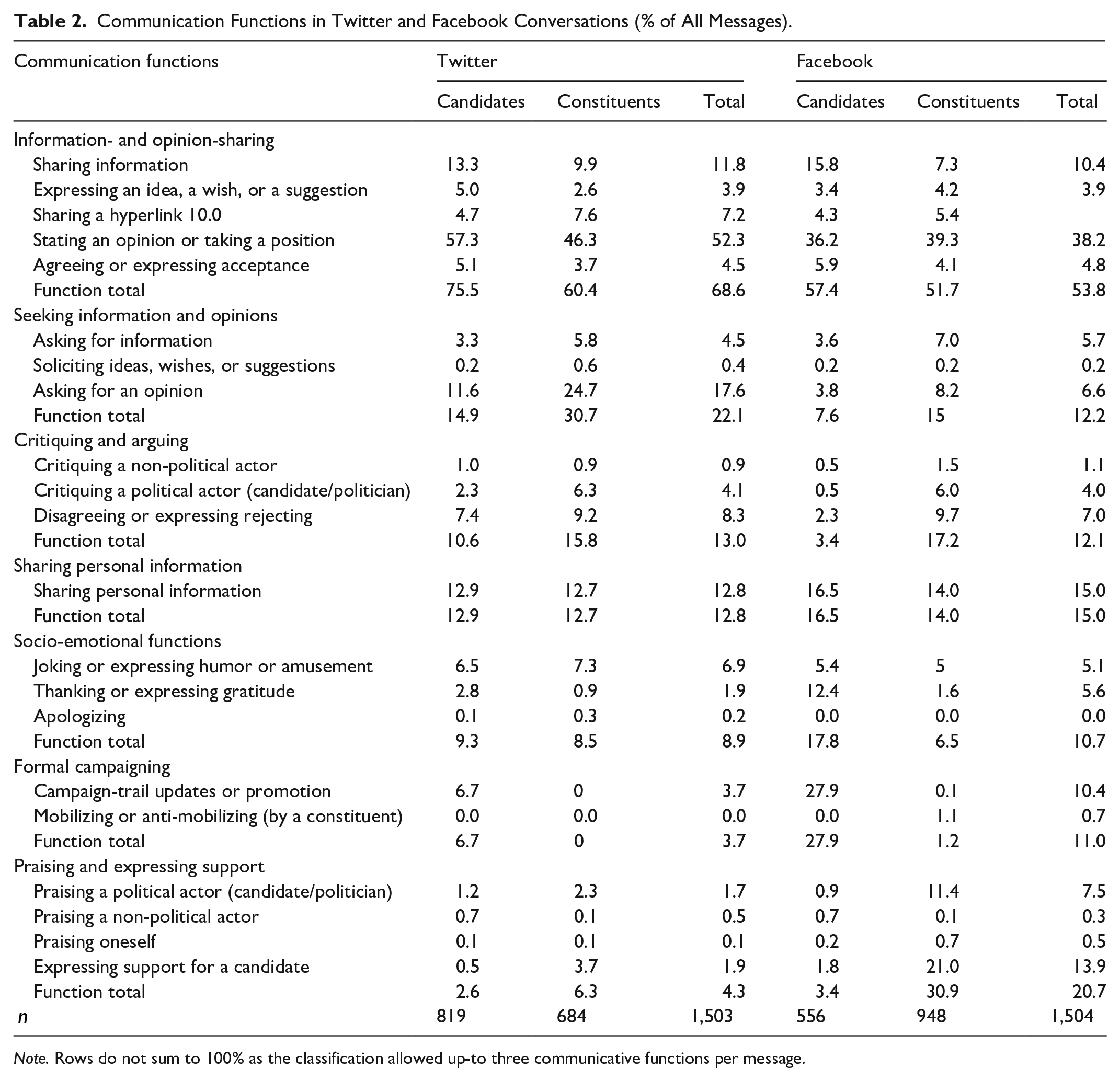
Our typology of functions was informed by literature on politicians’ interactions via social media (Graham et al., 2013, 2016), social interaction in computer-mediated communication (Bryant et al., 2011), and classics of social psychology (Bales, 1951) and communications (Burleson, 2010; Canary et al., 2008). Classification schemes vary greatly, with Graham et al.’s (2013) set of 14 categories and Bales’s (1951) and Burleson’s (2010) 12 each being instructive. We elaborate on these classifications in Online Appendix. Building on the literature on messages’ categorization guided our analysis toward certain shared views of interaction, which we incorporated in a manner eliminating overlaps in functions and combining similar ones. For example, the functions “campaign promotion” and “campaign update” were joined in a single communication function. Differences in scope necessitated some changes: We focused on both candidates’ and constituents’ messages, while authors such as Graham et al. (2013) considered only the former. The final schema encompassed 22 functions, arranged under seven broader categories (see Online Appendix for full codebook, with examples). Table 2 lists all these functions.
Communication Functions in Twitter and Facebook Conversations (% of All Messages).
Note. Rows do not sum to 100% as the classification allowed up-to three communicative functions per message.
To validate the classification, inter-coder reliability was tested by two coders, using approximately 10% of the sample from Facebook and from Twitter. We improved the codebook by clarifying the description for each code in three refinement rounds. In the third round, the overall reliability scores for the communication functions were 0.860 for Twitter and 0.862 for Facebook. Such scores are considered acceptable (Krippendorff, 2004).
Analysis of Social Interaction
First, we conducted correspondence analysis to visualize the differences in functions’ use between candidates and constituents and between platforms. Correspondence analysis extracts two dimensions via statistical calculus, and the data points are fed in along these dimensions (Clausen, 1998; Härdle & Simar, 2015a). There are several approaches to conduct such dimension reduction for the data, most prominently principal component and factor analysis. Unlike principal component analysis, correspondence analysis focuses on relative differences; not absolute differences (Härdle & Simar, 2015a; McCutcheon, 1987). Factor analysis, on the other hand, does not seek to provide “clusters,” but to divide observed variables to factors (Härdle & Simar, 2015b). Therefore, we use correspondence analysis and its visualization to explore the data (Clausen, 1998), but base our results on statistical testing procedures.
To answer RQ1, we analyzed each communication function’s proportional distribution in our sample. We tested for equality of proportions between two samples, applying Bernoulli correction because of the large number of statistical tests. We applied a similar approach for RQ2, examining patterns linked to roles in relation to the platforms. Again, the two-sample test for equality of proportions was used, with Bernoulli correction.
With an analysis of only proportional distributions, one might detect merely individual-to-individual differences instead of differences on the platform level. We ruled out this possibility by working with a representative random sample of the data, also seeking to capture not individual differences but explore how the platforms are appropriated to use by candidates and constituents in their interaction. While our approach does not allow us to determine what drives the results, it helps to study the role of the platforms in candidate–constituent interaction. For causal analysis, for example, determining to what degree affordances, social practices, and user populations each contribute to the role of platforms in the candidate–constituent interaction, more advanced research setups are required. These are discussed extensively later; however, executing such detailed analysis is dependent on articulating the phenomenon, which is executed in this study.
Finally, a proportional analysis was used to control for the size differences between the samples. As the classification is not mutually exclusive (i.e., each message was assigned with 1–3 codes) the proportional calculation was in comparison for all messages in the sample. For example, out of the 1,503 messages analyzed from Twitter, 1,031 was assigned with at least one code from the category “Information- and opinion-sharing,” thus putting 68.6% of messages on Twitter to this category.
Findings
An Overview of the Findings
Table 2 presents our classification of communication functions in social media conversations, showing a clear match with existing empirical work. We observed that most social media messages were used for information- and opinion-sharing (48.8%), followed by seeking information and opinions (11.9%), sharing personal information (9.4%), and praising and expressing support (9.3%).
Figure 2 shows the results of the analysis of correspondence between actors (red triangles) and functions (blue circles). This explorative analysis shows differences in Facebook use patterns between candidates and constituents, while their use of Twitter appears similar. In addition, differences are visible between Twitter and Facebook, which we examine in terms of the two dimensions in the figure. Dimension 1 appears to depict differences in tone of voice, where formal campaigning is on the left and expressing support on the right. The positions of candidates’ and constituents’ Facebook use indicate differences surrounding campaigning and expressing support. While this dimension explains almost 68% of inertia, there is no clear theoretical background in the political communication literature to elaborate this dimension further. It could be argued, however, that the dimension represents the continuum from campaign-related communication pursued by the candidates to the various forms of support or criticism expressed toward a political actor by the citizens—mostly explained by the difference between the groups, which will be examined in more detail later. Correspondingly, the difference between distributing information and discussing information are represented by Dimension 2. Functions such as “formal campaigning” and “praising and expressing support,” although creating candidate–constituent interaction, are aligned more with distributing information. Those related to “information- and opinion-sharing” and “critiquing and arguing” suggest a more argumentative style instead and discussing the information. This dimension, explaining 28% of inertia, is more related to well-established focus between campaigning and interacting in social media, well present in previous research (e.g., Graham et al., 2013).
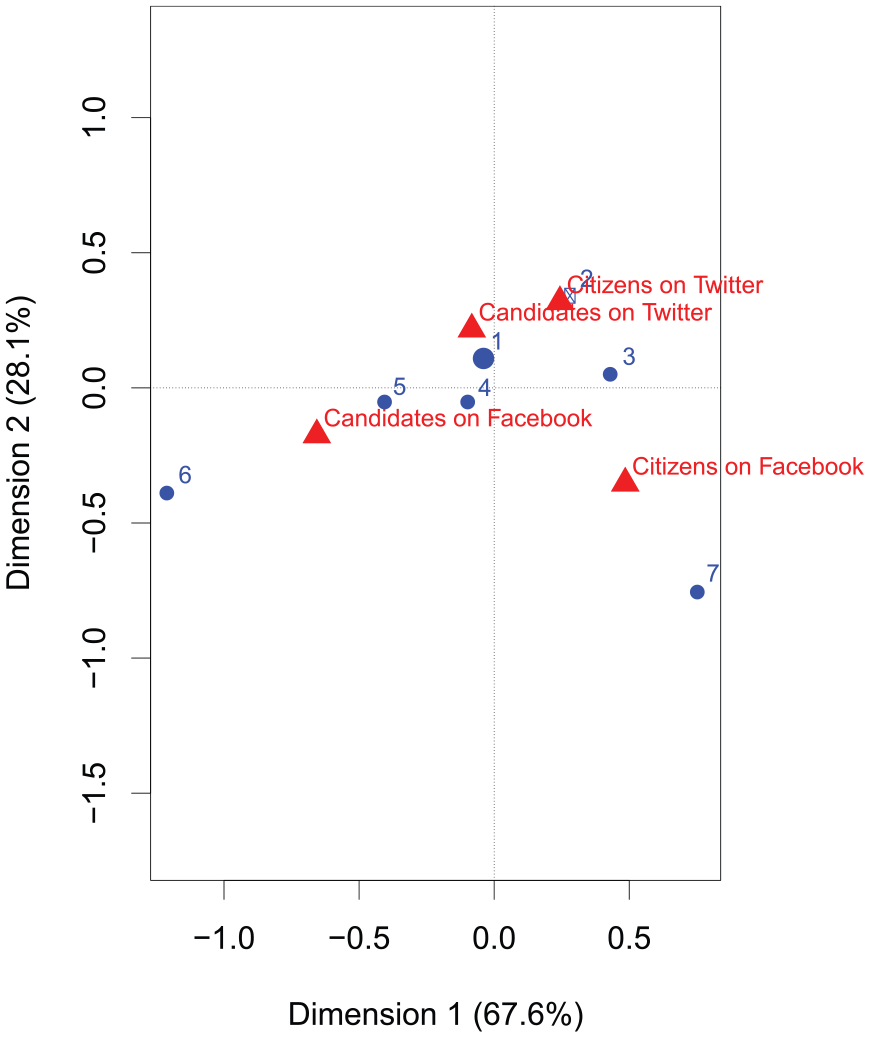
Correspondence analysis for functions, actors, and media platforms.
RQ1: Differences Between Facebook and Twitter
Our analysis (see Table 3) revealed that Twitter was used more for information- and opinion-sharing and seeking information and opinions (p < .001) than Facebook. Stating an opinion or taking a position was particularly prominent in the Twitter material. For other functions within these function groups, there were no statistically significant differences.
The Primary Platform Used for Each Communication Function (all measurements at p < .05).
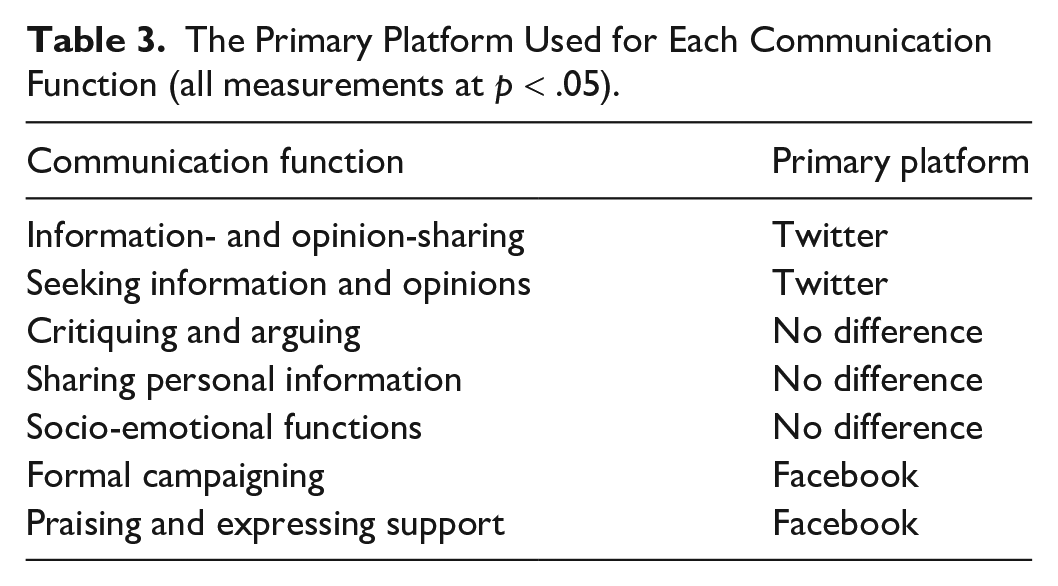
Facebook, in contrast, was used more for formal campaigning and praising and expressing support (p < .001). Campaign-trail updates (p < .001) in particular occurred more frequently in Facebook-based formal campaigning. As for expressing support, praising political actors was more common on this platform, as was expressing support for a candidate (p < .001).
No difference were evident for critiquing and arguing behavior, sharing personal information, or socio-emotional functions (p < .05). That said, one class of socio-emotional functions, thanking and expressing gratitude, was significantly more common in Facebook (p < .01). For all other socio-emotional functions, the differences between Facebook and Twitter were below the statistical significance threshold.
RQ2: Differences Between Roles
Answering RQ2 involves examining differences in the communication functions utilized in terms of role, by platform (see Table 4). Compared with constituents, candidates were more oriented toward information- and opinion-sharing, socio-emotional functions, and formal campaigning, with this pattern clearly showing statistical significance (p < .001). The differences related to information and opinions stemmed from candidates being more active in sharing information, sharing a hyperlink, or stating an opinion. Moreover, in the socio-emotional domain, candidates expressed gratitude more than did constituents, while there were no differences in levels of humor or apologizing. Unsurprisingly, with regard to formal campaigning, campaign-trail updates were used more by candidates than constituents.
The Primary Role in Interaction Fulfilling Each Communication Function, by Platform (all measurements at p < .05).

Constituents, meanwhile, showed a greater tendency toward seeking information and opinions, critiquing and arguing, and praising and expressing support. These behavioral differences were extremely significant (p < .001). When seeking input, constituents were more active in asking for information or an opinion, whereas there were no differences in requesting ideas, wishes, or suggestions. Constituents were more active also in criticizing political actors and expressing disagreement and rejection of something. Furthermore, in their “praising and expressing support” activity, constituents were more ready to praise and express support for candidates. Constituents and politicians patted themselves on the back to roughly the same extent. Finally, candidates and constituents did not differ significantly (p < .05) in sharing personal information.
Differences we observed in these roles and platforms could be related to other attributes relevant for interaction, such as parties. Previous research has suggested there are clear differences in social media use rooted in party differences (e.g., Graham et al., 2013). In a post hoc analysis, we confirmed this is not the case: As seen in Figure 3, our data do not suggest that differences in the interaction patterns observed would be caused by differences in party-related behaviors. We measured differences between parties’ candidates’ by computing the ratio of messages in each category (similar to Table 2) and conducted a non-parametric Kruskal–Wallis test on them. The adjusted p values were 1 for all categories and both Twitter and Facebook (df = 8). It may be that our focused analysis not on all social media use but only on interaction (in contrast to Graham et al., 2013) may explain the lack of party-originating differences.
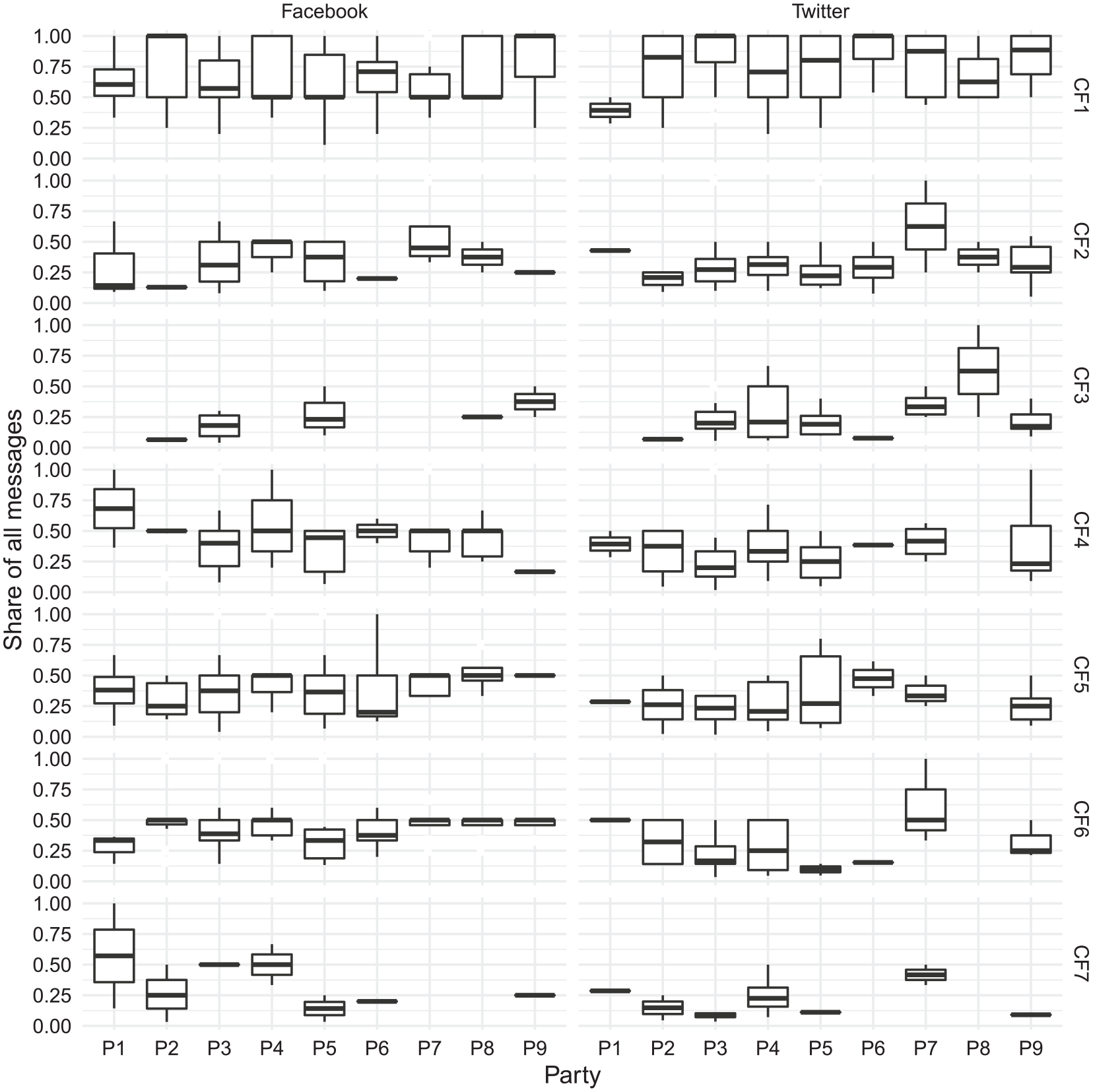
Candidates of communicative functions (CF1–7) per different parties (P1–9).
Discussion
While the existing research mostly focuses on candidate-centric actions, such as campaigning or negativity in political online discussions (e.g., Graham et al., 2016; Laaksonen et al., 2017; Lilleker et al., 2011; Rossini et al., 2018; Vergeer & Hermans, 2013), our study highlights that also meaningful political interaction takes place between candidates and citizens on social media. Our findings show that candidate–constituent interaction follows predictable patterns; candidates tend to share information and opinions and conduct overt campaigning, while voters, in turn, focus more on seeking information and opinions, critiquing, and expressing support for candidates or other political actors.
However, we found that the breakdown by communication function was different between the platforms (RQ1). Stating an opinion or taking a position was quite commonplace on both platforms, but even more pronounced on Twitter. In general, Twitter was characterized as a platform for sharing and requesting opinions and for information-sharing, whereas Facebook was used for formal campaigning and for offering praise and support.
With regard to RQ2, it emerged that behavior patterns may differ between candidates and constituents across the two platforms. Candidates were more likely to engage in information- and opinion-sharing on Twitter and socio-emotional functions on Facebook. No corresponding difference between candidates and constituents was detected for the other service studied, respectively. Constituents, on the other hand, were more likely to engage in critiquing and arguing on Facebook, but no difference between candidates and constituents was observed on Twitter. For example, in the case of information- and opinion-sharing, candidates were 15 percentage points (or 25 percentages) more likely to use these functions, while the difference in Facebook is only six percentage points (or 10 percentages) and non-significant. We confirmed that the differences observed in interaction were not related to candidates’ party. Proceeding from these findings, we argue that social media platforms seem to diverge in the forms of candidate–constituent interaction they support: Facebook is carved out as an arena of formal, traditional campaigning and speaking to supporters, while Twitter seems oriented toward political discussion.
Understanding Platformed Interaction
The interplay of technological and social factors in any social setting is complex (e.g., Bijker, 1997; MacKenzie & Wajcman, 1999; Winner, 1993). Our work adds to this body of literature by focusing on political interaction between the candidates and the constituents. Based on our findings, we put forth the claim that political interaction is platformed, that is, the forms and practices of candidate–constituent encounters on social media platforms are partly constituted by the specific platform used. We will now discuss potential causes of platformed interaction.
First, technical affordances may influence the candidate–constituent interaction (cf. Kalsnes et al., 2017). While both Twitter and Facebook allow serendipitous information retrieval (via users’ retweets/sharing or through paid content), Twitter is a “flatter” conversation platform; that is, all Twitter account-owners have similar rights to post content or to join an existing conversation, and it is reasonably easy to start a conversation through a direct “@” mention, irrespective of whether the user mentioned is already followed or a follower. On Facebook, on the contrary, at the time of the study, a user usually must be following or have “Like”d the page of a politician before being able to receive updates on it or post on that page. This renders it easier to start a political conversation mentioning a politician on Twitter and for a politician to join such an arbitrary constituent-originated conversation. On the Facebook platform, the politician is unlikely to see such a discussion at all. These factors might explain Twitter’s differentiation into a platform for sharing information and opinions, as shown in our results. The fundamental question is what drives platforms to implement particular affordances? Given the critical approach present in the platform studies literature (e.g., Gillespie, 2010, 2015; Hands, 2013; Plantin et al., 2016), we should not exclude factors such as platforms’ economic interests.
Second, the observations may be the result of social practices on the platform. User cultures and norms delimit how people are expected to behave (e.g., McLaughlin & Vitak, 2012; Stroud et al., 2015). For example, previous research has found that expressing positive emotions is more appropriate in Facebook than in Twitter (Waterloo et al., 2018). Especially in political communication, Twitter has been framed as an arena appropriate for political discussions and as a place where harsh, negative discussions and political gaffes feature prominently (Laaksonen et al., 2017), while Facebook is arranged more into groups of “Like”rs: Facebook users might find it hard to engage in critical discussion in a space populated by supporters of the page owner. Boczkowski et al. (2018) claim that each platform has particular meanings, which develop in interaction with other platforms. These results support our findings on the higher degree of socio-emotional function use in Facebook. Furthermore, it may be that the two channels serve different meanings for candidates and constituents, which may explain Twitter’s niche in political discussion and Facebook’s focus on formal campaigning. That is, candidates and constituents observe the use of Twitter or Facebook and adapt their use practices on the other platform to compliment that of the observed platform.
Finally, our observed differences may root from differences in user populations or imagined audiences (Marwick & boyd, 2011). Twitter is known to attract well-educated elites and journalists (Barbera & Rivero, 2015; Blank et al., 2018; Vainikka & Huhtamäki, 2015). Our observations on Twitter’s emphasis on information- and opinions-dissemination functions may be explained by such users’ aptitude and communication behavior. Similarly, the difficulty to navigate social context in social networking services, known as context collapse, may limit self-expression in these platforms (Marwick & boyd, 2011; Nelimarkka, 2019). This can as well attribute to the praising and expressing support prominent on Facebook. The imagined audience for those actions may be more limited to persons who have “Liked” the page, whereas in Twitter such context does not exist.
However, these different aspects discussed are intertwined (Bijker, 1997; MacKenzie & Wajcman, 1999). Technical affordances can define acceptable social practices or norms (Stanfill, 2015). However, differences in user populations (and their previous actions) can as well define norms that develop on technical platforms (Salganik et al., 2006). Design elements that encourage small and significant support, such as “Like”s, “hearting,” and other reactions (Hayes et al., 2016) may convey various meanings (Sumner et al., 2018) depending on the social context and the audience involved. The same argumentation relates to the candidate–constituent interaction as well: when multiple factors are at stake, it is difficult to demarcate the actual drivers or the observed differences in communication style. What our results clearly show, however, is that communication differs by platform when it comes to candidate–constituent discussions online.
The complex ways of platform-entangled practices unfold online has been discussed in platform studies. Platforms are conceptualized microsystems (van Dijck, 2013), techno-cultural constructs, and socioeconomic structures, where users, technology, and content are all part of the symbiosis. Through their affordances, norms, and practices platforms intervene in the ways in which political discussion plays out online. They form the technological unconscious, if yet visible, structures (Beer, 2009; Gillespie, 2015) that shape the societal processes, simultaneously imposing the values inscribed in them (van Dijck et al., 2018). An important aspect of this shaping is normalization: As the use of social media platforms becomes the standard, expected way of interacting with the constituents, it means the particular communication styles promoted and afforded by those platforms start to modify interaction practices (Boczkowski et al., 2018). Through observing the forms of candidate–constituent interaction in random samples, we capture what is the standard and expected way of interaction in these platforms. Our results indicate that the interaction forms are co-products of the platform affordances, practices, and users cultures. What is most significant in this regard is that if political interaction online is indeed platformed interaction, it means it is shaped by forces that are not necessarily in support for public or democratic values.
Implications of Platformed Interaction for Democracy
Platformed nature of political interaction has far-reaching implications for political discussion culture and, furthermore, for democracy. This stance echoes recent work in critical platform studies: scholars have begun to adopt a critical perspective on platforms and their power in various contexts (among others, Gillespie, 2010; Gillespie, 2015; Hands, 2013; Matamoros-Fernández, 2017; Plantin et al., 2016; van Doorn, 2017). Our findings are consistent with this literature: There are platform-specific differences in candidate–constituent interaction. As this interaction is critical in modern political campaigning (Borg & Moring, 2005; Trent & Friedenberg, 2007), our work points to several important ramifications for democracy, elaborated upon below.
Our findings show how those developing platforms may direct how candidates and constituents interact, as one potential cause for platformed interaction related to technical affordances. Furthermore, candidates may be strategic in their choices of online spaces for engagement, thereby creating even stronger forms of controlled interaction, wherein any real ability of constituents to drive conversation in particular directions is quite limited (Stromer-Galley, 2014). Also, platform controllers and campaigns can work together to help candidates tap the platforms’ potential to maximize electoral gains (Kreiss & McGregor, 2018). It is possible for the political elite and technology elite to co-operate also in developing platforms such that they shape the political culture in the manner most favorable for them. As the discussion of algorithmic content, recommendations elucidates (e.g., Gillespie, 2012), such technology-related decisions are not neutral. For this reason, we suggest that regulating social media platforms should focus not only on the content but also on the ways in which interaction affordances are designed on the platforms. During 2017–2018, nation-states have made various attempts to regulate the content and operations of social media services. Prominent examples are the stricter regulation to force operators to moderate hate speech on online platforms and the U.S. Congress and European parliament hearings of Facebook executives in response to the U.S. Presidential elections and Cambridge Analytica’s role therein. 3 However, we have not yet seen efforts to regulate the socio-cultural and socio-technical design decisions. In light of the importance of platforms in election campaigns, this type of regulation may be warranted. While it might seem extreme, regulation of campaigning is not unheard of: for example, Japan has long had strict limits in place on politicians’ and parties’ use of the internet during the campaign period (Tkach-Kawasaki, 2003). In a similar vein, technologies could be regulated to ensure that constituents can interact, fairly, with candidates in online spaces. Beyond this type of regulation, we should ask how could platforms, their users, and nation-states support pro-democratic forms of interactions?
Finally, we should cast our minds back to work pointing out that candidate–constituent interaction is rare (e.g., Graham et al., 2013; Stromer-Galley, 2000). Some scholars have found only dim possibilities for social media services to support political discussion, suggesting various mechanism for lack of interaction. Stromer-Galley (2000) posited that issues of resources or fear of losing control may play a role. Her later findings and more recent, related research indicate that candidates utilize spaces where they can control the forms of interaction (Freelon, 2017; Stromer-Galley, 2014). Our research contributes to this discussion by demonstrating that the platforms may constrain the interaction as well. For example, our results suggest that a candidate not wishing to engage in the debate should avoid Twitter, establishing a presence only in Facebook. Clearly, interaction between constituents and candidates is multifaceted, and understanding how candidates choose their platforms will help us learn more and develop platforms amenable to pro-democracy political interaction.
Implications for Academic Research
Finally, our findings point to three implications for social media research in academia. Though our analysis was confined to candidate–constituent interaction at election time, we argue that our findings may inform research on interaction in social media beyond this particular context.
First, they imply that social media researchers must be careful about generalizing their claims, particularly when focusing on one platform only. As the platforms themselves are integral to the social interaction, more reflection on the social and technical aspects of these platforms is warranted in research. Furthermore, researchers should indicate explicitly how these factors may impinge on the findings. We join others (Alhabash & Ma, 2017; Boczkowski et al., 2018; Hasebrink & Hepp, 2017; Madianou, 2015; Rogers, 2017; Tucker et al., 2018; Waterloo et al., 2018) in calling for more research that takes into account the individual platforms, the ways in which users navigate between these to construct their social realities, and the platformed interactions enabled by these platforms. Regrettably, much of recent social media scholarship still focuses on a single social media platform (Tucker et al., 2018, pp. 59–60).
Second, the proposals to standardize the analysis of interaction between social media services (e.g., Larsson, 2015) should be reconsidered. While we agree with the overall goal of rendering findings comparable across services, the differences between the platforms should be borne in mind. For example, while similar technical features are used, the communication functions they demonstrate can be different—as our study made clear. While acknowledging the platformed nature of interaction impedes comparative analysis efforts, invalid comparisons could be of great harm. Furthermore, a focus on predefined standardized modes of interaction (broadcasting, redistributing, interacting, acknowledging, etc.) may obscure the platforms themselves and their properties. We have argued that these are just as critical. Our work moves the emphasis from modes of interaction, which can be determined easily from feature use (e.g., with mention or retweet patterns), to qualitatively analyzing the functions used on the platforms and building an analysis framework accordingly. We suggest that such an approach is more suitable for examining interaction. However, we acknowledge that it is more laborious and, on account of the problems with applying classification frameworks in new contexts, may not be sustainable in the long term.
Finally, we see an opportunity to rethink the theory surrounding interaction via mass-personal communication. The question of platforms has been discussed with regard to friendship maintenance and interpersonal communication. People may use several platforms to communicate with friends (Van Cleemput, 2010, 2012); hence, social-network analysis relying on only a single data source is not sufficient for analyzing friendship (Karikoski & Nelimarkka, 2011). Therefore, this research community developed concepts to help them discuss these matters, through channel complementarity theory and media multiplexity theory (e.g., Ruppel et al., 2018). While they provide a starting point, these theories are framed for dyadic interaction so are ill-suited to studying mass-personal communication as seen in social media (O’Sullivan & Carr, 2018). The main difference between interpersonal and mass-personal communication lies in the target: The latter might not be tailored to any single person but directed to (imaginary) audiences (Marwick & boyd, 2011). Rather than attempt to transplant channel complementarity theory and media multiplexity theory, we must consider the role of particular platforms in candidate–constituent interaction in greater depth.
Implications to Political Communication Research
Political communication researchers have asked what kind of content candidates create in social media services. Results have shown differences between parties (among many others, Graham et al., 2013, 2016; Hansen & Kosiara-Pedersen, 2014; Lassen & Brown, 2011; Lilleker et al., 2011; Southern, 2015; Van Dalen et al., 2015; Vergeer & Hermans, 2013). Such analyses are very candidate-centric: Even when examining interactions, candidate-related variables are used in the analysis (e.g., Tromble, 2018). Our findings did not suggest differences between parties in either of the platforms. We believe that this is partly due to a different unit of analysis. Our analysis focused on candidate–constituent interactions instead of candidates’ actions.
Due to this mismatch, we invite political communication scholars to expand beyond candidate-centered research approaches and using candidates as the unit of analysis. Candidates’ behavior takes place in complex social settings with (imaginary) audiences and platforms’ technical features (such as affordances and algorithms) and social practices (such as norms). Therefore, research on online political communication should similarly seek to account the platformed interactions in the research design. This, however, is empirically challenging since the political views or potential party affiliations of the constituents are often unknown. Thus, we do not know if interactions are different if both candidate and constituents are politically like-minded or not. In candidate–candidate interactions such differences do exist (Laaksonen et al., 2017). One reason to venture away from candidate-centered research agenda is the positive effects of interaction to candidates’ electoral success (Grant et al., 2010; Vaccari, 2012). To understand the impact interaction, further qualitative analysis of interactions with stakeholders (candidates, citizens and platforms) may provide fruitful future avenues. The current study highlights opportunities in this research direction to discuss the complex socio-technical environment where online political interaction occurs.
Limitations and Future Work
While we have been able to demonstrate that interactions are platformed, the analysis does not reveal the mechanism behind the differences: the affordances, divergent practices, behavioral and cultural expectations and norms, and the make-up of the respective user populations.
Our reason not to engage with the causal question relates to the complexity of the natural research settings, focusing ecological validity of the research. However, strong causal claims call for another research strategy, such as experimental research. Tools for such research have been developed, and digital experiments have already been exploited to explore development of social norms (Salganik et al., 2006) and, more recently, to examine text-based exchanges in small groups (e.g., Cambre et al., 2014; Kulkarni et al., 2015). These approaches, either with more direct comparative setting or even experimental studies would strengthen our findings and help to address the question of why platformed interactions take place. The second alternative is to move from interaction to questions on how candidates use different platforms. This approach may be preferred to engage in the intersection of mass communication and platforms. In such research, a detailed analysis of the same candidates across different services to explicate further what drives the differences we have observed, potentially supplemented by interviews to provide a holistic picture.
In addition, the empirical findings should be carefully balanced against the limitations of the context. Most significantly, we studied Finnish culture and the Finnish electoral system, the specificities of which we outlined above. Therefore, we call for an investigation of the use of different platforms in candidate–constituent interaction in other cultural contexts. Similarly, the analysis of platformed interaction could be expanded to include other platforms and to encompass types of interaction situations beyond the political sphere. Also, studies with a comparative setting could be conducted across cultures (e.g., Geber & Scherer, 2015) but also across platforms—as indicated in this work—in order to better explain the platformed effects.
Finally, we acknowledge that a “big data” approach to social media data collection, while promising, brings with it limitations arising from factors such as users’ privacy settings and other difficulties in obtaining data for everyone involved in the discourse. These challenges are well known by social media researchers and our study is not alone with such issues (e.g., Bruns et al., 2012; Lorentzen & Nolin, 2017; McKelvey et al., 2014). In addition, our Facebook data exclude conversations initiated beyond candidates’ pages, such as discussions in which candidates might engage within various Facebook groups. While these limitations mean that not all candidate–constituent discussion threads could be covered by the data collection procedures employed, our sample is representative enough. For example, as we focus on Finnish-language tweets, the data collection is not as likely to be rate-limited.
Conclusion
We explored the place of platforms in the social media-based interaction between candidates and constituents during the 2015 Finnish parliamentary elections, uncovering clear platform-correlated differences in the communication functions chosen by both candidates and constituents. Twitter was used for sharing and seeking information and opinions, while Facebook was used for formal campaign activities and for praising and expressing support. Furthermore, we observed patterned differences between candidates and constituents in behavior on these platforms. Candidates used Facebook’s socio-emotional functions more than constituents did, while a corresponding difference for Twitter was not evident.
We conclude that these two findings demonstrate the great importance of the scholarship emerging on platforms’ role in modern society. Academics have been eager to point to social media platforms’ vast power in society (among others, Gillespie, 2010, 2015; Hands, 2013; Plantin et al., 2016). Their powers are manifested to users as affordances (e.g., Bucher & Helmond, 2017; Evans et al., 2017) and affordances-in-practice (Costa, 2018). Our findings demonstrate that these manifestations lead to different types of candidate–constituent interaction. With this framing, we find great merit in the platformed interaction perspective, which combines studying online interaction with taking the critical stance of platform studies. The main contribution with this idea is to extend scholarship on candidate–constituent interaction to embrace critical platform studies literature.
From this critical perspective, we considered possible implications for democracy. While we acknowledge that candidate–constituent interaction is critical for the democratic process (Borg & Moring, 2005; Trent & Friedenberg, 2007), discussing with platform studies literature we acknowledge how the platforms that mediate interaction are developed and can point to how power is embedded in the platforms (among others, Gillespie, 2010, 2015; Hands, 2013; Plantin et al., 2016). Because these platforms have potential to affect the functioning of democracy and, hence, may deserve further regulation, practitioners and policymakers should be careful to consider how platforms shape democratic interaction and how they could be developed in a manner beneficial to society, political discussion, and democracy. Finally, we add our voice to the growing chorus in academic communities calling for studies of multiple platforms, since some “known truths” of interaction may be artefacts of platformed interaction (e.g., Alhabash & Ma, 2017; Rogers, 2017). Furthermore, we point out that an opportunity may exist to develop theories of mass-personal communication that account for the existence of platforms, in a parallel to work on dyadic communication (e.g., Ruppel et al., 2018). We have taken the first steps toward this goal by stressing platforms’ implications for social interaction and the consequent need for fuller understanding of platformed interaction.
Supplemental Material
sj-pdf-1-sms-10.1177_2056305120903856 – Supplemental material for Platformed Interactions: How Social Media Platforms Relate to Candidate–Constituent Interaction During Finnish 2015 Election Campaigning
Supplemental material, sj-pdf-1-sms-10.1177_2056305120903856 for Platformed Interactions: How Social Media Platforms Relate to Candidate–Constituent Interaction During Finnish 2015 Election Campaigning by Matti Nelimarkka, Salla-Maaria Laaksonen, Mari Tuokko and Tarja Valkonen in Social Media + Society
Footnotes
Declaration of Conflicting Interests
The author(s) declared no potential conflicts of interest with respect to the research, authorship, and/or publication of this article.
Funding
The author(s) received no financial support for the research, authorship, and/or publication of this article.

Supplemental Material
Supplemental material for this article is available online.
Notes
Author Biographies
References
Supplementary Material
Please find the following supplemental material available below.
For Open Access articles published under a Creative Commons License, all supplemental material carries the same license as the article it is associated with.
For non-Open Access articles published, all supplemental material carries a non-exclusive license, and permission requests for re-use of supplemental material or any part of supplemental material shall be sent directly to the copyright owner as specified in the copyright notice associated with the article.
