



Abstract
Media criticism is a crucial part of meta-journalistic discourse, ensuring that journalists adhere to their democratic functions, such as informing citizens in an honest and complete manner. However, the profession increasingly faces hostile, nonevidence-based attacks from politicians that attempt to strategically fuel distrust among citizens and delegitimize opposed viewpoints. Despite this reality, we lack a systematic overview of the boundaries between constructive feedback and weaponized attacks in media criticism. To address this gap, we inductively analyzed how media criticism is represented within the social media discourse of ten German politicians from all major parties. Using a grounded theory approach, we conducted a qualitative content analysis of a subset of their tweets from 2015, 2017, and 2022 that contain media criticism (N = 545), mapping the types and severity of the criticism, the construction of opposing narratives, and the explicitness of references to facticity over opinions. We identified four themes within media criticism discourse, ranging from misinformation attributions to severe accusations of the intentional distortion of reality through the media. Politicians (strategically) employ a wide range of media criticism and inaccuracy claims beyond judgments of facticity with differing degrees of severity for the profession. Based on our findings, we propose a typology of media criticism from political elites that adds nuance to our understanding regarding the boundaries between supportive and disruptive criticism for journalism.
Media criticism is a crucial asset to democracies. Rational, evidence-based criticism ensures that journalists attain their democratic functions as critical watchdogs of elites in power and secures the correction of erroneous information without censorship (Figenschou and Ihlebæk 2019). However, journalism in countries, such as Germany, has faced increased hostile attacks from politicians in recent years, challenging the norms of rational and civil criticism underpinning this ideal (Egelhofer and Lecheler 2019). Instead of motivating critical thinking among audiences, accusations suggesting the intentional deception of citizens through the media delegitimize their position as a fourth estate, fuel institutional distrust, and impact the work of journalists (Bennett and Livingston 2018; Lecheler and Egelhofer 2022). Although there exists a variety of research on the use of hostile delegitimizing labels by politicians—such as Fake News or Lügenpresse (“lying press”; Brummette et al. 2018; Darius 2022; Farhall et al. 2019)—our understanding of the boundaries between disruptive and constructive media criticism beyond explicit disinformation labels is limited.
This lack of understanding is concerning in a digital journalistic environment shaped by social media’s affordances. Specifically, due to the compromised role of traditional journalistic gatekeepers on social media, and the facilitated dissemination and amplification of false narratives on social platforms (Pasquetto et al. 2020), citizens around the world increasingly worry that misinformation is ubiquitous in online settings (e.g., Newman et al. 2022). The skeptical stance toward information and the availability of multiple narratives around facts has led to the notion of truth becoming seemingly negotiable. Especially on social media, different versions of socio-political reality compete for the audience’s short-lived attention (Waisbord 2018). Terms such as “factual relativism” or “post truth” suggest that deliberation becomes nearly impossible when political camps cannot argue on the same set of facts (Van Aelst et al. 2017). This informational uncertainty creates new opportunities for politicians to challenge disliked media narratives as false information. As such, factual relativism is not only characterized by mis- and disinformation, but it also facilitates the further disempowerment of mass media as reliable information sources. Criticism like “fake news” has been “appropriated by politicians around the world to describe news organizations whose coverage they find disagreeable” (Carlson 2016: 5). Although fake news is a rather extreme example, the widespread belief surrounding ever-present false information can be successfully weaponized by political actors to label disliked information as “mis-” or “disinformation” to gain or uphold political power (Lecheler and Egelhofer 2022). Still, we know very little about the extent to which politicians make use of this strategy beyond the use of legitimate criticism and delegitimizing labels, especially when it comes to non-populist actors (Solis and Sagarzazu 2020). Against this backdrop, we need to investigate the varieties of media criticism as well as how and whether criticism does or does not refer to verifiable truth claims beyond delegitimizing labels.
Responding to the call to more comprehensively map the ways in which media criticism does (not) delegitimize the journalistic profession (Carlson 2017) in an era of factual relativism, we ask: How is media criticism represented in politicians’ social media discourse in Germany?
Using a qualitative content analysis of political communication on Twitter, we inductively arrive at a more comprehensive mapping of different types of media criticism in Germany’s (relatively) high trust and low polarization setting, which still experiences increasing pressure on and hostility toward the profession of journalism (RSF 2023). We focus on the extent to which criticism is delegitimizing—that is, challenging journalistic authority, as well as how accusations of untruthfulness over opinion-based disagreement specifically may confound the boundaries of constructive criticism. Suggesting (intentional) factual inaccuracy and deception, these accusations additionally challenge journalists’ epistemic authority. With this focus, we are bridging and extending the disinformation and media criticism literature by exploring its multifaceted variety communicated by political elites and the context of these accusations in terms of subjects and targets, and offer an evidence-driven typology that helps our understanding of the boundaries between legitimate criticism and disruptive attacks and their potential negative consequences for the profession of journalism.
The Functions of Media Criticism in Democracies
Media criticism is “part of a meta-journalistic discourse which comprises all public expressions about journalism, its definition, boundaries, and legitimacy” (Egelhofer et al. 2021: 654). It is thus a crucial democratic tool for journalistic accountability that ensures the maintenance of quality in media performance without censorship by identifying instances that deviate from journalistic norms (Cheruiyot 2019). On a system level, media criticism can also strive to point out and offer foundational alternatives to flaws in the underlying system of news production (Carlson 2009). Normatively speaking, media criticism only covers civil expressions that strive for positive change in journalism (e.g., Wyatt 2007), whereby critics take on the role of the “fifth estate,” that is “watching the watchdogs” (Hayes 2008).
Many scholars in recent years, however, have acknowledged that the recent rise of more hostile attacks toward the media has overstepped these normative boundaries (e.g., Cheruiyot 2019). Prior work notes that delegitimizing media references entail incivility and lack substantive reasoning (Egelhofer et al. 2021). In line with analyzing how the normative boundaries of media criticism are overstepped, we consider those references delegitimizing that suggest that the media fail to attain their democratic functions; that is independently performing checks and balances on the three pillars and to inform the public in an honest and balanced manner (Ukka 2019). In contrast to constructive media criticism, delegitimizing criticism suggests a systematic failure to achieve these functions, weaponizing accusations to weaken or abolish the media and their epistemic authority instead of trying to strengthen them with suggestions for positive change. Because we aim to map the discursive variety of such accusations and extend recent studies about more severe “fake news” accusations (e.g., Ross and Rivers 2018; Waisbord 2018), we consider a broader definition than media criticism that is disentangled from its normative expectations. Against this background, we look for all negative media references and define them as any expression of dissatisfaction with or disapproval of a journalistic product, a journalist, a media outlet, or any criticism of the general discourse around the role of journalists and journalism. Dissatisfaction is a broad term covering a range of aspects, including, but not limited to, a call to change a journalistic product, routine, or regulation, outright opposition against a medium or the media, or even threats toward journalistic actors.
Media Criticism in the Relationship Between Politicians and Journalism
Politicians are crucial actors when it comes to constructive media criticism. Ideally, politicians and journalists are interdependent actors deriving legitimacy from and creating accountability for one another through founded criticism in a shared culture of political communication (Van Dalen 2021). Hence, constructive criticism from politicians aims to improve journalism quality through respectful effort and reasoning (Egelhofer et al. 2021). Politicians, using constructive and well-founded criticism, have the power to point out the press’ accountability toward citizens, advocate for diverse perspectives, and stimulate critical thinking among audiences.
However, with significant discursive power (Jungherr et al. 2019), politicians may misuse criticism strategically to question the legitimacy of news media: to gain electoral advantage, disrupt the established order, strengthen ties with their followers through confirming their biases, or to avoid accountability (e.g., Lecheler and Egelhofer 2022). The “Fake News” label exemplifies this, weaponizing disinformation for political gain (Egelhofer and Lecheler 2019; Waisbord 2018). Social media facilitate this weaponization, allowing for personalized communication from politicians and creating an illusion of personal contact with audiences (Engesser et al. 2017). Additionally, news on social media is often paired with criticism on it, for example, in comment sections (Carlson 2016). Thus, social media have often been considered a cause for growing hostility toward journalists and an increase in media criticism (Egelhofer et al. 2021). Recent quantitative research suggests that media criticism from political elites on social media platforms in Germany is relatively often characterized by incivility or lacks argumentation (Egelhofer et al. 2021), making it a crucial discursive space to investigate. Thus, politicians may benefit from strategically crossing the cultural boundaries of founded and reasoned criticism to questioning the democratic role of the fourth estate—increasingly pressuring the profession, potentially resulting in self-censorship for journalists that constantly face uncivil attacks on their routines, daily practice, or even person (Balod and Hameleers 2021; RSF 2023).
Toward a Typology of Media Criticism in Germany
To explore the nature of media criticism in politicians’ direct communication on social media, we do not only investigate the types and possible severity of media criticism narratives presented but also the explicitness of facticity-related mis- and disinformation labels and the construction of opposing truth claims as sensitizing or direction-giving concepts for our mapping exercise (also see Hameleers and Minihold 2020). Herewith, we aim to arrive at an evidence-driven typology of the nature of media criticism in politicians’ discourse, extending research focusing on the weaponization of fake news and disinformation to identify possible additional ways and degrees of delegitimizing the press. These sensitizing concepts are not treated as being exhaustive—they simply guide the exploration of the varieties of media criticism.
(Non-)Factual Media Criticism
When it comes to accusations of untruthfulness, prior research has differentiated between mis- and disinformation accusations (e.g., Hameleers et al. 2022), referring to the attribution of unintentionally or intentionally disseminated falsehoods. Therefore, mis- and disinformation does not only exist as an informational genre but also as an accusatory label assigned to the media (Egelhofer and Lecheler 2019). The distinction between the labels is crucial: Whereas misinformation attributions simply point out erroneous information as honest mistakes, disinformation accusations assign intentional behavior to the target. Disinformation attributions, often used to spread distrust among right-wing populists (Hameleers and Minihold 2022), are inherently delegitimizing. Assigning deliberate factual inaccuracy to the media questions the democratic role of journalism as a truth-seeking institution. Beyond these labels, we know little about the discursive elements of criticism that may also point out how accurate information is, for example, falsely contextualized or interpreted. We thus explore these accuracy-related boundaries of accusations and nonfalsifiable criticism to better understand how the epistemic authority of the media is referenced.
Opposing Truth Claims in Media Criticism
The weaponization of accusations is especially concerning when accompanied by false opposing counter-narratives. Specifically, politicians may not only point out what is perceived to be “wrong” but also respond with opposing claims suggesting what is “right,” claiming epistemic authority over the media (Ross and Rivers 2018). Opposing statements become more problematic when leaving the realm of falsifiability, such as with the popular argument of a perceived “over-interpretation” of journalists (Crawford 2006), which should be “balanced” with the politicians’ opinions (Kruger 2022). Thus, we pay specific attention to the discursive use and verifiability of opposing claims in the context of media criticism.
Severity of Accusations for the Profession of Journalism
Despite the general importance of corrective media criticism, we have argued that it can be misused strategically to delegitimize the media’s epistemic credibility. With our analysis, we seek to better understand the severity of accusations, referring to the extent to which identified themes move away from constructive media criticism and become delegitimizing for the profession. We ask:
RQ 1: How does media criticism from politicians differ based on the type and severity of accusations, the construction of opposing truth claims, and the explicitness of mis- and disinformation labels?
Additionally, we have highlighted the disruptive potential of specifically disinformation accusations. We thus analyze how disinformation accusations might be present and differ discursively from other accusations:
RQ 2: How do disinformation attributions differ discursively from other forms of media criticism?
Lastly, based on prior literature on populist rhetoric, we consider the different political ideologies and contrasts between mainstream and challenger politicians, that is, those who have been in government on a federal level with those that have not (De Vries and Hobolt 2020). The two challenger parties (LINKE, Alternative für Deutschland) are the only populist parties in the sample (The PopuList 2020).
RQ 3: How does media criticism vary across political ideologies and mainstream versus challenger politicians?
Methods
The sampling and analysis procedure was preregistered anonymously with elaborate explanations on OSF. Figure 1 provides an overview of the case selection, data collection, and analysis process. The project was approved by the Ethics Review Board of the University of Amsterdam [Project FMG-5887_2023].
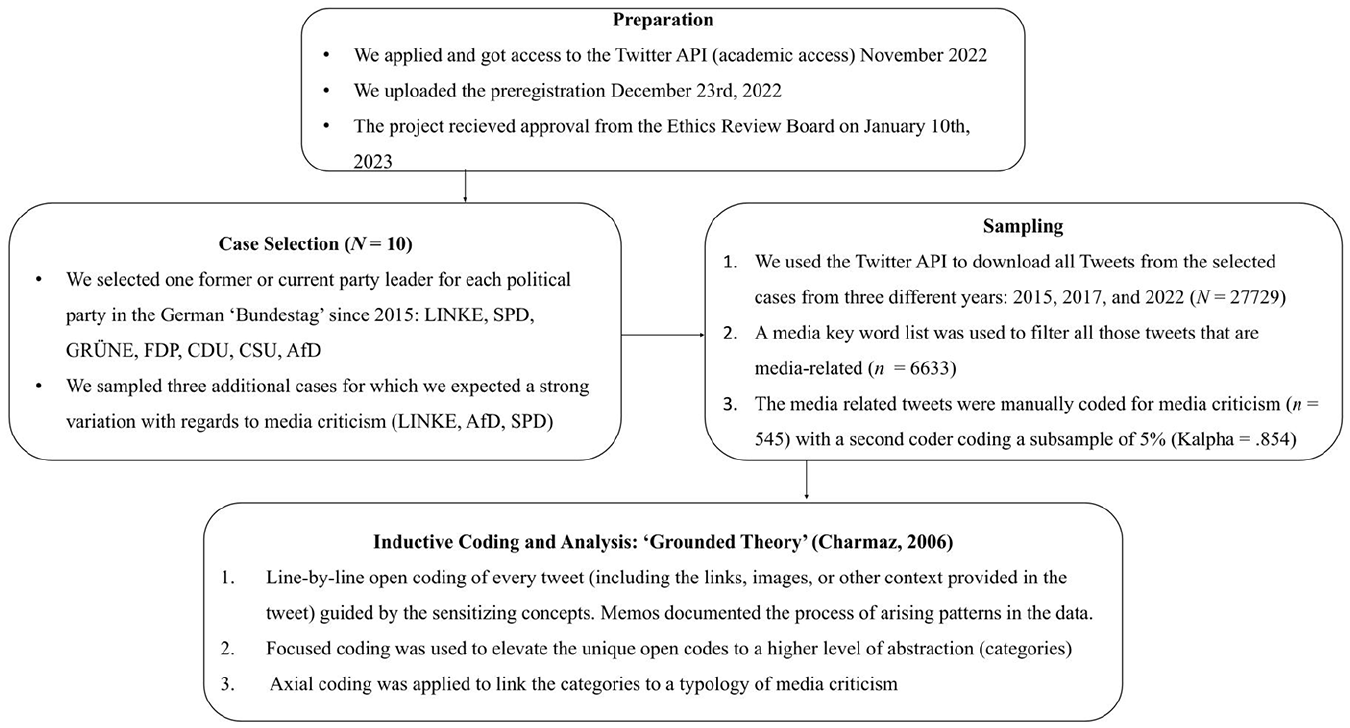
Overview of the sampling procedure and analysis strategy.
Case Selection: The German Context
We consider Germany a relevant case showing how media criticism may be weaponized in a country that (still) displays relatively stable media trust but currently faces new challenges (Darius 2022). Germany, compared to many other multiparty systems with proportional representation, displays relatively low levels of polarization (Newman et al. 2022; Reiljan 2020). Moreover, political elite incivility in Germany tends to get punished with backlash (Maier 2021), indicating a relatively civil political discourse. However, hostility in social networks toward journalists is growing and media pluralism has been declining (RSF 2023). Additionally, recent political discussions have increasingly scrutinized the legitimacy of public broadcasters (Holtz-Bacha 2021). Concurrently and in line with a global trend, Germany experiences an upsurge in right-wing populism cultivating a hostile rhetoric toward the media (e.g., Hameleers and Minihold 2022), even though the relative share of (right-wing) populist politicians is still small compared to other European countries (Rooduijn et al. 2019). Considering these developments, we expect to find both a traditional, relatively civil media criticism discourse as well as recent uncivil and hostile destabilization efforts toward the private media sector and the public service media. In the latest elections (2021), seven parties from a wide ideological range were elected into parliament with more than 5 percent of votes, all of which are well established in the German political landscape. This offers a unique opportunity to explore the varieties of media criticism in the context of political challenges many western countries are currently facing.
Data Collection and Sample
Because of its pivotal role in political communication (Valenzuela et al. 2018), we rely on Twitter (now X) for our sample frame of relevant posts showcasing media criticism. Not only is it used by a variety of politicians for communication with wide audiences (e.g., Farhall et al. 2019; Ross and Rivers 2018), but social platforms also attract the attention from traditional media, possibly reaching an even bigger audience (Kruikemeier et al. 2018). Additionally, the platform has been used for delegitimizing messages toward the media (Hameleers 2022). To ensure that we explore maximum variation of media criticism, we sample tweets from politicians across the ideological party spectrum from multiple years (2015, 2017, and 2022). In 2015, Pegida (“Patriotic Europeans Against the Islamisation of the West,” a pan-European, far-right extremist movement) and the AfD (Alternative for Germany, a populist far-right party) were on the rise, largely promoting a rhetoric against the established media. 2017 was an election year, but there were no significant events in the meta-journalistic discourse. 2022 was sampled to capture the aftermath of the Covid-19 pandemic, which has impacted the discourse surrounding facts and the routines and safety of journalists (RSF 2023). To select politicians, we rely on the number of followers and media references (see Supplemental Information file, Appendix A for more information) to choose one respective party leader for each of the seven parties that have been represented in the Bundestag since 2015. Party leaders tend to have the largest following and thus have the most visible and potentially impactful criticism. However, considering their more civil communication due to the responsibility of their position, we added three additional cases for which we expect strong variation. This includes one popular left- and right-wing politician, who are known for their relatively extreme policy stances, as well as the current federal minister of health who is known for his evidence-driven, (meta-)scientific discourse, especially since the Covid-19 pandemic. We collected all their tweets across the three respective years using the Twitter API in February 2023 (N = 27,729). Table 1 provides an overview of the selected cases.
Overview of Selected Cases.
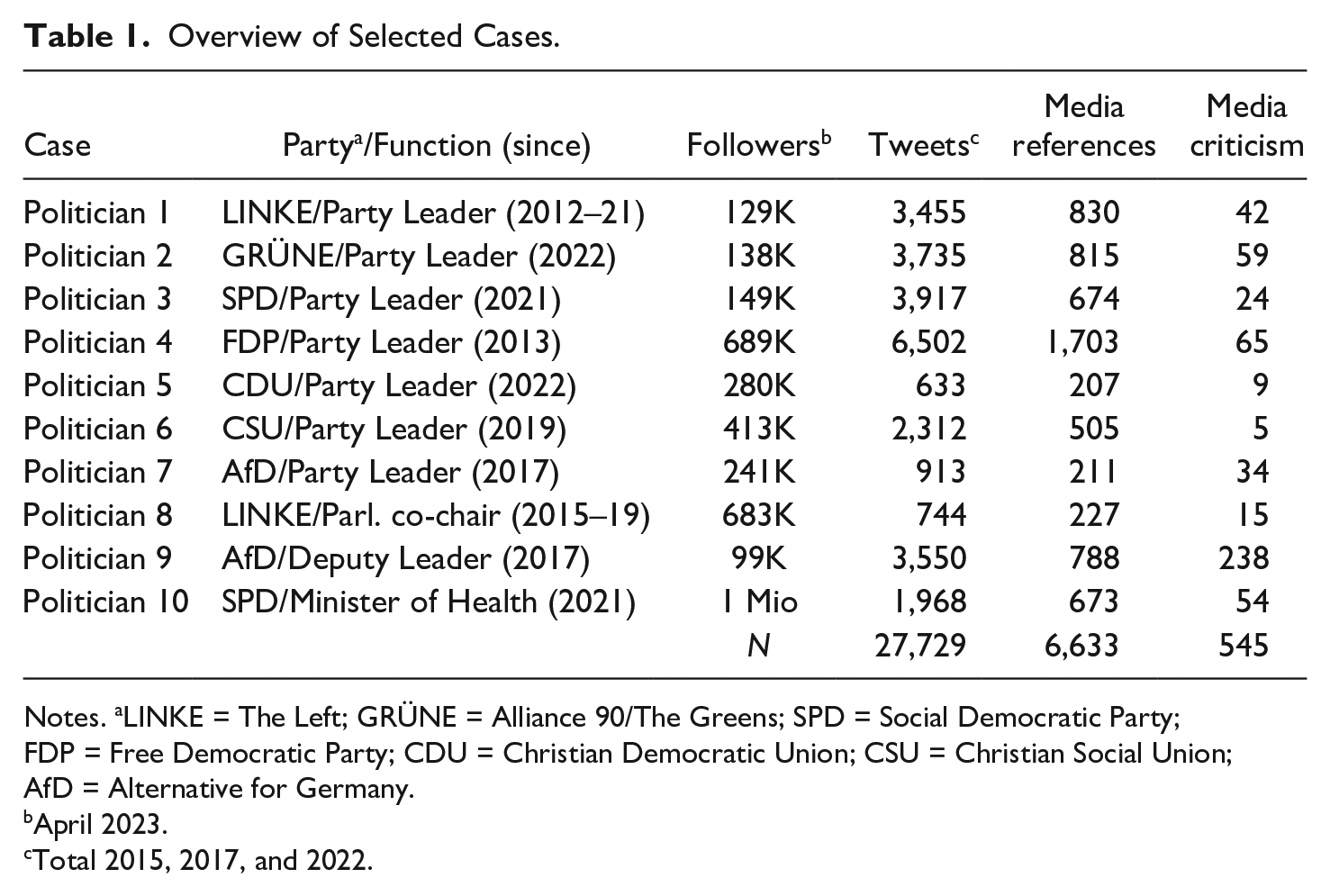
Notes. aLINKE = The Left; GRÜNE = Alliance 90/The Greens; SPD = Social Democratic Party; FDP = Free Democratic Party; CDU = Christian Democratic Union; CSU = Christian Social Union; AfD = Alternative for Germany.
April 2023.
Total 2015, 2017, and 2022.
To identify media-related tweets, we used a media keyword list from Egelhofer et al. (2021; see Supplemental Information file, Appendix B) that we extended with additional keywords. It includes general media-related terms (journalism, news, etc.), as well as names of popular media outlets, programs, and journalists, leaving n = 6,633 tweets with media references. 1 The main author manually selected those tweets containing media criticism based on the definition in this study (n = 545). Another author additionally selected media criticism from a subsample of 5% of all tweets with media references to assess agreement on the selection criteria; this was satisfactory (α = 0.854).
Analysis and Credibility Strategies
Coding and analysis follow the stepwise coding procedures of the grounded theory approach (Braun and Clarke 2013; Charmaz 2006) and were chiefly conducted by the first author. All 545 tweets were assigned open codes on the level of individual tweets guided by the sensitizing concepts. They ensured that the coder paid specific attention to the data-driven (i.e., noninterpretative) variety of criticism and opposing truth claims and guided the researcher-derived and more theory-bound interpretation of the severity of accusations and the explicitness of mis- and disinformation labels. We additionally coded each tweet’s target and considered responses/links to other tweets, images, or links to external sources to ensure contextual understanding. All authors held regular peer debriefing and common coding sessions in this process to ensure transparency and procedural reliability.
During focused coding, the many unique open codes (~700) were merged, elevated to higher levels of abstraction, and assigned to themes. For example, data-driven codes such as “sloppy work of outlet” and “rushed headlines could have had consequences” were elevated to the category “lack of journalistic quality standards,” which is part of a broader theme of “deviations from professional standards.” We documented and extensively discussed all decisions in this process. Peer debriefings ensured agreement in the process of abstracting codes to themes (see Supplemental Information file, Appendix C for further documentation). After identifying these coding categories and themes during focused coding, the last step of axial coding serves to understand the relationships and conceptual link between these themes and categories. In this case, all emerging themes and categories were analyzed in light of the normative boundaries of media criticism. Specifically, we analyzed to what extent the themes fall under or move away from the definition of constructive media criticism or have delegitimizing qualities. These results inform the typology of media criticism.
Results
The study aimed to map out the different ways in which politicians in Germany criticize the media, specifically considering references to facticity. Before turning to the research questions, we offer some descriptive findings on the messengers and targets of media criticism.
Who Targets Whom with Media Criticism?
Nearly 50% of tweets containing media criticism were posted by the two right-wing populist actors included in our sample. However, the candidate of the liberal party (11.9%), the leader of the green party (10.8%), and the federal minister of health (9.9%) also presented a considerable amount of criticism relative to the sample. Interestingly, the CDU and CSU party leaders offered barely any criticism despite having a considerable amount of general media references. If present, their criticism contributed to the critical discourse surrounding the role of the public service media.
All politicians addressed a variety of targets. Most often, they were targeting specific media outlets (25.6%) or the public service media as a whole (PSM; 21.1%). Only around 14.3% were directed at “the media” or “the reporting” in general. Sometimes, politicians were addressing (specific) journalists, too (16.1%). Thus, criticism was often targeted toward a higher level than a specific journalistic product, even though specific articles were sometimes used to exemplify the point of criticism toward a specific outlet or the media in general.
Media Criticism in the Social Media Discourse of German Politicians
German politicians presented a wide variety of media criticism in their social media discourse. We identified four overarching themes in media criticism: Accusations of (1) deviations from professional standards, (2) deviations from social norms and personal values, (3) distorted representation, and (4) intentional bias and fabrication. Additionally, we point out the distinctive references to the public service media which differ in their discursive construction. Figure 2 presents an overview of the derived themes and subcategories. We argue that the ordering of themes represents the severity of accusations, starting with what we consider part of constructive media criticism and gradually moving away from its normative standards with opinion-based statements, delegitimization regarding normative role performances, and lastly, systematic democratic functions, expressing systematic distrust in the honest and impartial functioning of the media. It is important to note that we do not make any claims on the legitimacy of criticism, thus whether they align with actual media performance in the respective cases. Instead, we present a data-driven typology of negative media references in light of the boundaries of constructive, evidence-based media criticism.
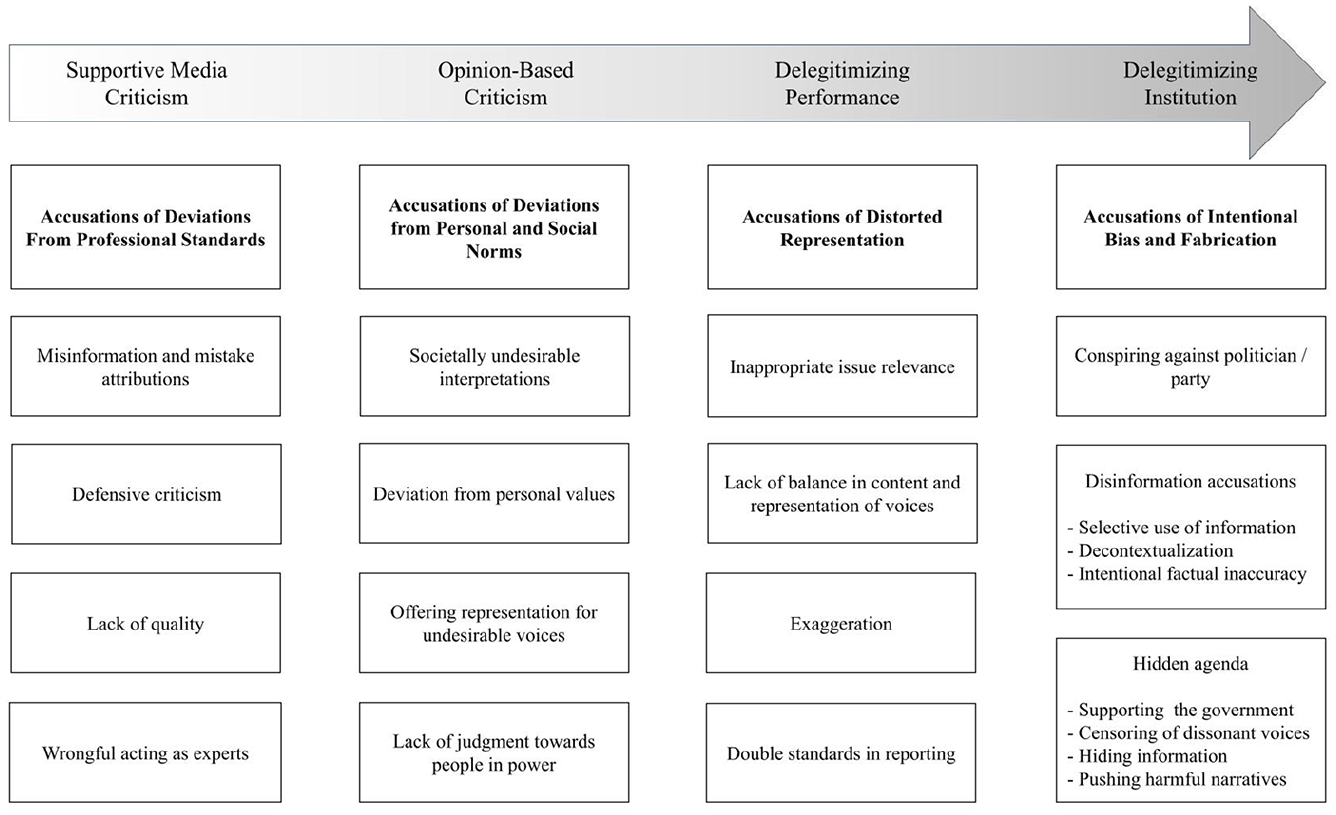
Typology of media criticism in the social media discourse of German politicians.
We present the themes and their discursive construction (RQ1) and discuss their implications for journalism, the discursive elements of disinformation accusations (RQ2), and differences across ideologies and between mainstream versus challenger politicians (RQ3) where appropriate.
Accusations of Deviations from Professional Standards
The first theme in media criticism discourse comprises statements that follow the normative ideas of supportive media criticism, pointing out perceived falsehoods in general or specifically in reports on the politician, limits of professional boundaries, and perceived inconsistencies in journalistic quality. The critique does not systematically cast doubt on the intentions or functioning of media institutions, but points out individual acts or journalists for making mistakes or inaccurately reporting on certain events or situations (i.e., nonsystematic). First, politicians commonly point out perceived misinformation or defend themselves against alleged misconceptions, misinterpretations, or factual inaccuracies, such as “The piece of text from the ZEIT is not a quote from me, but a misunderstood representation [. . .].” (Politician 4, 2022 [4A]). 2 Interestingly, this kind of defensive media criticism was most commonly voiced by the politician of the liberal party FDP (RQ3). The misinformation attributions often serve as counterclaims to statements written about the politicians.
Second, politicians also make references to expert knowledge, setting boundaries for journalists’ professional roles acting as experts, or interpreting expert opinions. As one politician argued when interpreting the legitimacy of expert knowledge about COVID-19, the claims of experts should not be taken at face value but critically assessed regarding the validity of conclusions drawn: “I think a lot of people need to hear this (including journalists): a disease with 1% mortality is not what we usually consider mild in medicine.” (Politician 10, 2022 [Retweet; 10A]). Again, these statements do not suggest malicious intentions, but instead criticize a transgression of professional limits.
Lastly within this theme, politicians highlight alleged inconsistencies in journalistic quality. These references do not relate to mistakes in content but focus on supposed sloppy journalistic routines and their outcomes. Despite not suggesting intention and rarely using any generalizations, one can observe considerable variation in the style of accusations. Some politicians employ mocking language and cynicism “Article is worth 0 cents. Couple anecdotes and insults, zero research [. . .]” (Politician 10, 2017 [10B]). A perceived lack of quality standards seems to legitimize a more uncivil criticism.
Overall, these references to professional standards align with the normative notion that media criticism should be used to ensure that journalists adhere to their professional standards (Cheruiyot 2018). Apart from the sometimes cynical style, they can be considered part of a corrective media criticism discourse in which the media is held accountable for failures and inconsistencies through the political system. They highlight singular inconsistencies in the quality and correctness of journalism without assigning intent or systematic behavior to the respective targets. In some instances, politicians even specifically highlight “honest mistakes” or singular “slip-ups” from the general perceived quality: “Generally a good journalist. But conspiracy theories prevent neither covid nor climate deaths [. . .]” (Politician 10, 2022 [10C]).
Relating to ideological differences (RQ3), if at all, challengers tend to generalize instances to outlets or “the media” as a whole, whereas mainstream politicians direct their criticism almost exclusively to specific outlets, products, or journalists. In most cases, politicians used this type of criticism as a defense against articles written about them, aiming to refute or correct the information presented. Overall, the corrective criticism reflects the normative idea that politicians and the media should hold each other accountable in terms of mistakes, quality, and professional limits (see Van Dalen 2021).
Accusations of Deviations from Personal and Social Norms
The analysis further unveiled normative accusations surrounding a supposed societally or personally disliked interpretation of the media, as well as statements that revolve around power dynamics, involving the inclusion or exclusion of particular voices and opinions and the framing of opposing political figures. In contrast to theme 1, this theme revolves around opinion-based statements over verifiable mistake accusations in the former theme, meaning that they depend on the subjective ideas of the politicians voicing them.
First, politicians often deem specific media output morally “wrong” or inconsistent with their values or frame targets as outsiders deviating from societal norms: “BZ calls this year’s #Berlinale the ‘Berlinale of Women’ because 115 of 441 films came from women. #fail” (Politician 2, 2015 [2A]). These accusations typically arise in the context of social issues such as gender and sexuality that are subject to current public debates. In line with the nature of this criticism, it is often targeted at specific journalists and opinion pieces. By employing strong normative judgments such as “disgusting,” or “mockery,” politicians stress a perceived disparity between the “wrong” outlet/journalist and the “just” politician. Remarkably, instead of providing additional opposing opinions or arguments, politicians tend to dismiss the journalistic piece as self-explanatorily “wrong” or “bad” for democratic discourse.
Whereas these categories criticize the interpretation of issues, the theme also entails subjective accusations surrounding an alleged lack of judgment toward political figures. This criticism is mostly reflecting opposition to how political opponents are framed without offering corrective alternatives: “What does Faeser know about the financing of mosque associations from #Qatar? Apparently nothing if you ask the media” (Politician 9, 2022 [Retweet; 9A]).”
Last, subjective judgments surrounding the appearance of particular people and groups in the media form part of this normative discourse. Hereby, politicians do not relate to balanced or equal representation, but instead discuss which voices and opinions are (un-)desired in journalistic output—and thus political discourse—at all: “It was AfD theme night, which is a shame. Media allow AfD to force topics on them” (Politician 10, 2017 [10D]). Pointing out the consequences of supposed (over-)representation, the media are framed as contributors to the success of undesirable social groups. This criticism is often voiced by politicians from the political left commenting on the appearances of AfD politicians in the media (RQ3). They do not accuse the media of deliberate action but use criticism for a seemingly educational purpose: “When other parties and media adopt the AfD’s and Pegdia’s descriptions of problems, you make them stronger. (Politician 1, 2017 [Retweet; 1A]).”
Overall, this discourse contributes to a longstanding debate surrounding journalistic role perceptions and the question of an objective versus interpretative journalism (Skovsgaard et al. 2013). Although many scholars conclude that objectivity is not achievable and that the role of journalists also contains an interpretative function (Wahl-Jorgensen 2013), this theme shows that journalists are in a vulnerable position when deviating from an “objective” presentation of reality through commentary. Especially criticizing the framing of or the room given to the “wrong” voices challenges the profession: On the one hand, they ought to refrain from (the “wrong”) interpretative functions, on the other hand, they face accusations of being too uncritical of voices deemed unfit for political discourse. Clearly, the nature of this criticism is influenced by personal values and ideological stances. It can thus be considered general political discourse carried out in the media arena. Even though opinion-based criticism on media content is part of a democratic discourse, they deviate from the normative notion of media criticism pointing out inconsistencies or mistakes in the quality of the media. Whereas pointing out disliked interpretative narratives based on opinions rather than supposed facts does not delegitimize the media, it reflects ideological motives over specific corrective statements, challenging the objectivity norm on a broader level. Consequently, with this theme, journalists’ role perceptions are constantly challenged both in interpretative and noninterpretative functions.
Accusations of Distorted Representation
A third pattern arising in politicians’ social media discourse comprises references to the media presenting information in a way that distorts reality, suggesting that they allegedly fail to attain their democratic-representative role beyond isolated instances due to their agenda, perceived bias in content and viewpoints, exaggerations, and double standards in reporting. In contrast to the second theme offering subjective evaluations, this theme suggests the existence of an objective and quantifiable reality that the media should represent but would fail to. With that, the accusations delegitimize the role performance of the media more systematically but refrain from suggesting intentional behavior that would challenge the basic premise of the media as institutions informing the public in an honest manner.
First, it covers an alleged inappropriate issue relevance on the media agenda. The assigned lack of attention to relevant issues is highlighted either through claims that the media prioritize unimportant events/details, focus on irrelevant aspects undermining an issue’s severity, or completely miss crucial topics. They imply that the media would fail to offer an accurate depiction of relevant issues. Rightwing challengers in particular emphasize this alleged issue by pointing out a supposed disparity between the German mainstream media and alternative sources on the Internet: “[. . .] With the Internet, you’re well informed—but what about when you only have ARD/ZDF [. . .]?” (Politician 9, 2017 [9B]).
Another point of contention within this theme is the perceived balance of perspectives and the question of objectivity versus bias. Challenger politicians highlight supposed deviations from an ascribed journalistic objectivity norm. Additionally, they criticize a supposed lack of fair representation: “MerkelSchulzFestspiele on ARD/ZDF: #SPD & #Union received 10× more airtime in election broadcasts than the LINKE #btw” (Politician 8, 2017 [8A]). Similarly, challenger AfD politicians repeatedly demand more media attention, arguing with the need for fairness in democratic representation. With that, the media is often faced with accusations of double standards in reporting, in which one political party is supposedly favored over another.
Lastly, politicians also criticize supposed inaccurate depictions of events through exaggerations. They suggest that journalists, sometimes even driven by a desire for drama, prioritize exaggerations over their professional duty to present an “accurate” image of events, confounding accuracy with interpretative perceptions “The fact that of all outlets, @BILD, which is always happy to spread #Lauterbach’s scaremongering, is now calling for a return to normality is ironic. . .” (Politician 7, 2022 [7A]). It is noteworthy that politicians tend to voice these accusations without providing numbers or verifiable evidence, but seem to “innocently wonder” about the lack of issues on the media agenda.
Overall, politicians suggest an objective reality to the representation of people, topics, and viewpoints that is not present in the media—bringing up the controversial objectivity norm not in terms of interpretation, but representation. The implications of this theme carry greater severity as the accusations are not rooted in personal disagreement (theme 2) or misinformation (theme 1), but in the belief that representation in media reporting is systematically distorted. With that, the accusations question the role of informing the public fairly and fully and thus delegitimize the media’s performance.
Although these accusations do not suggest a malicious intent to deceive, using performance delegitimizing accusations to refer to perceptions of reality and “wrong” representations that cannot be falsified ascribes a norm to journalists that is challenging to fulfill—highlighting the blurry conceptual boundaries of facticity in (systematic) misinformation accusations. Wardle (2018), for instance, argues that the dissemination of misleading information—such as exaggerations—can be categorized as misinformation. These gray areas underscore the necessity for a criticism discourse relying on reasoning, supported by arguments or verifiable evidence to assess their legitimacy.
Accusations of Intentional Bias and Fabrication
The last theme, almost exclusively voiced by right-wing populists, entirely delegitimizes the media as an institution. It surrounds implications and outright attacks suggesting that the media intentionally abuse their power to disseminate false information for political purposes, conspire against opponents, and act deliberately against their duty to inform the public fully and honestly, sometimes even suggesting an entire hidden agenda to harm the people. It goes beyond performance delegitimization and instead dismisses the institution as an epistemic authority entirely. The narratives are frequently accompanied by aggressive rhetoric and threats.
First, politicians suggest that specific outlets or the media systematically conspire against them or their respective party as opponents. This argument is often justified by emphasizing the alleged repetitive, sometimes agitating nature of media attacks, portraying the alleged malice and harmful impact of the media. The “conspiring” media is juxtaposed with the “innocent” messenger, suggesting that the media violates the desirable power balance between them: “Those who have listened to 1 evening ZDF (#frontal21, #heutejournal, #dieanstalt, #heuteplus) propaganda against the #AfD, know: GEZ must go [. . .]” (Politician 9, 2017 [Retweet; 9C]; Note: GEZ is the organization that collects fees for public radio and television). With that, politicians employ blame-shifting tactics to move the accusations away from them and onto the target.
Second, on a societal level, this discourse presents the people as alleged victims of the media intentionally pushing false narratives on them. Accusations of disinformation emerge, with politicians using terms like “Fake News” to suggest intentional deception by the media. Interestingly, these accusations go beyond factual inaccuracy and encompass the supposed deliberate selective omission of information or deceptive framing: “Damn plague!! These are not activists!!! These are leftist extremists and criminals!!! #fakenews” (Politician 9, 2017 [9D]).
Last, the most severe accusations revolve around the idea that the news media would follow a systematic covert endeavor that contradicts the principles of democracy. In line with the populist rhetoric, the media are portrayed as colluding with the government to push a narrative that harms the ordinary people. This includes accusations suggesting that the media hides specific events or censor dissonant voices. These accusations imply an abuse of power to pursue political, anti-democratic goals: “For 9 months, no AfD representative has been invited to the major talk shows on ARD & ZDF. This is a #media war against an opposition party and 5 million voters. Public broadcasting is an anti-democratic state institution” (Politician 9, 2022 [Retweet; 9E]).
The theme shows various distinctive delegitimizing strategies to the right-wing populist rhetoric (RQ3), with calls to abolish outlets and cherry-picking instances to generalize to broader issues with the media. Moreover, the challenger politicians use labels such as “agitprop activists” to delegitimize journalists, as well as delegitimizing and call-to-action hashtags such as #BILDmussweg (Bild needs to go), which are rarely found among mainstream politicians.
The disinformation accusations in this theme present three key differences in their discursive construction (RQ2): First, they are uncivil in nature. Politicians employ delegitimizing labels and cynical language such as condescending insults, schadenfreude, and sarcasm to point out supposed absurdities in content. Second, politicians use disinformation narratives to justify severe suggested consequences for the media. A commonly observed narrative is the suggestion that the media—through its actions—has already lost its legitimacy or will delegitimize itself. Accordingly, some narratives call to abolish an entire outlet or its funding. Lastly, references to truth differ from other accusations. Politicians reference truth, for example, by suggesting that media institutions aim to legitimize lies. However, the conceptual boundaries of disinformation accusations go beyond the alleged dissemination of false facts and encompass decontextualization and the selective use of information. In these instances, challengers rely on opposing sources such as party-affiliated “media-experts” that make unverifiable claims. Additionally, challenger politicians use anecdotal evidence from “witnesses” within the media or from an alternative source to claim the omission or decontextualization of issues on the mainstream media agenda.
Overall, the notion of deliberate deception by the media inherently undermines the legitimacy of the profession, making these accusations the most disruptive in terms of democratic outcomes. In line with prior research (Hameleers 2021; Schmuck and Hameleers 2020; Van Dalen 2021), this hostile antimedia sentiment was voiced almost exclusively by AfD politicians. The attacks varied from isolated disinformation accusations to claims of a secret disinformation-agenda. Besides being a threat to the profession, delegitimizing accusations can be weaponized to present opposing narratives to the media and claim epistemic authority over them (Van Dalen 2021). Undoubtedly, these accusations pose a threat to a profession that is already under pressure in times of factual relativism.
The Discursive Structure of Criticism toward the PSM
Due to their distinctive function and funding in Germany, the discursive construction of the criticism toward the PSM differs considerably from other targets. While the content of accusations addresses the topics presented in our four themes, their justification recurrently highlights the distinctive role of the PSM. Most of the criticism on the PSM was expressed by right-wing populist politicians (RQ3) and concerns the financial structure of the PSM, justifying the alleged severity of criticism by addressing a supposed disproportionate income of people working in the PSM and the broadcasting fee. Additionally, considering that the PSM cannot have an editorial guideline near a political camp, many politicians make implicit references to their legislated independence. Specifically, politicians present strong judgments when they perceive a lack of objectivity or a lack of quality in products of the public service media based on their inherent role of representing the public’s viewpoints. The different standards expected from PSM are also reflected in a broader range of delegitimizing criticism, often expressed through threatened consequences from politicians. Compared to other targets, politicians tend to point out specific instances in the PSM as a “failure” of the system and link their criticism to demands. Examples of alleged bias, mistakes, or personnel decisions are used to call for the abolition of the broadcasting fee or defunding the institution altogether: Böhmermann compares children to rats. No, you really don’t have to get upset about this man anymore. But how can ZDF pay someone like that from our broadcasting fee? Abolish the broadcasting fee!. (Politician 9, 2022 [Retweet; 9F])
Moreover, PSM were the only target with specific references to legitimacy or the lack thereof: “The #Schlesinger affair has the potential to finally strip the #ÖRR of its legitimacy” (Politician 5, 2022 [5A]). Again, the severity of accusations varies considerably across politicians and the style tends to be strongly uncivil and cynical when expressed by challenger (vs mainstream) politicians (RQ3). With that, we can also observe more delegitimizing references, overstepping the boundaries of criticism that aims to preserve and improve the institution.
General Discussion and Conclusion
With press freedom in Germany and many other countries being increasingly under pressure (RSF, 2023), there is a great need to better understand how and on what grounds politicians (strategically) criticize the media. We aimed to map out media criticism using Germany as a relatively high-trust and low-polarization setting recently experiencing similar political challenges to many other countries, allowing for an adequate geographical transferability. This study used a grounded theory approach to propose a typology of media criticism to help understand the spectrum and boundaries of supportive and disruptive criticism in politicians’ discourse. We identified four main themes encompassing the varieties of accusations that are expressed to point out disagreement, both on a factual and normative level, with varying degrees of suggested failure and intentional behavior, and proposed a—conditional—order of severity for the profession, relating to the degree of deviation from constructive media criticism. We come to the conclusion that there is a variety of criticism that is in line with the idea of supportive media criticism, relating to journalistic quality or verifiable mistake attribution (Cheruiyot 2019). Beyond that, we found a second theme that is based on opinion-based statements, such as criticizing commentary pieces. Whereas this criticism is not delegitimizing, its basis on ideology or opinions of the individual does not aim to point out specific flaws in news production, but instead challenges the degree to which journalists should have an interpretative role. Theme three, the supposed distortion of reality, in turn, suggests that there exists an objective, representative reality that journalists fail to depict. We argued that this theme delegitimizes the role performance of journalists as it suggests a failure to adhere to the representative objectivity norm ascribed to them. Lastly, we identified a theme that delegitimizes the media as an institution entirely. These accusations suggest not only a systematic failure to adhere to professional norms but also malicious intent to manipulate the people and to achieve political goals.
Whereas our results are consistent with prior research suggesting that right-wing populist politicians frame the media as intentionally deceptive to question their democratic function (e.g., Egelhofer et al. 2022; Hameleers 2021), we extend the literature by showing the more subtle ways of questioning media content that do not delegitimize the existence of the media, but their role performance through claiming that they fail to represent reality systematically. With that, we also contribute to the misinformation literature by showing the conceptual overlap and distinctions of media criticism with mis- and disinformation labels by elaborating on gray areas (such as decontextualization) or nonfactual criticism based on opinions and norms.
The results suggest three challenges for the academic literature within the realm of media criticism discourse. First, they further bend the already tenuous conceptual boundaries of how we think about mis- and disinformation accusations and facticity (Wardle 2018). In line with the worries of an increasing trend toward “factual relativism,” falsehoods are assigned to issues that are not clearly falsifiable, but subject to perceptions. For instance, the term “fake news” is occasionally used to suggest an alleged media silence or understated threats. Moreover, politicians often make claims about a “wrong” representation of reality. With that, politicians mingle the absence of objectivity (both in terms of interpretation and representation) with mis- or disinformation—blurring the lines of falsehoods and subjective perceptions in their social media discourse. In line with this, experimental research suggests that objectivity is in fact perceived through a subjective lens (Mothes 2017). This type of criticism, referencing the role of perceptions of news media as a representative reflection of political ideologies and issues, puts the profession under pressure and sets unachievable role expectations. Consequently, in media criticism, we may need to consider mis- and disinformation beyond falsehoods (Wardle 2018) and follow the idea of understanding it as the perception of misleading information or any information that was created to deceive (Hameleers 2023). The analysis unveiled a perceptual challenge, whereby deviations from reality can be considered a subjective phenomenon. Because the results showed relatively few verifiable accusations compared to unfalsifiable perceptions, further research should investigate these types of “mis-” and “disinformation” and the impact that they can have on citizens.
Second, some tweets presented a discrepancy between the severity of the accusation and the employed style and language, for example, when phrasing misinformation accusations (i.e., absence of assigned intent) in an uncivil and cynical manner. These observations raise the question of the extent to which the style and content of an accusation can be disentangled when considering democratic outcomes of media criticism. Specifically, we need to better understand whether it is the kind of negative reference that could harm the profession or the style in which the message is conveyed, especially when it comes to mockeries and cynicism.
Third, this study analyzed media criticism detached from the actual role performance of the media. With that, we cannot make any claims about the legitimacy of the accusations. For example, there is some evidence that German news slanted toward AfD topics in the time running up to the elections in 2021 (Löw and Dewenter 2022) or that governing parties receive favorable attention overall (Dallmann et al. 2015). Germany, being considered a pragmatic journalistic culture, is characterized by strict adherence to news values and a skeptical stance toward those in power (Esser 2008), which may play into a perceived abundance of criticism from the politicians’ side. At the same time, in comparison to other European countries, German journalists seem to give less room to partisan bias and entertainment overall (van Dalen et al. 2012). Despite offering valuable insights into the varieties of media criticism, the lack of contextualization of singular pieces of criticism with media performance presents a limitation of this study.
Additionally, the proposed typology cannot certainly predict to what extent media criticism is supportive or disruptive for journalism, given the diverse manifestations in the observed discourse. Despite suggesting an order of the delegitimization of themes, we think that depending on the degree of generalization, the suggested consequences, and incivility, even mild accusations could be potentially impactful. Future research could combine types of accusations with differing stylistic elements or fact checks to understand their potential impact on citizens.
Last, the sampled politicians should not be regarded as “representatives” for their respective parties or all German politicians in general. In fact, media criticism could be seen as a distinctive political communication style of specific political personas. Consequently, it is challenging to claim saturation. Considering that most criticism was identified in the social media discourse of the selected cases that were not party leaders, it is possible that more variation in the presentation of media criticism exists. This is especially the case when it comes to politicians from the CDU and CSU, whose highly professionalized social media feeds rarely featured any negative media references.
In conclusion, this study sheds light on the diverse nature of media references from German political elites and its potential implications for journalism. The findings underscore the pressure the profession is facing by a variety of judgments, the blurred boundaries of mis- and disinformation accusations, and the disruptive nature of delegitimizing discourse. Through further addressing these complexities, we can strive toward a better understanding of how media criticism from politicians can hold the media accountable without causing a disruptive impact on the profession.
Supplemental Material
sj-docx-1-hij-10.1177_19401612241291826 – Supplemental material for Beyond “Lügenpresse”: How Politicians Criticize and Delegitimize the Media in Germany
Supplemental material, sj-docx-1-hij-10.1177_19401612241291826 for Beyond “Lügenpresse”: How Politicians Criticize and Delegitimize the Media in Germany by Lina Buttgereit, Michael Hameleers, Katjana Gattermann and Andreas Schuck in The International Journal of Press/Politics
Footnotes
Declaration of Conflicting Interests
The author(s) declared no potential conflicts of interest with respect to the research, authorship, and/or publication of this article.
Funding
The author(s) received no financial support for the research, authorship, and/or publication of this article.

Supplemental Material
Supplemental material for this article is available online.
Notes
Author Biographies
References
Supplementary Material
Please find the following supplemental material available below.
For Open Access articles published under a Creative Commons License, all supplemental material carries the same license as the article it is associated with.
For non-Open Access articles published, all supplemental material carries a non-exclusive license, and permission requests for re-use of supplemental material or any part of supplemental material shall be sent directly to the copyright owner as specified in the copyright notice associated with the article.
